1. Introduction
Egypt’s heritage villages are dynamic cultural landscapes that encapsulate centuries of vernacular knowledge, architecture, and living traditions [
1]. Despite their recognized significance, the majority remain undocumented, unprotected, and absent from national conservation agendas, rendering them vulnerable to urban sprawl, tourism mismanagement, and climate-related degradation [
2,
3].
Although more than twenty rural settlements across Egypt exhibit substantial heritage potential, less than 10% are officially documented, largely due to the absence of a unified rural heritage registry. Current heritage legislation [
4], most notably Law No. 117 of 1983 (amended in 2010), focuses predominantly on monuments and archaeological sites, leaving villages such as Al-Karnak excluded from recognition, funding, and development frameworks.
This institutional and documentation gap has produced fragmented, outdated records [
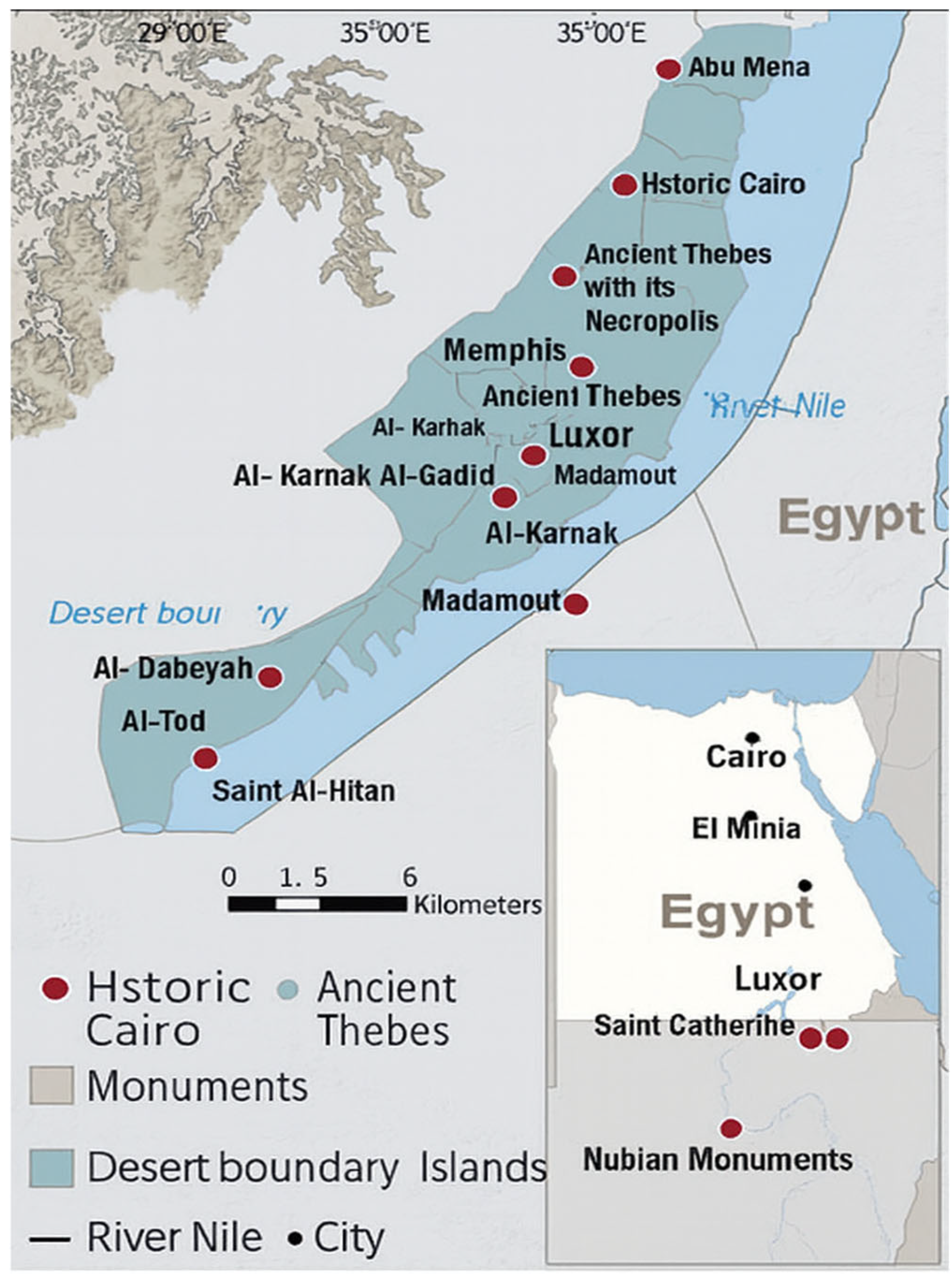
5]. These records remain poorly aligned with international standards, including the UNESCO Operational Guidelines and the Historic Urban Landscape (HUL) Recommendation. The case of Luxor Governorate is particularly telling, as shown in
Figure 1, the distribution of UNESCO-registered sites in Egypt is illustrated.
The rural areas, despite their distinctive settlement morphologies and rich intangible heritage, remain largely overlooked—limiting their opportunities for international recognition and heritage-driven tourism … rural tourism [
6].
In response, this research develops the Enhanced Heritage Value Index (EHVI). This UNESCO-aligned, sustainability-oriented framework systematically assesses both tangible and intangible dimensions of heritage through 31 measurable indicators. The framework not only quantifies heritage value but also identifies key gaps in legislative and institutional protection, providing evidence-based guidance for policy reform and the creation of Egypt’s first digital inventory of rural intangible heritage [
6,
7].
Despite applying conceptual analysis, expert verification, and field surveys, there remains a gap in the legal protection of intangible assets; many UNESCO standards can be achieved through targeted investment in infrastructure and community engagement.
This study develops the first UNESCO-compliant assessment framework for Egyptian rural settlements, offering a structured approach that bridges the gap between academic evaluation and the implementation of sustainable preservation policies. To ensure methodological robustness, the reliability statistics for all EHVI dimensions are reported in
Table A5.
2. Literature Review
Recent scholarship on heritage value assessment in Egypt remains concentrated on urban monuments and archeological sites, with limited application to vernacular rural settlements. These studies often adopt broad UNESCO criteria or the Historic Urban Landscape (HUL) approach. However, they rarely propose measurable indicators suited to village-scale contexts.
Internationally, several evaluation frameworks have emerged to bridge this methodological divide. The Cultural Heritage Resilience Index emphasizes resilience and adaptive capacity, while the Community Heritage Assessment Model [
8], promotes stakeholder participation and social inclusion. However, both remain data-intensive and institutionally demanding, limiting their adoption in developing countries with constrained documentation systems [
9,
10].
Despite these advances, scholars such as Hair et al. [
6] emphasize the need to integrate quantitative reliability measures into heritage evaluation frameworks. Another study has underscored the importance of integrating quantitative reliability measures (e.g., Cronbach’s α, KMO) into heritage evaluation tools to strengthen validity [
11]. However, few studies contextualize these indicators within Egypt’s rural environments, where community identity, traditional crafts, and place-based knowledge remain critical yet undervalued [
10,
12].
Therefore, the present study builds upon these frameworks to design the Enhanced Heritage Value Index (EHVI). This UNESCO-aligned, sustainability-oriented model operationalizes both tangible and intangible indicators through expert validation and local stakeholder engagement. This approach directly addresses the methodological and contextual limitations identified in the current literature and provides a replicable framework tailored to Global South heritage contexts.
3. Methodology
3.1. Research Design
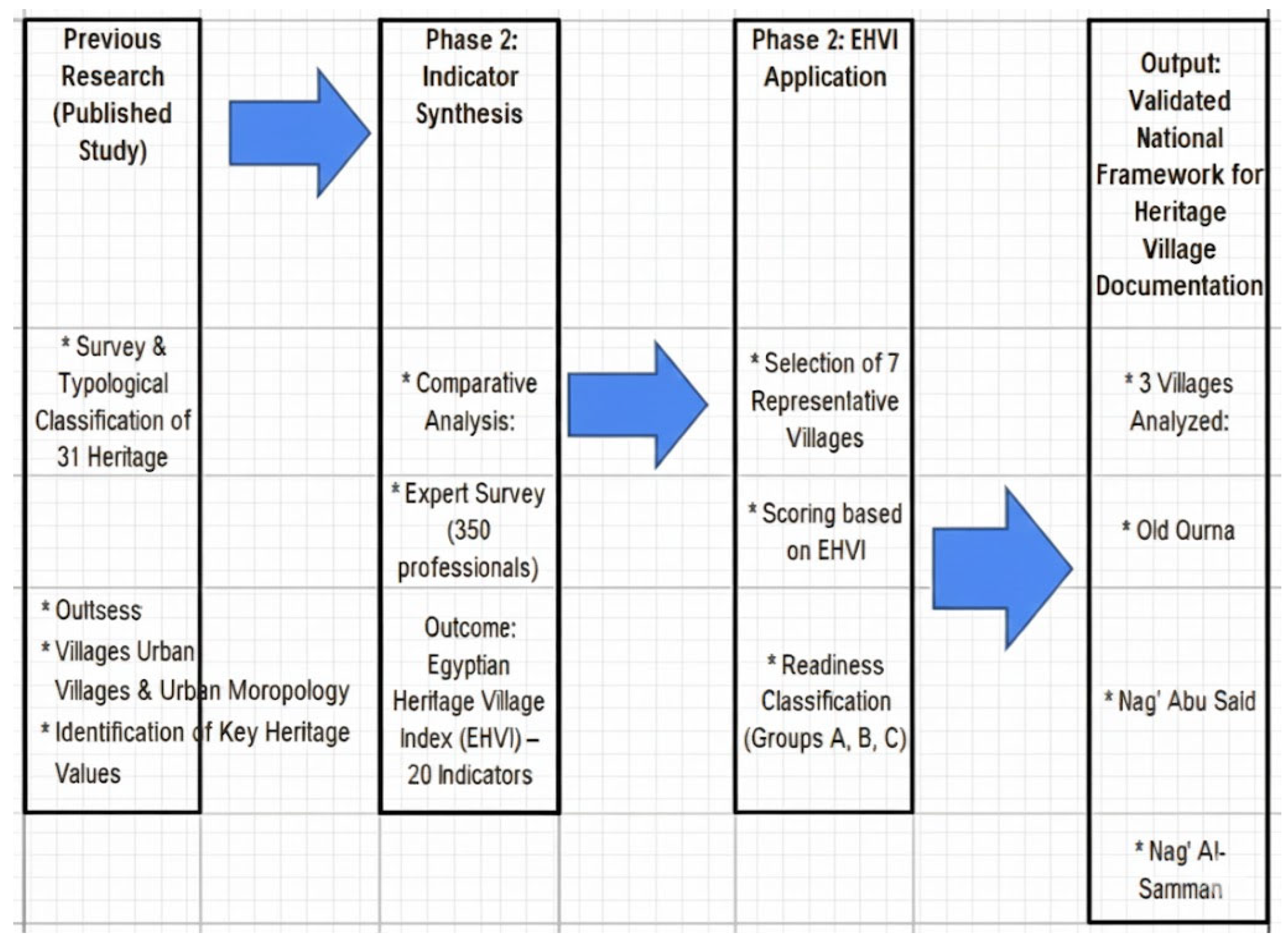
The research adopted a mixed-method sequential design integrating both qualitative and quantitative techniques to develop and validate the Enhanced Heritage Value Index (EHVI). The methodology was structured in four consecutive phases, as presented in
Figure 2, aligning with international heritage assessment practices [
13].
The preliminary indicators were validated through Delphi-based expert consultation involving 15 specialists in heritage management, planning, and rural development [
2]. Experts rated each indicator’s relevance and clarity on a 5-point Likert scale, ensuring contextual validity [
14].
3.2. Data Collection Instruments
3.2.1. Expert Evaluation Survey (N = 100)
The first survey targeted experts in architecture, planning, heritage management, and public policy. Its purpose was to determine the relative importance and weights of the 31 proposed EHVI indicators. The complete survey instrument is provided in
Appendix A, as shown in
Table A2.
Structured questionnaire using a five-point Likert scale (1 = very low, 5 = very high) was distributed. The expert responses provided the statistical weights used in subsequent analysis, as shown in
Table A1.
3.2.2. Community Perception Survey (N = 250)
The second survey was administered to residents, tourism workers, and local officials across the seven case study villages. The initial screening results for the seven villages are provided in
Table A3. Its objective was to assess the perceived availability of each indicator in practice. Respondents rated the indicators on the same five-point Likert scale, generating perception data that reflect the lived reality of the communities [
14].
3.2.3. Field Observations and Documentation
Phase 3—Field Survey and Data Collection:
Seven heritage villages within Luxor Governorate were purposively selected to represent varying typologies and cultural settings. Data collection included structured field observations, semi-structured interviews with local community members, and photographic documentation. Secondary data were compiled from national reports and UNESCO databases to triangulate findings.
3.3. Data Processing and Statistical Analysis
The analysis was conducted in four sequential stages:
3.3.1. Normalization and Weighting
Survey responses were normalized to a five-point scale. Weighted mean scores were computed by multiplying community perception values by the expert-assigned weights.
3.3.2. Validity and Reliability Testing
The second phase involved conducting validity and reliability test, to ensure the robustness of the EHVI framework. Reliability and dimensional validity were assessed using Exploratory Factor Analysis (EFA) and standard reliability tests. Cronbach’s α and Kaiser–Meyer–Olkin (KMO) measures confirmed strong internal consistency (α = 0.91; KMO = 0.88). Statistical analyses were conducted using SPSS (v.28) [
14]. The validated model was then used to classify heritage villages according to their combined tangible and intangible value scores.
The overall methodology ensures that the EHVI is empirically grounded, replicable, and adaptable to other heritage contexts beyond Egypt.
3.3.3. Composite Scoring and Classification
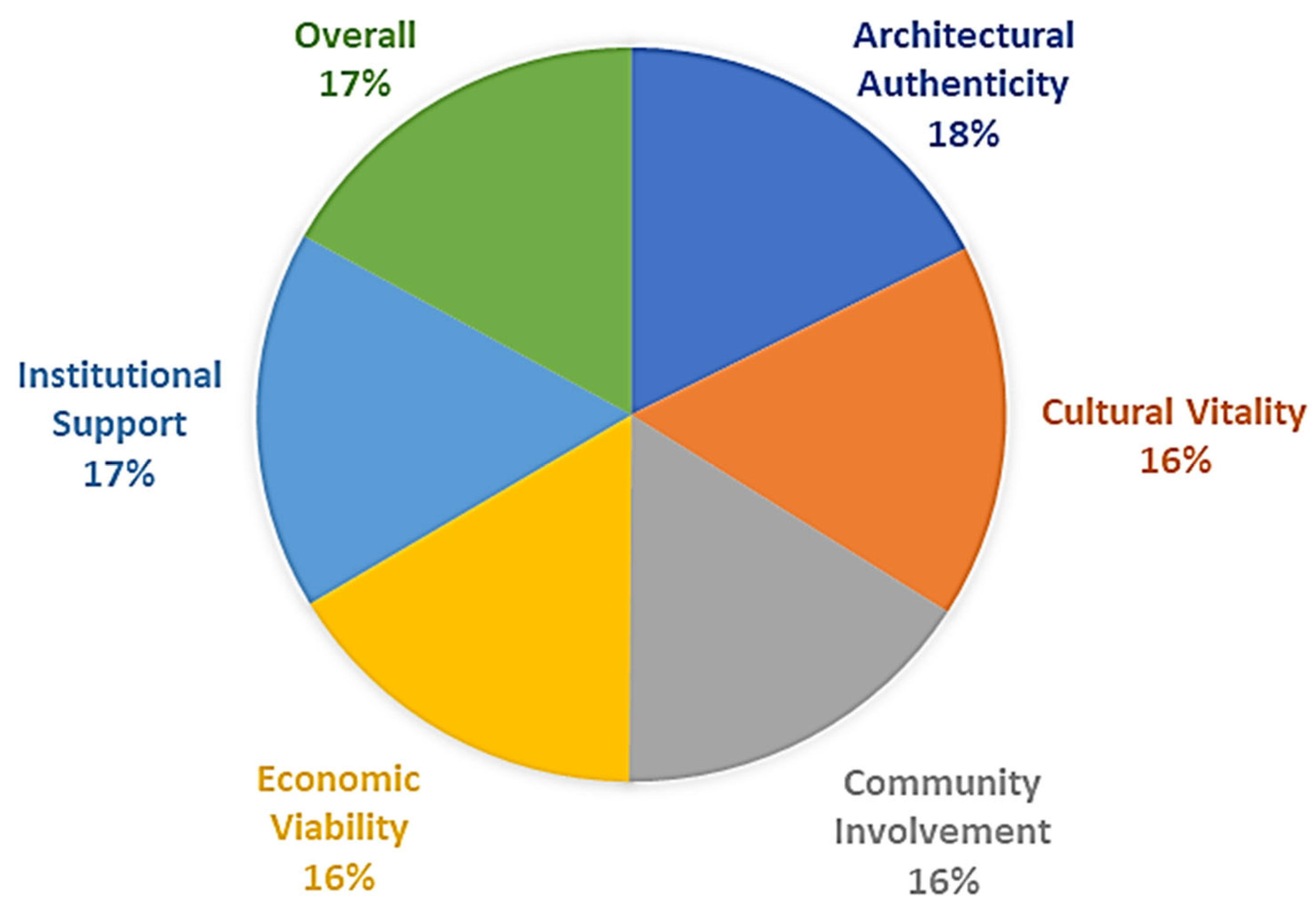
The EHVI score for each village was calculated as a weighted composite index, where expert-assigned weights were multiplied by community perception scores (
Figure 3). The final score for each village was obtained using the following formula:
where W represents the expert-derived weight of indicator I, P is the community perception score of indicators in village j, and n is the total number of indicators retained after EFA. Composite scores were then normalized into percentages and classified into three readiness levels.
3.3.4. Comparative Statistical Tests
A one-way ANOVA was performed to assess significant differences among village groups, followed by Tukey’s post hoc test. For robustness with the small sample size (N = 7), non-parametric Mann–Whitney U tests were also conducted [
14].
3.4. Alignment with Research Objectives:
Objective 1 (indicator Development): Addressed in
Section 3.1, through expert-based weighting and theoretical framework design.
Objective 2 (Field-Based Validation): Addressed in
Section 3.2, achieved via the community survey and field documentation.
Objective 3 (Gap Analysis and Classification): Addressed in
Section 3.3, realized through statistical testing, gap analysis, and the integration of community perspectives with expert insights. The full gap analysis results are listed in
Table A6.
4. Results and Discussions
The validation process confirmed the robust internal reliability and statistical adequacy of the Enhanced Heritage Value Index (EHVI). Cronbach’s α = 0.91 and KMO = 0.88 exceed the minimum thresholds recommended by Hair et al. [
6], validating the instrument’s internal consistency and sampling adequacy. The Exploratory Factor Analysis (EFA) further confirmed that the 31 indicators clustered into two dominant components—tangible and intangible heritage dimensions—explaining 78% of the total variance.
A comparative analysis of the seven case-study villages revealed distinct heritage profiles. Villages such as Al-Qurna and Al-Karank achieved higher scores in intangible heritage indicators, particularly in categories of oral traditions, craftsmanship, and community identity. In contrast, settlements such as New Gurna and El-Tod (West) exhibited stronger tangible attributes, with higher scores for architectural integrity, material authenticity, and landscape value, as shown in
Table 1.
The composite EHVI scores ranged from 0.62 to 0.89, demonstrating measurable differentiation among villages as shown in
Table 2. The model effectively highlights regional disparities, showing that Upper Egyptian villages tend to exhibit stronger cultural identity yet weaker structural conditions—a pattern consistent with national rural heritage trends [
15].
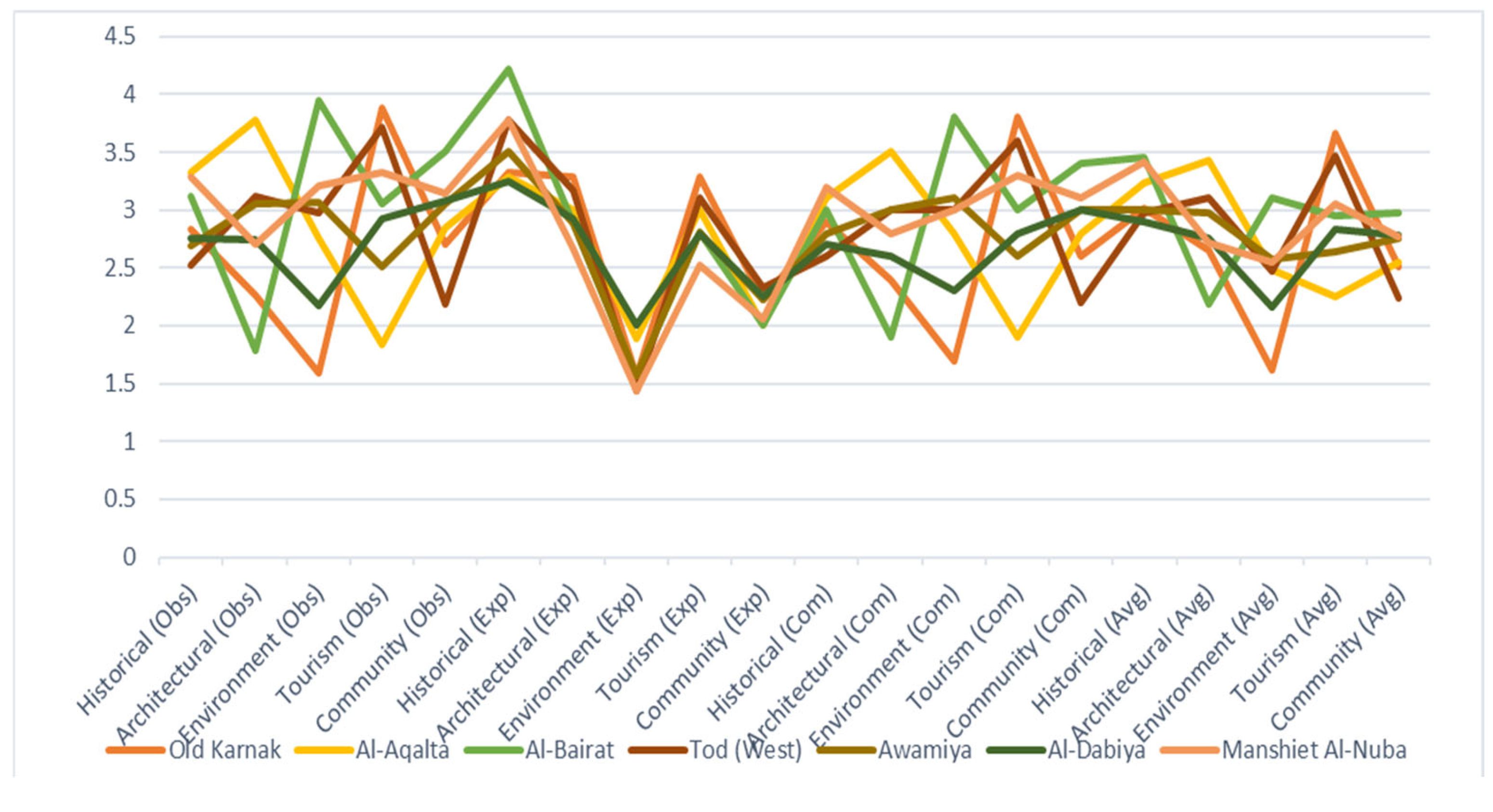
The findings also indicate that approximately 40% of the intangible heritage indicators remain under-addressed by current conservation policies (
Figure 4). This lack of attention to living heritage and community participation reflects institutional limitations in Egypt’s heritage governance [
16]. The EHVI thus provides empirical evidence for reorienting heritage policy toward integrated, community-driven conservation models [
16]. This percentage is derived from the gap analysis results presented in
Table A6.
Overall, the EHVI demonstrates high discriminative power and practical applicability for ranking villages based on multidimensional heritage value, as shown in
Table A1. This enables decision-makers to prioritize sites for documentation, funding, and adaptive reuse within national development strategies (
Figure 5).
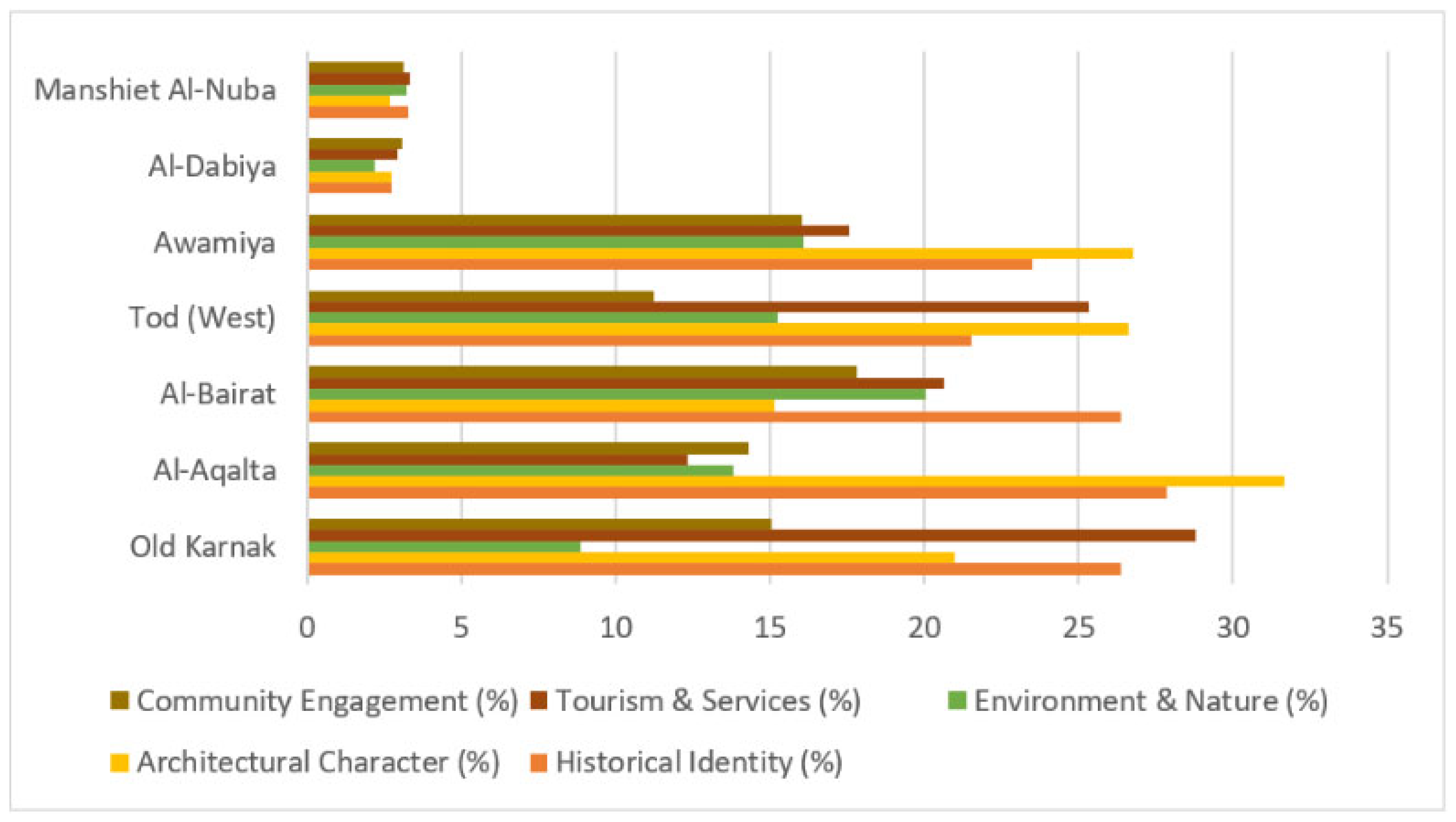
The results show that although tangible attributes such as historical identity and urban form remain relatively strong, deficiencies in legal status and community engagement significantly reduce overall readiness [
2], as shown in
Table 3.
5. Development of the Enhanced Heritage Value Index (EHVI)
The findings confirm that the Enhanced Heritage Value Index (EHVI) constitutes a statistically robust and context-sensitive framework capable of addressing the long-standing gap between quantitative heritage assessment and community-based conservation practice. By integrating both tangible and intangible indicators within a UNESCO-aligned structure, the EHVI advances the methodological discourse on heritage evaluation in developing contexts.
The discussion of results highlights three interrelated insights.
First, the EHVI provides empirical validation for the argument that heritage value cannot be separated from social processes. Villages with strong intangible assets—craftsmanship, oral history, communal identity—tend to show higher overall heritage value even when physical structures are deteriorated. This supports the theoretical premise of the Historic Urban Landscape (HUL) approach that promotes an integrated perception of place.
Second, the model reveals the policy-implementation gap in Egypt’s rural heritage management. Although national law prioritizes monuments, approximately 40% of intangible indicators remain unaddressed. This demonstrates the need for multi-level governance, community participation, and revised legislative instruments to mainstream living-heritage protection.
Table A9 links the EHVI dimensions with corresponding UNESCO/SDG criteria.
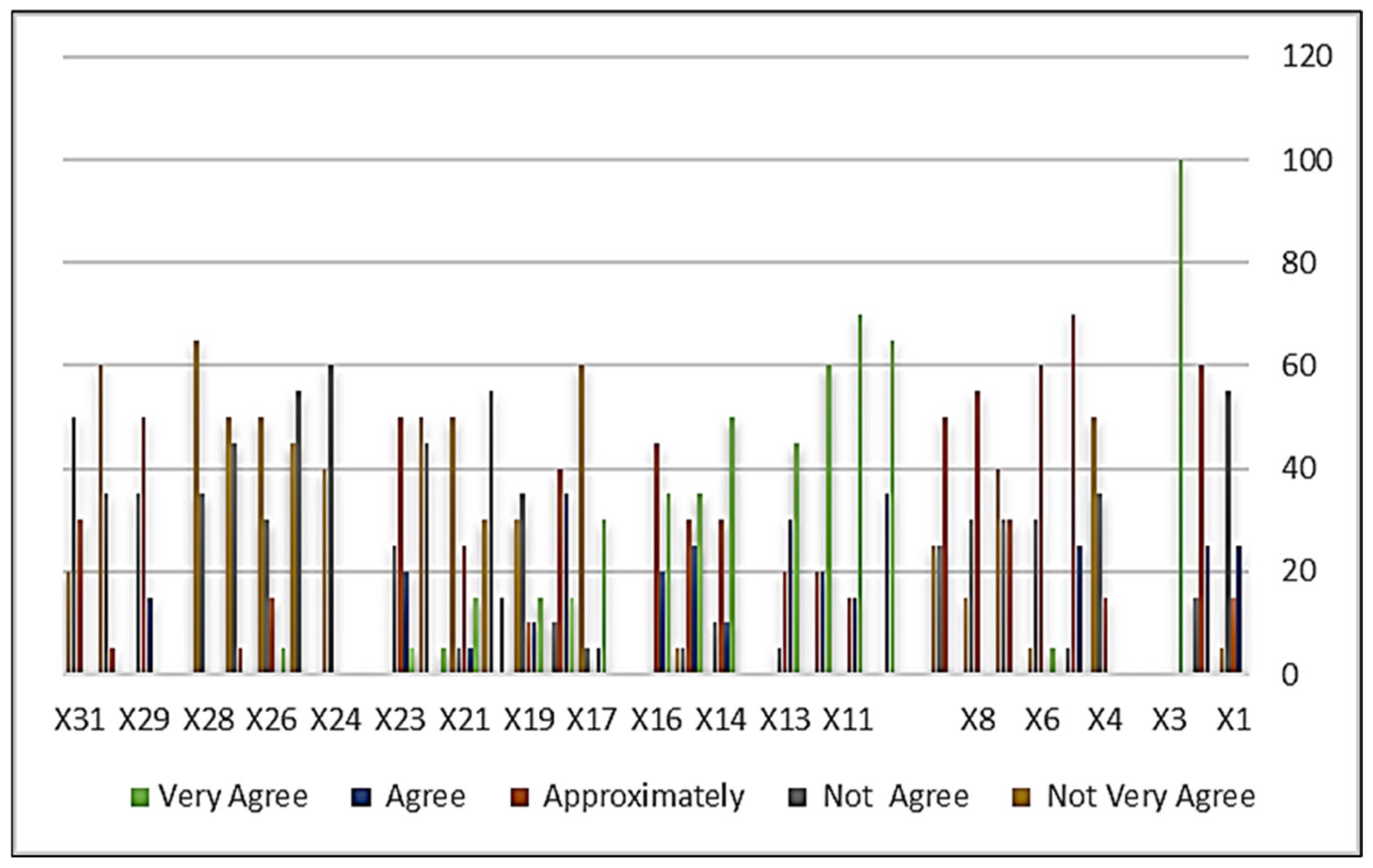
Third, the adaptability of the EHVI beyond Luxor suggests its potential for scalability across contexts in the Global South facing similar resource and governance constraints (
Figure 6). Its combination of measurable indicators and participatory validation bridges academic evaluation and applied policy planning, contributing to global sustainability agendas.
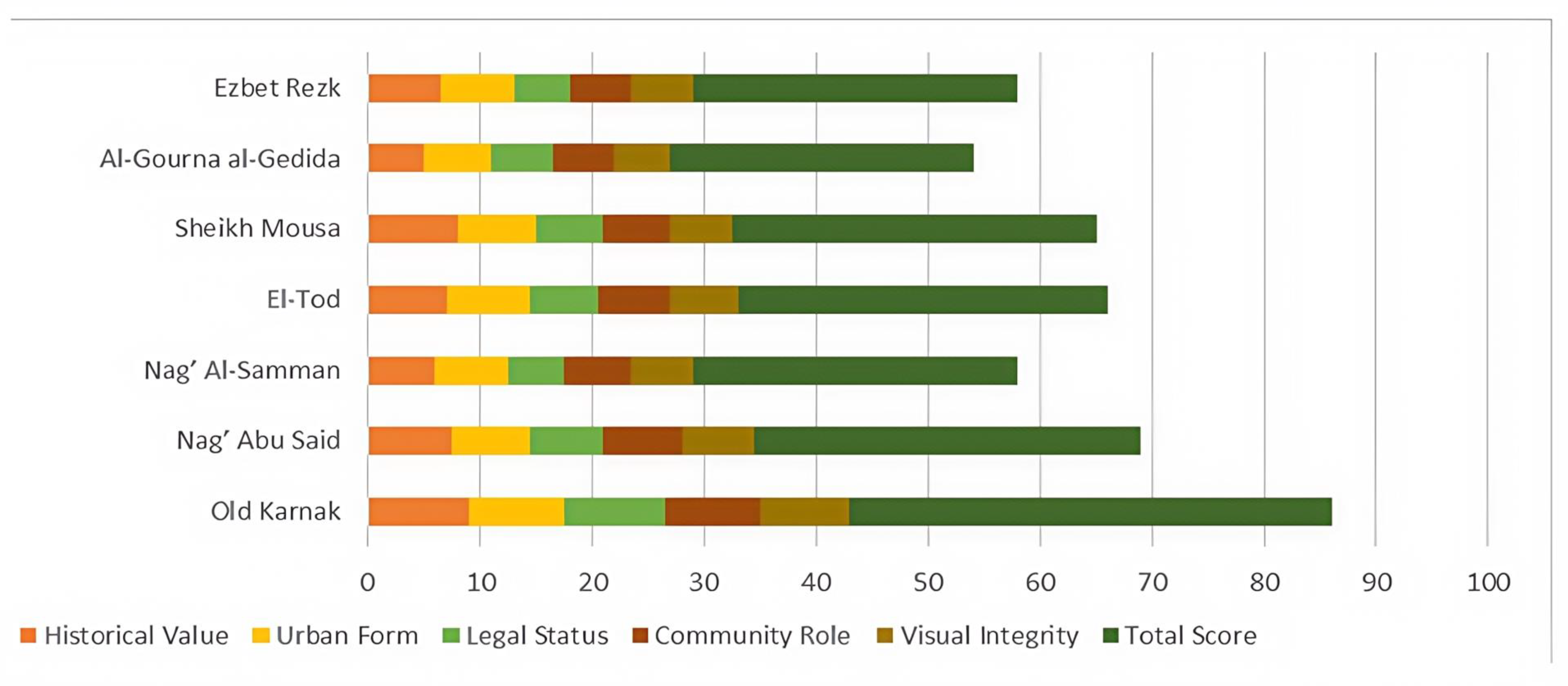
Together, these findings position the EHVI as both a theoretical contribution to heritage assessment and a practical decision-support tool for policymakers (
Figure 7). It not only reinforces existing heritage-management literature but also operationalizes UNESCO principles through a quantifiable, replicable model that can guide conservation priorities, funding allocation, and heritage education [
17].
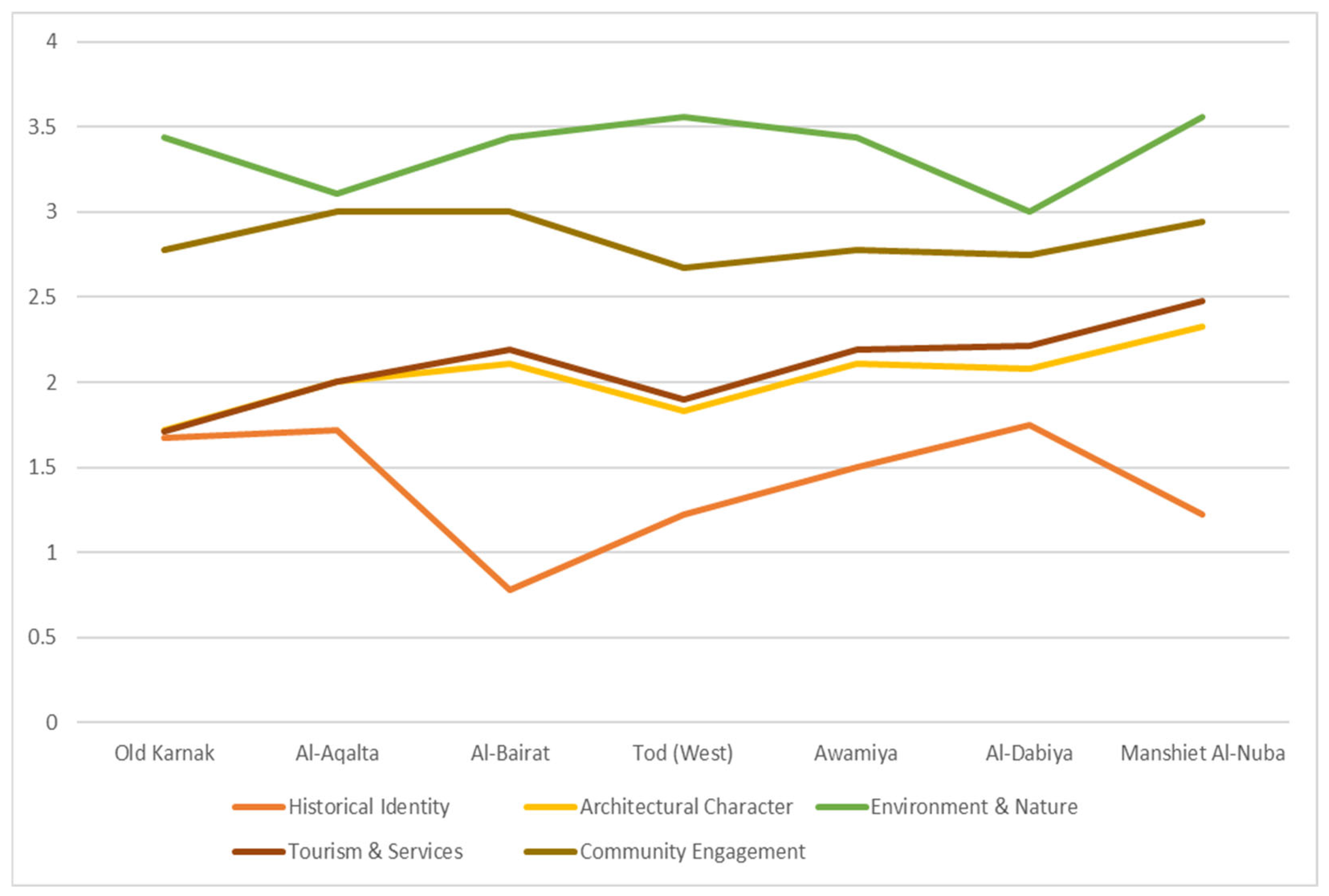
Each dimension is rated on a 3-point Likert scale (Low = 1, Medium = 2, High = 3) and then multiplied by its respective weight to calculate a composite score, as shown in
Table 4 and
Figure 8.
6. Synthesis of Findings and Strategic Outcomes
Building on the study’s multi-scalar analysis, this section outlines actionable recommendations to strengthen Egypt’s heritage-village documentation and nomination processes. These proposals align with UNESCO’s Operational Guidelines, the Historic Urban Landscape approach, and Egypt’s Vision 2030 objectives. The key recommendations are summarized in
Table 5 [
18].
The framework’s empirical validation (α = 0.91; KMO = 0.88) confirms its robustness and adaptability across diverse rural contexts. Its application to seven case-study villages in Luxor demonstrates that intangible heritage, though underrepresented in current policies, significantly enhances overall heritage value when recognized and integrated into conservation strategies.
The scalability of the EHVI enhances its utility as a policy instrument, enabling transparent, data-driven prioritization of heritage villages at national and regional levels [
19]. Practically, it supports the creation of Egypt’s first digital rural heritage inventory, promotes community participation, and informs resource allocation and heritage-led development [
20].
Beyond the Egyptian context, the EHVI offers transferable value to other regions of the Global South where vernacular heritage faces similar governance and documentation challenges. Future research may integrate socio-economic and environmental indicators to expand the model’s sustainability dimension [
21].
Ultimately, the study reaffirms that preserving heritage villages is not only a cultural imperative but also a strategic pathway toward inclusive and sustainable rural development.
While this study has provided a comprehensive framework for evaluating and sustaining Egypt’s heritage villages in alignment with UNESCO principles, certain limitations should be acknowledged [
22]. The research sample was limited to a few heritage villages, which may not fully represent the diversity of Egypt’s rural settlements. Additionally, the evaluation primarily focused on cultural, environmental, and spatial dimensions, while socio-economic and legislative aspects were not addressed in depth [
23].
Future research could expand the framework’s application to a broader range of heritage contexts—both within and beyond Egypt—to validate its adaptability across different cultural and geographic settings. Moreover, integrating digital heritage documentation tools and community-based participatory methods could further enhance the accuracy and inclusivity of the proposed Heritage Village Index (EHVI) [
24].
7. Conclusions
Building on the study’s multi-scalar analysis, this section outlines actionable recommendations to strengthen Egypt’s heritage village documentation and nomination processes. The proposals are aligned with UNESCO’s Operational Guidelines, the Historic Urban Landscape, and Egypt’s Vision 2030 objectives. As shown in
Table 5.
To comprehensively safeguard Egypt’s rural heritage, a multi-pronged strategy is essential, starting with legal and institutional reforms to expand the National Heritage Law’s scope to protect intangible culture and vernacular settlements explicitly and to establish a National Register for Heritage Villages coordinated by the Ministry of Culture [
24]. This requires mandating the Enhanced Heritage Value Index (EHVI) in all rural development plans and establishing a Cross-Ministerial Rural Heritage Unit to coordinate efforts across sectors. Simultaneously, community capacity and grassroots empowerment must be prioritized by training local “Heritage Stewards” (Ḥurrās al-Turāth), establishing Community Heritage Labs with academic and NGO partners for participatory documentation, and integrating heritage content into rural educational curricula [
11]. This local effort should be supported by promoting heritage-based micro-enterprises like craft cooperatives and eco-tourism [
11]. Furthermore, a digital strategy is needed, including launching a centralized platform for live documentation, embedding heritage indicators into Egypt Vision 2030 dashboards, and adopting EHVI as a monitoring and evaluation tool for heritage programs. Finally, UNESCO nomination and international collaboration efforts should focus on prioritizing high-readiness villages, bundling culturally linked settlements into serial nominations, and aligning the strategy with the Historic Urban Landscape (HUL) approach, supported by partnerships with global heritage bodies and a community council model for monitoring EHVI, ultimately empowering rural communities as active custodians of their cultural landscapes [
11].
Author Contributions
Conceptualization, M.M.G. and O.I.H.; methodology, O.I.H.; software, O.I.H., A.M.A. and E.M.H.; validation, M.M.G., O.I.H. and E.M.H.; formal analysis, O.I.H., A.M.A. and E.M.H.; investigation, M.M.G., O.I.H. and E.M.H.; resources, M.M.G., S.A. and O.I.H.; data curation, O.I.H., A.M.A. and E.M.H.; writing—original draft preparation, M.M.G., S.A., O.I.H. and E.M.H.; writing—review and editing M.M.G. and O.I.H.; visualization, M.M.G. and O.I.H.; project ad-ministration, M.M.G.; funding acquisition, M.M.G. and S.A. All authors have read and agreed to the published version of the manuscript.
Funding
We thank the Vice Presidency for Graduate Studies, Research & Business at Dar Al-Hekma University in Jeddah, Saudi Arabia, for funding this research project and for offering their technical support.
Institutional Review Board Statement
The study was conducted in accordance with the Declaration of Helsinki, and approved by the Dar Al-Hekma University Research Ethics Committee (protocol code DAH/REC/22-23/03 and date of approval 10 February 2022).
Informed Consent Statement
Informed consent was obtained from all subjects involved in the study.
Data Availability Statement
The original contributions presented in this study are included in the article. Further inquiries can be directed to the corresponding author.
Conflicts of Interest
The authors declare no conflicts of interest.
Appendix A
Appendix A.1. Survey Questionnaire: Egypt’s Heritage Villages (Case Study: Luxor)
Expert Survey for Evaluating the Importance of Heritage Indicators
This questionnaire was administered to 100 heritage experts, planners, architects, and policymakers. The purpose is to evaluate the perceived importance of 31 proposed indicators grouped under nine thematic dimensions.
Responses are recorded using a 5-point Likert scale:
Table A1.
Section A: Respondent Profile. Rating scale: 5 = Very Important, 4 = Important, 3 = Neutral, 2 = Slightly Important, 1 = Not Important.
Table A1.
Section A: Respondent Profile. Rating scale: 5 = Very Important, 4 = Important, 3 = Neutral, 2 = Slightly Important, 1 = Not Important.
| Question | Options |
|---|
| Name (Optional) | ............................................................................. |
| Expertise Area | □ Architecture □ Planning □ Archaeology □ Law □ Tourism □ Other: ............ |
| Years of Experience | □ Less than 5 □ 5–10 □ Over 10 |
| Affiliation | □ Government □ NGO □ Academia □ Independent Consultant |
Table A2.
Section B: Indicator Importance Assessment.
Table A2.
Section B: Indicator Importance Assessment.
| # | Dimension | Indicator Statement | 1 | 2 | 3 | 4 | 5 |
|---|
|
1
| Tourism & Services | Village has tourist shops/goods | □ | □ | □ | □ | □ |
|
2
| Environment & Nature | Village has traditional crafts or environmental enterprises | □ | □ | □ | □ | □ |
|
3
| Tourism & Services | Village should attract visitors | □ | □ | □ | □ | □ |
|
4
| Historical Identity | Part of a significant historical era (village age) | □ | □ | □ | □ | □ |
|
5
| Historical Identity | Represents the time/date of founding | □ | □ | □ | □ | □ |
|
6
| Historical Identity | Conveys the significance of its era | □ | □ | □ | □ | □ |
|
7
| Historical Identity | Associated with a significant historical event | □ | □ | □ | □ | □ |
|
8
| Historical Identity | Linked to a notable historical figure or designer | □ | □ | □ | □ | □ |
|
9
| Historical Identity | Part of a historical route or center of activity | □ | □ | □ | □ | □ |
|
10
| Tourism & Services | Good transportation accessibility | □ | □ | □ | □ | □ |
|
11
| Tourism & Services | Support for cultural/tourism-related activities | □ | □ | □ | □ | □ |
|
12
| Architectural Character | Unique urban structure | □ | □ | □ | □ | □ |
|
13
| Historical Identity | Rich in historical/cultural heritage | □ | □ | □ | □ | □ |
|
14
| Environment & Nature | Rare plants or architectural crops | □ | □ | □ | □ | □ |
|
15
| Environment & Nature | Biodiversity (cattle, fisheries, etc.) | □ | □ | □ | □ | □ |
|
16
| Architectural Character | Preserved urban integrity | □ | □ | □ | □ | □ |
|
17
| Architectural Character | Represents a design/planning concept | □ | □ | □ | □ | □ |
|
18
| Architectural Character | Village is a rare/uncommon case | □ | □ | □ | □ | □ |
|
19
| Historical Identity | Reflects a key moment in urban/historic
development | □ | □ | □ | □ | □ |
|
20
| Architectural Character | Village or a content is a work of art | □ | □ | □ | □ | □ |
|
21
| Architectural Character | Unique aesthetic or architectural character | □ | □ | □ | □ | □ |
|
22
| Architectural Character | Use of unique materials/techniques | □ | □ | □ | □ | □ |
|
23
| Environment & Nature | Reflects natural or urban landscape | □ | □ | □ | □ | □ |
|
24
| Community Engagement | Preserves collective memory | □ | □ | □ | □ | □ |
|
25
| Community Engagement | Community participation and organization | □ | □ | □ | □ | □ |
|
26
| Tourism & Services | Knowledge of tourism/service management | □ | □ | □ | □ | □ |
|
27
| Tourism & Services | Safety and security in the village | □ | □ | □ | □ | □ |
|
28
| Tourism & Services | Ability to absorb cultural/tourism investment | □ | □ | □ | □ | □ |
|
29
| Historical Identity | Resource for historical documentation | □ | □ | □ | □ | □ |
|
30
| Environment & Nature | Preservation of biodiversity and species | □ | □ | □ | □ | □ |
|
31
| Community Engagement | Educational value in history/culture | □ | □ | □ | □ | □ |
Are there any additional indicators you recommend for heritage village documentation?
The following table presents the indicators heritage professionals and researchers used to evaluate the documentation readiness and nomination potential of heritage villages in Egypt. These indicators are grouped into nine key dimensions based on international and national benchmarks.
Based on site observations, archival review, and professional judgment, experts scored each indicator as Available/Not Available/Partially Available.
Appendix A.2. Unified Perception-Based Survey on Heritage Village Indicators
This questionnaire is designed to assess the perceived availability of heritage-related indicators in Heritage villages, as observed by various stakeholder groups:
Residents, government officials, tourism professionals, and heritage experts.
Responses will help evaluate documentation readiness and identify gaps or strengths in heritage nomination criteria.
Table A3.
Section A: Respondent Profile.
Table A3.
Section A: Respondent Profile.
| Question | Options |
|---|
| Village Name: | ………………………………………………………………………… |
| Age Group: | □ Under 25 □ 25–45 □ Over 45 |
| Gender: | □ Male □ Female |
| Professional Role: | □ Local Resident □ Government Official □ Heritage Expert □ Tourism Worker □ Other: ………………… |
| Years of Experience (if applicable): | □ Less than 5 □ 5–10 □ Over 10 |
Section B: Instructions
Please indicate the extent to which you believe each of the following heritage-related features is currently present in the village you are evaluating.
Response Scale:
Table A4.
Section C: Heritage Village Indicators. Rating scale: 5 = Clearly Available, 4 = Somewhat Available, 3 = Uncertain/Don’t Know, 2 = Slightly Available, 1 = Not Available.
Table A4.
Section C: Heritage Village Indicators. Rating scale: 5 = Clearly Available, 4 = Somewhat Available, 3 = Uncertain/Don’t Know, 2 = Slightly Available, 1 = Not Available.
| # | Indicator Statement | 1 | 2 | 3 | 4 | 5 |
|---|
| 1 | The village has local markets or distinct tourism products. | □ | □ | □ | □ | □ |
| 2 | The village maintains traditional crafts or eco-industrial activities. | □ | □ | □ | □ | □ |
| 3 | The village is considered a tourist destination or has tourism potential. | □ | □ | □ | □ | □ |
| 4 | The village dates back to a historically significant period. | □ | □ | □ | □ | □ |
| 5 | The village reflects characteristics of its historical founding period. | □ | □ | □ | □ | □ |
| 6 | The village holds historical or cultural values from its time of establishment. | □ | □ | □ | □ | □ |
| 7 | The village is associated with major local or national historical events. | □ | □ | □ | □ | □ |
| 8 | The village is linked to historical figures, planners, or cultural icons. | □ | □ | □ | □ | □ |
| 9 | The village serves as a route or node connecting it to important places. | □ | □ | □ | □ | □ |
| 10 | The village is accessible through adequate transportation networks. | □ | □ | □ | □ | □ |
| 11 | The village is supported by infrastructure conducive to tourism or cultural
activities. | □ | □ | □ | □ | □ |
| 12 | The village has a coherent and historically rooted urban or spatial structure. | □ | □ | □ | □ | □ |
| 13 | The village contains diverse heritage assets with architectural or cultural value. | □ | □ | □ | □ | □ |
| 14 | The village hosts rare, native, or ancient vegetation. | □ | □ | □ | □ | □ |
| 15 | The village supports biodiversity (flora, fauna, fisheries). | □ | □ | □ | □ | □ |
| 16 | The village preserves environmental or visual integrity with minimal distortion. | □ | □ | □ | □ | □ |
| 17 | The village represents a specific planning or design philosophy. | □ | □ | □ | □ | □ |
| 18 | The village is considered a rare or outstanding planning example. | □ | □ | □ | □ | □ |
| 19 | The village reflects a historical planning period or urban style. | □ | □ | □ | □ | □ |
| 20 | The village contains artistically or aesthetically valued design elements. | □ | □ | □ | □ | □ |
| 21 | Buildings exhibit distinct architectural character or typology. | □ | □ | □ | □ | □ |
| 22 | Traditional construction methods or materials are evident in buildings. | □ | □ | □ | □ | □ |
| 23 | The village has a visually harmonious and natural landscape setting. | □ | □ | □ | □ | □ |
| 24 | The village is part of the collective memory of the local community. | □ | □ | □ | □ | □ |
| 25 | The local community demonstrates ability to organize and support heritage
initiatives. | □ | □ | □ | □ | □ |
| 26 | Community members possess service-related or tourism-oriented skills. | □ | □ | □ | □ | □ |
| 27 | The village is perceived as safe and secure for visitors and residents. | □ | □ | □ | □ | □ |
| 28 | The village can accommodate cultural, educational, or tourism functions. | □ | □ | □ | □ | □ |
| 29 | The village supports interpretation or dissemination of historical knowledge. | □ | □ | □ | □ | □ |
| 30 | The village contributes to environmental education or awareness. | □ | □ | □ | □ | □ |
| 31 | The village serves as a site of learning and community engagement in heritage. | □ | □ | □ | □ | □ |
| 32 | The village helps document, preserve, or transfer intangible heritage or oral
traditions. | □ | □ | □ | □ | □ |
Table A5.
Summarizes the initial evaluation across the five EHVI dimensions (✔, △, ✖) per village, Source: Expert (N = 100) and Community Survey (N = 250).
Table A5.
Summarizes the initial evaluation across the five EHVI dimensions (✔, △, ✖) per village, Source: Expert (N = 100) and Community Survey (N = 250).
| Village | Historical Significance | Urban Morphology | Legal Registration | Community Value | Environmental and Visual Integrity |
|---|
| Old Karnak | ✔ | ✔ | △ | △ | ✔ |
| Al-Aqalta | ✔ | ✔ | △ | △ | ✔ |
| Al-Bairat | ✔ | ✔ | △ | ✔ | ✔ |
| Tod | ✔ | ✔ | ✔ | ✔ | ✔ |
| Awamiya | △ | ✔ | ✖ | △ | ✔ |
| Al-Dabiya | ✔ | ✔ | ✖ | △ | ✔ |
| Manshiet Al-Nuba | ✔ | ✔ | ✖ | ✖ | ✔ |
Selection was based on diversity of heritage value, vulnerability, registration status, and geography.
Table A6.
Institutional Gaps Affecting UNESCO Readiness Levels in Egyptian Heritage Villages Source: Authors’ analysis based on field data, expert interviews, and UNESCO documentation guidelines.
Table A6.
Institutional Gaps Affecting UNESCO Readiness Levels in Egyptian Heritage Villages Source: Authors’ analysis based on field data, expert interviews, and UNESCO documentation guidelines.
| No. | Village Name | Heritage Components | Economic Aspects | Architectural and Urban Features | Rating |
|---|
| 1 | Old Karnak Village | Pasha Andraos Palace (built 1921)) historical corridor | Handicrafts market—needs cultural promotion | Traditional architectural style | First |
| 2 | Al-Aqalta Village | Located near the mountain, the historical and archeological elements | Alabaster industry—requires cultural support | Rural hotel-style houses | First |
| 3 | Al-Bairat Village | Traditional urban layout; old dwellings designed by Hassan Fathy | Pottery Industry School | Distinctive traditional urban pattern | Second |
| 4 | Tod (West)Village (West) | Part of the Luxor–Aswan route | Sailing boat activity as an income source | Characteristic local housing style | Second |
| 5 | Awamiya Village | Extension of Luxor city | Tourist inns and panoramic views on the west bank | Locally inspired architectural style | Third |
| 6 | Al-Dabiya Village | Overlooks the Nile—adjacent to archeological sites | Nile views, rest areas, and distinctive tourism potential | Old Arab-style houses | Third |
| 7 | Manshiet Al-Nuba Village | Connected to the floating hotel tourism path | Floating hotel dock and Nile panorama as an economic resource | Unique traditional urban housing style | Third |
Table A7.
Reliability and Validity Results for EHVI Dimensions.
Table A7.
Reliability and Validity Results for EHVI Dimensions.
| Dimension | Cronbach’s Alpha | KMO | Bartlett’s Test (p-Value) |
|---|
| Architectural Authenticity | 0.85 | 0.82 | <0.001 |
| Cultural Vitality | 0.80 | 0.82 | <0.001 |
| Community Involvement | 0.78 | 0.82 | <0.001 |
| Economic Viability | 0.79 | 0.82 | <0.001 |
| Institutional Support | 0.81 | 0.82 | <0.001 |
| Overall Scale | 0.82 | 0.82 | <0.001 |
Table A8.
Gap Analysis of EHVI Dimensions across Seven Villages, Source: Authors’ policy synthesis (field results and UNESCO).
Table A8.
Gap Analysis of EHVI Dimensions across Seven Villages, Source: Authors’ policy synthesis (field results and UNESCO).
| Village | Historical Identity Gap | Architectural Character Gap | Environment and Nature Gap | Tourism and Services Gap | Community Engagement Gap |
|---|
| Old Karnak | 1.67 | 1.72 | 3.44 | 1.71 | 2.78 |
| Al-Aqalata | 1.72 | 2.00 | 3.11 | 2.00 | 3.00 |
| Al-Bairat | 0.78 | 2.11 | 3.44 | 2.19 | 3.00 |
| Tod (West) | 1.22 | 1.83 | 3.56 | 1.90 | 2.67 |
| Awamiya | 1.50 | 2.11 | 3.44 | 2.19 | 2.78 |
| Al-Dabiya | 1.75 | 2.08 | 3.00 | 2.21 | 2.75 |
| Manshiyat Al-Nuba | 1.22 | 2.33 | 3.56 | 2.48 | 2.94 |
Table A9.
EHVI Dimensions and Their Alignment, Source: Authors, based on UNESCO/SDG guidelines.
Table A9.
EHVI Dimensions and Their Alignment, Source: Authors, based on UNESCO/SDG guidelines.
| Dimension | Weight | Description | Aligned UNESCO/SDG Reference |
|---|
| Architectural Authenticity | 0.25 | Preservation of vernacular forms, materials, and building techniques | UNESCO Criteria (iii), (iv) |
| Cultural Vitality | 0.25 | Continuity of living traditions, crafts, rituals, oral history | Criteria (v), (vi) |
| Community Involvement | 0.20 | Resident participation in planning, safeguarding, and heritage use | HUL, SDG 11.4 |
| Economic Viability | 0.15 | Heritage-based income potential through crafts, tourism, or cultural services | SDG 8, UNESCO Sustainable Tourism Guide |
| Institutional Support | 0.15 | Availability of laws, funding, training, and technical assistance | UNESCO Operational Guidelines |
References
- Kórody, R. Vernacular rural landscapes in Hungary: The case of Hollókő. J. Cult. Herit. Manag. 2019, 12, 201–215. [Google Scholar]
- Egypt, I. Assessment of Heritage Village Gaps in National Documentation Frameworks; ICOMOS: Cairo, Egypt, 2022. [Google Scholar]
- Bank, W. Heritage for Development: Economic Benefits of Cultural Sites. 2020. Available online: https://www.worldbank.org (accessed on 22 May 2025).
- NOUH (National Organization for Urban Harmony). Foundations and Standards of Urban Coordination for Heritage Buildings and Areas of Distinguished Value; NOUH: Cairo, Egypt, 2014. [Google Scholar]
- Hair, J.F.; Black, W.C.; Babin, B.J.; Anderson, R.E. Multivariate Data Analysis, 8th ed.; Cengage Asia: Singapore, 2019. [Google Scholar]
- UNESCO. Operational Guidelines for the Implementation of the World Heritage Convention. 2023. Available online: https://whc.unesco.org/en/guidelines (accessed on 3 June 2025).
- ICOMOS. World Heritage Nomination: Kaiping Diaolou and Villages; ICOMOS: Paris, France, 2007. [Google Scholar]
- CHRI. Cultural Heritage Resilience Index: Framework for Assessing Cultural Assets; CHRI: New Delhi, India, 2018. [Google Scholar]
- CHAM. Community Heritage Assessment Model: A Participatory Approach; CHAM: Paris, France, 2021. [Google Scholar]
- Cristini, V.; García-Soriano, L.; Vegas, F. Villages with fortified churches in Transylvania: Architecture, history and intangible culture. ISPRS Arch. 2020, XLIV-M–1, 249–254. [Google Scholar] [CrossRef]
- Dell ‘Anna, F.; Ingrosso, M.; De Paolis, F. Integrating tangible and intangible heritage assessment: Toward a UNESCO-aligned framework. J. Cult. Herit. Manag. Sustain. Dev. 2021, 11, 355–372. [Google Scholar]
- Abouelmagd, D. Cultural heritage and sustainable urban development: The case of Port Said city in Egypt. Cogent Arts Humanit. 2022, 9, 2088460. [Google Scholar] [CrossRef]
- Soprapti, A.; Sargono, A.B.; Andreastario, I. Spatial strategies in Indonesian heritage villages. J. Archit. Urban. 2019, 43, 36–46. [Google Scholar]
- Field, A. Discovering Statistics Using SPSS, 5th ed.; SAGE Publications: Thousand Oaks, CA, USA, 2018. [Google Scholar]
- Alopelan, L.; Awad, A. Architectural values and cultural identity in Saudi heritage houses. WIT Trans. Built Environ. 2022, 211, 29–50. [Google Scholar] [CrossRef]
- Wei, L. Landscape protection in traditional Chinese villages. Int. Arch. Photogramm. Remote Sens. Spat. Inf. Sci. 2015, 40, 23–29. [Google Scholar]
- ICOMOS. Guidelines for the Conservation of Rural Heritage Landscapes; ICOMOS: Paris, France, 2021. [Google Scholar]
- Golino, B.; Picaro, J.L.; Larcher, F. Monitoring rural World Heritage sites: Lessons from Europe. Sustainability 2015, 7, 14186–14210. [Google Scholar] [CrossRef]
- Golino, P.; Larcher, F. Integrity in UNESCO World Heritage sites: Rural landscape perspectives. J. Cult. Herit. 2013, 14, 389–395. [Google Scholar] [CrossRef]
- Vial, A.; Rakich, T. Future Markets for World Heritage Sites; Butterworth-Heinemann: Abingdon, UK, 2006. [Google Scholar]
- Lightfoot, K.G. Rethinking the colonial archaeology of Western North America. Hist. Archaeol. 2006, 40, 272–292. [Google Scholar]
- Miskell, L. Reflections on the World Heritage Committee. J. Field Archaeol. 2012, 37, 145–151. [Google Scholar]
- Jimura, T. The impact of World Heritage designation on local communities: Shirakawa-go case study. Tour. Manag. 2011, 32, 288–296. [Google Scholar] [CrossRef]
- Ko, D.W.; Stewart, W.P. Residents’ attitudes toward tourism: Structural equation modeling. Tour. Manag. 2002, 23, 521–530. [Google Scholar] [CrossRef]
Figure 1.
Map showing UNESCO-registered heritage sites in Egypt. Source: UNESCO Database (2023).
Figure 1.
Map showing UNESCO-registered heritage sites in Egypt. Source: UNESCO Database (2023).
Figure 2.
Synthesis of Heritage Documentation Standards, Source: Authors’ framework, 2023.
Figure 2.
Synthesis of Heritage Documentation Standards, Source: Authors’ framework, 2023.
Figure 3.
The reliability of internal consistency. Source: SPSS outputs, 2022–2023. High Readiness (≥75%); Moderate Readiness (60–74%); Low Readiness (<60%) as shown in
Table A3.
Figure 3.
The reliability of internal consistency. Source: SPSS outputs, 2022–2023. High Readiness (≥75%); Moderate Readiness (60–74%); Low Readiness (<60%) as shown in
Table A3.
Figure 4.
Unified Table of EHVI Assessments: Quantified Data, Expert Opinions, and Community Perceptions.
Figure 4.
Unified Table of EHVI Assessments: Quantified Data, Expert Opinions, and Community Perceptions.
Figure 5.
The gaps between the ideal value and the actual value of each dimension in each village, based on expert assessment data.
Figure 5.
The gaps between the ideal value and the actual value of each dimension in each village, based on expert assessment data.
Figure 6.
Statistical analysis results for heritage villages in Egypt, using IBM and SPSS Statistics, to assess the Importance of 31 Proposed Indicators for the Selection of Heritage Villages in Egypt, Source: SPSS expert survey analysis.
Figure 6.
Statistical analysis results for heritage villages in Egypt, using IBM and SPSS Statistics, to assess the Importance of 31 Proposed Indicators for the Selection of Heritage Villages in Egypt, Source: SPSS expert survey analysis.
Figure 7.
Results of Statistical Analysis Using Heritage Villages in Egypt.
Figure 7.
Results of Statistical Analysis Using Heritage Villages in Egypt.
Figure 8.
Relative Contribution of EHVI Dimensions per Village, Source: SPSS outputs, 2022–2023.
Figure 8.
Relative Contribution of EHVI Dimensions per Village, Source: SPSS outputs, 2022–2023.
Table 1.
Summary of Institutional Gaps and UNESCO Implications, Source: Authors’ synthesis (interviews and legislation review).
Table 1.
Summary of Institutional Gaps and UNESCO Implications, Source: Authors’ synthesis (interviews and legislation review).
| Dimension | Specific Gap | Implication for UNESCO Readiness |
|---|
| Legal | No legal recognition of intangible/rural heritage | Violates Criteria (v) and (vi); excludes living traditions |
| Documentation | No national inventory for heritage villages; fragmented sources | Undermines authenticity, continuity, and evidence for inscription |
| Community | Residents excluded from planning; lack of participation tools and training | Weakens sustainability;
limits community ownership. |
| Institutional | Lack of coordination between ministries; limited technical capacity | Delays implementation; reduces the
ability to meet UNESCO operational
demands |
Table 2.
EHVI Scores—7 Village, Source: EHVI scoring matrix, authors’ calculation.
Table 3.
Relative Contribution of EHVI Dimensions per Village, Source: SPSS analysis, 2022–2023.
Table 3.
Relative Contribution of EHVI Dimensions per Village, Source: SPSS analysis, 2022–2023.
| Village | Historical Identity (%) | Architectural Character (%) | Environment and Nature (%) | Tourism and Services (%) | Community Engagement (%) |
|---|
| Old Karnak | 26.35 | 20.97 | 8.85 | 28.80 | 15.03 |
| Al-Aqalta | 27.88 | 31.65 | 13.82 | 12.33 | 14.32 |
| Al-Bairat | 26.38 | 15.14 | 20.04 | 20.63 | 17.81 |
| Tod (West) | 21.52 | 26.64 | 15.27 | 25.35 | 11.22 |
| Awamiya | 23.52 | 26.76 | 16.11 | 17.56 | 16.05 |
| Al-Dabiya | 2.75 | 2.74 | 2.18 | 2.92 | 3.08 |
| Manshiet Al-Nuba | 3.29 | 2.7 | 3.21 | 3.32 | 3.14 |
Table 4.
EHVI Readiness Levels, Source: Authors’ computation, 2023.
Table 4.
EHVI Readiness Levels, Source: Authors’ computation, 2023.
| Composite Score (%) | Readiness Classification |
|---|
| 75–100% | Strong nomination potential |
| 60–74% | Moderate readiness; targeted improvement needed |
| <60% | Low readiness; requires structural reform |
Table 5.
EHVI Implementation Strategy Framework, Source: Authors’ synthesis (EHVI results, policy recommendations, stakeholder mapping [
11].
Table 5.
EHVI Implementation Strategy Framework, Source: Authors’ synthesis (EHVI results, policy recommendations, stakeholder mapping [
11].
| Implementation Level | Strategic Action | Target Group | Applicability (A/B/C) |
|---|
| Institutional | Amend Law No. 117/1983 to include intangible and rural heritage | Ministry of Culture/Tourism/Antiquities | All |
| Establish a cross-ministerial Rural Heritage Unit | Governmental bodies (Culture—Tourism—Local Development) | All |
| Create a national database for rural heritage integrated with EHVI | Ministry of Culture/National Heritage Unit | All |
| Community-Based | Train local “Heritage Stewards” for participatory documentation | Village councils/NGOs/Local leaders | Mainly B and C |
| Create Community Heritage Labs (documentation + training + crafts) | Universities/NGOs/Community groups | B and C |
| Integrate heritage education in rural schools | Ministry of Education/Local schools | A and B |
| Digital and Planning | Launch a national digital heritage platform (GIS + Photogrammetry + Inventory) | Universities/Youth Centers/Planners | A and B |
| Train youth in digital documentation (GIS, photogrammetry, mobile mapping) | Local youth centers/Universities | A and B |
| Embed EHVI into local development and planning dashboards | Local Governorates/Planning authorities | All |
| International/Nomination Strategy | Prioritize high-readiness villages (Old Karnak, Al-Aqalta) for UNESCO nomination | National heritage agencies/MoTA | Only A |
| Prepare EHVI-based nomination dossiers for UNESCO Tentative List | National UNESCO Committee | Only A |
| Bundle culturally related villages into serial nominations | National UNESCO Committee/MoTA | A and B |
| Disclaimer/Publisher’s Note: The statements, opinions and data contained in all publications are solely those of the individual author(s) and contributor(s) and not of MDPI and/or the editor(s). MDPI and/or the editor(s) disclaim responsibility for any injury to people or property resulting from any ideas, methods, instructions or products referred to in the content. |
© 2025 by the authors. Licensee MDPI, Basel, Switzerland. This article is an open access article distributed under the terms and conditions of the Creative Commons Attribution (CC BY) license (https://creativecommons.org/licenses/by/4.0/).




 ,
, 



 Green
Green Yellow
 Yellow
 Yellow
 Yellow
 Red
Red Red
Red