
You are currently viewing a new version of our website. To view the old version click .

DNA, Volume 4, Issue 2

June 2024 - 6 articles

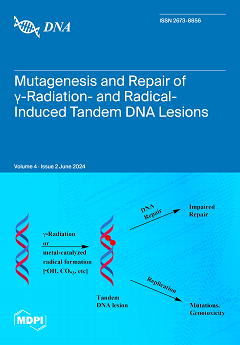
Cover Story: One of the most well-known characteristics of γ-radiation is its ability to cause tandem DNA damage. Oxidative stress in response to inflammation in tissues and metal-catalyzed reactions that result in the generation of radicals also form these DNA lesions. In this minireview, we discussed the mechanism of formation of the tandem lesions followed by the replication and repair studies carried out on these lesions after site-specific synthesis. Many of these lesions are resistant to traditional base excision repair, but nucleotide excision repair is effective. They also block DNA replication and, when lesion bypass occurs, may be significantly error-prone. Some of these tandem DNA lesions may contribute to ageing, neurological diseases, and cancer. View this paper
  • Issues are regarded as officially published after their release is announced to the table of contents alert mailing list .
  • You may sign up for email alerts to receive table of contents of newly released issues.
  • PDF is the official format for papers published in both, html and pdf forms. To view the papers in pdf format, click on the "PDF Full-text" link, and use the free Adobe Reader to open them.

Articles (6)

  • Article
  • Open Access
1 Citations
2,282 Views
9 Pages

Child Telomere Length at 11–12 Years of Age Is Not Associated with Pregnancy Complications

  • Tina Bianco-Miotto,
  • Sadia Hossain,
  • Nahal Habibi,
  • Dandara G. Haag and
  • Jessica A. Grieger

11 June 2024

Children born from pregnancy complications are at higher risk of chronic diseases in adulthood. Identifying which children born from a complicated pregnancy are likely to suffer from later chronic disease is important in order to intervene to prevent...

  • Article
  • Open Access
2 Citations
4,864 Views
10 Pages

Role of Supercoiling and Topoisomerases in DNA Knotting

  • Jorge Cebrián,
  • María-Luisa Martínez-Robles,
  • Victor Martínez,
  • Pablo Hernández,
  • Dora B. Krimer,
  • Jorge B. Schvartzman and
  • María-José Fernández-Nestosa

27 May 2024

DNA knots are deleterious for living cells if not removed. Several theoretical and simulation approaches address the question of how topoisomerases select the intermolecular passages that preferentially lead to unknotting rather than to the knotting...

  • Review
  • Open Access
4 Citations
3,171 Views
17 Pages

Mutagenesis and Repair of γ-Radiation- and Radical-Induced Tandem DNA Lesions

  • Ashis K. Basu,
  • Laureen C. Colis and
  • Jan Henric T. Bacurio

6 May 2024

Ionizing radiation induces many different types of DNA lesions. But one of its characteristics is to produce complex DNA damage, of which tandem DNA damage has received much attention, owing to its promise of distinctive biological properties. Oxidat...

  • Brief Report
  • Open Access
1 Citations
3,028 Views
13 Pages

5 April 2024

Repetitive DNA sequences are abundant in the human genome and can adopt alternative (i.e., non-B) DNA structures. These sequences contribute to diverse biological functions, including genomic instability. Previously, we found that Z-DNA-, H-DNA- and...

  • Review
  • Open Access
4 Citations
4,054 Views
13 Pages

2 April 2024

Since the discovery of transposable elements (TEs) in maize in the 1940s by Barbara McClintock transposable elements have been described as junk, as selfish elements with no benefit to the host, and more recently as major determinants of genome struc...

  • Perspective
  • Open Access
1 Citations
3,046 Views
25 Pages

30 March 2024

Mosquitoes, like Drosophila, are dipterans, the order of “true flies” characterized by a single set of two wings. Drosophila are prime model organisms for biomedical research, while mosquito researchers struggle to establish robust molecu...

Get Alerted

Add your email address to receive forthcoming issues of this journal.

XFacebookLinkedIn
DNA - ISSN 2673-8856