1. Introduction
The motivation for this study comes from a practical upgrade scenario: assessing whether it is feasible to migrate from legacy 1 Gbit/s equipment to 10 Gbit/s Ethernet while reusing an existing copper cabling infrastructure. Re-cabling large installations is often costly and disruptive, requiring lengthy construction works; therefore, understanding the real-world limits of commodity 10GBASE-T under legacy cabling constraints is of direct practical relevance.
Reducing AXT is a critical task for high-speed network connectivity. AXT occurs when unwanted interference between cable pairs degrades data signals, which is particularly problematic in densely packed cable environments typical of modern infrastructure. As detailed in ref. [
1], this form of interference poses significant challenges due to the complex nature of modern network setups, where cables are often closely bundled, exacerbating the impact of AXT on data transmission.
In practical 10GBASE-T deployments, these effects are particularly severe in high-density environments such as data centers, wiring closets, and industrial installations, where dozens of twisted-pair cables are tightly bundled in trays or conduits. In such scenarios, operators are primarily concerned not with idealized channel capacity, but with the stability and effective throughput of commodity Ethernet interfaces. Even moderate increases in alien crosstalk may force links to renegotiate from 10 Gbit/s to 1 Gbit/s or to drop the connection entirely, leading to substantial loss of usable capacity. This practical perspective motivates the need for experimental studies of AXT that use off-the-shelf hardware and realistic cabling conditions rather than relying solely on analytical models and specialized laboratory equipment.
Despite considerable progress, the behavior and impact of AXT can vary substantially across practical deployment conditions, where cable layout, bundle excitation, and other physical factors influence observed performance. Many published studies therefore focus on controlled measurement setups and analytical modeling to isolate specific coupling mechanisms and to build tractable channel representations [
2,
3]. In addition, a broad class of adaptive receiver and precoding approaches has been explored to adjust signal processing to the observed interference environment [
4,
5]. Existing directions span infrastructure-oriented measures and advanced coding/modulation techniques with non-trivial computational requirements, as well as software-driven approaches that aim to improve robustness using configurable processing without extensive hardware redesign [
6,
7].
In this work, we experimentally evaluated alien crosstalk in a realistic dense-cabling scenario using only off-the-shelf 10GBASE-T hardware. Our main contributions are as follows:
We determined the necessary component specifications and assembled the experimental testbed for studying alien crosstalk in 10GBASE-T Ethernet using commodity network interface cards and tightly bundled 60 m twisted-pair cables, emulating worst-case high-density installations.
We provide a quantitative characterization of how increasing alien crosstalk affects individual port speeds and aggregate throughput, showing a strong non-linear saturation of the total capacity and frequent speed downgrades or link failures under severe interference.
We discuss the limitations of consumer-grade Ethernet hardware for controlled AXT studies and derive practical implications for dense-cabling deployments, along with key requirements for experimental testbeds that can more reliably quantify AXT severity and its impact on commodity 10GBASE-T link stability (rate fallback and link loss) when evaluating advanced robustness and mitigation techniques.
These contributions complement existing physical-layer and coding-oriented work by focusing on the behavior of real 10GBASE-T devices under realistic, widely available deployment conditions.
2. Related Work
This section reviews recent work on alien crosstalk mitigation and related interference reduction techniques for high-speed links.
Reference [
8] evaluates the effectiveness of dual-dimensional modulation schemes (PAM-16 and DSQ128) and forward error correction codes in mitigating the deleterious effects of AXT. Also, these approaches to the AXT issue primarily revolve around physical layer modifications and advanced encoding techniques. For example, the DSQ128 constellation scheme with a two-dimensional modulation scheme and the normal PAM12 constellation scheme are both between 8-PAM and 16-PAM modulation, but according to the actual experiment of Broadcom, the noise of the DSQ128 constellation scheme is reduced by 0.5115 dB. At the same time, the Stronger LDPC (1,024,797) code is better matched to uncoded-bit-only error performance than (1,024,821) weak LDPC coding (−0.0469 bit/dim loss but 0.28 dB gain). The effectiveness of DSQ128 and LDPC in combating AXT is comprehensively documented in ref. [
9], illustrating their pivotal roles in modern network systems.
Technological advancements in pulse amplitude modulation, specifically the transition from PAM-12 to PAM-16, illustrate significant developments in the field. As highlighted in ref. [
10], these advancements are crucial in accommodating the increased bandwidth requirements of modern Ethernet networks. Additionally, the application of Tomlinson–Harashima precoding to these modulation techniques aids in preemptively canceling crosstalk, thereby refining signal quality before it is compromised [
4,
5].
In the context of on-chip communications, where bus delays caused by crosstalk can critically undermine system performance, novel approaches have been explored. One such technique involves intentionally skewing signal transition timings to reduce bus delay induced by crosstalk, which has proven effective, particularly in VLSI circuits where dense wire packing is common. As outlined in ref. [
11], this technique strategically enhances signal integrity and system reliability by tackling the specific challenges associated with proximity and layout in densely wired VLSI circuits.
Overall, the current state of the field is dominated by physical-layer optimization and analytical or simulation-based studies [
12,
13]. Most existing works assume carefully controlled channels, rely on specialized measurement equipment, and focus on improving modulation formats, coding schemes, or precoding algorithms to increase AXT tolerance. In contrast, there is comparatively little quantitative evidence on how commodity 10GBASE-T network interface cards behave under severe alien crosstalk in realistic dense-cabling installations, particularly with respect to automatic link-speed renegotiation and the resulting aggregate data rate.
3. Materials and Methods
In this section, we describe the materials and experimental setup used to evaluate the impact of AXT on commodity 10GBASE-T links. The goal of the testbed is to emulate realistic dense-cabling conditions using only off-the-shelf hardware, so that any observed performance degradation can be attributed to AXT effects on the Ethernet links rather than to limitations of the host systems.
3.1. Alien-Crosstalk Channel Model
To provide a compact physical interpretation of alien crosstalk (AXT) in multi-cable bundles, we introduce the following channel model. The model represents the interference observed at a victim receiver as the superposition of contributions from multiple disturbing transmitters, separated into near-end (ANEXT) and far-end (AFEXT) coupling components.
Alien crosstalk model between two connectors can be described as [
1,
14]:
Different K values represent coupling constants of the alien-crosstalk model. They quantify how strongly a disturbing pair couples interference into a victim pair under a given configuration. Typically, separate constants are used for different mechanisms, e.g., KANEXT for alien near-end crosstalk and KAFEXT for alien far-end crosstalk, and sometimes additional K values to reflect different cable categories, connector types, frequency ranges, or bundle geometries.
Known from actual experimental results [
15,
16] for the category 5e rated cable that was tested (2 cables):
As summarized in
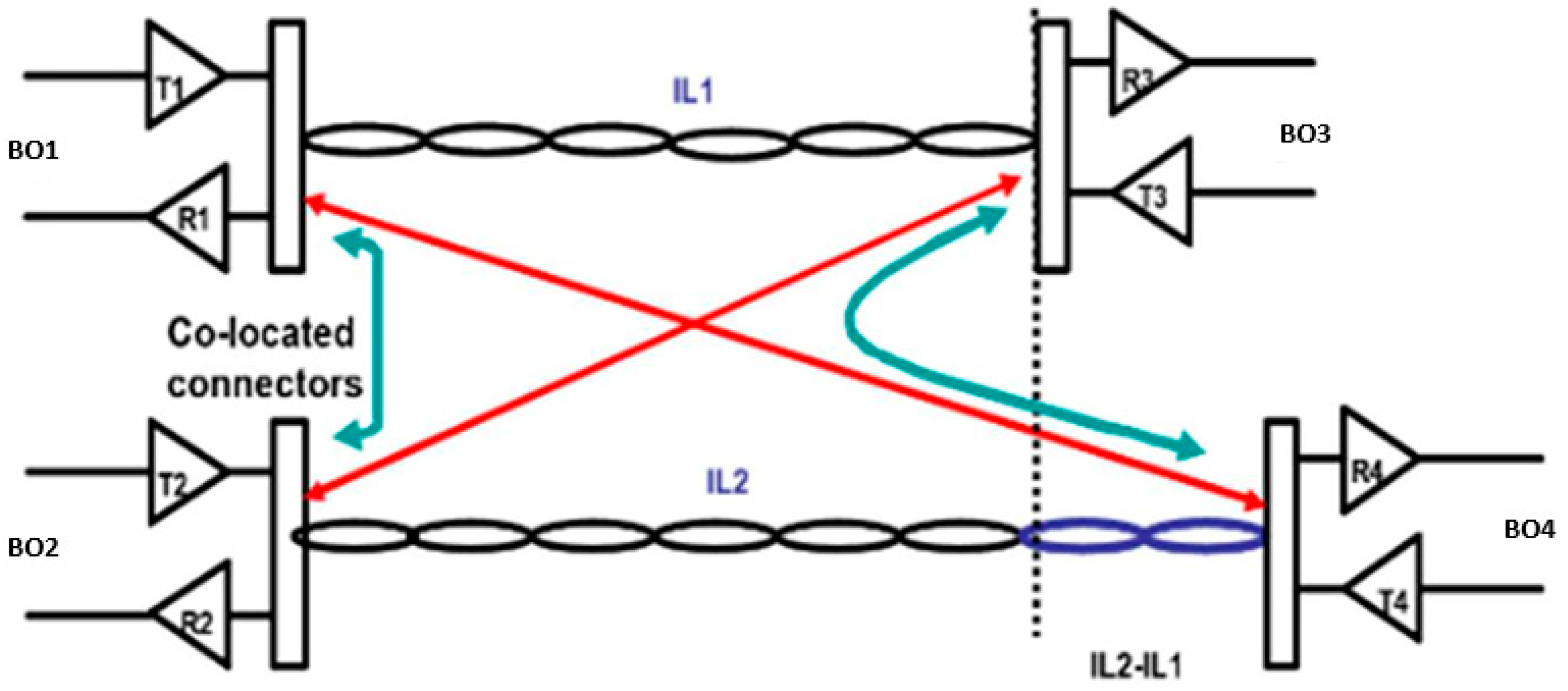
Table 1, each receiver Ri is affected by several disturbing transmitters, which contribute specific AFEXT and ANEXT terms scaled by the corresponding insertion losses (IL) and transmit power backoffs (BO). For example, the AFEXT expression for R1 includes the contribution from transmitter T4 together with the power backoff BO4 and the relative difference between the insertion losses of links 2 and 1, whereas the ANEXT term for R1 includes the contribution from transmitter T2 and the backoff BO2. In this way,
Figure 1 and
Table 1 together provide a compact description of how the physical cable layout and transmitter settings combine into the total alien crosstalk observed at each receiver, forming a conceptual baseline for interpreting the experimental results.
In this study, the model in
Figure 1 serves as a conceptual framework for organizing ANEXT/AFEXT contributions and interpreting how the relative exposure of each link evolves as more cables in the bundle become active, with the expectation that increased bundle activity raises the overall AXT level and causes the most strongly coupled ports to degrade earlier and more severely. To summarize the relative interference load on each victim port as more links become active, we introduce a qualitative exposure index
Ei(
N), defined as the sum of ANEXT and AFEXT contributions from all simultaneously active disturbing links:
Here, denotes the set of active links when N connections are enabled, and the summation is taken over all disturbing transmitters with . The metric is used as a qualitative exposure index: we do not compute its absolute value for a specific cable bundle but employ it to compare ports in terms of relative AXT loading and to explain why some links tend to degrade earlier than others under denser bundle excitation.
3.2. Experimental Setup
While balancing the overall budget and maximizing the use of available equipment, we built the experimental setup with the following configuration based on OS Ubuntu Linux 22.04 LTS (Canonical Ltd., London, UK).
Ethernet cards: we take advantage of Intel X710-T4 and Intel X550-T2 10GBASE-T Ethernet cards with Intel Ethernet drivers (Intel Corporation, Santa Clara, CA, USA), which provide four and two 10 Gigabit Ethernet copper ports, respectively. Together, these cards allow us to establish up to 8 parallel 10 Gbit/s links between the two hosts, while the built-in offload capabilities reduce processing pressure on the CPU.
Motherboard and CPU: the experiments are conducted using an AMD Ryzen 7 7800X3D processor (Advanced Micro Devices, Santa Clara, CA, USA) on an Asus X670-P WIFI motherboard (ASUSTeK Computer Inc., Taipei, Taiwan), providing robust processing capabilities and sufficient PCIe lanes to accommodate multiple high-speed network cards without saturating the system bus.
Memory and storage: each host is equipped with 4 × 32 GB of DDR5 RAM and high-speed storage: 3 × Crucial PCIe 4.0 1 TB SSDs (Micron Technology Inc., Boise, ID, USA) plus 2 × Western Digital 2 TB HDDs (Western Digital Corporation, San Jose, CA, USA), ensuring that packet generation, logging, and data processing during the experiments are not bottlenecked by system performance.
Cabling: we used Category 5e (CAT5e) 24AWG unshielded twisted-pair cables (part number TL-EC5e-305A, TP-Link Technologies Co., Ltd., Shenzhen, China) to emulate a legacy copper plant that was originally deployed for 1 Gbit/s Ethernet. To mimic a high-crosstalk environment, seven 60 m Ethernet cables are tightly bundled and wrapped in polyethylene film, creating a controlled yet challenging scenario that emulates worst-case conditions in high-density cable trays or conduits in practical installations. CAT5e is not the reference cabling for 10GBASE-T reach and is outside the standardized deployment conditions defined for CAT6/CAT6a systems. Therefore, our experiments should not be interpreted as a standards-compliance demonstration. Instead, the CAT5e choice is intentional and aligned with the practical upgrade motivation of this study: assessing how commodity 10GBASE-T behaves when an existing 1G copper infrastructure is reused without recabling. In this context, the results are valid as a worst-case baseline for link stability under reduced margin and strong bundle coupling; absolute throughput values may differ for CAT6/CAT6a, but the observed degradation trend with increasing bundle excitation remains the main focus.
The selection of specific hardware components, such as the Intel Ethernet cards (X710-T4 and X550-T2), the AMD 7800X3D CPU, and high-speed SSD storage, was aimed at creating a robust environment capable of handling high data rates and simulating dense network conditions that are critical for studying the effects of alien crosstalk on 10GBASE-T links. These components ensure that the host system does not become the bottleneck, so that the observed performance degradation can be attributed to alien crosstalk effects on the Ethernet links rather than to CPU, memory, or I/O limitations.
3.3. Experimental Methodology
Before starting the measurements, we designed a widely available experimental method that relies solely on commodity 10GBASE-T hardware and software-based traffic generation rather than on specialized test equipment. Two hosts were connected back-to-back: each port of the 10GBASE-T network interface cards on the first host was linked to a corresponding port on the second host via a separate twisted-pair cable. The ports were numbered consistently across both hosts so that “port 1” always referred to the same physical cable pair in all experiments.
For each experiment, we selected a given number of simultaneously active links N in the range from 1 to 7. For a given N, we started one long-lived bulk traffic flow on each of the N active ports, configured to saturate the link close to its maximum data rate. Each measurement run lasted long enough to obtain statistically stable values; the initial transient interval was discarded, and the remaining interval was used to compute the average per-port throughput. At the same time, we recorded the negotiated link speed on each port. This approach enabled us to emulate dense cabling scenarios and collect detailed throughput using hardware and software readily available in typical data-center or enterprise environments. Because commodity network cards do not expose raw physical layer (PHY) measurements, e.g., per-pair crosstalk power spectral density (PSD), we evaluate AXT impact using observable endpoints: negotiated rate, per-port throughput, and link loss events. These observable metrics can also be consumed by higher-layer control frameworks, like SDN, as triggers for traffic engineering actions.
4. Results
The experiments conducted with seven tightly bundled Ethernet cables yielded significant insights into the behavior of AXT under densely packed conditions. We observed severe AXT disturbances, which significantly impacted network performance. Most notably, the majority of Ethernet card interfaces experienced substantial delays and errors in hardware-driven detection, leading to automatic downshifts in link speeds from 10 Gigabit to 1 Gigabit connections.
In
Table 2, the speed of simultaneously active connections appears in rows, while the individual tests are numbered from 1 to 7 in the first column. With a single active connection port, 1 delivers 8.11 Gbit/s, which is already close to the practical limit for a 10GBASE-T link when protocol overheads are taken into account. When a second link is enabled, both ports still operate near 10 Gbit/s, and the aggregate throughput increases to 17.61 Gbit/s. When comparing per-port rates, the first port is actually faster in the two-link case (9.41 Gbit/s vs. 8.11 Gbit/s). The apparently “anomalous” of measurement is not a physical improvement caused by adding a second cable; it is a measurement/definition effect. This difference is consistent with normal run-to-run variability in application-level 10GBASE-T throughput caused by protocol overhead and test conditions (e.g., TCP windowing, driver/interrupt scheduling, background load, and “warm-up” effects) rather than any beneficial crosstalk-related phenomenon.
In each run, we recorded the negotiated link rate reported by the NIC (10 Gbit/s or 1 Gbit/s) together with the sustained iperf3 traffic generator (ESnet/Lawrence Berkeley National Laboratory, Berkeley, CA, USA) TCP throughput and link up/down events. The “0.94 Gbit/s” plateau in
Table 2 corresponds to the 1 Gbit/s negotiated mode, whereas “N/A” denotes a link-down condition.
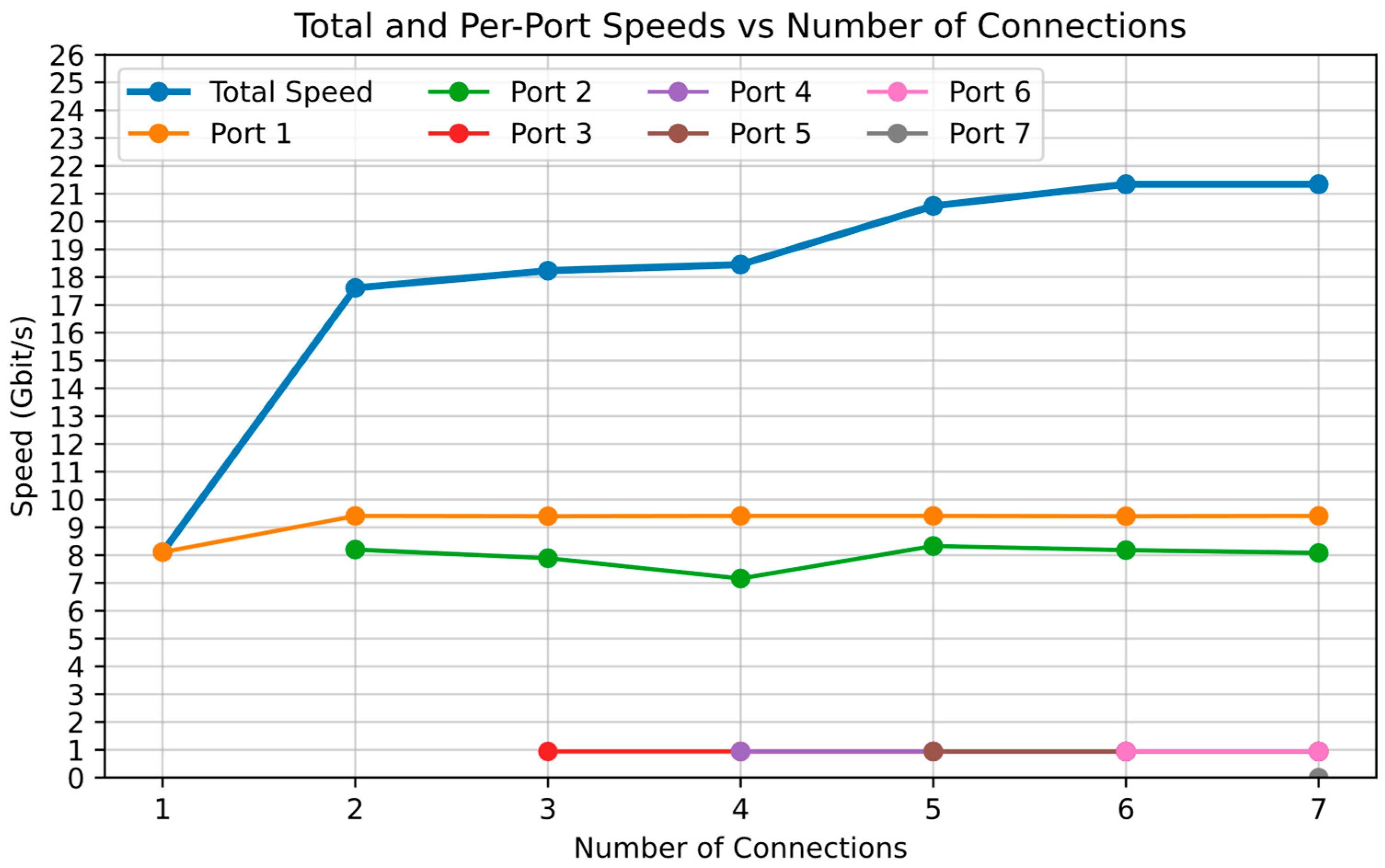
Starting from three simultaneously active connections, at least one port is forced down to 1 Gbit/s (≈0.94 Gbit/s in our measurements), and the number of such downgraded ports grows with each additional active link. In the seven-connection case, only two ports maintain 10G operation, four ports are limited to 1 Gbit/s, and one port fails completely (0 Gbit/s), yet the aggregate throughput remains bounded at about 21.34 Gbit/s despite the nominal 70 Gbit/s capacity of seven 10GBASE-T links. The onset of 1 Gbit/s fallbacks at N ≥ 3 is consistent with the model’s expectation of monotonically increasing aggregated exposure as additional disturbing links become active.
Figure 2 plots the total throughput together with the per-port rates as the number of simultaneously active links
N increases from 1 to 7. The per-port traces also reveal non-monotonic behavior on some interfaces (e.g., port 2 dips at
N = 3–4 and partially recovers at
N = 5), which could reflect the redistribution of alien-crosstalk energy across the bundle and the adaptive equalization/negotiation behavior of commodity PHYs.
Overall, the figure visualizes how severe AXT in dense cabling simultaneously induces speed downgrades, sporadic link loss, and early throughput saturation, even when several ports still report a 10 Gbit/s link. This shows that, under strong alien crosstalk, combined with the auto-negotiation mechanisms of commodity Ethernet hardware, constrains the usable capacity of densely bundled cable installations. Thus, adding more nominal 10 Gbit/s links does not translate into proportional throughput, because several ports are forced to downgrade their speed or temporarily drop the link.
5. Discussion
The experimental results presented directly demonstrate how severe alien crosstalk in densely bundled 10GBASE-T installations limits the usable capacity of widely available Ethernet hardware. As shown in
Table 2 and
Figure 2, the aggregate throughput of seven nominal 10 Gbit/s links saturates at about 21 Gbit/s, with several ports being forced to operate at 1 Gbit/s or failing altogether due to frequent renegotiations.
Figure 2 further reveals that the worst-case ports experience interference levels close to the correction limits of the built-in LDPC codes [
9,
17], while remaining links operate at much lower error rates. A finer explanation of why specific ports degrade earlier would require PHY telemetry such as error counters, SNR margin estimates, or vendor diagnostics. These were not consistently available in our off-the-shelf setup, so we rely on negotiated-rate transitions and sustained throughput as reproducible indicators of reduced margin. These findings confirm that, under strong AXT, the behavior of commodity 10GBASE-T interfaces is dominated by auto-negotiation and error-control mechanisms rather than by the nominal physical-layer capacity of the links.
The absolute throughput values reported here depend on the specific channel margin and implementation details, and therefore may change with cable length, cable category, bundle geometry, and the vendor or PHY firmware. Shorter cables or higher-grade cabling, such as Cat6 or Cat6a, typically provide lower insertion loss and greater headroom, which is expected to shift the onset of rate fallback and the saturation point to higher bundle excitation, meaning more simultaneously active links before degradation. Conversely, longer reaches, or legacy cabling with higher attenuation, are expected to reduce margin and cause earlier fallback and link loss. Despite these quantitative shifts, the key qualitative behavior observed in this work—namely, that increasing the number of simultaneously active links increases overall AXT excitation and can drive some ports into fallback modes, resulting in aggregate throughput saturation—should remain applicable across commodity 10GBASE-T systems. Differences between vendors’ PHYs may affect precise thresholds and the stability of adaptation but not the underlying mechanism that dense bundle excitation increases alien crosstalk exposure and reduces available noise margin.
From an operational perspective, the observed rate fallback and link-loss events suggest that monitoring negotiated link speed and sustained throughput can serve as practical degradation indicators. In SDN-controlled environments, such indicators could be fed into the controller to trigger policy-driven rerouting: moving flows away from affected ports, rebalancing LAG members, or temporarily de-preferencing unstable links. A detailed SDN implementation and evaluation is beyond the scope of this work; however, our measurements help define realistic thresholds and timing characteristics for such control actions.
Although AI/ML methods are increasingly used for network monitoring and control, this study focuses on establishing a reproducible experimental baseline for AXT impact on commodity 10GBASE-T links. We deliberately do not introduce an AI component because the available measurements are limited to endpoint observables: negotiated rate, per-port throughput, and link loss, and do not include raw PHY features, like crosstalk PSD, per-tone SNR, or equalizer/forward error correction state, that are typically required for training and validating reliable ML models. Consequently, adding AI in the current setup would risk overfitting to a narrow set of runs rather than providing a robust, generalizable contribution.
The observed performance degradation underscores that, in high-density cable environments, the robustness of practical 10GBASE-T links can be strongly affected by AXT and by the adaptive behavior of commodity PHYs:
Building on the mitigation and adaptive-processing directions reported in the literature, future work may further explore adaptive interference-aware techniques that adjust their operating parameters to the currently observed coupling conditions. In particular, dynamically configurable approaches that can diagnose interference levels and tune system responses in real time may help maintain stable performance under fluctuating crosstalk exposure [
4,
5,
18].
Integration of Artificial Intelligence (AI): Explore the potential of AI to predict and mitigate the impact of AXT before it affects network integrity. AI models could analyze real-time data to forecast potential crosstalk issues and automatically adjust the network settings to preemptively counteract these disturbances, enhancing both reliability and throughput [
19].
Use of Specialized Hardware: Employing professional or industrial-grade Ethernet cards that allow for detailed control over hardware settings and negotiation protocols might circumvent the limitations encountered with consumer-grade hardware [
6,
11].
An instrumented testbed that exposes richer PHY-level telemetry (e.g., per-tone SNR/PSD estimates, error counters, and adaptation states) could enable data-driven models to predict rate fallback or link loss under dense cabling and to guide configuration choices in deployment.
Enhanced Simulation Tools: Developing or utilizing more sophisticated network simulation tools that can accurately model the impact of AXT without the constraints of physical hardware auto-negotiation could provide deeper insights into the data and transmission methods best suited for high-speed Ethernet environments [
2,
12].
Protocol Development: There is a need for the development of new or modified network protocols that can resist automatic downgrading in the presence of high interference. These protocols should be designed to maintain higher data rates while ensuring data integrity [
8,
10].
Collaboration with Hardware Manufacturers: Engaging with network device manufacturers could lead to the development of customizable Ethernet cards tailored for research and high-performance networking, specifically designed to handle high levels of AXT [
16,
17].
Overall, this discussion links the experimental evidence obtained in this work with the initial objectives stated in the Introduction. By quantifying how alien crosstalk in densely bundled copper cables reduces the effective aggregate throughput of seven nominal 10 Gbit/s links to roughly 30% of their theoretical capacity and pushes some ports close to their error correction limits, we provide a realistic baseline for assessing the robustness of widely available 10GBASE-T deployments. The strategies outlined above build directly on these findings and define concrete directions for future work to improve AXT robustness in dense cabling, as well as to develop experimental platforms and measurement methodologies that can more accurately characterize AXT severity and its impact on link stability.
6. Conclusions
This research has demonstrated that severe AXT can drastically reduce network reliability and data throughput, leading to significant performance degradation in high-density cable environments, which includes interface speed degradation, connection failures, and aggregate rate bottlenecks, as shown in
Figure 2 and
Table 2.
The initial exploration conducted in this study aimed to identify data-coding structures and transmission techniques that remain robust at higher 10GBASE-T speeds in the presence of severe alien crosstalk. However, the experiments revealed several practical challenges that limited the effectiveness of the evaluated approaches. One of the primary issues was the excessive error rate caused by AXT, which triggered the automatic negotiation protocols of the Ethernet cards to significantly downgrade connection speeds. This auto-negotiation response, designed to maintain data integrity under adverse conditions, unfortunately limits the ability to fully test the impact of various data structures and transmission techniques at higher network speeds.
Furthermore, the use of consumer-grade Ethernet cards presented an additional limitation. These cards lack the capability for deep programming and control over specific negotiation protocols and hardware settings. This restriction hinders the ability to customize or bypass standard auto-negotiation processes that could allow for sustained high-speed connections despite high levels of crosstalk interference.