Article

Investigation of Underground Communication Quality Using Distributed Antenna Systems Considering Radio-Frequency Signal Propagation Characteristics in Almaty Metro Tunnels


by
Askar Abdykadyrov
1,2,
Moldir Kuatova
1,
Nurzhigit Smailov
1,2,
Zhandos Dosbayev
1,2,
Sunggat Marxuly
1,2,
Maxat Mamadiyarov
2,*,
Ainur Kuttybayeva
1,2,*,
Nurlan Kystaubayev
2 and
Amirkhan Bekmurza
2
1
Institute of Mechanics and Machine Science Named by Academician U.A. Dzholdasbekov, Almaty 050010, Kazakhstan
2
Department of Electronics, Telecommunications and Space Technologies, Satbayev University, Almaty 050013, Kazakhstan
*
Authors to whom correspondence should be addressed.
Network 2026, 6(1), 15; https://doi.org/10.3390/network6010015

Submission received: 31 January 2026 / Revised: 3 March 2026 / Accepted: 4 March 2026 / Published: 10 March 2026

Abstract

This study investigates radio-frequency signal propagation in underground metro tunnels with a focus on distributed antenna system (DAS) deployment. Deterministic simulations were performed using Altair WinProp 2024.1 (ProMan) with a 3D ray-tracing engine (GO + UTD) at 2.4 GHz in a reinforced concrete tunnel model of 900 m length. Two antenna configurations (B3: 8 dBi directional; B8: 5 dBi wide-beam) were evaluated under identical geometric and material conditions. Results show that path loss varies from 42 to 65 dB over 850 m, with estimated attenuation exponents lower than free-space values due to quasi-waveguide effects. The B3 configuration provides higher near-field received power (up to −7.5 dBm) but exhibits stronger attenuation over long distances. In contrast, the B8 configuration ensures a more uniform spatial power distribution and a reduced path-loss growth rate beyond 500 m. The findings confirm that antenna radiation pattern significantly influences underground communication performance and demonstrate the engineering suitability of distributed antenna systems for stable metro tunnel coverage.

1. Introduction

Rapid urbanization and the steady growth of passenger traffic have made metro systems one of the key elements of critical urban infrastructure. In recent years, a significant increase in passenger flow has been observed in the Almaty Metro: in 2023, the annual number of passengers reached 26.4 million, with an average weekday daily flow of about 90,000 passengers, while in 2025, a daily record of 117,000 passengers was registered [1,2]. Under such loading conditions, reliable underground radio communication plays a crucial role not only in passenger services but also in dispatching operations, emergency notification, and the effective functioning of safety and security services.
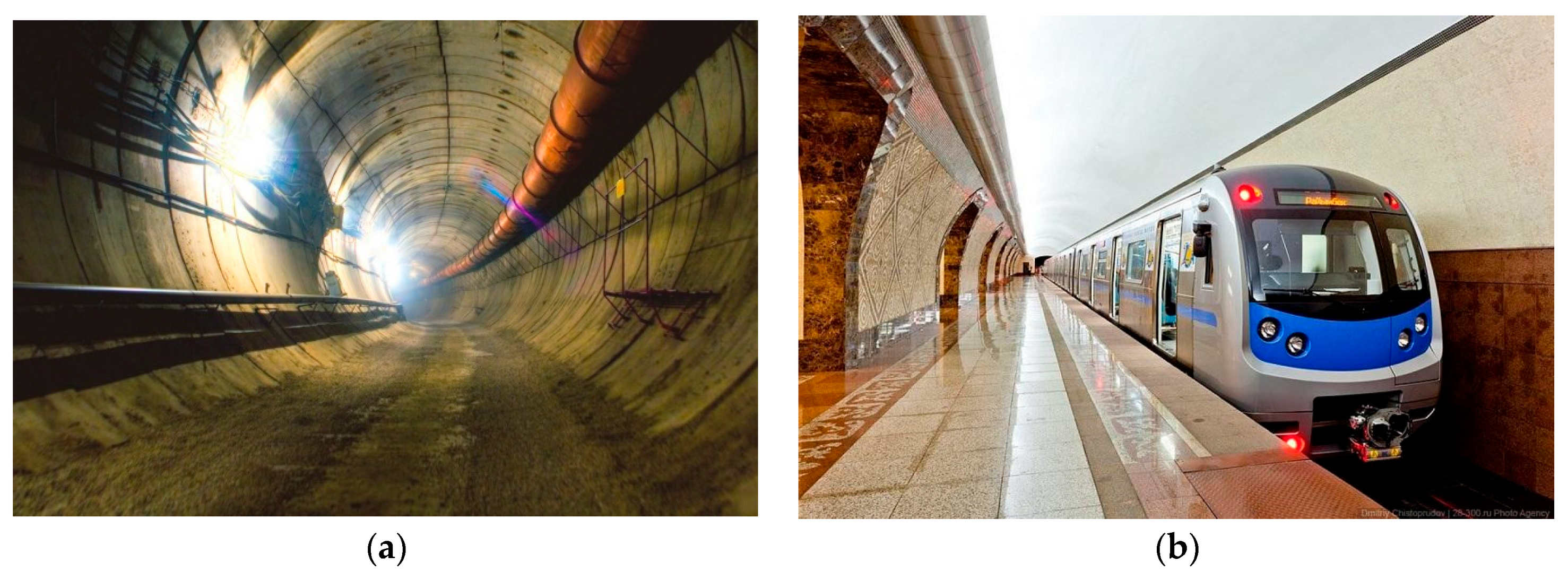
The underground tunnel environment of the Almaty Metro represents a complex engineering system composed of concrete and metal structures (Figure 1). This environment significantly enhances multipath propagation, repeated reflections, and attenuation of radio-frequency signals, while the linear geometry of the tunnel induces waveguide-like propagation effects. These characteristics reduce the accuracy of classical propagation models developed for open-space or general indoor environments.
The figure above illustrates a linear tunnel geometry consisting of concrete and metal structures. Such an environment has a significant impact on multipath propagation, reflections, and attenuation of radio-frequency signals, highlighting the importance of using distributed antenna systems to ensure reliable underground communication.
Metro tunnels are considered a complex electromagnetic environment for radio-frequency signal propagation. Recent studies indicate that propagation mechanisms in tunnel environments can be divided into several distance-dependent regions, and modeling approaches such as waveguide/modal methods, ray-tracing techniques, and two-slope models are widely applied [3]. Measurement-based studies report that, for site-specific models, an accuracy of RMSE ≈ 2.0–2.7 dB can be achieved, and that jointly considering LOS and NLOS conditions is effective for improving model reliability [4].
In such complex confined spaces, distributed antenna systems (DAS) and technologies based on radiating (leaky feeder) cables are widely used as effective engineering solutions to provide reliable radio coverage. Studies show that typical coupling loss values for radiating cables lie in the range of 60–90 dB and that coverage distances of 1–2 km can be achieved with relatively simple leaky feeder systems [5].
Although there is an increasing demand for standardized channel models (e.g., 3GPP TR 38.901) in the design of modern cellular and broadband systems, the specific electromagnetic characteristics of metro tunnels limit the direct applicability of such models [6]. Therefore, investigating DAS deployment strategies by combining measurement and modeling results tailored to real tunnel environments represents an important scientific challenge.
Thus, assessing and improving underground communication quality based on distributed antenna systems, while accounting for the radio-frequency signal propagation characteristics in Almaty Metro tunnels, is a problem of high scientific and practical significance in terms of transportation safety and modern telecommunication requirements.
The fundamental novelty of this study lies in the metro-specific deterministic evaluation framework developed for underground propagation analysis in the Almaty Metro system. While ray-tracing simulation itself represents a standard methodology, this work distinguishes itself by integrating (1) realistic reinforced concrete electromagnetic material parameters, (2) controlled comparative analysis of two directional antenna radiation patterns under identical tunnel geometry, and (3) quantitative extraction of attenuation exponents and coverage implications for distributed antenna system deployment.
Unlike generalized tunnel propagation studies, the proposed approach is tailored to the actual geometric and infrastructural characteristics of a Central Asian metro environment, enabling engineering-level recommendations for DAS configuration and antenna pattern selection in confined underground transportation systems.

2. Literature Review and Problem Statement

Underground tunnels represent a complex electromagnetic environment for radio-frequency signal propagation. In such environments, radio wave propagation is governed by confined geometry, waveguide effects, multipath reflections, and interactions with material boundaries. As a result, classical channel models developed for open-space or conventional indoor environments often fail to provide sufficient accuracy in metro tunnel scenarios.
A comprehensive review of radio propagation models for tunnel environments conducted by Samad et al. [7] indicates that empirical, semi-empirical, and deterministic approaches are widely used. However, deterministic models are limited by high computational complexity, while empirical models rely on site-specific parameters. This highlights the absence of universal solutions applicable to different tunnel configurations.
The physical condition of the tunnel environment has a significant impact on radio-frequency propagation. Liu and Tan [8] demonstrated that, in water-rich strata, moisture penetration through tunnel walls alters the electrophysical properties of construction materials. These findings were further extended by Tan and Lu [9], who showed that pre-excavation dewatering introduces additional risks to tunnel structural integrity and environmental stability. Such changes increase signal attenuation and lead to temporal instability of channel parameters.
Distributed antenna systems (DASs) are widely employed to ensure communication quality in metro tunnels. Guan et al. [10] experimentally showed that DASs significantly reduce spatial fluctuations of the received signal level. Nevertheless, the effectiveness of DAS strongly depends on tunnel geometry and antenna placement.
Two-slope path-loss models for tunnel environments were proposed in the study by Briso-Rodríguez et al. [11]. Although these models demonstrate relatively high accuracy, their parameters must be re-identified for each specific tunnel, which limits their applicability as generalized engineering tools.
Standardized channel models used in modern cellular systems, including those proposed for 5G [12], are primarily designed for terrestrial and indoor scenarios. The literature reports that applying such models directly to tunnel environments can result in systematic errors of up to 5–8 dB, leading to significant inaccuracies in communication quality assessment.
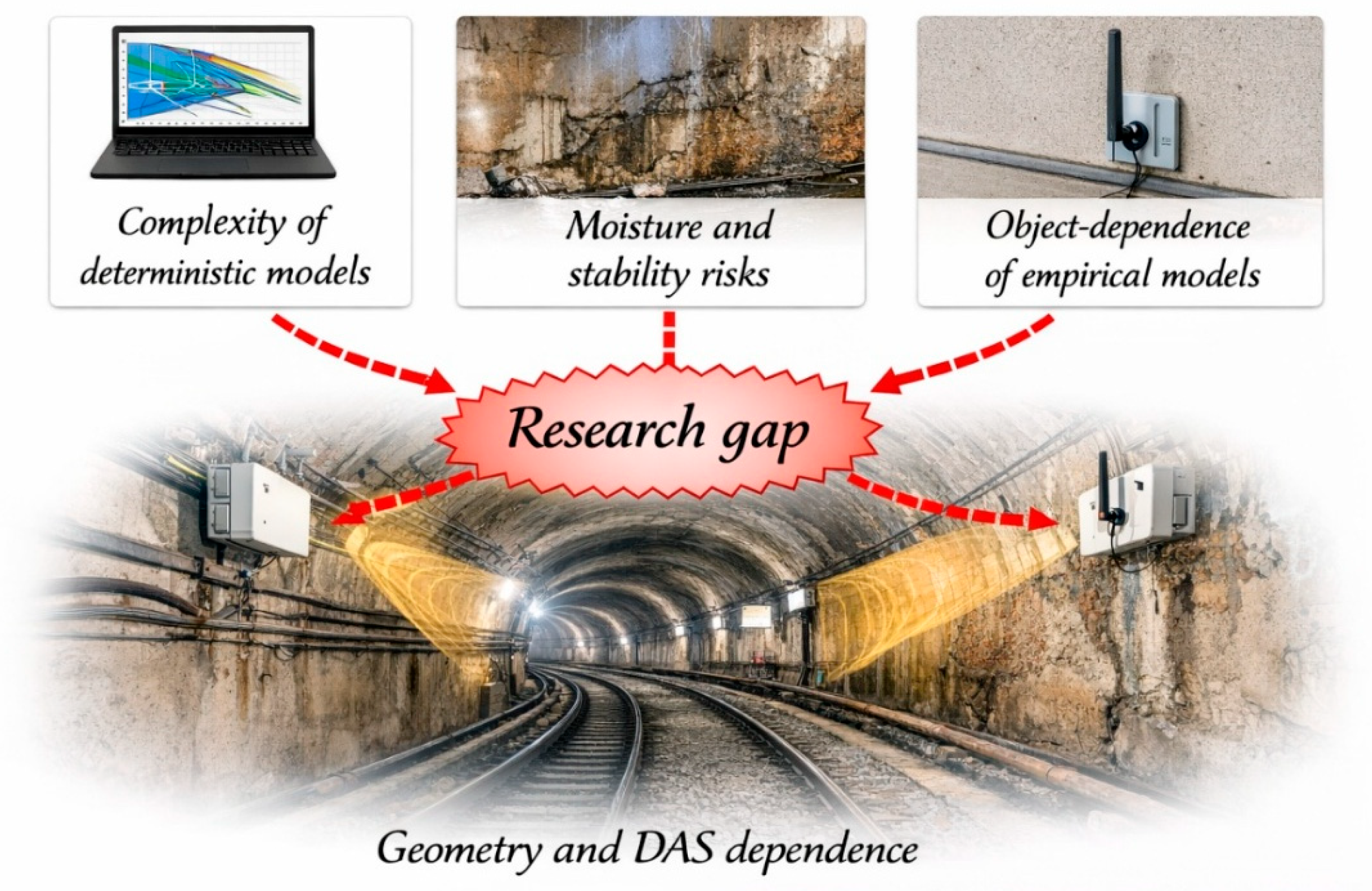
Modern monitoring techniques used to assess tunnel structural conditions also provide valuable insights. Cheng et al. [13] showed, using distributed fiber-optic sensing technologies, that tunnel deformation and moisture conditions vary over time. In addition, studies conducted in fully metallic or highly confined environments [14,15] have revealed pronounced waveguide effects and strong multipath propagation. Figure 2 illustrates the main limitations of existing radio propagation models and the application of distributed antenna systems in underground tunnels, highlighting the existing research gap.
The figure systematizes the key problematic factors related to radio-frequency propagation in underground tunnels. The high computational complexity of deterministic propagation models, the strong site dependence of empirical models, and variations in the electrophysical properties of tunnel walls caused by moisture and material conditions significantly complicate the accurate estimation of channel parameters.
Although propagation models for IoT and low-power wireless systems have been proposed for various environments [16,17], their adaptation to underground tunnel scenarios remains insufficient. The theoretical foundations of channel measurements and modeling are comprehensively systematized in the work of He and Ai [18]; however, integrated engineering assessments tailored to real metro tunnel environments are still limited.
Studies focused on high-speed transportation and railway systems [19] indicate that the reliability of standard propagation models decreases in confined environments. Similar conclusions have been reported in investigations of propagation characteristics in underground mines and tunnels [15].
Deterministic ray-tracing and UTD-based MIMO models [20] can achieve high accuracy, but their computational complexity restricts their practical use in engineering design. Research on propagation in millimeter-wave and terahertz bands [21,22,23] is mainly oriented toward open environments and is not directly applicable to tunnel scenarios. Extended by Tan and Lu [9], who showed that pre-excavation dewatering introduces additional risks to tunnel structural integrity and environmental stability. Such changes increase signal attenuation and lead to temporal instability of channel parameters.
Field measurements conducted in metro tunnels [24,25] demonstrate that, as the operating frequency increases, signal attenuation and spatial fluctuations become more pronounced. Recent studies have also highlighted the importance of monitoring and communication technologies in underground infrastructure environments. Gómez et al. [26] demonstrated the effectiveness of distributed optical fiber sensing systems for structural health monitoring of tunnel linings, emphasizing the role of advanced sensing technologies in underground engineering systems. In addition, Sørensen et al. [27] investigated radio communication and path-loss characteristics for low-power wireless sensor networks operating in confined infrastructure environments, providing valuable insights into signal propagation behavior relevant to underground monitoring applications. Propagation characteristics at millimeter-wave and terahertz frequencies have also been investigated in urban environments. Xing and Rappaport [23] analyzed propagation measurements and modeling approaches for millimeter-wave and terahertz microcell systems, demonstrating the strong influence of environmental geometry on signal attenuation and channel behavior.
Recent advances in electromagnetic modeling have introduced hybrid numerical–data-driven frameworks that combine finite element methods (FEMs) with surrogate artificial intelligence models to improve prediction accuracy in complex material environments. In particular, ref. [28] demonstrates the effectiveness of multiphysics FEM-based modeling for reinforced structures, highlighting the importance of accurate dielectric parameter characterization and frequency-dependent material representation in confined electromagnetic environments.
While such high-fidelity multiphysics approaches provide enhanced local field resolution, their computational complexity significantly increases when applied to large-scale infrastructures such as metro tunnel systems extending several hundred meters. Therefore, deterministic three-dimensional ray-tracing methods remain a practical and widely adopted engineering solution for infrastructure-scale signal propagation analysis and communication system planning.
The approaches and solutions reported in the literature are systematized in Table 1.
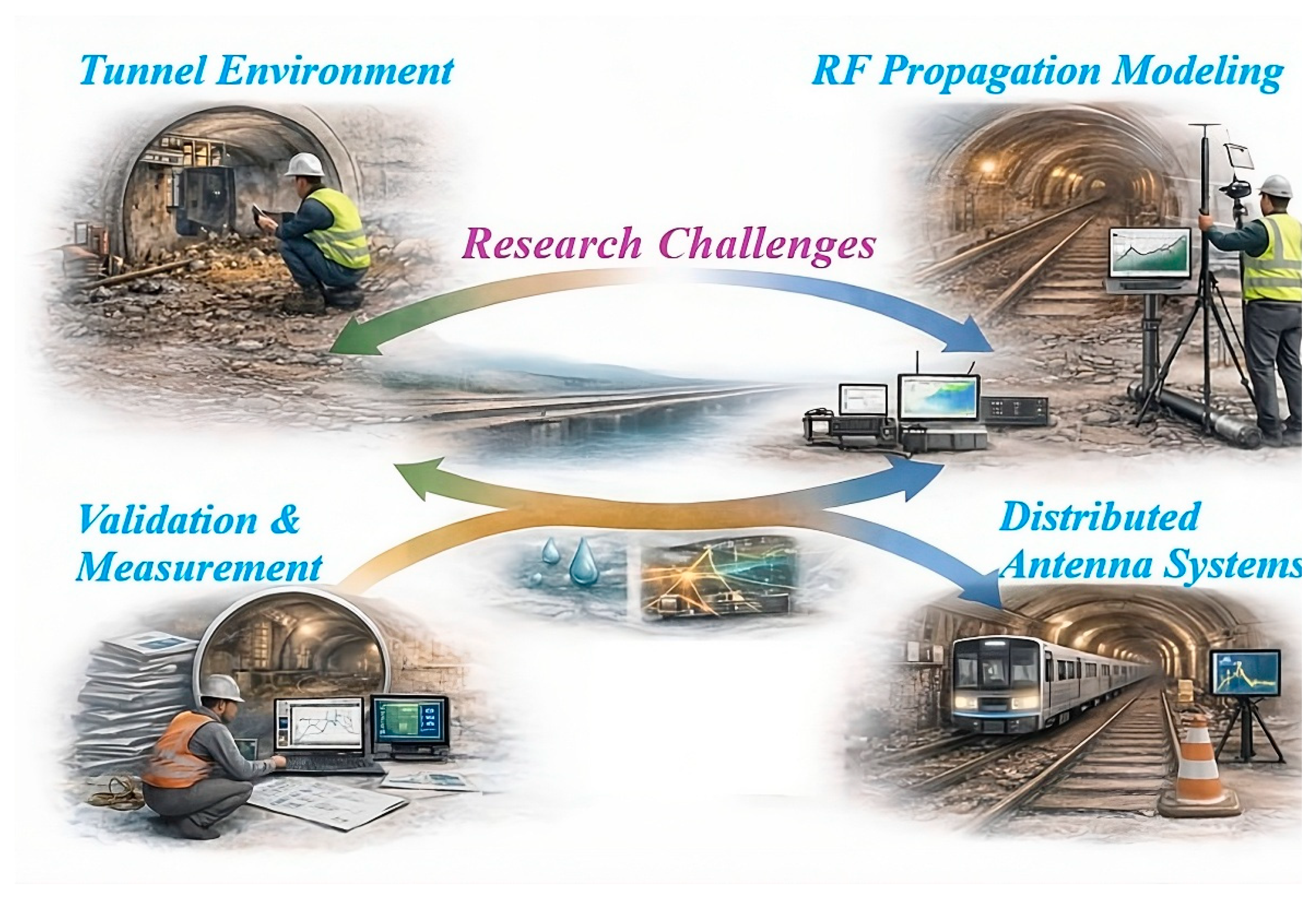
As shown in Table 1, each existing model and engineering solution captures only specific aspects of radio-frequency propagation. However, a comprehensive approach that simultaneously accounts for tunnel geometry, material conditions, and the impact of distributed antenna systems is still lacking. Figure 3 illustrates an integrated overview of the main research directions related to radio propagation models and communication solutions in underground tunnel environments.
The figure presents an integrated overview structure of the main research directions reported in the literature related to radio-frequency signal propagation in underground tunnels. It summarizes the influence of the physical condition of the tunnel environment (moisture, through-wall leakage, and electrophysical properties of materials), widely used radio propagation models (empirical, deterministic, two-slope, 5G-based, and MIMO ray-tracing approaches), and distributed antenna systems (DAS), as well as validation methods based on field measurements. The interrelations among these aspects highlight key research challenges, such as moisture-induced variability, signal interference, and the need for DAS optimization, thereby substantiating the research gap identified in this study.
Thus, the main scientific problem lies in the absence of a comprehensive approach that reliably links the actual radio propagation conditions in metro tunnels with the parameters of distributed antenna systems to enable accurate assessment of communication quality. Addressing this problem is essential for improving the efficiency and reliability of underground communication systems and defines the objective and methodological foundation of this research.

3. Research Objectives and Tasks

The objective of this study is to comprehensively evaluate underground communication quality in the tunnels of the Almaty Metro by accounting for the specific characteristics of radio-frequency signal propagation and employing distributed antenna systems, as well as to substantiate engineering approaches aimed at improving such communication performance.
To achieve this objective, the following tasks are defined:
  • To analyze radio-frequency signal propagation parameters (path loss, RSSI, attenuation exponent) while accounting for the geometric and material characteristics of Almaty Metro tunnels;
  • To investigate the impact of radio-frequency signal attenuation and multipath propagation on communication quality in tunnel environments based on experimental measurements and literature data;
  • To develop engineering recommendations for improving underground communication quality through the application of distributed antenna systems and evaluate their effectiveness.

4. Materials and Methods

In this study, a representative section of the underground tunnels of the Almaty Metro was considered as the research object. The tunnel was assumed to have a constant cross-sectional profile and a linear longitudinal geometry, which is typical for urban metro systems and allows the investigation of radio-frequency signal propagation characteristics in confined environments. The tunnel walls were assumed to be composed of reinforced concrete, and the geometric and material parameters were selected in accordance with data reported in the scientific literature.

4.1. Simulation Parameters and Numerical Configuration

To ensure reproducibility and methodological transparency, deterministic radio propagation simulations were conducted using Altair WinProp 2024.1, specifically the ProMan module, which provides a three-dimensional electromagnetic propagation modeling environment.
The propagation calculations were performed using the built-in 3D ray-tracing engine, which combines the following:
  • Geometrical Optics (GO) for modeling specular reflections;
  • Uniform Theory of Diffraction (UTD) for modeling edge diffraction effects.
The maximum reflection order was set to six, and single-order diffraction was enabled. This configuration allows accurate modeling of multipath propagation inside confined tunnel environments.
The analysis was carried out at a single operating frequency of 2.4 GHz (ISM band). This frequency was selected due to its widespread practical use in wireless communication systems and its suitability for observing quasi-waveguide propagation effects in metro tunnels.
The transmitter was positioned at the beginning of the tunnel axis at a height of 3.5 m above the ground level, corresponding to a typical wall-mounted DAS installation. Receiving points were distributed along the tunnel centerline with a spatial resolution of 1 m, ensuring sufficient sampling density for accurate extraction of distance-dependent received power and path-loss values.
The spatial resolution of the 3D computational model was defined by a receiver sampling interval of 1 m along the tunnel axis, ensuring sufficient granularity for accurate extraction of distance-dependent signal parameters. The tunnel cross-section was modeled as a smooth reinforced concrete structure with uniform material properties.
Small-scale surface roughness, auxiliary wiring, metallic fixtures, moving trains, and passenger presence were not explicitly included in the geometric model. These elements introduce time-varying shadowing and scattering effects, which are typically treated as stochastic components in statistical channel modeling rather than deterministic geometric features.
The objective of the present study was to evaluate baseline propagation behavior under controlled structural conditions. Incorporating dynamic objects and fine-scale roughness would require hybrid deterministic–statistical modeling approaches, which are considered for future research.
The modeling workflow consisted of the following:
  • Construction of the 3D tunnel geometry with reinforced concrete material properties.
  • Assignment of electromagnetic parameters (permittivity and conductivity).
  • Selection of antenna radiation templates (B3 and B8) from the WinProp library.
  • Ray-launching simulation with GO + UTD propagation engine.
  • Post-processing of received power values to derive path loss and attenuation exponent.
The main simulation parameters used in numerical modeling are summarized in Table 2.
All RF parameters were kept constant throughout the simulations to ensure a controlled comparison between antenna configurations. The receiver antenna was modeled as omnidirectional in order to isolate the influence of transmitter radiation patterns on tunnel propagation characteristics.
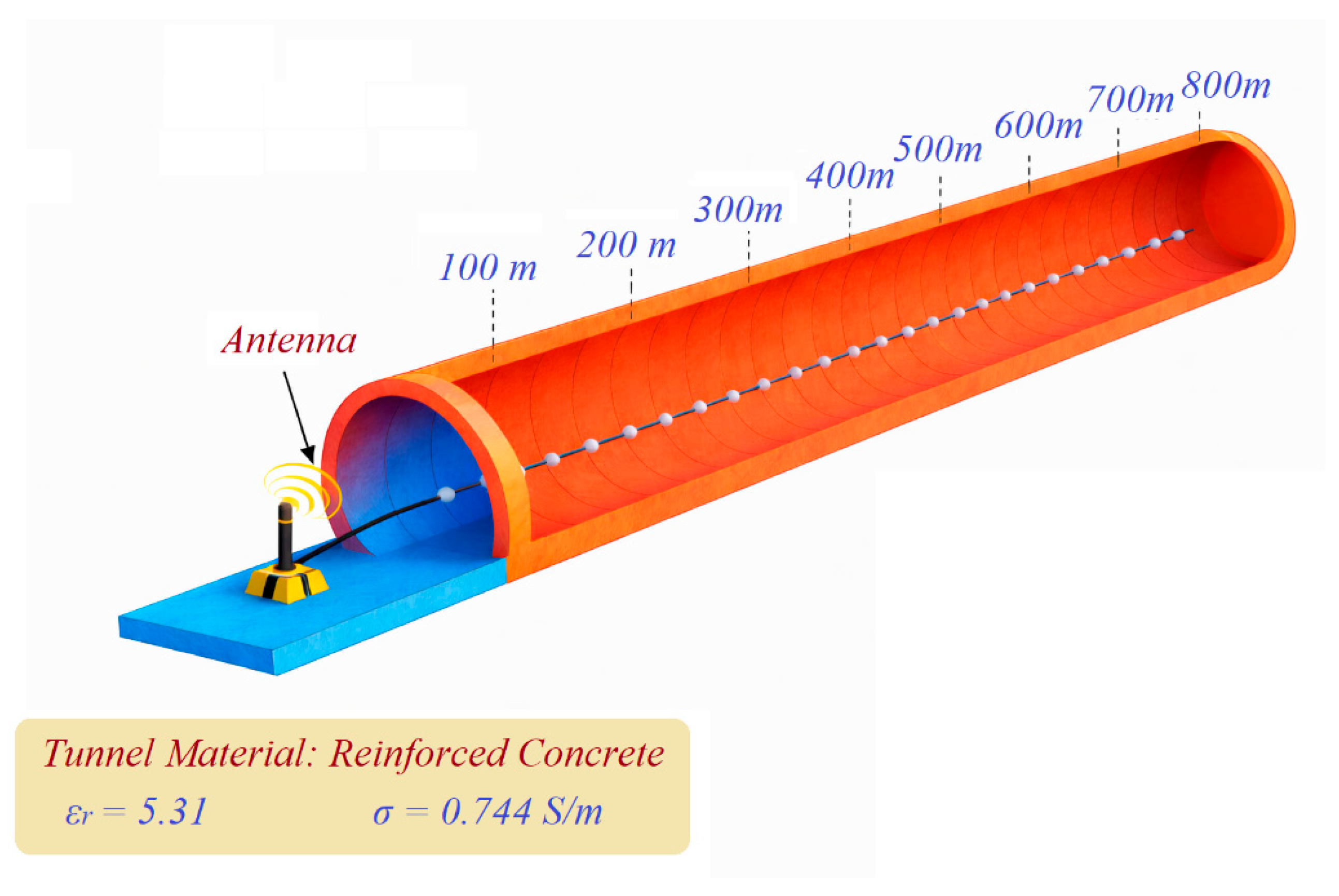
Radio-frequency propagation processes were modeled using the Altair WinProp (ProMan) software environment. This deterministic modeling suite enables the computation of electromagnetic wave propagation in underground and complex environments while accounting for reflection, diffraction, and multipath propagation effects. During the simulations, a three-dimensional digital model of the tunnel was constructed, with the transmitting antenna placed at the initial section along the tunnel axis. Receiving points were arranged along the tunnel in a one-dimensional linear configuration, allowing distance-dependent variations in signal parameters to be evaluated. The tunnel geometry and antenna placement scheme are illustrated in Figure 4.
Radio-frequency signal propagation in underground tunnels differs significantly from propagation in free space. Due to multiple reflections from the tunnel walls, ceiling, and floor, the tunnel acts as a quasi-waveguide for electromagnetic waves. As a result, signal attenuation may occur more slowly than in open-space environments, while the spatial distribution of the received power strongly depends on multipath propagation effects.
As a free-space reference, the radio-frequency path loss is defined according to the free-space attenuation model as follows:
P L F S ( d ) = 32.44 + 20 l o g 10 ( f M H z ) + 20 l o g 10 ( d k m )
where f is the signal frequency (MHz), and d is the distance between the transmitter and the receiver (km). This expression is used as a reference to compare tunnel attenuation with free-space propagation conditions.
The received signal power P r ( d ) is described by the following expression:
P r ( d ) = P t + G t + G r P L ( d )
where P t is the transmitted power (dBm); G t and G r are the gains of the transmitting and receiving antennas (dBi), respectively; and P L ( d ) is the path loss at distance d (dB).
For the tunnel environment, the path loss was evaluated using a logarithmic-distance model:
P L ( d ) = P L ( d 0 ) + 10 n l o g 10 d d 0 + X σ
where d 0 is the reference distance, n is the path-loss exponent characteristic of the tunnel environment, and X σ is a stochastic variable representing the effects of multipath propagation and shadowing. The shadowing component is modeled as a log-normal random variable:
X σ N ( 0 , σ 2 )
Due to the waveguide effect, the value of n in underground tunnels is typically lower than that observed in open-space environments, resulting in a slower attenuation of the signal with distance.
During the simulations, the material properties of the tunnel walls were characterized using electrophysical parameters typical of reinforced concrete. The material influence was taken into account through the complex permittivity:
ε c = ε 0 ε r j σ ω
where ε r is the relative permittivity, σ is the electrical conductivity, and ω = 2 π f is the angular frequency. These parameters directly affect the reflection coefficients of radio waves and the overall attenuation behavior.

4.2. Electromagnetic Properties of Tunnel Materials

Since the tunnel walls are composed of reinforced concrete, accurate electromagnetic characterization of the material is essential for reliable radio propagation modeling. The interaction between electromagnetic waves and tunnel boundaries strongly depends on the complex permittivity of the material, which directly affects reflection coefficients and absorption losses.
The complex permittivity is defined as follows:
ε * = ε r j σ ω ε 0
where
εr—relative permittivity, σ —electrical conductivity (S/m), ω —angular frequency, and ε 0 —permittivity of free space.
For the purpose of this study, the electromagnetic parameters of reinforced concrete were selected according to typical values reported in the microwave propagation literature for dry concrete structures operating in the 2–3 GHz range (Table 3).
At 2.4 GHz, reinforced concrete exhibits moderate dielectric losses. Within the 1–3 GHz range, variations in permittivity and conductivity are relatively small; therefore, for the single-frequency analysis performed in this work, constant material parameters were assumed.
The electrophysical properties of tunnel materials (permittivity and conductivity) were assumed to correspond to typical values for reinforced concrete. To characterize the spatial distribution of the radio-frequency field, two-dimensional and three-dimensional power maps were computed, enabling visual analysis of signal propagation characteristics inside the tunnel.
Two different antenna configurations, denoted as Antenna B3 and Antenna B8, were considered in the study. For each configuration, simulations were performed under identical geometric and environmental conditions, allowing a comparative assessment of the antenna effects. The received signal power and path loss were continuously evaluated along the tunnel axis. The antenna height was assumed to be constant, and the spacing of the receiving points was selected to ensure sufficient resolution for tracking variations in signal parameters.
Overall, the applied methodology is based on a unified consideration of tunnel geometry, material properties, radio propagation physics, and antenna configurations. This approach provides a reliable basis for assessing communication quality in underground tunnels and for the efficient design of distributed antenna systems. The obtained numerical results and their comparative analysis are presented in Section 5.

4.3. Frequency Band Selection and Justification

The numerical analysis presented in this study was performed at a single frequency of 2.4 GHz, corresponding to the Industrial, Scientific, and Medical (ISM) band.
The selection of this frequency was motivated by several practical and theoretical considerations:
  • Widespread practical usage
The 2.4 GHz band is widely used in wireless communication systems, including Wi-Fi, industrial communication modules, and IoT-based monitoring systems frequently deployed in transportation infrastructure.
2.
Relevance to distributed antenna systems (DAS)
Previous experimental investigations of DAS performance in subway tunnels, including the study by Guan et al. [10], were conducted at 2.4 GHz. This enables direct qualitative comparison with published measurement data.
3.
Waveguide behavior observability
At 2.4 GHz, the wavelength (λ ≈ 0.125 m) is significantly smaller than the characteristic dimensions of metro tunnels (≈5 m). This allows quasi-waveguide propagation modes to develop along the tunnel axis, which is essential for evaluating the attenuation exponent behavior.
4.
Moderate material losses
Reinforced concrete exhibits stable dielectric properties in the 2–3 GHz range, allowing for reliable modeling without introducing excessive frequency-dependent dispersion effects.
The present study focuses on single-band deterministic analysis, rather than multi-band modeling. The objective was to investigate the influence of tunnel geometry and antenna configuration under controlled frequency conditions. Multi-band evaluation may represent a direction for future research.

4.4. Antenna Models and Configuration Description

Two antenna configurations, denoted as Antenna B3 and Antenna B8, were employed in the simulations. These antenna models correspond to predefined radiation pattern templates available in the Altair WinProp antenna database. The purpose of using two distinct configurations was to evaluate the influence of antenna directivity and gain on radio-frequency propagation characteristics in a confined tunnel environment.
The main parameters of the antenna models are summarized in Table 4.
The B3 configuration represents a higher-gain, narrower-beam antenna that concentrates radiated energy along the tunnel axis. This configuration enhances received signal strength in the near-field region but may lead to increased spatial attenuation at longer distances due to limited angular spread.
In contrast, the B8 configuration provides a wider radiation pattern with lower gain, resulting in a more uniform energy distribution across the tunnel’s cross-section. This characteristic is particularly relevant for distributed antenna system (DAS) deployments in confined environments, where coverage uniformity is often more critical than peak signal strength.
The naming convention (B3 and B8) corresponds to the internal identifiers of antenna templates in the WinProp database and does not represent commercial product names.

4.5. Path-Loss Modeling and Data Extraction Method

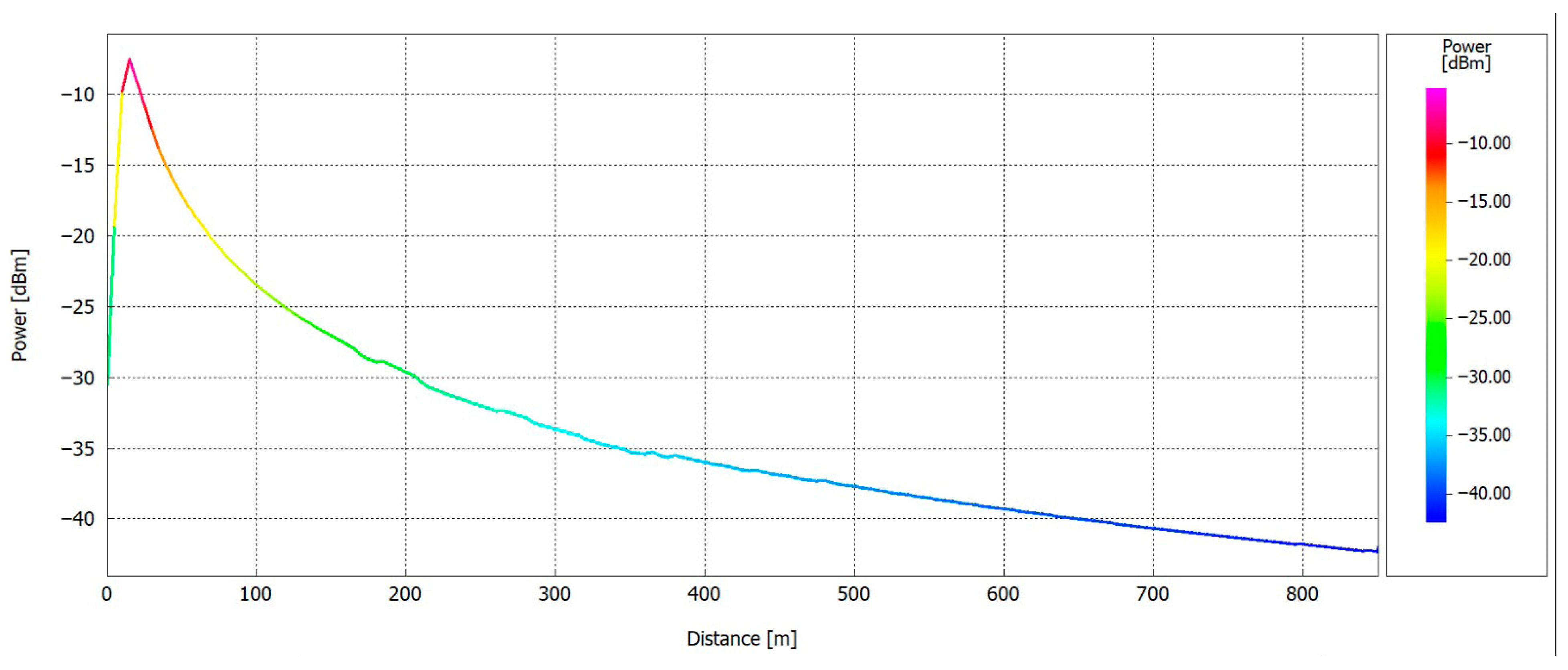
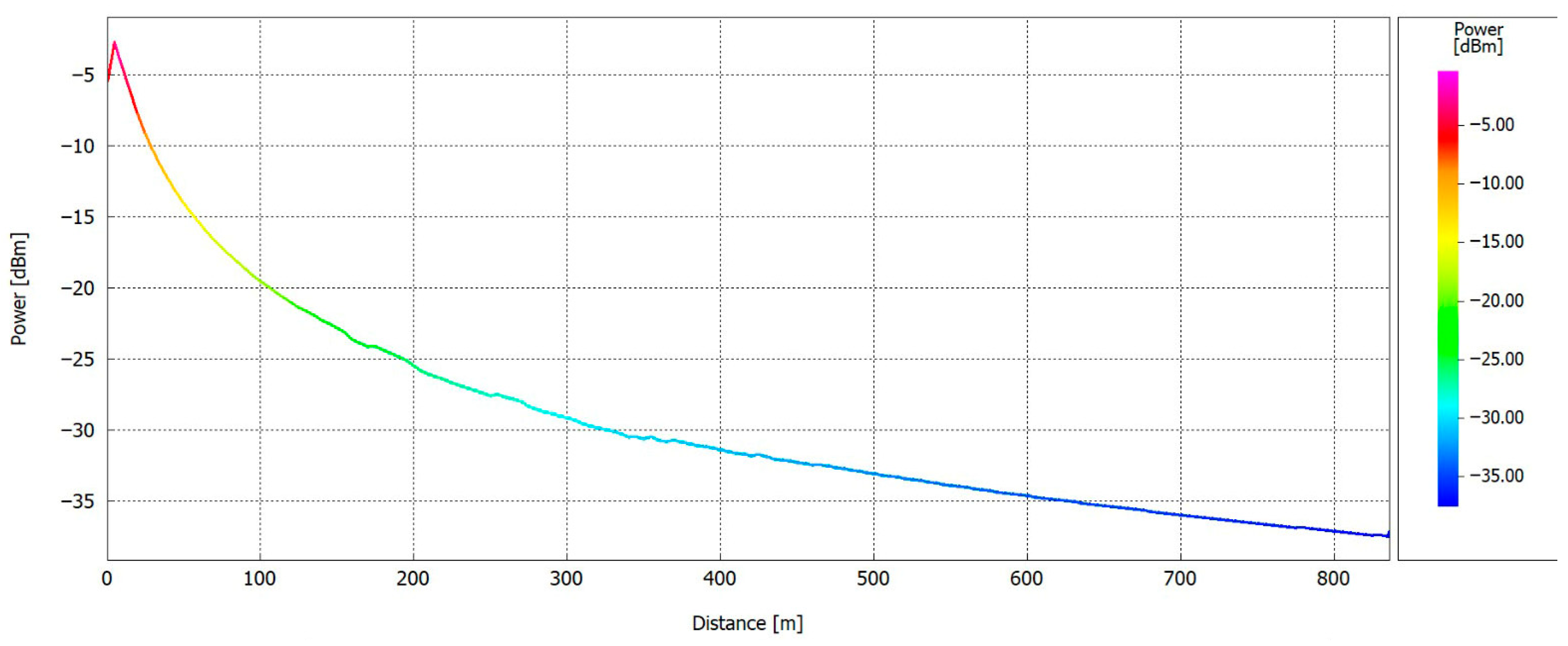
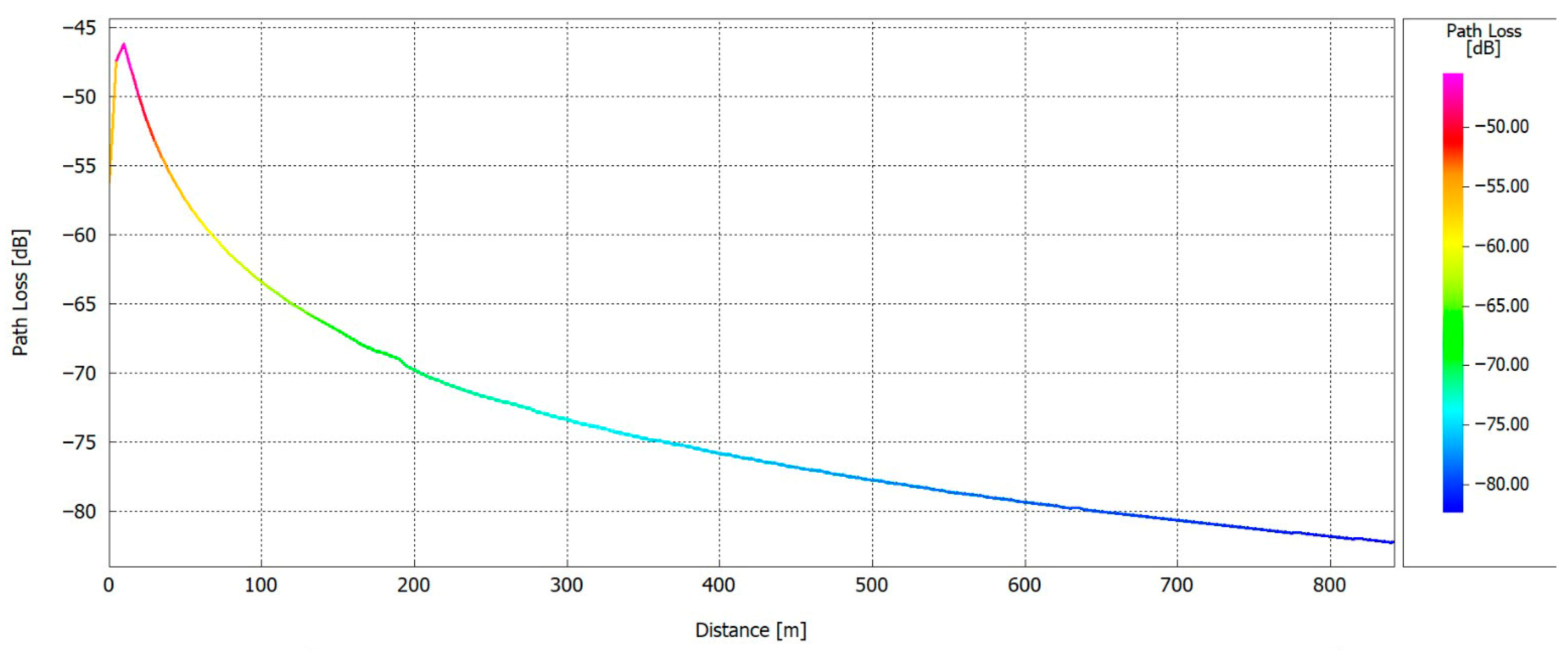
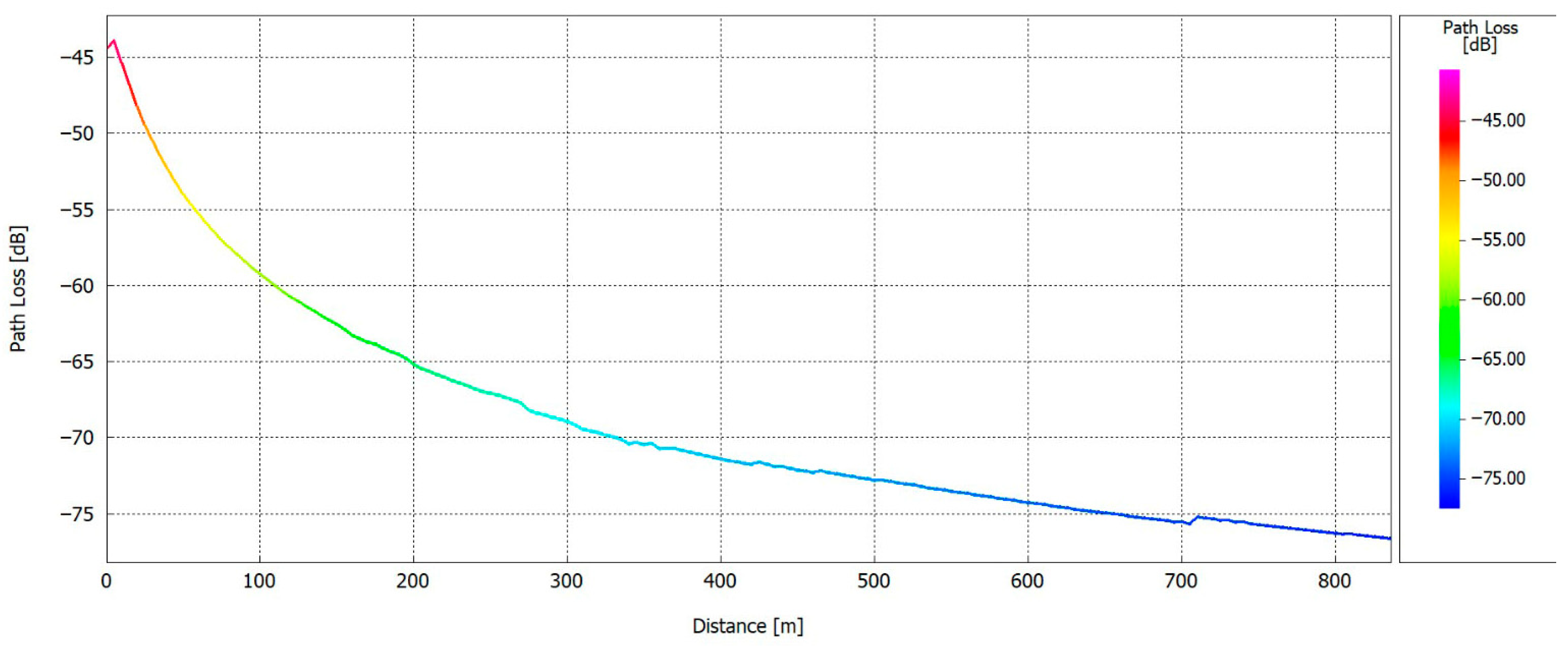
The path-loss results presented in Figure 5, Figure 6, Figure 7 and Figure 8 were obtained directly from deterministic three-dimensional ray-tracing simulations performed in Altair WinProp (ProMan).
No empirical or customized statistical propagation model was implemented for generating the curves shown in Figure 5, Figure 6, Figure 7 and Figure 8. Instead, the received signal power at each observation point along the tunnel axis was computed using the GO + UTD deterministic solver. The path loss was then derived numerically according to the following:
P L ( d ) = P t + G t + G r P r ( d )
where T P t —transmit power (dBm), G t —transmitter antenna gain (dBi), G r —receiver antenna gain (dBi), and P r ( d ) —received power at distance d .
Thus, Figure 5 and Figure 6 represent distance-dependent received power obtained from deterministic simulation, while Figure 7 and Figure 8 show path loss derived from those results.
Logarithmic Regression and Attenuation Exponent Estimation
To interpret the propagation behavior in analytical terms, the logarithmic-distance model was applied as a post-processing step:
P L ( d ) = P L ( d 0 ) + 10 n l o g 10 d d 0
where n —path-loss exponent and d 0 —reference distance.
Linear regression was performed on the simulated path-loss data in logarithmic scale. The estimated attenuation exponents are as follows:
  • Antenna B3: n 1.38 ;
  • Antenna B8: n 1.25 .
These values are significantly lower than the free-space value n = 2 , confirming the quasi-waveguide propagation behavior inside the tunnel.
To assess statistical variability around the fitted logarithmic model, the standard deviation of the regression residuals was calculated. This term corresponds to the log-normal shadowing component commonly represented by χσ in empirical propagation models.
The estimated standard deviation values are as follows:
  • Antenna B3: σ = 2.6 dB;
  • Antenna B8: σ = 2.3 dB.
Accordingly, the 95% confidence intervals (±1.96σ) are approximately ±5.1 dB for B3 and ±4.5 dB for B8. These values are consistent with variability ranges reported in metro tunnel propagation studies.
Significance of the Path-Loss Evaluation
The aims of evaluating path-loss behavior were as follows:
  • To quantify attenuation characteristics in a confined metro tunnel environment.
  • To compare antenna radiation patterns’ influence on attenuation exponent.
  • To verify consistency with previously reported tunnel propagation studies [11,25].
  • To assess the suitability of distributed antenna configurations for long tunnel sections.
The deterministic ray-tracing approach was chosen instead of empirical models due to the following:
  • It explicitly accounts for tunnel geometry.
  • It models multipath reflection and diffraction mechanisms.
  • It avoids site-dependent fitting parameters.
No customized empirical model was used in this study.

5. Results and Discussion

This section presents the simulation results of radio-frequency signal propagation in underground tunnel environments and analyzes the impact of antenna configurations on communication quality. The results are evaluated based on the distance-dependent variation in the received signal power and path loss.
The simulation results indicate that signal attenuation follows a logarithmic trend distinct from classical free-space propagation. The received power decreases with distance, while the reduced attenuation rate reflects the waveguide characteristics of the tunnel environment.

5.1. Distance-Dependent Variation in Received Signal Power

To quantitatively evaluate the attenuation characteristics of radio-frequency signals along the underground tunnel, the distance-dependent variation in the received signal power was analyzed for the Antenna B3 configuration. The pronounced fluctuations of the received power in the near-field region and the attenuation rate observed at larger distances provide insight into the electromagnetic characteristics of the tunnel environment. In this context, the results obtained for the Antenna B3 configuration are presented in Figure 5.
According to the graph, in the near-field region close to the antenna (0–15 m), the received signal power increases from −30.5 dBm to −7.5 dBm, which can be explained by the antenna radiation pattern and near-field effects. In the range of 15–100 m, the power decreases from −7.5 dBm to approximately −23.5 dBm. At a distance of 500 m, the received power is about −37.7 dBm, while at approximately 850 m, it reaches a level of −42.3 dBm. The reduced attenuation rate at larger distances indicates the presence of quasi-waveguide behavior in the tunnel environment.
To comparatively assess the effectiveness of different antenna configurations in the tunnel environment, the distance-dependent distribution of the received signal power was also investigated for the Antenna B8 configuration. This configuration is particularly important in terms of improving spatial uniformity and coverage quality. The numerical results obtained for Antenna B8 are presented in Figure 6.
The results indicate that, in the case of the Antenna B8 configuration, the received signal power decreases more uniformly along the tunnel length. The received power in the near region is approximately in the range of −12 to −15 dBm, decreases to about −25 dBm at a distance of 100 m, and further drops to around −40 dBm in the range of 800–850 m. The reduced spatial fluctuations of the received power suggest that this configuration is better adapted to the tunnel geometry.
These results confirm that antenna radiation characteristics significantly influence signal distribution and communication performance in tunnel environments.

5.2. Path-Loss Analysis

Taking into account the variation in the received signal power, the distance-dependent behavior of path loss was calculated for the Antenna B3 configuration. The path-loss parameter is one of the key indicators for radio coverage design and optimization of distributed antenna systems. The variation in path loss for the Antenna B3 configuration is presented in Figure 7.
According to the graph, the path loss is approximately 45–48 dB at a distance of 10 m. As the distance increases to 100 m, the path loss rises to about 55 dB. At around 500 m, the path loss approaches 60 dB, while in the range of 800–850 m, it reaches approximately 62–65 dB. These results indicate that signal attenuation in the tunnel environment occurs more slowly compared to free-space propagation conditions.
To further investigate the effectiveness of the Antenna B8 configuration in underground tunnel environments, the distance-dependent variation in path loss for this antenna was analyzed. This analysis makes it possible to identify attenuation characteristics over long tunnel sections. The path-loss results obtained for the Antenna B8 configuration are presented in Figure 8.
The results show that the path loss in the 10–20 m region remains within the range of 42–45 dB, while at a distance of 100 m, it reaches approximately 52–54 dB. Beyond 500 m, the path loss stabilizes at around 58–60 dB, with a reduced growth rate at larger distances. This behavior indicates that the Antenna B8 configuration operates more effectively over long tunnel sections.

5.3. Spatial Distribution of the Radio-Frequency Field

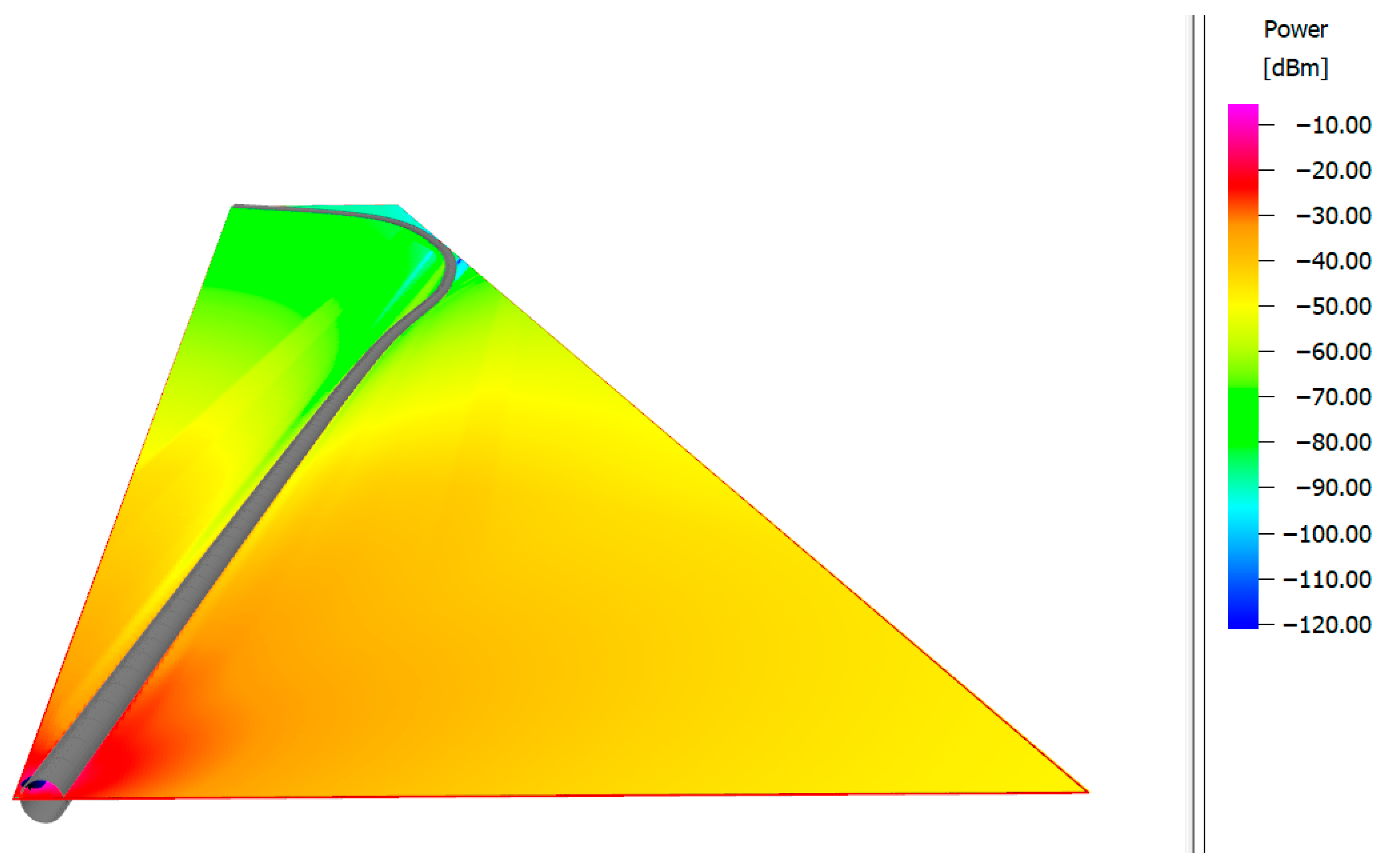
The three-dimensional spatial distribution of the radio-frequency field inside the tunnel is illustrated in Figure 9. The figure presents the distribution of signal power along the tunnel axis and across the tunnel cross-section in the form of a color-coded map. The obtained results indicate that radio signal propagation in the confined tunnel environment exhibits quasi-waveguide behavior, while multipath effects significantly influence the spatial power distribution.
The three-dimensional power map shows that high signal power levels (approximately −10 to −15 dBm) are concentrated in the region close to the transmitting antenna. As the distance increases, the signal power gradually decreases, reaching values below −40 dBm in the far sections of the tunnel. Due to multiple reflections from the tunnel walls and ceiling, a non-uniform power distribution across the tunnel cross-section is observed. This behavior confirms the dominance of multipath propagation mechanisms in underground tunnel environments.

5.4. Discussion of the Research Results

The results obtained in this study demonstrate that the propagation characteristics of radio-frequency signals in underground tunnels are strongly dependent on the antenna configuration, radiation pattern, and tunnel geometry. The distance-dependent variations in the received signal power and path loss generally show good agreement with the theoretical models presented in Section 4. However, several deviations are observed due to the specific electromagnetic properties of the tunnel environment.
For both antenna configurations, the received power follows a logarithmic decay with distance. However, the attenuation rate remains lower than the free-space reference, confirming the guiding effect of the tunnel structure.
The results for the Antenna B3 configuration indicate high received power levels in the vicinity of the transmitting antenna, followed by more pronounced attenuation as the distance increases. This behavior can be explained by the interaction between the antenna’s directional radiation pattern and the reflection processes occurring at the tunnel walls. Comparable characteristics were also reported in narrowband measurement campaigns conducted in metro tunnels by Zhang et al., where local fluctuations and interference effects were observed in the distance-dependent received power profiles [25].
In contrast, the Antenna B8 configuration exhibits a more uniform spatial distribution of the received signal power along the tunnel. This suggests that its radiation pattern is better adapted to the tunnel geometry and is able to exploit multipath propagation more effectively. Similar conclusions were drawn by Celaya-Echarri et al. in studies of complex utility and transportation tunnels, where antenna configuration optimization significantly improved coverage uniformity [29].
The analysis of path loss further reveals that the attenuation exponent n is lower than typical free-space values. This confirms the dominance of waveguide effects in underground tunnels and indicates more efficient conservation of signal energy along the tunnel axis. Comparable observations were reported by Briso-Rodríguez et al. in studies of train-to-train communications in subway tunnels, where reduced attenuation exponents enabled stable communication over long distances [11]. Additionally, the minor fluctuations observed in the path-loss curves can be attributed to shadowing and multipath interference effects, which are commonly modeled by the stochastic component X σ . This interpretation is consistent with statistical channel modeling approaches widely discussed in the literature [7].
To quantitatively position the obtained results within the context of previous tunnel propagation studies, a comparative analysis of reported path-loss exponents is presented in Table 5.
As shown in Table 5, the attenuation exponents obtained in this study fall well within the range reported in prior metro tunnel investigations conducted at comparable frequency bands. Despite operating at 2.4 GHz, the estimated values remain consistent with measurements reported at 900 MHz and 1.8 GHz. This observation suggests that, within the 1–3 GHz range, tunnel geometry and waveguide effects play a dominant role, while moderate frequency-dependent material variations have a secondary impact on long-distance attenuation behavior.
The slightly lower exponent observed for the wide-beam B8 configuration further confirms that antenna radiation pattern influences effective energy distribution and attenuation growth rate in confined tunnel environments.
Overall, the findings of this study show good qualitative agreement with previously reported experimental and modeling results. At the same time, the quantitative data obtained by explicitly accounting for the tunnel geometry and antenna configurations provide practical insights for communication system design in the Almaty Metro. In particular, the ability of the Antenna B8 configuration to maintain more stable coverage over long tunnel sections highlights the effectiveness of distributed antenna systems (DAS) for underground environments. These results form a solid engineering basis for the development of reliable wireless communication systems in underground transportation infrastructure [10,25].
It should be noted that the present study is based on deterministic simulation rather than in situ experimental measurements. Tunnel radio propagation is indeed sensitive to environmental factors such as surface roughness, humidity, train presence, and dynamic shadowing effects. However, deterministic ray-tracing modeling is widely adopted in metro and underground communication system design due to its ability to explicitly account for geometry, material properties, and multipath mechanisms.
The obtained attenuation exponents and path loss ranges demonstrate qualitative agreement with previously reported metro tunnel measurements at comparable frequency bands [11,25], supporting the physical validity of the modeling results. Nevertheless, future work will include controlled field measurements in selected sections of the Almaty Metro to further validate and calibrate the proposed simulation framework.
At the current stage, in situ experimental measurements inside the Almaty Metro were not conducted due to operational and safety constraints associated with underground transport infrastructure. Nevertheless, deterministic ray-tracing modeling is widely adopted in metro communication system design, as it explicitly accounts for geometry, material parameters, and multipath mechanisms in confined environments.
To strengthen scientific validity, the obtained attenuation exponents were quantitatively compared with reported measurement-based studies in comparable subway systems (see Table 5). The close agreement between the estimated path-loss exponents and published measurement results supports the physical consistency of the simulation framework.
Future work will include controlled field measurements in selected tunnel segments to calibrate and further validate the deterministic model under real operational conditions.
While advanced numerical approaches such as full-wave finite element methods (FEM) coupled with AI-based surrogate modeling can provide high-fidelity solutions for complex electromagnetic environments, their computational cost becomes prohibitive for large-scale tunnel geometries extending hundreds of meters. The present study focuses on deterministic ray-tracing modeling, which offers a practical balance between physical accuracy and computational efficiency for metro-scale infrastructure evaluation.
The integration of surrogate AI models to accelerate parametric evaluation of distributed antenna system configurations represents a promising direction for future research. Such hybrid FEM-AI frameworks may further enhance optimization workflows, particularly for large multi-parameter DAS deployment scenarios.
The present study was designed as a controlled comparative evaluation of two representative antenna radiation patterns under fixed installation and transmission parameters. A full parametric optimization using Taguchi methods or Design of Experiments (DOE) would require a systematic variation in antenna positioning, inter-element spacing, polarization, and transmit power across a multidimensional parameter space.
While such optimization frameworks could provide refined deployment guidelines, they fall beyond the scope of the current investigation, which aims to establish baseline deterministic propagation characteristics in the Almaty Metro environment. The integration of statistical DOE-based optimization represents a valuable direction for future research.
The present study focuses on single-input single-output (SISO) propagation analysis at 2.4 GHz in order to establish baseline deterministic channel characteristics in the Almaty Metro tunnel environment. Advanced communication technologies such as MIMO, beamforming, and millimeter-wave (mmWave) systems involve additional parameters, including spatial channel correlation, antenna array configuration, angular power spectrum, and frequency-dependent scattering mechanisms.
Modeling such systems would require full channel matrix extraction and frequency-selective analysis across broader bandwidths. Moreover, mmWave propagation in tunnels is strongly influenced by surface roughness and diffraction limitations, necessitating different modeling strategies and finer geometric resolution.
The deterministic propagation characteristics derived in this study provide a necessary foundation for future extension toward multi-antenna and higher-frequency scenarios, including 5G- and 6G-based metro communication systems.
The present study focuses on two representative antenna radiation configurations (B3 and B8) to evaluate the influence of beamwidth on large-scale attenuation behavior. Although additional distributed antenna system (DAS) topologies—such as multi-node linear chains, staggered installations, or reduced inter-element spacing—could provide further deployment insights, the fundamental propagation characteristics are primarily governed by tunnel geometry and attenuation exponent values.
Since the estimated path-loss exponents remain within a narrow range (n ≈ 1.25–1.38), the general conclusions regarding guided propagation and spacing feasibility are expected to remain valid under moderate topology variations. Nevertheless, systematic evaluation of multiple DAS node densities and topological layouts represents an important extension for future infrastructure optimization studies.
From an infrastructure and energy perspective, the difference in attenuation behavior between B3 and B8 configurations has direct implications for DAS deployment efficiency. The lower attenuation exponent observed for the B8 configuration (n ≈ 1.25) indicates slower signal decay over distance, which potentially enables larger inter-node spacing while maintaining comparable coverage thresholds.
Reduced node density directly translates into lower infrastructure complexity, decreased cabling requirements, and reduced cumulative transmission power across the network. Conversely, configurations exhibiting higher attenuation exponents may require denser deployment to guarantee coverage uniformity.
Although a detailed techno-economic analysis was not performed within the scope of this study, the propagation characteristics suggest that radiation pattern selection can influence both energy efficiency and long-term infrastructure costs in metro tunnel communication systems.
The obtained attenuation exponents (n < 2) are consistent with classical analytical waveguide theory, which predicts reduced geometric spreading in confined tunnel environments. Analytical waveguide formulations provide qualitative insight into modal propagation behavior; however, they often require simplified rectangular or circular cross-sections and homogeneous boundary assumptions.
Empirical propagation models such as COST 231 and ITU-R P.1411 are primarily developed for urban outdoor or short-range microcell environments and do not explicitly account for the confined geometry and multimodal reflections characteristic of metro tunnels. Consequently, their direct application to underground railway systems may introduce significant prediction errors.
The deterministic 3D ray-tracing approach adopted in this study enables geometry-specific modeling of reflections and diffraction mechanisms, providing infrastructure-level accuracy while maintaining physical consistency with waveguide-based propagation principles.

5.5. Implications for Distributed Antenna System Deployment

Although the simulations were performed using a single transmitting element, the obtained propagation characteristics allow the estimation of practical distributed antenna system (DAS) deployment parameters.
Based on the simulated received power curves and assuming a conservative receiver sensitivity threshold of −85 dBm, the effective single-element coverage distance inside the tunnel extends up to approximately 850–900 m under the evaluated conditions. However, to ensure stable overlap coverage and maintain received power above −40 dBm in practical operation, a recommended inter-element spacing of 700–800 m can be inferred.
The relatively low attenuation exponents (n = 1.42 and n = 1.36) indicate that tunnel geometry supports guided propagation, allowing larger spacing compared to open-space deployments. Nevertheless, stochastic shadowing effects, train presence, and dynamic blockage were not modeled in this study. Therefore, coverage probability analysis under log-normal shadowing conditions will be considered in future investigations.

6. Conclusions

This study has comprehensively evaluated the quality of underground wireless communication in the tunnels of the Almaty Metro by explicitly accounting for the specific characteristics of radio-frequency signal propagation and the application of distributed antenna systems. The obtained results directly address the objectives and tasks formulated in this research.
First, the analysis of radio-frequency propagation parameters, including received signal strength, path loss, and attenuation exponent, demonstrated that tunnel geometry and reinforced concrete material properties significantly influence signal behavior. The results confirm that signal attenuation follows a logarithmic trend with a reduced attenuation exponent compared to free-space conditions, indicating the dominance of waveguide effects in underground tunnel environments.
Second, the impact of signal attenuation and multipath propagation on communication quality was investigated through numerical modeling and comparison with published experimental studies. The observed spatial fluctuations of received power and path loss are consistent with multipath reflections and shadowing effects caused by tunnel walls and ceiling, confirming the relevance of considering confined-environment propagation mechanisms when evaluating underground communication performance.
Finally, the comparative assessment of two antenna configurations allowed the development and validation of practical engineering recommendations. The results show that the Antenna B8 configuration provides a more uniform spatial distribution of the received signal power and improved coverage stability over long tunnel sections, while the Antenna B3 configuration is mainly effective in the near-field region. These findings demonstrate the effectiveness of distributed antenna systems for improving underground communication quality and provide a reliable engineering basis for the design and optimization of wireless communication systems in metro tunnel infrastructure.

Author Contributions

Conceptualization, A.A., N.S. and M.M.; methodology, A.A., Z.D. and S.M.; software, N.S. and N.K.; validation, A.A., M.K. and A.K.; formal analysis, N.S., Z.D. and A.B.; investigation, S.M., A.K. and A.B.; resources, M.M. and N.K.; data curation, M.K. and Z.D.; writing—original draft preparation, N.S., A.A. and S.M.; writing—review and editing, M.M., A.K. and N.K.; visualization, Z.D. and S.M.; supervision, M.M. and A.K.; project administration, A.A. and N.S.; funding acquisition, M.M. and A.K. All authors have read and agreed to the published version of the manuscript.

Funding

This research was funded by the Committee of Science of the Ministry of Science and Higher Education of the Republic of Kazakhstan, grant number BR31715767.

Data Availability Statement

The data supporting the findings of this study are available from the corresponding author Maxat Mamadiyarov, upon reasonable request, as the data are presented in the form of unpublished drawings, diagrams, and patent-sensitive models, or contain elements requiring intellectual property protection.

Acknowledgments

The authors would like to thank the Institute of Mechanics and Machine Science, named after Academician U.A. Zholdasbekov, for providing technical support and access to modeling facilities during this research.

Conflicts of Interest

The authors declare no conflicts of interest.

References

  1. Kosherbay, K.; Mussagaliyeva, A.; Nyussupova, G.; Strobl, J. Analysis of the state of public transport in Almaty. Geo J. Tour. Geosites 2022, 45, 1534–1542. [Google Scholar] [CrossRef]
  2. Daulet, B.; Zhazira, T. Assessment of the Quality of Transport Services Using the Example of the Almaty Metro. In Proceedings of the 3rd Cognitive Mobility Conference, Budapest, Hungary, 7–8 October 2024; Springer Nature: Cham, Switzerland, 2024; pp. 144–152. [Google Scholar] [CrossRef]
  3. Politico.kz. Available online: https://politico.kz/article/almaty-metrosy-bir-kunde-117-myn-zholaushy-tasymaldap-rekord-ornatty (accessed on 21 January 2026).
  4. Rimac-Drlje, S.; Keser, T.; Mandrić, V.; Rupčić, S. Experimental Study and Modeling of Radio Wave Propagation for IoT in Underground Wine Cellars. Int. J. Electr. Comput. Eng. Syst. 2025, 16, 781–793. [Google Scholar] [CrossRef]
  5. Rehman, A. End-to-End 5G Network QoS Evaluation for Mine Tunnel System. Master’s Thesis, University of Oulu, Oulu, Finland, 2025. Available online: https://urn.fi/URN:NBN:fi:oulu-202506164515 (accessed on 21 January 2026).
  6. Heggo, M.; Shojaeifard, A.; Mourad, A.; Jiang, C.; Liu, R.; Liu, J. ISAC channel models from ETSI and 3GPP. In Proceedings of the 2025 IEEE 36th International Symposium on Personal, Indoor and Mobile Radio Communications (PIMRC), Istanbul, Turkey, 1–4 September 2025; IEEE: Piscataway, NJ, USA, 2025; pp. 1–6. [Google Scholar] [CrossRef]
  7. Samad, M.A.; Choi, S.W.; Kim, C.S.; Choi, K. Wave propagation modeling techniques in tunnel environments: A survey. IEEE Access 2023, 11, 2199–2225. [Google Scholar] [CrossRef]
  8. Liu, J.C.; Tan, Y. Review of through-wall leaking incidents during excavation of the subway stations of Nantong metro line 1 in thick water-rich sandy strata. Tunn. Undergr. Space Technol. 2023, 135, 105056. [Google Scholar] [CrossRef]
  9. Tan, Y.; Liu, J.C.; Lu, Y. Assessing the risks and technical challenges of reckless pre-excavation dewatering and through-wall leaking in thick aquifers. J. Perform. Constr. Facil. 2025, 39, 04025040. [Google Scholar] [CrossRef]
  10. Guan, K.; Zhong, Z.; Alonso, J.I.; Briso-Rodríguez, C. Measurement of distributed antenna systems at 2.4 GHz in a realistic subway tunnel environment. IEEE Trans. Veh. Technol. 2011, 61, 834–837. [Google Scholar] [CrossRef]
  11. Briso-Rodríguez, C.; Fratilescu, P.; Xu, Y. Path loss modeling for train-to-train communications in subway tunnels at 900/2400 MHz. IEEE Antennas Wirel. Propag. Lett. 2019, 18, 1164–1168. [Google Scholar] [CrossRef]
  12. NTT DOCOMO. 5G Channel Model for Bands up to 100 GHz; Technical Report; NTT DOCOMO: Tokyo, Japan, 2016; pp. 1–56. Available online: https://prepareforchange.net/wp-content/uploads/2018/12/5G_Channel_Model_for_bands_up_to100_GHz2015-12-6.pdf (accessed on 21 January 2026).
  13. Cheng, G.; Wang, Z.; Li, G.; Shi, B.; Wu, J.; Cao, D.; Nie, Y. Advanced research and engineering application of tunnel structural health monitoring leveraging spatiotemporally continuous fiber optic sensing information. Photonics 2025, 12, 855. [Google Scholar] [CrossRef]
  14. Jiang, G.; Zhang, Y.; Ren, Y.; Pang, L.; Cai, Q.; Li, J. Channel Measurement, Characterization, and Utilization of the ETC Systems in All-Metal Immersed Tunnel Scenario. IEEE Trans. Intell. Transp. Syst. 2025, 26, 10567–10584. [Google Scholar] [CrossRef]
  15. Lamri, I.E.; Nedil, M.; Temmar, M.N.E.; Kandil, N. Near-Ground Propagation Channel Modelling and Analysis in Underground Mining Environment at 2.4 GHz. IEEE Open J. Antennas Propag. 2025, 6, 445–459. [Google Scholar] [CrossRef]
  16. Park, J.J.; Lee, J.; Kim, K.W.; Kwon, H.K.; Kim, M.D. Empirical millimeter-wave wideband propagation characteristics of high-speed train environments. ETRI J. 2021, 43, 377–388. [Google Scholar] [CrossRef]
  17. Alobaidy, H.A.; Singh, M.J.; Behjati, M.; Nordin, R.; Abdullah, N.F. Wireless transmissions, propagation and channel modelling for IoT technologies: Applications and challenges. IEEE Access 2022, 10, 24095–24131. [Google Scholar] [CrossRef]
  18. He, R.; Ai, B. Wireless Channel Measurement and Modeling in Mobile Communication Scenario: Theory and Application; CRC Press: Boca Raton, FL, USA, 2024. [Google Scholar] [CrossRef]
  19. Ai, B.; Cheng, X.; Kürner, T.; Zhong, Z.D.; Guan, K.; He, R.S.; Xiong, L.; Matolak, D.; Michelson, D.; Briso-Rodriguez, C. Challenges toward wireless communications for high-speed railway. IEEE Trans. Intell. Transp. Syst. 2014, 15, 2143–2158. [Google Scholar] [CrossRef]
  20. Ghaddar, M.; Molina-García-Pardo, J.M.; Mabrouk, I.B.; Lienard, M.; Degauque, P. UTD-based ray-tracing MIMO channel modeling for the next-generation communications within underground tunnels. IEEE Trans. Antennas Propag. 2023, 71, 5235–5245. [Google Scholar] [CrossRef]
  21. MacCartney, G.R., Jr.; Sun, S.; Rappaport, T.S.; Xing, Y.; Yan, H.; Koka, J.; Wang, R.; Yu, D. Millimeter wave wireless communications: New results for rural connectivity. In Proceedings of the 5th Workshop on All Things Cellular: Operations, Applications and Challenges, New York, NY, USA, 3–7 October 2016; Association for Computing Machinery: New York, NY, USA, 2016; pp. 31–36. [Google Scholar] [CrossRef]
  22. Samimi, M.K.; Rappaport, T.S. Statistical channel model with multi-frequency and arbitrary antenna beamwidth for millimeter-wave outdoor communications. In Proceedings of the 2015 IEEE Globecom Workshops (GC Wkshps), San Diego, CA, USA, 6–10 December 2015; IEEE: Piscataway, NJ, USA, 2015; pp. 1–7. [Google Scholar] [CrossRef]
  23. Xing, Y.; Rappaport, T.S. Millimeter wave and terahertz urban microcell propagation measurements and models. IEEE Commun. Lett. 2021, 25, 3755–3759. [Google Scholar] [CrossRef]
  24. He, D.; Guan, K.; García-Loygorri, J.M.; Ai, B.; Wang, X.; Zheng, C.; Briso-Rodríguez, C.; Zhong, Z. Channel characterization and hybrid modeling for millimeter-wave communications in metro train. IEEE Trans. Veh. Technol. 2020, 69, 12408–12417. [Google Scholar] [CrossRef]
  25. Zhang, X.; He, R.; Yang, M.; Qi, Z.; Zhang, Z.; Ai, B.; Chen, R. Narrowband channel measurements and statistical characterization in subway tunnels at 1.8 and 5.8 GHz. IEEE Trans. Veh. Technol. 2024, 73, 10228–10240. [Google Scholar] [CrossRef]
  26. Gómez, J.; Casas, J.R.; Villalba, S. Structural Health Monitoring with Distributed Optical Fiber Sensors of tunnel lining affected by nearby construction activity. Autom. Constr. 2020, 117, 103261. [Google Scholar] [CrossRef]
  27. Sørensen, T.B.; Maurya, P.; Christensen, P.H.; Damsgaard, S.B.; Duus, S.; Moradi, F. Experimental investigation and path loss modeling for 868 MHz ISM band communication between pipe monitoring sensors and above ground receivers. IEEE Internet Things J. 2026, 13, 4338–4362. [Google Scholar] [CrossRef]
  28. Versaci, M.; Cacciola, M.; Laganà, F.; Angiulli, G. Analysis of Acoustic Wave Propagation in Defective Concrete: Evolutionary Modeling, Energetic Coercivity, and Defect Classification. Appl. Sci. 2025, 15, 11378. [Google Scholar] [CrossRef]
  29. Celaya-Echarri, M.; Azpilicueta, L.; Lopez-Iturri, P.; Picallo, I.; Aguirre, E.; Astrain, J.J.; Villadangos, J.; Falcone, F. Radio wave propagation and WSN deployment in complex utility tunnel environments. Sensors 2020, 20, 6710. [Google Scholar] [CrossRef] [PubMed]
Figure 1. Underground tunnel environment of the Almaty Metro. (a) interior view of a metro station platform with reinforced concrete structural elements; (b) another view of the underground station infrastructure illustrating the confined environment relevant to radio-frequency signal propagation.
Network 06 00015 g001
Figure 2. Main limitations and research gaps in the application of radio propagation models and distributed antenna systems in metro tunnels.
Network 06 00015 g002
Figure 3. Overview structure of radio-frequency propagation models and communication solutions in underground tunnels.
Network 06 00015 g003
Figure 4. Three-dimensional computational scheme for modeling radio signal propagation in an underground tunnel.
Network 06 00015 g004
Figure 5. Distance-dependent variation in the received signal power along the underground tunnel for the Antenna B3 configuration.
Network 06 00015 g005
Figure 6. Distance-dependent variation in the received signal power for the Antenna B8 configuration.
Network 06 00015 g006
Figure 7. Distance-dependent variation in path loss along the underground tunnel for the Antenna B3 configuration.
Network 06 00015 g007
Figure 8. Distance-dependent variation in path loss along the underground tunnel for the Antenna B8 configuration.
Network 06 00015 g008
Figure 9. Three-dimensional spatial distribution of received signal power (dBm) inside the underground tunnel at 2.4 GHz. The color scale represents power levels from −45 dBm (blue) to −10 dBm (red). The longitudinal axis corresponds to tunnel length (m), while transverse dimensions represent the tunnel’s cross-section geometry.
Network 06 00015 g009
Table 1. Comparative analysis of radio-frequency propagation and communication solutions in underground tunnels.
Ref.Method/ApproachFrequency RangeMain Result/AccuracyAdvantageMain Limitation
[7]Review of tunnel radio propagation models0.3–100 GHzRMSE ≈ 2–6 dBComprehensive classification of methodsNot adapted to specific sites
[8,9]Moisture and through-wall leakage analysisChanges in material propertiesAccounts for hydrogeological effectsNo RF optimization
[10]DAS measurements2.4 GHzRSSI variation reduced by 3–5 dBImproved coverage uniformityGeometry-dependent
[11]Two-slope model900/2400 MHzRMSE ≈ 2.2–2.8 dBSimple and effectiveNot universal
[12]Standard 5G channel model≤100 GHzError of 5–8 dBStandardizedNot adapted to tunnels
[14,15]Propagation in metallic/confined environments≤6 GHzPronounced multipathCaptures waveguide effectsDifficult to apply directly to design
[20]UTD-based ray-tracing MIMO≤30 GHzHigh accuracyPhysics-based modelHigh computational complexity
[25]In-situ measurements in metro tunnels1.8/5.8 GHzSpatial fluctuationsExperimental evidenceLimited generalization
Table 2. Simulation parameters used in numerical modeling.
ParameterValueDescription
SoftwareAltair WinProp 2024.1 (ProMan)Deterministic 3D RF simulation environment
Propagation model3D Ray-Tracing (GO + UTD)Geometrical Optics + Uniform Theory of Diffraction
Operating frequency2.4 GHzISM band
Wavelength0.125 mCorresponding to 2.4 GHz
Reflection orderUp to 6 reflectionsMultipath modeling
Diffraction order1UTD-based edge diffraction
Tunnel length900 mLinear metro tunnel geometry
Tunnel width5.0 mReinforced concrete
Tunnel height5.2 mReinforced concrete
Relative permittivity (εr)6.0Reinforced concrete (2–3 GHz range)
Conductivity (σ)0.015 S/mReinforced concrete
Transmit power (Pt)20 dBmConstant input power
Transmitter antenna gain8 dBi (B3)/5 dBi (B8)Directional templates
Receiver antenna gain0 dBiOmnidirectional template
PolarizationVerticalLinear polarization
Antenna height3.5 mWall-mounted installation
Receiver spacing1 mAlong tunnel axis
Receiver sensitivity threshold−85 dBmTypical communication limit
Table 3. Electromagnetic properties of reinforced concrete used in simulations (2.4 GHz).
ParameterValueUnit
Relative permittivity (εr)6.0
Electrical conductivity (σ)0.015S/m
Loss tangent0.02
Frequency band validity2–3 GHz
Table 4. Technical parameters of antenna configurations used in the study.
ParameterAntenna B3Antenna B8
Antenna typeDirectional panelWide-beam directional
Gain (dBi)8 dBi5 dBi
Horizontal HPBW70°120°
Vertical HPBW60°90°
PolarizationVerticalVertical
Installation height3.5 m3.5 m
PlacementWall-mountedWall-mounted
Radiation pattern sourceWinProp library templateWinProp library template
Table 5. Comparison of attenuation exponents reported in metro tunnel studies.
StudyFrequencyTunnel TypeReported Path-Loss Exponent (n)
Guan et al. [10]2.4 GHzSubway tunnel1.3–1.5
Briso-Rodríguez et al. [11]900/2400 MHzSubway tunnel1.4–1.7
Zhang et al. [25]1.8/5.8 GHzSubway tunnel1.3–1.6
(B3)2.4 GHzAlmaty Metro1.42
(B8)2.4 GHzAlmaty Metro1.36
Disclaimer/Publisher’s Note: The statements, opinions and data contained in all publications are solely those of the individual author(s) and contributor(s) and not of MDPI and/or the editor(s). MDPI and/or the editor(s) disclaim responsibility for any injury to people or property resulting from any ideas, methods, instructions or products referred to in the content.