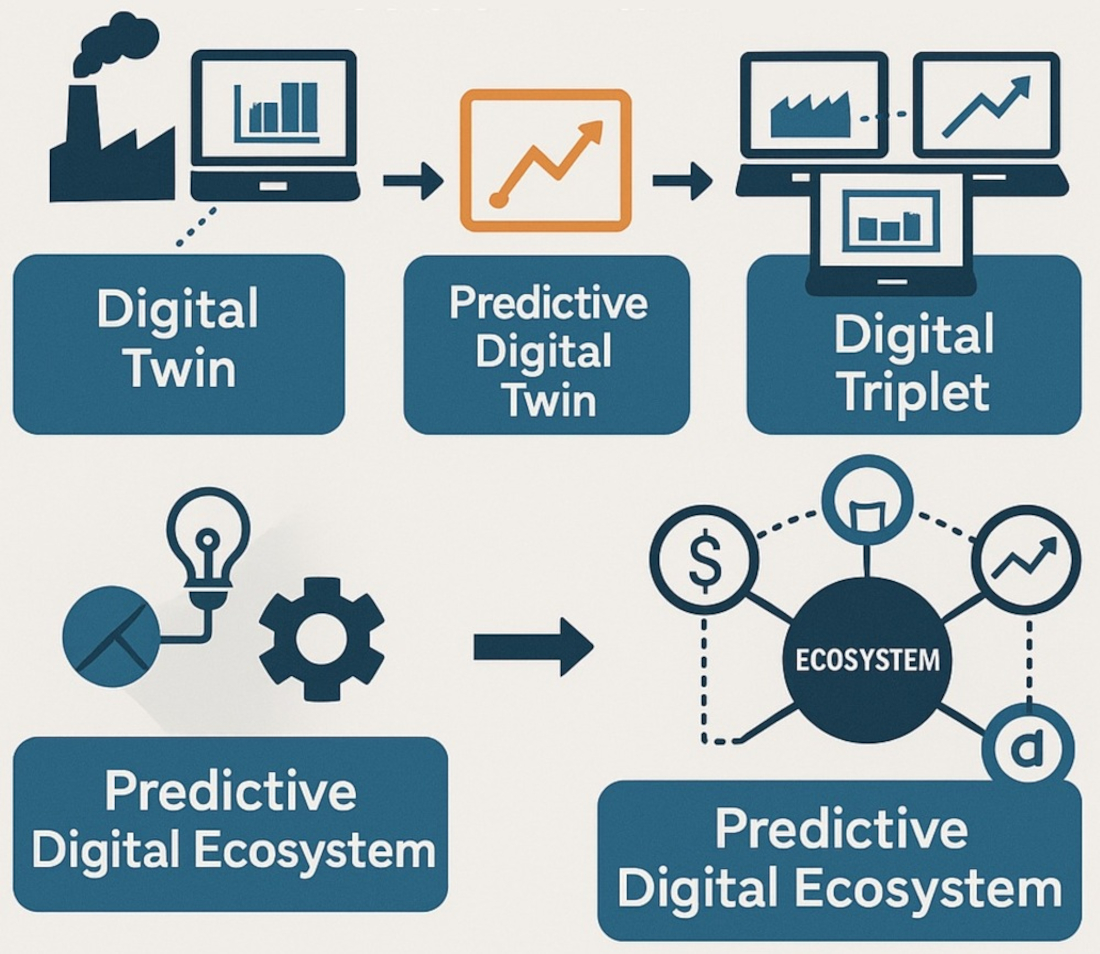

From Digital Twins to Digital Triplets in Economics and Financial Decision-Making


Definition
1. History
2. Conceptual Framework and Applications
Applications in Economic and Financial Decision-Making
3. Ethical, Legal, and Regulatory Considerations
4. Current Challenges
5. Future Directions
6. Conclusions and Prospects
Funding
Informed Consent Statement
Data Availability Statement
Conflicts of Interest
References
- Mrugalska, B.; Wyrwicka, M.K. Towards lean production in industry 4.0. Procedia Eng. 2017, 182, 466–473. [Google Scholar] [CrossRef]
- Batty, M. Digital twins. Environ. Plan. B Urban Anal. City Sci. 2018, 45, 817–820. [Google Scholar] [CrossRef]
- Jiang, Y.; Yin, S.; Li, K.; Luo, H.; Kaynak, O. Industrial applications of digital twins. Philos. Trans. R. Soc. A Math. Phys. Eng. Sci. 2021, 379, 20200360. [Google Scholar] [CrossRef] [PubMed]
- Mane, S.; Dhote, R.R.; Sinha, A.; Thirumalaiswamy, R. Digital twin in the chemical industry: A review. Digit. Twins Appl. 2024, 1, 118–130. [Google Scholar] [CrossRef]
- Guzmán-Torres, J.A.; Domínguez-Mota, F.J.; Alonso Guzmán, E.M.; Tinoco-Guerrero, G.; Tinoco-Ruíz, J.G. A digital twin approach based method in civil engineering for classification of salt damage in building evaluation. Math. Comput. Simul. 2025, 233, 433–447. [Google Scholar] [CrossRef]
- Guo, J.; Lv, Z. Application of Digital Twins in multiple fields. Multimed Tools Appl. 2022, 81, 26941–26967. [Google Scholar] [CrossRef]
- Al-Sartawi, A.M.A.M.; Hussainey, K.; Razzaque, A. The role of artificial intelligence in sustainable finance. J. Sustain. Financ. Investig. 2022, 1–6. [Google Scholar] [CrossRef]
- Paiola, M.; Schiavone, F.; Grandinetti, R.; Chen, J. Digital servitization and sustainability through networking: Some evidences from IoT-based business models. J. Bus. Res. 2021, 132, 507–516. [Google Scholar] [CrossRef]
- van Dinter, R.; Tekinerdogan, B.; Catal, C. Predictive maintenance using digital twins: A systematic literature review. Inf. Softw. Technol. 2022, 151, 107008. [Google Scholar] [CrossRef]
- Flammini, F. Digital twins as run-time predictive models for the resilience of cyber-physical systems: A conceptual framework. Philos. Trans. R. Soc. A Math. Phys. Eng. Sci. 2021, 379, 20200369. [Google Scholar] [CrossRef]
- Zhang, H.; Wang, Z.; Zhang, S.; Qiu, L.; Wang, Y.; Xiang, F.; Pan, Z.; Zhu, L.; Tan, J. Digital-Triplet: A new three entities digital-twin paradigm for equipment fault diagnosis. J. Intell. Manuf. 2024. [Google Scholar] [CrossRef]
- Umeda, Y.; Ota, J.; Kojima, F.; Saito, M.; Matsuzawa, H.; Sukekawa, T.; Takeuchi, A.; Makida, K.; Shirafuji, S. Development of an education program for digital manufacturing system engineers based on ’Digital Triplet’concept. Procedia Manuf. 2019, 31, 363–369. [Google Scholar] [CrossRef]
- Alimam, H.; Mazzuto, G.; Ortenzi, M.; Ciarapica, F.E.; Bevilacqua, M. Intelligent Retrofitting Paradigm for Conventional Machines towards the Digital Triplet Hierarchy. Sustainability 2023, 15, 1441. [Google Scholar] [CrossRef]
- Suleykin, A.; Bakhtadze, N. Digital ecosystems control based on predictive Real-Time situational models. In Advances in Intelligent Systems and Computing; Springer International Publishing: Cham, Switzerland, 2021; pp. 605–623. [Google Scholar] [CrossRef]
- Kshetri, N. The economics of digital twins. Computer 2021, 54, 86–90. [Google Scholar] [CrossRef]
- Bostrom, N. Are we living in a computer simulation? Philos. Q. 2003, 53, 243–255. [Google Scholar] [CrossRef]
- Grieves, M.W. Digital Twins: Past, present, and future. In Digital Twin; Springer International Publishing: Cham, Switzerland, 2023; pp. 97–121. [Google Scholar] [CrossRef]
- Li, L.; Aslam, S.; Wileman, A.; Perinpanayagam, S. Digital twin in Aerospace industry: A gentle Introduction. IEEE Access 2021, 10, 9543–9562. [Google Scholar] [CrossRef]
- Glaessgen, E.H.; Stargel, D.S. The Digital Twin Paradigm for Future NASA and U.S. Air Force Vehicles. In Proceedings of 53rd AIAA/ASME/ASCE/AHS/ASC Structures, Structural Dynamics and Materials Conference, Honolulu, HI, USA, 23–26 April 2012. [Google Scholar]
- Stark, J. Product Lifecycle Management; Springer: London, UK, 2006. [Google Scholar]
- Grieves, M.W. Product lifecycle management: The new paradigm for enterprises. Int. J. Prod. Dev. 2005, 2, 71. [Google Scholar] [CrossRef]
- Braniff, A.; Akundi, S.S.; Liu, Y.; Dantas, B.; Niknezhad, S.S.; Khan, F.; Pistikopoulos, E.N.; Tian, Y. Real-time process safety and systems decision-making toward safe and smart chemical manufacturing. Digit. Chem. Eng. 2025, 15, 100227. [Google Scholar] [CrossRef]
- Tao, F.; Zhang, H.; Liu, A.; Nee, A.Y.C. Digital twin in industry: State-of-the-Art. IEEE Trans. Ind. Inform. 2019, 15, 2405–2415. [Google Scholar] [CrossRef]
- Fuller, A.; Fan, Z.; Day, C.; Barlow, C. Digital Twin: Enabling technologies, challenges and open research. IEEE Access 2020, 8, 108952–108971. [Google Scholar] [CrossRef]
- Grieves, M.W. Virtually intelligent product systems: Digital and physical twins. In Complex Systems Engineering: Theory and Practice; American Institute of Aeronautics and Astronautics, Inc.: Reston, VA, USA, 2019; pp. 175–200. [Google Scholar] [CrossRef]
- Nagy, M.; Figura, M.; Valaskova, K.; Lăzăroiu, G. Predictive maintenance algorithms, artificial intelligence digital twin technologies, and internet of robotic things in Big Data-Driven Industry 4.0 manufacturing systems. Mathematics 2025, 13, 981. [Google Scholar] [CrossRef]
- Crespi, N.; Drobot, A.T.; Minerva, R. The Digital Twin; Springer International Publishing: Cham, Switzerland, 2023. [Google Scholar]
- Aydin, G.; Tezcan, M.; Ozgen, B.; Özkan, T.N. Digital twin and predictive quality solution for insulated glass line. J. Intell. Manuf. 2024, 36, 3543–3567. [Google Scholar] [CrossRef]
- Suleykin, A.; Bakhtadze, N. Control Systems Architecture with a Predictive Identification Model in Digital Ecosystems. In Smart Innovation, Systems and Technologies; Springer: Singapore, 2020; pp. 439–449. [Google Scholar] [CrossRef]
- Pratap, A.; Vi, T.K.; Lee, Y.W.; Sardana, N.; Hsiung, P.A.; Kao, Y.C. A DT framework integrating human and artificial intelligence for power consumption prediction in CNC machining. Int. J. Adv. Manuf. Technol. 2024, 135, 915–938. [Google Scholar] [CrossRef]
- Bamakan, S.M.H.; Far, S.B. Distributed and trustworthy Digital Twin platform based on blockchain and Web3 technologies. Cyber Secur. Appl. 2024, 3, 100064. [Google Scholar] [CrossRef]
- Passas, I. Accounting for Integrity: ESG and Financial Disclosures: The Challenge of Internal Fraud in Management Decision-Making; Hellenic Mediterranean University: Heraklion, Greece, 2023. [Google Scholar] [CrossRef]
- Kagias, P.; Garefalakis, A.; Passas, I.; Kyriakogkonas, P.; Sariannidis, N. Whistleblowing based on the three lines model. Adm. Sci. 2024, 14, 83. [Google Scholar] [CrossRef]
- Kalaboukas, K.; Kiritsis, D.; Arampatzis, G. Governance framework for autonomous and cognitive digital twins in agile supply chains. Comput. Ind. 2023, 146, 103857. [Google Scholar] [CrossRef]
- Huang, C.; Liu, S. Securing the future of industrial operations: A blockchain-enhanced trust mechanism for digital twins in the industrial Internet of Things. Int. J. Comput. Appl. 2024, 46, 338–347. [Google Scholar] [CrossRef]
- Ragazou, K.; Passas, I.; Garefalakis, A.; Zopounidis, C. ESG in Construction Risk Management: A Strategic Roadmap for Controlling Risks and Maximizing Profits. In Financial Evaluation and Risk Management of Infrastructure Projects; Advances in public policy and administration (APPA) book series; IGI Global: Hershey, PA, USA, 2023; pp. 58–81. [Google Scholar] [CrossRef]
- Ragazou, K.; Passas, I.; Garefalakis, A.; Galariotis, E.; Zopounidis, C. Big Data Analytics Applications in Information Management Driving Operational Efficiencies and Decision-Making: Mapping the Field of Knowledge with Bibliometric Analysis Using, R. Big Data Cogn. Comput. 2023, 7, 13. [Google Scholar] [CrossRef]
- Gichane, M.M.; Byiringiro, J.B.; Chesang, A.K.; Nyaga, P.M.; Langat, R.K.; Smajic, H.; Kiiru, C.W. Digital Triplet approach for Real-Time monitoring and control of an elevator security system. Designs 2020, 4, 9. [Google Scholar] [CrossRef]
- Maravelaki, A.; Zopounidis, C.; Lemonakis, C.; Passas, I. Corporate governance as a tool for fraud mitigation. In Machine Learning Applications for Accounting Disclosure and Fraud Detection; Advances in finance, accounting, and economics book series; IGI Global Scientific Publishing: Hershey, PA, USA, 2021; pp. 1–15. [Google Scholar] [CrossRef]
- Cheliatsidou, A.; Sariannidis, N.; Garefalakis, A.; Passas, I.; Spinthiropoulos, K. Exploring Attitudes towards Whistleblowing in Relation to Sustainable Municipalities. Adm. Sci. 2023, 13, 199. [Google Scholar] [CrossRef]
- Kagias, P.; Sariannidis, N.; Garefalakis, A.; Passas, I.; Kyriakogkonas, P. Validating the whistleblowing maturity model using the Delphi method. Adm. Sci. 2023, 13, 120. [Google Scholar] [CrossRef]
- Yiannoulis, Y.; Vortelinos, D.; Passas, I. Exploring Audit Opinions: A Deep Dive into Ratios and Fraud Variables in the Athens Exchange. Account. Audit. 2025, 1, 3. [Google Scholar] [CrossRef]
- Tiwari, S.; Wee, H.M.; Daryanto, Y. Big data analytics in supply chain management between 2010 and 2016: Insights to industries. Comput. Ind. Eng. 2018, 115, 319–330. [Google Scholar] [CrossRef]
- Papademetriou, C.; Ragazou, K.; Garefalakis, A.; Passas, I. Green Human Resource Management: Mapping the Research Trends for Sustainable and Agile Human Resources in SMEs. Sustainability 2023, 15, 5636. [Google Scholar] [CrossRef]
- Stufano Melone, M.R.; Borgo, S.; Camarda, D. Digital Twins Facing the Complexity of the City: Some Critical Remarks. Sustainability 2025, 17, 3189. [Google Scholar] [CrossRef]
- Shahat, E.; Hyun, C.T.; Yeom, C. City Digital Twin Potentials: A Review and Research Agenda. Sustainability 2021, 13, 3386. [Google Scholar] [CrossRef]
- Okonta, E.D.; Israel, G.C.; Okeke, F.O. Scientometric review and visualisation of City Information Modeling (CIM) trends and future directions. Discov. Cities 2025, 2, 28. [Google Scholar] [CrossRef]
- Vardopoulos, I.; Papoui-Evangelou, M.; Nosova, B.; Salvati, L. Smart ‘Tourist Cities’ Revisited: Culture-Led Urban Sustainability and the Global Real Estate Market. Sustainability 2023, 15, 4313. [Google Scholar] [CrossRef]
- Zopounidis, C.; Garefalakis, A.; Lemonakis, C.; Passas, I. Environmental, social and corporate governance framework for corporate disclosure: A multicriteria dimension analysis approach. Manag. Decis. 2020, 58, 2473–2496. [Google Scholar] [CrossRef]
- Modgil, S.; Gupta, S.; Sivarajah, U.; Bhushan, B. Big data-enabled large-scale group decision making for circular economy: An emerging market context. Technol. Forecast. Soc. Change 2021, 166, 120607. [Google Scholar] [CrossRef]
- Fakhraian, E.; Semanjski, I.; Semanjski, S.; Aghezzaf, E.-H. Towards safe and efficient unmanned aircraft system operations: Literature review of digital twins’ applications and European Union regulatory compliance. Drones 2023, 7, 478. [Google Scholar] [CrossRef]
- André, P.; Azzi, F.; Cardin, O. Heterogeneous communication middleware for digital twin based cyber manufacturing systems. In Studies in Computational Intelligence; Springer International Publishing: Berlin/Heidelberg, Germany, 2019; pp. 146–157. [Google Scholar] [CrossRef]
- Albrecht, J.P. How the GDPR Will Change the World. Eur. Data Prot. Law Rev. 2016, 2, 287–289. [Google Scholar] [CrossRef]
- Awan, U.; Shamim, S.; Khan, Z.; Zia, N.U.; Shariq, S.M.; Khan, M.N. Big data analytics capability and decision-making: The role of data-driven insight on circular economy performance. Technol. Forecast. Soc. Change 2021, 168, 120766. [Google Scholar] [CrossRef]
- Ai, L.; Laxman, K.C.; Elbatanouny, E.; Henderson, A.; Ziehl, P. Assisting Load Rating Testing of Precast Reinforced Concrete Bridge Slab through Digital Twins and Field Monitoring Data. J. Test. Eval. 2024, 52, 1926–1938. [Google Scholar] [CrossRef]
- Roco, M.C. Possibilities for global governance of converging technologies. J. Nanoparticle Res. 2007, 10, 11–29. [Google Scholar] [CrossRef]
- Shokri, R.; Shmatikov, V. Privacy-preserving deep learning. In Proceedings of the ACM Conference on Computer and Communications Security, Association for Computing Machinery, New York, NY, USA, 12 October 2015; pp. 1310–1321. [Google Scholar] [CrossRef]
- Huang, P.H.; Kim, K.H.; Schermer, M. Ethical Issues of Digital Twins for Personalized Health Care Service: Preliminary Mapping Study. J. Med. Internet Res. 2021, 24, e33081. [Google Scholar] [CrossRef]
- Tikkinen-Piri, C.; Rohunen, A.; Markkula, J. EU General Data Protection Regulation: Changes and implications for personal data collecting companies. Comput. Law Secur. Rev. 2017, 34, 134–153. [Google Scholar] [CrossRef]
- Voigt, P.; Von Dem Bussche, A. The EU General Data Protection Regulation (GDPR); Springer: Cham, Switzerland, 2024. [Google Scholar] [CrossRef]
- Caruccio, L.; Desiato, D.; Polese, G.; Tortora, G.; Zannone, N. A decision-support framework for data anonymization with application to machine learning processes. Inf. Sci. 2022, 613, 1–32. [Google Scholar] [CrossRef]
- Talati, N.D.V. Artificial Intelligence and unintended bias: A call for responsible innovation. Int. J. Sci. Res. Arch. 2021, 2, 298–312. [Google Scholar] [CrossRef]
- Tollenaar, N.; Van Der Heijden, P.G.M. Which method predicts recidivism best?: A comparison of statistical, machine learning and data mining predictive models. J. R. Stat. Soc. Ser. A (Stat. Soc.) 2012, 176, 565–584. [Google Scholar] [CrossRef]
- Rudin, C.; Radin, J. Why are we using black box models in AI when we don’t need to? A lesson from an explainable AI competition. Harv. Data Sci. Rev. 2019, 1, 1–9. [Google Scholar] [CrossRef]
- Milosevic, Z.; Van Schalkwyk, P. Towards responsible digital twins. In Lecture Notes in Business Information Processing; Springer Nature: Cham, Switzerland, 2024; pp. 123–138. [Google Scholar] [CrossRef]
- Kauffman, M.; Soares, M.N.; Long, T.; Harris, L.; Cugula, J.R.G.; Manzato, W.; Zhang, K. Enhancing Intellectual Property Identification and Valuation in Manufacturing Through Digital Twins. Soc. Sci. Res. Netw. 2024. [Google Scholar] [CrossRef]
- Wang, K.J.; Lee, T.L.; Hsu, Y. Revolution on digital twin technology—A patent research approach. Int. J. Adv. Manuf. Technol. 2020, 107, 4687–4704. [Google Scholar] [CrossRef]
- Ashouri, S.; Mention, A.-L.; Smyrnios, K.X. Anticipation and analysis of industry convergence using patent-level indicators. Scientometrics 2021, 126, 5727–5758. [Google Scholar] [CrossRef]
- Teller, M. Legal aspects related to digital twin. Philos. Trans. R. Soc. A Math. Phys. Eng. Sci. 2021, 379, 20210023. [Google Scholar] [CrossRef]
- Gudiño-Rosero, J.; Grandi, U.; Hidalgo, C.A. Large Language Models (LLMs) as Agents for Augmented Democracy. Comput. Soc. 2024, 382, 20240100. [Google Scholar] [CrossRef]
- De Kerckhove, D. The personal digital twin, ethical considerations. Philos. Trans. R. Soc. A Math. Phys. Eng. Sci. 2021, 379, 20200367. [Google Scholar] [CrossRef]
- Abraham, R.; Schneider, J.; Brocke, J.V. Data governance: A conceptual framework, structured review, and research agenda. Int. J. Inf. Manag. 2019, 49, 424–438. [Google Scholar] [CrossRef]
- Piroumian, V. Digital Twins: Universal Interoperability for the Digital Age. Computer 2021, 54, 61–69. [Google Scholar] [CrossRef]
- Klar, R.; Arvidsson, N.; Angelakis, V. Digital twins’ maturity: The need for interoperability. IEEE Syst. J. 2023, 18, 713–724. [Google Scholar] [CrossRef]
- Eriksson, K.; Markussen, C. Quality Assurance of Digital Twins. In Proceedings of the ASME 2023 42nd International Conference on Ocean, Offshore and Arctic Engineering. Volume 1: Offshore Technology, Melbourne, Australia, 11–16 June 2023; V001T01A020. ASME: New York, NY, USA, 2023. [Google Scholar] [CrossRef]
- Jia, W.; Wang, W.; Zhang, Z. From simple digital twin to complex digital twin Part I: A novel modeling method for multi-scale and multi-scenario digital twin. Adv. Eng. Inform. 2022, 53, 101706. [Google Scholar] [CrossRef]
- Nobar, M.; Keller, J.; Rupenyan, A.; Khosravi, M.; Lygeros, J. Guided Bayesian Optimization: Data-Efficient controller tuning with digital Twin. IEEE Trans. Autom. Sci. Eng. 2024, 22, 11304–11317. [Google Scholar] [CrossRef]
- Su, M.; Zhang, Z.; Zhu, Y.; Zha, D. Data-Driven Natural Gas Spot Price Forecasting with Least Squares Regression Boosting Algorithm. Energies 2019, 12, 1094. [Google Scholar] [CrossRef]
- Machchhar, R.J.; Toller, C.N.K.; Bertoni, A.; Bertoni, M. Data-driven value creation in Smart Product-Service System design: State-of-the-art and research directions. Comput. Ind. 2022, 137, 103606. [Google Scholar] [CrossRef]
- Dietz, M.; Vielberth, M.; Pernul, G. Integrating digital twin security simulations in the security operations center. In Proceedings of the 17th International Conference on Availability, Reliability and Security, Vienna, Austria, 23–26 August 2022; Association for Computing Machinery: New York, NY, USA, 2020. [Google Scholar] [CrossRef]
- De Azambuja, A.J.G.; Giese, T.; Schützer, K.; Anderl, R.; Schleich, B.; Almeida, V.R. Digital Twins in Industry 4.0—Opportunities and challenges related to Cyber Security. Procedia CIRP 2024, 121, 25–30. [Google Scholar] [CrossRef]
- Lyytinen, K.; Weber, B.; Becker, M.C.; Pentland, B.T. Digital twins of organization: Implications for organization design. J. Organ. Des. 2023, 13, 77–93. [Google Scholar] [CrossRef]
- Broo, D.G.; Schooling, J. Digital twins in infrastructure: Definitions, current practices, challenges and strategies. Int. J. Constr. Manag. 2021, 23, 1254–1263. [Google Scholar] [CrossRef]
- Clark, G.L.; Feiner, A.; Viehs, M. From the stockholder to the stakeholder: How sustainability can Drive financial Outperformance. SSRN Electron. J. 2014. [Google Scholar] [CrossRef]
- De Araujo Góes, H.A.; Fatima, G.; De Oliveira Santos Jhunior, R.; Boaventura, J.M.G. Managing for stakeholders towards corporate environmental sustainability. Corp. Soc. Responsib. Environ. Manag. 2023, 30, 1561–1572. [Google Scholar] [CrossRef]
- Harrison, J.S.; Wicks, A.C. Stakeholder theory, value, and firm performance. Bus. Ethics Q. 2013, 23, 97–124. [Google Scholar] [CrossRef]

| Architecture Type | Defining Characteristics | Data Integration | Autonomy Level | Key Use Cases |
|---|---|---|---|---|
| Model-Driven DT | Based on physics-based or engineering simulation models | Low | Low | Aerospace simulation, material stress testing |
| Data-Driven DT | Empirical modeling via sensor streams, Machine Learning (ML) pattern recognition | High | Medium | Manufacturing, predictive maintenance |
| Hybrid DT | Integrates data streams with pre-existing analytical or mechanistic models | Medium–High | Medium–High | Healthcare, urban traffic control, fintech |
| Cognitive DT/DTr | Self-learning systems with real-time environmental adaptation | Very High | High | Autonomous vehicles, smart grids, ESG compliance |
| Aspect | Digital Twins (DTs) | Predictive Digital Twins (PDTs) | Digital Triplets (DTrs) | Indicative References |
|---|---|---|---|---|
| Definition | Real-time digital replica of a physical object or system | Digital Twin enhanced with predictive modeling and simulation | An interconnected network of multiple Predictive Digital Twins | [10,11,13,23,24] |
| Purpose | Monitoring and descriptive analysis of current states | Forecasting, simulation of future scenarios, optimization | Holistic, system-wide predictive decision-making across complex systems | [9,10,14,30,31] |
| Key Components | Physical entity, virtual model, real-time data connection | DT components plus machine learning, predictive analytics | Multiple PDTs, data integration, and collaborative decision engines | [10,13,14,23,24] |
| Technological Enablers | IoT, real-time data acquisition, cloud computing | IoT, AI/ML algorithms, big data analytics, cloud/edge computing | IoT, AI/ML, blockchain, federated analytics, multi-agent systems | [23,24,32,33,34] |
| Application Focus | Operational efficiency, monitoring, maintenance | Risk prediction, anomaly detection, proactive optimization | Cross-domain systemic forecasting, strategic economic and financial planning | [3,6,9,13,31,35] |
| Examples | Machine health monitoring, smart infrastructure | Predictive maintenance, financial risk assessment | Economic simulation ecosystems, integrated financial planning environments | [3,30,32,33,36] |
| Technology | Primary Function in PDEs | Representative Examples | Selected References |
|---|---|---|---|
| Internet of Things (IoT) | Real-time data acquisition from physical entities | Sensor networks in smart factories, real-time financial transaction monitoring | [3,6] |
| Artificial Intelligence (AI) and Machine Learning (ML) | Pattern recognition, predictive modeling, decision optimization | Predictive maintenance models, financial risk assessment algorithms | [10,24] |
| Big Data Analytics | Processing and analysis of high-volume and high-velocity data | Demand forecasting, customer behavior analysis in financial services | [38] |
| Cloud Computing | Scalable storage and computational resource provisioning | Cloud-based Digital Twin platforms, Software as a Service (SaaS) analytics tools | [8,37] |
| Edge Computing | Low-latency real-time data processing near the data source | Edge analytics in supply chain monitoring, localized financial fraud detection | [14,35] |
| Blockchain Technology | Data security, integrity, and transparency across ecosystems | Secure asset tracking, decentralized transaction verification | [31,35] |
| Simulation and Digital Modeling Tools | Virtual environment construction, scenario testing and optimization | Digital replicas of economic systems, policy impact simulations | [22,23] |
| Period | Simulation Models (1960s–2000s) | Digital Twin (DT) (2005–2015) | Predictive Digital Twin (PDT) (2015–2022) | Digital Triplet (DTr) & PDE (2022–2025+) |
|---|---|---|---|---|
| Definition | Real-time replication of physical assets using early simulation logic, mainly in aerospace (NASA) [19] | Virtual + physical models with real-time feedback loops and PLM integration [21,23] | Predictive optimization using AI/ML and real-time sensing [9,24,26] | Cross-domain, autonomous PDEs with AI, edge computing, and blockchain [31,35,39] |
| Use Case Focus | Maintenance planning, control systems, mission simulations [19,23] | Monitoring, feedback-based diagnostics, operational visualization [23,24] | Risk prevention, failure prediction, scenario testing [9,11,28] | Urban forecasting, financial risk regulation, decentralized planning [14,36,48] |
| Core Technologies | PLM, computer-aided design (CAD), early IoT, and Supervisory Control and Data Acquisition (SCADA) systems [20] | IoT, embedded systems, cloud computing [6,23] | AI + ML, Big Data analytics, digital sensors [9,26,37] | Blockchain, explainable artificial intelligence (XAI), edge computing [31,35,38,51] |
| Challenges | Limited real-time data capture, poor scalability, and siloed data [23] | Interoperability of cyber-physical systems, model update delays [24,52] | Data drift, privacy, computational cost, explainability [26,51,53] | Algorithmic opacity, regulatory harmonization, infrastructure intensity [54,55,56] |
| Representative Domains | Aerospace, military systems, industrial process control [19,20] | Insurance modeling, manufacturing diagnostics, industrial IoT [6,23] | Fintech, precision agriculture, health prediction systems [13,26,30] | ESG platforms, smart cities, central banking, predictive logistics [36,46,49,56] |
| Aspect | Concern | Required Actions | Current Frameworks |
|---|---|---|---|
| Data Privacy | Risk of unauthorized access, misuse of sensitive financial and personal data | Compliance with data protection regulations (e.g., GDPR), encryption, and access controls | GDPR (EU); California Consumer Privacy Act (CCPA) |
| Algorithmic Bias | Potential discrimination or unfair outcomes from predictive models | Bias detection and mitigation, transparency in model development and deployment | Organisation for Economic Co-operation and Development (OECD) AI Principles; EU AI Act |
| Transparency and Explainability | Opaqueness of AI-driven predictions undermining user trust | Development of explainable AI models, clear documentation of decision processes | Defense Advanced Research Projects Agency (DARPA) XAI, ISO/IEC 22989 |
| Regulatory Compliance | Adherence to evolving financial and technological regulatory frameworks | Regular audits, alignment with sector-specific compliance standards | Basel III, European Insurance and Occupational Pensions Authority (EIOPA), Digital Operational Resilience Act ((DORA (EU)); |
| Intellectual Property Rights | Ownership of models, data, and predictive outputs | Clear contractual agreements, protection of proprietary data and model rights | Trade-Related Aspects of Intellectual Property Rights (TRIPS) Agreement; National IP Acts |
| Societal Impact | Effects on employment, market stability, and democratic processes | Socio-economic impact assessments, inclusive policy design | United Nations Sustainable Development Goals (UN SDGs); Digital Services Act (EU) |
Disclaimer/Publisher’s Note: The statements, opinions and data contained in all publications are solely those of the individual author(s) and contributor(s) and not of MDPI and/or the editor(s). MDPI and/or the editor(s) disclaim responsibility for any injury to people or property resulting from any ideas, methods, instructions or products referred to in the content. |
© 2025 by the author. Licensee MDPI, Basel, Switzerland. This article is an open access article distributed under the terms and conditions of the Creative Commons Attribution (CC BY) license (https://creativecommons.org/licenses/by/4.0/).
Share and Cite
Passas, I. From Digital Twins to Digital Triplets in Economics and Financial Decision-Making. Encyclopedia 2025, 5, 87. https://doi.org/10.3390/encyclopedia5030087
Passas I. From Digital Twins to Digital Triplets in Economics and Financial Decision-Making. Encyclopedia. 2025; 5(3):87. https://doi.org/10.3390/encyclopedia5030087
Chicago/Turabian StylePassas, Ioannis. 2025. "From Digital Twins to Digital Triplets in Economics and Financial Decision-Making" Encyclopedia 5, no. 3: 87. https://doi.org/10.3390/encyclopedia5030087
APA StylePassas, I. (2025). From Digital Twins to Digital Triplets in Economics and Financial Decision-Making. Encyclopedia, 5(3), 87. https://doi.org/10.3390/encyclopedia5030087