


Abstract
Soil stabilization is widely applied in transportation engineering to enhance the mechanical performance and serviceability of road subgrades, particularly in fine-grained soils susceptible to moisture-induced deterioration. Although Portland cement provides rapid strength development and high load-bearing capacity, its high energy consumption and associated CO2 emissions have encouraged the exploration of lower-impact stabilization alternatives. This study presents a performance-based comparative evaluation of fine-grained soils stabilized with Portland cement and kaolin at dosages of 3%, 5%, and 7% by dry soil mass. The experimental program included soil characterization, Standard Proctor compaction testing, and unconfined compressive strength (UCS) testing conducted at curing ages of 0, 7, 14, 28, 90, and 180 days. Cement-treated soils exhibited faster early-age strength development and higher long-term UCS values, supporting applications requiring early load-bearing capacity. In contrast, kaolin-treated soils showed gradual and stable strength gains primarily associated with densification and particle rearrangement mechanisms. Overall, the results demonstrate that kaolin can serve as a viable low-impact stabilizer for low-volume and secondary road infrastructure. The findings support performance-based and sustainability-oriented material selection strategies for context-sensitive road subgrade design.
1. Introduction
Soil stabilization plays a critical role in transportation engineering by improving the mechanical performance and long-term serviceability of road subgrades, particularly where native soils exhibit low bearing capacity, high compressibility, or significant moisture sensitivity [1,2,3]. Subgrade inadequacy remains a primary factor contributing to pavement distress, including rutting, cracking, and premature structural failure, thereby increasing maintenance costs and reducing service life [4,5,6]. As modern pavement systems increasingly adopt mechanistic–empirical design approaches, the mechanical reliability of stabilized subgrades becomes essential for ensuring structural resilience and durability.
Soil stabilization techniques used in transportation infrastructure include chemical stabilization with binders such as cement, lime, and fly ash [7], as well as mechanical stabilization methods and reinforcement techniques such as geosynthetics. These approaches aim to improve the load-bearing capacity, durability, and moisture resistance of weak subgrade soils, thereby enhancing the long-term performance of pavement structures.
Portland cement is widely used as a conventional hydraulic binder due to its ability to rapidly enhance soil strength and stiffness through hydration-driven cementitious bonding [8,9]. Cement-treated subgrades provide early load-bearing capacity and improved stiffness, making them suitable for heavily trafficked pavements. However, cement production is associated with high energy demand and substantial CO2 emissions, contributing significantly to the environmental footprint of transportation infrastructure [10,11,12,13]. In response, transportation agencies are progressively encouraging low-impact materials and performance-based stabilization strategies that balance structural efficiency with environmental responsibility [14,15,16].
Natural mineral stabilizers have emerged as potential complementary alternatives to conventional binders [17,18]. Kaolin, a fine-grained aluminosilicate clay with plate-like morphology, can modify soil behavior primarily through physical mechanisms such as microfilling, particle rearrangement, and improved packing efficiency [19,20,21]. Although kaolin exhibits limited intrinsic chemical reactivity under ambient conditions compared with cement, its incorporation may still promote gradual strength development and enhanced mechanical stability while reducing embodied carbon [22,23,24].
Despite extensive research on cement stabilization and chemically activated systems [25,26,27], comparative investigations evaluating cement-treated and kaolin-treated soils under identical preparation, compaction, curing, and testing conditions remain limited [28,29]. Moreover, many studies report unconfined compressive strength (UCS) improvements without explicitly linking laboratory findings to practical engineering decisions, such as suitability for specific traffic levels or road classifications [30,31,32,33,34]. This gap reduces the direct applicability of experimental evidence within performance-based pavement design frameworks.
Accordingly, this study aims to evaluate the mechanical performance of cement- and kaolin-stabilized fine-grained soils within the context of sustainable and resilient road infrastructure development. By examining compaction characteristics and unconfined compressive strength (UCS) development over extended curing periods (0–180 days), the research seeks to clarify the distinct stabilization mechanisms and engineering implications associated with each stabilizer. Rather than proposing kaolin as a replacement for cement, the study positions it as a complementary, low-impact alternative whose suitability depends on traffic demand, service conditions, and sustainability objectives. Through this approach, the work contributes to advancing performance-oriented and context-sensitive stabilization strategies in transportation infrastructure.
2. Materials and Methods
2.1. Base Soil Characterization
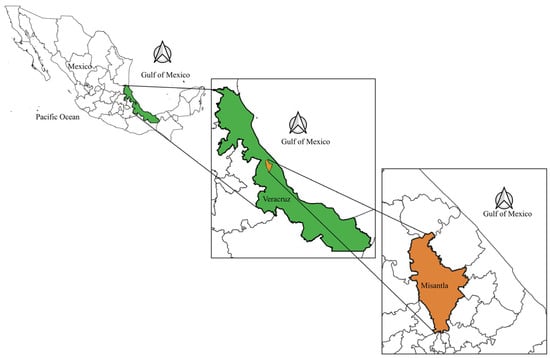
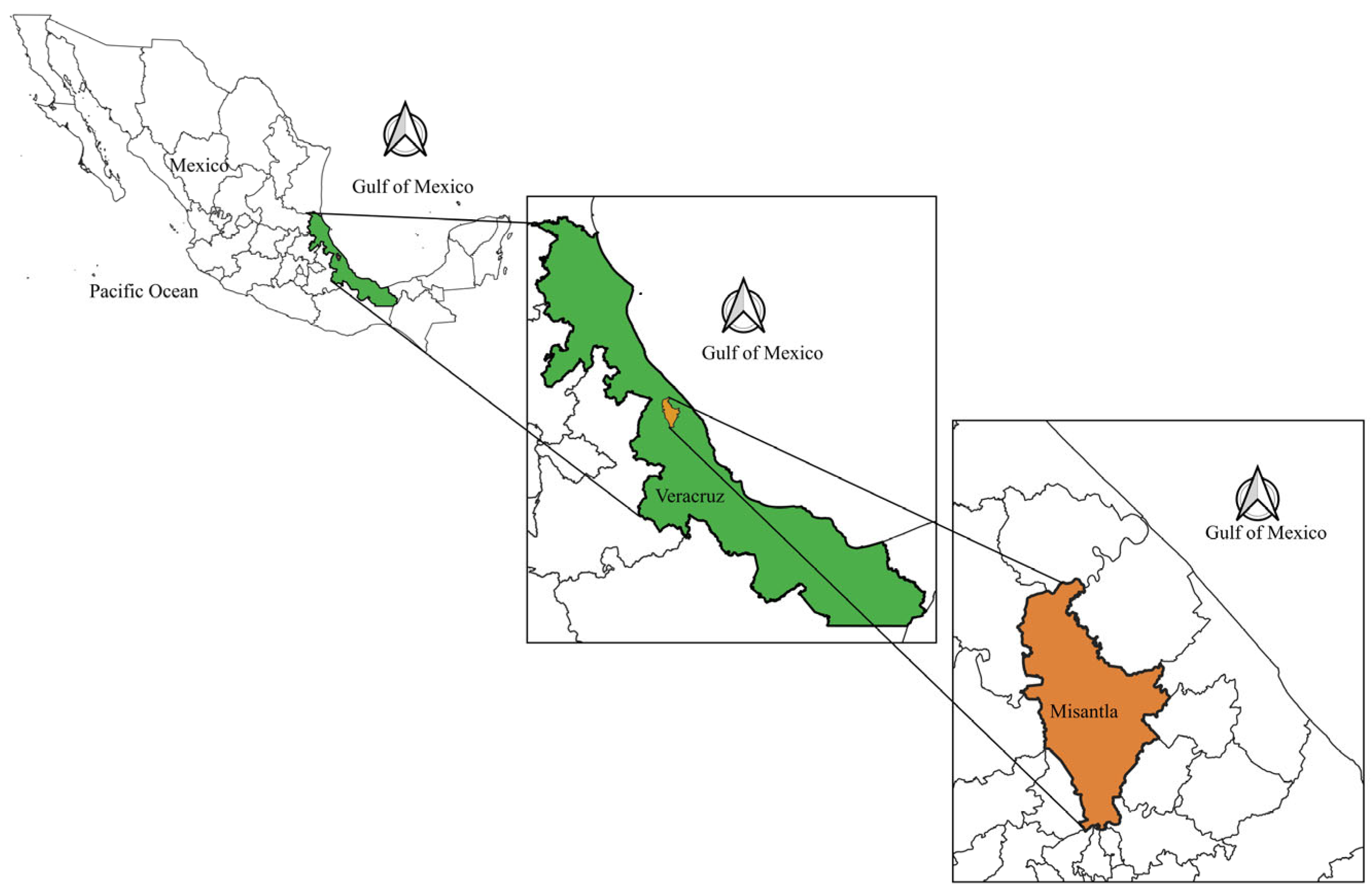
The natural soil used in this study was collected from a representative site in the Misantla region, Veracruz, Mexico (Figure 1), selected due to its typical use as road subgrade material in low- to medium-traffic transportation infrastructure. The sampling location was chosen because it represents the fine-grained soils commonly used in local pavement structures, where subgrade performance is strongly influenced by moisture variations typical of humid tropical environments.
Figure 1.
Geographic location of the representative soil sampling site used for subgrade evaluation in Misantla, Veracruz, Mexico.
Laboratory characterization tests were conducted to determine the main geotechnical index properties of the natural soil, which are summarized in Table 1. Particle size analysis indicated that the material consisted of 8.64% sand and 91.36% fines. According to the Unified Soil Classification System (USCS), the soil was classified as CL (low plasticity clay). The liquid limit (LL) and plastic limit (PL) were 30.77% and 22.22%, respectively, resulting in a plasticity index (PI) of 8.55%.
Table 1.
Geotechnical properties of the natural soil used in this study.
Standard Proctor compaction tests were performed to determine the compaction characteristics of the soil. The results indicated an optimum moisture content of 12.1% and a maximum dry density of 1421.3 kg/m3. These properties are consistent with fine-grained subgrade soils commonly encountered in humid tropical regions, which typically exhibit moderate bearing capacity and significant sensitivity to moisture variations.
Such geotechnical characteristics justify the need for stabilization treatments aimed at improving compaction behavior and mechanical performance. Accordingly, the selected soil is considered representative of subgrade materials commonly used in transportation infrastructure projects, particularly in regions where locally available soils require improvement to meet serviceability and structural performance requirements.
This characterization provides the engineering context for evaluating the effects of cement and kaolin stabilization on compaction parameters and unconfined compressive strength within a performance-based evaluation framework.
2.2. Stabilizing Materials
Two stabilizing agents were used in this study:
- Portland composite cement (CPC 30R) (commercially available in Mexico) was used as the conventional hydraulic binder. This cement type is characterized by high early-strength development and complies with the Mexican standard NMX-C-414-ONNCCE [35] for hydraulic cements. Its selection was motivated by its widespread use in transportation infrastructure and its suitability for subgrade stabilization requiring early load-bearing capacity.
- Kaolin, a naturally occurring aluminosilicate clay, was used as an alternative stabilizing material due to its fine particle size, mineralogical characteristics, and potential to modify soil behavior primarily through physical mechanisms. The kaolin used in this study is primarily composed of the clay mineral kaolinite (Al2Si2O5(OH)4). Typical chemical compositions reported for kaolin materials include approximately 45–47% SiO2 and 36–38% Al2O3, with minor quantities of Fe2O3, TiO2, and K2O (<2%).
Each stabilizer was incorporated at proportions of 3%, 5%, and 7% by dry weight of soil. All mixtures were carefully homogenized to ensure uniform distribution of the stabilizing agent throughout the soil matrix, thereby guaranteeing consistency and reproducibility in the subsequent compaction and mechanical testing procedures.
2.3. Compaction Tests
Standard Proctor compaction tests were performed on the untreated soil and all stabilized mixtures to determine the optimum moisture content (OMC) and maximum dry density (MDD), following ASTM D698/D698M [36]. For each mixture, a single compaction test was conducted to define the OMC–MDD relationship. The resulting OMC and MDD values were used to prepare specimens for unconfined compressive strength testing under consistent density and moisture conditions representative of typical field subgrade compaction practice. This approach ensured that strength comparisons between mixtures were not influenced by differences in initial compaction state.
2.4. Unconfined Compressive Strength Testing
Cylindrical specimens were molded at the corresponding optimum moisture content (OMC) and maximum dry density (MDD) obtained from the compaction tests. Specimens had a diameter of approximately 5.0 cm and a height of 10.0 cm, corresponding to a height-to-diameter ratio of 2. After molding, specimens were sealed in hermetic plastic bags and stored inside a closed container to minimize moisture loss during curing.
Unconfined compressive strength (UCS) tests were conducted in accordance with ASTM D2166/D2166M [37] by applying monotonic axial loading under unconfined conditions, without lateral confinement. Axial load was applied continuously through compression platens until failure, following the loading rate specified in the standard. The applied load was recorded in kilograms and converted to compressive stress by dividing the failure load by the specimen cross-sectional area.
UCS tests were performed at curing ages of 0, 7, 14, 28, 90, and 180 days. For each stabilized mixture and curing age, two replicate specimens were tested (n = 2), and the reported values correspond to the average UCS.
2.5. Experimental Design
An experimental matrix was defined to evaluate the effect of cement and kaolin content on the mechanical behavior of stabilized soils relevant to transportation infrastructure applications. Mixtures incorporating 3%, 5%, and 7% of each stabilizing agent (by dry weight of soil) were prepared and compared with untreated natural soil used as the control condition.
Each mixture was assigned a specific nomenclature according to the type and percentage of stabilizer employed. Portland cement–stabilized mixtures and kaolin-stabilized mixtures were designed independently in order to isolate and compare their respective effects on soil behavior.
The nomenclature adopted for the mixtures follows a simple coding system. EAS represents the untreated natural soil (control condition). EACx refers to soil stabilized with kaolin, where x indicates the percentage of kaolin by dry weight of soil (3%, 5%, or 7%). Similarly, EACPx refers to soil stabilized with Portland cement, where x indicates the percentage of cement used in the mixture.
The experimental design was applied consistently to both compaction testing and unconfined compressive strength testing, ensuring that all mechanical evaluations were performed on specimens prepared under identical mixture proportions and compaction conditions. Table 2 summarizes the experimental matrix adopted in this study.
Table 2.
Experimental design matrix for untreated and stabilized soil mixtures.
2.6. Conceptual Framework of Stabilization Mechanisms
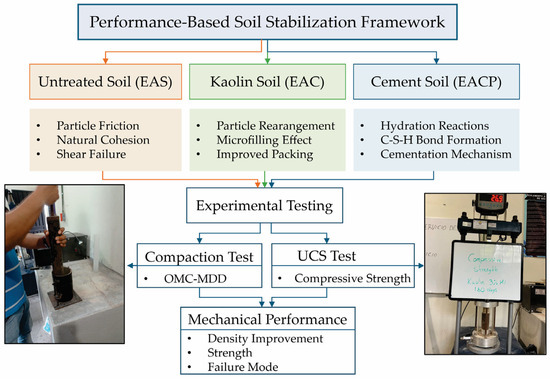
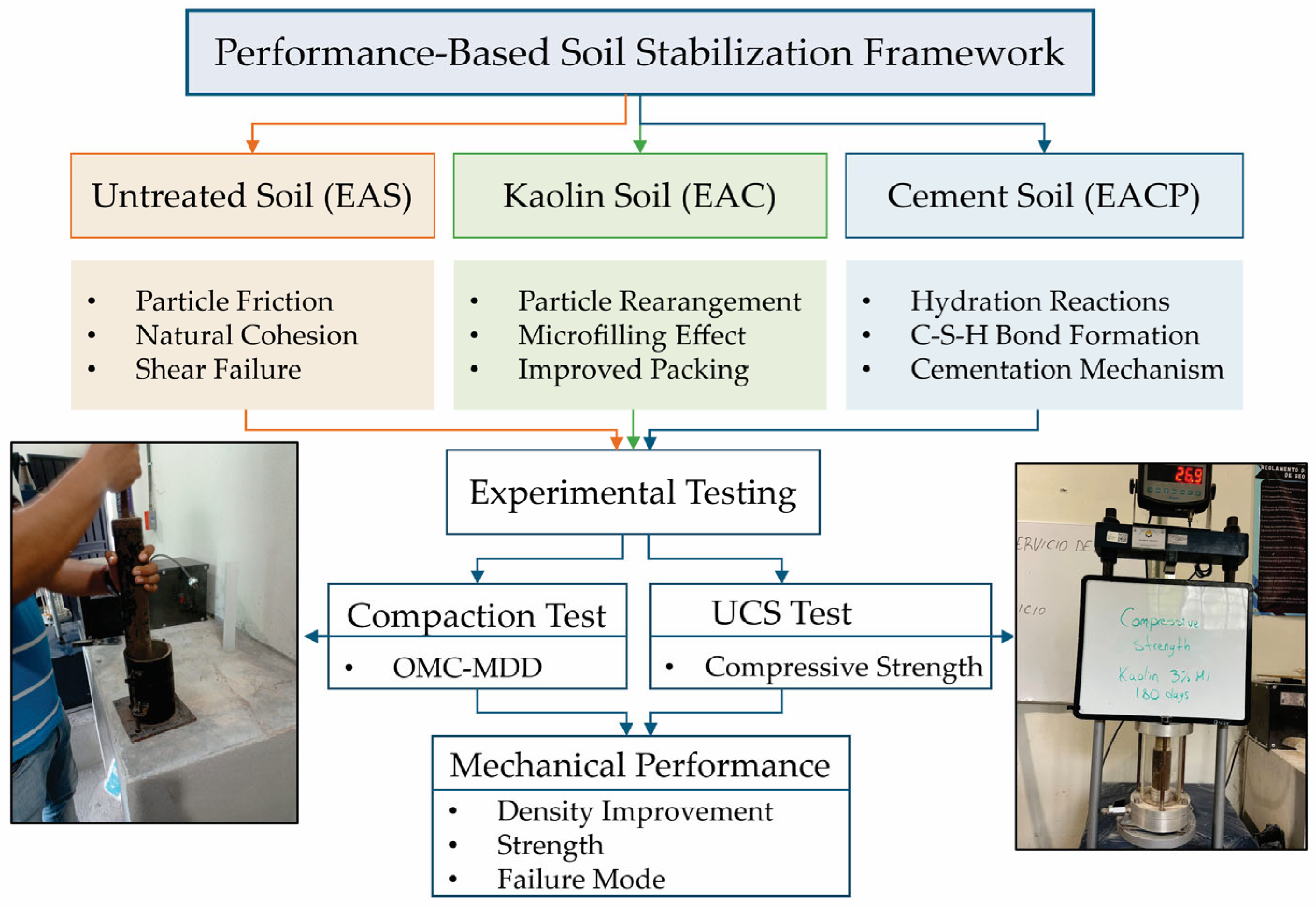
A conceptual framework was established to support the experimental design and to guide the interpretation of the mechanical behavior of untreated and stabilized soils subjected to compaction and unconfined compression testing, as summarizedin Figure 2. This framework differentiates the expected stabilization mechanisms associated with untreated soil, kaolin stabilization, and cement stabilization, providing a consistent basis for analyzing the effects of stabilizer type and content on soil performance.
Figure 2.
Schematic representation of the experimental framework used to evaluate untreated soil (EAS), kaolin-stabilized soil (EAC), and cement-stabilized soil (EACP), including compaction parameters (optimum moisture content, OMC, and maximum dry density, MDD) and unconfined compressive strength (UCS) testing.
For the untreated soil (EAS), mechanical behavior is governed primarily by particle friction and inherent cohesion, with load transfer occurring through direct interparticle contacts. Under axial loading, failure is expected to occur due to particle slippage and the formation of shear planes, without the contribution of additional bonding mechanisms. In this condition, strength development is controlled mainly by soil fabric and compaction state rather than by chemical interactions.
For kaolin-stabilized soils (EAC), stabilization is conceptualized as a predominantly physical process. The incorporation of fine, plate-like kaolin particles modifies the soil fabric through particle rearrangement, microfilling of voids, and improved packing efficiency. Within this framework, strength development is anticipated to be gradual and mainly associated with densification and enhanced particle interlocking, rather than the formation of cementitious bonds. As a result, improvements in mechanical behavior are expected to be progressive and closely related to compaction parameters.
For cement-stabilized soils (EACP), stabilization is conceptualized as a chemically driven process. Cement hydration reactions generate cementitious products such as calcium silicate hydrates (C–S–H), which bind soil particles together and significantly enhance stiffness and load-bearing capacity [25,27]. In contrast, kaolin incorporation mainly modifies the soil fabric through microfilling and particle rearrangement mechanisms that improve packing efficiency and interparticle contact [19,20,21,22]. Under unconfined compression, failure is expected to involve the progressive rupture of cementitious bonds and microcracking within the bonded matrix, rather than simple particle rearrangement, reflecting a fundamentally different stabilization mechanism compared to untreated and kaolin-stabilized soils.
This conceptual framework structured the experimental program and provided a theoretical basis for interpreting the compaction parameters, including optimum moisture content (OMC) and maximum dry density (MDD), as well as the unconfined compressive strength (UCS) development observed at different stabilizer contents and curing ages. The relationships summarized in Figure 2 support a performance-based interpretation of the mechanical response of the studied soil systems.
3. Results
3.1. Compaction Behavior
The compaction results demonstrate that both stabilizer type and stabilizer content significantly influence the moisture demand and packing characteristics of the studied soils. Cement stabilization produced a consistent reduction in optimum moisture content (OMC) with increasing cement content, reflecting the combined effects of hydration reactions and reduced free water availability. From a construction perspective, lower OMC values can reduce field water demand and improve constructability, particularly under conditions where moisture control is critical.
Kaolin-stabilized mixtures exhibited a non-linear OMC response, suggesting that initial water demand is offset at higher kaolin contents by improved packing efficiency and particle rearrangement. Variations in maximum dry density (MDD) further indicate that physical fabric modification plays a dominant role in kaolin-treated soils, whereas cement-treated soils benefit from early bonding effects that enhance density at certain dosages.
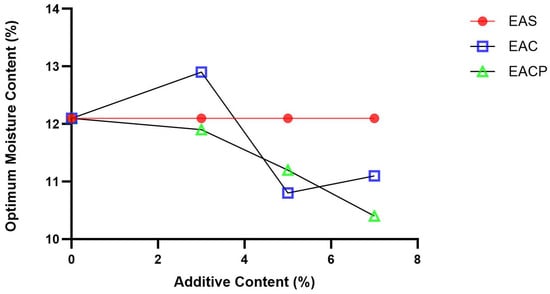
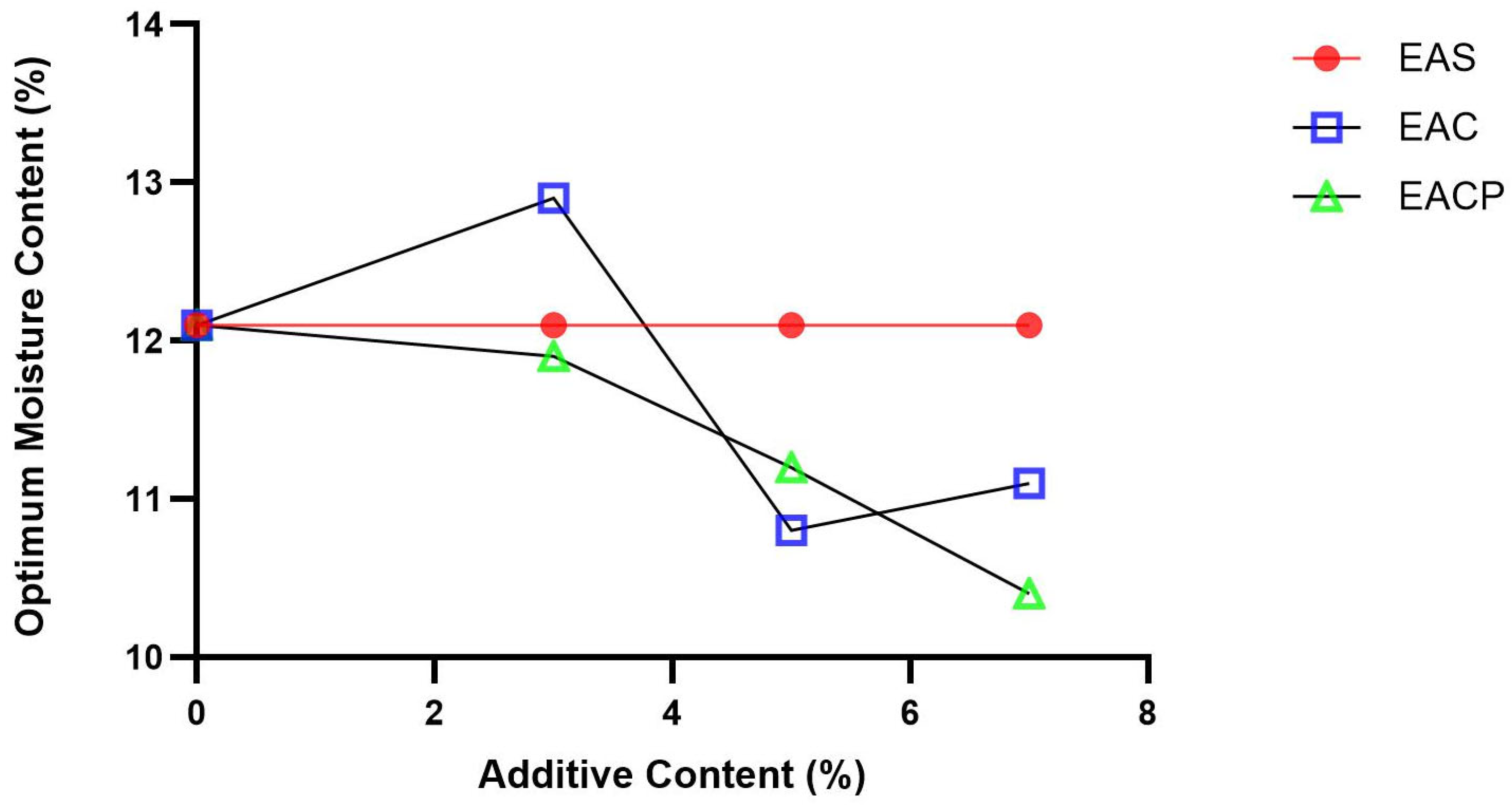
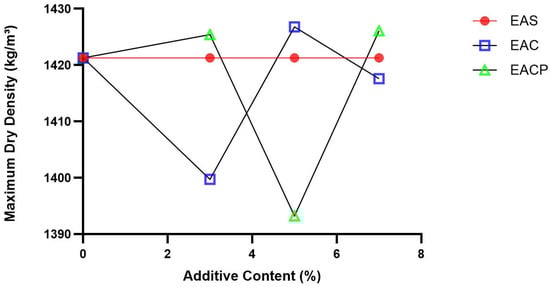
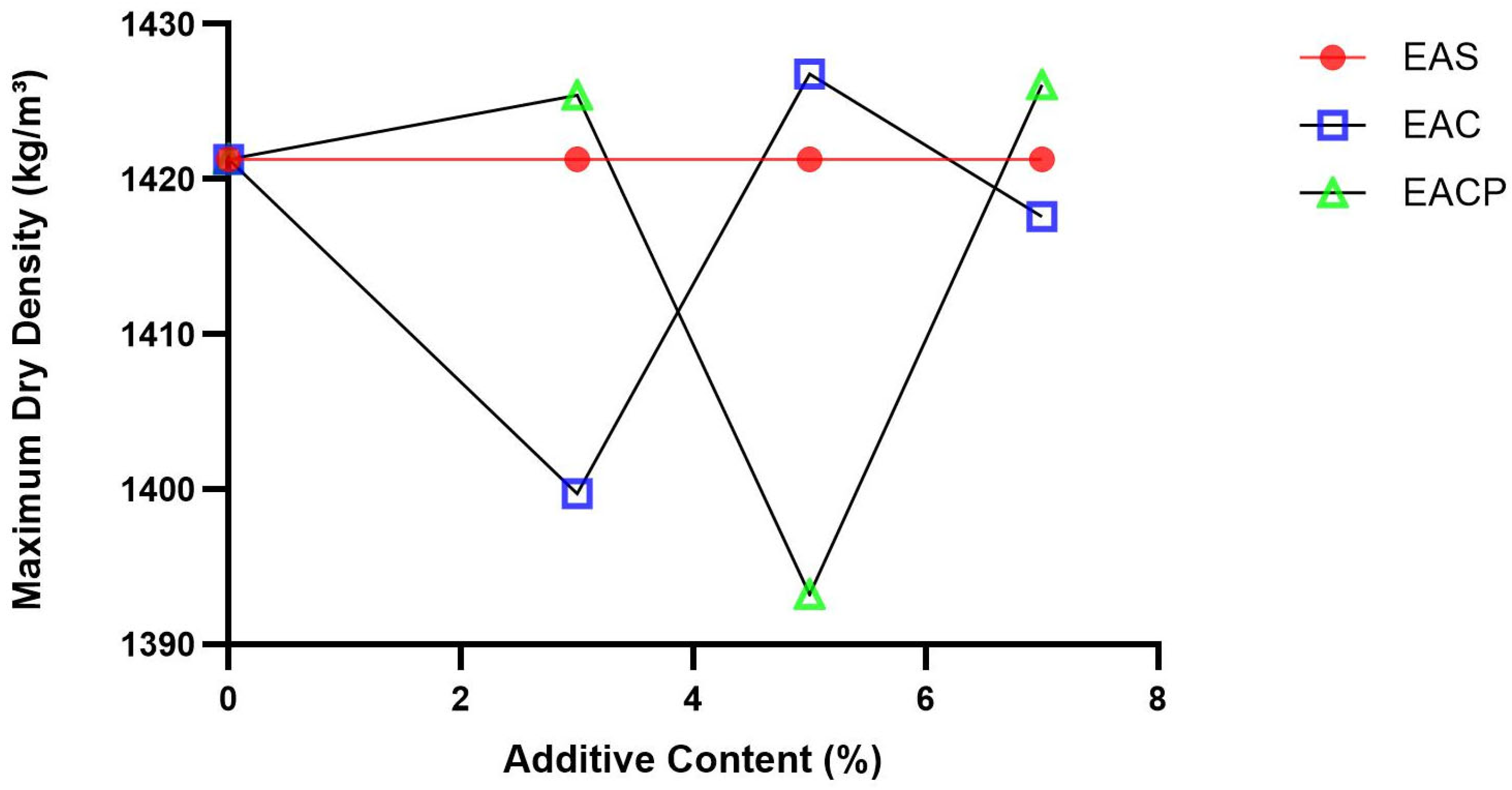
Overall, these compaction trends provide a mechanistic basis for interpreting the subsequent strength development observed in the UCS tests, which is further detailed through the OMC and MDD trends presented in Figure 3 and Figure 4. Differences in moisture demand and packing density partially explain the contrasting UCS evolution between cement- and kaolin-stabilized soils, particularly at early curing ages.
Figure 3.
Variation in optimum moisture content (OMC) with additive content for untreated and stabilized soils.
Figure 4.
Variation in maximum dry density (MDD) with additive content for untreated and stabilized soils.
Figure 3 presents the variation in optimum moisture content (OMC) as a function of stabilizer content for the untreated soil (EAS) and the soils stabilized with kaolin (EAC) and Portland cement (EACP). The untreated soil exhibited a nearly constant OMC of approximately 12%, indicating stable moisture requirements for compaction.
For kaolin-stabilized soils, the OMC showed a non-linear response to increasing stabilizer content. At 3% kaolin, a slight increase in OMC was observed, reaching values close to 13%, while higher kaolin contents (5% and 7%) resulted in a reduction in OMC to values between 10.8% and 11.1%. This behavior suggests that the incorporation of fine kaolin particles initially increased water demand, followed by improved packing efficiency and reduced moisture requirements at higher contents.
In contrast, cement-stabilized soils exhibited a more consistent decrease in OMC with increasing stabilizer content. OMC values decreased progressively from approximately 12% at 0% cement to around 10.4% at 7% cement, reflecting the influence of cement hydration reactions and the reduction in free water available for compaction.
Figure 4 shows the corresponding variation in maximum dry density (MDD) with stabilizer content. The untreated soil maintained a relatively constant MDD of approximately 1420 kg/m3. Kaolin-stabilized mixtures exhibited variable MDD behavior, with a decrease at 3% kaolin, followed by an increase at 5%, and a slight reduction at 7%, indicating a non-monotonic response associated with changes in particle arrangement and packing structure.
Cement-stabilized soils generally showed higher MDD values compared to the untreated soil, particularly at 3% and 7% cement, suggesting enhanced particle bonding and reduced void ratios. However, a noticeable reduction in MDD was observed at 5% cement, indicating that excessive fines or early cementitious structure formation may temporarily hinder optimal particle rearrangement during compaction.
Overall, the compaction results confirm that both stabilizer type and stabilizer content govern moisture demand and dry density. Cement produced more pronounced reductions in OMC and increases in MDD, while kaolin induced moderate and non-linear variations primarily driven by physical packing effects.
3.2. Unconfined Compressive Strength Development
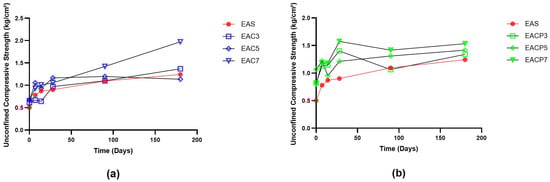
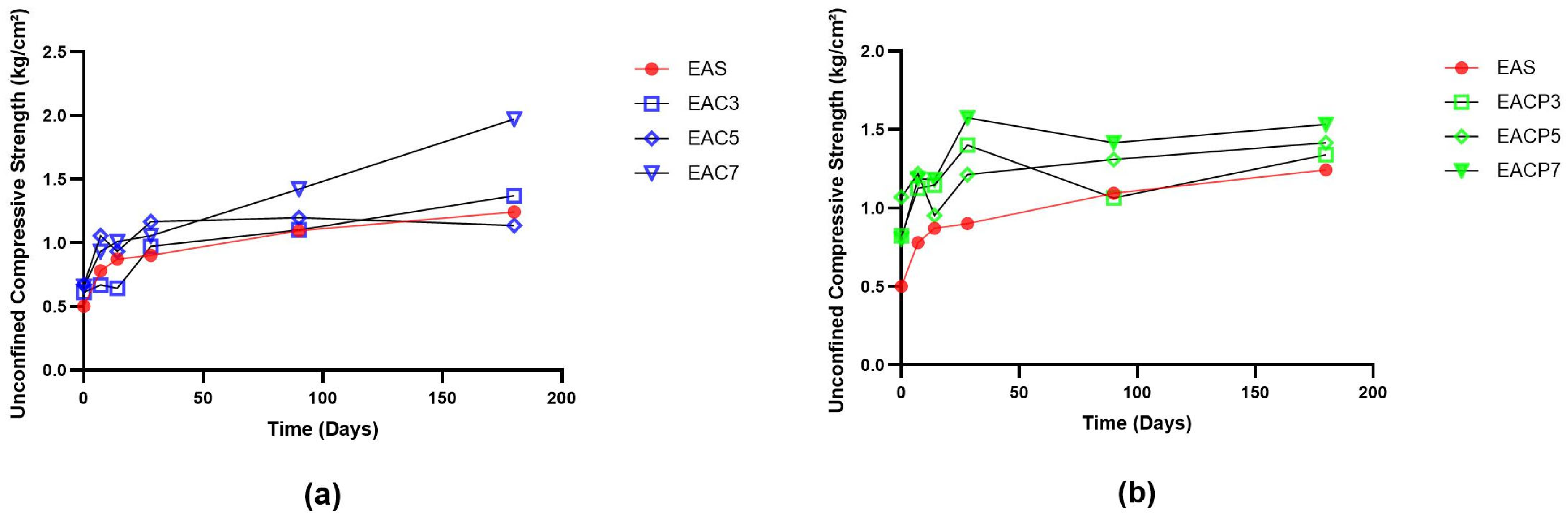
The unconfined compressive strength (UCS) results of the untreated soil (EAS) and the stabilized soil mixtures are presented in Figure 5. The experimental program included soils stabilized with different contents of kaolin (EAC3, EAC5, and EAC7) and Portland cement (EACP3, EACP5, and EACP7), evaluated at curing ages of 0, 7, 14, 28, 90, and 180 days.
Figure 5.
Unconfined compressive strength (UCS) development of untreated soil and soils stabilized with (a) kaolin and (b) Portland cement at different curing ages.
At 0 days, UCS values ranged approximately between 0.5 and 1.1 kg/cm2 for all mixtures. At this stage, both kaolin- and cement-stabilized soils exhibited slightly higher UCS values compared to the untreated soil (EAS). However, the differences among mixtures were limited, indicating that the mechanical contribution of the stabilizing agents was minimal prior to curing.
At early curing ages (7 and 14 days), differences in UCS development between stabilizer types became evident. Cement-stabilized mixtures (Figure 5b) showed a more pronounced increase in UCS, particularly for higher cement contents, whereas kaolin-stabilized mixtures (Figure 5a) exhibited more gradual strength development. At these ages, UCS values of cement-stabilized soils generally exceeded those of kaolin-stabilized soils at comparable stabilizer contents.
The slight variability observed in the UCS trend of cement-stabilized mixtures during the first curing days in Figure 5b may be associated with the early stages of cement hydration and the progressive development of cementitious bonding within the soil matrix. During this period, cement hydration reactions are still evolving and the soil structure gradually transitions from a friction-dominated granular system to a partially cemented matrix. As a result, minor fluctuations in measured UCS values may occur before the stabilization products become more uniformly distributed and a more consistent strength increase is observed at later curing ages.
By 28 days, UCS values increased further for all stabilized mixtures, reaching approximately 0.9 to 1.6 kg/cm2. The highest UCS values at this curing age were observed for the mixture containing 7% Portland cement (EACP7). In contrast, kaolin-stabilized soils remained within a narrower UCS range, showing moderate but consistent strength gains with increasing kaolin content.
At longer curing ages (90 and 180 days), continued UCS development was observed for all mixtures. Cement-stabilized soils achieved the highest UCS values, with EACP7 reaching approximately 2.0 kg/cm2 at 180 days, indicating sustained strength development over time. Kaolin-stabilized soils also exhibited progressive UCS increases, with values generally ranging between 1.1 and 1.5 kg/cm2 at 180 days, reflecting stable long-term mechanical performance.
Overall, the UCS results demonstrate that strength development is influenced by both stabilizer type and content, as well as curing time. Cement-stabilized soils exhibited higher UCS values and a more pronounced strength increase at both early and long curing ages, while kaolin-stabilized soils showed gradual and consistent strength development over time relative to the untreated soil.
To further highlight the performance-based nature of the evaluation, UCS improvement was also interpreted in terms of relative strength gain with respect to the untreated soil at each curing age. Cement-stabilized mixtures exhibited higher strength gain ratios at early ages, whereas kaolin-treated soils showed progressive and stable relative gains at longer curing periods. This comparison reinforces the differentiated applicability of each stabilizer according to traffic demand and service conditions.
4. Discussion
4.1. Interpretation of Stabilization Mechanisms
In pavement engineering practice, unconfined compressive strength (UCS) is commonly used as a preliminary screening parameter and indicator of soil improvement for assessing the suitability of improved subgrade materials for different road classes and traffic levels [1,2,30]. As such, UCS provides a practical parameter for comparing stabilization strategies and their potential applicability within pavement design frameworks.
These observations are consistent with findings reported in the international literature on soil stabilization, which indicate that cement stabilization typically produces rapid strength gains due to hydration-driven bonding mechanisms, whereas clay-based or mineral additives tend to promote gradual strength development associated with physical soil structure modification [23,24,25,26,27].
The mechanical behavior observed in the stabilized soil mixtures reveals two distinct stabilization mechanisms with direct relevance to transportation infrastructure design. Cement-stabilized soils exhibit rapid strength development associated with hydration-driven reactions that generate rigid bonding and effective load-transfer paths within the soil matrix. This behavior explains the pronounced early-age strength gains and higher ultimate strength levels, which are critical attributes for subgrades subjected to construction loads and early traffic conditions.
From a pavement engineering standpoint, the early stiffness and load-bearing capacity provided by cement stabilization contribute to improved structural support and reduced deformation during the initial service stages. These characteristics are particularly advantageous in urban roads, industrial corridors, and heavily trafficked transportation routes, where construction efficiency and early serviceability are essential.
In contrast, kaolin-stabilized soils display a more gradual and progressive increase in mechanical performance. The absence of rapid chemical bonding indicates that strength enhancement is governed primarily by physical mechanisms, including densification, particle rearrangement, and improved packing efficiency. Although the ultimate strength achieved is lower than that of cement-stabilized soils, the consistent and stable strength development demonstrates that kaolin treatment can effectively improve soil performance relative to untreated conditions.
The influence of stabilizer content further highlights the importance of dosage optimization in transportation applications. While increasing cement or kaolin content generally enhances mechanical performance, the diminishing marginal gains observed at higher dosages suggest that excessive stabilizer use may not be economically or environmentally justified. This observation emphasizes the need for balanced design strategies that consider mechanical requirements alongside material efficiency and sustainability objectives.
Long-term curing effects play a critical role in the assessment of stabilization strategies for road subgrades. The continued strength development observed over extended curing periods indicates that both cement- and kaolin-stabilized soils benefit from time-dependent mechanisms that enhance structural integrity. In cement-treated soils, ongoing hydration contributes to increased stiffness and strength, whereas in kaolin-treated soils, gradual microstructural adjustment supports sustained mechanical performance. These trends are particularly relevant for transportation infrastructure expected to perform reliably over long service lives under variable environmental conditions.
Within this context, the differentiated strength development observed in cement- and kaolin-stabilized soils provides a practical basis for selecting stabilization approaches according to functional road classification, traffic demand, and service conditions.
4.2. Engineering Implications for Transportation Infrastructure
From a practical engineering perspective, the observed mechanical behavior provides guidance for selecting soil stabilization strategies in transportation projects. Cement-stabilized soils are particularly suitable for pavement structures requiring high early stiffness and rapid load-bearing capacity, such as urban roads, industrial access routes, and heavily trafficked subgrades, where early serviceability and construction efficiency are critical.
Conversely, kaolin-stabilized soils may be considered for low-volume roads, rural transportation networks, access roads, and secondary infrastructure, where construction schedules are more flexible and moderate strength levels are acceptable. In these contexts, the progressive and stable strength development associated with kaolin treatment can provide adequate mechanical performance while contributing to improved sustainability outcomes.
According to pavement engineering standards for subgrade materials, such as the Mexican guideline N·CMT·1·03/21 [38], soils used in pavement subgrade layers must satisfy specific quality requirements, including limits on plasticity and adequate compaction levels to ensure sufficient structural support. These criteria are commonly applied in rural and secondary road infrastructure, where stabilized soils can provide adequate performance when properly compacted and controlled.
The gradual strength gain observed in kaolin-treated soils suggests potential applicability in environmentally sensitive areas, where reducing cement consumption and associated CO2 emissions is a relevant design objective. Overall, these findings support a performance-based approach to soil stabilization in transportation engineering, enabling material selection based on traffic demand, service conditions, and sustainability goals rather than prescriptive material use.
From a pavement engineering perspective, the UCS values obtained for both kaolin- and cement-stabilized mixtures fall within ranges commonly considered acceptable for improved subgrade layers in low- to medium-traffic pavement systems. These results indicate that the evaluated stabilization strategies can effectively enhance subgrade performance when properly designed and compacted, supporting their applicability within performance-based pavement design frameworks.
From a mechanistic–empirical pavement design perspective, stabilized subgrade materials with higher UCS values contribute to increased stiffness and improved load distribution within the pavement structure. The comparative results obtained in this study provide a practical basis for selecting stabilizer type and dosage according to expected traffic levels and structural design requirements. In particular, cement stabilization may be preferred when rapid strength gain and high stiffness are required, while kaolin stabilization may represent a viable alternative in low-volume roads where moderate strength and sustainability considerations are prioritized.
This observation reinforces the relevance of the proposed evaluation approach for transportation infrastructure applications, where material selection and stabilization strategies must balance mechanical performance, constructability, and resource efficiency.
5. Conclusions
This study evaluated the mechanical performance of cement- and kaolin-stabilized soils with specific emphasis on their applicability in transportation infrastructure. Based on the experimental observations and their engineering interpretation, the following conclusions are drawn:
- Cement stabilization is recommended for transportation projects requiring early serviceability and high load-bearing capacity, as it provides rapid early-age strength development and higher ultimate strength, making it suitable for heavily loaded road subgrades and pavement support layers.
- Kaolin stabilization is suitable for low-traffic and secondary transportation infrastructure, where moderate strength levels, gradual performance improvement, and construction flexibility are acceptable, particularly in rural and low-volume road applications.
- Long-term curing enhances the mechanical performance of both stabilization systems, with cement-treated soils achieving superior ultimate strength and kaolin-treated soils maintaining stable and consistent strength development over time.
- The selection of stabilizer type and dosage should be guided by performance-based criteria, considering traffic demand, service conditions, construction scheduling, and sustainability objectives rather than strength requirements alone.
Overall, the findings provide practical, performance-oriented evidence to support informed decision-making in the design and improvement of road subgrades. The results also highlight the potential of natural mineral stabilizers, such as kaolin, to contribute to more sustainable transportation infrastructure by reducing reliance on conventional cement-based stabilization.
It is important to emphasize that the objective of this study is not to propose kaolin as a replacement for Portland cement, but rather to expand the range of stabilization alternatives available within a performance-based evaluation framework. Cement remains a highly effective stabilizer for achieving significant strength gains; however, the results demonstrate that alternative materials such as kaolin can provide measurable improvements in compaction behavior and mechanical performance through different stabilization mechanisms.
By prioritizing performance over prescriptive material selection, the proposed approach allows engineers to tailor stabilization strategies to specific project requirements, traffic conditions, sustainability objectives, and resource availability. This flexibility is particularly valuable for context-sensitive and sustainable road subgrade design, where optimization of materials and performance criteria is essential.
6. Limitations and Future Research
This study focused on compaction behavior and unconfined compressive strength as primary indicators of mechanical performance relevant to road subgrades. While these parameters provide valuable insight into load-bearing capacity, they do not fully capture the stress conditions experienced by subgrades under traffic loading.
Future research should incorporate additional performance indicators commonly used in pavement engineering, such as the resilient modulus (MR), California Bearing Ratio (CBR), and durability assessments under cyclic wetting–drying or freeze–thaw conditions, depending on climatic context. These tests would allow a more comprehensive evaluation of long-term subgrade performance under repeated loading and environmental variability.
Field-scale validation, including test sections and in situ monitoring, is also recommended to confirm laboratory findings under real traffic and construction conditions. From a sustainability perspective, future research should also evaluate the life-cycle environmental implications of stabilization strategies, particularly considering that subgrade layers are typically designed for long service lives and are not frequently reconstructed. Finally, life-cycle assessment and cost–benefit analyses would further support the evaluation of kaolin as a low-impact stabilization alternative in sustainable transportation infrastructure.
Author Contributions
Conceptualization, writing—original draft preparation, P.J.L.-G., J.S.-L. and S.A.Z.-C.; methodology, O.M.-V., K.N., J.R.R.-V. and B.S.T.-G.; investigation, N.S.-Z. and I.C.-C.; writing—review and editing, N.S.-Z., I.C.-C. and B.S.T.-G.; supervision, B.S.T.-G. All authors have read and agreed to the published version of the manuscript.
Funding
This research received no external funding.
Institutional Review Board Statement
Not applicable.
Informed Consent Statement
Not applicable.
Data Availability Statement
The original contributions presented in this study are included in the article. Further inquiries can be directed to the corresponding authors.
Acknowledgments
The authors acknowledge the Civil Engineering Laboratory of the Instituto Tecnológico Superior de Misantla for the use of laboratory facilities and technical assistance during specimen preparation and mechanical testing.
Conflicts of Interest
The authors declare no conflicts of interest.
References
- Piechowicz, K.; Szymanek, S.; Kowalski, J.; Lendo-Siwicka, M. Stabilization of Loose Soils as Part of Sustainable Development of Road Infrastructure. Sustainability 2024, 16, 3592. [Google Scholar] [CrossRef] [Scilit]
- Pooni, J.; Robert, D.; Giustozzi, F.; Gunasekara, C.; Setunge, S. A Review on Soil Stabilisation of Unsealed Road Pavements from an Australian Perspective. Road Mater. Pavement Des. 2023, 24, 1005–1049. [Google Scholar] [CrossRef] [Scilit]
- Shinde, B.; Sangale, A.; Pranita, M.; Sanagle, J.; Roham, C. Utilization of Waste Materials for Soil Stabilization: A Comprehensive Review. Prog. Eng. Sci. 2024, 1, 100009. [Google Scholar] [CrossRef] [Scilit]
- Amakye, S.Y.; Abbey, S.J.; Booth, C.A. Road Pavement Defect Investigation Using Treated and Untreated Expansive Road Subgrade Materials with Varying Plasticity Index. Transp. Eng. 2022, 9, 100123. [Google Scholar] [CrossRef] [Scilit]
- Ikechukwu, A.F.; Hassan, M.M. Assessing the Extent of Pavement Deterioration Caused by Subgrade Volumetric Movement through Moisture Infiltration. Int. J. Pavement Res. Technol. 2022, 15, 676–692. [Google Scholar] [CrossRef] [Scilit]
- Alsheyab, M.A.; Khasawneh, M.A.; Abualia, A.; Sawalha, A. A Critical Review of Fatigue Cracking in Asphalt Concrete Pavement: A Challenge to Pavement Durability. Innov. Infrastruct. Solut. 2024, 9, 386. [Google Scholar] [CrossRef] [Scilit]
- Chompoorat, T.; Likitlersuang, S.; Thepumong, T.; Tanapalungkorn, W.; Jamsawang, P.; Jongpradist, P. Solidification of Sediments Deposited in Reservoirs with Cement and Fly Ash for Road Construction. Int. J. Geosynth. Ground Eng. 2021, 7, 85. [Google Scholar] [CrossRef] [Scilit]
- Zhao, K.; Wong, L.N.Y. A Review of Cement–Soil in Engineering Geological Applications: Mixing Mechanisms, Mechanical Behavior, and Constitutive Models. Bull. Eng. Geol. Environ. 2025, 84, 637. [Google Scholar] [CrossRef] [Scilit]
- Chenarboni, H.A.; Lajevardi, S.H.; MolaAbasi, H.; Zeighami, E. Effect of Zeolite and Cement Stabilization on the Mechanical Behavior of Expansive Soils. Constr. Build. Mater. 2021, 272, 121630. [Google Scholar] [CrossRef] [Scilit]
- Sousa, V.; Bogas, J.A. Comparison of Energy Consumption and Carbon Emissions from Clinker and Recycled Cement Production. J. Clean. Prod. 2021, 306, 127277. [Google Scholar] [CrossRef] [Scilit]
- Nie, S.; Zhou, J.; Yang, F.; Lan, M.; Li, J.; Zhang, Z.; Chen, Z.; Xu, M.; Li, H.; Sanjayan, J.G. Analysis of Theoretical Carbon Dioxide Emissions from Cement Production: Methodology and Application. J. Clean. Prod. 2022, 334, 130270. [Google Scholar] [CrossRef] [Scilit]
- Soomro, M.; Tam, V.W.Y.; Evangelista, A.C.J. Production of Cement and Its Environmental Impact. In Recycled Concrete; Woodhead Publishing: Cambridge, UK, 2023; pp. 11–46. [Google Scholar] [CrossRef] [Scilit]
- Abiodun, Y.O.; Olanrewaju, O.A.; Gbenebor, O.P.; Ochulor, E.F.; Obasa, D.V.; Adeosun, S.O. Cutting Cement Industry CO2 Emissions through Metakaolin Use in Construction. Atmosphere 2022, 13, 1494. [Google Scholar] [CrossRef] [Scilit]
- Haque, M.M.; Uddin, S.Z. A Review on Sustainable Building Materials and Their Role in Enhancing US Green Infrastructure Goals. J. Sustain. Dev. Policy 2024, 3, 65–100. [Google Scholar] [CrossRef] [Scilit]
- Abujder Ochoa, W.A.; Iarozinski Neto, A.; Vitorio Junior, P.C.; Calabokis, O.P.; Ballesteros-Ballesteros, V. The Theory of Complexity and Sustainable Urban Development: A Systematic Literature Review. Sustainability 2025, 17, 3. [Google Scholar] [CrossRef] [Scilit]
- Birkeland, J. Nature Positive: Interrogating Sustainable Design Frameworks for Their Potential to Deliver Eco-Positive Outcomes. Urban Sci. 2022, 6, 35. [Google Scholar] [CrossRef] [Scilit]
- Singh, V.K. The Science and Technology of Cement and Other Hydraulic Binders; Elsevier: Amsterdam, The Netherlands, 2023. [Google Scholar]
- Jastrzębska, M. Use of Alternative Materials in Sustainable Geotechnics: State of World Knowledge and Some Examples from Poland. Appl. Sci. 2025, 15, 3352. [Google Scholar] [CrossRef] [Scilit]
- Thomas, S.; Chandrakaran, S.; Sankar, N. Engineering Performance and Microstructural Behavior of Kaolin Treated with Nanomaterials. Clays Clay Miner. 2025, 73, e12. [Google Scholar] [CrossRef] [Scilit]
- Shalaby, O.B.; Elkady, H.M.; Salah, M.; Nagy, N.M.; Fayed, A.L. Effect of Kaolin–Nano-Silica Mixture on Geomechanical Properties Enhancement of Soils. Innov. Infrastruct. Solut. 2024, 9, 384. [Google Scholar] [CrossRef] [Scilit]
- Abdelbaset, A.M.; Katunský, D.; Zeleňáková, M.; El-Feky, M.H. Mechanical Properties Stabilization of Low-Plasticity Kaolin Soil Using Fly Ash and Hydrated Lime. Case Stud. Constr. Mater. 2024, 21, e03662. [Google Scholar] [CrossRef] [Scilit]
- Roshan, M.J.; Rashid, A.S.B.A. Geotechnical Characteristics of Cement Stabilized Soils from Various Aspects: A Comprehensive Review. Arab. J. Geosci. 2024, 17, 1. [Google Scholar] [CrossRef] [Scilit]
- AlFukaha, R.; Shaqour, F.; Ismeik, M. Freeze–Thaw Durability of Clayey Soils Stabilized by Alkaline-Activated Kaolin and Recycled Cement Kiln Dust. Results Eng. 2024, 24, 103199. [Google Scholar] [CrossRef] [Scilit]
- Mohammed, A.A.; Nahazanan, H.; Nasir, N.A.M.; Huseien, G.F.; Saad, A.H. Calcium-Based Binders in Concrete or Soil Stabilization: Challenges, Problems, and Calcined Clay as Partial Replacement to Produce Low-Carbon Cement. Materials 2023, 16, 2020. [Google Scholar] [CrossRef] [Scilit]
- Haghsheno, H.; Arabani, M. Effect of Primary Stabilizers for Stabilization/Solidification of Oil-Polluted Soils: A Review. Environ. Technol. Rev. 2023, 12, 337–358. [Google Scholar] [CrossRef] [Scilit]
- Tavala, A.N.; Tabaroei, A. Sustainable Clay Soil Stabilization Using Construction Waste: Mechanical Behavior, Engineering Parameters, and Microstructural Analysis. Results Eng. 2025, 27, 106247. [Google Scholar] [CrossRef] [Scilit]
- Al-Adhadh, A.R.; Daud, N.N.N.; Yusuf, B.; Al-Rkaby, A.H. Supplementary Cementitious Materials in Sandy Soil Improvement: A Review. J. Build. Rehabil. 2024, 9, 138. [Google Scholar] [CrossRef] [Scilit]
- Zhu, M.; Leo, C.; Zeng, Q.; Fanna, D.J.; Hsi, J.; Karimi, R.; Fabbri, A.; Liyanapathirana, S.; Hu, P.; Alzghool, H. Efficacy of Expansive Soil Stabilisation Using Uncalcined Kaolinite-Based Alkali-Activated Binders. Clean. Mater. 2025, 16, 100315. [Google Scholar] [CrossRef] [Scilit]
- Shao, J.; Guo, S.; Wang, H. A Review of the Performance, Sustainable Applications, and Research Challenges of Limestone–Calcined Clay Cement (LC3) Systems. Coatings 2025, 15, 611. [Google Scholar] [CrossRef] [Scilit]
- Famewo, B.G.; Shokouhian, M. A Review of Pavement Performance Deterioration Modeling: Influencing Factors and Techniques. Symmetry 2025, 17, 1992. [Google Scholar] [CrossRef] [Scilit]
- Aljanabi, K.R.M.; Salih, N.B. Using Artificial Neural Networks to Predict the Unconfined Compressive Strength of Clayey Soils Stabilized by Various Stabilization Agents. KSCE J. Civ. Eng. 2023, 27, 3720–3728. [Google Scholar] [CrossRef] [Scilit]
- Luo, Z.; Xue, X.; Xiong, C.; Huang, R.; Du, J.; Li, J.; Liu, K. Data-Driven Prediction of Unconfined Compressive Strength in Stabilized Soils Using Machine Learning. Discov. Appl. Sci. 2025, 7, 1122. [Google Scholar] [CrossRef] [Scilit]
- Teodoru, I.-B.; Owusu-Yeboah, Z.; Aniculăesi, M.; Dascălu, A.V.; Hörtkorn, F.; Amelio, A.; Lungu, I. Prediction of Unconfined Compressive Strength in Cement-Treated Soils: A Machine Learning Approach. Appl. Sci. 2025, 15, 7022. [Google Scholar] [CrossRef] [Scilit]
- Alqudah, M.; Saleh, H.; Yasarer, H.; Al-Ostaz, A.; Najjar, Y. Comparative Study of Machine Learning Techniques for Predicting UCS Values Using Basic Soil Index Parameters in Pavement Construction. Infrastructures 2025, 10, 153. [Google Scholar] [CrossRef] [Scilit]
- NMX-C-414-ONNCCE-2017; Construction Industry–Hydraulic Cements–Specifications and Testing Methods. Mexican Standard; ONNCCE: Mexico City, Mexico, 2017.
- ASTM D698/D698M–12e2; Standard Test Methods for Laboratory Compaction Characteristics of Soil Using Standard Effort. ASTM International: West Conshohocken, PA, USA, 2012.
- ASTM D2166/D2166M–16; Standard Test Method for Unconfined Compressive Strength of Cohesive Soil. ASTM International: West Conshohocken, PA, USA, 2016.
- N·CMT·1·03/21; Materiales Para Subrasante. SCT: Ciudad de México, México, 2021. Available online: https://normas.imt.mx/storage/normativa/N-CMT-1-03-21.pdf (accessed on 5 March 2026).

Disclaimer/Publisher’s Note: The statements, opinions and data contained in all publications are solely those of the individual author(s) and contributor(s) and not of MDPI and/or the editor(s). MDPI and/or the editor(s) disclaim responsibility for any injury to people or property resulting from any ideas, methods, instructions or products referred to in the content. |
© 2026 by the authors. Licensee MDPI, Basel, Switzerland. This article is an open access article distributed under the terms and conditions of the Creative Commons Attribution (CC BY) license.