Article

Planning and Control Strategies for Truck Platooning: A Benefit-Driven Literature Review

by
Erika Olivari
1,
Angela Carboni
1,
Claudia Caballini
1,*,
Cecilia Pasquale
2,
Bruno Dalla Chiara
1 and
Simona Sacone
2
1
Department of Environment, Land and Infrastructure Engineering, Politecnico di Torino, 10129 Turin, Italy
2
Department of Informatics, Bioengineering, Robotics and Systems Engineering, University of Genova, 16126 Genova, Italy
*
Author to whom correspondence should be addressed.
Future Transp. 2025, 5(4), 187; https://doi.org/10.3390/futuretransp5040187
Submission received: 27 October 2025 / Revised: 30 November 2025 / Accepted: 1 December 2025 / Published: 3 December 2025

Abstract

Truck platooning refers to a group of heavy-duty vehicles travelling in close succession through cooperative driving technologies and inter-vehicle communication. This transport solution is increasingly investigated as a promising strategy to enhance the efficiency and sustainability of road freight transport. The expected benefits include fuel and operational cost savings, reduced emissions, improved traffic flow and congestion mitigation, as well as enhanced safety for both platoon drivers and surrounding traffic. This paper presents a literature review of truck platooning, with a specific focus on the expected benefits and on how they are addressed across two fundamental perspectives: planning and control. Planning encompasses issues related to platoon formation, maintenance and reconfiguration during transport operations, whereas control focuses on the methods and schemes used to coordinate vehicle behaviour within and between platoons. The reviewed contributions are further analysed according to the methodology adopted, the level of vehicle automation, and the specific control approaches implemented. The resulting classification provides an integrated view of how different research streams contribute to economic, environmental, safety and social benefits. Finally, the current gaps and promising research directions are outlined to support future developments in large-scale platooning deployment.

1. Introduction

Over the past decades, road transport has continued to grow, reinforcing its dominant position in the freight sector [1]. This trend is mainly due to its flexibility and economic convenience, especially over short- to medium-distance routes, as well as its capillarity and possibility to transport any kind of goods, which allow it to access the entire freight market. Conversely, rail transport remains constrained by infrastructural path and lack of full electrification, which restricts the type of goods that can be transported. As a result, road transport still outperforms other transport modes.
However, increasing driver shortages—particularly evident in Europe—together with rising environmental and social concerns have prompted the research for innovative solutions capable of mitigating the negative externalities associated with road freight transport. Freight transport sector faces increasing pressure to reduce its environmental footprint being responsible for around 30% of all CO2 emissions from transport in the EU and Road transport remains the dominant mode for freight movement in Europe, contributing substantially to the sector’s environmental footprint [2]. Several strategies have been explored to improve the sustainability of cargo transport. These include technological innovations, such as electrification, hydrogen propulsion, and more efficient engines [3]; modal shift to rail and inland waterways, which offer lower carbon intensity per ton-kilometre [4]; and operational measures that improve efficiency through automation and cooperation. Among the latter, truck platooning represents a promising solution by enabling closer coordination between vehicles and reducing aerodynamic drag, thereby improving fuel efficiency and lowering emissions. This term refers to a convoy of two or more trucks travelling in close succession, at short inter-vehicle distance enabled by advanced automation and communication technologies [5]. In this work, we focus primarily on operational benefits of truck platooning while recognising that broader freight sustainability requires a combination of low-carbon energy adoption, infrastructure adaptation, and modal diversification.
Truck platooning can be further characterised as a Cooperative Automated Vehicle (CAV) system, since it relies on both on-board automation technologies and on inter-vehicle communication to enable the real-time exchange of critical driving information.
The Society of Automotive Engineers (SAE) taxonomy [6] defines six levels of driving automation, ranging from no driving automation (SAE 0) to full driving automation (SAE 5). Building on this framework, the research provided by [7] introduces three specific platooning levels for trucks: level 1 (TP1) corresponds to a fully manned platoon, while level 3 (TP3) represents a highly automated platoon, though the truck driver has to be present in front of the steering wheel and ready to take over, while being allowed to temporarily attend to secondary tasks, such as load-matching activities to avoid empty trips or administrative tasks.
Truck platooning implies certain risks but is widely recognised for its potential benefits [7]. Among these, fuel consumption reduction stands out as one of the most relevant—especially in light of the recent surge in fuel prices across several European countries, which has significantly increased road freight transport costs [8]. Since a considerable share of transport-related emissions is caused by road transport—rolling, braking, and internal combustion processes [6]—any reduction in fuel consumption reduces environmental impact. Such fuel savings are primarily achieved through aerodynamic improvement of trucks, as closely spaced trucks experience lower air resistance when travelling in convoy. In addition, the automation technologies that characterise truck platooning—particularly Advanced Driver Assistance Systems (ADAS)—can improve road safety by mitigating human error and enabling faster, coordinated vehicle reactions [9]. Furthermore, by reducing the cognitive and physical workload required for driving, especially with higher levels of automation, platooning can improve drivers’ working conditions. Finally, by reducing the physical spacing between trucks, platooning can optimise road space use, thereby increasing traffic throughput and reducing congestion [10].
Several review papers have analysed truck platooning from different perspectives. Reference [7] classified the existing literature according to the planning problems addressed. Reference [11] focused instead on coordination strategies, categorising contributions based on the characteristics of the coordination approach used—such as optimisation level, coordination triggers, planning horizon—as well as goals, constraints, and algorithms applied. Reference [12] investigated the expected benefits of truck platooning by reviewing a number of real-world implemented projects.
This paper aims to provide a comprehensive literature review of truck platooning, with a specific focus on its expected benefits—economic, safety-related, environmental, and social —and on the two main perspectives through which it is typically approached: planning and control. In this context, planning refers to all aspects related to the formation, maintenance, and reconfiguration of platoons during transport operations, whereas control concerns the methods and techniques used to coordinate vehicle behaviour and manage information exchange within a platoon. In addition, each contribution is analysed with respect to the methodological approach used, the level of vehicle automation, and the control schemes considered.
Beyond the potential benefits discussed in this review, several challenges could hinder the large-scale implementation of truck platooning. A primary concern relates to the potential impact of heavy vehicles travelling in close proximity on road infrastructure. Recent studies have shown that repeated loading along nearly identical wheel paths can accelerate pavement deterioration, particularly on asphalt layers with existing fatigue sensitivity [13]. Similar implications emerge from infrastructure assessments conducted in the Netherlands, which indicate that truck load patterns can affect pavement design margins under certain traffic and climatic conditions [14]. A second concern is related to the interaction with surrounding traffic: long platoons may constrain lane changing opportunities or complicate exit manoeuvres for lighter vehicles, especially on busy motorway sections. Practical insights into operational difficulties are discussed in study [15], which assesses how platoon size, internal distance between trucks, and traffic conditions affect overtaking manoeuvres by manual vehicles, including the difficulty of overtaking when the internal distance is reduced.
The remainder of the paper is structured as follows. Section 2 describes the methodology used to collect, classify, and analyse the literature. Section 3 provides a general overview of the reviewed studies. Section 4 discusses platooning from a planning perspective, while Section 5 addresses control-related aspects. Finally, Section 5 summarises the main findings and highlights directions for future research.

2. Methodology

This review followed a structured and reproducible procedure. Since the goal of the study is to classify literature through planning/control perspectives and benefit-oriented categories, a flexible review approach, which is more suitable and consistent with engineering-oriented literature reviews, was adopted.
The research methodology adopted in this study consists of four phases:
  • Phase 1: Literature search and selection. A comprehensive search of relevant publications was carried out across the databases Web of Science, IEEE Xplore, ScienceDirect, SAE Journals, and Google Scholar. The following keywords were used in different combinations: “truck platooning” together with “planning, control, benefits, economic benefit, safety, social impact, environmental”. Overall, the combined search of the aforementioned databases using the selected keywords initially returned approximately 250 papers. The filtering process was conducted iteratively, eliminating duplicates and non-peer-reviewed sources, papers not written in English as well as articles that did not directly address truck platooning applications. Studies focusing on light vehicle or car platooning were excluded. To ensure an updated overview of the state of the art, only studies published between 2010 and 2024 were considered. A total of 97 papers met the inclusion criteria, namely: (i) relevance to truck platooning planning and control; (ii) clear discussion of benefits related to the platoon.
  • Phase 2: Preliminary classification. The selected papers were first classified by year of publication, source type (journal or conference proceedings), research methodology, and main thematic focus (planning or control).
  • Phase 3: Thematic analysis. Within the two main areas of interest, i.e., planning and control, the papers were further analysed and classified based on the expected benefits as well as on specific characteristics such as automation level and control scheme adopted.
Figure 1 shows the main categories analysed in the present paper.
  • Phase 4: Comparative analysis and gap identification. A detailed comparative analysis of the selected papers was carried out. Particular attention was devoted to identifying gaps in the current literature, including underexplored research topics and limitations in existing approaches.
  • Phase 5: Synthesis of findings and future research directions. Based on the comparative assessment outcomes, the main findings were consolidated, and some conclusions were outlined. Finally, directions for future research were delineated to support further advances in truck platooning.

3. Overview of the Analysed Truck Platooning Literature

According to the methodology described in the previous section, 97 papers were selected and analysed. These works were classified into two main topic categories, resulting in 63 papers falling under planning and 43 papers under control. Nine papers addressed both perspectives and were therefore assigned to both categories. Consequently, the percentages and figures reported throughout the paper should be interpreted considering this overlap (Table 1).

3.1. Publication Type and Spatio-Temporal Distribution

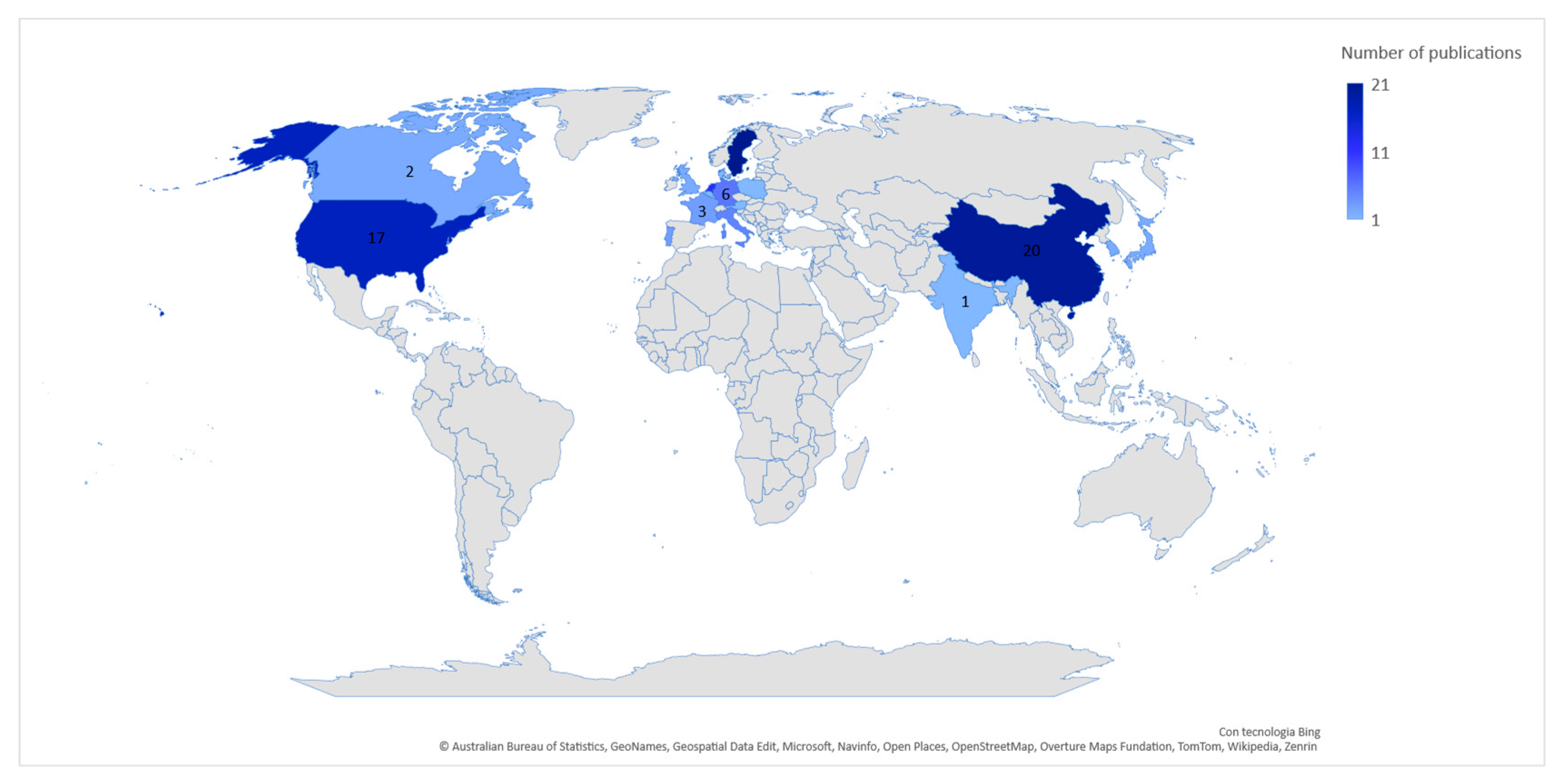
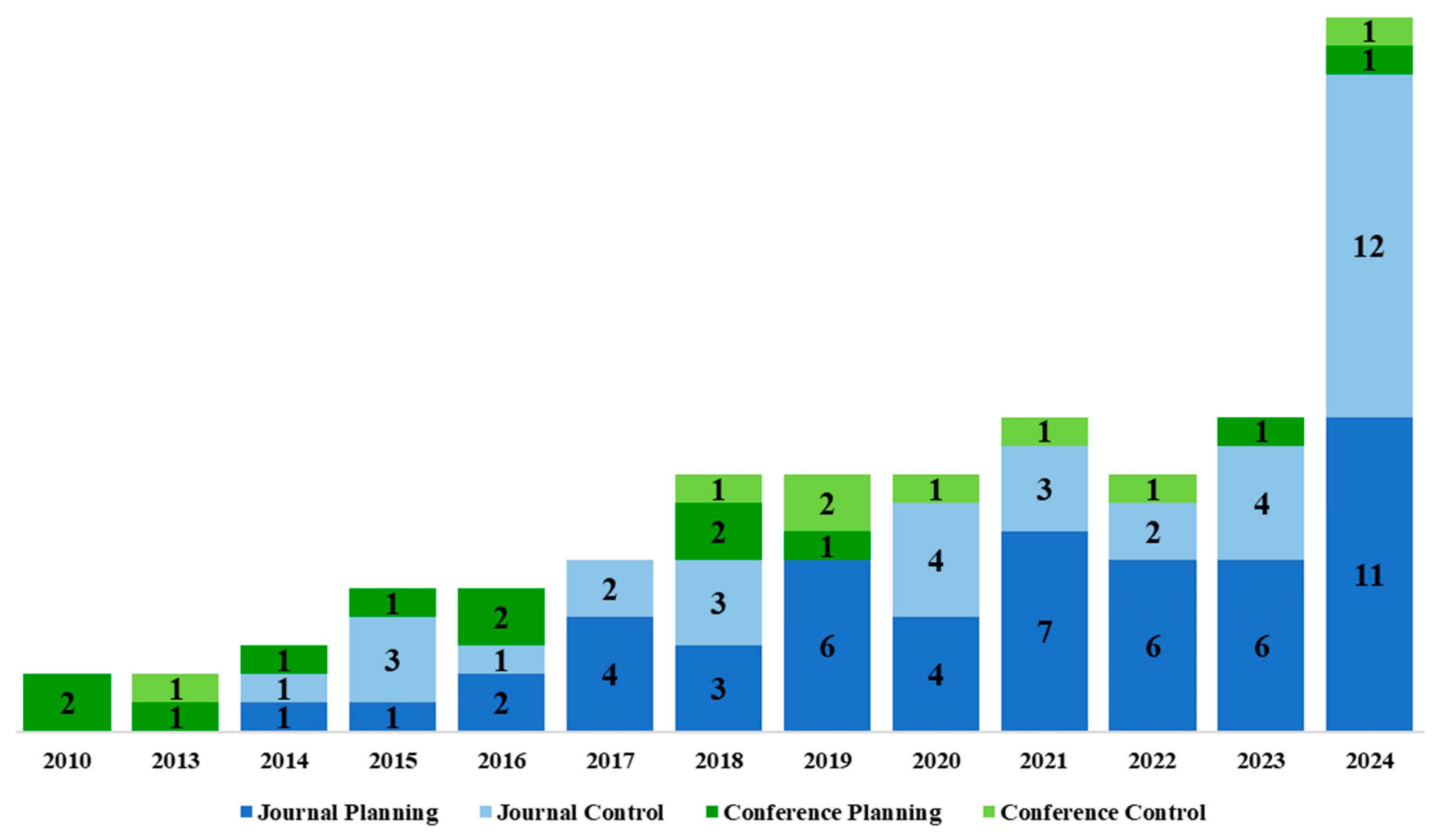
Figure 2 and Figure 3 show the geographical and temporal distribution of the analysed papers, respectively. Based on the first author’s declared affiliation, the articles show a concentration in three main areas: North America (mainly the USA), Europe (mainly Sweden), and Asia (mainly China, India, and Japan). The earliest contribution in the form of conference proceedings on truck platooning dates back to 2010, while the first journal articles appeared in 2014. The number of publications peaked in 2019, followed by 2018 and 2020. Overall, approximately 80% of the selected papers were published in peer-reviewed journals. The same percentage is found when the two thematic areas analysed later (i.e., planning and control) are considered individually.

3.2. Methodologies Used in the Reviewed Studies

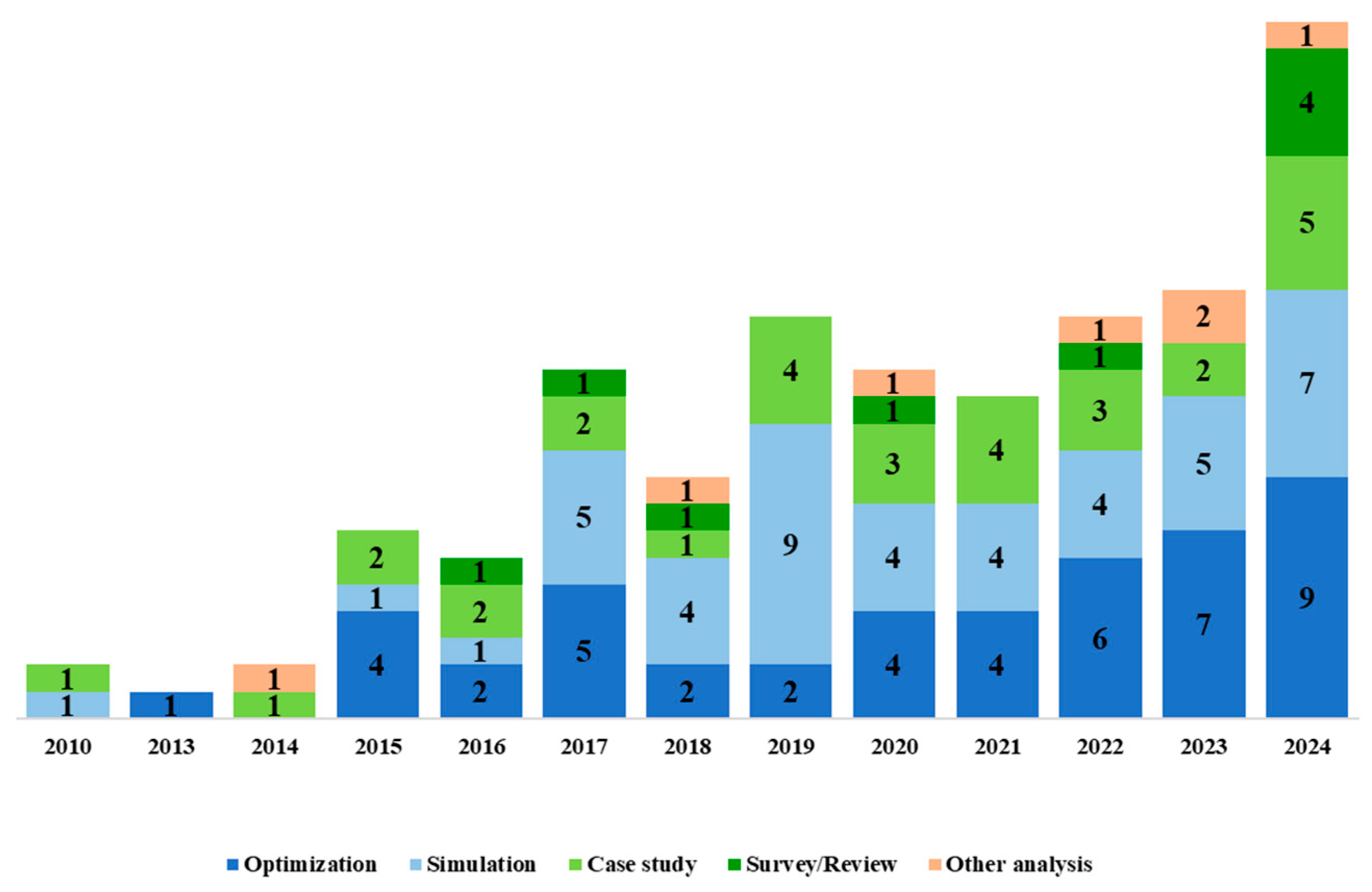
As shown in Table 1, the literature on truck platooning largely relies on simulation and optimisation approaches. For instance, ref. [16] presented an agent-based simulation model for truck platoon matching, based on multiple truck properties. Similarly, ref. [17] proposed a general simulation framework for modelling and analysing the influence of truck platooning on traffic. In the area of control strategies, ref. [18] introduced a delay-based spacing policy for the control of vehicle platoons together with a notion of disturbance string stability, and validated the results using simulation, while ref. [15] developed a micro-simulation model of truck platooning with CACC, also demonstrating the applicability of the model through a case study. Reference [19] developed a path planning algorithm for platooning of articulated cargo trucks with the aim of maintaining both dynamic and string stability. Moreover, by analysing vehicle data from a European region and using map-matching and path-inference algorithms, ref. [14] determined the rate of spontaneous platooning and estimated the resulting fuel savings. From a broader perspective, ref. [20] identified the strengths and weaknesses of truck platooning in the context of the European Union’s sustainable development criteria.
Table 1. Methodologies used in the analysed paper (P = planning, C = control, P,C = both).
AuthorAreaYearOptimisationSimulationCase StudySurvey/ReviewOtherQuantitativeQualitative
[21]Alam et al.P2010
[22]Robinson et al.P2010
[23]Liang et al.P,C2013
[24]Alam et al.P,C2014
[25]Liang et al.P2014
[26]Alam et al. (a)C2015
[27]Alam et al. (b)C2015
[28]Larsson et al.P2015
[29]Liang et al. C2015
[30]Van De Hoef et al.P2015
[17]DengP2016
[31]Liang et al. (a)P2016
[32]Liang et al. (b)C2016
[33]Nourmohammadzadeh et al.P2016
[34]Tsugawa et al.P2016
[35]Axelsson et al.C2017
[36]Johansson et al.P2017
[37]Sokolov et al.P2017
[38]Turri et al. C2017
[39]van De Hoef et al.P2017
[40]Zhang et al.P2017
[7]Bhoopalm et al.P2018
[41]Boysen et al.P2018
[42]Chen et al.C2018
[12]Jacob et al.P2018
[43]Jin et al.P2018
[44]Pasquale et al. C2018
[45]Ramezani et al.C2018
[46]Van De Hoef et al.P,C2018
[47]Calvert et al.P2019
[48]Čičić & Johansson C2019
[49]Duret et al.P2019
[16]Gerrits P2019
[50]Larsen et al.P2019
[51]Piacentini et al. C2019
[52]Scherr et al.P2019
[53]Wang et al.P2019
[54]Yang et al.P2019
[55]Faber et al.C2020
[56]Johansson et al.P2020
[19]Lee et al.C2020
[20]Pająk & CyplikP2020
[57]Piacentini et al.C2020
[58]Scherr et al.P2020
[59]Wang et al.C2020
[60]You et al. P2020
[61]Ladino et al.C2020
[62]Čičić et al. C2021
[63]Noruzoliaee et al.P2021
[64]Sacone et al.C2021
[65]Sun et al.P2021
[66]Watanabe et al.P,C2021
[67]Lee et al.P,C2021
[68]Paddeu et al.P2021
[69]Abdolmaleki et al.P2021
[70]Chen et al.P2021
[71]Bouchery et al.P2022
[72]Čičić et al.C2022
[11]Lesch et al.P2022
[73]Li et al.P2022
[74]Marzano et al.P2022
[75]Xu et al.P2022
[76]Hussein et al.C2022
[77]Wassergurger et al.C2022
[78]Xu et al.P2022
[79]Ma et al. C2023
[80]Pourmohammad-Zia et al.P2023
[81]Wang et al.P2023
[82]Zhou et al.P2023
[83]Combes et al.P2023
[84]Luo et al.C2023
[85]Rui et al.C2023
[86]Wu et al.P2023
[87]Peng et al.P2023
[88]Scholl et al.P2023
[89]Lian et al.C2023
[90]Yang et al. (a)P2024
[91]Wang et al.C2024
[92]Lourenço et al.P2024
[93]Karthik et al.P,C2024
[94]Hu et al.P2024
[95]Mahajan et al.P,C2024
[96]Liu et al.P,C2024
[97]Rebelo et al.P,C2024
[98]Chowdury et al. C2024
[99]Jiang et al.C2024
[100]Liatsos et al.P2024
[101]Zhao et al.P2024
[102]Liatsos et al.P2024
[103]Li et al.C2024
[104]Jiang et al.C2024
[105]Liu et al.C2024
[106]Ioannou et al.P2024
[107]Hu et al.C2024
[108]Choobchian et al.C2024
[109]Yang et al. (b)P2024
[110]Cheng et al.C2024
The application of modelling approaches to real-world case studies is a common practice in the literature, used both to validate theoretical findings and to provide practical insights into platooning operations. For instance, ref. [31] used traffic data from the Stockholm motorway control system to assess how traffic conditions affect platoon formation manoeuvres. Similarly, ref. [54] based their simulation experiments on traffic data from Dutch motorways, while [24] investigated Swedish highway conditions to evaluate safety-related parameters, such as the minimum safety distance between vehicles that can be maintained at legally permitted speeds.
Overall, 87% of the papers included in the review adopt a quantitative approach. The remaining papers rely on a qualitative approach, primarily through surveys. For instance, ref. [34] provided a review of the main truck platooning project aimed at reducing energy consumption. Reference [7] performed a survey of the literature by classifying the different planning problems associated with truck platooning, whereas [11] introduced a new taxonomy for coordination strategies and mapped existing approaches accordingly. Reference [12] analysed the expected benefits of truck platooning by reviewing numerous implemented projects, and [59] reviewed the literature in relation to cooperative longitudinal motion control systems for multiple CAVs.
Figure 4 provides an overview of the methodologies adopted over time across the analysed studies. Optimisation models appear consistently throughout the entire time span considered, whereas the use of simulation-based approaches becomes more prominent starting from 2017 onward.

4. Planning of Truck Platooning

Planning truck platooning includes all activities related to the formation, maintenance, and reassembly of platoons during transport operations. In the literature, three main planning paradigms are typically identified, depending on when trips are organised with respect to vehicle departure [7]:
  • Scheduled platoon planning (also referred to as “off-line” or “static planning”): all routes and platoon formations are defined in advance, prior to the execution of transport operations;
  • Real-time planning (or “online” or “dynamic planning”): platoons are formed just before departure or in real-time while trucks are travelling;
  • Opportunistic platooning (also known as “spontaneous”, “ad hoc” or “on the fly”): no prior planning is assumed; vehicles form platoons spontaneously when they encounter other trucks travelling in the same direction and within a suitable proximity.
The role of a Platooning Service Provider (PSP) becomes crucial when planning is required, as in the case of “online” and “offline” or when, due to poor freight traffic on specific routes [111]. PSP acts as an intermediary between trucking companies, providing centralised planning to create platoons efficiently and effectively. Moreover, the PSP contributes to fair benefit allocation among participating vehicles and often manages administrative and insurance-related procedures associated with platoon operations.
A further classification in platoon planning concerns the location where platoons are formed, namely en-route or at hubs. In en-route platooning, platoons are formed while travelling on the road, thus directly interacting with the surrounding traffic. Several studies have examined this type of planning to assess its impact on overall traffic flow; for instance, ref. [31] observed that platoon formation during circulation may lead to temporary slowdowns or even speed limit violations under certain conditions. On the contrary, hub-based platooning [56] occurs at designated locations along the road network (such as freight terminals, service stations, and parking areas); in this case, the figure of the PSP mentioned above becomes essential. When forming platoons in hubs, platoon coordination, i.e., the decision of when to release vehicles from the hub in platoon form, is crucial. In the literature, several authors have addressed platoon coordination problems. For example, ref. [56] studied a coordination problem in which the coordinator knows the statistical distribution of the vehicle arrival process, yet does not know the exact arrival time in advance. The problem is to decide, at each step of the procedure, whether the vehicles should leave the hub to form a platoon or wait in the hub.

4.1. Planning of Truck Platooning: Level of Automation of the Vehicles and Other Features

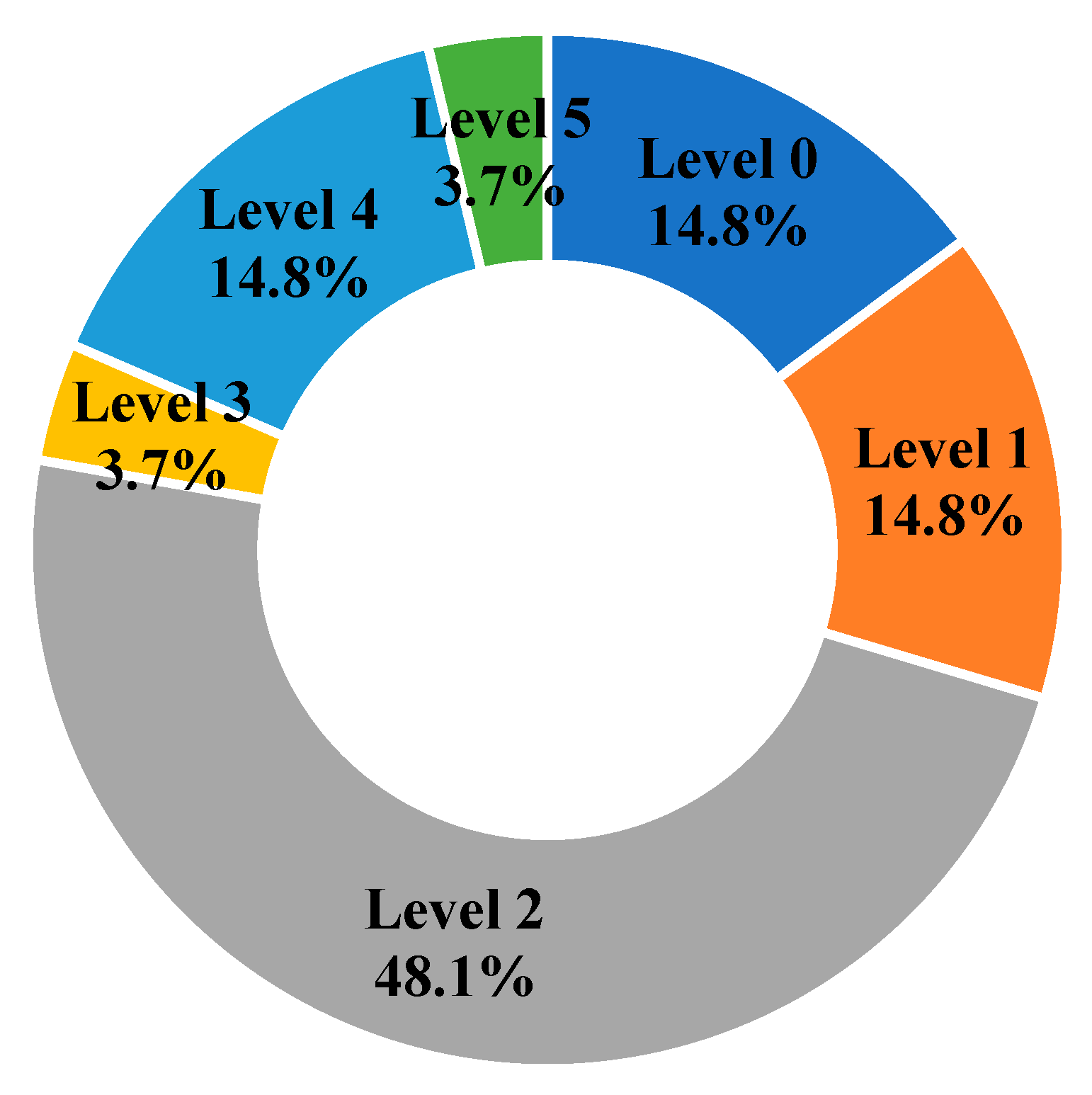
The studies included in the planning category exhibit significant variability in platoon characteristics, particularly the number and type of vehicles, automation level, and road infrastructure type. Figure 5 illustrates the distribution of automation levels across the analysed papers. The level refers SAE classification [6], ranging from level 0 (no driving automation) to level 5 (full driving automation). It should be noted that Figure 5 only considers papers in which the level of automation was explicitly stated. In several papers, this information was either omitted or treated as a variable within the analysis. This is particularly common in planning-focused papers, where the specific automation level is not of primary importance. A few studies adopted custom or non-standard classifications rather than referring directly to SAE levels. Reference [60] considered a semi-automated platoon, without indicating a corresponding SAE level, while ref. [7] introduced an alternative categorization based on operational modes, distinguishing between human-driven platooning with in-platoon resting, hybrid platooning, and driverless platooning. Among the papers that clearly define the automation level, SAE level 2 [8,10,12,15,17,31,44,47,57], i.e., partial automation, is the most commonly assumed. Only a few authors considered higher levels of automation [52,54,58]. Other authors, on the other hand, considered a low level of automation [12,25,30,31,33,39].
Most contributions assume that platooning takes place on highway networks, as such environments are generally considered the most suitable for implementation due to their controlled traffic dynamics and reduced complexity compared to urban settings. Regarding vehicle homogeneity, approximately half of the papers analysed consider platoons composed of identical vehicle types, while in the remaining studies, this information is either not explicitly specified or multiple scenarios with different compositions are considered. The number of vehicles per platoon is another aspect that is frequently unavailable, perhaps because it is precisely among the goals of the authors’ work to determine it, such as [81], or a case study dependent variable, such as [49,50,53].

4.2. Planning of Truck Platooning: Expected Benefits

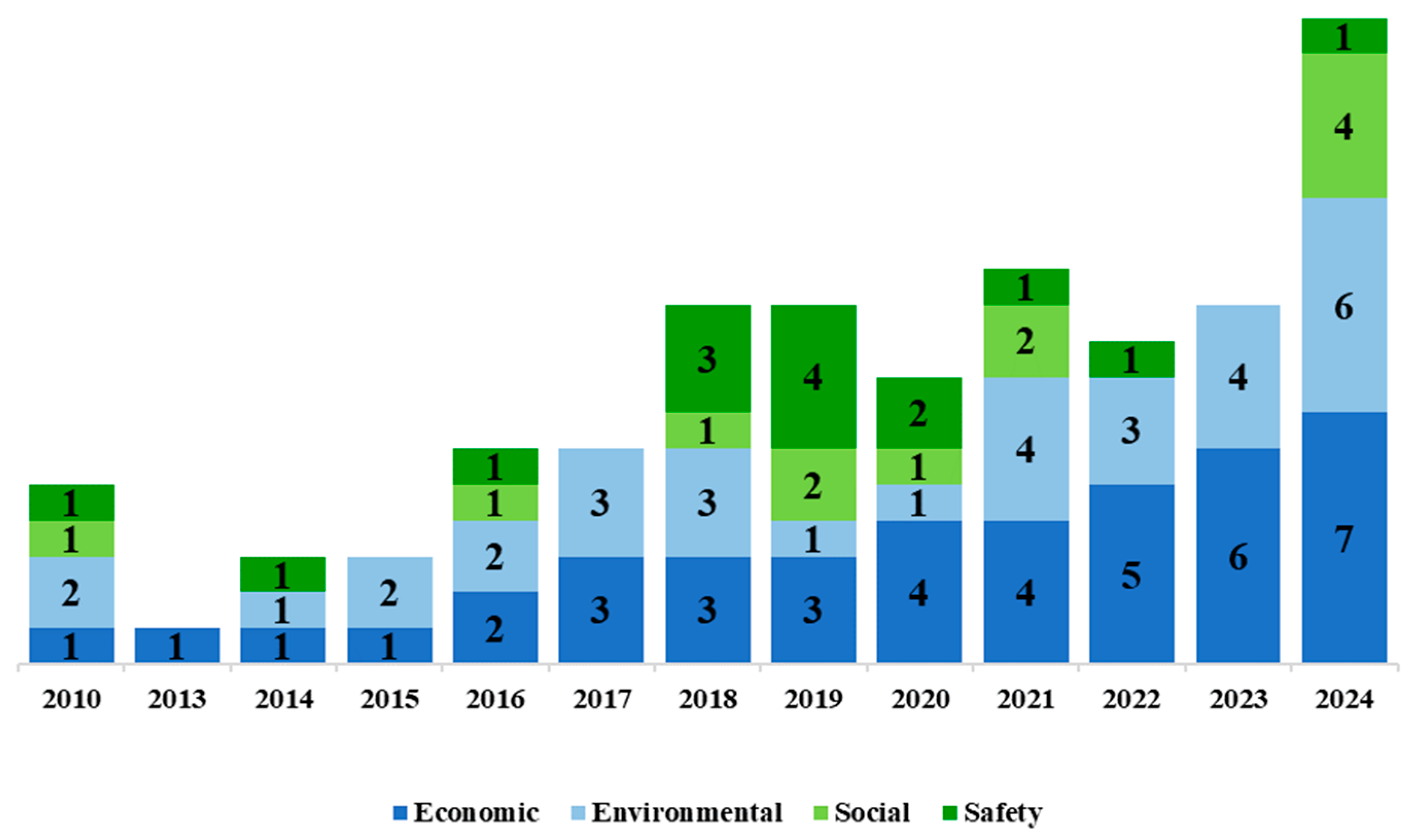
As previously discussed, truck platooning can generate numerous benefits: economic, environmental, social, and safety-related. Table 2 summarises the expected benefits considered in the planning-focused contributions included in this literature review. Overall, 65% of the analysed papers address economic aspects, while 51% explore environmental impacts, most often in relation to reduced fuel consumption. Safety-related benefits are investigated in 24% of the studies, whereas social implications, such as congestion mitigation and traffic efficiency, are considered in 19% of the cases.
From a temporal perspective, economic benefits have received increasing attention since 2017, while the focus on environmental aspects appears more irregular over time (Figure 6). Social benefits are comparatively less emphasised within the planning literature. Interest in safety-related aspects appears concentrated between 2018 and 2019, with less prominence in the other years.

4.2.1. Environmental and Economic Benefits

As already mentioned, fuel consumption reduction is one of the primary goals of truck platooning technology [21,34,36,50,73,75,82,112]. The environmental benefits are mainly associated with the decrease in CO2 and pollutant emissions derived from lower fuel usage. For instance, ref. [36] proposed an optimal speed control approach to determine the optimal fuel-efficient trajectory of heavy-duty vehicles (HDVs) during deceleration. Through microscopic traffic simulation, the research reported fuel savings of 84% for the leading trucks the platoon and 81% for the following vehicles in the platoon, compared to simulations without optimal control. The aerodynamic drag-reduction effect that emerges when trucks travel in close succession is widely recognised as the main driver of fuel efficiency improvements. Consequently, numerous studies have focused on planning strategies and coordination mechanisms to maintain favourable inter-vehicle distances and stable platoon formations [7,11,50,63,65].
Beyond quantitative analyses, some contributions adopt a qualitative perspective. For example, ref. [20] argued that truck platooning can contribute to achieving the European Union’s sustainable development goals, although they also noted that its overall impact may be limited unless integrated with broader transport decarbonization strategies.
Several studies apply optimisation models to quantify the economic and environmental impact of platooning. For instance, ref. [39] formulated a combinatorial optimisation problem that combines plans involving only two vehicles, later validating the approach through Monte Carlo simulations in a realistic setting. Reference [25] studied the platooning rate of 1800 heavy vehicles by analysing the location data of vehicles in a European region over a single day. The research shows that a coordination mechanism can increase the platooning rate and fuel savings by an order of magnitude, even with minor adjustments to existing schedules. From a routing perspective, ref. [28] defined the platooning problem, allowing the calculation of fuel-optimal paths on large-scale real networks. Their results indicate that, when assuming all HDVs depart from the same origin, optimal platoon routing strategies can lead to fuel savings of 9–10%. Reference [30] formulated an optimisation problem that simultaneously addresses platoon coordination at the formation stage and at the breakup stage with the aim of reducing fuel consumption. In [33], the platooning problem is formulated over a graph derived from the German road network; due to its computational complexity, a genetic algorithm is employed to obtain fast, high-quality solutions for large instances.
While fuel savings represent the most widely recognised economic benefit of truck platooning, they constitute only one component of the broader operational cost structure. Reference [81] proposed two different platoon configuration strategies, fixed platoon and flexible platoon, and tested their impact on consumption reduction. Their results show that as the length of the platoon increases, there is a reduction in the platoon’s energy consumption; however, when the platoon is formed by more than 3 vehicles, the effect of energy saving and emission reduction persists but is not as significant. Reference [40] formulated a platoon coordination problem with soft time windows as a mixed-integer linear programming problem with the objective of minimising total costs composed of operation costs, schedule miss penalties and fuel costs. Reference [52] defined a model that jointly determine the fleet size, vehicle mix and routing plan, with the goal of minimising overall logistics costs. The issue of cost-sharing among multiple operators is addressed by [71], who apply cooperative game theory to analyse benefit allocation mechanisms. Their findings suggest that inter-operator collaboration can significantly enhance cost efficiency, provided that fair distribution schemes are implemented [74]. explored the potential market of truck platooning in Italy, comparing it against alternative multimodal transport models, including rail and maritime transport. Their results indicate that truck platooning could become a competitive option for medium and long distances.
Similar conclusions are reported in [80], who proposed an optimisation model to evaluate the time and cost performance of Automated Guided Vehicles (AGVs) in platoons for container pick-up and delivery. The application of the model to two case studies shows that truck platoons are generally both time- and cost-efficient, particularly over long distances.

4.2.2. Safety Aspects

Safety concerns apply to both truck drivers and surrounding road users. Due to the synchronisation between trucks in a platoon, which move in a line at close distances, platooning can have a positive impact on safety, as it reduces overtaking and lane-changing manoeuvres [17,25,35], provided that the vehicle performance and maintenance conditions are homogeneous and of high standard. In addition, vehicle-to-vehicle communication enables platoons to achieve reaction times that are significantly faster than those of human drivers, thereby increasing overall crash-avoidance capability. This aspect will be further elaborated in Section 4.2, which focuses on platoon control mechanisms.
Ref. [24] developed a nonlinear dynamic model to derive a safety criterion between neighbouring vehicles within a platoon. The purpose of the study is to estimate the minimum distance required between two vehicles (in which the latter receives position and speed information from the former) to prevent a collision. The model is first set for 2 vehicles and later generalised to N-vehicle platoons.
In order to address the challenges related to safe interaction between platoons and surrounding traffic, especially at network discontinuities where mandatory lane changes may cause platoons breakups, ref. [49] proposed an efficient method to split a platoon of vehicles in proximity to road intersections. Similarly, ref. [53] studied the effects of truck platooning in operations near a highway ramp.

4.2.3. Social Benefits

Although environmental benefits (Section 4.2.1) and safety impacts (Section 4.2.2) should be included in the social benefits category, this specific section focuses on the interaction between the truck platoon and the surrounding traffic [22,52,53], particularly in relation to congestion effects.
In this context, ref. [43] proposed a fluid queuing model to study the macroscopic interaction between randomly arriving vehicle platoons and background traffic at highway bottlenecks. Similarly, ref. [17] evaluated the impact of HDV platooning on traffic flow through simulation, considering three scenarios: the first examines the effect of platooning on traffic flow, while the second and third investigate the effect of traffic conditions on platoon formation.
Using a simulation model, ref. [47] finds that, under the scenarios considered, truck platooning may have a slightly negative effect on traffic flow performance. In contrast with other research, the authors recommend that platooning strategies should be refined and that policymakers should restrict their deployment to non-saturated traffic conditions.
Additional Societal Impacts
Although the evidence on the societal impacts of truck platooning remains limited and often heterogeneous across studies, several contributions provide useful qualitative and quantitative insights into how platoons interact with surrounding traffic and influence broader mobility conditions. Early investigations indicate that long platoons may temporarily reduce overtaking opportunities or create localised bottlenecks, especially near ramps or weaving sections where mandatory lane changes may disrupt traffic flow [22,53]. Simulation-based studies report mixed effects: while some authors identify slight reductions in overall traffic performance under specific operating conditions [47], others show that cooperative driving dynamics and smoother speed profiles can mitigate turbulence in mixed traffic and support more stable flow patterns [17,43].
Driver-related aspects also constitute an important societal dimension. Experimental findings highlight that human drivers may experience discomfort when interacting with tightly spaced platoons, particularly during merging or passing manoeuvres [55]. Conversely, other studies suggest that higher levels of automation may contribute to reducing driver workload and improving acceptance of cooperative following strategies.
Overall, the available findings suggest that the societal implications of platooning depend strongly on traffic density, infrastructure configuration, platoon length and technological maturity. While the evidence base is not yet extensive enough to enable systematic comparisons across studies, the emerging insights contribute to a more holistic understanding of the non-economic and non-environmental effects associated with truck platooning deployment.

5. Control of Truck Platooning

Autonomous driving technology represents a key enabler for improving both safety and efficiency in transportation systems. By reducing human intervention, it contributes to accident prevention, fuel savings, and congestion mitigation, largely thanks to smoother driving dynamics and reduced aerodynamic drag among closely spaced vehicles [23].
Truck platooning is inherently based on vehicle cooperation, enabled to Cooperative Adaptive Cruise Control (CACC) systems in combination with Vehicle to Vehicle (V2V) wireless communication. These technologies allow trucks to maintain close inter-vehicle distances while ensuring safety and coordination within the platoon.
The leading vehicle (LV) typically operates under Cruise Control (CC), responsible for maintaining a constant speed, or Adaptive Cruise Control (ACC), which additionally adjusts speed based on the distance to the preceding vehicle. The following vehicles (FV), instead, rely on CACC, which, through V2V connection, ensures tight synchronisation with the leader and enables minimal headway between trucks. The lead vehicle can also switch to the CACC controller to join another platoon.
As automation levels increase, the role of human drivers in the following vehicles becomes progressively more passive. Full or partial autonomy is achieved through the integration of longitudinal and lateral control modules, supported by on-board environmental sensors such as radars and cameras. While longitudinal control ensures appropriate spacing and speed regulation, lateral control maintains lane keeping and alignment with the leading vehicle’s trajectory, thereby preserving the integrity of the platoon.
Connected and automated vehicles (CAVs), as previously discussed, offer significant potential in addressing safety, mobility, and sustainability challenges. From a functional perspective, a CAV system typically consists of several modules [59], including:
  • Perception sensors, such as cameras, radars and/or LIDARs, which are the main sources of information about surrounding vehicles and the road environment;
  • Communication module, enabling reliable real-time wireless V2V/Infrastructure to Vehicles (I2V) communication. This component provides information that cannot be readily detected by other sensors (such as information from vehicles outside the sensor range, immediate notification of speed changes or steering commands, or negotiation between vehicles regarding desired manoeuvres to increase safety and efficiency).
The effective application of these technologies to truck platooning has been widely demonstrated through numerous funded projects worldwide. The interested reader may refer to the work presented in [28], which proposes a review of projects in truck platooning, with a special focus on energy saving.
However, the objective of this section goes beyond the analysis of the technological equipment used to make the implementation of platooning techniques possible. Instead, it proposes a concise overview of the main control schemes developed to manage real-time platoon formation and trips, with the aim of assessing how different approaches contribute to the expected operational, environmental and safety benefits associated with platooning.

5.1. Control of Truck Platooning: Control Schemes

A substantial portion of the scientific literature on truck platooning focuses on the design of control schemes that determine how vehicles or entire platoons behave during operation. These control schemes can be classified according to two hierarchical levels:
  • Low-level platoon control, which governs the trajectories and actuation of individual vehicles within the platoon;
  • High-level platoon control, which manages the collective behaviour of the platoon and the execution of decisions established at the planning level.
Within low-level control, two fundamental components are typically distinguished, although often applied jointly:
  • Longitudinal control, responsible for speed regulation and inter-vehicle distance maintenance;
  • Lateral control, which ensures lane keeping and alignment between vehicles.
High-level platoon control, on the other hand, encompasses speed control of the platoon, coordination control between multiple platoons, and freeway traffic control, which governs platoon interaction with surrounding traffic at the network level. Table 3 summarises the main control approaches reported in the literature, classifying them according to control level and the type of actuation. Each of these categories is further analysed in the following subsections.

5.1.1. Low-Level Platoon Control

Low-level platoon control schemes encompass approaches that aim to keep trucks in a close formation while the platoon is travelling or performing specific manoeuvres. Implementation of these control schemes involves the definition of appropriate control actions for each vehicle composing the platoon, which are generally defined on models referred to the individual vehicle. These control schemes generally assume that higher-level decisions, such as whether to form a platoon or which route to follow, have already been taken during the planning or coordination phase.
The main categories of low-level control are:
  • Longitudinal control, which regulates speed and inter-vehicle spacing, and
  • Lateral control, which ensures lane keeping and alignment between vehicles.
A crucial aspect related to CACC-based cooperation is the acceptance of reduced distances between vehicles by human drivers, particularly during the early stages of implementation, when drivers remain responsible for monitoring the driving environment. Although the technological capability to maintain very short distances between vehicles is well established, experience shows that driver comfort and perceived safety strongly influence the stability of a platoon in real-world operations. Results from the California PATH programme show that drivers generally accept reduced safety distances when automation provides smooth and predictable longitudinal control, but discomfort increases when speed variations or sudden decelerations occur [113,114]. These findings, although derived from CACC experiments with passenger cars, are highly relevant to truck platooning, where optimal distances for fuel economy (typically 0.3–0.7 s) may fall below the comfort threshold of human drivers at intermediate levels of automation. Therefore, the design of platoon control systems must consider distancing policies, queue stability, and human acceptance together, ensuring that vehicles remain tightly coordinated without undermining driver confidence or causing unnecessary disruptions.
As highlighted in Table 3, low-level control schemes represent the earliest and most extensively investigated forms of platoon control in the literature.
A closer look at low-level control approaches shows that most methods focus on longitudinal control (see, for instance, ref. [59] for a comprehensive review of approaches of this type). Generally, in such schemes, the main control variables to be defined for each vehicle—typically speed and acceleration—are identified to implement intra-platoon spacing policies. Spacing policies can be of different types and may be based on the tracking of a desired constant spacing or a variable spacing. One of the earliest works in this area is [115], which proposes two nonlinear spacing policies based on variable time headway and variable separating error. References [26,27] exploited the presence of CACC systems to implement distancing policies by leveraging cooperation among the vehicles in the platoon. More in detail, ref. [27] presented a decentralised linear-quadratic controller to minimise the intra-vehicular distance with the goal of reducing fuel consumption while not compromising safety aspects. Reference [38] proposed a hierarchical control scheme, in which the high level of control, named platoon coordinator, defines the optimal fuel reference speed for all vehicles in the platoon, considering the topography and speed limits on the road. This speed and the corresponding time gap between vehicles are used as reference signals by the low-level control, which, according to a Model Predictive Controller (MPC) control logic, defines the speed and acceleration of each vehicle. Other approaches include the presence of external disturbances in the development of the longitudinal controller, such as performed in the work proposed by [12], or the effect of a particular layout of the road, e.g., uphill grades, on the feasibility of the platoon, see [42]. Closely related to the longitudinal control is the work proposed by [24] in which a game-based approach is developed to find the minimum intra-platoon distance that must be maintained to avoid collisions.
Lateral control is of utmost importance when platoons need to perform manoeuvres (e.g., lane changing, entering or exiting from ramps, and so on), or to ensure that all vehicles maintain their trajectory on a curved road, as performed by [19].
In the majority of the studies reviewed, lateral control is combined with longitudinal control (see Table 3). One of the first approaches of this type is described in [116], which reports the application and the experimental results obtained in the CHAUFFEUR project using combined longitudinal and lateral control. More recent works are those presented in [55,79,117]. Reference [55] presented a new lateral controller to deal with critical traffic conditions (such as platoon merging from a ramp with mainstream traffic) and tested it, in combination with existing longitudinal control, under different traffic conditions. Reference [79] suggested a longitudinal and lateral controller based on PI controllers to handle lane-change manoeuvres while avoiding the occurrence of collisions. Reference [117] proposed a nonlinear controller that exploits the presence of CACC systems on board vehicles.
Finally, it is worth noting that most of the aforementioned approaches design longitudinal and lateral controllers to ensure string stability [18,19,42,55,115]. String stability is a key property that ensures disturbances or errors are not amplified as they propagate upstream through the platoon. A comprehensive analysis of low-level control strategies for preserving string stability is presented in [118].

5.1.2. High-Level Platoon Control

High-level platoon control includes the set of control schemes needed to implement decisions made at the planning level or to read just them according to conditions occurring in real time. These control schemes may be devoted to control a single platoon, or groups of platoons, with the objective of improving performance metrics such as travel time, fuel consumption, or safety. In other cases, high-level control focuses on coordinating individual vehicles during the formation process, determining when and how trucks should merge into a platoon. A further perspective considers platoons as mobile actuators to implement control strategies, where their coordinated behaviour is leveraged to optimise overall traffic flow rather than solely the performance of the platoon itself. Compared to low-level controllers, high-level control schemes typically rely on more aggregate modelling frameworks.
Some high-level control schemes aim to implement platoon speed control in order to achieve some benefits. For example, in [44], a control scheme based on traffic prediction is proposed to dynamically adjust platoon speed to minimise time spent in congested conditions. Similarly, ref. [23] proposed a decision framework to determine the convenience for a truck to accelerate and join an existing platoon or to continue independently.
Other studies focus on defining control actions to achieve the goals set at the planning level by implementing appropriate coordination control actions between trucks or platoons that want to collaborate. The majority of works in this aim to minimise fuel consumption or maximise the efficiency of transport activities. For example, refs. [29,46] proposed en-route coordination algorithms that facilitate platoon formation during trips, while the control algorithms proposed by [32] aim to not only reduce fuel but also inefficient empty trips.
Finally, one of the most recent trends in truck platooning research involves its use as an active tool for freeway traffic control strategies (Table 3). Traditionally, freeway traffic control has been addressed by developing control schemes in which control actions are defined based on traffic conditions detected through sensors located along freeways and implemented through fixed actuators. However, studies such as [48,51,57,62,64,72] propose a new paradigm in which platoons act as mobile actuators, actively regulating the traffic flow upstream of bottlenecks. The control strategies proposed in these papers are mainly inspired by variable speed limit (VSL) schemes, whose objective is to reduce the inflow towards a bottleneck by imposing a lower speed on approaching vehicles. In practice, VSL effectiveness is often limited by driver compliance and the positioning of fixed signage. In contrast, platoon-actuated speed control inherently enforces compliance, as surrounding vehicles are constrained to adapt to the speed of the platoons.
In control schemes where platoons are actuators, speed [51,57,64] or both speed and lane allocation [48,62,72] are treated as control variables to prevent bottleneck activation. In all cases, control actions are computed based on predicted traffic conditions in the freeway, using either first-order traffic flow models [48,51,57,62,72] or second-order models [64]. These models must include the presence of the platoons themselves, allowing the control system to account for their impact on overall traffic dynamics.

5.2. Control of Truck Platooning: Expected Benefits

Most of the control schemes discussed above have been developed to pursue specific benefits, which can be broadly grouped into environmental, economic, safety and social. These dimensions are also analysed in the survey paper on longitudinal control by [59], which demonstrates that such control schemes are not only effective in reducing energy consumption, but may also contribute to improved safety, increased road capacity, and greater user satisfaction.
Table 4 shows the classification of the papers analysed in this section according to the expected benefits they address. Most of these papers are developed with the primary goal of ensuring string stability [18,115,118]. As already mentioned and as highlighted in [118], this property is inherently related to safety, since it prevents the propagation of spacing errors within the platoon. However, as pointed out by [24], string stability alone does not guarantee collision avoidance, particularly in scenarios involving sudden braking.
The literature places the greatest emphasis on safety and energy savings (Table 4). These two objectives, however, may be in conflict with each other. Indeed, increasing inter-vehicle distances enhances safety but reduces fuel consumption savings, as air drag is reduced. Some works, such as [26,27], address this issue by minimising inter-vehicular distances without compromising energy efficiency.
It is also important to distinguish control approaches that generate benefits exclusively for platoon members from those that produce system-level advantages, as in the case of platoons used as mobile actuators of control strategies.
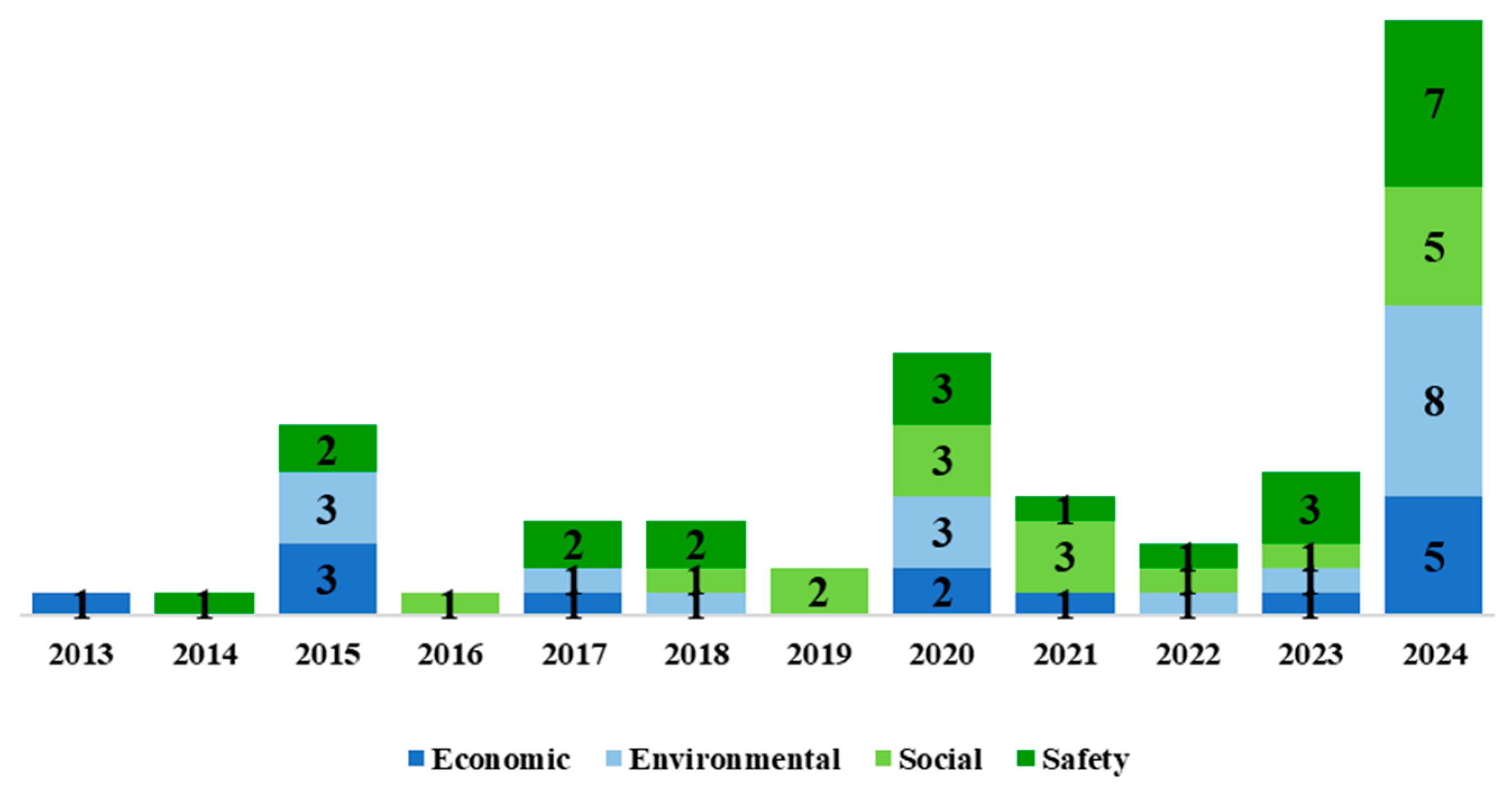
Figure 7 shows three peaks of research activity—in 2015, 2020 and 2024—during which the expected benefits were extensively studied compared to other years.

5.2.1. Environmental and Economic Benefits

Fuel-saving is one of the primary reasons behind the development of truck platooning techniques. At the control level, a key challenge is to translate the economic benefits envisioned during the planning phase into tangible operational gains while managing the technological constraints imposed by maintaining tight vehicle formations. For this reason, some works address fuel efficiency and safety jointly. In [26,27], the control objective is to minimise inter-vehicular distance in order to maximise fuel saving while not compromising safety. In [38], the goal of the controller is to track a fuel-efficient reference speed defined at the planning level, while imposing safety constraints implemented at the vehicle control level.
In other studies, energy efficiency is the primary controller goal. Reference [23] analysed the conditions under which it is convenient for a vehicle to merge into a platoon, based on the expected fuel savings. Similarly, refs. [29,46], instead, proposed control algorithms to coordinate the platoon formation with the aim of optimising energy efficiency.
In most of these approaches, the energy benefits are shared by all platoon members. However, in the control scheme proposed by [51], the focus shifts to the system-level since fuel consumption and travel time reduction are for the benefit of vehicular flow. In this scheme, platoons are modelled as moving bottlenecks and controlled to avoid the occurrence of circumstances that lead to inefficient driving conditions (mainly congested scenarios) and, thus, high fuel consumption.

5.2.2. Safety Aspects

Safety is a key aspect for the implementation of truck platooning, as vehicles are required to travel at high speeds while maintaining very short inter-vehicular distances, provided that they are compliant with the performance (acceleration, deceleration, and dynamics) of the platooned trucks. There are currently many commercially available systems specifically designed to enable safe driving. High-technology vehicles, such as those adopted to perform truck platooning, use radar detection and wireless communication systems to implement control strategies developed to maintain the trajectory of the leading vehicle and avoid collisions. Control schemes conceived with the main objective of ensuring driving safety take advantage of the availability of these technological devices on board vehicles. In [24], a general framework is proposed to derive empirical safety bounds, identifying the minimum safe inter-vehicular distance required to avoid collisions within a platoon.
Other papers address safety in specific operational contexts. For instance, ref. [42] developed a longitudinal controller that guarantees asymptotic and string stability even under critical road configurations such as uphill slopes, whereas [19] proposed a string stable longitudinal and lateral controller that ensures safe driving on curved roads.
In some approaches, safety is assessed not only within the platoon itself, but also in relation to interactions with the surrounding traffic. Reference [44] introduced a platoon speed control approach based on traffic prediction, designed to minimise the time spent by the platoon in a congested situation and avoid abrupt speed variations, thereby enhancing safety. Another major challenge to the successful implementation of truck platooning is the safe and efficient interaction with surrounding traffic in correspondence with entering and exiting ramps, where mandatory lane changes can lead to the decoupling of truck platoons. The study conducted by [55] fits into this line of research by proposing a study that evaluates traffic and safety efficiency when truck platoons are introduced into the freeway from entering ramps. This work shows that there is a strong correlation between platoon characteristics, traffic demand, and traffic scenarios. Reference [79] proposed a longitudinal and lateral controller designed to avoid collisions in the presence of mixed traffic.

5.2.3. Social Benefits

Similarly, as in Section 4.2.3, social benefits are intended here as those related to traffic flow improvements, particularly congestion reduction and interactions with surrounding traffic. Most studies addressing these benefits rely on platoons acting as mobile actuators within traffic control strategies. In such approaches, platoons are modelled as moving bottlenecks and their speed and/or lane allocation are controlled to achieve system-level improvements in mobility. Representative contributions of this type include [48,51,57,62,64,72]. In particular, ref. [72] proposed a platoon-actuated mainstream control strategy to alleviate congestion at freeway bottlenecks, with similar approaches presented in [48,62]. In [64], two control architectures—centralised and decentralised—are presented to mitigate congestion in freeways by controlling platoon speed. Likewise, refs. [51,57] investigated speed control policies for platoons in order to mitigate congestion.
In other approaches, the impact of platoons on mobility is not directly included in the definition of control actions, but rather assessed a posteriori. For example, ref. [55] analysed the effect of applying control actions on platoons in different traffic scenarios. A different perspective is adopted in [32], where the focus is on increasing transport efficiency by reducing the number of empty trips, rather than directly optimising traffic flow.
Finally, ref. [45] applied a simulation model considering different market penetration rates, showing that CACC improved traffic operations for trucks without negatively affecting car operations and, in some cases, even leading to considerable improvements in overall traffic conditions.

6. Conclusions

The literature indicates that truck platooning may offer relevant sustainability gains for road freight transport, especially in terms of fuel efficiency, emissions reduction and operational performance. However, the magnitude and reliability of these advantages strongly depend on behavioural, regulatory and organisational conditions that are still insufficiently investigated. Quantitative results are robust for aerodynamic savings and energy efficiency, whereas most social, labour and operational impacts remain qualitative due to the current predominance of Level 2 automation and the scarcity of real-world experiments.
From a planning perspective, most contributions pursue economic and environmental benefits through routing optimisation, dynamic scheduling and cooperative coordination among fleet operators. Nevertheless, modelling approaches typically assume homogeneous trucks, idealised operating conditions and do not explicitly analyse the influence of ADAS availability, traffic density or road typology. The composition of the platoon, including the number of trucks and the diversity of vehicle classes involved, is seldom analysed in depth, despite its influence on energy savings and cost allocation. Furthermore, potential synergies with alternative low-emission fuels remain scarcely explored, even though they could affect both economic feasibility and environmental performance. Planning research should therefore incorporate more realistic assumptions on vehicle variety, multimodal integration and incentive mechanisms for cooperation.
From a control perspective, benefits arise primarily from string stability, coordinated braking and reduced inter-vehicle distances that lower aerodynamic drag and improve safety margins. However, safety and energy efficiency may diverge if larger spacing distances are enforced by regulation, comfort preferences or manufacturer policies. The role of ADAS and V2V/V2X communication in enhancing safety, reducing driver distraction, stabilising traffic flow and generating indirect social benefits (e.g., insurance implications, reduced liability, improved driver well-being) remains insufficiently quantified. Progress in simulation research should therefore extend beyond Level 2 automation to assess conditional or higher levels, where shorter time-gaps and reorganised driver tasks could enable additional savings and foster more flexible driving-time management and compliance with working-hour regulations.
A crucial research direction concerns multi-operator cooperation, which considerably improves the economic viability of platooning [71] but raises unresolved issues regarding coalition stability, cost and revenue sharing, and fair distribution of aerodynamic benefits. Since trucks in different positions do not benefit equally from fuel savings, mechanisms for fair benefit attribution are essential to ensure stable and trustworthy platooning agreements and to avoid strategic behaviours that undermine cooperation [75]. Cooperation mechanisms should be investigated together with regulatory harmonisation and business models that incentivise shared investment in platooning technologies and digital infrastructure.
The assumption of homogeneous fleets and idealised road or traffic conditions also limits the transferability of current results. Real-world deployment will require modelling heterogeneous vehicle dynamics, complex manoeuvres in mixed traffic, disturbances, nonlinear effects and variable topographies. Such aspects have only marginally been addressed and represent a key challenge for ensuring platoon stability in realistic operating conditions [81]. This need extends to deployment planning, where studies should assess whether platooning can compete with other freight options (e.g., rail, inland navigation) under alternative pricing, infrastructure investment and digital interoperability scenarios.
As technological maturity progresses and digital infrastructure becomes more widespread, the integration of platooning into freight networks should be evaluated at a system-wide scale, rather than route-specific. Future research should therefore examine its role within multimodal logistics, including its competitiveness relative to other transport modes, its compatibility with evolving low-emission technologies, and its regulatory feasibility across borders. System-level assessment should also evaluate infrastructure cost–benefit implications, such as the need for V2X-enabled corridors, adapted road layouts or telematic services supporting platoon formation, monitoring and enforcement.
In conclusion, while the technological foundations of platooning are increasingly mature, its deployment feasibility requires interdisciplinary research at the intersection of automation, logistics, behavioural modelling, infrastructure management and policy regulation. Only by linking technological performance with organisational, multimodal and regulatory feasibility will it be possible to determine whether platooning can evolve into a scalable component of sustainable freight transport systems.

Author Contributions

Conceptualization, all; methodology, A.C., C.C. and C.P.; validation, E.O., A.C. and C.C.; formal analysis, E.O., A.C., C.C. and C.P.; data curation, E.O., A.C. and C.C.; writing—original draft preparation, E.O., A.C. and C.C.; writing—review and editing, all.; visualisation, E.O.; supervision, S.S., B.D.C., A.C. and C.C. Project Administration: C.C. All authors have read and agreed to the published version of the manuscript.

Funding

This research received no external funding.

Institutional Review Board Statement

Not applicable.

Informed Consent Statement

Not applicable.

Data Availability Statement

The original contributions presented in this study are included in the article. Further inquiries can be directed to the corresponding author.

Conflicts of Interest

The authors declare no conflicts of interest.

References

  1. Eurostat Road Freight Transport Statistics. Available online: https://ec.europa.eu/eurostat/statistics-explained/index.php?title=Road_freight_transport_statistics (accessed on 8 February 2024).
  2. Greenhouse Gas Emissions from Transport in the EU. Available online: https://ec.europa.eu/eurostat/statistics-explained/index.php?title=Greenhouse_gas_emissions_from_transport_in_the_EU (accessed on 18 November 2025).
  3. Trasporti Più Ecologici. Available online: https://www.consilium.europa.eu/it/policies/greener-transport/?utm_source=chatgpt.com118 (accessed on 18 November 2025).
  4. Ferguson, M.M.; Sharmin, A.; Camur, M.C.; Li, X. A Review on Intermodal Transportation and Decarbonization: An Operations Research Perspective. arXiv 2025, arXiv:2503.12322. [Google Scholar] [CrossRef]
  5. ISO. ISO/FDIS 23792-2 Intelligent Transport Systems-Motorway Chauffeur Systems (MCS). Available online: https://www.iso.org/standard/76965.html (accessed on 2 November 2025).
  6. SAE International Taxonomy and Definitions for Terms Related to Driving Automation Systems for On-Road Motor Vehicles–SAE International. Available online: https://www.sae.org/standards/content/j3016_202104/ (accessed on 8 February 2024).
  7. Bhoopalam, A.K.; Agatz, N.; Zuidwijk, R. Planning of Truck Platoons: A Literature Review and Directions for Future Research. Transp. Res. Part B Methodol. 2018, 107, 212–228. [Google Scholar] [CrossRef]
  8. Kerriou, A. Europe: Road Transport Prices Hit Record Highs in the 2nd Quarter. Available online: https://market-insights.upply.com/en/europe-road-transport-prices-hit-record-highs-in-the-2nd-quarter (accessed on 8 February 2024).
  9. Basili, E.; Caschili, C.; Dalla Chiara, B.; Pellicelli, M. The Impact of Road Accidents on Hospital Admissions and the Potential of ADAS in Containing Health Expenditure: Evidence from Piedmont Data. Transp. Res. Interdiscip. Perspect. 2024, 25, 101125. [Google Scholar] [CrossRef]
  10. Lioris, J.; Pedarsani, R.; Tascikaraoglu, F.Y.; Varaiya, P. Platoons of Connected Vehicles Can Double Throughput in Urban Roads. Transp. Res. Part C Emerg. Technol. 2017, 77, 292–305. [Google Scholar] [CrossRef]
  11. Lesch, V.; Breitbach, M.; Segata, M.; Becker, C.; Kounev, S.; Krupitzer, C. An Overview on Approaches for Coordination of Platoons. IEEE Trans. Intell. Transp. Syst. 2022, 23, 10049–10065. [Google Scholar] [CrossRef]
  12. Jacob, B.; DE Chalendar, O.A. Truck Platooning: Expected Benefits and Implementation Conditions on Highways. 2018. Available online: https://hvttforum.org/wp-content/uploads/2019/11/Jacob-TRUCK-PLATOONING-EXPECTED-BENEFITS-AND-IMPLEMENTATION-CONDITIONS-ON-HIGHWAYS.pdf (accessed on 18 November 2025).
  13. Al-Qadi, I.; Ozer, H.; Ramakrishnan, A.; Alrajhi, A. Pavement Distresses Due to Truck Platoons: A Holistic Analysis; Illinois Center for Transportation: Rantoul, IL, USA, 2023. [Google Scholar]
  14. El Bouchihati, M. The Impact of Truck Platooning on the Pavement Structure of Dutch Motorways the Link Between Truck Platooning and Road Surface Wear. Master’s Thesis, TU Delft, Delft, The Netherlands, 2020. [Google Scholar]
  15. Lin, Z.; Chen, F.; Öztürk, İ.; Merat, N. Overtaking Automated Truck Platoons: Effects of Platoon Organisations and Traffic Situation on Driving Behaviours of Nearby Manual Vehicle Drivers. Transp. Res. Part F Traffic Psychol. Behav. 2025, 109, 1208–1228. [Google Scholar] [CrossRef]
  16. Gerrits, B. An Agent-Based Simulation Model for Truck Platoon Matching. Procedia Comput. Sci. 2019, 151, 751–756. [Google Scholar] [CrossRef]
  17. Deng, Q. A General Simulation Framework for Modeling and Analysis of Heavy-Duty Vehicle Platooning. IEEE Trans. Intell. Transp. Syst. 2016, 17, 3252–3262. [Google Scholar] [CrossRef]
  18. Besselink, B.; Johansson, K.H. String Stability and a Delay-Based Spacing Policy for Vehicle Platoons Subject to Disturbances. IEEE Trans. Autom. Control 2017, 62, 4376–4391. [Google Scholar] [CrossRef]
  19. Lee, Y.; Ahn, T.; Lee, C.; Kim, S.; Park, K. A Novel Path Planning Algorithm for Truck Platooning Using V2V Communication. Sensors 2020, 20, 7022. [Google Scholar] [CrossRef] [PubMed]
  20. Pająk, M.; Cyplik, P. Truck Platooning in the Context of Sustainable Development’s Targets Defined in European Union’s Strategies. Logforum 2020, 16, 311–321. [Google Scholar] [CrossRef]
  21. Alam, A.A.; Gattami, A.; Johansson, K.H. An Experimental Study on the Fuel Reduction Potential of Heavy Duty Vehicle Platooning. In Proceedings of the 13th International IEEE Conference on Intelligent Transportation Systems, Madeira Island, Portugal, 19–22 September 2010; pp. 306–311. [Google Scholar]
  22. Robinson, T.; Coelingh, E.; Chan, E. Operating Platoons On Public Motorways: An Introduction To The SARTRE Platooning Programme. In Proceedings of the 17th World Congress on Intelligent Transport Systems, Busan, Republic of Korea, 25–29 October 2010; Volume 1, p. 12. [Google Scholar]
  23. Liang, K.-Y.; Mårtensson, J.; Johansson, K.H. When Is It Fuel Efficient for a Heavy Duty Vehicle to Catch Up with a Platoon? IFAC Proc. Vol. 2013, 46, 738–743. [Google Scholar] [CrossRef]
  24. Alam, A.; Gattami, A.; Johansson, K.H.; Tomlin, C.J. Guaranteeing Safety for Heavy Duty Vehicle Platooning: Safe Set Computations and Experimental Evaluations. Control Eng. Pract. 2014, 24, 33–41. [Google Scholar] [CrossRef]
  25. Liang, K.-Y.; Mårtensson, J.; Johansson, K.H. Fuel-Saving Potentials of Platooning Evaluated through Sparse Heavy-Duty Vehicle Position Data. In Proceedings of the 2014 IEEE Intelligent Vehicles Symposium Proceedings, Ypsilanti, MI, USA, 8–11 June 2014; pp. 1061–1068. [Google Scholar]
  26. Alam, A.; Besselink, B.; Turri, V.; MåRtensson, J.; Johansson, K.H. Heavy-Duty Vehicle Platooning for Sustainable Freight Transportation: A Cooperative Method to Enhance Safety and Efficiency. IEEE Control Syst. Mag. 2015, 35, 34–56. [Google Scholar] [CrossRef]
  27. Alam, A.; Mårtensson, J.; Johansson, K.H. Experimental Evaluation of Decentralized Cooperative Cruise Control for Heavy-Duty Vehicle Platooning. Control Eng. Pract. 2015, 38, 11–25. [Google Scholar] [CrossRef]
  28. Larsson, E.; Sennton, G.; Larson, J. The Vehicle Platooning Problem: Computational Complexity and Heuristics. Transp. Res. Part C Emerg. Technol. 2015, 60, 258–277. [Google Scholar] [CrossRef]
  29. Liang, K.-Y.; Mårtensson, J.; Johansson, K.H. Heavy-Duty Vehicle Platoon Formation for Fuel Efficiency. IEEE Trans. Intell. Transp. Syst. 2015, 17, 1051–1061. [Google Scholar] [CrossRef]
  30. van de Hoef, S.; Johansson, K.H.; Dimarogonas, D.V. Fuel-Optimal Centralized Coordination of Truck Platooning Based on Shortest Paths. In Proceedings of the 2015 American Control Conference (ACC), Chicago, IL, USA, 1–3 July 2015; pp. 3740–3745. [Google Scholar]
  31. Liang, K.-Y.; Mårtensson, J.; Johansson, K.H. Experiments on Platoon Formation of Heavy Trucks in Traffic. In Proceedings of the 2016 IEEE 19th International Conference on Intelligent Transportation Systems (ITSC), Rio de Janeiro, Brazil, 1–4 November 2016; pp. 1813–1819. [Google Scholar]
  32. Liang, K.-Y.; van de Hoef, S.; Terelius, H.; Turri, V.; Besselink, B.; Mårtensson, J.; Johansson, K.H. Networked Control Challenges in Collaborative Road Freight Transport. Eur. J. Control 2016, 30, 2–14. [Google Scholar] [CrossRef]
  33. Nourmohammadzadeh, A.; Hartmann, S. The Fuel-Efficient Platooning of Heavy Duty Vehicles by Mathematical Programming and Genetic Algorithm. In Theory and Practice of Natural Computing, Proceedings of the 5th International Conference, TPNC 2016, Sendai, Japan, 12–13 December 2016; Martín-Vide, C., Mizuki, T., Vega-Rodríguez, M.A., Eds.; Springer International Publishing: Cham, Switzerland, 2016; pp. 46–57. [Google Scholar]
  34. Tsugawa, S.; Jeschke, S.; Shladover, S.E. A Review of Truck Platooning Projects for Energy Savings. IEEE Trans. Intell. Veh. 2016, 1, 68–77. [Google Scholar] [CrossRef]
  35. Axelsson, J. Safety in Vehicle Platooning: A Systematic Literature Review. IEEE Trans. Intell. Transp. Syst. 2017, 18, 1033–1045. [Google Scholar] [CrossRef]
  36. Johansson, I.; Jin, J.; Ma, X.; Pettersson, H. Look-Ahead Speed Planning for Heavy-Duty Vehicle Platoons Using Traffic Information. Transp. Res. Procedia 2017, 22, 561–569. [Google Scholar] [CrossRef]
  37. Sokolov, V.; Larson, J.; Munson, T.; Auld, J.; Karbowski, D. Maximization of Platoon Formation Through Centralized Routing and Departure Time Coordination. Transp. Res. Rec. 2017, 2667, 10–16. [Google Scholar] [CrossRef]
  38. Turri, V.; Besselink, B.; Johansson, K.H. Cooperative Look-Ahead Control for Fuel-Efficient and Safe Heavy-Duty Vehicle Platooning. IEEE Trans. Control Syst. Technol. 2017, 25, 12–28. [Google Scholar] [CrossRef]
  39. van de Hoef, S.; Johansson, K.H.; Dimarogonas, D.V. Efficient Dynamic Programming Solution to a Platoon Coordination Merge Problem With Stochastic Travel Times 11This Work Was Supported by the COMPANION EU Project, the Knut and Alice Wallenberg Foundation, the Swedish Research Council, and the Swedish Strategic Research Foundation. IFAC-PapersOnLine 2017, 50, 4228–4233. [Google Scholar] [CrossRef]
  40. Zhang, W.; Sundberg, M.; Karlström, A. Platoon Coordination with Time Windows: An Operational Perspective. Transp. Res. Procedia 2017, 27, 357–364. [Google Scholar] [CrossRef]
  41. Boysen, N.; Briskorn, D.; Schwerdfeger, S. The Identical-Path Truck Platooning Problem. Transp. Res. Part B Methodol. 2018, 109, 26–39. [Google Scholar] [CrossRef]
  42. Chen, D.; Ahn, S.; Chitturi, M.; Noyce, D. Truck Platooning on Uphill Grades under Cooperative Adaptive Cruise Control (CACC). Transp. Res. Part C Emerg. Technol. 2018, 94, 50–66. [Google Scholar] [CrossRef]
  43. Jin, L.; Čičić, M.; Amin, S.; Johansson, K.H. Modeling the Impact of Vehicle Platooning on Highway Congestion: A Fluid Queuing Approach. In Proceedings of the 21st International Conference on Hybrid Systems: Computation and Control (Part of CPS Week), Porto, Portugal, 11–13 April 2018; Association for Computing Machinery: New York, NY, USA, 2018; pp. 237–246. [Google Scholar]
  44. Pasquale, C.; Sacone, S.; Siri, S.; Ferrara, A. A New Micro-Macro METANET Model for Platoon Control in Freeway Traffic Networks. In Proceedings of the 2018 21st International Conference on Intelligent Transportation Systems (ITSC), Maui, HI, USA, 4–7 November 2018; pp. 1481–1486. [Google Scholar]
  45. Ramezani, H.; Shladover, S.E.; Lu, X.-Y.; Altan, O.D. Micro-Simulation of Truck Platooning with Cooperative Adaptive Cruise Control: Model Development and a Case Study. Transp. Res. Rec. 2018, 2672, 55–65. [Google Scholar] [CrossRef]
  46. van de Hoef, S.; Johansson, K.H.; Dimarogonas, D.V. Fuel-Efficient En Route Formation of Truck Platoons. IEEE Trans. Intell. Transp. Syst. 2018, 19, 102–112. [Google Scholar] [CrossRef]
  47. Calvert, S.C.; Schakel, W.J.; van Arem, B. Evaluation and Modelling of the Traffic Flow Effects of Truck Platooning. Transp. Res. Part C Emerg. Technol. 2019, 105, 1–22. [Google Scholar] [CrossRef]
  48. Čičić, M.; Johansson, K.H. Stop-and-Go Wave Dissipation Using Accumulated Controlled Moving Bottlenecks in Multi-Class CTM Framework. In Proceedings of the 2019 IEEE 58th Conference on Decision and Control (CDC), Nice, France, 11–13 December 2019; pp. 3146–3151. [Google Scholar]
  49. Duret, A.; Wang, M.; Ladino, A. A Hierarchical Approach for Splitting Truck Platoons near Network Discontinuities. Transp. Res. Procedia 2019, 38, 627–646. [Google Scholar] [CrossRef]
  50. Larsen, R.; Rich, J.; Rasmussen, T.K. Hub-Based Truck Platooning: Potentials and Profitability. Transp. Res. Part E Logist. Transp. Rev. 2019, 127, 249–264. [Google Scholar] [CrossRef]
  51. Piacentini, G.; Pasquale, C.; Sacone, S.; Siri, S.; Ferrara, A. Multiple Moving Bottlenecks for Traffic Control in Freeway Systems. In Proceedings of the 2019 18th European Control Conference (ECC), Naples, Italy, 25–28 June 2019; pp. 3662–3667. [Google Scholar]
  52. Scherr, Y.O.; Neumann Saavedra, B.A.; Hewitt, M.; Mattfeld, D.C. Service Network Design with Mixed Autonomous Fleets. Transp. Res. Part E Logist. Transp. Rev. 2019, 124, 40–55. [Google Scholar] [CrossRef]
  53. Wang, M.; van Maarseveen, S.; Happee, R.; Tool, O.; van Arem, B. Benefits and Risks of Truck Platooning on Freeway Operations Near Entrance Ramp. Transp. Res. Rec. 2019, 2673, 588–602. [Google Scholar] [CrossRef]
  54. Yang, D.; Kuijpers, A.; Dane, G.; van der Sande, T. Impacts of Large-Scale Truck Platooning on Dutch Highways. Transp. Res. Procedia 2019, 37, 425–432. [Google Scholar] [CrossRef]
  55. Faber, T.; Sharma, S.; Snelder, M.; Klunder, G.; Tavasszy, L.; van Lint, H. Evaluating Traffic Efficiency and Safety by Varying Truck Platoon Characteristics in a Critical Traffic Situation. Transp. Res. Rec. 2020, 2674, 525–547. [Google Scholar] [CrossRef]
  56. Johansson, A.; Turri, V.; Nekouei, E.; Johansson, K.H.; Mårtensson, J. Truck Platoon Formation at Hubs: An Optimal Release Time Rule. IFAC-PapersOnLine 2020, 53, 15312–15318. [Google Scholar] [CrossRef]
  57. Piacentini, G.; Goatin, P.; Ferrara, A. Traffic Control Via Platoons of Intelligent Vehicles for Saving Fuel Consumption in Freeway Systems. IEEE Control Syst. Lett. 2020, 5, 593–598. [Google Scholar] [CrossRef]
  58. Scherr, Y.O.; Hewitt, M.; Neumann Saavedra, B.A.; Mattfeld, D.C. Dynamic Discretization Discovery for the Service Network Design Problem with Mixed Autonomous Fleets. Transp. Res. Part B Methodol. 2020, 141, 164–195. [Google Scholar] [CrossRef]
  59. Wang, Z.; Bian, Y.; Shladover, S.E.; Wu, G.; Li, S.E.; Barth, M.J. A Survey on Cooperative Longitudinal Motion Control of Multiple Connected and Automated Vehicles. IEEE Intell. Transp. Syst. Mag. 2020, 12, 4–24. [Google Scholar] [CrossRef]
  60. You, J.; Miao, L.; Zhang, C.; Xue, Z. A Generic Model for the Local Container Drayage Problem Using the Emerging Truck Platooning Operation Mode. Transp. Res. Part B Methodol. 2020, 133, 181–209. [Google Scholar] [CrossRef]
  61. Ladino, A.; Duret, A.; El Faouzi, N.-E. Calibration and Impact of Control Strategies for Splitting Truck Platoons at On-Ramps. In Proceedings of the TRB 2020, Transportation Research Board Annual Meeting, Washington, DC, USA, 12–16 January 2020; p. 17. [Google Scholar]
  62. Čičić, M.; Xiong, X.; Jin, L.; Johansson, K.H. Coordinating Vehicle Platoons for Highway Bottleneck Decongestion and Throughput Improvement. IEEE Trans. Intell. Transp. Syst. 2021, 23, 8959–8971. [Google Scholar] [CrossRef]
  63. Noruzoliaee, M.; Zou, B.; Zhou, Y.J. Truck Platooning in the U.S. National Road Network: A System-Level Modeling Approach. Transp. Res. Part E Logist. Transp. Rev. 2021, 145, 102200. [Google Scholar] [CrossRef]
  64. Sacone, S.; Pasquale, C.; Siri, S.; Ferrara, A. Centralized and Decentralized Schemes for Platoon Control in Freeway Traffic Systems. In Proceedings of the 2021 60th IEEE Conference on Decision and Control (CDC), Austin, TX, USA, 13–17 December 2021; pp. 2665–2670. [Google Scholar]
  65. Sun, X.; Wu, H.; Abdolmaleki, M.; Yin, Y.; Zou, B. Investigating the Potential of Truck Platooning for Energy Savings: Empirical Study of the U.S. National Highway Freight Network. Transp. Res. Rec. 2021, 2675, 784–796. [Google Scholar] [CrossRef]
  66. Watanabe, D.; Kenmochi, T.; Sasa, K. An Analytical Approach for Facility Location for Truck Platooning—A Case Study of an Unmanned Following Truck Platooning System in Japan. Logistics 2021, 5, 27. [Google Scholar] [CrossRef]
  67. Lee, S.; Oh, C.; Lee, G. Impact of Automated Truck Platooning on the Performance of Freeway Mixed Traffic Flow. J. Adv. Transp. 2021, 2021, 8888930. [Google Scholar] [CrossRef]
  68. Paddeu, D.; Denby, J. Decarbonising Road Freight: Is Truck Automation and Platooning an Opportunity? Clean Techn Env. Policy 2022, 24, 1021–1035. [Google Scholar] [CrossRef]
  69. Abdolmaleki, M.; Shahabi, M.; Yin, Y.; Masoud, N. Itinerary Planning for Cooperative Truck Platooning. Transp. Res. Part B Methodol. 2021, 153, 91–110. [Google Scholar] [CrossRef]
  70. Chen, S.; Wang, H.; Meng, Q. Autonomous Truck Scheduling for Container Transshipment between Two Seaport Terminals Considering Platooning and Speed Optimization. Transp. Res. Part B Methodol. 2021, 154, 289–315. [Google Scholar] [CrossRef]
  71. Bouchery, Y.; Hezarkhani, B.; Stauffer, G. Coalition Formation and Cost Sharing for Truck Platooning. Transp. Res. Part B Methodol. 2022, 165, 15–34. [Google Scholar] [CrossRef]
  72. Čičić, M.; Pasquale, C.; Siri, S.; Sacone, S.; Johansson, K.H. Platoon-Actuated Variable Area Mainstream Traffic Control for Bottleneck Decongestion. Eur. J. Control 2022, 68, 100687. [Google Scholar] [CrossRef]
  73. Li, M.; Li, Z.; Zhou, Y.; Wu, J. A Cooperative Energy Efficient Truck Platoon Lane-Changing Model Preventing Platoon Decoupling in a Mixed Traffic Environment. J. Intell. Transp. Syst. 2022, 28, 174–188. [Google Scholar] [CrossRef]
  74. Marzano, V.; Tinessa, F.; Fiori, C.; Tocchi, D.; Papola, A.; Aponte, D.; Cascetta, E.; Simonelli, F. Impacts of Truck Platooning on the Multimodal Freight Transport Market: An Exploratory Assessment on a Case Study in Italy. Transp. Res. Part A Policy Pract. 2022, 163, 100–125. [Google Scholar] [CrossRef]
  75. Xu, M.; Yan, X.; Yin, Y. Truck Routing and Platooning Optimization Considering Drivers’ Mandatory Breaks. Transp. Res. Part C Emerg. Technol. 2022, 143, 103809. [Google Scholar] [CrossRef]
  76. Hussein, A.A.; Rakha, H.A. Vehicle Platooning Impact on Drag Coefficients and Energy/Fuel Saving Implications. IEEE Trans. Veh. Technol. 2022, 71, 1199–1208. [Google Scholar] [CrossRef]
  77. Wasserburger, A.; Schirrer, A.; Hametner, C. Stochastic Optimisation for the Design of Energy-Efficient Controllers for Cooperative Truck Platoons. Int. J. ITS Res. 2022, 20, 398–408. [Google Scholar] [CrossRef]
  78. Xu, W.; Cui, T.; Chen, M. Optimizing Two-Truck Platooning With Deadlines. IEEE Trans. Intell. Transp. Syst. 2023, 24, 694–705. [Google Scholar] [CrossRef]
  79. Ma, Y.; Liu, Q.; Fu, J.; Liufu, K.; Li, Q. Collision-Avoidance Lane Change Control Method for Enhancing Safety for Connected Vehicle Platoon in Mixed Traffic Environment. Accid. Anal. Prev. 2023, 184, 106999. [Google Scholar] [CrossRef]
  80. Pourmohammad-Zia, N.; Schulte, F.; González-Ramírez, R.G.; Voß, S.; Negenborn, R.R. A Robust Optimization Approach for Platooning of Automated Ground Vehicles in Port Hinterland Corridors. Comput. Ind. Eng. 2023, 177, 109046. [Google Scholar] [CrossRef]
  81. Wang, T.; Lu, H.; Sun, Z.; Wang, J. Towards Higher Efficiency and Less Consumption: Control Strategy and Simulation for CAV Platooning. Phys. A Stat. Mech. Its Appl. 2023, 613, 128518. [Google Scholar] [CrossRef]
  82. Zhou, T.; Zheng, F.; Liu, X.; Fan, Z. A Two-Stage Trajectory Planning Model for Cooperative Truck Platooning on Freeways. J. Intell. Transp. Syst. 2023, 27, 217–237. [Google Scholar] [CrossRef]
  83. Aboulkacem, E.M.; Combes, F. A Micro-Economic Model of the Market Uptake of Truck Platooning. Transp. Res. Part E Logist. Transp. Rev. 2023, 178, 103269. [Google Scholar] [CrossRef]
  84. Luo, X.; Xu, Z.; Hong, J.; Hu, J.; Gao, B.; Chen, H. Eco-Driving for Truck Platoon Velocity Planning Based on V2X Communication Considering Road Geometry. IFAC-PapersOnLine 2023, 56, 4971–4977. [Google Scholar] [CrossRef]
  85. Rui, Y.; Wang, S.; Wu, R.; Shen, Z. Research on Truck Lane Management Strategies for Platooning Speed Optimization and Control on Multi-Lane Highways. Appl. Sci. 2023, 13, 4072. [Google Scholar] [CrossRef]
  86. Wu, Y.; Chen, P. Energy Management of Electric Truck Fleet Considering Cargo Load, Platooning, and Charging. In Proceedings of the 2023 American Control Conference (ACC), San Diego, CA, USA, 31 May–2 June 2023; pp. 1747–1752. [Google Scholar]
  87. Peng, W.; Xue, Z. Route Planning and Benefit Assessment of Container Drayage Platooning Considering Truck Laden-or-Empty State. Comput. Ind. Eng. 2023, 175, 108879. [Google Scholar] [CrossRef]
  88. Scholl, J.; Boysen, N.; Scholl, A. E-Platooning: Optimizing Platoon Formation for Long-Haul Transportation with Electric Commercial Vehicles. Eur. J. Oper. Res. 2023, 304, 525–542. [Google Scholar] [CrossRef]
  89. Lian, R.; Li, Z.; Wen, B.; Wei, J.; Zhang, J.; Li, L. Predictive Information Multiagent Deep Reinforcement Learning for Automated Truck Platooning Control. IEEE Intell. Transp. Syst. Mag. 2024, 16, 116–131. [Google Scholar] [CrossRef]
  90. Yang, Z.; Xu, M.; Tian, X. Sustainable Truck Platooning Operations in Maritime Shipping: A Data-Driven Approach. Clean. Logist. Supply Chain 2024, 12, 100167. [Google Scholar] [CrossRef]
  91. Wang, K.; Wang, X.; E, W.; Fan, M.; Tong, J. Multi-Objective Optimization for Connected and Automated Truck Platoon Control with Improved CACC Model. Phys. A Stat. Mech. Its Appl. 2024, 654, 130136. [Google Scholar] [CrossRef]
  92. Lourenço, V.; Duarte, S.P.; Lobo, A.; Ferreira, S.; Cunha, L. Representations of Truck Platooning Acceptance of Truck Drivers, Decision-Makers, and General Public: A Systematic Review. Transp. Res. Part F Traffic Psychol. Behav. 2024, 104, 359–373. [Google Scholar] [CrossRef]
  93. Karthik, S.; Rohith, G.; Devika, K.B.; Subramanian, S.C. A Deep Learning Based Encoder-Decoder Model for Speed Planning of Autonomous Electric Truck Platoons. Heliyon 2024, 10, e31836. [Google Scholar] [CrossRef]
  94. Hu, Q.; Gu, W.; Wu, L.; Zhang, L. Optimal Autonomous Truck Platooning with Detours, Nonlinear Costs, and a Platoon Size Constraint. Transp. Res. Part E Logist. Transp. Rev. 2024, 186, 103545. [Google Scholar] [CrossRef]
  95. Mahajan, K.; Sakib Bin Masud, S.; Kondyli, A. Navigating the Landscape of Automated Truck Platooning: A Systematic Review on Stakeholder Perspectives, Employment Implications, and Regulatory Challenges. Transp. Res. Interdiscip. Perspect. 2024, 23, 101009. [Google Scholar] [CrossRef]
  96. Liu, D.; Eksioglu, B.; Schmid, M.; Huynh, N.; Comert, G. Decentralized Platoon Formation for a Fleet of Connected and Autonomous Trucks. Expert Syst. Appl. 2024, 249, 123650. [Google Scholar] [CrossRef]
  97. Rebelo, M.; Rafael, S.; Bandeira, J.M. Vehicle Platooning: A Detailed Literature Review on Environmental Impacts and Future Research Directions. Future Transp. 2024, 4, 591–607. [Google Scholar] [CrossRef]
  98. Chowdhury, T.; Park, P.Y.; Gingerich, K. Estimation of Passing Sight Distance Required for Operation of Truck Platooning on Two-Lane Highways in North America. IATSS Res. 2024, 48, 347–356. [Google Scholar] [CrossRef]
  99. Jiang, C.; Yin, S.; Yao, Z.; He, J.; Jiang, R.; Jiang, Y. Safety Evaluation of Mixed Traffic Flow with Truck Platoons Equipped with (Cooperative) Adaptive Cruise Control, Stochastic Human-Driven Cars and Trucks on Port Freeways. Phys. A Stat. Mech. Its Appl. 2024, 643, 129802. [Google Scholar] [CrossRef]
  100. Liatsos, V.; Golias, M.; Hourdos, J.; Mishra, S. The Capacitated Hybrid Truck Platooning Network Design Problem. Transp. Res. Part A Policy Pract. 2024, 181, 103999. [Google Scholar] [CrossRef]
  101. Zhao, B.; Leus, R. An Improved Decomposition-Based Heuristic for Truck Platooning. Comput. Oper. Res. 2024, 161, 106439. [Google Scholar] [CrossRef]
  102. Liatsos, V.; Iwannou, I.; Golias, M.; Kaiser, E.I. Fuel Emission Reduction by The Capacitated Hybrid Truck Platooning. In Proceedings of the 2024 Forum for Innovative Sustainable Transportation Systems (FISTS), Riverside, CA, USA, 26–28 February 2024; pp. 1–6. [Google Scholar]
  103. Li, W.; Zheng, H.; Fang, J.; Feng, X.; Cheng, C. Intelligent Heavy Truck Platooning with ISCC for Enclosed Intermodal Railway-Road Transport Parks. In Proceedings of the 2024 IEEE International Conference on Acoustics, Speech, and Signal Processing Workshops (ICASSPW), Seoul, Republic of Korea, 14–19 April 2024; pp. 650–654. [Google Scholar]
  104. Jiang, L.; Kheyrollahi, J.; Koch, C.R.; Shahbakhti, M. Cooperative Truck Platooning Trial on Canadian Public Highway under Commercial Operation in Winter Driving Conditions. Proc. Inst. Mech. Eng. Part D J. Automob. Eng. 2025, 239, 2272–2284. [Google Scholar] [CrossRef]
  105. Liu, T.; Meidani, H. Neural Network Surrogate Models for Aerodynamic Analysis in Truck Platoons: Implications on Autonomous Freight Delivery. Int. J. Transp. Sci. Technol. 2024, 16, 234–243. [Google Scholar] [CrossRef]
  106. Ioannou, I.P.; Liatsos, V.; Kaisar, E.; Golias, M. The Mixed Fleet Hybrid Truck Platoon Network Design Problem. IFAC-PapersOnLine 2024, 58, 69–74. [Google Scholar] [CrossRef]
  107. Hu, J.; Yan, X.; Wang, G.; Tu, M.; Zhang, X.; Wang, H.; Gruyer, D.; Lai, J. A Simulation Platform for Truck Platooning Evaluation in an Interactive Traffic Environment. IEEE Trans. Intell. Transp. Syst. 2024, 25, 13785–13804. [Google Scholar] [CrossRef]
  108. Choobchian, P.; Zou, B.; Spearing, L. Truck Platooning Technology Diffusion: System Dynamics with Matching Platform Consideration. Transp. Res. Interdiscip. Perspect. 2024, 28, 101277. [Google Scholar] [CrossRef]
  109. Yang, Z.; Wang, L.; Yu, Z.; Wang, H.; Sun, W. Energy Efficient Strategy for Heterogeneous Truck Platooning Based on a Non-Uniform Platooning Model. Sci. Rep. 2024, 14, 28777. [Google Scholar] [CrossRef]
  110. Cheng, H.; Wang, Y.; Chong, D.; Xia, C.; Sun, L.; Liu, J.; Gao, K.; Yang, R.; Jin, T. Truck Platooning Reshapes Greenhouse Gas Emissions of the Integrated Vehicle-Road Infrastructure System. Nat. Commun. 2023, 14, 4495. [Google Scholar] [CrossRef]
  111. Janssen, R.; Zwijnenberg, H.; Blankers, I.; de Kruijff, J. Truck Platooning: Driving the Future of Transportation; National Academies of Sciences, Engineering, and Medicine: Washington, DC, USA, 2015. [Google Scholar]
  112. Barua, L.; Zou, B.; Choobchian, P. Maximizing Truck Platooning Participation with Preferences. Transp. Res. Part E Logist. Transp. Rev. 2023, 179, 103297. [Google Scholar] [CrossRef]
  113. Shladover, S.E.; Su, D.; Lu, X.-Y. Impacts of Cooperative Adaptive Cruise Control on Freeway Traffic Flow. 2012. Available online: https://journals.sagepub.com/doi/abs/10.3141/2324-08 (accessed on 17 November 2025).
  114. Nowakowski, C.; O’Connell, J.; Shladover, S.E.; Cody, D. Cooperative Adaptive Cruise Control: Driver Acceptance of Following Gap Settings Less than One Second. Proc. Hum. Factors Ergon. Soc. Annu. Meet. 2010, 54, 2033–2037. [Google Scholar] [CrossRef]
  115. Yanakiev, D.; Kanellakopoulos, I. Nonlinear Spacing Policies for Automated Heavy-Duty Vehicles. IEEE Trans. Veh. Technol. 1998, 47, 1365–1377. [Google Scholar] [CrossRef]
  116. Fritz, H. Longitudinal and Lateral Control of Heavy Duty Trucks for Automated Vehicle Following in Mixed Traffic: Experimental Results from the CHAUFFEUR Project. In Proceedings of the 1999 IEEE International Conference on Control Applications (Cat. No.99CH36328), Kohala Coast, HI, USA, 22–27 August 1999; Volume 2, pp. 1348–1352. [Google Scholar]
  117. Bayuwindra, A.; Ploeg, J.; Lefeber, E.; Nijmeijer, H. Combined Longitudinal and Lateral Control of Car-Like Vehicle Platooning With Extended Look-Ahead. IEEE Trans. Control Syst. Technol. 2020, 28, 790–803. [Google Scholar] [CrossRef]
  118. Feng, S.; Zhang, Y.; Li, S.E.; Cao, Z.; Liu, H.X.; Li, L. String Stability for Vehicular Platoon Control: Definitions and Analysis Methods. Annu. Rev. Control 2019, 47, 81–97. [Google Scholar] [CrossRef]
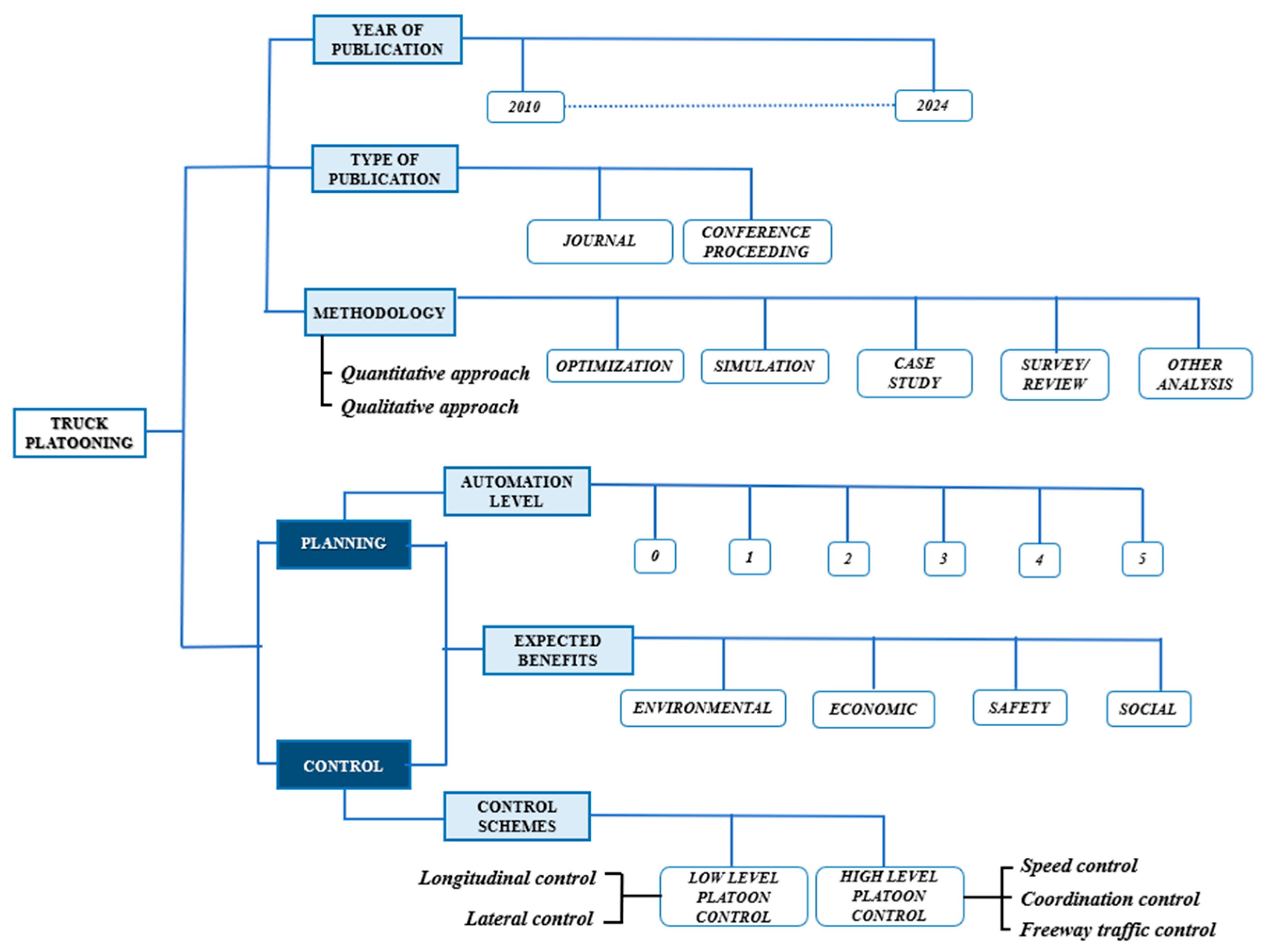
Figure 1. Methodology used to categorise the selected papers.
Futuretransp 05 00187 g001
Figure 2. Geographical distribution of the paper analysed.
Futuretransp 05 00187 g002
Figure 3. Publication type related to the analysed literature.
Futuretransp 05 00187 g003
Figure 4. Overview of the methodologies used per year of publication.
Futuretransp 05 00187 g004
Figure 5. Level of automation considered in the literature analysed.
Futuretransp 05 00187 g005
Figure 6. Expected benefits investigated per year of publication related to platoon planning papers.
Futuretransp 05 00187 g006
Figure 7. Expected benefits investigated per year of publication related to platoon control papers.
Futuretransp 05 00187 g007
Table 2. Expected benefits analysed in the papers related to the planning of platoons.
AuthorYearEconomicEnvironmentalSocialSafety
[21]Alam et al.2010
[22]Robinson et al.2010
[23]Liang et al.2013
[24]Alam et al.2014
[25]Liang et al.2014
[28]Larsson et al.2015
[30]Van De Hoef et al.2015
[17]Deng2016
[31]Liang et al. (a)2016
[33]Nourmohammadzadeh et al.2016
[34]Tsugawa et al.2016
[36]Johansson et al.2017
[37]Sokolov et al.2017
[39]van De Hoef et al.2017
[40]Zhang et al.2017
[7]Bhoopalm et al.2018
[41]Boysen et al.2018
[12]Jacob et al.2018
[43]Jin et al.2018
[46]Van De Hoef et al.2018
[47]Calvert et al.2019
[49]Duret et al.2019
[16]Gerrits 2019
[50]Larsen et al.2019
[52]Scherr et al.2019
[53]Wang et al.2019
[54]Yang et al.2019
[56]Johansson et al.2020
[20]Pająk & Cyplik2020
[58]Scherr et al.2020
[60]You et al. 2020
[63]Noruzoliaee et al.2021
[65]Sun et al.2021
[66]Watanabe et al.2021
[67]Lee et al.2021
[68]Paddeu et al.2021
[69]Abdolmaleki te al.2021
[70]Chen et al.2021
[71]Bouchery et al.2022
[11]Lesch et al.2022
[73]Li et al.2022
[74]Marzano et al.2022
[75]Xu et al.2022
[78]Xu et al.2022
[80]Pourmohammad-Zia et al.2023
[81]Wang et al.2023
[82]Zhou et al.2023
[83]Combes et al.2023
[86]Wu et al.2023
[87]Peng et al.2023
[88]Scholl et al.2023
[90]Yang et al. (a)2024
[92]Lourenço et al.2024
[93]Karthik et al.2024
[94]Hu et al.2024
[95]Mahajan et al.2024
[96]Liu et al.2024
[97]Rebelo et al.2024
[100]Liatsos et al.2024
[101]Zhao et al.2024
[102]Liatsos et al.2024
[106]Ioannou et al.2024
[109]Yang et al. (b)2024
Table 3. Main control approaches in truck platooning.
No.AuthorYearLow-Level Platoon ControlHigh-Level Platoon Control
Longitudinal
Control
Lateral
Control
Speed
Control
Coordination
Control
Freeway
Traffic Control
[23]Liang et al.2013
[24]Alam et al.2014
[26]Alam et al. (a)2015
[27]Alam et al. (b)2015
[29]Liang et al.2015
[32]Liang et al. (b)2016
[35]Axelsson et al.2017
[38]Turri et al.2017
[42]Chen et al.2018
[44]Pasquale et al.2018
[45]Ramezani et al.2018
[46]Van De Hoef et al.2018
[48]Čičić & Johansson2019
[51]Piacentini et al.2019
[55]Faber et al.2020
[19]Lee et al.2020
[57]Piacentini et al.2020
[59]Wang et al.2020
[61]Ladino et al.2020
[62]Čičić et al.2021
[64]Sacone et al.2021
[66]Watanabe et al.2021
[67]Lee et al.2021
[72]Čičić et al.2022
[76]Hussein et al.2022
[77]Wassergurger et al.2022
[79]Ma et al.2023
[84]Luo et al.2023
[85]Rui et al.2023
[89]Lian et al.2023
[91]Wang et al.2024
[93]Karthik et al.2024
[95]Mahajan et al.2024
[96]Liu et al.2024
[97]Rebelo et al.2024
[98]Chowdury et al.2024
[99]Jiang et al.2024
[103]Li et al.2024
[104]Jiang et al.2024
[105]Liu et al.2024
[107]Hu et al.2024
[108]Choobchian et al.2024
[110]Cheng et al.2024
Table 4. Expected benefits are analysed in the papers related to the control of truck platooning.
AuthorYearEconomicEnvironmentalSocialSafety
[23]Liang et al.2013
[24]Alam et al.2014
[26]Alam et al. (a)2015
[27]Alam et al. (b)2015
[29]Liang et al. 2015
[32]Liang et al. (b)2016
[35]Axelsson et al.2017
[38]Turri et al. 2017
[42]Chen et al.2018
[44]Pasquale et al. 2018
[45]Ramezani et al.2018
[46]Van De Hoef et al.2018
[48]Čičić & Johansson 2019
[51]Piacentini et al. 2019
[55]Faber et al.2020
[19]Lee et al.2020
[57]Piacentini et al.2020
[59]Wang et al.2020
[61]Ladino et al.2020
[62]Čičić et al. 2021
[64]Sacone et al.2021
[66]Watanabe et al.2021
[67]Lee et al.2021
[72]Čičić et al.2022
[76]Hussein et al.2022
[77]Wassergurger et al.2022
[79]Ma et al. 2023
[84]Luo et al.2023
[85]Rui et al.2023
[89]Lian et al.2023
[91]Wang et al.2024
[93]Karthik et al.2024
[95]Mahajan et al.2024
[96]Liu et al.2024
[97]Rebelo et al.2024
[98]Chowdury et al. 2024
[99]Jiang et al.2024
[103]Li et al.2024
[104]Jiang et al.2024
[105]Liu et al.2024
[107]Hu et al.2024
[108]Choobchian et al.2024
[110]Cheng et al.2024
Disclaimer/Publisher’s Note: The statements, opinions and data contained in all publications are solely those of the individual author(s) and contributor(s) and not of MDPI and/or the editor(s). MDPI and/or the editor(s) disclaim responsibility for any injury to people or property resulting from any ideas, methods, instructions or products referred to in the content.