
You are currently viewing a new version of our website. To view the old version click .
Future Transportation
  • Review
  • Open Access

11 February 2022

Mobility Trends in Transport Sector Modeling
,
and
1
Institute for Techno-Economic Systems Analysis (IEK-3), Forschungszentrum Jülich GmbH, 52425 Jülich, Germany
2
Chair for Fuel Cells, RWTH Aachen University, c/o Institute for Techno-Economic Systems Analysis (IEK-3), Forschungszentrum Jülich GmbH, 52428 Jülich, Germany
*
Author to whom correspondence should be addressed.

Abstract

Transport sector models help provide strategic information for the future development of the transportation sector. Such long-term scenarios are typically challenged by uncertainties. Moreover, certain trends, such as the transition to zero-emission transportation systems and modal shifts, as well as connected, shared and autonomous vehicles, are already apparent today. Therefore, this paper investigates the impact of these trends on greenhouse gas emissions, as well as their implementation in transport sector modeling thus far. The investigations are structured into the four main parts of transport sector greenhouse gas emission calculation: activity, modal share, energy intensity and fuel carbon intensity. Our analysis of the related effects reveals their importance to the transportation sector of the future. Current models and scenarios widely consider trends such as the modal shift and electrification. However, other trends such as the sharing economy and automated driving are not commonly regarded in the context of transport sector modeling. The coupling of the different types of models and collaboration among researchers from the different fields is recommended for filling this gap.

1. Introduction

In planning the future energy system, possible pathways must be designed, analyzed, and evaluated. Related work is mostly based on energy system model calculations. With the transport sector ranking among the major carbon emission sources, climate change mitigation efforts are expected to have a major impact on transportation systems over the next few decades. Thus, politicians, industrial enterprises, scientists, and others are interested in the sector’s future development. Typical questions include: Which drivetrain and fuel should be used for which mode of transportation? What energy demands can be expected in the coming decades? How will the sector’s greenhouse gas emissions develop? All these questions are illuminated with the help of transport sector models, and possible pathways are shown. Therefore, researchers have developed various models with different focuses. In this paper, transport sector models are examined for their ability to answer the above questions. Thus, our analysis reveals some possible strengths and weaknesses in transport sector models with regard to these trends. Possible research gaps are made visible, and should be closed in the future in order to improve model-based assessments in the context of current research tasks.
Comparative reviews of some of these models have already been conducted. Edelenbosch et al. [1] investigate the modeling of the transport sector in eleven global integrated assessment models (IAMs) that comprise not only transportation but also other sectors of the energy system. Thereby, they focus on input and result comparisons. Their analysis shows fuel shift to be the most important driver of greenhouse gas (GHG) emissions reduction. Girod et al. [2] and Yeh et al. [3] also reviewed global transport sector models according to input and output. They partly discovered differences, e.g., in assumptions regarding future travel demand. In contrast to this, Linton et al. [4] explored six different methodologies for analyzing transport sector CO2 emissions. These range from microsimulation on the small scale up to large-scale IAMs. Creutzig [5] also examines different types of models and highlights the divergent backgrounds of the modelers. The first type of models are IAMs, which are primarily developed by economists. The second concern the transport sector and are usually developed by engineers. The third and final type of model considered here are place-based one, which are developed by geographers and public health researchers.
The focus of this paper is mobility trends in transport sector models, as these influence the selection of suitable pathways for achieving near-zero GHG transport emissions. The aim of this review is to qualitatively analyze how mobility trends influence GHG emissions and how models methodically take such trends into account. In contrast to the reviews conducted by Edelenbosch et al. [1], Girod et al. [2] and Yeh et al. [3], an analysis of input or output values of the models or scenarios is not undertaken in this work.
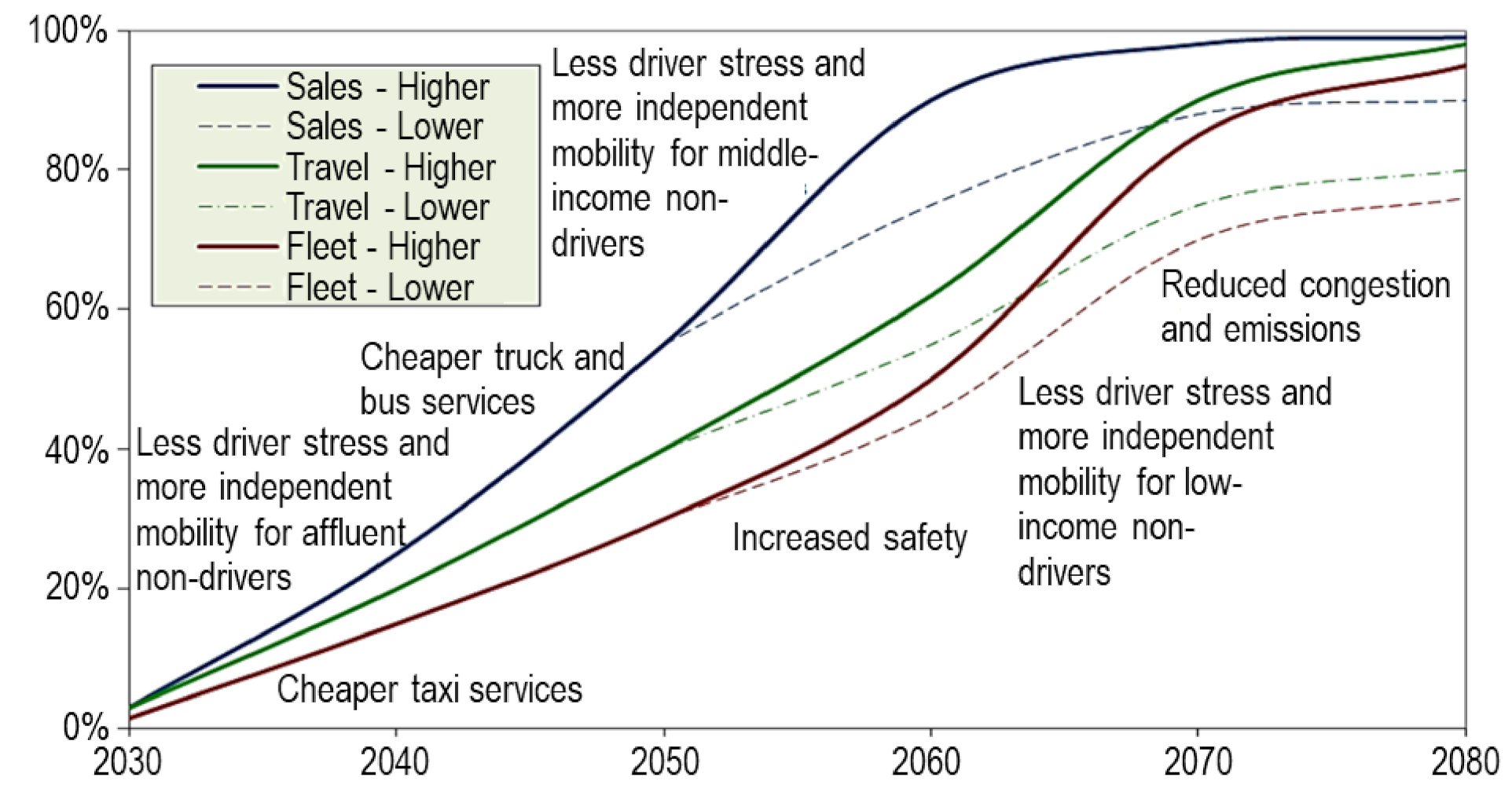
McKinsey [6] describe future mobility trends using the abbreviation ACES. Deloitte [7], Toyota [8], and Daimler [9] use the abbreviation CASE. The meaning behind these two is the same, with only the order of the letters differing. In the case of the latter, future vehicles are expected to be connected, autonomous, shared, and electrified. As vehicle connection comes alongside vehicle automation, these two are combined in this paper under the rubric of automated driving. In order to underline the importance for future transport sector-related analysis, Figure 1 displays the projections by Litman et al. regarding the uptake of autonomous vehicles [10].
Figure 1. Projected Autonomous Vehicle Sales, Fleet and Travel from 2030 to 2080. Adapted with permission from [10].
They project that in 2050, every second vehicle will be autonomous. According to their projections, the continuous uptake of the technology from 2030 onwards will result in ~30% fleet and 40% travel shares in 2050 [10]. Other studies offer similar projections for the uptake of connected and autonomous vehicles [11,12]. Thus, the trend should definitely not be neglected in long-term transport sector modeling.
Electrification as the last part of CASE disregards the possibility of shifting used fuel without electrifying drivetrains, which is a possibility when decarbonizing, especially heavier vehicles, apart from cars. As the abovementioned abbreviations merely focus on passenger cars, with the modal shift being another major trend in passenger and freight transport, although it is not included. Still, this trend is also taken into account in this study. The trends examined herein are therefore as follows: modal shift, fuel shift, shared mobility and automated driving.
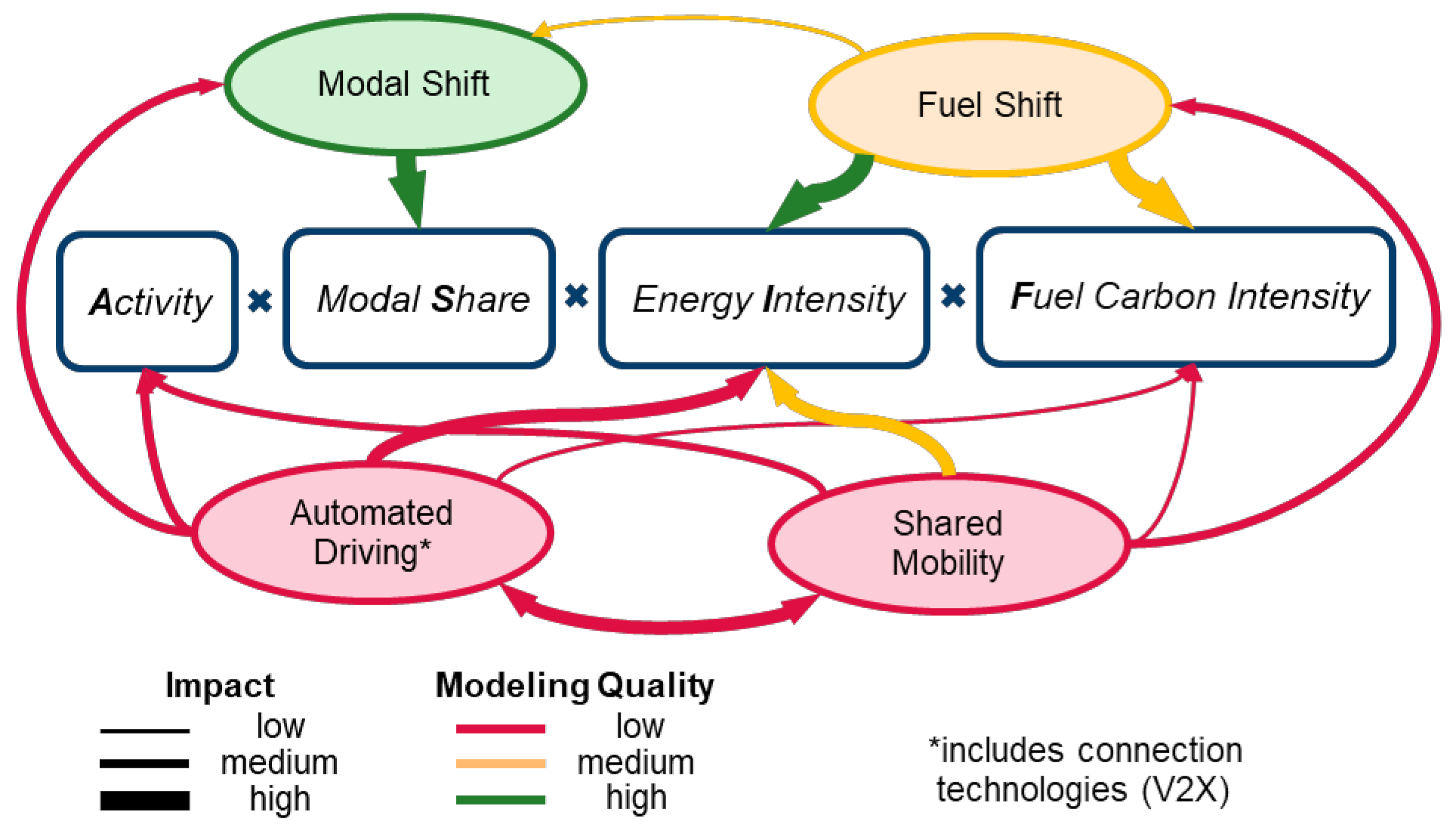
The analysis is structured according to the activity, modal share, energy intensity and fuel carbon intensity (ASIF) method by Schipper and Marie-Lilliu [13]. Using this basic method which was developed to calculate GHG emissions in the transport sector a structured analysis should be guaranteed. Section 2 provides a short introduction to ASIF as well as the model selection process. Subsequently, the boundary conditions of the investigated models are analyzed in Section 3. This includes information on spatio-temporal settings and sectoral coverage. Thereby, differences between the models in many respects become obvious. Section 4 qualitatively analyzes the impacts of mobility trends on the ASIF method. In doing so, the relevance of these trends for the calculation of future GHG emissions becomes apparent. Finally, an investigation of mobility trends in transport sector models is conducted in Section 5.

2. Method

This paper focusses on mobility trends, including their impacts on greenhouse gas emissions, as well as their modeling in transport sector models. As the trends investigated develop over a long period of time, the models should be capable of depicting such periods. Furthermore, the models should include the impacts of the trends on at least a national level.
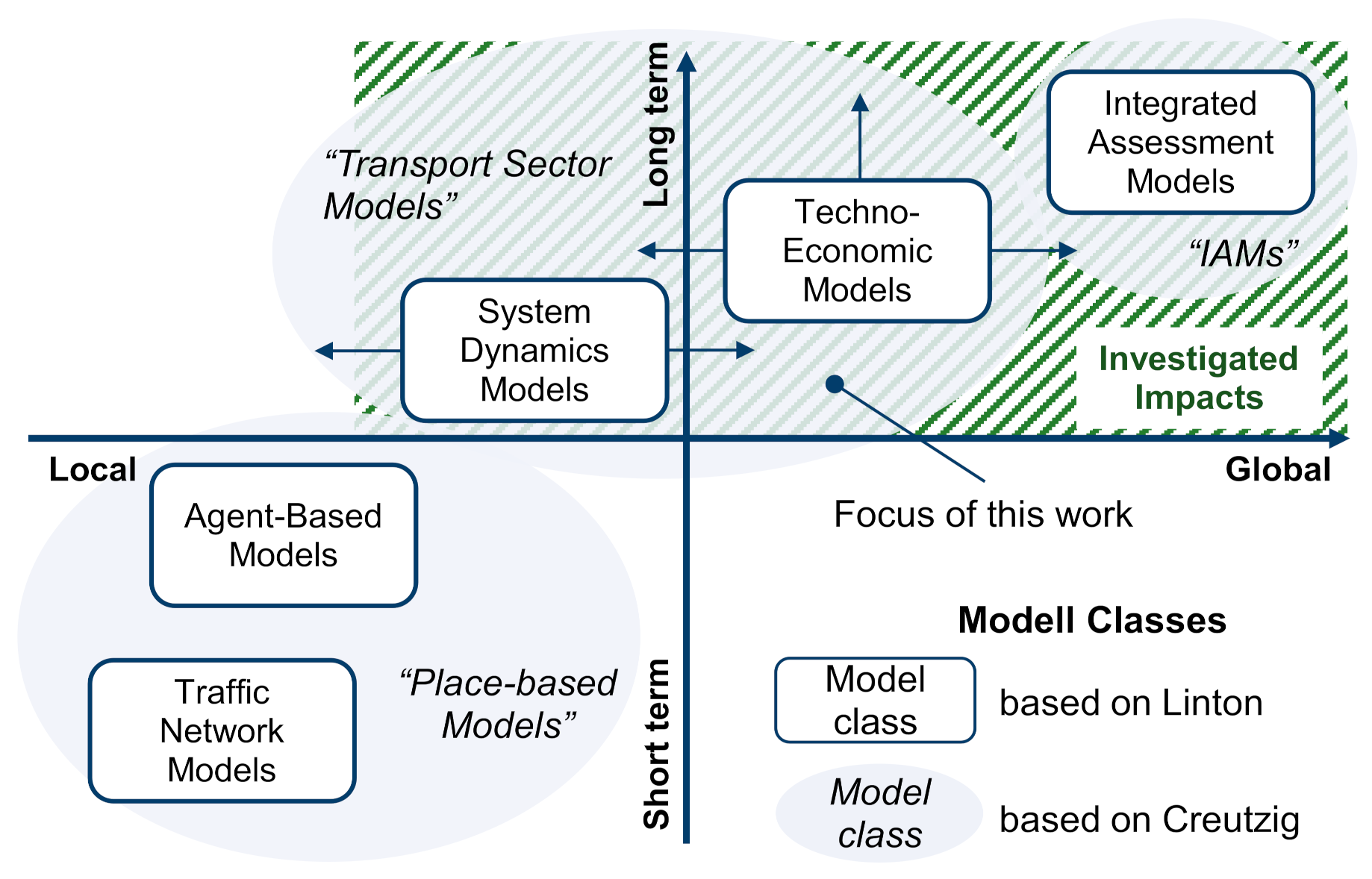
Figure 2 shows the modeling techniques required for calculating the greenhouse gas emissions emitted by the transport sector according to Linton et al. [4] and Creutzig [5]. These techniques are used at different spatial and temporal scales. The spatio-temporal settings of the models within one type are not exactly fixed, but can vary between each other. Still, the relationship between model types can be depicted as in the figure. On the one hand, traffic network models are used for small-scale simulations on a local and short-term basis [14,15]. On the other, integrated assessment models are deployed for long term projections on national or even global scales [16,17]. Agent-based models like MATSIM focus on the behavior and motivations of a series of agents [18]. Compared to system dynamics and techno-economic models, the focus of these is on a more regional level. The model classes defined by Creutzig [5] can in part be understood as groupings of the model classes, as per Linton. Traffic network and agent-based models correspond to Creutzig’s place-based ones, which operate at the local level. Between the place-based models and IAMs, Creutzig defines transport sector models, which include Linton’s System Dynamics and techno-economic models.
Figure 2. Model classification of different techniques to calculate GHG emissions from transport based on Linton [4] and Creutzig [5].
Using the previously defined spatio-temporal criteria for the model selection in this paper leads to the green highlighted zone. As the focus of this analysis is on transport-only models, integrated assessment models are neglected in the model selection. Therefore, transport sector models including system dynamics and techno-economic models for calculating the greenhouse gas emissions of the transport sector are considered herein.
The underlying models were identified with the help of an extensive literature survey in well-known databases (i.e., ScienceDirect, SCOPUS, Google Scholar, Wiley, Taylor & Francis, SpringerLink), as well as the websites of various institutes in the field of energy system analysis (e.g., those of the IEA, ICCT, and US national laboratories). In addition, forward and backward snowballing was used to include as many relevant models as possible. The literature was collected in the period from October 2019 to the end of 2020. In order to only include current models, the last publication on the model must have been after 2010. In addition, only analyses that take into account at least one of the defined trends were included. Appendix A contains information on the 41 investigated models and their properties.
The models differ with respect to their spatio-temporal settings and sectoral coverage and these model characteristics are the first point of analysis in this study. In addition to the spatio-temporal settings, the sectoral coverage of the models is also examined. This comprises an analysis of the most relevant modes with respect to transport volume and sectoral GHG emissions. These include especially street modes for passenger and freight transportation like light-commercial vehicles (LCV) and heavy-duty vehicles (HDV). Additionally, frequently discussed alternatives are considered and today’s most common drivetrains and fuels investigated. The drivetrains range from the currently predominant internal combustion engine vehicle (ICEV), to different hybridization stages, to battery- (BEV) and fuel cell-electric vehicles (FCEV). The hybridization stages differ mainly in terms of battery size increasing from hybrid electric vehicles (HEV) over plug-in hybrid electric vehicles (PHEV) up to range-extender electric vehicles (REEV). Possible fuels form a similarly broad list containing, e.g., conventional, bio-, and synthetic fuels.
In order to maintain technological openness, models should take into account the modes, drivetrains and fuels listed in Table 1, which could be used depending on the respective requirements.
Table 1. Considered modes, drivetrains, and fuels for analysis.
The focus of further conducted analyses is on mobility trends. On the one hand, this includes the impacts on future greenhouse gas emissions by the transportation sector. On the other, the consideration of mobility trends in the selected models is examined. Thereby, the ASIF methodology is used to structure the different impacts and methodological aspects of these trends.
The ASIF method was introduced by Schipper and Marie-Lilliu in 1999 to delineate the effects of the transport sector on greenhouse gas emissions [13]. The methodology breaks down the calculation of transport sector greenhouse gas emissions into four main components. These parts become apparent in the mathematical equation below:
G = i , j A   ·   S i   ·   I i   · F i j
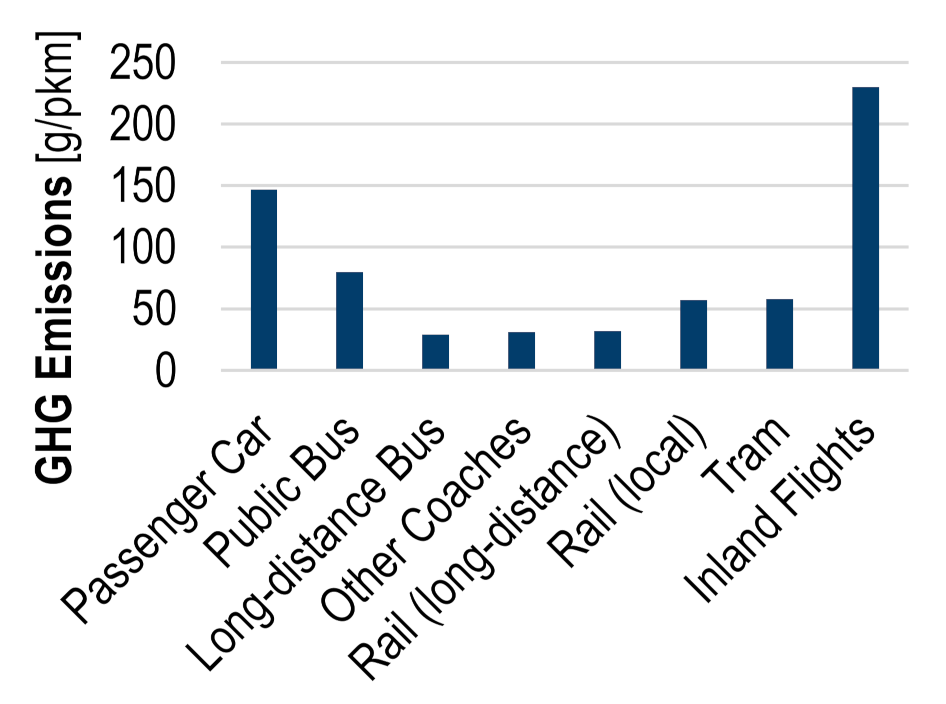
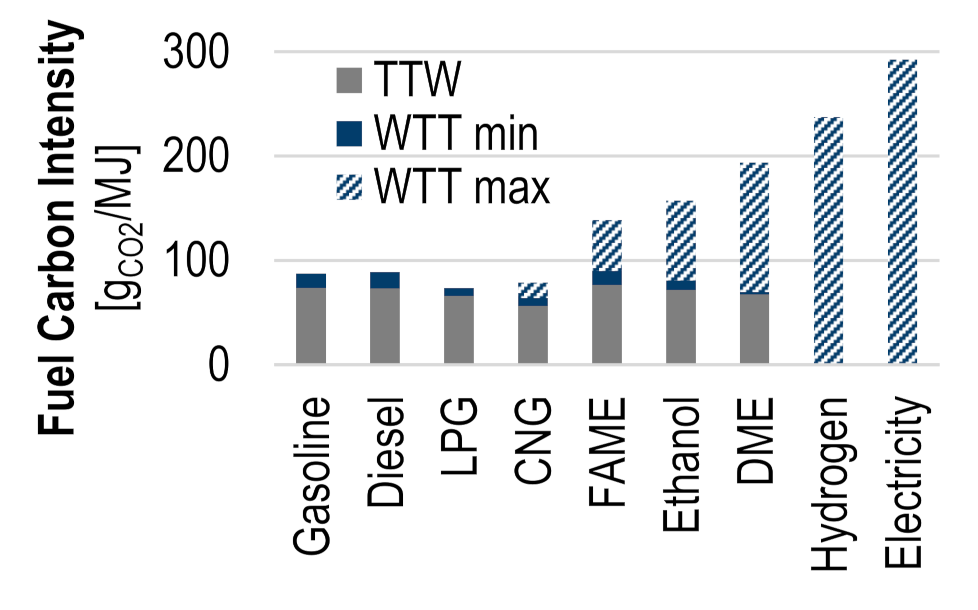
The resulting greenhouse gas emissions G are dependent on the activity A , the modal share S i, the energy intensity I i, and the fuel carbon intensity F i,j. The activity A describes the total transport demand in passenger- or ton-kilometers (pkm or tkm). The modal share S represents how much of the overall transport demand is covered by each mode (in %). The energy intensity includes information on the mode-dependent fuel consumption per delivered passenger- or ton-kilometer (MJ/pkm or MJ/tkm). Finally, the fuel carbon intensity considers the emitted amount of greenhouse gas emissions of the used fuel (gCO2-eq./MJ). Moreover, Schipper and Marie-Lilliu determine the modal energy intensity based on three components [13]:
I i =   f     E i   ,   C i   ,   U i  
First, the technical efficiency E is considered, which is affected by the type of drivetrain and fuel that is used. Furthermore, vehicle characteristics are combined in factor C . These comprise characteristics such as the vehicle mass or drag coefficients, which largely influence the vehicle’s mechanical energy demand. U denotes the capacity utilization, considering the mode-specific statistical average of the load or passenger capacity utilization.

3. Boundary Conditions of Transport Sector Models

In this section, the spatio-temporal scope of the investigated transport sector models is analyzed. Further analysis regarding the boundary conditions can be found in Appendix B. This comprises the temporal, as well as spatial resolution. Additionally, the sectoral coverage of the models is examined. Therefore, the considered modes, drivetrains, and fuels are regarded.
As the models have been developed for answering different individual research questions, the model approaches characterized by the boundary conditions differ. This can, for example, include the temporal and spatial aspects. The spatio-temporal settings can be divided into the overall scope and spatio-temporal resolution.
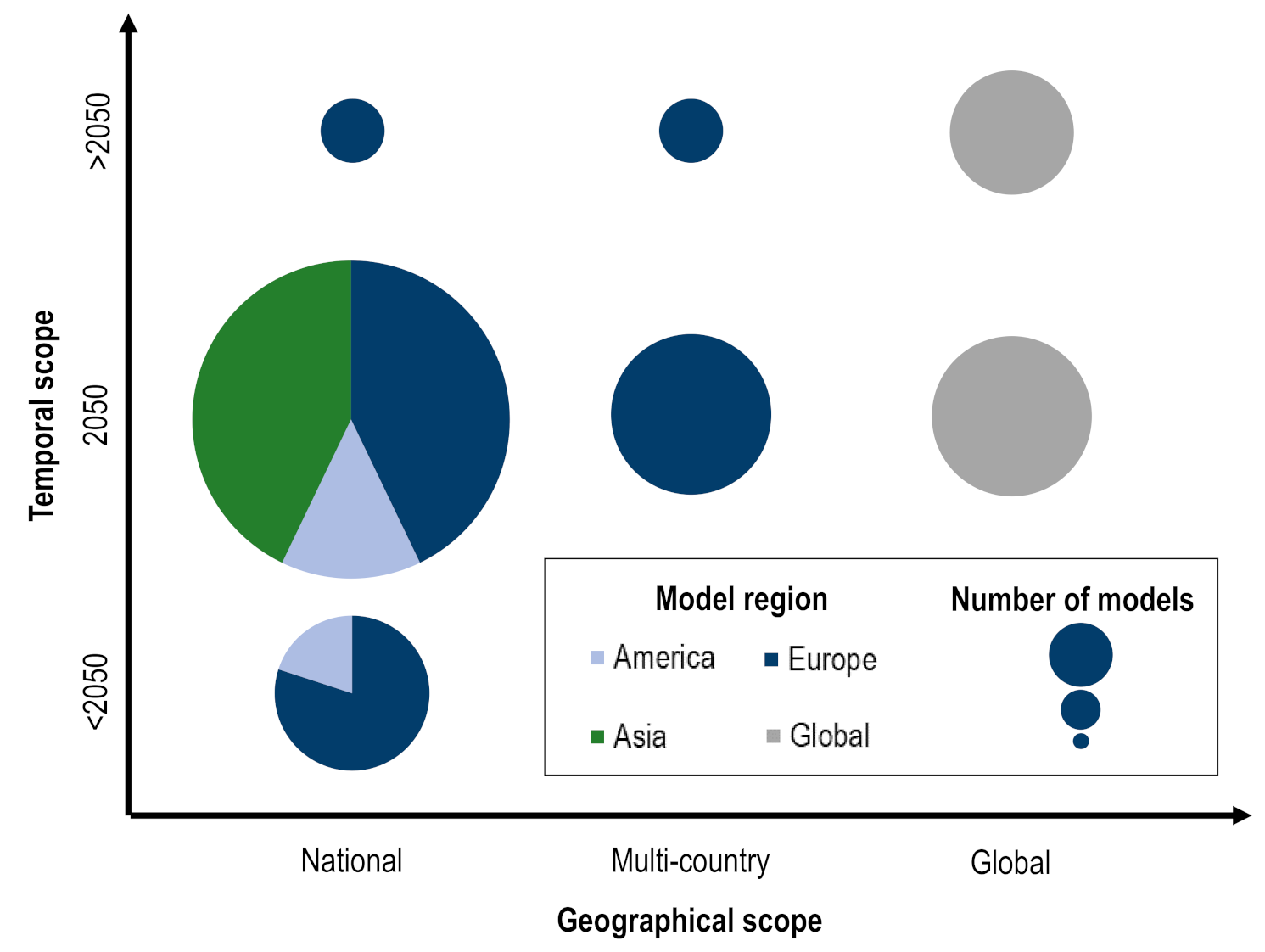
The time horizon of the analyzed models is dominated by the year 2050, as can be seen in Figure 3. This is due to the fact that most of the models investigate possible decarbonization pathways, which refer to climate targets in accordance with the Kyoto Protocol [19]. Nevertheless, a small number of the models have a shorter time horizon. Others are already starting to look at possible developments in the second half of the century. This is especially the case for global models.
Figure 3. Temporal and geographical scope of the investigated transport sector models underlining the focus on national analyses up through the year 2050.
Aside from the described temporal scope, the geographic scope can also differ. Two thirds of the models analyze the transport sector within national borders (Figure 3). In contrast, eight of the models consider global development. Additionally, some multi-country models analyze the European transport sector. Compared to other multi-country models, the transport, energy, economics, environment (TE3) model, a system dynamics model developed by Gómez Vilchez, does not cover the transport sector globally or at the EU level. Instead, it comprises Germany, France, India, Japan, China, and the USA, which are six of the most relevant passenger car markets in the world [20]. The consideration of larger parts of the world helps in calculating the costs of emerging technologies [20]. This is due to the fact that their costs are largely affected by the learning rate and cumulative production, which depend on global, rather than national markets.
Overall, it can be summarized that transport sector models analyze on average the transport sector on a national scale through 2050. Thereby, the analysis in Appendix B shows the temporal resolution is on a yearly basis and the spatial resolution on a national one. Section 4 shows that higher resolutions are necessary for various effects that result from the different investigated trends.
Furthermore, the analysis has revealed the sectoral coverage of the investigated transport sector models. For the most part, the models cover all of the most important means of transport with respect to energy demand and greenhouse gas emissions. Furthermore, they include the most promising drivetrain architectures. This is also the case for energy carriers, whereby synthetic fuels, which could be a helpful pathway of decarbonization for larger means of transport, are underrepresented. The inclusion of all relevant modes is a precondition to correctly modeling the effects of modal shifts. The same applies to the drivetrain technologies and the fuels used with respect to the trend in the fuel shift.

6. Conclusions

In this paper, transport sector models were analyzed with a focus on four major trends in the transport sector—modal shift, fuel shift, shared mobility and automated driving. The scope of the investigated models ranges from the national, to the multinational, to the global scales. Furthermore, some of the models’ projections end before 2050, whereas others are already starting to look at the second half of the century. The analysis shows national models projecting through 2050 to be the average.
Although some of the models include passenger cars as the only mode or solely consider street vehicles, the majority consider the most relevant modes with respect to transport volume and GHG emissions. Therefore, these fulfill the precondition of being able to analyze modal shift effects. The same applies to the coverage of drivetrains and possible fuels. Nevertheless, a preference for analyzing BEVs and electricity as future drivetrains and fuels, respectively, can be identified. In particular, alternatives such as REEVs or synthetic fuels are given much less consideration in the investigated models.
The analysis of the possible impacts of mobility trends based on the ASIF method highlights the manifold effects of these trends. The modal shift primarily leads to a change in the modal shares ( S ). Furthermore, the modal shift can influence the occupancy rates of the different modes.
In contrast to the modal shift, the fuel shift, which mostly also includes a drivetrain shift, mainly touches the energy intensity ( I ) and fuel carbon intensity ( F ) parts of the ASIF equation. The degree of the effect depends strongly on user behavior. Thus, the driving region (urban vs. rural) has an impact on the potential for reducing fuel consumption through electrification. Furthermore, for hybrid vehicles, the electric driving share relates to the driving distance. In addition, the charging times influence the carbon intensity of the charged electricity.
Shared mobility affects the activity ( A ), the modal shares ( S ), and energy intensity ( I ). Younger and older people tend to be more mobile if mobility-on-demand concepts are made available. Therefore, the overall activity increases due to shared mobility. Due to the different properties of such a mode, especially with respect to travel cost and time, the modal shares of other modes change. Additionally, the energy intensity of passenger cars decreases because ridesharing leads to higher occupancy rates. In particular, in the case of autonomous taxis, the last point is debatable, since there will be empty trips that at least diminish the effect of higher occupancy rates to some degree.
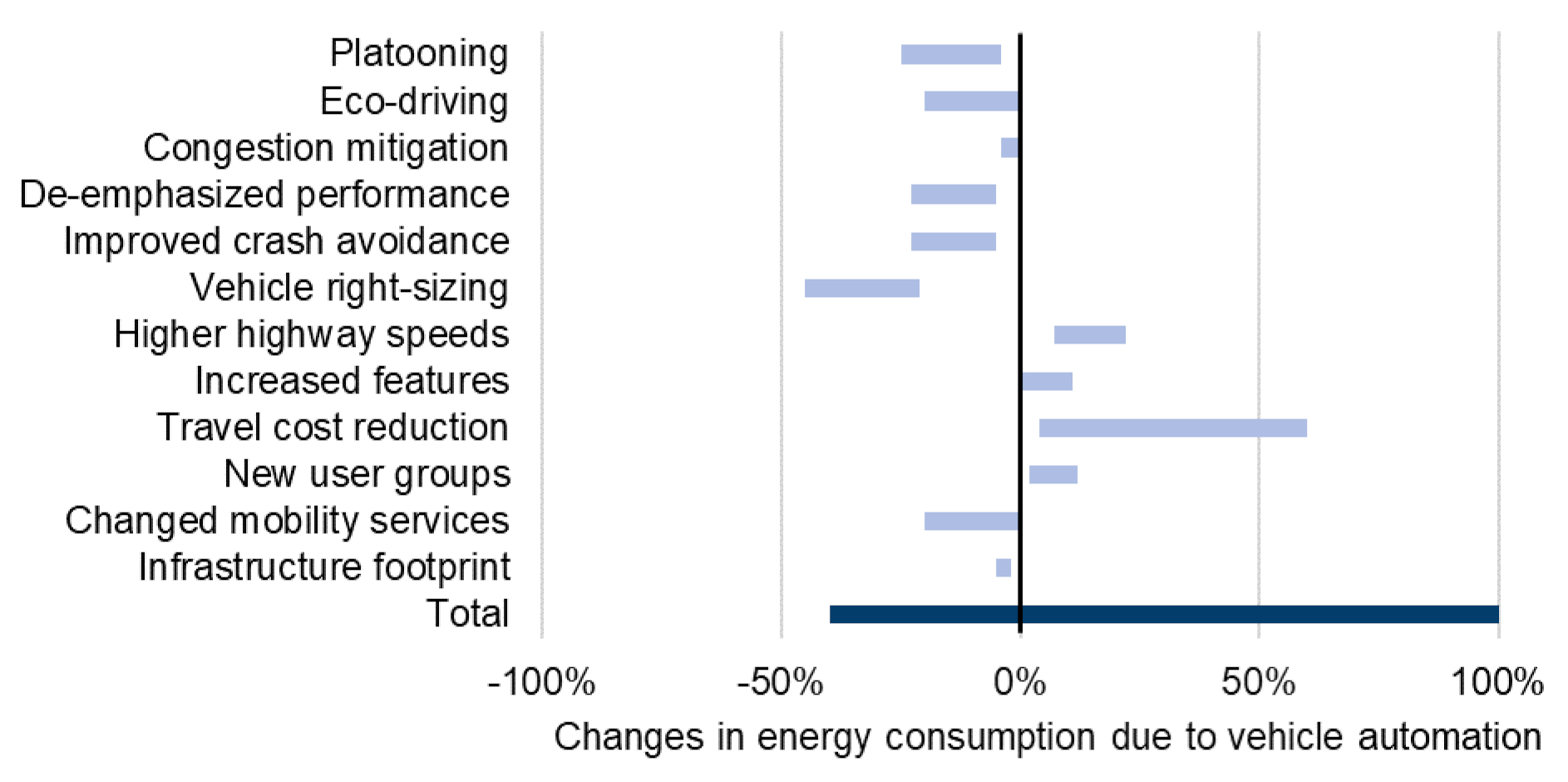
Alongside empty trips, vehicle automation has various impacts on the energy intensity ( I ) of vehicles. Moreover, the activity ( A ) increases because of autonomous vehicles, as these offer the possibility of using driving time for other activities and present new mobility possibilities to younger and older people who are not able to drive on their own. This change in passenger car characteristics also affects the modal shares ( S ). Furthermore, autonomous and shared vehicles have different usage profiles compared to human-driven ones, and therefore influence the choice of drivetrain when new vehicles are bought. This is an example of the interdependency between the analyzed trends.
Overall, the analysis indicates the influence of shared mobility and automated driving to be much more diverse compared to the modal and fuel shift, and increased interdependencies with the other trends are also apparent.
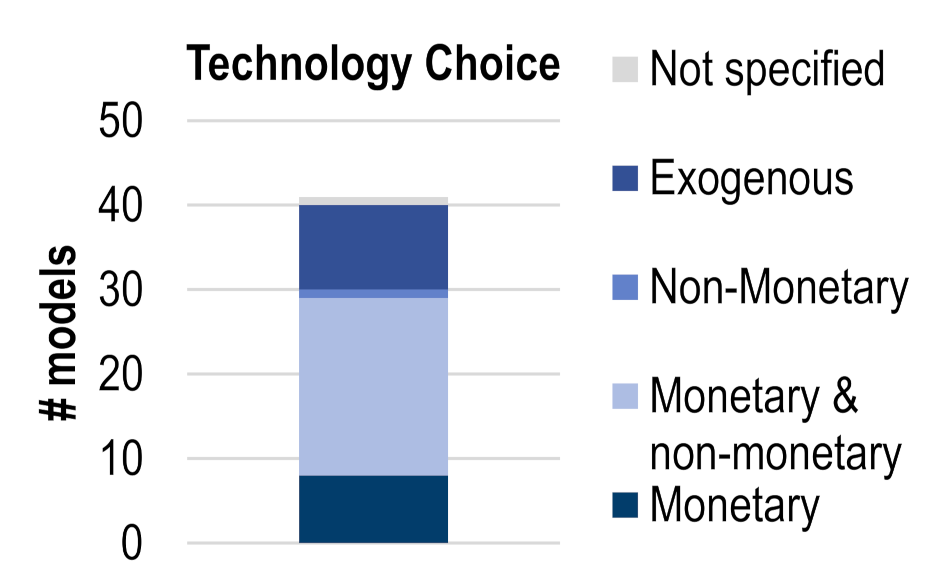
In Section 5, an overview of the consideration and modeling of mobility trends in transport sector models was presented. The modal shift was taken into account in about half of the analyzed models. In most cases where it was not considered, the reason was the lack of different modes. The modeling of the modal shift was performed either exogenously or endogenously. For endogenous modal shifts, either elasticities or discrete choice were used, with the latter predominantly utilized. The primary mode characteristics considered in these models are the travel cost and time.
All of the investigated models consider the fuel shift. Nevertheless, the level of detail varies widely across the models. Although some of the models exogenously define the future shares of drivetrains, others exogenously determine, e.g., fuel consumption and technology choice for different user groups. The literature shows the importance of differentiating between usage profiles for correctly calculating the quantitative effects of the fuel shift on energy demand or GHG emissions. Therefore, a high level of detail with respect to user preferences and vehicle-specific usage patterns is recommended for endogenously modeling the fuel shift.
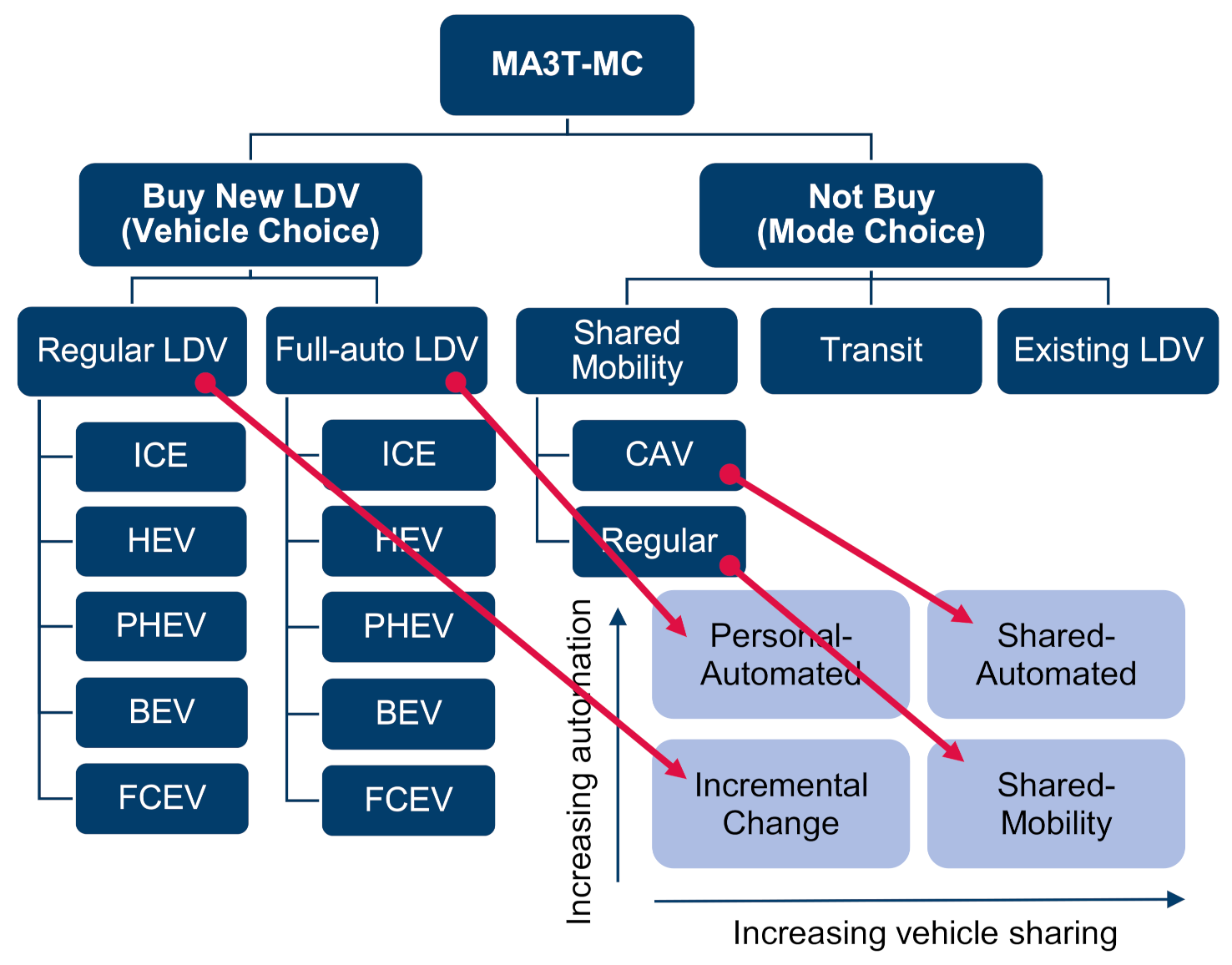
The usage profile and thus the technology choice is strongly influenced by the trends in shared mobility and automated driving. As projections indicate increasing shares of autonomous vehicles that could also be in shared usage after 2030, these trends should not be neglected in long-term modeling. However, the analysis showed an underrepresentation of these two trends in the investigated models. Furthermore, the modeling was dominated by exogenous assumptions, especially regarding transportation activities and occupancy rates. Due to high uncertainty, these assumptions were also sometimes contrasting. Only Xie et al. [67] include the effects of vehicle automation on fuel consumption. Furthermore, they introduce three new modes in order to represent the combinations of car-sharing and autonomous vehicles.
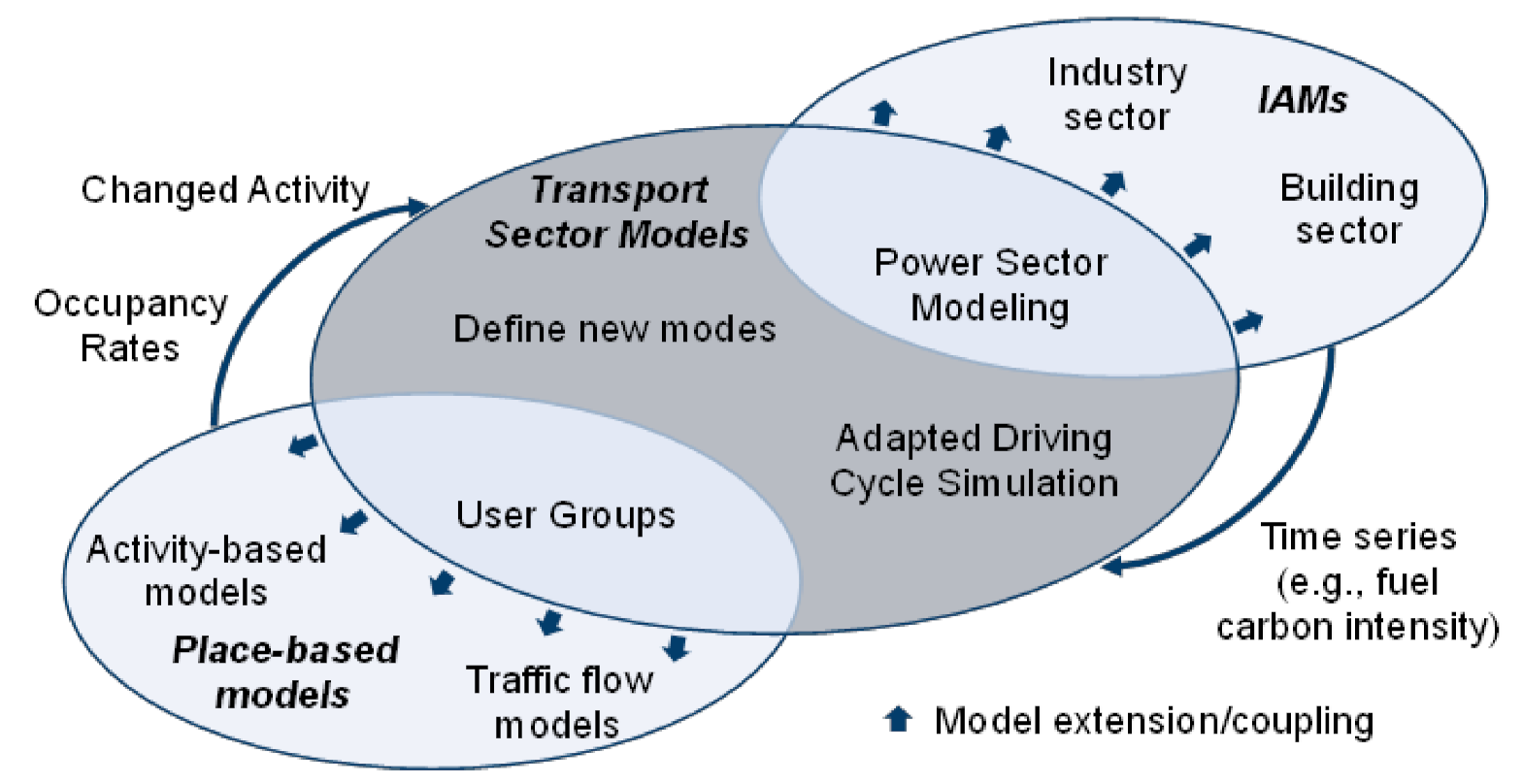
The literature review showed the large gap between the modeling of mobility trends. Whereas the modal and fuel shifts were mostly considered, car-sharing and vehicle automation is underrepresented although it is considered to reach an non-negligible share in the investigated time horizons. This gap should be filled in future in order to evaluate the interdependent effects of mobility trends and to project quantitative numbers for future transport energy demand or other transportation-related topics. For this, necessary model improvements are, on the one hand, internal to the model, such as defining new modes or adapted driving cycle calculations and, on the other, by extension or coupling to other model types. Agent-based models, for example, help to assess the impact of autonomous and shared driving on vehicle activity and utilization. Moreover, the coupling to IAMs can serve to better map interactions with the power sector, which are becoming increasingly important due to the analyzed trends. Thus, the coupling of the different types of models and the collaboration of the different academic fields is recommended as a possible means of filling this gap.

Author Contributions

S.K.: Methodology, Formal analysis, Investigation, Writing—original draft. T.G.: Conceptualization, Writing—review & editing, Supervision, Project administration, Funding acquisition. D.S.: Conceptualization, Supervision, Project administration, Funding acquisition. All authors have read and agreed to the published version of the manuscript.

Funding

This research received no external funding.

Institutional Review Board Statement

Not applicable.

Conflicts of Interest

The authors declare no conflict of interest.

Appendix A. Model Information

Table A1. Spatio-temporal properties and sectoral scope of investigated models.
Model/AuthorRefSpatial ScopeTemporal ScopeSpatial ResolutionTemporal ResolutionSectoral Scope
RegionNationalMulti-countryGlobal<2050−2050>2050<State LevelState LevelCountry Level>Country Level<HoursHourlyYearlyPassenger and FreightPassenger OnlyFreight Only
Renewbility III[66]Germanyx x x x x
ASTRA-DE[68]Germanyx x x x
VECTOR21[69]Germanyx x x x x
VM-SIM[70]Germanyx x x x x
Shell[64]Germanyx x x x x
TraM[71]Germanyx x x x x
TEMPS[65]Germanyx x x x x
Trost[50]Germanyx x x x x
Belmonte et al.[51]Germanyx x x x x
SERAPIS[72]Austriax x x x x
UKTCM[73]UKx x x xx
STEAM[74]Scotlandx x x xx
DTReM-LV[75]Latviax x x xx
UniSyD[76]Icelandx x x xx
Shepherd et al.[77]UKx x x x x
TMOTEC[45]Chinax x x xx
MA3T[67]USx x x x x
ParaChoice[61]USx x x x
ADOPT[60]USx x x x x
CPREG[78]Chinax x x xx
Hao et al.[79]Chinax x x x x
LEAP[80]Chinax x x xx
Palencia et al.[81]Japanx x x x x
Gambhir et al.[82]Chinax x x xx
Ou et al.[83]Chinax x x xx
Yabe et al.[54]Japanx x x x x
TRAN[63]USx x x xx
PTTMAM[58]EU x x x x
ASTRA-EC[68]EU x x x x
TE3[20]Germany, France, India, Japan, China, US x x x x
HIGH-TOOL[84]EU x x x x
PRIMES-TREMOVE[85]EU x x x x
TRIMODE[86]EU x x (x) x
TRAVEL[44]global x x x x x
AIM/Transport[46]global x x x x
MOVEET[87]global x x (x) x
MoMo[88]global x x (x) x
RoadMap[41]global x x (x) x
ITEDD[89]global x x (x) x
Khalili et al.[90]global x x x xx
ForFITS[91]global x x (x) x
Table A2. Considered modes, drivetrains and energy carriers in investigated models.
Model/AuthorRefModesDrivetrainsEnergy Carriers
BicycleMotorcycleCarLCVHDVBusRailWaterAirICEVHEVPHEVREEVBEVFCEVGasolineDieselKeroseneCNGElectricityHydrogenBiofuelsSynthetic Fuels
Renewbility III[66]xxxxxxxxxxxx xxxxxxxxxx
ASTRA-DE[68]x xxxxxxxxxxxxxxxxxxxx
VECTOR21[69] x xxxxxxxx xxx
VM-SIM[70] x xxxxxxxx xxx
Shell[64] x xxx xxxx xxxxx
TraM[71] xxxxxxxxxxx xxxxxxxx
TEMPS[65] xxxxxxxxxx xxxxxxxxxx
Trost[50] xx xxxxxxxx xxxx
Belmonte et al.[51] x xxx xxxx xxxxx
SERAPIS[72] xx xxx x xx x
UKTCM[73]xxxxxxxxxxxx xxxxxxxxx
STEAM[74]xxxxxxxxxxxx xxxxxxxxx
DTReM-LV[75]x xxxxx xxx xxxx xxxx
UniSyD[76] xxx xxx xxxx xxxx
Shepherd et al.[77] x x x x x x
TMOTEC[45] xxxxxxxxxxx xxxxxxxxxx
MA3T[67] xx xxx xxxx xxxx
ParaChoice[61] xxx xxx xxxx xxxx
ADOPT[60] xx xxx xxxx xxxx
CPREG[78] xxxxx x xxxx xxxxx
Hao et al.[79] x x x xxxx xxxx
LEAP[80] xxxxxxxxxx x xxxxx
Palencia et al.[81] x xx xxx xx
Gambhir et al.[82] xxxxx xxx xxxx xxxx
Ou et al.[83] xxxxx x x x xx xx xx
Yabe et al.[54] x xxx x x x
TRAN[63] xxxxxxxxxx xxxxxxxxx
PTTMAM[58] xx xxx xxxx xxxx
ASTRA-EC[68]x xxxxxxxxxxxxxxxxxxxx
TE3[20] x xxx xxxx xxxx
HIGH-TOOL[84]xxxxxxxxxxxx xxxxxxxxxx
PRIMES-TREMOVE[85] xxxxxx xxxx xxxxxxxxx
TRIMODE[86]xxxxxxxxxxxx xxxxxxxxxx
TRAVEL[44]xxx xxxxxxx xxxxxxxxx
AIM/Transport[46] xx xxxx
MOVEET[87] xxxxxxx
MoMo[88] xxxxxxxxxxx xxxxxxxxxx
RoadMap[41] xxxxxxxxxxx x(x)xxxxxxx
ITEDD[89] xxxxxxxx
Khalili et al.[90] xxxxxxxxx x xxxxxxxxxx
ForFITS[91]xxxxxxxxxxxx xxxxxxxxxx
Table A3. Considered mobility trends in investigated models.
Model/AuthorRefMobility Trends
Modal ShiftFuel ShiftAutomated DrivingSharing Mobility
Renewbility III[66]xxxx
ASTRA-DE[68]xx x
VECTOR21[69] x
VM-SIM[70] x
Shell[64] x x
TraM[71] x
TEMPS[65]xxxx
Trost[50] x
Belmonte et al.[51] x
SERAPIS[72] x
UKTCM[73]xx
STEAM[74]xx
DTReM-LV[75]xx
UniSyD[76] x
Shepherd et al.[77] x
TMOTEC[45]xx
MA3T[67] xxx
ParaChoice[61] x
ADOPT[60] x
CPREG[78] x
Hao et al.[79] x
LEAP[80] x
Palencia et al.[81] x
Gambhir et al.[82] x
Ou et al.[83] x
Yabe et al.[54] x
TRAN[63] x
PTTMAM[58] x
ASTRA-EC[68]xx x
TE3[20] x
HIGH-TOOL[84]xx
PRIMES-TREMOVE[85]xx
TRIMODE[86]xx
TRAVEL[44]xx
AIM/Transport[46]xx
MOVEET[87]xx
MoMo[88]xx
RoadMap[41]xx
ITEDD[89]xx
Khalili et al.[90]xx
ForFITS[91]xx

Appendix B. Boundary Conditions of Transport Sector Models

In addition to Section 3 in this section, further boundary conditions of the investigated transport sector models are analyzed. This comprises the temporal, as well as spatial resolution. Additionally, the sectoral coverage of the models is examined. Therefore, the considered modes, drivetrains, and fuels are regarded.

Appendix B.1. Spatio-Temporal Settings

The temporal resolution provides insight into the consideration of time-dependent effects. These become relevant for the transport sector, especially in terms of electricity demand. Although fuel stations for other energy carriers compensate for intra-day fluctuations due to standard installed on-site storages, charging stations for electric vehicles do not include comparable storage, as they are predominantly directly connected to the electricity grid. Therefore, the electric power must either be simultaneously generated to meet demand or must be retained by integrated electricity storage systems.
More than half of the analyzed models have a yearly resolution, as can be seen in Figure A1. Thus, these cannot take into account the intra-day peaks in electricity demand caused by electric charging. Only six of the 41 investigated models are specified to include a higher temporal resolution.
Trost employs three typical days to investigate the effect of electric charging. These three typical days comprise a working day, representing Monday through Friday, Saturdays and Sundays. Each of these is divided into day and night periods, for which different proportions of electrically-coupled vehicles are assumed for various charging capacities [50].
Pichlmaier et al. also take into account the dependency of a high temporal resolution on the energy carrier. Although the demand for electrical energy is resolved hourly, it is resolved daily for methane and hydrogen and annually for liquid fuels [55].
Figure A1. Temporal (a) and spatial (b) resolution of the investigated transport sector models.
The analysis of the possible effects on energy infrastructures requires spatial resolution. These infrastructures play an important role in the transition to BEVs and FCEVs, which are two promising decarbonization solutions. This effect can be considered by models with higher spatial resolutions. Furthermore, a high spatial resolution can help include the differences in transport demand, as well as vehicle-specific fuel consumption in different types of regions.
Furthermore, Figure A1 shows that most of the investigated models analyze the transport sector on a country level. Six of the global models even combine countries into larger regions. As they do not focus on infrastructural questions, a high spatial resolution is not necessarily required.
For China and the USA, models exist that simulate future energy demand via the transport sector on a state level [63,78]. Peng et al. do not include the influence of regional energy demand on the transmission infrastructure for energy carriers [78]. The transportation sector demand module of the National Energy Modeling System (NEMS), developed by the U.S. Energy Information Administration, calculates the future energy demand of the transport sector in the USA on a state level as well [63]. The model itself cannot be used to analyze the influence on the infrastructure. However, with the help of model coupling to another NEMS module, the effects can be investigated.
Other models calculate the transport demand on a regional level, but investigate the energy demand on a national level instead [66,68].
Overall, it can be summarized that transport sector models analyze on average the transport sector on a national scale through 2050. Thereby, the temporal resolution is on a yearly basis and the spatial resolution on a national one. Section 4 shows that higher resolutions are necessary for various effects that result from the different investigated trends.

Appendix B.2. Sectoral Coverage

Passenger and freight transport demand can be met by different modes. These in turn can be equipped with various drivetrain architectures. Finally, different energy carriers provide the required power. To obtain an overview of the sectoral coverage, an analysis of the inclusion of diverse technological possibilities in transport sector models is conducted in the following subsection. The considered modes range from different street vehicles to rail, water, and air. Considered drivetrains are conventional ICEVs, different levels of hybridization, as well as BEVs and FCEVs. Finally, the energy carriers comprised of conventional fuels (gasoline, diesel, and kerosene) and alternatives such as electricity, hydrogen, biofuels, and synthetic fuels are appraised.
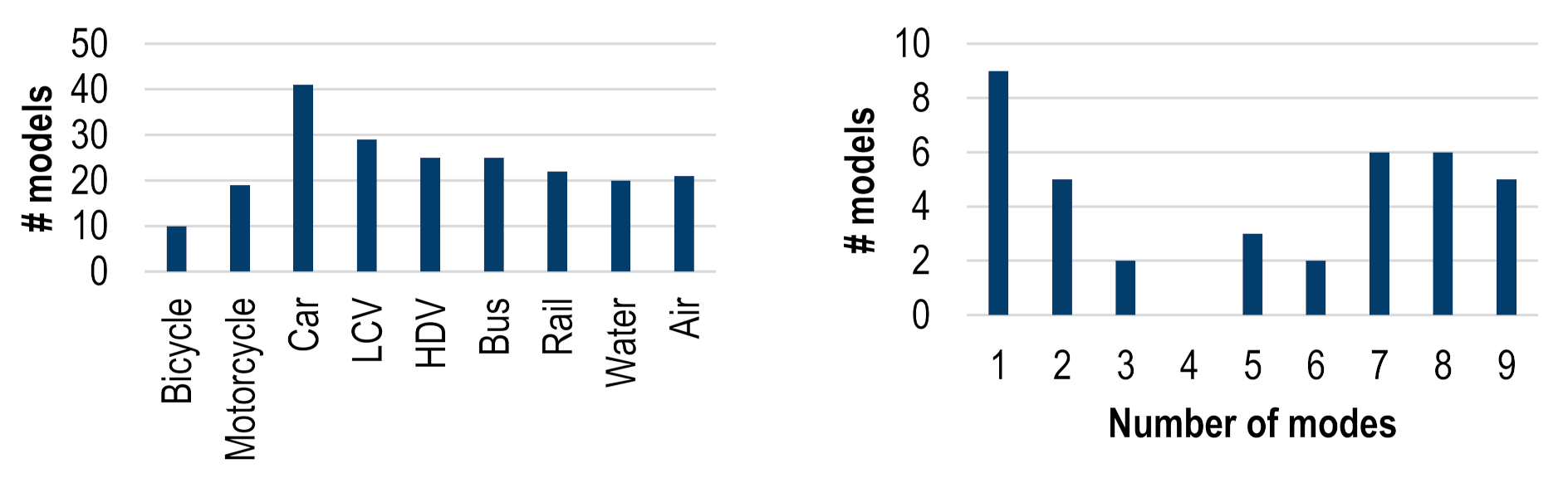
Figure A2 displays how many models contain the different means of transport. It can be seen that cars are included in all of the selected models. The reason for this is the high share of transport sector energy demand arising from passenger cars. Some of the models focus on passenger cars and do not take any other transport mode into account at all.
Bicycles are the least considered mode. A reason for this could be their low influence on the overall energy demand and greenhouse gas emissions in the transport sector. Although the burgeoning market for electric bikes for people and freight leads to rising electricity demand for this means of transport, it still makes up only a small share of the overall transport energy demand due to low specific energy demand [92]. Motorcycles are generally considered in global transport sector models because they play an important role in the transport sectors of less developed countries.
Gambhir et al. [82], Peng et al. [78], and Ou et al. [83] only model road transport modes, as these are the main drivers for rising energy demand in the Chinese transport sector. This leads to a lower overall consideration of rail, water, and air transport in the analyzed models, as can be seen in Figure A2.
Figure A2. Considered modes in transport sector models.
Only six of the models include all modes of transport considered in our analysis. Eight further models consider all modes, except for bicycles. Adding the four models that only disregard two-wheelers yields 18 models that take into account the most important modal drivers of energy demand and greenhouse gas emissions in the transport sector. Section 4.1 emphasizes the importance of including several modes in the context of mobility trends.
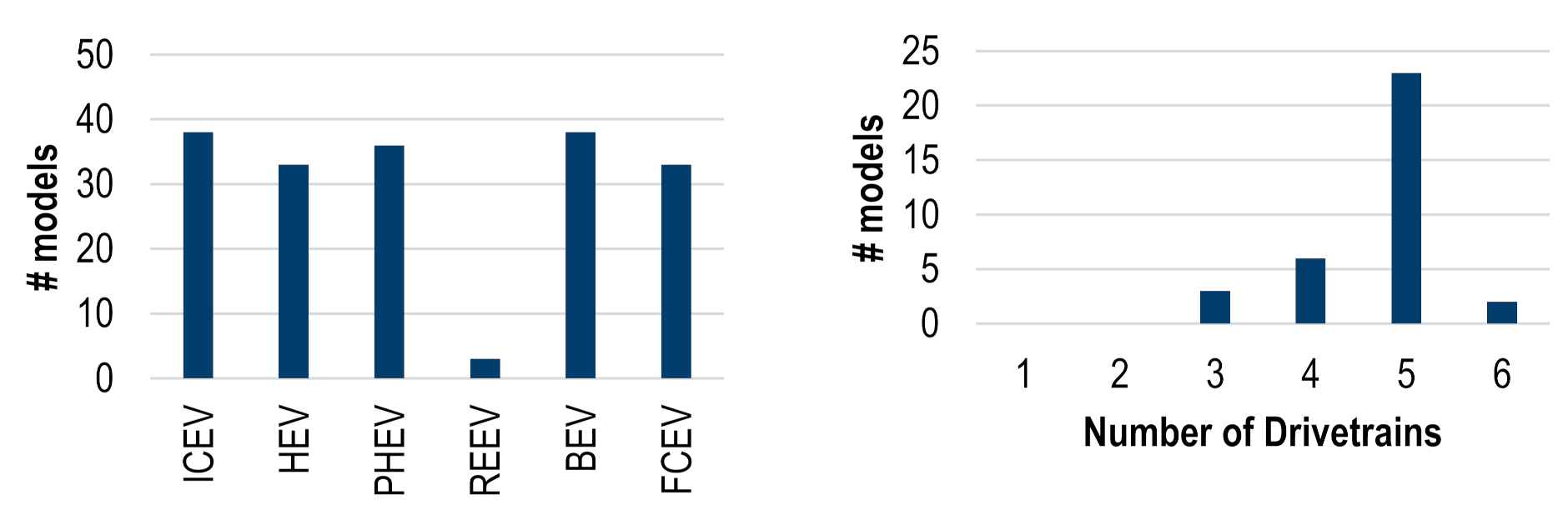
As noted above, the modes can be equipped with different drivetrain architectures. Due to a lack of information, it is not possible to analyze the considered drivetrains by mode. Therefore, Figure A3 depicts the number of models that include the investigated drivetrains for passenger cars. For three of the models, no information on the modeled drivetrains is available.
All models for which such information is available consider ICEVs and BEVs. Peng et al. [78] and Palencia et al. [81] do not include PHEVs though. The less electrified HEVs are also not taken into account in five of the models. FCEVs are included in the same number of models as HEVs. By far the least attention is paid to REEVs. Overall, a slight preference for including BEVs as an alternative drivetrain technology in the analysis can therefore be identified in some of the models.
The right diagram in Figure A3 shows the number of considered drivetrains (out of the drivetrain architectures included in the upper diagram) in the investigated models. It is apparent that most of the models include all listed drivetrain architectures, except for REEVs. In three of the models, only three different drivetrain architectures are taken into account for the analysis. Shepherd et al. [77] and Ou et al. [83] consider ICEVs, PHEVs, and BEVs. In contrast to this, Peng et al. do not consider hybrid drivetrains at all [78].
It should also be noted that the drivetrain variety in the models can be expected to be the highest for cars, and especially hybrid variants, which are often not considered as other means of transportation.
Figure A3. The relevance of different drivetrain architectures for passenger cars in transport sector models.
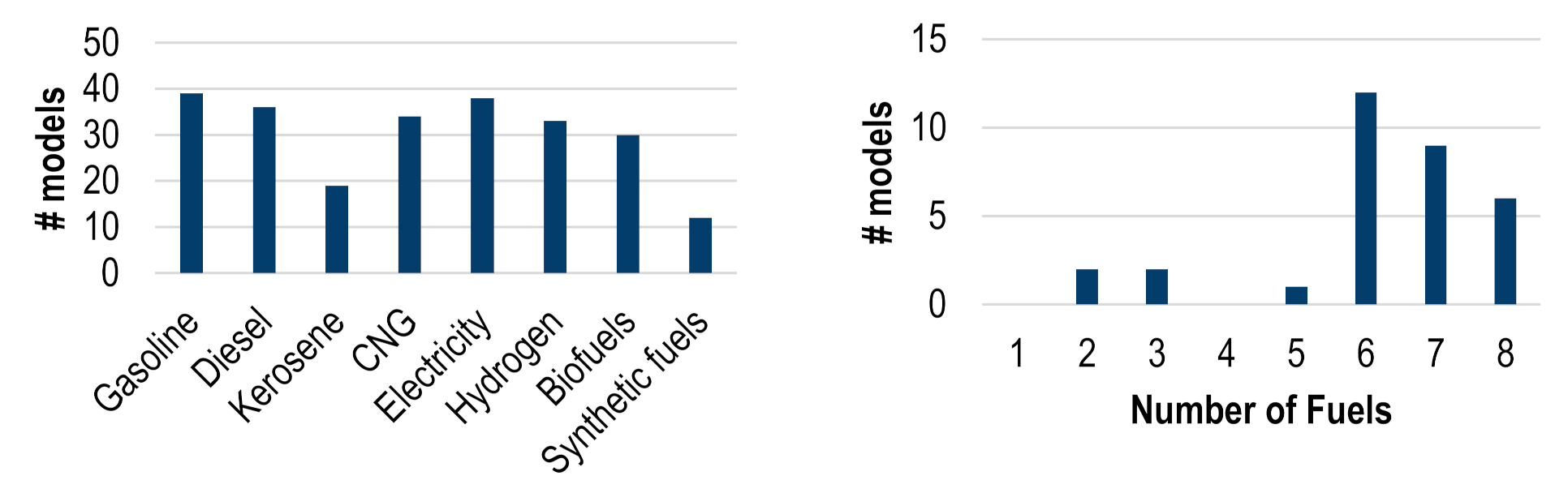
The final characteristic of the models, which is examined with respect to the sectoral level of detail, are the fuels. As with the drivetrains, not all fuels are used for all of the modes.
Gasoline and electricity are considered in all of the models, as they all include ICEV and BEV drivetrain technologies, as described above. Moreover, the number of models that take hydrogen into account as a possible energy carrier for the transport sector is related to the number of models that consider FCEV drivetrain technology. CNG is another alternative energy carrier that is included in most of the investigated transport sector models. Biofuels, and especially synthetic fuels, are not explicitly noted in many publications. However, it could be that the models implicitly switch from conventional gasoline and diesel to synthetic variants without mention.
The evaluations of the number of fuels considered per model indicate that six or more of the selected fuels were included in the models. Only five models consider fewer fuels. Yabe et al. [54] and Shepherd et al. [77] disregard all fuels, except for gasoline and electricity. Palencia et al. [81] investigate gasoline, electricity and hydrogen in their analysis. Pfaffenbichler et al. [72] disregard hydrogen, but instead include diesel as a second conventional fuel alongside gasoline.
Figure A4. Fuels in transport sector models.
The analysis in this subsection has revealed the sectoral coverage of the investigated transport sector models. For the most part, the models cover all of the most important means of transport with respect to energy demand and greenhouse gas emissions. Furthermore, they include the most promising drivetrain architectures. This is also the case for energy carriers, whereby synthetic fuels, which could be a helpful pathway of decarbonization for larger means of transport, are underrepresented. The inclusion of all relevant modes is a precondition to correctly modeling the effects of modal shifts. The same applies to the drivetrain technologies and the fuels used with respect to the trend in the fuel shift.

Appendix C. Shared Mobility Concepts

In the following a short distinction between different shared mobility concepts is made based on the work of Machado et al. [27].
They classify five major concepts of shared mobility [27], namely:
  • Car-sharing
  • Personal vehicle sharing
  • Ridesharing
  • On-demand ride services
  • Bike-sharing
Car-sharing is classified as a transportation mode in which a single vehicle is used by several people [93]. It can be organized in a station-based or free-floating manner. In a station-based system, vehicles must be returned to defined stations. In contrast, in a free floating system, they can be returned to any location within a specified zone.
Personal vehicle-sharing is similar to car-sharing, the main difference being the type of vehicle owner. In the case of personal vehicle-sharing, the vehicle is owned by one or more persons, whereas in the case of car-sharing vehicles are owned commercially.
Another concept of shared mobility is ridesharing, wherein similar trips according to paths and departure times from multiple travelers are combined using the same vehicle. Such carpools can be regular or spontaneous. A classic example is the carpooling of colleagues between home and work. New technological possibilities have made it easier to also pool trips among people who are strangers to each other.
On-demand ride services are characterized by their door-to-door nature. Vehicle owners are paid to deliver rides to other people who book and pay for their trips via smartphones. This service is personalized and highly flexible [94].
Next to the outlined concepts that refer to cars as shared vehicles, bike-sharing is a further shared mobility option that is comparable to car-sharing.

Appendix D. Levels of Vehicle Automation

According to the SAE [95], the degree of vehicle automation is classified into six levels (0–5), ranging from no automation (level 0) to full automation (level 5). The classification is based on the distribution of tasks between the driver and the vehicle. As the entire dynamic driving task is performed by the system from level 3 upwards, a key distinction between the levels is made at this point. Aside from the task distribution, it is important to consider in which driving modes the system is capable of executing its functions. Only full automation (level 5) is able to do so for all driving modes. When people refer to self-driving or autonomous vehicles, they usually mean those at level 5.
Oftentimes, the connectivity of vehicles is in conjunction with the automation of the driving task. On the one hand, vehicles themselves can be networked and exchange information regarding parameters such as velocity or information on prevailing traffic conditions (vehicle-to-vehicle, V2V). On the other hand, vehicles can be connected to infrastructural elements such as traffic lights (vehicle-to-infrastructure, V2I). Further connection to other elements such as pedestrians and networks is also conceivable (vehicle-to-x, V2X) [96].

References

  1. Edelenbosch, O.Y.; McCollum, D.L.; van Vuuren, D.P.; Bertram, C.; Carrara, S.; Daly, H.; Fujimori, S.; Kitous, A.; Kyle, P.; Ó Broin, E.; et al. Decomposing passenger transport futures: Comparing results of global integrated assessment models. Transp. Res. Part D Transp. Environ. 2017, 55, 281–293. [Google Scholar] [CrossRef] [Green Version]
  2. Girod, B.; van Vuuren, D.P.; Grahn, M.; Kitous, A.; Kim, S.H.; Kyle, P. Climate impact of transportation A model comparison. Clim. Chang. 2013, 118, 595–608. [Google Scholar] [CrossRef] [Green Version]
  3. Yeh, S.; Mishra, G.S.; Fulton, L.; Kyle, P.; McCollum, D.L.; Miller, J.; Cazzola, P.; Teter, J. Detailed assessment of global transport-energy models’ structures and projections. Transp. Res. Part D Transp. Environ. 2017, 55, 294–309. [Google Scholar] [CrossRef] [Green Version]
  4. Linton, C.; Grant-Muller, S.; Gale, W.F. Approaches and Techniques for Modelling CO2Emissions from Road Transport. Transp. Rev. 2015, 35, 533–553. [Google Scholar] [CrossRef]
  5. Creutzig, F. Evolving Narratives of Low-Carbon Futures in Transportation. Transp. Rev. 2016, 36, 341–360. [Google Scholar] [CrossRef]
  6. Möller, T.; Padhi, A.; Pinner, D.; Tschiesner, A. The Future of Mobility is at Our Doorstep; McKinsey & Company: Cologne, Germany, 2019. [Google Scholar]
  7. Deloitte CASE Automotive Trends and Insights. Available online: https://www2.deloitte.com/us/en/pages/manufacturing/topics/case-automotive-industry.html (accessed on 30 July 2020).
  8. Toyota CASE. Available online: https://global.toyota/en/mobility/case/ (accessed on 30 July 2020).
  9. Daimler CASE–Intuitive Mobility. Available online: https://www.daimler.com/innovation/case-2.html (accessed on 30 July 2020).
  10. Litman, T. Autonomous Vehicle Implementation Predictions; Victoria Transport Policy Institute: Victoria, BC, Canada, 2020. [Google Scholar]
  11. LMC Automotive. The Outlook for Autonomous Vehicle Sales and Their Impact to 2050; LMC Automotive: Oxford, UK, 2018. [Google Scholar]
  12. Transport Systems Catapult. Market Forecast for Connected and Autonomous Vehicles; Transport Systems Catapult: Milton Keynes, UK, 2017. [Google Scholar]
  13. Schipper, L.; Marie-Lilliu, C. Transportation and CO2 Emissilons: Flexing the Link-A Path for the World Bank. In Environment Department Papers; International Energy Agency: Paris, France, 1999. [Google Scholar]
  14. PTV Austria GmbH. How does the City of Copenhagen Become the World’s Most Bike-Friendly City? PTV Austria GmbH: Vienna, Austria, 2019. [Google Scholar]
  15. Liu, R. The DRACULA Dynamic Network Microsimulation Model. In International Symposium on Transport Simulation; Springer: Boston, MA, USA, 2002. [Google Scholar]
  16. Joint Global Research Institute. Overview of the Global Change Assessment Model (GCAM); Pathways to Sustainable Energy Stakeholder Consultation Workshop: Bishkek, Kyrgystan, 2018. [Google Scholar]
  17. Stehfest, E.; van Vuuren, D.; Kram, T.; Bouwman, L.; Alkemade, R.; Bakkenes, M. Integrated Assessment of Global Environmental Change with IMAGE 3.0; PBL Netherlands Environmental Assessment Agency: The Hague, The Netherlands, 2014. [Google Scholar]
  18. Horni, A.; Nagel, K.; Axhausen, K.W. The Multi-Agent Transport Simulation MATSim; Ubiquity Press: London, UK, 2016. [Google Scholar]
  19. United Nations. Kyoto Protocol to the United Nations Framework Convention on Climate Change; United Nations: Kyoto, Japan, 1998. [Google Scholar]
  20. Jochem, P.; Möst, D. Model Description of TE3; KIT: Karslruhe, Germany; TU: Dresden, Germany, 2019. [Google Scholar]
  21. IEA Energy Intensity of Passenger Transport Modes. 2018. Available online: https://www.iea.org/data-and-statistics/charts/energy-intensity-of-passenger-transport-modes-2018 (accessed on 30 July 2020).
  22. Umwelt Bundesamt. Vergleich Der Durchschnittlichen Emissionen Einzelner Verkehrsmittel Im Personenverkehr in Deutschland-Bezugsjahr 2018; Umwelt Bundesamt: Dessau-Roßlau, Germany, 2020. [Google Scholar]
  23. IEA. Rail; IEA: Paris, France, 2020. [Google Scholar]
  24. Bilgin, B.; Magne, P.; Malysz, P.; Yang, Y.; Pantelic, V.; Preindl, M.; Korobkine, A.; Jiang, W.; Lawford, M.; Emadi, A. Making the Case for Electrified Transportation. IEEE Trans. Transp. Electrif. 2015, 1, 4–17. [Google Scholar] [CrossRef]
  25. Edwards, R.; Hass, H.; Larivé, J.-F.; Lonza, L.; Maas, H.; Rickeard, D. WELL-TO-WHEELS Report Version 4.a; JRC, EUCAR, CONCAWE: Luxembourg, 2014. [Google Scholar]
  26. Gaker, D.; Walker, J. Revealing the Value of “Green” and the Small Group with a Big Heart in Transportation Mode Choice. Sustainability 2013, 5, 2913–2927. [Google Scholar] [CrossRef] [Green Version]
  27. Machado, C.; de Salles Hue, N.; Berssaneti, F.; Quintanilha, J. An Overview of Shared Mobility. Sustainability 2018, 10, 4342. [Google Scholar] [CrossRef] [Green Version]
  28. Krueger, R.; Rashidi, T.H.; Rose, J.M. Preferences for shared autonomous vehicles. Transp. Res. Part C Emerg. Technol. 2016, 69, 343–355. [Google Scholar] [CrossRef]
  29. Kuhnert, F.; Stürmer, C.; Koster, A. Five Trends Transforming the Automotive Industry; PwC: Frankfurt am Main, Germany, 2018. [Google Scholar]
  30. Namazu, M.; MacKenzie, D.; Zerriffi, H.; Dowlatabadi, H. Is carsharing for everyone? Understanding the diffusion of carsharing services. Transp. Policy 2018, 63, 189–199. [Google Scholar] [CrossRef]
  31. Schäfer, A.W.; Yeh, S. A holistic analysis of passenger travel energy and greenhouse gas intensities. Nat. Sustain. 2020, 3, 459–462. [Google Scholar] [CrossRef]
  32. Martinez, L.M.; Correia, G.H.A.; Viegas, J.M. An agent-based simulation model to assess the impacts of introducing a shared-taxi system: An application to Lisbon (Portugal). J. Adv. Transp. 2015, 49, 475–495. [Google Scholar] [CrossRef]
  33. Jochem, P.; Babrowski, S.; Fichtner, W. Assessing CO2 emissions of electric vehicles in Germany in 2030. Transp. Res. Part A Policy Pract. 2015, 78, 68–83. [Google Scholar] [CrossRef] [Green Version]
  34. Wadud, Z.; MacKenzie, D.; Leiby, P. Help or hindrance? The travel, energy and carbon impacts of highly automated vehicles. Transp. Res. Part A Policy Pract. 2016, 86, 1–18. [Google Scholar] [CrossRef] [Green Version]
  35. Bösch, P.M.; Becker, F.; Becker, H.; Axhausen, K.W. Cost-based analysis of autonomous mobility services. Transp. Policy 2018, 64, 76–91. [Google Scholar] [CrossRef]
  36. Lammert, M.P.; Duran, A.; Diez, J.; Burton, K.; Nicholson, A. Effect of Platooning on Fuel Consumption of Class 8 Vehicles Over a Range of Speeds, Following Distances, and Mass. SAE Int. J. Commer. Veh. 2014, 7, 626–639. [Google Scholar] [CrossRef] [Green Version]
  37. Enzian, F.; Brzoska, I. Why Platooning is the Future of Delivery Traffic. Available online: https://www.mantruckandbus.com/en/innovation/why-platooning-is-the-future-of-delivery-traffic.html (accessed on 30 July 2020).
  38. Degraeuwe, B.; Beusen, B. Using on-board data logging devices to study the longer-term impact of an eco-driving course. Transp. Res. Part D Transp. Environ. 2013, 19, 48–49. [Google Scholar] [CrossRef]
  39. European Automobile Manufacturers Association New Passenger Car Registrations by Engine Capacity and Power. Available online: https://www.acea.be/statistics/article/new-passenger-car-characteristics-cubic-capacity-average-power (accessed on 30 June 2020).
  40. Baxter, J.A.; Merced Cirino, D.A.; Costinett, D.J.; Tolbert, L.M.; Ozpineci, B. Review of Electrical Architectures and Power Requirements for Automated Vehicles. In Proceedings of the IEEE Transportation Electrification Conference and Expo (ITEC), Long Beach, CA, USA, 13–15 June 2018. [Google Scholar]
  41. ICCT. ICCT Roadmap Model, Version 1-0; ICCT: Washington, DC, USA, 2012. [Google Scholar]
  42. Brand, C.; Tran, M.; Anable, J. The UK transport carbon model: An integrated life cycle approach to explore low carbon futures. Energy Policy 2012, 41, 107–124. [Google Scholar] [CrossRef] [Green Version]
  43. Ben-Akiva, M.; Lerman, S.R. Discrete Choice Analysis: Theory and Application to Travel Demand; The MIT Press: Cambridge, MA, USA, 1985. [Google Scholar]
  44. Girod, B.; van Vuuren, D.P.; Deetman, S. Global travel within the 2 °C climate target. Energy Policy 2012, 45, 152–166. [Google Scholar] [CrossRef] [Green Version]
  45. Wang, H.; Ou, X.; Zhang, X. Mode, technology, energy consumption, and resulting CO2 emissions in China’s transport sector up to 2050. Energy Policy 2017, 109, 719–733. [Google Scholar] [CrossRef]
  46. Mittal, S.; Dai, H.; Fujimori, S.; Hanaoka, T.; Zhang, R. Key factors influencing the global passenger transport dynamics using the AIM/transport model. Transp. Res. Part D Transp. Environ. 2017, 55, 373–388. [Google Scholar] [CrossRef]
  47. Hollevoet, J.; Witte, A.D.; Macharis, C. Improving insight in modal choice determinants: An approach towards more sustainable transport. In Urban Transport; WIT Press: Southampton, UK, 2011; Volume 116. [Google Scholar]
  48. Schäfer, A. Regularities in Travel Demand: An International Perspective. J. Transp. Stat. 2000, 3, 1–31. [Google Scholar]
  49. Siegemund, S.; Trommler, M.; Kolb, O.; Zinnecker, V. The Potential of Electricity-Based Fuels for Low-Emission Transport in the EU; Dena: Berlin, Germany, 2017. [Google Scholar]
  50. Trost, T. Erneuerbare Mobilität Im Motorisierten Individualverkehr; Forschungsgesellschaft für Straßen-und Verkehrswesen (FGSV): Leipzig, Germany; Stuttgart, Germany, 2017. [Google Scholar]
  51. Blat Belmonte, B.; Esser, A.; Weyand, S.; Franke, G.; Schebek, L.; Rinderknecht, S. Identification of the Optimal Passenger Car Vehicle Fleet Transition for Mitigating the Cumulative Life-Cycle Greenhouse Gas Emissions until 2050. Vehicles 2020, 2, 75–99. [Google Scholar] [CrossRef] [Green Version]
  52. Zimmer, W.; Blank, R.; Bergmann, T.; Mottschall, M.; Waldenfels, R. RENEWBILITY III-Die einzelnen RENEWBILITY-Modelle Im Detail; Ökoinstitut, DLR, IFEU, Infras: Berlin, Germany, 2015. [Google Scholar]
  53. Siskos, P.; Capros, P.; Zazias, G.; Fiorello, D.; Noekel, K. Energy and fleet modelling within the TRIMODE integrated transport model framework for Europe. Transp. Res. Procedia 2019, 37, 369–376. [Google Scholar] [CrossRef]
  54. Yabe, K.; Shinoda, Y.; Seki, T.; Tanaka, H.; Akisawa, A. Market penetration speed and effects on CO2 reduction of electric vehicles and plug-in hybrid electric vehicles in Japan. Energy Policy 2012, 45, 529–540. [Google Scholar] [CrossRef]
  55. Pichlmaier, S.; Fattler, S.; Bayer, C. Modelling the Transport Sector in the Context of a Dynamic Energy System. In Proceedings of the 41st IAEE International Conference, Groningen, The Netherlands, 10–13 June 2018. [Google Scholar]
  56. Lebeau, K.; Lebeau, P.; Macharis, C.; Van Mierlo, J. How expensive are electric vehicles? A total cost of ownership analysis. World Electr. Veh. J. 2013, 6, 996–1007. [Google Scholar] [CrossRef] [Green Version]
  57. Knupfer, S.M.; Hensley, R.; Hertzke, P.; Schaufuss, P. Electrifying Insights: How Automakers can Drive Electrified Vehicle Sales and Profitability; McKinsey & Company: Stamford, USA, 2017. [Google Scholar]
  58. Harrison, G.; Thiel, C.; Jones, L. Powertrain Technology Transition Market Agent Model (PTTMAM): An introduction; Joint Research Centre: Luxembourg, 2016. [Google Scholar]
  59. Struben, J.; Sterman, J.D. Transition Challenges for Alternative Fuel Vehicle and Transportation Systems. Environ. Plan. B Plan. Des. 2008, 35, 1070–1097. [Google Scholar] [CrossRef]
  60. Brooker, A.; Gonder, J.; Lopp, S.; Ward, J. ADOPT: A Historically Validated Light Duty Vehicle Consumer Choice Model. In Proceedings of the SAE 2015 World Congress and Exhibition, Detroit, MI, USA, 21–23 April 2015. [Google Scholar]
  61. Manley, D.; Levinson, R.; Barter, G.; West, T. ParaChoice-Parametric Vehicle Choice Modeling; Sandia National Lab: Albuquerque, NM, USA.
  62. Rogers, E. Diffusion of Innovations; Free Press: New York, NY, USA, 2003. [Google Scholar]
  63. U.S. Energy Information Administration. Transportation Sector Demand Module of the National Energy Modeling System: Model Documentation; U.S. Energy Information Administration: Washington, DC, USA, 2019.
  64. Adolf, J.; Balzer, C.; Joedicke, A.; Schabla, U.; Wilbrand, K.; Rommerskirchen, S.; Anders, N.; der Maur, A.a.; Ehrentraut, O.; Krämer, L.; et al. Shell PKW-Szenarien bis 2040; Shell, Prognos: Hamburg, Germany, 2014. [Google Scholar]
  65. Hacker, F.; Blanck, R.; Hülsmann, F.; Kasten, P.; Loreck, C.; Ludig, S.; Mottschall, M.; Zimmer, W. eMobil 2050-Szenarien Zum möglichen Beitrag Des elektrischen Verkehrs Zum Langfristigen Klimaschutz; Öko-Institut e.V.: Berlin, Germany, 2014. [Google Scholar]
  66. Zimmer, W.; Blank, R.; Bergmann, T.; Mottschall, M.; Waldenfels, R. Endbericht RENEWBILITY III-Optionen Einer Dekarbonisierung Des Verkehrssektors; Ökoinstitut, DLR, IFEU, Infras: Berlin, Germany, 2016. [Google Scholar]
  67. Xie, F.; Lin, Z. In Market Acceptance of Advanced Automotive Technologies–Mobility Choice (MA3T-MC): Consumer Acceptance of CAV, Shared Mobility and Electric Vehicle. In Proceedings of the Automated Vehicle Symposium 2019, Orlando, FL, USA, 16 July 2019. [Google Scholar]
  68. Fiorello, D.; Fermi, F.; Bielanska, D. The ASTRA model for strategic assessment of transport policies. Syst. Dyn. Rev. 2010, 26, 283–290. [Google Scholar] [CrossRef]
  69. Mock, P. Entwicklung eines Szenariomodells Zur Simulation Der Zukünftigen Marktanteile Und CO2-Emissionen Von Kraftfahrzeugen (VECTOR21); Universität Stuttgart: Stuttgart, Germany, 2010. [Google Scholar]
  70. Redelbach, M. Entwicklung Eines Dynamischen Nutzenbasierten Szenariomodells Zur Simulation Der Zukünftigen Marktentwicklung Für Alternative PKW-Antriebskonzepte; Deutsches Zentrum für Luft-und Raumfahrt: Stuttgart, Germany; Cologne, Germany, 2016. [Google Scholar]
  71. FfE. TraM-Sektormodell Des Verkehrs; FfE: Munich, Germany, 2017. [Google Scholar]
  72. Pfaffenbichler, P.; Renner, S.; Krutak, R. Modelling the Development of Vehicle Fleets with Alternative Propulsion Technologies; AEA: Vienna, Austria, 2011. [Google Scholar]
  73. Brand, C. UK Transport Carbon Model: Reference Guide; UK Energy Research Centre: Oxford, UK, 2010. [Google Scholar]
  74. Brand, C.; Cluzel, C.; Anable, J. Modeling the uptake of plug-in vehicles in a heterogeneous car market using a consumer segmentation approach. Transp. Res. Part A Policy Pract. 2017, 97, 121–136. [Google Scholar] [CrossRef]
  75. Barisa, A.; Rosa, M. A system dynamics model for CO2 emission mitigation policy design in road transport sector Aiga Barisa*, Marika Rosa. Energy Procedia 2018, 147, 419–427. [Google Scholar] [CrossRef]
  76. Shafiei, E.; Davidsdottir, B.; Leaver, J.; Stefansson, H.; Asgeirsson, E.I. Comparative analysis of hydrogen, biofuels and electricity transitional pathways to sustainable transport in a renewable-based energy system. Energy 2015, 83, 614–627. [Google Scholar] [CrossRef]
  77. Shepherd, S.; Bonsall, P.; Harrison, G. Factors affecting future demand for electric vehicles: A model based study. Transp. Policy 2012, 20, 62–74. [Google Scholar] [CrossRef]
  78. Peng, T.; Ou, X.; Yuan, Z.; Yan, X.; Zhang, X. Development and application of China provincial road transport energy demand and GHG emissions analysis model. Appl. Energy 2018, 222, 313–328. [Google Scholar] [CrossRef]
  79. Hao, H.; Liu, Z.; Zhao, F.; Li, W.; Hang, W. Scenario analysis of energy consumption and greenhouse gas emissions from China’s passenger vehicles. Energy 2015, 91, 151–159. [Google Scholar] [CrossRef]
  80. Liu, L.; Wang, K.; Wang, S.; Zhang, R.; Tang, X. Assessing energy consumption, CO2 and pollutant emissions and health benefits from China’s transport sector through 2050. Energy Policy 2018, 116, 382–396. [Google Scholar] [CrossRef]
  81. Palencia, J.C.G.; Otsuka, Y.; Araki, M.; Shiga, S. Impact of new vehicle market composition on the light-duty vehicle fleet CO2 emissions and cost. Energy Procedia 2017, 105, 3862–3867. [Google Scholar] [CrossRef]
  82. Gambhir, A.; Tse, L.K.C.; Tong, D.; Martinez-Botas, R. Reducing China’s road transport sector CO2 emissions to 2050: Technologies, costs and decomposition analysis. Appl. Energy 2015, 157, 905–917. [Google Scholar] [CrossRef] [Green Version]
  83. Ou, X.; Zhang, X.; Chang, S. Scenario analysis on alternative fuel/vehicle for China’s future road transport: Life-cycle energy demand and GHG emissions. Energy Policy 2010, 38, 3943–3956. [Google Scholar] [CrossRef]
  84. Szimba, E.; Ihrig, J.; Kraft, M.; Mitusch, K.; Chen, M.; Chahim, M.; van Meijeren, J.; Kiel, J.; Mandel, B.; Ulied, A.; et al. HIGH-TOOL–a strategic assessment tool for evaluating EU transport policies. J. Shipp. Trade 2018, 3, 11. [Google Scholar] [CrossRef]
  85. Karkatsoulis, P.; Siskos, P.; Paroussos, L.; Capros, P. Simulating deep CO2 emission reduction in transport in a general equilibrium framework: The GEM-E3T model. Transp. Res. Part D 2017, 55, 343–358. [Google Scholar] [CrossRef]
  86. Fiorello, D.; Nökel, K.; Martino, A. The TRIMODE integrated model for Europe. Transp. Res. Procedia 2018, 31, 88–98. [Google Scholar] [CrossRef]
  87. Purwanto, J.; de Ceuster, G.; Vanherle, K. Mobility, Vehicle fleet, Energy use and Emissions forecast Tool (MOVEET). Transp. Res. Procedia 2017, 25, 3421–3434. [Google Scholar] [CrossRef]
  88. Fulton, L.; Cazzola, P.; Cuenot, F. IEA Mobility Model (MoMo) and its use in the ETP 2008. Energy Policy 2009, 37, 3758–3768. [Google Scholar] [CrossRef]
  89. U.S. Energy Information Administration (EIA). Component Design Report: International Transportation Energy Demand Determinants Model; U.S. Energy Information Administration (EIA): Washington, DC, USA, 2017.
  90. Khalili, S.; Rantanen, E.; Bogdanov, D.; Breyer, C. Global Transportation Demand Development with Impacts on the Energy Demand and Greenhouse Gas Emissions in a Climate-Constrained World. Energies 2019, 12, 3870. [Google Scholar] [CrossRef] [Green Version]
  91. Cuenot, F. ForFITS at UNECE; iTEM4: Laxenburg, Austria, 2017. [Google Scholar]
  92. Weiss, M.; Dekker, P.; Moro, A.; Scholz, H.; Patel, M.K. On the electrification of road transportation-A review of the environmental, economic, and social performance of electric two-wheelers. Transp. Res. D Transp. Environ. 2015, 41, 348–366. [Google Scholar] [CrossRef] [PubMed]
  93. Greenblatt, J.B.; Shaheen, S. Automated Vehicles, On-Demand Mobility, and Environmental Impacts. Curr. Sustain./Renew. Energy Rep. 2015, 2, 74–81. [Google Scholar] [CrossRef] [Green Version]
  94. Atasoy, B.; Ikeda, T.; Ben-Akiva, M.E. Optimizing a Flexible Mobility on Demand System. Transp. Res. Rec. J. Transp. Res. Board 2019, 2563, 76–85. [Google Scholar] [CrossRef]
  95. SAE International. Levels of Driving Automation; J3016; SAE International: Warrendale, USA, 2014. [Google Scholar]
  96. Pearre, N.S.; Ribberink, H. Review of research on V2X technologies, strategies, and operations. Renew. Sustain. Energy Rev. 2019, 105, 61–70. [Google Scholar] [CrossRef]
Publisher’s Note: MDPI stays neutral with regard to jurisdictional claims in published maps and institutional affiliations.

Article Metrics

Citations

Article Access Statistics

Multiple requests from the same IP address are counted as one view.