1. Introduction
In Brazil, the social inclusion of people with disabilities has been systematically denied throughout history, with them being subjected to exclusion (until the early 20th century) and segregation (from the 1920s to the 1940s). It was only after 1950 that progress was made towards integrating them into society in specific spaces, such as schools or classrooms (integration paradigm). Although once marginalized, segregated, and excluded from societal life, individuals with disabilities began to be integrated into community programs—initiatives that were often limited to serving only this population [
1].
Although progress has been made in terms of integration, the focus of change has remained on the individual [
2]. This situation sometimes resulted in a lack of adequate support, which compromised the participation of people with disabilities. In other words, although aimed at integration into work environments and community activities, the environments and colleagues were often not adequately prepared, resulting in situations of marginalization [
3].
Given an environmental and social context that was unsuitable for people with disabilities to live in society, which limited their opportunities to experience diverse human experiences, a new paradigm, inclusion, began to take shape. In the absence of support and in light of the marginalization that still exists, the inclusion of people with disabilities is no longer being demanded for specific locations, but rather for spaces where people with and without disabilities can live together, thus characterizing inclusion. According to Sassaki [
1], the paradigm of inclusion encompasses the existence of a society where human diversity is valued, and all individuals have opportunities for participation and development. To this end, solid support is imperative. In this sense, inclusion implies the construction of a social environment that provides the tools and resources necessary for this participation to be autonomous, dignified, and meaningful [
2].
The growing struggle of people with disabilities and their families for a just and inclusive society has resulted in significant changes since 1990, contributing to the emergence of the inclusion paradigm. This movement has been accompanied by international regulatory advances, such as the United Nations Convention on the Rights of Persons with Disabilities [
4] and national advances, notably the Brazilian Inclusion Law [
5]. These documents highlight the urgent need for a society that guarantees equal opportunities and the full participation of historically marginalized social groups. This participation must be ensured through the adaptation of the social environment to achieve social justice in serving people in all their diversity.
Inclusion, guided by human rights and social justice, aims to guarantee all citizens participation at all levels and in all services, covering areas such as education, health, employment, leisure, culture, among others, without any type of discrimination based on personal characteristics [
6].
In short, physical activities are included among the environments, contexts, and experiences in which inclusion should be promoted. Physical activities, from a holistic perspective, involve “[…]
people who move, act, and perform in culturally specific spaces and contexts and are influenced by a unique set of interests, emotions, ideas, instructions, and relationships” [
7] (p. 5). These experiences involve the mobilization and action of individuals in culturally specific contexts, promoting the development of physiological, psychological, emotional, affective, social, political, and cultural aspects [
7]. This inclusion can occur through adapted physical activities (APA), adapted sports (AS), and/or parasports, each with specific characteristics and objectives.
APAs comprise “[…]
games, sports, rhythmic and expressive activities whose organization is based on the interests, abilities, and limitations of individuals with disabilities” [
8] (p. 15). They cover a wide range of people and can be experienced for educational, recreational, competitive, or therapeutic purposes [
9]. Among the benefits, they can contribute to a physically active lifestyle, rehabilitation of bodily functions, and, above all, equitable social inclusion [
10]. Furthermore, such practices are fundamental for health promotion and social development [
11].
In addition, inclusion can occur through AS, which covers not only APA for people with disabilities, but also the elderly and individuals with specific health conditions. Inclusion, leisure, health, and well-being are fundamental pillars that underpin its approach [
12]. Sports have been adapted, adjusted, or specifically created to accommodate the participation of people with disabilities, enabling an inclusive sports experience that respects the abilities and needs of this diverse audience.
It can also occur through parasport, designed specifically for high-performance competitions, with its own set of rules and classifications, culminating in events such as the Paralympic Games. The main objective is high performance and structured competition, with specific rules and classifications to ensure fairness in competitions involving different types and degrees of disability [
12].
Despite the diverse possibilities and objectives for including people with disabilities, as well as their essential role in society, the reality for these individuals is still often marked by significant challenges due to social inadequacies that act as barriers [
13]. Among the difficulties identified, architectural barriers stand out, such as the absence of ramps, tactile floors, adapted equipment, and professionals trained to meet the specific needs of people with disabilities. In addition, there are attitudinal barriers, which manifest themselves in behaviors that hinder social participation. Methodological barriers are evident, arising from conventional approaches that fail to address the unique needs of individuals with disabilities and the necessary accommodations. In addition, there are programmatic barriers, resulting from the lack of services for people with disabilities with the necessary support, and instrumental barriers, resulting from the lack of tools, technologies, and resources that aid communication [
14].
These barriers stem from a social construct based on an idealized biotype. This model assumes that the problem lies with the individual [
2]. Therefore, the entire focus of change is centered on the person with a disability, creating stereotypes and prejudices based on ableism, which consists of valuing physical and mental ability and ignoring the diversity and complexity of human experiences [
6].
Considering the support identified as necessary, it is appropriate that public policies be formulated and implemented to promote structural, methodological, pedagogical, and social conditions in order to enable accessibility in its different dimensions in schools, universities, sports facilities, among others.
Laws, regulations, program projects, and actions are formalized as the public manager’s intention regarding the public policy implemented. The analysis of these documents can provide important contributions to the understanding of public policies aimed at different audiences and areas, as well as the intentions of managers, including the inclusion of people with disabilities in APA, AS, and/or parasports.
The analysis of regulations and plans is recognized as an excellent methodological tool for identifying structural anchors in national contexts, as it provides a baseline and influences the phases of implementation projects involving the collection of primary data [
15]. The analysis of laws and decrees has shown that the sports organization model in Brazil is centered on the autonomy of sports entities, but with heavy use of public funds to finance the maintenance of these entities’ structures [
16].
In accordance with the above, this research asks: Are sports programs implemented in the educational context in Mato Grosso do Sul? If so, what sports are developed? Do the programs/projects include the intentional inclusion of people with disabilities in their objectives? Are people with disabilities included as a target audience? If so, how is inclusion verified?
The overall objective of the research was to analyze the public sports policy of the state of Mato Grosso do Sul in the educational context and the inclusion of people with disabilities. In particular, the objective was to identify the dimensions of sports covered; assess the intentionality of the inclusion of people with disabilities; and analyze the mechanisms used.
Development of Public Policies in Light of the Cycle Model: Process and Specification of Intentions
In addition to the involvement of civil society, the third sector, and the market, the development of public policies requires the action of the State, insofar as it has objective superiority in drafting laws and ensuring their enforcement [
17] and relies on the Government, the producer of public policies par excellence [
18]. In addition to having a bureaucratic-administrative apparatus for carrying out its activities, the government has resources from taxes collected at different levels (federal, state, district, and municipal) to fund not only the functioning of the public sector, but also the realization of rights, whether political, fundamental, or social.
To this end, it is imperative to outline strategies that allow for the inclusion of multifaceted requirements, such as education, health, sports, leisure, security, among others, in public policies. This goal takes on particular importance in light of the creation of the Fiscal Responsibility Law, which established budgetary rules and restrictions. Each year, the executive branch must prepare a budget plan based on the previous year’s revenue and submit it for legislative approval. After approval, the executive branch establishes the financial program and the monthly disbursement schedule [
19].
Considering the various theoretical models, simplified representations of the real world that underpin the development of public policies [
20], the cycle model helps to understand this dynamic. According to the model, public policies occur in stages (policy cycles), namely: agenda, policy formulation, policy decision-making, policy implementation, and policy evaluation [
21]. In line with the objectives set out for this study, the analysis will focus on the first four stages, which are considered essential for implementing a public policy on physical activity services for people with disabilities within the public administration context.
The agenda comprises the moment when an organization focuses its attention on specific issues [
22]. In the first stage, various emerging issues arising from the needs of the political community (systemic agenda) are presented to the head of the executive branch. In a complex scenario with disputes over a set of issues, only a few capture the government’s attention and become problems that it proposes to solve (institutional agenda) [
21]. The definition of the problem and priority issues stems from socially constructed processes that demarcate a particular worldview [
23]. Those that are not included are not accepted as a political problem.
Once the government has accepted the need to address an issue, the question requires answers that provide solutions (formulation). The formulation of responses to the problem is achieved by identifying and determining possible solutions, which may involve the use of incentives, coercion, awareness raising, or technical solutions developed by politicians, career civil servants (bureaucrats), and other political actors [
21]. It is at this stage that policy objectives are defined, and policy solutions and instruments are selected [
23].
In the process of developing alternatives (options), several elements are considered, including the established objectives and strategies. At this stage, the actors involved define the expected results [
17], considering the technical, political, and financial constraints of the state [
21]. The more concrete the objectives are, the easier it will be to verify the program’s effectiveness, as they guide the alternatives to be created and the subsequent stages. At this stage, programs, actions, strategies, and methods are established to achieve what has been outlined and outlined [
17].
Among the options listed, the one that obtains approval (decision stage) from members of specific subsystems who hold formal positions in the government will be considered an official statement of intent [
21]. Based on the decision, plans (strategic macro guidelines), implemented through programs (tactical-managerial content) and operationalized via projects (operational procedures), define the public policy instrument to be implemented, entering the implementation stage.
Within the scope of public policy instruments, the direct provision of public services to society is a fundamental component [
24]. The main function of this stage is regulation, i.e., the definition of standards of conduct, performance, and management criteria, which form the basis for formal approval. The main actors in this area are career civil servants working in ministries or departments [
21].
2. Materials and Methods
This research is qualitative in nature, with an exploratory approach and a retrospective longitudinal design [
25]. The object of the analysis was normative documents (laws, decrees, regulations, guidelines, cooperation agreements) related to sports programs and projects promoted by the Government of the State of Mato Grosso do Sul, through the Mato Grosso do Sul Sports and Leisure Foundation (Fundesporte). The analysis period ran from 2020 to 2024.
Analytical methods were applied in accordance with the guidelines established by Minayo [
26], with the necessary adaptations to meet the specific requirements of this research. Initially, the process involved an exploratory literature review. This procedure mapped the issues previously formulated within the scope of the study and identified the areas that received the most emphasis, as well as those that were less explored.
The theoretical framework of this manuscript is composed of authors who support the paradigm of inclusion [
2], the dimensions and barriers of accessibility [
3], physical activities [
7], Adapted Physical Activity (APA), parasports [
10,
12,
27], and public policies [
17,
21]. These concepts, within the scope of this study, are understood as follows:
Inclusion: refers to the construction of a social environment that provides opportunities for participation for people with disabilities through the creation of tools and supports necessary to promote autonomy and human dignity [
28].
Dimensions of accessibility: these refer to environmental and social adaptations in architectural, communicational, methodological, instrumental, programmatic, and attitudinal aspects that enable people with disabilities to experience the various opportunities of life in society, in contexts such as work, leisure, and sports [
14].
Barriers: these are architectural, communicational, methodological, instrumental, programmatic, and attitudinal structures based on the “standard man” model, which result in limitations or impediments to the access of people with disabilities to different contexts and experiences [
14].
Physical activities: involve people who move, act, and perform in culturally specific spaces and contexts, influenced by a unique set of interests, emotions, ideas, instructions, and relationships [
7].
Adapted Physical Activities (APA): consist of a diverse set of activities, games, sports, rhythmic and expressive practices, adapted to people with disabilities, considering their interests and limitations [
29].
Adapted sports: represent an expanded set of sporting possibilities, adapted to meet the needs of people with disabilities, the elderly, and individuals with specific health conditions. The focus is on inclusion, leisure, health promotion, and well-being [
12].
Parasports: aimed exclusively at people with disabilities, its main objective is high performance in structured competitions, with specific rules and classifications, in order to ensure fairness in competitions between people with different types and degrees of disability [
12].
The object of the analysis was normative documents (laws, decrees, regulations, guidelines, cooperation agreements) related to sports programs and projects promoted by Fundesporte. The documents were identified through an official letter sent to the Presidency of Fundesporte, requesting the availability of regulations (decrees, laws, resolutions, program regulations, and public notices for the selection of projects) related to sports policy in educational contexts. The inclusion criteria were as follows:
(a) Documents related to sports programs developed by Fundesporte in educational contexts in Mato Grosso do Sul; (b) Documents published between 2018 and 2024; (c) Documents made available by Fundesporte. The documents were received by email and stored in a specific folder for later analysis. This technique enabled us to arrive at the study’s analysis corpus (
Table 1).
The results were processed and analyzed according to Minayo [
26] and consisted of:
- (a)
Preliminary analysis: skimming and preparation of indicators—sports programs and the dimensions of sport; program objectives and intentionality in the inclusion of persons with disabilities; target audience of the programs, consideration of persons with disabilities, and mechanisms used);
- (b)
Exploration of the material: exhaustive reading of the documents, identifying the units of registration (phrases related to the indicators), exploration of the material, identifying the categories (textual expressions) and reducing them to meaningful expressions, with excerpts (reduction) of the texts into units of registration;
- (c)
Identification of items: sports projects (existence or non-existence), inclusion of persons with disabilities in the objectives of sports projects (existence or non-existence), sports dimensions covered by the projects (sports education, sports participation, sports performance), and mechanisms aimed at including persons with disabilities in the projects (APA, AS, parasports);
- (d)
Treatment and interpretation of results: inferences interrelated with the theoretical framework on the inclusion of people with disabilities and public policies outlined in the introduction and theoretical basis. To present the results, two tables were prepared, one with text excerpts related to the dimensions of sport (words) and another with text excerpts (phrases) related to the objectives of the projects.
3. Results
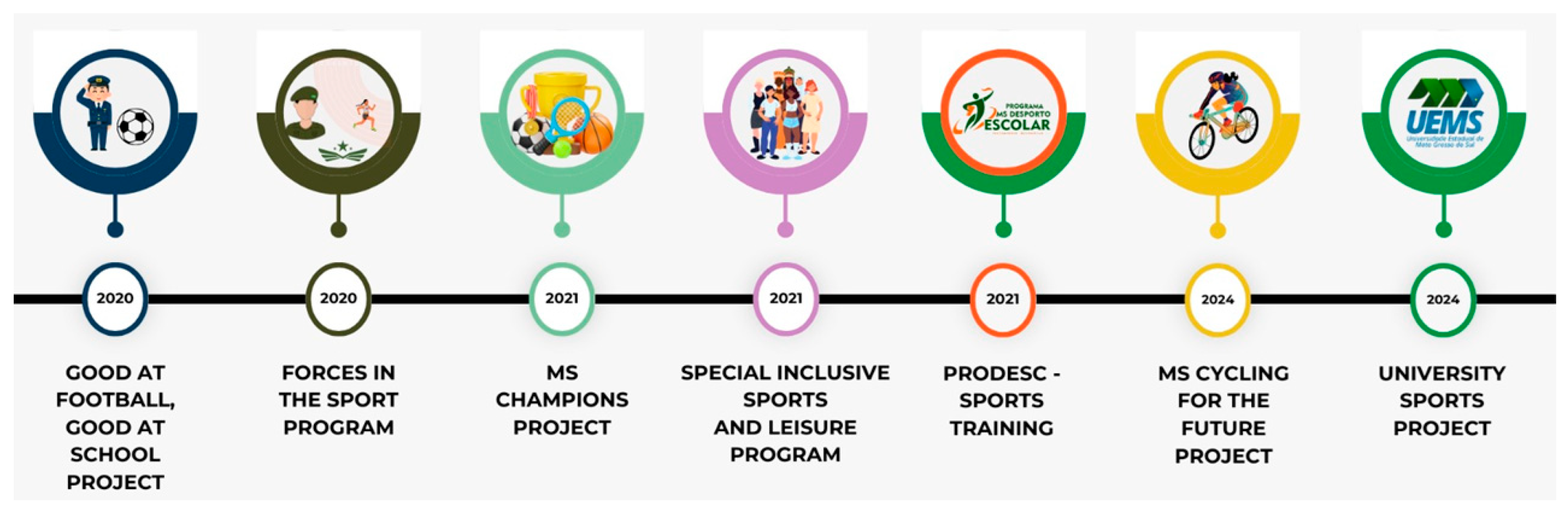
In 2020, sports in Mato Grosso do Sul underwent changes with the implementation of the “MS School Sports” program, resulting from a collaboration between Fundesporte and the State Department of Education (SED). The MS School Sports Program (Prodesc) replaced the former ‘School Sports Training and Development Program,’ while preserving its original objectives (
Figure 1).
With the aim of strengthening sport and promoting inclusion, “Prodesc” began its activities by incorporating existing projects such as the “Good at Football, Good at School Project” and “Sports Forces Program). Over the years, new projects were added, resulting in the expansion of the program, which began to encompass others, taking on the role of an umbrella program.
In 2021, the program was significantly expanded. New initiatives were created, such as the “MS Champions” and the “Inclusive Sport and Leisure Program”, which expanded the program’s reach and introduced sports into educational contexts that had not been covered before, such as indigenous schools, quilombola schools, and Educational Internment Units (EIUs).
In 2021, MS School Sports, which focuses on supporting sports in schools, underwent a name change to “Prodesc Sports Training”. This change resulted in the separation of “MS School Sports” as a macro public policy (umbrella) and “Prodesc Sports Training” as a specific program.
In 2022, the “Inclusive Sport and Leisure Program” underwent significant restructuring, resulting in specific rules for the program’s operation in indigenous and quilombola communities, which differed from the rules applicable to EIUs. This change aimed at improving service delivery to these specific groups by adapting sports activities to their cultural and social characteristics and indicating a likely commitment by the program to inclusion and diversity, especially with regard to the legal basis for minors deprived of liberty.
In 2023, new projects were implemented, namely “MS Cycling for the Future” and “University Sports”, demonstrating Fundesporte ongoing efforts to diversify and expand opportunities for access to sports. However, in the same year, the “MS Champions Project” project was discontinued.
Considering the objectives of each project, Prodesc prioritizes competitive sports (see
Table 2), which account for 42.85% of the analyzed actions. Although there are initiatives focused on participatory sports (28.57%) and sports education (14.28%), these dimensions are complementary, demonstrating that sports performance remains the focus. Thus, Fundesporte main sports policy program for the educational context adopts an approach focused on high performance, student-athletes, technical improvement, the development of competitive sports, and the pursuit of victories in competitions.
Initiatives such as “MS Champions”, “Prodesc Sport Training,” and “University Sports” prioritize competitive sports, focusing on technical improvement, talent discovery, and the creation of competitive teams to represent the state in competitions at different levels. In contrast, initiatives such as the “Inclusive Sport and Leisure Program” and “Forces in Sport” promote participatory sports, fostering social inclusion, interaction, and the integral development of participants, focusing on the principles of citizenship and human values. The central objective is not competition, but engagement in sports activities that promote well-being.
The “MS Pedaling for the Future” project encompasses the three dimensions of sport: education, performance, and participation. In terms of education, the project encourages dedication to school activities, organizes lectures on education and health, and improves psychosocial skills, in accordance with the principles of participation, cooperation, and responsibility. Performance sport aims to identify young people with potential for sporting success, providing conditions for their technical improvement and participation in local, regional, and national competitions. Finally, participating in sport uses cycling as an enjoyable and democratic activity, encouraging social integration, well-being, and the constructive use of free time, especially in socially vulnerable communities.
About the objectives of “MS School Sports” in 2020, these were exclusively focused on the sporting development of students in the state school system, with an emphasis on discovering talent and forming competitive teams for the School Games. In 2021, the program broadened its horizons to include sports training programs, social inclusion initiatives, and attention to academic performance. The program began its implementation, establishing a link between sports and academic development. In this sense, databases were created to monitor the athletes’ profiles, and psychosocial skills such as leadership, teamwork, discipline, and resilience were promoted. In 2024, the overall objective was changed to encourage the training and sports development of student athletes in the state school system. This new objective also included the promotion of specialized training and cooperation with primary and secondary schools, as well as private schools, for participation in School Games and other sporting events (
Table 3).
When analyzing the objectives of the programs, it is observed that there is no intention to include people with disabilities, either through the programmatic or methodological dimension of accessibility. Not even the “Inclusive Sport and Leisure Program”, the only program specifically designed with inclusion objectives, contemplated the intention to include persons with disabilities.
About the regard to the target audience of the programs that make up “MS School Sports,” it should be noted that the “Good at Football, Good at School Project”, the “Forces in Sport” the “Inclusive Sport and Leisure Program” and the “MS Cycling for the Future Project” are aimed at children and adolescents. The “MS Champions Project” is aimed at adolescents, while the “University Sports/UEMS Project” aims to serve young adults in higher education
4. Discussion
4.1. Macro Structure of the Sports Policy Developed by Fundesporte
During the period under review, significant progress was observed at the macro level in the state’s sports policy, especially with the implementation of the “Esporte Escolar MS” (Prodesc) program. This program functions as a policy that anchors smaller programs, implemented gradually, covering various regions of Mato Grosso do Sul. The creation of new initiatives and the improvement of existing ones led to the expansion of state policy from two to seven programs, highlighting the commitment of state authorities to sports in the educational environment.
The programs function as tactical management tools, enabling public policies through projects supported by operational procedures. In this context, the metaphor of the “steel cable”—composed of multiple interconnected wires—illustrates the complexity and articulation between programs, projects, and specific actions [
17]. The “Prodesc” can be understood as one of these cables, formed by initiatives with different objectives, varied target audiences, and specific age groups, which outline sports policy in the state’s educational context.
As a government policy associated with specific management, “Prodesc” reflects the priorities of the specific agendas of the administration in office at the time of the research [
17]. Although it is strategic for promoting sport among students in Mato Grosso do Sul, its continuity is subject to instability caused by changes in government, which represents a risk to the program’s sustainability. This vulnerability is recurrent in Brazil, where public policies often face discontinuity with each electoral cycle.
Although government policies meet immediate needs, only state policies are capable of establishing a lasting legacy, with positive impacts on current and future generations [
17]. Given this scenario, it is imperative that state sports management evolve into long-term public policies, institutionalized through legal instruments—such as laws and decrees—that guarantee their permanence regardless of electoral cycles [
17]. Institutionalization provides stability to the model, limiting the executive branch’s room for maneuver and ensuring the continuity of actions [
30]. Certainly, preceding the institutionalization of “Prodesc” as a state public policy, as advocated here, requires a critical and effective analysis of existing limiting factors, among which we will highlight the following, in order to correct them before implementation.
4.2. Objectives of the Programs That Make up Prodesc and Predominant Sports Dimensions
As for the specific objectives of the programs/projects that make up “Prodesc,” these were structured to encompass the three dimensions of sport, as proposed by Tubino [
31]: sports education, sports participation, and sports performance.
“[…] Sports education is the aspect of sport with the greatest socio-educational content. It is based on educational principles such as participation, cooperation, coeducation, integration, and responsibility. Participatory sport or popular sport, in turn, is based on the principle of recreational enjoyment, leisure, and the constructive use of free time. This form of sport is not bound by institutional or any other rules, and its main objective is participation, through which it promotes the well-being of those who practice it, which is its true goal (free translation) (free translation)”.
(free translation, p. 17)
Although projects covering all three dimensions have been developed, the data show a prevalence of the sports performance dimension, as shown in
Table 2, where four of the seven projects developed by Fundesporte (“MS Champions”, “MS Cycling for the Future”, “College Sports”, and “Prodesc Sports Training”) are directly related to competitions, reflecting a historical trend that has been consolidated in Brazil since the 1970s. This period, marked by military dictatorship, was responsible for establishing a logic of valuing physical performance and the training of athletes as a strategy for national projection and political affirmation on the international stage [
32].
In the Brazilian school context, this orientation translated into prioritizing activities aimed at developing specific sports skills, with a focus on competitive results. Examples of this approach can be seen in initiatives such as those implemented in Curitiba between 1980 and 1990, where students who excelled in sports received scholarships to represent their institutions in municipal, state, and national competitions [
33]. A similar situation was observed in state schools in São Paulo, which adopted practices to identify and encourage sporting talent [
34]. By relying on discretionary power, public managers reproduce a logic historically rooted in Brazil, marked by the influence of the nationalist military regime, which used sport as a tool for international promotion and symbolic construction of national identity.
In the case of Mato Grosso do Sul, this view of sport is replicated at the state level, with priority given to projects focused on sporting performance. By adopting a redistributive policy, directing public resources—mostly from education—to initiatives that benefit a minority of students with high sporting performance, to the detriment of the majority who seek sport as a form of leisure, inclusion, and social development, makes the program selective and, consequently, exclusionary, as it does not cover objectives other than athletic performance.
This logic, still present in contemporary sports policies, reveals an institutional continuity that privileges performance over other dimensions of sport, such as leisure. By maintaining a focus on competition and athletic excellence, these programs end up restricting access for a large part of the school population, especially those who do not have a competitive profile. The prioritization of performance-based sports as the central axis of educational sports policies is not only a technical choice, but above all a political decision.
This political decision, although aligned with the interests of institutional visibility and the projection of results, compromises the transformative potential of sport as a universal right, a civic practice, and an instrument of social justice. By prioritizing competitive sports performance, managers limit access for a large part of the school population to meaningful sports experiences, such as those focused on leisure, health, and inclusion, compromising the potential of sport as a tool for human development and social justice.
In this sense, public sports policies are needed in the context of the state administration of Mato Grosso do Sul, reoriented towards an inclusive and democratic perspective. Sport, as a social practice, should be understood as a plural field, capable of promoting bonds, broadening horizons, and contributing to the integral formation of citizens.
4.3. Sports Programs, Services for People with Disabilities, and Adapted Physical Activities
With regard to the specific characteristics of the programs, the analysis revealed that, of the seven implemented by Fundesporte, only “Prodesc Sport Training” includes people with disabilities in its target audience. However, its programming is limited to promoting parasports, neglecting the diversity of existing APA modalities.
Although parasports play an important role in facilitating access for athletes with disabilities to high-performance sports—and it is essential that this modality be encouraged from childhood as a legitimate alternative— its emphasis on performance does not comprehensively address the multiple needs of the person with a disability, who may be interested in other physical experiences, such as those focused on leisure, health, and social integration.
The centralization of parasports as the only form of APA for people with disabilities within the scope of the “Prodesc” program ignores the diversity of needs, interests, and desires of this population. Many students with disabilities may not show interest or possess the athletic skills required for competitive practice. However, they could benefit significantly from APA proposals focused on leisure, the promotion of quality of life, well-being, and social inclusion
Although parasports are an important tool for the inclusion of people with disabilities in the sporting world—by providing opportunities for physical, disciplinary, and social practice and development—within the scope of the programs promoted by Fundesporte, their structure is strongly associated with high performance, achievement, and the pursuit of competitive excellence.
It is important to consider that public policies aimed at including people with disabilities through competitive sports, when geared toward high performance, are somewhat ambivalent, since while they include a group of people with disabilities (those who have the required athletic skills), they exclude others who do not. By promoting this modality exclusively, a funnel-shaped selection process is established, in which only individuals who achieve high levels of performance are able to remain and progress.
Ambivalent human manifestations such as parasports, which are inherently exclusive since they only include the most able-bodied individuals, require that public policies aimed at people with disabilities not be limited to inclusion in sports performance, taking into account the various possibilities for adapted physical activities that exist [
35]. It is essential that the democratization of access to APA also be geared toward leisure, in order to contribute to the promotion of health and well-being.
Sports programs based on APAs with different purposes, when grounded in and aligned with the principles of universal accessibility [
36] in their architectural, programmatic, methodological, instrumental, and attitudinal dimensions [
14], are tools for the development of people with disabilities, given that physical activities, in light of holistic theory, contribute to physiological, psychological, emotional, affective, social, political, and cultural aspects [
7].
Therefore, it is essential to offer alternatives so that people with disabilities are not restricted to a single path, having to choose between participating in competitive parasports or remaining on the sidelines, without access to meaningful sporting experiences. The possibility of engaging in different levels of practice, without the pressure to perform at a high level, would help to avoid frustration resulting from not qualifying for competitions. In addition, it would enable more enriching experiences, focusing not only on performance, but also on the well-being, inclusion, and overall development of students.
This study suggests that it is not a question of denying competitive sport through parasport, but rather of providing those interested with experiences that are different from those linked to competitive sporting performance. The problem is not in offering parasports with performance goals, but rather in the predominance of programs focused on competitive sports—or, in this case, their exclusivity—in terms of the number of projects and, consequently, the financial resources allocated, which contravenes the Brazilian Federal Constitution [
37] and the Pelé Law [
38].
4.4. Sports Programs, Target Audience, and Intentionality of Inclusion
An analysis of the target audience for state sports programs reveals that people with disabilities are formally included only in the “Prodesc Sport Training” program. However, the objectives of this program do not include specific guidelines for the inclusion of this group. The absence of explicit objectives compromises the effectiveness of the actions, since merely referring to the participation of people with disabilities does not guarantee that their needs will be adequately met. Inclusion requires intentional planning, with clearly defined goals, targeted strategies, and adequate resources directed toward accessibility, diverse practices, and the recognition of different forms of participation.
It is precisely in the objectives of a project that the intentionality of a public policy is expressed, in order to mitigate problems or meet evident demands. It is the objectives that allow politicians, public policy analysts, and other stakeholders to establish what they intend to achieve through the application of public resources in services or benefits. The objectives guide the alternatives to be created and the development of subsequent stages [
17].
The intention of a public policy (i.e., its purpose) is guided by the objectives outlined for programs, projects, and actions. As Sulbrandt [
39] explains, it is no coincidence that evaluating the effectiveness of a public policy consists of verifying the degree to which its objectives have been achieved. Boschetti [
40] presents a similar opinion when he states that:
“Evaluation means establishing a causal relationship between a program and its outcome, and this can only be achieved by establishing a causal relationship between the social policy modality evaluated and its success and/or failure, using as a parameter the relationship between objectives, intention, performance, and achievement of objectives.”
(free translation, p. 2)
Therefore, the absence of objectives related to the inclusion of people with disabilities in sports projects developed by Fundesporte in the educational context indicates a lack of intentionality on the part of managers in promoting the inclusion of this specific group of people, which can result in problems for their athletic, affective, social, emotional, and political development and, above all, their inclusion.
The lack of intention to promote the inclusion of people with disabilities beyond the objectives of general programs, as analyzed within the scope of Fundesporte, is also confirmed by the absence of a specific program for this purpose. The creation of specific programs for the inclusion of people with disabilities is seen as a way to promote programmatic accessibility. According to Sassaki [
14], this should aim to eliminate invisible barriers incorporated into decrees, laws, regulations, public policies, and other legal frameworks.
Although public policies and sports facilities seek to promote inclusion, specifically with regard to the inclusion of people with disabilities in APA programs, considerable obstacles remain, particularly of a programmatic nature. The lack of inclusive practices in terms of opening days, hours, and target audiences creates programmatic barriers that restrict access and effective participation for people with disabilities [
35].
Therefore, even with the legislative advances represented by the Convention on the Rights of Persons with Disabilities [
4] and the Brazilian Law on the Inclusion of Persons with Disabilities [
5], there is still a lack (or absence, as noted in this study) of intentionality on the part of public managers to promote the inclusion of persons with disabilities, since this is not included in the objectives outlined for the program. In short, the guarantees enshrined in international guidelines/conventions and laws sometimes fail to materialize into concrete actions, leaving significant gaps in access to the rights of people with disabilities.
Programmatic accessibility should promote sports involvement not only among people with disabilities, but also in projects that enable interaction between people with and without disabilities [
35]. Therefore, it is necessary to develop its elective dimension, ensuring that all people, regardless of their condition, have the right to relate and interact with the groups that interest them, guaranteeing them the right to autonomy and their own choices [
6].
The exclusion of people with disabilities from public policies on physical activities [
7] is not unique to the state of Mato Grosso do Sul, but a widely recognized challenge in Brazilian literature. In Santa Maria, Rio Grande do Sul, barriers to access to PA were also highlighted, given that the shortage of qualified professionals to provide support contributed to the physical inactivity of this group [
41]. In Belo Horizonte, in the state of Minas Gerais, the limitations of experiences with PA are directly associated with political, social, and cultural aspects [
42]. A similar situation has been observed in Europe over the last decade, where traditional sports organizations have been reluctant to take responsibility for sports for people with disabilities [
43]. In New Zealand, people with disabilities continue to report cases of exclusion, marginalization, and low levels of participation in sports policies [
44]. This situation indicates a disconnect between the legal recognition of the inclusion of people with disabilities in various areas of life, including sports [
5], and Fundesporte’s intention to materialize this right in its programs and projects.
The scarcity of projects aimed at serving people with disabilities in public policies, whether due to a lack of specific projects (programmatic barriers) or a lack of adaptation of methodologies that allow people with disabilities to practice APA alongside people without disabilities (methodological barriers), is an urgent issue that must be intentionally included in Fundesporte’s political agenda, with the inclusion of people with disabilities explicitly incorporated into the program’s objectives.
Public policies are needed that not only increase the availability of sports programs in schools, but also consider human diversity, including people with disabilities. These individuals need public policies that guarantee their inclusion through multiple dimensions of accessibility—programmatic, methodological, and architectural [
14]—which are essential for effective inclusion.
Therefore, it is urgent that state sports programs reevaluate their objectives and structures, clearly and effectively incorporating inclusion as a central axis. This implies recognizing the diversity of interests, abilities, and trajectories of people with disabilities, and ensuring that all have access to meaningful sports experiences, whether in the context of sports performance, leisure, health, or citizenship training.
4.5. Integration vs. Inclusion
The data obtained in this study reveal a significant contradiction in the public sports policies developed by Fundesporte. On the one hand, the projects do not include guidelines aimed at the inclusion of people with disabilities in their formal objectives. On the other hand, these same people are mentioned as the target audience in the “Prodesc Sports Training” program. In addition, the program created specifically for social inclusion—“Inclusive Sports and Leisure”—includes indigenous people, quilombolas, and adolescents serving socio-educational measures, but does not include people with disabilities. This inconsistency shows that there is an attempt to integrate people with disabilities into sports activities, but there is no effective commitment to their inclusion.
A conceptual understanding of the distinction between integration and inclusion is central to this debate. Integration consists of allowing people with disabilities access to political and social spaces, such as sports, promoting a process of joint development between people with and without disabilities [
45]. However, this approach presupposes the adaptation of the individual to the existing structure, without necessarily modifying the environment, methods, or objectives to suit their specific needs. Its philosophical principles focus on changing people with disabilities rather than ensuring equitable access to resources available to the general population [
2].
Amaral [
46] reinforces this criticism by stating that the paradigm of integration often fails to promote meaningful interactions, perpetuating stigma: “[…],
simply being ‘next to’ someone does not promote real and effective integration, just as we are not integrated with the people who share an elevator, a bus, a subway train, or an airplane with us” (free translation, p. 105).
Public policies based on integrative logic are therefore conceptually outdated and inadequate for current human rights and inclusive education guidelines. The recognition that disability is a social construct, resulting from the interaction between physical, attitudinal, and policy barriers, requires that public actions be designed to eliminate these barriers, not just to accommodate individuals who manage to overcome them.
On the other hand, inclusion implies a structural transformation, oriented towards universality and the valorization of diversity [
14]. For inclusion to be effective in various human contexts, including APAs, social, economic, physical, and instrumental support is essential. Interventions are necessary not only in the development of the individual, but also in the reconfiguration of social realities [
2].
Inclusion consists of ensuring that all citizens, without exception, can participate fully in all levels and services, without discrimination on the basis of disability [
47]. Unlike integration, inclusion should not be interpreted as the simple insertion of a specific population into segmented groups, as happens in sports activities exclusively for people with disabilities. On the contrary, conditions should be created so that these people have freedom of choice and can participate in mixed groups or elective activities that are aligned with their interests and forms of expression.
This configuration is not present in the policy developed, in general, by Prodesc and, specifically, by Prodesc Sports Training. By not having objectives focused on inclusion, relevant aspects related to the inclusion of people with disabilities, such as accessibility in its architectural, methodological, attitudinal, and instrumental dimensions, end up going unnoticed, so that the contexts in which the program is developed are not properly prepared to serve people universally, which creates barriers and requires people with disabilities who want to participate in the program to adapt to the existing environment.
Therefore, it is urgent that Fundesporte’s sports programs move towards an inclusive approach, with explicit objectives of promoting accessibility, full participation, and appreciation of the different ways of experiencing APAs. This implies reviewing the fundamentals of existing projects and incorporating principles of social justice, equity, and universality into the structural axes of public policies aimed at people with disabilities, in order to make the intention of inclusion evident and ensure that context adaptation measures are implemented in a way that promotes inclusion.
In light of the evidence obtained, it is pertinent to promote substantial changes to the public sports policy developed by Fundesporte, in order to increase inclusion and overcome the structural barriers that still limit full access to sport. The following recommendations are proposed:
- (a)
Expand programs in educational contexts focused on participatory sports, targeting students who lack the skills required for competitive sports or who wish to experience sports as a means of socialization, health promotion, and well-being. This expansion would contribute to democratizing access and valuing different forms of physical engagement.
- (b)
Realign the objectives of the “Prodesc Sports Training program” to explicitly incorporate the inclusion of people with disabilities as a structural axis. Simply integrating these individuals as a target audience is not enough; inclusion must be intentional, planned, and supported by appropriate methodological and pedagogical strategies.
- (c)
Effectively include people with disabilities in the “Inclusive Sports and Leisure Program,” given that the name itself implies attention to this audience. The absence of actions aimed at this audience in this project constituted a conceptual and operational inconsistency that must be corrected.
- (d)
Implement methodological accessibility in all sports programs, including adaptations in content, teaching strategies, materials used, and the attitudes of the professionals involved. This measure is essential to ensure a truly inclusive sports training process that eliminates attitudinal barriers and promotes the full participation of all students.
When combined with public policies geared toward universality and social justice, these proposals have the potential to transform the educational sports landscape, promoting practices that are more equitable, representative, and aligned with the rights of people with disabilities, i.e., inclusion.
5. Conclusions
The documents analyzed indicate the existence of a government sports policy for the educational context, which is conducted not by a public administration body that integrates education, but rather by a foundation linked to sports, which prioritizes competitive sports, treating students as athletes who must be prepared to represent their schools in state and national competitions. In this context, there is no intention to include people with disabilities, as no program includes this commitment in its objectives. Not even the “Inclusive Sports and Leisure Project”, created specifically to promote inclusion, includes people with disabilities. However, people with disabilities are integrated into the “Prodesc Sports Training” program.
It can be concluded that, although the literature presents inclusion as a paradigm, the political practice evidenced in this research does not yet reflect this concept, indicating that, despite theoretical and normative advances, a transition phase marked by integration predominates in the field of public policy.
Finally, despite the importance of documentary studies for the analysis of public policies, the authors acknowledge the limitations of this type of study. Therefore, it is suggested that future field studies with public policy managers and schools with disabilities be conducted to better understand the impact of these policies on the target audience.