
Plant Diversity in a Volcanic Crater Interior: Laguna De Apoyo Nature Reserve, Nicaragua


Abstract
1. Introduction
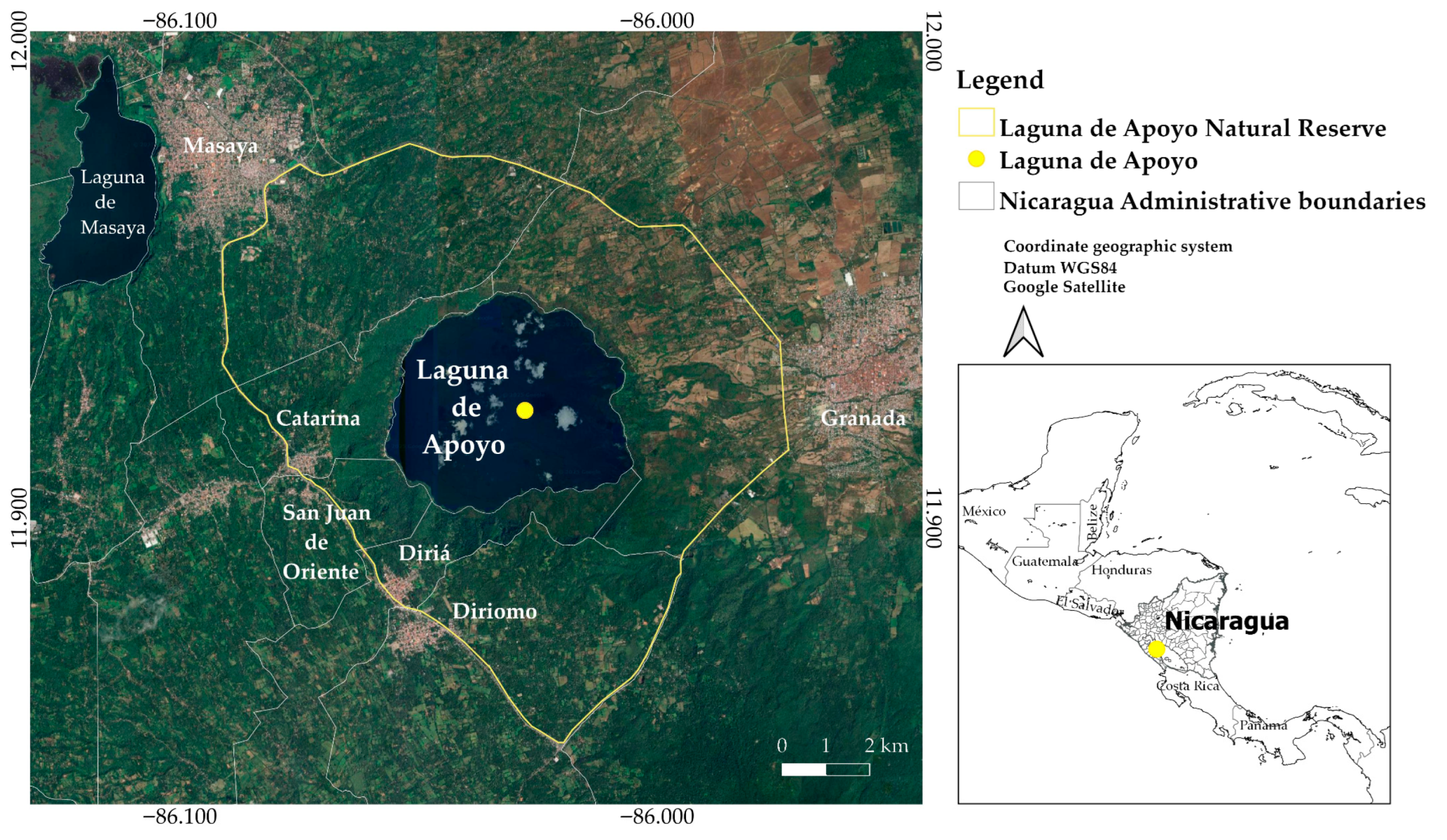
2. Materials and Methods
3. Results
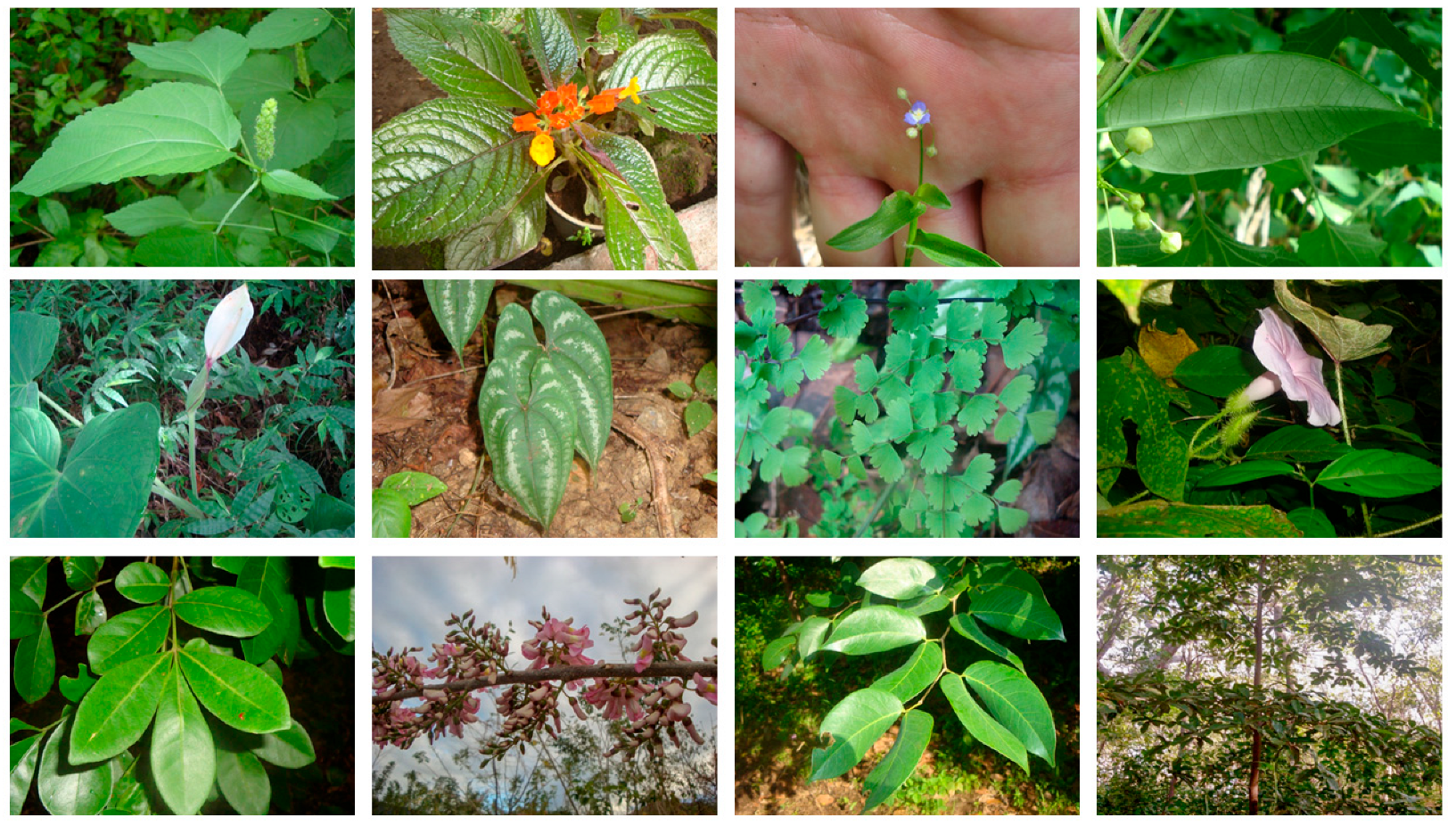
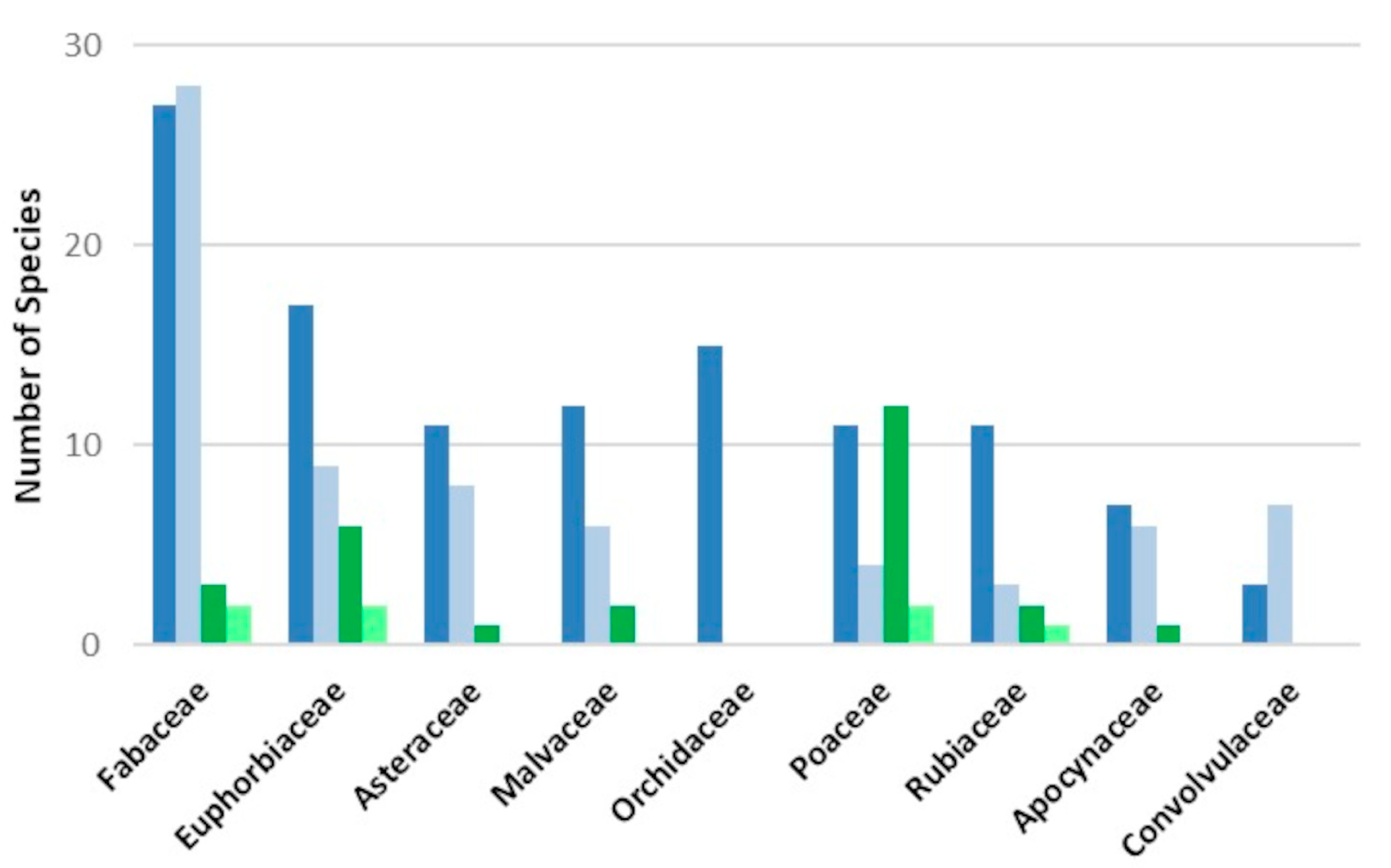
3.1. Plant Biodiversity in LANR
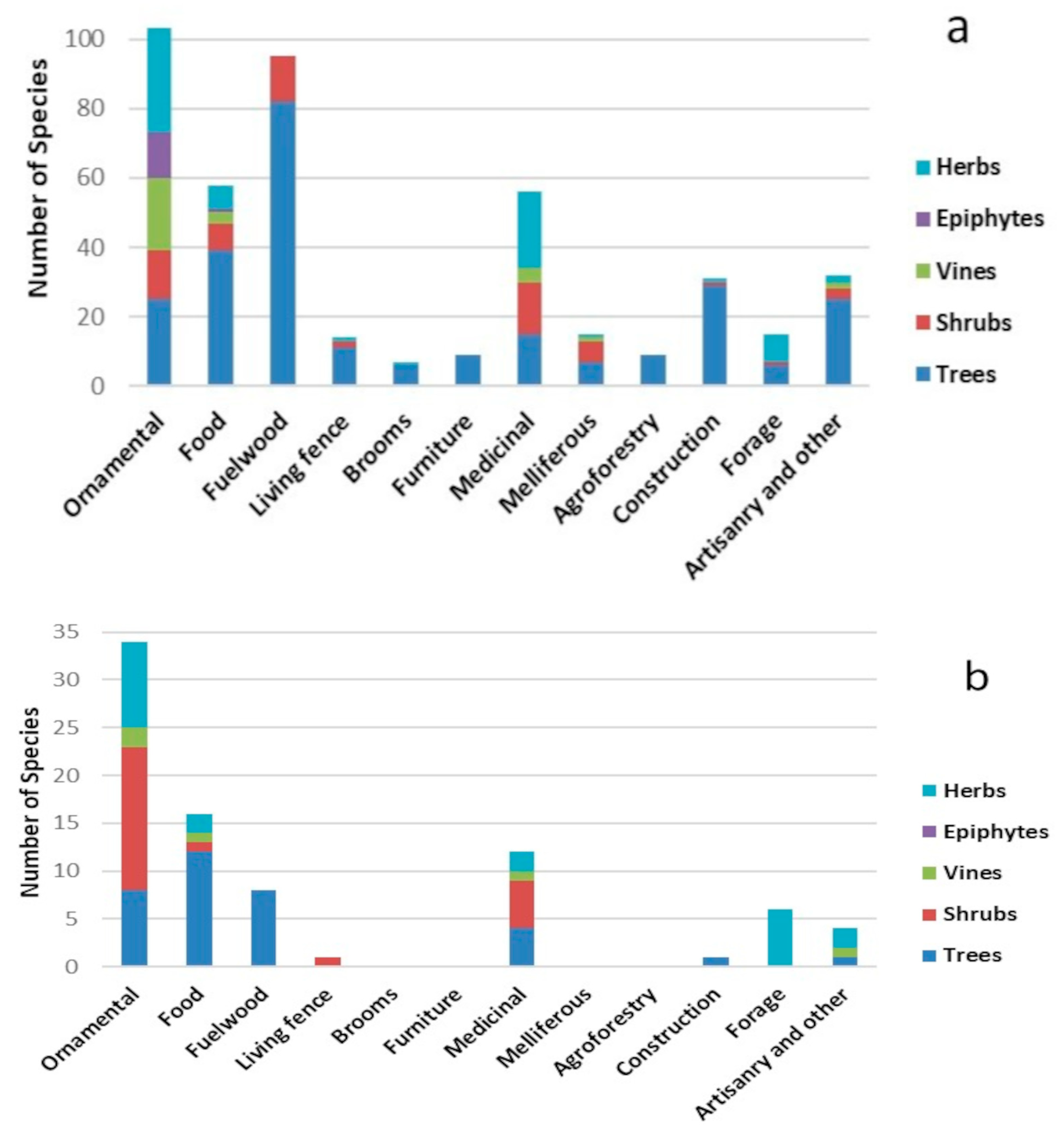
3.2. Useful Plants in LANR
4. Discussion
4.1. Native Plant Biodiversity
4.2. Introduced Species
4.3. Useful and Overexploited Plants in LANR
4.4. Plant Biodiversity Conservation
5. Conclusions
Supplementary Materials
Author Contributions
Funding
Institutional Review Board Statement
Informed Consent Statement
Data Availability Statement
Acknowledgments
Conflicts of Interest
Abbreviations
| LANR | Laguna de Apoyo Nature Reserve |
| masl | meters above sea level |
| cm | centimeters |
| km | kilometers |
| SINAP | National Protected Area System of Nicaragua |
| IUCN | International Union for Conservation of Nature |
| CITES | Convention on International Trade in Endangered Species of Wild Fauna and Flora |
References
- Falcón-Brindis, A.; León-Cortés, J.L.; Montañez-Reyna, M. How effective are conservation areas to preserve biodiversity in Mexico? Perspect. Ecol. Conserv. 2021, 19, 399–410. [Google Scholar] [CrossRef]
- González-Maya, J.F.; Víquez-R, L.R.; Belant, J.L.; Ceballos, G. Effectiveness of protected areas for representing species and populations of terrestrial mammals in Costa Rica. PLoS ONE 2015, 10, e0124480. [Google Scholar] [CrossRef]
- Contreras, A.M.; Romero, M. The trace of the trees: A historically situated geospatial assessment of deforestation in Bosawas biosphere reserve. FTL 2025, 34, 61–82. [Google Scholar] [CrossRef]
- Eklund, J.; Cabeza, M. Quality of governance and effectiveness of protected areas: Crucial concepts for conservation planning. Ann. NY Acad. Sci. 2017, 1399, 27–41. [Google Scholar] [CrossRef]
- DeClerck, F.A.; Chazdon, R.; Holl, K.D.; Milder, J.C.; Finegan, B.; Martinez-Salinas, A.; Imbach, P.; Canet, L.; Ramos, Z. Biodiversity conservation in human-modified landscapes of Mesoamerica: Past, present, and future. Biol. Cons. 2010, 143, 2301–2313. [Google Scholar] [CrossRef]
- Suzart de Albuquerque, F.; Benito, B.; Beier, P.; Assunção-Albuquerque, M.J.; Cayuela, L. Supporting underrepresented forests in Mesoamerica. N&C 2015, 13, 152–158. [Google Scholar] [CrossRef]
- Li, G.; Fang, C.; Watson, J.E.M.; Sun, S.; Qi, W.; Wang, Z.; Liu, J. Mixed effectiveness of global protected areas in resisting habitat loss. Nat. Commun. 2024, 15, 8389. [Google Scholar] [CrossRef]
- Grantham, H.S.; Duncan, A.; Evans, T.D.; Jones, K.R.; Beyer, H.L.; Schuster, R.; Walston, J.; Ray, J.C.; Robinson, J.G.; Callow, M.; et al. Anthropogenic modification of forests means only 40% of remaining forests have high ecosystem integrity. Nat. Commun. 2020, 11, 5918. [Google Scholar] [CrossRef]
- Saldivar, I.; Vammen, K. Tropical dry forests, water, biodiversity and the challenges of climate change in Nicaragua. Braz. J. Biol. 2024, 84, e280001. [Google Scholar] [CrossRef]
- MARENA. Ministry of the Environment and Natural Resources. Available online: https://www.marena.gob.ni (accessed on 5 October 2025). (In Spanish).
- Gillespie, T.W.; Nicholson, K.E.; McCrary, J. Patterns of vertebrate species richness and conservation in Nicaragua. Nat. Areas J. 2001, 21, 159–167. [Google Scholar]
- Portillo-Quintero, C.A.; Sánchez-Azofeifa, G.A. Extent and conservation of tropical dry forests in the Americas. Biol. Conserv. 2010, 143, 144–155. [Google Scholar] [CrossRef]
- Belt, T. The Naturalist in Nicaragua, 1st ed.; University Press of the Pacific: Honolulu, HI, USA, 2002; pp. 79–85. ISBN 1-4102-0011-6. [Google Scholar]
- González-Rivas, B.; Tigabu, M.; Gerhardt, K.; Castro-Marín, G.; Odén, P.C. Species composition, diversity, and local uses of tropical dry deciduous and gallery forests in Nicaragua. Biodivers. Conserv. 2006, 15, 1509–1527. [Google Scholar] [CrossRef]
- Tarrasón, D.; Urrutia, J.T.; Ravera, F.; Herrera, E.; Andrés, P.; Espelta, J.M. Conservation status of tropical dry forest remnants in Nicaragua: Do ecological indicators and social perception tally? Biodivers. Conserv. 2010, 19, 813–827. [Google Scholar] [CrossRef]
- Ravera, F.; Tarrasón, D.; Espelta, J.M. Land use change trajectories, conservation status and social importance of dry forests in Nicaragua. Environ. Conserv. 2015, 42, 1–11. [Google Scholar] [CrossRef]
- Lanuza, O.R.; Casanoves, F.; Vílchez-Mendoza, S.; Espelta, J.M.; Peñuelas, J.; Peguero, G. Structure, diversity and the conservation value of tropical dry forests in highly fragmented landscapes. J. Plant Ecol. 2023, 16, rtac046. [Google Scholar] [CrossRef]
- National Assembly. Law 217, General Law for the Environment and Natural Resources, with its reforms included. La Gaceta, 31 January 2014; pp. 786–802. (In Spanish) [Google Scholar]
- Barrios de Chamorro, V. Ministerial Decree 42-91. Declaration of protected areas in several mountains, forests, volcanoes, and lakes in the country. La Gaceta, 4 November 1991; pp. 2102–2103. (In Spanish) [Google Scholar]
- National Commission for Technical Standards and Quality. NTON 05-002 08, Technical regulations for the protection and conservation of the crater lakes. La Gaceta, 12 July 2010; pp. 3761–3766. (In Spanish) [Google Scholar]
- Hardy, N.G.; Kuebbing, S.E.; Duguid, M.C.; Ashton, M.S.; Sheban, K.C.; Inman, S.E.; Martin, M.P. Non-native invasive plants in tropical dry forests: A global review of presence, impacts, and management. Restor. Ecol. 2025, 33, e14288. [Google Scholar] [CrossRef]
- Cavalcante de Souza, A.; Prevedello, J.A. The importance of protected areas for overexploited plants: Evidence from a biodiversity hotspot. Biol. Conserv. 2020, 243, 108482. [Google Scholar] [CrossRef]
- Pulido-Chadid, K.; Virtanen, E.; Geldmann, J. How effective are protected areas for reducing threats to biodiversity? A systematic review protocol. Env. Evid. 2023, 12, 18. [Google Scholar] [CrossRef]
- McCrary, J.K.; Hammett, A.L.; Barany, M.E.; Machado, H.E.; Garcia, D.J.; Barrios, J.I. Illegal extraction of forest products in Laguna de Apoyo Nature Reserve, Nicaragua. Caribb. J. Sci. 2004, 40, 169–181. [Google Scholar]
- Kutterolf, S.; Freundt, A.; Perez, W.; Wehrmann, H.; Schmincke, H.U. Late Pleistocene to Holocene temporal succession and magnitudes of highly-explosive volcanic eruptions in west-central Nicaragua. J. Volcanol. Geoth. Res. 2007, 163, 55–82. [Google Scholar] [CrossRef]
- Ministry of the Environment and Natural Resources. Ministerial Resolution No. 001-2010. Approve the Management and Protection Plan for the Protected Area Laguna de Apoyo Nature Reserve. La Gaceta, 19 March 2010; pp. 1527–1528. (In Spanish) [Google Scholar]
- McCrary, J.K. Biodiversity and conservation of conservation priority fish species in the Nicaraguan volcanic crater lakes. Nat. Resour. Conserv. Res. 2024, 7, 5582. [Google Scholar] [CrossRef]
- McCrary, J.K.; Madsen, H.; González, L.; Luna, I.; López, L.J. Comparison of gastropod mollusk (Apogastropoda: Hydrobiidae) habitats in two crater lakes in Nicaragua. Rev. Biol. Trop. 2008, 56, 113–120. [Google Scholar] [CrossRef] [PubMed]
- López, A.; Urcuyo, J.; Vega, G. Biodiversity of the malacological fauna of Laguna de Apoyo. Encuentro 2015, 102, 8–18. (In Spanish) [Google Scholar] [CrossRef]
- van Dort, J.; McCrary, J.K. Lepidoptera of Laguna de Apoyo Nature Reserve. Rev. Nicaragüense Biodivers. A Prot. 2010, 2, 87–92. (In Spanish) [Google Scholar]
- Crockett, C.M.; Brooks, R.D.; Meacham, R.C.; Meacham, S.C.; Mills, M. Recent observations of Nicaraguan primates and a preliminary conservation assessment. Neotrop. Primates 1997, 5, 71–74. [Google Scholar] [CrossRef]
- McCrary, J.K.; Arendt, W.; Chavarría, L.; López, L.J.; Somarriba, P.A.; Boudrault, P.-O.; Cruz, A.L.; Muñoz, F.J.; Mackler, D.G. A contribution to Nicaraguan ornithology, with a focus on the pine-oak ecoregion. Cotinga 2008, 31, 89–95. [Google Scholar]
- McCrary, J.K.; Shillington, L.J.; Santana, R.; Hammett, A.L.; Riviere, J. Participation of non-timber forest products in the informal economy: A case study. Encuentro 2004, 69, 58–68. (In Spanish) [Google Scholar] [CrossRef]
- Shillington, L.J.; McCrary, J.K.; Hammett, A.L. Complex Connections: The role of non-timber forest products in urban and rural livelihoods in Nicaragua. In Proceedings of the Proceedings, Emerging Issues along Urban-Rural Interfaces: Linking Science and Society, Atlanta, GA, USA, 13–16 March 2005; Laband, C., Ed.; USDA-FS: Auburn, AL, USA, 2005; pp. 254–260. [Google Scholar]
- Mena-García, B.A.; Jirón-García, A.B. Tourism and territory: Touristic activity of the Laguna de Apoyo Nature Reserve. Rev. Geogr. Am. Cent. 2017, 2, 67–89. (In Spanish) [Google Scholar] [CrossRef][Green Version]
- Dickau, R. Paleoethnobotany of the Lake Managua Region, Nicaragua. Master’s Thesis, University of Calgary, Calgary, AB, Canada, 1999. [Google Scholar]
- Flores, M. Small landslides in Laguna de Apoyo. La Prensa, 19 October 2005; p. 6. (In Spanish) [Google Scholar]
- Meyrat, A.C.; Castañeda, G.B.; Galeano, N.A.; Reyes, S.M.; Espinales, E.; Argeñal, O.M. Spatial and temporal dynamics of coverage and land use in the Laguna de Apoyo Nature Reserve in the period 1972 to 2007. In Proceedings of the Anais XIV Simpósio Brasileiro de Sensoriamento Remoto, Natal, Brasil, 25–30 April 2009; pp. 5989–5995. (In Spanish). [Google Scholar]
- Stevens, W.D.; Ulloa, C.; Pool, A.; Montiel, O.M. (Eds.) Plants of Nicaragua; Missouri Botanical Garden Press: St. Louis, MI, USA, 2001; Volume 85, ISBN 0-915279959. (In Spanish) [Google Scholar]
- Enquist, B.J.; Sullivan, J.J. Vegetative Key and Descriptions of Tree Species of the Tropical Dry Forests of Upland Sector Santa Rosa, Area de Conservación Guanacaste, Costa Rica; University of Arizona: Tucson, AZ, USA, 2001. Available online: https://www.acguanacaste.ac.cr/paginas_especie/plantae_online/EnquistSullivanTreeKey.pdf (accessed on 24 August 2025).
- Plants of Nicaragua. Copyright Missouri Botanical Garden. Available online: https://legacy.tropicos.org/Project/FN (accessed on 5 October 2025).
- Grijalva Pineda, A. Useful Plants: Ethnobotany of Nicaragua, 1st ed.; MARENA: Managua, Nicaragua, 2005. [Google Scholar]
- Pérez Torres, F. Manual of Most Common Medicinal Plants in Western Nicaragua. Master’s Thesis, UNAN-León, León, Nicaragua, 2007. [Google Scholar]
- Gillespie, T.W.; Grijalva, A.; Farris, C.N. Diversity, composition, and structure of tropical dry forests in Central America. Plant Ecol. 2000, 147, 37–47. [Google Scholar] [CrossRef]
- Castro Marín, G.; Tigabu, M.; González-Rivas, B.; Odén, P.C. A chronosequence analysis of forest recovery on abandoned agricultural fields in Nicaragua. J. For. Res. 2009, 20, 213–222. [Google Scholar] [CrossRef]
- Rueda, R.M.; Coronado, I.; Holt, S. Flora of Reserva Natura; FUNDENIC SOS/FONDO NATURA: Managua, Nicaragua, 2012; 330p. [Google Scholar]
- Barstow, M.; Linares, J. Dalbergia retusa. RLTS 2020, e.T32957A67799410. Available online: https://www.iucnredlist.org/species/32957/67799410 (accessed on 24 August 2025).
- CITES. Appendices I, II, and III valid from February 2025. Available online: https://cites.org/eng/app/appendices.php (accessed on 24 August 2025).
- Barstow, M. Swietenia humilis. RLTS 2019, e.T32954A68104636. Available online: https://www.iucnredlist.org/species/32954/68104636 (accessed on 24 August 2025).
- Ministry of the Environment and Natural Resources. Updating the closed season system for the year 2025. Ministerial Resolution 009-2025. La Gaceta, 21 February 2025; pp. 1509–1519. [Google Scholar]
- Mark, J.; Rivers, M.C. Cedrela odorata. RLTS 2017, e.T32292A68080590. Available online: http://legislacion.asamblea.gob.ni/gacetas/2025/2/g35.pdf (accessed on 24 August 2025).
- World Conservation Monitoring Centre. Sideroxylon capiri subsp. capiri. RLTS 1998, e.T36041A9977046. [Google Scholar] [CrossRef]
- García-Mendoza, A.J.; Puente, R.; Véliz, M. Yucca guatemalensis. RLTS 2020, e.T110686444A110686453. [Google Scholar] [CrossRef]
- Contreras, A. Carica papaya. RLTS 2016, e.T20681422A20694916. [Google Scholar] [CrossRef]
- Santana, R.; Montagnini, F.; Louman, B.; Villalobos Soto, R.; Gómez, M. La industria de artesanías de Masaya y Masatepe, Nicaragua: Demanda por materia prima de bosques tropicales. Recur. Nat. Ambiente 2004, 42, 77–85. [Google Scholar]
- Olmos-Martínez, E.; Romero-Schmidt, H.L.; Blázquez, M.D.C.; Arias-González, C.; Ortega-Rubio, A. Human communities in protected natural areas and biodiversity conservation. Diversity 2022, 14, 441. [Google Scholar] [CrossRef]
- Ximenes Mota, J.A.; Ferreira Lemos, H.Á.; Nepomuceno Ferreira, W.; Menezes Silva, M.A. Allelopathic effect of Azadirachta indica fresh leaves on the germination of native plants in the Seasonally Dry Tropical Forest. Sci. Plena. 2020, 16, 124202. [Google Scholar] [CrossRef]
- Meli, P.; Dirzo, R. Effects of grasses on sapling establishment and the role of transplanted saplings on the light environment of pastures: Implications for tropical forest restoration. Appl. Veg. Sci. 2013, 16, 296–304. [Google Scholar] [CrossRef]
- Wolfe, B.T.; Van Bloem, S.J. Subtropical dry forest regeneration in grass-invaded areas of Puerto Rico: Understanding why Leucaena leucocephala dominates and native species fail. For. Ecol. Manag. 2012, 267, 253–261. [Google Scholar] [CrossRef]
- Gazo Robles, J.M. Popular medicine and its traditional agents: Traditional healers, midwives, and shamans in urban zones (Spanish). Raíces 2017, 1, 49–63. [Google Scholar] [CrossRef]
- Coe, F.G. Medicinal Flora of the Atlantic Region of Nicaragua. Wani 2018, 74, 27–40. (In Spanish) [Google Scholar] [CrossRef]
- Dávila Bolaños, A. Pre-colombian Indigenous medicine of Nicaragua. La Univ. 1975, 12–39. (In Spanish) [Google Scholar]
- Vellak, A.; Tuvi, E.L.; Reier, U.; Kalamees, R.; Roosaluste, E.; Zobel, M.; Pärtel, M. Past and present effectiveness of protected areas for conservation of naturally and anthropogenically rare plant species. Conserv. Biol. 2009, 23, 750–757. [Google Scholar] [CrossRef] [PubMed]
- McCrary, J.K. (UNAN-Managua, Managua, Nicaragua). Personal communication, 2025.
- Hinsley, A.; De Boer, H.J.; Fay, M.F.; Gale, S.W.; Gardiner, L.M.; Gunasekara, R.S.; Kumar, P.; Masters, S.; Metusala, D.; Roberts, D.L.; et al. A review of the trade in orchids and its implications for conservation. Bot. J. Linn. Soc. 2018, 186, 435–455. [Google Scholar] [CrossRef]
- Danielsen, F.; Balete, D.S.; Poulsen, M.K.; Enghoff, M.; Nozawa, C.M.; Jensen, A.E. A simple system for monitoring biodiversity in protected areas of a developing country. Biodivers. Conserv. 2000, 9, 1671–1705. [Google Scholar] [CrossRef]



| Family | Species | Conservation Status |
|---|---|---|
| Acanthaceae | Justicia rothschuhii (Lindau) Durkee | NT |
| Acanthaceae | Pseuderanthemum alatum (Nees) Radlk. ex Lindau | VU/NT |
| Agavaceae | Agave angustifolia Haw. | NT |
| Amaryllidaceae | Zephyranthes lindleyana Herb. | NT |
| Annonaceae | Sapranthus palanga R.E. Fr. | NT |
| Apocynaceae | Lacmellea panamensis (Woodson) Markgr. | NT |
| Apocynaceae | Metastelma schlechtendalii Decne. | NT |
| Araceae | Xanthosoma mexicanum Liebm. | NT |
| Arecaceae | Acrocomia aculeata (Jacq.) Lodd. ex Mart. | NT |
| Arecaceae | Attalea butyracea (Mutis ex L. f.) Wess. Boer | NT |
| Asparagaceae | Yucca guatemalensis Baker | NT |
| Asteraceae | Vernonia patens Kunth | VU/NT |
| Cactaceae | Hylocereus costaricensis (F.A.C. Weber) Britton & Rose | VU |
| Commelinaceae | Dichorisandra hexandra (Aubl.) C.B. Clarke | NT |
| Convolvulaceae | Ipomoea setosa Ker Gawl. | NT |
| Dioscoreaceae | Dioscorea floribunda M. Martens & Galeotti | NT |
| Euphorbiaceae | Acalypha pseudalopecuroides Pax & K. Hoffm. | NT |
| Euphorbiaceae | Euphorbia cotinifolia L. | NT |
| Euphorbiaceae | Euphorbia leucocephala Lotsy | EN/VU |
| Euphorbiaceae | Euphorbia prostrata Aiton | NT |
| Fabaceae | Mimosa arenosa (Willd.) Poir. | NT |
| Fabaceae | Mucuna sloanei Fawc. & Rendle | NT |
| Fabaceae | Vachellia hindsii (Benth.) Seigler & Ebinger | NT |
| Gesneriaceae | Chrysothemis pulchella (Donn ex Sims) Decne | NT |
| Lecythidaceae | Couroupita nicaraguarensis DC. | NT |
| Meliaceae | Guarea glabra Vahl | NT |
| Myrtaceae | Psidium friedrichsthalianum (O.Berg.) Nied. | NT |
| Nyctaginaceae | Boerhavia diffusa L. | NT |
| Orchidaceae | Catasetum integerrimum Hook. | NT |
| Orchidaceae | Catasetum maculatum Kunth | NT |
| Orchidaceae | Encyclia cordigera (Kunth) Dressler | NT |
| Orchidaceae | Trichocentrum cebolleta (Jacq.) M.W. Chase & N.H. Williams | NT |
| Poaceae | Acroceras zizanioides (Kunth) Dandy | NT |
| Poaceae | Gynerium sagittatum (Aubl.) P. Beauv. | NT |
| Polygonaceae | Podopterus mexicanus Bonpl. | NT |
| Pteridaceae | Adiantum deflectens Mart. | NT |
| Rutaceae | Casimiroa dura A. Pool & Coronado | NT |
| Sapindaceae | Cardiospermum halicacabum L. | NT |
| Sapindaceae | Cupania dentata DC. | NT |
| Sapotaceae | Pouteria sapota (Jacq.) H. E. Moore & Stearn | NT |
| Sapotaceae | Sideroxylon capiri ssp. capiri (Pittier) T.D. Penn. | NT |
Disclaimer/Publisher’s Note: The statements, opinions and data contained in all publications are solely those of the individual author(s) and contributor(s) and not of MDPI and/or the editor(s). MDPI and/or the editor(s) disclaim responsibility for any injury to people or property resulting from any ideas, methods, instructions or products referred to in the content. |
© 2025 by the authors. Licensee MDPI, Basel, Switzerland. This article is an open access article distributed under the terms and conditions of the Creative Commons Attribution (CC BY) license (https://creativecommons.org/licenses/by/4.0/).
Share and Cite
McCrary, J.K.; Meyrat, A.K.; Rueda, R.M.; Calvo-Irabien, L.M. Plant Diversity in a Volcanic Crater Interior: Laguna De Apoyo Nature Reserve, Nicaragua. Conservation 2025, 5, 83. https://doi.org/10.3390/conservation5040083
McCrary JK, Meyrat AK, Rueda RM, Calvo-Irabien LM. Plant Diversity in a Volcanic Crater Interior: Laguna De Apoyo Nature Reserve, Nicaragua. Conservation. 2025; 5(4):83. https://doi.org/10.3390/conservation5040083
Chicago/Turabian StyleMcCrary, Jeffrey K., Alain Kheim Meyrat, Ricardo M. Rueda, and Luz Maria Calvo-Irabien. 2025. "Plant Diversity in a Volcanic Crater Interior: Laguna De Apoyo Nature Reserve, Nicaragua" Conservation 5, no. 4: 83. https://doi.org/10.3390/conservation5040083
APA StyleMcCrary, J. K., Meyrat, A. K., Rueda, R. M., & Calvo-Irabien, L. M. (2025). Plant Diversity in a Volcanic Crater Interior: Laguna De Apoyo Nature Reserve, Nicaragua. Conservation, 5(4), 83. https://doi.org/10.3390/conservation5040083