1. Introduction
Several studies have highlighted the potential of virtual, augmented and mixed reality to create new ways of enjoying tourism, support destination marketing and promote memorable experiences (
S. Li & Jiang, 2023;
Pestek & Sarvan, 2021;
Talwar et al., 2022), while recent reviews on customer/tourist experience emphasise the need to understand the tourist experience as a multidimensional phenomenon, co-created and strongly dependent on interpretative and cultural processes (
Câmara et al., 2023;
Ortiz et al., 2024;
Rusu et al., 2023). At the same time, other studies show that immersive technologies can contribute to sustainability, accessibility, and the decentralisation of tourist flows, particularly in sensitive cultural and natural heritage sites (
Bec et al., 2021;
Gonçalves et al., 2022;
Suanpang et al., 2022).
Tourists are increasingly seeking Mixed Reality (MR) experiences, and because this is a recent trend, there are still many opportunities to create value with these technologies to meet new customer needs (
Bec et al., 2021). This virtual presence can help address issues related to destination capacity, accessibility, and destination conservation (
Buhalis et al., 2019). Thus, virtual tours are potential tools for increasing tourism offerings and attracting more visitors to cultural destinations (
Pantano & Corvello, 2014). The creation of a virtual world or the metaverse itself can help tourists to visit various tourist destinations of different types, such as natural attractions and museums that they would like to visit but are unable to do so in person (
Suanpang et al., 2022).
By understanding the needs of its target audience and applying innovative techniques and ideas, the tourism industry can benefit as a whole and, above all, can deliver a more satisfying experience for visitors and a more profitable one for businesses (
Kim et al., 2020).
Baglieri and Consoli (
2009) put forward the idea that tourism businesses can increase their competitive advantage and innovation in their products by creating virtual communities where the sharing of knowledge, interests and needs of their customers can be matched. For the use of MR in tourism to continue to gain ground, marketing teams must be able to meet customer needs by creating a unique service that adds value for visitors, so that they are inclined to return and recommend the service to others (
Huang et al., 2016).
While it is important for the business world to learn more about the profitability of MR and its contribution to the tourist experience, from an academic perspective,
Bec et al. (
2021) point out that there are gaps that can be addressed in new research, with a view to expanding the academic dialogue on the applications of virtual tourism and mixed realities as a viable solution for tourist destinations.
Thus, this study aims to contribute to the theory and practice of the use of mixed realities in tourism, focusing on two main aspects. At the theoretical level, it is expected to deepen comprehension of the impact of innovations such as mixed realities, which include virtual reality and augmented reality, on the tourism sector, identifying the components that promote their adoption by visitors/potential visitors and highlighting the role of new technologies in innovation and the creation of unique experiences for visitors. On a practical level, the results of this study will provide insights for tourism managers and professionals on how to apply mixed realities to attract visitors and promote innovation and sustainability in destinations. Mixed realities can reduce pressure on natural and cultural resources by offering alternative and complementary digital experiences. In addition, the study may guide investments aimed at integrating innovative technologies into tourism, strengthening the competitiveness of destinations.
3. Development of Hypotheses and Conceptual Framework
Building on the synthesis in
Section 2.4, the present study conceptualises mixed reality (MR)—including AR/VR-based applications—as an interpretive interface in tourism, whose value depends not only on the technological layer but also on the informational and meaning-making layer provided to visitors. In this view, MR contributes to visitor outcomes when it delivers destination information in a way that is cognitively accessible and practically useful, and when tourists perceive MR as a relevant innovation aligned with contemporary tourism priorities.
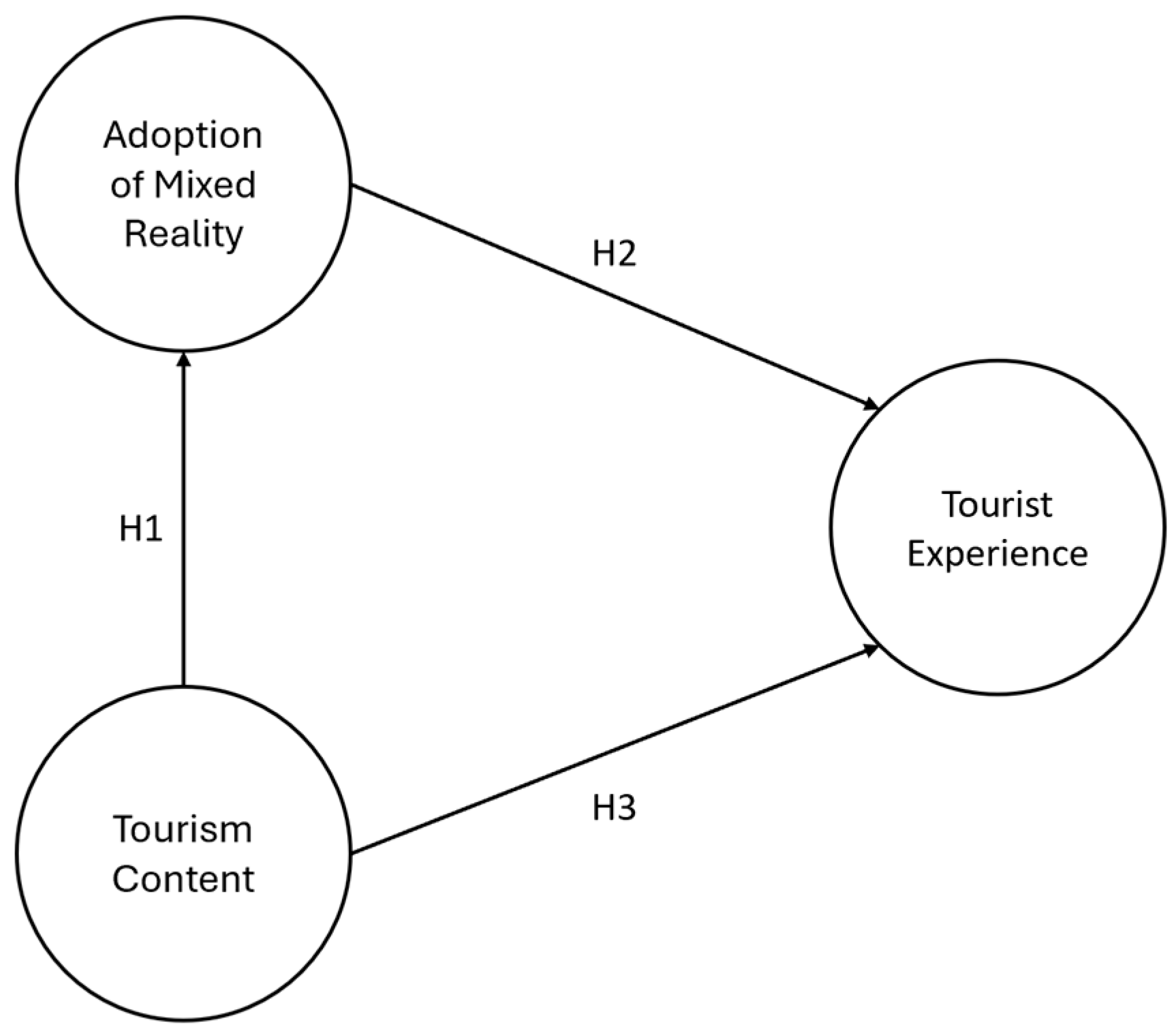
Accordingly, our conceptual framework connects three constructs that are operationalised through tourism-specific validated measures. Tourism Content (TC) reflects tourists’ perceptions that MR presents relevant and clear content about tourist destinations (
Jung et al., 2015). Also, Adoption of Mixed Reality (AMR) reflects the degree to which tourists perceive MR as an essential innovation for tourism and as a technology that promotes tourism sustainability (
Talwar et al., 2022). Finally, Tourist Experience (TE) captures the hedonic experiential value associated with MR in tourism—namely whether MR can be enjoyable, rewarding, and fun (
Kim et al., 2020).
From a theoretical standpoint, we argue that content quality is a foundational antecedent that can (a) increase favourable adoption evaluations and (b) directly enhance experience by improving interpretability and engagement. Moreover, adoption is theorised as a complementary mechanism that can further amplify experiential outcomes by fostering openness to, and engagement with, MR interactions. This logic is also consistent with the model’s intent to assess both direct and indirect (mediated) pathways linking content and experience.
We acknowledge the multidimensional nature of adoption and experience; however, our measures deliberately capture the specific facets most aligned with the present research purpose, and conclusions should be interpreted accordingly.
3.1. Tourism Content and Adoption of Mixed Reality
In MR-based tourism contexts, the content layer is a primary driver of whether users perceive the technology as meaningful rather than merely novel. When MR presents destination content that is perceived as relevant (i.e., aligned with what tourists seek to know and do) and clear (i.e., easy to process and interpret), it reduces uncertainty and cognitive friction, increases perceived value, and supports the belief that MR constitutes a useful and legitimate innovation for tourism. In addition, clearer and more relevant content facilitates the perception that MR can contribute to broader destination goals—such as sustainability—by enabling alternative or complementary ways of accessing and consuming tourism experiences. In this sense, higher perceived content quality should translate into stronger endorsement of MR as an essential innovation and as a sustainability-supporting tool (
Talwar et al., 2022). Therefore, considering the above, the following hypothesis is formulated:
H1: Tourism content influences the adoption of mixed reality by tourists.
3.2. Adoption of Mixed Reality and Tourist Experience
Tourist experience is frequently described as multidimensional; however, in MR contexts, a key proximal outcome is the hedonic and affective value generated through interaction. In this study, experiential value is captured through the perception that MR tourism experiences can be enjoyable, rewarding, and fun (
Kim et al., 2020).
A favourable adoption evaluation (i.e., viewing MR as an essential innovation and as supportive of sustainable tourism) is expected to shape experience because it increases willingness to engage with MR, legitimises the interaction as worthwhile, and encourages deeper attention to the MR layer as part of the visit. Thus, tourists who express stronger adoption evaluations of MR should report stronger positive experiential outcomes. Based on the above, the following hypothesis is formulated:
H2: The adoption of mixed reality by tourists enhances the tourist experience.
3.3. Tourism Content and Tourist Experience
Beyond adoption, tourism content is expected to exert a direct effect on experience because experience is partly constructed through interpretation and engagement with destination information and narratives. When MR presents content that is perceived as clear and relevant (
Jung et al., 2015), tourists are more likely to feel oriented, to make sense of what they are seeing, and to connect the digital layer to the destination context. This meaning-making process can enhance hedonic experiential evaluations (enjoyable, rewarding, fun), even when controlling for adoption. Therefore, we expect tourism content to contribute directly to tourist experience. Thus, the following hypothesis is formulated:
H3: Tourism content contributes to the tourist experience.
3.4. Conceptual Model and Expected Mechanism
Based on these hypotheses, the conceptual model links Tourism Content to Adoption of Mixed Reality and Tourist Experience, and links Adoption of Mixed Reality to Tourist Experience. The conceptual model (
Figure 1) explicitly allows Tourism Content to influence Tourist Experience both directly and indirectly through adoption—consistent with the theoretical premise that adoption operates as a complementary (partial) mechanism through which content quality translates into experiential value.
4. Materials and Methods
4.1. Nature of the Study and Methodological Approach
This study falls within the quantitative research paradigm, adopting a positivist approach that aims to define causes and effects between variables and test previously formulated hypotheses. The research focuses on understanding the factors that influence the use of mixed reality technologies in the context of the tourism sector, seeking to contribute to the existing body of knowledge through the empirical validation of a structured theoretical model.
In terms of its purpose, this study is characterised as descriptive explanatory. The descriptive component allows the profile of users to be characterised, while the explanatory dimension enables the analysis of causal relationships between theoretical constructs, allowing the determinants of the behaviour of use of this emerging technology to be identified.
From a temporal point of view, the research is cross-sectional, as the data were collected at a single point in time, providing a snapshot of the participants’ perceptions and behaviours regarding the use of mixed reality in tourism contexts.
The methodological strategy adopted is based on the collection of primary data through a structured online questionnaire, developed specifically to operationalise the theoretical constructs underlying the research model. This methodological choice is justified by the need to achieve a representative and geographically dispersed sample, maximising efficiency in data collection and allowing for a higher response rate.
For data processing and analysis, we used a structural equation modelling approach, supported by PLS-SEM (Partial Least Squares Structural Equation Modelling. There are several reasons for choosing this methodological technique. Firstly, PLS-SEM is particularly suitable for exploratory and confirmatory research, allowing complex models that include multiple relationships between latent variables to be tested. Secondly, this technique is robust in the face of less restrictive assumptions regarding data distribution, as it does not require multivariate normality. Additionally, PLS-SEM allows effective work with moderate-sized samples and offers high flexibility in modelling reflective and formative constructs.
For data processing and analysis, we employed structural equation modelling (SEM) using the variance-based Partial Least Squares approach (PLS-SEM). SEM is suitable for research that examines multiple latent constructs and their simultaneous relationships, because it enables the joint assessment of measurement properties and hypothesised structural paths within a single model (
Hair et al., 2022). We selected PLS-SEM because the present research is explanatory–predictive and focuses on explaining key determinants of mixed reality usage in an emerging context, where maximising explained variance and predictive relevance is particularly important (
Hair et al., 2019). Moreover, PLS-SEM is appropriate for models with several constructs and paths, performs well under less restrictive distributional assumptions, and can be implemented robustly through nonparametric bootstrapping for significance testing (
Hair et al., 2022). Compared with covariance-based SEM, which is typically preferred for strict theory confirmation and global model fit assessment, PLS-SEM offers greater flexibility for prediction-oriented research and for modelling both reflective and formative specifications (
Hair et al., 2019).
The analysis using PLS-SEM is carried out in two fundamental stages: (i) the evaluation of the measurement model, which allows the reliability and validity of the constructs to be verified; and (ii) the evaluation of the structural model, which makes it possible to test the hypotheses formulated and analyse the causal relationships between the latent variables. This analytical procedure ensures the scientific rigour necessary for the empirical validation of the proposed theoretical model and the formulation of well-founded conclusions on the use of mixed reality in the tourism sector.
4.2. Sampling and Data Collection
Non-probability sampling was used for convenience, targeting individuals with actual or potential contact with MR applications in tourism contexts (visitors, residents, professionals and/or students with MR previous experience).
The data collection tool was designed after reviewing the scientific literature presented, integrating validated scales adapted to the specific context of mixed reality in tourism. The measurement items presented in
Table 1 were adopted from the three sources mentioned, ensuring that we benefit from their established validity and reliability. This approach follows best practices in scale development and application, where existing validated scales should be used when available rather than creating new, untested measures (
Straub et al., 2004).
TC was operationalized using
Jung et al.’s (
2015) validated scale, which specifically evaluates content quality in augmented reality tourism applications. Jung et al. developed and tested their measurement items in actual tourism settings across multiple destinations, demonstrating high reliability (Cronbach’s α > 0.85) and construct validity. Their scale captures both relevance and clarity dimensions, which are essential for assessing how effectively mixed reality presents destination information to tourists. This scale has been subsequently adopted and validated by other researchers, including
tom Dieck and Jung (
2018) in their study of mobile augmented reality acceptance in urban heritage tourism, and
Cranmer et al. (
2020) in their exploration of augmented reality value for tourism. The specificity of Jung et al.’s items to tourism content, rather than generic information quality, made this scale particularly appropriate for our research context.
AMR was measured using
Talwar et al.’s (
2022) recent validated scale addressing innovation adoption and sustainability in tourism technology contexts.
Talwar et al.’s (
2022) work extends beyond basic technology adoption to include contemporary concerns about sustainable tourism development, making it highly relevant to current tourism industry challenges. Their scale captures both the perceived essentiality of mixed reality as an innovation and its role in promoting sustainable tourism practices. This dual focus aligns with the evolving priorities in tourism research, where technological innovation must be evaluated not only for its novelty but also for its contribution to sustainable development goals. The scale has been validated in emerging market contexts, demonstrating its cross-cultural applicability. Supporting research by
Yung and Khoo-Lattimore (
2019) and
Han et al. (
2019) has reinforced the importance of these dimensions in understanding mixed reality adoption in tourism.
TE was operationalized through
Kim et al.’s (
2020) comprehensive scale capturing hedonic aspects of technology-mediated tourism experiences.
Kim et al. (
2020) developed a three-dimensional approach (enjoyable, rewarding, fun) that specifically addresses the experiential nature of mixed reality applications. Their scale has been validated across multiple tourism contexts, including cultural heritage sites, natural attractions, and urban destinations. The hedonic focus of this scale is particularly appropriate for mixed reality applications, which aim to enhance tourist experiences through immersive and engaging content. This approach aligns with broader research on experiential tourism (
Cranmer et al., 2020;
tom Dieck & Jung, 2018), while maintaining specific relevance to technology-mediated experiences.
While our review identified numerous other relevant studies—including research on presence and immersion (
Tussyadiah et al., 2018), user interface design (
Olsson et al., 2013), and destination image formation (
Huang et al., 2016)—the three primary references were selected because they provide validated, tourism-specific measurement scales that directly operationalize our constructs. Other studies, while theoretically relevant, either lacked validated measurement instruments, addressed different technological contexts (e.g., purely virtual environments rather than mixed reality), or focused on outcomes beyond the scope of our research model.
The questionnaire includes items measured using Likert scales, allowing the perceptions, attitudes and behavioural intentions of respondents to be captured in a standardised and quantifiable manner. Following
Rossiter’s (
2002) critique of the “practice of adding attempted synonyms that actually decrease the content validity of the measure” (p. 331), we avoided expanding the questionnaire with multiple highly similar items that may not meaningfully increase construct domain coverage. At the same time, we acknowledge that technology adoption and tourist experience are inherently multidimensional constructs, as also emphasised in the tourism experience literature.
Therefore, our measurement strategy is intentionally parsimonious but facet-specific, aligning each construct with the particular dimension most central to the present research purpose and the selected validated sources. In practical terms, Adoption of Mixed Reality captures an evaluative endorsement of MR as (i) an essential innovation for tourism and (ii) a sustainability-supporting tool (AMR1–AMR2), while Tourist Experience captures hedonic experiential value (enjoyable, rewarding, fun; TE1–TE3).
This approach helps to limit redundancy and mitigate respondent fatigue—an important consideration in online survey research—while preserving content relevance and theoretical alignment. Nevertheless, this operationalisation also implies that our conclusions should be interpreted as pertaining to these specific facets rather than the full conceptual domains of adoption and experience. Future research should replicate and extend the present findings using more comprehensive, multidimensional scales (e.g., separating utilitarian, social, affective, and behavioural components) to strengthen construct validation and examine the robustness and boundary conditions of the observed relationships.
The survey was conducted within a limited period, with informed consent and explicit eligibility criteria (legal age, understanding of the language, contact with MR).
6. Discussion
The results obtained contribute to the emerging literature on the application of MR technologies in tourism, providing empirical evidence that supports the theoretical propositions of authors such as
Buhalis and Karatay (
2022),
Bec et al. (
2021) and
Kim et al. (
2020). From a practical point of view, the results offer clear guidance to tourism destination managers on the importance of integrated investments in quality content and facilitating technological adoption, with the potential to simultaneously promote innovation, sustainability and competitiveness of destinations.
The validation of the conceptual model confirms that the perception of clear, relevant and informationally rich content is the main driver of user adoption of these technologies. In theoretical terms, this evidence is consistent with classical frameworks on MR as a continuum between real and virtual environments (
Milgram & Kishino, 1994;
Tori et al., 2006) and with approaches that emphasise that technology alone is insufficient to generate value without a layer of meaning anchored in content. Studies such as those by
Jung et al. (
2015),
Huang et al. (
2016) and
Pantano and Corvello (
2014) had already shown, in AR/VR contexts, that perceived usefulness, gratification and recommendation strongly depend on the quality and relevance of the information and narrative provided. The results now obtained reinforce this conclusion by quantifying that content is a much more important antecedent than any other variable in the MR adoption process.
This central role of content is consistent with the literature discussing collaborative innovation and the design of digital services in tourism.
Baglieri and Consoli (
2009) highlight the importance of virtual communities in the co-creation of value and knowledge;
Mendonça et al. (
2021) show how collaborative platforms can leverage the creation and integration of VR content in the tourism sector;
Chen and Chen (
2024) demonstrate that computer-assisted design of cultural tourism products, when service-oriented, requires a strong content design component; and
Gatelier et al. (
2022) propose a methodology for innovating business models for digital interpretation experiences in heritage attractions. The present study converges with these perspectives by indicating that the adoption of MR depends, to a large extent, on content curation and design processes, rather than on a purely technological logic, bringing the discussion closer to the dynamics of collaborative innovation and user-centred experience design.
Regarding the relationship between the adoption of MR and the tourist experience, the results show a positive and statistically significant effect, with a small to moderate magnitude, suggesting that MR contributes to the experience being perceived as more enjoyable, fun, and rewarding, but is only one of the factors that shape it. This finding is consistent with the literature that associates immersive technologies with the creation of memorable and hedonic experiences (
Jorge et al., 2023;
Kim et al., 2020;
S. Li & Jiang, 2023;
Sanchez Ruiz et al., 2020), as well as with the synthesis by
J. Li et al. (
2023), which identifies interactivity, immersion, and engagement as central dimensions of the experience in museum and digital heritage contexts. However, the moderate magnitude of the effect contrasts with some studies in controlled VR environments–such as
Kim et al. (
2020) or
Jorge et al. (
2023)–where the impact of technology on the experience tends to be more pronounced, probably because technology is at the core of the experience itself. In the present case, MR appears as a complement to the visit or contact with the destination, which helps to explain a positive contribution, but one shared with other determinants already identified in the literature on tourist experience, namely environmental, social and cultural factors (
Câmara et al., 2023;
Godovykh & Tasci, 2020;
Ortiz et al., 2024;
Rusu et al., 2023).
From an analytical standpoint, our findings both overlap with and extend earlier research in at least three ways. First, the prominence of content quality as the strongest driver of MR adoption converges with prior evidence in AR/VR contexts showing that perceived usefulness, gratification and recommendation are strongly contingent on the relevance and clarity of the informational/narrative layer (e.g.,
Jung et al., 2015;
Huang et al., 2016;
Pantano & Corvello, 2014). However, our results extend this line of work by demonstrating—within a unified model—that content operates as a “core antecedent” not only of adoption but also of the experience itself, suggesting that content design is not merely an enabling condition of technology acceptance but a primary source of experiential value in cultural tourism settings.
Second, the positive but small-to-moderate effect of MR adoption on tourist experience refines the dominant narrative that immersive technologies consistently produce strong experiential gains. Studies conducted in more controlled or technology-centred environments frequently report larger effects because the immersive system constitutes the main experience stimulus (
Kim et al., 2020;
Jorge et al., 2023). In contrast, our results suggest that, when MR is positioned as a complement to a destination visit (rather than the visit itself), its contribution becomes incremental and contingent on how well it integrates with other experience determinants such as place atmosphere, social interaction and cultural meaning (
Câmara et al., 2023;
Godovykh & Tasci, 2020;
Ortiz et al., 2024;
Rusu et al., 2023). This divergence is theoretically important because it supports a “complementarity” view of immersive technologies in cultural destinations and cautions against assuming uniformly large experiential effects across contexts.
Third, the partial mediation found in our model helps reconcile two streams of research that are often treated separately: technology acceptance/usage on the one hand, and meaningful experience formation on the other. The coexistence of a significant direct effect (Content → Experience) and an indirect effect via MR adoption indicates that MR functions primarily as an amplifier of interpretative value rather than as a substitute for interpretative mediation. This extends prior conceptual arguments that immersive technologies generate value only when anchored in meaningful narratives and visitor-centred interpretation (
Buhalis & Karatay, 2022;
Dueholm & Smed, 2014), by providing empirical support for a dual pathway linking content, adoption and experience in the same explanatory structure.
Theoretically, our results are consistent with the idea that mixed reality enhances tourist experience through a combination of psychological and experiential mechanisms. A first mechanism is heightened engagement through interactivity: MR enables visitors to actively explore content, manipulate viewpoints, and access information on demand, which can increase involvement and perceived personal relevance (
J. Li et al., 2023;
Siddiqui et al., 2022). A second mechanism concerns perceived immersion/presence: by blending digital overlays with physical settings (or by enabling vivid reconstructions), MR can intensify the sense of “being there” and thereby increase enjoyment and hedonic value—an effect repeatedly linked to memorable experiences in immersive tourism research (
Kim et al., 2020;
S. Li & Jiang, 2023). A third mechanism is interpretative fluency: informationally rich and well-structured content can reduce uncertainty and cognitive effort during the visit, supporting learning and meaning-making; MR then extends this fluency by offering multimodal cues (visual, spatial, interactive) that make complex heritage information easier to grasp and more emotionally resonant. Importantly, these mechanisms also help explain why MR effects are not necessarily large in cultural destinations: if MR introduces friction (e.g., usability barriers) or cognitive overload, experiential gains may plateau, reinforcing the need for careful experience design and content curation.
Overall, these mechanisms clarify how MR can deepen experience without replacing the foundational role of interpretative storytelling. In line with the authenticity debate, MR appears most beneficial when it strengthens subjective authenticity by supporting coherent narratives and respectful mediation of heritage meanings, rather than when it operates as a standalone technological spectacle (
Buhalis & Karatay, 2022;
Dueholm & Smed, 2014).
A particularly relevant contribution of this study lies in identifying the dual role of tourism content: on the one hand, as a direct determinant of the experience, and on the other, as a precursor to the adoption of MR, which in turn influences the experience. The direct effect of content on the experience, similar in magnitude to that of the adoption of MR, shows that the way information is structured, clarified and narrated impacts the overall evaluation of the visit, even when technology is used little or not at all. This evidence is in line with the body of literature on meaningful experiences and meaning construction in tourism, which emphasises the role of narratives and interpretive devices in attributing meaning, emotional connection to place, and memorability (
Câmara et al., 2023;
Dueholm & Smed, 2014;
Gonçalves et al., 2022). At the same time, the significant indirect effect–translated into partial mediation–reinforces that better quality content enhances the adoption of MR, which amplifies the experience by providing more immersive, interactive, and personalised ways of accessing that same information, which converges with the conclusions of
Siddiqui et al. (
2022),
Kuching (
2023) and
Kadagidze and Ugrelidze (
2023) on the role of AR/VR/MR technologies in intensifying visitor immersion and participation
This partial mediation also complements the debate on authenticity and technological mediation. Studies on perceived authenticity in heritage contexts, such as
Dueholm and Smed (
2014), have emphasised that interpretation and narrative framing decisively condition the perception of authenticity, either reinforcing or diluting it. By showing that content has a direct positive effect on the experience, even after controlling for the adoption of MR, the present study suggests that immersive technologies do not replace the need for careful interpretative work; rather, they function as an extension of mediation and storytelling practices already described in the heritage and cultural tourism literature (
Bruno et al., 2020;
Buhalis & Karatay, 2022;
Gatelier et al., 2022). Thus, the results support the idea that MR should be conceived as an additional layer of interpretation–and not just as a technological spectacle–capable of reinforcing meanings, promoting more accessible readings of complex content, and creating experiences more aligned with expectations of subjective authenticity.
Another dimension that brings together the results of recent literature concerns sustainability and the management of pressures on cultural destinations. The inclusion, in the adoption of MR, of items associated with innovation and sustainability is echoed in works that defend VR/MR as instruments for ‘second chance tourism’ (
Bec et al., 2021), for the sustainable enhancement of underwater heritage (
Bruno et al., 2020) or for the reduction in physical travel in the form of virtual reality tourism (
Pestek & Sarvan, 2021;
Talwar et al., 2022). At the same time, authors such as
Frey and Briviba (
2021) and
Rane et al. (
2023) relate digitalisation–including AR/VR–to strategies for mitigating overtourism, improving flow management and promoting more sustainable tourism. The positive relationship between MR adoption and tourist experience observed in this study suggests that, when well-grounded in content, MR solutions can simultaneously enhance the quality of the experience and offer alternatives or complements to physical visits, aligning with proposals for smart tourism cities and the tourism metaverse (
Siddiqui et al., 2022;
Suanpang et al., 2022). Although behavioural or environmental variables were not analysed, these results reinforce the potential of MR as a policy and destination management tool, in line with concerns already identified in contexts such as rural tourism and seasonality (
Lusa, 2023) and the safeguarding of intangible heritage (
Gonçalves et al., 2022).
The socio-demographic profile of the sample–predominantly individuals aged between 18 and 29–also helps to interpret the openness to adopting MR and its positive impact on the experience. Several studies indicate that Generation Z and younger audiences demonstrate a high level of familiarity and comfort with immersive environments and digital platforms, which increases the likelihood of accepting MR in tourism (
Buhalis & Karatay, 2022;
Saneinia et al., 2022). The results of this study seem consistent with this framework: the adoption of MR emerges as a relevant factor for the experience, but not an exclusive one, suggesting that even digitally competent segments simultaneously value content and physical context, corroborating the idea that MR is perceived as a complement to and not a substitute for in-person visits (
Pestek & Sarvan, 2021;
Talwar et al., 2022). This finding points to the need for caution in generalising to segments less familiar with technology, such as senior tourists or audiences with lower digital literacy, which the literature identifies as facing specific challenges when it comes to immersive solutions (
Rusu et al., 2023;
Siddiqui et al., 2022).
7. Conclusions
7.1. Practical Implications
The study shows that the quality of tourism content plays a central role both in the adoption of mixed reality and in the perceived tourism experience, with MR being an important mediating mechanism that enhances the impact of this content. These findings reinforce the need to think about technological innovation in tourism in an integrated way, linking technology, content and experience to promote more sustainable, attractive and competitive destinations.
On a practical level, the results offer clear clues for public decision-makers, destination managers and tourism organisations. The priority should not lie solely in the acquisition of hardware or the development of platforms but also in the definition of strategies for curating, designing and updating content, aligned with the characteristics of the target segments and with sustainability objectives. MR projects that do not incorporate a deep reflection on what narratives they intend to construct, what messages they wish to convey, and what types of engagement they want to stimulate run the risk of becoming mere technological exercises, with reduced impact on the experience and competitiveness of destinations.
In conclusion, the results demonstrate that content is not an accessory element but the main explanatory factor for the adoption of MR and a direct determinant of the tourist experience. MR thus emerges as an extension of this content, amplifying its impact by providing more immersive, interactive and personalised ways of engaging with the destination. This evidence helps consolidate the idea that the value of immersive technologies in tourism depends largely on the quality and relevance of the content they convey.
7.2. Theoretical Implications
From a theoretical perspective, the study contributes to the literature by integrating, in a single model, tourism content, MR adoption and tourism experience, highlighting direct and mediated relationships between these constructs. In doing so, it brings together research traditions that have often been treated separately: on the one hand, the acceptance and use of immersive technologies; on the other, the analysis of meaningful tourism experiences and their relationship with storytelling, interpretation, and authenticity. The empirical demonstration that content has a direct effect on the experience, even in the presence of MR, reinforces the role of interpretive mediation practices as a structuring axis of the experience, confirming that technology should be conceived as a complement to, rather than a substitute for, the visitor’s relationship with places.
While prior studies have largely demonstrated that immersive technologies can enhance enjoyment, engagement and memorability, our findings refine this evidence by showing that the experiential contribution of MR in cultural destinations is typically incremental and strongly conditioned by content quality and interpretative design. Thus, the study extends previous AR/VR research by empirically demonstrating a dual role of content—both as the primary antecedent of MR adoption and as a direct driver of tourist experience—while positioning MR as an amplifying mechanism that strengthens interpretative value through interactivity, immersion/presence and enhanced meaning-making. This nuanced view advances current debates on complementarity versus substitution between digital and physical tourism experiences and underscores that the scientific and managerial value of MR depends less on technological novelty per se and more on coherent narrative integration, visitor-centred usability and heritage-sensitive mediation.
7.3. Limitations and Future Research
Although the model is methodologically and theoretically robust, some limitations should be recognised, offering clues for future work. The sample is non-probabilistic, with a predominance of young individuals with medium to high levels of education. This limits the generalisation of the results to other segments (e.g., senior tourists or audiences with lower digital literacy). Future studies may use probabilistic or stratified samples, comparing different generational segments and technological literacy profiles.
The sample is predominantly composed of younger participants. While this group represents a relevant and theoretically meaningful segment for the study of emerging and immersive technologies—given their higher levels of digital literacy and openness to technological innovation—this demographic concentration may constrain the generalisability of the findings. Specifically, the relationships identified in the proposed model may reflect behavioural patterns that are more characteristic of younger users and may not fully capture the perceptions, motivations, or barriers experienced by older age groups or individuals with lower levels of technological familiarity. Consequently, caution should be exercised when extrapolating the results to the broader tourist population.
Another limitation of the study relates to the sociodemographic characterisation of the sample, which included only gender, age and education level. The failure to collect variables such as income, profession or family situation prevents analyses of heterogeneity and segmentation, which may limit the generalisation of the results to different tourist profiles. It is recommended that future studies include these indicators to test possible moderating effects and further the external robustness of the conclusions.
Transversal studies do not capture the evolution of perceptions about MR over time. (before, during, and after the visit). Longitudinal investigations could track the effective use of MR in real visit contexts, assessing impacts on memorable experiences, intention to revisit, and recommendation.
The model focuses on three central constructs (content, MR adoption, and experience), not including other potentially relevant variables such as overall satisfaction, well-being, behavioural intention, perception of authenticity, or technological risk. Subsequent studies could extend the model by incorporating these dimensions and exploring more complex mediations and moderations.
However, the measurement items were selected to capture the core meaning of each construct in a parsimonious way; the use of a limited number of items per construct may constrain the assessment of measurement reliability and the conceptual breadth of the operationalisation. In particular, some constructs may not fully reflect their potentially multidimensional nature, which can limit the robustness of conclusions regarding their effects within the proposed model. Future research should therefore replicate and extend these findings using more comprehensive, multidimensional scales grounded in well-established literature, allowing for stronger construct validation and improved measurement precision.
The study treats MR in tourism in a relatively aggregated manner, without differentiating between types of destinations (natural, urban, cultural, underwater, etc.) or between different degrees of immersion (non-immersive, semi-immersive, fully immersive). Future research may compare different VR contexts and formats, assessing whether the role of content and adoption remains the same or varies depending on the type of experience and the tourism environment.




 ,
,