1. Introduction
College students feel that programming is difficult as it is not easy for them to imagine or understand the execution process of the code and the internal operation in the execution of the program. Even if professors adopt various teaching strategies to help students master these concepts, most students cannot understand the details of program execution. For example, to understand basic concepts such as variables, operations, conditional judgments, loops, and function calls in C programming language, students spend a lot of time. In courses teaching advanced data forms such as arrays, structures, and linked lists, the program structure becomes more complex, and it is more difficult for students to understand its operation process, which eventually leads some students to abandon learning programming. Therefore, it is necessary to effectively help students understand the running process of the program and master its working principles.
To overcome such challenges, teaching strategies, such as using teaching tools to assist in explanation, have been developed [
1], using flipped teaching [
2], educational Chatbots to enhance programming [
3], and computer programs to assist teaching [
4].
In this study, we developed a visualization teaching method to enhance students’ understanding of program logic and to learn and understand the program structure effectively [
5]. It is easier to present abstract concepts graphically than in plain text. Therefore, we applied visualization technology to teach programming and help students understand program concepts more deeply. The developed system dynamically generates flowcharts and architecture diagrams. By graphically presenting the program architecture, students can see the operation process and structure of the program reducing the difficulty of learning and improving the learning effect.
2. Literature Review
2.1. Visualization System
In practicing programming, the abstract concepts of the program need to be imagined in the mind, which is difficult for beginners to understand. Many beginners refer to textbooks or examples on the Internet to learn existing programs to understand their logic in group discussion. They can understand the program fragments but often do not see the role of the overall program operation [
6]. The wholeness and organization of human beings in perception and learning are linked to the cognition of graphics.
The key to solving the problem is to understand the overall structure of the program, rather than simply combining parts [
7], which aligns with the design concept of the program visualization system. The visualization tool displays the program structure and processes it through images, which helps beginners understand program logic and concepts. It also allows them to easily view program blocks as a whole and understand the application. Additionally, it encourages students to perceive the context of program operation step by step [
8].
2.2. Program Visualization
Programming language is difficult for beginners to learn, as language diversity, grammar rules, program architecture, abstract data structure, functions, and other concepts must be understood. Beginners can expand their understanding of programming languages step by step through the learning process and practice these concepts. However, it often takes time for beginners to fully apply the concepts. In addition, the lack of problem-solving skills is also an obstacle. Solving programming problems involves four steps, such as “understanding the problem”, “designing the framework”, “writing code”, and “testing and debugging”. For beginners, decomposing problems, making plans, and implementing those plans through programming languages to solve problems is challenging [
9]. Previous studies indicated that students cannot understand and break down problems. This results in an inability to solve issues or organize solutions into a cohesive plan. To address these difficulties and help beginners accelerate their mastery of programming, the visual learning environment is used as an effective teaching tool. It helps students lower the learning threshold and increase their interest in programming [
10].
3. Experimental Methods
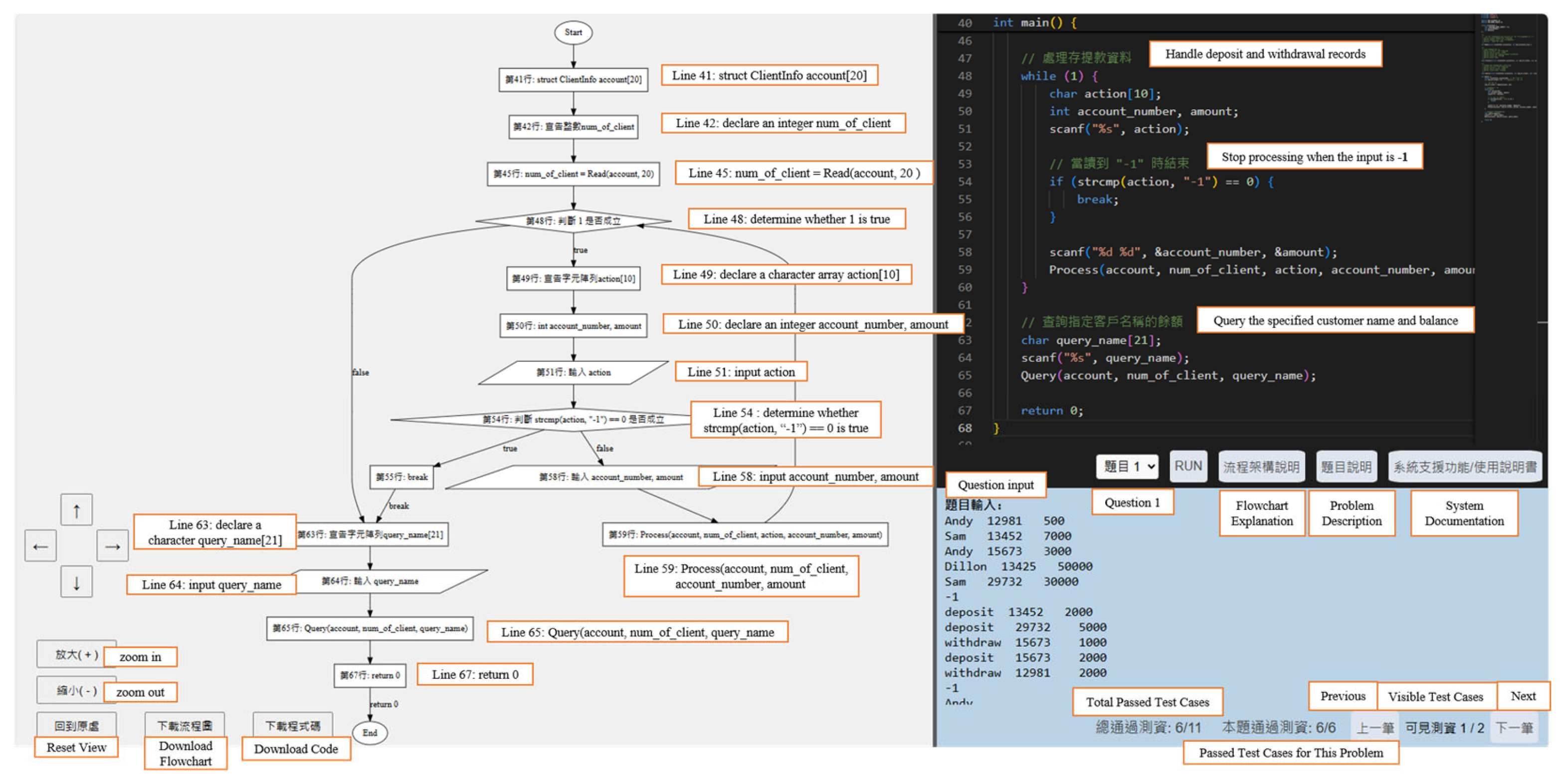
We have developed a system that dynamically generates flowcharts and architecture diagrams “process visualization system” (
Figure 1). The system accurately extracts the necessary information from the code and converts it into a visualized flowchart and architecture diagram. After the system was designed, students evaluated its effectiveness in programming learning. The experiment was conducted to collect feedback from students after using the system through a questionnaire survey to analyze the impact of the system on students’ learning.
3.1. Subject and Course
First-year university students in northern Taiwan participated in this study. All participants majored in electrical engineering and computer science and did not have prior programming knowledge. Before the experiment, they were introduced to basic programming concepts. The students did not understand the structure and processes of the program operation. After using the developed system, the students evaluated the effect of visualization tools on programming learning.
A course “Introduction to Computers” was offered to teach C programming. Basic and advanced concepts, including variables, operations, conditional judgment, loops, function calls, arrays, structures, and linked lists were taught. The course content included the foundation of programming, which was ideal for testing the effectiveness of the developed visualization tools for the first-year students.
3.2. Process
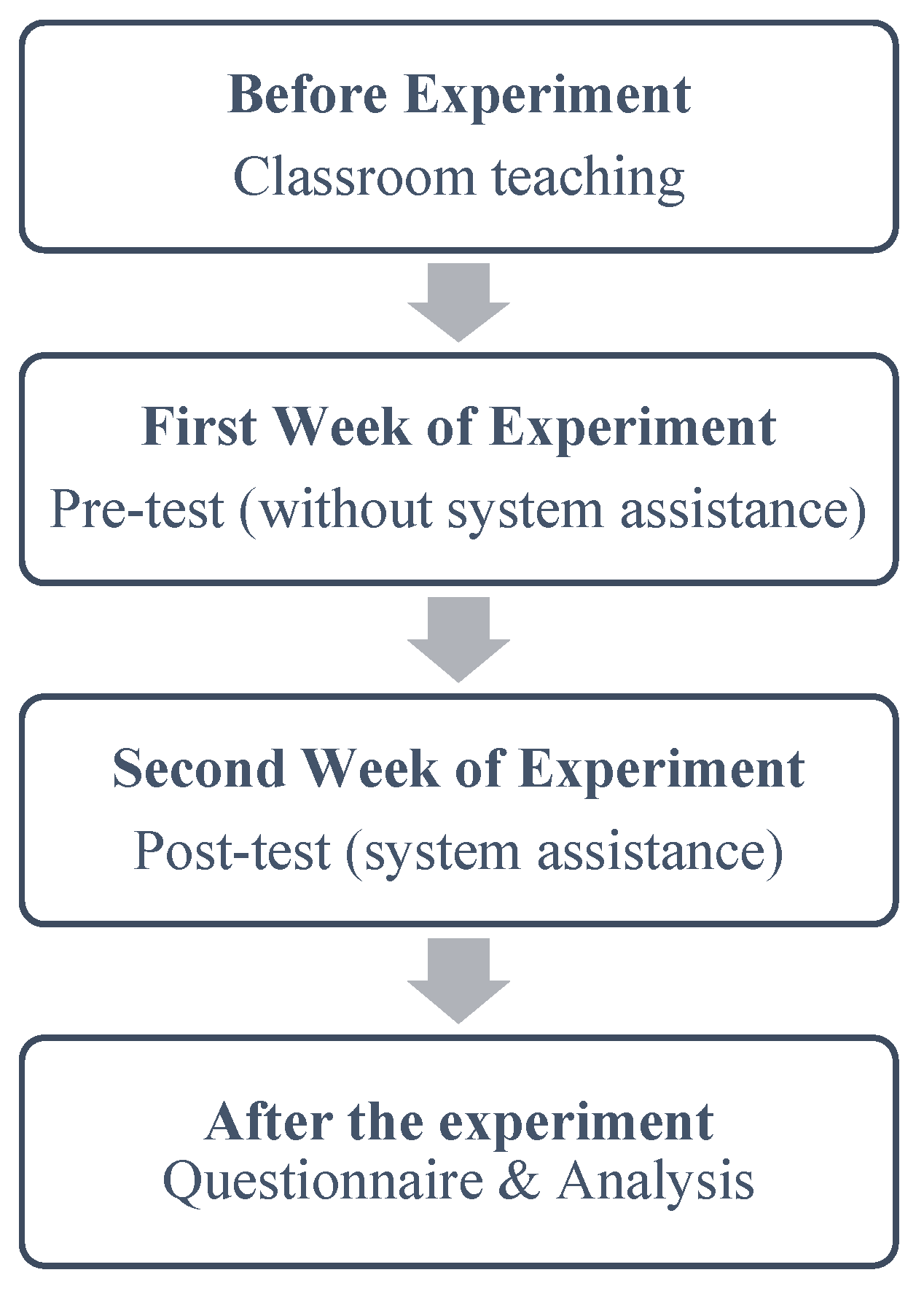
The experiment was conducted in two phases (
Figure 2). Before the experiment, the professor explained the concepts to help students understand the basic structure and operating logic of the C language and have basic programming knowledge. The first test was conducted one week after the course began without using the visualization tool to evaluate students’ basic understanding of the content. The second test was conducted in the following week after using the developed tool. This allowed the students to use the system in programming tasks. After the experiment, students filled out a questionnaire on their experience with the tool and its learning effect.
4. Results and Discussion
The questionnaire survey data were analyzed to explore the impact of the developed tool that generated flowcharts showing students’ learning effects and motivation. Based on the survey results and data analysis, the usability of the tool, improvement in learning motivation, the impact of peer competition, and learning performance were evaluated.
4.1. System Usability
In total, 84% of the students found the tool easy to use. This indicated that the tool’s interface was intuitive, allowing users to quickly understand how to operate it and learn after familiarizing themselves with it (
Table 1). The participants showed their expectations for additional system features. We improved several tool functions to make the learning experience more comfortable.
4.2. Learning Effect
4.2.1. Learning Progress
In total, 87% of the students believed that the tool enhanced their ability to track learning progress(
Table 2). They thought that the tool helped them change their perception of program mastery in the learning process, understand learning status, and improve their programming skills.
4.2.2. Program Ability
Totally, 81% of the students said that the tools improve their understanding of the code (
Table 3). The tool converted students’ code into flowcharts, presenting program logic concisely and intuitively, making it easier for students to understand. This aided them in learning program logic. Through graphical presentation, students understand the course content, thus improving their learning outcomes.
4.2.3. Interest and Confidence in Learning
In total, 83% of the students believed that interactive elements made learning attractive (
Table 4). These interactive elements allowed the students to see the results of program execution in real time but also dynamically displayed the corresponding blocks of the flowchart to each line of code.
4.2.4. Confidence in Learning
In total, 63% of the students said that their confidence in learning programming in the course improved (
Table 5). While the visualization tool effectively assisted students in understanding the program’s running process, several students felt less confident. In the programming-learning process, the tool did not remove the difficulties of learning that the students felt.
5. Conclusions
We have developed a visualization tool that dynamically generates flowcharts based on the code and applies it in teaching, utilizing a graphical teaching method. The tool was applied in a programming language course to improve student learning outcomes.
The tool helped students understand programming language logic by converting code into flowcharts. Compared with traditional learning methods, the tool enabled students to quickly grasp the program’s execution process. By observing the flowchart, the students understood the relationship between different steps, thus improving their mastery of programming languages.
The visual learning tool converted abstract code into concrete flowcharts, allowing students to intuitively understand the logic behind program execution. The visualization of flowcharts made the learning process intuitive, helping students reduce psychological barriers when learning complex program structures. This learning method enhanced students’ acceptance of programming languages and improved their ability to master programming concepts, further stimulating their interest in programming.
Students’ learning mentality—such as their confidence in solving programming problems—also affects their progress. Therefore, the tool needs to be enhanced by adopting AI. AI models allow students to ask questions and engage in continuous dialog, adjusting the teaching method based on each student’s learning process. For instance, in learning programming architecture, AI assists students in breaking down problems and provides tailored guidance according to their thinking patterns.
The flowchart can be enhanced in an animated format to show the program execution process in more detail, providing a clearer view of how the program operates. By adding more detailed visual representations, the flowchart improves its visual appeal and boosts students’ interest and engagement in the learning process. The tool needs to incorporate a variable tracking feature to adjust the program’s execution interval, observe changes in the program’s variables, and increase the interactivity with students. Such functionality can provide more assistance for students to understand program execution and enhance the learning experience.
Author Contributions
Conceptualization, P.-W.L. and S.-H.Y.; methodology, C.-H.L.; software, P.-W.L. and S.-H.Y.; validation, C.-H.L. resources, P.-W.L. and S.-H.Y.; data curation, P.-W.L. and C.-H.L.; writing—original draft preparation, P.-W.L., S.-H.Y. and C.-H.L.; writing—review and editing, P.-W.L. and C.-H.L.; visualization, P.-W.L.; supervision, C.-H.L. All authors have read and agreed to the published version of the manuscript.
Funding
This research was supported by the National Science and Technology Council under Grant (113-2813-C-033-012-H) and Chung Yuan Christian University.
Institutional Review Board Statement
Not applicable.
Informed Consent Statement
Not applicable.
Data Availability Statement
The data presented in this study are available on request from the corresponding author due to school privacy policies.
Conflicts of Interest
The authors declare no conflicts of interest.
References
- Lai, C.H. Design Interactive Response System based on Hot Option for Improving the Participation of Students: A Case Study. Educ. J. 2023, 51, 77–99. [Google Scholar]
- Yu, C.C.; Wu, L.Y. Instructing with Cognitive Apprenticeship Programming Learning System (CAPLS) for novice computer science college freshmen. Educ. Technol. Soc. 2024, 27, 183–196. [Google Scholar]
- Wang, J.Y.; Wang, W.Y.; Liang, J.C. Designing an Educational Chatbot for Enhanced Learning in Programming Courses. In Proceedings of the 2024 12th International Conference on Information and Education Technology (ICIET), Yamaguchi, Japan, 18–20 March 2024; IEEE: Piscataway, NJ, USA, 2024; pp. 237–242. [Google Scholar]
- Liang, J.-C.; Wang, J.-Y.; Chang, C.-C. The CodingHere Platform for Programming Courses. Inf. Eng. Express 2022, 8, 1–14. [Google Scholar] [CrossRef] [Scilit]
- Kui, X.; Liu, W.; Xia, J.; Du, H. Research on the improvement of python language programming course teaching methods based on visualization. In Proceedings of the 2017 12th International Conference on Computer Science and Education (ICCSE), Houston, TX, USA, 22–25 August 2017; IEEE: Piscataway, NJ, USA, 2017; pp. 639–644. [Google Scholar]
- Han, G.; Kagawa, K. Towards a Web-based program visualization system using Web3D. In Proceedings of the 2012 International Conference on Information Technology Based Higher Education and Training (ITHET), Istanbul, Turkey, 21–23 June 2012; IEEE: Piscataway, NJ, USA, 2012; pp. 1–4. [Google Scholar]
- Georgas, J.C.; Palmer, J.D.; McCormick, M.J. Supporting software architecture learning using runtime visualization. In Proceedings of the 2016 IEEE 29th International Conference on Software Engineering Education and Training (CSEET), Dallas, TX, USA, 5–6 April 2016; IEEE: Piscataway, NJ, USA, 2016; pp. 101–110. [Google Scholar]
- Al-Fedaghi, S.; Alrashed, A. Visualization of execution of programming statements. In Proceedings of the 2014 11th International Conference on Information Technology: New Generations, Las Vegas, NV, USA, 7–9 April 2014; IEEE: Piscataway, NJ, USA, 2014; pp. 363–370. [Google Scholar]
- Suryana, N.; Salam, S.; Azmi, M.S.; Noersasongko, E. 3De-synergetic program visualization: A visual learning-aid tool for novice students. In Proceedings of the International Conference on e-Education, Entertainment and e-Management, Bali, Indonesia, 27–29 December 2011; IEEE: Piscataway, NJ, USA, 2012; pp. 133–137. [Google Scholar]
- Simoňák, S. Algorithm visualizations as a way of increasing the quality in computer science education. In Proceedings of the 2016 IEEE 14th International Symposium on Applied Machine Intelligence and Informatics (SAMI), Herlany, Slovakia, 21–23 January 2016; IEEE: Piscataway, NJ, USA, 2016; pp. 153–157. [Google Scholar]
| Disclaimer/Publisher’s Note: The statements, opinions and data contained in all publications are solely those of the individual author(s) and contributor(s) and not of MDPI and/or the editor(s). MDPI and/or the editor(s) disclaim responsibility for any injury to people or property resulting from any ideas, methods, instructions or products referred to in the content. |
© 2025 by the authors. Licensee MDPI, Basel, Switzerland. This article is an open access article distributed under the terms and conditions of the Creative Commons Attribution (CC BY) license (https://creativecommons.org/licenses/by/4.0/).