


Abstract
Hydrogen fuel cell systems are a viable option for electrified aero engines due to their efficiency and environmental benefits. However, integrating these systems presents challenges, notably in terms of overall system weight and thermal management. Heat exchangers are crucial for the effective thermal management system of electric propulsion systems in commercial electrified aviation. This paper provides a comprehensive review of various heat exchanger types and evaluates their potential applications within these systems. Selection criteria are established based on the specific requirements for air and hydrogen heat exchangers in electrified aircraft. The study highlights the differences in weighting criteria for these two types of heat exchangers and applies a weighted point rating system to assess their performance. Results indicate that extended surface, microchannel, and printed circuit heat exchangers exhibit significant promise for aviation applications. The paper also identifies key design challenges and research needs, particularly in enhancing net heat dissipation, increasing compactness, improving reliability, and ensuring effective integration with aircraft systems.
1. Introduction
Strategic initiatives such as Flightpath 2050 [1] aim to significantly reduce emissions in the aviation sector by 2050. Fuel cells are emerging as a viable solution for electrically driven propulsion systems due to their high efficiency and low emissions. Among fuel cell types, Low Temperature Polymer Electrolyte Membrane Fuel Cells (LTPEMFC) and Solid Oxide Fuel Cells (SOFC) stand out for megawatt level high-duty applications. However, their integration poses challenges, particularly in system weight and thermal management [2]. An effective thermal management system (TMS) is crucial for several reasons: it ensures the preheating of air and hydrogen fuel, cools the compressed cathode air, and efficiently rejects waste heat from the fuel cell system and electronic components. This is essential for maintaining efficient and optimal aircraft operation [3]. This requires a comprehensive system incorporating components like compressors, air ducts, and heat exchangers (HEXs). Conventional HEXs would be impractical due to the extensive surface area required for these high-duty applications. Therefore, HEXs must be designed to balance performance, cost, and weight, given their significant impact on aircraft efficiency.
While review literature is abundant on HEXs used in solar receivers, high-temperature applications, and nuclear reactors [4,5,6], there is a notable gap in the literature regarding HEXs specifically for electric aviation. This paper addresses this gap by providing an overview of the most relevant HEX types and evaluating them to identify the most promising options for commercial electrified aircraft propulsion.
The paper first introduces the most common HEX types and outlines the evaluation methodology used. Evaluation criteria are then derived from the specific requirements of the aviation sector. Based on these criteria, the HEX types are assessed using a weighted point rating (WPR) system to determine their suitability for aircraft propulsion and to identify associated design challenges. This work aims to provide a foundation for further research and development in the field of TMS for electrified aviation.
2. Methodology
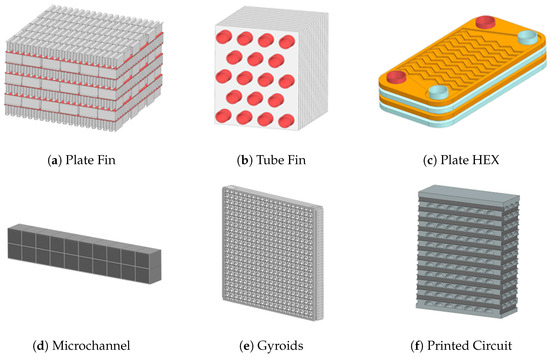
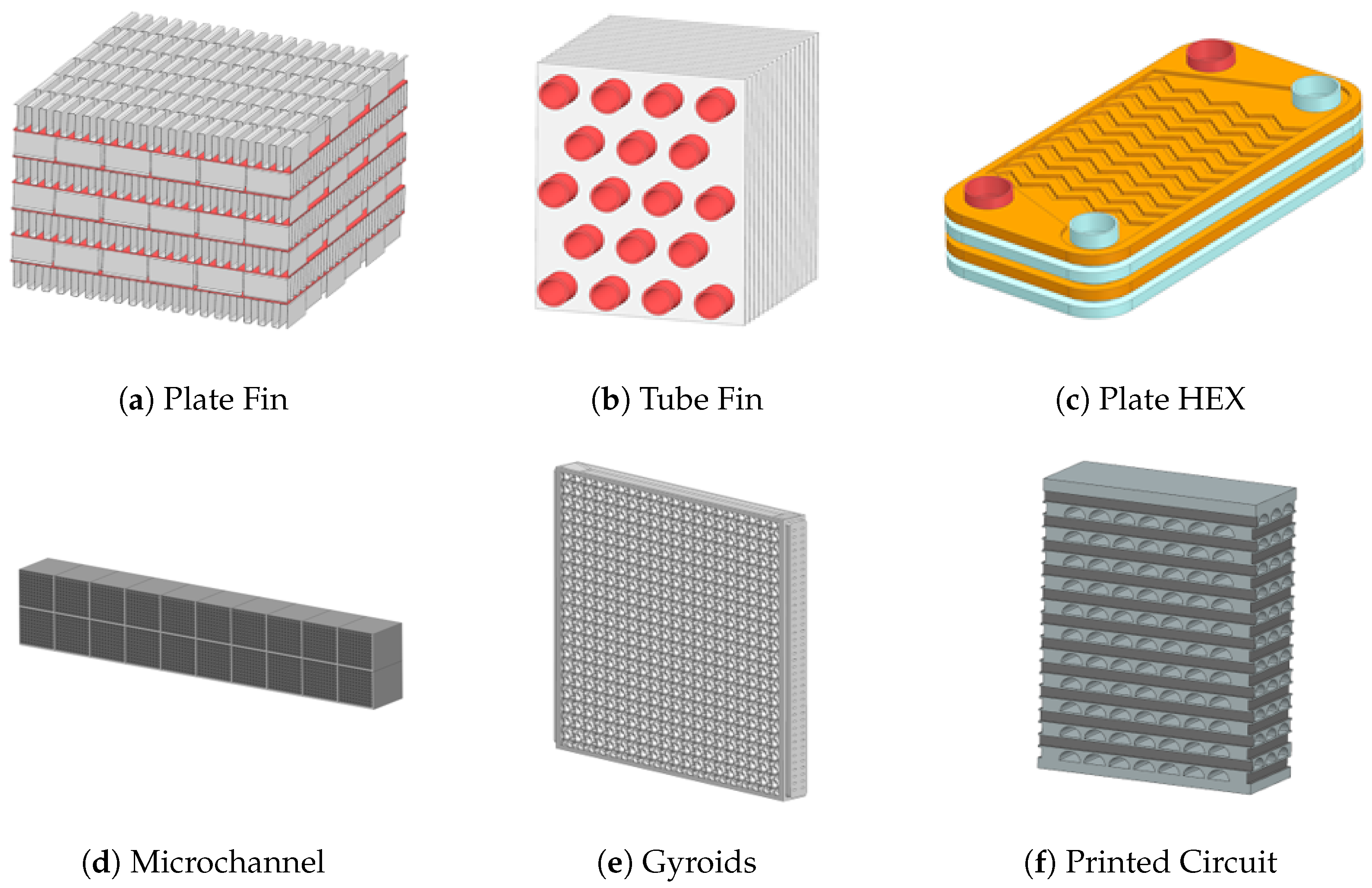
In electric aviation, selecting the appropriate HEX types based on thermal requirements is critical, particularly for fuel cell system applications. This study investigates both conventional and advanced HEX designs, evaluating their suitability for these demanding environments. Established designs like plate and extended surface HEXs are widely used for their proven effectiveness and manufacturability. Extended surface HEXs, including plate-fin and tube-fin configurations, are widely used for their versatility. Plate-fin HEXs are preferred for their compactness, while tube-fin designs excel in high-pressure applications. Microchannel heat exchangers (MCHEs), characterized by various channel geometries (e.g., square, rectangular, circular, hexagonal, and trapezoidal), offer exceptionally high surface area-to-volume ratios, thereby enhancing heat-transfer efficiency. Triply Periodic Minimal Surface (TPMS) designs, with intricate structures like diamond, gyroid, and primitive configurations, show improvement in heat transfer via complex internal fluid pathways. Similarly, printed circuit heat exchangers (PCHEs), fabricated through chemical etching processes, feature zigzag and aerofoil-shaped channels, offering high thermal performance and compactness. The various HEX types discussed are illustrated in Figure 1. Their operational principles are well-documented in the literature [7,8,9].
Figure 1.
Overview of different HEX types considered for evaluation in aviation.
Many commonly used HEX types, such as tubular HEXs (e.g., shell and tube, double-pipe), are widely used in the commercial sectors but have not been thoroughly evaluated for electric aviation. Plate HEXs, offering higher compactness and lower cost per heat-transfer area, are often preferred for high megawatt applications. Double-pipe HEXs are suitable for small heat-transfer areas (up to 50 m2) and are bulkier, making them less ideal for electric aviation [8]. Regenerators used in heat recovery applications are also under-explored in aviation. Despite their compactness and cost advantages, issues like bypass leakage and their suitability for low-pressure, gas–gas applications limit their use [7].
2.1. Application Area in the Context of Electric Aviation
This study examines two primary HEX applications in fuel cell-powered electric aircraft propulsion: preheating hydrogen and air for fuel cells and removing excess heat from fuel cells to ensure safe operation. Different fuel cells require distinct cooling and heating characteristics due to their specific operating temperature ranges. For instance, LTPEMFCs, which operate between 333 K and 353 K, often use liquid coolants with superior heat transfer and low pumping power requirements [10]. These coolants transfer absorbed heat to an air heat sink before recirculation. In contrast, SOFCs operate at much higher temperatures (923 K to 1273 K), making air, the most available heat sink in aircraft, essential for their cooling [2].
The study underscores the importance of air HEXs in aviation, as air is the primary cooling medium. However, their size and weight significantly impact the TMS efficiency and overall aircraft weight. Effective design of air HEXs is therefore crucial for optimal TMS performance. Although HEX selection criteria remain consistent, the weighting differs between air and hydrogen applications due to the difference in the thermophysical properties. This paper highlights these differences in weighting criteria and presents the HEX design challenges for aviation applications.
2.2. Criteria for Weighting
This study employs the WPR method, combined with a pairwise comparison approach, to evaluate and rank HEX options for electric aviation [2,11,12]. This methodology is particularly suitable during the preliminary design phase, as it provides a structured, quantitative framework that facilitates comparison across multiple HEX designs, even when complete qualitative data and direct performance comparisons are unavailable. This is especially critical where certain HEX types are at lower Technology Readiness Levels (TRsL) and lack comprehensive performance data under varying operational conditions.
The WPR method allows the evaluation to focus on essential performance criteria—such as thermal efficiency, reliability, compactness, and weight—without requiring extensive qualitative data for each HEX option. The pairwise comparison method further refines this approach by assigning numerical weights to each criterion based on its relative importance, as determined by a panel of aeronautical and mechanical engineers. In this approach, each criterion is evaluated against others in pairs by an evaluation group. If one criterion is more important than the other, it is assigned a value of 2. If both criteria are equally important, they are given a value of 1. Conversely, if a criterion is less important, it receives a value of 0. Once all criteria have been compared, each criterion i receives a total score , which is the sum of the scores from the comparisons as shown in Table 1. The relative weighting factor for each criterion is calculated by dividing its total score by the sum of all scores P, .
Table 1.
Criteria weighting via pairwise comparison for air HEX.
2.3. Selection Criteria
For HEXs in electric aviation, selection criteria are derived from aircraft propulsion requirements [10,13,14,15], including thermal performance, compactness and lightweight design, pumping power, design flexibility, reliability and life cycle cost, and manufacturing considerations. These interdependent factors often require trade-offs.
2.3.1. Thermal Performance
Thermal performance is crucial for HEXs in electric aviation, where they operate at high megawatt range heat duty. These HEXs maintain optimal fuel cell performance by precisely controlling the temperature of fuel and air. High-efficiency HEXs, with high heat-transfer coefficients, handle large heat loads with minimal temperature differences, which enhances energy efficiency. Efficient HEXs also play a vital role in cooling the hot fluids exiting the fuel cells, preventing thermal degradation, and extending the operational life of the fuel cells by preserving their structural integrity and improving system reliability.
2.3.2. Compactness and Weight
Compact HEXs optimize heat transfer while minimizing weight and size, with a surface area density greater than 700 m2/m3 or a hydraulic diameter mm for gas streams [7]. A compact HEX can integrate a larger heat-transfer surface inside the limited small volume. This can also aid in the integration of other critical components. Using compact HEX, aircraft level drag and fuel efficiency can be improved.
2.3.3. Pumping Power
Minimizing pressure drop across HEXs is essential to reduce power-off take, TMS mass and volume. On the gas side, a compressor is typically required to overcome pressure losses, making pumping power a critical consideration, particularly for air systems. Due to air’s low density, more energy is needed to circulate it, leading to increased strain on the compressor, higher energy consumption, and greater maintenance requirements. Reducing pumping power is therefore essential for enhancing energy efficiency and system durability. The pumping power P is given by the following equation where are mass flow rate, pressure drop, compressor efficiency, and density of the fluid, respectively.
2.3.4. Design Flexibility
Design flexibility is crucial for HEX selection, as it must accommodate various fluid types (single-phase liquids, gases, and two-phase flows) and flow configurations across a wide range of temperatures and pressures, even in corrosive environments. Material selection is key, ensuring durability, corrosion resistance, and thermal stability, as operating temperatures are limited by material capabilities.
2.3.5. Reliability and Life Cycle Cost
HEX reliability is influenced by fouling, leakage, and material durability. Liquid-side fouling, driven by higher particle concentrations, significantly increases thermal and hydraulic resistance, while air-side fouling is less critical but still requires effective filtration to prevent plugging, especially in compact designs. Leakage, critical in hydrogen and cryogenic systems, demands robust sealing, detection, mitigation, and precise manufacturing for safety and integrity. Material selection is key to withstanding thermal, chemical, and mechanical stresses while minimizing vibration-induced wear. A well-designed HEX reduces maintenance needs, improving efficiency and lowering life cycle costs.
2.3.6. Development and Manufacturing Cost
Development and Manufacturing Cost is dictated by the TRL and experience in aviation. Lower TRL systems require extensive testing and development, increasing costs and timelines. High-performance materials and specialized production methods can drive costs but offer technological advancements. Balancing these factors optimizes cost while aligning with industry trends toward sustainability.
3. Results and Discussion
3.1. Selection Criteria for Air HEX
When selecting air-side HEXs for aviation, key considerations arise due to air’s unique thermophysical properties, such as low heat-transfer coefficient, density, and heat capacity, as shown in Table 1. These properties necessitate a higher mass flow rate to meet large-scale heat duties. At the aircraft level, thermal performance and reliability are paramount. Thermal performance maintains optimal fuel cell temperatures, preventing degradation and extending fuel cell life. Reliability, equally critical, ensures safety and system resilience under demanding conditions [13,14], though it may slightly reduce TMS efficiency.
Compactness and pumping power are essential at the TMS level. Compact designs save weight and space, while pumping power during takeoff supports preheating and efficient waste heat removal. However, excessive pumping power decreases TMS efficiency, while large HEX sizes add weight, so balancing these is vital for optimal performance and energy efficiency. The non-corrosive nature of air allows for flexible material and flow configuration, reducing degradation and fouling risks, and enabling higher-performance optimization. Costs are secondary to safety and performance, as aviation standards prioritize reliability and compliance with stringent regulations, critical for mission success.
3.2. Selection Criteria for Hydrogen HEX
The weighting criteria for hydrogen HEXs in aviation differ from air HEX due to hydrogen’s high thermal conductivity and specific heat, as shown in Table 2. At the aircraft level, reliability is paramount, particularly leakage control, as hydrogen’s high diffusivity and flammability pose significant risks. This includes ensuring robust performance under high pressure and temperature and hydrogen embrittlement [13,14,15]. Design flexibility is crucial, encompassing the selection of materials and fluid types compatible with hydrogen to prevent ignition and maintain system integrity under varied conditions. Optimizing thermal performance leverages hydrogen’s superior heat transfer, enhancing preheating and dissipation. Lightweight, compact designs improve fuel efficiency, and, unlike air-side HEXs, pumping power is less critical due to hydrogen’s low mass flow and diffusivity. Development and manufacturing costs are secondary to safety, which demands stringent leak detection and explosion-proof features to meet regulatory standards [15].
Table 2.
Criteria weighting via pairwise comparison for hydrogen HEX.
3.3. Heat Exchanger Type Rating for Air and Hydrogen HEX
Each HEX type is assigned a numerical score, to reflect how well it meets a specific criterion i [11,12]. Given that some HEX types have a low TRL for aviation applications, only a quantitative comparison is feasible at this stage. Therefore, a narrow scale from 0 to 4 is used for evaluation. Table 3 results use a plus–minus system to compare HEX types intuitively. The scoring system is as follows: A “very good” fulfillment is awarded 4 points, denoted as (++). If the fulfillment is “good”, it is given 3 points, represented by (+). For “average” fulfillment, 2 points are assigned, marked as (o). A “bad” fulfillment receives 1 point, indicated by (-). Lastly, “very bad” fulfillment is assigned 0 points, shown as (- -).
Table 3.
Evaluation of relevant HEX types for aviation.
This approach allows for clear evaluation. However, without considering the relative weighting of each criterion, it is difficult to determine the most suitable HEX type. Therefore, the relative rating for each HEX type is calculated as the sum of all products of the numerical scores multiplied by the weighting factor , divided by the scale size:
In the assessment summarized in Table 3, extended surface HEXs achieved the highest relative rating for air and hydrogen HEXs, excelling in balanced performance across all evaluation criteria. They outperformed MCHE and PCHE due to their high TRL and proven reliability in aviation. MCHEs and TPMS showed superior thermal performance and compactness but scored lower in reliability, development cost, and pumping power due to lower TRLs, limited performance data, and manufacturing challenges. PCHEs, with their diffusion-bonded structure, demonstrate high reliability under extreme temperatures and pressures, and leakage-proof designs when used with fluids like CO2, helium, and water. This capability highlights their potential for future aviation applications with air and hydrogen where compact, efficient, leakage-proof HEX designs are vital. Plate HEXs, though more cost-effective and an improvement over traditional tubular designs, received the lowest ratings due to their limited compactness, thermal efficiency, and hydraulic performance making them less suitable for aviation applications.
However, the analysis is subject to uncertainties arising from limited qualitative data for certain HEX types due to their lower TRLs, the absence of established thermal and hydraulic correlations, and the unique requirements of aviation applications. Additionally, the subjective nature of weight assignments in the pairwise comparison method adds another layer of uncertainty. Nevertheless, these results provide valuable insights into the relative strengths and weaknesses of various HEX designs, offering a robust foundation for selecting and refining HEX technologies tailored to the demands of electric aviation.
3.4. Potential and Challenges for HEXs in Aviation
Advancing HEXs for electrified aircraft propulsion requires optimizing the heat-transfer coefficient relative to pumping power per unit area, known as net dissipation while achieving higher compactness, reduced weight, enhanced safety, and extended lifespans.
Extended surface HEXs shown in Figure 1a,b have the highest TRL and are widely used in aviation [7,8] due to their flexible geometry, minimal leakage, and high versatility, allowing customization for various fluids and pressure and temperature conditions. Fin designs, including plain, offset, louver, and wavy types, optimize the thermal performance-to-pumping power ratio [7,8,16]. The research aims to enhance net dissipation and reliability under higher operating conditions [17].
MCHEs in Figure 1d excel in high-pressure and high-temperature environments [20,21] but face challenges with flow maldistribution and high-pressure drops. Improved manifold designs have the potential to reduce pressure losses, but comprehensive air-side thermal–hydraulic correlations remain underdeveloped [5,16].
TPMS, particularly Gyroids in Figure 1e, offer up to 7.5 times higher heat transfer than plate HEXs due to their complex flow paths [9]. Research primarily focuses on low Reynolds number flows, with limited studies on turbulent conditions. For air HEXs, high friction factors increase pumping power requirements. Additive manufacturing methods, such as selective laser melting, pose leakage risks and safety concerns for hydrogen applications, with TPMS reliability under extreme conditions remaining underexplored [19].
PCHEs in Figure 1f are notable for their heat-transfer effectiveness and performance in extreme environments. They offer flexibility in flow configurations but suffer from high-pressure drops and moderate compactness [22]. Airfoil channels provide excellent pressure-drop performance but are costly and less pressure-resistant. Current research focuses on improving TRLs through experimental validations [22,23].
Plate HEXs in Figure 1c are cost-effective and reliable for liquid and hydrogen applications due to their high TRL. However, they encounter challenges in air applications due to high-pressure drops. Gasketed designs are suitable for moderate conditions, while brazed and welded types offer greater durability at the cost of easier maintenance. Ongoing research focuses on improving thermal performance and reducing pressure drops using advanced surface treatments and innovative designs such as chevron patterns [4,7,8].
4. Conclusions
This study evaluates various HEX types for commercial electric aviation, addressing the distinct requirements of air and hydrogen HEXs. For air HEXs, critical considerations include thermal performance, reliability, compactness, and low pumping power. Conversely, hydrogen HEXs emphasize stringent leakage control, material compatibility, and reliability, due to its unique thermophysical properties and the challenges of megawatt-scale thermal management. A weighted point rating system identifies extended surface, microchannel, and printed circuit HEXs as promising solutions for air and hydrogen applications. Overall, this study highlights significant opportunities and research gaps, providing valuable insights for advancing thermal management solutions in electric propulsion systems.
Author Contributions
Author S.B. conducted a comprehensive review of various HEX designs for electric aviation, evaluating their performance based on selection criteria and identifying the potential and challenges of selected HEX types for their application. Author C.S. contributed to the design and results assessment of TPMS HEX, as well as the selection criteria based on engine- and aircraft-level applications. Author S.K. provided expertise in determining weighting factors for HEX selection and interpreting the results. All authors have read and approved the final version of the manuscript.
Funding
This work contributes to the internal DLR project HEADS.
Institutional Review Board Statement
Not applicable.
Informed Consent Statement
Not applicable.
Data Availability Statement
Data are contained within the article.
Acknowledgments
We wish to acknowledge Antje Link and Sebastian Merbold for fruitful insights and interesting discussions, which vastly helped to improve the results presented in this paper.
Conflicts of Interest
The authors declare no conflicts of interest.
References
- European Commission. Clean Sky 2 First Global Assessment 2020: Technology Evaluator Report. Technical Report. 2021. Available online: https://cleansky.paddlecms.net/sites/default/files/2021-10/TE-FGA-TR_en.pdf (accessed on 30 July 2024).
- Kazula, S.; de Graaf, S.; Enghardt, L. Review of fuel cell technologies and evaluation of their potential and challenges for electrified propulsion systems in commercial aviation. J. Glob. Power Propuls. Soc. 2023, 7, 43–57. [Google Scholar] [CrossRef] [Scilit]
- Kazula, S.; Staggat, M.; de Graaf, S. Functional and Safety Challenges of Hydrogen Fuel Cell Systems for Application in Electrified Regional Aircraft. J. Phys. Conf. Ser. 2023, 2526, 012063. [Google Scholar] [CrossRef] [Scilit]
- Li, Q.; Flamant, G.; Yuan, X.; Neveu, P.; Luo, L. Compact heat exchangers: A review and future applications for a new generation of high temperature solar receivers. Renew. Sustain. Energy Rev. 2011, 15, 4855–4875. [Google Scholar] [CrossRef] [Scilit]
- Zhang, X.; Keramati, H.; Arie, M.; Singer, F.; Tiwari, R.; Shooshtari, A.; Ohadi, M. Recent developments in high temperature heat exchangers: A review. Front. Heat Mass Transf. 2018, 11, 18. [Google Scholar]
- Liu, G.; Huang, Y.; Wang, J.; Liu, R. A review on the thermal-hydraulic performance and optimization of printed circuit heat exchangers for supercritical CO2 in advanced nuclear power systems. Renew. Sustain. Energy Rev. 2020, 133, 110290. [Google Scholar] [CrossRef] [Scilit]
- Shah, R.K.; Sekulic, D.P. Fundamentals of Heat Exchanger Design; John Wiley & Sons: Hoboken, NJ, USA, 2003. [Google Scholar]
- Kakaç, S.; Liu, H.; Pramuanjaroenkij, A. Heat Exchangers: Selection, Rating, and Thermal Design; CRC Press: Boca Raton, FL, USA, 2002. [Google Scholar]
- Yeranee, K.; Rao, Y. A review of recent investigations on flow and heat transfer enhancement in cooling channels embedded with triply periodic minimal surfaces (TPMS). Energies 2022, 15, 8994. [Google Scholar] [CrossRef] [Scilit]
- Sain, C.K.; Hänsel, J.; Kazula, S. Conceptual Design of Air and Thermal Management in a Nacelle-Integrated Fuel Cell System for an Electric Regional Aircraft. In Proceedings of the AIAA AVIATION 2023 Forum, San Diego, CA, USA, 12–16 June 2023; p. 3875. [Google Scholar]
- Lindemann, U. Methodische Entwicklung Technischer Produkte: Methoden Flexibel und Situationsgerecht Anwenden; Springer: Berlin/Heidelberg, Germany, 2006. [Google Scholar]
- Pahl, G.; Beitz, W.; Schulz, H.J.; Jarecki, U. Pahl/Beitz Konstruktionslehre; Springer: Berlin/Heidelberg, Germany, 2013. [Google Scholar]
- SAE Eurocae Fuel Cell Task Group. AIR6464. EUROCAE/SAE WG80/AE-7AFC Hydrogen Fuel Cells Aircraft Fuel Cell Safety Guidelines; Technical Report; SAE International: Warrendale, PA, USA, 2023. [Google Scholar]
- SAE International. Guidelines and Methods for Conducting the Safety Assessment Process on Civil Airborne Systems and Equipment ARP4761; Technical Report; SAE International: Warrendale, PA, USA, 2023. [Google Scholar]
- SAE Eurocae Fuel Cell Task Group. Considerations for Hydrogen Fuel Cells in Airborne Applications ARP7765; Technical Report; SAE International: Warrendale, PA, USA, 2023. [Google Scholar]
- Qasem, N.A.; Zubair, S.M. Compact and microchannel heat exchangers: A comprehensive review of air-side friction factor and heat transfer correlations. Energy Convers. Manag. 2018, 173, 555–601. [Google Scholar] [CrossRef] [Scilit]
- Bhapkar, S.; Kazula, S. Development of a Predictive Model for the Preliminary Design of Heat Exchangers in Electric Aviation. In Proceedings of the German Aerospace Congress DLRK, Stuttgart, Germany, 19–21 September 2023. [Google Scholar]
- Lee, H. Thermal Design: Heat Sinks, Thermoelectrics, Heat Pipes, Compact Heat Exchangers, and Solar Cells; John Wiley & Sons: Hoboken, NJ, USA, 2022. [Google Scholar]
- Dutkowski, K.; Kruzel, M.; Rokosz, K. Review of the state-of-the-art uses of minimal surfaces in heat transfer. Energies 2022, 15, 7994. [Google Scholar] [CrossRef] [Scilit]
- Dwivedi, A.; Khan, M.M.; Pali, H.S. A comprehensive review of thermal enhancement techniques in microchannel heat exchangers and heat sinks. J. Therm. Anal. Calorim. 2023, 148, 13189–13231. [Google Scholar] [CrossRef] [Scilit]
- Li, X.; Wilson, C.T.; Zhang, L.; Bhatia, B.; Zhao, L.; Leroy, A.; Brandt, O.; Orta-Guerra, R.; Youngblood, J.P.; Trice, R.W.; et al. Design and modeling of a multiscale porous ceramic heat exchanger for high temperature applications with ultrahigh power density. Int. J. Heat Mass Transf. 2022, 194, 122996. [Google Scholar] [CrossRef] [Scilit]
- Ma, Y.; Xie, G.; Hooman, K. Review of printed circuit heat exchangers and its applications in solar thermal energy. Renew. Sustain. Energy Rev. 2022, 155, 111933. [Google Scholar] [CrossRef] [Scilit]
- Huang, C.; Cai, W.; Wang, Y.; Liu, Y.; Li, Q.; Li, B. Review on the characteristics of flow and heat transfer in printed circuit heat exchangers. Appl. Therm. Eng. 2019, 153, 190–205. [Google Scholar] [CrossRef] [Scilit]

Disclaimer/Publisher’s Note: The statements, opinions and data contained in all publications are solely those of the individual author(s) and contributor(s) and not of MDPI and/or the editor(s). MDPI and/or the editor(s) disclaim responsibility for any injury to people or property resulting from any ideas, methods, instructions or products referred to in the content. |
© 2025 by the authors. Licensee MDPI, Basel, Switzerland. This article is an open access article distributed under the terms and conditions of the Creative Commons Attribution (CC BY) license (https://creativecommons.org/licenses/by/4.0/).