


Abstract
The purpose of this study is to examine whether there are complex interrelationships between supply chain collaboration, adoption of artificial intelligence, and the resulting risk management performance, with potential effects on organizational performance, supply chain performance, and supply chain flexibility. The data for this study were obtained from the answer questionnaires distributed in leading business and management universities in Karachi; out of 400 questionnaires disseminated, 384 were returned and filled with the responses. The data were analyzed using the Partial Least Squares–Structure Equation Modeling (PLS-SEM) approach. Among the six hypotheses tested in this particular study, it was revealed that none of the tested hypotheses were rejected at its level. These findings and recommendations gain more importance with the changing nature of the supply chain network and outlook toward sustainable practice.
1. Introduction
Recent studies have mentioned that market instability, variable demand, shortening product lifecycles, and natural calamities contribute to serious supply chain disruptions to the concerned companies [1]. Researchers and practitioners must design the required supply chain systems whose robust structures will stand any interruptions and adverse changes that destroy the entire system [2]. The SCR concept has gained increasing popularity in recent years. Supply chain resilience has been defined by [3] as an organization’s ability to resume programs that have been disrupted in some way by unforeseen shocks to their supply chain. Supply chain resilience (SCR) represents the inherent capacity of a supply chain against any uncertainty where the severity cannot be fully met by proactive engagement to absorb impacts, manage adaptation, and, after overcoming, maintain its initial performance [4]. Prior research on resilience and recovery in the supply chain has been focused on measuring the level of response and recovery resilience before development [5]. Many researchers and business experts opine that the food supply chain has to be better managed so that it can remain resilient in the face of significant disruptions posed by the raging pandemic [6]. This study seeks to establish the relationship that prevails between supply chain resilience and other factors that are associated with supply chain flexibility, organizational performance, supply chain performance, risk management performance, and artificial intelligence in the supply chain.
2. Theory Development and Literature Review
2.1. Organizational Information Process Theory (OIPT)
With respect to the sustainability and resilience of the supply chain, organizational information processing theory is a very fitting and relevant lens. This notion assumes the view that organizations can make decisions and change their environment by taking in, analyzing, and using information. Based on the adaptation of this notion, companies can form more resistant supply chains against any disturbances and consequently contribute to providing beneficial effects to social and environmental sustainability.
2.2. Supply Chain Collaboration
The complete term, with reference to collaboration in supply chains, can mean working with other intrinsic suppliers and outside partners to keep the flow across the supply chain at optimal levels. It enhances on-time delivery and completeness in meeting demand [7].
2.3. Artificial Intelligence
Artificial intelligence is “the power of learning by the observations of external world phenomena with a capacity of changing existing planes accordingly, or creation of totally new ones under changes in conditions [8]”.
2.4. Performance in Risk Management
Risk-based performance management aims to help businesses maintain strategy realization by connecting business strategy, performance management, and risk management [9].
2.5. Supply Chain Resilience
This concept is defined as an operational capability of the supply chain through which a supply chain that has been disrupted recomposes itself in such a way that the state it acquires after the disrupting incident is no worse than its state before the occurrence of the disruption [10].
2.6. Performance in Supply Chains
It appraises the perfection level of each business supply chain division, which needs the integration of several player segments such that the business supply chain functions to meet and optimize costs, inefficiency, and speed [1].
2.7. Supply Chain Flexibility
Supply chain flexibility refers to the capacity of each participant in the chain to adapt to changing environmental circumstances and fulfill diverse consumer demands without incurring unanticipated expenses, delays, organizational disturbances, or performance setbacks [11].
2.8. Conceptual Framework and Hypotheses Development
Based on the above theories and theoretical discussion (in the following sections), we have proposed a model with six hypotheses. The conceptual framework presented in Figure 1 shows the developed hypotheses.
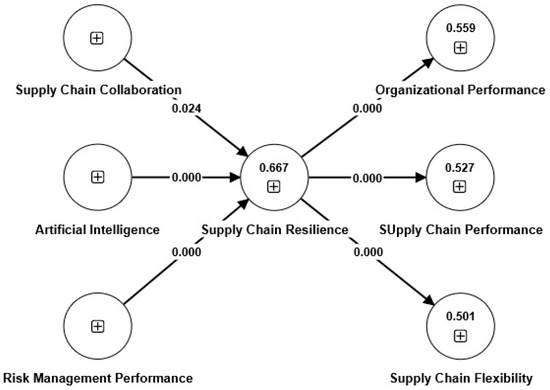
Figure 1.
Conceptual framework.
2.8.1. Supply Chain Collaboration and Supply Chain Resilience
According to Nwagwu, Niaz, Chukwu, and Saddique [12], it is critical for the development of supply chain resilience for suppliers to establish collaborative relationships.
H1.
Supply chain collaboration has a positive influence on supply chain resilience.
2.8.2. Artificial Intelligence and Supply Chain Resilience
There is a substantial effect on supply chain resilience from the widespread availability, high accuracy, and openness offered by digital technology [13].
H2.
Artificial intelligence has a positive influence on supply chain resilience.
2.8.3. Risk Management Performance and Supply Chain Resilience
Research in the supply chain focuses on the relationship between the chain’s resilience and the effectiveness of risk management. There is evidence to show that if appropriate risk management is in place, supply chains can be very resilient [14].
H3.
Risk management performance has a positive impact on supply chain resilience.
2.8.4. Supply Chain Resilience and Organizational Performance
Even though substantial research on SCR and a significant amount of empirical evidence showing its importance exist, some have argued that it is a research area that has been neglected in recent years [15].
H4.
Supply chain resilience positively influences organizational performance.
2.8.5. Supply Chain Resilience and Supply Chain Performance
The past literature indicates that the development of SCR is very crucial for minimizing risks and maintaining proper SCP levels [16].
H5.
Resilience in supply chain has a positive effect on supply chain performance.
2.8.6. Supply Chain Resilience and Supply Chain Flexibility
According to [17], agility, also known as flexibility, greatly improves the resilience of supply chains. This is because agility offers strategic value in risk mitigation while requiring very little investment in flexibility.
H6.
Supply chain resilience has a positive influence on supply chain flexibility.
3. Methodology
The study’s sample size was 387, with a chance of error of around 5% and a 95% confidence level. We chose to focus on the top business schools in Karachi because their students have prior knowledge about supply chains. The authors selected six enumerators who visited the target universities and gathered the information. A total of 425 questionnaires were distributed, and 415 were returned, which is a respectable response rate.
3.1. Questionnaire Design
This study’s questionnaire is divided into two sections. The first portion deals with demographic knowledge, which we calculated on a nominal scale. The second section discusses the main study. It has 21 items rated on a five-point scale and 7 factors, as shown in Table A1 in the annexure.
3.2. Common Method Bias
According to [18], a common method bias occurs as a result of variations in responses collected by the study instrument. As a result, by adhering to the necessary protocol, the study decreased the likelihood of the common method biases.
4. Results
4.1. Descriptive Analysis
The conclusion after the results show that the highest Cronbach’s alpha values are for organizational performance (α 0.881) and the lowest are for supply chain performance (α 0.759), as shown in Table 1. Based on the information gathered from Karachi, Pakistan, it is suggested that the constructs have acceptable internal consistency.

Table 1.
Descriptive analysis.
4.2. Discriminant Validity
The findings indicate that the constructs used in the study are distinct and one-of-a-kind because the square root of AVE values is higher than the Pearson correlation values [19]. The study has proposed six direct hypotheses, shown in Table 2. The bootstrapping method is used to check the hypotheses.
Table 2.
Discriminant Validity.
4.3. Findings and Discussion
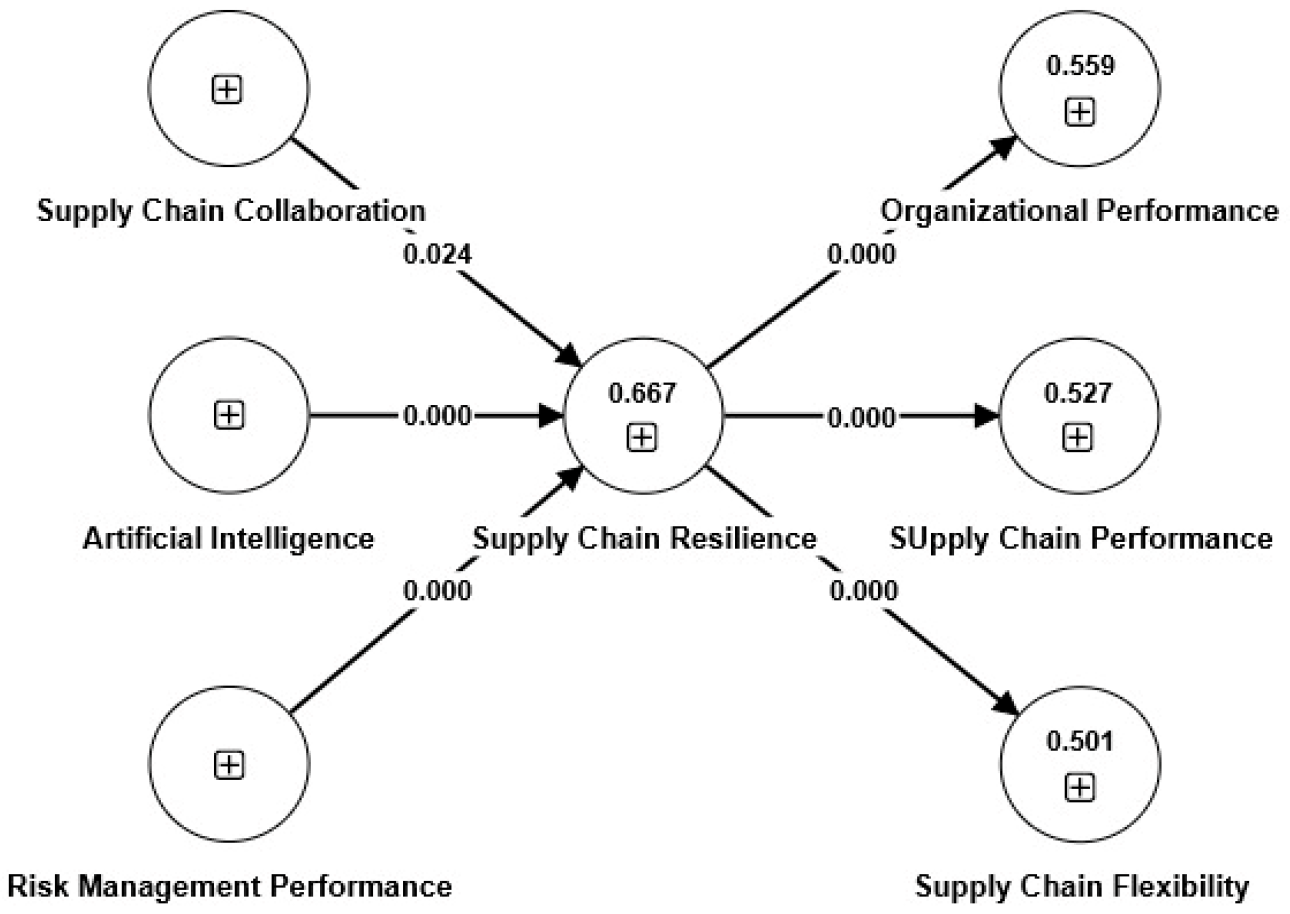
The results obtained from Table 3 show that AI builds a foundation for the development of a resilient supply chain for both operation and organizational performance. This resilience further increased as a result of efficient risk management with collaboration efforts made within the supply chain. According to [20], this is because AI enhances resiliency in the supply chain. More importantly, supply chain resilience ensures outstanding organizational performance, enhances flexible supply chain performance, and increases the ability to manage change effectively—all key qualities necessary for firms to adapt to dynamic markets. According to [21], the concept of supply chain resilience is characterized by a source of competitive advantage through its capacity or ability to recover from the impact of disruptions within the system promptly. [22] It is posited that building flexibility into supply chains for enhancing resiliency is yet one more measure to gain a competitive edge in the market.
Table 3.
Hypotheses Results.
5. Conclusions
The study has increased and spread the theoretical support to develop a model to examine supply chain resilience. The study has examined and proposed the effect of factors (i.e., supply chain collaboration, artificial intelligence, risk management performance, organizational performance, supply chain performance and supply chain flexibility) on supply chain resilience. Artificial intelligence (AI), risk management performance, and supply chain collaboration are significant predictors of supply chain resilience, with each demonstrating a positive and statistically significant impact. The robust results confirm the acceptance of these relationships. Furthermore, supply chain resilience is shown to have a crucial influence on organizational performance, supply chain performance, and supply chain flexibility, confirming the hypothesis that resilience within the supply chain is not only beneficial but essential for the overall health and adaptability of an organization. These findings highlight the importance of investing in AI and fostering a collaborative and well-managed risk environment to build a resilient supply chain that supports and drives organizational success.
5.1. Theoretical Implications
This study’s theoretical contributions come from its conceptual framework. Supply chain resilience can be better understood by using OIPT, DCT, and SCRT in the field. This will allow us to identify the factors that influence supply chain performance, organizational performance, and SCM flexibility.
5.2. Practical and Managerial Implications
Businesses that want to build SCR and perform better under difficult situations might benefit from this study’s contributions to two important managerial concerns. The primary objective is to maximize the firm’s performance by utilizing its absorptive power. Interorganizational ties are a treasure trove of useful information for most companies. However, some of these crucial assets risk going unused if they are not put to use in the fight against threats and hardships. Companies should build up their collaboration ability and improve it if they want to obtain the most out of SCR.
5.3. Limitations and Future Recommendations
The difficulty of determining causality and directionality among variables, the influence of unaccounted contextual factors, evolving technology dynamics, inadequate consideration of practical implementation challenges, and the need for a deeper understanding of the mechanisms underlying supply chain resilience are some examples of limitations. Future studies should consider longitudinal studies, sector-specific analyses, qualitative research for useful insights, intervention studies to test strategies, examination of the influence of external factors, and benchmarking to identify best practices, all of which will advance our understanding of the complex dynamics that shape modern supply chains.
Author Contributions
Conceptualization, S.K. (Sherbaz Khan); methodology, S.K. (Sherbaz Khan) and F.t.Z.; software, S.K. (Sharfuddin Khan); validation, S.K. (Sharfuddin Khan); formal analysis, S.K. (Sharfuddin Khan); investigation, S.K. (Sherbaz Khan); resources, S.K. (Sharfuddin Khan); data curation, S.K. (Sherbaz Khan); writing—original draft preparation, F.t.Z. and S.K. (Sherbaz Khan); writing—review and editing S.K. (Sherbaz Khan) and F.t.Z.; visualization, S.K. (Sharfuddin Khan); supervision, S.K. (Sharfuddin Khan); project administration, S.K. (Sharfuddin Khan). All authors have read and agreed to the published version of the manuscript.
Funding
This research received no external funding.
Institutional Review Board Statement
Not applicable.
Informed Consent Statement
Not applicable.
Data Availability Statement
Original contributions are presented in the study as statistical analysis. Further inquiries can be referred to the corresponding author.
Conflicts of Interest
The authors declare no conflicts of interest.
Appendix A
Table A1.
Scale and Measurement.
Table A1.
Scale and Measurement.
| Variables | Reference’s | Items |
|---|---|---|
| Supply Chain Resilience | [23] | 3 |
| Supply Chain Collaboration | [23,24] | 3 |
| Artificial Intelligence | [24] | 3 |
| Risk Management Performance | [25] | 3 |
| Organizational Performance | [26] | 3 |
| Supply Chain Performance | [27] | 3 |
| Supply Chain Flexibility | [23] | 3 |
References
- Pettit, T.J.; Croxton, K.L.; Fiksel, J. The evolution of resilience in supply chain management: A retrospective on ensuring supply chain resilience. J. Bus. Logist. 2019, 40, 56–65. [Google Scholar]
- Vanany, I.; Ali, M.H.; Tan, K.H.; Kumar, A.; Siswanto, N. A supply chain resilience capability framework and process for mitigating the COVID-19 pandemic disruption. IEEE Trans. Eng. Manag. 2021, 71, 10358–10372. [Google Scholar] [CrossRef]
- Revilla, E.; Acero, B.; Sáenz, M.J. Resilience in the Supply Chain. In The Palgrave Handbook of Supply Chain Management; Palgrave Macmillan: Cham, Switzerland, 2024. [Google Scholar]
- Stadtfeld, G.M.; Gruchmann, T. Dynamic capabilities for supply chain resilience: A meta-review. Int. J. Logist. Manag. 2023, 35, 623–648. [Google Scholar] [CrossRef]
- Huang, F. A Novel Improved Grey Incidence Model for Evaluating the Performance of Supply Chain Resilience. Discret. Dyn. Nat. Soc. 2023, 2023, 2812467. [Google Scholar] [CrossRef]
- Kane, G.C.; Nanda, R.; Phillips, A.N.; Copulsky, J.R. The Transformation Myth: Leading Your Organization through Uncertain Times; MIT Press: Cambridge, MA, USA, 2021. [Google Scholar]
- Bvuchete, M.; Grobbelaar, S.S.; van Eeden, J. a network maturity mapping tool for demand-driven supply chain management: A case for the public healthcare sector. Sustainability 2021, 13, 11988. [Google Scholar] [CrossRef]
- Grover, P.; Kar, A.K.; Dwivedi, Y.K. Understanding artificial intelligence adoption in operations management: Insights from the review of academic literature and social media discussions. Ann. Oper. Res. 2020, 308, 177–213. [Google Scholar] [CrossRef]
- Ispas, L.; Mironeasa, C.; Silvestri, A. Risk-based approach in the implementation of integrated management systems: A systematic literature review. Sustainability 2023, 15, 10251. [Google Scholar] [CrossRef]
- Can Saglam, Y.; Yildiz Çankaya, S.; Sezen, B. Proactive risk mitigation strategies and supply chain risk management performance: An empirical analysis for manufacturing firms in Turkey. J. Manuf. Technol. Manag. 2021, 32, 1224–1244. [Google Scholar] [CrossRef]
- Sharma, M.; Luthra, S.; Joshi, S.; Kumar, A.; Jain, A. Green logistics driven circular practices adoption in industry 4.0 Era: A moderating effect of institution pressure and supply chain flexibility. J. Clean. Prod. 2023, 383, 135284. [Google Scholar] [CrossRef]
- Nwagwu, U.; Niaz, M.; Chukwu, M.U.; Saddique, F. The influence of artificial intelligence to enhancing supply chain performance under the mediating significance of supply chain collaboration in manufacturing and logistics organizations in Pakistan. Tradit. J. Multidiscip. Sci. 2023, 1, 29–40. [Google Scholar]
- Li, Y.; Li, D.; Liu, Y.; Shou, Y. Digitalization for supply chain resilience and robustness: The roles of collaboration and formal contracts. Front. Eng. Manag. 2023, 10, 5–19. [Google Scholar] [CrossRef]
- Um, J.; Han, N. Understanding the relationships between global supply chain risk and supply chain resilience: The role of mitigating strategies. Supply Chain Manag. Int. J. 2020, 26, 240–255. [Google Scholar] [CrossRef]
- Qazi, A.A.; Appolloni, A.; Shaikh, A.R. Does the stakeholder’s relationship affect supply chain resilience and organizational performance? Empirical evidence from the supply chain community of Pakistan. Int. J. Emerg. Mark. 2022, 19, 1879–1900. [Google Scholar] [CrossRef]
- Hamidu, Z.; Boachie-Mensah, F.O.; Issau, K. Supply chain resilience and performance of manufacturing firms: Role of supply chain disruption. J. Manuf. Technol. Manag. 2023, 34, 361–382. [Google Scholar] [CrossRef]
- Tang, C.; Tomlin, B. The power of flexibility for mitigating supply chain risks. Int. J. Prod. Econ. 2008, 116, 12–27. [Google Scholar] [CrossRef]
- Podsakoff, P.M.; MacKenzie, S.B.; Lee, J.Y.; Podsakoff, N.P. Common method biases in behavioral re-search: A critical review of the literature and recommended remedies. J. Appl. Psychol. 2003, 88, 879. [Google Scholar] [CrossRef] [PubMed]
- Fornell, C.; Larcker, D.F. Evaluating structural equation models with unobservable variables and measurement error. J. Mark. Res. 1981, 18, 39–50. [Google Scholar] [CrossRef]
- Modgil, S.; Singh, R.K.; Hannibal, C. Artificial intelligence for supply chain resilience: Learning from Covid-19. Int. J. Logist. Manag. 2021, 33, 1246–1268. [Google Scholar] [CrossRef]
- Pu, G.; Li, S.; Bai, J. Effect of supply chain resilience on firm’s sustainable competitive advantage: A dynamic capability perspective. Environ. Sci. Pollut. Res. 2022, 30, 4881–4898. [Google Scholar] [CrossRef]
- Munir, M.A.; Hussain, A.; Farooq, M.; Rehman, A.U.; Masood, T. Building resilient supply chains: Empirical evidence on the contributions of ambidexterity, risk management, and analytics capability. Technol. Forecast. Soc. Chang. 2024, 200, 123146. [Google Scholar] [CrossRef]
- Yu, F.; Yang, C.; Zhu, Z.; Bai, X.; Ma, J. Adsorption behavior of organic pollutants and metals on micro/nanoplastics in the aquatic environment. Sci. Total. Environ. 2019, 694, 133643. [Google Scholar] [CrossRef] [PubMed]
- Dubey, R.; Gunasekaran, A.; Childe, S.J.; Bryde, D.J.; Giannakis, M.; Foropon, C.; Roubaud, D.; Hazen, B.T. Big data analytics and artificial intelligence pathway to operational performance under the effects of entrepreneurial orientation and environmental dynamism: A study of manufacturing organisations. Int. J. Prod. Econ. 2019, 226, 107599. [Google Scholar] [CrossRef]
- Golgeci, I.; Ponomarov, S.Y. Does firm innovativeness enable effective responses to supply chain disruptions? An empirical study. Supply Chain. Manag. Int. J. 2013, 18, 604–617. [Google Scholar] [CrossRef]
- De Vass, T.; Shee, H.; Miah, S.J. The effect of “Internet of Things” on supply chain integration and performance: An organisational capability perspective. Australas. J. Inf. Syst. 2018, 22. [Google Scholar] [CrossRef]
- Srinivasan, R.; Swink, M. An investigation of visibility and flexibility as complements to supply chain analytics: An organizational information processing theory perspective. Prod. Oper. Manag. 2018, 27, 1849–1867. [Google Scholar] [CrossRef]
Disclaimer/Publisher’s Note: The statements, opinions and data contained in all publications are solely those of the individual author(s) and contributor(s) and not of MDPI and/or the editor(s). MDPI and/or the editor(s) disclaim responsibility for any injury to people or property resulting from any ideas, methods, instructions or products referred to in the content. |
© 2024 by the authors. Licensee MDPI, Basel, Switzerland. This article is an open access article distributed under the terms and conditions of the Creative Commons Attribution (CC BY) license (https://creativecommons.org/licenses/by/4.0/).