


Abstract
Alzheimer’s disease is a neurodegenerative condition primarily attributed to environmental factors, abnormal protein deposits, immune system dysregulation, and the consequential death of nerve cells in the brain. On the other hand, Parkinson’s disease manifests as a neurological disorder featuring primary motor, secondary motor, and non-motor symptoms, accompanied by the rapid demise of cells in the brain’s dopamine-producing region. Utilizing brain images for accurate diagnosis and treatment is integral to addressing both conditions. This study harnessed the power of artificial intelligence for classification processes, employing state-of-the-art transformer models such as Swin transformer, vision transformer (ViT), and bidirectional encoder representation from image transformers (BEiT). The investigation utilized an open-source dataset comprising 450 images, evenly distributed among healthy, Alzheimer’s, and Parkinson’s classes. The dataset was meticulously divided, with 80% allocated to the training set (390 images) and 20% to the validation set (90 images). Impressively, the classification accuracy surpassed 80%, showcasing the efficacy of transformer-based models in disease detection. Looking ahead, this study recommends delving into hybrid and ensemble models and leveraging the strengths of multiple transformer-based deep learning architectures. Beyond contributing crucial insights at the intersection of artificial intelligence and neurology, this research emphasizes the transformative potential of advanced models for enhancing diagnostic precision and treatment strategies in Alzheimer’s and Parkinson’s diseases. It signifies a significant step towards integrating cutting-edge technology into mainstream medical practices for improved patient outcomes.
1. Introduction
Alzheimer’s disease, which causes a significant decrease in skills such as social skills, thinking, and behavior, leads to brain shrinkage and cell death in the brain. When looking at the symptoms of Alzheimer’s, which is the most common cause of dementia, memory loss stands out prominently. The symptoms, starting with difficulty remembering recent conversations and events, worsen over time. The changes in the brain that occur with the progression of Alzheimer’s can lead to various problems in thinking, decision making, planning, behavioral changes, and memory. Parkinson’s disease, characterized by tremors and initially slow-onset symptoms, affects parts of the body controlled by nerves, particularly the nervous system. There is no cure for Parkinson’s disease, but its symptoms can be managed with medication or, if necessary, various surgeries can be performed. Looking at the core symptoms that can manifest differently in everyone, they include slowing of movement, postural instability, changes in speech, changes in handwriting, or tremors [1,2]
Brain imaging may be necessary for diagnosis and treatment. In this study, an open-source dataset consisting of normal, Alzheimer’s, and Parkinson’s classes of brain images was used as the imaging dataset. The study then proceeds to discuss Alzheimer’s and Parkinson’s disease diagnosis and biomedical deep learning studies in the related works section, classification results in the results section, and interpretation of the study’s findings and potential future work in the conclusions and future works section.
2. Related Works
When reviewing the literature, it is observed that there are many different artificial intelligence studies involving brain images used in the diagnosis of Alzheimer’s and Parkinson’s diseases. Balaji et al. developed a hybrid model using a convolutional neural network with long short-term memory models based on two different open-source brain images, achieving an accuracy of 98.5% [3]. El-Latif et al. conducted multi-class classification operations using a lightweight deep learning model proposed in the study for the detection of Alzheimer’s disease with an open-source dataset on the Kaggle platform, resulting in an overall accuracy of 95.93% [4]. Saratxaga et al. performed magnetic resonance imaging-based Alzheimer’s diagnosis using BrainNet and ResNet models with the OASIS (Open Access Series of Imaging Studies) dataset, achieving the highest balanced accuracy of 93% in two-class and three-class classification operations [5]. Battineni et al. conducted Alzheimer’s detection using images obtained from magnetic resonance imaging machines, employing six different supervised classifiers with various machine learning algorithms, and achieved the highest AUC (Area Under the Curve) score of 98.3% with Random Forest [6]. Ibrahim et al. conducted both Alzheimer’s and brain tumor detection operations using a convolutional neural network-particle swarm optimization-based deep learning model, achieving the highest classification result of 98.83% with two different datasets [7]. Baydargil et al. achieved 96.03% accuracy in Alzheimer’s disease classification studies using positron emission tomography images with an unsupervised adversarial deep learning model [8]. Hazarika et al. conducted Alzheimer’s disease detection using brain magnetic resonance imaging, initially employing numerous deep learning models and then proposing a hybrid model, resulting in a classification accuracy of 93.58% [9]. Chintalapudi et al. achieved the highest F1-score of 98.96% for Parkinson’s disease diagnosis using recurrent neural networks, multilayer perception, and long short-term memory with cascaded neural network models [10]. Maskeliūnas et al. achieved the highest F1-score of 89.74% in Parkinson’s disease detection operations with a hybrid U-lossian deep learning model using two different datasets [11]. Carvajal-Castaño et al. achieved the highest accuracy of 92.7% using convolutional neural network and gate recurrent network models based on deep learning for Parkinson’s disease detection, conducting various classification operations [12]. In a study by Elshewey et al. on Parkinson’s disease classification, employing six different machine learning models such as logistic regression, support vector machine, and decision tree, the proposed Bayesian optimization support vector machine model achieved an accuracy of 92.3% [13]. Deep learning models commonly used in the detection of Alzheimer’s and Parkinson’s diseases are also frequently employed in various biomedical or multidisciplinary studies involving artificial intelligence related to heart disease, retinal disease, breast cancer, super resolution, change detection, and brain tumors, among others [14,15,16,17,18,19,20,21].
In the literature, both machine learning and deep learning approaches are observed to be used for the detection of Alzheimer’s and Parkinson’s diseases. In this study, deep learning-based transformer models, including Swin transformer, vision transformer (ViT), and bidirectional encoder representation from image transformers (BEiT), have been used for the detection of Alzheimer’s and Parkinson’s diseases in brain images.
3. Materials and Methods
In the study, brain images with a three-class structure consisting of normal, Alzheimer’s, and Parkinson’s classes were used, which were shared as open source from the Kaggle platform [22]. Due to the imbalance in the dataset, the classes were balanced by creating balanced classes with the existing dataset. Upon examining the classes in terms of data quantity in the dataset, there are a total of 450 brain images, with 150 images in each class. In the data augmentation section, images were randomly rotated at certain angles. After this process, 80% of the dataset containing 390 brain images was used for training, while the remaining 20% containing 90 brain images was used for testing.
In the classification processes, the Swin transformer was applied as the first model. When examining the Swin transformer architecture, which is one of the transformer-based deep learning models, it can be noted that it consists of several parts following the images and patch partition sections. These parts include four different stages. In these stages, linear embedding or patch merging is applied initially, depending on the stage order. Additionally, each stage contains Swin transformer blocks [23].
The second model chosen is the vision transformer. Similar to the basic transformer architecture, vision transformers can be used for image classification and operate on image patches. In this deep learning-based model, after the images are divided into fixed-size patches, they undergo linear embedding and position embedding processes. The sequence of vectors obtained after these processes then feeds into the transformer encoder. Following the encoder’s output from the MLP (multi-layer perceptrons) head, image classification operations are carried out [24].
The last model used is BEiT (bidirectional encoder representation from image transformers). In the bi-directional encoder representation from the image transformers model, which is based on the transformer architecture, the original images are first divided into image patches. Then, they pass through blockwise masking, flattening, patch embedding, and position embedding sections before being given to the BEiT encoder. At the output of the encoder, a masked image modeling head is obtained, making BEiT ready for classification [25] (Figure 1).
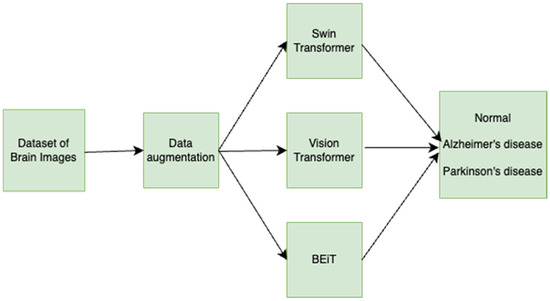
Figure 1.
Flowchart of Alzheimer’s and Parkinson’s disease classification.
4. Results
When examining the results of multi-class classification operations conducted on brain images for the diagnosis of Alzheimer’s and Parkinson’s diseases, the results obtained are provided in Table 1 and Figure 2 below. When analyzing the results in terms of accuracy, it is observed that results above 80% were achieved. The lowest loss value was obtained with the ViT model. When examining the accuracy, F1-score, precision, and recall evaluation metric results, the ranking of models from highest to lowest in all metrics is ViT, Swin, and BEiT, respectively. The highest metric results were found with the ViT model: 94.4% for accuracy, F1-score, and recall, and 94.7% for precision.

Table 1.
Multi-class classification all results.
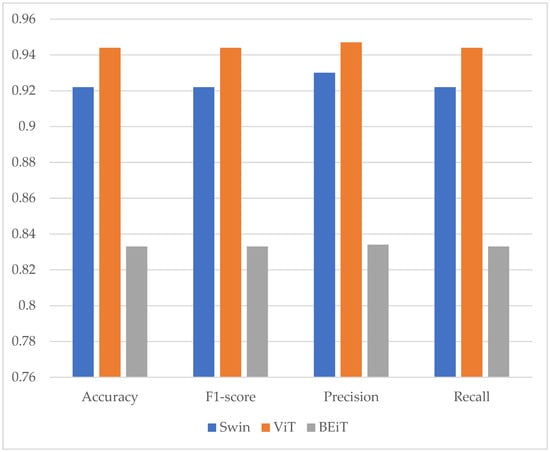
Figure 2.
Multi-class classification results.
5. Conclusions and Future Works
The study conducted multi-class classification operations on brain images shared as open source on the Kaggle platform to detect Alzheimer’s and Parkinson’s diseases. In this study, transformer-based models like Swin, ViT, and BEiT were used for classification, achieving accuracies of 92.2%, 94.4%, and 83.3%, respectively. When the results were analyzed, it was observed that the Swin and ViT models achieved close and high accuracy values, while the lowest accuracy value was obtained in the BEiT model. It was observed that ViT is the most suitable model for disease diagnosis for this classification problem. In future work, improving classification results could involve using different deep learning models, machine learning models, and combining these models via ensemble or hybrid approaches to develop new applications.
Funding
This research received no external funding.
Institutional Review Board Statement
Not applicable.
Informed Consent Statement
Not applicable.
Data Availability Statement
Data used in this study are available at https://www.kaggle.com/datasets/farjanakabirsamanta/alzheimer-diseases-3-class (accessed on 7 May 2024).
Conflicts of Interest
The author declares no conflicts of interest.
References
- Alzheimer’s Disease. Available online: https://www.mayoclinic.org/diseases-conditions/alzheimers-disease/symptoms-causes/syc-20350447 (accessed on 7 May 2024).
- Parkinson’s Disease. Available online: https://www.mayoclinic.org/diseases-conditions/parkinsons-disease/symptoms-causes/syc-20376055 (accessed on 7 May 2024).
- Balaji, P.; Chaurasia, M.A.; Bilfaqih, S.M.; Muniasamy, A.; Alsid, L.E.G. Hybridized Deep Learning Approach for Detecting Alzheimer’s Disease. Biomedicines 2023, 11, 149. [Google Scholar] [CrossRef] [PubMed]
- El-Latif, A.A.A.; Chelloug, S.A.; Alabdulhafith, M.; Hammad, M. Accurate Detection of Alzheimer’s Disease Using Lightweight Deep Learning Model on MRI Data. Diagnostics 2023, 13, 1216. [Google Scholar] [CrossRef] [PubMed]
- Saratxaga, C.L.; Moya, I.; Picón, A.; Acosta, M.; Moreno-Fernandez-de-Leceta, A.; Garrote, E.; Bereciartua-Perez, A. MRI Deep Learning-Based Solution for Alzheimer’s Disease Prediction. J. Pers. Med. 2021, 11, 902. [Google Scholar] [CrossRef] [PubMed]
- Battineni, G.; Hossain, M.A.; Chintalapudi, N.; Traini, E.; Dhulipalla, V.R.; Ramasamy, M.; Amenta, F. Improved Alzheimer’s Disease Detection by MRI Using Multimodal Machine Learning Algorithms. Diagnostics 2021, 11, 2103. [Google Scholar] [CrossRef] [PubMed]
- Ibrahim, R.; Ghnemat, R.; Abu Al-Haija, Q. Improving Alzheimer’s Disease and Brain Tumor Detection Using Deep Learning with Particle Swarm Optimization. AI 2023, 4, 551–573. [Google Scholar] [CrossRef]
- Baydargil, H.B.; Park, J.-S.; Kang, D.-Y. Anomaly Analysis of Alzheimer’s Disease in PET Images Using an Unsupervised Adversarial Deep Learning Model. Appl. Sci. 2021, 11, 2187. [Google Scholar] [CrossRef]
- Hazarika, R.A.; Maji, A.K.; Kandar, D.; Jasinska, E.; Krejci, P.; Leonowicz, Z.; Jasinski, M. An Approach for Classification of Alzheimer’s Disease Using Deep Neural Network and Brain Magnetic Resonance Imaging (MRI). Electronics 2023, 12, 676. [Google Scholar] [CrossRef]
- Chintalapudi, N.; Battineni, G.; Hossain, M.A.; Amenta, F. Cascaded Deep Learning Frameworks in Contribution to the Detection of Parkinson’s Disease. Bioengineering 2022, 9, 116. [Google Scholar] [CrossRef] [PubMed]
- Maskeliūnas, R.; Damaševičius, R.; Kulikajevas, A.; Padervinskis, E.; Pribuišis, K.; Uloza, V. A Hybrid U-Lossian Deep Learning Network for Screening and Evaluating Parkinson’s Disease. Appl. Sci. 2022, 12, 11601. [Google Scholar] [CrossRef]
- Carvajal-Castaño, H.A.; Pérez-Toro, P.A.; Orozco-Arroyave, J.R. Classification of Parkinson’s Disease Patients—A Deep Learning Strategy. Electronics 2022, 11, 2684. [Google Scholar] [CrossRef]
- Elshewey, A.M.; Shams, M.Y.; El-Rashidy, N.; Elhady, A.M.; Shohieb, S.M.; Tarek, Z. Bayesian Optimization with Support Vector Machine Model for Parkinson Disease Classification. Sensors 2023, 23, 2085. [Google Scholar] [CrossRef] [PubMed]
- Guven, M.; Uysal, F. A New Method for Heart Disease Detection: Long Short-Term Feature Extraction from Heart Sound Data. Sensors 2023, 23, 5835. [Google Scholar] [CrossRef] [PubMed]
- Özdaş, M.B.; Uysal, F.; Hardalaç, F. Classification of Retinal Diseases in Optical Coherence Tomography Images Using Artificial Intelligence and Firefly Algorithm. Diagnostics 2023, 13, 433. [Google Scholar] [CrossRef] [PubMed]
- Uysal, F.; Köse, M.M. Classification of Breast Cancer Ultrasound Images with Deep Learning-Based Models. Eng. Proc. 2023, 31, 8. [Google Scholar] [CrossRef]
- Güven, M.; Hardalaç, F.; Özışık, K.; Tuna, F. Heart Diseases Diagnose via Mobile Application. Appl. Sci. 2021, 11, 2430. [Google Scholar] [CrossRef]
- Özdaş, M.B.; Uysal, F.; Hardalaç, F. Super Resolution Image Acquisition for Object Detection in the Military Industry. In Proceedings of the 5th International Congress on Human-Computer Interaction, Optimization and Robotic Applications, Ankara, Türkiye, 8–10 June 2023. [Google Scholar]
- Uysal, F.; Erkan, M. Multiclass Classification of Brain Tumors with Various Deep Learning Models. Eng. Proc. 2022, 27, 30. [Google Scholar] [CrossRef]
- Peker, O.; Uysal, F.; Hardalaç, F. Boost Loss Functions for Better Change Detection. In Proceedings of the 3rd International Informatics and Software Engineering Conference, Ankara, Türkiye, 15–16 December 2022. [Google Scholar]
- Uysal, F.; Erkan, M. Evrişimsel Sinir Ağları Temelli Derin Öğrenme Modelleri Kullanılarak Beyin Tümörü Manyetik Rezonans Görüntülerinin Sınıflandırılması. EMO Bilimsel Dergi 2023, 13, 19–27. [Google Scholar]
- Kaggle. Available online: https://www.kaggle.com/datasets/farjanakabirsamanta/alzheimer-diseases-3-class (accessed on 7 May 2024).
- Liu, Z.; Lin, Y.; Cao, Y.; Hu, H.; Wei, Y.; Zhang, Z.; Lin, S.; Guo, B. Swin transformer: Hierarchical vision transformer using shifted windows. In Proceedings of the IEEE/CVF International Conference on Computer Vision, Virtual, 11–17 October 2021. [Google Scholar]
- Dosovitskiy, A.; Beyer, L.; Kolesnikov, A.; Weissenborn, D.; Zhai, X.; Unterthiner, T.; Dehghani, M.; Minderer, M.; Heigold, G.; Gelly, S.; et al. An image is worth 16x16 words: Transformers for image recognition at scale. In Proceedings of the International Conference on Learning Representations, Virtual, 4 May 2021. [Google Scholar]
- Bao, H.; Dong, L.; Piao, S.; Wei, F. Beit: Bert pre-training of image transformers. In Proceedings of the International Conference on Learning Representations, Virtual, 25 April 2022. [Google Scholar]
Disclaimer/Publisher’s Note: The statements, opinions and data contained in all publications are solely those of the individual author(s) and contributor(s) and not of MDPI and/or the editor(s). MDPI and/or the editor(s) disclaim responsibility for any injury to people or property resulting from any ideas, methods, instructions or products referred to in the content. |
© 2024 by the author. Licensee MDPI, Basel, Switzerland. This article is an open access article distributed under the terms and conditions of the Creative Commons Attribution (CC BY) license (https://creativecommons.org/licenses/by/4.0/).