


Abstract
Mobile edge computing (MEC), which is now gaining a lot of momentum, allows users to use its services with low latency, location awareness, and mobility assistance to offset the drawbacks of cloud computing. The quality of the experience, reduced latency, and boosted performance are the ultimate context-aware goals. There have been many context-aware efforts in the past. In this study, we reviewed many elements of the proposed context-aware approach for edge cloud computing, including their benefits and drawbacks. Additionally, we looked at such context-aware techniques to determine which were practical given the situation. We anticipate that the survey will be carefully considered in the creation of new context-aware methods. Future directions and problems have also been looked at.
1. Introduction
Edge computing became popular after the introduction of 5G networks and the Internet of Things. The mobility of applications and edge computing depends on the geographical distribution of resources. A node for edge computing only benefits those nearby. Since cloud computing allows application mobility by setting the location of the server and sending data to the server over the network, the mobile management of the application in edge computing is an entirely new approach. Context awareness in mobile computing is currently an effective approach for developing adaptive universal computing applications. One of the basic elements of ubiquitous computing is context awareness. Any information that can be utilized to describe the condition of an entity is considered a context. The user-related context (such as activity, mobility, and social interaction), the application-related context (such as application type, latency sensitivity, and application architecture), the physical or environmental context (location, time), the network-related context (such as bandwidth, network condition, communication, and traffic), and the device-related context (such as available resources, dataflow, and data size, remaining battery) are common context types. If a system can adjust its behavior to a specific scenario and provide appropriate data and/or services, it is said to be context-aware.
1.1. Cloud Computing
Until the introduction of edge computing, conventional cloud computing centralized storage and computational problems by sending all data across the network to the cloud computing center [1]. Today’s cloud computing has evolved. It offers a very strong basis for network services with distributed computing, balance of load, computing in parallel, network storage, and other technologies. But as the World Wide Web of Things permeates more aspects of everyday life, more devices are linked to it, and as a result, more data are being generated. The network bandwidth required for dependent-on-time applications and immediate efficacy has not been met by cloud computing [2].
1.2. Fog Computing
Fog computing seeks to minimize network traffic and latency between client devices and cloud servers. A fog node in fog computing systems may be overloaded due to an increase in end device requests. To address the needs of fog computing in this situation, an effective offloading mechanism among fog nodes is required. The size of the hardware components associated with these computing paradigms is largely responsible for the distinctions between cloud and fog computing. The high availability of data is provided through cloud computing. Computing resources have a proportionally high power consumption, while fog computing offers a reasonable availability of computing resources with a lower power usage [3].
1.3. Edge Computing
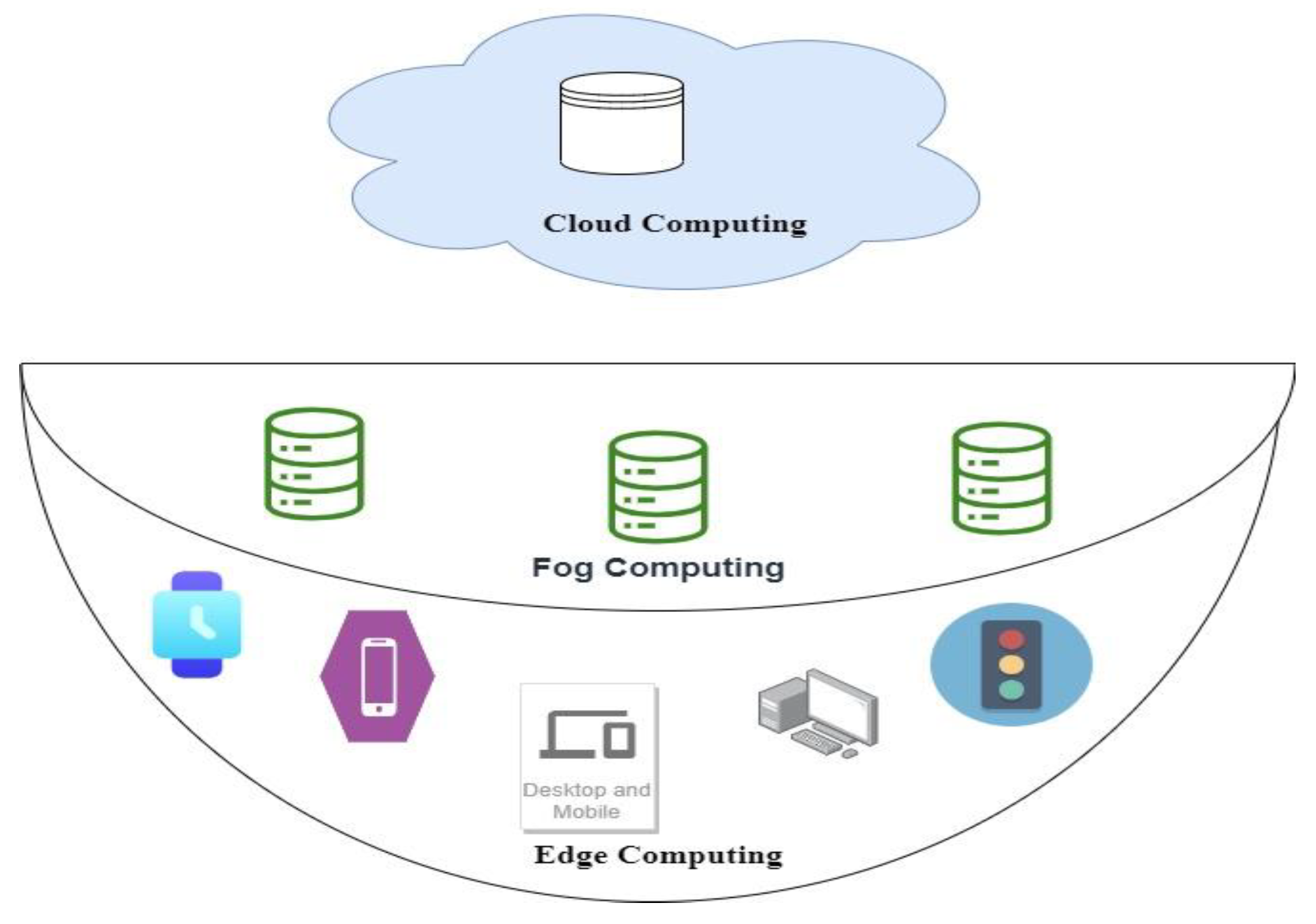
Edge computing is typical of conventional cloud computing. It may be a neglected computing perspective that handles processing at the array’s boundary. Its main objective is to make the calculation more connected to an accurate data source [4]. Edge computing aims to be the Internet of Things (IoT) solution of the future that solves a variety of issues, especially those associated with dependence on time and computation-based applications. Data processing with the network edge has several benefits, including lowering communication and collaboration burden; dismantling big designers [5]; providing enhanced efficiency, safety, and confidentiality; enabling tiny and big developers to participate in fostering future innovations; lowering the energy consumption of mobile nodes; and removing congestion from the main network (Figure 1).

Figure 1.
The cloud, fog computing, and edge computing scenario.
1.4. Paper Contribution and Organization
A complete, comprehensive review of the research on context-aware mobility in edge computing is presented in this article. It gives a thorough investigation of the context awareness that various edge computing entities currently offer. The goal of this case study is to help authors decide what further studies to pursue and obtain knowledge about how to produce context awareness by using and improving QoS (Quality of Service) needs. The following are this paper’s key contributions: A comprehensive review of context awareness is conducted, and its categorization is established. Mobility is compared based on essential components such as context-aware characteristics and efficiency measures, each with advantages as well as limitations.
The remaining section of the paper is structured as follows:
An overview of recent surveys on context awareness in edge computing is given in Section 2. Section 3 discusses context awareness, contextual information, context representation, context modeling, and the classification of context awareness. Section 4 discusses challenges and future directions. Section 5 concludes this paper.
2. Related Work
For context-awareness based on cloud, fog, and edge computing, many surveys have been proposed. In the next part, we evaluate comparable survey publications and discuss their advantages and limitations. Table 1 summarizes these subsections and compares them with our survey.

Table 1.
Summary of edge computing in context: awareness of advantages and limitations used in this paper.
M Ma, et al. [17] propose enabling real-time context awareness and decision-making in IoT edge systems with a high-efficiency joint event inference model to allow multi-pattern optimization. We construct several types of redundancy relations across event inference models and provide an explanation mechanism called an event-containing graph. Merge, fail, and output are three operations on single-pattern event inference models.
Chatterjee et al. [18] provide the most efficient techniques for in-sensor analytics that allow for the measurement of energy usage in a large area. Through event-driven communication of temporally compressed data without losing more than 1% of the information, spatial data compression with collaborative intelligence, and context-aware cluster head switching during CI for a longer network lifetime, WSNs (wireless sensor networks) reduce the degree of duplication in the transmitted data.
Zhao, P, et al.’s [19] network with context-UCB, a model-free online ML method, has been presented as a resource allocation technique. It may provide an image of AI by dynamically adjusting the TDD configuration for each period based on the localized environment and MAB.
Liao, H, et al. [20] proposed a manner of training the selection that considers service security, energy use, and backlog awareness and can increase throughput by between 30% and 36% compared to random selection and the UCB.
Chen, X, et al. [21] presented C2-EXP3, a context-aware EXP3-based channel selection method for CM2M communications with the coexistence of licensed and unlicensed spectrum. Comparing C2-EXP3 to EXP3, random selection, C2-UCB, and UCB, C2-EXP3 may increase utility by 5.77%, 15.06%, 48.29%, and 59.91% while stabilizing the data queue and meeting the constraints of energy usage and service stability.
3. Context Awareness
“Any information that can be utilized to characterize the situation of an entity” is referred to as context. A person, place, or thing that is considered important to the relationship between a user and an application is known as an entity [22].
3.1. Contextual Information
The term “context” can also refer to a description of a particular entity scenario, such as a user’s profile, environment, social interactions, or activity. We may, for instance, create the context based on location information and the entity based on the user by enhancing the individualization and usability of sensor network services; context becomes a much richer and more powerful term in this sense, especially for mobile users.
3.2. Context Representation
In context-aware applications, a sensor is described as both a physical object and a potential data source. For the representation of context, in terms of the specification and projection of an occurrence onto a thing in the digital world from the real world, the collected contextual information may vary significantly.
3.3. Context Modelling
An efficient context modeling strategy tries to make programs more adaptable and maintainable for future development while lowering their complexity for robustness and usability. To be able to achieve that, a variety of context sources from any level of abstraction must exhibit variability (i.e., defects of a dynamic nature), similarity (i.e., the presence of identical context from different sources), and mobility (i.e., delayed, timeless data collection).
3.4. Classification of Context Awareness
The low-level contexts that correspond to the different levels of complexity are then used to identify the high-level context, the context of the device, such as its net connectivity, the resources and cost of communications, etc. User context includes the user’s profile, location, neighbors, and social context, among other things. The environment includes things like humidity, volume, brightness, and traffic conditions. Historical context comprises, among other things, the current day, week, period, time of year, (Figure 2), etc.

Figure 2.
Classification of context awareness in edge computing [22].
4. Challenges and Future Direction
The prospective priorities for this study are derived from the comprehensive evaluation of the research, including designing a user-context-aware mobile experience based on awareness of context at various levels and contextual information for mobile devices and users to improve communication and computational support, as well as optimizing resource use and meeting deadlines for service delivery, taking advantage of mobility and user-customized settings, and developing an approach that is effective for obtaining and utilizing cross-domain connections. The notion of exchanging context and minimizing the delay for context sharing across edge nodes and creating efficient mobility management while taking device power and mobility reliance into account and enhancing application placement rules by combining user- and device-level contexts was also analyzed. Utilizing context information like budget, cost, and time to react, mobility management was evaluated. Using interoperability to fulfill QoS criteria requires context awareness.
5. Conclusions
The context awareness of the edge computing paradigm and a complete literature analysis are presented in this study. The outcomes of this survey have been investigated in several ways. Use application, device, environmental, network, and user contexts are the five categories it uses to categorize the context of edge computing. Furthermore, the use of context-aware parameters and performance indicators, along with an evaluation of various strategies and a thorough analysis of all parameters, were studied. Additionally, the benefits and drawbacks of each context-specific method were examined. The edge cloud is still in its early stages, so more work is still needed. We predict that the survey we have just provided will serve as an entry point into the edge cloud world and be advantageous for both the research and business communities.
Author Contributions
Conceptualization, V.M. and B.K.; methodology, V.M. and B.K.; investigation, V.M. and B.K.; writing—original draft preparation, V.M. and B.K.; writing—review and editing, V.M. and B.K. All authors have read and agreed to the published version of the manuscript.
Funding
This research received no external funding.
Institutional Review Board Statement
Not applicable.
Informed Consent Statement
Not applicable.
Data Availability Statement
Data are contained within the article.
Conflicts of Interest
The authors declare no conflicts of interest.
References
- Cao, K.; Liu, Y.; Meng, G.; Sun, Q. An overview of edge computing research. IEEE Access 2020, 8, 85714–85728. [Google Scholar] [CrossRef]
- Giurgiu, I.; Riva, O.; Juric, D.; Krivulev, I.; Alonso, G. Calling the cloud: Enabling mobile phones as interfaces to cloud applications. In Proceedings of the Middleware 2009: ACM/IFIP/USENIX, 10th International Middleware Conference, Urbana, IL, USA, 30 November–4 December 2009; Proceedings 10. Springer: Berlin/Heidelberg, Germany, 2009; pp. 83–102. [Google Scholar]
- Pan, J.; McElhannon, J. Future edge cloud and edge computing for Internet of Things applications. IEEE Internet Things J. 2017, 5, 439–449. [Google Scholar] [CrossRef]
- Satyanarayana, M. The emergence of edge computing. Computer 2017, 50, 30–39. [Google Scholar] [CrossRef]
- Abowd, G.D.; Dey, A.K.; Brown, P.J.; Davies, N.; Smith, M.; Steggles, P. Towards a better understanding of context and context-awareness. In Handheld and Ubiquitous Computing: First International Symposium, HUC’99 Karlsruhe, Germany, 27–29 September 1999; Springer: Berlin/Heidelberg, Germany, 1999. [Google Scholar]
- Truong, H.L.; Truong-Huu, T.; Cao, T.D. Making distributed edge machine learning for resource-constrained communities and environments smarter: Contexts and challenges. J. Reliab. Intell. Environ. 2023, 9, 119–134. [Google Scholar] [CrossRef]
- Liu, Z.; Sheng, Q.Z.; Xu, X.; Chu, D.; Zhang, W.E. Context-aware and adaptive QoS prediction for mobile edge computing services. IEEE Trans. Serv. Comput. 2019, 15, 400–413. [Google Scholar] [CrossRef]
- Chen, Z.; Zhang, S.; Ma, Z.; Zhang, S.; Qian, Z.; Xiao, M.; Wu, J.; Lu, S. An online approach for DNN model caching and processor allocation in edge computing. In Proceedings of the 2022 IEEE/ACM 30th International Symposium on Quality of Service (IWQoS), Oslo, Norway, 10–12 June 2022; IEEE: Piscataway, NJ, USA; pp. 1–10. [Google Scholar]
- Aranda, J.A.S.; dos Santos Costa, R.; de Vargas, V.W.; da Silva Pereira, P.R.; Barbosa, J.L.V.; Vianna, M.P. Context-aware Edge Computing and Internet of Things in Smart Grids: A systematic mapping study. Comput. Electr. Eng. 2022, 99, 107826. [Google Scholar] [CrossRef]
- Yang, Y.; Feng, L.; Que, X.; Zhou, F.; Li, W. Energy-and Quality-Aware Task Offloading for WebVR Service in Terminal-Aided Mobile Edge Network. IEEE Trans. Veh. Technol. 2022, 71, 8825–8838. [Google Scholar] [CrossRef]
- Sellami, B.; Hakiri, A.; Yahia, S.B.; Berthou, P. Energy-aware task scheduling and offloading using deep reinforcement learning in SDN-enabled IoT network. Comput. Netw. 2022, 210, 108957. [Google Scholar] [CrossRef]
- Fu, M.; Fang, W.; Gao, S.; Hong, J.; Chen, Y. Edge computing-driven scene-aware intelligent augmented reality assembly. Int. J. Adv. Manuf. Technol. 2022, 119, 7369–7381. [Google Scholar] [CrossRef]
- Wang, G.; Xu, F.; Zhang, H.; Zhao, C. Joint resource management for mobility-supported federated learning in the Internet of Vehicles. Future Gener. Comput. Syst. 2022, 129, 199–211. [Google Scholar] [CrossRef]
- Zhou, P.; Gong, S.; Xu, Z.; Chen, L.; Xie, Y.; Jiang, C.; Ding, X. Trustworthy and context-aware distributed online learning with autoscaling for content caching in collaborative mobile edge computing. IEEE Trans. Cogn. Commun. Netw. 2021, 7, 1032–1047. [Google Scholar] [CrossRef]
- Tefera, G.; She, K.; Shelke, M.; Ahmed, A. Decentralized adaptive resource-aware computation offloading and caching for multi-access edge computing networks. Sustain. Comput. Inform. Syst. 2021, 30, 100555. [Google Scholar] [CrossRef]
- Shahidinejad, A.; Farah Bakhsh, F.; Ghobadi-Arani, M.; Malik, M.H.; Anwar, T. Context-aware multi-user offloading in mobile edge computing: A federated learning-based approach. J. Grid Comput. 2021, 19, 18. [Google Scholar] [CrossRef]
- Ma, M.; Wang, P. Efficient event inference and context-awareness in the Internet of Things edge systems. IEEE Trans. Big Data 2019, 8, 658–670. [Google Scholar] [CrossRef]
- Chatterjee, B.; Seo, D.H.; Chakraborty, S.; Avlani, S.; Jiang, X.; Zhang, H.; Sen, S. Context-aware collaborative intelligence with spatiotemporal in-sensor analytics for efficient communication in a large-area IoT testbed. IEEE Internet Things J. 2020, 8, 6800–6814. [Google Scholar] [CrossRef]
- Zhao, P.; Tian, H.; Chen, K.C.; Fan, S.; Nie, G. Context-aware TDD configuration and resource allocation for mobile edge computing. IEEE Trans. Commun. 2019, 68, 1118–1131. [Google Scholar] [CrossRef]
- Liao, H.; Zhou, Z.; Zhao, X.; Zhang, L.; Mumtaz, S.; Jolfaei, A.; Bashir, A.K. Learning-based context-aware resource allocation for edge-computing-empowered industrial IoT. IEEE Internet Things J. 2019, 7, 4260–4277. [Google Scholar] [CrossRef]
- Liao, H.; Chen, X.; Zhou, Z.; Liu, N.; Ai, B. Licensed and unlicensed spectrum management for cognitive M2M: A context-aware learning approach. IEEE Trans. Cogn. Commun. Netw. 2020, 6, 915–925. [Google Scholar] [CrossRef]
- Islam, M.S.U.; Kumar, A.; Hu, Y.C. Context-aware scheduling in Fog computing: A survey, taxonomy, challenges, and future directions. J. Netw. Comput. Appl. 2021, 180, 103008. [Google Scholar] [CrossRef]

Disclaimer/Publisher’s Note: The statements, opinions and data contained in all publications are solely those of the individual author(s) and contributor(s) and not of MDPI and/or the editor(s). MDPI and/or the editor(s) disclaim responsibility for any injury to people or property resulting from any ideas, methods, instructions or products referred to in the content. |
© 2024 by the authors. Licensee MDPI, Basel, Switzerland. This article is an open access article distributed under the terms and conditions of the Creative Commons Attribution (CC BY) license (https://creativecommons.org/licenses/by/4.0/).