


Abstract
This research paper unveils an all-encompassing literature exploration into “nudging” in digital platforms and its profound impact on the user experience. This study delved into various sources spanning academic research papers, corporate reports, books, and online publications, acquired through a thorough four-step approach. The methodology entailed unearthing pertinent sources via diverse academic databases and industry networks, and a diligent review process to estimate their relevance and calibre. Data extraction from each selected source focused on the employed nudge techniques, underlying behavioural principles, and their repercussions on the user experience. The findings were subsequently synthesised to unearth the existing literature’s prevalent themes, disparities, and prospective gaps. The paper underscores the importance of nudging as a potent driver of user actions while safeguarding their autonomy. We employed a comprehensive approach to explore nudging application and influences on digital platforms, including academic database searches, corporate reports, and web blogs. We thoroughly extracted data on platform types, nudging strategies, behavioural theories, and user experience influences and impacts. Our study deliberates on potential future research trajectories, encompassing ethical considerations and personalised nudging methodologies. Ultimately, this study underscores how applying nudge techniques in the architecture of digital platforms can elevate user experiences and confer value upon both users and providers. However, the findings acknowledge the inherent limitations that accompany any literature review and may not encapsulate every facet of the subject matter.
1. Introduction
“Nudging” has emerged as a new and revolutionary instrument in public policy and decision-making due to the pioneering work of renowned behavioural economist Richard Thaler and legal scholar Cass Sunstein [1]. A nudge is intentionally using cognitive biases to influence people’s conduct in certain situations. This notion has sparked heated debates in various businesses and has gained universal approval among legislators worldwide.
In recent years, a cutting-edge strategy known as “digital nudging” has gained popularity, combining basic notions of behavioural psychology with advanced digital technology to discreetly modify user behaviour inside digital platforms [2]. Digital nudging may successfully steer customers towards pre-determined selections by gently altering user interfaces, adjusting feedback, and applying strategic design components, notably in digital food choice settings [3].
Nevertheless, as digital nudging becomes popular, worries about its ethical consequences have emerged [4]. While digital nudging can potentially improve user experiences in digital domains, ethical quandaries must be addressed, and its application must ensure inclusivity. Specific ethical principles and a more comprehensive discussion regarding the moral appropriateness of digital nudging have become obvious [4]. Understanding the nature of a nudge in the digital age demands tackling the ethical implications of its use.
Despite its broad application in political decision-making, research into its efficacy is continuing [5]. Some studies have questioned its use and discovered unintended results. Understanding the advantages and limitations of nudging necessitates a quantitative evaluation of its effectiveness, especially in digital contexts [5]. As experts such as Hummel et al. point out, systematic reviews provide critical information for policymakers trying to improve policy design across various digital platforms [5].
The user experience inside digital platforms is critical in shaping user behaviour and decision-making in today’s ever-changing digital world. The notion of “nudging,” which has its roots in the study of behavioural economics, has emerged as a viable approach for discreetly directing people to desirable behaviours while protecting their freedom of choice. Understanding the influence of nudging on user behaviour is becoming more critical as digital platforms become more integrated into our everyday lives.
This article delves deeply into the user experience on digital platforms regarding the art of motivating user activity. We traverse the rationale underlying encouraging techniques, scrutinise specific methods used in various situations, delve into the bedrock of behavioural principles, and assess the profound influence these techniques have on user behaviour through an extensive and meticulous literature review.
According to data from several sources, nudging tactics effectively change user perceptions, preferences, and interactions in the digital environment. This analysis offers politicians, designers, and academics essential insights as they attempt to improve user experiences and build more fascinating and meaningful digital interactions for users and providers alike while carefully navigating the maze of ethical issues.
2. Methodology
A profound exploration was undertaken to delve into the domain of “nudging,” its utilisation in digital platforms, and its impacts on user experience. An extensive array of sources was scoured to cultivate an extensive comprehension of this subject matter, comprising academic research papers, scholarly books, corporate exposés, and online treatises. This educational endeavour employed a meticulous four-step procedure: identifying pertinent sources, scrutinising said sources, dissection the discoveries, and amalgamating the resultant insights.
Several precise measures must be followed to conduct a full analysis of nudging use and effects on digital platforms for this study. These processes are intended to ensure that the review is objective, thorough, and recognises any limitations.
2.1. Identifying Relevant Sources
To begin, we searched academic databases for keywords and phrases such as “nudging”, “digital platforms”, “user experience” and “behavioural economics”. The purpose of this study is to acquire access to peer-reviewed English papers that have been approved and published in reputable journals. In addition to sources from academia, it is vital to broaden the reach by getting corporate reports and white papers from company websites and professional networks like LinkedIn. This technique will provide essential insights into the industry. In addition, relevant web blogs, articles, and outlook pieces are evaluated, which are critical for gaining diverse perspectives on the problem.
2.2. Analysing the Findings
Once the relevant sources are identified, the following step is to extract useful information in a systematic and structured manner. This involves gathering information on a variety of topics, including the types of digital platforms used, the nudging strategies used, the underlying behavioural theories driving these tactics, and the impact of nudging on user experience. During the data extraction process, it is also critical to take note of any other important information, notably ethical considerations. This methodical technique guarantees that this study provides a thorough understanding of the subject.
2.3. Synthesising the Results
Following the data extraction phase, the emphasis moves to the results synthesis. This entails gathering and synthesising data from all included sources to uncover common themes and patterns in the data. As a result, the assessment can give valuable insights on how nudging is used on digital platforms, as well as its effects on the behaviour and experience of users.
2.4. Comprehensive and Objective Approach
It is critical to maintain a complete and objective approach throughout the evaluation process. The goal is to thoroughly evaluate nudging and to accumulate significant material to significantly add to research topics. However, it is critical to recognise that the conclusions are constrained by the limitations of the included research. These limits may include possible source selection constraints, which might result in insufficient coverage of the issue. To overcome this, precise procedures and manoeuvres must be detailed to ensure a full and valuable evaluation.
To summarise, conducting an in-depth investigation of nudging application and impacts on digital platforms necessitates a scientific approach to source identification, data analysis, and results synthesis. It should be approached honestly, with an awareness of potential limitations and a commitment to providing useful insights into this complicated issue.
3. Summary of Key Insights
The literature review includes a range of publications from 2013 to 2023, reflecting a decade of research and insights into the field of digital nudging on various platforms. These sources collectively provide a comprehensive understanding of the concept, its evolution, and its impact on user behaviour and experienceable. Table 1 presents a summary of the nudging process, accompanied by a brief description of each step.

Table 1.
Summary of the nudging process, along with a brief description of each step.
3.1. The Use of Nudging on Digital Platforms
Mills (2020) explores how Amazon, renowned for orchestrating behavioural nudges to elevate customer experience, has ingeniously tailored its tactics amidst the COVID-19 whirlwind. In the past, the “Recommended for You” section would conjure personalised product suggestions, but now it unfurls alluring advertisements for Amazon’s streaming marvels [6].
This transformation mirrors the company’s deft response to the surge in online cravings and the potential snags in order fulfilment due to the need for more available staff. By nudging customers towards the digital realm, Amazon endeavours to foment purchases that demand less physical exertion and logistical wizardry [6]. This adaptation vividly illustrates the seamless integration of behavioural economics into crisis-infused business strategies. Although Amazon may currently revel in fleeting triumphs, the lingering ambiguities cast a shadow on its long-term prospects. The captivating case study of Amazon’s nudging gambit amid the pandemic bequeaths invaluable insights into the intricate symbiosis of behavioural science and business stratagems in these uncharted times [6].
A major e-commerce company masterfully employs the nudge theory in their marketing ploy by instigating urgency to incite coveted reactions from customers. They wield a time-constrained voucher emblem beneath select products, propelling intrigued customers to execute impulsive purchases before the offer dissipates. This urgency nudge is crafted to instil a gnawing fear of relinquishing the deal, goading customers to act with haste. Amazon’s nudge marketing scheme also encompasses harnessing seasonal markdowns, flaunting stock availability, incorporating ticking timers, showcasing the tally of customers perusing the offer, and deploying urgent language in their discourse. By implementing these nudge techniques, the company maximises conversions and fosters expeditious decision-making among its clientele [7].
The same e-commerce company also skilfully employs behavioural nudges to boost sales in these nudge marketing examples from the same source. The model showcases a scarcity nudge, where the company generates a sense of urgency by asserting that only one copy of a product remains in stock. This scarcity nudge compels visitors to swiftly decide on a purchase, fearful of missing out on the final available item. The image depicting this example is labelled as Figure 1a.
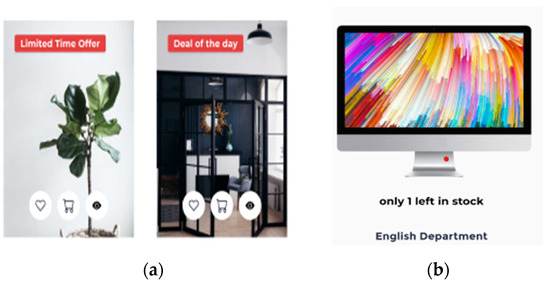
Figure 1.
(a) Scarcity nudge—urgency to buy on an e-commerce site; (b) strategies for implementing scarcity nudge marketing. The images (a,b) here are hypothetical and not actual representations of the website described in the summary.
The second example of nudge marketing also accentuates the utilisation of scarcity, guiding the effective implementation of this strategy. Retailers are advised to employ scarcity nudges judiciously to avoid a detrimental impact on customers. By exhibiting the number of items left in stock, scarcity appears more credible, propelling customers to act promptly. Also, emphasising immediate purchase incentives can spur customers to make swift decisions. The image illustrating these tips is designated as Figure 1b.
Nudge marketing presents a potent approach to influencing customer behaviour, and Amazon’s adept utilisation of scarcity nudges exemplifies their efficacy in driving conversions and sales. Table 2 outlines the key findings from the reviewed literature, highlighting the nudging technique and its applications in digital platforms.
Table 2.
Summary of reviewed literature on nudging technique and application of nudging in digital platforms.
3.2. Effects of Nudging on User Experience:
In numerous digital and commercial environments, nudging has shown to be a vital tool for favourably influencing user behaviour and decision-making. Nudging in commercial contexts boosted the number of nudged products added to shopping carts by 17%, according to Katner and Jianu (2019), with Nudge C being the most successful. User trust was maintained, and some users thought the version that required more nudges was technically superior. Mirsch, Lehrer, and Jung (2017) observed that Amazon’s system shows products purchased by others who bought the same item, influencing users to make similar purchase decisions [12,13]. According to Mejtoft et al. (2019), a fascinating user experience design firmly persuaded people to favour the plug over the standard socket. In contrast, a poor UX design caused uncertainty between the two alternatives [14]. Table 3 shows a summary of what we found in the literature about how nudging affects user experience.
Table 3.
Summary of reviewed literature on the effects of nudging on user experience.
Nudging, employing environmental adjustments to influence behaviour without restricting choices [18], can yield unintended consequences [19]. While nudges aim to foster healthier choices and societal benefits, challenges in implementation and unexpected outcomes persist [20]. The impact varies across individuals and subgroups, with some experiencing adverse effects on behaviour and welfare [21]. Recognising this, understanding distributional effects becomes crucial for informed, personalised policymaking [21]. To optimise social welfare and ensure distributive justice, targeted, personalised nudging may be imperative [22].
4. Conclusions
Nudging is a powerful technique for influencing user behaviour and decision-making in the digital realm. Digital nudging uses behavioural economics and modern digital technology to transform user experiences on digital platforms. Well-designed nudges can increase user engagement, evoke desired behaviours, and improve decision-making processes. Nudging has also proven itself in the shopping environment, where it can increase acceptance of nudge products in the shopping cart. However, there are also ethical considerations when using nudging techniques. Politicians, designers, and scientists are confronted with these frontal challenges. Various digital boost tactics, including emergency boost, scatter boost, defaults, and social information, have been identified. Each strategy has potential and problems for influencing user behaviour in digital situations. The push can be used to improve the online grocery system, charity functions on e-commerce platforms, presentation skills in educational institutions, and decision-making processes. Further quantitative assessments of hibernation, especially in the digital context, are needed. Future research should also focus on personalised nudging approaches and digital-specific issues. Nudging has become a significant driver of user activity on digital platforms as it enhances the user experience while maintaining individuality. The research findings presented in this paper highlight the strong impact of nudging techniques on user behaviour and decision-making in digital and commercial settings. These studies imply that well-designed nudges can suggestively influence user choices, from increasing sales and boosting engagement to enhancing user trust and improving decision-making processes. The practical suggestions of these findings extend to both academia and the real world, offering valuable insights for businesses, policymakers, and designers seeking to optimise user experiences, drive conversions, and shape behaviour in an increasingly digital and competitive domain. These findings highlight the potential of nudging as a powerful tool for achieving desired outcomes and fostering positive user interactions across various domains. By carefully considering ethical issues and implementing tailored approaches, digital media can leverage the momentum to improve user interactions, benefit both users and providers, deliver more engaging digital experiences, and be meaningful to all users.
5. Ethical Considerations
The ethical considerations in this comprehensive paper revolve primarily around responsible access to and use of data rather than data collection. The lack of direct data collection eliminates concerns about user consent and data privacy.
Author Contributions
Conceptualisation, N.J.V. and R.D.S.; Methodology, N.J.V. and R.D.S.; Writing—Original Draft, N.J.V. and R.D.S.; Writing—Review and Editing, D.K.S.; Supervision, T.T.; Critical Revisions and Insights, S.R.B. and N.P. All authors have read and agreed to the published version of the manuscript.
Funding
This research received no external funding.
Institutional Review Board Statement
Not applicable.
Informed Consent Statement
Not applicable.
Data Availability Statement
Data sharing does not apply to this paper.
Conflicts of Interest
The authors declare no conflict of interest.
References
- Congiu, L.; Moscati, I. A review of nudges: Definitions, justifications, effectiveness. J. Econ. Surv. 2021, 36, 188–213. [Google Scholar] [CrossRef]
- Sobolev, M. Digital nudging: Using technology to nudge for good. In Behavioral Science in the Wild; Soman, D., Mazar, N., Eds.; University of Toronto Press: Toronto, ON, Canada, 2022; pp. 292–299. [Google Scholar]
- Piper, J.; Adam, M.T.; De Vlieger, N.; Collins, C.; Bucher, T. A Bibliometric Review of Digital Nudging within Digital Food Choice Environments. In Proceedings of the ACIS 2021, DeKalb, IL, USA, 7–9 October 2021. [Google Scholar]
- Lembcke, T.-B.; Engelbrecht, N.; Brendel, A.; Kolbe, L. To Nudge or Not to Nudge: Ethical Considerations of Digital Nudging Based on Its Behavioral Economics Roots; ECIS: Singapore, 2019. [Google Scholar]
- Hummel, D.; Maedche, A. How effective is nudging? A quantitative review on the effect sizes and limits of empirical nudging studies. J. Behav. Exp. Econ. 2019, 80, 47–58. [Google Scholar] [CrossRef]
- Mills, S. Amazon Is Changing How It Nudges in Response to Coronavirus. Available online: https://medium.com/swlh/amazon-is-changing-how-it-nudges-in-response-to-coronavirus-c4b47cfba45d (accessed on 30 July 2023).
- 30 Best Examples of Nudge Marketing in Ecommerce. Available online: https://www.convertcart.com/blog/nudge-marketing-examples (accessed on 30 July 2023).
- Jesse, M.; Jannach, D.; Gula, B. Digital nudging for online food choices. Front. Psychol. 2021, 12, 729589. [Google Scholar] [CrossRef] [PubMed]
- Meske, C.; Amojo, I.; Mohr, P. Digital nudging to increase usage of charity features on e-commerce platforms. In Proceedings of the 15th International Conference on Wirtschaftsinformatik, Potsdam, Germany, 8–11 March 2020; pp. 1203–1218. [Google Scholar] [CrossRef]
- Mirsch, T.; Lehrer, C.; Jung, R. Making Digital Nudging Applicable: The Digital Nudge Design Method. In Proceedings of the International Conference on Interaction Sciences, San Francisco, CA, USA, 13–16 December 2018. [Google Scholar]
- Schneider, C.; Weinmann, M.; vom Brocke, J. Digital nudging—Guiding Choices by Using Interface Design. Commun. ACM 2018, 61, 67–73. [Google Scholar] [CrossRef]
- Katner, K.; Jianu, R. The effectiveness of nudging in commercial settings and impact on User Trust. In Proceedings of the 2019 CHI Conference on Human Factors in Computing Systems, Glasgow, UK, 4–9 May 2019. Extended Abstracts. [Google Scholar]
- Mirsch, T.; Lehrer, C.; Jung, R. Digital Nudging: Altering User Behavior in Digital Environments. In Proceedings of the 13th International Conference on Wirtschaftsinformatik (WI) 2017, St. Gallen, Switzerland, 12–15 February 2017; pp. 634–648. [Google Scholar]
- Mejtoft, T.; Ristiniemi, C.; Söderström, U.; Mårell-Olsson, E. User experience design and digital nudging in a decision making process. In Proceedings of the 32nd Bled eConference Humanizing Technology for a Sustainable Society, Bled, Slovenia, 16–19 June 2019. [Google Scholar] [CrossRef]
- Wang, Y.; Leon, P.G.; Scott, K.; Chen, X.; Acquisti, A.; Cranor, L.F. Privacy nudges for Social Media. In Proceedings of the 22nd International Conference on World Wide Web, Rio de Janeiro, Brazil, 13–17 May 2013. [Google Scholar]
- Esposito, G.; Hernández, P.; van Bavel, R.; Vila, J. Nudging to prevent the purchase of Incompatible Digital Products Online: An experimental study. PLoS ONE 2017, 12, e0173333. [Google Scholar] [CrossRef] [PubMed]
- Wijland, R.; Hansen, P.; Gardezi, F. Mobile nudging: Youth engagement with banking apps. J. Financ. Serv. Mark. 2016, 21, 51–63. [Google Scholar] [CrossRef]
- Shatz, I. (No Date) Effectiviology. Available online: https://effectiviology.com/nudge/ (accessed on 31 October 2023).
- O’Hara, R.E. The Unexpected Effects of Nudging. Available online: https://www.psychologytoday.com/us/blog/nudging-ahead/201907/the-unexpected-effects-nudging (accessed on 31 October 2023).
- Mullett, T. What Are the Advantages and Disadvantages of Nudging? News. Available online: https://www.wbs.ac.uk/news/what-are-the-advantages-and-disadvantages-of-nudging/ (accessed on 31 October 2023).
- Thunström, L. Good for Some, Bad for Others: The Welfare Effects of Nudges. Available online: https://www.behavioraleconomics.com/good-for-some-bad-for-others-the-welfare-effects-of-nudges/ (accessed on 31 October 2023).
- Sunstein, C.R. The distributional effects of nudges. Nat. Hum. Behav. 2021, 6, 9–10. [Google Scholar] [CrossRef] [PubMed]
Disclaimer/Publisher’s Note: The statements, opinions and data contained in all publications are solely those of the individual author(s) and contributor(s) and not of MDPI and/or the editor(s). MDPI and/or the editor(s) disclaim responsibility for any injury to people or property resulting from any ideas, methods, instructions or products referred to in the content. |
© 2023 by the authors. Licensee MDPI, Basel, Switzerland. This article is an open access article distributed under the terms and conditions of the Creative Commons Attribution (CC BY) license (https://creativecommons.org/licenses/by/4.0/).