


Abstract
Phase loss is a typical problem in the optical domain, and optical detectors only measure the amplitude distribution of a signal without its phase. However, an optimal phase is desired in a variety of practical applications, such as optical metrology, nondestructive testing, and quantitative microscopy. Several methods have been proposed to quantitatively measure phase, among which interferometry is one of the most commonly used. An intensity interferometer has also been used to recover phase and enhance the phase difference measurement via the intensity correlation. In this paper, we present and examine another technique based on the Stokes correlation for enhancing phase measurement by a factor of two. The enhancement in phase measurement is accomplished through an evaluation of the correlation between two points of Stokes fluctuations of randomly scattered light and by recovering the enhanced phase of the object by using three-step phase shifting along with the Stokes correlations. This technique is expected to be useful for imaging and the experimental measurement of the phase of a weak signal.
1. Introduction
Among the most active areas of research in contemporary physics is optical metrology [1], which aims to increase measurement accuracy. This encourages the study of novel phenomena and the advancement of fundamental research. Phase measurement is important in metrology for measuring length, speed, rotation vibration, etc. Phase loss is a common problem in the optical domain, and optical detectors only measure the amplitude distribution of a signal without its phase. Several methods have been proposed to quantitatively measure phase [2], among which interferometry is one of the most commonly used. However, the majority of these methods are only capable of detecting the phase profile of a phase object in free space or homogeneous media. Intensity interferometers have also been used to recover the phase and enhance the phase difference measurement according to the intensity correlation [3,4]. Measuring weak phase information is a common problem in this regard. It has been suggested that the enhancement of the phase during measurement might increase precision and phase resolution.
In this paper, we present and examine a highly stable non-interferometric technique for recovering and enhancing phase measurement by a factor of two through scattering media. This is realized using a two-point Stokes correlation along with three-step phase shifting [5]. Our method employs the complex polarization correlation function (CPCF), which provides a complex Fourier coefficient and enhanced phase measurement. The complex Fourier coefficient retrieves information on the complex amplitude and uses it to extract enhanced phase information. The pilot-assisted strategy, which loads a phase object into one of the orthogonal polarization states, is employed to design a compact, highly stable, and robust noninterferometric setup. The two stokes parameters and are used as the theoretical basis of our method.
2. Theory
Consider a polarized, coherent light source that is traveling along the z-axis and has two orthogonal polarization states: x and y. A phase object is loaded on one polarization state of the beam and the other is left unloaded. At the transverse plane z = 0, the complex field of coherent-polarized light is represented as follows:
where represent the x and y polarization components of the beam, respectively. A light beam (given in Equation (1)) passes through the random scattering media and travels to the detection plane, which is located at any random distance z as determined by the Fresnel diffraction formula. At the arbitrary distance z, the scattered field is represented as follows:
where exp {} is a propagation kernel, and k is a wavenumber. The position vector at the detector plane and source are denoted by r and ȓ, respectively, and the diffuser introduces a random phase (ȓ). Pauli spin matrices are used to define the Stokes parameter of the scattered field as follows:
σ0 is the identity matrix, and σ1, σ2, and σ3 are the Pauli spin matrices of a 2 × 2 order. The Stokes fluctuation around the mean value of the SPs is as follows:
where brackets (< >) represent the ensemble average. Let us consider that the behavior of the random light beam corresponds to Gaussian statistics; accordingly, the Gaussian moment theorem is used to illustrate the SPs’ fluctuations as follows:
From the above equation, C22() and C33() are calculated. The real parts of the CPCF are obtained by subtracting C33 (r1,r2) from C22(r1,r2) as follows:
where .
Now, we use Equation (6) in the development of a phase recovery and enhancement method through scattering media. Here, a phase object named vortex beam, i.e., with a topological charge l and an azimuthal index , is loaded into the x-polarized state, while the y-polarized state is reserved as a reference beam, i.e., , where A and B represent the amplitude distribution of the vortex beam and the plane beam, respectively. The values of and are substituted into Equation (6). Therefore, Equation (6) transforms [6] into
Consequently, Equation (7) is combined with the three-step phase-shifting method [7] to obtain CPCF, which is given below
where (), ), and indicate the real components of the CPCF with a phase shift of , respectively. C( is our required quantity and is utilized to recover and enhance the phase measurement of the phase object.
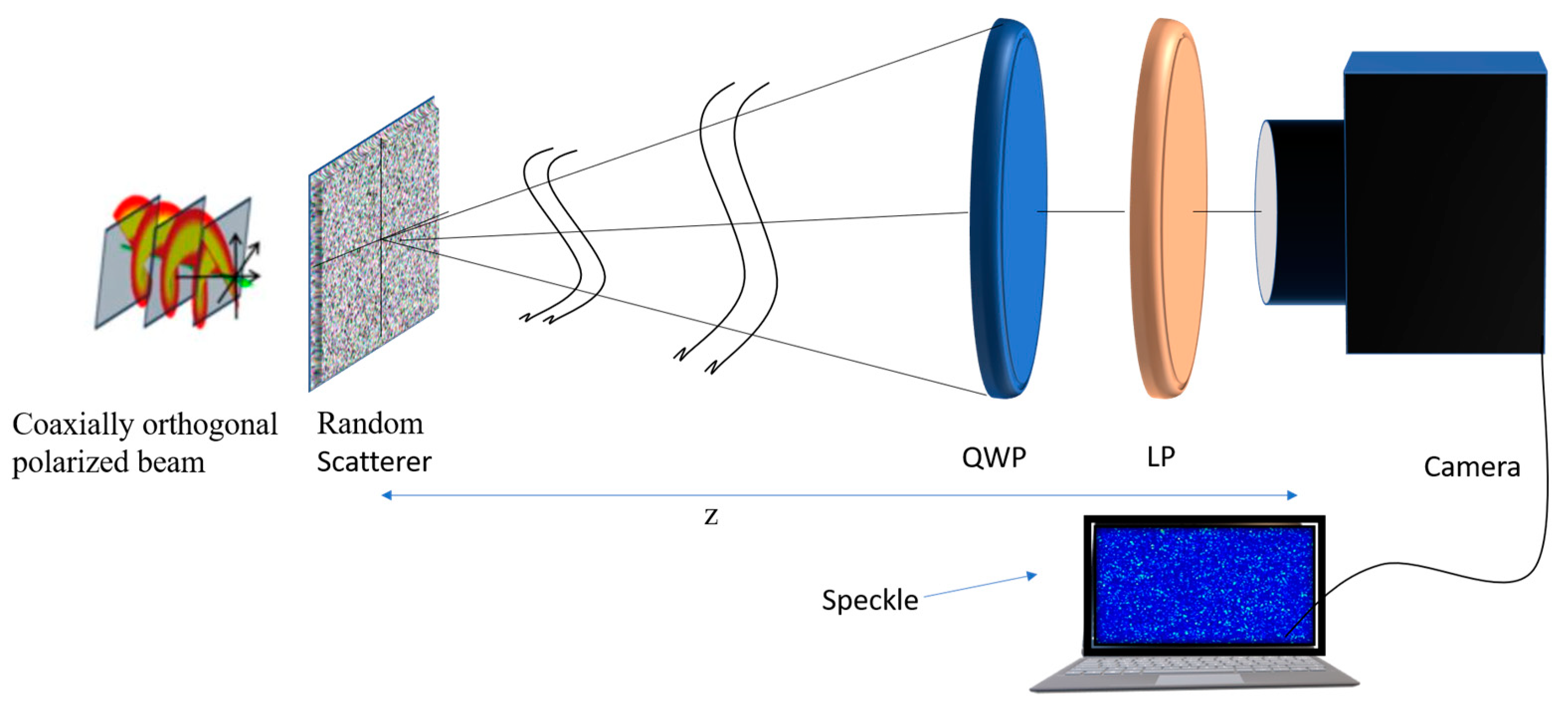
A schematic diagram of our experiment is shown in Figure 1 given below.
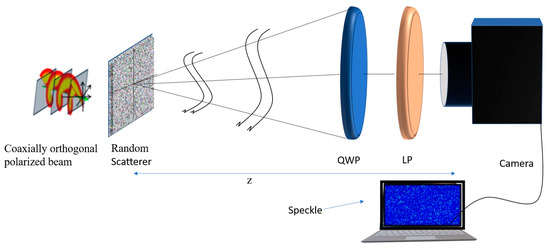
Figure 1.
Schematic representation of proposed method. QWP—quarter wave plate; LP—linear polarizer. The CCD records intensity speckle patterns at the observation plane. These speckle patterns are used to determine two SPs.
3. Result and Discussion
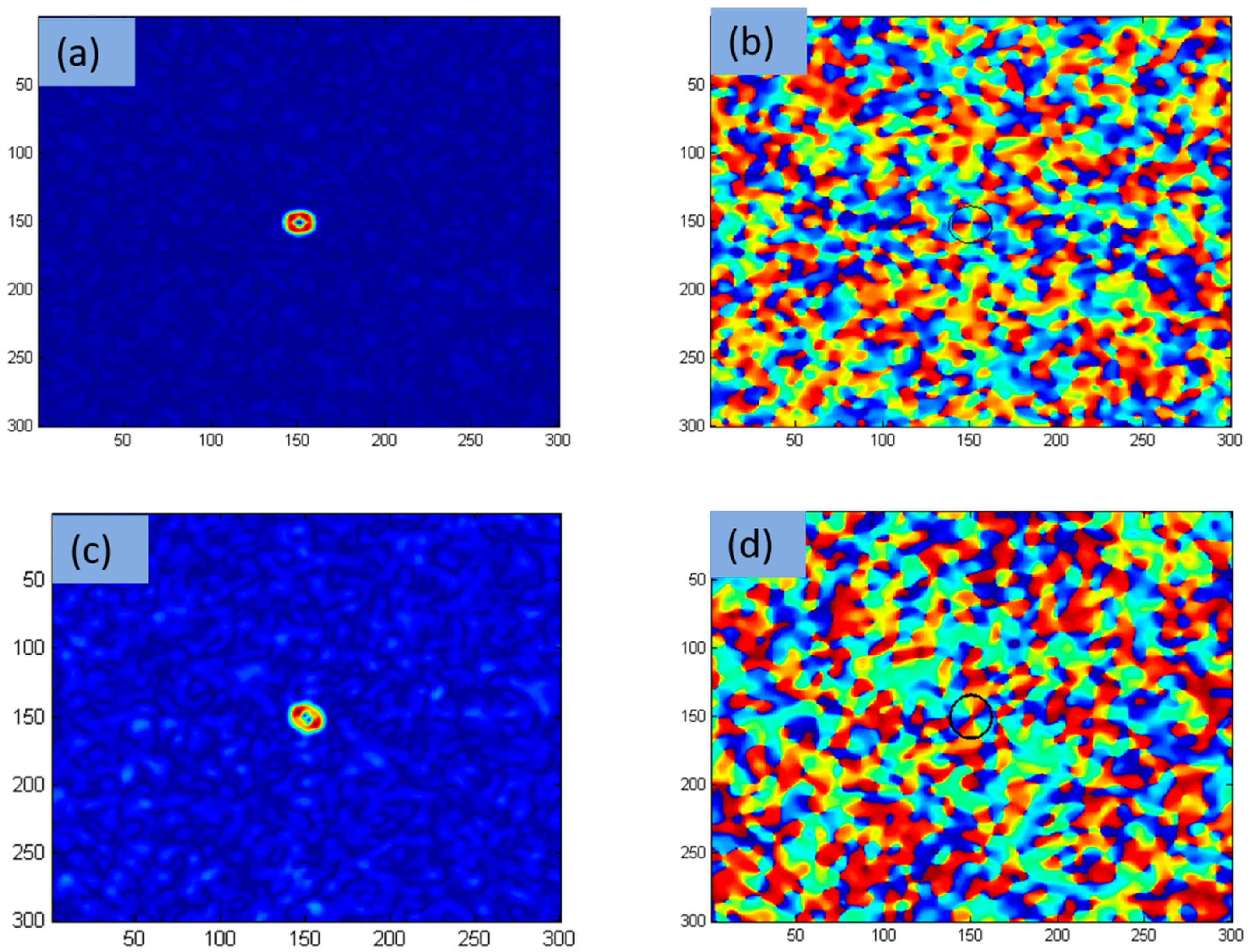
We load a vortex beam with a topological charge of l= −1 in x polarization component of the beam and use y polarization as a guide. The vortex beam is considered a phase object with which to test the enhancement in the phase measurement. Around the singularity, the vortex beam’s phase change is on the order of 2l. For the topological charge l = −1, the phase variation is one order of magnitude greater than 2 around the singularity. However, reconstructed results from the polarization correlations based on Equation (7) show a topological charge of l = −2 instead of l= −1. These results present a two-fold enhancement in phase measurement. The simulation and experimental results of our proposed method are shown in Figure 2.
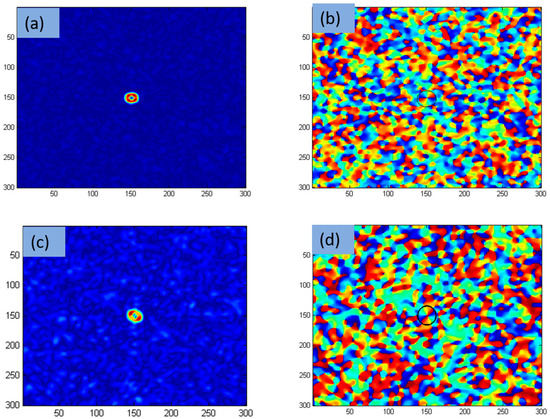
Figure 2.
Simulation results: (a) amplitude distribution and (b) corresponding phase distribution for vortex beam with a charge of l = −1; Experimental results: (c) amplitude distribution and (d) corresponding phase distribution for the vortex beam with l = −1.
4. Conclusions
We have presented a method for enhancing phase measurement by using higher-order stokes fluctuation correlations. This method is expected to be helpful in optical metrology and the measurement of weak phase information. The proposed method’s viability was assessed via numerical simulation, which was followed by an experimental demonstration to gain enhanced phase information.
Author Contributions
Conceived the idea, prepared manuscript, and methodology, A.Y.; manuscript preparation, methodology, and experimental design, T.S. (Tushar Sarkar); provided advice, reviewed the manuscript, supervised the research, and edited the work, T.S. (Takamasa Suzuki); involved in supervision, formulation of research goals, funding acquisition, and reviewing and editing, R.K.S. All authors have read and agreed to the published version of the manuscript.
Funding
This work is supported by the Science and Engineering Research Board (SERB) India CORE/2019/000026.
Institutional Review Board Statement
Not applicable.
Informed Consent Statement
Not applicable.
Data Availability Statement
The data used in this paper are not currently publicly accessible; however, they are available from the authors upon justifiable request.
Acknowledgments
Amit Yadav acknowledges University Grant Commission, India, for its financial support through the Junior Research Fellowship.
Conflicts of Interest
The authors declare no conflict of interest.
References
- De Groot, P.J. A review of selected topics in interferometric optical metrology. Rep. Prog. Phys. 2021, 82, 056101. [Google Scholar] [CrossRef] [PubMed]
- Creath, K. V Phase-Measurement Interferometry Techniques. In Progress in Optics; Wolf, E., Ed.; Elsevier: Amsterdam, The Netherlands, 1988; Volume 26, pp. 349–393. [Google Scholar]
- Shirai, T. Phase difference enhancement with classical intensity interferometry. Opt. Commun. 2016, 380, 239–244. [Google Scholar] [CrossRef]
- Singh, R.K.; Vinu, R.V.; Sharma, A.M. Recovery of complex valued objects from two-point intensity correlation measurement. Appl. Phys. Lett. 2014, 104, 111108. [Google Scholar] [CrossRef]
- Kuebel, D.; Visser, T.D. Generalized Hanbury Brown-Twiss effect for Stokes parameters. J. Opt. Soc. Am. 2019, 36, 362. [Google Scholar] [CrossRef] [PubMed]
- Sarkar, T.; Parvin, R.; Brundavanam, M.M.; Kumar Singh, R. Higher-order Stokes-parameter correlation to restore the twisted wave front propagating through a scattering medium. Phys. Rev. A 2021, 104, 013525. [Google Scholar] [CrossRef]
- Huang, P.S.; Zhang, S. Fast three-step phase-shifting algorithm. Appl. Opt. 2006, 45, 5086–5091. [Google Scholar] [CrossRef] [PubMed]
Disclaimer/Publisher’s Note: The statements, opinions and data contained in all publications are solely those of the individual author(s) and contributor(s) and not of MDPI and/or the editor(s). MDPI and/or the editor(s) disclaim responsibility for any injury to people or property resulting from any ideas, methods, instructions or products referred to in the content. |
© 2023 by the authors. Licensee MDPI, Basel, Switzerland. This article is an open access article distributed under the terms and conditions of the Creative Commons Attribution (CC BY) license (https://creativecommons.org/licenses/by/4.0/).