


Abstract
One achievement in smart grids is the construction of smart cities. In this kind of city houses are equipped with smart meters that can record electric energy as well as transmit and accept data regarding energy utilization and prices to consumers. Additionally, new methods, known as real-time pricing of electricity, have been introduced in which energy prices change based on an hourly timeline and depend on consumers’ energy requests. Due to the production of electricity by PV panels, a smart grid will share the surplus of the energy provided by the panels to the grid. These pricing policies will force and encourage consumers to track their power consumption and use renewable energies. In this paper, the impacts of pricing policy on the reduction in consumers’ power consumption are investigated. A small-scale smart city is presented and a policy is applied to it. Additionally, an implementation through a simulation of some houses equipped with renewable energy sources is done to study their effect on the grid performance.
1. Introduction
Emerging smart grid technology has been introduced to help utilities conserve energy; reduce costs, and increase grid transparency, sustainability, and efficiency. In addition, this introduction aims at captivating consumer attention via one important aspect of smart grids, which is demand-side management (DSM) [1,2,3]. Dynamic pricing is one of the emerging areas and is a DSM approach that is able to cut the overstress in energy requests through assigning various pricing at variable time intervals depending on energy requests [4]. The common practices in the electricity markets are that prices remain unchanged irrespective of demand (flat pricing) or that the kilowatt price of energy will be raised or lowered with the growing portions of electricity consumption (block pricing) [5].
A variety of research has dealt with dynamic pricing and found it to quite effective in stimulating a high level of demand response. Customers are more likely to reduce electricity usage than postpone. Users with large electricity demand and in hot regions tend to adhere better to this program. Modern technology facilitates the realization of this dynamic pricing. Faruqui et al. [6] analyzed five dynamic pricing programs in the USA and demonstrated that users react completely to pricing irrespective of where electricity service is located. The deployment of facilitating equipment allows a better likelihood of a positive request pricing reaction. Zhou and Teng [7] discovered cheap pricing and revenue flexibility of demand in city housing consumption in China. The standard of living and population growth parameters turn out to have a significant impact on explaining electricity demand. Faruqui et al. [8] have shown that customers’ reactions to dynamic pricing increases according to the facilitating equipment. The reaction to pricing is larger in hot regions. Users in housing areas are more likely to react to dynamic pricing compared to business and small industrial users. Users with lower revenue react to a lesser extent as their utilization is weak and essential, causing them to have no chance to lessen their utilization any more. Pagani and Aiello [9] established a practical scheme to reasonably motivate dynamic pricing with smart grid benefits based on statistics of general sales and renewable energy deployment in the Netherlands. In-lab tests are being deployed more and more to advertise community plans and in-societal discipline in general [10]. Despite their probability of being “hypothetically biased”, hypothetical actions of favoritism and motivation to pay [11] in addition to procedures of ability are probably more consistent and can be motivated through incentives [12]. Investigative set-ups that evaluate the precision of resolution-taking at diverse phases of procurement turned out to be victorious in suggesting a broad collection of perspectives in all community plan areas, such as in the ruling of automobile economics [13].
2. Case Study
In Algeria, the company SONELGAZ, which is a state-owned utility in charge of electricity and natural gas distribution, has employed different pricing policies for its consumers. These are summarized in Table 1, Table 2, Table 3 and Table 4.

Table 1.
Tariffs for code 51M.
Table 2.
Tariffs for code 52M.
Table 3.
Tariffs for code 53M.
Table 4.
Tariffs for code 54M.
As an illustration of the use of this policy, we suppose a smart city containing 12 houses; 10 of them are not equipped with PV panels (renewable energy) and the rest are not equipped with this system. The pricing policy in Table 5 is adopted for the entire city:
Table 5.
The applied tariffs for the proposed policy.
Figure 1 illustrates the power consumption profile for the 12 houses with the tariffs used by SONELGAZ (Table 1, Table 2, Table 3 and Table 4). The loads used have been turned on based on a pattern to produce peak load consumption.
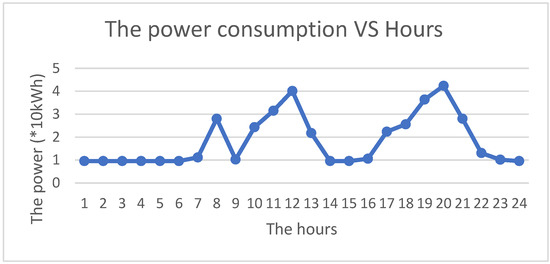
Figure 1.
The consumption of power before applying the proposed policy.
We observe that for the power consumption curve in Figure 1, there exist two peak values at 12 h (4.0122 kWh) and 20 h (4.23621 kWh). After applying the proposed pricing policy, we notice in Figure 2 that the curve shows only one peak value at 20 h (3.9822 kWh); this is due to the pricing policy we have implemented for this city.
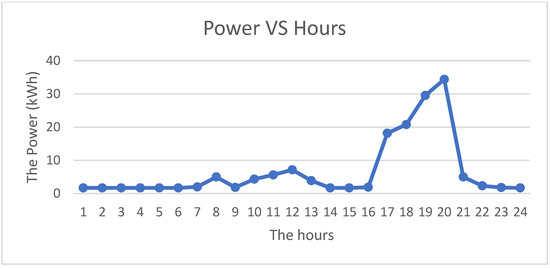
Figure 2.
The profile after applying the pricing.
3. Conclusions
In this work, the impact of a pricing policy on the power consumption in a smart city has been illustrated. If a client consumes much energy at peak hours, the tariffs will be large. The implementation of smart meters in houses will help a consumer control and track his power consumption as well as the associated cost. A consumer can choose to use power at different periods of time (during a low-tariff period). This will also help relieve the stress on power plants as well as the entire network. The use of renewable energy will further help in the production of power, as the system will use the power produced by the panels.
Author Contributions
Conceptualization, A.R.; methodology, F.Z.D.; software, F.Z.D.; validation, A.R. and F.Z.D.; formal analysis, A.R.; investigation, F.Z.D.; resources, F.Z.D.; data curation, F.Z.D.; writing—original draft preparation, F.Z.D.; writing—review and editing, A.R.; visualization, F.Z.D.; supervision, A.R.; project administration, A.R.; funding acquisition, A.R. All authors have read and agreed to the published version of the manuscript.
Funding
No external funds were received to perform this research.
Institutional Review Board Statement
Not applicable.
Informed Consent Statement
Not applicable.
Data Availability Statement
No new data were created or analyzed in this study. Data sharing is not applicable to this article.
Conflicts of Interest
The authors declare no conflict of interest.
References
- Recioui, A.; Bentarzi, H. Optimizing Smart Grid Operationand Control; IGI Global: Hershey, PA, USA, 2021. [Google Scholar]
- Recioui, A.; Djemai, H.; Boucenna, F. A Smart Metering Simulationin LABVIEW. Alg. J. Sig. Syst. 2019, 4, 89–100. [Google Scholar]
- Recioui, A. Home Load-Side Managementin Smart Grids Using Global Optimization. In Research Anthologyon Multi-Industry Uses of Genetic Programming and Algorithms; IGI Global: Hershey, PA, USA, 2021. [Google Scholar]
- Dekhandji, F.Z. Smart Metering and Pricing Policy in Smart Grids. In Optimizing and Measuring Smart Grid Operation and Control; IGI Global: Hershey, PA, USA, 2021. [Google Scholar]
- Simshauser, P.; Downer, D. On the inequity of flat-rate electricity tariffs. In AGL Applied Economic and Policy Working Paper; 41 AGL Energy Ltd.: Brisbane, Australia, 2014. [Google Scholar]
- Faruqui, A.; Hledik, R.; Sergici, S. Piloting the smart grid. Electricity J. 2009, 22, 55–69. [Google Scholar] [CrossRef]
- Zhou, S.; Teng, F. Estimation of urban residential electricity demand in China using household survey data. Energy Policy 2013, 61, 394–402. [Google Scholar] [CrossRef]
- Faruqui, A.; Sergici, S.; Akaba, L. The impact of dynamic pricing on residential and small commercial and industrial usage: New experimental evidence from Connecticut. Energy J. 2014, 35, 137–160. [Google Scholar] [CrossRef]
- Pagani, G.; Aiello, M. Generating realistic dynamic prices and services for the smart grid. IEEE Syst. J. 2015, 9, 191–198. [Google Scholar] [CrossRef] [Green Version]
- Falk, A.; Heckman, J.J. Lab experiments are a major source of knowledge in the social sciences. Science 2009, 326, 535–538. [Google Scholar] [CrossRef] [PubMed] [Green Version]
- Harrison, G.W.; Rutström, E.E. Experimental evidence on the existence of hypothetical bias in value elicitation methods. Handb. Exp. Econ. Results 2008, 1, 752–767. [Google Scholar]
- Lunn, P.D.; Choisdealbha, Á.N. The case for laboratory experiments in behavioural public policy. Behav. Public Policy 2018, 2, 22–40. [Google Scholar] [CrossRef] [Green Version]
- McElvaney, T.J.; Lunn, P.D.; McGowan, F.P. Do consumers understand PCP car finance? An experimental investigation. J. Consum. Policy 2018, 41, 229–255. [Google Scholar] [CrossRef] [Green Version]
Publisher’s Note: MDPI stays neutral with regard to jurisdictional claims in published maps and institutional affiliations. |
© 2022 by the authors. Licensee MDPI, Basel, Switzerland. This article is an open access article distributed under the terms and conditions of the Creative Commons Attribution (CC BY) license (https://creativecommons.org/licenses/by/4.0/).