


Abstract
Biodegradable hydrogel-based conductive inks, with application in additive circuit manufacturing, are synthesized from agarose, sodium alginate and functional carbon-based particles (carbon nanotubes and graphite). Rheological measurements are conducted to evaluate the printing performance of each ink. The synthesized functional inks are printed, and their conductivity properties are evaluated as a function of the functional material concentration. Promising conductivity values are achieved, demonstrating their potential application for low-cost and low-environmental-impact circuital and electromagnetic designs.
1. Introduction
New-generation communications and the Internet of Things (IoT) have the potential to virtually interconnect every person, animal, and object worldwide. IoT applications are already transforming sectors such as healthcare and industry: by 2030, the number of connected devices is expected to grow to 40 billion [1], and the market value to reach USD 20.61 billion [2]. Thus, innovative strategies that facilitate the fabrication of IoT devices while also addressing their environmental impact are essential, since the electronic waste (e-waste) associated with these devices poses serious environmental and health risks [3].
Printed electronics enables fast and low-cost manufacturing of electronic devices for IoT applications while reducing e-waste through biodegradable inks that compost after use. Some examples include cellulose-based [4], graphene-based [5], and poly(3,4-ethylenedioxythiophene) polystyrene sulfonate (PEDOT:PSS) inks [6]. Among additive manufacturing techniques, Direct Ink Writing (DIW) enables scalable fabrication of smart electronics with high pattern fidelity by printing viscoelastic materials with appropriate rheological properties [7]. The rheology of DIW inks must ensure smooth extrusion and rapid solidification after deposition, to enable the creation of printing patterns that retain their shape. Conductive hydrogels have recently been explored as DIW inks due to their tunable physicochemical properties, such as viscoelasticity and flexibility [8]. Electrically conductive hydrogels can be formulated by incorporating conducting nanoparticles (NPs) as fillers, like silver NPs [9], MXenes [10], or carbon nanotubes [11], enabling applications in printed sensors [12], energy-storage devices [13], and EMI shields [14], among others.
This work develops of a new kind of biodegradable conductive inks based on agarose and sodium alginate hydrogels functionalized with carbon-based fillers. Agarose is a thermosensitive gelling polymer extracted from certain species of red algae that jellifies at room temperature (RT), while sodium alginate (Na-alginate) is a polymer extracted from some brown algae. The inks are intended for the fabrication of electrical circuits through DIW: a Voltera® Nova printer is used, allowing pressure and temperature control of the ink dispenser. Once the developed inks are printed and left to dry on the substrate, their conductivity is measured, demonstrating the potential applications of the inks for low-cost and low-environmental impact printed electronic circuits.
2. Hydrogel-Based Ink Preparation
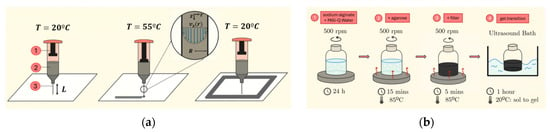
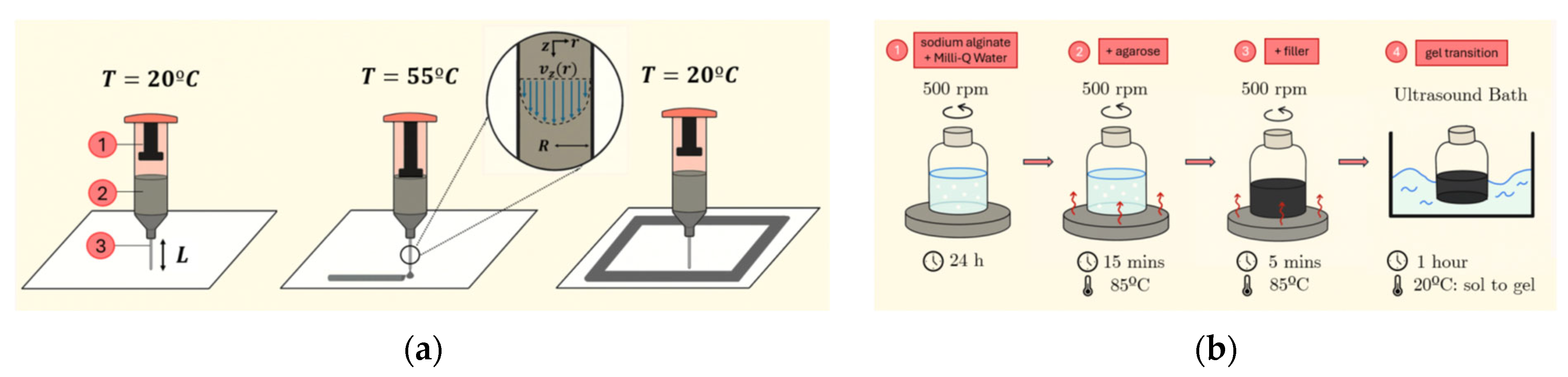
The first step of this work was the preparation of a printable ink, the formulation of which is key to its performance. Also, the compatibility with the tool used for its delivery needs to be considered (Figure 1a). The formulation of the hydrogel-based ink was optimized to achieve the rheological properties required for printing. The advantage of using a hydrogel for the ink’s base is that at low shear stresses and room temperatures is that the ink has predominantly elastic behavior (i.e., the gel state), but when subjected to higher shear stresses (such as those exerted by the plunger) and temperatures it undergoes a transition to predominantly viscous behavior (i.e., the sol phase). When the plunger applies the pressure at 55 °C to extrude the ink, this is in the sol state, enabling its flow through the nozzle during printing. Once deposited on the substrate, the ink recovers the elastic behavior, undergoing the sol to gel transition under ambient conditions that prevents its spreading and enables the printing of patterns with high-shape fidelity.
Figure 1.
(a) Overview of the printing process. First the ink (2) is in the gel phase at room temperature inside the cartridge. When the plunger (1) exerts the pressure, the ink flows through the nozzle (3). Once it is printed, the ink solidifies and regains the elastic behavior. (b) Procedure for hydrogel-based ink preparation.
The ink synthesis began by dissolving Na-alginate powder in Milli-Q water by magnetically stirring the mixture for 24 h at 500 rpm at room temperature. Then, the agarose powder was incorporated into the Na-alginate solution and was dissolved under magnetic stirring (500 rpm) for 15 min at 85 °C. Once the agarose and Na-alginate were dissolved in water, a thermosensitive hydrogel (the ink’s base) was obtained. Subsequently, the fillers (MW-CNTs or graphite powder) were dispersed in the solution under magnetic stirring, and when the suspension was homogeneous, it was placed in an ultrasonic bath for 1 h to ensure dispersion and to deagglomerate any formed clusters of particles and bubbles, improving homogeneity and printability. As the water of the bath was at 20 °C, the resulting thermosensitive ink gellified in the ultrasound bath. This procedure is shown in Figure 1b. To find the ideal base formulation for printing applications, rheological measurements of different concentrations have been carried out: 0.5% agarose–1% Na-alginate, 1% agarose–1% Na-alginate and 0.5% agarose–2% Na-alginate. Lower agarose concentrations (e.g., 0.1%) were considered, but the hydrogel was not formed. Because the viscosity of agarose hydrogels in the sol phase was not high enough to be properly printed according to the printer manufacturer’s specifications, it was also necessary to incorporate Na-alginate as a thickening agent.
3. Results
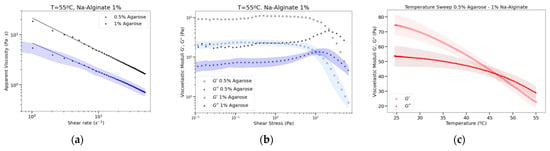
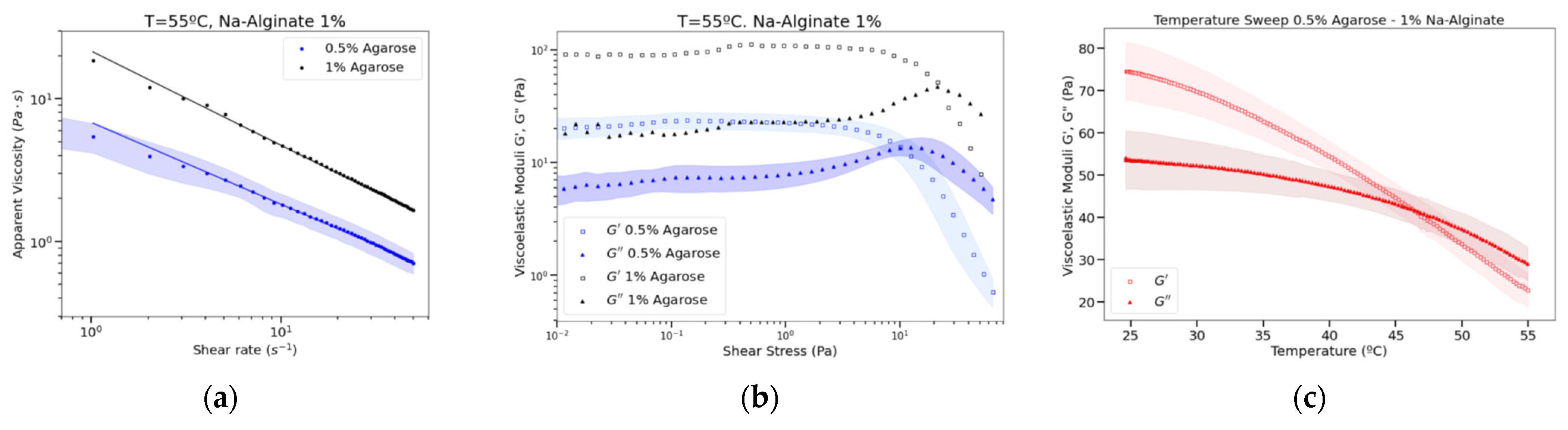
To determine which of the three formulations presented the best printability, their apparent viscosity was measured as a function of the shear rate (flow curve) in steady state measurements. In addition, their viscoelastic moduli ( the elastic modulus, the viscous modulus) were obtained as a function of the shear stress amplitude (amplitude sweep) in oscillatory measurements for the different formulations. The measured rheological properties were correlated with the printability of each one (Figure 2). The ink with the lowest viscosity and viscoelastic moduli (0.5–1%) was the one that printed best. It was observed through printing tests that higher concentrations made the ink too solid to be extruded, so 0.5% agarose–1% Na-alginate was chosen as the optimal ink base.
Figure 2.
Rheological characterization of the ink base with varying concentrations of agarose and Na-alginate (Haake Mars Modular Advanced Rheometer System, with the Couette geometry of concentric cylinders). (a) Flow curve and (b) amplitude sweep of different base formulations: agarose 0.5% (blue) and agarose 1% (black), fixing Na-alginate concentration of 1%. The crossover point of and indicate the transition from solid-like behavior () to liquid-like behavior () upon a certain applied stress. (c) Temperature sweep of the base: the crossover point of and (~45 °C) does not change with the addition of low-concentration particle fillers. The effect of increasing Na-alginate concentration to 2% was also analyzed. Similarly, more concentration of Na-alginate led to higher viscosity and viscoelastic moduli, and therefore worse printability was observed through printing tests. Solid lines in (a) represent the fit based on the power-law model [15]. Shaded areas correspond to the uncertainties after performing three different measurements.
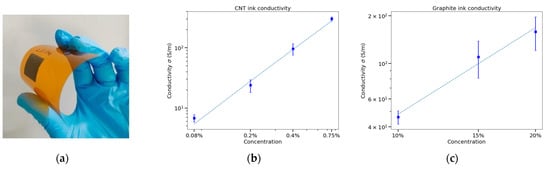
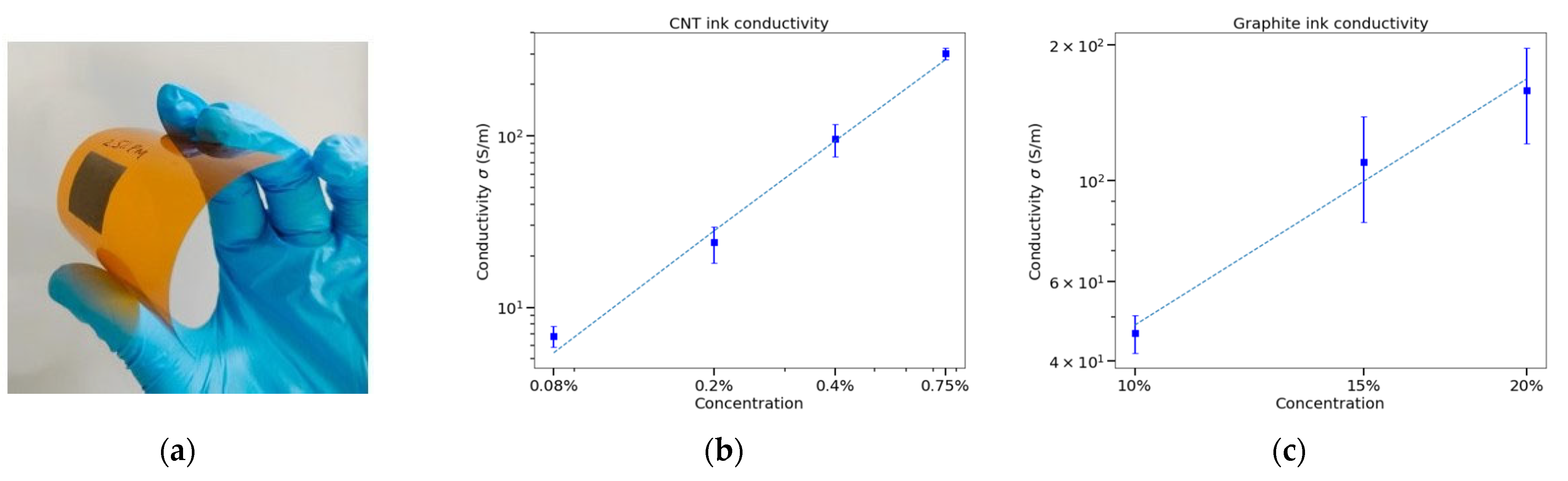
The developed inks were later functionalized using multi-walled carbon nanotubes (MW-CNTs) and graphite powder with varying concentrations, and printed into standard flexible substrates. No sintering process was applied: the as-printed circuits were left to dry in air for 4 h, showing excellent applicability and promising conductive results. A sample of ink, printed on a commercial polyimide substrate, is depicted in Figure 3a, demonstrating good flexibility. The conductivity of the samples as a function of the filler concentration was evaluated by means of the four-point-probe method [16], using a universal probe station by Jandel, and an SMU by Keysight (B2902C): the results are shown in Figure 3b,c. In particular, for the MW-CNT-based inks, conductivity values well above S/m were achieved for concentrations below 1%, close to those reported for commercial carbon-based conductive inks [17]. Conductivity values also in the range of S/m were also calculated in graphite-based inks, although in this case the graphite concentration needed to achieved them was around 20%. Also, a higher results dispersion was observed (see Figure 3c).
Figure 3.
(a) Ink applied on a flexible PI substrate. (b) Measured conductivity σ (S/m) of the printed MW-CNTs -based thin films. According to classical percolation theory [18], which is commonly used to evaluate the conductivity of printed inks [19]: t = 1.8, φc = 0.007%. (c) Conductivity of graphite particles, whose parameters are t = 0.7, φc = 8%.
4. Conclusions
A novel functional biodegradable ink based on hybrid agarose and Na-alginate hydrogels consisting of conductive carbon-based particles (MW-CNTs and graphite) has been developed. The viscoelastic properties of the ink have been designed ad hoc to be compatible with a commercial circuit printer, and flexibility and conductivity tests have been performed. The results show promising conductivity, in particular when MW-CNTs are used as a functionalizing material.
Author Contributions
Conceptualization: Á.M.-E., F.P., L.R.-A., M.T.L.-L. and F.G.R.; Experimental methods and data analysis: Á.M.-E., S.O.-R. and M.G.P.; writing—original draft preparation, Á.M.-E., F.P., L.R.-A. and F.G.R.;. Writing—review and editing, Á.M.-E., S.O.-R., M.G.P., F.P., L.R.-A., M.T.L.-L. and F.G.R. All authors have read and agreed to the published version of the manuscript.
Funding
This work is part of the research project PID2023-148323OA-I00 COMPOSTRONICS funded by MICIU/AEI/10.13039/501100011033 and FEDER, UE. M. García-Palomo and S. Ortiz-Ruiz acknowledge grants PREP2023-001936 and PREP2023-001240, respectively, funded by MCIU/AEI/10.13039/501100011033 and FSE+. M.T. López-López and L. Rodríguez-Arco acknowledge grant PID2023-151913NB-I00, funded by MICIU/AEI/10.13039/501100011033, Spain, and by ERDF, EU.
Institutional Review Board Statement
Not applicable.
Informed Consent Statement
Not applicable.
Data Availability Statement
Data are available upon request to the authors.
Conflicts of Interest
The authors declare no conflicts of interest.
References
- IoT Analytics. State of IoT—Summer Report 2024. Available online: https://iot-analytics.com/product/state-of-iot-summer-2024 (accessed on 29 June 2025).
- Tavares, J.; Loss, C.; Pinho, P.; Alves, H. Flexible Textile Antennas for 5G Using Eco-Friendly Water-Based Solution and Scalable Printing Processes. Adv. Mater. Technol. 2024, 9, 2301499. [Google Scholar] [CrossRef] [Scilit]
- International Telecommunication Union (ITU); United Nations Institute for Training and Research (UNITAR). The Global E-Waste Monitor 2024—Electronic Waste Rising Five Times Faster than Documented E-Waste Recycling; United Nations University (UNU): Shibuya, Japan; ITU: Geneva, Switzerland; UNITAR: Geneva, Switzerland; ISWA: Rotterdam, The Netherlands, 2024. [Google Scholar]
- Nocheseda, C.J.C.; Liza, F.P.; Collera, A.K.M.; Caldona, E.B.; Advincula, R.C. 3D Printing of Metals Using Biodegradable Cellulose Hydrogel Inks. Addit. Manuf. 2021, 48, 102380. [Google Scholar] [CrossRef] [Scilit]
- Casiraghi, C.; Jurchescu, O.D.; Magdassi, S.; Su, W. Introduction to Nanomaterials for Printed Electronics. Nanoscale 2023, 15, 10480–10483. [Google Scholar] [CrossRef] [Scilit] [PubMed]
- Galliani, M.; Ferrari, L.M.; Bouet, G.; Eglin, D.; Ismailova, E. Tailoring Inkjet-Printed PEDOT:PSS Composition toward Green, Wearable Device Fabrication. APL Bioeng. 2023, 7, 016101. [Google Scholar] [CrossRef] [Scilit] [PubMed]
- Orangi, J.; Hamade, F.; Davis, V.A.; Beidaghi, M. 3D Printing of Additive-Free 2D Ti3C2Tx (MXene) Ink for Fabrication of Micro-Supercapacitors with Ultra-High Energy Densities. ACS Nano 2020, 14, 640–650. [Google Scholar] [CrossRef] [Scilit]
- Ho, M.; Ramirez, A.B.; Akbarnia, N.; Croiset, E.; Prince, E.; Fuller, G.G.; Kamkar, M. Direct Ink Writing of Conductive Hydrogels. Adv. Funct. Mater. 2025, 35, 2415507. [Google Scholar] [CrossRef] [Scilit]
- Bergonzi, C.; Remaggi, G.; Graiff, C.; Bergamonti, L.; Potenza, M.; Ossiprandi, M.C.; Zanotti, I.; Bernini, F.; Bettini, R.; Elviri, L. Three-Dimensional (3D) Printed Silver Nanoparticles/Alginate/Nanocrystalline Cellulose Hydrogels: Study of the Antimicrobial and Cytotoxicity Efficacy. Nanomaterials 2020, 10, 844. [Google Scholar] [CrossRef] [Scilit] [PubMed]
- Zhang, C.; McKeon, L.; Kremer, M.P.; Park, S.-H.; Ronan, O.; Seral-Ascaso, A.; Barwich, S.; Coileáin, C.Ó.; McEvoy, N.; Nerl, H.C.; et al. Additive-Free MXene Inks and Direct Printing of Micro-Supercapacitors. Nat. Commun. 2019, 10, 1795. [Google Scholar] [CrossRef] [Scilit] [PubMed]
- Liu, J.; Garcia, J.; Leahy, L.M.; Song, R.; Mullarkey, D.; Fei, B.; Dervan, A.; Shvets, I.V.; Stamenov, P.; Wang, W.; et al. 3D Printing of Multifunctional Conductive Polymer Composite Hydrogels. Adv. Funct. Mater. 2023, 33, 2214196. [Google Scholar] [CrossRef] [Scilit]
- Darabi, M.A.; Khosrozadeh, A.; Mbeleck, R.; Liu, Y.; Chang, Q.; Jiang, J.; Cai, J.; Wang, Q.; Luo, G.; Xing, M. Skin-Inspired Multifunctional Autonomic-Intrinsic Conductive Self-Healing Hydrogels with Pressure Sensitivity, Stretchability, and 3D Printability. Adv. Mater. 2018, 30, 1705922. [Google Scholar] [CrossRef] [Scilit] [PubMed]
- Bao, P.; Lu, Y.; Tao, P.; Liu, B.; Li, J.; Cui, X. 3D Printing PEDOT-CMC-Based High Areal Capacity Electrodes for Li-Ion Batteries. Ionics 2021, 27, 2857–2865. [Google Scholar] [CrossRef] [Scilit]
- Liu, J.; Mckeon, L.; Garcia, J.; Pinilla, S.; Barwich, S.; Möbius, M.; Stamenov, P.; Coleman, J.N.; Nicolosi, V. Additive Manufacturing of Ti3C2-MXene-Functionalized Conductive Polymer Hydrogels for Electromagnetic-Interference Shielding. Adv. Mater. 2022, 34, 2106253. [Google Scholar] [CrossRef] [Scilit] [PubMed]
- Bird, R.B.; Armstrong, R.C.; Hassager, O. Dynamics of Polymeric Liquids. Vol. 1: Fluid Mechanics, 2nd ed.; John Wiley and Sons Inc.: New York, NY, USA, 1987. [Google Scholar]
- ASTM 1529; ASTM International Standard Test Method for Sheet Resistance Uniformity Evaluation by in-Line Four-Point Probe with the Dual-Configuration Procedure. ASTM: West Conshohocken, PA, USA, 1997.
- MG Chemicals. Technical Data Sheet: 838AR-P Carbon Conductive Pen. 2025. Available online: https://mgchemicals.com/downloads/tds/tds-838ar-p.pdf (accessed on 13 February 2026).
- Sahimi, M. Applications of Percolation Theory, 1st ed.; CRC Press: Boca Raton, FL, USA, 1994. [Google Scholar]
- Franco, M.; Alves, R.; Perinka, N.; Tubio, C.R.; Costa, P.; Lanceros-Mendéz, S. Water-Based Graphene Inks for All-Printed Temperature and Deformation Sensors. ACS Appl. Electron. Mater. 2020, 2, 2857–2867. [Google Scholar] [CrossRef] [Scilit]
Disclaimer/Publisher’s Note: The statements, opinions and data contained in all publications are solely those of the individual author(s) and contributor(s) and not of MDPI and/or the editor(s). MDPI and/or the editor(s) disclaim responsibility for any injury to people or property resulting from any ideas, methods, instructions or products referred to in the content. |
© 2026 by the authors. Licensee MDPI, Basel, Switzerland. This article is an open access article distributed under the terms and conditions of the Creative Commons Attribution (CC BY) license.