


Abstract
The consequences of corrosion of steel reinforcement are recognized as one of the predominant degradation factors in the durability of Reinforced Concrete (RC) structures, negatively affecting their load-bearing capacity, ductility, and service lifetime. In light of structural aging, Greece has established methods for inspecting and assessing its seismic adequacy prior to seismic events. However, although current scientific knowledge has considerably progressed in terms of quantifying corrosion damage of steel reinforcement, current regulations are now significantly lagging in adequately introducing the contribution of the corrosive factor in the assessment of existing structures’ seismic adequacy. Based on recent literature and the results of an extensive ongoing experimental research campaign (related to the corrosive factor), the present manuscript proposes interventions in the guidelines of the 2nd Degree Pre-Earthquake Inspection.
1. Introduction
Corrosion of steel reinforcement is acknowledged as one of the major factors impairing the durability of reinforced concrete structures (RC) worldwide, as it adversely affects the load-bearing capacity of RC elements in terms of both strength and deformation [1,2,3]. In Greece, with a high percentage of buildings located in coastal areas, the high concentration of chlorides intensifies corrosion phenomena and, in conjunction with frequent and intense seismic activity, premature aging of buildings is noted. Due to these degradation phenomena and given that the majority of existing structures are approaching or have already exceeded their theoretical lifespan of fifty years, there is an immediate need to assess the structural adequacy of these structures. In this light, rapid methods for assessing the structural vulnerability of existing structures have recently been established through 1st and 2nd degree Pre-earthquake Inspections, along with more analytical and in-depth methods for assessing structural adequacy (3rd degree Pre-earthquake Inspection), adopting the provisions of the Code of Structural Interventions (KANEΠE) [4,5].
To date, several studies have focused on the adverse effects of corrosion of steel reinforcement, which are primarily reflected in the material itself, in the steel–concrete bond, and, therefore, in the overall mechanical behavior of RC elements [6,7,8,9,10,11,12]. Steel corrosion is an electrochemical phenomenon in which steel reacts to the environmental conditions (in the presence of moisture) and tends to return to its original mineral form, resulting in the loss of some of its mass and the formation of iron oxides (rust) in its place. The development of oxides on the surface of steel alters the conditions at the steel–concrete interface, resulting in a deterioration of the bond between the two materials. The products of corrosion, iron oxides, occupy a larger volume than the original (lost) steel material and lead to the development of tensile stresses in the surrounding concrete, which cause progressive cracking and ultimately spalling of the concrete cover thickness, negatively affecting the loss of steel–concrete bond [11,12]. On a steel rebar, the propagation of corrosion causes a reduction in its effective cross-section, which can be either uniform (uniform corrosion) or localized with pits (pitting corrosion), and a deterioration of its mechanical properties (reduction in yield strength and ductility) [10]. The result of all the above is the deterioration of the mechanical behavior of corroded RC elements in terms of force and displacement.
However, although current scientific knowledge has advanced significantly in terms of quantifying steel corrosion damage [9,10,11,12,13,14,15], the current regulations of Pre-Earthquake Inspections and Code of Structural Interventions (KANEΠE) are now significantly lagging in adequately introducing the contribution of the corrosive factor in assessing the structural adequacy of structures. Based on the International Scientific bibliography [9,10,11,12,13,14,15,16,17] and recognizing the technological problem of corrosion of steel reinforcement, the present manuscript highlights the primary factors of influence of corrosion on the mechanical behavior of steel and, in general, of reinforced concrete elements with corroded steel reinforcement, citing the relevant provisions of technical regulations.
2. Corrosion of Steel Reinforcement
2.1. The Influence of Corrosion on the Mechanical Properties of Steel Reinforcement
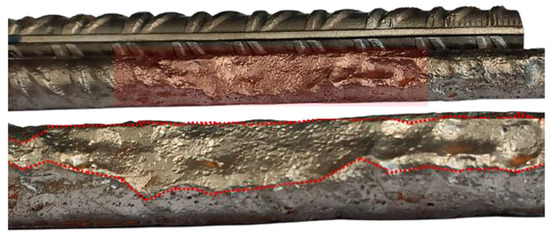
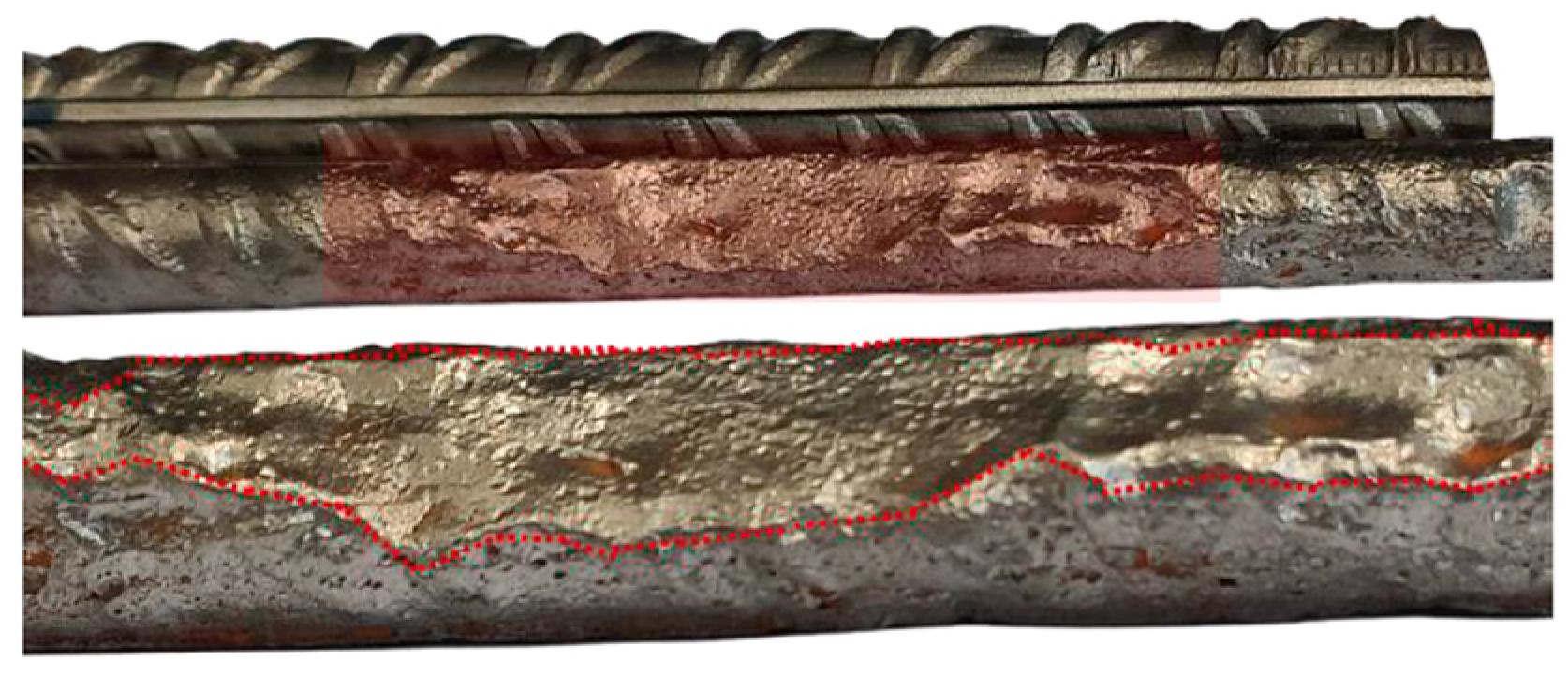
As demonstrated by numerous studies, corrosion alters the geometry of reinforcing bars due to their mass loss (Figure 1) with a consequent reduction in their cross-section, which leads to a deterioration in their mechanical properties in terms of strength (yield stress fy and ultimate tensile stress fu) and ductility (maximum deformation at failure εmax).
Figure 1.
Embedded reinforcing bar exhibiting non-uniform corrosion damage, as shown in the red range.
Prior to presenting the deterioration of the mechanical properties of steel reinforcement due to corrosion, it is crucial to highlight that the quantification of the degree of corrosion is a particularly compound problem in practice, as rebars are embedded in the concrete and are not visible along their full length. At low corrosion levels, before apparent cracks develop on the surface of the concrete cover thickness, corrosion damage is difficult to detect. Moreover, even after exposing the reinforcement, corrosion damage is often characterized by significant non-uniformity both around the perimeter of the cross-section and along its length, resulting in significant deviation in the measurements of the remaining cross-section. An important parameter of this deviation consists of the type of corrosion: uniform corrosion and pitting corrosion, which is associated with the presence of chlorides in coastal environments. According to the provisions of 2nd Pre-earthquake Inspection, no differentiation between types of corrosion is drawn, which significantly affects the rate of deterioration of the mechanical properties of steel reinforcement [10], and corrosion degree Xcor of a single bar is defined as the maximum percentage loss of cross-section ΔA or loss of diameter ΔD, in relation to the initial cross-section As or the initial diameter Ds.
where As,cor and Ds,cor are the remaining cross-section or diameter of the corroded bar, respectively.
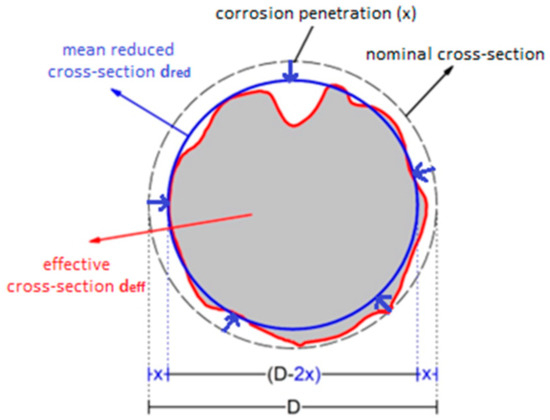
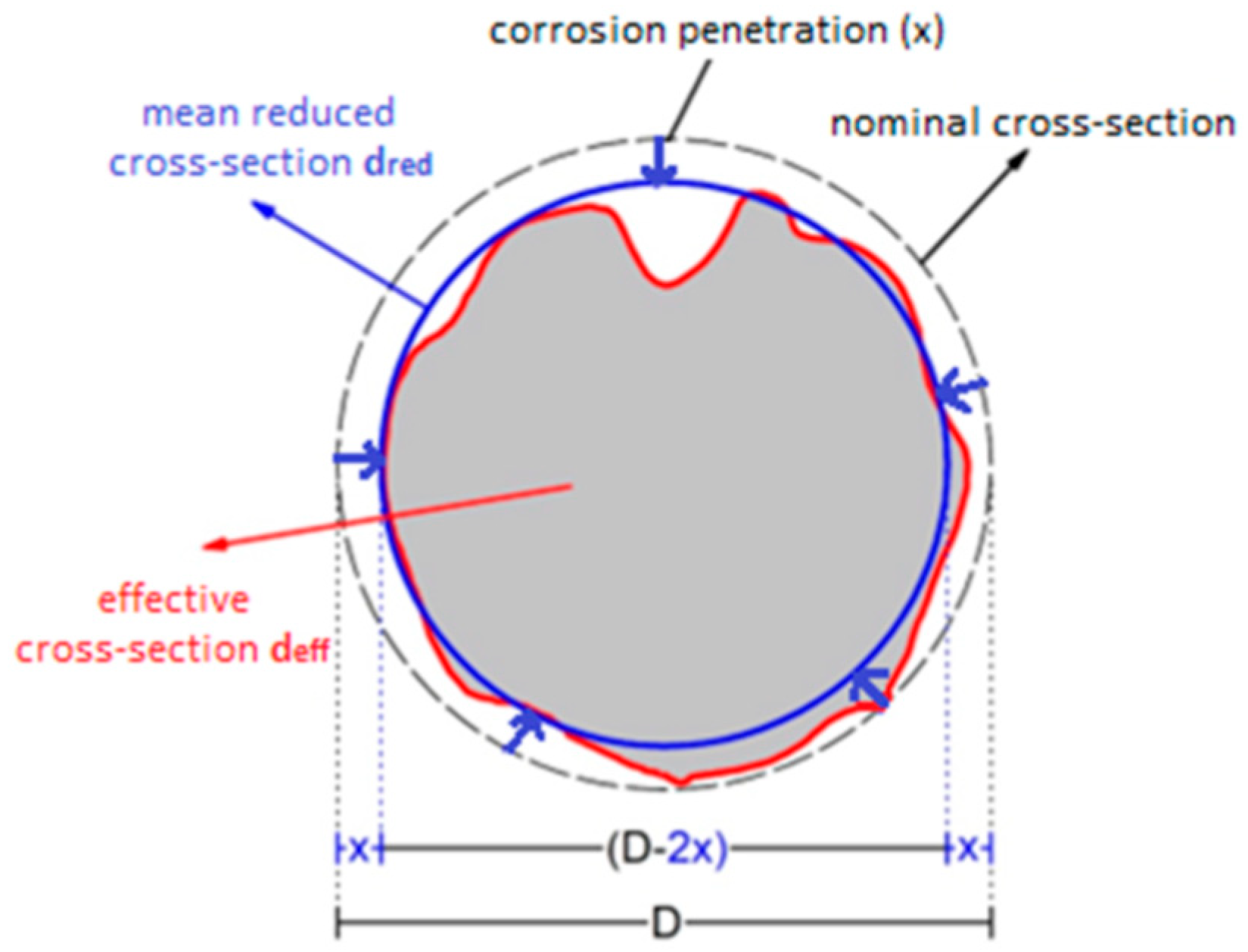
Alongside the abovementioned, the term “corrosion penetration”, which is now widely adopted, is also found in international technical standards such as the Fib Model Code 2010. According to the Rilem code and fib Model Code [16], the term “steel corrosion penetration” was adopted based on the assumption of uniform average corrosion penetration in the material, so that the actual equivalent (remaining) cross-section relative to the original corresponds to the simplified view in Figure 2.
Figure 2.
Simplified approach of uniform cross-section loss due to pitting corrosion.
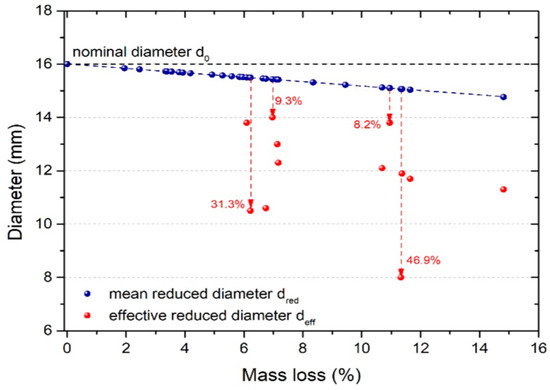
An experimental study [10] has shown the deviation of the equivalent reduced diameter dred calculated in terms of penetration depth (x) (corrosion penetration) from the actual reduced diameter deff. In order to highlight the differences between the simplified consideration of the uniform penetration type (x) with pits, the diagram in Figure 3 displays the values of the equivalent reduced diameter (dred) and the actual reduced diameter (deff). The use of the “penetration depth” is not a representative measure of the corrosion damage to the reinforcing steel, as it may deviate significantly from the actual corrosion damage caused to the material.
Figure 3.
Correlation between equivalent reduced diameter (assuming uniform corrosion) dred, and actual reduced diameter deff (in case of pitting corrosion). Reprinted from Ref. [10].
Hence, in coastal areas, the assessment of the corrosion damage of steel reinforcement through corrosion penetration requires special attention, as intense pits are developed due to the aggressive action of chlorides, resulting in significant deviation from the mean penetration depth to the corresponding maximum depth, which affects the overall load-bearing capacity.
2.2. The Effect of Corrosion on the Shear Strength of RC Members
Based on observations and recordings, corrosion damage on the steel reinforcement bars of the columns due to the action of chlorides is not evenly distributed along their height. In fact, the variable corrosion damage to the reinforcing steel actually determines the locally vulnerable areas of the load-bearing element. Based on this fact, the seismic analysis of reinforced concrete structures becomes even more complex, as it depends on the dependent mechanical performance of each bar along its length.
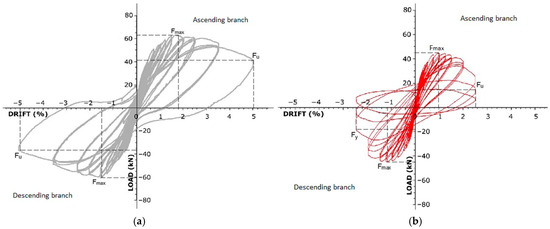
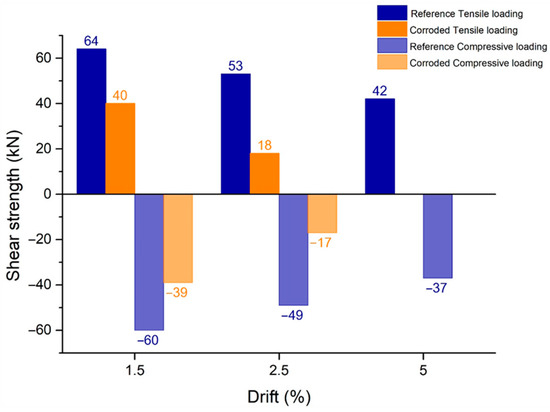
Figure 4 presents the results of an experimental study conducted at the Laboratory of Materials Technology and Strength of the Department of Mechanical and Aeronautical Engineering of the University of Patras [9], as part of the assessment of the mechanical behavior of a typical column (with a constant vertical load and horizontal increasing drifts) before and after corrosion, which demonstrated a significant deterioration in service life and shear strength in both the ascending branch (tension) and the descending branch (compression) (Figure 5). The above results of the seismic behavior of corroded R.C. columns are in good agreement with similar scientific studies [7,14,15].
Figure 4.
Non-linear response of the non-corroded (a) and corroded column (b). Reprinted with permission from Ref. [9]. Copyright 2026 Emerald Publishing Limited.
Figure 5.
Histograms of seismic response of columns in terms of maximum shear strength in the tensile (ascending) and compressive (descending) branches.
A significant degradation was noted in terms of shear strength capacity, both in the tensile and compressive branches. Particularly, the maximum tensile load was recorded equal to 64 kN, corresponding to a drift equal to 1.5%, while the tensile load during the last loading cycle dropped to 42 kN at a drift equal to 5%. Similarly, in the compressive branch, the maximum load was recorded equal to 60 kN, corresponding to a drift equal to 1.5%, while at the failure cycle (drift equal to 5%), the bearing capacity was degraded to 37 kN.
In the case of the corroded column, a huge reduction in the bearing capacity and ductility was observed. The maximum tensile load decreased in contrast to non-corroded conditions, from 64 kN to 40 kN, and the maximum compressive load from 60 kN to 39 kN, respectively. The maximum recorded loads were degraded due to corrosion by 37% and 35% in the tensile and compressive branches, respectively. Moreover, the failure of the corroded column occurred at a drift equal to 2.5%, i.e., a 50% reduction relative to the non-corroded column.
3. Discussion on the Provisions of the 2nd Degree Pre-Earthquake Inspection
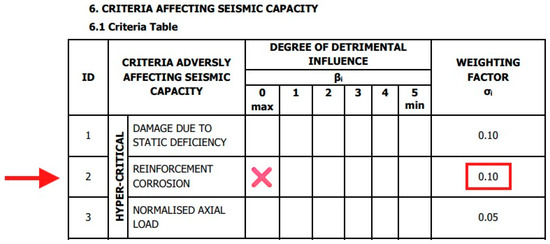
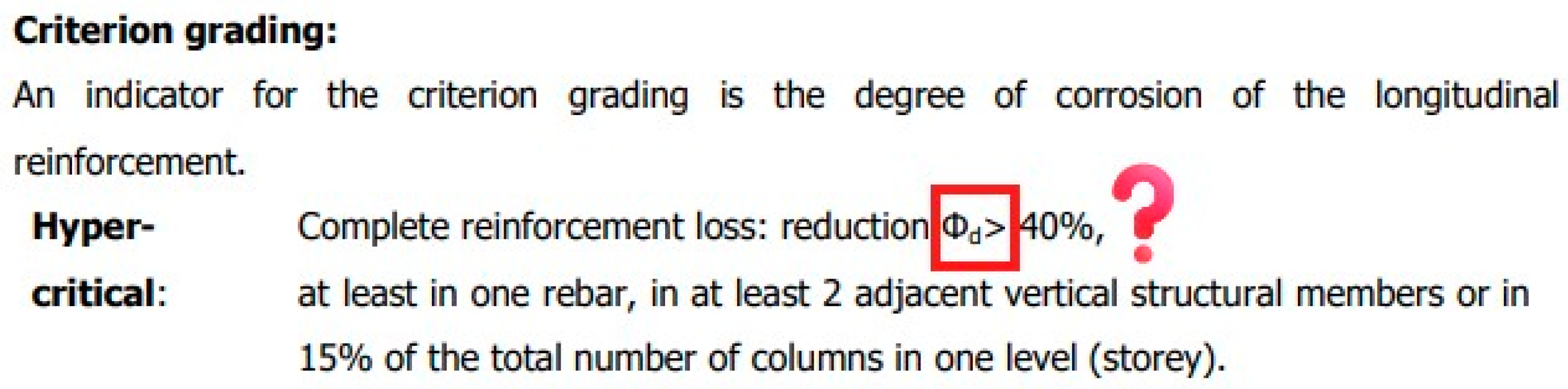
According to the proposed methodology of the 2nd Pre-earthquake Inspection, the vulnerability factors that decisively influence the seismic behavior of a building are summarized in 13 criteria of seismic vulnerability, each of which is rated on a scale of 1 to 5, where 1 corresponds to the highest level of negative impact (i.e., reduction in seismic resistance) and 5 corresponds to the lowest level of negative impact. In addition, a criterion is classified as critical when its intensity and extent exceed a threshold beyond which the overall stability of a building is compromised. In the 2nd degree Pre-earthquake Inspection, only three criteria can be classified as hypercritical, including the corrosion of steel reinforcement. An indicator for calibrating this criterion is the degree of corrosion damage of the longitudinal reinforcement only [4], where if the engineer finds complete loss of reinforcement, i.e., a reduction of Φd > 40%, at least at one bar, in at least two adjacent vertical elements or in 15% of the total number of columns on one level, this criterion is translated as critical. Excluding the influence of all other seismic load criteria and taking into account the weighting factor of the ‘Reinforcement Corrosion’ due to the negative effect of steel corrosion, the shear strength of the building is reduced by only 10% (Figure 6).
Figure 6.
Excerpt from the criteria adversely affecting seismic capacity table of the 2nd Pre-Earthquake Inspection. Adapted from Ref. [4].
However, according to the abovementioned experimental results, for a mass loss of approximately 16% of the steel rebar, a 35% reduction in shear strength was recorded, despite the fact that the guidelines for 2nd degree Pre-earthquake Inspection for a uniform reduction in rebar’s cross-section by 40% recommend a maximum reduction in shear strength of 10%.
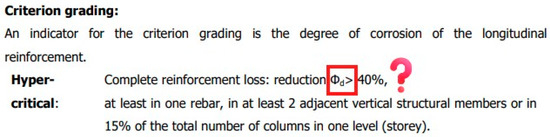
At this point, it should be noted that the scientific community employs numerous terms to define corrosion damage, namely mass loss or corrosion penetration. In that manner, it is not explicitly stated whether the reduction in size Φd refers to a reduction in the diameter of the reinforcing steel bar or a reduction in its cross-section (Figure 7). The need for clarification is crucial since if the term Φd refers to the nominal diameter of the bar, then a bar with a nominal diameter of Ø16 becomes a bar with a diameter of Ø9.5, which is equivalent to a loss of 64% of the effective cross-section.
Figure 7.
Excerpt from the 2nd Pre-Earthquake Inspection regarding the criteria grading of criterion 2. Adapted from Ref. [4].
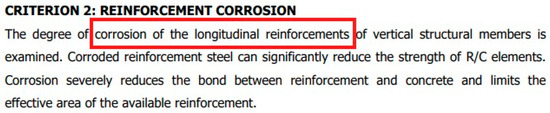
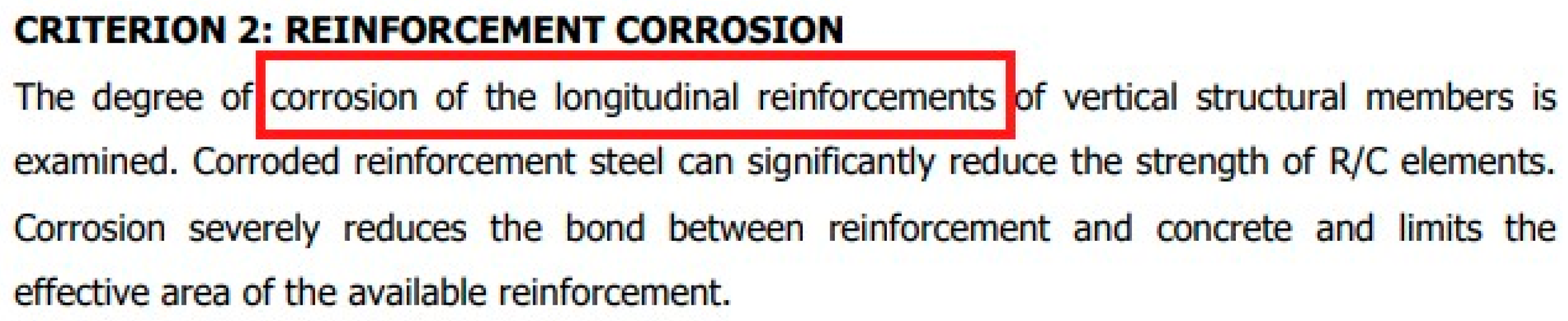
Furthermore, while the shear strength of the columns is related to the existence and adequacy of transverse reinforcement (stirrups), which usually consists of smaller diameter bars, it is subject to faster degradation than the main reinforcement [11,18,19,20]. However, the 2nd degree Pre-earthquake Inspection does not refer to the fact of corrosion damage of stirrups (Figure 8), which is directly linked to both the steel–concrete bond mechanism and the degree of confinement and shear strength of reinforced concrete elements.
Figure 8.
Excerpt from the 2nd Pre-Earthquake Inspection regarding the description of criterion 2. Adapted from Ref. [4].
In laboratory accelerated corrosion tests via imposed current [9,10], the current has been imposed exclusively on the longitudinal reinforcement and not in parallel on the transverse reinforcement (stirrups), as all stirrups were protected with a special anti-corrosion coating (epoxy resin), in order to adequately maintain their corrosion resistance. However, a significant part of the applied current was simultaneously consumed to damage the additional protective material of the stirrups. Therefore, it appears that corrosion generally first affects the outer layer of steel reinforcement (transverse reinforcement) and subsequently the inner steel reinforcement (longitudinal reinforcement). To conclude, the degradation of the shear strength of a column is actually even greater, considering corrosion damage of both longitudinal and transverse reinforcement (stirrups).
Furthermore, when referring to a reduction in diameter between a main reinforcement bar and a stirrup, the remaining cross-sections Acor and diameters Dcor appear clearly differentiated. For example, a 2 mm reduction in diameter in a main reinforcement bar with a nominal diameter of Ø16 corresponds to a 12.5% reduction in diameter and is equivalent to a 23% loss of effective cross-section, whereas a 2 mm reduction in diameter in a transverse reinforcement bar with a nominal diameter of Ø8 corresponds to a 25% reduction in diameter, which is equivalent to a 44% loss of effective cross-section, respectively.
4. Conclusions
From the broader study on the effects of corrosion of reinforcing steel on the structural behavior of RC elements, it becomes apparent that the initial inclusion of the corrosive factor in the provisions of the 2nd degree Pre-Earthquake Inspection was a significant innovation in the technical guidelines. Nonetheless, considering the results of recent literature (extensive experimental studies), it appears that there is space for further improvement of the relevant sections of the Regulations. In particular, based on the above-mentioned, the following findings can be drawn:
- Comparing the degradation of the shear strength and the maximum deformation of a structural member, in the presence of corrosion, the guidelines of the 2nd degree Pre-earthquake Inspection overestimate the shear strength, in contrast to several experimental results, which demonstrated its significant degradation due to the corrosive factor.
- Given that the shear strength of a crucial structural element in an earthquake, as in the case of a column, depends significantly on the presence of strong confinement (stirrups), it is worrisome that the 2nd degree Pre-earthquake Inspection does not also address the consequences of corrosion damage on the most vulnerable part of the element, namely, the transverse reinforcement.
- Given that the majority of existing structures are approaching or have already exceeded their useful life, and a pre-seismic check is carried out, considerable emphasis should be placed during the assessment on the corrosive factor so as not to overestimate the structural adequacy of the structures.
Author Contributions
Investigation, M.B. and K.K.; writing—original draft preparation, M.B. and K.K.; writing—review and editing, C.A.; supervision, C.A. All authors have read and agreed to the published version of the manuscript.
Funding
This research received no external funding.
Institutional Review Board Statement
Not applicable.
Informed Consent Statement
Not applicable.
Data Availability Statement
The data presented in this study are available upon request from the corresponding author.
Conflicts of Interest
The authors declare no conflicts of interest.
References
- Imperatore, S. Mechanical properties decay of corroded reinforcement in concrete—An overview. Corros. Mater. Degrad. 2022, 3, 210–220. [Google Scholar] [CrossRef] [Scilit]
- Caprili, S.; Moersch, J.; Salvatore, W. Mechanical performance vs. corrosion damage indicators for corroded steel reinforcing bars. Adv. Mater. Sci. Eng. 2015, 2015, 739625. [Google Scholar] [CrossRef] [Scilit]
- Sorbari, K.; George, D.-W.A.; Kennedy, C. The Effect of Corrosion on the Mechanical Properties (Diameter, Cross-Sectional Area, Weight) of the Reinforcing Steel. Middle East Res. J. Eng. Technol. 2024, 4, 39–53. [Google Scholar] [CrossRef] [Scilit]
- Earthquake Planning; Protection Organization-EPPO. 2nd Degree Pre-Earthquake Inspection of Reinforced Concrete Buildings, 1st ed.; Earthquake Planning & Protection Organization-EPPO: Athens, Greece, 2022. [Google Scholar]
- Earthquake Planning and Protection Organization (OASP). Code of Structural Interventions (KAN.EΠE.), 3rd ed.; Earthquake Planning and Protection Organization (OASP): Athens, Greece, 2022. [Google Scholar]
- Imperatore, S.; Rinaldi, Z.; Drago, C. Degradation relationships for the mechanical properties of corroded steel rebars. Constr. Build. Mater. 2017, 148, 219–230. [Google Scholar] [CrossRef] [Scilit]
- El-Joukhadar, N.; Tsiotsias, K.; Pantazopoulou, S. Consideration of the state of corrosion in seismic assessment of columns. Int. J. Struct. Integr. 2020, 11, 239–247. [Google Scholar] [CrossRef] [Scilit]
- Andisheh, K.; Scott, A.; Palermo, A.; Clucas, D. Influence of chloride corrosion on the effective mechanical properties of steel reinforcement. Struct. Infrastruct. Eng. 2019, 15, 1036–1048. [Google Scholar] [CrossRef] [Scilit]
- Apostolopoulos, C.A.; Drakakaki, A.; Basdeki, M. Seismic assessment of RC column under seismic loads. Int. J. Struct. Integr. 2019, 10, 41–54. [Google Scholar] [CrossRef] [Scilit]
- Basdeki, M.; Koulouris, K.; Apostolopoulos, C. Effect of Corrosion on the Hysteretic Behavior of Steel Reinforcing Bars and Corroded RC Columns. Appl. Sci. 2022, 12, 7451. [Google Scholar] [CrossRef] [Scilit]
- Koulouris, K.; Apostolopoulos, C. An experimental study on effects of corrosion and stirrups on bond behavior of reinforced concrete. Metals 2020, 10, 1327. [Google Scholar] [CrossRef] [Scilit]
- Coccia, S.; Imperatore, S.; Rinaldi, Z. Influence of corrosion on the bond strength of steel rebars in concrete. Mater. Struct. 2016, 49, 537–551. [Google Scholar] [CrossRef] [Scilit]
- Guo, A.; Li, H.; Ba, X.; Guan, X.; Li, H. Experimental investigation on the cyclic performance of reinforced concrete piers with chloride-induced corrosion in marine environment. Eng. Struct. 2015, 105, 1–11. [Google Scholar] [CrossRef] [Scilit]
- Ma, Y.; Che, Y.; Gong, J. Behavior of corrosion damaged circular reinforced concrete columns under cyclic loading. Constr. Build. Mater. 2012, 29, 548–556. [Google Scholar] [CrossRef] [Scilit]
- Yang, S.-Y.; Song, X.-B.; Jia, H.-X.; Chen, X.; Liu, X.-L. Experimental research on hysteretic behaviors of corroded reinforced concrete columns with different maximum amounts of corrosion of rebar. Constr. Build. Mater. 2016, 121, 319–327. [Google Scholar] [CrossRef] [Scilit]
- CEB-FIP. FIB Model Code 2010: Structural Concrete; Ernst and Sohn: Lausanne, Switzerland, 2013; pp. 152–189. [Google Scholar]
- Meda, A.; Mostosi, S.; Rinaldi, Z.; Riva, P. Experimental evaluation of the corrosion influence on the cyclic behaviour of RC columns. Eng. Struct. 2014, 76, 112–123. [Google Scholar] [CrossRef] [Scilit]
- Shang, Z.; Zheng, S.; Zheng, H.; Li, Y.; Dong, J. Seismic behavior and damage evolution of corroded RC columns designed for bending failure in an artificial climate. Structures 2022, 38, 184–201. [Google Scholar] [CrossRef] [Scilit]
- Zhong, X.; Li, J.; Xu, J.; Wang, K.; Zhu, B.; Liu, Y.; Ni, K. Deterioration of Mechanical Properties of Axial Compression Concrete Columns with Corroded Stirrups Coupling on Load and Chloride. Appl. Sci. 2023, 13, 2423. [Google Scholar] [CrossRef] [Scilit]
- Lin, H.; Zhao, Y.; Yang, J.-Q.; Feng, P.; Ozbolt, J.; Ye, H. Effects of the corrosion of main bar and stirrups on the bond behavior of reinforcing steel bar. Constr. Build. Mater. 2019, 225, 13–28. [Google Scholar] [CrossRef] [Scilit]
Disclaimer/Publisher’s Note: The statements, opinions and data contained in all publications are solely those of the individual author(s) and contributor(s) and not of MDPI and/or the editor(s). MDPI and/or the editor(s) disclaim responsibility for any injury to people or property resulting from any ideas, methods, instructions or products referred to in the content. |
© 2026 by the authors. Licensee MDPI, Basel, Switzerland. This article is an open access article distributed under the terms and conditions of the Creative Commons Attribution (CC BY) license.