


Abstract
This study investigates the role of leaf shape in detecting disease in tomato plants, grounded in the observation that plant leaves often undergo structural changes in response to infection. Healthy and diseased tomato leaves are characterized by extracting shape signature features from images and analyzing their spectral characteristics. Leaf images were captured using a Sony ZV-E10 Mark II mirrorless camera equipped with a Sigma 16 mm f/1.4 DC DN lens. Each leaf was placed flat on a matte white surface under a controlled overhead photography setup. The camera was mounted at a fixed height on a tripod, and uniform illumination was achieved using two symmetrically positioned LED spotlight lamps, minimizing shadows and glare. The dataset comprises 200 samples: 100 healthy and 100 diseased tomato leaves, representing a range of morphological and pathological variations. Three primary shape metrics were extracted from the images to characterize the structural differences: (1) the Centroid Contour Distance measured the radial distances from the leaf centroid to its outer contour; (2) the Hausdorff Distance quantified the geometric dissimilarity between contours; and (3) the Dice Similarity Index assessed the degree of overlap. In addition, spectral characteristics were derived from the RGB channels: mean intensities of red, green, blue, and the Excess Green Index. Results show that both shape and spectral features are valuable for detecting plant diseases: PCA shows clustering patterns between the two classes of leaves, and correlation analysis highlights the relationship between several pairs of geometric and color features. In conclusion, shape is an essential aspect of plant health, as it reflects the structural changes that occur as a result of disease.
1. Introduction
Plant leaves are highly sensitive indicators of health status and environmental stress. In tomato (Solanum lycopersicum), one of the most widely cultivated vegetable crops globally, leaf morphology is directly affected by biotic stresses such as viral, bacterial, and fungal infections. Plant pathologists have long noted that disease-induced anomalies manifest not only as color changes but also as structural irregularities such as leaf curling, vein distortion, holes from necrosis, or asymmetric growth patterns [1,2]. These morphological alterations provide critical diagnostic signals that complement spectral signatures and are particularly useful when color differences are subtle or confounded by environmental variability. Traditional plant disease recognition approaches have primarily emphasized texture- and color-based features extracted from leaf images. While spectral indices remain valuable, they are often sensitive to illumination conditions, sensor calibration, and background noise [3]. In contrast, shape-based descriptors capture inherent geometric properties of leaves that are invariant to lighting and thus less susceptible to extrinsic noise.
Shape analysis in plant studies is well-established [4]. Early work such as Mahdikhanlou and Ebrahimnezhad [5] employed centroid distance and the axis of least inertia method for leaf classification, demonstrating the utility of boundary-based descriptors. More recent research has explored hybrid approaches that integrate shape with color features: for instance, Yigit et al. [6] combined geometric descriptors (e.g., length, area, and perimeter) with RGB statistics to train AI-based leaf identification models. Similarly, the MASS framework (Morphological Analysis of Size and Shape) introduced by Chuanromanee et al. [7] formalized morphometric analysis to enable streamlined comparisons across botanical datasets. CCD-based methods have successfully distinguished canonical leaf classes such as elliptic, cordate, and ovate with high recognition accuracy [8,9], and have also been applied in automated plant identification systems [10,11]. Extensions of CCD incorporate Fourier analysis, where normalized radial distance signatures are transformed into the frequency domain to extract rotation-, translation-, and scale-invariant features [12,13]. Such Fourier-based descriptors allow the fine-grained capture of contour variability beyond what is achievable with geometric indices alone.
Several studies have explored frequency-domain approaches for contour-based shape analysis. Earlier work by Neto et al. [14] employed elliptic Fourier analysis and discriminant function analysis to classify plant species. They generated EFDs from chain-coded boundary contours and used these features in species classification tasks. Lee et al. [13] developed an FFT-based leaf recognition system in which shape features, extracted as centroid-to-boundary distances, were transformed into the frequency domain. From this, they derived a compact feature set of ten descriptors incorporating both magnitude and phase information. More recently, Wu et al. [15] introduced a novel elliptic Fourier descriptor (EFD) normalization method which ensures invariance to translation, rotation, scaling, starting point selection, and symmetry transformations. The authors also released a user-friendly software tool called ElliShape, which combines interactive contour extraction with the new normalization approach. Beyond CCD and Fourier techniques, morphometric frameworks have also been applied to broader taxonomic contexts. Oso and Jayeola [16] investigated exploratory and confirmatory landmark-based geometric morphometrics within the Cucurbitaceae family, a group with high leaf-shape diversity. Using MorphoLeaf, they generated a dataset of 140 specimens across seven species through landmark extraction, contour reparameterization, and normalization. Similarly, Prasetyo et al. [17] applied boundary-based descriptors, including CCD-derived Boundary Moments, along with texture and color features, for mango leaf variety classification. Haque and Haque [18] applied leaf image analysis to extract geometric parameters including area, perimeter, length, and width, and used these features for plant identification. Collectively, these studies highlight that morphometric descriptors, whether centroid-based, frequency-based, or landmark-based, provide a toolkit for capturing variation in leaf morphology.
While CCD, Fourier technique, and other geometric shape descriptors have demonstrated utility in botanical classification tasks, their application to distinguishing healthy versus diseased tomato leaves remains underexplored. In particular, pairwise contour similarity metrics such as the Hausdorff distance and Dice similarity index, commonly used in computer vision for object comparison, have not been widely leveraged to quantify disease-associated shape distortions or boundary irregularities in plants. To address these gaps, this study establishes a pipeline that spans controlled image acquisition, automated segmentation, and extraction of shape-based features. Shape characterization is conducted using CCD, Fourier-based descriptors, and pairwise similarity metrics, while spectral indices derived from RGB channels provide color-based information. To assess discriminability, dimensionality reduction and unsupervised embedding techniques are applied, including Principal Component Analysis (PCA) and t-distributed Stochastic Neighbor Embedding (t-SNE). The primary contributions of this work are as follows:
- Construction of a dataset of tomato leaves, acquired under controlled imaging conditions, and segmentation using the Segment Anything Model (SAM).
- Analysis of shape descriptors (CCD, FRS, Hausdorff distance, and Dice similarity) to characterize healthy vs. diseased leaves.
- Evaluation of combined shape and spectral feature sets through PCA and t-SNE embeddings to investigate class separability and clustering behavior.
2. Materials and Methods
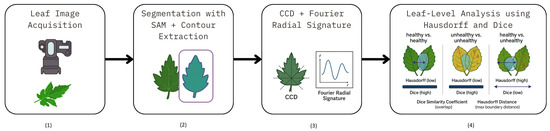
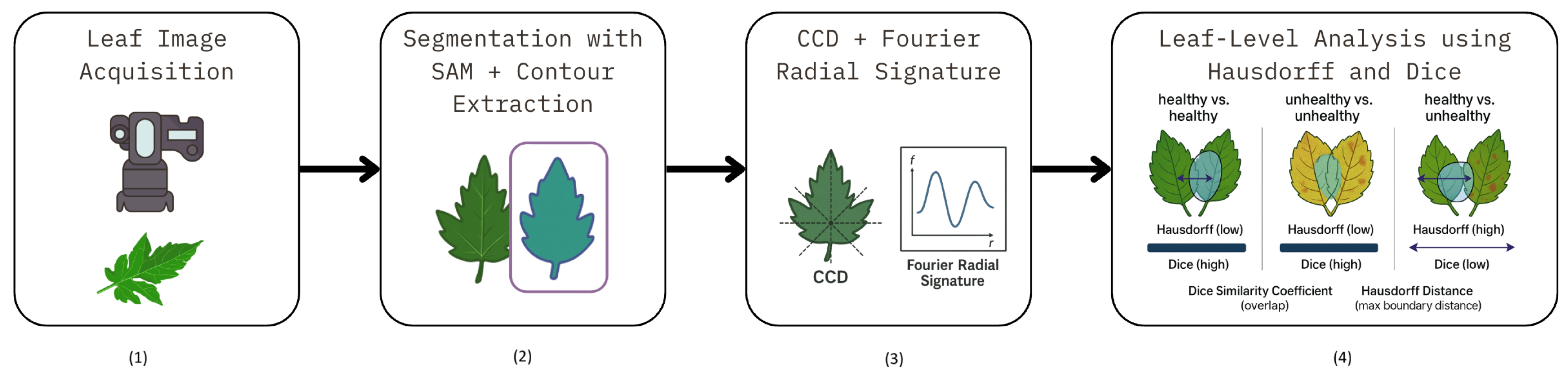
The process in Figure 1 illustrates the pipeline adopted in this study. The framework is structured in four stages: image acquisition, segmentation and contour extraction, shape extraction, and leaf-level comparison.
Figure 1.
The Process Framework: (1) Leaf image acquisition under controlled environment (2) Leaf Segmentation using SAM, (3) Fourier Features Extraction, and (4) Leaf-Level Analysis.
2.1. Data Collection
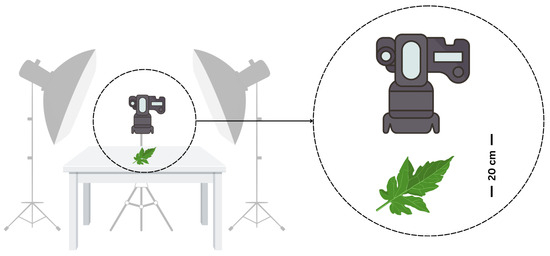
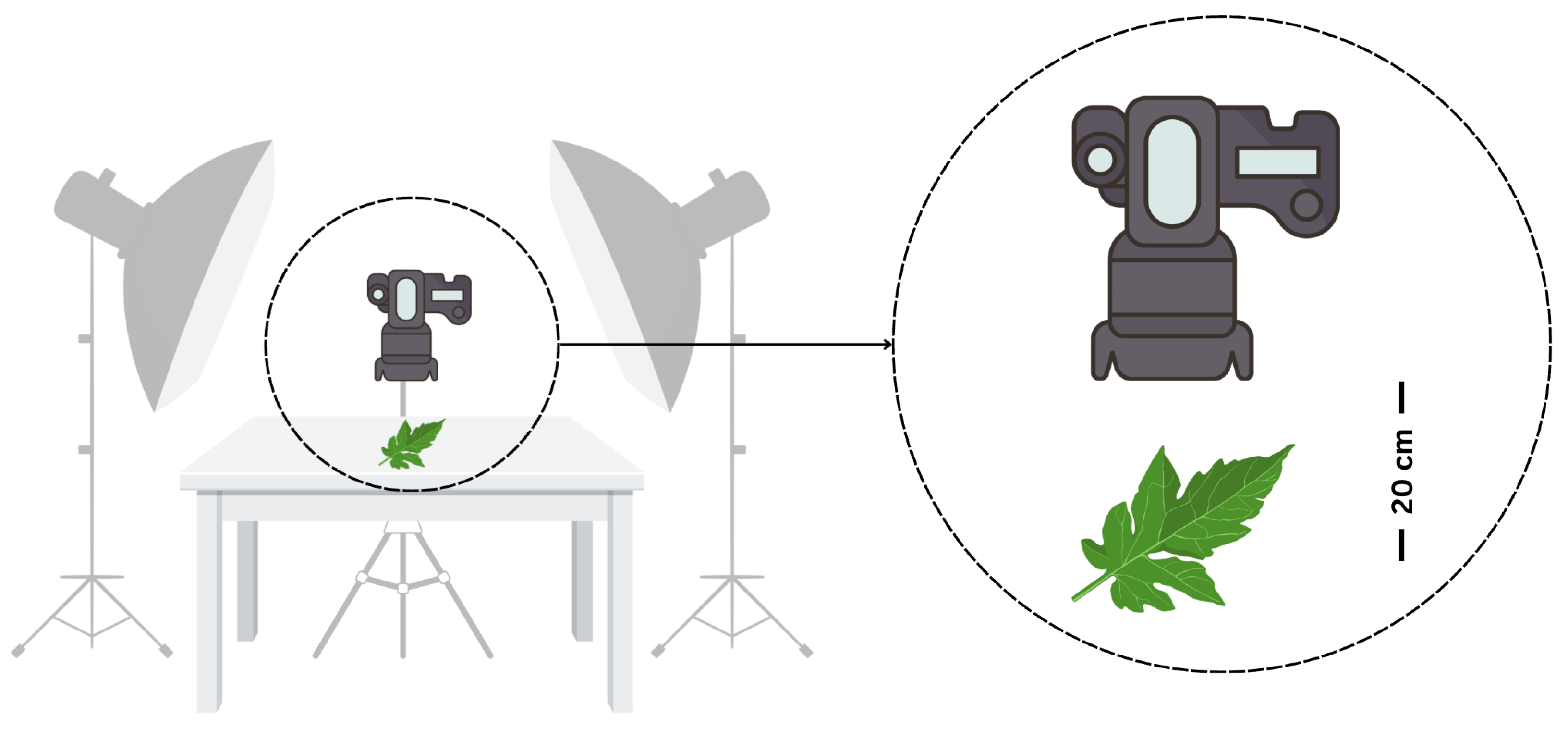
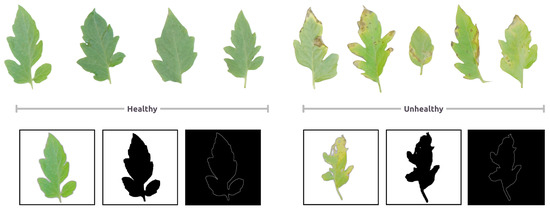
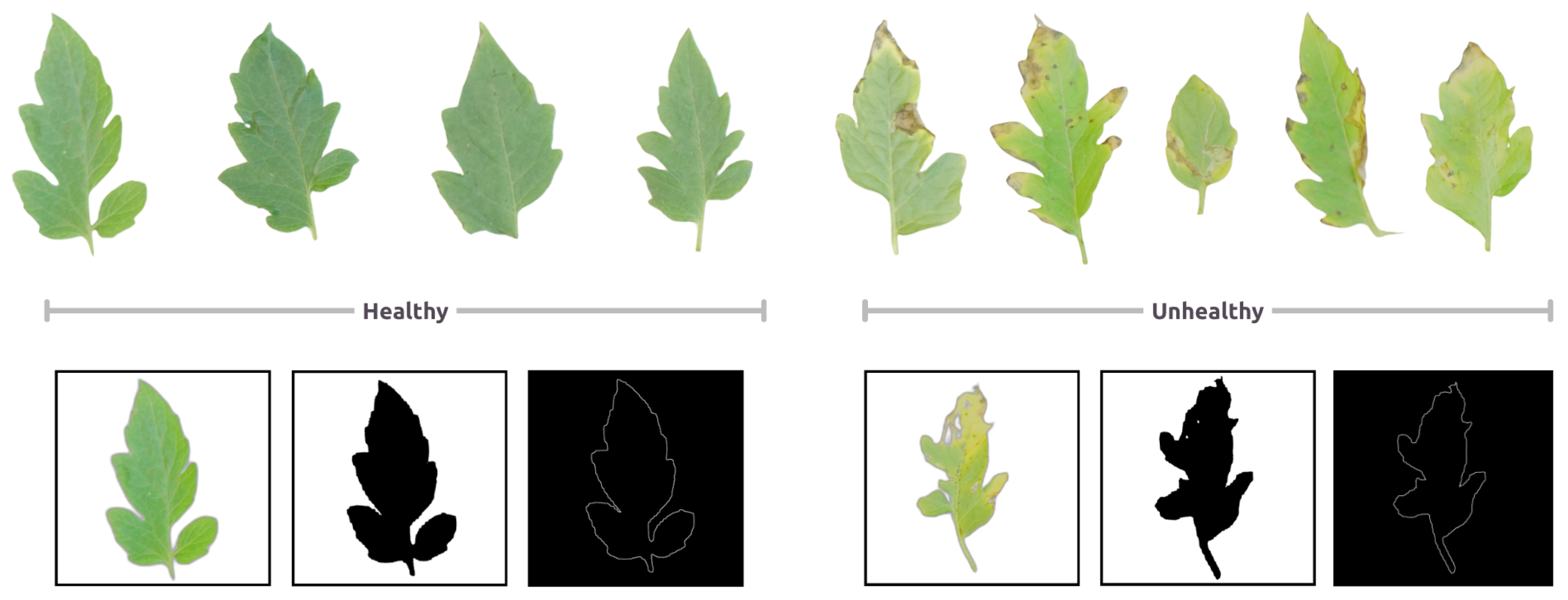
The tomato species used is Solanum lycopersicum L. 1753. Leaf samples are initially collected using Sony ZV-E10 Mark II mounted with Sigma 1.4 fixed aperture lens. The leaf sample is illuminated using two LED light boxes to minimize shadowing and nonuniform light, and is 20 cm away from the end part of the lens hood. The schematic diagram of this setup is illustrated in Figure 2. After acquisition, the leaf samples are segmented from background using the Segment Anything Model algorithm, specifically the sam_vit_h. Binary contour images are generated by segmenting each leaf to isolate the primary outline. Figure 3 shows sample instances of healthy and unhealthy leaves and the masking + contour extraction process.
Figure 2.
The leaf image acquisition setup.
Figure 3.
Several instances of healthy and unhealthy leaves and the binary masks.
2.2. Centroid Contour Distance (CCD) and Fourier Signatures
Given a closed contour represented as a set of 2D points and its centroid , the CCD function measures the distance from the centroid to the contour at uniformly sampled angles. Formally,
We sample angles to produce a vector . To ensure scale invariance, we normalize this curve by its mean radius:
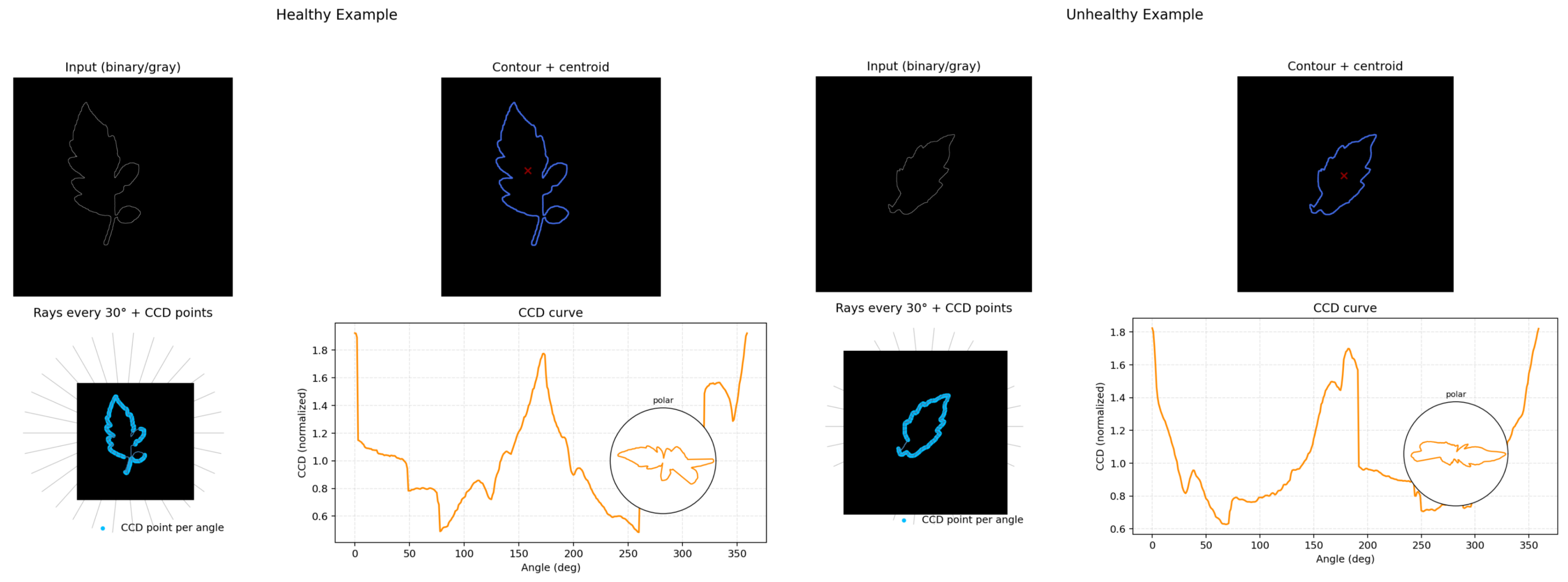
To enforce rotation invariance, we circularly shift such that the maximum radius occurs at a fixed angle, aligning the longest direction across leaves. This produces normalized CCDs that reflect pure shape, independent of size or orientation. Figure 4 illustrates the process. The normalized CCD is transformed via the 1D discrete Fourier transform (DFT), yielding complex coefficients :
Figure 4.
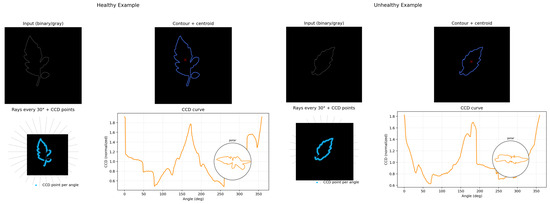
Normalized centroid contour distance of healthy vs. unhealthy leaf; the red cross indicates the centroid of each leaf shape.
We exclude the DC component (mean already normalized), and retain the magnitudes of the first harmonics, forming the Fourier radial signature vector:
This representation captures periodic patterns along the contour, encoding global features (low frequencies) and local margin irregularities (high frequencies). Using magnitudes ensures phase invariance, allowing shape comparison regardless of rotational alignment.
2.3. Elliptic Fourier Descriptors (EFDs)
While CCD captures radial fluctuations, it remains sensitive to local noise. To provide a complementary and robust global shape descriptor, we employ EFD. Given a closed contour parameterized by sequential boundary coordinates , the boundary can be expressed as a truncated Fourier series:
where K is the harmonic order, and are the Fourier coefficients. Each harmonic captures progressively finer details of the outline. In this study, we fix harmonics to balance reconstruction fidelity and descriptor compactness. To ensure comparability across leaves, EFD coefficients are normalized: translation invariance by removing , scale invariance by dividing by the first harmonic’s amplitude, and rotation invariance by aligning the first ellipse to the x-axis. This yields a canonical representation of each outline that is independent of position, size, or orientation. To quantify intra- and inter-group variability, we compare pairs of normalized outlines using two complementary metrics:
- Hausdorff distance (HD): Measures the maximum deviation between two point sets. This reflects the worst-case dissimilarity between contours.
- Dice coefficient (DC): Evaluates area overlap between two binary masks. For masks ,The Dice coefficient ranges from 0 (no overlap) to 1 (perfect match), capturing volumetric similarity rather than boundary extremes.
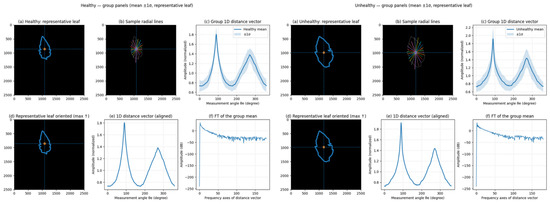
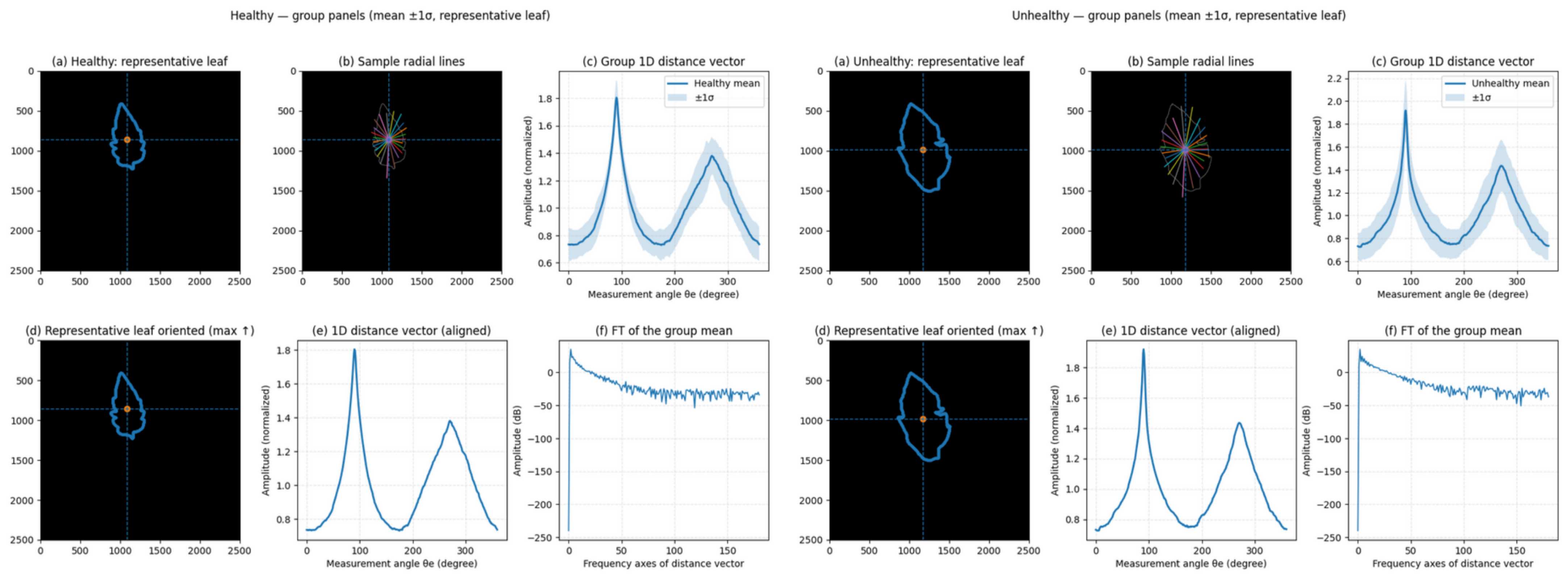
Both metrics complement each other: Hausdorff emphasizes boundary discrepancies, while Dice reflects overall shape overlap. For comparison, we rasterize all EFD-reconstructed contours onto a common canvas with shared global scaling for fair Dice evaluation across groups. Figure 5 shows an instance of how leaf images of the same scales are normalized for FT analysis. For both healthy and unhealthy groups, representative leaves are shown with radial rays emanating from the centroid. These rays sample distances from the centroid to the contour at fixed angular intervals, forming a 1D signature vector for each leaf.
Figure 5.
Two sample leaves of healthy vs. unhealthy class and their shape signal characteristics (left to right, top to bottom): (a) Representative leaf contour with centroid marked. (b) Radial rays sampled uniformly around the centroid, illustrating distance measurements to the contour. (c) Group mean radial signature (solid line) with variability (shaded region), representing shape consistency across samples. (d) Representative contour re-oriented such that the maximum radius aligns to (upward). (e) Aligned group mean radial signature. (f) Fourier magnitude spectrum of the mean signature, revealing dominant spatial frequencies associated with margin irregularities.
3. Results
3.1. CCD and Elliptical Fourier Descriptors (EFD)
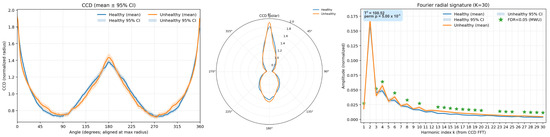
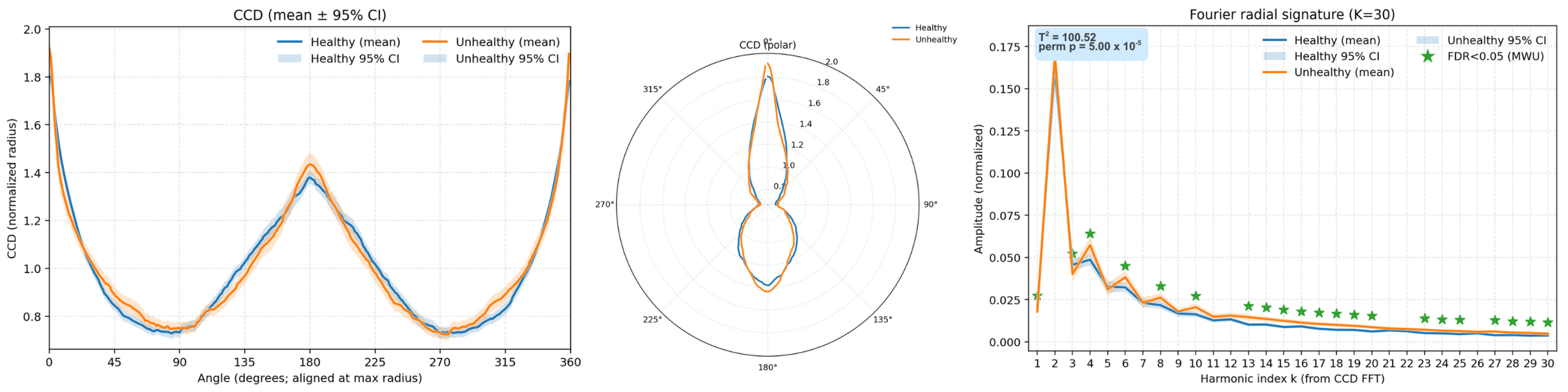
Figure 6 presents that unhealthy leaves deviate from healthy leaves across wide angular ranges; the polar view emphasizes relatively larger radii for the unhealthy group. Using normalized CCD curves and their Fourier radial signatures, we evaluate the differences in shape between healthy and unhealthy tomato leaves. To assess global morphological differences in the CCD domain, we perform a functional max- permutation test across the 360-sample CCD curves. The global p-value is , indicating statistically significant shape differences localized at specific angular perspective. Fourier radial signatures (FRS) further enables a frequency-domain analysis of contour shape. We compute the magnitude spectra from the first 30 harmonics after discarding the DC term, capturing both global and local shape characteristics. Using the energy distance metric, we observe a substantial distributional separation between healthy and unhealthy FRS vectors (, , permutation test). Additionally, a multivariate Hotelling-like test across the 30D Fourier signature vectors reveals a highly significant group difference (, , permutation-based). Together, these analyses confirm that the overall radial structure of unhealthy leaves deviates significantly from healthy counterparts, both in direct spatial comparison (CCD) and in harmonic decomposition (FRS) under disease-related shape alterations in a scale-, rotation-, and phase-invariant manner.
Figure 6.
Mean CCD Curves (from left to right): Normalized CCD vs. angle, CCD in polar coordinates, and Fourier radial signature of healthy vs. unhealthy leaves.
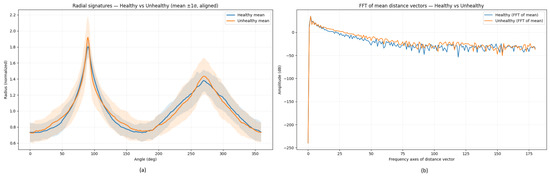
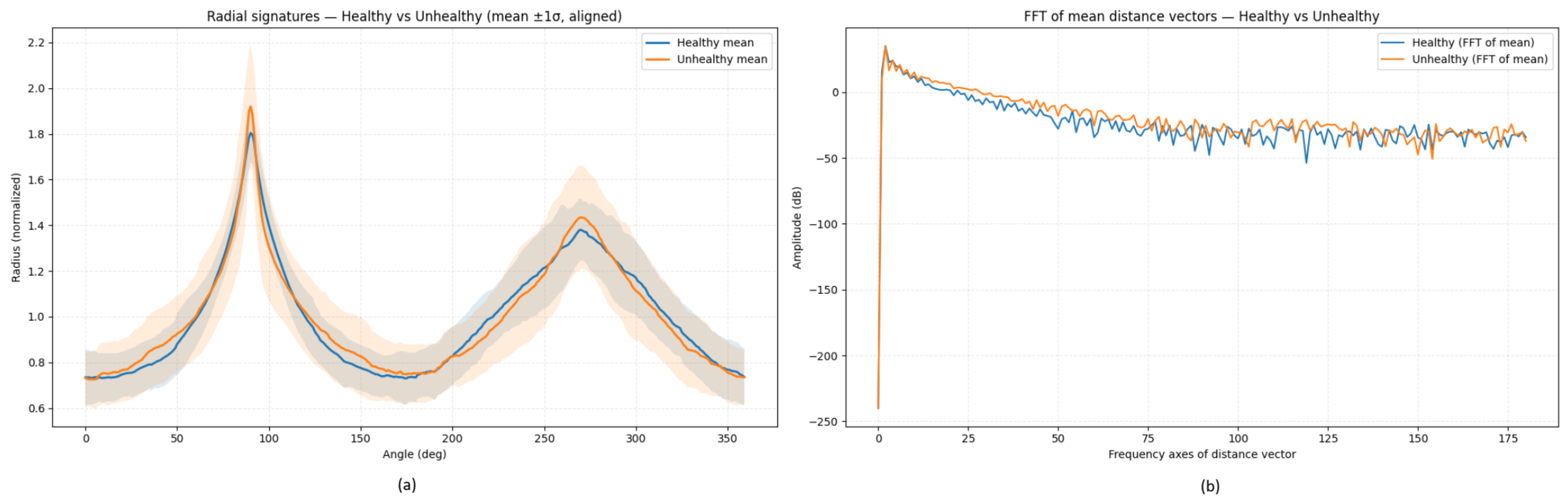
Figure 7 further quantifies the differences. The leftmost image shows the aligned mean radial signature curves across all samples. The rightmost displays the corresponding Fourier magnitude spectra, where unhealthy leaves tend to exhibit stronger amplitudes at certain harmonics. A global permutation test is conducted on the full Fourier spectra to determine whether spectral profiles of the two groups differ significantly. The test yields a global statistic of , with a permutation p-value of , confirming statistically significant group-level differences in the frequency domain.
Figure 7.
Radial signature and FFT plots (left to right): (a) Comparison of mean radial signatures between healthy (blue) and unhealthy (orange) tomato leaves, (b) Fourier spectra of mean radial signatures for healthy and unhealthy groups. Amplitudes are shown in decibels as a function of spatial frequency (cycles per 360∘).
We decompose the CCD curves into Fourier descriptors (Figure 6, right) to further quantify these differences in a compact harmonic space. The first few harmonics capture the majority of the contour variation, with unhealthy leaves showing consistently larger amplitudes at low- to mid-frequency components. Energy distance testing reveals a highly significant distributional difference between groups (, ), confirming that the global shape signatures of unhealthy leaves are distinct and several individual harmonics are identified as significantly different after multiple-comparison correction (green stars). These suggests that unhealthy leaves not only differ in overall shape magnitude but also exhibit characteristic deviations in specific harmonic modes. Taken together, the CCD and Fourier analyses provide evidence that unhealthy leaves exhibit geometric distortions: the CCD approach highlights contour-level deviations, while Fourier descriptor analysis confirms that these deviations persist when shapes are summarized in a lower-dimensional harmonic space. These results demonstrate that leaf health status is associated with quantifiable differences in contour geometry. Because CCDs are normalized by each leaf’s mean radius and anchored at the centroid, the reported effects reflect shape rather than absolute size or position and uniform rescaling or translation does not affect the conclusions. The Fourier-magnitude descriptors additionally remove dependence on in-plane rotation. Consequently, the detected differences implicate deformations and localized boundary irregularities characteristic of unhealthy leaves.
3.2. Pairwise Shape Cohesion and Cross-Group Divergence
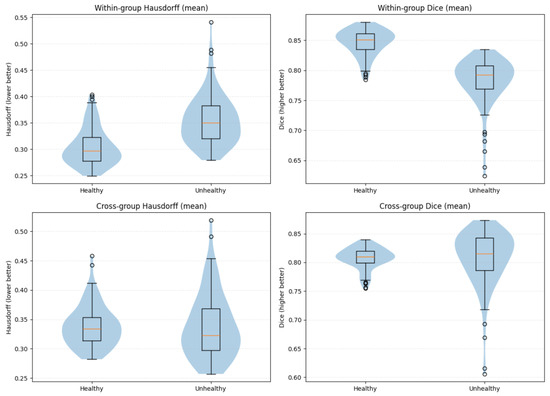
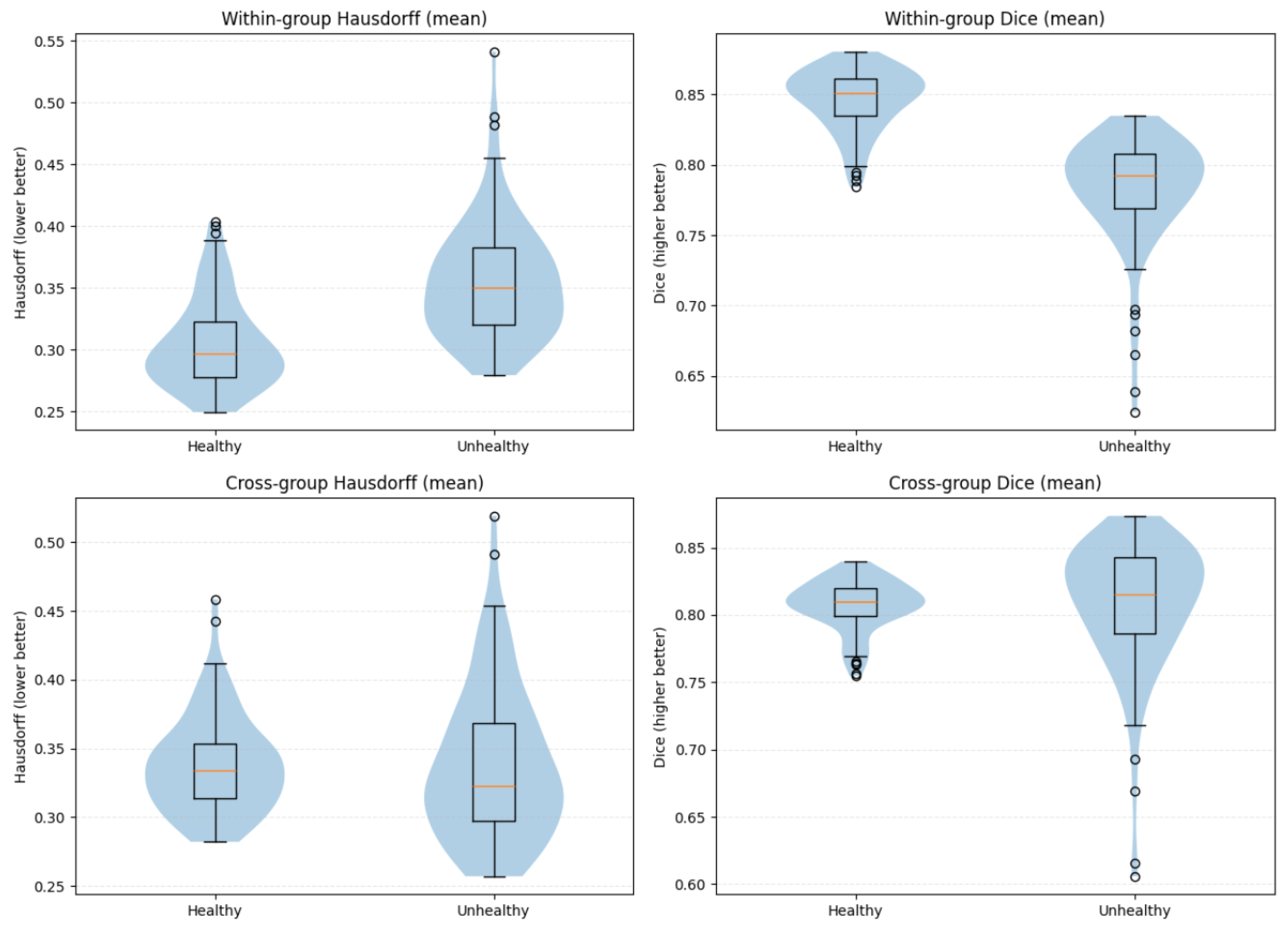
We quantify outline similarity using Elliptical Fourier Descriptors (EFD). Prior to reconstruction, we remove translation, rotation, uniform scale, and starting-point effects so that downstream comparisons reflect shape alone. From these reconstructions, we compute pairwise Hausdorff distance and Dice similarity both within and across health states as seen in Table 1 and the associated box plot visualization in Figure 8. Within the healthy group, shapes are tightly clustered (Hausdorff: mean 0.305, SD 0.076; Dice: mean 0.847, SD 0.040). Unhealthy shapes are more dispersed (Hausdorff: mean 0.355, SD 0.093; Dice: mean 0.783, SD 0.068). Cross-group comparisons (healthy–unhealthy) lie between these regimes (Hausdorff: mean 0.339; Dice: mean 0.807). In practical terms, a random healthy pair is ∼16% closer in Hausdorff distance than a random unhealthy pair (0.305 vs. 0.355) and overlapped by ∼8% more Dice (0.847 vs. 0.783). Cross-group similarity is closer to the unhealthy distribution than to the healthy one, consistent with the greater morphological heterogeneity among unhealthy leaves.
Table 1.
Summary statistics for Hausdorff distance (lower is better) and Dice coefficient (higher is better).
Figure 8.
Box plot of Dice and Hausdorff distances for different groups.
These findings agree with the EFD summary that healthy leaves occupy a tighter region of normalized shape space, higher Dice, lower Hausdorff, whereas unhealthy leaves are more dispersed. Fourier-domain summaries show larger mean amplitude and variability for unhealthy leaves (FD mean vs. ; FD std vs. ), and spatial-domain CCD statistics are both higher and more variable on average (centroid–distance mean 380.25 vs. 358.08; std 117.56 vs. 102.89). This shows that unhealthy outlines deviate more from a compact, balanced form, where greater radial unevenness is exhibited, while healthy leaves remain more mutually consistent. Importantly, the unhealthy group is not uniformly “more complex” at high frequencies; it is more variable, which increases dispersion.
For each leaf, we also compute its mean Hausdorff and Dice to all other leaves within the same class (within-group) and to leaves from the opposite class (cross-group), yielding four per-leaf distributions. This reduces dependency from pairwise counting and supports valid inference across groups. Results are reported in Table 2. Healthy leaves exhibit higher structural cohesion, as reflected in both lower Hausdorff distances and higher Dice similarity scores. Effect sizes are large ( for Dice), suggesting that healthy leaf shapes are more uniform. In contrast, diseased leaves show greater structural variability, indicating that disease disrupts shape regularity. For cross-group similarity, the average proximity to the opposite class is similar. Cross-group comparisons reveal no significant differences in pairwise similarity metrics, with near-identical mean Hausdorff and Dice values across groups. Although there is a marginal trend toward higher Dice similarity within the healthy group (), overall, the shapes are not clearly separable based on these metrics alone. While shape-based descriptors capture intra-group consistency especially among healthy leaves, they offer limited discriminability between healthy and diseased groups when used in isolation. Overall, morphological stress manifests primarily as increased within-class variability rather than a uniform displacement in shape space.
Table 2.
Statistical comparison of healthy (A) vs. unhealthy (B) leaves using Hausdorff distance (lower is better) and Dice coefficient (higher is better).
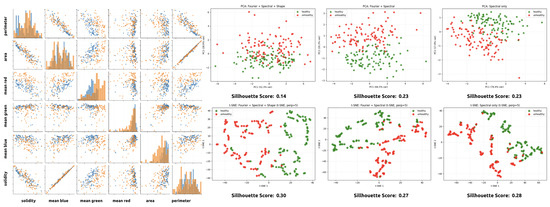
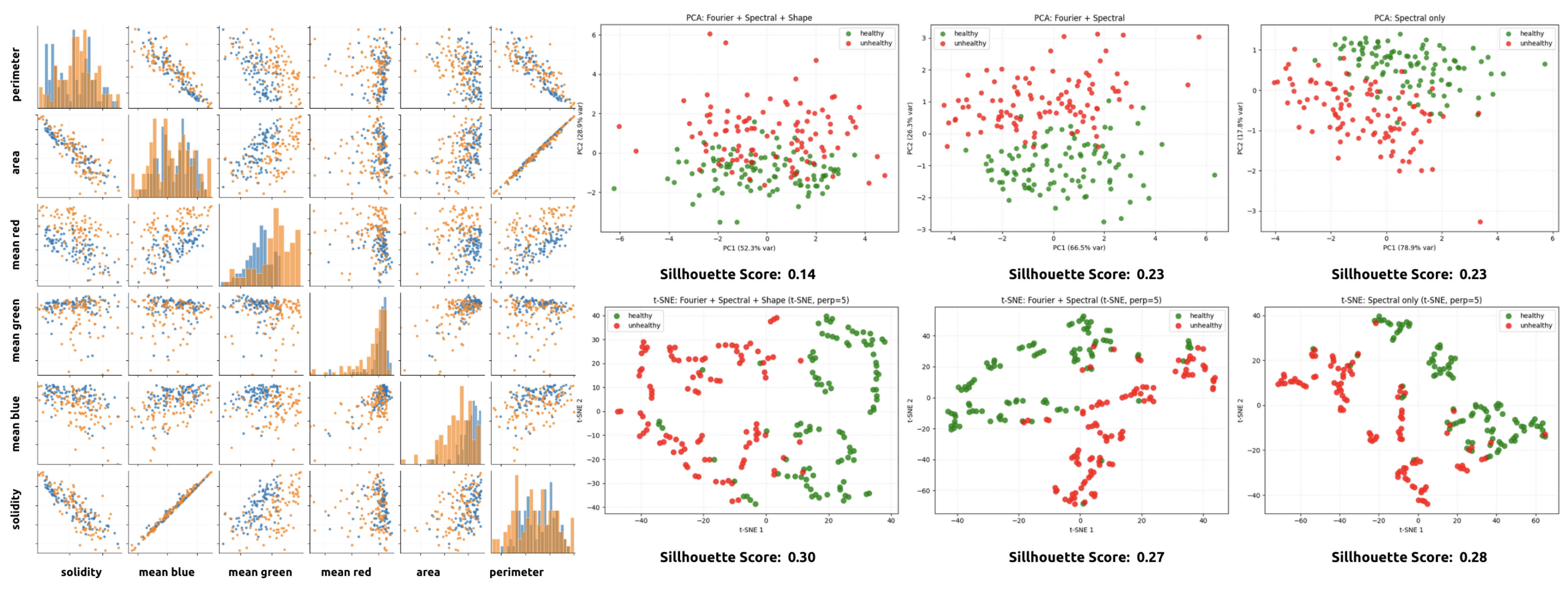
The leftmost panel of Figure 9 displays a scatter–histogram matrix for six representative features (perimeter, area, mean R/G/B, and solidity) stratified by group (healthy in blue, unhealthy in orange). Two patterns are immediately apparent. First is size covariation. Perimeter and area are linearly related (upper-left block) as expected for similarly shaped objects at different scales. Consistent with the univariate summaries reported earlier, the unhealthy cohort tends to occupy slightly larger values on both axes. Second is margin compactness. Solidity (area/convex–hull area) shows negative association with perimeter and area as leaves with longer boundaries tend to be less compact (more lobed/indented). For a given size, unhealthy leaves are shifted toward solidity, matching the group means of unhealthy vs. healthy , and indicating greater boundary irregularity in the diseased group. The RGB-channel histograms show low between-group shifts and substantial overlap.
Figure 9.
Pairplot of select features, PCA, and tSNE plots.
Figure 9 also illustrates the comparison of linear (PCA) and non-linear (t-SNE, perplexity = 5) embeddings for three feature sets: Fourier + Spectral + Shape, Fourier + Spectral and Spectral only In PCA, Spectral only attains the highest separation on the first two components (Silhouette ), matched by Fourier + Spectral () and exceeding Fourier + Spectral + Shape (). PC1 explains the greatest variance for Spectral only (about ), followed by Fourier + Spectral () and Fourier + Spectral + Shape (), indicating that the strongest linear class signal lies in the RGB and ExG channels. The t-SNE projections yield higher silhouettes ( for Fourier + Spectral + Shape, for Fourier + Spectral, for Spectral only), showing that some class structure is non-linear. However, the absolute silhouette values remain modest (all ≈–), meaning the two classes still overlap in the embedded space rather than forming perfectly separated clusters. These results indicate that there are statistically detectable group differences in radial and spectral descriptors, yet unhealthy leaves exhibit broader shape dispersion, which keeps unsupervised clusters only moderately separated.
4. Conclusions and Recommendations
This study presented a framework for quantifying tomato-leaf shape features from contour masks: centroid–contour distance (CCD), Fourier radial signatures (FRSs), and normalized EFD reconstructions for pairwise comparisons. The analyses converge on three observations.
First, group differences exist in the radial and spectral domains. Normalized CCD curves differ by a functional max- permutation test (), and the corresponding Fourier signature vectors differ by both a Hotelling-like permutation test (, ) and an energy–distance test (, ). These results indicate that disease is associated with systematic changes in the radial structure and its frequency content. Second, healthy leaves are more cohesive; unhealthy leaves are more heterogeneous. Within-group EFD comparisons show markedly lower Hausdorff distances and higher Dice overlaps for healthy leaves than for unhealthy ones (e.g., mean Hausdorff vs. ; mean Dice vs. ), with large effect sizes. By contrast, cross-group means are similar (Hausdorff , Dice ), consistent with a substantial overlap of the two groups in normalized shape space. Third, unsupervised separation is moderate. PCA on spectral statistics yields higher linear separability (silhouette ) than when many shape descriptors are appended (down to ≈). Non-linear t-SNE views an increase in silhouettes to ≈–, but clusters remain overlapping. Pairwise feature plots further show that unhealthy leaves tend to have slightly larger perimeter/area and lower solidity but with a wide overlap.
Given the results, the study recommends a fusion of spectral statistics with the shape features (CCD/FRS/EFD) since spectral features provide the clearest linear signal in PCA, whereas CCD/FRS capture the statistically significant radial and frequency differences between groups. Inputs should remain rotation- and scale-invariant, and inference should rely on per-leaf summaries rather than raw pairwise matrices to avoid dependency bias. To improve generalizability, we recommend increasing the dataset size beyond the current 100 healthy and 100 unhealthy leaves. Although statistical differences are detected between groups using both shape and spectral features, the sample size may limit the robustness of more complex models. Expanding the dataset to include more intra-class variability such as different cultivars, growth stages, or mild disease cases could improve model sensitivity and reduce overfitting. Including additional shape descriptors may further enhance discrimination, especially when combined with the current centroid- and frequency-based signatures.
Author Contributions
Conceptualization, J.R.J. and E.A.V.; methodology, J.R.J.; formal analysis, J.R.J. and E.A.V.; investigation, J.R.J. and E.A.V.; resources, J.R.J.; data curation, J.R.J.; writing—original draft preparation, J.R.J. and E.A.V.; writing—review and editing, J.R.J. and E.A.V.; visualization, J.R.J. and E.A.V.; supervision, E.A.V. All authors have read and agreed to the published version of the manuscript.
Funding
This research received no external funding.
Institutional Review Board Statement
Not applicable.
Informed Consent Statement
Not applicable.
Data Availability Statement
Data in this study can be accessed in this https://github.com/jazziejao/Leaf-Shape-Signatures (accessed on 19 August 2025), Github Repository.
Conflicts of Interest
The authors declare no conflicts of interest.
References
- Blancard, D. Tomato Diseases; CRC Press: Boca Raton, FL, USA, 2012. [Google Scholar]
- Liu, B.; Wei, S.; Zhang, F.; Guo, N.; Fan, H.; Yao, W. Tomato leaf disease recognition based on multi-task distillation learning. Front. Plant Sci. 2024, 14, 1330527. [Google Scholar] [CrossRef] [Scilit] [PubMed]
- Barbedo, J.G.A. A review on the main challenges in automatic plant disease identification based on visible range images. Biosyst. Eng. 2016, 144, 52–60. [Google Scholar] [CrossRef] [Scilit]
- Jabal, M.F.A.; Hamid, S.; Shuib, S.; Ahmad, I. Leaf features extraction and recognition approaches to classify plant. J. Comput. Sci. 2013, 9, 1295–1304. [Google Scholar] [CrossRef] [Scilit]
- Mahdikhanlou, K.; Ebrahimnezhad, H. Plant Leaf Classification using Centroid Distance and Axis of Least Inertia Method. In Proceedings of the 2014 22nd Iranian Conference on Electrical Engineering (ICEE), Tehran, Iran, 20–22 May 2014; pp. 1690–1694. [Google Scholar] [CrossRef] [Scilit]
- Yigit, E.; Sabanci, K.; Toktas, A.; Kayabasi, A. A study on visual features of leaves in plant identification using artificial intelligence techniques. Comput. Electron. Agric. 2019, 156, 369–377. [Google Scholar] [CrossRef] [Scilit]
- Chuanromanee, T.S.; Cohen, J.I.; Ryan, G.L. Morphological Analysis of Size and Shape (MASS): An integrative software program for morphometric analyses of leaves. Appl. Plant Sci. 2019, 7, e11288. [Google Scholar] [CrossRef] [Scilit] [PubMed]
- Hasim, A.; Herdiyeni, Y.; Douady, S. Leaf Shape Recognition using Centroid Contour Distance. IOP Conf. Ser. Earth Environ. Sci. 2016, 31, 012002. [Google Scholar] [CrossRef] [Scilit]
- Nieto-Barajas, L.E. Leaf clustering using circular densities. arXiv 2022, arXiv:2211.10547. [Google Scholar] [CrossRef] [Scilit]
- Saleem, G.; Akhtar, M.; Ahmed, N.; Qureshi, W. Automated analysis of visual leaf shape features for plant classification. Comput. Electron. Agric. 2019, 157, 270–280. [Google Scholar] [CrossRef] [Scilit]
- Khmag, A.; Al-Haddad, S.; Kamarudin, N. Recognition System for Leaf Images Based on its Leaf Contour and Centroid. In Proceedings of the 2017 IEEE 15th Student Conference on Research and Development (SCOReD), Kuala Lumpur, Malaysia, 13–14 December 2017; pp. 467–472. [Google Scholar] [CrossRef] [Scilit]
- Siravenha, A.C.Q.; Carvalho, S.R. Exploring the use of Leaf Shape Frequencies for Plant Classification. In Proceedings of the 2015 28th SIBGRAPI Conference on Graphics, Patterns and Images, Salvador, Brazil, 26–29 August 2015; pp. 297–304. [Google Scholar] [CrossRef] [Scilit]
- Lee, K.; Chung, K.W.; Hong, K.S. An Implementation of Leaf Recognition System Based on Leaf Contour and Centroid for Plant Classification. Lect. Notes Electr. Eng. 2013, 214, 109–116. [Google Scholar] [CrossRef] [Scilit]
- Neto, J.C.; Meyer, G.E.; Jones, D.D.; Samal, A.K. Plant species identification using Elliptic Fourier leaf shape analysis. Comput. Electron. Agric. 2006, 50, 121–134. [Google Scholar] [CrossRef] [Scilit]
- Wu, H.; Yang, J.J.; Li, C.Q.; Ran, J.H.; Peng, R.H.; Wang, X.Q. Reliable and superior elliptic Fourier descriptor normalization and its application software ElliShape with efficient image processing. arXiv 2024, arXiv:2412.10795. [Google Scholar] [CrossRef] [Scilit]
- Oso, O.A.; Jayeola, A.A. Digital morphometrics: Application of MorphoLeaf in shape visualization and species delimitation, using Cucurbitaceae leaves as a model. Appl. Plant Sci. 2021, 9, e11448. [Google Scholar] [CrossRef] [Scilit] [PubMed]
- Prasetyo, E.; Adityo, R.D.; Suciati, N.; Fatichah, C. Partial Centroid Contour Distance (PCCD) in Mango Leaf Classification. Int. J. Adv. Sci. Eng. Inf. Technol. 2020, 10, 1920–1926. [Google Scholar] [CrossRef] [Scilit]
- Haque, F.; Haque, S. Plant recognition system using leaf shape features and minimum euclidean distance. ICTACT J. Image Video Process. 2018, 9, 1919–1925. [Google Scholar] [CrossRef] [Scilit]

Disclaimer/Publisher’s Note: The statements, opinions and data contained in all publications are solely those of the individual author(s) and contributor(s) and not of MDPI and/or the editor(s). MDPI and/or the editor(s) disclaim responsibility for any injury to people or property resulting from any ideas, methods, instructions or products referred to in the content. |
© 2025 by the authors. Licensee MDPI, Basel, Switzerland. This article is an open access article distributed under the terms and conditions of the Creative Commons Attribution (CC BY) license (https://creativecommons.org/licenses/by/4.0/).