


Abstract
The “COVID-19” pandemic led Vodárenská akciová společnost, a.s., to start monitoring wastewater toxicity due to the fact that toxic wastewater began to flow into wastewater treatment plants during the pandemic. Parameters such as toxicity and ecotoxicity are not routinely monitored in wastewater treatment plants. As part of the project, samples from the location were analyzed, with sampling sites selected to obtain wastewater samples of different origins. These samples were then subjected to toxicity tests on several organisms.
1. Introduction
The topic of ecotoxicity/toxicity in the field of wastewater treatment became relevant during the “COVID-19” pandemic, when highly toxic wastewater flowed into wastewater treatment plants. The cause of toxic wastewater was considered to be the increased consumption of disinfectants and sanitation products, both in hospitals, social services, public spaces, and households. Toxic wastewater can cause considerable problems in wastewater treatment plants during its treatment, e.g., mortality of nitrifying bacteria in activation tanks. This issue is not yet widespread among operators of water supply and sewage systems for public use. At present, it is not possible to firmly define the effect of toxicity on individual stages of wastewater treatment; however, it is assumed that it will not have a fundamental effect on the mechanical stage of treatment, but that it will have a significant effect on the biological stage of treatment [1].
Ecotoxicity is a key factor in environmental protection in the European Union (EU). The European Chemicals Agency (ECHA) and the European Food Safety Authority (EFSA) are responsible for the evaluation and control of chemicals in terms of their ecotoxicity.
Council Directive 91/271/EEC concerning urban wastewater treatment aims to ensure a reduction in toxic substances discharged into surface waters [2]. Directive 2000/60/EC of the European Parliament and of the Council establishing a framework for Community action in the field of water policy requires good surface water and groundwater status [3]. Directive 2013/39/EU of the European Parliament and of the Council assesses priority substances in the field of water policy and the environmental quality of surface waters [4]. Directive 2006/118/EC on the Protection of Groundwater Against Pollution sets threshold values for pollutants in groundwater while taking into account their origin [5]. All of these directives indirectly support a reduction in ecotoxicity in wastewater. The reason is the subsequent discharge of these substances into surface water, which poses a threat to aquatic organisms and the environment.
The Stockholm Convention on Persistent Organic Pollutants of 2004 is in force within the framework of the United Nations Environment Programme [6,7]. Persistent organic pollutants are toxic substances, harmful to organisms and the environment, that persist in the environment for extended periods of time. They accumulate in living organisms through food chains and can be transported over long distances.
During the “COVID-19” pandemic, several problems were repeatedly detected in wastewater treatment processes at wastewater treatment plants—higher nitrite values in the effluent, a problem with reducing total phosphorus in wastewater, the water in the settling tank being colored gray, and foam in the effluent [1].
The situation described above prompted Vodárenská akciová společnost, a.s., to start monitoring the toxicity of wastewater. Based on an emergency situation at a wastewater treatment plant, this company established a project called “Ecotoxicity of wastewater in public sewerage systems” [1].
2. Methods
The methods of determining ecotoxicity/toxicity of wastewater are described in several international, European, and Czech standards. Several methods can be used to determine the acute or acute lethal toxicity of wastewater. Each method uses a different group of living organisms for this determination, in which inhibition, mortality, or immobilization is determined after a certain period of exposure.
2.1. European Standards—Methods for Determining Ecotoxicity/Toxicity in Wastewater
This part of the article will provide a brief overview of ČSN EN standards that describe methods for determining the toxicity of wastewater.
- ČSN EN ISO 6341 Water quality—Determination of the inhibition of the mobility of Daphnia magna Straus (Cladocera, Crustacea)—Acute toxicity test [8].
- ISO 7346-1,2,3 Water quality—Determination of the acute lethal toxicity of substances to a rainbow fish (Brachydanio rerio Hamilton-Buchanan—Teleostei, Cyprinidae) [9].
- ISO 11348-1,2,3 Water quality—Determination of the inhibitory effect of water samples on the light emission of Vibrio fischeri [10].
- ČSN EN ISO 20665 Water quality—Determination of chronic toxicity to Ceriodaphnia dubia [11].
- ČSN EN ISO 20666 Water quality—Determination of the chronic toxicity to Brachionus calyciflorus in 48 h [12].
- ČSN EN ISO 10712 Water quality—Pseudomonas putida growth inhibition test (Pseudomonas cell multiplication inhibition test [13].
- ČSN EN ISO 8692 Water quality—Freshwater algal growth inhibition test with unicellular green algae [14].
- ČSN EN ISO 20079 Water quality—Determination of the toxic effect of water constituents and wastewater on duckweed (Lemna minor)—Duckweed growth inhibition test [15].
- OECD 201 Algal Growth Inhibition Test [16].
- OECD 202 Daphnia sp. Acute Immobilisation Test [17].
- OECD 203 Fish Acute Toxicity Test [18].
2.2. Determination of Biological Analysis of Wastewater
The toxicity of wastewater was tested within the project using the following methods:
- An inhibitory effect test on luminescent bacteria;
- An acute lethal toxicity test on rainbow fish;
- An acute toxicity test on Cladocera;
- A growth inhibition test on green algae;
- A white mustard seed root growth inhibition test.
2.3. Determination of Chemical Analyses of Wastewater
The project included chemical analyses covering the determination of:
- Biochemical oxygen demand (BOD);
- Chemical oxygen demand (COD);
- Ammoniacal nitrogen (N-NH4);
- Total nitrogen (Ntotal);
- Total phosphorus P(total);
- Volatile suspended solids (SS);
- pH.
3. Study
The measuring campaign took place on one date, during which samples were taken in pre-selected sewer shafts in one city. This was carried out to determine whether toxic wastewater was flowing into the wastewater treatment plant and whether the wastewater treatment plant was capable of treating such wastewater.
3.1. Selected Wastewater Treatment Plant
The mechanical–biological wastewater treatment plant was designed with a low-load circulation activation stage, secondary clarifiers, chemical phosphorus removal, aerobic sludge stabilization, and a sludge-thickening and -dewatering line [19].
3.2. Results of Ecotoxicity/Toxicity Determination
Table 1 shows the results of biological analyses of samples taken at the influent and outfluent of the wastewater treatment plant. Inhibition and stimulation in luminescent bacteria, green algae, and white mustard are distinguished by color—a green color and a negative number indicate stimulation, and a positive number in gray indicates inhibition. For other organisms, the percentage of mortality or immobilization is given. If a wastewater sample shows inhibition, immobilization, or mortality higher than 30%, it is considered toxic, and a 1:10 dilution of the sample with dilution water is made. If the 1:10 dilution still produces values higher than 30%, a 1:100 dilution is performed, potentially followed by a dilution of 1:1000.

Table 1.
Biological tests of ecotoxicity/toxicity at the influent and outfluent of the wastewater treatment plant.
Table 1, showing tests on luminescent bacteria, which were performed with exposure times of 15 min and 30 min, indicate that the tests with exposure times of 15 min and 30 min are comparable in this case. The same result was obtained when testing Cladocera—the results from 24 h and 48 h exposure are comparable.
In the following two images, the above values are displayed in graphs. Figure 1 shows a graph of the average values of inhibition, immobilization, and mortality at the influent of the wastewater treatment plant. Figure 2 shows a graph of the average values of inhibition, immobilization, and mortality at the outfluent of the wastewater treatment plant.
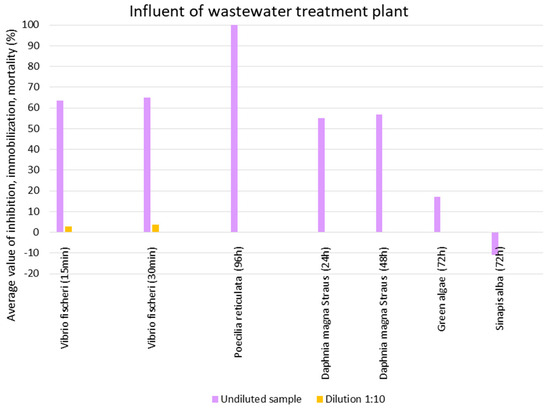
Figure 1.
Average values of inhibition, immobilization, and mortality at the influent of the wastewater treatment plant.
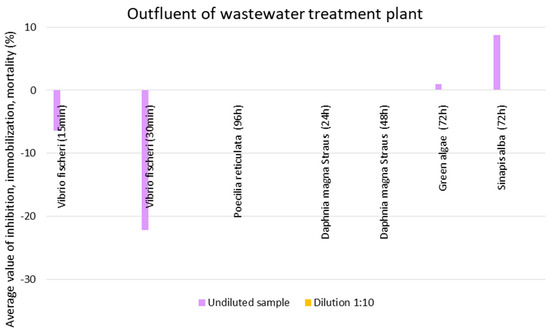
Figure 2.
Average values of inhibition, immobilization, and mortality at the outfluent of the wastewater treatment plant.
4. Discussion
Based on the above values and findings, it can be stated that for time reasons, in methods with two exposures, a shorter exposure is sufficient in terms of results. When testing the inhibitory effect on Vibrio fischeri (undiluted samples) at the influent of the wastewater treatment plant, inhibition values higher than 30% were found in several samples. After a 1:10 dilution, the percentage of inhibition was already below 30%, and no further dilution was necessary. Values indicating stimulation were found in samples taken from the outfluent of the wastewater treatment plant. No further dilution was necessary.
In tests conducted on rainbow fish with exposure for 96 h, 100% mortality was found in undiluted samples in the wastewater influent. After performing a 1:10 dilution, mortality was zero. In samples taken from the outfluent of the wastewater treatment plant, a mortality of 0% was found. No further dilution was performed.
When testing the inhibition of green algae growth and white mustard seed root growth on samples from the influent and outfluent of the wastewater treatment plant, values lower than 30% were found, and therefore, no further dilution was necessary.
Toxicity tests performed on Cladocera samples taken at the influent of the wastewater treatment plant showed immobilization greater than 30%. After performing a 1:10 dilution, immobilization was zero. Immobilization was 0% in the wastewater outfluent.
5. Conclusions
Most of the wastewater samples collected at the influent of the wastewater treatment plant demonstrated the presence of toxicity in all tests performed to demonstrate the presence of wastewater toxicity. On the contrary, samples collected at the outfluent of the wastewater treatment plant showed only very low values of inhibition, immobilization, or mortality, and in most cases, the values indicated stimulation. Based on this, it can be stated that the monitored wastewater treatment plant is capable of removing toxicity from wastewater with its treatment processes. The flow of toxic wastewater into wastewater treatment plants is undesirable, because such polluted wastewater causes significant damage to some of the treatment processes taking place at wastewater treatment plants.
According to a study conducted at the Institute of Environmental Engineering and Building Installations, Lodz University of Technology, the value of green algae growth inhibition and the acute toxicity to Daphnia magna were comparable [20]. However, our study does not confirm these conclusions—the green algae growth inhibition was detected to be below 30%, and the value of acute toxicity to Daphnia magna was 50–70% on average.
Author Contributions
P.H.—text; I.A.B.—text and evaluation of measured data. All authors have read and agreed to the published version of the manuscript.
Funding
The project entitled “Ecotoxicity of wastewater in public sewerage” was fully funded by Vodárenská akciová společnost, a.s. This article was created with co-financing by project No. FAST-S-25-8737 URBAN WATERCARE 2025: A comprehensive approach to sustainable urban water management. This article was drawn up as part of the internal project entitled “Ecotoxicity of wastewater in public sewerage systems” conducted at Vodárenská akciová společnost, a.s.
Institutional Review Board Statement
Not applicable.
Informed Consent Statement
Not applicable.
Data Availability Statement
The data presented in this study are available on request from the corresponding author.
Conflicts of Interest
Author Ida Antonie Bogáňová is employed by the company Vodárenská Akciová Společnost, a.s. Author Petr HLuštík is employed by Brno University of Technology, Faculty of Civil Engineering. The remaining authors declare that the research was conducted in the absence of any commercial or financial relationships that could be construed as potential conflicts of interest.
References
- Bogáňová, I.A. Stanovení Limitu Ekotoxicity pro Vybrané Producenty Odpadních vod. Ph.D. Thesis, Brno University of Technology, Faculty of Civil Engineering, Institute of Municipal Water Management, Brno, Czech Republic, 2025. [Google Scholar]
- Council Directive 91/271/EEC of 21 May 1991 concerning urban wastewater treatment. Off. J. Eur. Communities 1991, 135, 40–52. Available online: https://esipa.cz/sbirka/sbsrv.dll/sb?DR=SB&CP=31991L0271 (accessed on 23 October 2025).
- Directive 2000/60/EC. Establishing a framework for Community action in the field of water policy. Off. J. Eur. Communities 2000. Available online: https://eur-lex.europa.eu/eli/dir/2000/60/oj/eng (accessed on 23 October 2025).
- Directive 2013/39/EU of the European Parliament and of the Council amending Directives 2000/60/EC and 2008/105/EC. Off. J. Eur. Union 2013, 226, 1–17. Available online: https://esipa.cz/sbirka/sbsrv.dll/sb?DR=SB&CP=32013L0039 (accessed on 23 October 2025).
- Directive 2006/118/EC of the European Parliament and of the Council of 12 December 2006 on the protection of groundwater against pollution and deterioration. Off. J. Eur. Union 2006, 372, 19–31. Available online: https://eur-lex.europa.eu/eli/dir/2006/118/oj/eng (accessed on 23 October 2025).
- United Nations Environment Programme (UNEP). Available online: https://www.unep.org/ (accessed on 23 October 2025).
- Stockholm Convention on Persistent Organic Pollutants. Available online: https://www.pops.int/ (accessed on 23 October 2025).
- ČSN EN ISO 6341; Water Quality—Determination of the Inhibition of the Mobility of Daphnia magna Straus (Cladocera, Crustacea)—Acute Toxicity Test. Czech Standards Institute: Prague, Czech Republic, 2013.
- ISO 7346-1,2,3; Water Quality—Determination of the Acute Lethal Toxicity of Substances to a Freshwater Fish (Brachydanio rerio Hamilton-Buchanan—Teleostei, Cyprinidae). International Organization for Standardization: Geneva, Switzerland, 1999.
- ISO 11348-1,2,3; Water Quality—Determination of the Inhibitory Effect of Water Samples on the Light Emission of Vibrio fischeri. International Organization for Standardization: Geneva, Switzerland, 2009.
- ČSN EN ISO 20665; Water Quality—Determination of Chronic Toxicity to Ceriodaphnia dubia. Czech Standards Institute: Prague, Czech Republic, 2010.
- ČSN EN ISO 20666; Water Quality—Determination of Chronic Toxicity to Brachionus calyciflorus in 48 h. Czech Standards Institute: Prague, Czech Republic, 2010.
- ČSN EN ISO 10712; Water Quality—Pseudomonas putida Growth Inhibition Test (Pseudomonas Cell Multiplication Inhibition Test). Czech Standards Institute: Prague, Czech Republic, 1997.
- ČSN EN ISO 8692; Water Quality—Freshwater Algal Growth Inhibition Test with Unicellular Green Algae. Czech Standards Institute: Prague, Czech Republic, 2012.
- ČSN EN ISO 20079; Water Quality—Determination of the Toxic Effect of Water Constituents and Wastewater on Duckweed (Lemna minor)—Duckweed Growth Inhibition Test. Czech Standards Institute: Prague, Czech Republic, 2007.
- OECD 201. Algal Growth Inhibition Test; Organisation for Economic Co-Operation and Development: Paris, France, 2011. [Google Scholar]
- OECD 202. Daphnia sp. Acute Immobilisation Test; Organisation for Economic Co-Operation and Development: Paris, France, 2004. [Google Scholar]
- OECD 203. Fish Acute Toxicity Test; Organisation for Economic Co-Operation and Development: Paris, France, 2019. [Google Scholar]
- Eyer, M. (Boskovice, Czech Republic); Mikulášek, P. (Boskovice, Czech Republic); Bláha, M. (Brno, Czech Republic). Provozní Řád pro Trvalý Provoz Čistírny Odpadních vod (ČOV 1), Internal Document; Boskovice, Czech Republic. 2008.
- Liwarska-Bizukojć, E. Evaluation of ecotoxicity of wastewater from full-scale treatment plants. Water 2022, 14, 3345. [Google Scholar] [CrossRef]
Disclaimer/Publisher’s Note: The statements, opinions and data contained in all publications are solely those of the individual author(s) and contributor(s) and not of MDPI and/or the editor(s). MDPI and/or the editor(s) disclaim responsibility for any injury to people or property resulting from any ideas, methods, instructions or products referred to in the content. |
© 2025 by the authors. Licensee MDPI, Basel, Switzerland. This article is an open access article distributed under the terms and conditions of the Creative Commons Attribution (CC BY) license (https://creativecommons.org/licenses/by/4.0/).