Proceeding Paper

Potential of Biomass-Derived Fly Ash for Zinc Adsorption from Acidic Water †
Department of Environmental Engineering, Faculty of Mining and Geology, VSB—Technical University of Ostrava, 17. listopadu 15/2172, 708 00 Ostrava, Czech Republic
*
Author to whom correspondence should be addressed.
Presented at the 5th International Conference on Advances in Environmental Engineering, Ostrava, Czech Republic, 26–28 November 2025.
Eng. Proc. 2025, 116(1), 25; https://doi.org/10.3390/engproc2025116025
Published: 3 December 2025

Abstract

Fly ash from biomass combustion was used as an adsorbent for zinc removal from model solutions. Its properties were characterized using XRF, FTIR, and SEM-EDS. Batch experiments showed that the Langmuir model fit the data. The untreated ash can be used only for polishing acidic industrial wastewater.

1. Introduction

Water resource pollution represents a major global environmental issue, driven not only by growing water scarcity but also by increasing industrial activity and insufficient wastewater treatment. Industrial and economic expansion, though beneficial for technological advancement, has contributed to rising contamination of surface and groundwater, posing significant risks to aquatic ecosystems [1].
Among the contaminants of concern, zinc (Zn) is classified as a potentially toxic metal. Although naturally present in mineral forms, it enters aquatic systems via both geogenic and anthropogenic pathways. Anthropogenic sources include mining, ore processing, electroplating, pigment manufacturing, intensive agriculture (through fertilizers and pesticides containing zinc), and effluent discharges from industrial and municipal activities. Fossil fuel combustion and corrosion of metallic infrastructure also contribute to zinc release [2,3].
Zinc is biologically essential in trace amounts, but elevated concentrations can cause toxicity. High Zn levels negatively affect aquatic microorganisms, invertebrates, fish, and aquatic plants by disrupting metabolic functions and nutrient uptake. In humans, chronic exposure can impair kidney, liver, and neurological function [1].
Among currently available treatment technologies, adsorption is regarded as a highly effective approach for removing potentially toxic metals from aqueous environments. Alternative or complementary methods, such as flotation and biodegradation, have proven effective, particularly for persistent organic pollutants or complex mixtures in sediments and waterways [4,5].
In the context of sustainability goals and European Union policy promoting the reduction of landfill disposal by 2030, the valorization of industrial by-products is gaining momentum. Biomass-derived fly ash from thermal or power plants is one such by-product with promising adsorptive properties. Its low cost, wide availability, suitable physicochemical characteristics, and typically lower content of hazardous elements compared to coal fly ash make it attractive for environmental remediation. Moreover, its reuse in water treatment supports circular economy principles by reducing dependence on primary materials and decreasing waste volumes [6,7].
This study evaluates the potential of fly ash from biomass combustion for zinc removal from model industrial wastewater. The research includes chemical and physical characterization of the material and experimental analysis of its adsorption performance.

2. Materials and Methods

2.1. Preparation and Characterization of the Adsorbent

Fly ash was collected from a biomass-fired thermal power plant operating with fluidized bed combustion, using mixed wood chips as fuel. The sample was oven-dried at 105 ± 1 °C (ECOCELL, BMT, Praha, Czech Republic) to remove moisture and enhance adsorption performance.
Elemental composition was analysed using X-ray fluorescence (XRF; XEPOS, Spectro, Berlin, Germany), providing semi-quantitative data with an RSD of 15%. Functional groups were identified by FTIR spectroscopy (Nicolet iS10, Thermo Scientific, Pardubice, Czech Republic) in the 500–4000 cm−1 range, using KBr pellets at a 20:1 ratio (sample: KBr). The RSD was <5%. Surface morphology and composition were examined via scanning electron microscopy combined with energy-dispersive X-ray spectroscopy (SEM/EDX; Tescan Vega, Brno, Czech Republic).

2.2. Adsorption Experiment and Modelling

Batch adsorption experiments were performed to determine kinetic and equilibrium parameters. Precisely 1.0000 ± 0.01 g of adsorbent was mixed with 50.0 mL of zinc model solution (100 mg L−1) in HDPE containers (100 mL volume). All experiments were conducted at 23 ± 1 °C with continuous shaking (180 rpm, GFL 3031 incubator, Praha, Czech Republic). After predefined contact times (0–360 min), suspensions were filtered (PRAGOPOR 6, Praha, Czech Republic).
Zinc concentrations were measured by atomic absorption spectrometry with graphite furnace (contrAA® 700, Analytik Jena, Berlin, Germany; RSD ±3%). Blank experiments were conducted to account for zinc sorption to the container walls.

2.2.1. Kinetic Analysis

Kinetic analysis helped to understand the adsorption mechanism and determine equilibrium times. Adsorption capacity at equilibrium (qr, mg·g−1) was calculated by Equation (1):
q r = V c i c f m
where
c i and c f : real initial and final Zn concentration, (mg·L−1);
c f : equilibrium concentration of adsorbate in solution, (mg·L−1);
m: adsorbent mass, (g);
V: solution volume (L).

2.2.2. Effect of pH

The pH influence was tested across the pH range 3.0–7.0 (adjusted with 0.1 mol L−1 HNO3 or NaOH). Higher pH was excluded to avoid Zn(OH)2 precipitation. All tests were conducted under the same conditions as the kinetic study, with an exposure time of 120 min. The actual pH value of the model metal solution was verified each time using a pH meter PH-METR 526 (WTWcz, Berlin, Germany). The pH value was also measured in the filtrate.

2.2.3. Equilibrium Isotherms

Isotherms were established using initial Zn(II) concentrations from 50 to 900 mg L−1 under the same experimental conditions. Both the Langmuir and the Freundlich models were applied in linear and nonlinear forms. Langmuir constants (qmax, KL) and the separation factor RL were derived. Freundlich parameters (KF, n) were calculated using Equation (2):
q e = K F c e 1 / n ,
where KF is the Freundlich constant, also known as the Freundlich capacity, (mg·g−1), 1/n Freundlich constant, indicating the intensity of adsorption, qe is the adsorption capacity, the equilibrium amount of dissolved metal adsorbed per weight unit of adsorbent, (mg·g−1) and c e is the equilibrium concentration of the solute in the solution volume, (mg·L−1).
The Langmuir model in linear and nonlinear form is expressed by the following relations (Equations (3) and (4)):
c e q e = 1 q m a x K L + c e q m a x ,
1 q e = 1 q m a x + 1 q m a x K L + 1 c e ,
where q m a x is the maximum adsorption capacity corresponding to saturation sites, (mg·g−1); K L is the Langmuir constant, the affinity coefficient between the adsorbent and the adsorbate derived from the affinity constants K (b = 1/K). The remaining parameters have the same meaning as in the equations above.

3. Results and Discussion

3.1. Physicochemical Properties

Fly ash produced from the combustion of plant biomass possesses several properties that make it suitable for use as an adsorbent. However, depending on the origin of the biomass, it may also contain potentially hazardous elements such as As, Cd, Cu, or Al. The following section, therefore, focuses on the characterization of the fly ash samples used in this study.
X-ray fluorescence (XRF) analysis revealed that the ash derived from plant biomass combustion contains approximately 43% (w/w) of detectable elements (note that this method does not detect carbon, hydrogen, nitrogen, or oxygen). Importantly, the XRF results confirmed that the fly ash is not contaminated with toxic metals.
As expected, the fly ash is characterized by a high silicon content (approximately 20% w/w). It also contains calcium (approximately 9% w/w) and potassium (approximately 4% w/w). The elevated levels of potassium and calcium are likely due to the secondary addition of calcium salts aimed at reducing flue gas acidity. Iron is also present at approximately 2.5% w/w.
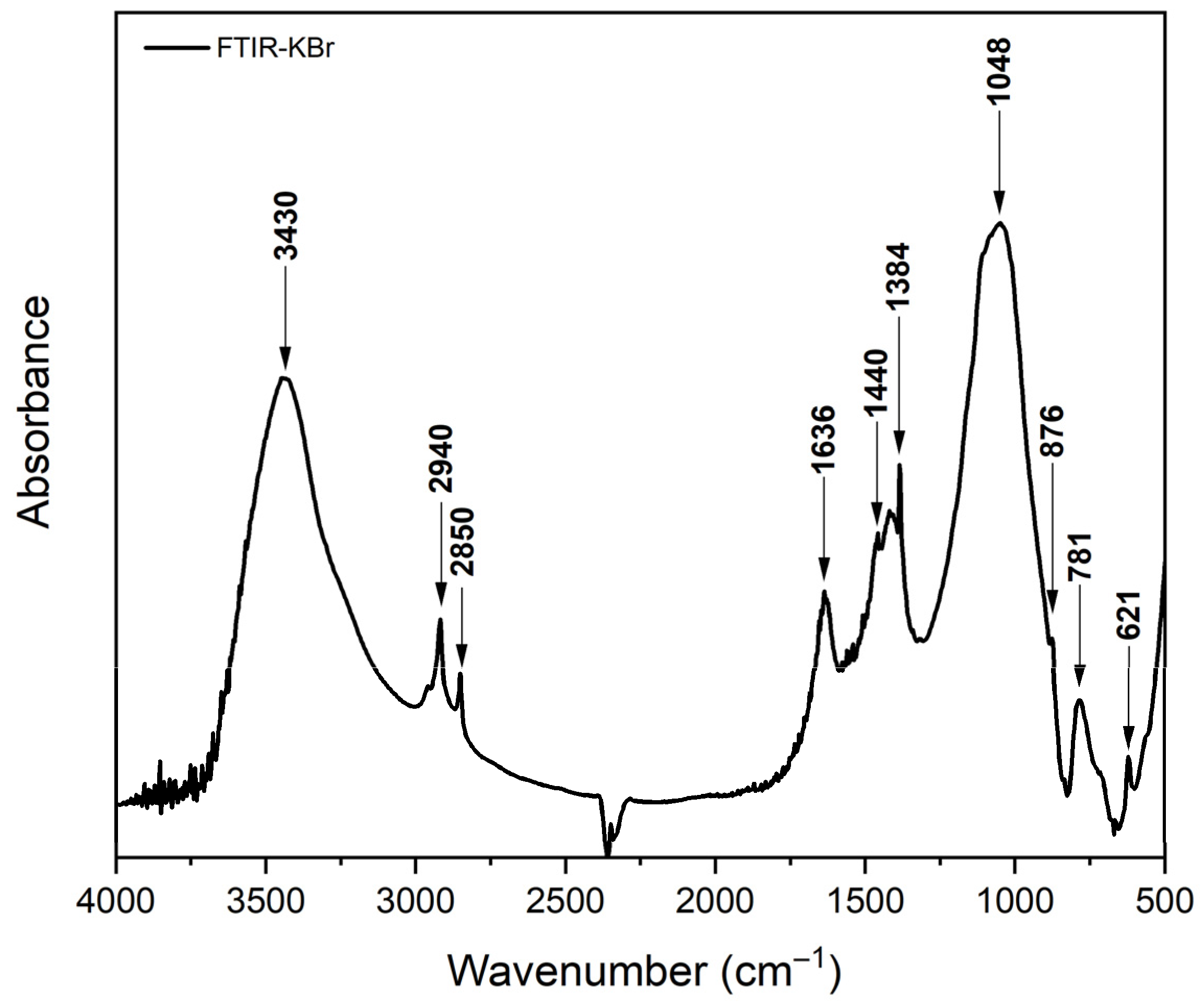
The chemical properties of the adsorbent used can also significantly affect the course of metal adsorption. FTIR spectra were used to analyze the surface layers of the fly ash (Figure 1). The band ranging from 3700 to 3000 cm−1 is clearly visible from the FTIR spectrum. This is usually attributed to the hydroxyl (-OH) functional group, which is typical for humidity. However, this humidity is typical for analysis using KBr tablets and is therefore attributed to the hydroscopic properties of KBr. The peak with a wavenumber of 1630 cm−1 is not typical for the hydroxyl group but directly for the free water contained in the sample. In the rest of the FTIR spectrum, it is visible that the sample was very well carbonized during the process of the combustion of plant biomass, and thus outweighs the CH2 functional groups of asymmetric (2940 cm−1) and symmetric (2850 cm−1) vibrations. C-H groups are also present here, and they are attributed to peaks with wavenumbers of 1440 cm−1, 1380 cm−1, 876 cm−1, and 781 cm−1. A very interesting functional group that occurs in the spectrum at a wavenumber of 1048 cm−1, based on peak deconvolution using Omnic software, it could be a C-O-H group, but it could also be a C-O, C-C, or C-H group [8]. The formation of primary alcohols and their groups is due to the process of thermal decomposition of carboxylic acids contained in plant biomass. At the end of the spectrum, there is the SO42− group (621 cm−1), which corresponds to an ash composition of 2.282 wt. % S [9,10].
SEM was used to take images of the surface of the sample, which were used to determine the exact surface morphology.
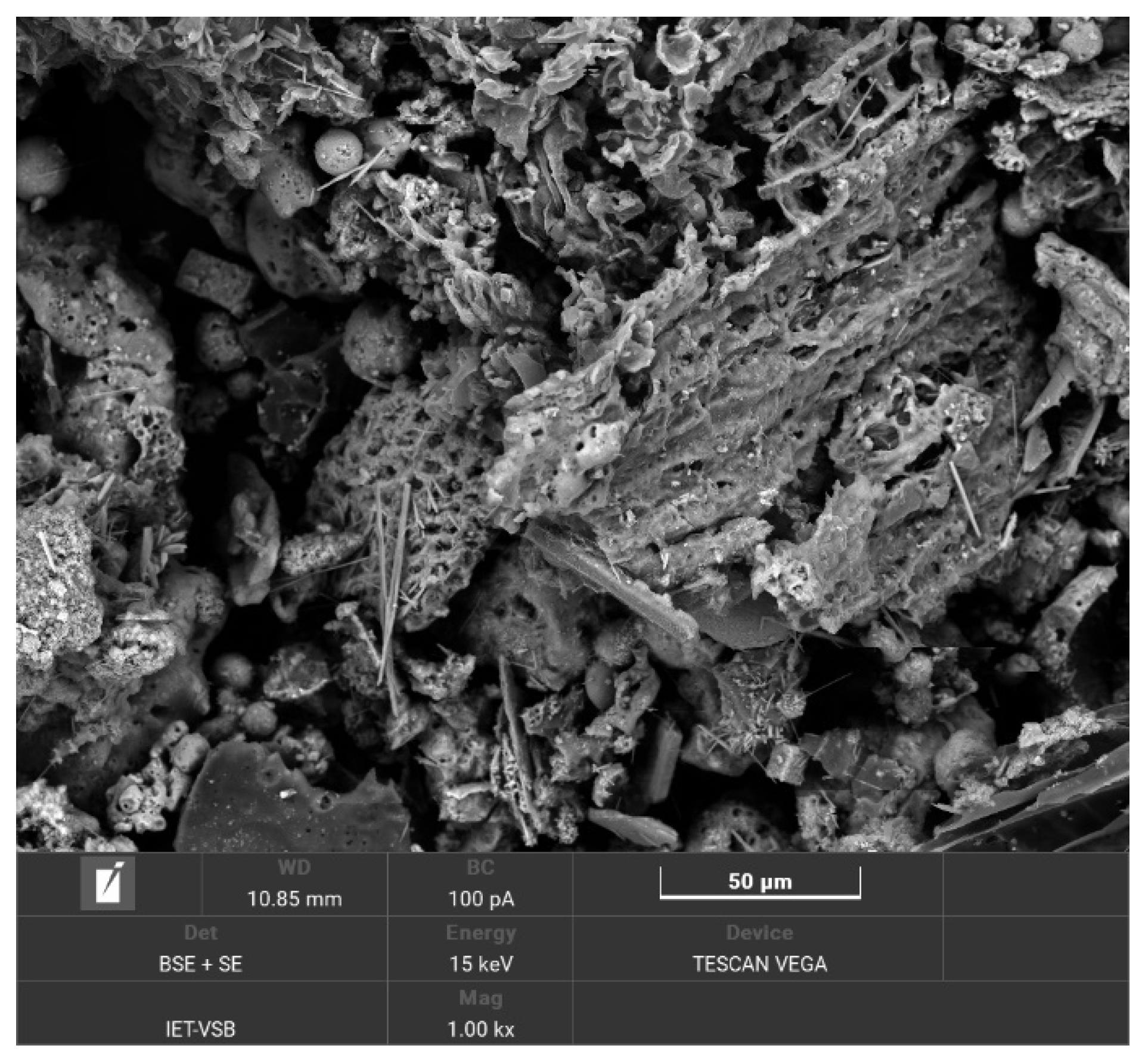
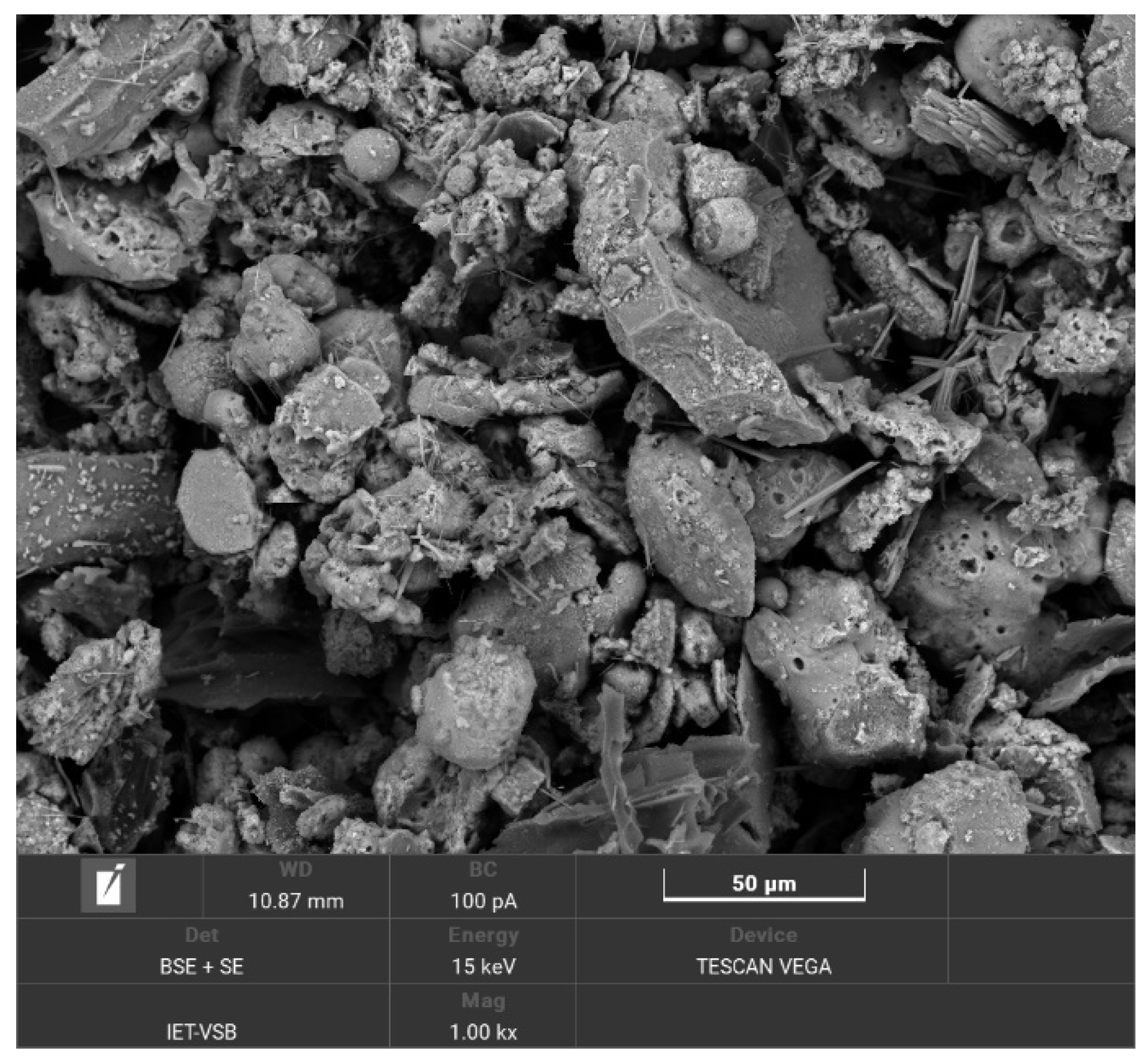
Fly ash prior to zinc adsorption (Figure 2) exhibits a complex and highly heterogeneous microstructure. The particle surfaces are characterized by a layered morphology with numerous micropores, irregularities, and depressions, forming an extensive network of potential adsorption sites. The presence of lamellar structures with a porous texture suggests a high specific surface area of the material. The particle morphology is predominantly irregular, featuring sharp edges, protrusions, and needle-like structures, which are typical products of high-temperature combustion processes [11]. The fine fibrous and needle-like features further contribute to the increased active surface area of the fly ash. Following zinc adsorption (Figure 3), significant morphological changes are observed. The particle surfaces appear more compact and rounded, with the original sharp edges and needle-like protrusions no longer present. These changes indicate that zinc ions filled surface irregularities during the adsorption process, partially modifying the microstructure of the fly ash. The observed formation of aggregates and particle clustering may result from zinc bridging, supporting the hypothesis of its active role in interparticle interactions [12].
The original microporous structure appears partially filled and smoothed, suggesting efficient deposition of zinc within the internal pores of the adsorbent. Regarding particle size distribution, a higher degree of uniformity is observed in the fly ash after adsorption. It is assumed that fine particles acted as nucleation centers for zinc ion adsorption, leading to their growth and morphological rounding. This process likely resulted in a decrease in specific surface area, while simultaneously confirming the effective immobilization of zinc on both the surface and within the pore structure of the fly ash [13].
From a chemical standpoint, the observed morphological changes suggest that, in addition to physical adsorption, chemical interactions between zinc ions and functional groups present on the fly ash surface also contributed. These interactions may include ion exchange, complexation, or precipitation of zinc compounds, which are reflected in the structural changes observed [14,15].
Microscopic analysis thus clearly confirms the effectiveness of fly ash as an adsorbent for zinc and highlights the substantial impact of the adsorption process on the material’s morphology and microstructure. These findings contribute to a deeper understanding of the adsorption mechanism and provide a valuable foundation for optimizing the use of fly ash in environmental applications, particularly in the treatment of wastewater contaminated with potentially toxic metals.
Although the BET method for determining the specific surface area was not available, the morphological characteristics obtained by SEM, along with knowledge of the chemical composition, offer sufficient insight into the material’s properties in terms of its suitability as an adsorbent.

3.2. Evaluation of the Kinetics of Adsorption of the Studied Metals

The study of zinc (Zn) adsorption kinetics on fly ash is essential for understanding the rate of the adsorption process and, importantly, for optimizing experimental conditions to achieve maximum adsorption efficiency. Kinetic analysis provides valuable insights into the reaction pathways and the contact time required between the adsorbent and adsorbate to reach equilibrium—one of the key parameters influencing the overall adsorption performance of the investigated metal.
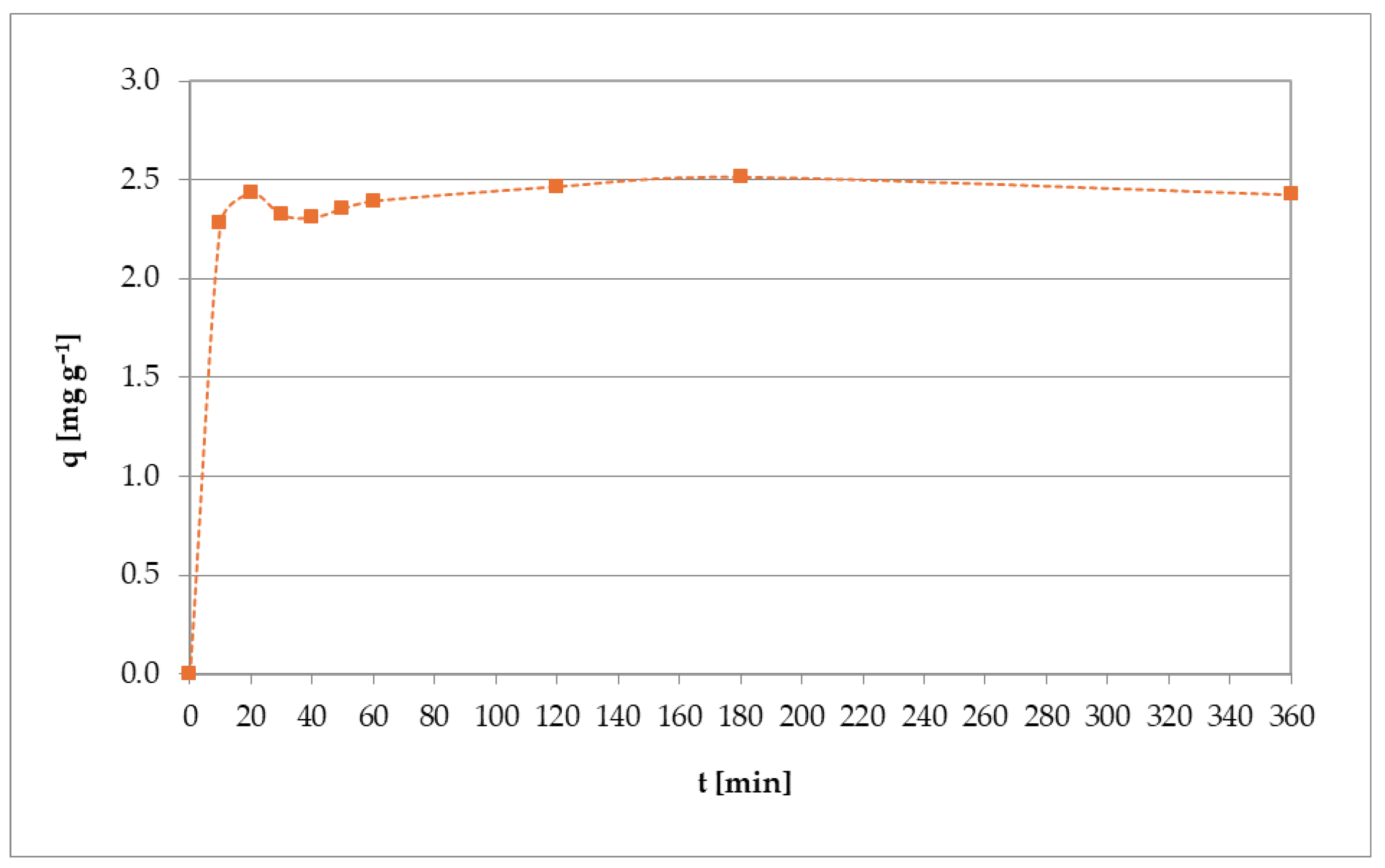
The particle size of the adsorbent also plays a crucial role, not only in the adsorption process itself but also in determining the economic feasibility of its treatment for practical applications. While smaller particles may enhance the rapid removal of metal ions from solution, larger particles may be more suitable for prolonged adsorption processes, particularly when adsorbent reuse is desired. The effect of adsorbent particle size on zinc adsorption at different contact times (0, 10, 20, 30, 40, 50, 60, 120, 180, and 360 min) is graphically presented in Figure 4.
To further investigate the mechanism of zinc adsorption onto fly ash, a contact time of 120 min was selected based on the results of the kinetic study. At this time, adsorption equilibrium was reached (q120 = 2.5 mg·g−1, corresponding to 99% efficiency). For the conference version, a linearized interpretation was retained. Nonlinear fitting results will be included in the extended version of the manuscript.

3.3. Influence of pH on the Adsorption of the Studied Metals

The pH value plays a key role in adsorption processes, as it significantly affects the efficiency of metal removal from aqueous solutions [10]. Kinetic experiments showed that equilibrium was reached only after 120 min, which raised concerns about pH changes caused by the alkaline nature of fly ash during this extended contact time. It was observed that pH increased markedly within the first hour, even when initially adjusted to acidic values (e.g., pH 3), which may lead to zinc removal not only via adsorption but also by precipitation of Zn(OH)2.
To assess this effect, model zinc solutions with initial pH values of 3.0–7.0 were prepared and buffered to maintain constant pH during the 120 min contact. At pH < 5.0, surface protonation reduced adsorption due to electrostatic repulsion and competition between Zn2+ and H+ ions [16]. In the range of pH 5.0–7.0, more negatively charged sites formed on the ash surface (containing, e.g., CaO, SiO2, Fe2O3), enhancing Zn2+ adsorption [17]. At pH > 7.0, precipitation of Zn(OH)2 became dominant. The highest adsorption efficiency was observed at pH 6.0. For equilibrium studies, pH 7.0 was selected as the upper limit to ensure adsorption remains the dominant removal mechanism.

3.4. Evaluation of Adsorption Isotherms

Equilibrium adsorption studies provide essential information about the efficiency and nature of the interaction between the adsorbent and the adsorbate. By analyzing adsorption isotherms, it is possible to quantify the equilibrium sorption capacity of the system and gain insight into the adsorption mechanism. Moreover, mathematical modeling of isotherms enables the prediction of key parameters important for designing effective adsorption processes [15].
To describe the equilibrium adsorption of zinc, two commonly used models were applied—the Langmuir and the Freundlich isotherms, both in their linear form. Equilibrium data were obtained at different initial Zn2+ concentrations (50–900 mg·L−1), while other experimental conditions were based on a previous kinetic study. The contact time was 120 min, the stirring speed was 150 rpm, and the temperature was 23 ± 1 °C. The validity of the models was assessed based on the coefficient of determination (R2), with values above 0.95 considered satisfactory. The isotherm model parameters, including maximum sorption capacity (qmax), isotherm constants, and correlation coefficients, are summarized in Table 1.
Zinc sorption onto the tested fly ash showed very good agreement with both models, as evidenced by high R2 values (0.98). The Langmuir model indicated a maximum sorption capacity (qmax) of 12.6 mg·g−1 and a Langmuir constant (KL) of 0.02 L·mg−1, suggesting a reasonable affinity of the adsorbent for Zn2+ ions. Furthermore, the very low value of the separation factor (RL = 0.0005) indicates highly favorable adsorption even at elevated initial concentrations. The Freundlich model provided a constant KF > 2.66 and an exponent n = 4.35, with n > 2 confirming very favorable and easily occurring adsorption. Based on these results, it can be concluded that fly ash exhibits high adsorption potential for zinc. The good fit of both models suggests that adsorption likely occurs on a surface with combined characteristics—homogeneous (as per Langmuir) and heterogeneous (as per Freundlich).
Nonlinear forms of the Langmuir and the Freundlich models were also applied, and both isotherms were compared to the experimental data. The Langmuir isotherm demonstrated excellent agreement, particularly at low to moderate initial Zn2+ concentrations, supporting the assumption of a limited number of active sites and monolayer adsorption. However, at higher concentrations, slight deviations appeared—the experimental values exceeded theoretical predictions—possibly due to surface heterogeneity, multilayer adsorption, or changes in zinc speciation induced by pH shifts.
Conversely, the Freundlich model, which assumes a heterogeneous surface and multilayer adsorption, described the adsorption behavior well, especially at higher concentrations. While its fit was not as strong in the lower concentration range, it better captured the nonlinearity of adsorption capacity growth at high system loadings, where various interactions between Zn2+ and fly ash components likely occur. Overall, the nonlinear Langmuir model provides a more accurate description at low to medium concentrations, whereas the Freundlich model offers a better fit at higher concentrations where additional mechanisms beyond monolayer adsorption may be involved. The combined use of both models thus provides a more comprehensive understanding of the adsorption behavior of fly ash toward Zn2+.

4. Conclusions

Based on the results obtained, it can be concluded that untreated fly ash derived from biomass combustion exhibits promising adsorption properties for the removal of Zn(II) from aqueous media. The material demonstrated high affinity for zinc ions, reaching equilibrium within 120 min and achieving 99% removal efficiency under optimized conditions. The maximum sorption capacity, evaluated using the Langmuir model, was 12.6 mg·g−1, and the Freundlich model also confirmed highly favorable adsorption behavior (n = 4.35).
The morphological and chemical analyses (SEM-EDS, FTIR, and XRF) confirmed that the fly ash surface offers a variety of active sites and functional groups capable of binding zinc through both physical and chemical interactions, including ion exchange and complexation. Although specific surface area measurements (e.g., BET) were not available, SEM observations revealed a porous and heterogeneous structure with substantial surface roughness prior to adsorption, which was visibly altered after metal uptake.
Given its availability, low cost, and relatively low content of hazardous elements, biomass-derived fly ash represents an effective and sustainable adsorbent for wastewater treatment applications. Its use aligns well with circular economic principles by promoting the valorization of industrial by-products and reducing the burden on landfilling.
Importantly, due to its alkaline nature, untreated fly ash is especially suitable for the treatment of acidic wastewater containing potentially toxic metals such as zinc. In such cases, the adsorbent not only contributes to metal removal but also partially neutralizes acidic effluents, reducing the need for additional chemical pH adjustment.
Future research should focus on testing the fly ash in real wastewater matrices, assessing regeneration potential, and evaluating long-term performance under dynamic flow conditions.

Author Contributions

Conceptualization, L.B. and P.B.; methodology, L.B.; software, L.B.; validation, L.B. and P.B.; formal analysis, L.B.; investigation, L.B.; resources, P.B.; data curation, L.B.; writing—original draft preparation, L.B.; writing—review and editing, L.B.; visualization, P.B.; supervision, P.B.; project administration, L.B.; funding acquisition, P.B. All authors have read and agreed to the published version of the manuscript.

Funding

Experimental results were accomplished by using the Large Research Infrastructure ENREGAT, supported by the Ministry of Education, Youth and Sports of the Czech Republic, under project No. LM2018098 and supported by VŠB–TUO, Faculty of Mining and Geology—grants numbers SP2024/30, 2025/014.

Institutional Review Board Statement

Not applicable.

Informed Consent Statement

Not applicable.

Data Availability Statement

The data that support the findings of this study are available from the corresponding author P.B.

Acknowledgments

Special thanks go to Pertile Eva for useful comments on and for editing an earlier draft of this manuscript.

Conflicts of Interest

The authors declare no conflict of interest.

References

  1. Mitra, S.; Chakraborty, A.J.; Tareq, A.M.; Emran, T.B.; Nainu, F. Impact of heavy metals on the environment and human health: Novel therapeutic insights to counter the toxicity. J. King Saud Univ. Sci 2022, 34, 101865. [Google Scholar] [CrossRef]
  2. Kavitha, E.; Gopika, A. Review and assessment of the separation and recovery of zinc from the aqueous stream. Desalination Water Treat. 2023, 291, 131–143. [Google Scholar] [CrossRef]
  3. Van Huu-Tap, H.; Hoang, V.H.; Nga, L.T.Q.; Nguyen, V.Q. Effects of Zn pollution on soil: Pollution sources, impacts and solutions. Results Surf. Interfaces 2024, 17, 100360. [Google Scholar] [CrossRef]
  4. Fečko, P.; Janakova, I.; Raclavská, H.; Tora, B. Application of flotation in the decontamination of sediments from the Černý Příkop stream. Pol. J. Chem. Technol. 2009, 11, 8–11. [Google Scholar] [CrossRef]
  5. Janáková, I.; Vojtková, H. Application of flotation and biodegradation to eliminate persistent organic pollutants in the influent stream of Černý Příkop. In Microbes in Applied Research; World Scientific: Malaga, Spain, 2012; pp. 28–32. [Google Scholar] [CrossRef]
  6. Xu, L.; Xing, X.; Peng, J. Removal of Zn2+ from aqueous solution using biomass ash and its modified product as biosorbent. Int. J. Environ. Res. Public Health 2022, 19, 9006. [Google Scholar] [CrossRef]
  7. Pertile, E.; Zamarsky, P. An alternative method of removing Cr(VI) from aquatic solution using chemically modified cone biomass and Fomitopsis pinicola. IOP Conf. Ser. Earth Environ. Sci. 2020, 444, 012043. [Google Scholar] [CrossRef]
  8. Pavlikov, A.V. Low-threshold field emission cathode based on heat-treated dehydrofluorinated polyvinylidene fluoride. J. Exp. Theor. Phys. 2022, 135, 844–852. [Google Scholar] [CrossRef]
  9. Chukanov, N.V.; Vigasina, M.F.; Shendrik, R.Y.; Varlamov, D.A.; Pekov, I.V.; Zubkova, N.V. Nature and isomorphism of extra-framework components in cancrinite- and sodalite-related minerals: New data. Minerals 2022, 12, 729. [Google Scholar] [CrossRef]
  10. Pertile, E.; Dvorský, T.; Václavík, V.; Šimáčková, B.; Balcařík, L. Utilization of bottom ash from biomass combustion in a thermal power plant to remove cadmium from the aqueous matrix. Molecules 2024, 29, 35727. [Google Scholar] [CrossRef] [PubMed]
  11. Izquierdo, M.; Querol, X. Leaching behaviour of elements from coal combustion fly ash: An overview. Int. J. Coal Geol. 2012, 94, 54–66. [Google Scholar] [CrossRef]
  12. Babel, S. Low-cost adsorbents for heavy metals uptake from contaminated water: A review. J. Hazard. Mater. 2003, 97, 219–243. [Google Scholar] [CrossRef] [PubMed]
  13. Chen, X.; Chen, G.; Chen, L.; Chen, Y.; Lehmann, J.; McBride, M.B.; Hay, A.G. Adsorption of copper and zinc by biochars produced from pyrolysis of hardwood and corn straw in aqueous solution. Bioresour. Technol. 2011, 102, 8877–8884. [Google Scholar] [CrossRef] [PubMed]
  14. Wang, S.; Chen, X. Biosorbents for heavy metals removal and their future. Biotechnol. Adv. 2009, 27, 195–226. [Google Scholar] [CrossRef] [PubMed]
  15. Kurniawan, T.A.; Chan, G.Y.S.; Lo, W.; Babel, S. Physico–chemical treatment techniques for wastewater laden with heavy metals. Chem. Eng. J. 2006, 118, 83–98. [Google Scholar] [CrossRef]
  16. Thanooja, N.; Krishnan, K.; Aruna, J.; Krishnan, R. Isotherm, kinetic and thermodynamic modelling of liquid phase adsorption of the heavy metal ions Zn(II), Pb(II) and Cr(VI) onto MgFe2O4 nanoparticles. Groundw. Sustain. Dev. 2024, 25, 101120. [Google Scholar] [CrossRef]
  17. Sahoo, P.K.; Tripathy, S.; Panigrahi, M.K.; Equeenuddin, S.M. Evaluation of the use of an alkali modified fly ash as a potential adsorbent for the removal of metals from acid mine drainage. Appl. Water Sci. 2013, 3, 567–576. [Google Scholar] [CrossRef]
Figure 1. FTIR spectrum of fly ash from the combustion of plant biomass in a thermal power plant [10].
Engproc 116 00025 g001
Figure 2. SEM analysis: fly ash before Zn adsorption.
Engproc 116 00025 g002
Figure 3. SEM analysis: fly ash after Zn adsorption.
Engproc 116 00025 g003
Figure 4. Kinetics study: effect of contact time on Zn adsorption (experimental conditions: c s = 10 g·L−1; c i = 50 mg·L−1; 150 rpm; T = 23 ± 1 °C, V = 50 mL).
Engproc 116 00025 g004
Table 1. Constants of isothermal models and correlation coefficients of Zn adsorption.
Langmuir LinearFreundlich Linear
q120
mg·g−1
qmax
mg·g−1
KL
L·mg−1
RL
for ci = 900 mg·L−1
R2KFnR2
12.812.60.020.00050.982.664.350.98
Disclaimer/Publisher’s Note: The statements, opinions and data contained in all publications are solely those of the individual author(s) and contributor(s) and not of MDPI and/or the editor(s). MDPI and/or the editor(s) disclaim responsibility for any injury to people or property resulting from any ideas, methods, instructions or products referred to in the content.