


Optical and Mechanical Characterization of Lignocaine-Impregnated Maltose-Based Dissolvable Microneedles †
 , ,
, ,  , , , , and
Abstract
1. Introduction
2. Material and Methods
2.1. Material
2.2. Methods
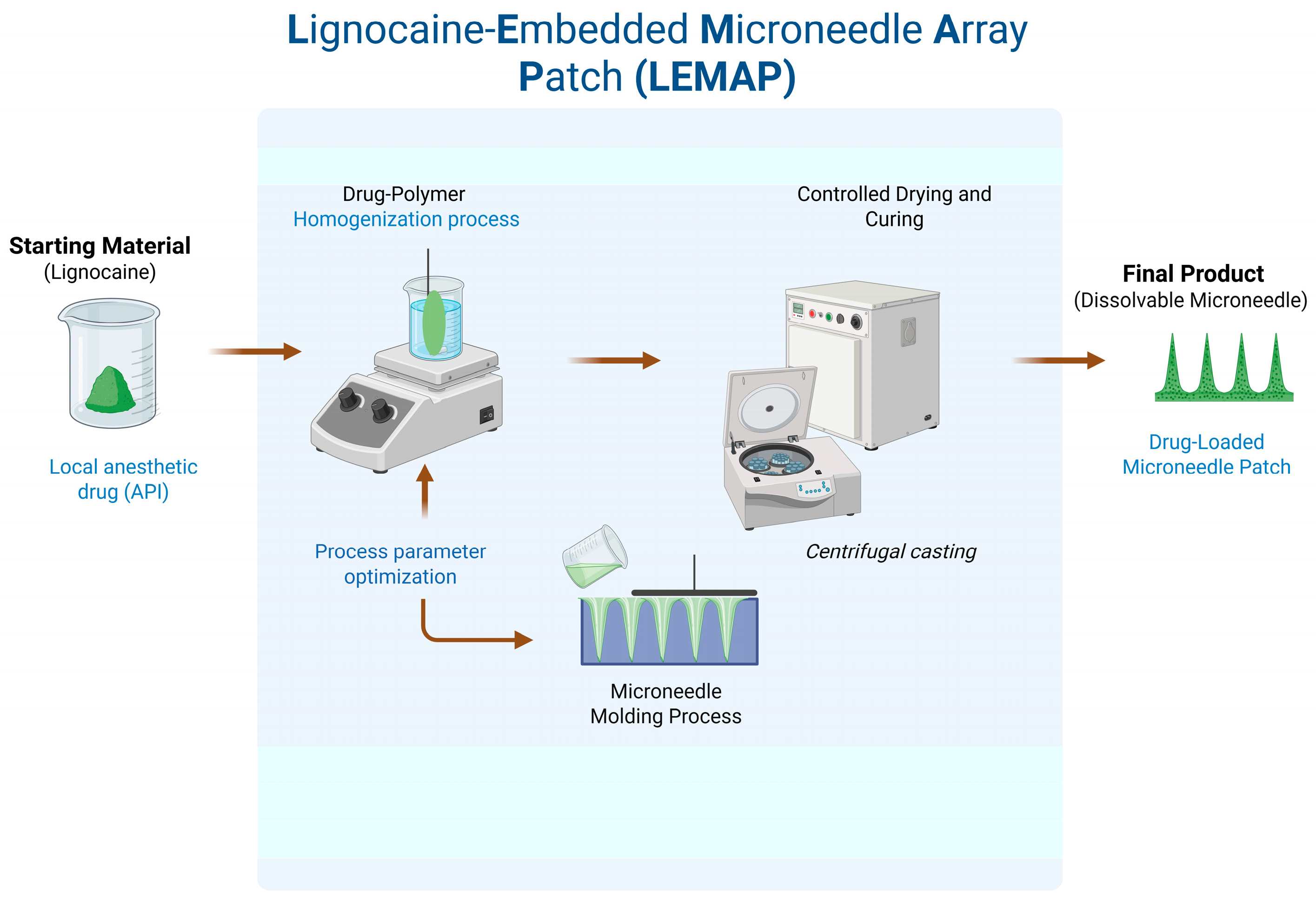
2.2.1. Fabrication Process
2.2.2. Optical Characterization
Field Emission Scanning Electron Microscopy (FESEM)
Confocal Laser Scanning Microscopy (CLSM)
2.2.3. Mechanical Characterization
3. Results and Discussion
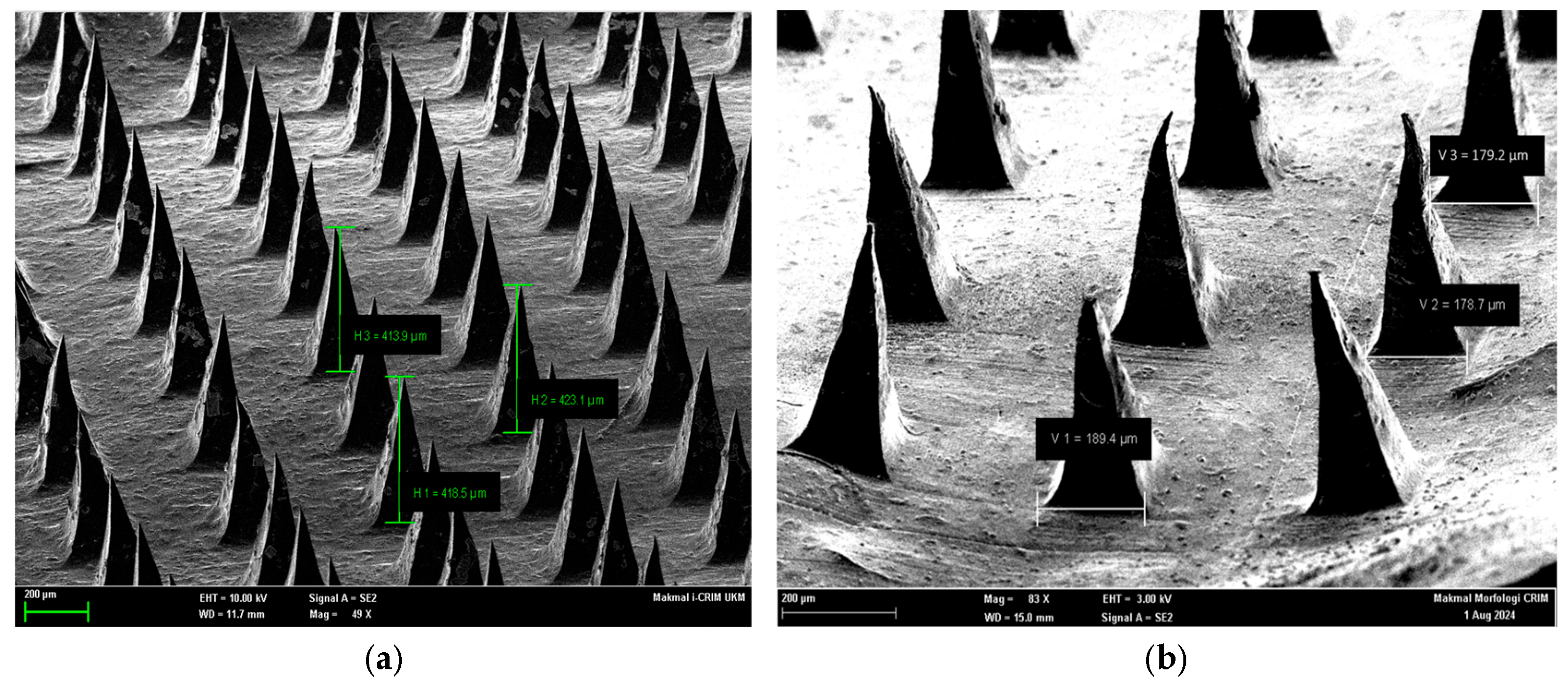
3.1. Field Emission Scanning Electron Microscopy (FE-SEM)
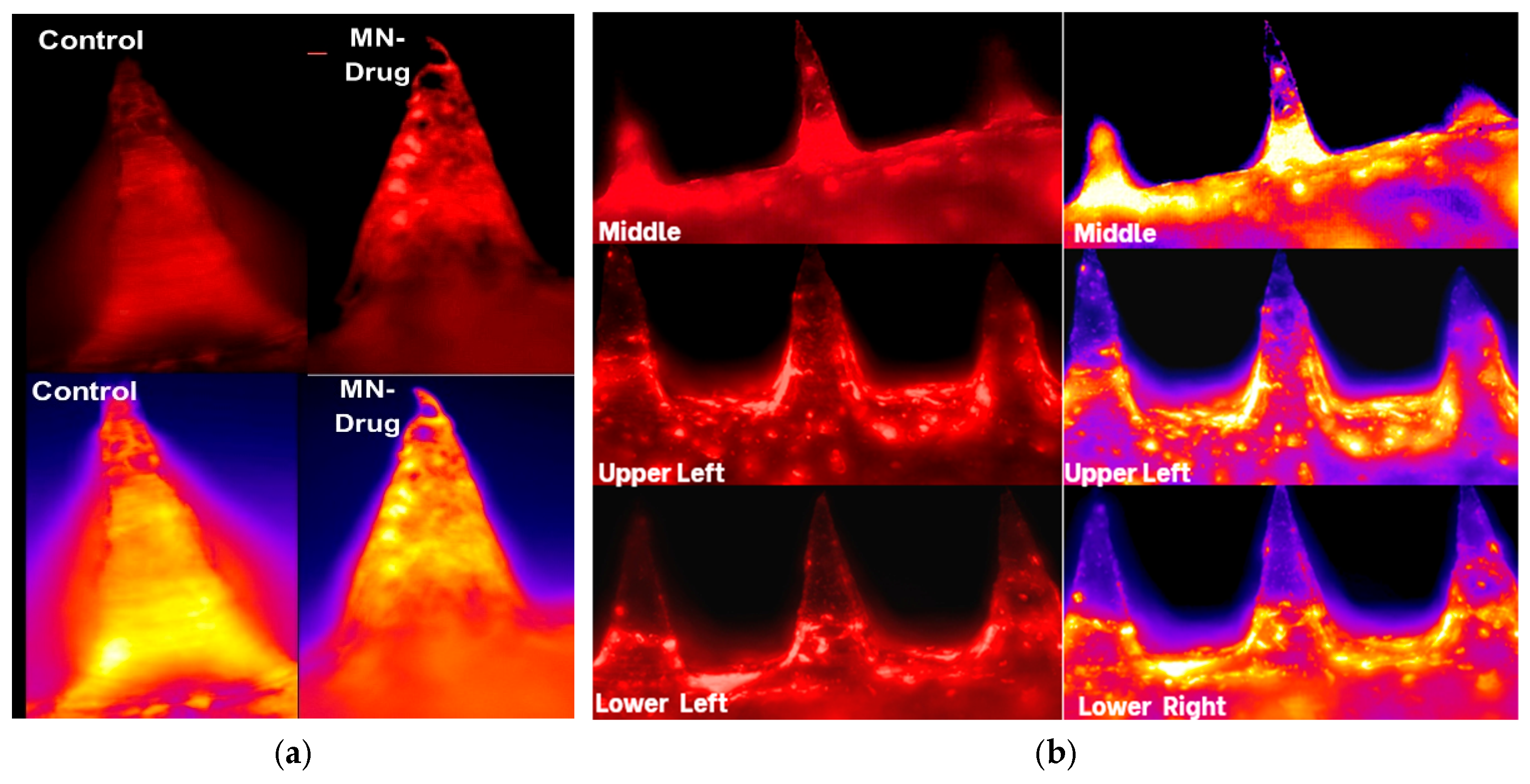
3.2. Confocal Laser Scanning Microscopy (CLSM)
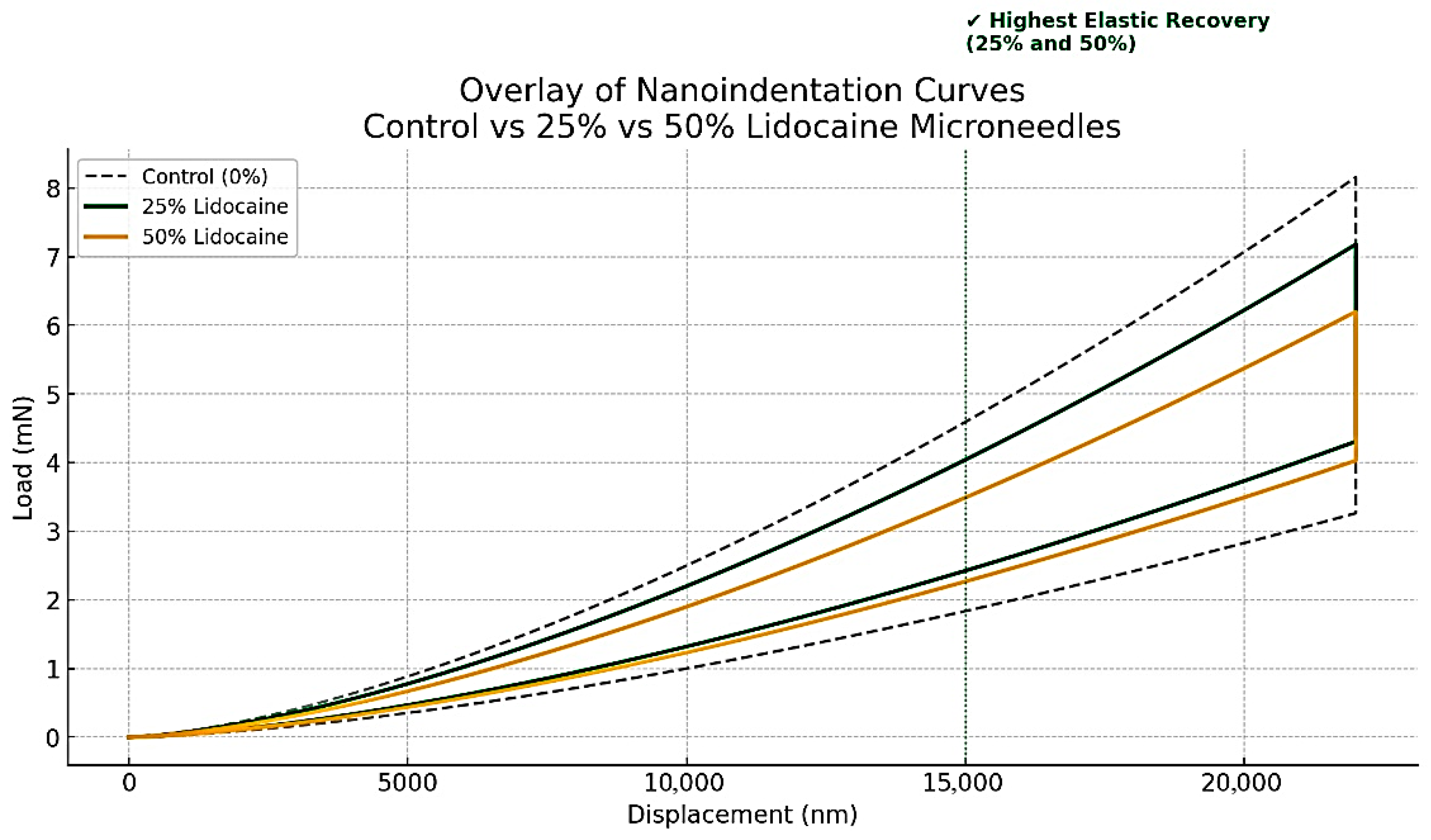
3.3. Nanoindentation
3.4. Comparison of Microneedle Fabrication Method with Previously Published Systems
4. Conclusions
Author Contributions
Funding
Institutional Review Board Statement
Informed Consent Statement
Data Availability Statement
Acknowledgments
Conflicts of Interest
References
- Barry, B.W. Novel mechanisms and devices to enable successful transdermal drug delivery. Eur. J. Pharm. Sci. 2001, 14, 101–114. [Google Scholar] [CrossRef] [PubMed]
- Sartawi, Z.; Blackshields, C.; Faisal, W. Dissolving microneedles: Applications and growing therapeutic potential. J. Control. Release 2022, 348, 186–205. [Google Scholar] [CrossRef] [PubMed]
- Larrañeta, E.; Lutton, R.E.M.; Woolfson, A.D.; Donnelly, R.F. Microneedle arrays as transdermal and intradermal drug delivery systems: Materials science, manufacture and commercial development. Mater. Sci. Eng. R Rep. 2016, 104, 1–32. [Google Scholar] [CrossRef]
- Gordh, T.; Gordh, T.E.; Lindqvist, K.; Warner, D.S. Lidocaine: The Origin of a Modern Local Anesthetic. Anesthesiology 2010, 113, 1433–1437. [Google Scholar] [CrossRef] [PubMed]
- Zhang, Y.; Jiang, G.; Yu, W.; Liu, D.; Xu, B. Microneedles fabricated from alginate and maltose for transdermal delivery of insulin on diabetic rats. Mater. Sci. Eng. C 2018, 85, 18–26. [Google Scholar] [CrossRef] [PubMed]
- Rad, Z.F.; Prewett, P.D.; Davies, G.J. An overview of microneedle applications, materials, and fabrication methods. Beilstein J. Nanotechnol 2021, 12, 1034–1046. [Google Scholar] [CrossRef]
- Peeni, B.A.; Lee, M.L.; Hawkins, A.R.; Woolley, A.T. Sacrificial layer microfluidic device fabrication methods. Electrophoresis 2006, 27, 4888–4895. [Google Scholar] [CrossRef] [PubMed]
- Oliver, W.C.; Pharr, G.M. An improved technique for determining hardness and elastic modulus using load and displacement sensing indentation experiments. J. Mater. Res. 1992, 7, 1564–1583. [Google Scholar] [CrossRef]
- Wang, Q.L.; Ren, J.W.; Chen, B.Z.; Jin, X.; Zhang, C.Y.; Guo, X.D. Effect of humidity on mechanical properties of dissolving microneedles for transdermal drug delivery. J. Ind. Eng. Chem. 2018, 59, 251–258. [Google Scholar] [CrossRef]
- Hamzah, A.A.; Majlis, Y.; Ahmad, I. Deflection Analysis of Epitaxially Deposited Polysilicon Encapsulation for MEMS Devices. In Proceedings of the 2004 IEEE International Conference on Semiconductor Electronics, Kuala Lumpur, Malaysia, 7–9 December 2004. [Google Scholar]
- Faraji Rad, Z.; Prewett, P.D.; Davies, G.J. Rapid prototyping and customizable microneedle design: Ultra-sharp microneedle fabrication using two-photon polymerization and low-cost micromolding techniques. Manuf. Lett. 2021, 30, 39–43. [Google Scholar] [CrossRef]
- Wang, Q.L.; Zhu, D.D.; Chen, Y.; Guo, X.D. A fabrication method of microneedle molds with controlled microstructures. Mater. Sci. Eng. C 2016, 65, 135–142. [Google Scholar] [CrossRef] [PubMed]
- Monou, P.K.; Saropoulou, E.; Junqueira, L.A.; Kolipaka, S.S.; Andriotis, E.G.; Tzimtzimis, E.; Tzetzis, D.; Bekiari, C.; Bouropoulos, N.; Harding, B.; et al. Fabrication and characterization of dissolving microneedles combining digital light processing and vacuum compression molding technique for the transdermal delivery of rivastigmine. Eur. J. Pharm. Biopharm. 2025, 210, 114687. [Google Scholar] [CrossRef] [PubMed]
- Park, J.H.; Allen, M.G.; Prausnitz, M.R. Polymer microneedles for controlled-release drug delivery. Pharm. Res. 2006, 23, 1008–1019. [Google Scholar] [CrossRef] [PubMed]
- Hamzah, A.A.; Zainal Abidin, H.E.; Yeop Majlis, B.; Mohd Nor, M.; Ismardi, A.; Sugandi, G.; Tiong, T.Y.; Dee, C.F.; Yunas, J. Electrochemically deposited and etched membranes with precisely sized micropores for biological fluids microfiltration. J. Micromechanics Microengineering 2013, 23, 074007. [Google Scholar] [CrossRef]
- Ando, D.; Miyatsuji, M.; Sakoda, H.; Yamamoto, E.; Miyazaki, T.; Koide, T.; Sato, Y.; Izutsu, K.I. Mechanical Characterization of Dissolving Microneedles: Factors Affecting Physical Strength of Needles. Pharmaceutics 2024, 16, 200. [Google Scholar] [CrossRef] [PubMed]
- Aziz, N.A.; Bais, B.; Hamzah, A.A.; Majlis, B.Y. Characterization of HNA etchant for silicon microneedles array fabrication. In Proceedings of the 2008 IEEE International Conference on Semiconductor Electronics, Johor Bahru, Malaysia, 25–27 November 2008. [Google Scholar]
- Marsi, N.; Majlis, B.Y.; Hamzah, A.A.; Mohd-Yasin, F. Comparison of mechanical deflection and maximum stress of 3C SiC- and si-based pressure sensor diaphragms for extreme environment. In Proceedings of the 2012 10th IEEE International Conference on Semiconductor Electronics (ICSE), Kuala Lumpur, Malaysia, 19–21 September 2012; pp. 186–190. [Google Scholar]
- Kochhar, J.S.; Lim, W.X.S.; Zou, S.; Foo, W.Y.; Pan, J.; Kang, L. Microneedle integrated transdermal patch for fast onset and sustained delivery of lidocaine. Mol. Pharm. 2013, 10, 4272–4280. [Google Scholar] [CrossRef] [PubMed]
- Jiang, X.; Wang, S.; Zhang, L.; Jiang, X.; Gou, M. Lidocaine hydrochloride loaded isomaltulose microneedles for efficient local anesthesia of the skin. Chin. Chem. Lett. 2024, 35, 108686. [Google Scholar] [CrossRef]
- Mao, Y.; Zhang, X.; Sun, Y.; Shen, Z.; Zhong, C.; Nie, L.; Shavandi, A.; Yunusov, K.E.; Jiang, G. Fabrication of lidocaine-loaded polymer dissolving microneedles for rapid and prolonged local anesthesia. Biomed. Microdevices 2024, 26, 9. [Google Scholar] [CrossRef] [PubMed]
- Loizidou, E.Z.; Williams, N.A.; Barrow, D.A.; Eaton, M.J.; Mccrory, J.; Evans, S.L.; Allender, C.J. Structural characterisation and transdermal delivery studies on sugar microneedles: Experimental and finite element modelling analyses. Eur. J. Pharm. Biopharm. 2015, 89, 224–231. [Google Scholar] [CrossRef] [PubMed]
- Jin, S.Y.; Park, E.J.; Kwon, S.M.; Jung, H.; Kim, D.W. Rapidly Dissolving Microneedles Incorporating Lidocaine Hydrochloride: A PVP/PVA-Based Approach for Local Anesthesia. Pharmaceutics 2025, 17, 1100. [Google Scholar] [CrossRef] [PubMed]

| Study | Material | Drug | Fabrication Method | Mechanical Strength (N/Needle) | Drug Uniformity | Notable Features |
|---|---|---|---|---|---|---|
| This study | Maltose | Lignocaine | Micromolding | ~0.6 N | ≥85% (CLSM verified) | Simple, low-cost process; no backing layer |
| Jiang et al. (2023) [20] | Isomaltulose (ISO) | Lidocaine hydrochloride (LIDH) | 3D-printing-supported mold microneedle casting | Up to ~80% | Not reported | High drug loading |
| Mao et al. (2023) [21] | PVP/PVA/HA (1:2:1) | Lidocaine hydrochloride | Micromolding | >0.1 N/needle | Visual but not quantified | Only confirms loading amount, not distribution uniformity |
| Loizidou et al. [22] | CMC/SUC, CMC/MAL, CMC/TRD | Propranolol | Vacuum mold casting | Up to 7.42 GPa (modulus) | Not assessed | CLSM used only for skin insertion |
| Jin et al. [23] | PVP/PVA | Lidocaine HCl | Double casting | 0.32 N/needle | Quantified by HPLC only | OCT showed insertion, no CLSM |
Disclaimer/Publisher’s Note: The statements, opinions and data contained in all publications are solely those of the individual author(s) and contributor(s) and not of MDPI and/or the editor(s). MDPI and/or the editor(s) disclaim responsibility for any injury to people or property resulting from any ideas, methods, instructions or products referred to in the content. |
© 2026 by the authors. Licensee MDPI, Basel, Switzerland. This article is an open access article distributed under the terms and conditions of the Creative Commons Attribution (CC BY) license.
Share and Cite
Rahman, A.S.; Cheah, F.-C.; Nashriby, M.E.A.; Bastion, M.-L.C.; Dee, C.F.; Buyong, M.R.; Mohamed, M.A.; Chua, X.Y.; Ooi, P.C.; Abdul Jalal, M.I.; et al. Optical and Mechanical Characterization of Lignocaine-Impregnated Maltose-Based Dissolvable Microneedles. Eng. Proc. 2025, 110, 7. https://doi.org/10.3390/engproc2025110007
Rahman AS, Cheah F-C, Nashriby MEA, Bastion M-LC, Dee CF, Buyong MR, Mohamed MA, Chua XY, Ooi PC, Abdul Jalal MI, et al. Optical and Mechanical Characterization of Lignocaine-Impregnated Maltose-Based Dissolvable Microneedles. Engineering Proceedings. 2025; 110(1):7. https://doi.org/10.3390/engproc2025110007
Chicago/Turabian StyleRahman, Arifah Syahirah, Fook-Choe Cheah, Mohd Eusoff Azizol Nashriby, Mae-Lynn Catherine Bastion, Chang Fu Dee, Muhamad Ramdzan Buyong, Mohd Ambri Mohamed, Xin Yun Chua, Poh Choon Ooi, Muhammad Irfan Abdul Jalal, and et al. 2025. "Optical and Mechanical Characterization of Lignocaine-Impregnated Maltose-Based Dissolvable Microneedles" Engineering Proceedings 110, no. 1: 7. https://doi.org/10.3390/engproc2025110007
APA StyleRahman, A. S., Cheah, F.-C., Nashriby, M. E. A., Bastion, M.-L. C., Dee, C. F., Buyong, M. R., Mohamed, M. A., Chua, X. Y., Ooi, P. C., Abdul Jalal, M. I., Lam, C., Mun, Y. Y., Goh, C. S., Ismail, A. G., & Hamzah, A. A. (2025). Optical and Mechanical Characterization of Lignocaine-Impregnated Maltose-Based Dissolvable Microneedles. Engineering Proceedings, 110(1), 7. https://doi.org/10.3390/engproc2025110007