


Abstract
In order to obtain high quality grapes, necessary for the wine industry, table grapes or other by-products, different management techniques are applied to the vine crops. The pruning is a common practice that generates massive amounts of waste, especially shoots and canes that may affect the environment and also the human health. On the other hand, various scientific studies confirm the presence of phytochemicals (antioxidants) in grapevine waste being used as a natural added-value in food, pharmaceutical and cosmetic industries due to their benefits. The nanoparticle phytosynthesis is a safe, non-toxic and environment friendly approach in which the phytochemicals from vine waste extracts act as reducing agents.
1. Introduction
Romania has a rich viticulture history, being one of the largest wine-growing countries in the world and the fifth country in Europe in terms of the number of vineyards, with about 150,000 hectares of vineyards used for wine production [1]. However, the practice of viticulture presents the disadvantage of accumulating large amounts of vineyard wastes. Thus, after pruning the vines in October and March, considerable quantities of vine shoots and canes are produced [2]. Furthermore, these residues represent a valuable source of bioactive compounds, which may have different medical, cosmetic and food applications [3]. The present work evaluates classical and modern extraction methods of phytochemicals from local vine shoot wastes in order to obtain phytosynthesized bimetallic nanoparticles (Ag and Au) with antimicrobial and antioxidant effects.
2. Materials and Methods
To extract the phytochemicals from vine shoot wastes, two solid–liquid extraction pathways were approached: classical extraction (using an oven) and microwave-assisted extraction with MILESTONE ETHOS EASY (microwave digestion system). The ratio between solid material and solvent was 1:10 (w/v). The total phenolic content of extracts was determined using Folin–Ciocâlteu method, while the antioxidant capacities of extracts and phytosynthesized bimetallic nanoparticles were determined using a DPPH assay. The formation of nanoparticles was monitored by UV–VIS spectrometry in the wavelength range of 300–700 nm. Transmission Electron Microscopy (TEM) was used to visualize the size and shape of bimetallic nanostructures. The antimicrobial activity of both extracts and bimetallic nanoparticles was determined on Gram-positive, Gram-negative and fungi strains.
3. Results
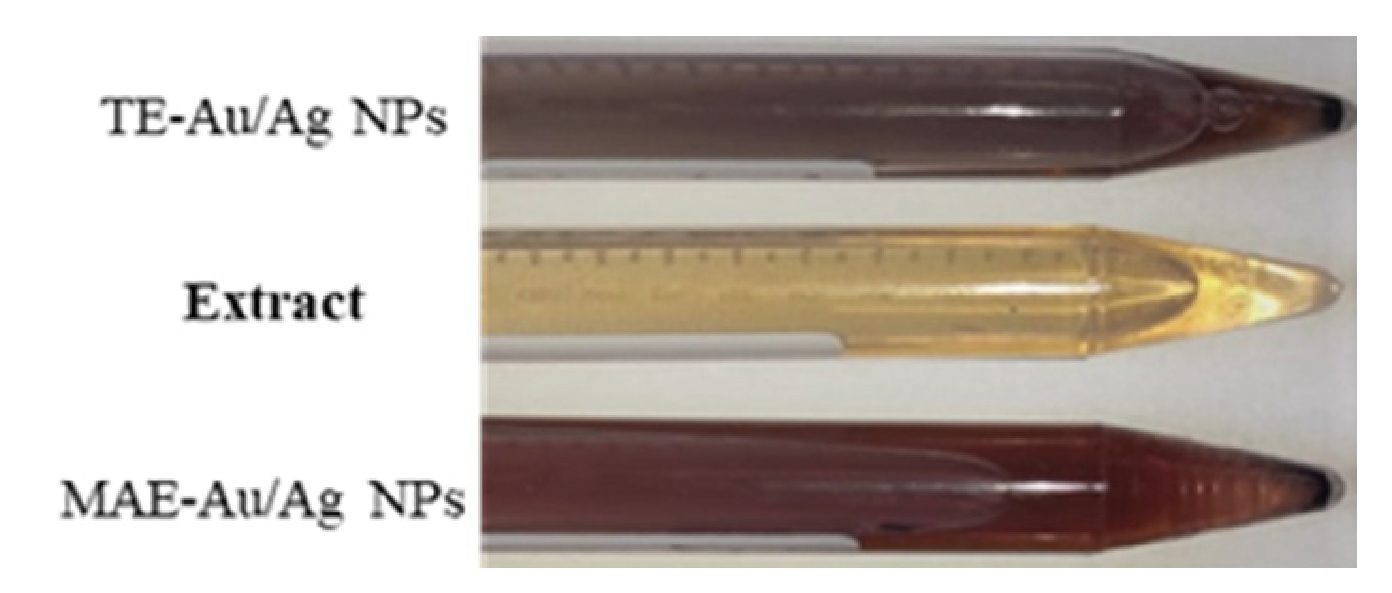
The obtained results suggested the formation of Au/Ag nanoparticles in both extraction methods.
4. Conclusions
The microwave extraction method improves the ability of recovering phenolic compounds from viticultural wastes in order to obtain Ag/Au bimetallic nanostructures with significant antioxidant and antimicrobial activity.
Author Contributions
Conceptualization, A.M.B., R.C.F. and I.F.; methodology, A.M.B., R.C.F., R.S. and L.-M.D.; validation, R.C.F., L.-M.D. and I.F.; formal analysis, I.F.; investigation, A.M.B., T.F., R.I.B., R.S. and L.-M.D.; resources, R.C.F., L.-M.D. and R.S.; data curation, A.M.B., R.C.F. and I.F.; writing-original draft preparation, A.M.B., R.C.F. and I.F.; writing-review and editing, A.M.B., R.C.F. and I.F.; supervision, R.C.F. and I.F.; project administration, I.F.; funding acquisition, I.F. All authors have read and agreed to the published version of the manuscript.
Funding
This research was funded by the Romanian National Authority for Scientific Research and Innovation, CNCS/CCCDI—UEFISCDI, project number PN-III-P3-3.5-EUK-2019-0226, contract 220/2020, and project number PN-III-P2-2.1-PED-2019-3166, contract 299PED/2020, within PNCDI III.
Institutional Review Board Statement
Not applicable.
Informed Consent Statement
Not applicable.
Data Availability Statement
All data are available upon reasonable request from the authors.
Conflicts of Interest
The authors declare no conflict of interest.
References
- Soceanu, A.; Dobrinas, S.; Sirbu, A.; Manea, N.; Popescu, V. Economic aspects of waste recovery in the wine industry. A multidisciplinary approach. Sci. Total Environ. 2021, 759, 143543. [Google Scholar] [CrossRef] [PubMed]
- Rätsep, R.; Karp, K.; Maante-Kuljus, M.; Aluvee, A.; Kaldmäe, H.; Bhat, R. Recovery of Polyphenols from Vineyard Pruning Wastes—Shoots and Cane of Hybrid Grapevine (Vitis sp.) Cultivars. Antioxidants 2021, 10, 1059. [Google Scholar] [CrossRef] [PubMed]
- Fierascu, R.C.; Sieniawska, E.; Ortan, A.; Fierascu, I.; Xiao, J. Fruits By-Products—A Source of Valuable Active Principles. A Short Review. Front. Bioeng. Biotechnol. 2020, 8, 319. [Google Scholar] [CrossRef] [PubMed] [Green Version]
Publisher’s Note: MDPI stays neutral with regard to jurisdictional claims in published maps and institutional affiliations. |
© 2022 by the authors. Licensee MDPI, Basel, Switzerland. This article is an open access article distributed under the terms and conditions of the Creative Commons Attribution (CC BY) license (https://creativecommons.org/licenses/by/4.0/).