

Skip to Content

Journal of Nuclear Engineering, Volume 5, Issue 1

2024 March - 8 articles

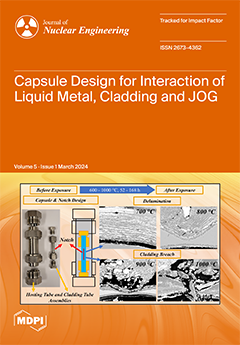
Cover Story: The high-temperature corrosion of 15-15Ti cladding material in high burn-up situations has been an important topic for lead-cooled Gen-IV reactors. This study aims to examine the simultaneous impact of liquid lead and cesium molybdate on the cladding tube. A capsule was designed and built for exposures between 600 °C and 1000 °C. In order to simulate a cladding breach, a notch design on the cladding tube was introduced. Material thinning by corrosion and leaching at ≥900 °C caused breaches at the notches after 168 h. The temperature-dependent cladding thinning phenomenon was used for kinetic interpretation. As the first of a two-part study, this paper will focus on the capsule performance, including cross-section preparation and preliminary results on the interface chemistry. View this paper
  • Issues are regarded as officially published after their release is announced to the table of contents alert mailing list .
  • You may sign up for email alerts to receive table of contents of newly released issues.
  • PDF is the official format for papers published in both, html and pdf forms. To view the papers in pdf format, click on the "PDF Full-text" link, and use the free Adobe Reader to open them.

Articles (8)

  • Correction
  • Open Access
1,156 Views
3 Pages

8 March 2024

The authors would like to make the following corrections to the published paper [...]

  • Article
  • Open Access
4 Citations
3,691 Views
20 Pages

5 March 2024

In this paper, the interactions of low-energy muons (E < 10 MeV) with natural silicon, the basic material of microelectronics, are studied by Geant4 and SRIM simulation. The study is circumscribed to muons susceptible to slowdown/stop in the targe...

  • Article
  • Open Access
1 Citations
1,996 Views
17 Pages

26 February 2024

Reactor design requires safety studies to ensure that the reactors will behave appropriately under incidental or accidental situations. Safety studies often involve multiphysics simulations where several branches of reactor physics are necessary to m...

  • Article
  • Open Access
1 Citations
1,937 Views
17 Pages

6 February 2024

High temperature corrosion of fuel cladding material (15-15Ti) in high burn-up situations has been an important topic for molten metal-cooled Gen-IV reactors. The present study aims to investigate the simultaneous impact of liquid lead (coolant side)...

  • Technical Note
  • Open Access
2 Citations
3,748 Views
13 Pages

29 January 2024

Understanding the behaviour of a neutron spectrum with burnup is important for describing various phenomena associated with reactor operation. The quest to understand the neutron spectrum comes with a lot of questions. One question that is usually as...

  • Article
  • Open Access
12 Citations
7,279 Views
18 Pages

Gamma-ray Spectroscopy in Low-Power Nuclear Research Reactors

  • Oskari V. Pakari,
  • Andrew Lucas,
  • Flynn B. Darby,
  • Vincent P. Lamirand,
  • Tessa Maurer,
  • Matthew G. Bisbee,
  • Lei R. Cao,
  • Andreas Pautz and
  • Sara A. Pozzi

26 January 2024

Gamma-ray spectroscopy is an effective technique for radioactive material characterization, routine inventory verification, nuclear safeguards, health physics, and source search scenarios. Gamma-ray spectrometers typically cannot be operated in the i...

  • Article
  • Open Access
2 Citations
3,022 Views
13 Pages

3 January 2024

Control rod calibration experiment results for the Oregon State TRIGA® Reactor (OSTR) immediately following LEU conversion in 2008, and MCNP® 5 predicted rod worths from the 2008 LEU Conversion Safety Analysis Report (CSAR) are discussed. The...

  • Article
  • Open Access
1 Citations
2,117 Views
12 Pages

21 December 2023

The accurate calculation of reactor core heating is vital for the design and safety analysis of reactor physics. However, negative KERMA factors may be produced when processing and evaluating libraries of the nuclear data files ENDF/B-VII.1 and ENDF/...

XFacebookLinkedIn
J. Nucl. Eng. - ISSN 2673-4362