3.1. Morphological Analysis of Fracture Surfaces via FESEM
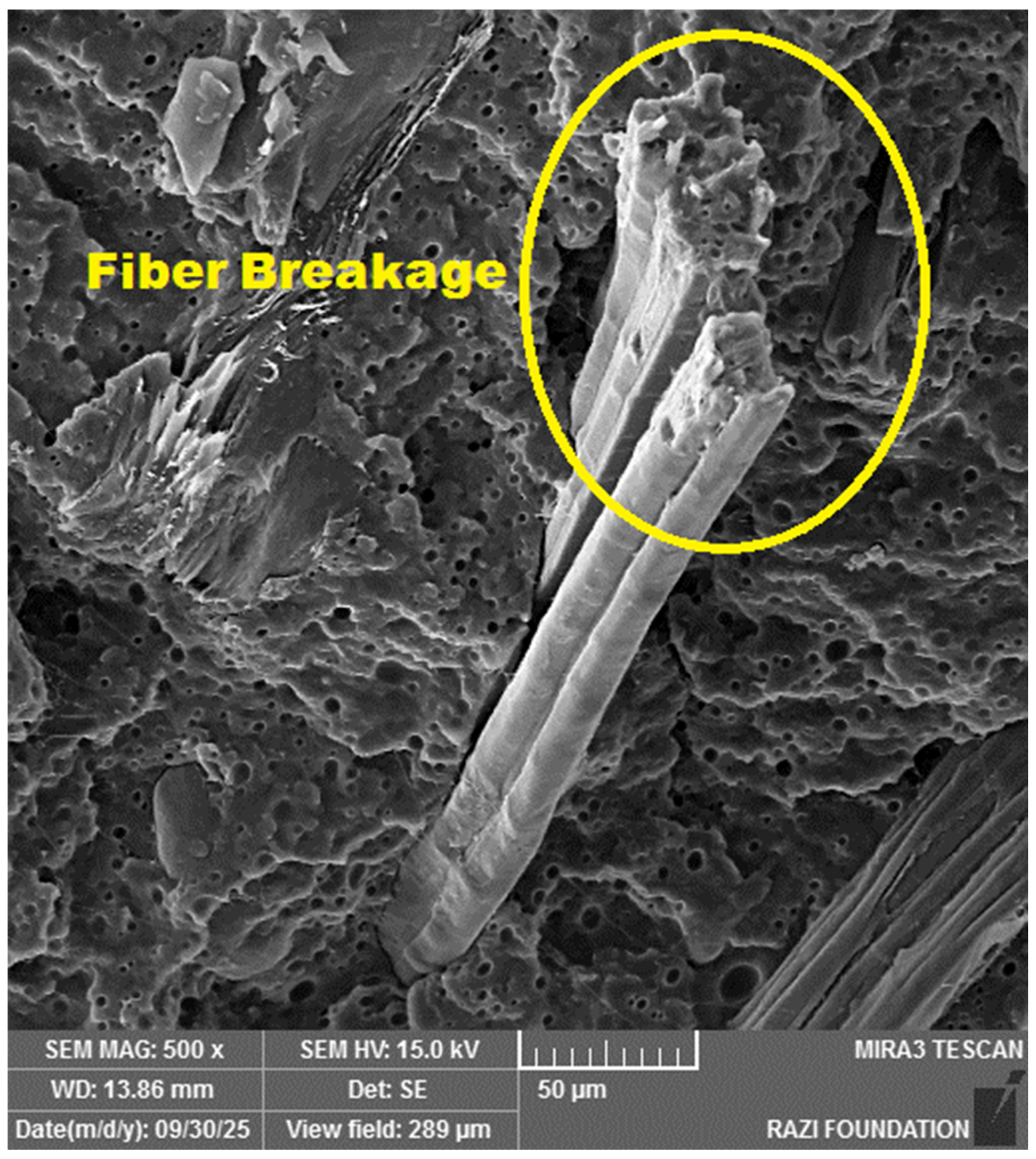
To gain deeper insight into the mechanical behavior of the fabricated biocomposites and to assess the interfacial adhesion between their constituent phases, field emission scanning electron microscopy (FESEM) was employed to examine the fracture surfaces of impact-tested samples fractured in liquid nitrogen. Cryogenic fracture (achieved via liquid nitrogen immersion) suppresses polymer chain mobility, resulting in a brittle fracture mode that yields a clean and well-defined surface. This facilitates clear visualization of key microstructural features, including reinforcement dispersion, fiber matrix interfacial bonding, fracture morphology, and failure mechanisms such as debonding or pull-out. FESEM micrographs of the various formulations are presented in
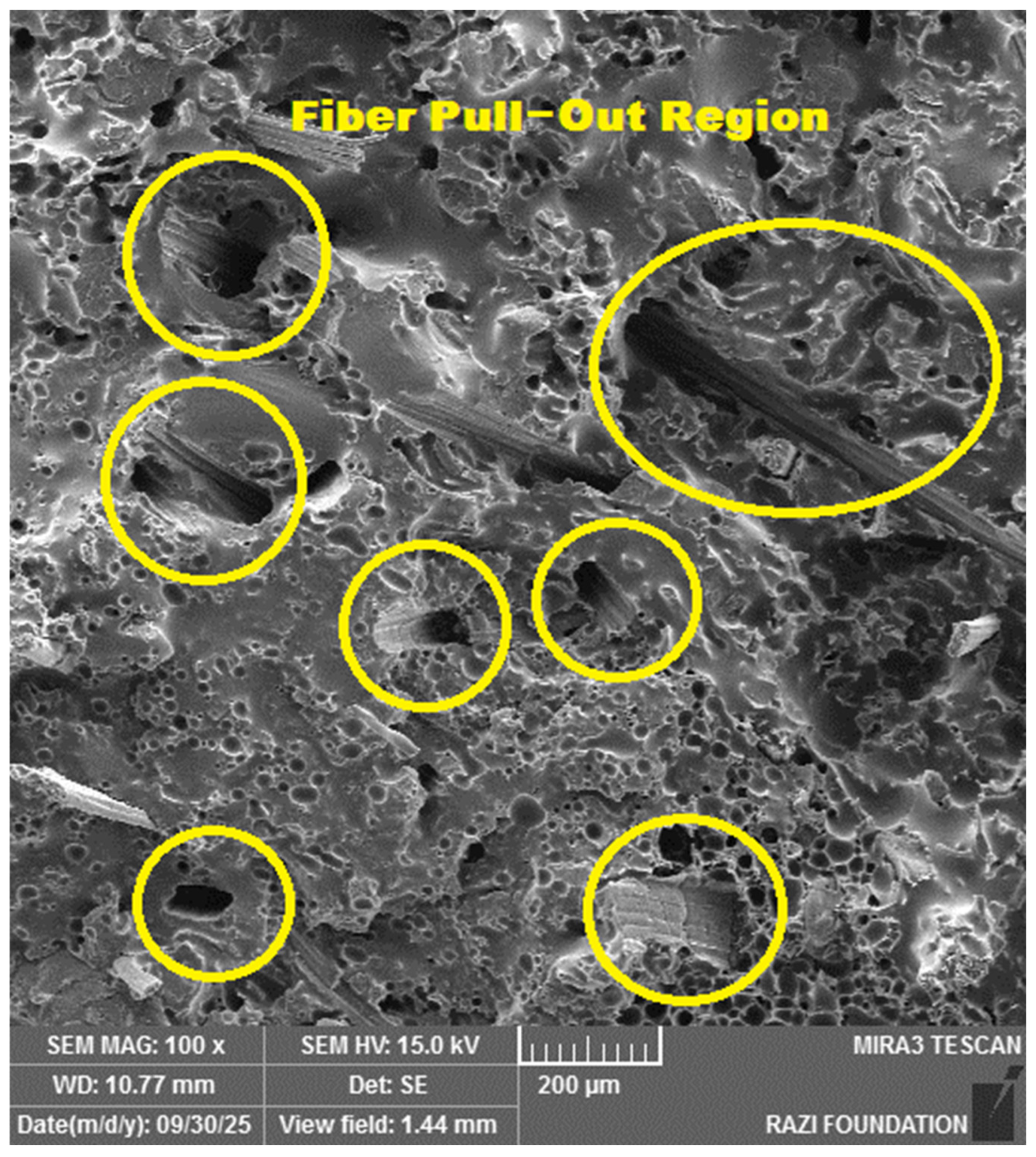
Figure 2,
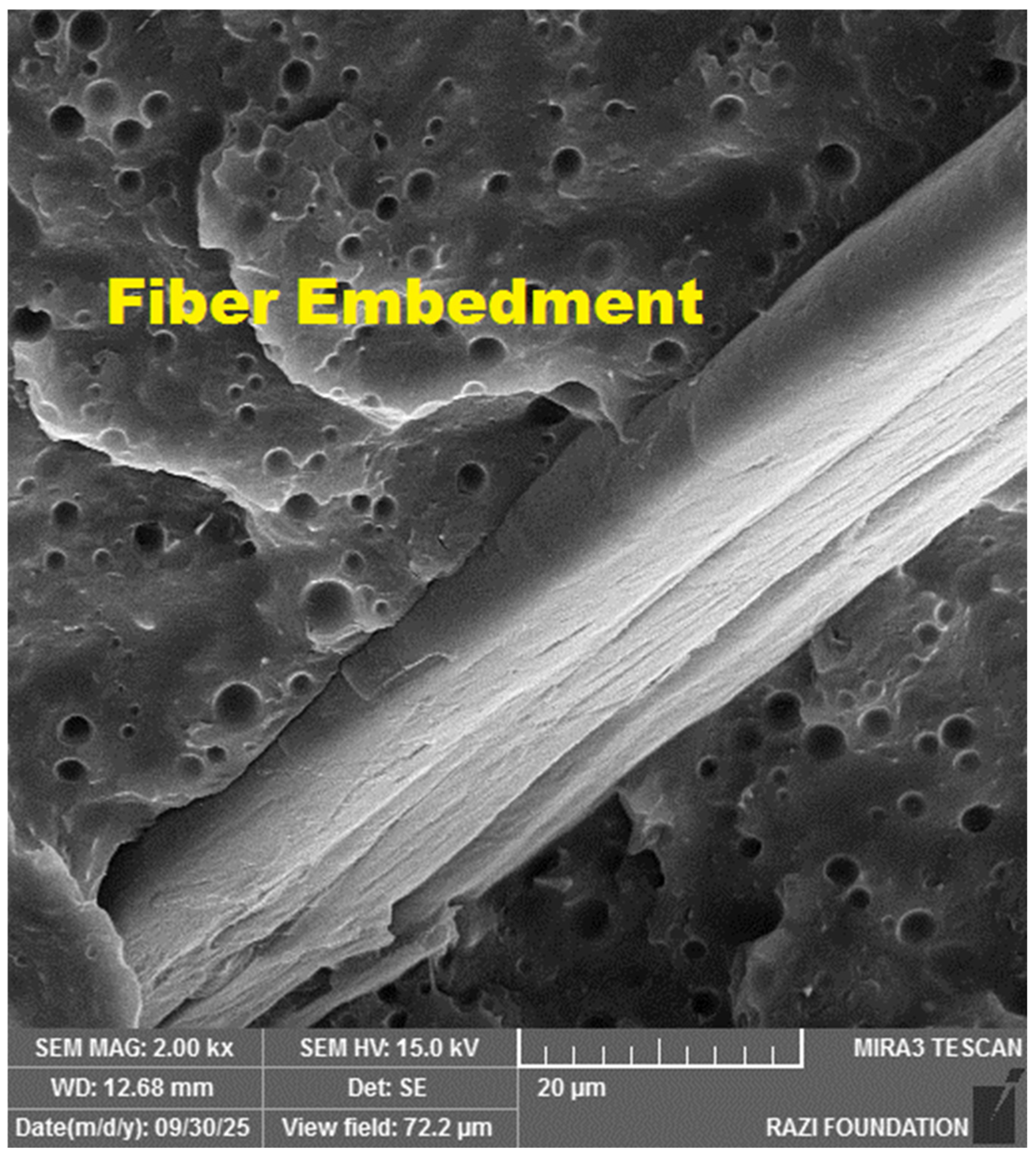
Figure 3,
Figure 4 and
Figure 5, and their correlation with the measured mechanical properties is analyzed in the following section. To directly visualize the effect of nanochitosan content on the fiber-matrix interface, FESEM analysis was conducted on representative samples along this compositional gradient:
- -
Figure 2 shows the fracture surface of a composite with a low nanochitosan content (2 wt%), where insufficient interfacial modification leads to prominent fiber pull-out and debonding.
- -
Figure 3 and
Figure 4 depict composites with an optimal nanochitosan content (4 wt%). Here, improved interfacial adhesion is evidenced by fibers remaining well-embedded in the matrix and instances of fiber breakage, indicating effective stress transfer.
- -
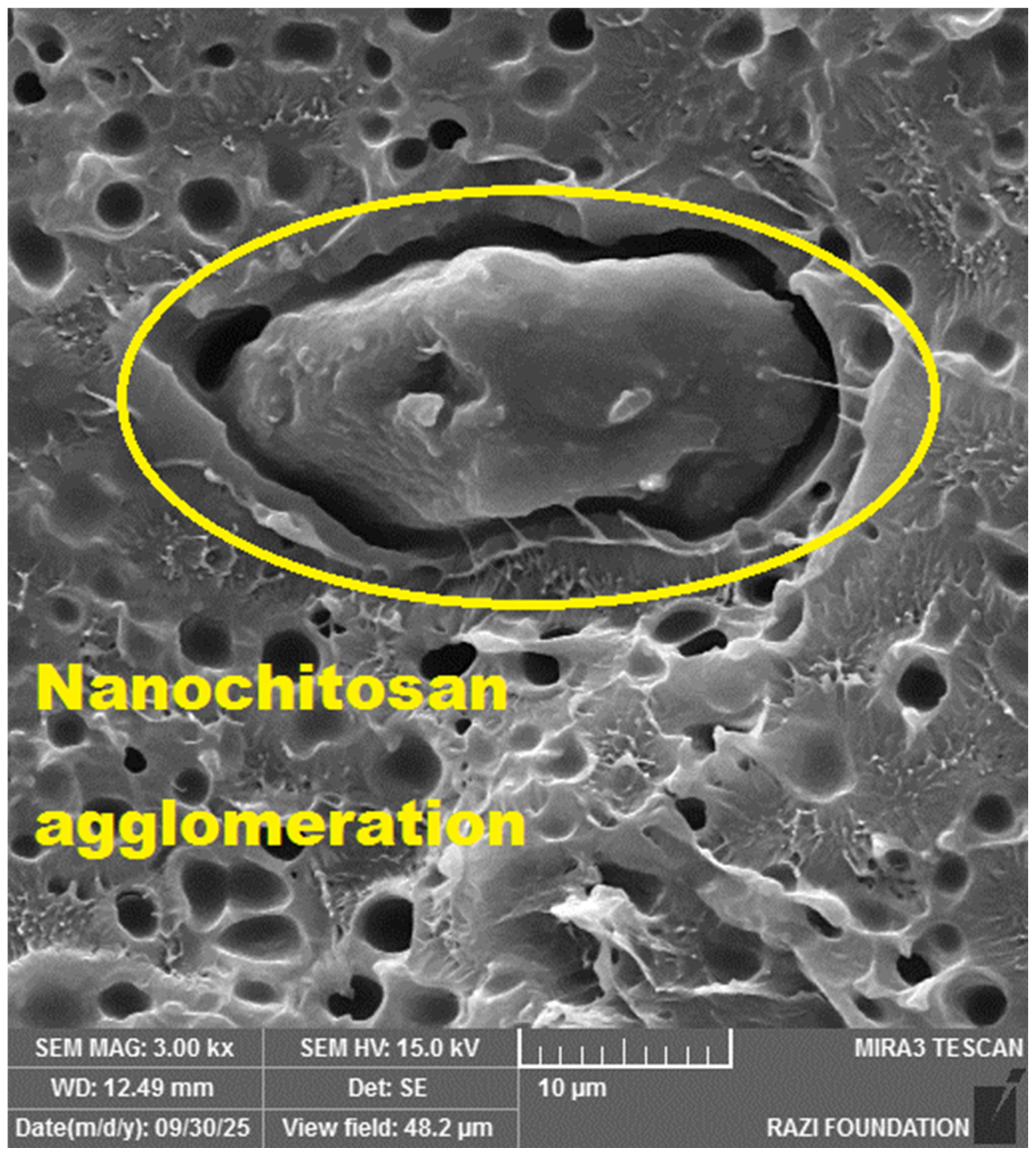
Figure 5 illustrates the microstructure at a high nanochitosan content (6 wt%), where particle agglomeration is observed, creating defects that can compromise mechanical performance.
The morphological analysis provides a clear rationale for the complex, non-linear trends in the mechanical properties established by the RSM models. The system’s inability to maintain a perfectly uniform morphology at all compositions—evident from interfacial gaps and filler agglomeration—necessarily leads to property variations that are non-monotonic and dependent on the balance between reinforcement and defect formation.
Figure 2 presents the FESEM micrograph of the cryogenically fractured surface of Sample 1, composed of 2 wt% nanochitosan, 5 wt% kenaf fibers, and 20 wt% SMR20 in a PLA matrix. The sample was impact-tested at liquid nitrogen temperature to induce brittle fracture, thereby producing a sharp and well-defined surface suitable for detailed morphological analysis. The micrograph reveals clear evidence of weak interfacial adhesion between the kenaf fibers and the PLA/SMR20 matrix. Notably, numerous fibers are fully pulled out of the matrix, leaving behind distinct longitudinal voids or debonded channels. This pull-out behavior is characteristic of poor fiber matrix bonding, wherein interfacial debonding occurs preferentially over fiber fracture under applied stress. Consequently, the fibers fail to effectively transfer load or dissipate energy, leading to reduced impact resistance, a finding consistent with the relatively low mechanical performance observed for this formulation. A similar observation has been reported by Nouri et al. [
26], which shows a good agreement.
The limited amount of nanochitosan (2 wt%) in this formulation is identified as a key contributor to the poor interfacial adhesion observed between the kenaf fibers and the PLA/SMR20 matrix. Nanochitosan possesses abundant active functional groups, particularly amine (–NH2) and hydroxyl (–OH), that can act as compatibilizing agents by forming hydrogen bonds or polar interactions with both the hydroxyl-rich surface of kenaf fibers and the polar ester groups in the PLA/SMR20 matrix. However, at such a low concentration (2 wt%), nanochitosan particles are insufficiently distributed at the fiber–matrix interface and fail to form a continuous, cohesive interphase layer. Consequently, the interfacial region remains weak and prone to debonding under applied stress, leading to premature fiber pull-out and reduced load transfer efficiency.
Figure 3 presents an FESEM micrograph of the fracture surface of Sample 13 (4 wt% nanochitosan, 10 wt% kenaf, 20 wt% SMR20) following impact testing. In comparison to Sample 1 (
Figure 2), the fracture morphology suggests enhanced interfacial compatibility. The micrograph shows a notable reduction in clean fiber pull-out cavities. Instead, fibers appear well-embedded within the matrix, and some exhibit resin residues or fractures within the fiber body itself. These features are commonly associated with improved interfacial stress transfer [
27]. This improved interfacial compatibility is primarily attributed to the increase in nanochitosan content from 2 to 4 wt%. Nanochitosan contains abundant functional groups (–NH
2, –OH) that can form hydrogen bonds and polar interactions with both kenaf fibers and PLA chains. At 4 wt%, nanochitosan particles are adequately dispersed, potentially forming an effective compatibilizing interphase that promotes stronger fiber-matrix interaction, as inferred from the mechanical property enhancement.
Figure 4 presents the FESEM micrograph of Sample 12, formulated with 4 wt% nanochitosan, 15 wt% kenaf fibers, and 30 wt% SMR20. The image reveals a significant improvement in interfacial performance: under impact loading, the fibers undergo fracture rather than premature debonding and pull-out. This behavior is attributed to the optimal concentration of nanochitosan, which enhances fiber–matrix adhesion and enables efficient stress transfer from the matrix to the reinforcing fibers. Unlike fiber pull-out, which dissipates minimal energy, fiber fracture is an energy-intensive failure mechanism that substantially increases the composite’s capacity to absorb impact energy. The FESEM image clearly shows broken fiber ends embedded in the matrix, confirming strong interfacial bonding. Such microstructural features are indicative of a more ductile and damage-tolerant failure mode, reflecting the system’s enhanced ability to dissipate energy and resist catastrophic fracture. These morphological observations are in excellent agreement with findings reported by other researchers [
28,
29]. Specifically, Sample 13 demonstrates superior mechanical performance, exhibiting higher tensile strength, elastic modulus, and notably enhanced impact strength compared to formulations containing lower nanochitosan loadings. The FESEM micrographs in
Figure 3 and
Figure 4 not only corroborate the improved fiber–matrix interfacial adhesion but also clearly elucidate the underlying microstructural mechanisms responsible for the enhanced mechanical properties. Collectively, these results underscore the critical role of nanochitosan as an effective compatibilizer in optimizing the overall performance of PLA/SMR20-based biocomposites.
Figure 5 presents the FESEM micrograph of the cryogenically fractured surface of Sample 8, composed of 6 wt% nanochitosan, 10 wt% kenaf fibers, and 30 wt% SMR20 in a PLA matrix. The sample was impact-tested at liquid nitrogen temperature to suppress plastic deformation and reveal a clear, brittle fracture surface suitable for detailed morphological analysis. The micrograph reveals a distinct nanoscale agglomerate of nanochitosan particles localized within the PLA/SMR20 matrix. This clustering is a common phenomenon at elevated nanoparticle loadings and reflects both heterogeneous dispersion and limited interfacial compatibility between nanochitosan and the PLA/SMR20 matrix.
The presence of such nanochitosan agglomerates in the composite microstructure can significantly degrade mechanical performance. These clusters act as structural defects and serve as stress concentration sites. Under mechanical loading, particularly during impact, the localized stress around these agglomerates intensifies, creating favorable conditions for crack nucleation and subsequent propagation.
Moreover, nanochitosan agglomeration significantly reduces the effective interfacial contact area between the nanoparticles and the PLA/SMR20 matrix. At optimal loadings such as 4 wt%, nanochitosan particles are uniformly dispersed at the fiber–matrix interface, where they enhance interfacial adhesion through polar interactions and hydrogen bonding with both the kenaf fibers and the PLA/SMR20 matrix. In contrast, at higher concentrations (e.g., 6 wt%), the strong self-association tendency of nanochitosan driven by intermolecular hydrogen bonding between adjacent particles promotes the formation of larger agglomerates. These clusters not only lose their effectiveness as compatibilizing agents but also act as structural defects that compromise matrix integrity and serve as potential sites for stress concentration and crack initiation.
These morphological observations are fully consistent with mechanical trends reported in the literature [
30,
31]. Specifically, Sample 8 exhibits reduced tensile strength, elastic modulus, and most notably impact strength compared to formulations containing 4 wt% nanochitosan, such as Sample 12.
3.2. Effects of Nanochitosan, Kenaf Fiber, and SMR20 Content on Tensile Strength
The analysis of variance (ANOVA) results for the tensile strength quadratic model are presented in
Table 4. The model is highly significant (F-value = 117.95,
p < 0.0001), explaining over 99% of the data variability (R
2 = 0.9935, Adjusted R
2 = 0.9869). The high predictive R
2 (0.9266) confirms robust generalizability.
The key significant factors (p < 0.05) are:
Linear Effects: All three components—Nanochitosan (A), Kenaf fiber (B), and SMR20 (C).
Quadratic Effects: Nanochitosan (A2) and Kenaf fiber (B2).
Interaction Effect: Kenaf fiber × SMR20 (BC).
This significance profile quantitatively confirms that tensile strength depends non-linearly on nanochitosan and kenaf content (evident from the quadratic terms) and is influenced by a synergistic interaction between the fiber and the elastomer. The insignificant lack-of-fit (p > 0.05) validates the model adequacy.
The coefficients of the second-order polynomial equation were estimated using multiple regression analysis based on the ANOVA results. After removing statistically insignificant terms, the resulting quadratic model expressed in terms of coded variables is as follows:
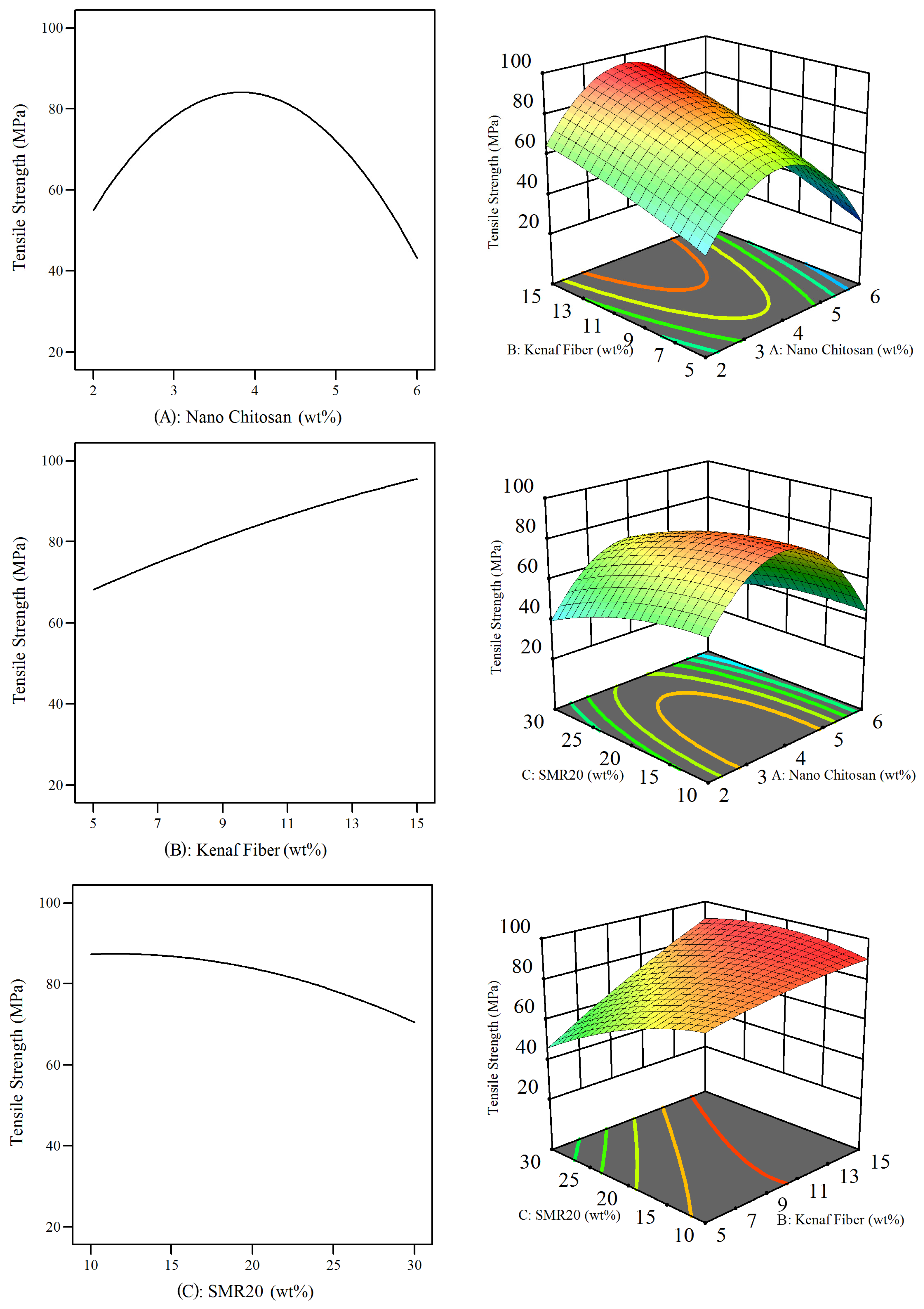
Figure 6 presents the main effects and response surface plots showing the influence of each material on tensile strength. As shown, increasing the nanochitosan content to 4 wt% significantly enhanced the tensile strength of the nanocomposites. However, further increasing the nanochitosan loading to 6 wt% not only halted this improvement but also resulted in a reduction in tensile strength falling below even that of the neat PLA sample. The observed increase in tensile strength within the 1–4 wt% nanochitosan loading range can be attributed primarily to three key mechanisms. First, chitosan nanoparticles, owing to their high specific surface area and abundant surface functional groups (notably amine and hydroxyl groups), form strong hydrogen bonds with the PLA matrix, facilitating efficient stress transfer across the interfacial region. Second, at these low concentrations, the nanoparticles are uniformly dispersed throughout the matrix, establishing a percolating network that effectively hinders crack initiation and propagation. Third, electron microscopy analyses reveal that nanochitosan in this concentration range enhances interfacial adhesion by filling microvoids and interfacial gaps between the kenaf fibers and the PLA/SMR20 matrix, thereby improving load-bearing efficiency.
The decline in tensile strength at nanochitosan contents exceeding 4 wt% can be attributed to multiple interrelated mechanisms. The dominant factor is the agglomeration of chitosan nanoparticles at elevated loadings, resulting in the formation of nanoscale clusters. These agglomerates act as stress concentration sites, facilitating crack initiation and propagation. Moreover, excessive nanochitosan disrupts the recrystallization of PLA chains by introducing physical barriers that impede molecular reorganization, thereby further reducing tensile strength [
32].
Further analysis reveals that at the optimal loading of 4 wt%, nanochitosan promotes a more integrated composite structure by forming molecular bridges between the polar functional groups of natural rubber and kenaf fibers. However, at higher concentrations, nanochitosan nanoparticles tend to adsorb onto the surface of kenaf fibers, thereby inhibiting direct interfacial bonding between the fibers and the PLA/SMR20 matrix. These findings are significant in two respects: first, they underscore that precise optimization of nanochitosan content is critical in the design of high-performance bio-based composites; second, they demonstrate that excessive nanoparticle loading can exert detrimental effects on interfacial adhesion and, consequently, on mechanical properties [
33].
As shown in
Figure 6, the incorporation of kenaf fibers at loadings between 5 and 15 wt% into PLA/SMR20-based nanocomposites leads to a continuous and significant enhancement in tensile strength. Kenaf fibers serve as highly effective natural reinforcements owing to their unique lignocellulosic structure. The hydroxyl groups on their surface form hydrogen bonds with the PLA matrix, promoting strong interfacial adhesion. Moreover, the alignment of fibers within the matrix facilitates efficient load transfer, while the three-dimensional network they form helps distribute stress more uniformly and mitigates localized stress concentrations. Notably, a synergistic interaction between kenaf fibers and nanochitosan further enhances the overall mechanical performance of the biocomposite [
34,
35].
Nanochitosan further enhances interfacial adhesion by filling the voids and micro-pores at the interface between the fibers and the PLA/SMR20 matrix. While increasing the kenaf fiber content up to 15 wt% results in a progressive improvement in tensile strength, this trend is expected to reverse beyond a certain threshold. Previous studies have consistently demonstrated that fiber loadings exceeding 20–25 wt% typically lead to a decline in tensile strength, primarily due to fiber agglomeration and reduced dispersion uniformity. Moreover, excessive fiber content can compromise the composite’s flexibility and processability [
36].
It is also observed that the incorporation of SMR20 natural rubber reduces the tensile strength of the composite. This reduction primarily stems from the inherent incompatibility between the two components and their weak interfacial interactions. Polylactic acid (PLA), as a semi-crystalline polymer, possesses a regular molecular structure and relatively high tensile strength, whereas SMR20 is a natural elastomer with an amorphous, flexible chain architecture and significantly lower tensile strength. Upon blending SMR20 into the PLA matrix, multiple mechanisms concurrently contribute to strength degradation. First, SMR20 domains act as soft inclusions within the rigid PLA matrix, undergoing pronounced deformation under tensile loading. This localized strain induces stress concentration around the rubber particles, promoting crack initiation. Second, the presence of SMR20 diminishes the density of effective intermolecular load-bearing interactions, as the elastomeric chains of SMR20 are less capable of participating in stress transfer compared to the stiffer PLA chains.
3.3. Effects of Nanochitosan, Kenaf Fiber, and SMR20 Content on Elastic Modulus
As shown in
Table 5, the quadratic model for elastic modulus is statistically highly significant (F-value = 55.22,
p = 0.0002), with excellent explanatory power (R
2 = 0.9900, Adjusted R
2 = 0.9721). The close match between Adjusted and Predicted R
2 (R
2Pred = 0.0555) indicates no overfitting.
Statistical analysis identifies the following significant terms (p < 0.05):
Linear Effects: Kenaf fiber (B) and SMR20 (C).
Quadratic Effects: Nanochitosan (A2) and Kenaf fiber (B2).
Interaction Effects: Nanochitosan × Kenaf fiber (AB) and Nanochitosan × SMR20 (AC).
Notably, the linear effect of nanochitosan (A) is not significant, but its quadratic effect (A2) and interactions (AB, AC) are. This indicates that nanochitosan’s influence on stiffness is not a simple linear reinforcement but is governed by optimal dispersion (quadratic term) and its coupled effect with other components (interaction terms).
The coefficients of the second-order polynomial equation were estimated using multiple regression analysis based on the ANOVA results. After removing statistically insignificant terms, the resulting quadratic model expressed in terms of coded variables is as follows:
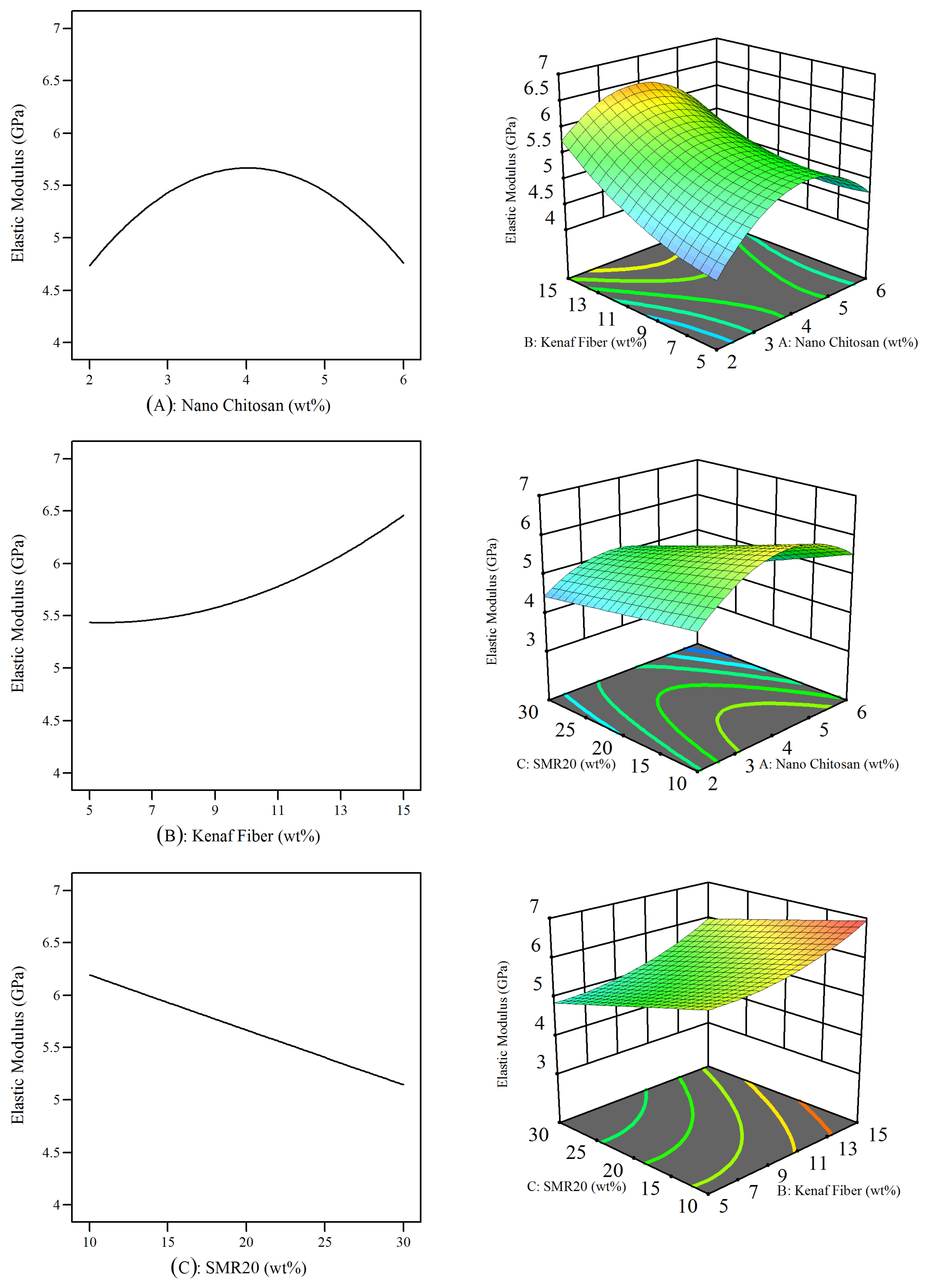
The influence of each constituent material on the elastic modulus is illustrated by the main effects and response surface plots presented in
Figure 7. As shown, the elastic modulus of PLA/SMR20 biocomposites exhibits a nonlinear dependence on nanochitosan content. Response surface methodology (RSM) plots reveal that increasing nanochitosan from 2 to 4 wt% leads to a significant enhancement in elastic modulus. However, further addition of nanochitosan beyond 4 wt% up to 6 wt% results in a decline in modulus. This non-monotonic behavior can be attributed to two competing mechanisms at the microstructural level: at optimal loadings, well-dispersed nanochitosan nanoparticles act as effective reinforcing agents, whereas at higher concentrations, particle agglomeration occurs, creating stress concentration sites that compromise mechanical performance [
37].
Within the loading range of 2 to 4 wt%, nanochitosan is uniformly dispersed throughout the PLA matrix, providing a large interfacial contact area with the polymer phase. The nanoscale dimensions, inherent rigidity, and abundant surface functional groups, particularly hydroxyl (–OH) and amine (–NH2) groups of nanochitosan, facilitate strong physical and chemical interactions with PLA chains. These interactions restrict segmental mobility of the polymer chains and enhance the overall stiffness of the composite, thereby increasing the elastic modulus. Furthermore, nanochitosan acts as an effective nucleating agent, promoting PLA crystallization. The resulting increase in crystallinity further contributes to the enhancement of stiffness and elastic modulus.
However, at higher loadings (e.g., 6 wt%), the tendency of nanochitosan particles to agglomerate and form heterogeneous clusters within the PLA/SMR20 matrix increases significantly. These agglomerates not only reduce the effective interfacial contact area between the nanoparticles and the matrix but also act as microscopic defects and stress concentration sites, thereby compromising structural homogeneity. Under such conditions, stress transfer from the matrix to the reinforcing phase becomes inefficient, leading to deterioration in the composite’s mechanical performance. This effect is particularly pronounced in multiphase systems like PLA/SMR20, which inherently face challenges related to phase compatibility. Although SMR20 rubber enhances toughness, its presence combined with high nanochitosan concentrations can introduce complex three-phase interactions that further hinder the uniform dispersion of nanoparticles and exacerbate agglomeration.
Consequently, the nonlinear relationship between elastic modulus and nanochitosan content underscores the critical need to identify an optimal nanoparticle concentration in the design of nanobiocomposites. These findings align with previous studies in the field, which consistently report a decline in mechanical properties when nanoparticle loading exceeds a critical threshold, typically due to agglomeration and poor interfacial adhesion. Therefore, to maximize the elastic modulus in the PLA/SMR20/kenaf fiber system, nanochitosan content in the range of 2–4 wt% is recommended as the optimal formulation. It was also observed that the incorporation of kenaf fibers into the PLA/SMR20 matrix up to 15 wt% led to a continuous and significant increase in the elastic modulus of the resulting composites. Specifically, as the kenaf fiber content increased from 5 to 10 and then to 15 wt%, the elastic modulus exhibited a consistent upward trend. This enhancement can be primarily attributed to the inherently high stiffness of kenaf fibers relative to both the PLA matrix and the elastomeric SMR20 phase. As a natural reinforcement with a high modulus, kenaf fibers effectively restrict matrix deformation under load, thereby substantially improving the overall rigidity of the composite system [
38].
In the composite structure, kenaf fibers function as a reinforcing phase by effectively transferring and absorbing the applied load from the softer PLA/SMR20 matrix, thereby limiting excessive deformation. As the fiber content increases, the number of stress transfer sites rises, and a percolating fiber network gradually develops throughout the matrix, enhancing the composite’s resistance to elastic deformation. This effect is particularly pronounced in the 10–15 wt% range, where kenaf fibers are present in sufficient concentration to form a continuous and mechanically efficient network—without inducing severe issues such as fiber agglomeration or compromised interfacial adhesion [
39].
In addition, the surface of kenaf fibers is rich in hydroxyl groups, which can promote substantial physical interactions with the PLA/SMR20 matrix. Although compatibility with hydrophobic matrices such as PLA remains a challenge, the presence of the SMR20 phase combined with optimized processing conditions (e.g., internal mixing and controlled hot-press temperature) enhances interfacial adhesion. While these interactions are primarily physical and relatively weak from a chemical standpoint, they are sufficient to enable effective stress transfer from the matrix to the fibers, provided that the fibers are uniformly dispersed and free from agglomeration. This is further corroborated by the response surface plots, which consistently show that, at all fixed levels of nanochitosan and SMR20, increasing the kenaf fiber content leads to a monotonic increase in elastic modulus. This trend underscores the dominant and beneficial role of kenaf fibers in enhancing the stiffness of the composite system. Overall, kenaf fibers serve as an effective and stable reinforcement in PLA/SMR20 biocomposites, significantly enhancing the stiffness and elastic modulus of the material up to a loading of 15 wt%. This finding holds considerable relevance for industrial applications, as the incorporation of natural fibers not only improves mechanical performance but also enhances the biocompatibility and biodegradability of the final product, aligning with the growing demand for sustainable and eco-friendly composite materials [
40].
As shown in
Figure 7, the incorporation of SMR20 natural rubber into the PLA matrix at loadings ranging from 10 to 30 wt% led to a continuous and significant reduction in the elastic modulus of the resulting composites. This trend is fully consistent with the inherent mechanical characteristics of elastomeric polymers: SMR20 exhibits a very low modulus and highly flexible, soft behavior, which stands in stark contrast to the relatively rigid and glassy nature of PLA. Consequently, the addition of this low-stiffness rubber phase effectively lowers the overall stiffness of the composite system [
41].
In composite systems, the incorporation of an elastomeric phase such as SMR20 introduces a flexible, low-modulus component that reduces the overall stiffness of the material. This soft phase increases the mobility of the polymer chains in the matrix, rendering the structure more susceptible to deformation under tensile loading and diminishing its resistance to elastic strain. Consequently, as the SMR20 content increases, the volume fraction of the elastomeric phase rises, amplifying its influence on the composite’s global mechanical response. Since the elastic modulus is a direct measure of a material’s stiffness and resistance to elastic deformation, it is inherently sensitive to this shift in phase composition and decreases accordingly.
Moreover, poly(lactic acid) (PLA) is an inherently brittle polymer with relatively high crystallinity and a strong propensity for brittle fracture. The primary role of SMR20 in PLA-based composites is therefore to enhance toughness and impact resistance, not to improve stiffness. The observed reduction in elastic modulus can thus be regarded as a trade-off for achieving superior energy absorption capacity. By forming dispersed soft domains within the rigid PLA matrix, SMR20 promotes toughening mechanisms such as crazing, microvoid formation, interfacial debonding, and stress redistribution. While these mechanisms significantly improve impact strength, they concurrently lower the composite’s overall rigidity.
From a microstructural standpoint, blends containing high loadings of SMR20 (particularly 20–30 wt%) may promote the formation of more continuous rubbery phases or larger dispersed particles within the PLA matrix. Such morphological features can compromise blend homogeneity and reduce interfacial stress transfer efficiency. Although a relatively uniform dispersion of SMR20 was achieved in this study through melt blending in an internal mixer followed by hot pressing, the inherently soft and low-modulus nature of the SMR20 phase alone is sufficient to significantly diminish the composite’s elastic modulus.
3.4. Effects of Nanochitosan, Kenaf Fiber, and SMR20 Content on Impact Strength
The ANOVA for the impact strength model (
Table 6) reveals exceptional significance (F-value = 119.10,
p < 0.0001). The model accounts for 99.5% of the variability (R
2 = 0.9954) and shows strong predictive ability (Predicted R
2 = 0.9267).
All linear terms and nearly all interaction/quadratic terms are significant (p < 0.05):
Linear Effects: Nanochitosan (A), Kenaf fiber (B), and SMR20 (C)—with SMR20 showing the strongest individual influence (highest F-value).
Quadratic Effects: Nanochitosan (A2) and SMR20 (C2).
Interaction Effects: All two-way interactions (AB, AC, BC).
This comprehensive significance underscores the complex, synergistic toughening mechanism in the hybrid composite. The dominant linear effect of SMR20 confirms its primary role as an impact modifier, while the significance of all interactions highlights how the combined presence of nanochitosan, fiber, and elastomer jointly dictates the toughness.
The coefficients of the second-order polynomial equation were estimated using multiple regression analysis based on the ANOVA results. After removing statistically insignificant terms, the resulting quadratic model expressed in terms of coded variables is as follows:
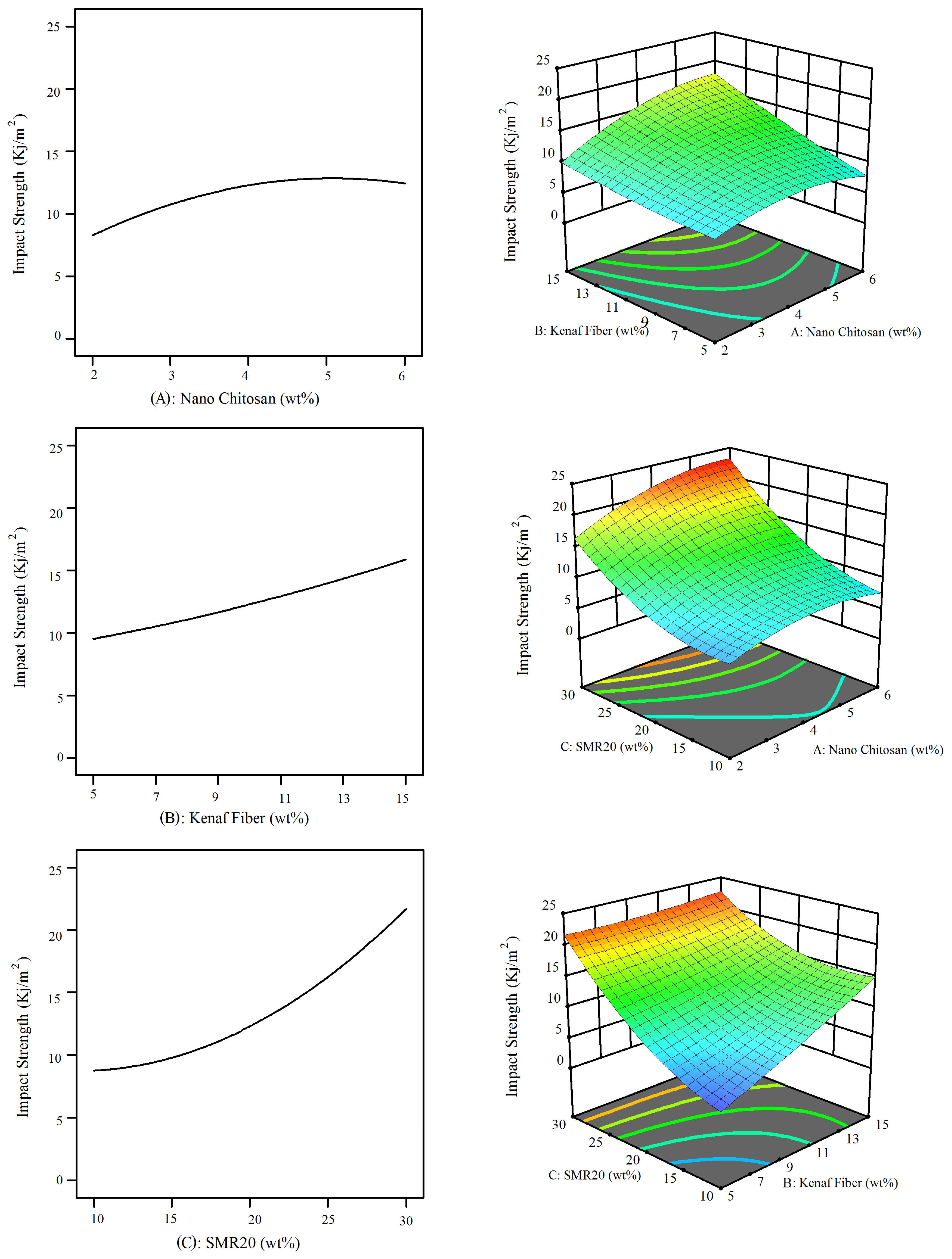
The influence of each constituent material on impact strength is illustrated in the main effects and response surface plots presented in
Figure 8. As shown, increasing the nanochitosan content up to 4 wt% leads to a significant improvement in impact strength. However, further addition beyond this threshold, specifically at 6 wt%, results in a noticeable decline in this mechanical property. This non-monotonic behavior can be attributed to a combination of physical, chemical, and morphological factors, including nanoparticle dispersion quality, interfacial adhesion, and the formation of stress-concentrating agglomerates at higher loadings [
42].
At low to moderate loadings (up to 4 wt%), nanochitosan is uniformly dispersed within the PLA/SMR20 matrix and significantly enhances interfacial adhesion between the filler and the matrix phases. This improvement stems from the abundance of reactive functional groups in chitosan—particularly amino (–NH2) and hydroxyl (–OH) groups, which facilitate the formation of strong hydrogen bonds and potential covalent interactions with the PLA/SMR20 matrix. These interfacial bonds promote efficient stress transfer and suppress the initiation and propagation of microcracks. Moreover, well-dispersed nanochitosan particles act as effective crack arresters: under impact loading, energy is dissipated through multiple toughening mechanisms, including crack deflection, nanoparticle debonding and pull-out, and the formation of localized plastic deformation (yield) zones around the nanoparticles, leading to enhanced energy absorption.
However, when the nanochitosan content exceeds 4 wt% and reaches 6 wt%, the previously observed improvement in impact strength reverses, leading to a notable decline. This reduction is primarily attributed to the poor dispersion of nanoparticles and the formation of agglomerates within the PLA/SMR20 matrix. At higher loadings, nanochitosan particles tend to aggregate due to strong intermolecular van der Waals forces. These agglomerates act as stress concentration sites, introducing structural weaknesses in the composite. Under impact loading, rather than hindering crack propagation, these clusters promote the early initiation and accelerated growth of microcracks, thereby diminishing the overall toughness of the material [
43].
It was also observed that increasing the weight percentage of kenaf fibers in the PLA/SMR20 matrix of the nanocomposite enhanced the impact strength. This improvement can be attributed to the effective reinforcing role of natural kenaf fibers within the composite structure. Kenaf fibers possess high tensile strength, low density, and excellent energy absorption capacity characteristics that make them particularly well-suited for enhancing the mechanical performance, especially impact resistance, of polymeric composites.
When embedded in a PLA/SMR20 matrix, kenaf fibers effectively facilitate the transfer of applied impact loads throughout the composite. This efficient stress transfer is primarily attributed to the strong interfacial adhesion between the fiber surface and the matrix, which is enhanced by the presence of polar functional groups such as hydroxyl (–OH) and carboxyl (–COOH) in the cellulose and lignin components of kenaf fibers. These groups promote robust fiber matrix bonding through hydrogen bonding and other physicochemical interactions, thereby minimizing interfacial debonding and fiber pull-out under impact loading [
44].
Kenaf fibers act as effective agents for arresting crack propagation. Under impact loading, microcracks initiated in the PLA/SMR20 matrix are deflected, pinned, or halted upon encountering kenaf fibers, a mechanism known as crack deflection. This process increases the tortuosity and overall length of the crack propagation path, thereby dissipating more energy before catastrophic failure. Additionally, energy absorption is further enhanced through mechanisms such as fiber pull-out and fiber fracture, both of which require significant work to debond fibers from the matrix or break them, respectively. These toughening mechanisms collectively contribute to the improved impact strength of the composite.
The three-dimensional network formed by kenaf fibers within the PLA/SMR20 matrix promotes a more uniform distribution of impact-induced stresses throughout the composite volume, thereby mitigating stress concentration and delaying crack initiation. This characteristic is especially critical under dynamic and impact loading conditions, where a rapid and homogeneous structural response is essential for energy absorption and damage resistance [
45].
In general, increasing the kenaf fiber content up to an optimal level enhances multiple energy absorption mechanisms such as efficient stress transfer, crack deflection, fiber elongation and fracture, and stress dispersion, thereby significantly improving the impact strength of the nanocomposite. However, this beneficial effect is typically limited to a certain threshold; beyond the optimal fiber loading, impact performance may decline due to poor fiber dispersion, agglomeration, or a reduction in matrix toughness. In the present study, however, the incorporation of kenaf fibers within the investigated range (up to 15 wt%) did not induce severe heterogeneity or agglomeration, and consequently, a continuous increase in impact strength was observed with increasing fiber content.
It was also observed that increasing the content of SMR20 natural rubber in the nanocomposite matrix led to a significant enhancement in impact strength. This favorable response is primarily attributed to the elastomeric character of natural rubber and its capacity to absorb and dissipate energy under dynamic loading conditions. SMR20 (Standard Malaysian Rubber 20), composed of long, flexible polyisoprene chains with a highly elastic molecular architecture, undergoes substantial elastic and plastic deformation upon impact. This energy-dissipating mechanism effectively delays crack propagation and prevents catastrophic, brittle failure of the composite [
46].
The incorporation of natural rubber into the PLA matrix enhances the toughness of the composite through several well-established energy-dissipating mechanisms. First, natural rubber acts as an elastomeric dispersed phase that promotes the formation of localized plastic deformation zones around the rubber particles during impact, thereby dissipating a significant amount of energy. Second, the presence of rubber particles induces microcracking in the surrounding matrix. The initiation and propagation of these microcracks absorb additional energy, contributing to increased overall fracture resistance prior to catastrophic failure. Third, rubber particles impede crack propagation through mechanisms such as crack pinning and crack deflection. When a propagating crack encounters a rubber particle, it is either temporarily arrested (pinned) or forced to change direction (deflected), resulting in a longer and more tortuous crack path. This increased path length further enhances energy absorption during fracture.
In this study, the incorporation of natural rubber (SMR20) contributed to a significant enhancement in impact strength, as shown in
Table 3. While SMR20 lacks the reactive epoxy groups of its modified counterparts (e.g., ENR), the observed mechanical improvement and the FESEM micrographs (
Figure 3 and
Figure 4), which show a coherent polymer blend morphology without gross phase separation, suggest that an adequate level of interfacial adhesion was achieved under the employed melt-blending conditions. This indicates that standard SMR20 can be an effective toughening agent for PLA when processed appropriately. This effective bonding facilitates efficient stress transfer from the matrix to the rubber phase and helps prevent premature debonding during mechanical loading. In some cases, however, controlled interfacial debonding or micro-delamination at the rubber–matrix interface can act as an additional energy-dissipating mechanism, further enhancing toughness. Beyond interfacial effects, SMR20 imparts flexibility to the composite system by mitigating the inherent brittleness of the PLA matrix. While the incorporation of rigid reinforcements—such as nanoparticles or natural fibers—often improves stiffness and strength, it can simultaneously reduce impact resistance. In this context, SMR20 functions as an effective toughening agent, striking an optimal balance between strength and ductility, which is critical for withstanding impact loads.
3.5. Optimization of Mechanical Properties of Bio-Based Composites Using Response Surface Methodology
To optimize the overall mechanical performance of the biocomposite, tensile strength, elastic modulus, and impact strength must be maximized simultaneously. This multi-response optimization problem was addressed using the desirability (utility) function approach, a widely accepted method for balancing competing responses. In this framework, each response is individually transformed into a dimensionless desirability value d ranging from 0 to 1, where d = 0 represents an unacceptable response and d = 1 corresponds to the ideal (target) performance. Since all three mechanical properties tensile strength, elastic modulus, and impact strength are of the “larger-the-better” type, their individual desirability functions were defined accordingly. The general form of the desirability function used in this study is given by Equation (2) [
23]:
In the desirability function approach, y represents the predicted response, T is the target (or desired) value, L is the lower acceptable limit, and r is a shape parameter (weighting exponent) that reflects the relative importance of approaching the target. When r = 1, the desirability function is linear. Values of r > 1 place greater emphasis on responses close to the target, whereas 0 < r < 1 indicate reduced sensitivity to deviations from the target, resulting in a flatter desirability curve near T. In general, the utility function is expressed as Equation (3) [
47]:
where n represents the number of responses considered in the optimization. The overall desirability function D is defined as the geometric mean of the individual desirability values corresponding to the three key mechanical responses:
where D ranges from 0 to 1, with values closer to 1 indicating a more favorable combination of factor settings (e.g., nanochitosan, kenaf fiber, and SMR20 contents, denoted collectively as x). Each individual desirability function di transforms the predicted response value into a dimensionless scale between 0 and 1: di = 0 signifies an unacceptable performance (below the lower limit), while di = 1 represents a response at or above the target value. Since all three properties tensile strength, elastic modulus, and impact strength are of the “larger-the-better” type, their desirability functions are constructed to increase monotonically with the response. The cubic root (i.e., exponent 1/3) reflects the geometric averaging of three responses, ensuring that a poor performance in any single property significantly reduces the overall desirability. This approach, based on the Derringer–Suich methodology, effectively balances competing mechanical requirements and enables the identification of optimal formulation conditions that simultaneously maximize strength, stiffness, and toughness.
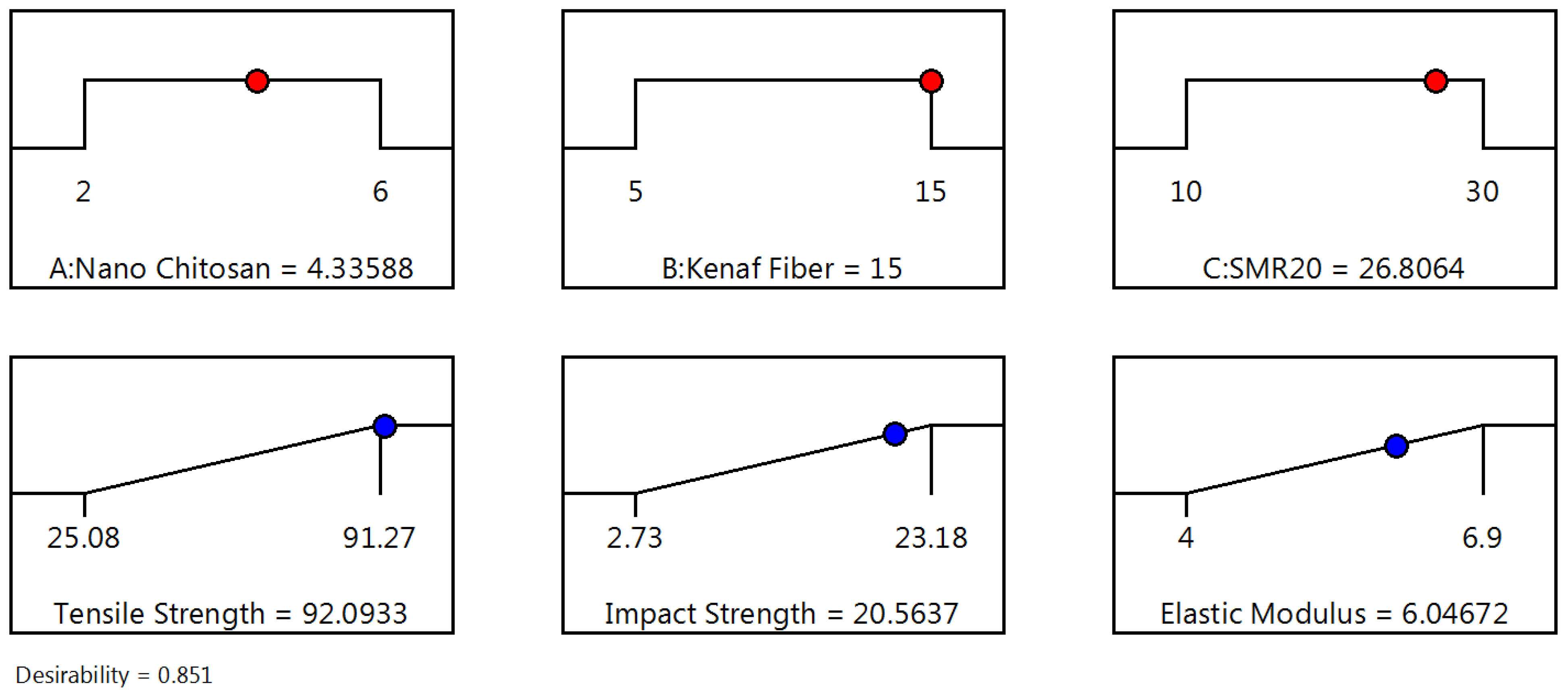
Figure 9 presents the results of the desirability function analysis for simultaneous optimization of the mechanical properties. The optimization analysis pinpointed a unique optimal composition within the design space: 4.33 wt% nanochitosan, 15 wt% kenaf fiber, and 26.80 wt% SMR20, achieving a maximum overall desirability of D = 0.851. This point does not correspond exactly to any of the originally tested runs but lies between them (notably, between Samples 10 and 12 in terms of SMR20 content), demonstrating the model’s power to interpolate and refine the optimum beyond the initial experimental grid. The predicted mechanical properties at this optimum were: tensile strength of 92.09 MPa, elastic modulus of 6.04 GPa, and impact strength of 20.56 kJ/m
2.
A confirmation experiment at the predicted optimum yielded excellent agreement with the model (
Table 7), validating its predictive accuracy. To address the interesting observation regarding similar performance across different compositions, a direct comparison is insightful. The predicted optimum (26.8% SMR20) and Sample 12 (30% SMR20) exhibit comparable high levels of impact strength, attributable to their high elastomer content. However, Sample 10 (10% SMR20), while having significantly less rubber, also approaches the optimal performance. This is due to a compensating reinforcement effect: the high kenaf fiber content (15% in all three cases) in Sample 10 provides substantial stiffness and strength, partially offsetting the lower toughness imparted by SMR20. The optimization model successfully captures these trade-offs, identifying the precise SMR20 level (~26.8%) that synergizes with the fixed high kenaf content to maximize the overall desirability, without the excessive loss of stiffness that very high rubber content might cause. Therefore, the optimization provides critical insight: while acceptable performance can be achieved with different SMR20/PLA ratios (as in Samples 10 and 12), the true optimum represents a calculated balance that the desirability function quantifies, which would not be evident from examining individual experimental runs alone.