1. Introduction
The Industrial Internet of Things (IIoT) revolutionized industries by empowering machines, sensors, and other equipment to collect and exchange vast amounts of sensitive data [
1]. However, with such additional connectivity come numerous security and privacy challenges, especially with the increasing importance of data coming from IIoT devices in supporting the functionality of industrial systems [
2]. One of the most significant problems with IIoT systems is that sensitive information must be stored securely and access to it strictly controlled, in accordance with data protection laws, such as the General Data Protection Regulation (GDPR) [
3]. Traditional security solutions, which typically rely on centralized models of access control, cannot serve in IIoT contexts due to the volume and nature of the network, which does not support maintaining control at its center. Never before have more robust, yet flexible and decentralized, security requirements been felt. Revolutionary cryptographic techniques, such as Attribute-Based Encryption (ABE) and the use of blockchain technology, are significant solutions. ABE is an encryption that allows data to be securely stored and transmitted, with users being granted access based on pre-specified properties [
4]. This means that sensitive information can be encrypted until it reaches the intended person or device, making unauthorized access impossible.
Decentralized Attribute-Based Encryption (DABE) [
5] replaces the single managing entity with a set of distributed, independent attribute authorities. By integrating DABE with blockchain technology, it becomes possible to decentralize access control operations, ensuring that no single organization has complete control over who should access what data. Decentralization enhances transparency, security, and the robustness of the system. This paper aims to develop a privacy-preserving solution that utilizes DABE and blockchain technology to ensure IIoT systems are GDPR-compliant, specifically Article 32 [
3], which requires organizations to implement appropriate technical and organizational measures to ensure the confidentiality of personal data. The primary objective is to enforce security policies within IIoT systems automatically, with minimal human interaction, and to minimize the potential for compliance errors or security breaches. We also fill a significant gap by exploring how advanced cryptographic techniques are applied in IIoT systems, presenting a scalable, secure, and efficient method for protecting sensitive data and meeting regulatory requirements. The ultimate aim is to enhance the security, privacy, and trust of IIoT systems while enabling organizations to meet their legal obligations under GDPR [
3].
With the above context in mind, the main contributions of this paper are as follows:
We design a framework that utilizes DABE and blockchain technology, offering GDPR-compliant data access control for IIoT systems.
We utilize the blockchain architecture to ensure transparency and traceability of data access events, with automatic enforcement of data access policies by smart contracts. This eliminates the need for a central authority, enhancing system security and privacy.
We utilize smart contracts to automate the enforcement of GDPR compliance, thereby reducing human error and enhancing the visibility and auditability of regulatory compliance.
The rest of the paper is organised as follows.
Section 2 introduces various GDPR management techniques from the literature. Article 32 of the GDPR is briefly described in
Section 3. The proposed framework is presented in
Section 4.
Section 5 presents the experimental procedure and the implementation details.
Section 6 presents the observed results and their evaluation. Finally, a summary of this paper is provided in
Section 7, along with some future directions.
2. Related Work
The Industrial Internet of Things (IIoT) has transformed industrial operations by enabling interconnected devices to collect and exchange vast amounts of sensitive data [
1]. However, this connectivity introduces significant security and privacy challenges [
6], particularly in ensuring compliance with data protection regulations such as the GDPR [
3]. Traditional centralized access control models struggle to meet the scalability and flexibility demands of IIoT systems. Advanced cryptographic techniques, such as ABE [
4], combined with blockchain technology [
7], offer decentralized, secure, and transparent solutions for data management. This literature review examines recent studies on access control in IoT networks, focusing on ABE and blockchain-based approaches for securing IIoT systems. It discusses their consideration in ensuring GDPR compliance, scalability, and decentralization. A comparative table is provided to summarize key features of each study.
Several studies have explored access control to address security and privacy challenges in IIoT systems. Hu et al. [
8] proposed a secure aggregation scheme that aggregates the generated IoT data in a privacy-preserving approach, including the industrial data, to a centralized server. Hu et al. [
9] proposed a fine-grained IoT data access control scheme that utilizes ABE as a central building block. Their framework uses ABE to enforce attribute-based access control, ensuring that only authorized users with matching attributes can decrypt data. Building on similar principles, Sasikumar et al. [
10] developed a hierarchical ABE scheme integrated with blockchain for secure information sharing in IIoT. Their method supports multi-level access control, enabling fine-grained policy enforcement across complex industrial systems. Blockchain ensures decentralized and tamper-proof storage of access logs, enhancing transparency. Unlike our work, this model does not consider GDPR compliance when accessing data. Additionally, while a level of decentralization is achieved by using the hierarchical ABE scheme through the delegation of key generation, the root Private Key Generator (PKG) still has to generate the master key and delegate the key management operation to other PKGs.
Hussain et al. [
11] proposed a real-time, lightweight cache algorithm that integrates blockchain for IoT access control. The blockchain stores the access policies, and the actual IoT data is stored in the cloud server. This approach enhances scalability and performance, making it suitable for large IoT networks. However, while it demonstrates efficient access control, the study does not explore GDPR compliance access control. Lee et al. [
12] proposed a blockchain-based data access control and key agreement system for IoT environments. Their solution uses CP-ABE to enable fine-grained access control and secure data sharing. The proposed approach is scalable and efficient for resource-constrained devices, incorporating smart contracts for automated access management and leveraging off-chain decentralized storage to enhance system reliability and reduce on-chain data load. A single trusted authority in the proposed model manages the registration and key generation.
Roy and Ghosh [
13] presented BloAC, a blockchain-based access control system for IoT environments. Their framework focuses on enhancing scalability and security by proposing an efficient and lightweight mechanism for managing access permissions across a wide range of IoT devices. BloAC leverages smart contracts to automate access control decisions, reducing the need for centralized authorities and improving system resilience against single points of failure. The use of blockchain ensures tamper-proof logging of access events, contributing to greater transparency and auditability. However, while the study significantly advances decentralized management and secure access control, it does not directly address the data protection obligations imposed by GDPR, which are critical in privacy-sensitive IoT applications.
Zaidi et al. [
14] focus on an ABE-based access control framework for IoT, leveraging blockchain and smart contracts. Smart contracts automate access policy enforcement, thereby improving efficiency and reducing the need for human intervention. Despite its decentralized design, which utilizes the blockchain, the framework requires the data owner to generate the secret access keys. Morello et al. [
15] specified a privacy-aware protocol for verifying compliance with regulations, with a focus on secure and decentralized verification of organizational attributes within clouds. DABE and Zero-Knowledge Proofs (ZKPs) have been integrated into their framework to propose an Attribute Verification Protocol that guarantees a Prover (e.g., an organization) holds specific compliance-critical attributes without revealing them. The architecture mandates automatically enforced compliance checks by a decentralized ticketing system and is implemented in AWS using cloud-native building blocks. The effort directly responds to GDPR Article 32, and four sets of attributes map to its security requirements (e.g., pseudonymization, availability, periodical assessments). While it is not based on traditional blockchain infrastructure, it achieves decentralization through multiple Issuers and is designed for scalability and privacy. This makes the protocol particularly suitable for IIoT and cloud infrastructure that requires regulation-sensitive, fine-grained access control.
Table 1 provides a comparison of the features of the related works. To better understand the merits and drawbacks of the evaluated strategies, the following paragraphs outline the most significant features considered for comparison.
In the following, we provide a brief description of the key features that were introduced in
Table 1.
Data encryption: This feature assesses if the system ensures sensitive IIoT data is encrypted to prevent unauthorized access. Encryption systems, whether ABE or symmetric encryption, are crucial for data confidentiality.
Fine-grained access control: This refers to the ability to enforce policies that provide fine-grained and dynamic access, allowing only a specified user with specific characteristics or credentials to view specific data. Fine-grained control is essential for adhering to privacy laws and minimizing the exposure of sensitive information.
GDPR compliance: Solutions are assessed on the degree to which they directly provide mechanisms to satisfy GDPR requirements (e.g., as required by Article 32).
Scalability: This factor considers the scalability of the system so that there is performance and security when there is a growth in devices and users. Scalable architectures are required for realistic deployment in large-scale IIoT applications.
Resource efficiency: IIoT devices will be restricted in terms of computing and storage. Solutions are evaluated based on how efficiently they integrate into such configurations, with security features that do not consume excessive resources.
No single managing/storage entity: This feature ensures that no entity in the system represents a single managing or storage entity. While the rest of the protocol may be decentralized, the existence of such an entity can introduce a single point of attack and failure in the system.
Smart contract integration: This checks whether smart contracts are employed to automate access control or data management processes on the blockchain, reducing manual intervention and improving transparency and reliability.
Off-chain decentralized storage: This feature evaluates the use of decentralized storage solutions, such as the InterPlanetary File System (IPFS), to safely store large data files without congesting the blockchain, enhancing system scalability and efficiency.
3. GDPR Article 32
When an entity (e.g., a company branch) aims to access IIoT-generated private data, Article 32 of the GDPR (
https://gdpr-info.eu/art-32-gdpr/ accessed on 27 April 2025) requires that the user has implemented “appropriate technical and organisational measures to ensure a level of security appropriate to the risk.” This meant that the user had ensured “the ongoing confidentiality, integrity, availability and resilience of processing systems and services.” In practical terms, this can be achieved through measures such as encryption, access control, authentication, and logging. Article 32 sets out four main requirements, which can be translated into the following attributes:
Attribute 1: Pseudonymization and encryption of personal data.
Attribute 2: Ensuring ongoing confidentiality, integrity, availability, and resilience of processing systems and services.
Attribute 3: The ability to restore availability and access to personal data quickly after a physical or technical incident.
Attribute 4: A process for regularly testing, assessing, and evaluating the effectiveness of security measures.
Before an entity, such as a company branch, is granted access, the data owner must be assured that the entity can “regularly test, assess and evaluate the effectiveness of technical and organisational measures for ensuring the security of the processing.” Evidence such as security policies, contractual data processing agreements, or recognised certifications would serve to demonstrate compliance. The roles of controller and processor also must be clearly established, as responsibility for maintaining “a level of security appropriate to the risk” rests with both parties. In short, Article 32 requires that access is conditional upon provable safeguards being in place. The primary objective of this paper is to automate and integrate access control with GDPR compliance verification.
4. The Proposed Framework
The proposed framework combines the most advanced cryptographic techniques, such as DABE, blockchain technology, and smart contracts, to enable GDPR-compliant access control on IIoT platforms. DABE is used to facilitate fine-grained encryption of personal data, where the access policies are represented in ciphertext directly and are expressed in terms of attributes extracted from GDPR Article 32 requirements, such as encryption, pseudonymization, access control, and integrity mechanisms for data. By integrating these technologies, the framework guarantees greater confidentiality, integrity, and availability of IIoT data while being strictly compliant with GDPR regulations, particularly ensuring security, accountability, and user data protection.
4.1. Framework Architecture
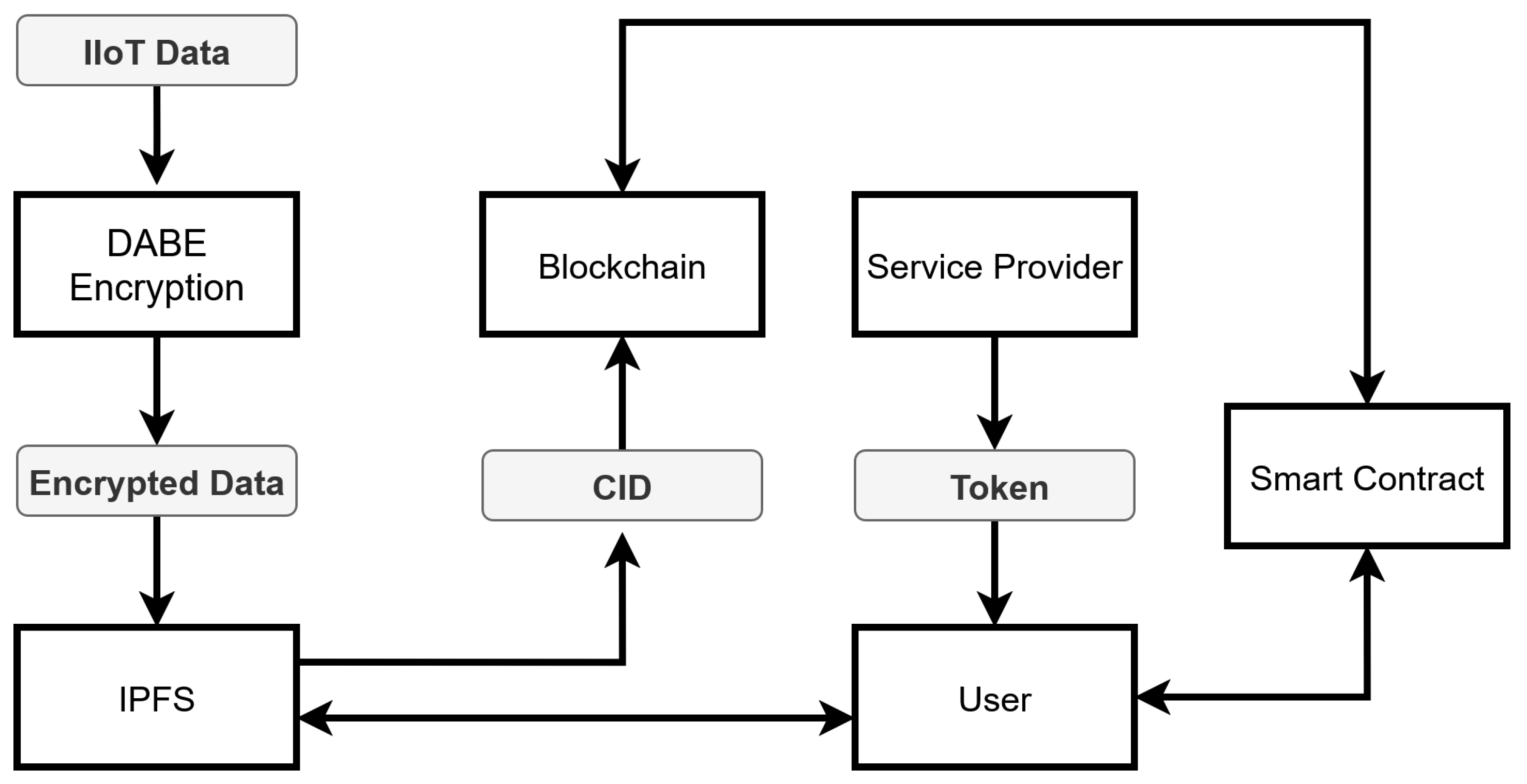
The architecture of the proposed framework integrates several aspects that collaborate to offer secure and GDPR-compliant access control. It starts with IIoT devices, which collect information from the real world and encrypt it to protect confidentiality. The encrypted data is stored securely via decentralized storage, ensuring its safety even in the event of system failure. The data is accessed by regulating it with smart contracts on a blockchain in such a way that only GDPR-compliant entities can access it based on their attributes. All elements of the system are structured to exchange information securely and efficiently, thereby safeguarding the information throughout the process. All these elements together constitute a secure environment that is GDPR-compliant in terms of security, transparency, and data privacy. An overview of the system architecture is presented in
Figure 1.
The sensors constantly collect real-time data, for instance, diagnostics data, location, velocity, and other operational parameters, which are required for controlling and monitoring. Due to data sensitivity, encryption is immediately applied once the data is collected to protect it against unauthorized use or interference. The encryption mechanism follows access rules that are customized according to the GDPR Article 32 characteristics; thus, only users possessing the required security set of properties can successfully decrypt and access the data. Such fidelity-based access ensures confidentiality and data integrity throughout their lifespan. Once encrypted, the information is stored in the distributed storage network, providing a decentralized, tamper-proof repository to enhance immunity to single points of failure. The blockchain is also an open and unalterable record containing metadata about every attempt to access the data, including user attributes, request date and time, and the success or failure of the request. This logging process not only enables real-time monitoring and audit capabilities but also enhances traceability and accountability, both of which are required under GDPR compliance regulations.
4.2. Integration with DABE
DABE is used for encrypting IIoT data. The encryption process ensures that only those entities who satisfy a defined set of attributes (aligned with GDPR requirements) can access the encrypted data. The DABE encryption mechanism is defined as follows:
Let
M represent the data to be encrypted. In DABE, the encryption of
M is performed based on a policy
P that specifies the required compliance attributes for decryption. The encryption process is
where
is the encryption function,
is the public key of the system, and
P is the set of compliance attributes that define the decryption policy. A user can decrypt the data only if their attributes match the compliance policy
P. Decryption is performed using the user’s secret key
, which various service providers generate based on the user’s attributes. The decryption function is
where
is the decryption function, and
C is the ciphertext.
4.3. Blockchain Integration
Blockchain technology is incorporated into the proposed framework to ensure that access requests are logged in a secure, decentralized, and immutable ledger. Each access request, along with its associated metadata, including timestamp, user attributes, and access status, is recorded on the Blockchain. The ledger provides transparency, ensuring that every access attempt is publicly verifiable and traceable. A typical transaction on the Blockchain can be represented as
where
U represents the anonymized identifier of the user making the request,
A represents the user’s compliance attributes,
represents the timestamp of the request,
P represents the compliance policy associated with the requested data and
indicates whether the access was approved or denied. IPFS and Ethereum work together by storing encrypted data on IPFS and recording its unique Content Identifier (CID) on the Blockchain.
4.4. Smart Contract
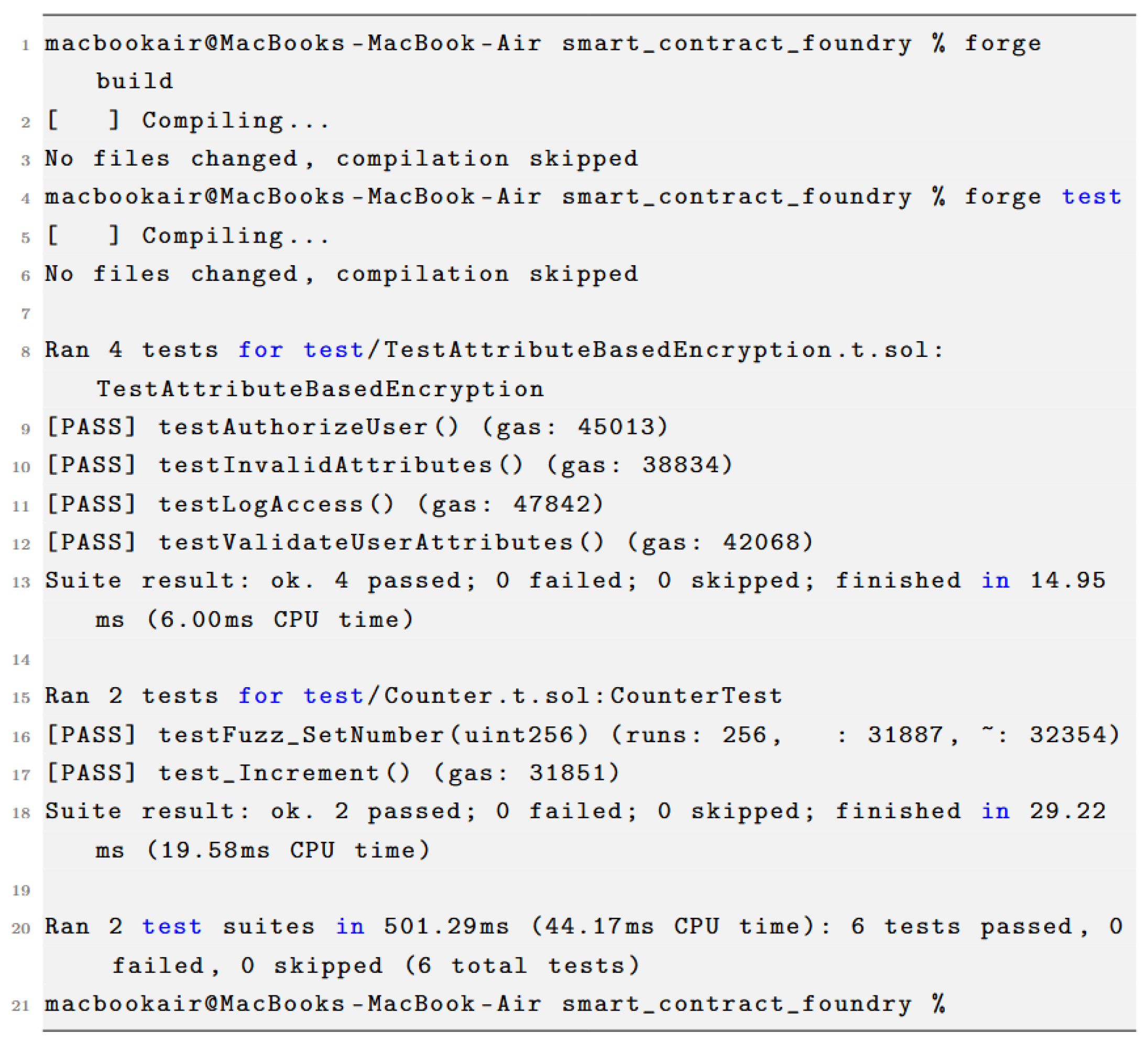
The smart contract is deployed on the blockchain to enforce access control policies automatically. The contract is written in Solidity using the Foundry framework and implements authorization checks against attribute policies, emitting audit events. More specifically, it is an access-control contract that verifies the compliance attribute satisfaction and logs decisions (AccessLogged with user address, timestamp, policy, and result).
The CID on IPFS ensures data integrity, while the smart contract manages access and rules, together creating a secure and decentralized system for handling encrypted information. When a user attempts to access encrypted data, the contract verifies whether the user’s attributes satisfy the conditions specified by the compliance policy. Formally, the smart contract function is defined as
where
U is the user,
A is the set of compliance attributes associated with the user, and
P is the compliance policy defined during encryption. The encrypted CID of IPFS is recorded in the smart contract. When the user
U requests access to the data, the contract checks whether the user’s compliance attributes meet the defined policy. If they do, the encrypted CID is returned, allowing the user to retrieve the ciphertext from IPFS; if not, access is denied.
4.5. Cryptographic Protocol Design
This section describes the cryptographic components used in the proposed framework, with a particular focus on DABE encryption, key management, and access control mechanisms.
The core of the encryption process is based on DABE [
5], where the data is encrypted based on a set of attributes. Key management in DABE involves an unlimited number of trusted and independent authorities that are authorized to generate compliance tokens for users. Upon joining the framework for the first time, an authority such as a cloud service provider generates its own public and private keys. The public key will later be used to create the ciphertext.
A user U, using its anonymized identity , requests a compliance ticket for each attribute i by contacting the corresponding service provider. The service provider then generates the user’s tickets, that is, the secret keys linked to those attributes. Each ticket associated with a given attribute serves as proof of possession of that attribute. This ticketing mechanism defines the role of the secret key as evidence of compliance with the corresponding regulatory requirement.
The decentralized design of the protocol assigns different service provider nodes the responsibility for generating different sets of tickets. This distribution of authorities across multiple service providers reduces reliance on a single central entity and significantly mitigates the risks typically found in centralized systems. Additionally, the system is fully aligned with the lightweight generation of the ciphertext by utilizing and integrating the sharing of the encryption process [
16] or outsourcing the heavy computations [
17], making it suitable for the resource-constrained nodes with low computation power.
4.6. GDPR Article 32 Compliance Mechanisms
The proposed framework ensures adherence to the GDPR in terms of secure data handling and access permissions in IIoT systems. The framework meets the GDPR’s requirements for confidentiality, integrity, and user rights, with a focus on protecting data in smart manufacturing system applications.
To check compliance with Article 32, each attribute must be verified. A user (e.g., a company branch) is considered compliant only if it meets all four attributes. In practice, this means the user requesting the data access must receive four validation tickets (secret keys for each attribute) from the Issuers (e.g., cloud providers). The compliance logic for each attribute can be defined as follows:
Pseudonymization technique: must be tokenization or masking.
Encryption algorithm: must be an approved option such as AES, RSA, or ChaCha20.
Key length: must meet minimum security standards, e.g., at least 128 bits for symmetric encryption or 2048 bits for asymmetric encryption.
Security measures: must include mandatory items such as a firewall.
Assessment frequency: at least quarterly.
Vulnerabilities found: must remain below a set threshold (e.g., fewer than 5).
Vulnerability severity: must not exceed acceptable levels (e.g., low or medium).
Backup type: must be incremental or full.
Backup frequency: must be daily or weekly.
Recovery Time Objective (RTO): no more than 8 h.
Recovery Point Objective (RPO): no more than 4 h.
Assessment frequency: must be monthly, quarterly, or yearly.
Assessment type: must be an accepted method, such as vulnerability scanning, penetration testing, or a security audit.
Assessment status: must be marked as passed.
Last assessment date: must be within the last 18 months.
5. Implementation
To implement the proposed framework, and without loss of generality, the FABEO scheme introduced by Riepel and Wee was employed [
18]. It provides efficient, pairing-based CP-ABE with optimal adaptive security and support for expressive access control policies. Based on that, we assumed one service provider that issues the four compliance tokens. In future implementations, these ABE implementations can be replaced by a DABE implementation. The deployment was carried out with the open-source code provided by the authors (
https://github.com/DoreenRiepel/FABEO accessed on 3 February 2025), which served as a working and effective base to construct and test the encryption facilities within IIoT applications. To further enhance the security and scalability of the system, we augment this ABE solution with a decentralized storage network, utilizing IPFS to store the encrypted data.
Decentralized storage removes risks associated with centralized storage systems by offering enhanced resilience and availability. Additionally, data stored in IPFS remains completely encrypted, ensuring that even if the storage network is compromised, malicious nodes cannot access the confidential information. The data can only be retrieved by limiting the encrypted data, and this can only be carried out by the intended parties whose attributes satisfy the pre-configured requirements, through the use of the DABE scheme.
Currently, the system prototype (
https://github.com/elte-cybersec/gdpr-compliant-IIoT accessed on 20 September 2025) encompasses four main components: (1) the ABE scheme that uses attributes to control access to encrypted data based on the GDPR Article 32 compliance, (2) encryption and decryption to secure data and ensure authorized decryption based on user attributes, (3) smart contracts to manage user access based on attributes stored on the blockchain, and (4) IPFS integration to store encrypted data off-chain for secure and decentralized access.
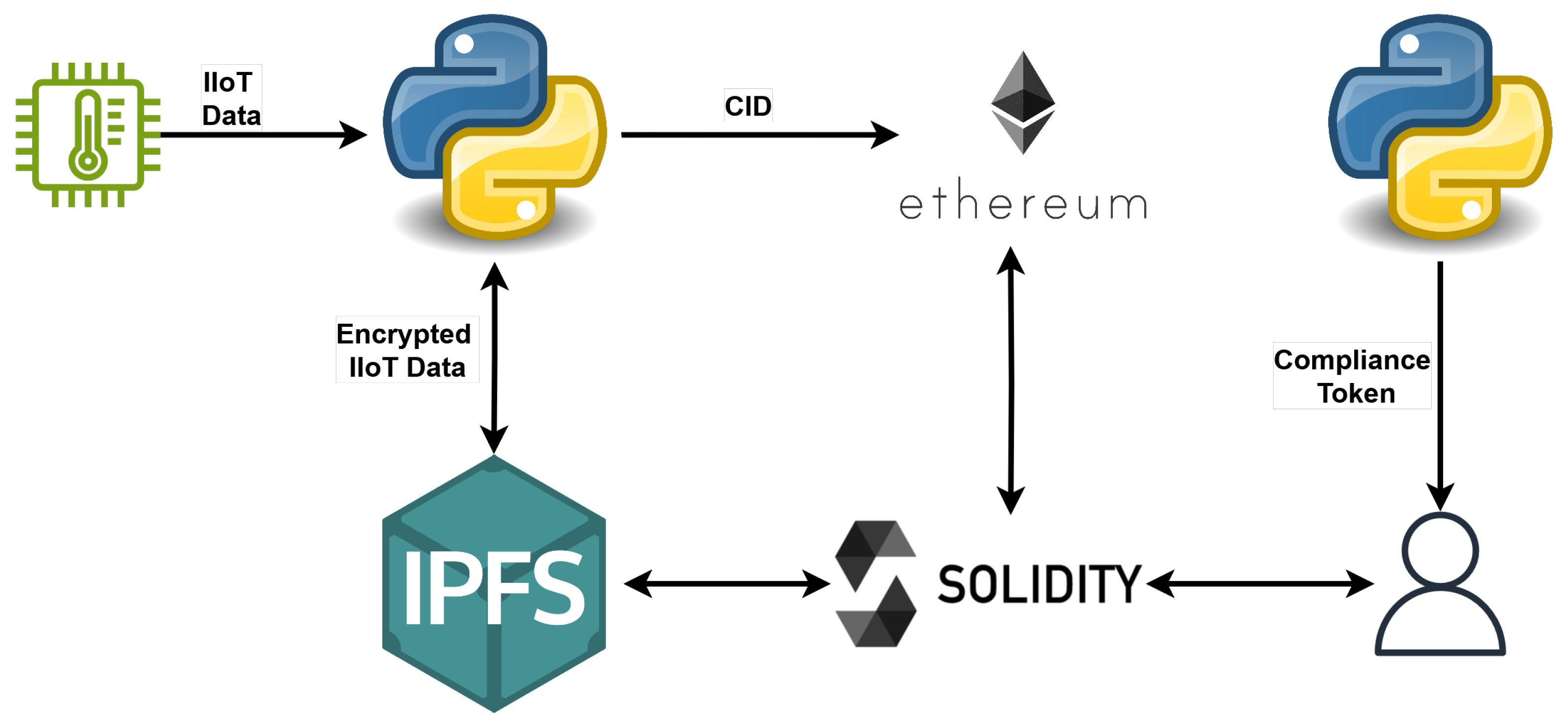
IPFS and Ethereum complement each other by combining decentralized storage with verifiable smart contract logic. Since storing ciphertext data directly on the blockchain is costly and inefficient, compared to storing it on IPFS, the encrypted and serialized ciphertext () is uploaded to IPFS, which returns a unique CID. This CID, a lightweight cryptographic reference, is then encrypted based on the compliance policy and stored in an Ethereum smart contract. The smart contract regulates the access, verification, and usage policies, while IPFS ensures decentralized and tamper-resistant storage. Together, this integration enables scalable, secure, and decentralized management of encrypted data.
Figure 2 illustrates an overview of the framework architecture and the used technologies. The compliance token is generated by the service provider. To conduct the process of both encryption and decryption, we implemented Algorithms 1 and 2, respectively. We start by outlining some of the notations we use in the rest of the paper, as shown in
Table 2.
On the one hand, Algorithm 1 illustrates the operation of the storage, where the essential inputs are the original IIoT data,
, and the
. The resulting
is structured with various cryptographic components such as
C0, which enforce the access control policy. The
function encrypts the original IIoT data (
msg) under the provided policy. The encryption ensures that only GDPR-compliant users with the right attributes can decrypt the data. After serialization, the
is uploaded to IPFS for decentralized storage. Each element of the
is serialized using the
group.serialize function to enable it to be stored on IPFS.
| Algorithm 1 Encryption Process |
- Require:
- Ensure:
- 1:
- 2:
- 3:
- 4:
|
On the other hand, Algorithm 2 illustrates the operation of data access, where the essential inputs are the encrypted data
,
, and the secret key
. The
decrypt function checks if the set of attributes of a user matches the policy that is embedded in the
. If the attributes meet the conditions, the
is first decrypted to the CID of the stored
, which is then decrypted. As a result, the original IIoT data will be recovered. To validate, we compare the decrypted message and the original message to verify successful decryption.
| Algorithm 2 Decryption Process |
- Require:
- Ensure:
- 1:
if is met then - 2:
- 3:
- 4:
- 5:
if then - 6:
▹ This is a validation process - 7:
else - 8:
- 9:
end if - 10:
end if
|
The access control in the system is governed by the user’s attributes. These attributes determine whether a user can decrypt a message. Each user has a set of attributes, and the system checks if these attributes match the policy embedded in the ciphertext. A list of attributes is associated with each user. These attributes are used to generate a secret key for the user and are the basis for access control. Here is an example of a list of attributes: [‘DATACONTROLLER’, ‘ENCRYPTIONENABLED’, ‘ACCESSCONTROLENFORCED’, ‘PSEUDONYMIZATIONAPPLIED’, ‘TESTEDSECURITY’, ‘GDPRCOMPLIANT’]. The user’s secret key is generated based on their specific attributes, ensuring that only users with the right attributes can decrypt messages. In terms of the access control policy, a logical policy defines the required attributes for accessing a message. For example, a policy could specify that a user must have GDPRCOMPLIANT and ENCRYPTIONENABLED attributes to access the data.
To manage and enforce the access control policies on the blockchain, smart contracts are used. These contracts validate if a user has the required attributes and log access requests.