
A Conceptual Framework for Integrating IoT and Blockchain for Smart and Sustainable Urban Development

Highlights
- The integration of IoT and blockchain enables transparency, automation, and secure digital identities to enhance sustainable urban development.
- IoT and blockchain technologies support urban sustainability and strengthen citizen engagement through digital participation and governance tools.
- IoT and blockchain convergence advances smart, sustainable, and participatory urban development aligned with SDG 11.
- Policymakers and urban planners can leverage IoT and blockchain integration to design inclusive, accountable, and citizen-centered smart and sustainable urban environments.
Abstract
1. Introduction
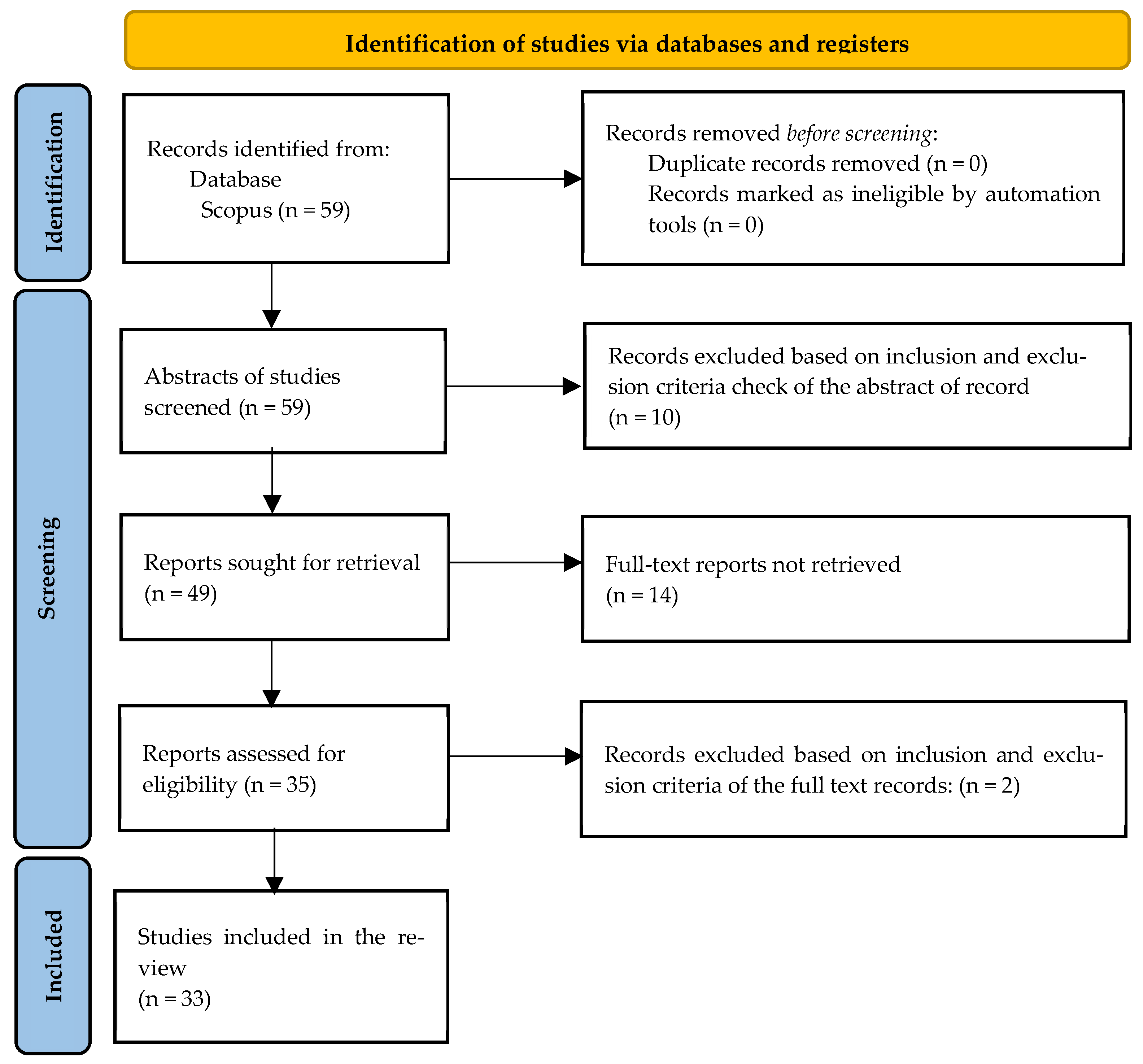
2. Methodology
3. Results
3.1. General Observations
- Applications of IoT and blockchain for sustainable urban development;
- Key IoT and blockchain use cases across urban sustainability sectors;
- Transformations in urban governance through IoT and blockchain integration;
- Enhancing citizen engagement through the integration of IoT and blockchain;
- Challenges and opportunities associated with IoT and blockchain technologies;
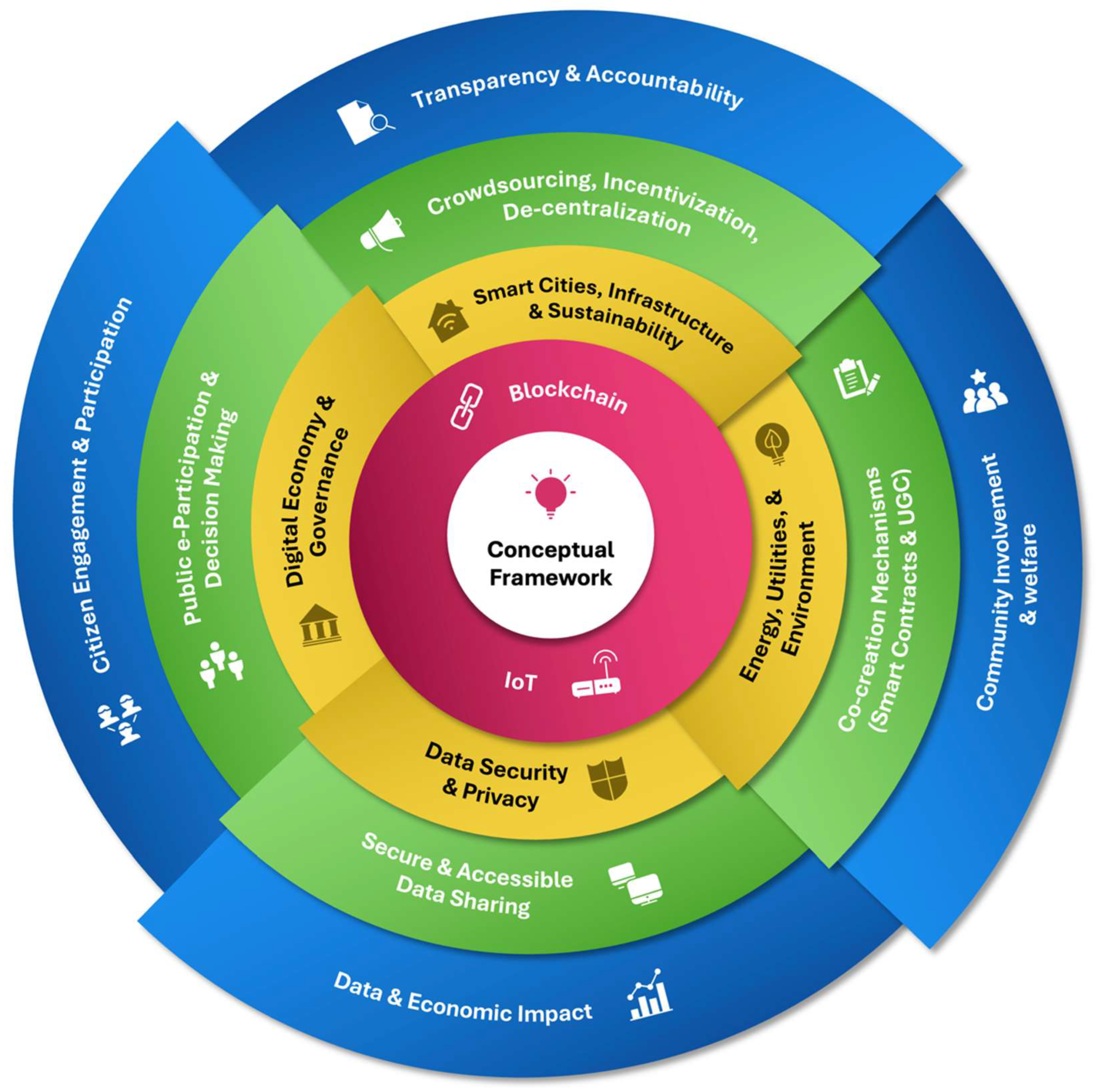
- Moving towards a conceptual framework.
3.2. IoT and Blockchain Applications Enabling Sustainable Urban Development
3.3. Key IoT and Blockchain Applications in Urban Sustainability Sectors
3.4. Transforming Urban Governance Through IoT and Blockchain Integration
3.5. Integrating IoT and Blockchain to Enhance Citizen Engagement
3.6. Opportunities for IoT and Blockchain to Overcome Challenges
3.7. Towards a Conceptual Framework
4. Discussion
5. Conclusions
Author Contributions
Funding
Data Availability Statement
Conflicts of Interest
References
- Almulhim, A.I.; Cobbinah, P.B. On Urban Sustainability: Urbanization and Climate Change Collision. Sustain. Dev. 2025, 2025, 1–17. [Google Scholar] [CrossRef]
- Almulhim, A.I.; Sharifi, A.; Aina, Y.A.; Ahmad, S.; Mora, L.; Filho, W.L.; Abubakar, I.R. Charting Sustainable Urban Development Through a Systematic Review of SDG11 Research. Nat. Cities 2024, 1, 677–685. [Google Scholar] [CrossRef]
- Sun, Y.; Wu, K.; Zheng, G.; Zhang, X.; Lu, H.; Fang, J. City Brain Promotes the Co-Reduction of Carbon and Nitrogen Emissions. Earth Crit. Zone 2025, 2, 100028. [Google Scholar] [CrossRef]
- UNEP. Global Waste Management Outlook 2024: Beyond an Age of Waste, Turning Rubbish into a Resource; UN Environment Program: Nairobi, Kenya, 2024. Available online: https://www.unep.org/resources/global-waste-management-outlook-2024 (accessed on 19 July 2025).
- Berniak-Woźny, J.; Sliż, P.; Siciński, J. Empowering Smart Cities Through Start-Ups: A Sustainability Framework for Incubator-City Collaboration. Systems 2025, 13, 219. [Google Scholar] [CrossRef]
- Almulhim, A.I. Building Urban Resilience Through Smart City Planning: A Systematic Literature Review. Smart Cities 2025, 8, 22. [Google Scholar] [CrossRef]
- Almulhim, A.I. Integrating Artificial Intelligence into Smart Infrastructure Management for Sustainable Urban Planning. Technologies 2025, 13, 481. [Google Scholar] [CrossRef]
- Singh, S.; Sharma, P.K.; Yoon, B.; Shojafar, M.; Cho, G.H.; Ra, I. Convergence of Blockchain and Artificial Intelligence in IoT Network for the Sustainable Smart City. Sustain. Cities Soc. 2020, 63, 102364. [Google Scholar] [CrossRef]
- Mohsen, B.M. AI-Driven Optimization of Urban Logistics in Smart Cities: Integrating Autonomous Vehicles and IoT for Efficient Delivery Systems. Sustainability 2024, 16, 11265. [Google Scholar] [CrossRef]
- Shahmohammad, M.; Salamattalab, M.M.; Sohn, W.; Kouhizadeh, M.; Aghamohmmadi, N. Opportunities and Obstacles of Blockchain Use in Pursuit of Sustainable Development Goal 11: A Systematic Scoping Review. Sustain. Cities Soc. 2024, 112, 105620. [Google Scholar] [CrossRef]
- Thormundsson, B. Size of Smart Cities Market Worldwide in 2019 and 2030. Statista 2023. Available online: https://www.statista.com/statistics/1256262/worldwide-smart-city-market-revenues/ (accessed on 28 November 2025).
- Almulhim, A.I.; Aina, Y.A. Achieving Human-Centered Smart City Development in Saudi Arabia. Urban Sci. 2025, 9, 393. [Google Scholar] [CrossRef]
- Pahuja, N. Smart Cities and Infrastructure Standardization Requirements. In Solving Urban Infrastructure Problems Using Smart City Technologies; Elsevier: Amsterdam, The Netherlands, 2021; pp. 331–357. [Google Scholar] [CrossRef]
- Foster, S.R.; Iaione, C. Ostrom in the City: Design Principles and Practices for the Urban Commons. In Routledge Handbook of the Study of the Commons; Routledge: London, UK, 2019; pp. 235–255. [Google Scholar]
- Ibrahimy, M.M.; Norta, A.; Normak, P. Blockchain-Based Governance Models Supporting Corruption-Transparency: A Systematic Literature Review. Blockchain Res. Appl. 2024, 5, 100186. [Google Scholar] [CrossRef]
- Kassen, M. Understanding Decentralized Civic Engagement: Focus on Peer-to-Peer and Blockchain-Driven Perspectives on E-Participation. Technol. Soc. 2021, 66, 101650. [Google Scholar] [CrossRef]
- Zhao, B.; Cheng, S.; Schiff, K.J.; Kim, Y. Digital Transparency and Citizen Participation: Evidence from the Online Crowdsourcing Platform of the City of Sacramento. Gov. Inf. Q. 2023, 40, 101868. [Google Scholar] [CrossRef]
- Ajoudanian, S.; Aboutalebi, H.R. A Capability Maturity Model for Smart City Process-Aware Digital Transformation. J. Urban Manag. 2025, 14, 877–895. [Google Scholar] [CrossRef]
- Salih, S.; Abdelmaboud, A.; Husain, O.; Motwakel, A.; Elshafie, H.; Sharif, M.; Hamdan, M. IoT in Urban Development: Insight into Smart City Applications, Case Studies, Challenges, and Future Prospects. PeerJ Comput. Sci. 2025, 11, e2816. [Google Scholar] [CrossRef] [PubMed]
- Sosunova, I.; Porras, J. IoT-Enabled Smart Waste Management Systems for Smart Cities: A Systematic Review. IEEE Access 2022, 10, 73326–73363. [Google Scholar] [CrossRef]
- Truong, V.T.; Le, L.; Niyato, D. Blockchain Meets Metaverse and Digital Asset Management: A Comprehensive Survey. IEEE Access 2023, 11, 2169–3536. [Google Scholar] [CrossRef]
- Gholami, M.; Ghaffari, A.; Derakhshanfard, N.; Ibrahimoğlu, N.; Kazem, A.A.P. Blockchain Integration in IoT: Applications, Opportunities, and Challenges. Comput. Mater. Contin. 2025, 83, 1561–1605. [Google Scholar] [CrossRef]
- Khan, B.U.I.; Goh, K.W.; Khan, A.R.; Zuhairi, M.F.; Chaimanee, M. Integrating AI and Blockchain for Enhanced Data Security in IoT-Driven Smart Cities. Processes 2024, 12, 1825. [Google Scholar] [CrossRef]
- Bhushan, B.; Khamparia, A.; Sagayam, K.M.; Sharma, S.K.; Ahad, M.A.; Debnath, N.C. Blockchain for Smart Cities: A Review of Architectures, Integration Trends and Future Research Directions. Sustain. Cities Soc. 2020, 61, 102360. [Google Scholar] [CrossRef]
- Jeyabharathi, D.; Thava, A.M.; Idas, S.J.P.; Sangeetha, T. Waste Management in Smart Cities Using Blockchaining Technology. In Blockchain for Smart Cities; Elsevier: Amsterdam, The Netherlands, 2021; pp. 171–181. [Google Scholar] [CrossRef]
- Szpilko, D.; de la Torre Gallegos, A.; Jimenez Naharro, F.; Rzepka, A.; Remiszewska, A. Waste Management in the Smart City: Current Practices and Future Directions. Resources 2023, 12, 115. [Google Scholar] [CrossRef]
- Chauhan, M.; Sahoo, D.R. Towards a Greener Tomorrow: Exploring the Potential of AI, Blockchain, and IoT in Sustainable Development. Nat. Environ. Pollut. Technol. 2024, 23, 1105–1113. [Google Scholar] [CrossRef]
- Zyoud, S.; Zyoud, A. Internet of Things Supporting Sustainable Solid Waste Management: Global Insights, Hotspots, and Research Trends. Int. J. Environ. Sci. Technol. 2024, 22, 7641–7670. [Google Scholar] [CrossRef]
- Bagloee, S.A.; Heshmati, M.; Dia, H.; Ghaderi, H.; Pettit, C.; Asadi, M. Blockchain: The Operating System of Smart Cities. Cities 2021, 112, 103104. [Google Scholar] [CrossRef]
- Sleem, A. Towards Sustainable Smart Cities: Exploring the Synergy of Blockchain and Edge Intelligence—A Review and Outlook. J.Sustain. Dev. Green Technol. 2023, 3, 8–19. [Google Scholar] [CrossRef]
- Shen, C.; Pena-Mora, F. Blockchain for Cities—A Systematic Literature Review. IEEE Access 2018, 6, 76787–76819. [Google Scholar] [CrossRef]
- Falco, E.; Kleinhans, R. Digital Participatory Platforms for Co-Production in Urban Development: A Systematic Review. Int. J. E-Plan. Res. (IJEPR) 2018, 7, 52–79. [Google Scholar] [CrossRef]
- Becker, F.; Siemon, D.; Robra-Bissantz, S. Smart Participation Design: Prescriptive Knowledge for Bottom-Up Participation. Commun. Assoc. Info. Syst. 2022, 51, 484–508. [Google Scholar] [CrossRef]
- Berigüete, F.E.; Santos, J.S.; Rodriguez Cantalapiedra, I. Digital Revolution: Emerging Technologies for Enhancing Citizen Engagement in Urban and Environmental Management. Land 2024, 13, 1921. [Google Scholar] [CrossRef]
- Bai, Y.; Hu, Q.; Seo, S.-H.; Kang, K.; Lee, J.J. Public Participation Consortium Blockchain for Smart City Governance. IEEE Internet Things J. 2021, 9, 2094–2108. [Google Scholar] [CrossRef]
- Benini, S.M.; Da Silva, A.L.C.; De Godoy, J.A.R.; Palmisano, A. Smart Cities for Urban Planning: A Bibliometric-Conceptual Analysis. Int. J. Bus. Manag. 2024, 19, 92. [Google Scholar] [CrossRef]
- Veloso, Á.; Fonseca, F.; Ramos, R. Insights from Smart City Initiatives for Urban Sustainability and Contemporary Urbanism. Smart Cities 2024, 7, 3188–3209. [Google Scholar] [CrossRef]
- Biasin, M.; Delle Foglie, A. Blockchain and Smart Cities for Inclusive and Sustainable Communities: A Bibliometric and Systematic Literature Review. Sustainability 2024, 16, 6669. [Google Scholar] [CrossRef]
- Kapoor, A.; Singh, E. Empowering Smart Cities Though Community Participation: A Literature Review. In Smart Cities—Opportunities and Challenges; Lecture Notes in Civil Engineering; Ahmed, S., Abbas, S., Zia, H., Eds.; Springer: Singapore, 2020; Volume 58. [Google Scholar] [CrossRef]
- Page, M.J.; McKenzie, J.E.; Bossuyt, P.M.; Boutron, I.; Hoffmann, T.C.; Mulrow, C.D.; Mulrow, C.D.; Shamseer, L.; Tetzlaff, J.M.; Moher, D. Updating Guidance for Reporting Systematic Reviews: Development of the PRISMA 2020 Statement. J. Clin. Epidemiol. 2021, 134, 103–112. [Google Scholar] [CrossRef] [PubMed]
- Clarke, V.; Braun, V. Thematic analysis. In Encyclopedia of Critical Psychology; Springer: Berlin/Heidelberg, Germany, 2014; pp. 1947–1952. [Google Scholar] [CrossRef]
- Rasoulzadeh Aghdam, S.; Bababeimorad, B.; Ghasemzadeh, B.; Irani, M.; Huovila, A. Social Smart City Research: Interconnections Between Participatory Governance, Data Privacy, Artificial Intelligence and Ethical Sustainable Development. Front. Sustain. Cities 2025, 6, 1514040. [Google Scholar] [CrossRef]
- Rashid, M.R.A.; Al Rafi, A.; Islam, M.A.; Sharkar, S.U.; Rafi, Z.H.; Hasan, M.; Ali, S.; Khan, M.S.H. Enhancing Land Management Policy in Bangladesh: A Blockchain-Based Framework for Transparent and Efficient Land Management. Land Use Policy 2025, 150, 107436. [Google Scholar] [CrossRef]
- Miller, T.; Durlik, I.; Kostecka, E.; Kozlovska, P.; Łobodzińska, A.; Sokołowska, S.; Nowy, A. Integrating Artificial Intelligence Agents with the Internet of Things for Enhanced Environmental Monitoring: Applications in Water Quality and Climate Data. Electronics 2025, 14, 696. [Google Scholar] [CrossRef]
- Malarvizhi, B.; Anusuya, S. Integrating Blockchain, the Internet of Things, and Artificial Intelligence Technologies in Developing Smart Cities. In Artificial Intelligence and IoT for Cyber Security Solutions in Smart Cities; Chapman and Hall/CRC: Boca Raton, FL, USA, 2025; pp. 166–190. [Google Scholar]
- Hakiri, A.; Sellami, B.; Yahia, S.B. Joint Energy Efficiency and Network Optimization for Integrated Blockchain-SDN-Based Internet of Things Networks. Future Gener. Comput. Syst. 2025, 163, 107519. [Google Scholar] [CrossRef]
- Daud, A.; Al Abdouli, K.M.; Badshah, A. Emerging Computing Tools for Emergency Management: Applications, Limitations and Future Prospects. IEEE Open J. Comput. Soc. 2025, 6, 627–644. [Google Scholar] [CrossRef]
- Zou, H.; Zhong, M. Local Environmental Constraints and City’s Position in Dual Value Chain: What Role Does Digital Technology Play? Technol. Soc. 2024, 78, 102679. [Google Scholar] [CrossRef]
- Szpilko, D.; Fernando, X.; Nica, E.; Budna, K.; Rzepka, A.; Lăzăroiu, G. Energy in Smart Cities: Technological Trends and Prospects. Energies 2024, 17, 6439. [Google Scholar] [CrossRef]
- Matei, A.; Cocoșatu, M. Artificial Internet of Things, Sensor-Based Digital Twin Urban Computing Vision Algorithms, and Blockchain Cloud Networks In Sustainable Smart City Administration. Sustainability 2024, 16, 6749. [Google Scholar] [CrossRef]
- Sedrati, A.; Mezrioui, A.; Ouaddah, A. IoT-Gov: A Structured Framework for Internet of Things Governance. Comput. Netw. 2023, 233, 109902. [Google Scholar] [CrossRef]
- Rathod, T.; Jadav, N.K.; Tanwar, S.; Sharma, R.; Tolba, A.; Raboaca, M.S.; Marina, V.; Said, W. Blockchain-Driven Intelligent Scheme for IoT-Based Public Safety System Beyond 5G Networks. Sensors 2023, 23, 969. [Google Scholar] [CrossRef] [PubMed]
- Gupta, C. Blockchain Technology Toward Green Internet of Things—An Exploratory Survey. In Green Blockchain Technology for Sustainable Smart Cities; Elsevier: Amsterdam, The Netherlands, 2023; pp. 279–302. [Google Scholar] [CrossRef]
- Adhikari, N.; Ramkumar, M. IoT and Blockchain Integration: Applications, Opportunities, and Challenges. Network 2023, 3, 115–141. [Google Scholar] [CrossRef]
- Pahuja, N. Partnering with Technology Firms to Train Smart City Workforces. In Smart Cities Policies and Financing; Elsevier: Amsterdam, The Netherlands, 2022; pp. 169–180. [Google Scholar] [CrossRef]
- Ivić, A.; Milićević, A.; Krstić, D.; Kozma, N.; Havzi, S. The Challenges and Opportunities in Adopting AI, IoT and Blockchain Technology in E-Government: A Systematic Literature Review. In Proceedings of the 2022 International Conference on Communications, Information, Electronic and Energy Systems (CIEES), Veliko Tarnovo, Bulgaria, 24–26 November 2022. [Google Scholar]
- Khare, V.; Khare, C.; Nema, S.; Baredar, P. Renewable Energy System Paradigm Change from Trending Technology: A Review. Int. J. Sustain. Energy 2021, 40, 697–718. [Google Scholar] [CrossRef]
- D’Agati, L.; Benomar, Z.; Longo, F.; Merlino, G.; Puliafito, A.; Tricomi, G. IoT/cloud-powered crowdsourced mobility services for green smart cities. In Proceedings of the 2021 IEEE 20th International Symposium Oon Network Computing and Applications (NCA), Boston, MA, USA, 23–26 November 2021. [Google Scholar] [CrossRef]
- Hsu, A.; Khoo, W.; Goyal, N.; Wainstein, M. Next-Generation Digital Ecosystem for Climate Data Mining and Knowledge Discovery: A Review of Digital Data Collection Technologies. Front. Big Data 2020, 3, 29. [Google Scholar] [CrossRef]
- Engin, Z.; van Dijk, J.; Lan, T.; Longley, P.A.; Treleaven, P.; Batty, M.; Penn, A. Data-Driven Urban Management: Mapping the Landscape. J. Urban Manag. 2020, 9, 140–150. [Google Scholar] [CrossRef]
- Berglund, E.Z.; Monroe, J.G.; Ahmed, I.; Noghabaei, M.; Do, J.; Pesantez, J.E.; Fasaee, M.A.K.; Bardaka, E.; Han, K.; Proestos, G.T.; et al. Smart Infrastructure: A Vision for the Role of the Civil Engineering Profession in Smart Cities. J. Infrastruct. Syst. 2020, 26, 03120001. [Google Scholar] [CrossRef]
- Komninos, N.; Panori, A.; Kakderi, C. Smart Cities Beyond Algorithmic Logic: Digital Platforms, User Engagement and Data Science. In Smart Cities in the Post-Algorithmic Era; Edward Elgar Publishing: Cheltenham, UK, 2019; pp. 1–15. [Google Scholar] [CrossRef]
- Engin, Z.; Treleaven, P. Algorithmic Government: Automating Public Services and Supporting Civil Servants in Using Data Science Technologies. Comput. J. 2019, 62, 448–460. [Google Scholar] [CrossRef]
- Lam, R.; Junus, A.; Mak, J.; Lam, L.; Lee, P. Blockchain for Civil Engineering Practices in Smart Cities. In Proceedings of the IEEE International Conference on Internet of Things (iThings) and IEEE Green Computing and Communications (GreenCom) and IEEE Cyber, Physical and Social Computing (CPSCom) and IEEE Smart Data (SmartData), Halifax, NS, Canada, 30 July–3 August 2018; pp. 1294–1300. [Google Scholar] [CrossRef]
- Potts, J.; Rennie, E.; Goldenfein, J. Blockchains and the Crypto City. IT-Inf. Technol. 2017, 59, 285–293. [Google Scholar] [CrossRef]
- Wibowo, A.; Amar, M.Y.; Mardiana, R.; Sobarsyah, M.; Sabbar, S.D. Strategic Planning for the Development of a Smart City in Tangerang, Indonesia: Integrating Technology and Innovation in Urban Development. J. Infrastruct. Policy Dev. 2024, 8, 5885. [Google Scholar] [CrossRef]
- Ullah, I.; Havinga, P.J. Governance of a Blockchain-Enabled IoT Ecosystem: A Variable Geometry Approach. Sensors 2023, 23, 9031. [Google Scholar] [CrossRef] [PubMed]
- Ietto, B.; Rabe, J.; Muth, R.; Pascucci, F. Blockchain for Citizens’ Participation in Urban Planning: The Case of the City of Berlin. A Value Sensitive Design Approach. Cities 2023, 140, 104382. [Google Scholar] [CrossRef]
- Fiorentino, S.; Bartolucci, S. Blockchain-Based Smart Contracts As New Governance Tools for the Sharing Economy. Cities 2021, 117, 103325. [Google Scholar] [CrossRef]
- Razaque, A.; Bektemyssova, G.; Yoo, J.; Khan, M.; Alotaibi, A.; Ryskhan, S.; Kalpeyeva, Z.; Alshammari, M.; Hwang, J. Blockchain-Enabled Smart Contracts and Prioritized Delegated Proof-of-Stake Paradigm for Secure and Scalable Electronic Voting Systems. Blockchain Res. Appl. 2025, 100348. [Google Scholar] [CrossRef]
- Viano, C. Context-Based Civic Blockchain: Localising Blockchain for Local Civic Participation. Digit. Geogr. Soc. 2024, 6, 100090. [Google Scholar] [CrossRef]
- Khanna, A.; Sah, A.; Bolshev, V.; Jasinski, M.; Vinogradov, A.; Leonowicz, Z.; Jasiński, M. Blockchain: Future of E-Governance in Smart Cities. Sustainability 2021, 13, 11840. [Google Scholar] [CrossRef]
- Kassen, M. Blockchain and E-Government Innovation: Automation of Public Information Processes. Inf. Syst. 2022, 103, 101862. [Google Scholar] [CrossRef]
- Serrano, M.; John, S.; Cousin, P.; Maló, P. Internet of things experimentation: Linked-Data, Sensing-as-a-Service, ecosystems and IoT data stores. In Building the Hyperconnected Society-Internet of Things Research and Innovation Value Chains, Ecosystems and Markets; River Publishers: Aalborg, Denmark, 2022; pp. 261–277. [Google Scholar] [CrossRef]
- Haque, E.U.; Shah, A.; Iqbal, J.; Ullah, S.S.; Alroobaea, R.; Hussain, S.A. Scalable Blockchain Based Framework for Efficient IoT Data Management Using Lightweight Consensus. Sci. Rep. 2024, 14, 7841. [Google Scholar] [CrossRef]
- Dave, B.; Buda, A.; Nurminen, A.; Främling, K.A. Framework for Integrating BIM and IoT Through Open Standards. Autom. Constr. 2018, 95, 35–45. [Google Scholar] [CrossRef]
- Cirillo, F.; Solmaz, G.; Berz, E.L.; Bauer, M.; Cheng, B.; Kovacs, E. A Standard-Based Open Source IoT Platform: FIWARE. IEEE IoTM 2020, 2, 12–18. [Google Scholar] [CrossRef]
- Barker, T. The Digital Technology Environment and Europe’s Capacity to Act; DGAP Report, 27; Forschungsinstitut der Deutschen Gesellschaft für Auswärtige Politik e.V.: Berlin, Germany, 2021. Available online: https://nbn-resolving.org/urn:nbn:de:0168-ssoar-77217-2 (accessed on 2 July 2025).
- Tong, X.; Hamzei, M.; Jafari, N. Towards Secure and Efficient Data Aggregation in Blockchain--Driven IoT Environments: A Comprehensive and Systematic Study. Trans. Emerg. Telecommun. Technol. 2025, 36, e70061. [Google Scholar] [CrossRef]
- Hu, H.; Yao, C. Technology Innovations in Supply Chains: Unlocking Sustainability and SDG Advancement. Environ. Sci. Pollut. Res. 2023, 30, 102725–102738. [Google Scholar] [CrossRef] [PubMed]
- Paturi, M.; Puvvada, S.; Ponnuru, B.S.; Simhadri, M.; Egala, B.S.; Pradhan, A.K. Smart Solid Waste Management System Using Blockchain and IoT for Smart Cities. In Proceedings of the 2021 IEEE International Symposium on Smart Electronic Systems (iSES), Jaipur, India, 18–22 December 2021. [Google Scholar] [CrossRef]
- Akram, S.V.; Alshamrani, S.S.; Singh, R.; Rashid, M.; Gehlot, A.; AlGhamdi, A.S.; Prashar, D. Blockchain Enabled Automatic Reward System in Solid Waste Management. Sec. Commun. Netw. 2021, 2021, 6952121. [Google Scholar] [CrossRef]
- Ataman, C.; Herthogs, P.; Tunçer, B.; Perrault, S. From Insight to Action: An Integrated Assessment Framework for Digital Citizen Participation in Data-Centric Urban Practices. Cities 2024, 156, 105545. [Google Scholar] [CrossRef]
- Bastos, D.; Fernández-Caballero, A.; Pereira, A.; Rocha, N.P. Smart City Applications to Promote Citizen Participation in City Management and Governance: A Systematic Review. Informatics 2022, 9, 89. [Google Scholar] [CrossRef]
- Almulhim, A.; Yigitcanlar, T. Understanding Smart Governance of Sustainable Cities: A Review and Multidimensional Framework. Smart Cities 2025, 8, 113. [Google Scholar] [CrossRef]



| Database | Search String |
|---|---|
| Scopus | (TITLE-ABS-KEY (“Internet of Things” OR IoT) AND TITLE-ABS-KEY (“Blockchain”) AND (“urban planning” OR “sustainable urban development” OR “smart cities” OR “sustainable cities”) AND (“citizen engagement” OR “participatory governance” OR “public participation” OR “community engagement”)) |
| Inclusion Criteria | Exclusion Criteria |
|---|---|
| Studies that focus on or explicitly discuss the technological role of IoT and blockchain, as well as their integration in fostering sustainable urban development, participatory governance, and citizen engagement | Studies focused on other than IoT and Blockchain technologies |
| Studies addressing smart cities, sustainable cities, participatory urban development, or urban planning | Studies considered outside urban development |
| Studies that examined the role of citizen engagement, public participation, or governance mechanisms within urban or smart city contexts | Studies outside the scope of urban planning and not connected to city infrastructure or governance. |
| Studies focusing on sustainability aspects such as sustainable development and environmental sustainability within urban or smart city contexts | Studies that did not address sustainability or sustainable urban development |
| Articles, books, book chapter, reviews and conference papers | Studies of non-peer-reviewed journals, opinion or editorial papers |
| Papers in the English language | Papers in other than the English language |
| Papers published from 2017–2025 inclusive | Papers published before 2017 |
| Author (Year) | Study Type | Key Findings |
|---|---|---|
| Thomas et al. [42] | Conceptual framework study | Proposes a conceptual smart framework for sustainable urban development by integrating AI, blockchain, and IoT technologies to enhance resource efficiency, data security, and urban service delivery in smart cities. |
| Rasoulzadeh Aghdam et al. [42] | Bibliometric review | Evaluates existing research on socially focused smart cities by mapping key themes such as participatory governance, data privacy, AI, and sustainability, offering a synthesis to guide future research and policy development. |
| Rashid et al. [43] | Conceptual framework study | Proposes and evaluates a blockchain-based framework integrated with AI and IoT to reform land management in Bangladesh by enhancing transparency, reducing corruption, and improving the efficiency of land registration and monitoring systems. |
| Miller et al. [44] | Literature review | Evaluates how the integration of IoT and AI enhances environmental monitoring and supports sustainable environmental management, with a focus on applications in water quality and climate data. |
| Malarvizhi and Anusuya [45] | Conceptual study | Proposes a smart city framework that integrates Blockchain, IoT, and AI to enhance urban sustainability, transparency, and service efficiency through secure data management, predictive analytics, and real-time monitoring |
| Hakiri et al. [46] | Experimental study | Proposes an integrated experimental framework combining blockchain and software-defined networking (SDN) to enhance the performance, security, and energy efficiency of IoT networks through smart contracts and a novel proof-of-authority consensus mechanism |
| Gholami et al. [22] | Literature Review | Reviews the integration of blockchain technology into IoT systems, examining their benefits and challenges, particularly in security and privacy, and highlighting future research directions |
| Daud et al. [47] | Literature review | Evaluates the role of emerging technologies as tools in emergency management, focusing on their application, effectiveness across emergency management phases, and integration challenges. |
| Zyoud and Zyoud [28] | bibliometric review | Reviews IoT applications in waste management in smart cities, identifying key research trends, challenges, and future opportunities for advancing urban sustainability |
| Zou and Zhong [48] | Quantitative study | Analyzes how digital technologies, including IoT and blockchain, influence the relationship between local environmental constraints and a city’s position in the dual value chain |
| Szpilko et al. [49] | Bibliometric review | Analyzes technological trends and prospects in energy management for smart cities, highlighting the role of emerging technologies such as IoT, AI, blockchain, and smart grids in promoting sustainable urban development |
| Matei and Cocoșatu [50] | Systematic Review | Synthesizes and analyzes how IoT, AIoT, digital twins, and cloud-based technologies are integrated into smart city governance to support sustainable urban development and citizen engagement |
| Khan et al. [23] | Experimental study | Proposes an AI-enhanced blockchain framework for securing IoT data in smart cities, aiming to improve threat detection, data confidentiality, and system efficiency |
| Truong et al. [21] | Literature review | Provides a comprehensive survey of how blockchain enables the metaverse, focusing on digital asset management, decentralized governance, and data security. |
| Szpilko et al. [26] | Bibliometric review | Classifies and synthesizes research trends in smart city waste management, highlighting current practices, emerging technologies, and future research directions to support urban sustainability. |
| Sedrati et al. [51] | Conceptual framework study | Proposes a governance framework (IoT-Gov) for managing IoT systems, aiming to address challenges related to accountability, security, privacy, and ethical use in smart cities |
| Rathod et al. [52] | Experimental study | Proposes and experimentally validates a blockchain- and AI-enabled framework for enhancing public safety systems in smart cities over 6G networks, focusing on data integrity, scalability, and security in IoT environments. |
| Gupta [53] | Qualitative study | Explores how blockchain technology can support the development of a greener and more sustainable IoT ecosystem, with a focus on enhancing energy efficiency, data security, and long-term environmental sustainability. |
| Adhikari and Ramkumar [54] | Literature review | Examines the integration of IoT and blockchain technologies, analyzing their applications, challenges, and security implications across various domains, including smart cities. |
| Pahuja [55] | Conceptual study | Examines the role of technology firms in training and reskilling smart city workforces, highlighting strategies for workforce development through public–private partnerships. |
| Ivić et al. [56] | Systematic literature review | Analyzes how the integration of AI, IoT, and blockchain technologies can enhance e-government services, identifying key opportunities, challenges, and risks associated with their adoption. |
| Pahuja [13] | Conceptual framework study | Outlines baseline infrastructure requirements and promotes standardization frameworks to support scalable, interoperable, and efficient smart city development. |
| Khare et al. [57] | Literature review | Reviews the application of emerging digital technologies in renewable energy systems, with emphasis on enhancing sustainability and transforming energy infrastructure in smart cities |
| D’Agati et al. [58] | Conceptual framework study | Develops and evaluates a multilevel IoT/cloud architecture for crowdsourced mobility services in smart cities, addressing sustainability, traffic efficiency, and air quality monitoring. |
| Bai et al. [35] | Experimental research | Assesses the role of blockchain in enabling citizen participation for smart city governance and sustainable infrastructure maintenance. |
| Hsu et al. [59] | Literature review | Reviews how IoT and Earth observation technologies, with support from blockchain-based data governance, can address key gaps in climate change monitoring and mitigation efforts. |
| Engin et al. [60] | Conceptual/literature review | Explores the role of IoT, AI, blockchain, and big data in transforming urban management, planning, and governance in the shift toward data-driven cities. |
| Berglund et al. [61] | Literature review | Reviews the role of IoT and other emerging technologies in enabling smart infrastructure systems across civil engineering domains, with a focus on advancing smart city development and sustainability. |
| Komninos et al. [62] | Qualitative study | Critically examines how smart cities can move beyond algorithmic automation by integrating digital platforms, citizen engagement, and collaborative intelligence into urban governance. |
| Engin and Treleaven [63] | Literature review | Reviews how data science technologies, including AI, IoT, blockchain, and analytics, are transforming government services and enabling automation in public administration. |
| Lam et al. [64] | Conceptual study | Proposes a blockchain-based system to improve transparency and accountability in civil engineering practices within smart cities. |
| Potts et al. [65] | Conceptual/theoretical Study | Explores how blockchain technology and the emerging concept of the “crypto city” can transform smart cities by decentralizing infrastructure coordination, reducing transaction costs, and enabling civic participation in the provision of urban services. |
| Wibowo A et al. [66] | Quantitative study | Evaluates the strategic planning and community adoption of smart city technologies in Tangerang, Indonesia, focusing on the integration of IoT, blockchain, and big data into urban development and digital public service delivery. |
| Author (Year) | Key Application | Specific Details/Examples (Domains Covered) |
|---|---|---|
| Thomas et al. [42] | Data-driven urban management and sustainable infrastructure optimization | IoT, integrated with AI and big data, enables real-time urban monitoring and resource optimization, while blockchain ensures secure data flows, transparency, and privacy in smart city management. |
| Rasoulzadeh Aghdam et al. [42] | Socially inclusive smart city governance and ethical tech integration | Participatory governance in smart cities relies on digital platforms, with AI, IoT, and blockchain as key tools, requiring ethical, inclusive frameworks that protect privacy, build trust, promote equity, and integrate social research. |
| Rashid et al. [43] | Digital land governance and transparent urban property system | Blockchain secures land records and automates transactions via smart contracts; IoT enables real-time monitoring; and AI detects fraud. A phased, community-level rollout fosters transparency, trust, and active local participation. |
| Miller et al. [44] | AIoT-enabled environmental monitoring for climate-resilient infrastructure | IoT sensors enable real-time environmental monitoring, while AI supports prediction and automation in early warning systems. Future advancements, including blockchain, edge computing, and citizen science, can enhance transparency, scalability, and stakeholder engagement. |
| Malarvizhi and Anusuya [45] | Urban infrastructure optimization and transparent governance | IoT gathers real-time urban data; AI enables prediction and automation; and blockchain secures management, collectively optimizing infrastructure, boosting service delivery, and fostering citizen engagement for efficient, transparent, and sustainable smart city governance. |
| Hakiri et al. [46] | Secure IoT infrastructure for smart transportation, energy, and network optimization | Blockchain secures IoT communications with tamper-proof records, while smart contracts automate threat detection. PoA boosts trust, and SDN optimizes real-time data flow for V2X transport, power grid monitoring, and urban public safety. |
| Gholami et al. [22] | Secure data management and decentralized smart city systems | Blockchain enables tamper-proof data sharing and decentralized IoT control, enhancing security, privacy, and trust in smart grids, supply chains, and infrastructure. Key challenges include scalability, interoperability, and integration for future smart cities. |
| Daud et al. [47] | Disaster management and urban resilience | IoT and machine learning enhance fault tolerance and early warnings, notably for flash floods, enabling real-time monitoring, accurate data, and informed decisions to strengthen urban disaster resilience and emergency preparedness. |
| Zyoud and Zyoud [28] | Solid waste management and circular economy | IoT monitors waste levels, optimizes routes, and supports sorting and treatment analysis, while Blockchain ensures secure, transparent data management, advancing municipal waste systems aligned with circular economy principles. |
| Zou and Zhong [48] | Digital policy-mediated environmental governance and urban value chain positioning | The paper shows how IoT, AI, big data, cloud, and blockchain mitigate local environmental constraints in the dual-value chain, boosting policy impact, competitiveness, and environmental governance through digital innovation. |
| Szpilko et al. [49] | Energy management and smart cities | Smart cities use IoT, AI, blockchain, and digital twins to optimize energy, integrate renewables, enhance forecasting, improve resilience, and support sustainable, low-emission urban transitions through real-time monitoring and smart grid systems. |
| Matei and Cocoșatu [50] | Smart city governance and environmental sustainability | IoT, AIoT, and blockchain-enabled networks optimize infrastructure, environmental management, and governance, fostering citizen engagement. Applications span energy, mobility, waste, and transport, improving resource efficiency, reducing emissions, and enabling sustainable urban growth through transparent, real-time platforms. |
| Khan et al. [23] | Urban cybersecurity and resilient smart infrastructure | A decentralized blockchain-enabled IoT framework using SEaaS integrates AI for threat detection and Ethereum smart contracts, enhancing security, accountability, energy efficiency, and resilience across device, edge, and cloud layers in smart city infrastructure. |
| Truong et al. [21] | Digital governance and metaverse infrastructure using blockchain | Blockchain enables secure and transparent digital asset transactions, decentralized metaverse economies, and identity management systems. |
| Szpilko et al. [26] | Smart waste management and route optimization | IoT-enabled smart bins and blockchain-based data management monitor fill levels in real time, optimizing collection routes to cut fuel use and emissions, improving waste efficiency and advancing circular economy practices in sustainable smart city management. |
| Sedrati et al. [51] | Smart infrastructure governance and ethical IoT oversight | Proposes IoT-Gov, a layered governance model ensuring accountability, security, and ethics in smart cities. Using blockchain, it improves transparency, trust, and compliance, demonstrated via a smart hospital parking access control case. |
| Rathod et al. [52] | Smart cities infrastructure and public safety management | Utilizes IoT, blockchain, and AI technologies to enhance real-time monitoring, data integrity, and secure communication in public safety applications within smart urban environments. |
| Gupta [53] | Environmental monitoring | Explores how integrating blockchain with IoT enhances energy efficiency, data security, and system integrity to support resource optimization and sustainable urban development in smart cities. |
| Adhikari and Ramkumar [54] | Secure IoT infrastructure; blockchain integration for smart city systems | Explores how blockchain–IoT integration enhances trust, transparency, and security in smart city services, covering sectors such as energy, transportation, and environmental monitoring, while addressing scalability, interoperability, and data integrity challenges in urban development. |
| Pahuja [55] | Workforce capacity building and smart city implementation | Emphasizes developing a smarter workforce for smart cities via tech partnerships, AI-driven local training, resource pools, blockchain-enabled supply chain and logistics management, and public–private collaboration to foster community-led innovation and sustain urban development. |
| Ivić et al. [56] | Digital infrastructure and public service innovation | IoT, AI, and blockchain are explored as enablers of smarter urban governance, supporting improved service delivery, transparency, and infrastructure management in smart cities. |
| Pahuja [13] | Infrastructure standardization and community-led innovation | Promotes standardized frameworks and open architecture for smart city interoperability, cost reduction, and scalability, where IoT is a seamless connected network enabling human-free communication, empowering data managers and local innovation to strengthen governance and efficiency. |
| Khare et al. [57] | Sustainable energy systems and renewable energy integration | IoT, AI, and blockchain optimize renewable energy systems by enabling real-time monitoring, predictive control, and secure decentralized data management, improving generation, forecasting, and distribution efficiency to advance smart city sustainability. |
| D’Agati et al. [58] | Crowdsourced mobility and environmental quality | IoT and cloud infrastructure enable crowdsourced mobility services, parking detection, air quality monitoring, public transport, reducing costs, pollution, and congestion, while blockchain secures data, enhancing IT security and citizens’ quality of life. |
| Bai et al. [35] | Smart city infrastructure maintenance and participatory governance | A blockchain-based system enables citizen participation in infrastructure decision-making and monitoring. IoT devices supply data, while blockchain’s architecture, consensus, and incentives drive innovation; digital identity and high-performance computing are excluded. |
| Hsu et al. [59] | Climate monitoring and environmental data governance | IoT, integrated with analytics and cloud computing, enhances environmental monitoring, supports sustainable living, enables energy and carbon tracking, and addresses big environmental data challenges for climate change mitigation and progress evaluation. |
| Engin et al. [60] | Smart city and data-driven management of urban systems | IoT sensors and blockchain, combined with big data analytics, enable virtual models and data-driven systems that optimize traffic, energy, and waste management, enhance governance, and support efficient, sustainable urban operations. |
| Berglund et al. [61] | Smart infrastructure management and smart city transparency through data visualization | IoT and blockchain enable secure, interoperable infrastructure for smart parking, adaptive lighting, traffic, environmental, and structural monitoring. Shared data and visualization tools enhance transparency, fostering informed interaction among planners, citizens, and urban systems. |
| Komninos et al. [62] | Collaborative smart city governance and digital platform-enabled engagement | IoT, blockchain, and AI enable smart cities, but integrating human and institutional intelligence fosters innovation. Digital platforms enhance engagement, co-creation, and collaboration, while balancing technical solutions with social and creative inputs for inclusivity. |
| Engin and Treleaven [63] | Real-time urban infrastructure management and smart public service delivery | IoT, AI, and blockchain transform public services via real-time monitoring, predictive analytics, and secure records. Barcelona applies these in waste, lighting, transit, and parking, boosting efficiency, transparency, and data-driven urban management. |
| Lam et al. [64] | Blockchain for civil engineering oversight in smart city infrastructure | Proposes a blockchain system for civil engineering to ensure transparent, tamper-proof records of construction activities. Includes a token model to engage the public, with potential expansion to broader smart city applications. |
| Potts et al. [65] | Decentralized governance of urban services and digital infrastructure | Introduces the “crypto city” model, using blockchain to cut costs, enable decentralized infrastructure coordination, and empower civic management of public goods, shifting governance from centralized authorities to community-driven urban data and services. |
| Wibowo A et al. [66] | Digital public service delivery and inclusive smart city engagement | Highlights “Tangerang Live” smart city app offering civil services, complaints handling, and real-time updates. IoT, blockchain, and big data support it, but gaps in access and awareness call for inclusive planning. |
| Domain | IoT and Blockchain Application | Contribution to Sustainability | Details/Examples |
|---|---|---|---|
| Mobility | Smart traffic management, smart parking systems, and vehicle-to-infrastructure (V2I) communication | Reduces traffic congestion and lower greenhouse gas emissions. |
|
| Energy management | Smart grids, smart meters, and real-time monitoring of energy consumption | Enhances energy efficiency, supports integration of renewable sources, and reduces dependency on fossil fuels. |
|
| Waste management | Smart bins, monitoring systems, and sorting, recycling, and waste-to-energy processes | Reduces environmental impact by optimizing collection routes, minimizing fuel use and emissions, and promoting a circular economy through recycling and reusability. |
|
| Environmental sustainability | Real-time air and water quality monitoring and secured climate change forecasting | Improves pollution control and environmental quality, reduces carbon footprint, and enhances sustainability via early hazard detection and better resource management. |
|
| Domains of Urban Governance | Blockchain’s Role/Benefit | Details/Examples |
|---|---|---|
| Overall governance and decision-making | Enhances transparency, accountability, and collaboration; promotes decentralized governance. | IoT and blockchain frameworks enable governance models, policy development, and sustainable growth through data-driven urban planning, offering immutable records, reliable data management, and decentralized systems to enhance transparency, security, and efficiency in smart city operations [22,23,48,50,54]. |
| Public participation and engagement | Encourages active citizen involvement in governance processes. | IoT and blockchain ensure transparent, verifiable decision-making [50], using verifier groups, game-theory incentives [35], blockchain voting, and citizen contributions to crypto-platforms [65] to enhance participation and democracy. |
| Data management and integrity | Ensures secure, immutable, and transparent data flow and record-keeping. | Blockchain improves data integrity and flow, removing central failure points with tamper-proof, auditable histories [54], enabling secure land-data sharing and IoT node authentication for trust [22,43]. |
| E-government services | Automates administrative processes, reduces intermediaries, and enhances efficiency. | Blockchain automates most administrative tasks, improving public service efficiency, scalability, and reliability [56,63]. Estonia, China, and Singapore are investing in blockchain for e-governance. Healthcare transactions and land records are managed using blockchain and IoT [43,54]. |
| Contract and agreement management | Facilitates self-executing, transparent, and trusted agreements. | Blockchain automates land sales and lease agreements via smart contracts, enhancing governance transparency [43]. IoT-generated smart city data is securely managed through blockchain, improving integrity and access control [23]. |
| Identity and authentication management | Provides decentralized and tamper-proof identity solutions for users and devices. | IoT and blockchain enable decentralized identity and key management, ensuring secure authentication and transparent access control. Consensus mechanisms enhance trust and integrity in identity verification and permissions [22,54]. |
| Resource management (Energy, Waste, Mobility) | Optimizes resource allocation, enhances transparency, and enables peer-to-peer sharing. | IoT and blockchain can be used in wastage management to guarantee transparency. It is traceable and auditable to promote incentives, decentralized energy trading, and secure V2V communications—preventing pollution, increasing safety, and making resources more efficient [26,52,57,59]. |
| Security and privacy | Offers robust security features and privacy-preserving mechanisms. | Decentralization, transparency, immutability, validation, and pseudo-anonymity are attributes of blockchain that ensure the security of IoT data sharing to allow citizens to check the processes of governance in real time [22,35,52,61]. |
| Emergency management | Improves coordination and transparency in emergency relief. | The blockchain suggests the interoperability and transparency of emergency response, and it will be used as a universal system enabling various stakeholders to coordinate their resources during a disaster [47]. |
| Citizen Engagement Parameters | IoT and Blockchain Application/Mechanism | How It Helps |
|---|---|---|
| Transparency and trust | IoT and blockchain ensure immutable, verifiable records via smart contracts, preventing data tampering and enhancing accountability, traceability, and public trust in smart city administrative services [54,72,42,70,67]. | Builds public trust in government by enabling citizens to verify data and processes, so reducing fraud. |
| IoT delivers continuous data feeds, while blockchain secures timestamped, transparent records, enabling civic monitoring, participatory governance, and public engagement [17,39,42,54,62,67,71,72]. | This enables citizens to monitor urban activities in real time, ensuring accountability and fostering shared oversight. | |
| IoT and blockchain ensure data credibility and provenance via timestamping, enabling trusted AI decisions. Immutable records enhance transparency, auditability, and public trust in governance [21,35,42,54,67,72]. | Accurate, tamper-proof data and processes boost citizen confidence in policy decisions and algorithmic urban planning. | |
| Secure and accessible data sharing | The IoT collects sensitive data in urban areas, and blockchain upholds a decentralized storage platform, providing reliability, integrity, and trust to establish participatory data ecosystems and civic empowerment [17,54,67,70,71,73]. | Despite breach concerns, citizens can access and share sensitive data securely, preserving privacy, integrity, and trust. |
| The use of IoT and blockchain can support secure and decentralized data sharing while ensuring data provenance and transparency. These technologies foster trust among stakeholders and enable citizens to participate in the verification and use of civic information [16,17,32,42,60,67,71,73]. | This creates secure data ecosystems where citizens, governments, and stakeholders collaborate to solve problems and enhance services. | |
| In the context of identity and access management, the use of IoT along with blockchain allows a decentralized authentication process that enhances privacy, access control, and trust in civic services, such as voting and access to data [21,33,67,70,71]. | Secure digital identities enable citizens to safely access public services, protecting sensitive data and preventing unauthorized decision-making. | |
| Facilitating public participation and decision-making | IoT and AI gather real-time citizen feedback; blockchain ensures transparency, enabling accountable, inclusive decision-making and empowering citizen participation in urban planning [16,32,50,71,73]. | Citizen input and real-time data shape decisions, ensuring governance remains transparent, responsive, and aligned with community needs. |
| Blockchain enables decentralized urban governance, allowing citizen participation through secure, transparent, incentive-based systems, with real-time monitoring ensuring accountability and fostering trust in public projects [16,32,35]. | It enhances electoral integrity and enables direct, trustworthy citizen input into policies through secure democratic participation channels. | |
| Blockchain, integrated with digital identity systems, enables secure, transparent, and tamper-proof e-voting, enhancing civic participation and trust in local democratic decision-making, [21,70,73]. | Enables traceable, tamper-proof referenda, strengthening civic participation and trust in democratic decision-making at the local level. | |
| IoT, combined with AR, GIS, and digital twins, enables interactive urban co-design, while blockchain secures and verifies citizen input, fostering inclusive governance and civic trust [32,35,62,67,15]. | Participatory visualization helps citizens understand and shape urban development, ensuring inclusion in public and private planning. | |
| Co-creation mechanisms | The integration of IoT, blockchain, and social media fosters citizen interaction via participatory sensing, user-generated content, and open collaboration [35,62]. Citizens share real-time urban data using connected devices and platforms [15,17], enhancing transparency and participatory decision-making. | This empowers citizens to be active co-creators to use their local knowledge and real-time observations to improve urban life. |
| Blockchain-based smart contracts enable real-time incentive models that reward citizens for participation in smart city services. These include managing waste, reporting incidents, and contributing urban data sharing, using game-theoretic and proof-of-participation models to sustain engagement [28,35,70]. | Incentive models motivate citizens to engage in tasks like waste management and reporting, sustaining participation and involvement in smart city services. | |
| SEaaS and data markets based on blockchains also allow citizens to distribute and commercialize sensor data, with smart contracts achieving authenticity, open exchanges, and participatory innovation in smart cities [23,74]. | This enables citizens to monetize or share data, fostering participatory urban engagement and collaborative resource-sharing economic models. | |
| Smart contracts that have blockchain ready to run allow their use in self-governing activities such as environmental reporting. Combined with IoT and AI, they allow process decentralization, transparency, and inclusivity of the decision-making approach through participatory crypto-city models [51,54,59,65,72]. | Transparent, automated policy implementation builds citizen trust in governance, enhancing interactions and reducing reliance on intermediaries. |
Disclaimer/Publisher’s Note: The statements, opinions and data contained in all publications are solely those of the individual author(s) and contributor(s) and not of MDPI and/or the editor(s). MDPI and/or the editor(s) disclaim responsibility for any injury to people or property resulting from any ideas, methods, instructions or products referred to in the content. |
© 2025 by the author. Licensee MDPI, Basel, Switzerland. This article is an open access article distributed under the terms and conditions of the Creative Commons Attribution (CC BY) license (https://creativecommons.org/licenses/by/4.0/).
Share and Cite
Almulhim, A.I. A Conceptual Framework for Integrating IoT and Blockchain for Smart and Sustainable Urban Development. Smart Cities 2025, 8, 209. https://doi.org/10.3390/smartcities8060209
Almulhim AI. A Conceptual Framework for Integrating IoT and Blockchain for Smart and Sustainable Urban Development. Smart Cities. 2025; 8(6):209. https://doi.org/10.3390/smartcities8060209
Chicago/Turabian StyleAlmulhim, Abdulaziz I. 2025. "A Conceptual Framework for Integrating IoT and Blockchain for Smart and Sustainable Urban Development" Smart Cities 8, no. 6: 209. https://doi.org/10.3390/smartcities8060209
APA StyleAlmulhim, A. I. (2025). A Conceptual Framework for Integrating IoT and Blockchain for Smart and Sustainable Urban Development. Smart Cities, 8(6), 209. https://doi.org/10.3390/smartcities8060209