1. Introduction
The systemic physical risks posed by intensifying climate change, together with the global green economic transition, are jointly reshaping the global economic landscape [
1]. A burgeoning body of literature has documented how the rising frequency of extreme weather events—such as floods, heatwaves, and droughts—generates not only direct economic losses but also profound uncertainty for regional development [
2,
3,
4,
5]. In this context, China faces particular complexity. As one of the world’s largest economies and carbon emitters [
6], its economic activity is highly concentrated in dense urban clusters, amplifying exposure to physical risks [
7]. Simultaneously, the national mandate for carbon neutrality has elevated green technological innovation from an optional activity to a strategic imperative [
8,
9].
This imperative necessitates a broader theoretical lens, situating our inquiry within the scholarship on sustainable and climate-resilient cities. Recent advances in this field emphasize that urban resilience extends beyond physical hardening [
10]; it relies fundamentally on the adaptive capacity of local economies to reorganize in the face of shocks [
11,
12]. From the perspective of sustainable and inclusive local development, green innovation is not merely an engine for growth but a critical mechanism for adaptation, enabling cities to mitigate environmental vulnerabilities while fostering long-term viability [
13,
14]. Therefore, understanding how cities mobilize resources to innovate under pressure is essential for assessing their broader trajectory toward sustainability.
However, green innovation is rarely an isolated act. While the literature distinguishes between environmental innovation (often focusing on pollution control) [
15], eco-innovation (emphasizing ecological efficiency) [
16], and green innovation (broadly covering sustainable products and processes) [
17], these terms are frequently used interchangeably in empirical studies. In this paper, we adopt green innovation as an overarching term encompassing all technological advancements that mitigate environmental risks, consistent with the WIPO data classification. It depends critically on interregional networks of knowledge, capital, and talent [
18,
19]. Extensive research on innovation geography highlights that, relative to general technologies, green innovation requires stronger cross-regional collaboration due to its high externalities, capital intensity, and complex system compatibility [
20,
21,
22]. Consequently, these collaborative networks constitute the soft infrastructure of the green transition. To analyze this infrastructure systematically, we conceptualize cities’ network functions into three distinct structural roles: Hubs (aggregating knowledge, measured by degree centrality) [
23], Channels (transmitting information, captured by closeness centrality) [
24], and Bridges (linking heterogeneous resources, reflected in betweenness centrality) [
25].
While existing studies have richly described the formation of these networks and the economic impacts of climate change separately, the intersection of these two fields remains underexplored. The literature on climate economics has quantified substantial effects on output [
26], productivity [
27], and trade [
28]. Yet, these studies often treat economic units as isolated entities, focusing on node-level damage rather than network-level disruption. Conversely, the literature on innovation networks typically attributes network evolution to endogenous factors such as multidimensional proximity (geographic, cognitive, institutional) [
29,
30], largely overlooking how exogenous environmental shocks act as a selection pressure. This creates a critical theoretical missing link: we know how climate shocks hurt individual cities, but we lack a systematic understanding of how the structure of the collaborative network—the very system needed for adaptation—reconfigures itself under stress.
To address this theoretical blind spot, this study formulates and answers three interrelated scientific research questions: (1) Does climate risk exert a uniform suppressive effect on urban green innovation networks, or does it act as a selective pressure that differentially impacts the structural roles of hubs, channels, and bridges? (2) Through what specific transmission mechanisms does physical climate risk translate into the erosion of network centrality? (3) How do these role dynamics vary across different urban hierarchies and risk types, and what does the resulting structural reconfiguration imply for the trade-off between network efficiency and resilience?
By answering these questions, this paper aims to bridge this gap by examining climate risk as an exogenous driver of network evolution. We offer three specific contributions to the literature. First, we provide systematic empirical evidence on how climate risk reshapes urban green innovation networks. Unlike studies that look at aggregate network density, we disentangle the heterogeneous effects on the three roles of hub, channel, and bridge. Second, we extend the theory of evolutionary economic geography by incorporating environmental selection pressure. We identify a “defensive reconfiguration” where networks sacrifice efficiency-oriented roles (Channels) to preserve resilience-oriented roles (Bridges). Third, we inform policy by demonstrating that effective intervention must be role-specific. Our findings suggest that relying on market forces alone under climate stress may lead to a suboptimal network structure, necessitating targeted policy support to maintain system connectivity.
2. Theoretical Analysis and Hypotheses
2.1. Climate Risk and Urban Green Innovation Networks
Climate risk, as a systemic exogenous shock [
31], alters the cost–benefit calculus of interurban innovation cooperation by raising transaction costs and increasing uncertainty about future returns [
29]. Faced with a cooperation environment that is costlier, riskier, and more uncertain [
32], rational cities and innovation actors will adjust their collaboration strategies, becoming more cautious and inward oriented. Such behavioral adjustments at the micro level will aggregate into systematic changes in the macroscopic topology of the innovation network, manifested in the core structural roles that cities occupy.
Climate risk undermines a city’s ability to function as a network hub. As a hub, a city sustains a large set of collaborative ties and thereby concentrates and diffuses knowledge. In an environment of heightened climate risk, a strategy that depends on maintaining numerous ties becomes markedly more costly and fragile. The cost of managing and sustaining each partnership rises, and the failure of any single partner can transmit shocks to the hub itself. To avoid risk and economize on resources, cities may be forced to shrink their collaboration portfolios and concentrate scarce resources on a small number of the most critical and reliable partners. This strategic contraction is expected to reduce a hub city’s overall connectivity.
Climate risk challenges a city’s channel function. This function reflects a city’s capacity to transmit information efficiently, rapidly reaching distant parts of the network and minimizing knowledge diffusion costs [
33]. Achieving this function typically requires establishing and maintaining many long distance, cross regional shortcut ties. Yet the transport and communication infrastructures that sustain such links are among the most vulnerable to climate shocks. In a high risk environment, strategies that pursue global information efficiency become costly and unreliable. Cities are likely to shift from a global optimal orientation toward a local optimal orientation, reducing fragile long distance ties and reinforcing collaborations with geographically proximate, more stable partners. The inevitable consequence is a diminished ability to rapidly reach the entire network.
Climate risk has a more complex effect on a city’s bridge role. A bridge links otherwise disconnected innovation communities and thereby governs the flow of heterogeneous knowledge and resources across network boundaries. We expect the net effect of network level risk aversion to be negative. From the perspective of other nodes, a bridge located in a high risk area represents a major structural vulnerability. Heavy dependence on such a fragile bridge means that the bridge’s failure would cripple cross boundary communication. Other actors therefore have strong incentives to identify alternative routes that bypass the high risk bridge, reducing the network’s dependence on it. This collective avoidance behavior is likely to systematically weaken the bridge function of high risk cities. Although a city may in some cases benefit from serving as a specialized bridge that connects regions with complementary risk profiles, we hypothesize that, on average, the network’s preference for structural stability will prevail.
Based on the foregoing theoretical analysis, the paper proposes the following hypotheses:
H1a: Climate risk is negatively associated with a city’s degree centrality in the green innovation network.
H1b: Climate risk is negatively associated with a city’s closeness centrality in the green innovation network.
H1c: Climate risk is negatively associated with a city’s betweenness centrality in the green innovation network.
2.2. Local Environmental Regulation
The increasing frequency and severity of climate shocks elevates the salience and urgency of environmental issues on local government agendas. Confronted with large economic losses and social impacts from extreme weather, and the accompanying public pressure, local authorities have strong political incentives to adopt more proactive environmental measures to demonstrate governance capacity and commitment to risk management. Such policy responses typically take the form of tighter local environmental regulation, for example, stricter energy and emissions standards, mandatory building energy codes, and expanded environmental taxes and fees.
Strengthened environmental regulation exerts two opposing effects on cities’ green innovation cooperation networks. It follows the logic of the Porter hypothesis [
34], where higher compliance costs push firms toward green technological innovation to secure compensating competitive advantages. That process raises demand for advanced green technologies and encourages local firms to seek external partners with relevant capabilities, potentially increasing the formation of new collaborative ties. At the same time, tighter regulation raises market entry barriers and makes cities more selective in partner choice, favoring partners with higher technological capacity and the ability to meet regulatory requirements; this selectivity can prune weaker links and produce a more consolidated network structure. Overall, climate driven increases in regulatory stringency function as an important institutional variable that both deepens and reconfigures urban green innovation cooperation. We therefore posit:
H2: Climate risk influences a city’s centrality in the green innovation network by increasing the stringency of local environmental regulation.
2.3. Urban Green Finance
Climate risk is also a crucial force reshaping the landscape of financial resource allocation. On the one hand, climate risk increases the physical and transition risks of traditional high-carbon and polluting industries. This leads financial institutions (e.g., banks, insurance companies) to demand higher risk premia or to directly tighten credit when evaluating related lending and investment projects [
35]. On the other hand, to address climate change and promote green reconstruction post-disaster, there is a surge in demand from both government and market for investment and financing in green industries, green infrastructure, and adaptive technological solutions. Together, these factors propel the development of urban green finance markets, including the expansion of financial products and services such as green credit, green bonds, and green funds.
The advancement of urban green finance provides crucial capital for local green innovation activities. It effectively alleviates financing constraints for green technology R&D and commercialization, incentivizing more firms to engage in green innovation [
36]. Cities with more developed green finance systems empower their local firms with not only stronger endogenous innovation incentives but also more sufficient capital to initiate and participate in external, high-level innovation collaborations. Consequently, these cities become more attractive to external innovation partners and are better positioned to build and lead broader and deeper collaborative networks. Accordingly, we propose:
H3: Climate risk influences urban network centrality by promoting the development of urban green finance.
2.4. Urban Venture Capital
Venture capital, as one of the most dynamic and perceptive capital forces within the innovation ecosystem, sees its investment decisions serve as a bellwether for technological development trends and market opportunities. The intensification of climate risk, while introducing uncertainty for traditional industries, simultaneously creates significant market opportunities and growth potential for start-ups dedicated to providing climate solutions [
37]. These areas, such as new energy technologies, energy storage, carbon capture, smart agriculture, and disaster early warning systems, are emerging as new focal points for venture capital investment. Rational venture capitalists tend to reallocate their capital portfolios towards areas that can hedge against climate risks and benefit from long-term green transition trends.
Consequently, the climate risks faced by a city may influence its attractiveness for venture capital investment in green technology sectors. Particularly, cities with clearly defined risk types (e.g., frequent droughts) and an established local industrial base in related areas are more likely to attract specialized venture capital focused on addressing such problems [
38]. The influx of venture capital not only provides growth capital for local green start-ups; more importantly, VC firms typically leverage their own network resources to connect their portfolio companies with external markets, technologies, and talent, thereby significantly fostering external innovation collaborations for these portfolio companies and, by extension, the entire city. This directly leads to an increase in connections within the urban innovation network and an enhancement of its structural position. We propose the following hypothesis:
H4: Climate risk influences urban network centrality by affecting a city’s attractiveness for venture capital investment in green sectors.
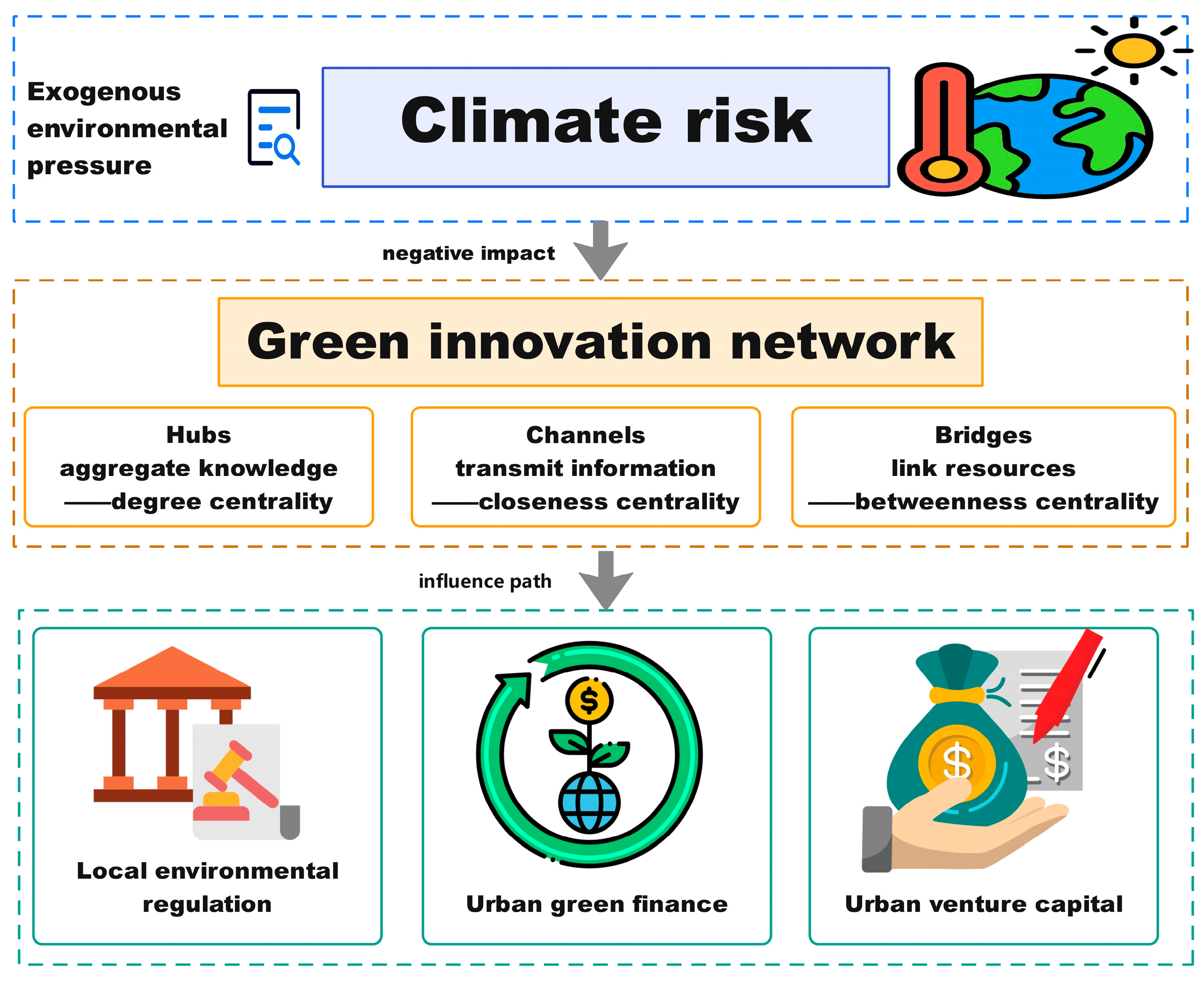
In summary, the research framework of this paper is as follows (see
Figure 1):
4. Empirical Analysis
4.1. Baseline Regression Analysis
The results presented in
Table 1 unequivocally demonstrate a significant inhibiting effect of climate risk on the structure of urban green innovation networks. Specifically, the regression coefficients for ln
cpri in columns (1) to (3) are all significantly negative, which strongly supports our core hypotheses (H1a, H1b, H1c). This indicates that the intensification of climate risk significantly reduces cities’ degree centrality, closeness centrality, and betweenness centrality. Under the sustained pressure of climate risk, urban collaboration networks exhibit a comprehensive inward-looking trend, where their breadth of connections (as “hubs”), efficiency of information transmission (as “channels”), and structural control over resources (as “bridges”) are all systematically negatively impacted.
Regarding the relative magnitude of these impacts, the results carry straightforward economic implications. Specifically, a 1% increase in the climate risk index leads to an approximate 0.022% decrease in closeness centrality, a 0.018% decrease in degree centrality, and a 0.006% decrease in betweenness centrality. This hierarchy of impacts reveals substantive differences in vulnerability. The most severe impact on closeness centrality suggests that climate risk is most detrimental to the information transmission function that relies on long-distance, cross-regional connections. This indicates that, in the face of climate risk, strategies aimed at maintaining global network information transmission efficiency are the most vulnerable and are the first to be abandoned. Degree centrality is also significantly negatively affected, suggesting that cities’ “hub” function of maintaining large-scale collaborations faces substantial pressure. However, its resilience to impact is slightly better than that of closeness centrality, which could be attributed to the preservation of some core, proximate collaborative relationships. Although the coefficient for betweenness centrality is also negative, its absolute value is considerably smaller than the other two. This suggests that while the network as a whole tends to avoid high-risk “bridges”, the “bridge” role itself possesses a certain degree of rigidity or indispensability.
Regarding the control variables, the results largely align with theoretical expectations, though some present interesting nuances warranting discussion. The coefficient for economic development level (lnpgdp) is significantly positive, confirming that wealthier cities possess the resources to maintain extensive network ties. Conversely, the coefficient for openness (open) shows a negative association with network centrality in some specifications. This may suggest a substitution effect: cities with high exposure to foreign trade and investment might rely more on international technology transfers rather than domestic inter-city collaborations for green innovation. Additionally, R&D investment (lnrd) shows a positive impact, particularly on degree centrality, indicating that local absorptive capacity is a prerequisite for becoming a network hub.
In summary, the baseline regressions not only confirm the pervasive inhibiting effect of climate risk but also, through a comparison of coefficient magnitudes, preliminarily delineate the vulnerability hierarchy of different network roles under risk impact: channel > hub > bridge. This suggests that climate risk is compelling the network structure to undergo a passive, defensive reconfiguration at the expense of efficiency.
4.2. Robustness Checks
To ensure the reliability of our baseline regression results, we conduct a series of robustness checks, including considering potential confounding policies, addressing endogeneity concerns, and altering the study sample. The results of these tests confirm that our core conclusions remain robust.
4.2.1. Considering Innovation City Pilot Policies
The innovation city pilot policy aims to enhance urban innovation capacity and could potentially be related to both green innovation networks and local climate response strategies. To rule out its confounding effect, we include a dummy variable for this policy in our baseline model. Results presented in columns (1) to (3) of
Table 2 show that, even after controlling for the innovation city pilot policy, the regression coefficients for climate physical risk (ln
cpri) remain significantly negative for degree centrality, closeness centrality, and betweenness centrality. Furthermore, the magnitude of these coefficients is largely consistent with the baseline regression results, indicating that our core conclusions are not confounded by this policy.
4.2.2. Considering Low Carbon City Pilot Policies
The low carbon city pilot policy directly focuses on cities’ green and low-carbon transition, making it a critical institutional factor influencing green innovation activities. We further control for this policy variable in our regressions. As shown in columns (4) to (6) of
Table 2, the coefficients for climate physical risk remain significantly negative across all models, with their values highly consistent with the baseline results. This demonstrates that the inhibiting effect of climate risk on innovation networks, as identified in this paper, is not driven by the low carbon city policy, thus confirming the robustness of our findings.
4.2.3. Addressing Endogeneity Issues
To rigorously address potential endogeneity issues arising from omitted variables (e.g., unobserved cultural factors) and reverse causality (e.g., prosperous networks investing more in climate adaptation), we employ an instrumental variable (IV) approach. Following established environmental economics literature [
46], we construct the ventilation coefficient (
VC) as the instrument for climate physical risk.
The
VC determines the atmospheric capacity to disperse heat and pollutants. A lower
VC indicates stable atmospheric conditions that are prone to heat accumulation and extreme weather anomalies, thus strongly correlating with our climate risk indicators. The
VC is determined by large-scale atmospheric circulation and geographic topography. It is strictly exogenous to local economic activities, innovation policies, or network formation processes, satisfying the exclusion restriction. Columns (1) to (3) of
Table 3 report the second-stage results from the Two-Stage Least Squares (2SLS) regression. We performed standard diagnostic tests: the Kleibergen–Paap rk Wald F statistic significantly exceeds the critical value (e.g., the rule-of-thumb of 10), rejecting the null hypothesis of weak instruments.
The results show that the coefficients for climate risk remain significantly negative across all models. Notably, the absolute magnitudes of the IV estimates are larger than those in the baseline regressions, suggesting that the baseline OLS models may have underestimated the negative impact of climate risk due to attenuation bias. However, we explicitly note that the causal interpretation of these findings relies on the validity of the IV assumptions, particularly the strict exogeneity of the ventilation coefficient. Under these assumptions, the evidence supports our core conclusion that climate risk drives a defensive contraction in network roles.
4.2.4. Excluding Direct Controlled Municipalities
Considering the unique political, economic, and innovation resources of direct-controlled municipalities such as Beijing and Shanghai, which might disproportionately influence the full sample regression results, we re-estimate the models after excluding these four municipalities. Columns (4) to (6) of
Table 3 show that the regression coefficients and significance levels for climate risk on all three centrality measures remain substantively unchanged. This confirms that our findings are not driven by a few exceptional cities and hold true for a more general sample of cities.
4.3. Mechanism Analysis
To explore the specific transmission pathways through which climate risk influences urban green innovation networks, we examine the three core mechanisms proposed earlier.
Table 4 reports the results on the impact of climate risk on local environmental regulation (ln
ER), urban green finance (ln
EF), and urban venture capital (ln
RI).
4.3.1. Local Environmental Regulation Channel
Column (1) of
Table 4 shows that the regression coefficient of the climate physical risk index on local environmental regulation is 0.062, and it is statistically significant at the 10% level (thus confirming H2). This indicates that an intensification of climate risk significantly prompts local governments to strengthen environmental regulations. Frequent environmental events heighten the political urgency of environmental issues, compelling governments to adopt stricter regulatory measures to address societal pressure and demonstrate their commitment to governance. The strengthening of environmental regulation, in turn, is a critical institutional variable affecting green innovation collaboration. According to the Porter Hypothesis [
47], stricter regulations increase firms’ compliance costs, thereby incentivizing them to seek innovation offsets through green technological innovation, which stimulates the demand for advanced green technologies. However, this also raises market entry barriers, making cities more selective in choosing partners and inclining them to collaborate with a few technologically robust partners while foregoing potential collaborations that do not meet regulatory requirements.
4.3.2. Urban Green Finance and Venture Capital Channels
Columns (2) and (3) of
Table 4 reveal a more direct financial suppression channel. The coefficients of the climate risk index on urban green finance (ln
EF) and venture capital (ln
RI) are −0.003 and −0.423, respectively, both significantly negative at the 5% level (thus confirming H3 and H4). This suggests that an increase in climate risk, contrary to expectations, not only fails to foster more green financial support but instead significantly inhibits the development of green finance and exerts a strong crowding-out effect on venture capital.
While climate risk creates a specific demand for green technologies, it simultaneously and substantially elevates overall macroeconomic uncertainty and systemic risk for the entire city. Facing such pervasive uncertainty, both traditional commercial banks and high-risk-preference venture capital institutions tend to adopt more conservative risk-taking postures. Financial institutions may tighten credit and investment for all projects in the region, including green initiatives, due to concerns about the overall stability of the local economy, the default risk of corporate clients, and the potential damage to physical assets.
Green finance and venture capital are crucial factors that catalyze green innovation activities and support firms in establishing external R&D collaborations. When these two key financial support channels are suppressed by climate risk, the financing constraints faced by local enterprises (especially small and medium-sized innovative firms) will sharply tighten, significantly curtailing their ability and willingness to initiate and participate in external innovation collaborations. Ultimately, this financial suppression and investment “winter” induced by climate risk directly undermines the vitality of the urban innovation ecosystem, which macroscopically manifests as a comprehensive decline in a city’s various centrality positions within the national green innovation network. This transmission pathway powerfully explains the pervasive negative impact we observed in the baseline regressions.
4.4. Heterogeneity Analysis
To further investigate the complexity of climate risk impacts, we conducted heterogeneity analyses across infrastructure connectivity, urban hierarchy, and different risk types.
4.4.1. Infrastructure Connectivity
The advent of high-speed rail (HSR) networks has significantly reduced spatial-temporal distances between cities, facilitating the flow of innovation factors such as knowledge and talent, and is a crucial factor influencing innovation network structure. To examine whether the impact of climate risk differs in cities with highly connected infrastructure, we restrict our sample to cities with operational HSR lines for this regression analysis. Columns (1) to (3) of
Table 5 report the test results. The results indicate that in cities with HSR access, the negative impact of climate risk on degree centrality (−0.012) and betweenness centrality (−0.011) remains significant, but its effect on closeness centrality (−0.005) becomes insignificant. This finding reveals the dual role of HSR in mitigating the impact of climate risk. On one hand, HSR networks strengthen physical connections between cities, allowing core and important collaborative relationships to be maintained even in the face of climatic disturbances. This partially buffers the impact of climate risk on network information transmission efficiency (closeness centrality). However, on the other hand, for the breadth of network connections (degree centrality) and structural control (betweenness centrality), the positive effects of HSR are insufficient to fully offset the systemic negative impact of climate risk, indicating that infrastructure improvements cannot entirely exempt cities from climate risk.
4.4.2. Urban Hierarchy
A city’s position within its regional economic hierarchy determines its capacity to acquire resources, withstand risks, and adjust strategies. We divide the sample into two groups, namely, “central cities” (typically provincial capitals and cities of higher administrative rank) and “peripheral cities” (other prefecture-level cities), and conduct separate regressions. The results are presented in columns (4) to (9) of
Table 5.
For central cities, climate risk significantly reduces their degree centrality (−0.051) and closeness centrality (−0.016). However, its impact on betweenness centrality (0.022) is no longer significantly negative, even showing a weakly positive trend. This suggests that central cities, as regional cores, while still contracting their breadth of connections and reducing information efficiency when facing risks, can maintain or even strengthen their indispensability as “key bridges” within the network, owing to their robust resource aggregation capabilities and innovation strengths. They possess the capacity to actively adjust and assume the role of “managers” in connecting and coordinating other cities within the region to jointly address risks.
For peripheral cities, the situation is markedly different. Climate risk not only significantly inhibits their degree centrality (−0.022) and closeness centrality (−0.060), but its impact on betweenness centrality (−0.001) is also negative (though insignificant). Notably, the negative impact on peripheral cities’ closeness centrality (−0.060) is substantially greater than that on central cities, and their “bridge” function shows almost no signs of improvement. This indicates that peripheral cities appear more vulnerable to climate risk; they are not only compelled to curtail collaborations, but their information channels connecting to the outside world are also more easily severed. Furthermore, lacking the strategic adjustment capacity of central cities, they occupy a more passive position in the restructuring of the network.
4.4.3. Different Risk Types
Physical climate risk is not a homogeneous concept; different types of extreme weather events exert impacts on socio-economic systems through distinct channels and intensities. To investigate this variation, we replaced the core explanatory variable with four specific extreme climate event indicators: extreme low temperature (ln
ltd), extreme high temperature (ln
htd), extreme rainfall (ln
erd), and extreme drought (ln
eed); the regression results are reported in
Table 6.
The results in columns (1) to (3) and (7) to (9) show that extreme low temperature and extreme rainfall exerted significant negative impacts on degree centrality, closeness centrality, and betweenness centrality, with generally large absolute coefficient values. This indicates that these two types of risks are hard shocks, typically accompanied by direct physical damage to critical infrastructure such as transportation, energy, and communications (e.g., freezing, floods, and landslides). This direct severing of inter-city physical connections can comprehensively paralyze the cooperation capabilities of cities, thus exerting a strong inhibitory effect on the three network roles of “hub”, “channel”, and “bridge”.
Columns (4) to (6) report the impact of extreme high temperature. Although its impacts on the three centralities are also negative, the absolute values of the coefficients are generally smaller, and the significance levels are relatively weaker. This suggests that as a “soft shock”, the influence of extreme high temperature operates primarily through channels such as reducing labor productivity, increasing energy system loads, and affecting residents’ living comfort, thereby indirectly increasing the costs and difficulty of cooperation; its direct destructiveness to the infrastructure maintaining network connectivity is relatively minor. Therefore, while its negative shock to the network structure exists, it is not as severe as that of low temperature and rainfall.
Columns (10) to (12) present the impact of extreme drought. The results show that extreme drought significantly reduced cities’ degree centrality (−0.016) and closeness centrality (−0.021), but its impact on betweenness centrality (−0.001) was statistically insignificant. This unique finding reveals the specific mechanism of drought as a chronic, resource-based risk. Prolonged drought weakens a city’s overall economic vitality and external attractiveness by affecting water resources, agricultural production, and energy supply, thereby leading to a decline in its cooperation breadth (“hub” role) and information accessibility (“channel” role). However, drought also stimulates immense demand for green innovation in specific fields such as water-saving technologies, drought-resistant agriculture, and water resource management. This enables cities capable of providing such technical solutions to potentially play an indispensable specialized “bridge” role in the network; this positive opportunity effect offsets the negative shock brought by the risk, ultimately resulting in their “bridge” status remaining statistically unaffected.
5. Conclusions and Discussion
5.1. Conclusions
This paper systematically investigates how climate risk, acting as an exogenous environmental selection pressure, reshapes the topological structure of China’s urban green innovation network. Viewing this network as the critical soft infrastructure for the green transition, our core finding is that climate risk is compelling innovation networks to undergo a profound, defensive restructuring. Unlike prior studies that focus on the direct damage to isolated economic units [
41,
48], our results highlight the systemic vulnerability of collaborative ties.
Empirical results indicate that while intensifying climate risk significantly inhibits all three network roles, there are distinct differences in impact intensity. Specifically, the “channel” role proves most vulnerable, followed by the “hub” role, whereas the “bridge” role exhibits comparatively stronger resilience. This evidence directly validates our research hypothesis regarding differentiated role selection. It extends the “efficiency-resilience trade-off” theory from general network science to the specific context of sustainable urban development, suggesting that in uncertain environments, urban systems prioritize preserving their adaptive capacity by maintaining core structural bridges, even at the cost of efficiency.
Furthermore, we revealed the complex mechanisms and high context-dependency behind this structural restructuring. On the one hand, climate risk guides the direction of innovation by compelling local governments to strengthen environmental regulations; on the other hand, however, a stronger effect is that the macro uncertainty brought by risk significantly suppresses green finance and venture capital, weakening the network’s innovation vitality through the financial suppression channel. More importantly, this impact is not monolithic but is profoundly moderated by the city’s position in the urban hierarchy (central vs. peripheral) and the specific risk types faced (e.g., floods as “hard shocks” vs. droughts as “chronic” risks). By demonstrating that environmental selection pressure is highly context-dependent—a dimension often overlooked in traditional proximity-based network evolution theories [
49]—our study offers novel theoretical insights for evolutionary economic geography, climate economics, and the broader scholarship on urban resilience.
5.2. Policy Implications
The findings of this study offer profound and clear policy implications, providing strategic guidance for China to build a regional innovation system adapted to an era of uncertainty.
First, regional innovation strategies should achieve a paradigm shift from “efficiency-first” to “resilience-oriented”. For a long time, China’s regional innovation policies have heavily focused on fostering a few innovation growth poles or technology hubs, a strategy that is efficient in stable environments. However, our research indicates that, in the context of normalized climate risks, such highly centralized network structures can be extremely vulnerable. Policymakers must prioritize enhancing the robustness and adaptability of the entire innovation network ecosystem, placing it on par with or even above efficiency, and commit to fostering a new network paradigm that is multi-centric, distributed, and functionally complementary.
Second, policy interventions must shift from universal support to targeted measures. The high degree of heterogeneity revealed in this paper implies that “one-size-fits-all” innovation subsidies or financial support policies are inherently inefficient. Effective policy interventions must be climate-smart, meaning they should be differentiated based on local specific risk exposure types, network positions, and transmission mechanisms. For instance, in a peripheral city facing drought risk, the policy focus might be on fostering its “bridge” function in water-saving agricultural technologies by incentivizing venture capital. Conversely, for a central city located in a flood-prone zone, the policy priority should be investing in strengthening its critical infrastructure to safeguard the stability of its “hub” function.
Third, network structure optimization should be incorporated as a crucial consideration for green finance and environmental regulation policies. Our mechanism analysis indicates that finance and regulation are key levers influencing network structure. Therefore, green finance policies should not only focus on the green attribute of projects but also consider whether they contribute to optimizing the connectivity of regional innovation networks, particularly their ability to support strategic collaborations across risk-prone regions. Similarly, the design of environmental regulations should avoid indiscriminately weakening the collaborative capacity of all firms. Instead, through differentiated standards, they should incentivize firms that can lead technological directions and serve as “bridge” roles to emerge.
5.3. Limitations and Future Research
We acknowledge certain limitations in this study, which also open promising avenues for future research. First, regarding the generalizability of our “defensive restructuring” narrative, our findings are based on the context of China, where local governments play a strong role in directing innovation resources. Whether this efficiency-resilience trade-off manifests identically in market-coordinated economies with different institutional arrangements remains a question for cross-country comparative studies.
At the data level, the patent collaboration data utilized in this paper does not capture all forms of innovation collaboration, such as tacit knowledge exchange and talent mobility between firms. Future research incorporating richer data sources could more comprehensively characterize network dynamics. From a research perspective, this paper focuses on climate physical risk. However, the impact of transition risks stemming from climate change on green innovation networks is equally crucial and warrants in-depth exploration in future studies. Additionally, extending the analytical framework of this study from the domestic to the global green innovation network to examine the transnational transmission effects of risk would also constitute a highly valuable research direction.