


Abstract
Building-Integrated Photovoltaic (BIPV) systems, which seamlessly integrate solar photovoltaic components into building structures, have garnered widespread attention for their aesthetic appeal and energy efficiency. However, the promotion of BIPV systems has also raised new fire safety concerns. This paper reviews recent fire incident cases and conducts risk identification for factors such as building and environmental risks, photovoltaic systems, electrical equipment, and safety protection. A fire risk assessment is performed using the Analytic Hierarchy Process (AHP) to evaluate the overall fire safety of BIPV systems. Based on the assessment, corresponding safety design strategies are proposed to ensure the safety of buildings and occupants. The research results indicate that BIPV systems pose certain fire hazards, and that proper design and regulation are crucial to mitigate these risks.
1. Introduction
In order to minimize the negative environmental impact of buildings by conserving energy and resources, governments worldwide are striving to develop and adopt green building regulations and policies. Building-Integrated Photovoltaic (BIPV) systems, as a technology that tightly integrates solar photovoltaic components with building structures, represent an effective means of achieving the goal of near-zero energy consumption in buildings. On 24 October 2021, the State Council of China released the “Action Plan for Peaking Carbon Dioxide Emissions Before 2030”, emphasizing the need to promote the application of renewable energy in buildings and to disseminate BIPV technology. The plan proposes that by 2025, the rate of rooftop photovoltaic coverage for newly constructed public institution buildings and factories should reach 50%. Therefore, the application prospects for BIPV technology in the construction industry are very promising.
Despite the significant advantages of BIPV systems in energy utilization, their close integration with buildings also poses new challenges for fire safety. Statistics show that in China, there were approximately 20 typical photovoltaic fire accidents in 2023, while Japan has seen about 125 rooftop photovoltaic system fires in the past decade. According to the Fraunhofer Institute in Germany, there have been 350 photovoltaic fires in Germany over the past 20 years. By 2012, Italy had experienced nearly 600 fires involving photovoltaic systems [1]. Since BIPV systems contain a large number of electrical devices and photovoltaic modules primarily cover the rooftops or exterior walls of buildings, in the event of a fire, the traditional fire sprinkler systems used in buildings may not effectively cover the areas where photovoltaic modules are located, thereby increasing the fire risk.
At present, studies at home and abroad mainly focus on the cause and prevention of fire accidents. Aram [2] and others analyzed the causes of fires in photovoltaic systems and proposed preventive measures and mitigation strategies. Dhere [3] studied the opening of DC circuits and bypass diodes, as well as the grounding faults that lead to fires in photovoltaic systems, providing recommendations for preventing fire hazards. Yang Hongyun [4] summarized that arc faults and spontaneous combustion are the main causes of photovoltaic fires by analyzing photovoltaic fire cases. Ueno Aram [5] and others reviewed the fire safety of photovoltaic systems in buildings, providing further examples. According to this research, photovoltaic-related fires can be caused by physical faults (cell damage, cracks, degradation), environmental faults (dust and shading), and electrical faults (hot spots, mismatching, arcs, grounding, line-to-line). Bachache [6] proposed the Discrete Wavelet Transform (DWT) method to detect the frequency of solar arc fire accidents. Jia Fan [7] and others, in order to avoid the risk of fire caused by arc faults in photovoltaic power supplies, first used the logistic regression method from the fields of artificial intelligence and machine learning to analyze the experimental results of arc faults in photovoltaic systems, obtaining a function between the probability of arc faults and the changes in characteristic variables. Georgijevic [8] proposed an adaptive method for detecting series arc faults in photovoltaic systems that continuously monitors the frequency spectrum of the current in photovoltaic modules (or strings).
Current research primarily focuses on photovoltaic systems themselves, with few scholars conducting comprehensive fire risk studies on the integration of buildings with photovoltaics. In reality, fires in photovoltaic systems can seriously jeopardize the safety of the entire building; thus, assessing the fire risk of Building-Integrated Photovoltaics (BIPVs) is of great significance.
2. Analysis of Current Fire Situation
2.1. Main Components
Building-Integrated Photovoltaics (BIPVs) specifically refers to an application form that integrates solar power generation systems with urban buildings. The BIPV system mainly consists of two parts: photovoltaic power generation equipment and the power distribution system. The photovoltaic power generation equipment includes photovoltaic modules, while the power distribution system includes inverters, distribution cabinets, connecting cables, and lightning protection and grounding systems. The schematic diagram of Building-Integrated Photovoltaics (BIPVs) is shown in Figure 1.
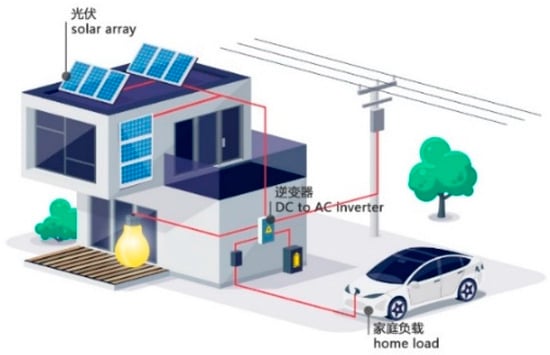
Figure 1.
A diagram of Building-Integrated Photovoltaics (BIPVs).
2.2. Fire Cases
Cancelliere [9] reported on 1600 fire incidents involving nearly 590,000 installed and operational photovoltaic (PV) systems in Italy. Table 1 lists several cases of PV-related fire accidents in foreign buildings, which reveal that the primary causes of current PV building fires are attributed to issues within the PV systems. An investigation into 430 fire cases reported in Germany over a two-year period (2011–2013) [10] showed that 50% of these fire cases were caused by PV panels, while the remainder were accidents ignited by external sources.

Table 1.
List of cases of photovoltaic fires in buildings.
2.3. Existing Issues
- (1)
- Inadequate Existing Evaluation Standards
From the perspective of current standards, the safety standards and regulations for photovoltaic systems are relatively comprehensive. However, there are limitations regarding the fire safety design for BIPV systems. Most of the current fire safety designs are based on traditional building design standards and specifications, and insufficient consideration has been given to the uniqueness of BIPV systems.
- (2)
- Complex Fire Propagation Paths
Since BIPV systems are typically integrated into the exterior walls or rooftops of buildings, photovoltaic modules, cables, and related electrical equipment are often spread across various parts of the building. In the event of a fire, this distribution makes fire spread more rapid and unpredictable, resulting in complex fire propagation paths and an increase in the difficulty of controlling fire.
- (3)
- High Difficulty of Fire Extinguishment
During a fire, BIPV systems may still be energized, posing significant challenges to fire extinguishment efforts. Traditional fire extinguishment methods within buildings are also unable to effectively cover the areas where photovoltaic modules are located.
- (4)
- Difficulty in Fire Detection
Current fire detection and early warning systems may not detect fire hazards in BIPV systems in a timely manner, resulting in delays in extinguishing the fire and worsening its escalation.
3. Fire Risk Identification and Analysis
3.1. Building and Environmental Risk Identification
Building-Integrated Photovoltaics (BIPV) technology organically integrates photovoltaic systems with building structures, achieving building energy efficiency and renewable energy utilization. However, the application of this technology has also posed a series of safety risks related to buildings and the environment.
3.1.1. Fire Resistance of Building Structures
BIPV systems are typically installed on a building’s load-bearing structure. In the event of a BIPV fire, it may directly affect the stability of that structure [13]. The literature indicates that certain building materials may lose strength at high temperatures, leading to structural collapse and thereby exacerbating the hazard of fire. Therefore, when designing and installing BIPV systems, it is imperative to consider the fire resistance of the building structure to ensure it can withstand a certain high temperatures and loads in the event of a fire.
3.1.2. Fire Prevention and Isolation Measures for Buildings and Photovoltaic Systems
Photovoltaic modules in BIPV systems are typically installed on the exterior walls, rooftops, or windows of buildings. These locations make it possible for the fire, once ignited in the photovoltaic modules, to spread rapidly throughout the building. According to research in the literature, fire spreads faster on the exterior walls of buildings than within internal structures, as exterior walls often lack effective fire barriers [14]. Additionally, gaps between photovoltaic modules and the building structure can serve as pathways for the spread of flames, smoke, and heat, further exacerbating the fire’s propagation.
3.1.3. Impact of Environmental Conditions
Meteorological conditions such as high temperatures, strong winds, and heavy snowfall can cause damage to photovoltaic modules, potentially leading to fires [15]. Especially under extreme weather conditions, such as typhoons or blizzards, the fixing devices of photovoltaic systems may be compromised, resulting in the detachment or damage of photovoltaic modules, which increases the risk of fire.
3.2. Risk Identification for Photovoltaic Systems
As the core component of BIPVs, the safety of the photovoltaic system directly impacts the fire safety of the entire building. The risks associated with photovoltaic systems mainly include the quality of photovoltaic modules, system design and installation, as well as the integration of the photovoltaic system within the building structure.
3.2.1. Quality of Photovoltaic Modules
The quality of photovoltaic modules directly relates to their safety and durability. Research in the literature has shown that low-quality photovoltaic modules, under high temperatures or mechanical stress, may experience issues such as material aging, weld joint detachment, or encapsulation layer cracking, which can lead to fires [16]. Additionally, electrical faults within the modules, such as short circuits or arc faults, can also trigger fires [17]. Therefore, ensuring that the quality of photovoltaic modules meets relevant standards is crucial for reducing the risk of fire in photovoltaic systems.
3.2.2. Design and Installation of the System
The design and installation of photovoltaic systems are crucial factors that affect their safety. The literature indicates that the improper electrical design of photovoltaic systems can lead to electrical faults such as overcurrent, overvoltage, or grounding faults, which may trigger fires [18]. Additionally, the quality of connections between photovoltaic modules and electrical equipment such as inverters and circuit breakers directly impacts the system’s safety. Non-standard operations during installation, such as loose wiring, poor insulation, or the unstable mounting of supports, can all increase the risk of fire [19].
3.2.3. Integration Methods of Photovoltaic Systems with Building Structures
The installation location, tilt angle, and arrangement of photovoltaic modules are factors that can influence heat accumulation and flame spread during a fire incident [20]. For example, restricted airflow between the photovoltaic modules and the roof may result in heat accumulation, thereby increasing the risk of fire. Furthermore, the routing of cables within the photovoltaic system and their connection to the building can also affect the difficulty of evacuation and fire suppression during a fire.
3.3. Risk Identification for Electrical Equipment
Faults in electrical equipment, including inverters, cables, junction boxes, and other devices, are often significant causes of fire hazards.
3.3.1. Fault Risk of Inverters
An inverter is an important device that converts the direct current generated by photovoltaic modules into an alternating current. Research in the literature has shown that inverter failures, particularly the aging or damage of internal components, can lead to overheating or electrical faults, thereby triggering fires [19]. The heat dissipation design, installation location, and maintenance of inverters are all critical factors that affect their safety. For example, if an inverter is installed in a poorly ventilated area, it may cause heat accumulation, increasing the risk of fire.
3.3.2. Fault Risk of Cables
The cables in photovoltaic systems carry large amounts of current, and their safety directly relates to the stability of the entire system. The literature points out that the aging of the cable insulation, mechanical damage, and overloading are potential risks that can lead to fires [21]. Especially in environments where cables are exposed to sunlight and rainwater for long periods, the aging process of the cables may accelerate, increasing the risk of fire. Additionally, the unreasonable routing of cables may cause them to come into contact with other building materials, thereby increasing the risk of fire propagation.
3.3.3. Risks Associated with Junction Boxes and Other Electrical Connection Components
Junction boxes and other electrical connection components are critical electrical connection points in photovoltaic systems. Poor sealing or loose connections in these components can lead to electrical short circuits, overheating, or arcing phenomena, which may trigger fires. The literature mentions that the waterproof design of junction boxes and the reliability of internal wiring are important factors in ensuring their safe operation [22]. Furthermore, the exposure of junction boxes to extreme environments, such as high temperatures, high humidity, or corrosive gas environments, can cause the deterioration of their internal components, thereby increasing the risk of fire.
3.4. Risk Identification for Safety Protection
3.4.1. Effectiveness of Fire Detection Systems
Fire detection systems are crucial equipment for promptly identifying fires. Research in the literature has shown that traditional fire detection systems may have certain limitations when dealing with fires caused by photovoltaic systems. For instance, fires in photovoltaic systems are often accompanied by electrical faults and high temperatures, which may lead to false alarms or alarms being missed by the detectors. Additionally, since photovoltaic systems are installed on the exterior of buildings, detectors may have difficulty detecting the occurrence of fires in a timely manner, increasing the risk of fire spread.
3.4.2. Limitations of Fire Suppression Systems
Fire suppression systems are a crucial means of controlling the spread of fires. However, the literature indicates that traditional sprinkler systems may have certain limitations when addressing fires in photovoltaic systems. For example, the waterproof nature of photovoltaic modules may prevent water spray from effectively penetrating to the fire source, reducing the effectiveness of fire extinguishment. Additionally, the presence of high-voltage electricity in photovoltaic systems may pose electrical safety risks during water-based fire suppression. Therefore, the development of specialized fire extinguishing equipment suitable for photovoltaic system fires, such as gas suppression systems or dry powder extinguishers, may be effective means of improving the efficiency of fire extinguishment.
4. Establishment of a Safety Risk Assessment System and Weight Calculation
4.1. Risk Assessment Methods
BIPVs is a unique architectural form, and its safety risk evaluation index system involves multiple factors and levels, forming a complex system. The Analytic Hierarchy Process (AHP) is a multi-objective decision analysis method that combines hierarchy and systematization. Its basic principle involves first decomposing various factors into a hierarchical ladder-like structure, then conducting pairwise comparisons of different factors within each level to construct judgment matrices and perform consistency checks. Subsequently, the comprehensive weights of elements at each level relative to the objective are calculated; finally, all elements are ranked overall to determine the importance of the lowest-level elements in the overall objective. By doing so, AHP fully considers the weight distribution of each index regarding the risk of fire, minimizing the influence of human subjective factors on fire risk evaluation. Therefore, it is reasonable and effective to adopt the Analytic Hierarchy Process (AHP) to construct the BIPV fire safety index system.
4.2. Construction of a Fire Safety Evaluation Index System for BIPV
The building fire risk evaluation system is divided into three levels: the objective level, the criterion level, and the indicator level. The first level, known as the objective level, identifies the goal to be achieved in the assessment process. In this paper, the objective is to conduct a fire risk assessment for BIPV. The second level is the criterion level, which outlines the intermediate steps necessary to attain the goal. This level includes various criteria and sub-criteria that must be considered. The criterion layer comprises primary indicators, while the sub-criterion layer includes secondary indicators. The third level, known as the indicator level, consists of the specific factors or indicators used in the decision-making process; this level is made up of tertiary indicators. In accordance with systematic, comprehensive, hierarchical, and scientific operability principles, the BIPV fire risk assessment index system is categorized into four primary indicators, eight secondary indicators, and twenty-three tertiary indicators based on fire case studies. The BIPV fire safety evaluation index system is shown in Table 2.
Table 2.
List of BIPV fire safety evaluation index systems.
4.3. Determination of Index Weights
By comparing each pair of indicators, the 1–9 scale method is adopted to rank the relative order of each evaluation indicator and construct the judgment matrix accordingly. On this basis, the scale of the judgment matrix is determined through surveys and expert consultation scoring methods, and the relative importance of each factor at the indicator level is determined based on the scale. By comparing the importance of each factor at the criterion level, a judgment matrix is constructed, and the weights of each factor at the criterion level are obtained through calculation. The judgment matrix is shown in Table 3, where A represents the Building and Environmental Risk Unit, B represents the Photovoltaic System Safety Unit, C represents the Electrical Equipment Safety Unit, and D represents the Safety Protection Unit.
Table 3.
Criterion layer each factor importance comparison matrix and weight determination.
Similarly, by comparing each pair of indicators and constructing a judgment matrix, and after consistency verification, the weights of the second-level and third-level indicators can be finally calculated. The overall weights of the BIPV fire risk evaluation index system are shown in Table 4.
Table 4.
List of BIPV fire risk evaluation index systems and overall weight.
4.4. Overall Ranking of Fire Risk Evaluation Indicators
The hierarchical total sorting of the weights in Table 4 is shown in Table 5. According to the table, factors such as the fire resistance rating of buildings, the flame retardancy of photovoltaic module materials, and arc fault protection have relatively large weights.
Table 5.
Total ranking list of fire risk assessment indicators.
5. Risk Prevention Strategies and Recommendation
Considering the weight ranking of the BIPV fire risk index system and actual BIPV fire cases, strategies and recommendations for risk prevention are proposed.
5.1. Promote the Improvement of Regulations and Standards
The development and refinement of BIPV fire safety standards and regulations needs to be promoted to clearly define the fire resistance requirements for buildings equipped with photovoltaic modules, thereby providing a standardized basis for design and installation. The supervision of BIPV systems should be enhanced by conducting regular safety inspections, enforcing penalties for the violation of operating procedures, and ensuring strict adherence to safety regulations by all stakeholders.
5.2. Optimize the Fire Resistance Performance of Photovoltaic Components
Photovoltaic component materials with good flame retardancy should be used to reduce their combustibility and the spread of flames in the event of a fire. The aging of photovoltaic components should be regularly inspected, and aged components should be replaced in a timely manner.
5.3. Improve Safety Measures for Electrical Equipment and Wiring
Arc fault circuit breakers should be installed or components with corresponding functions should be adopted to achieve intelligent arc detection and rapid cut-off functions. Good isolation and protective measures should be provided for the electrical equipment of photovoltaic systems (such as inverters, cables, etc.) to prevent fires caused by short circuits or overloads. National and local electrical safety regulations should be complied with to ensure that cables are laid reasonably and properly grounded, and that fire-resistant cables are used.
5.4. Strengthen the Consideration of Fire Safety During the Architectural Design and Planning Stages
During the design stage, photovoltaic components should be kept at a safe distance from flammable materials as much as possible to avoid the risk of fire spread. At the same time, the orientation and inclination angle of the photovoltaic components should be considered to reduce the possibility of heat accumulation. In building structures, especially in areas where BIPV systems are installed, such as roofs, fire compartments and firewalls should be set up to limit the spread of fire.
5.5. Equip with Effective Fire Extinguishers
Considering the building’s spatial layout and functional zoning, a rational plan should be formulated for the placement of fire extinguishers. This ensures easy accessibility during emergencies, thereby establishing a primary line of defense against fire in photovoltaic buildings. Concurrently, detection sensors should be installed within the photovoltaic system and at key locations. These sensors collaborate to form a comprehensive fire-monitoring network, enabling timely fire alarms. Leveraging big data and Internet of Things (IoT) technologies, an intelligent fire warning system can be constructed. This system has the capacity to monitor the real-time operational status of the photovoltaic system, offering proactive and accurate fire risk predictions.
6. Conclusions
- (1)
- This paper presents an in-depth study of fire accident cases involving Building-Integrated Photovoltaics (BIPVs). It employs the AHP method to analyze the fire risk in BIPV systems. The main factors to consider are building and environmental risks, the photovoltaic system itself, electrical equipment and safety protections. These factors are further divided into detailed sub-factors, creating a comprehensive fire safety evaluation index system for BIPV. This system aims to offer technical support for assessing the fire safety of BIPV installations.
- (2)
- This paper established four first-level indicators, eight second-level indicators, and twenty-three third-level indicators, calculating the weight value of each indicator and sorting them by their relative importance. The results indicate that factors such as the fire resistance rating of buildings, flame retardancy of photovoltaic module materials, and arc fault protection have relatively large weights in the overall risk. Therefore, photovoltaic modules with a high fire performance and the implementation of electrical protection equipment are critical to reducing risk.
- (3)
- Based on the fire safety evaluation index system for BIPV systems, and considering the causes of BIPV fire accidents, along with the current status and management level of fire prevention and control technologies, this paper proposes several targeted risk prevention measures. These include promoting the improvement of regulations and standards; optimizing the fire resistance performance of photovoltaic components; improving safety measures for electrical equipment and wiring; strengthening the consideration of fire safety during the architectural design and planning stages; and equipping buildings with effective fire extinguishers. These measures are essential to ensure the safe development of BIPV technology in the construction industry in the future.
Author Contributions
Conceptualization, P.F. and L.Z.; methodology, P.F. and G.S.; validation, P.F.; formal analysis, J.D.; investigation, G.S. and J.D.; resources, P.F. and L.Z.; writing—original draft preparation, P.F. and L.Z.; writing—review and editing, P.F., J.Z. and G.S.; visualization, G.S. and Z.W.; supervision, P.F., L.Z. and J.Z.; project administration, P.F.; funding acquisition, P.F. All authors have read and agreed to the published version of the manuscript.
Funding
This research was supported by the Natural Science Foundation for Young Scientists of China Academy of Building Research No. 20230111331030040.
Institutional Review Board Statement
Not applicable.
Informed Consent Statement
Not applicable.
Data Availability Statement
The authors declare that the data supporting the findings of this study are available within the article.
Conflicts of Interest
The authors declare that they have no known competing financial interests or personal relationships that could have appeared to influence the work reported in this paper.
References
- Fiorentini, L.; Marmo, L.; Danzi, E.; Puccia, V. Fire Risk Assessment of Photovoltaic Plants. A Case Study Moving from two Large Fires: From Accident Investigation and Forensic Engineering to Fire Risk Assessment for Reconstruction and Permitting Purposes. Chem. Eng. Trans. 2016, 48, 427–432. [Google Scholar]
- Aram, M.; Zhang, X.; Qi, D.; Ko, Y. A state-of-the-art review of fire safety of photovoltaic systems in buildings. J. Clean. Prod. 2021, 308, 127239. [Google Scholar] [CrossRef]
- Dhere, N.G.; Shiradkar, N.S. Fire hazard and other safety concerns of photovoltaic systems. J. Photonics Energy 2012, 2, 022006. [Google Scholar] [CrossRef]
- Yang, L.Z.; Yang, H.Y.; Zhang, T.L.; Zhou, X.L. Study on fire risk of photovoltaic panels. J. Therm. Sci. Technol. 2015, 14, 173–177. (In Chinese) [Google Scholar]
- Ueno, H.; Yamagishi, T.; Yokota, H.; Haramoto, K. Detection of Fire due to Photovoltaic Modules of a Photovoltaic Power Generating System for House. Trans. Electr. Equip. Soc. 2017, 37, 1–8. [Google Scholar]
- Bachache, N.K. Detector of DC Series Arc Fault in a Large Photovoltaic System using Discrete Wavelet Transform. Bilad Alrafidain J. Eng. Sci. Technol. 2022, 1, 1–5. [Google Scholar] [CrossRef]
- Jia, F.; Luo, L.; Gao, S.; Ye, J. Logistic Regression Based Arc Fault Detection in Photovoltaic Systems Under Different Conditions. J. Shanghai Jiaotong Univ. (Sci.) 2019, 24, 459–470. [Google Scholar] [CrossRef]
- Georgijevic, N.; Srdic, S.; Radakovic, Z. Detection of Series DC Arc-Fault in Photovoltaic Panel Circuits. In Proceedings of the 2nd International Conference on Renewable Electrical Power Sources—ICREPS ‘13, F, 2013, Beijing, China, 16 October 2013. [Google Scholar]
- Cancelliere, P. PV electrical plants fire risk assessment and mitigation according to the Italian national fire services guidelines. Fire Mater. 2016, 40, 355–367. [Google Scholar] [CrossRef]
- Sepanski, A.; Reil, F.; Vaaßen, W.; Janknecht, E.; Hupach, U.; Bogdanski, N.; van Heeckeren, B. Assessing Fire Risks in Photovoltaic Systems and Developing Safety Concepts for Risk Minimization; US Department of Energy, Solar Energy Technologies Office: Washington, DC, USA, 2018.
- Meacham, B.J. A Sociotechnical systems framework for performance-based design for fire safety. Fire Technol. 2022, 58, 1137–1167. [Google Scholar] [CrossRef]
- Namikawa, S.; Kinsey, G.; Heath, G.A.; Wade, A.; Sinha, P.; Komoto, K. Photovoltaics and Firefighters’ Operations: Best Practices in Selected Countries; National Renewable Energy Lab.: Golden, CO, USA, 2017. [Google Scholar]
- Mazziotti, L.; Cancelliere, P.; Paduano, G.; Setti, P.; Sassi, S. Fire risk related to the use of PV systems in building facades. In Proceedings of the MATEC Web of Conferences, EDP Sciences, Hong Kong, China, 26–27 April 2016. [Google Scholar]
- Zhao, J. Research on Fire Spreading and Barrier Method for Exterior Wall of High-Rise Building. Ph.D. Thesis, Shenyang Aerospace University, Shenyang, China, 2017. [Google Scholar]
- Lamnatou, C.; Notton, G.; Chemisana, D.; Cristofari, C. Storage systems for building-integrated photovoltaic (BIPV) and building-integrated photovoltaic/thermal (BIPVT) installations: Environmental profile and other aspects. Sci. Total Environ. 2020, 699, 134269. [Google Scholar] [CrossRef] [PubMed]
- Akram, M.W.; Li, G.; Jin, Y.; Chen, X. Failures of Photovoltaic modules and their Detection: A Review. Appl. Energy 2022, 313, 118822. [Google Scholar] [CrossRef]
- Ong, N.A.F.M.N.; Sadiq, M.A.; Said, M.S.M.; Jomaas, G.; Tohir, M.Z.M.; Kristensen, J.S. Fault tree analysis of fires on rooftops with photovoltaic systems. J. Build. Eng. 2022, 46, 103752. [Google Scholar]
- Zhang, Y.; Chen, H. Considerations of photovoltaic system structure design for effective lightning protection. IEEE Trans. Electromagn. Compat. 2020, 62, 1333–1341. [Google Scholar] [CrossRef]
- Laukamp, H.; Bopp, G.; Grab, R.; Wittwer, C.; Häberlin, H.; Heeckeren, B.V.; Phillip, S.; Reil, F.; Schmidt, H.; Sepanski, A.; et al. PV fire hazard-analysis and assessment of fire incidents. In Proceedings of the 28th European Photovoltaic Solar Energy Conference and Exhibition, Paris, France, 30 September–4 October 2013. [Google Scholar]
- Yue, W.; Wang, Z.; Dong, L.; Mingrui, Y. Analysis and research on fire spread behavior and influencing factors of rooftop photovoltaic modules. Fire Sci. Technol. 2023, 42, 1328–1333. (In Chinese) [Google Scholar]
- Aghaei, M.; Fairbrother, A.; Gok, A.; Ahmad, S.; Kazim, S.; Lobato, K.; Oreski, G.; Reinders, A.; Schmitz, J.; Theelen, M.; et al. Review of degradation and failure phenomena in photovoltaic modules. Renew. Sustain. Energy Rev. 2022, 159, 112160. [Google Scholar] [CrossRef]
- Huang, Y.C.; Lee, S.K.; Chan, C.C.; Wang, S.J. Full-scale evaluation of fire-resistant building integrated photovoltaic systems with different installation positions of junction boxes. Indoor Built Environ. 2018, 27, 1259–1271. [Google Scholar] [CrossRef]
Disclaimer/Publisher’s Note: The statements, opinions and data contained in all publications are solely those of the individual author(s) and contributor(s) and not of MDPI and/or the editor(s). MDPI and/or the editor(s) disclaim responsibility for any injury to people or property resulting from any ideas, methods, instructions or products referred to in the content. |
© 2025 by the authors. Licensee MDPI, Basel, Switzerland. This article is an open access article distributed under the terms and conditions of the Creative Commons Attribution (CC BY) license (https://creativecommons.org/licenses/by/4.0/).