


Abstract
This manuscript explores the interdisciplinary integration of quantum dot–hydrogel composites and smart materials and their applications across a spectrum of fields, including biomedical engineering, environmental sensing, and energy harvesting. It covers the synthesis of novel materials like fluorescent hydrogel nanocomposites that display enhanced chemical stability, mechanical strength, and thermal resistance, highlighting their utility in environmental monitoring and catalysis. In the biomedical sector, innovations include hydrogel composites for targeted drug delivery and advanced therapies such as photothermal DNA hydrogels for tumor treatment. This review also discusses the application of these materials in imaging, diagnostics, and the development of smart sensors capable of detecting various biological and environmental changes. Its scope further extends to optoelectronics and the design of energy-efficient systems, underscoring the versatile functionalities of hydrogels in modern technological applications. Challenges remain in scaling up these technologies for commercial use and ensuring their long-term stability and safety, necessitating future research focused on sustainable, scalable solutions that can be integrated into existing systems.
1. Introduction
The inclusion of quantum dots, such as CdTe, CdS, and ZnO, as well as graphene quantum dots and other nanomaterials like carbon dots and inorganic nanoparticles, is central to enhancing the optical and electronic characteristics of hydrogels, thereby boosting their functionality [1,2,3,4,5,6,7,8,9,10,11]. Nanoparticles, particularly graphene derivatives, are embedded in crafting composite hydrogels to bolster their mechanical strength, improve their sensing abilities, and augment their photocatalytic efficiency [6,8,12,13,14].
The foundation of these hydrogels often relies on synthetic polymers, such as poly(N-isopropylacrylamide), polyacrylamide, and poly(vinyl alcohol), which are sometimes modified to introduce specific features like thermal sensitivity and better mechanical properties [7,8,11,15,16,17,18]. Crosslinking methods are refined to customize hydrogels’ properties, employing techniques such as EDC/NHS, disulfide bond formation, and multicrosslinker agents to adjust their elasticity and stability [5,19,20].
Tailored hydrogels are developed for specific functions, including ion sensing, catalysis, drug delivery, and photocatalytic hydrogen production, highlighting the focus on biocompatibility and biomimetics with materials like collagen and peptides for applications in drug delivery, tissue engineering, and high-load-bearing scenarios [3,5,9,12,20,21,22,23]. The research extends into lanthanide-doped and luminescent hydrogels, driven by their potential in environmental sensing and medical imaging [24,25].
The trend towards creating hybrid and composite hydrogels underlines the movement towards multifunctional materials, which show improved performance across a range of applications, including medical engineering, environmental remediation, and energy harvesting [26,27,28,29,30]. The research community’s increasing interest in self-healing and environmentally responsive hydrogels indicates a shift towards dynamic and adaptive materials, with advancements in biodegradable and bioresponsive hydrogels aligning with sustainable solutions in tumor therapy and tissue regeneration [31,32,33,34,35,36].
Enhanced functionalization is achieved through materials like carbon quantum dots and black phosphorus quantum dots, aiming to improve aspects such as fluorescence, mechanical strength, and therapeutic effects, which are crucial in medical and biomedical applications like drug delivery, tissue engineering, biosensing, and cancer therapy [31,32,34,35,36,37,38,39,40,41,42,43]. Optoelectronic applications are prevalent too, with the development of photoluminescent and fluorescent hydrogels for uses in imaging, sensing, and diagnostics [39,42,43,44,45,46].
In nano- and microscale engineering, the encapsulation of quantum dots and the use of microfluidics showcase precision engineering trends in augmenting hydrogel functionality, particularly in sensing and detection, illustrating their versatility in identifying substances ranging from metal ions to biomolecules [44,47,48,49,50,51,52,53,54,55,56,57,58,59].
For environmental and energy applications, hydrogels are customized for pollutant removal and energy production, emphasizing sustainability and efficiency. Advanced fabrication and functionalization techniques, such as hydrodynamic focusing lithography and microwave-assisted synthesis, are employed to craft hydrogels with specific functionalities like enhanced sensing and photoluminescent properties [60,61,62,63,64,65]. These trends collectively highlight the evolution of the hydrogel field towards more sophisticated, multifunctional, and application-specific materials. Figure 1 highlights various quantum dot–hydrogel composites and their properties.
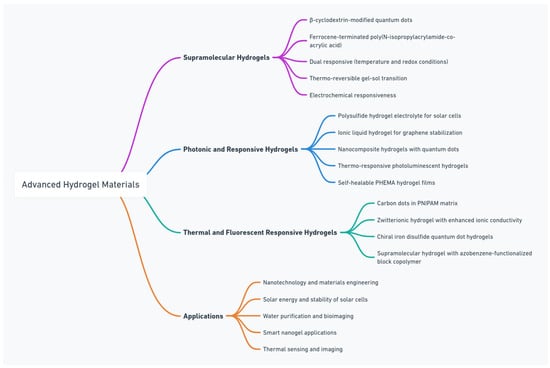
Figure 1.
Advanced hydrogel materials and applications in nanotechnology, energy, environment, and biomedical applications.
1.1. Quantum Dot–Hydrogel Composites
Hydrogel particles have been utilized as carriers for hydrophobic inorganic nanoparticles through a process known as solvent exchange. This method allows for the direct incorporation of inorganic nanoparticles into the hydrogel matrices without the need to modify the surface of the nanoparticles. As a result, the nanoparticles maintain their chemical stability in aqueous environments, leading to the formation of multifunctional composite particles [1]. In another approach, hydrogel microparticles were used to transport hydrophilic nanoparticles and enzymes into organic solvents, again employing a stepwise solvent exchange method. Notable substances like CdTe quantum dots and the CalB enzyme have been successfully transferred using this technique. The quantum dots retain their high fluorescence, and the CalB enzyme maintains its catalytic activity within the organic medium. Remarkably, this process is reversible, allowing for transfer back into aqueous media, highlighting the versatile functionality of these composite systems [2].
Building on these capabilities, further advancements include the integration of polyethyleneimine-modified carbon dots (PEI-CDs) within a microcrystalline cellulose (MCC) hydrogel matrix, aimed at detecting Fe3+ ions. This combination not only improves the mechanical and thermal properties of the hydrogel but also provides a stable and efficient means for Fe3+ ion sensing, demonstrating the potential of hydrogel-based nanocomposites in environmental monitoring and sensing applications (Figure 2) [3]. Extending these innovations, recent reviews have elaborated on the enhanced synergy when quantum dots are incorporated into hydrogel networks, significantly broadening their application scope, particularly in the field of sensing. These quantum dot/hydrogel composites have shown promising applications in fluorescence sensing, thus providing quick and effective means to evaluate environmental-, health-, and energy-related parameters [66].
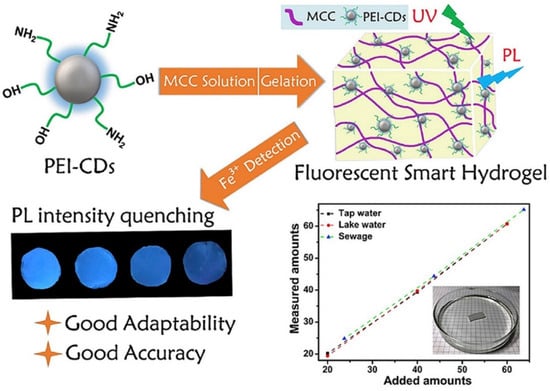
Figure 2.
A schematic representation of smart carbon dots (CDs), polyethyleneimine-modified carbon dots (PEI-CDs), within a microcrystalline cellulose (MCC) hydrogel for stable Fe3+ ion detection for photoluminescent (PL) performance [3].
Poly(2-acetamidoacrylic acid) (PAAA) hydrogels have been engineered to encapsulate CdS nanoparticles through an ion exchange process conducted in an aqueous environment. This method ensures the uniform distribution of the nanoparticles within the hydrogel, effectively preventing their aggregation. The resultant hydrogel–nanoparticle system exhibits enhanced thermal stability and a high content of nanoparticles, ensuring the long-term stability of the encapsulated nanoparticles, which is crucial for their practical application in various fields [4]. Hydrogels have also been employed as substrates in a modified gel crystal growth method to synthesize CdS and ZnS quantum dots, with the aim of enhancing photocatalytic hydrogen evolution. This technique mitigates the agglomeration of nanoparticles, thereby improving the efficiency of photocatalytic processes. The increased rate of hydrogen evolution observed in these systems indicates a promising route for advancing water-splitting technologies and harnessing sustainable energy sources [67].
Dipeptide-based hydrogel membranes, specifically Fmoc-Leu-Gly-OH, have been developed through directed self-assembly processes, achieving precise control over their thickness, ranging from tens of nanometers to several millimeters. These self-assembled hydrogel films or membranes display a unique, stable, and reversible formation, characterized by an entangled fiber structure, which has been meticulously examined using scanning electron microscopy (SEM) and transmission electron microscopy (TEM) [21]. Innovative triple-layered structures combining magnetite, hydrogel, and quantum dots have been constructed, encapsulating Fe3O4@SiO2 magnetic silica nanospheres within poly(N-isopropylacrylamide-co-acrylic acid) hydrogels and subsequently anchoring quantum dots (QDs) using 1,8-diaminooctane. This complex assembly process, facilitated by bifunctional diamines, aims to optimize the photoluminescence of the layered structure. The specific use of C-8 diamine as a linker has been shown to maximize the photoluminescence, with the structural and functional characteristics of these materials being thoroughly analyzed through SEM, Fourier transform infrared spectroscopy (FT-IR), and photoluminescence (PL) spectroscopy [15].
A composite hydrogel consisting of collagen and poly(2-acrylamido-2-methyl-1-propanesulfonic acid sodium salt) embedded with ZnO quantum dots has been synthesized using EDC/NHS crosslinking alongside poly(ethylene glycol) diacrylate crosslinking. This composite hydrogel was designed for multifaceted functions, including degradation tracking and inhibition, as well as gene delivery, while maintaining its optical and mechanical properties. The dual functionality of the ZnO quantum dots enables both fluorescence tracking and collagenase inhibition, with the hydrogel demonstrating effective gene delivery capabilities [5]. The synthesis of colloids, hydrogels, and aerogels from metal ions and biologically relevant ligands have been explored, focusing on their responsiveness to various stimuli and their potential applications in fields such as drug delivery, sensing, and catalysis. These materials, formed through coordination bonds, were highlighted for their potential in creating innovative solutions for antimicrobial, catalytic, and luminescent applications, pointing towards a future of advanced, multifunctional materials [22].
Energy storage and commercial polyacrylamide gels have been combined with carbon dots (CDs) through a process involving calcination activation to produce carbon-based materials with enhanced electrical properties. This technique has been applied to oxygen-doped, nitrogen-doped, and co-doped carbon dots, leading to the development of electrodes with high capacitance, rate stability, energy density, and an extended cycling life, making them suitable for use in electric double-layer capacitors (EDLCs) [7]. Extending the functional scope, a composite hydrogel made from cadmium sulfide (CdS) nanoparticles and reduced graphene oxide was developed for the purpose of photocatalytic hydrogen production. The composite’s structure increases both the surface area and the availability of its active sites, resulting in an enhanced rate of hydrogen production under sunlight exposure. This hydrogel demonstrates improved photocatalytic activity, a high catalyst recovery rate, and stable performance over repeated cycles [12].
Further exploring the interactions within hydrogels, the dynamics and effects of the shape anisotropy of nanoparticles in a tetra-poly(ethylene glycol) hydrogel embedded with poly(ethylene glycol)-functionalized quantum dot and rod probes have been studied. Through single-particle tracking, the mobility of quantum dot (QD) and quantum rod (QR) probes was compared within the hydrogel matrix. It was found that the shape anisotropy of the rods enhances their dynamics within the confined hydrogel networks, a factor that could significantly influence the effectiveness of these hydrogels in drug delivery applications [68]. Furthermore, a biomimetic hydrogel incorporating glutathione-stabilized cadmium telluride nanoparticles has been examined for its multiscale mechanics and viscoelastic properties. This study aimed to understand the potential of these hydrogels in applications requiring high load bearing and energy dissipation. The hydrogels exhibited exceptionally high storage and loss moduli, reflecting their unusual viscoelastic behavior and superior mechanical strength. Such findings highlight the promise of these nanoparticle-infused hydrogels in developing materials that can endure and dissipate high levels of mechanical energy [9]. Researchers also introduced X-ray-activated persistent luminescent phosphors for in situ photo-crosslinking of hydrogels, enabling deep-tissue applications surpassing previous limitations, like UV light’s shallow penetration and DNA damage risk. The method showed potential for photo-crosslinking within thick bone tissues, significantly expanding the depth and safety of hydrogel applications in medical settings [69]. Lastly, research successfully fabricated fluorescent hydrogels from cellulose and quantum dots via a mild chemical crosslinking process. The hybrid hydrogels displayed strong photoluminescence and mechanical strength, demonstrating the protective role of cellulose in preserving quantum dots’ integrity and emission properties. These findings offer a pathway to developing biocompatible, high-performance hybrid hydrogels [70].
1.2. Smart and Responsive Materials
The development of a supramolecular hydrogel that incorporates β-cyclodextrin-modified quantum dots and ferrocene-terminated poly(N-isopropylacrylamide-co-acrylic acid) represents a significant advance in the field of materials science. This hydrogel is uniquely designed to be dual-responsive, exhibiting changes in its physical state in response to alterations in temperature and redox conditions. The structure of the hydrogel is such that it forms according to inclusion complexation between cyclodextrin and ferrocene on the surface of the quantum dots, enabling a thermo-reversible gel–sol transition. This property, coupled with its electrochemical responsiveness, makes it a material of interest for various applications [16]. Building on this concept of responsive materials, another supramolecular hydrogel has been synthesized using a cyclodextrin host and a ferrocene guest attached to the surface of cadmium sulfide quantum dots, with copolymerization involving N,N-dimethylacrylamide. This innovative approach to the hydrogel’s design not only grants it electrochemical sensitivity but also enhances its fluorescent characteristics. Notably, the hydrogel displayed an increase in its elastic modulus as the ferrocene content rose, indicating the material’s promising electrochemical and fluorescent properties [10].
Expanding on the theme of responsive and functional hydrogels, nanocomposite hydrogels comprising poly(N-vinylimidazole-co-methacrylic acid) have been synthesized using plasma-ignited frontal polymerization, a method that embeds quantum dots within the hydrogel matrix. This innovative synthesis technique results in hydrogels that are not only superabsorbent but also exhibit distinct fluorescence properties. The rapid production process of these polyampholytic hydrogels, which are embedded with quantum dots, is particularly noteworthy for its ability to impart both superabsorbent and pH-responsive characteristics. These properties make the hydrogels ideal for applications in water purification and bioimaging, where rapid response and high absorbency are crucial [71]. In the domain of photonic materials, poly(vinyl alcohol) (PVA) has been used to create gelated crystalline colloidal array photonic crystal hydrogels. These hydrogels are distinguished by their self-healing properties and the incorporation of invisible quantum dots within their interfaces, allowing for a change in color under mechanical stress. The large-scale production of these hydrogels demonstrates their potential for applications that require self-healable and visually responsive materials with complex optical properties [17]. Further exploring the capabilities of photonic hydrogels, thermo-responsive photoluminescent hydrogels have been developed using cadmium selenide (CdSe) quantum dots and poly(diethylene glycol methyl ether methacrylate), with the quantum dots serving as multicrosslinker agents. This system showcases smart luminescent properties, where the thiol-monomer ligands on the CdSe quantum dots facilitate crosslinking within the hydrogel matrix. Notably, these hydrogels exhibit a sudden increase in fluorescence at the volume phase transition temperature, alongside reversible pH and temperature-responsive behaviors, which are pivotal for smart nanogel and hydrogel applications [20].
Poly(2-hydroxyethyl methacrylate) (PHEMA) hydrogel films, crosslinked with disulfide bonds and synthesized from 2-acetylthioethyl methacrylate and thioacetic acid, have been designed to investigate the self-healing capabilities of swelling-induced mechanical instabilities. These PHEMA hydrogel films demonstrate the ability to self-heal from instability patterns, returning to a flat gel surface. This self-healing mechanism is attributed to the reversible covalent crosslinking provided by the disulfide bonds, showcasing the hydrogels’ potential in applications requiring robust and self-repairing materials [19]. Extending the exploration of responsive materials, fluorescent silicon nanoparticle/poly(N-isopropylacrylamide) (F-SiNP/PNIPAM) composite hydrogels have been synthesized via in situ polymerization. These hydrogels exhibit thermal-sensitive phase transition properties, with the fluorescence intensity decreasing as the temperature increases. The integration of F-SiNPs into the PNIPAM hydrogel matrix allows for temperature-sensitive fluorescence changes, with the phase transition being both reversible and repeatable, highlighting their suitability for thermal sensing and imaging applications [18].
Transitioning to temperature-responsive materials, poly(N-isopropylacrylamide) (PNIPAM) hydrogel microspheres, enhanced with cadmium telluride (CdTe) nanocrystals, have been engineered to exhibit temperature-responsive fluorescent properties. These microspheres leverage the unique characteristics of the CdTe nanocrystals embedded within the PNIPAM hydrogel matrix to achieve tunable fluorescence that varies with temperature changes. This attribute allows for multiplex optical encoding, making these hydrogels particularly useful in applications where temperature-sensitive optical properties are required, such as in bioimaging and sensor technologies [72].
Carbon dot and poly(N-isopropylacrylamide) (CD/PNIPAM) hybrid hydrogels have been successfully synthesized at room temperature utilizing atom transfer radical polymerization. This method facilitates the integration of carbon dots into the PNIPAM hydrogel, resulting in a material that not only exhibits pronounced fluorescence but is also sensitive to temperature changes. This hydrogel produced a sharp transition in fluorescence intensity that occurred near its lower critical solution temperature (LCST), which underscores its reversible thermal response, making it suitable for various temperature-sensitive applications [11]. A zwitterionic hydrogel, crosslinked with glycidyl-methacrylate-functionalized graphene oxide quantum dots, was further improved with the addition of lithium chloride. This modification significantly enhanced its ionic conductivity and moisture retention properties. Consequently, the resulting hydrogel exhibited ultralow hysteresis, high ionic conductivity, and rapid response characteristics. These attributes render it well suited to applications such as strain sensing, heavy metal ion detection, and other wearable sensor applications [14].
Chiral materials such as chiral iron disulfide (FeS2) quantum dot hydrogels have been synthesized using L/D-cysteine as chiral ligands. These hydrogels are coassembled with gelators, allowing for the formation of co-gels with adjustable optical properties, including a controlled twist pitch and diameter. The resulting materials exhibit intense circularly polarized luminescence, highlighting their potential in applications requiring specific optical functionalities [23]. A supramolecular hydrogel crafted using an azobenzene-functionalized block copolymer and beta-cyclodextrin-modified cadmium sulfide (CdS) quantum dots was dually responsive to temperature and competitive host/guest substitution interactions. The formation of a hybrid inclusion complex within this hydrogel facilitates a reversible sol-to-gel transition, showcasing its potential in applications where precise control over the material state and responsiveness is essential [73].
1.3. Controlled Release Applications
One review delved into lanthanide-doped luminescent supramolecular hydrogels, focusing on their design, characteristics, and utilization in environmental and medical applications. These hydrogels, formed via coordination self-assembly involving lanthanide ions, exhibit unique luminescent properties with diverse applications. Recent progress in synthesizing multifunctional materials using these hydrogels illuminates their vast potential across fields like bioelectronics and applied sciences [24]. A photo-crosslinked poly(ethylene glycol) (PEG) hydrogel embedding cadmium telluride (CdTe) and cadmium selenide (CdSe) quantum dots (QDs) was developed. This innovative composite material demonstrated exceptional luminescent properties, attributed to the immobilization of the QDs within the PEG hydrogel matrix. The luminescent hydrogel exhibited promising applications in fluoroimmunoassays, drug delivery systems, and wound healing processes, thus representing a significant advancement in integrating luminescent materials into practical applications [47].
The creation of carbon quantum dot (CQD)-based fluorescent vesicles and chiral hydrogels was examined with the incorporation of biosurfactants and biocompatible small molecules. These novel materials are designed for biosensing and drug delivery purposes, offering high photoluminescence efficiency. Specifically, they demonstrate the potential to detect copper ions (Cu2+) in aqueous solutions, signifying a breakthrough in the development of sensitive and selective biosensing platforms [38]. An additional advancement was a carbon-quantum-dot-tailored calcium alginate hydrogel designed for the pH-responsive controlled release of vancomycin. By integrating CQDs derived from aloe vera into the calcium alginate hydrogel, the system achieves high drug loading efficiency and controlled release at stomach pH levels. This feature is particularly advantageous for the oral administration of vancomycin, presenting a novel approach to enhancing the efficacy and delivery of pharmaceutical compounds [32].
A dual pH- and temperature-responsive fluorescent hydrogel system synthesized using 1,6-hexamethylene diisocyanate, 1,4-bis(hydroxyethyl) piperazine, and Pluronic F127 was developed, with the addition of Erythrosine B to impart fluorescence. This innovative hydrogel demonstrates a sol–gel transition near body temperature, making it highly suitable for medical applications, including drug delivery and imaging. Its dual responsiveness to pH and temperature enhances its functionality, providing a versatile platform for controlled release systems and diagnostic tools [33]. A self-healing reloadable hydrogel composed of N-carboxyethyl chitosan and sodium alginate dialdehyde facilitated the diffusive transport of carbon quantum dots, enabling efficient reactive oxygen species scavenging. This self-healing property of the hydrogel ensures sustained performance and reliability, making it an excellent candidate for reloadable drug delivery systems. This technology represents a step forward in developing smart materials capable of enhancing drug transport across gel interfaces and improving the efficacy of therapeutic interventions [31]. The synthesis of a thermosensitive nitrogen-doped hydrogel enhanced with fluorescent carbon dots integrated into poly(ε-caprolactone)-poly(ethylene glycol)-poly(ε-caprolactone) (PCL-PEG-PCL) offered improved lubricity and viscoelasticity, which are crucial for applications in drug delivery and biotribology. The integration of the nitrogen-doped carbon dots into the hydrogel matrix led to slow-release properties, signifying a notable achievement in the field of material science for biomedical applications [37].
Table 1 outlines the advantages and disadvantages associated with various nanoparticle integration techniques in hydrogel applications. It provides a comprehensive overview of each method’s benefits and potential challenges, along with corresponding references for further detailed study. The contents represent a mixture of findings from the research literature and expert analysis.

Table 1.
Pros and cons of nanoparticle integration techniques in hydrogels.
2. Quantum Dot Technology for Biomedical and Diagnostic Applications
2.1. Tissue Engineering and Regeneration
A hydrogel, comprising GQDs-ε-PL@4-arm PEG-BA/QCS, was synthesized through dynamic imine bonds, featuring a surface enriched with amino groups from the GQDs-ε-PL to achieve chemo–photothermal antibacterial activity. This innovation resulted in a self-healing hydrogel engineered to exhibit chemo–photothermal antibacterial properties. The incorporation of GQDs-ε-PL and 4-arm PEG-BA/QCS into the hydrogel facilitates dynamic self-healing and enhances antibacterial efficacy. Remarkably, the hydrogel demonstrates a rapid sol-to-gel transition, which, combined with its potent antibacterial capabilities, plays a vital role in efficiently sealing wounds [39].
Researchers have devised a polyacrylonitrile conduit integrated with a fibrin hydrogel and graphene quantum dots to enhance nerve regeneration, leveraging the supportive role of Schwann cells in healing sciatic nerve injuries in rats. This advancement in nerve regeneration was achieved through the implementation of a three-dimensional-printed hydrogel conduit. Specifically, the conduit, composed of 3D-printed polyacrylonitrile with graphene quantum dots and fibrin hydrogel, was applied to a sciatic nerve injury model, resulting in enhanced motor and sensory functions, as well as notable nerve regeneration and recovery [40].
In further exploration, an injectable shear-thinning fluorescent hydrogel, composed of cellulose nanocrystals and graphene quantum dots, was introduced to propel advancements in tissue engineering, bioimaging, and biosensing. This led to the development of an injectable shear-thinning fluorescent hydrogel suitable for various biomedical applications, with its composition enabling utilization in three-dimensional printing. Its injectable and shear-thinning properties, combined with fluorescence, highlight its potential versatility in tissue engineering and bioimaging [41].
2.2. Antitumor and Cancer Therapy
A novel immunoinducible carbon-dot-incorporated hydrogel (iCD@Gel) has been developed for cancer therapy. This hydrogel employs mannose-modified aluminum-doped carbon dots as a crosslinking agent, strategically engineered to function as a photothermally derived antigen depot. This pioneering approach offers a promising avenue for enhancing tumor treatment effectiveness by combining photothermal therapy with immune activation. The integration of carbon dots within the hydrogel has been shown to promote dendritic cell maturation and improve antigen presentation, potentially eliciting a robust antitumor response [34]. Expanding the innovative applications of hydrogels in oncology is the development of nano-realgar quantum dots encapsulated in a pH-sensitive dextran hydrogel with a hyaluronic acid coating, termed NRA@DH gel. This composite material serves dual purposes in chemotherapy and radiotherapy for treating glioblastoma, one of the most aggressive brain tumors. The design of the nano-realgar hydrogel aims to optimize cancer treatment by harnessing the unique properties of realgar quantum dots within a pH-sensitive dextran hydrogel. This inventive approach has shown significant enhancements in chemotherapy and radiotherapy outcomes, leading to substantial inhibition of tumor growth (Figure 3) [35].
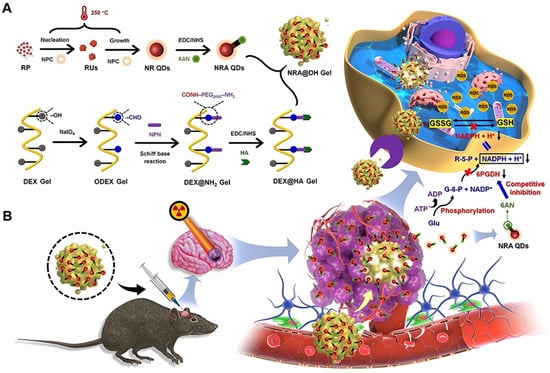
Figure 3.
Schematic illustrations of pH-sensitive dextran hydrogel with a hyaluronic acid coating (NRA@DH gel) (A) Synthesis of NRA QDs, DEX-HA gel, and multifunctional NRA@DH gel; (B) 6he in vivo mechanisms of the synergistic therapy with NRA@DH gel to include accumulation in tumor tissues, deep penetration, and sustained ROS generation [35].
There has been significant progress with the introduction of an injectable and biodegradable nano-photothermal DNA hydrogel, which incorporates black phosphorus quantum dots. This novel hydrogel is specifically formulated for tumor therapy, offering improved penetration and treatment efficiency within the tumor microenvironment. One of the key benefits of this technology is its potential to reduce drug resistance and consequently improve the survival rates in cancer treatment. The integration of black phosphorus quantum dots into the DNA hydrogel framework not only enhances its therapeutic efficacy but also ensures a more targeted and effective delivery of treatment [36].
2.3. Miscellaneous Biomedical Applications
The incorporation of carbon quantum dots into a hydrogel composed of polyvinyl alcohol and polyethylene glycol (PVA-PEG) has been conducted to examine its effectiveness as a lubricant. The integration of carbon quantum dots into the PVA-PEG hydrogel led to improved tribological properties and mechanical behavior, indicating its promise for use in joint lubrication applications [27]. An investigation explored the utility of acidified carbon nanotubes (CNTs) in creating hydrogels that can mimic biological tissues. This research resulted in the development of hydrogels that are responsive to changes in pH and near-infrared (NIR) light, akin to natural biological materials. These hydrogels exhibit properties that make them suitable as intelligent lubricating agents, showcasing their potential in the field of biomimetic materials [28].
Polyacrylamide (PAM) and carbon dots (C-dots) were synthesized with a focus on minimizing the chemical crosslinking within the material. The resulting hydrogel demonstrated enhanced mechanical strength and an increased capacity to swell, characteristics that are desirable in materials used for biomedical purposes. Notably, this hydrogel was found to be exceptionally stretchable, with enhanced mechanical and swelling properties up to 3700% and the capability to return to its original shape, underscoring its potential for various biomedical applications [74]. In a different context, the modification of hemodialysis membranes was undertaken by incorporating a heparinoid gel with carbon dots, aiming to enhance the membranes’ functionality. This approach resulted in membranes that exhibited improved anticoagulant and antioxidant characteristics, thereby increasing the efficacy of hemodialysis treatments [29].
Exploring hydrogels as environmental protectants, researchers have developed a hydrogel based on bovine serum albumin (BSA) via hydrothermal synthesis, aimed at safeguarding against UVB radiation. This BSA-based hydrogel exhibits efficient attenuation of UV radiation and demonstrates biocompatibility, showcasing its promise as a protective shield against UVB rays [75]. The incorporation of quantum dots into hydrogel composites for biomedical purposes has made notable advancements, underscoring the versatility of these composites in areas like bioimaging, biosensing, and drug delivery. With a wide array of potential applications in the medical and biotechnological fields [30], these developments highlight the expansive utility and adaptability of hydrogels enhanced with nanotechnology across multiple sectors.
2.4. Imaging and Diagnostics
Zinc sulfide (ZnS) nanocrystals, when capped with (3-mercaptopropyl)-trimethoxysilane and incorporated into a polyacrylamide (PAM) hydrogel, exhibit stabilized fluorescence emission, which is highly beneficial for biomedical applications. This combination results in the stabilization of ZnS nanocrystals within the polyacrylamide hydrogel matrix, leading to a system where the nanocrystals are both protected and stabilized, ensuring long-term stable fluorescence. Such stability is crucial for medical applications where consistent and reliable fluorescence emission is needed over time. This integrated approach allows the nanocrystals, capped with silane, to be effectively embedded within the hydrogel, culminating in enhanced stability and functionality of the fluorescence emission in biomedical settings [44]. Building on this theme of fluorescence and mechanical enhancements, the creation of a nitrogen-doped carbon dot/cellulose nanofibril hydrogel (NCD/CNF gel) composite showcases the synthesis of a unique material with improved fluorescence and mechanical properties, achieved through a one-pot green hydrothermal treatment. This process leads to the formation of a biomass-based hydrogel that not only exhibits enhanced fluorescence but also possesses superior mechanical strength, making it an ideal candidate for biomedical applications. The resultant material is not only injectable and resistant to pressure but also demonstrates excellent fluorescence and biocompatibility, making it suitable for a range of medical applications [45].
Quantum dot hydrogels have been innovatively functionalized with Nile Blue, aiming to selectively enhance fluorescence imaging of extracellular lactate. This advancement involves engineering quantum dot hydrogels specifically for lactate sensing, resulting in a surface-engineered material capable of selective fluorescence imaging. Such hydrogels are tailored to detect and image lactate within biological systems, which is particularly valuable for studies focused on metabolic processes. This selective imaging tool allows researchers to gain precise insights into the dynamics of lactate in various biological contexts, thereby enhancing the understanding of metabolic functions and disorders [46].
Chiral carbon dots (G-dots), derived from guanosine 5′-monophosphate (Na2(5′-GMP)), have led to the development of supramolecular hydrogels. These hydrogels are formed through the self-assembly of fluorescent G-dots, showcasing the potential of guanosine derivatives in creating advanced biomaterials. The resulting hydrogels exhibit excitation-dependent fluorescence, making them particularly suited to bio-imaging applications. This feature allows for versatile imaging capabilities, opening new avenues in the visualization of biological processes and structures [76]. Extending the application of advanced hydrogels in the biomedical field, research into DNA-crosslinked hydrogels has revealed their capability for the controlled trapping and release of quantum dots. This has been extensively investigated using techniques such as single-quantum-dot tracking and fluorescence correlation spectroscopy. The development of DNA-switchable hydrogels presents a novel method for precise control over the trapping and release of nanoparticles, offering significant implications for drug delivery and nanomedicine. Such hydrogels enable the precise timing and location of nanoscale agent release, thus enhancing the potential for targeted therapeutic applications [48].
The versatility of guanosine-based materials, with the formation of G4-quartet–M(+) borate hydrogels and the utilization of guanosine and potassium borate, highlights a novel approach to modulating the physical properties of biomaterials for biomedical applications. These guanosine–borate hydrogels are characterized by their strong, self-supporting structure, which can be tailored to specific applications. The ability to modify the physical properties of these hydrogels makes them highly significant for a range of biomedical applications, offering new possibilities in the design and development of advanced biomaterials [77].
Lastly, researchers have developed water-dispersible X-ray scintillators using Tb3+-doped Na5Lu9F32 nanocrystals on halloysite nanotubes. These nanocrystals exhibited highly sensitive luminescence to X-rays when integrated into various polymer matrices and hydrogels for applications in radioluminescence and X-ray imaging. This study highlights their potential for encrypting materials sensitive to X-ray, with false data readable under UV light [78].
2.5. Sensing and Biosensing
Considerable interest has arisen in the development of hydrogels based on fluorescent quantum dots, focusing on their synthesis, fabrication, and varied applications. These quantum dot–hydrogel composites are notably recognized for their contributions to multimodal biosensing, promising advancements in both bioimaging and biosensing realms [79]. Expanding the versatility of quantum dots in analytical applications, a novel approach in analytical chemistry involves the use of galactoside polyacrylate hydrogel to immobilize protein toxins for detection. This method employs streptavidin-coated quantum dots, enabling fluorescence-based protein detection. The integration of this hydrogel enhances protein visualization and quantification, serving as a valuable tool in protein detection and analysis with quantum dot fluororeagents. Beyond its immediate applications, this methodology significantly augments the detection capabilities and contributes to the broader landscape of analytical chemistry by providing a reliable means to visualize and quantify proteins [80].
The advancement of material science is marked by the development of luminescent hydrogels containing lanthanopolyoxometalates, specifically with the formula K-9[Ln(W5O18)(2)], where Ln represents either europium (Eu) or terbium (Tb). These carrageenan-based hydrogels demonstrate enhanced photoluminescence properties, with the integration of lanthanopolyoxometalates improving both their luminescent characteristics and mechanical strength. This renders them promising candidates for applications in optical devices [25]. Expanding upon the capabilities of microfluidics, a novel approach employs a thermo-reversible gelling polymer to facilitate the sorting of DNA molecules. These molecules are uniquely labeled with single quantum dots, enabling precise separation of DNA fragments. Leveraging the sol–gel transition of the hydrogel, this microfluidic device enables active sorting of biomolecules with high efficiency and purity [49].
In pursuit of applications for luminescent hydrogels, researchers developed a self-assembled photoluminescent peptide hydrogel designed to encapsulate enzymes and quantum dots, with the aim of creating an advanced optical biosensing platform. This innovative hydrogel system showcases a notable capacity for analyte detection while minimizing leakage, rendering it highly effective for biosensing applications. The incorporation of enzymes and quantum dots within the self-assembled peptide hydrogel highlights its potential as a highly efficient tool in the optical biosensing domain [42]. Further advancing this concept, researchers synthesized fluorescent DNA-derived carbon dots and incorporated them into DNA hydrogels for applications in bioimaging and dopamine detection. These luminescent hydrogels demonstrate multifunctional capabilities, suggesting their potential not only in bioimaging and biosensing but also in drug delivery systems. The innovative synthesis of carbon dots from DNA and their subsequent use in creating multifunctional luminescent hydrogels represent a significant advancement in this area of research [81].
A fluorescent hydrogel has been devised for glucose sensing in medical diagnostics, integrating immobilized glucose oxidase (GOx), acrylamide, fluorescein, and rhodamine B. This hydrogel system enables reversible and reusable glucose measurement, providing a stable and easily visible mechanism for glucose sensing. Such innovation holds particular promise for applications in diabetes management, indicating the hydrogel’s potential as a practical tool for continuous glucose monitoring [43]. In another study, a superabsorbent hydrogel biosensor has been engineered utilizing gum tragacanth, acrylic acid, and fluorescein, diacrylate as crosslinkers, tailored specifically to optical glucose monitoring. This fluorescent hydrogel biosensor stands out for its exceptional absorbency and sensitivity, enabling precise glucose monitoring. Its design incorporates quantum dots, further enhancing its performance as a highly sensitive and efficient tool for glucose detection, with potential significant implications for medical diagnostics and patient care [82].
A molecularly imprinted polymerized ionic liquid hydrogel, integrated with gold nanoparticles and ZnCdHgSe quantum dots, was engineered for the detection of human epididymis protein 4, showcasing exceptional selectivity and sensitivity. The inclusion of these nanomaterials in the hydrogel matrix enables precise targeting and quantification of this specific protein, underscoring its potential utility in clinical diagnostics [83]. Expanding hydrogel applications in protein detection, the development of a self-assembled DNA hydrogel with aptamer linkers marks another significant advancement in biosensing technology. Enhanced with gold nanoparticles and polyethyleneimine-wrapped quantum dots, this hydrogel is designed for the fluorescent detection of thrombin, a crucial protein in blood coagulation. Its engineered structure ensures specific and responsive detection, providing visual and fluorescent signals, thereby highlighting its potential for sensitive and accurate protein monitoring [51].
Quantum dot hydrogels and xerogels have been developed to encapsulate enzymes, establishing systems that merge biocatalysis with fluorescence signaling. These CdTe quantum dot hydrogels showcase integrated functionality, demonstrating potential as robust and sensitive biosensors. Their capability to encapsulate enzymes while providing fluorescence-based detection signals introduces new avenues for biosensor development, particularly in fields requiring precise and real-time monitoring of enzymatic activity [84]. Furthermore, graphene quantum dots co-doped with sulfur and nitrogen have been integrated into nanocellulosic hydrogels, forming a novel system for the sensitive and selective detection of laccase, an enzyme crucial in various biochemical processes. These fluorescent hydrogels display enhanced stability and sensitivity, serving as effective tools for laccase sensing. The incorporation of graphene quantum dots into the hydrogel matrix yields a potent sensing platform, offering improved fluorescence stability and sensitivity and paving the way for advanced biosensing applications [85].
In the context of environmental monitoring, a novel hydrogel comprising nanocellulose and graphene quantum dots co-doped with sulfur and nitrogen has been developed for the detection of 2,4,5-trichlorophenol in environmental samples. This photoluminescent sensing hydrogel is specifically tailored to monitoring contaminants like 2,4,5-trichlorophenol in various media, including water and wine, demonstrating its capability to provide selective and enhanced fluorescence sensing of environmental pollutants. Such advancements with these hydrogels in environmental analysis offer sensitive and selective methods for tracking hazardous substances in different settings [61]. Green-emitting methacrylic-acid-based nanogel probes have been integrated into hydrogels, creating a responsive system capable of sensing environmental changes such as divalent cations, pH fluctuations, temperature variations, and mechanical strain. These pH-responsive nanogel probes within the hydrogels emit green light and can adapt to different environmental conditions, making them versatile tools for monitoring and analyzing environmental stimuli. The potential of these probes extends to providing structural insights into the surrounding media, indicating a significant leap forward in environmental sensing technology [62].
Luminescent pectin-based hydrogels, infused with lanthanide ions and silk fibroin-derived carbon dots, have been engineered for multifunctional sensing tasks. These hydrogels exhibit a high sensitivity to pH and specific metal ions thanks to the unique properties of the incorporated lanthanide ions and carbon dots. Such materials are suitable for a wide range of sensing applications, including the detection of various chemical species in environmental and biological samples, highlighting their versatility and multifunctional sensing capabilities [86]. Tetragonal hydrogel microparticles containing quantum dots have been crafted using hydrodynamic focusing lithography for the multiplexed detection of microRNAs (miRNAs) associated with Alzheimer’s disease. These hydrogel particles allow for the simultaneous detection of multiple miRNA targets, facilitating high-throughput assays crucial for understanding and diagnosing Alzheimer’s disease. This approach represents a significant advancement in the field of biomedical research, offering a powerful tool for the multiplexed analysis of biomarkers related to neurodegenerative diseases [60].
The analysis of quantum dots within heterogeneous polyacrylamide hydrogels has been conducted with precision, focusing on single core/shell CdSe/ZnS quantum dots. This meticulous examination has yielded profound insights into the network structure of these hydrogels. By employing quantum dot tracking, this technique provides a detailed examination of the heterogeneity and mobility within the gel network. This approach not only advances our comprehension of the fundamental properties of hydrogels but also makes a substantial contribution to the field of materials science, offering a nuanced understanding of the complexities inherent in hydrogel network behaviors [87]. This exploration complements ongoing studies in polyelectrolyte hydrogels, which have been used for the electrophoresis of polyelectrolyte-coated nanoparticles, facilitating a deeper understanding of their electrophoretic behavior. This research includes a theoretical comparison of the electrophoretic behavior of the metallic and non-metallic nanoparticles within the gels, providing valuable insights into the dynamics of nanoparticle movement in different hydrogel environments. This study enhances our comprehension of the interactions and behaviors of nanoparticles in hydrogel matrices during electrophoresis, contributing to broader knowledge of gel-based separation technologies [88].
The creation of a nanosponge hydrogel system, integrating polylactic acid glycolic acid nanoparticles, MoS2 quantum dots, and urate oxidase, marks a leap forward in uric acid detection. This electrochemiluminescence biosensor harnesses the distinctive characteristics of MoS2 quantum dots to detect uric acid with exceptional sensitivity and specificity, notably in clinical serum assays. The amplified electrochemiluminescence (ECL) signal generated by this system highlights its efficacy and promise in the medical realm for precise monitoring of uric acid levels [50]. By advancing the techniques in protein analysis, polymer nanocomposite (PNC) hydrogels embedded with nanoparticles have been developed for the ultra-sensitive fluorescence detection of proteins during gel electrophoresis. These nanocomposite hydrogels exhibit improved performance and efficiency in detecting proteins, representing a substantial enhancement over traditional gel electrophoresis methods. The integration of nanoparticles into the hydrogel matrix facilitates a higher level of sensitivity and specificity in protein detection, showcasing the potential of these materials in advancing gel electrophoresis techniques and analytical methodologies in protein research [89].
2.6. Optoelectronics and Photonics
Researchers have developed metallohydrogels that incorporate zinc and cadmium, utilizing a process that traps cadmium sulfide (CdS) quantum dots within the gel’s structure, which is particularly advantageous for optoelectronic applications. These gels exhibit responsiveness to multiple stimuli and have the capability to undergo a reversible gel-to-sol transition, a characteristic that is coupled with the entrapment of the CdS quantum dots. Notably, these gels demonstrate properties such as tunable luminescence, responding dynamically to various external stimuli [90]. Building on this approach, in a related advancement, luminescent cadmium selenide (CdSe) quantum dots have been synthesized directly within a metal hydrogel matrix. This synthesis is facilitated by an amphiphilic bile salt, leading to a uniform distribution of quantum dots throughout the gel. The process, conducted at room temperature, not only yields luminescent quantum dots but also allows for their straightforward isolation and re-dispersion. As a result, the hybrid material formed exhibits consistent luminescence and a homogeneous distribution of the quantum dots [91].
Hydrogels embedded with graphene quantum dots (GQDs), particularly within hydrogels capped with N-anthracenemethyloxycarbonyl (Amoc) on aromatic amino acids, have been developed. These hydrogels emit blue light under ultraviolet exposure, indicating strong interactions between the embedded GQDs and the hydrogel matrix, as demonstrated by light quenching. Notably, these hydrogels possess self-repair capabilities and exhibit a tunable thixotropic nature, allowing their viscosity to vary under different stress conditions or over time [92]. In another approach expanding the applications of self-healing materials, a self-healing hydrogel composed of poly(acrylamide-co-maleic anhydride-beta-cyclodextrin-co-4-dimethylaminopyridine sulfonate) has been synthesized and integrated with quantum dots. This material shows promise for use in luminescent solar concentrators and white light-emitting diodes (LEDs). The hydrogels, known for their robustness and stretchability, possess self-healing properties, enhancing their utility in flexible optoelectronic devices. The inclusion of quantum dots further enhances these properties, contributing to the material’s functional versatility [93].
Research has also focused on the formation of wire-like assemblies within hybrid gels comprising both organo- and hydrogelators, integrating cadmium selenide–cadmium sulfide (CdSe-CdS) quantum rods. The amphiphilic nature of the quantum rods facilitates these assemblies, resulting in enhanced photoluminescent properties in the hybrid gels. The interaction among the rods promotes a tip-to-tip assembly mechanism, yielding distinctive wire-like structures that contribute to the material’s luminescence [94]. Expanding on the concept of structured material assemblies, researchers have innovated a method termed self-healing-driven assembly (SHDA), utilizing uniform gel beads to construct hydrogel ensembles. This technique enables the fabrication of programmed materials with specific structural configurations, including linear, planar, and three-dimensional assemblies. These materials hold promise for applications in tissue engineering and the fabrication of white light-emitting diodes (WLEDs), featuring the versatility and potential of this assembly strategy [95].
A study combined water-soluble molybdenum disulfide (MoS2) quantum dots with 2 kilobase pair (kbp) DNA to create fluorescent nanocomposite hydrogels through a hydrothermal synthesis process. This combination resulted in the formation of nanocomposite hydrogels that not only exhibit fluorescence suitable for organic light-emitting diode (OLED) applications but also have enhanced mechanical strength and temperature resistance. This advancement illustrates the potential of integrating inorganic quantum dots with organic DNA to produce materials with novel properties and functionalities [96]. Further research has led to the development of cellulose hydrogels infused with carbon dots, aimed at applications in information encryption and anti-counterfeiting. These luminescent hydrogels, made from nanocellulose and carbon dots, showcase exceptional mechanical strength and fluorescence. Their unique properties make them suitable for security-related applications, where durable and reliable materials are essential [97].
Nucleotide–amino acid hydrogels have yielded materials capable of inducing circularly polarized luminescence (CPL) in cadmium selenide/zinc sulfide (CdSe/ZnS) quantum dots. By incorporating achiral quantum dots into chiral hydrogels, researchers have observed CPL activity and investigated the mechanisms of chirality transfer within these systems. This has resulted in the development of hydrogels with tunable CPL properties, providing fresh insights into the interplay between molecular chirality and material structure [98]. Additionally, the development of a gold-nanocluster-based hydrogel has been reported, distinguished by its enhanced luminescence properties. Formed through the co-assembly of gold nanoclusters and trimesic acid, this hydrogel displays multicolor luminescence and robust self-healing capabilities. The distinctive luminescent attributes of this hydrogel position it as a promising candidate for encryption and other security applications, stressing the potential of integrating metallic nanoclusters with polymeric materials to create advanced functional materials [99]. Moreover, another research work improved the long-range ordering in perovskite quantum dot films to enhance carrier injection and operational stability in LEDs. Using a dual-ligand approach achieved higher conductivity and luminance, significantly improving the LEDs’ efficiency and lifespan. This leads to more stable red perovskite LEDs, marking a significant advancement in optoelectronic devices [100].
Table 2 presents a detailed comparison of the pros and cons of various hydrogel-based technologies aimed at enhancing biomedical applications. It captures the innovative aspects and potential limitations as derived from the scientific research, along with references for more in-depth information. The table also specifically combines insights from both the research findings and the authors’ opinions, reflecting the complex interplay between theoretical innovation and practical application challenges.
Table 2.
Advancements and challenges in hydrogel applications for biomedical sensing.
3. Environmental Applications
3.1. Environmental Sensing and Remediation
The development of smart hydrogels integrated with carbon-based nanoallotropes has led to significant enhancements in their mechanical, tribological, and biological characteristics. These advanced materials find utility across a broad spectrum of applications, from the medical field to the environmental sector. The incorporation of carbon nanoallotropes into hydrogels has resulted in improvements in their properties and the widening of the application possibilities for these hydrogels. Notably, these enhancements have been critical in augmenting the mechanical strength and expanding the functional scope of hydrogels in various domains [101]. Building on these advancements, the creation of hydrogels embedded with carbon quantum dots, specifically tailored to the detection of silver ions, represents a significant progress in hydrogel technology. These hydrogels exhibit changes in their fluorescence and selectivity based on the surface moieties present, offering a direct and nuanced approach to silver ion quantification. The development of these fluorescent hydrogels signifies a leap forward in devising selective and sensitive methodologies for monitoring silver ions in environmental samples [52].
The integration of quantum dots into hydrogel matrices has led to the formulation of hybrid materials capable of the sensitive and selective detection of iron ions (Fe3+). These hybrid fluorescent hydrogels represent a robust and stable platform specifically engineered for the detection of Fe3+ ions in aqueous environments. The innovative use of carbon quantum dots in these hydrogels not only imparts selectivity and sensitivity towards Fe3+ ions but also establishes a novel approach to ion detection in water, emphasizing the material’s utility in environmental and analytical chemistry [102]. Complementing these developments, the synthesis of poly(acrylamide-co-acrylic acid) hydrogels containing graphene quantum dots has been achieved, aimed at detecting Fe3+ ions. In these nanocomposite hydrogels, graphene quantum dots serve as crosslinking agents, enhancing the mechanical strength of the hydrogels and enabling the selective detection of Fe3+ ions. The incorporation of graphene quantum dots not only improves the mechanical properties of these hydrogels but also endows them with a fluorescent response, thus facilitating the selective detection of Fe3+ ions. This development marks a progress in the application of nanocomposite hydrogels for environmental and analytical purposes, demonstrating the effectiveness of these materials in detecting specific ions with high sensitivity (Figure 4) [54].
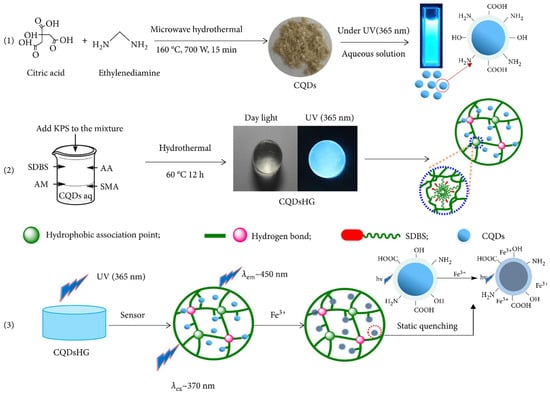
Figure 4.
Schematic representations of (1) CQD preparation, (2) CQDsHG preparation, (3) the mechanism of action of the CQDsHG sensor for Fe3+ ion detection [54].
The development of polyvinyl alcohol/poly(N-methylol acrylamide) hydrogels embedding graphene quantum dots has yielded a resilient material adept at sensing Fe3+ ions. These hydrogels are structured with an interpenetrating polymer network, bolstering their mechanical strength and fluorescence capabilities, thus enabling the selective detection of Fe3+ ions. Incorporating graphene quantum dots within the polymer network not only enhances its fluorescence but also markedly augments the mechanical properties of the hydrogel, positioning it as an excellent option for sensitive and selective ion sensing applications [55].
In solar energy, a polysulfide hydrogel electrolyte, synthesized using 12-hydroxystearic acid as the gelling agent, has been employed in quantum-dot-sensitized solar cells. This hydrogel electrolyte stands out for its improved stability and temperature-responsive behavior, essential for enhancing the longevity of solar cells. Although there is a slight decrease in efficiency compared to traditional liquid electrolytes, the overall stability benefits of this hydrogel electrolyte make it a noteworthy development in solar cell technology [103]. Transitioning from energy generation to graphene stabilization, a hydrogel created from 1-hexadecyl-3-methylimidazolium p-toluenesulfonate has been explored for its capacity to exfoliate and stabilize graphene flakes in an aqueous environment. The hydrogelation process of this ionic liquid not only facilitates the efficient exfoliation of graphene flakes but also ensures their stable dispersion in water. This method offers the advantage of easy recovery of graphene from the gel [13].
Heavy metal ion detection, with the use of polyacrylamide hydrogels functionalized with thymine-rich DNA strands, has been engineered to target mercury (II) ions. These hydrogels can detect and remove mercury ions from the environment, demonstrating their potential for environmental remediation. The incorporation of thymine-rich DNA into the hydrogel matrix allows for specific binding and efficient removal of mercury, showcasing the adaptability and effectiveness of DNA-functionalized materials in monitoring and treating pollution [53]. Advancing the development of mercury ion sensors, further innovations have led to the synthesis of biocompatible fluorescent carbon dots derived from cellulose hydrogels, aimed at the detection of mercury ions. These carbon dots exhibit a high fluorescence quantum yield, making them highly efficient and selective for Hg2+ sensing. The use of cellulose as a source for carbon dots not only ensures biocompatibility but also enhances the specificity towards mercury ions, highlighting the potential of these materials in developing sensitive and selective sensors for environmental monitoring [56]. Complementing these developments, DNA-functionalized monolithic hydrogels have been engineered for the highly sensitive detection of mercury ions. These hydrogels leverage electrostatic interactions to bind mercury ions selectively, with the DNA components providing specific binding sites for Hg2+. This configuration enhances the sensitivity and selectivity of the hydrogel for mercury ion detection, underlining the effectiveness of DNA-functionalized materials in creating precise and efficient sensing mechanisms for heavy metal ions [57].
Hydrogels based on graphitic carbon nitride have been developed to improve their adsorption, stability, and photocatalytic performance. These hydrogels enhance the photocatalytic process, making them effective in environmental applications, such as water purification and pollution degradation. The incorporation of graphitic carbon nitride into the hydrogel matrix contributes to improved adsorption capacities and stability, leading to enhanced photocatalytic activity and offering a promising approach for environmental remediation efforts [63].
In addition to advancements in individual hydrogel applications, hydrogel-immobilized photocatalysts have been examined to highlight their efficiency in degradation processes and self-regeneration capabilities. The research on hydrogel composites used as carriers for various photocatalysts includes titanium oxide and carbon nitride. These materials have been shown to enhance the photocatalytic efficiency of and provide valuable insights into the degradation mechanisms of hydrogels, thus contributing to the development of more effective and sustainable photocatalytic systems [104].
Advancements in nanosorbent technologies have led to the creation of a ferrofluid– covalent organic framework–aminated cotton-based hydrogel, designed specifically for the removal of nanoplastics and nanoparticles from the environment. This innovative hydrogel nanosorbent demonstrates high efficiency and reusability in pollutant extraction, with potential applications in catalytic degradation. The integration of ferrofluids and covalent organic frameworks with aminated cotton into the hydrogel matrix enhances its capacity to capture and remove nano-sized pollutants, thereby offering a novel and effective solution for mitigating the environmental impact of nanoplastics and nanoparticles [64]. For environmental remediation, a sodium alginate/gelatin-based hydrogel, incorporating zinc sulfide (ZnS) nanocomposites, has been optimized using response surface methodology–central composite design (RSM-CCD) specifically for dye removal applications. This optimization process has resulted in a hydrogel with superior dye adsorption capabilities, demonstrating high efficiency in dye removal, along with excellent recyclability and reusability. The inclusion of ZnS nanoparticles within the sodium alginate/gelatin matrix significantly enhances the hydrogel’s capacity to remove dyes from aqueous solutions, presenting a viable and effective option for wastewater treatment and environmental clean-up [65].
Research has been conducted on a polyacrylamide-aminated graphene oxide hybrid hydrogel, synthesized with the aid of microwave technology, to improve its adsorption properties in water treatment. This hybrid hydrogel shows a remarkable ability to adsorb methylene blue, a common industrial dye, suggesting its potential as a powerful tool for water treatment applications. The incorporation of aminated graphene oxide into the polyacrylamide matrix enhances the hydrogel’s adsorption capacity, making it an effective medium for the removal of dyes and possibly other pollutants from water [105]. Transitioning to the domain of agricultural and food safety, a nickel oxide@nickel–graphene quantum dot self-healing hydrogel has been developed for the colorimetric detection and removal of lambda-cyhalothrin, a pesticide, from fruits such as kumquats. This hydrogel combines colorimetric detection capabilities with self-healing properties, providing an effective and reusable method for pesticide detection and removal. This innovation holds significant promise for ensuring the safety and quality of food, particularly in monitoring and eliminating pesticide residues from fruits [106].
Supramolecular hydrogels synthesized from isomeric sugar-based derivatives have been crafted for the selective sensing of picric acid, a potent explosive compound. These hydrogels facilitate visual and selective sensing of picric acid in aqueous solutions, enabling rapid and efficient detection without the need for costly equipment. The sugar-based structure of these hydrogels allows for fast and selective gelation, making them ideal for environmental monitoring and safety applications, particularly in the detection of explosive residues in water [107]. In parallel, hydrogels embedded with cadmium telluride (CdTe) quantum dots have been developed for fluoride-responsive sensing through an ion exchange synthesis method. These hydrogels demonstrate a visible sol–gel transition that is specific to the presence of fluoride ions, providing a novel method for selective fluoride detection. The incorporation of CdTe quantum dots into the hydrogel matrix results in a material with outstanding fluorescence properties and a rapid response to fluoride ions, making it an excellent candidate for applications in environmental monitoring and water quality assessment [108]. Further advancements have led to the creation of dual-emission hydrogel beads, which incorporate europium(III) (Eu3+)-functionalized coordination polymers. These hydrogel beads are designed for the selective detection of antibiotics, exhibiting low detection limits and high selectivity. The dual-emission property of these hydrogel beads enhances their performance, making them suitable for precise and sensitive antibiotic detection in various environmental and biological samples [109].
A supramolecular hydrogel derived from phenylalanine, bis-(urea), graphene quantum dots, and enzymes has been engineered for the detection of dichlorvos, an organophosphate pesticide. This hydrogel integrates the high surface area and catalytic properties of the graphene quantum dots with the specificity of the enzymes, resulting in improved sensitivity for dichlorvos detection. This development signifies a step forward in the rapid and accurate monitoring of organophosphate pesticides in environmental samples, offering a potent tool for ensuring ecological safety and public health [58]. Cd(II)-nucleobase metallohydrogels have been synthesized for metal ion sensing, within which cadmium sulfide (CdS) quantum dots are formed in situ. These hydrogels facilitate color-tunable luminescence, serving as a versatile platform for the selective sensing of various metal ions. The ability to tune the luminescence color in response to different metal ions underscores the potential of these metallohydrogels in analytical chemistry, particularly in the detection and differentiation of metal ions in complex matrices [59].
Another development is a chitosan hydrogel incorporated with carbon quantum dots for the sensitive and selective detection of mercury (Hg2+ ) ions. The carbon quantum dots within the chitosan matrix enhanced the fluorescence quenching response to Hg2+ ions, enabling the hydrogel to detect mercury with high selectivity and sensitivity. This property, combined with a low detection limit, makes the hydrogel an effective tool for mercury ion sensing in environmental and health-related applications, demonstrating its utility in pollution monitoring and heavy metal detection [110].
3.2. Energy Harvesting and Solar Cells
The development of a dextran-based hydrogel containing a polysulfide electrolyte has marked an advancement in the field of quantum-dot-sensitized solar cells (QDSSCs). This innovation involved the creation of a highly conductive hydrogel electrolyte using dextran, specifically tailored to application in QDSSCs. The utilization of this hydrogel electrolyte not only facilitated efficient solar energy conversion but also hinted at the potential to enhance solar cell technologies [111]. Building on this concept, a similar study focused on the use of a polyacrylamide-based hydrogel, integrated with a polysulfide electrolyte, for quantum-dot-sensitized solar cells. This research employed a hydrogel as a quasi-solid-state electrolyte within CdS/CdSe co-sensitized solar cells, resulting in a notable light-to-electricity conversion efficiency of up to 4.0%. This achievement underlines the effectiveness of hydrogel electrolytes in improving the performance of QDSSCs [112].
Hydrogels have shown promise in solar energy applications, particularly with the advent of metallohydrogels facilitating the in situ synthesis of cadmium sulfide (CdS) quantum dots within a Zn(II)-based metallohydrogel, known as CdS@ZAVA gel. This advancement enables the production of quantum dots with adjustable emission properties spanning from white to yellow to orange, showcasing significant photocatalytic activity, including the capability to split water under visible light [113]. In line with this, investigations into semiconductor nanocrystal-based hydrogels have unveiled their potential in photocatalytic hydrogen production. By destabilizing ligand-stabilized semiconductor nanocrystal solutions, it has been observed that the hydrogel form of these nanocrystals exhibits a higher rate of hydrogen production compared to their solution counterparts. This finding highlights the heightened efficiency of semiconductor nanocrystals when integrated into hydrogels (Figure 5) [114].
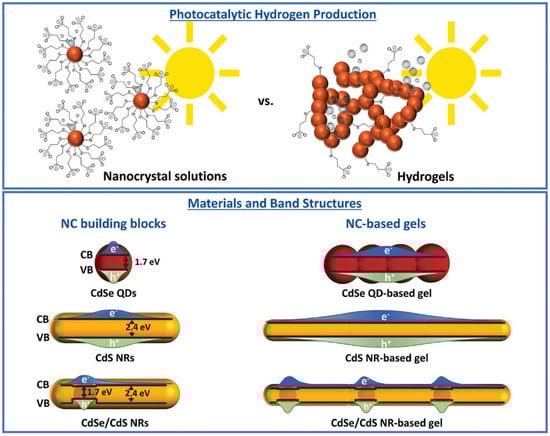
Figure 5.
A schematic illustration showing the photocatalytic hydrogen production with combined materials and band structures of the NC building blocks and NC-based gels. Demonstrated is a phase transfer from organic to an aqueous solution, showing the ligand-stabilized nanocrystals being destabilized by ligand oxidation with H2O2. The nanocrystals in aqueous solution and hydrogels can be used as potential sources of photocatalytic hydrogen production [114].
Adding to the versatility of hydrogel applications, the construction of a hybrid hydrogel comprising carbon dots (CDs), Protoporphyrin IX (PpIX), and single-stranded DNA (ssDNA) was another notable advancement. This CD-DNA-PpIX hybrid hydrogel was designed for sustained antimicrobial activity under light irradiation, achieving prolonged reactive oxygen species (ROS) generation and bacterial killing over a period of 10–11 days due to its controlled release mechanism [115]. Expanding on innovative hydrogel designs, the formulation of a supramolecular hydrogel, consisting of cyclodextrin and dye, incorporated with graphene oxide, represented a novel approach in the hydrogel domain. This polymer-free, cyclodextrin-based hydrogel exhibited significantly enhanced elasticity and improved dispersion stability of the graphene oxide, demonstrating the potential of integrating such materials for advanced applications [26].
Table 3 lists various hydrogel-based innovations, detailing their specific uses in heavy metal removal, pesticide detection, particle removal, environmental monitoring, photocatalytic activities, water treatment, and advanced material integration. There are also insights that are a combination of direct research observations and critical evaluations by the authors.
Table 3.
Categorization of hydrogel applications for environmental and technological advancements.
4. Testing and Evaluation of QD–Hydrogel Composites
Structural and Morphological Analysis: To understand the structure and growth mechanisms of QD–hydrogel composites, researchers commonly utilize transmission electron microscopy (TEM), scanning electron microscopy (SEM), high-resolution TEM (HRTEM), X-ray diffraction (XRD), and Fourier transform infrared spectroscopy (FT-IR) [3,4,32,46,47].
Chemical and Physical Stability/Characterization: Evaluating the chemical and physical stability of these composites involves tests in various environments (e.g., water, solvent exchange), centrifugation resistance, and examinations of swelling-induced mechanical instability, phase behavior, and surface engineering [1,19,45,77,102].
Optical, Fluorescence, and Spectroscopic Analysis: Fluorescence properties and stability are assessed through methods like fluorescence spectroscopy, photoluminescence, ultraviolet–visible spectroscopy, and infrared spectroscopy (e.g., [2,3,18,23,53]).
Mechanical, Thermal, and Rheological Properties: Research into the mechanical, thermal, and viscoelastic properties of hydrogels include thermogravimetric analysis, mechanical testing, and rheological experiments [3,9,41,42,99].
Environmental, Catalytic, and Adsorption Performance: These composites are also tested for environmental applications including photocatalytic hydrogen evolution, catalytic activity, and dye removal efficiency [6,65,67,105,113].
Biomedical, Cytotoxicity, and Medical Assessments: Biomedical evaluations focus on cytotoxicity, cytocompatibility, antibacterial testing, and in vivo assessments for inflammation and sensory functions [5,17,27,35,40].
Electrical, Electrochemical, and Electronic Properties: The electrical and electrochemical properties are analyzed through measurements like electrochemical activity, impedance spectroscopy, and conductivity tests [14,38,103,111,112].
Sensing, Analytical, and Detection Performance: The composite’s performance in sensing and detection is measured using techniques like electrochemiluminescence and biosensor testing [50,52,84,97,110].
5. Collective Outcomes
Interdisciplinary innovation has integrated chemistry, materials science, nanotechnology, and biomedical engineering, leading to significant advancements. For example, combining hydrophobic inorganic nanoparticles with hydrogels has created novel materials like fluorescent hydrogel nanocomposites for ion detection [1,3]. These materials have enhanced chemical stability, mechanical strength, and thermal resistance, useful in environmental monitoring, catalysis, and energy production [1,4].
In biomedical applications, new hydrogel membranes and magnetite/hydrogel/quantum dot composites are promising for drug delivery and therapy [15,21]. Environmental and energy solutions benefit from quantum-dot-enhanced photocatalytic systems for hydrogen production [12,67] and hydrogels tailored to dye adsorption [6].
Hydrogels display self-healing, thermal responsiveness, and fluorescence [17,18,20], applicable in optical devices, sensors, and medical equipment. They also respond to environmental stimuli like temperature, stress, and ionic shifts, improving smart sensing in medical and environmental fields [11,14,73].
Therapeutic advances include nano-realgar hydrogels that inhibit tumor metabolism and enhance ROS generation [35] and nano-photothermal DNA hydrogels used in tumor therapy [36]. In diagnostics, stable fluorescence [44] and quantum dot hydrogels [46,79,82] boost medical diagnostics.
Material innovation continues with enhancements in the mechanical and optical properties of hydrogels [25,45] and the development of smart materials for chemical and biological sensing [76]. The integration of quantum dots and nanomaterials into hydrogels enables precise detection of enzymes, pollutants, and metal ions [61,84,85], and hydrogels responsive to pH, temperature, and metal ions are tailored to diverse applications [62,72,86].
Hydrogels are also engineered for detecting and removing harmful substances in environmental and health monitoring, contributing to public health safety with advancements in pollutant detection [53,61,64,65,106] and sensitive diagnostics for organophosphates, heavy metals, and antibiotics [58,102,109,110]. Their tunable optical and mechanical features promote innovations in optoelectronics and photonics [59,90,93].
6. Limitations
Scaling up hydrogels for commercial use is challenged by manufacturing complexities and cost constraints, with cost-effectiveness and production costs as major hurdles in the transition from the lab to the industrial scale [1,8]. Ensuring their long-term stability, performance, and safety under real-world conditions is essential for reliable applications in sensing, remediation, and biomedicine [2,5,6,7].
The synthesis and fabrication complexities of hydrogels, due to their advanced functionalities, affect their reproducibility and scalability, posing challenges for large-scale production [3,15]. Effective integration into existing systems, especially in medical and environmental monitoring, requires further research [4,9,12,21].
In biomedicine, the long-term biocompatibility and environmental impact of hydrogels necessitate comprehensive testing to confirm their safety and effectiveness [22,67,68].
7. Future Directions
Research should focus on developing sustainable, biodegradable hydrogels to minimize environmental impacts [1,67,68]. In personalized medicine, using nanotechnology for specific drug delivery systems is crucial, particularly for controlled release in challenging conditions like brain tumors [2,21,22].
Developing smart hydrogels responsive to environmental or biological stimuli is key for intelligent sensors and therapeutic devices [3,6,10,16,42,76]. Integration with technologies like AI and photonics could enhance health monitoring and environmental sensing [4,5].
Advancing manufacturing methods, such as 3D printing, is essential for efficiently scaling these materials [15]. Improving the capabilities of hydrogel-based sensors is vital for diagnostics and environmental monitoring [7,9,43,50,54,60,61].
Interdisciplinary collaboration is necessary to address challenges and leverage hydrogel technologies [8,12,103]. Expanding applications into pollution control, sustainable energy, and healthcare will address global issues and improve health outcomes [13,17,28,29,71,113,114,115].
8. Conclusions
Interdisciplinary innovations in integrating fields like chemistry and biomedical engineering have led to significant advances in hydrogels, evidenced by developments in nanotechnology and smart material design. These achievements have paved the way for applications across environmental monitoring, energy production, and biomedical fields. However, challenges such as scalability, long-term stability, and integration hinder their broader application and commercialization. Future directions should focus on sustainability, personalized medicine, and smart materials, while leveraging emerging technologies and advanced manufacturing methods. Collaborative research and broadening the scope of applications are crucial for overcoming the current limitations and fully harnessing the potential of hydrogel technologies in addressing global health and environmental challenges.
Author Contributions
The authors confirm contributions to the paper as follows: conceptualization, writing, review, and editing, H.O.; investigation, review, and editing, R.L.W. All authors have read and agreed to the published version of the manuscript.
Funding
This review article received no external funding.
Data Availability Statement
No new data were created or analyzed in this study.
Conflicts of Interest
The authors declare no conflict of interest.
References
- Bai, S.; Nguyen, T.L.; Mulvaney, P.; Wang, D. Using hydrogels to accommodate hydrophobic nanoparticles in aqueous media via solvent exchange. Adv. Mater. 2010, 22, 3247–3250. [Google Scholar] [CrossRef] [PubMed]
- Bai, S.; Wu, C.; Gawlitza, K.; von Klitzing, R.; Ansorge-Schumacher, M.B.; Wang, D. Using hydrogel microparticles to transfer hydrophilic nanoparticles and enzymes to organic media via stepwise solvent exchange. Langmuir 2010, 26, 12980–12987. [Google Scholar] [CrossRef] [PubMed]
- Cheng, C.; Xing, M.; Wu, Q. Green synthesis of fluorescent carbon dots/hydrogel nanocomposite with stable Fe3+ sensing capability. J. Alloys Compd. 2019, 790, 221–227. [Google Scholar] [CrossRef]
- Ha, E.-J.; Park, C.-H.; An, S.S.A.; Paik, H.-j.; Lee, J.-O. Preparation and Characterization of Inorganic–Organic Composites with Highly Dense CdS Nanoparticles Using Poly(2-acetamidoacrylic acid) Hydrogels. Compos. Interfaces 2012, 16, 493–505. [Google Scholar] [CrossRef]
- Liu, Y.; Yang, J.; Zhang, P.; Liu, C.; Wang, W.; Liu, W. ZnO quantum dots-embedded collagen/polyanion composite hydrogels with integrated functions of degradation tracking/inhibition and gene delivery. J. Mater. Chem. 2012, 22, 512–519. [Google Scholar] [CrossRef]
- Sahoo, S.D.; Prasad, E. Self-healing stable polymer hydrogel for pH regulated selective adsorption of dye and slow release of graphene quantum dots. Soft Matter 2020, 16, 2075–2085. [Google Scholar] [CrossRef] [PubMed]
- Wei, J.-S.; Song, T.-B.; Zhang, P.; Zhu, Z.-Y.; Dong, X.-Y.; Niu, X.-Q.; Xiong, H.-M. Integrating Carbon Dots with Porous Hydrogels to Produce Full Carbon Electrodes for Electric Double-Layer Capacitors. ACS Appl. Energy Mater. 2020, 3, 6907–6914. [Google Scholar] [CrossRef]
- Martin, C.; Martin-Pacheco, A.; Naranjo, A.; Criado, A.; Merino, S.; Diez-Barra, E.; Herrero, M.A.; Vazquez, E. Graphene hybrid materials? The role of graphene materials in the final structure of hydrogels. Nanoscale 2019, 11, 4822–4830. [Google Scholar] [CrossRef] [PubMed]
- Zhou, Y.; Damasceno, P.F.; Somashekar, B.S.; Engel, M.; Tian, F.; Zhu, J.; Huang, R.; Johnson, K.; McIntyre, C.; Sun, K.; et al. Unusual multiscale mechanics of biomimetic nanoparticle hydrogels. Nat. Commun. 2018, 9, 181. [Google Scholar] [CrossRef]
- Du, P.; Chen, G.; Jiang, M. Electrochemically sensitive supra-crosslink and its corresponding hydrogel. Sci. China Chem. 2012, 55, 836–843. [Google Scholar] [CrossRef]
- Zhang, Y.-Y.; He, X.-W.; Li, W.-Y. Study on the room temperature synthesis of highly photoluminescent and temperature-sensitive CDs/PNIPAM hybrid hydrogels and their properties. RSC Adv. 2015, 5, 71030–71034. [Google Scholar] [CrossRef]
- Zhang, X.; An, W.; Li, Y.; Hu, J.; Gao, H.; Cui, W. Efficient photo-catalytic hydrogen production performance and stability of a three-dimensional porous CdS NPs-graphene hydrogel. Int. J. Hydrogen Energy 2018, 43, 9902–9913. [Google Scholar] [CrossRef]
- Kaur, M.; Singh, G.; Damarla, K.; Singh, G.; Wang, H.; Wang, J.; Aswal, V.K.; Kumar, A.; Kang, T.S. Aqueous systems of a surface active ionic liquid having an aromatic anion: Phase behavior, exfoliation of graphene flakes and its hydrogelation. Phys. Chem. Chem. Phys. 2019, 22, 169–178. [Google Scholar] [CrossRef] [PubMed]
- Zhou, Y.; Shu, H.; Yao, Y.; Yang, X.; Yu, C.; Zhong, W. An ultralow hysteresis zwitterionic hydrogel crosslinked by functionalized graphene oxide quantum dots for dual-responsive flexible wearable sensors. Chem. Eng. J. 2024, 483, 11. [Google Scholar] [CrossRef]
- Lim, S.; Lee, S. Fabrication of triple-layered magnetite/hydrogel/quantum dots via the molecular linkage of bi-functional diamines. J. Nanosci. Nanotechnol. 2012, 12, 5500–5504. [Google Scholar] [CrossRef] [PubMed]
- Du, P.; Liu, J.; Chen, G.; Jiang, M. Dual responsive supramolecular hydrogel with electrochemical activity. Langmuir 2011, 27, 9602–9608. [Google Scholar] [CrossRef] [PubMed]
- Wang, X.; Qiu, Y.; Chen, G.; Chu, Z.; Shadike, A.; Chen, C.; Chen, C.; Zhu, Z. Self-Healable Poly(vinyl alcohol) Photonic Crystal Hydrogel. ACS Appl. Polym. Mater. 2020, 2, 2086–2092. [Google Scholar] [CrossRef]
- Zhang, X.-Y.; Zheng, Y.; Liu, C.-H.; Wang, P.-H.; Zhu, Y.-Y. Facile and large scale in situ synthesis of the thermal responsive fluorescent SiNPs/PNIPAM hydrogels. RSC Adv. 2016, 6, 55666–55670. [Google Scholar] [CrossRef]
- Wang, Y.; Chen, Q.; Chen, M.; Guan, Y.; Zhang, Y. PHEMA hydrogel films crosslinked with dynamic disulfide bonds: Synthesis, swelling-induced mechanical instability and self-healing. Polym. Chem. 2019, 10, 4844–4851. [Google Scholar] [CrossRef]
- Liras, M.; Quijada-Garrido, I.; García, O. QDs decorated with thiol-monomer ligands as new multicrosslinkers for the synthesis of smart luminescent nanogels and hydrogels. Polym. Chem. 2017, 8, 5317–5326. [Google Scholar] [CrossRef]
- Johnson, E.K.; Adams, D.J.; Cameron, P.J. Directed self-assembly of dipeptides to form ultrathin hydrogel membranes. J. Am. Chem. Soc. 2010, 132, 5130–5136. [Google Scholar] [CrossRef] [PubMed]
- Maldonado, N.; Amo-Ochoa, P. Advances and Novel Perspectives on Colloids, Hydrogels, and Aerogels Based on Coordination Bonds with Biological Interest Ligands. Nanomaterials 2021, 11, 1865. [Google Scholar] [CrossRef] [PubMed]
- Hao, C.; Gao, Y.; Wu, D.; Li, S.; Xu, L.; Wu, X.; Guo, J.; Sun, M.; Li, X.; Xu, C.; et al. Tailoring Chiroptical Activity of Iron Disulfide Quantum Dot Hydrogels with Circularly Polarized Light. Adv. Mater. 2019, 31, e1903200. [Google Scholar] [CrossRef] [PubMed]
- Ahmed, F.; Muzammal Hussain, M.; Ullah Khan, W.; Xiong, H. Exploring recent advancements and future prospects on coordination self-assembly of the regulated lanthanide-doped luminescent supramolecular hydrogels. Coord. Chem. Rev. 2024, 499, 31. [Google Scholar] [CrossRef]
- Fateixa, S.; Carvalho, R.S.; Daniel-da-Silva, A.L.; Nogueira, H.I.S.; Trindade, T. Luminescent Carrageenan Hydrogels Containing Lanthanopolyoxometalates. Eur. J. Inorg. Chem. 2017, 2017, 4976–4981. [Google Scholar] [CrossRef]
- Zo, H.J.; Lee, J.-S.; Song, K.-W.; Kim, M.; Lee, G.; Park, J.S. Incorporation of graphene oxide into cyclodextrin-dye supramolecular hydrogel. J. Incl. Phenom. Macrocycl. Chem. 2013, 79, 357–363. [Google Scholar] [CrossRef]
- Hu, F.; Lu, H.; Xu, G.; Lv, L.; Chen, L.; Shao, Z. Carbon quantum dots improve the mechanical behavior of polyvinyl alcohol/polyethylene glycol hydrogel. J. Appl. Polym. Sci. 2022, 139, 12. [Google Scholar] [CrossRef]
- Hu, L.; Yu, X.; Hao, J.; Xu, L. pH- and near-infrared light-responsive, biomimetic hydrogels from aqueous dispersions of carbon nanotubes. Nano Res. 2023, 17, 3120–3129. [Google Scholar] [CrossRef]
- Xiao, T.; Wang, Y.; Wang, H.; Zhang, Y.; Zhou, J.; Zhao, Q. Anticoagulant and antioxidant properties of hemodialysis membranes modified by hydrogels incorporating carbon dots. J. Membr. Sci. 2024, 692, 11. [Google Scholar] [CrossRef]
- Zhou, W.; Hu, Z.; Wei, J.; Dai, H.; Chen, Y.; Liu, S.; Duan, Z.; Xie, F.; Zhang, W.; Guo, R. Quantum dots-hydrogel composites for biomedical applications. Chin. Chem. Lett. 2022, 33, 1245–1253. [Google Scholar] [CrossRef]
- Chen, J.; Li, S.; Zhang, Y.; Wang, W.; Zhang, X.; Zhao, Y.; Wang, Y.; Bi, H. A Reloadable Self-Healing Hydrogel Enabling Diffusive Transport of C-Dots Across Gel-Gel Interface for Scavenging Reactive Oxygen Species. Adv. Healthc. Mater. 2017, 6, 10. [Google Scholar] [CrossRef]
- Sarkar, N.; Sahoo, G.; Das, R.; Prusty, G.; Swain, S.K. Carbon quantum dot tailored calcium alginate hydrogel for pH responsive controlled delivery of vancomycin. Eur. J. Pharm. Sci. 2017, 109, 359–371. [Google Scholar] [CrossRef]
- Ye, W.; Zhu, L.; Xia, S.; Zhang, X. Dual pH-/temperature-responsive and fluorescent hydrogel for controlled drug delivery. J. Polym. Eng. 2018, 38, 371–379. [Google Scholar] [CrossRef]
- Liu, S.; Zhang, M.; Yu, H.; Sun, X.; Li, Q.; Yang, M.; Qiu, X.; Su, H.; Gong, A.; Du, F. Immunoinducible Carbon Dot-Incorporated Hydrogels as a Photothermal-Derived Antigen Depot to Trigger a Robust Antitumor Immune Response. ACS Appl. Mater. Interfaces 2023, 15, 7700–7712. [Google Scholar] [CrossRef]
- Wang, Y.; Wei, Y.; Wu, Y.; Zong, Y.; Song, Y.; Pu, S.; Wu, W.; Zhou, Y.; Xie, J.; Yin, H. Multifunctional Nano-Realgar Hydrogel for Enhanced Glioblastoma Synergistic Chemotherapy and Radiotherapy: A New Paradigm of an Old Drug. Int. J. Nanomed. 2023, 18, 743–763. [Google Scholar] [CrossRef] [PubMed]
- Zhou, L.; Pi, W.; Hao, M.; Li, Y.; An, H.; Li, Q.; Zhang, P.; Wen, Y. An injectable and biodegradable nano-photothermal DNA hydrogel enhances penetration and efficacy of tumor therapy. Biomater. Sci. 2021, 9, 4904–4921. [Google Scholar] [CrossRef]
- Guo, J.; Mei, T.; Li, Y.; Hafezi, M.; Lu, H.; Li, J.; Dong, G. One-pot synthesis and lubricity of fluorescent carbon dots applied on PCL-PEG-PCL hydrogel. J. Biomater. Sci. Polym. Ed. 2018, 29, 1549–1565. [Google Scholar] [CrossRef]
- Sun, X.; Li, G.; Yin, Y.; Zhang, Y.; Li, H. Carbon quantum dot-based fluorescent vesicles and chiral hydrogels with biosurfactant and biocompatible small molecule. Soft Matter 2018, 14, 6983–6993. [Google Scholar] [CrossRef] [PubMed]
- Gao, J.; Zhang, Y.; Feng, W.; Zhang, Y.; Cheng, C.; Han, X. GQDs-ε-PL and GQDs-ε-PL-based self-healing hydrogel: Synthesis, characterization and in vitro chemo-photothermal combined antibacterial. J. Mater. Res. 2022, 38, 368–379. [Google Scholar] [CrossRef]
- Hoveizi, E. Enhancement of nerve regeneration through schwann cell-mediated healing in a 3D printed polyacrylonitrile conduit incorporating hydrogel and graphene quantum dots: A study on rat sciatic nerve injury model. Biomed. Mater. 2023, 19, 17. [Google Scholar] [CrossRef]
- Khabibullin, A.; Alizadehgiashi, M.; Khuu, N.; Prince, E.; Tebbe, M.; Kumacheva, E. Injectable Shear-Thinning Fluorescent Hydrogel Formed by Cellulose Nanocrystals and Graphene Quantum Dots. Langmuir 2017, 33, 12344–12350. [Google Scholar] [CrossRef]
- Kim, J.H.; Lim, S.Y.; Nam, D.H.; Ryu, J.; Ku, S.H.; Park, C.B. Self-assembled, photoluminescent peptide hydrogel as a versatile platform for enzyme-based optical biosensors. Biosens. Bioelectron. 2011, 26, 1860–1865. [Google Scholar] [CrossRef] [PubMed]
- Kim, Y.; Namgung, H.; Lee, T.S. Synthesis of a glucose oxidase-conjugated, polyacrylamide-based, fluorescent hydrogel for a reusable, ratiometric glucose sensor. Polym. Chem. 2016, 7, 6655–6661. [Google Scholar] [CrossRef]
- Çakıcı, M.; Alveroglu, E. Stabilisation of (3-mercaptopropyl)-trimethoxysilanecapped ZnS nanocrystals in polyacrylamide hydrogel. Int. J. Nanotechnol. 2015, 12, 142–153. [Google Scholar] [CrossRef]
- Chen, X.; Song, Z.; Li, S.; Tat Thang, N.; Gao, X.; Gong, X.; Guo, M. Facile one-pot synthesis of self-assembled nitrogen-doped carbon dots/cellulose nanofibril hydrogel with enhanced fluorescence and mechanical properties. Green Chem. 2020, 22, 3296–3308. [Google Scholar] [CrossRef]
- Zhang, X.; Ding, S.; Cao, S.; Zhu, A.; Shi, G. Functional surface engineering of quantum dot hydrogels for selective fluorescence imaging of extracellular lactate release. Biosens. Bioelectron. 2016, 80, 315–322. [Google Scholar] [CrossRef] [PubMed]
- Gattás-Asfura, K.M.; Zheng, Y.; Micic, M.; Snedaker, M.J.; Ji, X.; Sui, G.; Orbulescu, J.; Andreopoulos, F.M.; Pham, S.M.; Wang, C.; et al. Immobilization of Quantum Dots in the Photo-Cross-Linked Poly(ethylene glycol)-Based Hydrogel. J. Phys. Chem. B 2003, 107, 10464–10469. [Google Scholar] [CrossRef]
- Liedl, T.; Dietz, H.; Yurke, B.; Simmel, F. Controlled trapping and release of quantum dots in a DNA-switchable hydrogel. Small 2007, 3, 1688–1693. [Google Scholar] [CrossRef] [PubMed]
- Haneoka, M.; Shirasaki, Y.; Sugino, H.; Aoki, T.; Arakawa, T.; Ozaki, K.; Yoon, D.H.; Ishii, N.; Iizuka, R.; Shoji, S.; et al. Microfluidic active sorting of DNA molecules labeled with single quantum dots using flow switching by a hydrogel sol–gel transition. Sens. Actuators B Chem. 2011, 159, 314–320. [Google Scholar] [CrossRef]
- Liu, W.; Nie, Y.; Zhang, M.; Yan, K.; Wang, M.; Guo, Y.; Ma, Q. A novel nanosponge-hydrogel system-based electrochemiluminescence biosensor for uric acid detection. Luminescence 2022, 37, 1524–1531. [Google Scholar] [CrossRef]
- Zhang, L.; Lei, J.; Liu, L.; Li, C.; Ju, H. Self-assembled DNA hydrogel as switchable material for aptamer-based fluorescent detection of protein. Anal. Chem. 2013, 85, 11077–11082. [Google Scholar] [CrossRef] [PubMed]
- Cayuela, A.; Soriano, M.L.; Kennedy, S.R.; Steed, J.W.; Valcarcel, M. Fluorescent carbon quantum dot hydrogels for direct determination of silver ions. Talanta 2016, 151, 100–105. [Google Scholar] [CrossRef] [PubMed]
- Dave, N.; Chan, M.Y.; Huang, P.J.; Smith, B.D.; Liu, J. Regenerable DNA-functionalized hydrogels for ultrasensitive, instrument-free mercury(II) detection and removal in water. J. Am. Chem. Soc. 2010, 132, 12668–12673. [Google Scholar] [CrossRef] [PubMed]
- Du, J.; Zhu, W.; She, X.; Yu, Q.; Yang, Q.; Huang, H.; Tsou, C.; Manuel, D.G. A tough fluorescent nanocomposite hydrogel probe based on graphene quantum dots for the selective detection of Fe3+ ions. Mater. Adv. 2022, 3, 7579–7589. [Google Scholar] [CrossRef]
- Du, J.; Zhu, W.; She, X.; Yu, Q.; Yang, Q.; Zhang, D.; Chen, J. A robust and fluorescent nanocomposite hydrogel with an interpenetrating polymer network based on graphene quantum dots. Polym. Eng. Sci. 2023, 63, 2169–2179. [Google Scholar] [CrossRef]
- Huang, H.; Ge, H.; Ren, Z.; Huang, Z.; Xu, M.; Wang, X. Controllable Synthesis of Biocompatible Fluorescent Carbon Dots From Cellulose Hydrogel for the Specific Detection of Hg2+. Front. Bioeng. Biotechnol. 2021, 9, 617097. [Google Scholar] [CrossRef] [PubMed]
- Joseph, K.A.; Dave, N.; Liu, J. Electrostatically directed visual fluorescence response of DNA-functionalized monolithic hydrogels for highly sensitive Hg2+ detection. ACS Appl. Mater. Interfaces 2011, 3, 733–739. [Google Scholar] [CrossRef] [PubMed]
- Sahub, C.; Andrews, J.L.; Smith, J.P.; Mohamad Arif, M.A.; Tomapatanaget, B.; Steed, J.W. Enhancement of sensitivity for dichlorvos detection by a low-weight gelator based on bolaamphiphile amino acid derivatives decorated with a hybrid graphene quantum dot/enzyme/hydrogel. Mat. Chem. Front. 2021, 5, 6850–6859. [Google Scholar] [CrossRef]
- Sharma, B.; Mandani, S.; Thakur, N.; Sarma, T.K. Cd(ii)-nucleobase supramolecular metallo-hydrogels for in situ growth of color tunable CdS quantum dots. Soft Matter 2018, 14, 5715–5720. [Google Scholar] [CrossRef]
- Roh, Y.H.; Sim, S.J.; Cho, I.J.; Choi, N.; Bong, K.W. Vertically encoded tetragonal hydrogel microparticles for multiplexed detection of miRNAs associated with Alzheimer’s disease. Analyst 2016, 141, 4578–4586. [Google Scholar] [CrossRef]
- Ruiz-Palomero, C.; Soriano, M.L.; Benítez-Martínez, S.; Valcárcel, M. Photoluminescent sensing hydrogel platform based on the combination of nanocellulose and S,N-codoped graphene quantum dots. Sens. Actuators B Chem. 2017, 245, 946–953. [Google Scholar] [CrossRef]
- Zhu, M.; Lu, D.; Wu, S.; Lian, Q.; Wang, W.; Lyon, L.A.; Wang, W.; Bartolo, P.; Saunders, B.R. Using green emitting pH-responsive nanogels to report environmental changes within hydrogels: A nanoprobe for versatile sensing. Nanoscale 2019, 11, 11484–11495. [Google Scholar] [CrossRef] [PubMed]
- Hu, C.; Lin, Y.R.; Yang, H.C. Recent Developments in Graphitic Carbon Nitride Based Hydrogels as Photocatalysts. ChemSusChem 2019, 12, 1794–1806. [Google Scholar] [CrossRef] [PubMed]
- Mahmoud, M.E.; Amira, M.F.; Abouelanwar, M.E.; Morcos, B.M. Removal of polymethyl methacrylate nanoplastics and silver nanoparticles by a novel ferrofluid-COF-aminated natural cotton-based hydrogel nanosorbent. J. Ind. Eng. Chem. 2024, 131, 265–279. [Google Scholar] [CrossRef]
- Priya; Sharma, A.K.; Kaith, B.S.; Tanwar, V.; Bhatia, J.K.; Sharma, N.; Bajaj, S.; Panchal, S. RSM-CCD optimized sodium alginate/gelatin based ZnS-nanocomposite hydrogel for the effective removal of biebrich scarlet and crystal violet dyes. Int. J. Biol. Macromol. 2019, 129, 214–226. [Google Scholar] [CrossRef] [PubMed]
- Zhang, J.; Jin, J.; Wan, J.; Jiang, S.; Wu, Y.; Wang, W.; Gong, X.; Wang, H. Quantum dots-based hydrogels for sensing applications. Chem. Eng. J. 2021, 408, 127351. [Google Scholar] [CrossRef]
- Jiang, Z.; Zhang, X.; Yang, G.; Yuan, Z.; Ji, X.; Kong, F.; Huang, B.; Dionysiou, D.D.; Chen, J. Hydrogel as a miniature hydrogen production reactor to enhance photocatalytic hydrogen evolution activities of CdS and ZnS quantum dots derived from modified gel crystal growth method. Chem. Eng. J. 2019, 373, 814–820. [Google Scholar] [CrossRef]
- Rose, K.A.; Gogotsi, N.; Galarraga, J.H.; Burdick, J.A.; Murray, C.B.; Lee, D.; Composto, R.J. Shape Anisotropy Enhances Nanoparticle Dynamics in Nearly Homogeneous Hydrogels. Macromolecules 2022, 55, 8514–8523. [Google Scholar] [CrossRef]
- Zhang, H.; Tang, B.; Zhang, B.; Huang, K.; Li, S.; Zhang, Y.; Zhang, H.; Bai, L.; Wu, Y.; Cheng, Y.; et al. X-ray-activated polymerization expanding the frontiers of deep-tissue hydrogel formation. Nat. Commun. 2024, 15, 3247. [Google Scholar] [CrossRef]
- Chang, C.Y.; Peng, J.; Zhang, L.N.; Pang, D.W. Strongly fluorescent hydrogels with quantum dots embedded in cellulose matrices. J. Mater. Chem. 2009, 19, 7771–7776. [Google Scholar] [CrossRef]
- Shao, H.; Wang, C.-F.; Chen, S.; Xu, C. Fast fabrication of superabsorbent polyampholytic nanocomposite hydrogels via plasma-ignited frontal polymerization. J. Polym. Sci. Part A Polym. Chem. 2014, 52, 912–920. [Google Scholar] [CrossRef]
- Gong, Y.; Gao, M.; Wang, D.; Möhwald, H. Incorporating Fluorescent CdTe Nanocrystals into a Hydrogel via Hydrogen Bonding: Toward Fluorescent Microspheres with Temperature-Responsive Properties. Chem. Mater. 2005, 17, 2648–2653. [Google Scholar] [CrossRef]
- Liu, J.; Chen, G.; Guo, M.; Jiang, M. Dual Stimuli-Responsive Supramolecular Hydrogel Based on Hybrid Inclusion Complex (HIC). Macromolecules 2010, 43, 8086–8093. [Google Scholar] [CrossRef]
- Hu, M.; Gu, X.; Hu, Y.; Wang, T.; Huang, J.; Wang, C. Low Chemically Cross-Linked PAM/C-Dot Hydrogel with Robustness and Superstretchability in Both As-Prepared and Swelling Equilibrium States. Macromolecules 2016, 49, 3174–3183. [Google Scholar] [CrossRef]
- Yadav, K.; Das, M.; Mishra, N.K.; Chhabra, A.; Mishra, A.; Srivastava, S.; Sharma, P.; Yadav, S.K.; Parmar, A.S. Tunning self-assembled phases of bovine serum albumin via hydrothermal process to synthesize novel functional hydrogel for skin protection against UVB. Nanotechnol. Rev. 2022, 11, 1643–1657. [Google Scholar] [CrossRef]
- Ghosh, A.; Parasar, B.; Bhattacharyya, T.; Dash, J. Chiral carbon dots derived from guanosine 5′-monophosphate form supramolecular hydrogels. Chem. Commun. 2016, 52, 11159–11162. [Google Scholar] [CrossRef]
- Peters, G.M.; Skala, L.P.; Plank, T.N.; Oh, H.; Reddy, G.N.; Marsh, A.; Brown, S.P.; Raghavan, S.R.; Davis, J.T. G4-quartet.M+ borate hydrogels. J. Am. Chem. Soc. 2015, 137, 5819–5827. [Google Scholar] [CrossRef]
- Zhang, H.; Zhang, B.; Cai, C.; Zhang, K.; Wang, Y.; Wang, Y.; Yang, Y.; Wu, Y.; Ba, X.; Hoogenboom, R. Water-dispersible X-ray scintillators enabling coating and blending with polymer materials for multiple applications. Nat. Commun. 2024, 15, 2055. [Google Scholar] [CrossRef]
- Ganguly, S.; Margel, S. Fluorescent quantum dots-based hydrogels: Synthesis, fabrication and multimodal biosensing. Talanta Open 2023, 8, 17. [Google Scholar] [CrossRef]
- Goldman, E.R.; O’Shaughnessy, T.J.; Soto, C.M.; Patterson, C.H., Jr.; Taitt, C.R.; Spector, M.S.; Charles, P.T. Detection of proteins cross-linked within galactoside polyacrylate-based hydrogels by means of a quantum dot fluororeagent. Anal. Bioanal. Chem. 2004, 380, 880–886. [Google Scholar] [CrossRef]
- Pandey, P.K.; Preeti; Rawat, K.; Prasad, T.; Bohidar, H.B. Multifunctional, fluorescent DNA-derived carbon dots for biomedical applications: Bioimaging, luminescent DNA hydrogels, and dopamine detection. J. Mater. Chem. B 2020, 8, 1277–1289. [Google Scholar] [CrossRef] [PubMed]
- Qasemi, S.; Ghaemy, M. Highly sensitive and strongly fluorescent gum tragacanth based superabsorbent hydrogel as a new biosensor for glucose optical detection. J. Mater. Chem. C 2020, 8, 4148–4156. [Google Scholar] [CrossRef]
- Wang, C.; Ye, X.; Wang, Z.; Wu, T.; Wang, Y.; Li, C. Molecularly Imprinted Photo-electrochemical Sensor for Human Epididymis Protein 4 Based on Polymerized Ionic Liquid Hydrogel and Gold Nanoparticle/ZnCdHgSe Quantum Dots Composite Film. Anal. Chem. 2017, 89, 12391–12398. [Google Scholar] [CrossRef] [PubMed]
- Yuan, J.; Wen, D.; Gaponik, N.; Eychmuller, A. Enzyme-encapsulating quantum dot hydrogels and xerogels as biosensors: Multifunctional platforms for both biocatalysis and fluorescent probing. Angew. Chem. Int. Ed. 2013, 52, 976–979. [Google Scholar] [CrossRef] [PubMed]
- Ruiz-Palomero, C.; Benitez-Martinez, S.; Soriano, M.L.; Valcarcel, M. Fluorescent nanocellulosic hydrogels based on graphene quantum dots for sensing laccase. Anal. Chim. Acta 2017, 974, 93–99. [Google Scholar] [CrossRef] [PubMed]
- Tang, K.Y.; Jiang, L.; Yeo, J.C.C.; Owh, C.; Ye, E.; Loh, X.J.; Li, Z. Engineering luminescent pectin-based hydrogel for highly efficient multiple sensing. Int. J. Biol. Macromol. 2021, 166, 869–875. [Google Scholar] [CrossRef] [PubMed]
- Lee, C.H.; Crosby, A.J.; Emrick, T.; Hayward, R.C. Characterization of Heterogeneous Polyacrylamide Hydrogels by Tracking of Single Quantum Dots. Macromolecules 2014, 47, 741–749. [Google Scholar] [CrossRef]
- Li, F.; Allison, S.A.; Hill, R.J. Nanoparticle gel electrophoresis: Soft spheres in polyelectrolyte hydrogels under the Debye-Huckel approximation. J. Colloid Interface Sci. 2014, 423, 129–142. [Google Scholar] [CrossRef] [PubMed]
- Zarei, M. Application of nanocomposite polymer hydrogels for ultra-sensitive fluorescence detection of proteins in gel electrophoresis. TrAC Trends Anal. Chem. 2017, 93, 7–22. [Google Scholar] [CrossRef]
- Bera, S.; Chakraborty, A.; Karak, S.; Halder, A.; Chatterjee, S.; Saha, S.; Banerjee, R. Multistimuli-Responsive Interconvertible Low-Molecular Weight Metallohydrogels and the in Situ Entrapment of CdS Quantum Dots Therein. Chem. Mat. 2018, 30, 4755–4761. [Google Scholar] [CrossRef]
- Chatterjee, S.; Maitra, U. In situ formation of luminescent CdSe QDs in a metallohydrogel: A strategy towards synthesis, isolation, storage and re-dispersion of the QDs. Nanoscale 2017, 9, 13820–13827. [Google Scholar] [CrossRef]
- Biswas, S.; Rasale, D.B.; Das, A.K. Blue light emitting self-healable graphene quantum dot embedded hydrogels. RSC Adv. 2016, 6, 54793–54800. [Google Scholar] [CrossRef]
- Hu, X.-H.; Liu, J.-D.; Du, X.-Y.; Cheng, R.; Li, Q.; Chen, S. A facile synthesis of self-healing hydrogels toward flexible quantum dot-based luminescent solar concentrators and white LEDs. J. Mater. Chem. C 2019, 7, 10988–10995. [Google Scholar] [CrossRef]
- Chakrabarty, A.; Maity, M.; Raffy, G.; Marre, S.; Aymonier, C.; Maitra, U.; Del Guerzo, A. Wire-Like Tip-To-Tip Linked Assemblies of CdSe-CdS Quantum Rods Promoted on Supramolecular Nanofibers of Hybrid Organo- and Hydrogels. ChemNanoMat 2019, 6, 79–88. [Google Scholar] [CrossRef]
- Li, Q.; Zhang, Y.W.; Wang, C.F.; Weitz, D.A.; Chen, S. Versatile Hydrogel Ensembles with Macroscopic Multidimensions. Adv. Mater. 2018, 30, e1803475. [Google Scholar] [CrossRef] [PubMed]
- Pandey, P.K.; Ulla, H.; Satyanarayan, M.N.; Rawat, K.; Gaur, A.; Gawali, S.; Hassan, P.A.; Bohidar, H.B. Fluorescent MoS2 Quantum Dot–DNA Nanocomposite Hydrogels for Organic Light-Emitting Diodes. ACS Appl. Nano Mater. 2020, 3, 1289–1297. [Google Scholar] [CrossRef]
- Wang, J.; Du, P.; Hsu, Y.-I.; Uyama, H. Cellulose Luminescent Hydrogels Loaded with Stable Carbon Dots for Duplicable Information Encryption and Anti-counterfeiting. ACS Sustain. Chem. Eng. 2023, 11, 10061–10073. [Google Scholar] [CrossRef]
- Wen, X.; Fan, H.; Jing, L.; Deng, M.; Huang, X.; Jiao, T.; Zhang, L.; Liu, M. Competitive induction of circularly polarized luminescence of CdSe/ZnS quantum dots in a nucleotide–amino acid hydrogel. Mater. Adv. 2022, 3, 682–688. [Google Scholar] [CrossRef]
- Yu, Y.; Zhang, X.; Wang, M.; Luan, J.; Liu, X.; Shen, J.; Qi, W. Au Nanocluster-Based Smart Multicolor Luminescent Hydrogels for Encryption Applications. ACS Appl. Nano Mater. 2022, 5, 10047–10054. [Google Scholar] [CrossRef]
- Wang, Y.K.; Wan, H.; Teale, S.; Grater, L.; Zhao, F.; Zhang, Z.; Duan, H.W.; Imran, M.; Wang, S.D.; Hoogland, S.; et al. Long-range order enabled stability in quantum dot light-emitting diodes. Nature 2024, 629, 586–591. [Google Scholar] [CrossRef]
- Awasthi, S.; Pandey, S.K. Recent advances in smart hydrogels and carbonaceous nanoallotropes composites. Appl. Mater. Today 2024, 36, 38. [Google Scholar] [CrossRef]
- Wu, S.; Zhou, C.; Ma, C.; Yin, Y.; Sun, C.; Afzali, D. Carbon Quantum Dots-Based Fluorescent Hydrogel Hybrid Platform for Sensitive Detection of Iron Ions. J. Chem. 2022, 2022, 3737646. [Google Scholar] [CrossRef]
- Huo, Z.; Tao, L.; Wang, S.; Wei, J.; Zhu, J.; Dong, W.; Liu, F.; Chen, S.; Zhang, B.; Dai, S. A novel polysulfide hydrogel electrolyte based on low molecular mass organogelator for quasi-solid-state quantum dot-sensitized solar cells. J. Power Sources 2015, 284, 582–587. [Google Scholar] [CrossRef]
- Liao, W.; Zhao, M.; Rong, H.; Jiang, P.; Liao, Q.; Zhang, C.; Chen, Y. Photocatalyst immobilized by hydrogel, efficient degradation and self regeneration: A review. Mater. Sci. Semicond. Process. 2022, 150, 16. [Google Scholar] [CrossRef]
- Viana, M.M.; do Amparo, S.Z.S.; Lima, M.C.F.S.; Lopes, R.C.F.G.; Vasconcelos, C.K.B.; Caliman, V.; Silva, G.G. Microwave-assisted synthesis of polyacrylamide-aminated graphene oxide hybrid hydrogel with improved adsorption properties. J. Environ. Chem. Eng. 2020, 8, 8. [Google Scholar] [CrossRef]
- Nana, L.; Ruiyi, L.; Wang, G.; Haiyan, Z.; Li, Z. A nickel oxide@nickel–graphene quantum dot self-healing hydrogel for colorimetric detection and removal of lambda-cyhalothrin in kumquat. New J. Chem. 2022, 46, 9408–9417. [Google Scholar] [CrossRef]
- Yu, X.; Guo, J.; Peng, P.; Shen, F.; Li, Y.; Geng, L.; Wang, T. Self-assembly induced hydrogelation approach as novel means of selective and visual sensing toward picric acid. Appl. Surf. Sci. 2019, 487, 473–479. [Google Scholar] [CrossRef]
- Zhou, J.; Li, H. Highly fluorescent fluoride-responsive hydrogels embedded with CdTe quantum dots. ACS Appl. Mater. Interfaces 2012, 4, 721–724. [Google Scholar] [CrossRef] [PubMed]
- Zhu, K.; Fan, R.; Zhang, J.; Jiang, X.; Jia, W.; Wang, B.; Lu, H.; Wu, J.; Wang, P.; Yang, Y. Dual-emission 3D supramolecular framework hydrogel beads: Highly selective detection of antibiotics and mechanism research. Dalton Trans. 2021, 50, 15679–15687. [Google Scholar] [CrossRef]
- Yan, X.; Rahman, S.; Rostami, M.; Tabasi, Z.A.; Khan, F.; Alodhayb, A.; Zhang, Y. Carbon Quantum Dot-Incorporated Chitosan Hydrogel for Selective Sensing of Hg2+ Ions: Synthesis, Characterization, and Density Functional Theory Calculation. ACS Omega 2021, 6, 23504–23514. [Google Scholar] [CrossRef]
- Chen, H.-Y.; Lin, L.; Yu, X.-Y.; Qiu, K.-Q.; Lü, X.-Y.; Kuang, D.-B.; Su, C.-Y. Dextran based highly conductive hydrogel polysulfide electrolyte for efficient quasi-solid-state quantum dot-sensitized solar cells. Electrochim. Acta 2013, 92, 117–123. [Google Scholar] [CrossRef]
- Yu, Z.; Zhang, Q.; Qin, D.; Luo, Y.; Li, D.; Shen, Q.; Toyoda, T.; Meng, Q. Highly efficient quasi-solid-state quantum-dot-sensitized solar cell based on hydrogel electrolytes. Electrochem. Commun. 2010, 12, 1776–1779. [Google Scholar] [CrossRef]
- Saha, S.; Das, G.; Thote, J.; Banerjee, R. Photocatalytic metal-organic framework from CdS quantum dot incubated luminescent metallohydrogel. J. Am. Chem. Soc. 2014, 136, 14845–14851. [Google Scholar] [CrossRef] [PubMed]
- Schlenkrich, J.; Lubkemann-Warwas, F.; Graf, R.T.; Wesemann, C.; Schoske, L.; Rosebrock, M.; Hindricks, K.D.J.; Behrens, P.; Bahnemann, D.W.; Dorfs, D.; et al. Investigation of the Photocatalytic Hydrogen Production of Semiconductor Nanocrystal-Based Hydrogels. Small 2023, 19, e2208108. [Google Scholar] [CrossRef]
- Kumari, S.; Rajit Prasad, S.; Mandal, D.; Das, P. Carbon dot-DNA-protoporphyrin hybrid hydrogel for sustained photoinduced antimicrobial activity. J. Colloid Interface Sci. 2019, 553, 228–238. [Google Scholar] [CrossRef]
Disclaimer/Publisher’s Note: The statements, opinions and data contained in all publications are solely those of the individual author(s) and contributor(s) and not of MDPI and/or the editor(s). MDPI and/or the editor(s) disclaim responsibility for any injury to people or property resulting from any ideas, methods, instructions or products referred to in the content. |
© 2024 by the authors. Licensee MDPI, Basel, Switzerland. This article is an open access article distributed under the terms and conditions of the Creative Commons Attribution (CC BY) license (https://creativecommons.org/licenses/by/4.0/).