


1. Background
Trigeminal Neuralgia (TN) is one of the most frequent and severe types of neuropathic facial pain encountered by clinicians [1]. The first line medical approach generally involves treatment with first and second generation anticonvulsants [2]. However, unfavorable adverse events impair compliance with the treatment, especially in relation to elderly patients. Lacosamide (LCM) is a third-generation anticonvulsant drug; it is a functionalized amino acid, with a multimodal mechanism of action which is not completely clear (Table 1 and Figure 1) [3,4]. It has also come into consideration as a treatment for neuropathic pain.

Table 1.
Mechanism of action and advantages of treatment with Lacosamide.
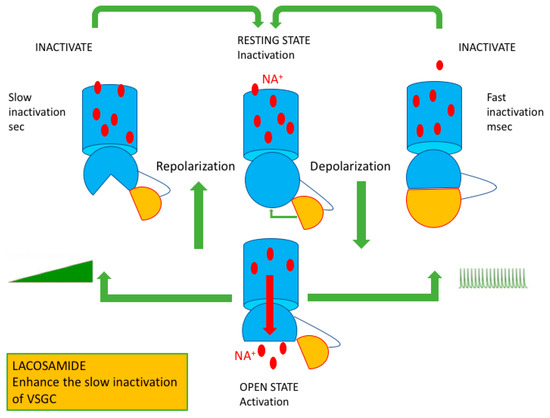
Figure 1.
Lacosamide: Mechanism of action. From Dr D. Adamo et Dr. N. Coppola.
We have aimed to investigate the efficacy and safety of LCM as a monotherapy in a case of TN who had not responded positively to previous treatments on account of severe leukopenia induced by several of the anticonvulsants previously used.
2. Presentation of the Case
A 60-year-old female patient was referred to the Oral Medicine Unit of the University Hospital of Federico II of Naples due to an acute exacerbation of TN, previously diagnosed by the Neurology Unit of our University.
The severe and unilateral pain was in the right side of her face, characterized by paroxysms of a strong stabbing nature extending in the sensory distribution of the maxillary and mandibular trigeminal right area and described as like an electric shock. The pain lasted only for seconds, occurring over intervals of a few minutes, and was triggered by swallowing or touching the affected area, without any autonomic or other neurological symptoms.
The patient was refractory to previous treatments (gabapentin, carbamazepine, lamotrigine and pregabalin) in terms of both the absence of any pain relief and the appearance of adverse events of leukopenia. We requested a routine blood test including a Complete Blood Count (CBC), glucose, electrolyte, blood urea nitrogen and creatinine levels, the erythrocyte sedimentation rate and an ECG evaluation. All results proved to be within normal limits. A Magnetic Resonance Imaging (MRI) of the brain and brainstem with and without intravenous paramagnetic contrast was required and proved to be normal except for a few subcortical white matter hyperintensities. An oro-facial evaluation and battery scales for an assessment of pain intensity and an evaluation of psychological profile were performed.
We started the treatment with a low dosage of oxcarbazepine (300 mg/daily) and re-evaluated the patient with a request for a blood examination after one month. We discovered that the WBC count had decreased from 5500 to 1900 cells/µL. We waited until the WBC had returned to a normal level and we started the treatment with 100 mg twice/daily of LCM. Pain relief was obtained in three weeks of treatment without any variations in the white blood cell count. The value of white blood cells was evaluated every month for the first six months of treatment and no changes have been detected. Currently, the patient takes a maintenance dosage of 100 mg/daily without any adverse events, remaining in a state of complete well-being without pain and with an improvement of psychological profile.
3. Conclusions
LCM has shown efficacy and a good safety profile. It may be useful for patients who are either subject to refractory TN which is not responsive to conventional therapy or are affected by significant adverse side effects.
References
- Dieleman, J.P.; Kerklaan, J.; Huygen, F.J.; Bouma, P.A.; Sturkenboom, M.C. Incidence rates and treatment of neuropathic pain conditions in the general population. Pain 2008, 137, 681–688. [Google Scholar] [CrossRef] [PubMed]
- Obermann, M. Treatment options in trigeminal neuralgia. Ther. Adv. Neurol. Disord. 2010, 3, 107–115. [Google Scholar] [CrossRef] [PubMed]
- Rogawski, M.A.; Tofighy, A.; White, H.S.; Matagne, A.; Wolff, C. Current understanding of the mechanism of action of the antiepileptic drug lacosamide. Epilepsy Res. 2015, 110, 189–205. [Google Scholar] [CrossRef] [PubMed]
- Niespodziany, I.; Leclère, N.; Vandenplas, C.; Foerch, P.; Wolff, C. Comparative study of lacosamide and classical sodium channel blocking antiepileptic drugs on sodium channel slow inactivation. J. Neurosci. Res. 2013, 91, 436–443. [Google Scholar] [CrossRef] [PubMed]
Publisher’s Note: MDPI stays neutral with regard to jurisdictional claims in published maps and institutional affiliations. |
© 2019 by the authors. Licensee MDPI, Basel, Switzerland. This article is an open access article distributed under the terms and conditions of the Creative Commons Attribution (CC BY) license (https://creativecommons.org/licenses/by/4.0/).