
You are currently viewing a new version of our website. To view the old version click .
Proceedings
  • Proceeding Paper
  • Open Access

30 December 2025

Evaluating the Performance of Intercropping Different Cultivars of Bread Wheat and Field Pea Using Economic Indices †
,
,
,
and
Laboratory of Agronomy, School of Agriculture, Aristotle University of Thessaloniki, 54124 Thessaloniki, Greece
*
Author to whom correspondence should be addressed.
Presented at the 18th International Conference of the Hellenic Association of Agricultural Economists, Florina, Greece, 10–11 October 2025.
Proceedings2026, 134(1), 16;https://doi.org/10.3390/proceedings2026134016 
(registering DOI)

Abstract

Intercropping is a sustainable agricultural system that has received significant attention in recent years. The objective of the present study was to assess the performance of intercropping different cultivars of wheat and pea, with and without N fertilization, using economic indices. Two bread wheat and two field pea cultivars were used as sole crops and in intercrops, both without nitrogen fertilization and with an application of 60 kg/ha of nitrogen. The combinations of Flamenko–Arvika, with and without N fertilization, along with the combination of Elissavet–Arvika with 50% N, achieved a Land Equivalent Ratio (LER) above 1, indicating they were more advantageous than the respective monocultures. Similarly, the Monetary Advantage Index (MAI) values were positive for the same combinations, indicating a clear economic benefit. According to the results, intercropping can lead to higher yields and economic benefits, both with and without nitrogen fertilization. Therefore, intercropping can play a role in modern agricultural systems.
Keywords:
LER; MAI; mixtures; index; grain yield

1. Introduction

Intercropping is considered a cultivation system capable of producing high yields, even under low-input conditions [1]. In addition, it offers several ecosystem services, making it a viable component of sustainable agricultural systems [2]. Although crop mixtures are often considered more beneficial without nitrogen fertilization, Li et al. [3], in their meta-analysis, concluded that intercropping remains advantageous, even when nitrogen (N) is applied. Moreover, the selection of appropriate cultivars is a critical factor in intercropping systems, as most cultivars are bred under monoculture conditions and may not perform optimally in mixtures [4]. This study aimed to evaluate the economic performance of different bread wheat and field pea cultivars with contrasting traits under intercropping, both with and without nitrogen fertilization, using various economic indices.

2. Materials and Methods

The experiment was conducted during the 2023–2024 growing season at the University Farm of the Aristotle University of Thessaloniki. Two bread wheat cultivars (Elissavet and Flamenko) and two field pea cultivars (Arvika and Furious) were used, and they were selected for their contrasting agronomic traits. Elissavet is a tall cultivar well suited to Mediterranean environments, while Flamenko is shorter, with a slower growth rate and later maturity. Arvika is a semi-leafless, early-maturing pea cultivar, whereas Furious is a fully leafless cultivar with a slower growth rate. The experimental year was characterized by drier conditions and higher average temperatures compared to the norm (Table 1).
Table 1. The average monthly temperature and rainfall of the growing season of 2023-2024 and the 30-year mean.
The experiment followed a Randomized Complete Block Design (RCBD), with four blocks and fourteen treatments. The treatments included the following: two bread wheat cultivars grown as sole crops, both without nitrogen (N) fertilization and with 120 kg/ha of N applied as ammonium nitrate (NH4NO3); two monocultures of field pea grown without N fertilization; and all possible combinations of bread wheat and field pea cultivars grown in intercrops, both without N and with 60 kg/ha of N (corresponding to 50% of the wheat monoculture rate). The seeding rate was 200 kg/ha, and the intercropping ratio was 25:75 (wheat:pea). Harvesting took place during the last week of May, where the three central rows of each plot were collected. After harvesting, plant material was dried and threshed using a laboratory thresher to determine the grain yield. The Land Equivalent Ratio (LER), Monetary Advantage Index (MAI), and intercropping advantage (IA) were then calculated based on the grain yield data.
The LER was calculated as follows:
LER = pLERw + pLERp,
where pLERw and pLERp are the partial Land Equivalent Ratios of wheat and pea, respectively.
The pLER’s were calculated as follows:
pLERw = Ywp/Yw,
pLERp = Ypw/Yp,
where Ywp is the wheat yield in an intercrop, Yw is the wheat yield in monoculture, Ypw is pea yield in an intercrop, and Yp is the pea yield in monoculture.
The Monetary Advantage Index (MAI) was calculated with the following equation:
MAI = ((LER − 1)/LER) × ((Ywp × 220) + (Ypw × 300)),
where 220 and 300 are the prices that wheat and pea grain yield per ton were sold, respectively.
The intercropping advantage (IA) was calculated with the following equation:
IAtotal = IAw + IAp,
IAw = AYLw × 220,
IAp = AYLp × 300,
where IAw, IAp, AYLw, and AYLp are the intercropping advantage and the actual yield loss of wheat and pea, respectively.

3. Results and Discussion

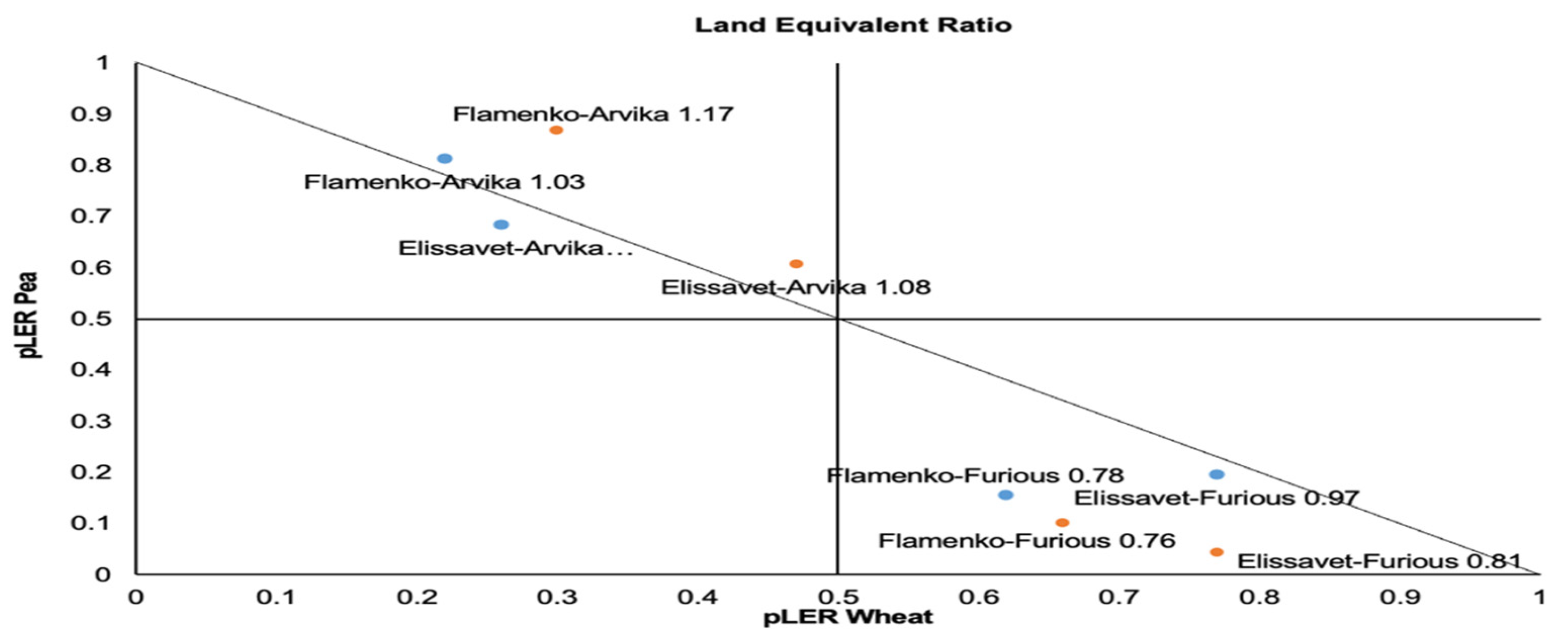
The combinations with Arvika appeared in the top left quadrant of the diagram, indicating that the pea component was more competitive than wheat, while the combinations with Furious were positioned in the bottom right quadrant, where wheat was more competitive than pea (Figure 1). Moreover, N fertilization increased the partial Land Equivalent Ratio (pLER) values of wheat. Cereals are generally more competitive than legumes in acquiring soil N, and they thus benefit more as soil N levels increase, resulting in higher pLER values [5]. The Flamenko–Arvika combination achieved a LER value above 1, regardless of nitrogen fertilization, indicating a consistent intercropping advantage. Similarly, the Elissavet–Arvika combination with 50% N fertilization reached a LER of 1.08, while all combinations involving Furious had LER values below 1. These findings reinforce the notion that, in breeding for intercropping systems involving cereals and legumes, it is essential to enhance the competitive performance of legume cultivars [6].
Figure 1. The Land Equivalent Ratio of the different treatments. Treatments above the diagonal line indicate a LER above 1 and, therefore, an intercropping advantage.
The Monetary Advantage Index values followed a similar trend to LER, which has been observed in other studies [7]. The intercrops of Flamenko–Arvika and Elissavet–Arvika 50%N obtained positive values, indicating a monetary advantage (Table 2). The IA was positive for almost all combinations, indicating an economic superiority of intercropping. The highest IAtotal was observed in the combination of Elissavet–Furious, regardless of N fertilization, due to the high values of IAw (Table 2).
Table 2. The intercropping advantage and Monetary Advantage Index of the different intercropping systems.

4. Conclusions

Intercropping is a sustainable agricultural system that can result in higher yields, even under low-input conditions. When mixing wheat and pea cultivars, it is important to select a pea cultivar with an early growth rate that can effectively compete with wheat. Based on both the intercropping advantage (IA) and the Monetary Advantage Index (MAI), it can be concluded that intercropping not only increases productivity per unit area, but also provides economic benefits for farmers.

Author Contributions

Conceptualization, C.D.; methodology and validation, A.M., P.P., E.D. and F.S.A.A.; investigation, A.M., P.P., E.D., F.S.A.A.; writing—original draft preparation, A.M., P.P., E.D. and F.S.A.A. All authors have read and agreed to the published version of the manuscript.

Funding

This research was also supported by the European Research Council under the European Union’s Horizon Europe research and innovation program in the framework of the project ‘IntercropVALUES’, grant number 101081973. The views and opinions expressed are, however, those of the authors only and do not necessarily reflect those of the European Union or REA. Neither the European Union nor the REA can be held responsible for them. Proceedings 134 00016 i001

Institutional Review Board Statement

Not applicable.

Data Availability Statement

The data presented in this study are available on request from the corresponding author. The data are not publicly available due to privacy restrictions.

Conflicts of Interest

The authors declare no conflicts of interest.

Abbreviations

The following abbreviations are used in this manuscript:
LERLand Equivalent Ratio
MAIMonetary Advantage Index
IAIntercrop Advantage

References

  1. Stomph, T.; Dordas, C.; Baranger, A.; de Rijk, J.; Dong, B.; Evers, J.; van der Werf, W. Designing intercrops for high yield, yield stability and efficient use of resources: Are there principles? Adv. Agron. 2020, 160, 1–50. [Google Scholar]
  2. Li, C.; Stomph, T.J.; Makowski, D.; Li, H.; Zhang, C.; Zhang, F.; van der Werf, W. The productive performance of intercropping. Proc. Natl. Acad. Sci. USA 2023, 120, e2201886120. [Google Scholar] [CrossRef]
  3. Li, C.; Hoffland, E.; Kuyper, T.W.; Yu, Y.; Zhang, C.; Li, H.; van der Werf, W. Syndromes of production in intercropping impact yield gains. Nat. Plants 2020, 6, 653–660. [Google Scholar] [CrossRef] [PubMed]
  4. Demie, D.T.; Döring, T.F.; Finckh, M.R.; van der Werf, W.; Enjalbert, J.; Seidel, S.J. Mixture × genotype effects in cereal/legume intercropping. Front. Plant Sci. 2022, 13, 846720. [Google Scholar] [CrossRef] [PubMed]
  5. Pelzer, E.; Hombert, N.; Jeuffroy, M.H.; Makowski, D. Meta-analysis of the effect of nitrogen fertilization on annual cereal–legume intercrop production. Agron. J. 2014, 106, 1775–1786. [Google Scholar] [CrossRef]
  6. Annicchiarico, P.; Collins, R.P.; De Ron, A.M.; Firmat, C.; Litrico, I.; Hauggaard-Nielsen, H. Do we need specific breeding for legume-based mixtures? Adv. Agron. 2019, 157, 141–215. [Google Scholar]
  7. Ghosh, P.K. Growth, yield, competition and economics of groundnut/cereal fodder inter-cropping systems in the semi-arid tropics of India. Field Crops Res. 2004, 88, 227–237. [Google Scholar] [CrossRef]
Disclaimer/Publisher’s Note: The statements, opinions and data contained in all publications are solely those of the individual author(s) and contributor(s) and not of MDPI and/or the editor(s). MDPI and/or the editor(s) disclaim responsibility for any injury to people or property resulting from any ideas, methods, instructions or products referred to in the content.

Article Metrics

Citations

Article Access Statistics

Multiple requests from the same IP address are counted as one view.