


Abstract
Ultrastrongly coupled quantum hardware may increase the speed of quantum state processing in distributed architectures, allowing to approach fault-tolerant threshold. We show that circuit QED architectures in the ultrastrong coupling regime, which has been recently demonstrated with superconductors, may show substantial speedup for a class of adiabatic protocols resilient to the main source of errors, namely the interplay of dynamical Casimir effect and cavity losses.
1. Introduction
Atom-cavity like systems in the strong coupling (SC) regime [1] implemented by circuit-QED solid-state systems [2] are nowadays one of the most promising platforms for quantum hardware [3]. Systems of superconducting artificial atoms coupled in the SC regime to an electromagnetic resonator are at the basis of the IBM, Intel, and Google quantum chips, the latter recently announced up to 72 qubits [4]. Recently entanglement has been demonstrated in systems with ten qubits [5]. Circuit-QED architectures are moreover paradigm models for studying fundamental physics from measurement theory [2] to quantum thermodynamics [6] and quantum communication [7].
We consider the simplest multiqubit architecture, two atoms coupled to a quantized mode, described by the Rabi model [1,8]:
Here is the oscillator frequency and (a) are the annihilation (creation) operator acting on the Hilbert space spanned by the Fock states . Pauli matrices for refer to the qubits whose splittings are . The whole Hilbert space is spanned by the factorized basis , where are eigenstates of , with eigenvalue 1 and , respectively. Atoms-mode couplings in the dipole approximation [1] are , which in the SC limit are large enough to overcome the atomic decoherence rates () and loss of the oscillator mode (). Moreover which allows the rotating wave approximations (RWA), where the counterrotating last term of is neglected. The resulting is a Jaynes-Cummings like Hamiltonian [1], whose dynamics conserves the number of excitation N. Therefore it allows design of state processing with simple building block operations, namely manipulations of single excitations across the network. The simplest family is based on Rabi swaps, the cavity working as a quantum bus [9]. Transformations depend on , where T is the duration of the gate, thus increasing g beyond the SC limit (typically ) may lead to speed-up, which is important for meeting the threshold for error correction.
2. Multiqubit Operation in the Ultrastrong Coupling Regime
In the last few years atom-cavity systems in the regime of ultrastrong coupling (USC), where , have been fabricated on several solid-state platforms (see the review [10]). In the simplest instance they are described by the full Rabi Hamiltonian Equation (1). The counterrotating terms spoil conservation of N. A remarkable feature is that large values of together with a modulation in time determine the production of photon pairs, a phenomenon known as the dynamical Casimir effect (DCE). As a consequence the USC quantum bus is sensitive to multiphoton generation, and DCE deteriorates the fidelity of quantum operations [11] even in absence of decoherence. This poses a fundamental limit for standard protocols based on Rabi oscillations.
To overcome this problem we propose a communication channel implemented by an adiabatic protocol similar to STIRAP [12]. Implementation of STIRAP in individual artificial atoms has been proposed [13,14] in the last few years. It has been recently demonstrated in the Transmon design [15,16], and extended to achieve hybrid control of qutrits [17]. We first consider [18,19]: the system is prepared in i.e., qubit 1 is in the excited state, and we switch on before . The protocol will end in , provided to guarantee adiabaticity of the dynamics (in practice, is sufficient). If this is the case the intermediate state is never populated during the whole protocol, thus the cavity acts as a virtual quantum bus. The protocol leaves unaffected the ground state , thus would implement ideal state transfer and other two qubit operations can be implemented with efficiency. One may wonder if in the USC regime STIRAP brings advantages over protocols based on Rabi swaps, in view of the fact that the cavity is almost never populated which should reduce the impact of DCE and photon losses.
We first study population transfer from the initial state at the doubly resonant point . In RWA the dynamics depends only on therefore the final population , is constant on each line (see Figure 1a). Larger A guarantees adiabaticity, the efficiency of population transfers being for . In the USC regime, with cavity losses modeled by the replacement , results in Figure 2 shows that: (1) the final population of is unaffected by USC even if during the protocol it is (blue curve); (2) population from is transferred in (red curves); (3) the main imperfection appearing for is population of at intermediate times (magenta curve), whereas for larger leakage from the subspaces (related to DCE) is the dominant stray effect.
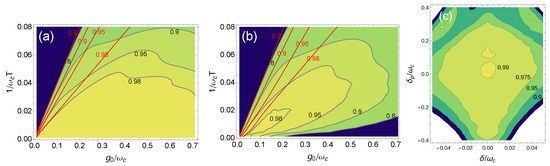
Figure 1.
(a) Efficiency of population transfer in the manifold for Rabi model and for the RWA (straight lines) for . (b) The same for , showing a region around where one may take advantage of the ultrastrong coupling, while at larger g combination of DCE and decay spoil the efficiency. (c) Sensitivity of population transfer to detunings, showing that the protocol is robust against fluctuations in a wide region about the resonance point , and that positive single photon detuning may further increase the efficiency.
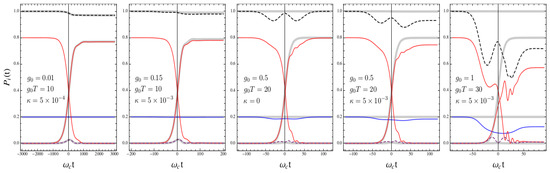
Figure 2.
Population transfer by STIRAP in RWA and USC, at the doubly resonant point , for initial state and . Colors: blue (), red ( and ), magenta dashed (), black dashed (sum of the above populations, i.e., the STIRAP subspace), thick gray (RWA). Parameters are in units of . Counterrotating terms do not modify the RWA behavior up to , which is a nearly optimal value for minimizing T; notice that a larger is used. At stronger coupling adiabaticity requires a less favorable scaling of T, and leakage from the STIRAP subspace occurs; this leakage is reversible for (due to the symmetries of the Hamiltonian) but becomes detrimental for finite .
For increasing g, the protocol becomes faster. Notice in particular that passing from the SC regime with regime to USC with , the typical time scale for the protocol reduces from to (in units of ). However, while the needed T scales as up to , further increase of g brings no advantage, since leakage to the subspaces becomes relevant. Although the STIRAP protocol would be by itself resilient to leakage due to symmetries in the Hamiltonian, this is no longer true in the presence of cavity losses, the main source of decoherence in present USC systems. Then leakage becomes irreversible and produces a substantial loss in the fidelity of population transfer.
In realistic cases increases with g but the protocol requires smaller time. Therefore there will be a tradeoff between speedup and errors due to the interplay of DCE and losses. To address this point we compare state transfer in the USC regime and in RWA, characterizing the impact of DCE plus losses as a function of g and T. Figure 1a shows the efficiency of population transfer in the subspace for . For it displays the dependence on only. This behavior approximately holds in the USC regime, the DCE reducing the efficiency for . The favorable region shrinks due to the interplay with cavity losses (Figure 1b, where ), but still in a region around one may take advantage from USC. In this region we then study robustness of population transfer against parametric fluctuations, which is one of the main assets of STIRAP. Figure 1c shows that the protocol keeps a very large efficiency in region around the doubly resonant point where the single-photon detuning and the two-photon detuning are nonvanishing. Notice that since the energy scale in the figure is this stability region is very large. Therefore the protocol is very robust, a feature essentially due to the USC between artificial atom and cavity. Another important property is that using non-vanishing single-photon detuning the efficiency is further increased. Both features have important consequences that we briefly discuss in the conclusions.
3. Conclusions
We have shown that a protocol based on STIRAP allows ultrafast and reliable state transfer in the USC regime, up to relatively large values of the qubits-field coupling strength , in spite of the joint presence of DCE, inducing leakage from the computational subspaces, and of large cavity losses determining Markovian decoherence. On the contrary protocols based on Rabi swaps are very sensitive to DCE [11], noise further degrading performances. In addition the STIRAP-based protocol is much more robust, a detailed study of population transfer has showing that very large efficiencies may be reached in a wide region of the space of the parameters. This property is essentially due to the large coupling strength achieved in the USC regime, and it has the important consequence of rendering our protocol resilient also to low-frequency noise [20,21]. Since STIRAP-based protocols may also be used to generate entanglement, this resilience may provide an alternative strategy to fight decoherence in two-qubit gates [22]. Therefore, it would be interesting to investigate other STIRAP-inspired protocols for multiqubit entanglement generation in the USC regime, and compare with other existing proposals [23]. Another important feature is that we have shown that efficiency may be further increased by using a non-vanishing single-photon atom-cavity detuning. This feature is reminiscent to what happens in a protocol called hyperstirap [12], where efficiency can be further increased by a proper phase modulation [14] of the control. Therefore it can be foreseen that optimal control techniques [24,25] could further improve the fidelity of such operations, also exploiting coupling schemes based on modulation of detunings [19,26].
References
- Haroche, S.; Raimond, J.M. Exploring the Quantum; Oxford University Press: Oxford, UK, 2006. [Google Scholar]
- Wallraff, A.; Schuster, D.I.; Blais, A.; Frunzio, L.; Huang, R.S.; Majer, J.; Kumar, S.; Girvin, S.; Schoelkopf, R. Strong coupling of a single photon to a superconducting qubit using circuit quantum electrodynamics. Nature 2004, 421, 162–167. [Google Scholar] [CrossRef] [PubMed]
- Schoelkopf, R.J.; Girvin, S.M. Wiring up quantum systems. Nature 2008, 451, 664. [Google Scholar] [CrossRef] [PubMed]
- Kelly, J. Engineering superconducting qubit arrays for quantum supremacy. In Proceedings of the American Physical Society March Meeting, Los Angeles, CA, USA, 5–9 March 2018. [Google Scholar]
- Song, C.; Xu, K.; Liu, W.; Yang, C.P.; Zheng, S.B.; Deng, H.; Xie, Q.; Huang, K.; Guo, Q.; Zhang, L.; et al. 10-Qubit Entanglement and Parallel Logic Operations with a Superconducting Circuit. Phys. Rev. Lett. 2017, 119, 180511. [Google Scholar] [CrossRef]
- Di Stefano, P.G.; Alonso, J.J.; Lutz, E.; Falci, G.; Paternostro, M. Nonequilibrium thermodynamics of continuously measured quantum systems: A circuit QED implementation. Phys. Rev. B 2018, 98, 144514. [Google Scholar] [CrossRef]
- Benenti, G.; D’Arrigo, A.; Falci, G. Enhancement of Transmission Rates in Quantum Memory Channels with Damping. Phys. Rev. Lett. 2009, 103, 020502. [Google Scholar] [CrossRef] [PubMed]
- Braak, D.; Chen, Q.H.; Batchelor, M.T.; Solano, E. Semi-classical and quantum Rabi models: in celebration of 80 years. J. Phys. A Math. Theor. 2016, 49, 300301. [Google Scholar] [CrossRef]
- Plastina, F.; Falci, G. Communicating Josephson qubits. Phys. Rev. B 2003, 67, 224514. [Google Scholar] [CrossRef]
- Gu, X.; Frisk Kockum, A.; Miranowicz, A.; Liu, Y.X.; Nori, F. Microwave photonics with superconducting quantum circuits. Phys. Rep. 2017, 718–719, 1–102. [Google Scholar]
- Benenti, G.; D’Arrigo, A. and Siccardi, S.; Strini, G. Phys. Rev. A 2014, 90, 052313. [Google Scholar] [CrossRef]
- Vitanov, N.V.; Rangelov, A.A.; Shore, B.W.; Bergmann, K. Stimulated Raman adiabatic passage in physics, chemistry, and beyond. Rev. Mod. Phys. 2017, 89, 015006. [Google Scholar] [CrossRef]
- Siewert, J.; Brandes, T.; Falci, G. Advanced control with a Cooper-pair box: Stimulated Raman adiabatic passage and Fock-state generation in a nanomechanical resonator. Phys. Rev. B 2009, 79, 024504. [Google Scholar] [CrossRef]
- Di Stefano, P.G.; Paladino, E.; Pope, T.J.; Falci, G. Coherent manipulation of noise-protected superconducting artificial atoms in the Lambda scheme. Phys. Rev. A 2016, 93, 051801. [Google Scholar] [CrossRef]
- Kumar, K.; Vepsäläinen, A.; Danilin, S.; Paraoanu, G. Stimulated Raman adiabatic passage in a three-level superconducting circuit. Nat. Comm. 2016, 7, 1062. [Google Scholar] [CrossRef] [PubMed]
- Xu, H.; Song, W.Y.; Liu, G.M.; Xue, F.F.; Su, H.; Deng, Y.; Tian, D.N.; Zheng, S.; Han, Y.P.; Zhong, H.; et al. Coherent population transfer between uncoupled or weakly coupled states in ladder-type superconducting qutrits. Nat. Commun. 2016, 7, 11018. [Google Scholar] [CrossRef]
- Vepsäläinen, A.; Danilin, S.; Paladino, E.; Falci, G.; Paraoanu, G.S. Quantum Control in Qutrit Systems Using Hybrid Rabi-STIRAP Pulses. Photonics 2016, 3, 62. [Google Scholar] [CrossRef]
- Wang, Y.D.; Zhang, R.; Yan, X.B.; Chesi, S. Optimization of STIRAP-based state transfer under dissipation. New J. Phys. 2017, 19, 093016. [Google Scholar] [CrossRef]
- Falci, G.; Di Stefano, P.; Ridolfo, A.; D’Arrigo, A.; Paraoanu, G.; Paladino, E. Advances in quantum control of three-level superconducting circuit architectures. Fortschr. Phys. 2017, 65, 1600077. [Google Scholar] [CrossRef]
- Paladino, E.; Galperin, Y.; Falci, G.; Altshuler, B. 1/f noise: implications for solid-state quantum information. Rev. Mod. Phys. 2014, 86, 361–418. [Google Scholar] [CrossRef]
- Falci, G.; La Cognata, A.; Berritta, M.; D’Arrigo, A.; Paladino, E.; Spagnolo, B. Design of a Lambda system for population transfer in superconducting nanocircuits. Phys. Rev. B 2013, 87, 214515-1–214515-13. [Google Scholar] [CrossRef]
- Paladino, E.; D’Arrigo, A.; Mastellone, A.; Falci, G. Decoherence times of universal two-qubit gates in the presence of broad-band noise. New J. Phys. 2011, 13. [Google Scholar] [CrossRef]
- Felicetti, S.; Sanz, M.; Lamata, L.; Romero, G.; Johansson, G.; Delsing, P.; Solano, E. Dynamical Casimir Effect Entangles Artificial Atoms. Phys. Rev. Lett. 2014, 113, 093602. [Google Scholar] [CrossRef] [PubMed]
- Rach, N.; Müller, M.M.; Calarco, T.; Montangero, S. Dressing the chopped-random-basis optimization: A bandwidth-limited access to the trap-free landscape. Phys. Rev. A 2015, 062343, 92. [Google Scholar] [CrossRef]
- Hoeb, F.; Angaroni, F.; Zoller, J.; Calarco, T.; Strini, G.; Montangero, S.; Benenti, G. Amplification of the parametric dynamical Casimir effect via optimal control. Phys. Rev. A 2017, 033851, 96. [Google Scholar] [CrossRef]
- Di Stefano, P.G.; Paladino, E.; D’Arrigo, A.; Falci, G. Population transfer in a Lambda system induced by detunings. Phys. Rev. B 2015, 91, 224506. [Google Scholar] [CrossRef]
Publisher’s Note: MDPI stays neutral with regard to jurisdictional claims in published maps and institutional affiliations. |
© 2019 by the authors. Licensee MDPI, Basel, Switzerland. This article is an open access article distributed under the terms and conditions of the Creative Commons Attribution (CC BY) license (https://creativecommons.org/licenses/by/4.0/).