Article

Dynamic Analysis of a Fractional-Order Economic Model: Chaos and Control
1
Department of Electronics Engineering, Applied College, University of Ha’il, P.O. Box 2440, Ha’il 81451, Saudi Arabia
2
Laboratory of Dynamical Systems and Control, Department of Mathematics and Computer Science, University of Oum El Bouaghi, Oum El Bouaghi 04000, Algeria
3
Department of Mathematics and Computer Science, University of Oum El Bouaghi, Oum El Bouaghi 04000, Algeria
4
Department of Electrical Engineering, College of Engineering, Princess Nourah bint Abdulrahman University, P.O. Box 84428, Riyadh 11671, Saudi Arabia
5
Department of Information Technology, Faculty of Computing and Information Technology, Northern Border University, Arar 91431, Saudi Arabia
*
Authors to whom correspondence should be addressed.
Fractal Fract. 2025, 9(11), 724; https://doi.org/10.3390/fractalfract9110724
Submission received: 4 October 2025 / Revised: 1 November 2025 / Accepted: 4 November 2025 / Published: 8 November 2025
(This article belongs to the Special Issue Modeling and Dynamic Analysis of Fractional-Order Systems)

Abstract

Fractional calculus in discrete-time is a recent field that has drawn much interest for dealing with multidisciplinary systems. A result of this tremendous potential, researchers have been using constant and variable-order fractional discrete calculus in the modelling of financial and economic systems. This paper explores the emergence of chaotic and regular patterns of the fractional four-dimensional (4D) discrete economic system with constant and variable orders. The primary aim is to compare and investigate the impact of two types of fractional order through numerical solutions and simulation, demonstrating how modifications to the order affect the behavior of a system. Phase space orbits, the 0-1 test, time series, bifurcation charts, and Lyapunov exponent analysis for different orders all illustrate the constant and variable-order systems’ behavior. Moreover, the spectral entropy (SE) and C 0 complexity exhibit fractional-order effects with variations in the degree of complexity. The results provide new insights into the influence of fractional-order types on dynamical systems and highlight their role in promoting chaotic behavior. Additionally, two types of control strategies are devised to guide the states of a 4D fractional discrete economic system with constant and variable orders to the origin within a specified amount of time. MATLAB simulations are presented to demonstrate the efficacy of the findings.

1. Introduction

Economic systems behave erratically, sometimes in a chaotic form [1,2,3]. The reason for and character of these irregularities have a major impact on how irregular behavior is employed for economic prediction and stabilization. Unusual occurrences, such as strikes, civil unrest, currency and oil shocks, major bankruptcies, epidemics, and floods, could cause irregular economic fluctuations [4,5]. One way to conceptualize these occurrences is as external shocks. The very nature of economic systems, however, can involve endogenous forces that produce erratic swings. Therefore, there are two methods for analyzing economic irregularities. Random processes that are regarded as exogenous shocks in the model are taken into consideration in the first method. Finding a deterministic endogenous mechanism for the emergence of irregular fluctuations—which could be chaotic—is the foundation of the second one. Views regarding the causes of irregular fluctuations were hotly debated as a result of the parallel development of these two methods in the economics literature.
Chaotic discrete systems serve as significant models for understanding natural events and can occur in a variety of settings. Because of their inherent characteristics, these systems provide excellent examples of chaos and are crucial for studying dynamical systems. Through their use, chaotic behavior has been successfully characterized in a variety of fields, including fluid dynamics, semiconductor processes, secure communication [6], economics [7], and finance [8]. The chaotic regime and attractor variety of a discrete economic system are revealed by the introduction of state-dependent nonlinearity.
In economic modelling through mathematics, the fundamentally language used to address non-integer-order integrals and derivatives, as well as difference and differential equations, is actively applied to systems [9,10]. Because of these operators and equations, economists were able to create mathematical models that described a variety of economic procedures and circumstances. The integer-order derivatives of the functions are known to depend on their properties in the infinitely small region where the derivatives are under consideration. Economic models, which rely on differential equations of integer orders, are therefore unable to explain memory-based and non-local processes [11,12].
In recent years, scientists from all around the world have worked hard to establish a general framework for the stability theory of fractional discrete calculus. In [13], the rich dynamics of a fractional discrete Lotka–Volterra system were investigated in the setting of fractional operators. The complexity behavior under the Caputo-left operator was examined by Fečkan et al. [14]. In [15], Xu et al. used a fractional Caputo-left operator to analyze a logistic map. Despite its more than 300-year history, fractional calculus has only been used in a number of scientific and engineering fields since the beginning of the twentieth century. The primary benefit of this type of calculus is the memory effect that results from fractional differentiation and integration, which allows for the more flexible modelling of natural occurrences. The dynamics, applications, and control of chaos have drawn the interest of researchers investigating discrete fractional calculus. Recent developments in fractional-order modeling further highlight its wide applicability in various fields, including the analysis and control of chaotic supply chain systems [16], the study of nonlinear distributed-order models with adaptive synchronization and encryption [17], and complex physical systems described by nonlinear Schrödinger equations [18]. These developments underscore the versatility of fractional-order modeling in capturing complex dynamics across disciplinary boundaries. The evolution of the fractional forms of various conventional discrete chaotic systems, as well as the stabilization of such discrete fractional systems, have been the subject of relatively recent investigations, for example, the bifurcation dynamics in discretized fractional predator–prey models [19], theoretical formulations of delta and nabla Caputo fractional differences [20], and the study of the dynamics and complexity of discrete-time fractional systems [21,22,23,24]. The monograph on discrete fractional calculus by Goodrich and Peterson [25] provides a comprehensive theoretical foundation that supports the methodology adopted in the present work.In addition, in [26], proposed a financial risk map using a Caputo-left operator. In [27], an artificial macroeconomic fractional system in discrete-time has been proposed. In contrast, the issue of incommensurate orders on the features of the macroeconomic system was examined in [28]. A discrete financial model with fractional orders and its stability is examined in [29].
As variable-order derivatives are more adaptable and adjustable as opposed to being of a constant order, they have increased suitability for modelling systems with time-varying diseases. In contrast to assuming a constant memory effect during system evolution, variable-order derivatives enable us to obtain a memory effect that shifts depending on the external situation or the system status. This type of adaptability improves system stability and prevents chaos by dynamically controlling the prior-state influence [30]. The main advantage of adopting a variable fractional order lies in its ability to represent time-dependent memory effects in complex systems. In economic dynamics, the degree of dependence on past states is rarely constant; rather, it evolves with market shocks, learning behavior, or policy interventions. Thus, the variable-order framework provides a more realistic and adaptive tool to capture such evolving memory characteristics compared with constant fractional-order models. In applications such as financial and economic applications, this capacity allows systems to improve their reactivity and durability while adapting their performance to various scenarios. In addition, when the order of the nonlocality varies over time, variable-order derivatives can explain real-world occurrences. This makes them very helpful in economic, financial, and other systems that require a great deal of control over chaotic dynamics. For instance, in [31], Jahanshahi et al. created a predictive controller using a nonlinear model for a variable fractional-order economic model. A symmetric chaotic financial system for variable fractional derivatives is examined in [32] through the application of intelligent parameter identification and prediction. Almatroud et al. [33] developed a variable fractional discrete system. Additionally, ref. [34] explored the chaotic dynamics of a variable fractional map.
The dynamics of the proposed fractional four-dimensional (4D) discrete economic system with constant and variable order are more complex. In this research, we use the Caputo delta difference derivative to investigate the nonlinear dynamic interaction between the parameters and fractional orders. The structure of this paper is as follows: the Caputo delta difference derivative is shown in Section 2. A mathematical model of a discrete economic system under constant order is presented in Section 3. Section 4 examines the dynamic analysis of a 4D chaotic economic model with variable-order derivatives. In Section 5, two control strategies of the system are investigated. The main discussion and conclusion are finally presented in Section 6.

2. Fractional Discrete Operators

A non-integer generalization of an operator’s order can be identified as discrete fractional calculus. Its application is expanding across various fields, including statistics, control theory, informatics, diffusion, and viscoelasticity. Difference operators take on a variety of forms, including Riemann–Liouville, Grunwald–Letnikov, and Caputo-left delta operators. This study focuses on a Caputo-left difference operator in a fractional 4D discrete economic system. The definition of the Δ t α C -Caputo-left difference operator of the function D ( x ) : N t R by Δ t α C D ( x ) , with N t = { t , t + 1 , t + 2 , } , and t R fixed, is displayed as follows [35]:
Δ t α C D ( x ) = Δ t ( l α ) Δ l D ( x ) = 1 Γ ( l α ) v = t x ( l α ) ( x v 1 ) ( l 1 t ) Δ l D ( v ) ,
where l = α + 1 , x N t + l α , and α N .
The fractional sum α t h of D ( x ) can be written as [36]
Δ t α D ( x ) = 1 Γ ( α ) v = t x α ( x 1 v ) ( α 1 ) D ( v ) ,
with x N t + α and α > 0 .
The falling function y ( α ) is as follows:
x ( α ) = Γ ( x + 1 ) Γ ( x α + 1 ) .
Also,
Δ l D ( x ) = Δ ( Δ l 1 D ( x ) ) = n = 0 l l n ( 1 ) l n D ( x + n ) , n N t .
The following theorem now allows us to determine the numerical expression for the fractional 4D discrete economic system.
Theorem 1
([37]). The delta fractional difference formula is as follows:
Δ t α C D ( x ) = F ( x + α 1 , D ( x + α 1 ) ) , Δ j D ( t ) = D j , l = α + 1 ,
The related discrete integral equation is as follows:
D ( x ) = D 0 ( t ) + 1 Γ ( α ) e = t 1 α x α ( x 1 e ) ( α 1 ) F ( e + α 1 , D ( e + α 1 ) ) , x N t + l ,
where
D 0 ( t ) = e = 0 l 1 ( x t ) e Γ ( e + 1 ) Δ e D ( t ) .
The stability of discrete fractional systems with constant and variable fractional orders, respectively, can be determined by the following theorems:
Theorem 2
([38]). For the discrete system with a constant commensurate fractional order represented by Δ t α C D ( x ) = Q Y v 1 + α , if all λ j , j = 1 , m ¯ eigenvalues of J r are as follows:
λ j h C : | h | < 2 cos | a r g h | π 2 α α and | a r g h | > α π 2 .
then the system has a fixed point that is asymptotically stable, where Y v = Y 1 v , Y 2 v , , Y m v T , and J r Y = D x Y Y = Y p is the Jacobian matrix at Y p .
Theorem 3
([39]). The stability of a variable fractional discrete system is therefore determined if any eigenvalues λ j of J r satisfy the following:
d λ j , C S α ( 0 ) > η .
Thus, the variable fractional system is locally asymptotically stable, where
η : = max 1 α min α max + α min α ( 0 ) , α max α min α max 1 + α ( 0 ) ,
α min = inf α ( v ) , α max = sup α ( v ) ,
which
S α ( 0 ) = h C : | h | < 2 cos | arg h | π 2 α ( 0 ) α ( 0 ) and | arg h | > α ( 0 ) π 2 .
and
d λ j , C S α ( 0 ) = inf | λ j h | , h C S α ( 0 ) .

3. The 4D Fractional Discrete Economic System with Constant Fractional Order

A continuous-time hyper-chaotic 4D economic system with fractional order was proposed in [40]. In this work, the 4D economic system can be discretized as follows:
y 1 ( v + 1 ) = y 1 ( v ) + y 3 ( v ) + y 1 ( v ) ( y 2 ( v ) δ ) + y 4 ( v ) , y 2 ( v + 1 ) = y 2 ( v ) + 1 γ y 2 ( v ) y 1 2 ( v ) , y 3 ( v + 1 ) = y 3 ( v ) y 1 ( v ) μ y 3 ( v ) , y 4 ( v + 1 ) = y 4 ( v ) σ y 1 ( v ) y 2 ( v ) κ y 4 ( v ) .
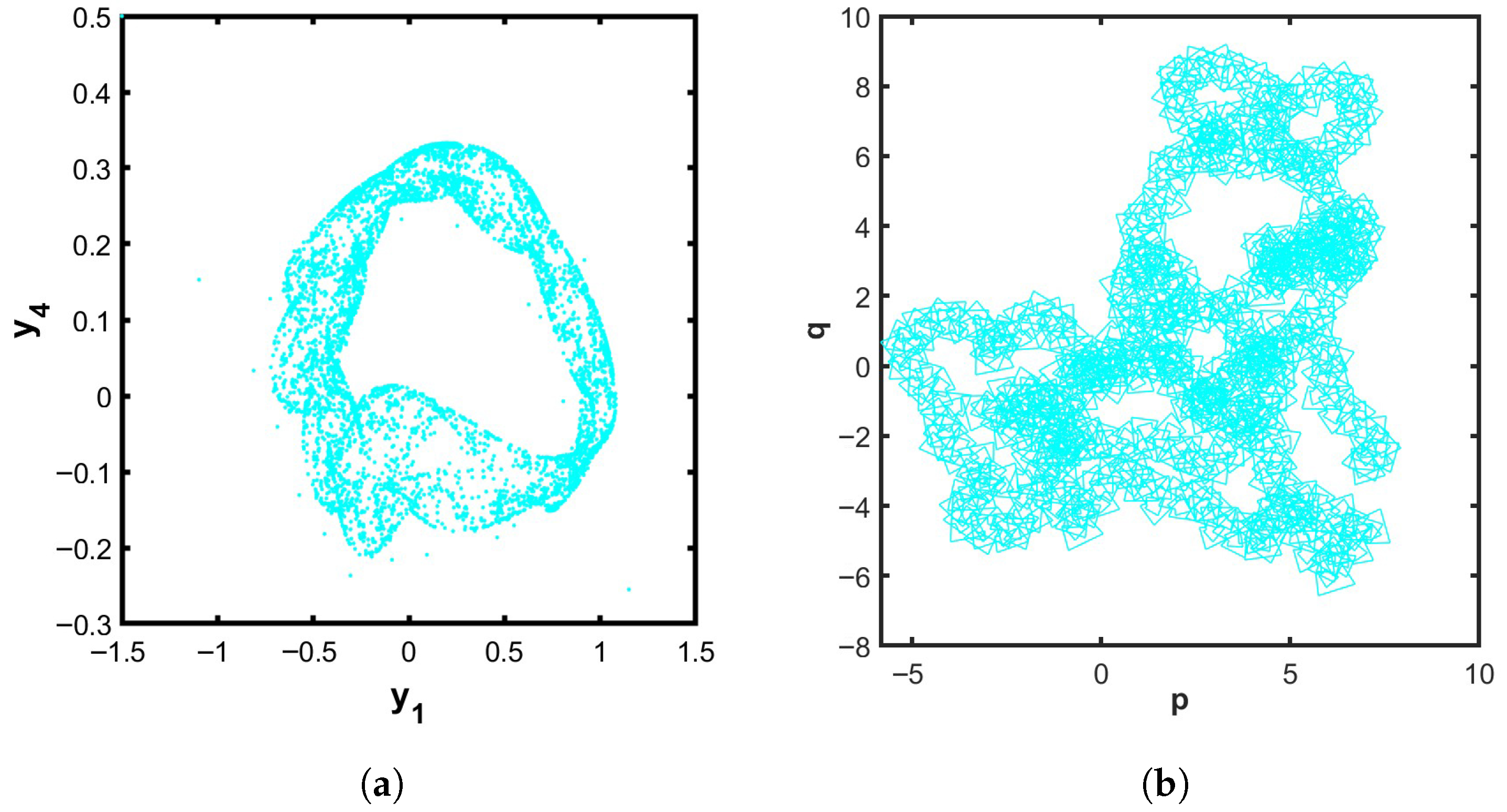
where the state variables y 1 denote the aggregate investment rate, y 2 represents the consumer demand or output index, y 3 corresponds to the price index, and y 4 describes the government expenditure feedback. The discrete iteration step is indicated by v, and the real parameters δ , γ , μ , σ , and β were selected based on established ranges from previous research on chaotic economic systems [40], ensuring comparability with the existing literature. These values represent typical ranges where economic systems exhibit complex dynamics, including chaos and bifurcations, while maintaining mathematical tractability for analysis. Using the 0-1 test [41], Figure 1 displays the translation components p q . A Brownian-like (unbounded) trajectory was discovered, suggesting the presence of a chaotic attractor.
The alternative version of system (14) can be described using the usual forward difference operator, as follows: Δ y n ( v ) = y n ( v + 1 ) y n ( v )
Δ y 1 ( v ) = y 3 ( v ) + y 1 ( v ) ( y 2 ( v ) δ ) + y 4 ( v ) , Δ y 2 ( v ) = 1 γ y 2 ( v ) y 1 2 ( v ) , Δ y 3 ( v ) = y 1 ( v ) μ y 3 ( v ) , Δ y 4 ( v ) = σ y 1 ( v ) y 2 ( v ) κ y 4 ( v ) .
Once v is changed to v 1 + α and Δ is changed to the Caputo-like operator C Δ t α , the resulting system is a fractional-order difference system:
C Δ t α y 1 ( v ) = y 3 ( W ) + y 1 ( W ) ( y 2 ( W ) δ ) + y 4 ( W ) , C Δ t α y 2 ( v ) = 1 γ y 2 ( W ) y 1 2 ( W ) , C Δ t α y 3 ( v ) = y 1 ( W ) μ y 3 ( W ) , C Δ t α y 4 ( v ) = σ y 1 ( W ) y 2 ( W ) κ y 4 ( W ) .
where W = v 1 + α v N t α + 1 , α ( 0 , 1 ] and t is the starting point. Our main goal now is to investigate the dynamic features of the 4D fractional discrete economic system (16) using phase space orbits, the 0-1 test, time series, bifurcation charts, and the Lyapunov exponent [42], while taking into account the effects of fractional constant order and σ system parameters. The 4D fractional discrete economic system (16) with constant order is numerically described in our simulations using Matlab R2025a, based on Theorem 1, which can be derived using the following:
y 1 ( e ) = y 1 ( 0 ) + 1 Γ ( α ) j = 0 e Γ ( e j + α ) Γ ( e j + 1 ) y 3 ( j ) + y 1 ( j ) ( y 2 ( j ) δ ) + y 4 ( j ) , y 2 ( e ) = y 2 ( 0 ) + 1 Γ ( α ) j = 0 e Γ ( e j + α ) Γ ( e j + 1 ) 1 γ y 2 ( j ) y 1 2 ( j ) , y 3 ( e ) = y 3 ( 0 ) + 1 Γ ( α ) j = 0 e Γ ( e j + α ) Γ ( e j + 1 ) y 1 ( j ) μ y 3 ( j ) , y 4 ( e ) = y 4 ( 0 ) + 1 Γ ( α ) j = 0 e Γ ( e j + α ) Γ ( e j + 1 ) σ y 1 ( j ) y 2 ( j ) κ y 4 ( j ) .
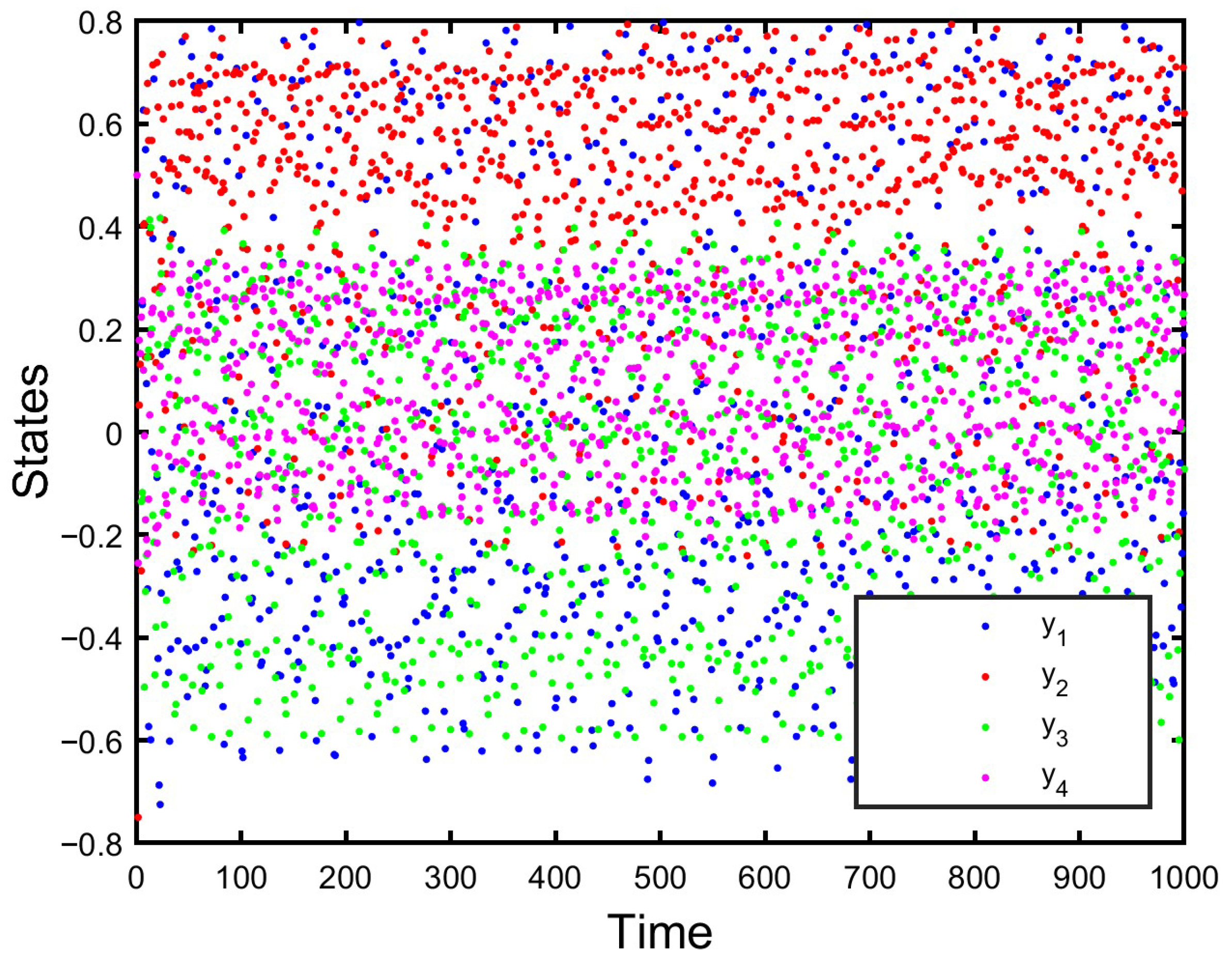
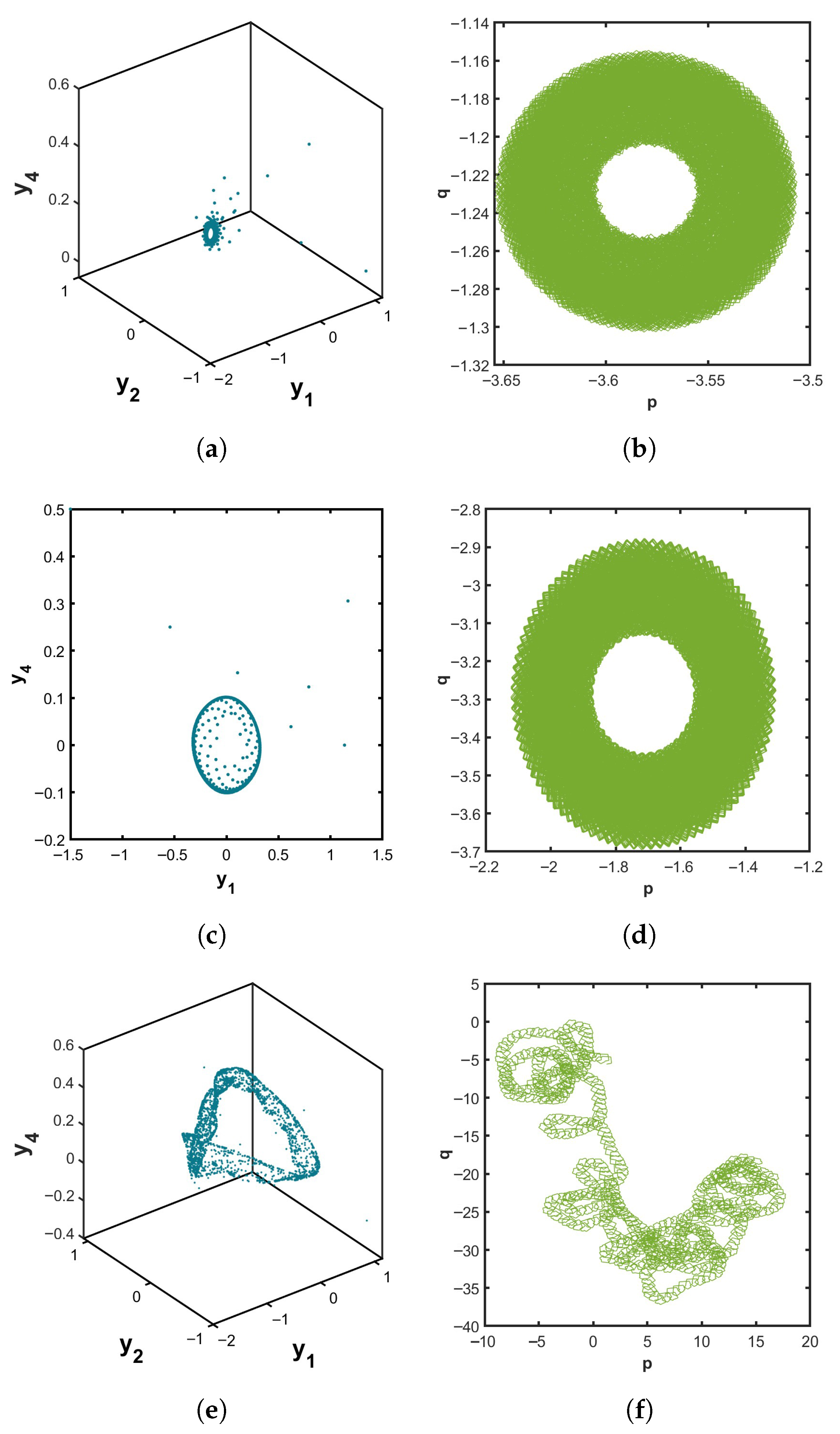
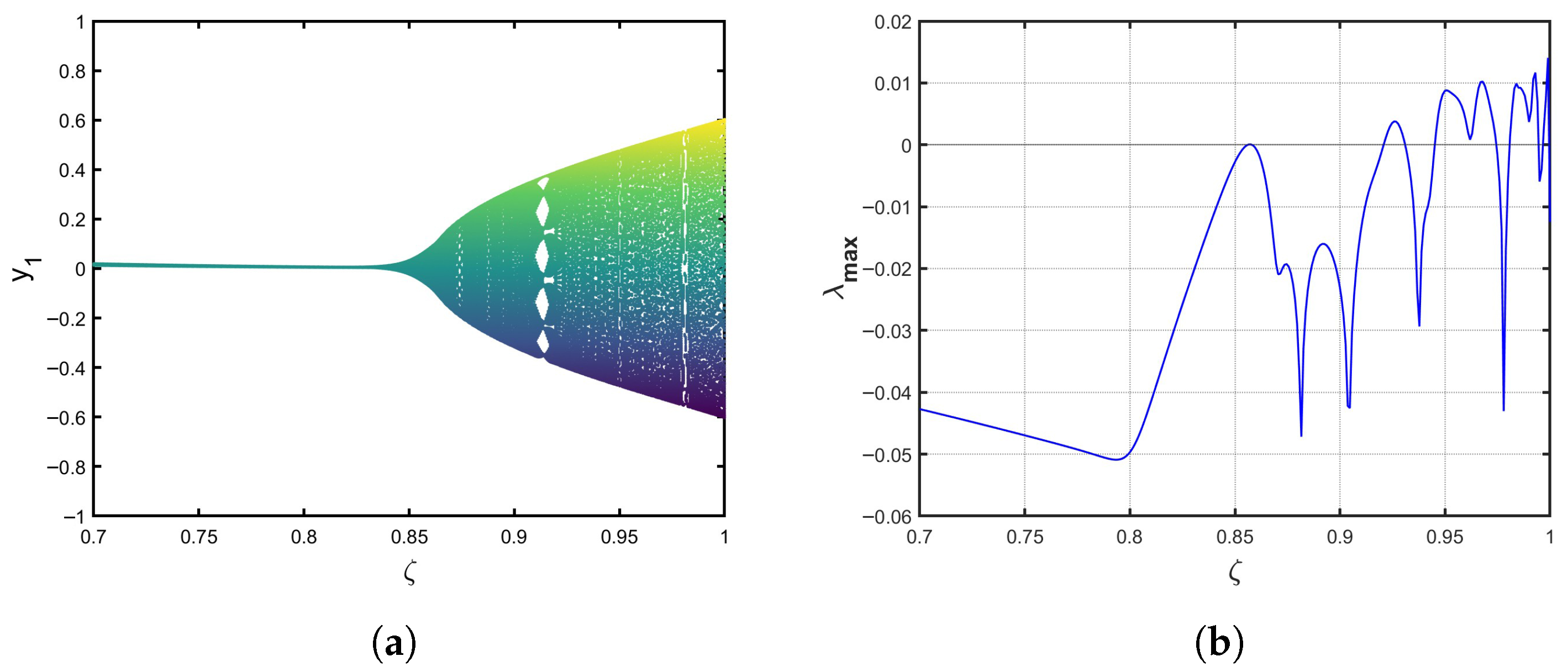
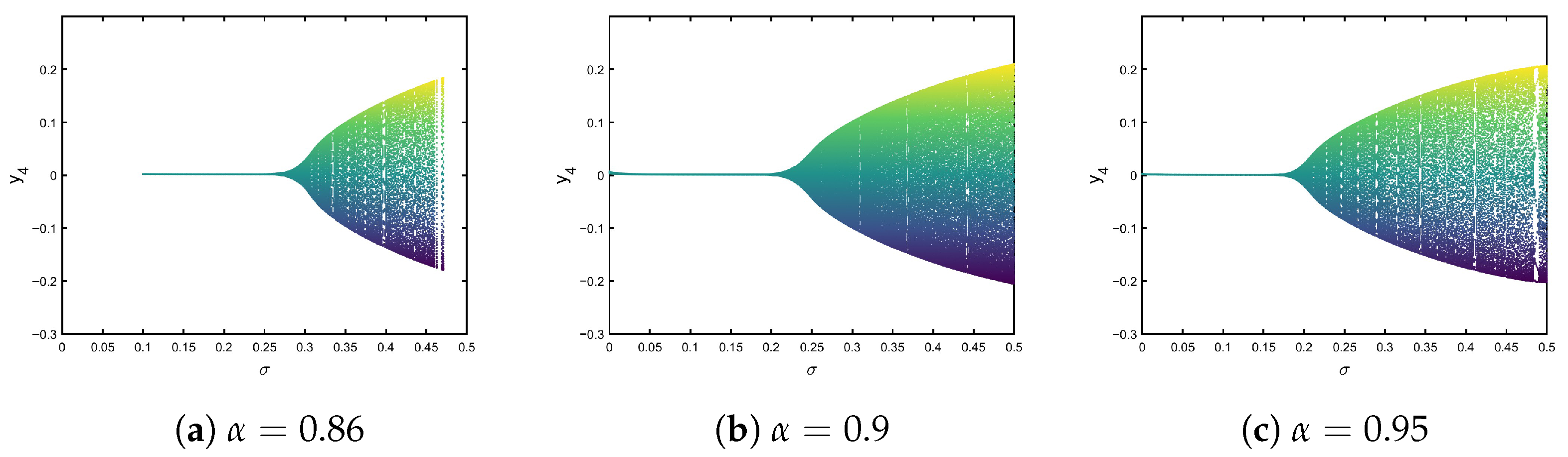
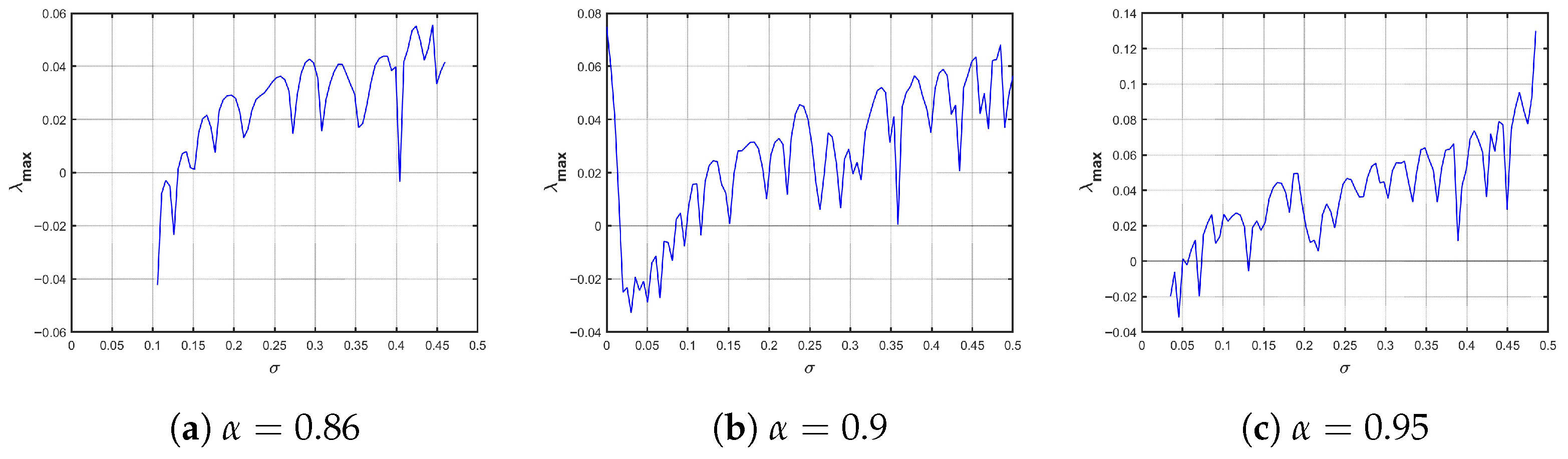
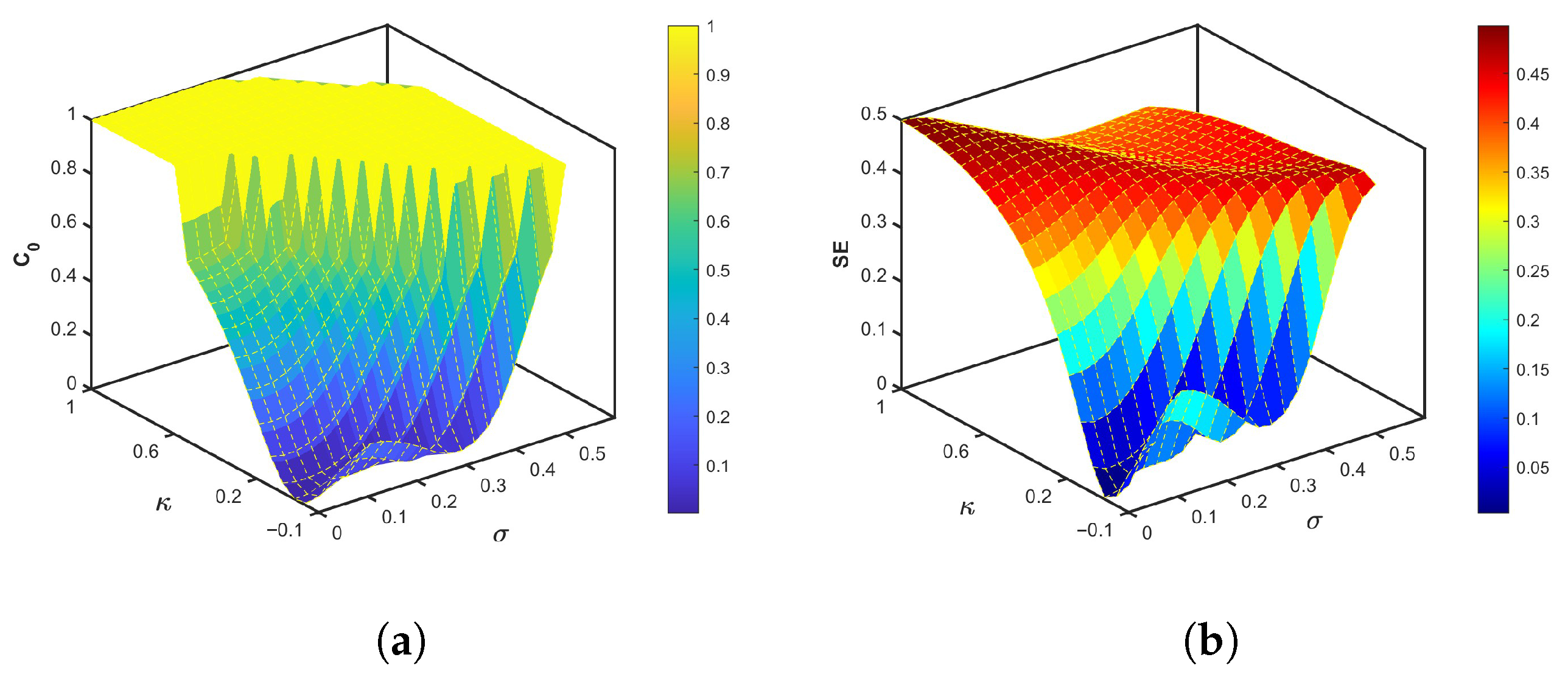
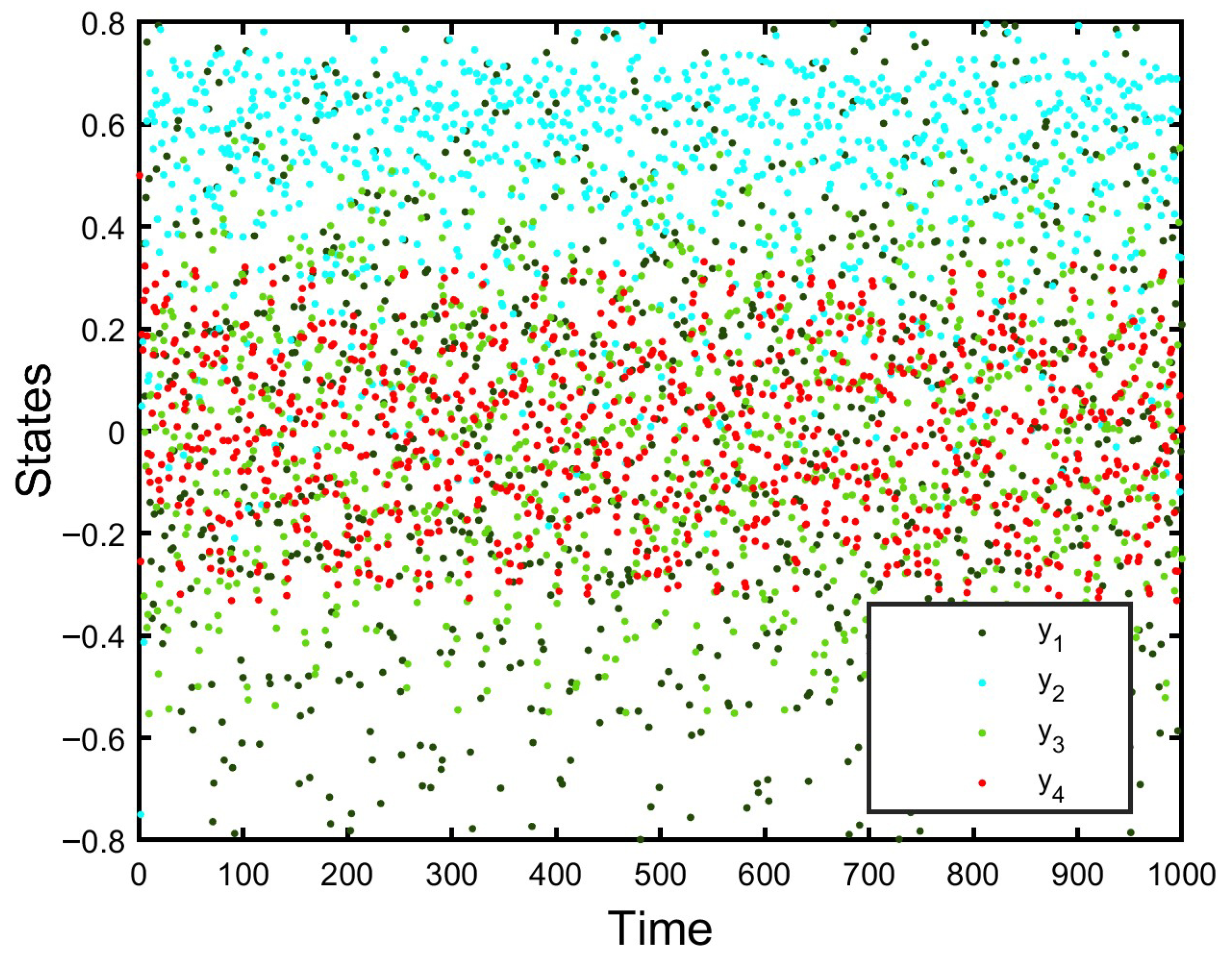
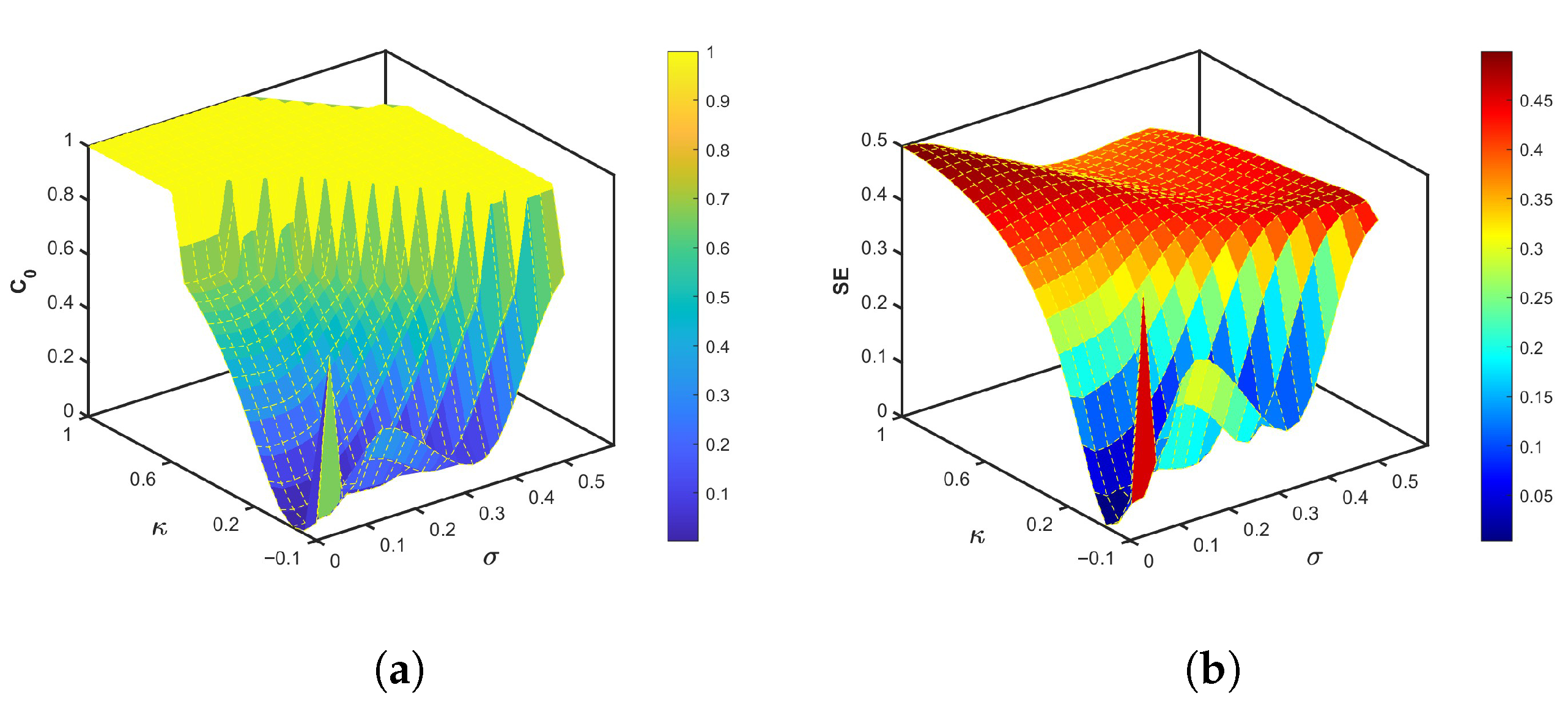
for instance, when selecting parameters δ = 0.09 , γ = 1.5 , μ = 1.5 , σ = 0.5 and κ = 0.1 and initial values y 1 ( 0 ) = 1.5 , y 2 ( 0 ) = 1 , y 3 ( 0 ) = 0.5 , y 4 ( 0 ) = 0.5 (I.C). The discrete time development of the states y 1 , y 2 , y 3 , and y 4 in the proposed constant fractional-order system is shown in Figure 2 to provide an extensive overview of these features. For all numerical simulations, the discrete iteration length was set to e = 3000 steps, with the initial 1000 iterations discarded as transients to ensure convergence with the attractor. It is evident to us that the trajectories are irregular and unpredictable. They exhibit erratic patterns, which are a defining characteristic of chaotic behavior, in which slight variations in the original setting result in wildly disparate movements. In Figure 3a,c, the stable closed invariant curve is shown. The extended closed invariant curve is depicted in Figure 1. A chaotic attractor is seen at α = 0.95 in Figure 3e, confirming that the closed invariant curve is impacted by the constant fractional order α . As previously mentioned, the system parameters are maintained, and the constant fractional order α is adjusted within the range [ 0.7 , 1 ] in order to further observe the dynamical behavior. We will provide more detail by discussing the chaos of the 4D fractional discrete economic system (16) for σ = 0.5 , where α varies from 0.7 to 1 by the step size Δ α = 0.8 × 10 4 . Both the highest Lyapunov exponent L L E diagram and the bifurcation diagram of y 1 vs α are displayed in Figure 4. As illustrated in this Figure, there is a clear correspondence between the bifurcation diagram and the Largest Lyapunov Exponent (LLE) curve. The negative values of the LLE ( LLE < 0 ) indicate the stable region where the trajectories converge toward a steady equilibrium. The narrow intervals where the LLE approaches zero ( LLE 0 ) represent periodic or quasi-periodic oscillations, while the positive values ( LLE > 0 ) identify the chaotic regime characterized by irregular and unpredictable fluctuations. This correspondence highlights the transitions between stability, periodicity, and chaos in the fractional-order economic system. It shows that as α decreases, the extensive memory system’s values change. The 4D fractional discrete economic system (16) loses stability through Neimark–Sacker bifurcation whenever we increase the value of α . Furthermore, we find that the chaotic zone disappears as the fractional-order value decreases. At α [ 0.95 , 0.973 ] [ 1.99 , 1 ] , the system (16) behaves chaotically. Figure 5 illustrates the bifurcation charts pertaining to parameter σ , since δ = 0.09 , γ = 1.5 , μ = 1.5 , and κ = 0.1 . Figure 6a–c represent the bifurcation diagrams for α = 0.86 , α = 0.9 , and α = 0.95 , accordingly. The three diagrams as a whole represent Neimark–Sacker bifurcations, with ε 1 varying among 0 and 0.5 . The plot of the largest Lyapunov exponent in Figure 6 validates the bifurcation diagram’s shape, as shown in Figure 5. Figure 7 plots the outcome of C 0 complexity [43] and S E [44]. As can be seen, the fluctuation in σ and κ correlated with the complexity of this model. Furthermore, in order to obtain a somewhat high structural complexity, we need to know the fractional order that was chosen. Therefore, to obtain a relatively high structural complexity, one should be careful when choosing the values of σ , κ , and fractional orders in system (16). These results are consistent with those of earlier analyses. The choice of constant fractional orders in modelling and influencing the dynamics of the 4D discrete economic system (16) is crucial, since this highlights the system’s complexity and diversity.

4. The 4D Fractional Discrete Economic System with Variable Fractional Order

In order to highlight the importance of fractional processes that depend on time in describing system behavior and complexity, numerical simulations were perfumed to investigate the interplay between parameters σ and variable fractional order α ( v ) . We will investigate the computation of the largest Lyapunov exponents (LLE), bifurcation charts, phase space orbits, 0-1 test, C 0 complexity, S E , and the evolution states of the system. Therefore, the previously defined Caputo-like difference operator Δ t α C is converted into its fractional variable-order version Δ t α ( v ) C . The variable-order fractional 4D discrete economic system is effectively formulated as
C Δ t α ( v ) y 1 ( v ) = y 3 ( U ) + y 1 ( U ) ( y 2 ( U ) δ ) + y 4 ( U ) , C Δ t α ( v ) y 2 ( v ) = 1 γ y 2 ( U ) y 1 2 ( U ) , C Δ t α ( v ) y 3 ( v ) = y 1 ( U ) μ y 3 ( U ) , C Δ t α ( v ) y 4 ( v ) = σ y 1 ( U ) y 2 ( U ) κ y 4 ( U ) .
where U = v 1 + α ( v ) , α ( v ) is the fractional variable-order such that α ( v ) [ 0 , 1 ] . The numerical formula for the system’s solution, (18), is required in order to discuss how the variable fractional order influences the dynamical behavior of the 4D discrete economic system. The numerical scheme in Theorem 1 can be extended to variable-order systems by treating the fractional order as a function of the discrete time index. In this case, the summation weights and gamma function terms become time-dependent, leading to the numerical formulation presented as follows [45]:
y 1 ( e ) = y 1 ( 0 ) + 1 Γ ( α ( j 1 ) ) j = 1 e Γ ( e j + α ( j 1 ) ) Γ ( e j + 1 ) { y 3 ( j 1 ) + y 1 ( j 1 ) ( y 2 ( j 1 ) δ ) + y 4 ( j 1 ) } , y 2 ( e ) = y 2 ( 0 ) + 1 Γ ( α ( j 1 ) ) j = 1 e Γ ( e j + α ( j 1 ) ) Γ ( e j + 1 ) 1 γ y 2 ( j 1 ) y 1 2 ( j 1 ) , y 3 ( e ) = y 3 ( 0 ) + 1 Γ ( α ( j 1 ) ) j = 1 e Γ ( e j + α ( j 1 ) ) Γ ( e j + 1 ) y 1 ( j 1 ) μ y 3 ( j 1 ) , y 4 ( e ) = y 4 ( 0 ) + 1 Γ ( α ( j 1 ) ) j = 1 e Γ ( e j + α ( j 1 ) ) Γ ( e j + 1 ) σ y 1 ( j 1 ) y 2 ( j 1 ) κ y 4 ( j 1 ) .
The intention of this part is to establish that, under variable fractional orders, the 4D discrete economic system displays rich dynamics. Examining the system’s dynamic features, particularly the impact of the bifurcation parameter and fractional variable-order functions, was our primary objective. For example, with starting values y 1 ( 0 ) = 1.5 ,   y 2 ( 0 ) = 1 , y 3 ( 0 ) = 0.5 , y 4 ( 0 ) = 0.5 (I.C) and assuming δ = 0.09 , γ = 1.5 , μ = 1.5 , σ = 0.5 and κ = 0.1 , we investigated the following three variable fractional orders:
α ( v ) = 0.94 + 0.05 sin v 5 , α ( v ) = 0.97 + 0.03 cos v 2 , α ( v ) = 0.9 + 0.1 sin v 2 .
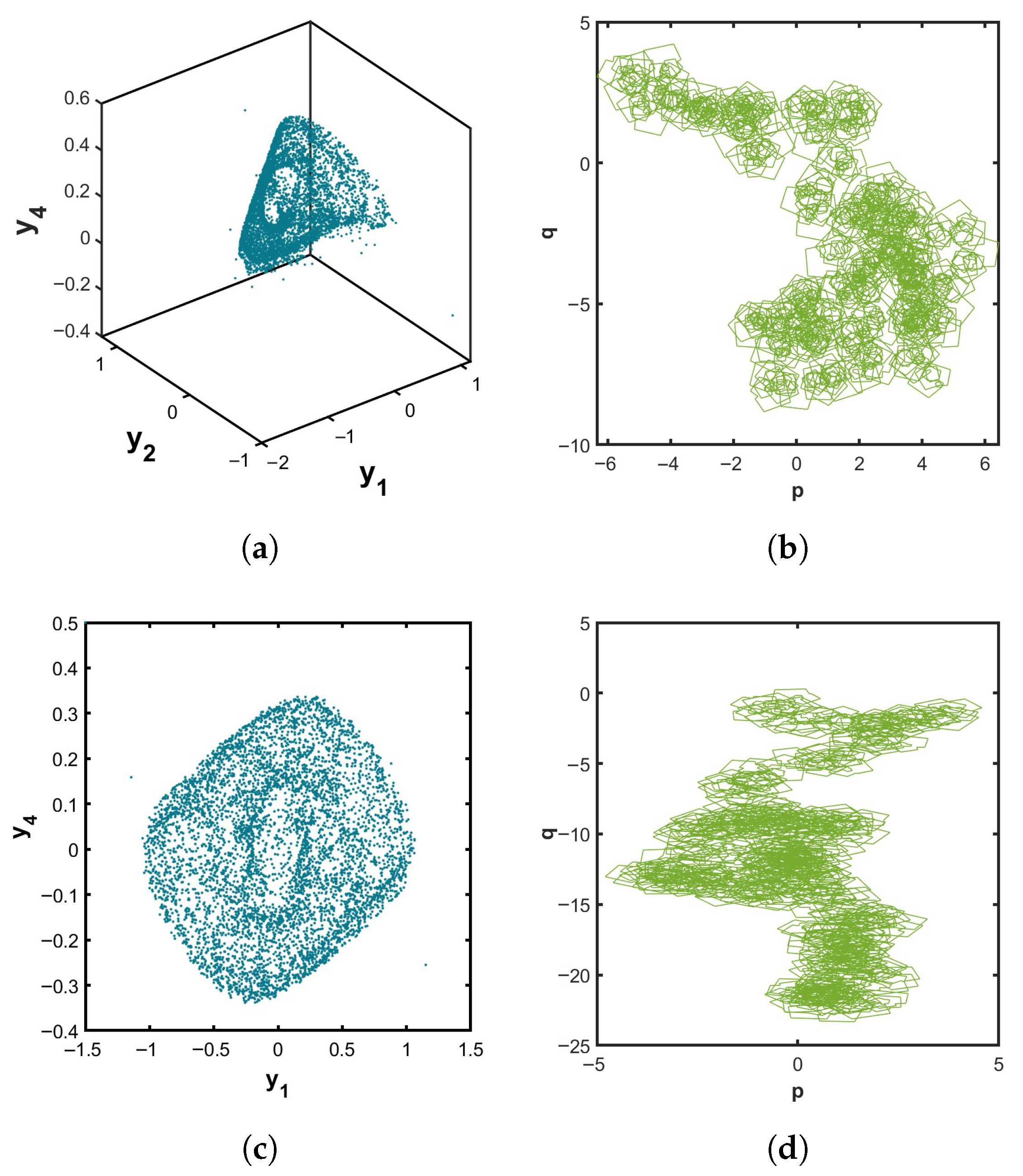
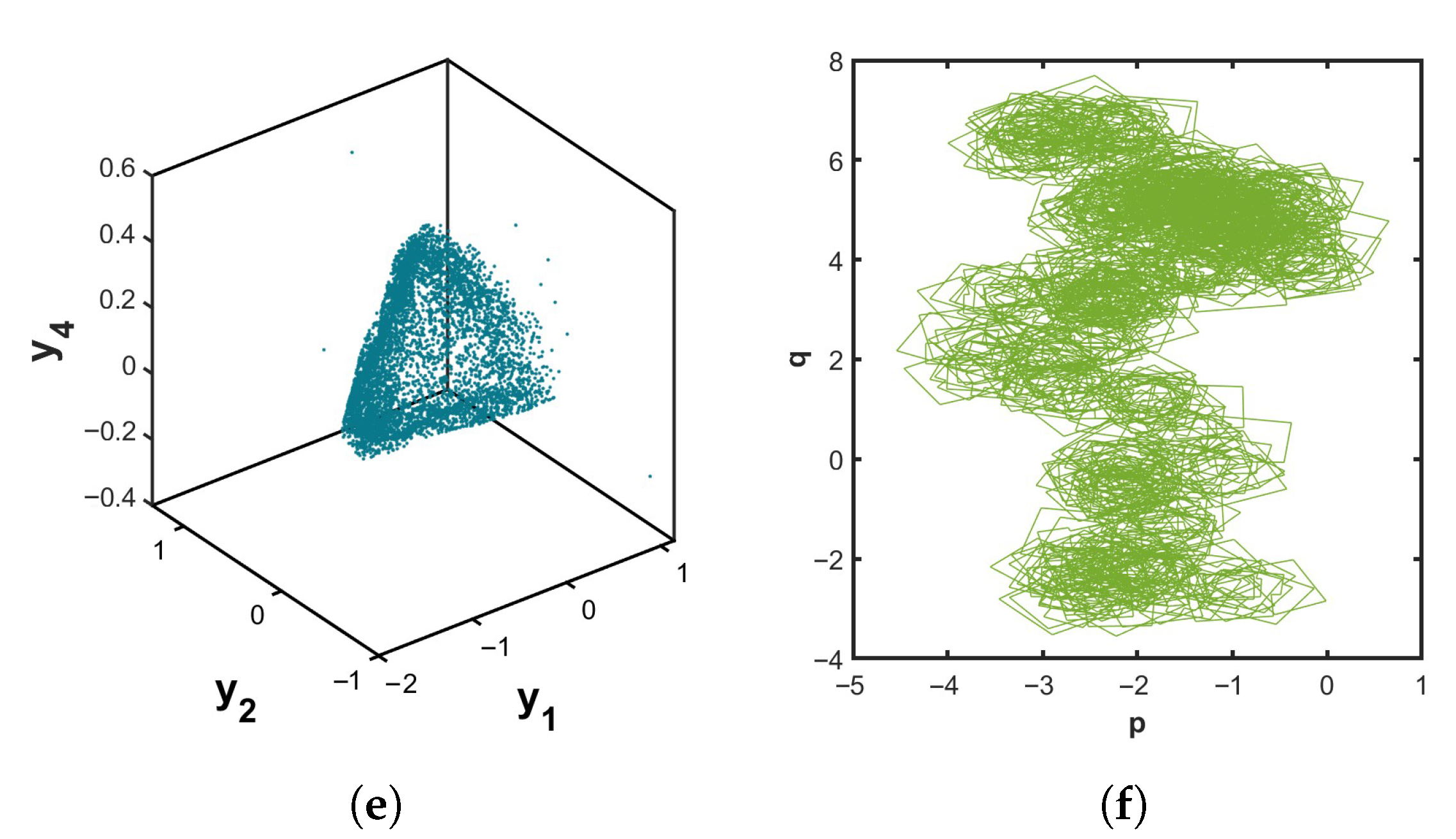
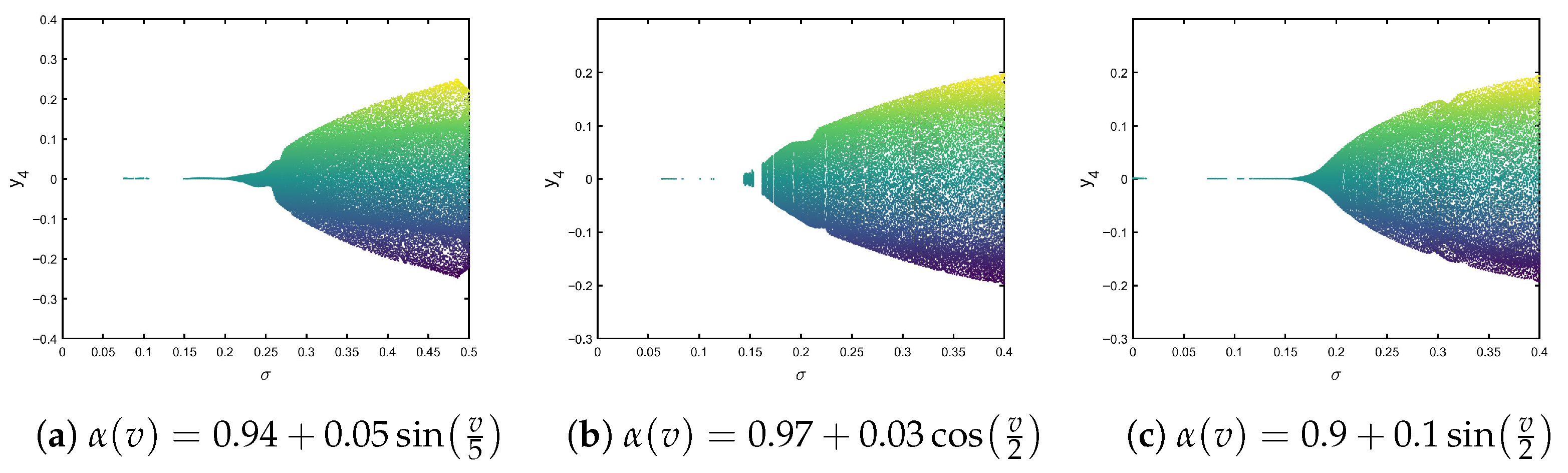
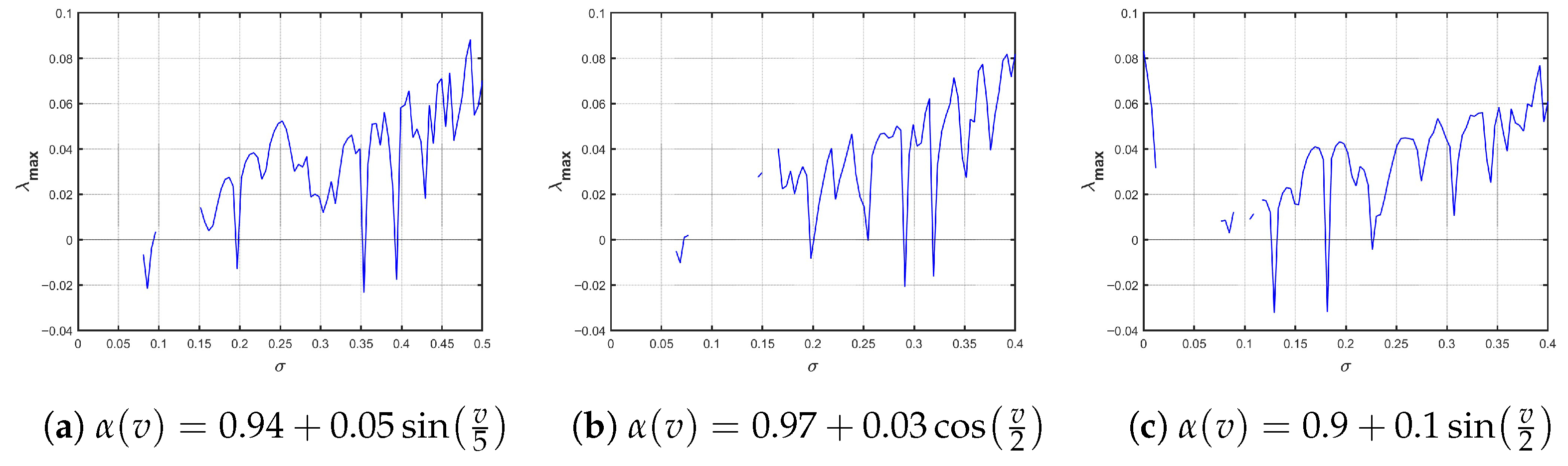
Firstly, the evolution of states y 1 , y 2 , y 3 , and y 4 was independent of time for the variable fractional α ( v ) = 0.97 + 0.03 cos v 2 order, as displayed in Figure 8. Furthermore, the analysis shows that the 4D discrete economic with variable fractional order has Brownian-like dynamics and chaotic attractors, as shown in Figure 9 for σ = 0.5 . Such figures are noteworthy because they show that even a slight alteration in the bifurcation parameter σ may impact the behavior. Notably, we observed more chaotic behavior for the variable fractional function α ( v ) = 0.97 + 0.03 cos v 2 than for the other two functions, as indicated by the evolution of states in Figure 8. Further, these chaotic attractors have a different structure from those found in the context of a constant fractional order. Taking σ as the bifurcation parameter, we examine the dynamics of the variable fractional system (18) and create bifurcation diagrams to comprehend system behavior. Specifically, δ = 0.09 , γ = 1.5 , μ = 1.5 , κ = 0.1 and I.C were set. For three variable fractional-order functions, bifurcation charts versus σ were calculated: α ( v ) = 0.94 + 0.05 sin v 5 , α ( v ) = 0.97 + 0.03 cos v 2 , α ( v ) = 0.9 + 0.1 sin v 2 , as shown in Figure 10. Notably, σ ranges from 0 to 0.5 in Figure 10a, while σ ranges from 0 to 0.4 in Figure 10b,c. We can see that the system exhibits a periodic condition at first. Through Neimark–Sacker bifurcation, it eventually descends into chaos. Next, in relation to the largest Lyapunov exponents L L E in Figure 11, the system is similar to the bifurcation pattern of the variable fractional system (18) seen in Figure 10. It is well known that when a system’s L L E is positive, it behaves chaotically, reflecting sensitivity to complicated dynamics and starting conditions. On the other hand, the system is in a periodic state if L L E is negative. Thus, in all three situations, the time-varying nature of variable fractional orders results in more severe transitory behaviors than their constant counterparts. In Figure 12, we apply the previously used numerical techniques in addition to other analytical tools like S E and C 0 complexity. These additional tools offer a more thorough evaluation of the chaotic structure of the system (18). Adding variable fractional-order dynamics to the 4D discrete economic system greatly enhances its behavior. Using various fractional operators (Caputo-left difference via constant order versus Caputo-left difference via variable order) produces different dynamic behaviors, as evidenced by this comparison of the two scenarios. The economic system with variable fractional order is a novel addition to studies on chaotic discrete systems with variable fractional-order dynamics.

5. Stabilization of the 4D Fractional Discrete Economic System

In this section, the capacity to stabilize chaotic economic systems (16), (18) is given special consideration. In order to move the chaotic systems states asymptotically towards zero, we refer to the control with the addition of adaptively updated terms. It should be noted that, in the context of this economic model, driving the state variables toward zero does not imply a shutdown of economic activity. Instead, the zero state corresponds to a normalized equilibrium point representing a steady balance among investment, demand, inflation feedback, and fiscal response. Hence, the control schemes are designed to eliminate chaotic fluctuations and restore this equilibrium condition.

5.1. Constant Fractional-Order Case

Here, we present the proposed constant fractional 4D discrete economic system’s control method (16). The presented control strategy dynamically modifies the system parameters according to the current state in order to reduce the chaotic behavior in the system. Employing the characteristics of constant fractional-order dynamics, the control rule is made to be both responsive and adaptive to modifications in the behavior of the system. In order to stabilize the constant fractional 4D discrete economic system, the next theorem presents a set of control laws.
Theorem 4.
The constant fractional 4D discrete economic system’s control method (16) can be asymptotically stabilized to the zero equilibrium under the proposed control law
C 1 ( W ) = y 1 ( W ) y 2 ( W ) y 1 ( W ) , C 2 ( W ) = y 1 2 ( W ) y 2 ( W ) 1 , C 3 ( W ) = y 3 ( W ) , C 4 ( W ) = y 4 ( W ) + σ y 1 ( W ) y 2 ( W ) .
Proof. 
The following is a description of the controller system:
C Δ t α y 1 ( v ) = y 3 ( W ) + y 1 ( W ) ( y 2 ( W ) δ ) + y 4 ( W ) + C 1 ( W ) , C Δ t α y 2 ( v ) = 1 γ y 2 ( W ) y 1 2 ( W ) + C 2 ( W ) , C Δ t α y 3 ( v ) = y 1 ( W ) μ y 3 ( W ) + C 3 ( W ) , C Δ t α y 4 ( v ) = σ y 1 ( W ) y 2 ( W ) κ y 4 ( W ) + C 4 ( W ) .
Thus, the below system was obtained by replacing the control term C i ( W ) , i = 1 , 2 , 3 , 4 in (21), as explained in (20):
C Δ t α y 1 ( v ) = y 3 ( W ) δ y 1 ( W ) + y 4 ( W ) y 1 ( W ) , C Δ t α y 2 ( v ) = γ y 2 ( W ) y 2 ( W ) , C Δ t α y 3 ( v ) = y 1 ( W ) μ y 3 ( W ) y 3 ( W ) , C Δ t α y 4 ( v ) = κ y 4 ( W ) y 4 ( W ) .
This is expressed in the following manner:
C Δ t α y 1 ( v ) y 2 ( v ) y 3 ( v ) y 4 ( v ) = Q y 1 ( v ) y 2 ( v ) y 3 ( v ) y 4 ( v ) ,
where
Q = ( 1 + δ ) 0 1 1 0 ( 1 + γ ) 0 0 1 0 ( 1 + μ ) 0 0 0 0 ( 1 + κ ) .
It is clear that the eigenvalues of Q fulfill
| arg λ j | > α π 2 and | λ j | < 2 cos | arg λ j | π 2 α α , j = 1 , 2 , 3 , 4 .
The zero solution of system (22) is asymptotically stable, as per Theorem 2. As a result, the proposed control law fully stabilizes the system (16). □
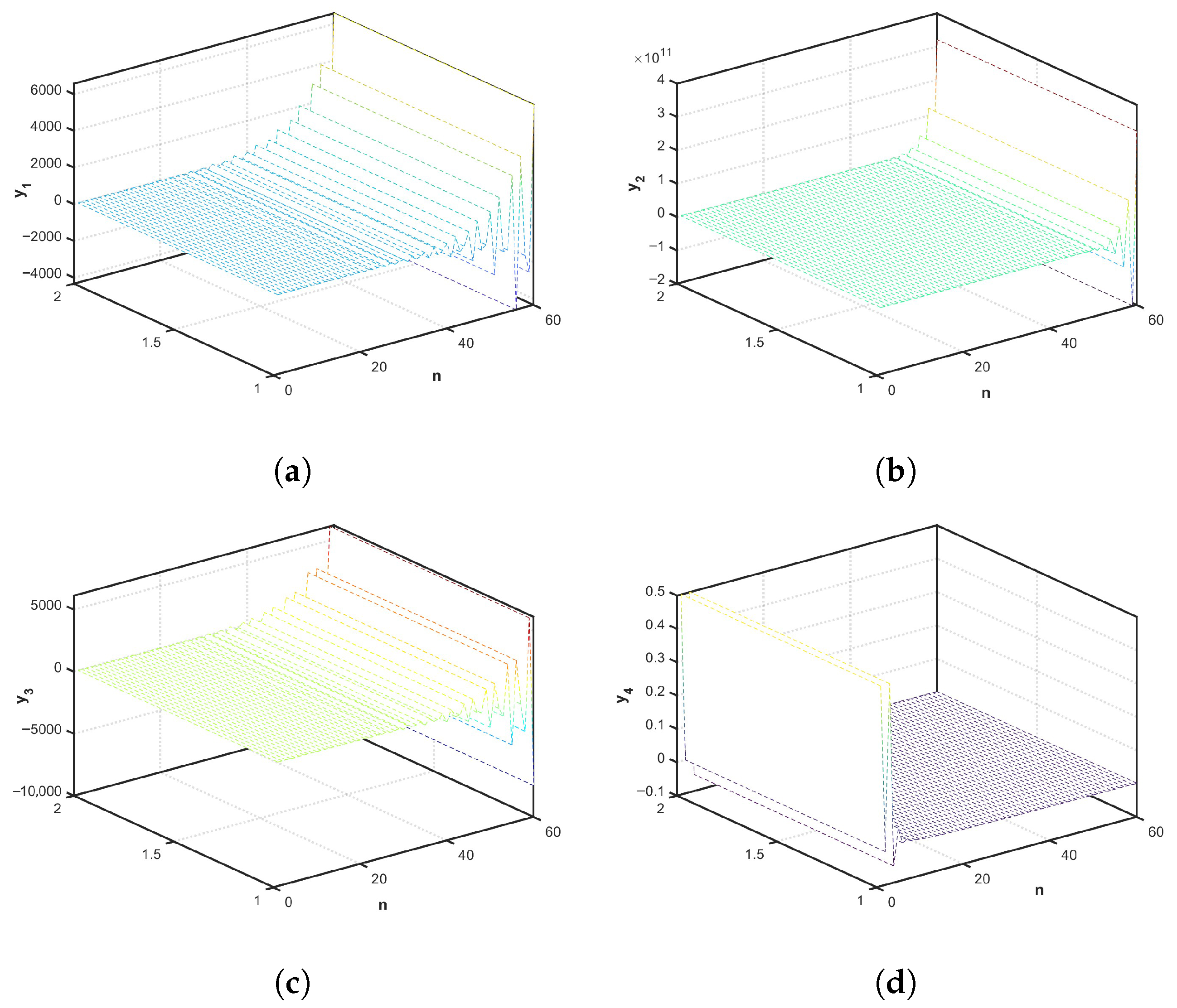
Through numerical simulations, we evaluate the outcomes of Theorem 4. Figure 13 shows the time series of the 4D discrete economic system (16) with controlled constant fractional order. The system’s states asymptotically approach zero, as the figure makes clear, verifying its successful stabilization.

5.2. Variable Fractional-Order Case

In the following part, by making use of the stabilization strategy for variable-order fractional systems, our goal is to develop a strong control rule that propels all states of the fractional 4D discrete economic system (18) with variable fractional order in the direction of asymptotic stability at the origin.
Accordingly, the controlled system is as follows:
C Δ t α ( v ) y 1 ( v ) = y 3 ( U ) + y 1 ( U ) ( y 2 ( U ) δ ) + y 4 ( U ) + T 1 ( U ) , C Δ t α ( v ) y 2 ( v ) = 1 γ y 2 ( U ) y 1 2 ( U ) + T 2 ( U ) , C Δ t α ( v ) y 3 ( v ) = y 1 ( U ) μ y 3 ( U ) + T 3 ( U ) , C Δ t α ( v ) y 4 ( v ) = σ y 1 ( U ) y 2 ( U ) κ y 4 ( U ) + T 4 ( U ) .
Theorem 5.
The variable fractional 4D discrete economic system’s control method (18) can be asymptotically stabilized to the zero equilibrium under the proposed control law
T 1 ( U ) = y 1 ( U ) y 2 ( U ) y 1 ( U ) , T 2 ( U ) = y 1 2 ( U ) y 2 ( U ) 1 , T 3 ( U ) = y 3 ( U ) , T 4 ( U ) = y 4 ( U ) + σ y 1 ( U ) y 2 ( U ) .
Proof. 
Replacing (27) the control term T i ( U ) , i = 1 , 2 , 3 , 4 in (26):
C Δ t α ( v ) y 1 ( v ) = y 3 ( U ) δ y 1 ( U ) + y 4 ( U ) y 1 ( U ) , C Δ t α ( v ) y 2 ( v ) = γ y 2 ( U ) y 2 ( U ) , C Δ t α ( v ) y 3 ( v ) = y 1 ( U ) μ y 3 ( U ) y 3 ( U ) , C Δ t α ( v ) y 4 ( v ) = κ y 4 ( U ) y 4 ( U ) .
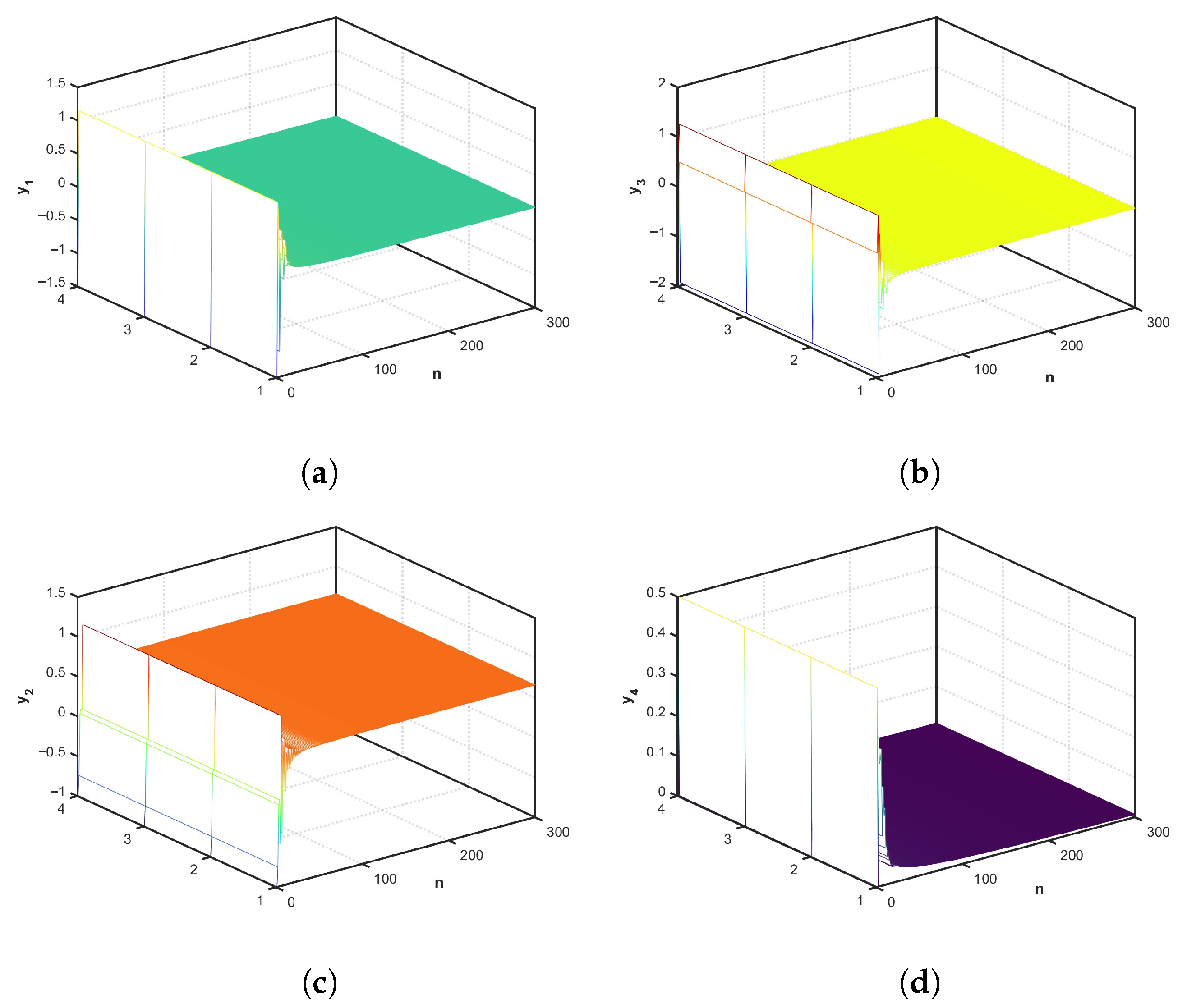
The values of λ 1 = 0.91 , λ 2 = λ 3 = 0.5 , λ 4 = 0.9 , and α = 0.9 are provided. Applying MATLAB, we find that System (28)’s eigenvalues fulfill Theorem (3)’s necessities, validating the stability of the variable fractional 4D discrete economic system (18) in Figure 14.

6. Conclusions

In this article, the evolution of the fractional four-dimensional (4D) discrete economic system with constant- and variable-order derivatives’ chaotic and stable states is presented. Beyond conventional integer-order systems, these two kinds of fractional orders are broadening the investigation of system dynamics. Different numerical techniques were used to verify that the suggested fractional variants of the 4D discrete economic system are chaotic. These consisted of 0-1 test plots, Lyapunov exponents, time states, phase space orbit, bifurcation diagrams, spectral entropy, and C 0 complexity. The research validates the existence of chaotic attractors in the system across many fractional-order scenarios by employing these methods for comprehensive investigation. The 4D fractional discrete economic system’s states with constant- and variable-order derivatives were also guided to the origin within an established period of time using two distinct types of control techniques. In future research, we plan to apply the variable fractional order in the framework of other economic models in order to explore this subject further.

Author Contributions

Conceptualization, A.A. and O.K.; Methodology, L.D.; Software, L.D.; Validation, O.K. and A.O.; Formal analysis, L.E.A. and M.A.; Investigation, L.D. and L.E.A.; Resources, L.E.A. and M.A.; Data curation, A.A. and A.O.; Writing—original draft, L.D.; Writing—review and editing, L.D. and O.K.; Visualization, L.D.; Supervision, A.O.; Project administration, L.D. and A.O.; Funding acquisition, A.A. and O.K. All authors have read and agreed to the published version of the manuscript.

Funding

Princess Nourah bint Abdulrahman University Researchers Supporting Project number (PNURSP2025R831), Princess Nourah bint Abdulrahman University, Riyadh, Saudi Arabia. The authors extend their appreciation to the Deanship of Scientific Research at Northern Border University, Arar, KSA for funding this research work through the project number “NBU-FFR-2025-2443-14”.

Data Availability Statement

The original contributions presented in this study are included in the article. Further inquiries can be directed to the corresponding author(s).

Acknowledgments

Princess Nourah bint Abdulrahman University Researchers Supporting Project number (PNURSP2025R831), Princess Nourah bint Abdulrahman University, Riyadh, Saudi Arabia. The authors extend their appreciation to the Deanship of Scientific Research at Northern Border University, Arar, KSA for funding this research work through the project number “NBU-FFR-2025-2443-14”.

Conflicts of Interest

The authors declare no conflict of interest.

References

  1. David, S.A.; Machado, J.A.T.; Quintino, D.D.; Balthazar, J.M. Partial chaos suppression in a fractional order macroeconomic model. Math. Comput. Simul. 2016, 122, 55–68. [Google Scholar] [CrossRef]
  2. Klioutchnikov, I.; Sigova, M.; Beizerov, N. Chaos theory in finance. Procedia Comput. Sci. 2017, 119, 368–375. [Google Scholar] [CrossRef]
  3. Federici, D.; Gandolfo, G. Chaos in economics. J. Econ. Dev. Stud. 2014, 2, 51–79. [Google Scholar]
  4. Gardini, L.; Lamantia, F.; Radi, D.; Szidarovszky, F.; Tramontana, F. Nonlinear dynamics in economic modelling. Decis. Econ. Financ. 2021, 44, 485–487. [Google Scholar] [CrossRef]
  5. Gardini, L.; Radi, D.; Schmitt, N.; Sushko, I.; Westerhoff, F. New economic era thinking and stock market bubbles: A two-dimensional piecewise linear discontinuous map approach. In International Conference on Difference Equations and Applications; Springer Nature: Cham, Switzerland, 2023; pp. 173–202. [Google Scholar]
  6. Rahman, Z.A.S.; Jasim, B.H.; Al-Yasir, Y.I.; Hu, Y.F.; Abd-Alhameed, R.A.; Alhasnawi, B.N. A new fractional-order chaotic system with its analysis, synchronization, and circuit realization for secure communication applications. Mathematics 2021, 9, 2593. [Google Scholar] [CrossRef]
  7. Rizk-Allah, R.M.; Hagag, E.A.; El-Fergany, A.A. Chaos-enhanced multi-objective tunicate swarm algorithm for economic-emission load dispatch problem. Soft Comput. 2023, 27, 5721–5739. [Google Scholar] [CrossRef]
  8. Tusset, A.M.; Fuziki, M.E.; Balthazar, J.M.; Andrade, D.I.; Lenzi, G.G. Dynamic analysis and control of a financial system with chaotic behavior including fractional order. Fractal Fract. 2023, 7, 535. [Google Scholar] [CrossRef]
  9. Tarasov, V.E.; Tarasova, V.V. Long and short memory in economics: Fractional-order difference and differentiation. arXiv 2016, arXiv:1612.07903. [Google Scholar] [CrossRef]
  10. Lin, Z.; Wang, H. Modeling and application of fractional-order economic growth model with time delay. Fractal Fract. 2021, 5, 74. [Google Scholar] [CrossRef]
  11. Baskonus, H.M.; Mekkaoui, T.; Hammouch, Z.; Bulut, H. Active control of a chaotic fractional order economic system. Entropy 2015, 17, 5771–5783. [Google Scholar] [CrossRef]
  12. Cheow, Y.H.; Ng, K.H.; Phang, C.; Ng, K.H. The application of fractional calculus in economic growth modelling: An approach based on regression analysis. Heliyon 2024, 10, e35379. [Google Scholar] [CrossRef]
  13. Elsonbaty, A.; Elsadany, A.A. On discrete fractional-order Lotka-Volterra model based on the Caputo difference discrete operator. Math. Sci. 2023, 17, 67–79. [Google Scholar] [CrossRef]
  14. Fečkan, M.; Danca, M.F. Non-periodicity of complex Caputo like fractional differences. Fractal Fract. 2023, 7, 68. [Google Scholar] [CrossRef]
  15. Xu, B.; Ye, X.; Wang, G.; Huang, Z.; Zhang, C. A Fractional-Order Improved Quantum Logistic Map: Chaos, 0-1 Testing, Complexity, and Control. Axioms 2023, 12, 94. [Google Scholar] [CrossRef]
  16. Johansyah, M.D.; Sambas, A.; Zheng, S.; Qureshi, S.; Abed-Elhameed, T.M.; Vaidyanathan, S. Analyzing and Controlling Chaos Phenomena in Fractional Chaotic Supply Chain Models. Heliyon 2024, 10, e35612. [Google Scholar] [CrossRef]
  17. Abed-Elhameed, T.M.; Mahmoud, G.M.; Elbadry, M.M.; Ahmed, M.E. Nonlinear Distributed-Order Models: Adaptive Synchronization, Image Encryption and Circuit Implementation. Chaos Solitons Fractals 2023, 175, 114039. [Google Scholar] [CrossRef]
  18. Abed-Elhameed, T.M.; Otefy, M.; Mahmoud, G.M. Dynamics of Chaotic and Hyperchaotic Modified Nonlinear Schrödinger Equations and Their Compound Synchronization. Phys. Scr. 2024, 99, 055226. [Google Scholar] [CrossRef]
  19. Zhang, X.; Li, C.; Wang, Q. Bifurcation Analysis for the Discretized–Fractionalized Holling Type-IV Predator–Prey System. Nonlinear Dyn. 2025, 115, 11262. [Google Scholar]
  20. Abdeljawad, T. On Delta and Nabla Caputo Fractional Differences and Dual Identities. Discret. Dyn. Nat. Soc. 2013, 2013, 406910. [Google Scholar] [CrossRef]
  21. Hamadneh, T.; Abbes, A.; Abu Falahah, I.; Al-Khassawneh, Y.A.; Heilat, A.S.; Al-Husban, A.; Ouannas, A. Complexity and Chaos Analysis for Two-Dimensional Discrete-Time Predator–Prey Leslie–Gower Model with Fractional Orders. Axioms 2023, 12, 561. [Google Scholar] [CrossRef]
  22. Busłowicz, M. Simple Conditions for Practical Stability of Positive Fractional Discrete-Time Linear Systems. Int. J. Appl. Math. Comput. Sci. 2009, 19, 263–269. [Google Scholar] [CrossRef]
  23. Busłowicz, M. Practical Stability of Positive Fractional Discrete-Time Linear Systems. Bull. Pol. Acad. Sci. Tech. Sci. 2008, 56, 313–317. [Google Scholar]
  24. Shatnawi, M.T.; Abbes, A.; Ouannas, A.; Batiha, I.M. A New Two-Dimensional Fractional Discrete Rational Map: Chaos and Complexity. Phys. Scr. 2022, 98, 015208. [Google Scholar] [CrossRef]
  25. Goodrich, C.H.; Peterson, A.C. Discrete Fractional Calculus; Springer: Cham, Switzerland, 2016; pp. 1–202. [Google Scholar]
  26. Diabi, L.; Ouannas, A.; Hioual, A.; Momani, S.; Abbes, A. On fractional discrete financial system: Bifurcation, chaos, and control. Chin. Phys. B 2024, 33, 100201. [Google Scholar] [CrossRef]
  27. Chu, Y.M.; Bekiros, S.; Zambrano-Serrano, E.; Orozco-López, O.; Lahmiri, S.; Jahanshahi, H.; Aly, A.A. Artificial macro-economics: A chaotic discrete-time fractional-order laboratory model. Chaos Solitons Fractals 2021, 145, 110776. [Google Scholar] [CrossRef]
  28. Abbes, A.; Ouannas, A.; Shawagfeh, N. An incommensurate fractional discrete macroeconomic system: Bifurcation, chaos, and complexity. Chin. Phys. B 2023, 32, 030203. [Google Scholar] [CrossRef]
  29. Diabi, L.; Ouannas, A.; Momani, S.; Grassi, G. On chaos in fractional discrete financial risk model and its control approaches. Asian J. Control 2025. [Google Scholar] [CrossRef]
  30. Abbes, A.; Ouannas, A.; Hioual, A.; Momani, S. Hidden Chaos in a New Memristor-Based Discrete System with Commensurate, Incommensurate and Variable Fractional Orders. Phys. Scr. 2024, 99, 105233. [Google Scholar] [CrossRef]
  31. Jahanshahi, H.; Sajjadi, S.S.; Bekiros, S.; Aly, A.A. On the development of variable-order fractional hyperchaotic economic system with a nonlinear model predictive controller. Chaos Solitons Fractals 2021, 144, 110698. [Google Scholar] [CrossRef]
  32. Wang, B.; Liu, J.; Alassafi, M.O.; Alsaadi, F.E.; Jahanshahi, H.; Bekiros, S. Intelligent parameter identification and prediction of variable time fractional derivative and application in a symmetric chaotic financial system. Chaos Solitons Fractals 2022, 154, 111590. [Google Scholar] [CrossRef]
  33. Almatroud, O.A.; Khennaoui, A.A.; Ouannas, A.; Alshammari, S.; Albosaily, S. A New Fractional Discrete Memristive Map with Variable Order and Hidden Dynamics. Fractal Fract. 2024, 8, 322. [Google Scholar] [CrossRef]
  34. Tang, Z.; He, S.; Wang, H.; Sun, K.; Yao, Z.; Wu, X. A novel variable-order fractional chaotic map and its dynamics. Chin. Phys. B 2024, 33, 030503. [Google Scholar] [CrossRef]
  35. Abdeljawad, T. On Riemann and Caputo fractional differences. Comput. Math. Appl. 2011, 62, 1602–1611. [Google Scholar] [CrossRef]
  36. Atici, F.M.; Eloe, P. Discrete fractional calculus with the nabla operator. Electron. J. Qual. Theory Differ. Equ. 2009, 62, 12. [Google Scholar] [CrossRef]
  37. Wu, G.C.; Baleanu, D. Discrete fractional logistic map and its chaos. Nonlinear Dyn. 2014, 75, 283–287. [Google Scholar] [CrossRef]
  38. Čermák, J.; Győri, I.; Nechvátal, L. On explicit stability conditions for a linear fractional difference system. Electron. J. Qual. Theory Differ. Equ. 2015, 18, 651–672. [Google Scholar] [CrossRef]
  39. Momani, S.; Batiha, I.M.; Djenina, N.; Ouannas, A. Analyzing the Stability of Caputo Fractional Difference Equations with Variable Orders. Prog. Fract. Differ. Appl. 2025, 11, 139–151. [Google Scholar] [CrossRef]
  40. Yousefpour, A.; Jahanshahi, H.; Munoz-Pacheco, J.M.; Bekiros, S.; Wei, Z. A fractional-order hyper-chaotic economic system with transient chaos. Chaos Solitons Fractals 2020, 130, 109400. [Google Scholar] [CrossRef]
  41. Gottwald, G.A.; Melbourne, I. The 0-1 test for chaos: A review. Chaos Detect. Predict. 2016, 915, 221–247. [Google Scholar]
  42. Wu, G.C.; Baleanu, D. Jacobian matrix algorithm for Lyapunov exponents of the discrete fractional maps. Commun. Nonlinear Sci. Numer. Simul. 2015, 22, 95–100. [Google Scholar] [CrossRef]
  43. Shen, E.; Cai, Z.; Gu, F. Mathematical foundation of a new complexity measure. Appl. Math. Mech. 2005, 26, 1188–1196. [Google Scholar] [CrossRef]
  44. Nunes, R.R.; Almeida, M.P.D.; Sleigh, J.W. Spectral entropy: A new method for anesthetic adequacy. Rev. Bras. Anestesiol. 2004, 54, 404–422. [Google Scholar] [PubMed]
  45. Anastassiou, G.A. Principles of delta fractional calculus on time scales and inequalities. Math. Comput. Model. 2010, 52, 556–566. [Google Scholar] [CrossRef]
Figure 1. Chaotic dynamics in the 4D discrete economic system (14) for δ = 0.09 , γ = 1.5 , μ = 1.5 , σ = 0.5 and β = 0.1 . (a) Phase space orbit, (b) 0-1 Test.
Fractalfract 09 00724 g001
Figure 2. Time series of the 4D fractional discrete economic system (16) with constant order.
Fractalfract 09 00724 g002
Figure 3. The phase space orbits and 0-1 test of the 4D fractional discrete economic system (16) with constant order for different α orders: (a,b) α = 0.86 , (c,d) α = 0.9 , (e,f) α = 0.95 .
Fractalfract 09 00724 g003
Figure 4. (a) Bifurcation of (16) versus α [ 0.7 , 1 ] , (b) the corresponding L L E .
Fractalfract 09 00724 g004
Figure 5. Bifurcations of (16) versus σ [ 0 , 0.5 ] parameter for different α orders.
Fractalfract 09 00724 g005
Figure 6. L L E analysis of (16) for different α orders adopted in Figure 5.
Fractalfract 09 00724 g006
Figure 7. Simulation with Matlab via various settings σ - κ for α = 0.95 : (a) C 0 Complexity, (b) S E approach.
Fractalfract 09 00724 g007
Figure 8. Time series of the 4D fractional discrete economic system (18) with variable order.
Fractalfract 09 00724 g008
Figure 9. The phase space orbits and 0-1 test of the 4D fractional discrete economic system (18) with variable order: (a,b) α ( v ) = 0.94 + 0.05 sin v 5 , (c,d) α ( v ) = 0.97 + 0.03 cos v 2 , (e,f) α ( v ) = 0.9 + 0.1 sin v 2 .
Fractalfract 09 00724 g009aFractalfract 09 00724 g009b
Figure 10. Bifurcations of (18) versus σ [ 0 , 0.5 ] parameter for different α ( v ) function orders.
Fractalfract 09 00724 g010
Figure 11. L L E analysis of (18) for different α ( v ) orders adopted in Figure 10.
Fractalfract 09 00724 g011
Figure 12. Simulation with Matlab via various settings σ - κ for α ( v ) = 0.97 + 0.03 cos v 2 : (a) C 0 Complexity, (b) S E approach.
Fractalfract 09 00724 g012
Figure 13. (ad) The stability states of the controlled constant-order system (21).
Fractalfract 09 00724 g013
Figure 14. (ad) The stability states of the controlled variable-order system (26).
Fractalfract 09 00724 g014
Disclaimer/Publisher’s Note: The statements, opinions and data contained in all publications are solely those of the individual author(s) and contributor(s) and not of MDPI and/or the editor(s). MDPI and/or the editor(s) disclaim responsibility for any injury to people or property resulting from any ideas, methods, instructions or products referred to in the content.