
Article

On Variable-Order Fractional Discrete Macroeconomic Model: Stability, Chaos, and Complexity
1
Department of Electronics Engineering, Applied College, University of Ha’il, Ha’il 2440, Saudi Arabia
2
Laboratory of Dynamical Systems and Control, Department of Mathematics and Computer Science, University of Oum El Bouaghi, Oum El Bouaghi 04000, Algeria
3
Department of Mathematics and Computer Science, University of Oum El Bouaghi, Oum El Bouaghi 04000, Algeria
4
Department of Electrical Engineering, College of Engineering, Princess Nourah bint Abdulrahman University, P.O. Box 84428, Riyadh 11671, Saudi Arabia
5
Department of Information Technology, Faculty of Computing and Information Technology, Northern Border University, Arar 91431, Saudi Arabia
*
Authors to whom correspondence should be addressed.
Fractal Fract. 2025, 9(11), 723; https://doi.org/10.3390/fractalfract9110723
Submission received: 23 September 2025 / Revised: 18 October 2025 / Accepted: 31 October 2025 / Published: 8 November 2025
(This article belongs to the Special Issue Nonlinear Dynamics, Chaos and Control of Fractional Systems)

Abstract

Macroeconomic mathematical models are practical instruments structured to carry out theoretical analyses of macroeconomic developments. In this manuscript, the Caputo-like fractional operator of variable order is used to introduce and investigate the mechanism of the discrete macroeconomic model. The nature of the dynamics was established, and the emergence of chaos using a distinct variable fractional order, especially the stability of the trivial solution, is examined. The findings reveal that the variable-order discrete macroeconomic model displays chaotic dynamics employing bifurcation, the Largest Lyapunov exponent ( L E m a x ), the phase portraits, and the 0–1 test. Furthermore, a complexity analysis is performed to demonstrate the existence of chaos and quantify its complexity using C 0 complexity and spectral entropy ( S E ). These studies show that the suggested variable-order fractional discrete macroeconomic model has more complex features than integer and constant fractional orders. Finally, MATLAB R2024b simulations are run to exemplify the outcomes of this study.
MSC:
91B62; 91B64; 37N40; 37D45; 34A08; 34D20; 93D20; 93B52; 93C55

1. Introduction

Economists’ research is increasingly interested in mathematical economic models and the study of their dynamics. This interest has had a significant impact on both macroeconomics and microeconomics. Specifically, in macroeconomics, its impact has been significantly larger. Some economic models can be found in [1,2]. We might locate a lot of mathematical conclusions about economic systems in this literature, which are helpful for thoroughly examining the dynamic properties of economic models. On the other hand, macroeconomic models can be used to illustrate and explain fundamental theoretical ideas [3]. They can also evaluate, compare, and quantify different macroeconomic theories. On the other hand, mathematics offers the basis for improving the accuracy and dependability of economic research findings. Mathematical modeling has emerged as the primary instrumental technique for indirectly studying economic facts and processes in recent decades. Therefore, several studies employ mathematical models as an analytical tool. Additional research has examined differential equations of integer order [4]. Furthermore, it is revealed that using a model with a fractional derivative to represent the real-world issue will yield more accurate simulation results [5].
In the 20th century, chaos theory was developed. The distinct features of chaos theory, such as ergodicity and initial value sensitivity, have garnered much interest [6,7]. Its theoretical accomplishments continue to grow, and numerous new features are continuously being investigated. As science and technology advance, providing a more accurate description of several intricate nonlinear phenomena is essential for gaining a deeper comprehension of systems’ dynamic behavior. In contrast to continuous models, discrete models have been widely used recently to assess and analyze economic markets. In addition, the dynamics of the discrete-time economic models are more complex than those of the continuous-time models. There are many important categories of discrete models in [8,9,10]. The study of chaos theory in fractional discrete models represented by difference equations of non-integer order has received more attention recently, demonstrating increased sensitivity to initial conditions [11,12]. Fractional discrete-time chaotic systems’ dynamical behaviors are significant and universal in various domains, from information security to mathematics. In order to address this, researchers have focused on applying discrete fractional calculus theory to discrete chaotic maps. These systems’ capacity to represent intricate, real-world phenomena that conventional integer-order models are unable to represent adequately makes them especially fascinating [13,14].
Fractional calculus has revolutionized the modeling of diffusion processes by incorporating non-integer-order derivatives and integrals [15,16]. Additionally, characterizing memory effects in a range of materials and processes is more accurate with fractional-order derivatives than with integer-order derivatives. Constant and variable-order fractional operators have emerged as essential tools in various fields, including physics, secure communication, finance, and economics [17,18]. Their importance stems from their capacity to function as a modeling solution for phenomena and systems characterized by dynamic degrees of memory and complexity [19]. Therefore, they have become essential tools for investigating and comprehending dynamic systems that display variable or adaptive properties. Thus, variable order is a better way to describe mathematical problems. In modeling dynamical systems with discrete-time variable order, there is much interest in considering a Caputo fractional difference operator [20,21,22,23]. For example, in [20], Calgan explored a fractional discrete dark matter and dark energy model with variable order. Zheng et al. [21] discussed the dynamical behavior of a variable fractional-order system with hidden memory. A variable fractional-order discrete sine model was investigated by Tang et al. [22]. The authors of [23] analyzed the synchronization and numerical solutions of the chaotic model via variable fractional order. These operators provide an incredibly flexible and versatile method for describing systems’ complex behaviors and dynamics where the fractional order dynamically adjusts to changing inputs and conditions. Their adaptability has allowed for more accurate and responsive modeling in dynamic and complex scenarios, opening up new research avenues.
There are not many published studies on the chaotic macroeconomic models that fractional difference operators describe. Specifically, there is insufficient documentation on fractional variable-order cases. It is appealing to assess the system’s chaotic characteristics and complexity of macroeconomic discrete-time models based on fractional differences under variable order. The content of this paper is divided as follows: Section 2 proposes the fractional discrete macroeconomic model with variable orders and provides a fundamental understanding of discrete fractional calculus. In Section 3 presents a variety of numerical tools, including phase diagrams, Lyapunov exponent, bifurcation, and the 0–1 test, which have been used to carefully analyze the chaotic dynamics of this discrete system under various variable orders. Continuing to Section 4, the emphasis switches to verifying the discrete system’s chaotic behaviors using C 0 complexity and spectral entropy ( S E ). Finally, the effectiveness and robustness of the techniques described in this study are confirmed by numerical results.

2. Background and Model Description

In this section, some fundamental theories based on the idea of fractional calculus with discrete time are offered, and a mathematical model for discrete macroeconomics with variable fractional order is given.

2.1. Fractional Tools

The ω -Caputo-left difference operator Δ o ω C η ( h ) of the function η ( h ) : N o R with fixed N o = { o , o + 1 , o + 2 , } , o R is expressed as follows [24]:
Δ o ω C η ( h ) = Δ o ( n ω ) Δ n η ( h ) = 1 Γ ( n ω ) u = b h ( h u 1 ) ( n ω 1 ) Δ n η ( u ) ,
where h N o + n ω and n = ω + 1 for ω N . The ω -th fractional sum of η ( h ) is as follows [25]:
Δ o ω η ( h ) = 1 Γ ( ω ) u = o h ( h u 1 ) ( ω 1 ) η ( u ) ,
with h N o + ω and ω > 0 . The falling function, denoted by the term h ( ω ) , is provided by
h ( ω ) = Γ ( h + 1 ) Γ ( h + 1 ω ) ,
and
Δ n η ( h ) = Δ ( Δ n 1 η ( h ) ) = l = 0 n n l ( 1 ) n l η ( h + l ) , h N o .
The Δ o ω ( h ) C Caputo-left variable-order fractional difference operator is defined as follows [26]:
Δ o ω ( h ) C η ( h + 1 ω ( h ) ) = η ( h + 1 ) + u = 0 h ( 1 ) h u + 1 ω ( h u ) h u + 1 η ( u ) + ( 1 ) h ω ( h ) 1 h + 1 η ( 0 ) ,
where ω : Z ( 0 , 1 ] .

2.2. The Model and Its Stability

A new nonlinear discrete macroeconomic model with fractional order was proposed in [27] using the Jomari fractional derivative. Afterward, Chu et al. [28] used the Caputo operator with commensurate constant order to present a two-dimensional discrete macroeconomic system. On the other hand, in [29], researchers studied the incommensurate-order version. So, the constant-order fractional discrete macroeconomic system is represented as
Δ o ω C z 1 ( h ) = z 2 ( υ ) , Δ o ω C z 2 ( h ) = ( γ 1 ) z 2 ( υ ) ( γ + 1 ) z 2 3 ( υ ) δ z 1 ( υ ) .
where z 1 denotes the investment state and z 2 denotes the income state. δ indicates the strength from investment to income, while γ describes the sensitivity of income growth. υ = h 1 + ω , h N o + 1 ω , and ω ( 0 , 1 ] . This mathematical model explains the dynamics of the macroeconomic system, where fractional memory influences the nonlinear interaction between output and demand. Variations in the fractional derivative order ω represent shifts in the economic system’s temporal reaction and how the market responds differently in stable times compared to crisis times. Thus, in this work, the appearance of chaos signifies erratic economic swings brought on by nonlinear interactions and fluctuating memory effects.
After substituting the variable-order operator Δ o ω ( h ) c for the Caputo-left difference operator Δ o ω c , the variable fractional discrete macroeconomic model is as follows:
Δ o ω ( h ) C z 1 ( h ) = z 2 ( h + ω ( h ) 1 ) , Δ o ω ( h ) C z 2 ( h ) = ( γ 1 ) z 2 ( h + ω ( h ) 1 ) ( γ + 1 ) z 2 3 ( h + ω ( h ) 1 ) δ z 1 ( h + ω ( h ) 1 ) .
where h N o + 1 ω ( h ) , with variable order ω ( h ) , is interpreted as representing the time-varying memory of the macroeconomic model, ω ( h ) ( 0 , 1 ] . The dynamic character of macroeconomic memory and adaptation across time is intended to be captured by the variable fractional order ω ( h ) . Under various economic conditions, the system’s ability to “remember” previous states changes, as indicated by the time-varying order ω ( h ) .
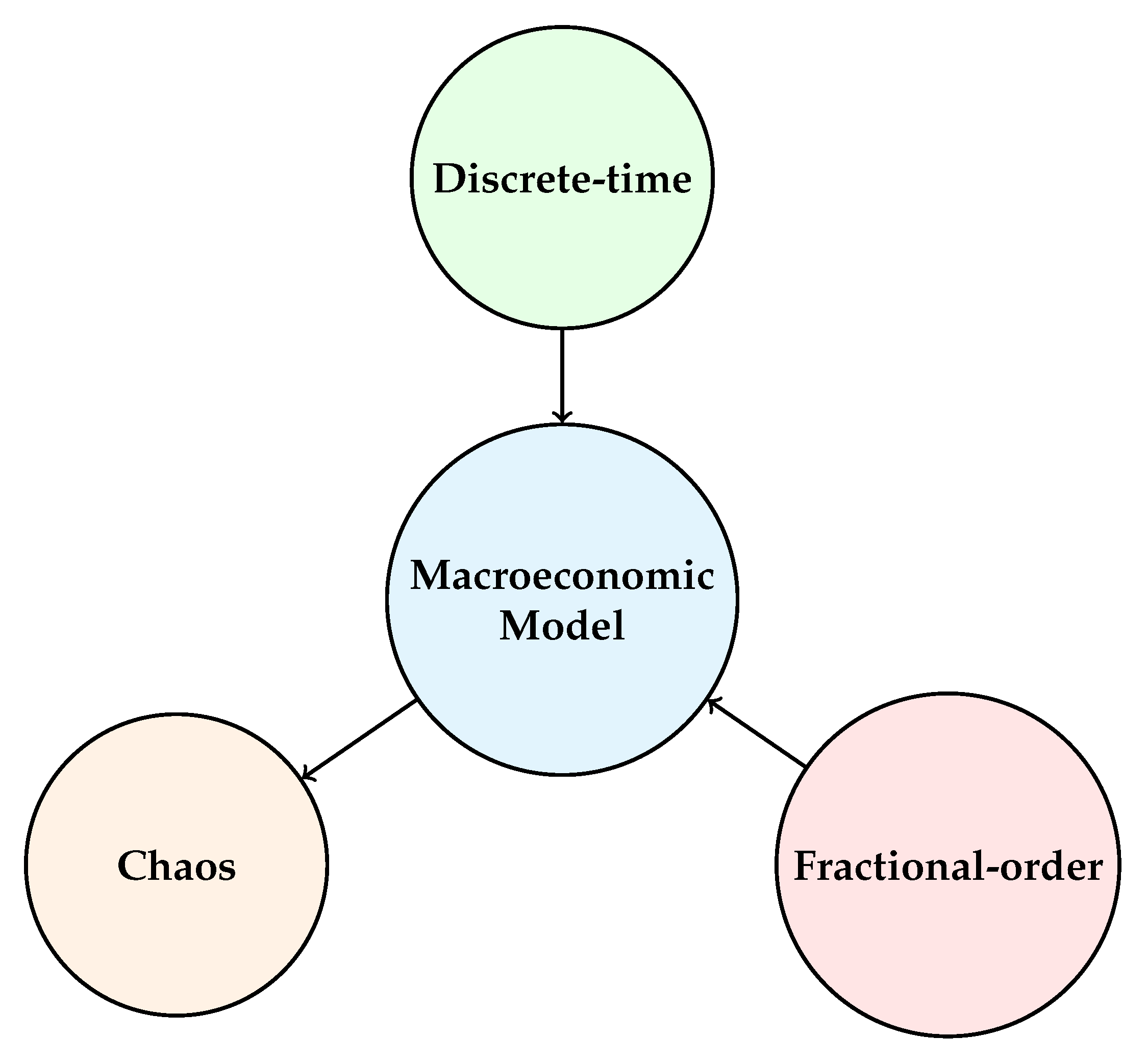
The essential components of a chaotic fractional discrete macroeconomic model are depicted in Figure 1. The primary system, known as the discrete macroeconomic model, is situated at the center of the diagram and is influenced by three key features. Indicating the model’s progressive progression across time, the top arrow indicates that it is a discrete-time model. To account for memory effects and hereditary qualities in the system’s evolution, the right node highlights the fractional-order nature. The system’s sensitivity to initial conditions and capacity for intricate, unpredictable dynamics are finally indicated by the left node, which denotes the system’s chaotic behavior. These characteristics collectively specify the dynamic complexity and underlying structure of the model (6) under consideration.
Next, we evaluate the stability characteristics of the Equilibrium Points (Eps) of the variable-order fractional discrete macroeconomic model (7); according to Refs [28,29], the fractional map has a zero equilibrium point and the Jacobian matrix for (7) computed at ( 0 , 0 ) is
J = 0 1 δ γ 1 .
It is necessary to remember the ensuing theorem aiming to examine the stability (Ep) of variable-order discrete model (7).
Theorem 1
([26]). A discrete macroeconomic model with fractional variable-order (7) is stable if for any eigenvalues λ of J,
d λ , C S ω ( 0 ) > ϱ .
Then, model (7) is locally asymptotically stable, where
ϱ : = max 1 ω min ω max + ω min ω ( 0 ) , ω max ω min ω max 1 + ω ( 0 ) ,
ω min = inf ω ( h ) , ω max = sup ω ( h ) ,
which means
S ω ( 0 ) = a C : | a | < 2 cos | arg a | π 2 ω ( 0 ) ω ( 0 ) and | arg a | > ω ( 0 ) π 2 .
and
d λ , C S ω ( 0 ) = inf | λ a | , a C S ω ( 0 ) .
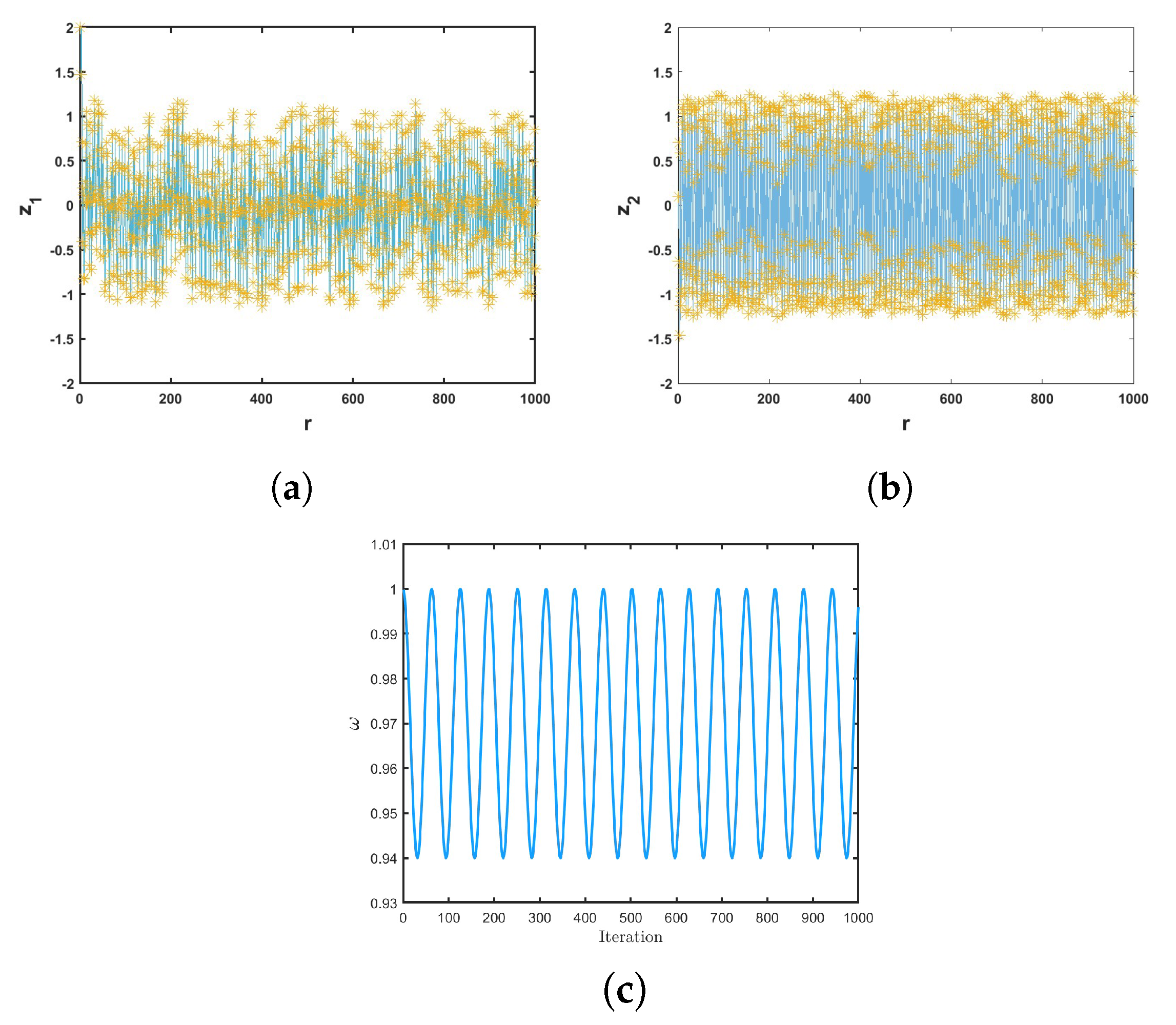
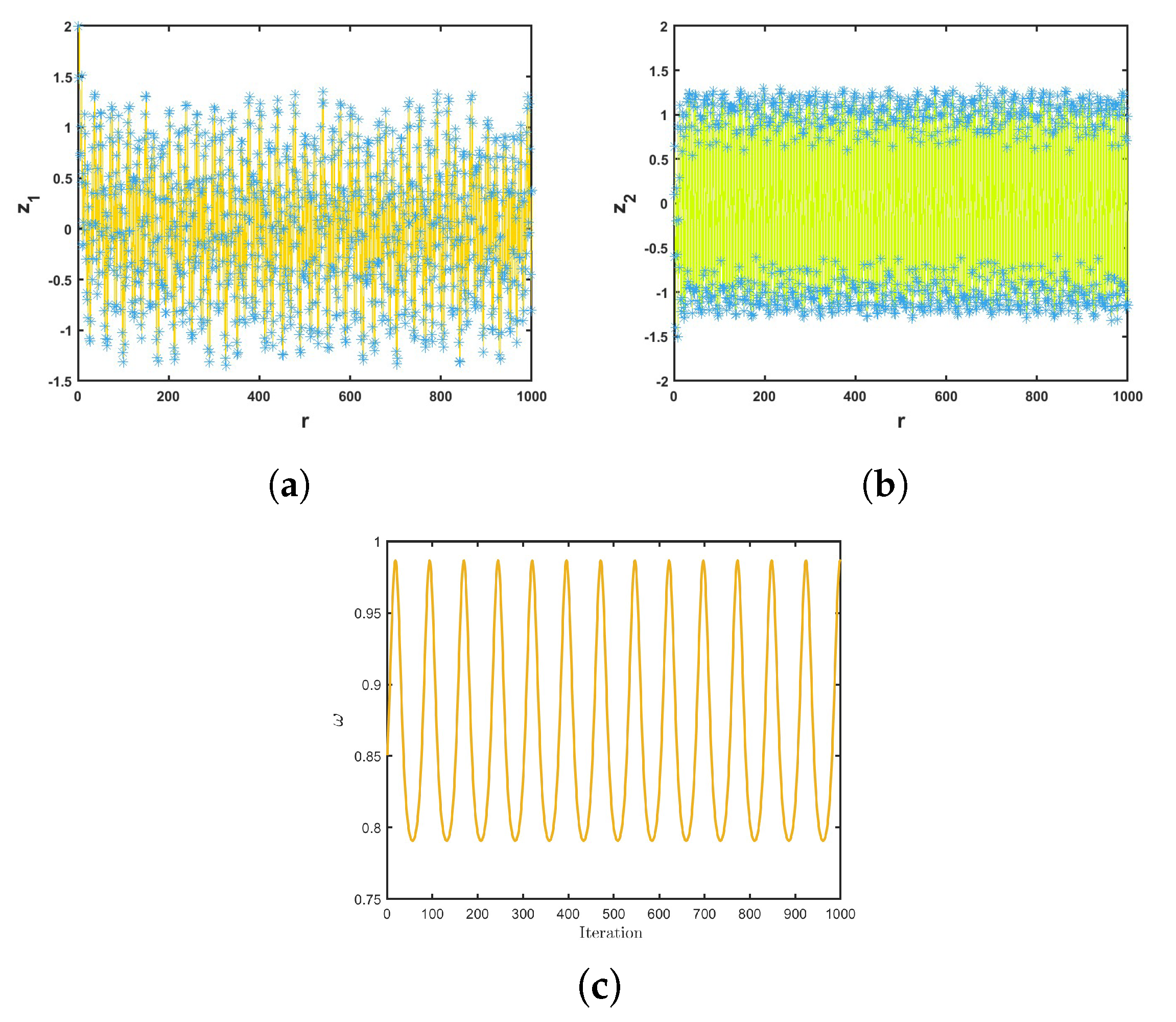
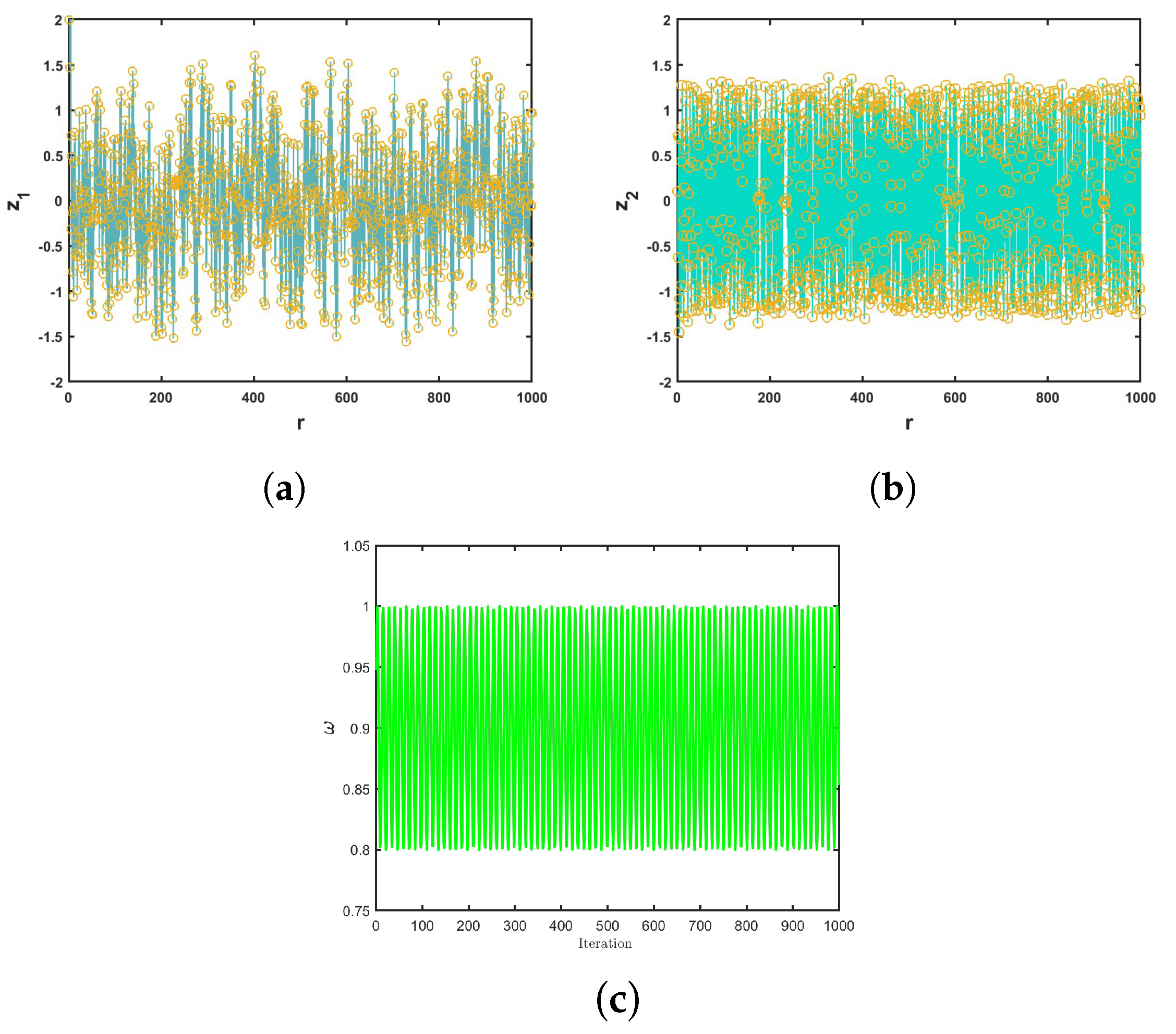
Now, we will analyze the non-stability of the proposed (7) model and demonstrate the existence of chaotic behavior through time evolution with the next three cases: ω ( h ) = 0.03 cos ( h 10 ) + 0.97 , ω ( h ) = ( 1 12 exp ( sin ( h 12 ) ) + 0.76 , and ω ( h ) = 0.1 sin ( h 2 ) + 0.9 variable-order functions. We chose ( γ , δ ) = ( 2.3 , 0.2 ) and the initial condition as ( z 1 ( 0 ) , z 2 ( 0 ) ) = ( 2 , 0.1 ) , where ω : N 0 [ 0 , 1 ] . The trajectories in Figure 2, Figure 3 and Figure 4 demonstrate aperiodic and irregular oscillations, hence verifying the existence of chaotic behavior. However, depending on the sort of variable-order function, the oscillations’ frequency and amplitude vary slightly, reflecting the system’s sensitivity to the order variation mechanism.
Case 1 When ω ( h ) = 0.03 cos ( h 10 ) + 0.97 , we have
ω min = 0.94 , ω max = 1 .
ϱ = max 1 ω min ω max + ω min ω ( 0 ) , ω max ω min ( ω max 1 + ω ( 0 ) ) = 0.06383 .
For ( γ , δ ) = ( 2.3 , 0.2 ) , the eigenvalues of (7) are λ 1 = 0.062 , λ 2 = 3.238 , since the condition of stability (9) of Theorem 1 in this case is not satisfied. Thus, the variable fractional-order discrete macroeconomic model (7) meets the requirement to exhibit chaotic behavior.
Case 2 Let us consider ω ( h ) = ( 1 12 exp ( sin ( h 12 ) ) + 0.76 : we have
ω min = 0.7907 , ω max = 0.9865 .
ϱ = max 1 ω min ω max + ω min ω ( 0 ) , ω max ω min ( ω max 1 + ω ( 0 ) ) = 0.4177 .
Similarly, the condition of stability (9) in this case is not satisfied. Then, the fractional variable-order discrete macroeconomic model (7) provides the conditions needed for exhibiting chaotic dynamics.
Case 3 Let ω ( h ) = 0.1 sin ( h 2 ) + 0.9 ; we now have
ω min = 0.8 , ω max = 1 .
ϱ = max 1 ω min ω max + ω min ω ( 0 ) , ω max ω min ( ω max 1 + ω ( 0 ) ) = 0.35 .
Condition (9) is not fulfilled. Here, the fractional variable-order discrete macroeconomic model (7) fulfills the prerequisite for the presence of chaos.

3. Dynamic Analysis

In this part, we provide a thorough examination of the behaviors of the variable fractional discrete macroeconomic model (7), showcasing the effectiveness of both short memory and fractional variable order.

3.1. Bifurcation and Largest L E m a x

This subsection aims to demonstrate the dynamics of (7) through numerical simulation, which includes the time-state representations, Largest Lyapunov exponent L E m a x , phase diagrams, and bifurcation of the state variables.
The variable-order fractional solution for the difference system that was given by model (7) is now represented as
z 1 ( h ) = z 1 ( o ) + 1 Γ ( ω ( h ) ) u = b + 1 ω ( h ) u ω ( h ) ( h u 1 ) ( ω ( h ) 1 ) z 2 ( u 1 + ω ( h ) ) , z 2 ( h ) = z 2 ( o ) + 1 Γ ( ω ( h ) ) u = b + 1 ω ( h ) u ω ( h ) ( h u 1 ) ( ω ( h ) 1 ) { ( γ 1 ) z 2 ( u 1 + ω ( h ) ) ( γ + 1 ) z 2 3 ( u 1 + ω ( h ) ) δ z 1 ( u 1 + ω ( h ) ) } ,
where h N o + 1 [30]. So, since ( h u 1 ) ( ω ( h ) 1 ) = Γ ( h u ) Γ ( h u + 1 ω ( h ) ) and for o = 0 , the numerical formula is as follows:
z 1 ( n ) = z 1 ( 0 ) + j = 1 n Γ ( n j + ω ( j ) ) Γ ( ω ( j ) ) Γ ( n j + 1 ) z 2 ( j 1 ) , z 2 ( n ) = z 2 ( 0 ) + j = 1 n Γ ( n j + ω ( j ) ) Γ ( ω ( j ) ) Γ ( n j + 1 ) ( γ 1 ) z 2 ( j 1 ) ( γ + 1 ) z 2 3 ( j 1 ) δ z 1 ( j 1 ) .
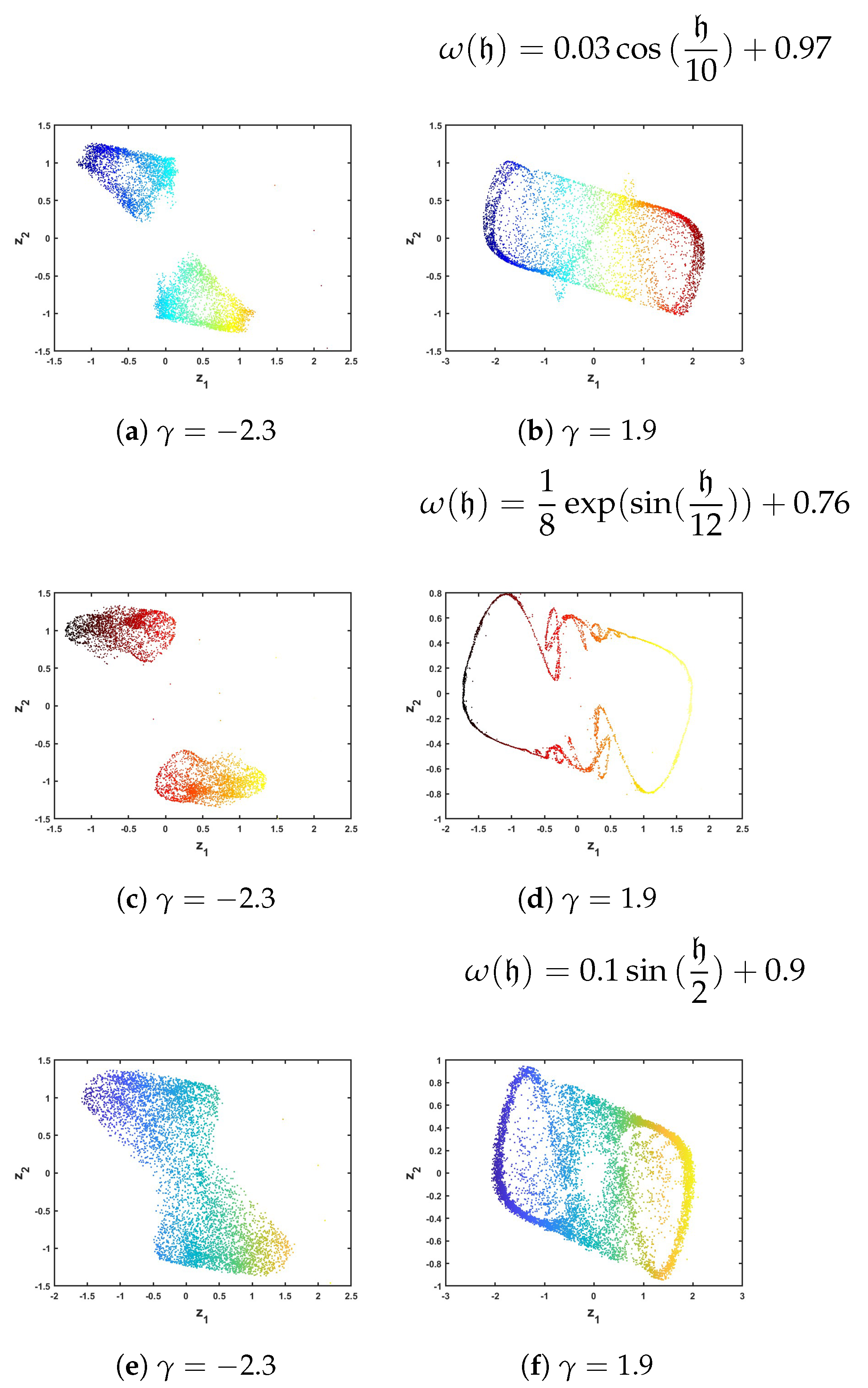
The fractional macroeconomic model dynamics (7) are investigated by varying γ , assuming δ = 0.2 as the control parameter and ( z 1 ( 0 ) , z 2 ( 0 ) ) = ( 2 , 0.1 ) as the initial condition. For the fractional behaviors, we also create variable orders, especially ω ( h ) = 0.03 cos ( h 10 ) + 0.97 , ω ( h ) = ( 1 12 exp ( sin ( h 12 ) ) + 0.76 , and ω ( h ) = 0.1 sin ( h 2 ) + 0.9 . These variable-order functions greatly impact the system’s dynamics, which outline variability in the fractional orders among iterations. Since each function depicts a unique temporal history of the fractional order, we can see how the chaotic behavior varies under various fractional scenarios. These three distinct variable-order functions were necessary to examine the effects of various time-varying memory effects on the system’s chaotic dynamics. In the following evaluation, we seek to reveal the complex behaviors displayed by the system under various circumstances by methodically altering the fractional orders and system parameters. Figure 5 shows that the variable-order fractional discrete macroeconomic model (7) exhibits chaotic attractors. Specifically, the system exhibits chaotic behavior when variable orders are fixed for γ = 2.3 and γ = 1.9 . Interestingly, the strange attractors show significant variations by slightly altering the system parameter γ , highlighting how sensitive the system’s dynamics are to parameter changes. As can be confirmed in Figure 5, the numerical dynamics of states z 1 and z 2 of the model (7) display chaotic behavior when ω ( h ) = 0.03 cos ( h 10 ) + 0.97 for γ = 2.3 and γ = 1.9 . This outcome demonstrates the significant influence of the variable fractional order on the attributes of the model, influencing its behaviors in complex and surprising methods.
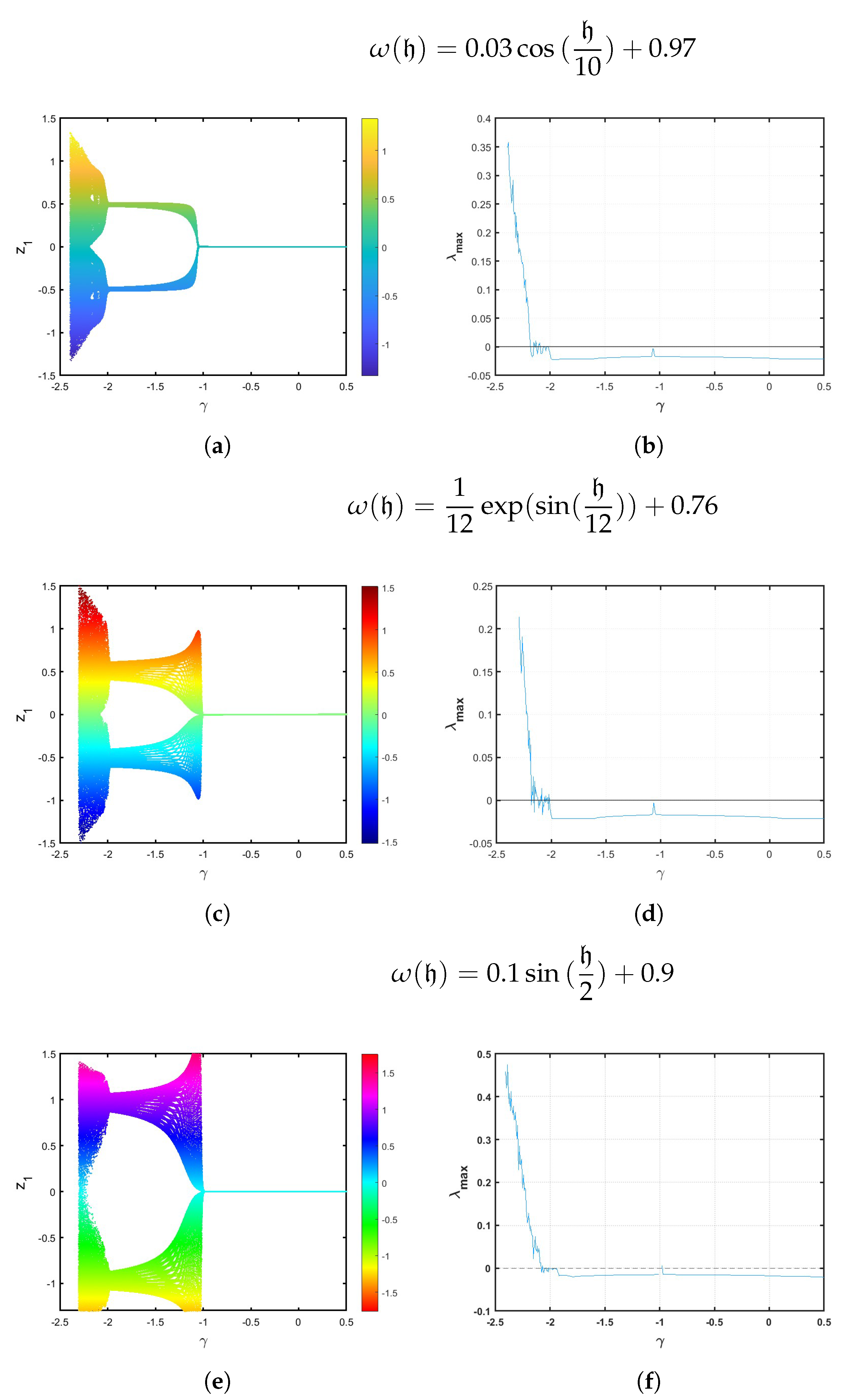
Next, the largest Lyapunov exponents L E m a x are computed using the Jacobian matrix method [31], and bifurcation analysis is employed to fully comprehend the dynamics of the variable fractional-order discrete macroeconomic model (7), with γ serving as the bifurcation factor. The model exhibits a variety of dynamics, including chaos, periodic behavior, and coexisting behaviors. Through this analysis, we can investigate the effects of changes γ in [ 2.5 , 0.5 ] and [ 0 , 2 ] on the system’s behavior, mainly when variable-order fractional dynamics are used. Firstly, we set γ [ 2.5 , 0.5 ] and fix δ = 0.2 . Considering initial states ( z 1 ( 0 ) , z 2 ( 0 ) ) = ( 2 , 0.1 ) , afterwards, we plot bifurcation and L E m a x versus γ for distinct variable functions: ω ( h ) = 0.03 cos ( h 10 ) + 0.97 , ω ( h ) = ( 1 12 exp ( sin ( h 12 ) ) + 0.76 , and ω ( h ) = 0.1 sin ( h 2 ) + 0.9 , as illustrated in Figure 6. The model performs chaotically at first, with positive Lyapunov exponent levels. However, the model enters a periodic double window at γ = 0.5 as γ increases, so the chaos appears and disappears. In particular, for ω ( h ) = 0.03 cos ( h 10 ) + 0.97 , at γ = 2.489 , the fractional discrete macroeconomic model (7) undergoes a period of doubling bifurcation before progressively transitioning from a chaotic state to a periodic state with a positive to negative L E m a x . However, with γ = 2 , the chaotic motion decreases, and a periodic window emerges in the range ( 2 , 1 ) . When ω ( h ) = ( 1 12 exp ( sin ( h 12 ) ) + 0.76 , the discrete model’s states (7) show chaotic motion in the γ ( 2.43 , 2.12 ) area, whereas the chaos disappears as the value is increased. In addition, for ω ( h ) = 0.1 sin ( h 2 ) + 0.9 , the model alternates between chaotic and periodic regimes where the corresponding L E m a x varies between positive and negative, and when γ > 2 , the model becomes chaotic, and the periodic orbit occurs at γ 2 . While parameter γ has a more restrictive effect, changing the three functions ω ( h ) results in a gradually shifting bifurcation pattern. These findings demonstrate the substantial effect of variable fractional-order dynamics on the behavior of the model. The observed dynamics highlight the richness and complexity of model (7), which also offers important insights into its behavior and the resulting implications. In summary, by highlighting the flexibility and adaptability of chaotic discrete fractional models with variable order in a variety of fields, our analysis adds to the body of research on the subject.
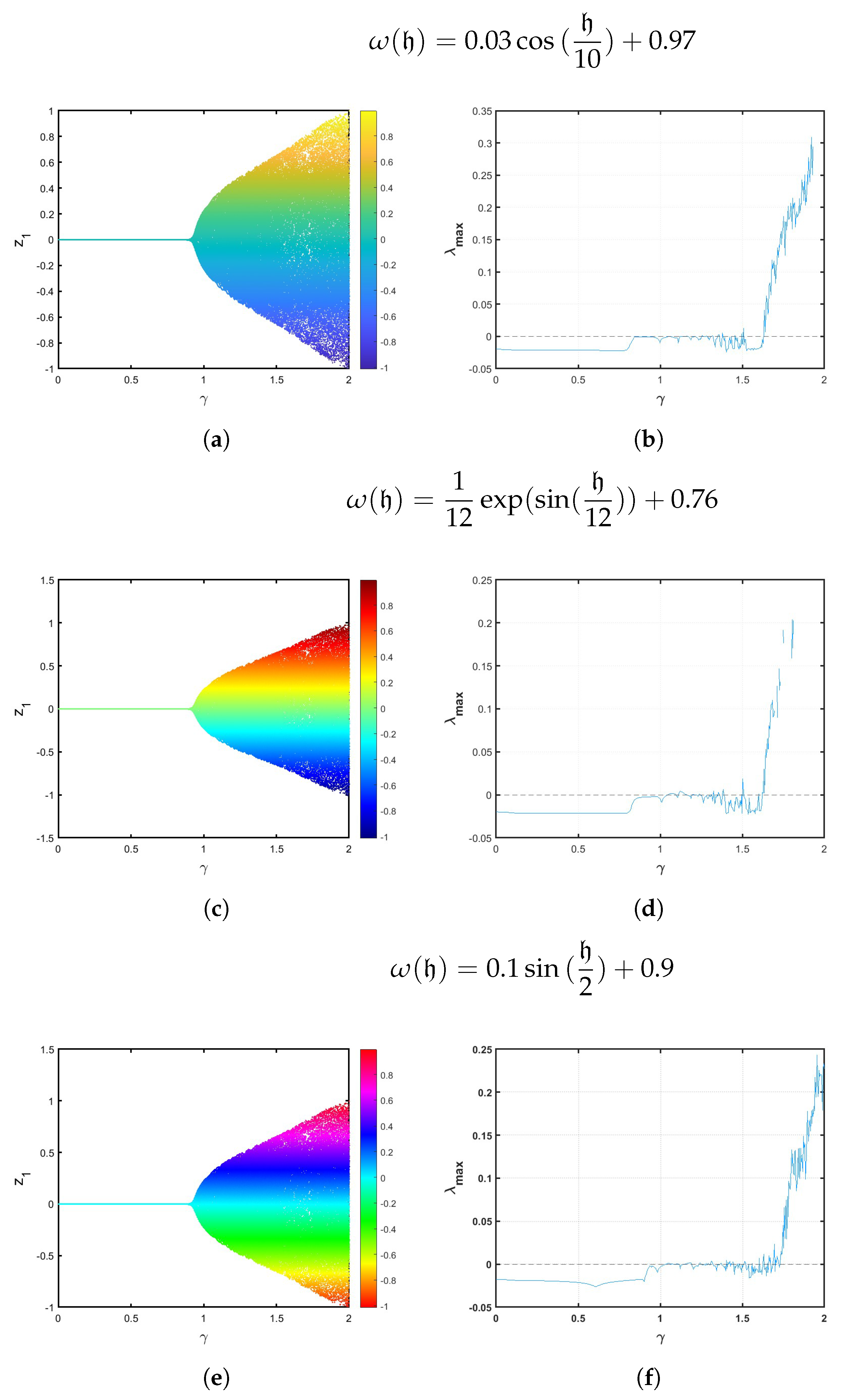
In Figure 7, γ [ 0 , 2 ] is regarded as a critical parameter in δ γ = 0.0001 , where the bifurcation and L E m a x were obtained with the same initial conditions, variable-order functions ω ( h ) , and parameters. We elucidate the behavior of the system in various γ and variable-order fractional dynamics scenarios. Here, we can see that the system moves from regular behavior to chaotic dynamics from the negative and positive L E m a x values. Specifically, when ω ( h ) = 0.03 cos ( h 10 ) + 0.97 , chaos comes from the Neimark–Sacker bifurcation at γ = 0.85 , which causes the stability of the fixed point to be lost. The associated L E m a x values shift from negative to positive. When the L E m a x is positive at ( 1.733 , 1.977 ) , chaos is confirmed to be present following Neimark–Sacker bifurcation. When ω ( h ) = 1 12 exp ( sin ( h 12 ) ) + 0.76 and γ is small, model (7) shows regular behavior with negative values. However, when γ rises, the model will eventually become more chaotic. Additionally, for ω ( h ) = 0.1 sin ( h 2 ) + 0.9 , it is evident that the system’s dynamic behavior varies from chaotic to periodic stages. In particular, the macroeconomic model is periodic in the range γ ( O , 1 ) and chaotic when γ ( 1.82 , 2 ) after Neimark–Sacker bifurcation. It is also obvious that the chaotic intervals associated with the fractional-order values show clear fluctuations. With changes in γ , the system transitions from periodic to chaotic behavior, as depicted by the bifurcation diagrams. These findings demonstrate the substantial impact of variable fractional order on the behavior of the model. The richness and complexity of the variable fractional discrete macroeconomic model (7) are highlighted by the observed dynamics.
Remark 1.
This comparison between the suggested discrete model and the system covered in References [28,29] highlights the following: Using different operators, such as the ”fractional Caputo-like difference with constant order versus fractional Caputo-like difference with variable order”, leads to different dynamic behaviors between the two studies. In greater detail, background studies on more chaotic discrete fractional models with variable-order dynamics emphasize the novel contribution of the conceived fractional discrete macroeconomic model with variable order. The contrast clarifies how the chaotic behavior is influenced by the fractional-order variation pattern and provides insight into how variable memory effects impact system complexity.

3.2. 0–1 Test

The 0–1 test for chaos was introduced in [31] to differentiate between chaotic and regular dynamics in deterministic models. In contrast to the L E m a x simulation, the 0–1 test does not require phase plane analysis and can be used on both known and unknown systems. This renders it especially useful for detecting chaos in data series without the need to reconstruct the phase space.
For the constant d in 0 , π , the time series x e ¯ represents the translation variables, e ¯ = 1 , M ¯ , and the component dynamics are as follows:
p d μ = e ¯ = 1 μ x e ¯ cos e ¯ d , q d μ = e ¯ = 1 μ x e ¯ sin e ¯ d ,
These provide a demonstration, and the mean square displacement is explained as follows:
M d μ = lim M 1 M e ¯ = 1 M p d e ¯ + μ p d e ¯ 2 + q d e ¯ + μ q d e ¯ 2 , μ M 10 .
Furthermore, the asymptotic growth rate, K d , is shown as
K d = lim e ¯ log M d μ log e ¯ .
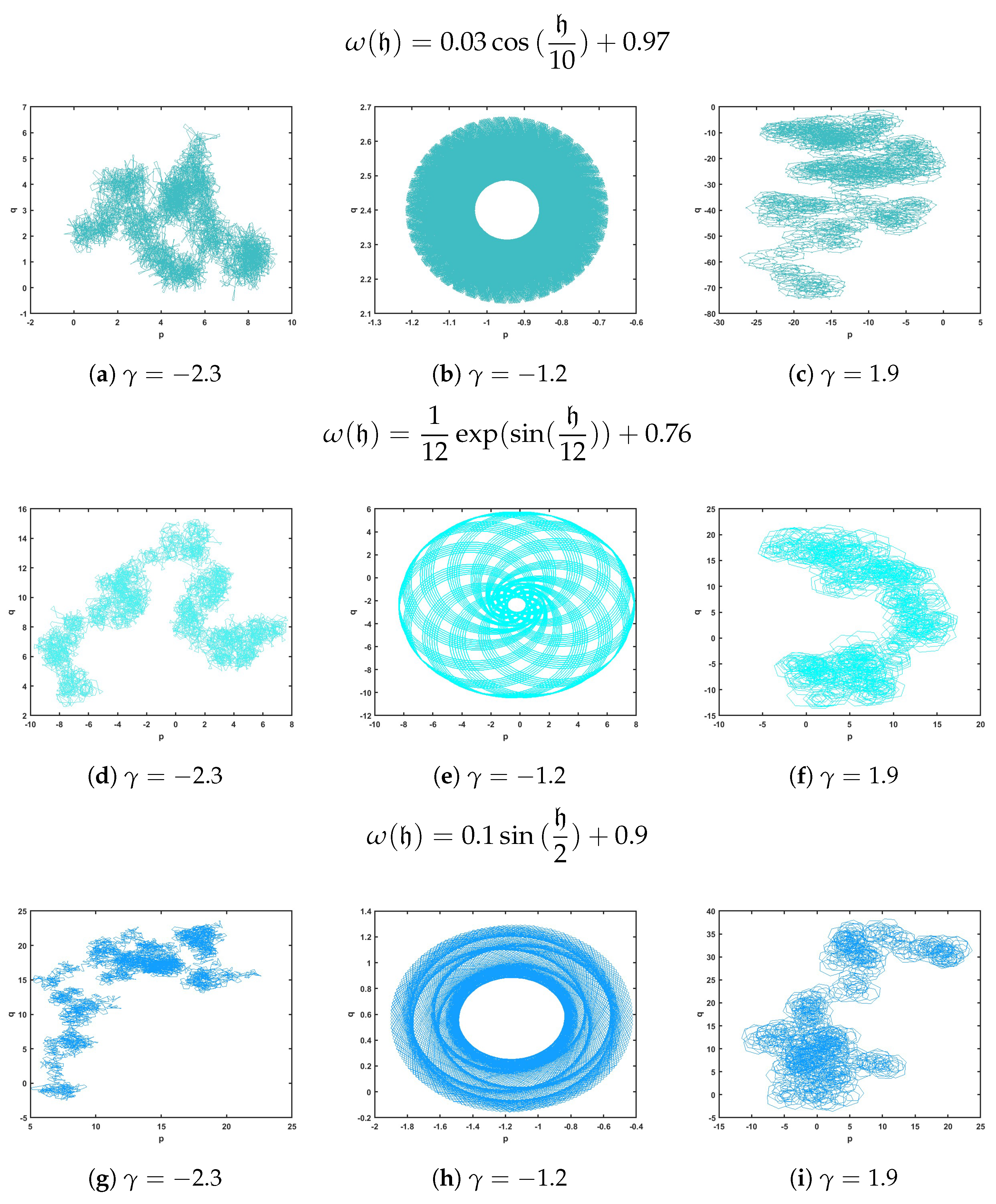
As a result, the model is periodic when K = m e d i a n ( K d ) approaches 0 and chaotic when K approaches 1. The p d q d trajectories are typically bounded if the model is regular; chaotic if the p d q d trajectories are Brownian. To discover the discrete macroeconomic model’s chaotic behavior with the fractional variable orders used, the p d q d plots are depicted in Figure 8 for various parameter values γ with starting settings identical to those used before. In detail, when γ = 1.2 , the states of q d and p d are bounded, so the model (7) is periodic, whereas for γ = 2.3 and γ = 1.9 , the states of q d and p d are Brownian, and the model (7) is chaotic.

4. Complexity Analysis

The dynamic behaviors of chaotic models can additionally be evaluated through measures of chaotic complexity characteristics. The model becomes increasingly chaotic as its complexity increases. In view of this, the complexity of variable fractional-order discrete macroeconomic model (7) is determined using the spectral entropy S E method and the C 0 measure.

4.1. Spectral Entropy

An outstanding algorithm for measuring structural complexity, the spectral entropy S E algorithm is a potent indicator of the system’s chaotic features. It is more accurate in assessing the overall structural complexity of the high-dimensional chaotic system. A study of the detailed SE algorithm can be found in the literature [32].To determine the system’s structural complexity in terms of parameters and initial values, we thus use the S E algorithm. The Fourier transform domain’s energy distribution is utilized to calculate the spectral entropy value. The first step in the S E computation for a time series of L samples in length ( l ) = { ( 0 ) , ( 1 ) , , ( L 1 ) } is to remove the current part:
( l ) = ( l ) ¯
where
¯ = 1 L l = 0 L 1 ( l ) .
For the sequence ( l ) , the discrete Fourier transform can be determined as follows:
χ ( ξ ) = l = 0 L 1 ( l ) e j 2 π ξ l / L
where ξ = 0 , 1 , , L 1 . The relative power spectral density of ( l ) is then determined as follows:
( ξ ) = | χ ( ξ ) | 2 ξ = 0 L 1 | χ ( ξ ) | 2
so that ξ = 0 L 1 ( x i ) = 1 . Therefore, the Shannon Entropy is calculated from the resulting spectral density to estimate the ( S E ):
S E = 1 ln ( L / 2 ) ξ = 0 L / 2 1 ( ξ ) ln ( ( ξ ) )
It is important to note that the standard error falls between 0 and 1 because it is evaluated at its maximum value ln ( L / 2 ) . While regular behavior, or a less complex and more predictable signal, is indicated by a low value of S E , a high value of S E denotes more complex chaotic behavior.
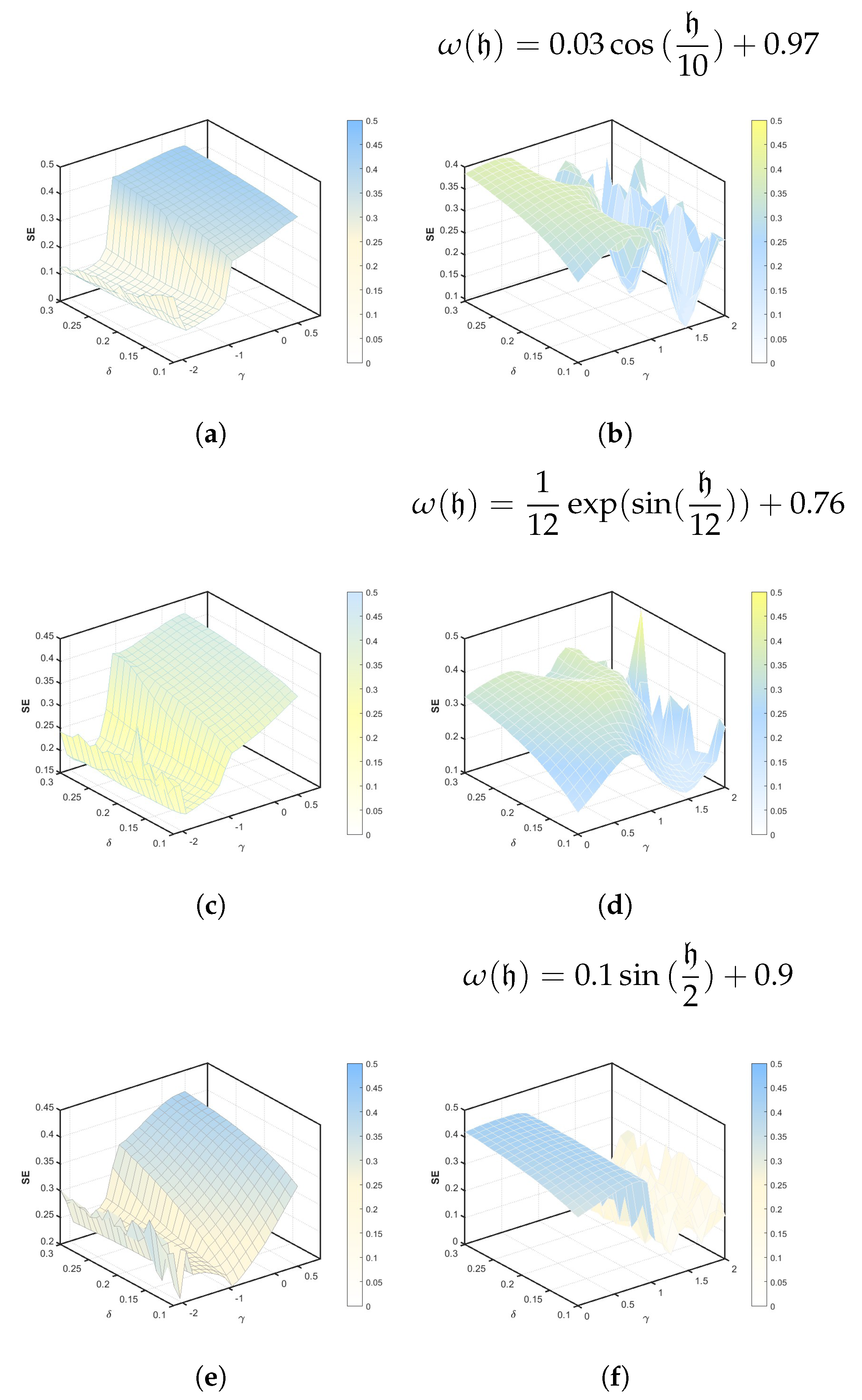
Figure 9 plots the 3D S E complexity of the variable fractional discrete macroeconomic model (7) for diverse variable-order functions. The results of the S E computation indicate that the fractional discrete macroeconomic model has higher S E values, indicating significant complexity, and that the maximum spectral entropy value reaches 0.5 .

4.2. C 0 Complexity

Shen et al. [33] initially proposed C 0 complexity, a randomness-based complexity metric, to address the problems associated with excessively coarse graining during preprocessing. The original data is broken down by the C 0 algorithm. The series is divided into two parts, with the irregular part being the primary focus and the regular part being the other parts. We use the C 0 complexity approach to examine how the system parameters affect the dynamic of the variable fractional discrete macroeconomic model (7), as explained in the following for { D ( ϵ ) , ϵ = 0 , 1 , , B 1 } :
  • The Fourier transform of D ( ϵ ) can be found by expressing
    Υ Q ( ϵ ) = 1 Q ϵ = 0 Q 1 D ( ϵ ) exp 2 π i ( j ϵ S ) , ϵ = 0 , 1 , . . . , B 1 .
  • The mean square of Υ P ( ϵ ) is explained as G P = 1 B ϵ = 0 B 1 | Υ B ( ϵ ) | 2 and set as
    Υ ¯ B ( ϵ ) = Υ B ( ϵ ) if Υ B ( ϵ ) 2 > r G B , 0 if Υ B ( ϵ ) 2 r G B .
  • The following formula is used to determine the inverse Fourier transform:
    ϕ ( j ) = 1 B ϵ = 0 B 1 Υ ¯ B ( ϵ ) exp 2 π i ( j ζ B ) , j = 0 , 1 , . . , B 1 .
  • By applying the previous formula, the C 0 complexity was found to be
    C 0 = j = 0 B 1 ϕ ( j ) D ( j ) j = 0 B 1 D ( j ) 2 .
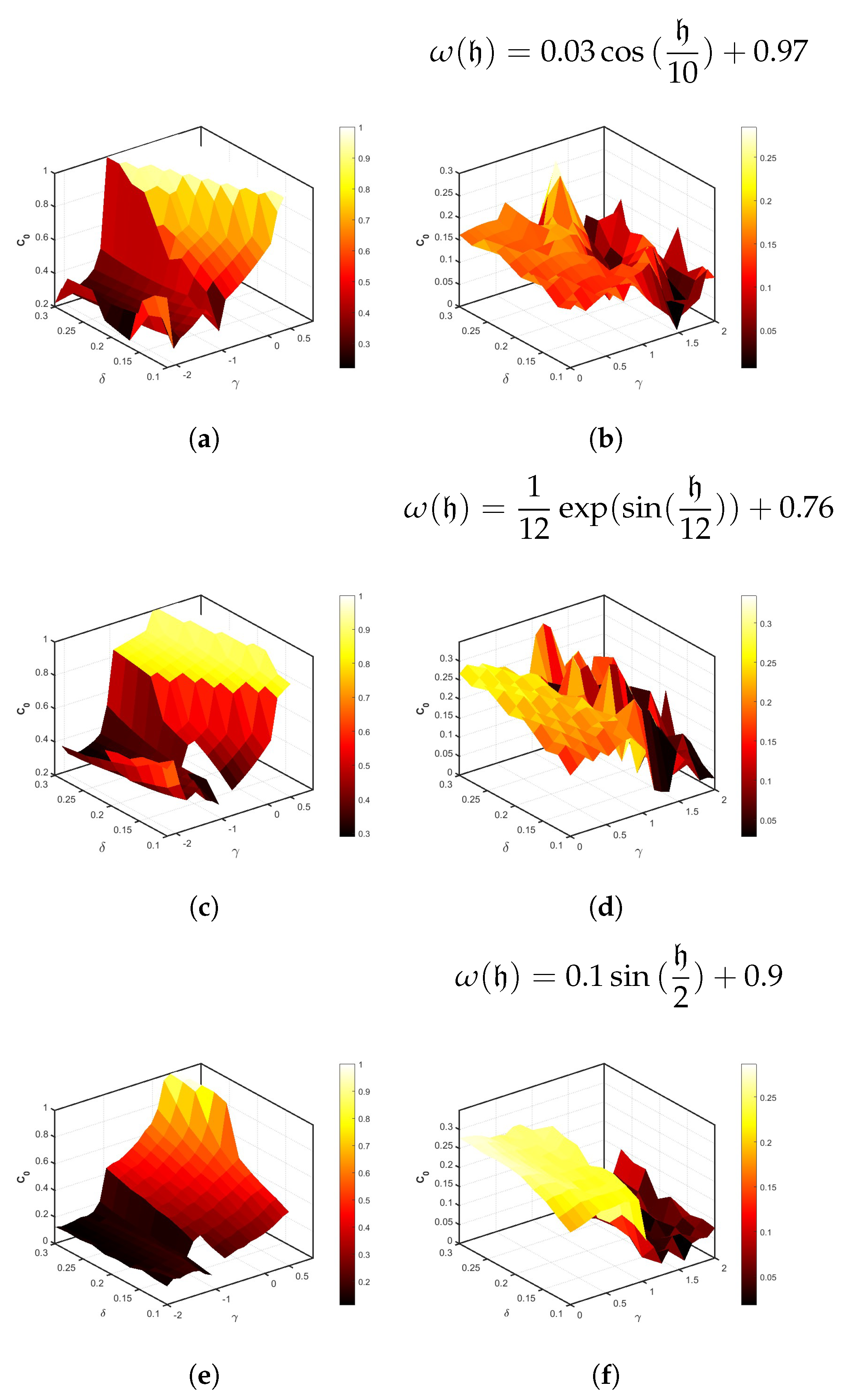
We perform a numerical evaluation of the C 0 complexity of fractional variable-order discrete macroeconomic model (7). Figure 10 displays the C 0 plot for the three functions of the variable fractional order, with various system parameters δ [ 0.1 , 0.3 ] , γ [ 2.5 , 0.5 ] , and γ [ 0 , 2 ] . The fractional discrete model becomes more complex as the C 0 complexity result rises.

5. Conclusions and Future Works

This study proposes a discrete macroeconomic system based on the Caputo-left difference operator with fractional variable order. This research project examines the discrete macroeconomic system’s chaotic behavior under variable fractional orders. Numerous numerical techniques have been used to confirm that the suggested fractional versions of the macroeconomic system are chaotic. These consist of Lyapunov exponents, phase diagrams, bifurcation, SE complexity, and 0–1 test charts. The novel fractional discrete model shows that chaos and numerous attractors were present. Our findings also show that the addition of variable order increases the complexity of the fractional discrete macroeconomic system. Our future works will consider the further analysis of this model in economic fields with fractional variable order in discrete time. We will also consider other discrete-time financial and economic systems with variable orders.

Author Contributions

Conceptualization, A.A. and O.K.; methodology, L.D.; software, L.D.; validation, O.K. and A.O.; formal analysis, L.E.A. and M.A.; investigation, L.D. and L.E.A.; resources, L.E.A. and M.A.; data curation, A.A. and A.O.; writing—original draft, L.D.; writing—review and editing, L.D. and O.K.; visualization, L.D.; supervision, A.O.; project administration, L.D. and A.O.; funding acquisition, A.A. and O.K. All authors have read and agreed to the published version of the manuscript.

Funding

Princess Nourah bint Abdulrahman University Researchers Supporting Project number (PNURSP2025R831), Princess Nourah bint Abdulrahman University, Riyadh, Saudi Arabia. The authors extend their appreciation to the Deanship of Scientific Research at Northern Border University, Arar, KSA for funding this research work through the project number “NBU-FFR-2025-2443-13”.

Data Availability Statement

The original contributions presented in this study are included in the article. Further inquiries can be directed to the corresponding author(s).

Acknowledgments

Princess Nourah bint Abdulrahman University Researchers Supporting Project number (PNURSP2025R831), Princess Nourah bint Abdulrahman University, Riyadh, Saudi Arabia. The authors extend their appreciation to the Deanship of Scientific Research at Northern Border University, Arar, KSA for funding this research work through the project number “NBU-FFR-2025-2443-13”.

Conflicts of Interest

The authors declare no conflicts of interest.

References

  1. Mokhov, V.; Aliukov, S.; Alabugin, A.; Osintsev, K. A review of mathematical models of macroeconomics, microeconomics, and government regulation of the economy. Mathematics 2023, 11, 3246. [Google Scholar] [CrossRef]
  2. Josephsen, L.W. Use of mathematics in macroeconomic analysis. In Routledge Handbook of Macroeconomic Methodology; Routledge: London, UK, 2023; pp. 251–265. [Google Scholar]
  3. Tarasov, V.E. Non-linear macroeconomic models of growth with memory. Mathematics 2020, 8, 2078. [Google Scholar] [CrossRef]
  4. Anagnostopoulos, A.; Giannitsarou, C. Modelling Time and Macroeconomic Dynamics. 2010. Available online: https://www.researchgate.net/publication/228222663_Modelling_Time_and_Macroeconomic_Dynamics (accessed on 10 June 2025).
  5. David, S.A.; Machado, J.A.T.; Quintino, D.D.; Balthazar, J.M. Partial chaos suppression in a fractional order macroeconomic model. Math. Comput. Simul. 2016, 122, 55–68. [Google Scholar] [CrossRef]
  6. Zhang, B.; Liu, L. Chaos-based image encryption: Review, application, and challenges. Mathematics 2023, 11, 2585. [Google Scholar] [CrossRef]
  7. Chua, L.O. Memristors on ‘edge of chaos’. Nat. Rev. Electr. Eng. 2024, 1, 614–627. [Google Scholar] [CrossRef]
  8. Attaullah; Mahdi, K.; Yavuz, M.; Boulaaras, S.; Haiour, M.; Pham, V.T. Computational approaches on integrating vaccination and treatment strategies in the SIR model using Galerkin time discretization scheme. Math. Comput. Model. Dyn. Syst. 2024, 30, 758–791. [Google Scholar] [CrossRef]
  9. Yan, W.; Dong, W.; Wang, P.; Wang, Y.; Xing, Y.; Ding, Q. Discrete-time memristor model for enhancing chaotic complexity and application in secure communication. Entropy 2022, 24, 864. [Google Scholar] [CrossRef]
  10. Diabi, L.; Ouannas, A.; Grassi, G.; Momani, S. Symmetry Breaking in Fractional Difference Chaotic Equations and Their Control. Symmetry 2025, 17, 352. [Google Scholar] [CrossRef]
  11. Wu, G.C.; Baleanu, D. Discrete fractional logistic map and its chaos. Nonlinear Dyn. 2014, 75, 283–287. [Google Scholar] [CrossRef]
  12. Dhakshinamoorthy, V.; Wu, G.C.; Banerjee, S. Chaotic Dynamics of Fractional Discrete Time Systems; CRC Press: Boca Raton, FL, USA, 2024. [Google Scholar]
  13. Choucha, A.; Boulaaras, S.; Haiour, M.; Shahrouzi, M.; Jan, R.; Abdalla, M. Growth and blow-up of solutions for a viscoelastic wave equation with logarithmic source, fractional conditions, and non-linear boundary feedback. J.-Pseudo-Differ. Oper. Appl. 2025, 16, 29. [Google Scholar] [CrossRef]
  14. Barros, L.C.D.; Lopes, M.M.; Pedro, F.S.; Esmi, E.; Santos, J.P.C.D.; Sánchez, D.E. The memory effect on fractional calculus: An application in the spread of COVID-19. Comput. Appl. Math. 2021, 40, 72. [Google Scholar] [CrossRef]
  15. Diabi, L.; Ouannas, A.; Hioual, A.; Momani, S.; Abbes, A. On fractional discrete financial system: Bifurcation, chaos, and control. Chin. Phys. B 2024, 33, 100201. [Google Scholar] [CrossRef]
  16. Ouannas, A.; Batiha, I.M.; Pham, V.T. Fractional Discrete Chaos: Theories, Methods and Applications; World Scientific: Singapore, 2023; Volume 3. [Google Scholar]
  17. Al-Taani, H.; Abu Hammad, M.M.; Abudayah, M.; Diabi, L.; Ouannas, A. On Fractional Discrete Memristive Model with Incommensurate Orders: Symmetry, Asymmetry, Hidden Chaos and Control Approaches. Symmetry 2025, 17, 143. [Google Scholar] [CrossRef]
  18. Iqbal, S.; Wang, J. A novel fractional-order 3-D chaotic system and its application to secure communication based on chaos synchronization. Phys. Scr. 2025, 100, 025243. [Google Scholar] [CrossRef]
  19. Wang, H.; Xin, Z.; He, S.; Sun, K. Design of a discrete memristive chaotic map: Fractional-order memory, dynamics and application. Phys. Scr. 2024, 99, 095218. [Google Scholar] [CrossRef]
  20. Calgan, H. Variable Fractional-Order Dynamics in Dark Matter–Dark Energy Chaotic System: Discretization, Analysis, Hidden Dynamics, and Image Encryption. Symmetry 2025, 17, 1655. [Google Scholar] [CrossRef]
  21. Zheng, X.; Wang, H. A hidden-memory variable-order time-fractional optimal control model: Analysis and approximation. SIAM J. Control Optim. 2021, 59, 1851–1880. [Google Scholar] [CrossRef]
  22. Tang, Z.; He, S.; Wang, H.; Sun, K.; Yao, Z.; Wu, X. A novel variable-order fractional chaotic map and its dynamics. Chin. Phys. B 2024, 33, 030503. [Google Scholar] [CrossRef]
  23. Hammouch, Z.; Yavuz, M.; Özdemir, N. Numerical solutions and synchronization of a variable-order fractional chaotic system. Math. Model. Numer. Simul. Appl. 2021, 1, 11–23. [Google Scholar] [CrossRef]
  24. Abdeljawad, T. On Riemann and Caputo fractional differences. Comput. Math. Appl. 2011, 62, 1602–1611. [Google Scholar] [CrossRef]
  25. Atici, F.M.; Eloe, P. Discrete fractional calculus with the nabla operator. Electron. J. Qual. Theory Differ. Equ. 2009, 2009, 1–12. [Google Scholar] [CrossRef]
  26. Momani, S.; Batiha, I.M.; Djenina, N.; Ouannas, A. Analyzing the Stability of Caputo Fractional Difference Equations with Variable Orders. Progress in Fractional Differentiation and Applications. Prog. Fract. Differ. Appl. 2024, 11, 139–151. [Google Scholar]
  27. Hu, Z.; Chen, W. Modeling of macroeconomics by a novel discrete nonlinear fractional dynamical system. Discret. Dyn. Nat. Soc. 2013, 2013, 275134. [Google Scholar] [CrossRef]
  28. Chu, Y.M.; Bekiros, S.; Zambrano-Serrano, E.; Orozco-López, O.; Lahmiri, S.; Jahanshahi, H.; Aly, A.A. Artificial macro-economics: A chaotic discrete-time fractional-order laboratory model. Chaos Solitons Fractals 2021, 145, 110776. [Google Scholar] [CrossRef]
  29. Abbes, A.; Ouannas, A.; Shawagfeh, N. An incommensurate fractional discrete macroeconomic system: Bifurcation, chaos, and complexity. Chin. Phys. B 2023, 32, 030203. [Google Scholar] [CrossRef]
  30. Anastassiou, G.A. Principles of delta fractional calculus on time scales and inequalities. Math. Comput. Model. 2010, 52, 556–566. [Google Scholar] [CrossRef]
  31. Wu, G.C.; Baleanu, D. Jacobian matrix algorithm for Lyapunov exponents of the discrete fractional maps. Commun. Nonlinear Sci. Numer. Simul. 2015, 22, 95–100. [Google Scholar] [CrossRef]
  32. Gottwald, G.A.; Melbourne, I. The 0-1 test for chaos: A review. In Chaos Detection and Predictability; Springer: Berlin/Heidelberg, Germany, 2016; pp. 221–247. [Google Scholar]
  33. Nunes, R.R.; Almeida, M.P.D.; Sleigh, J.W. Spectral entropy: A new method for anesthetic adequacy. Rev. Bras. Anestesiol. 2004, 54, 404–422. [Google Scholar]
Figure 1. Structural aspects of the chaotic fractional discrete macroeconomic model (6).
Fractalfract 09 00723 g001
Figure 2. (ac) Time states of (7) and plotting the variable function-order ω ( h ) = 0.03 cos ( h 10 ) + 0.97 for γ = 2.3 .
Fractalfract 09 00723 g002
Figure 3. (ac) Time states of (7) and plotting the variable function order ω ( h ) = ( 1 12 exp ( sin ( h 12 ) ) + 0.76 for γ = 2.3 .
Fractalfract 09 00723 g003
Figure 4. (ac) Time states of (7) and plotting the variable function order ω ( h ) = 0.1 sin ( h 2 ) + 0.9 for γ = 2.3 .
Fractalfract 09 00723 g004
Figure 5. Phase portrait of (7) for different variable fractional orders and γ .
Fractalfract 09 00723 g005
Figure 6. (af) Bifurcation and L E m a x of (7) with three variable fractional orders for γ versus in [ 2.3 , 0.5 ] .
Fractalfract 09 00723 g006
Figure 7. (af) Bifurcation and L E m a x of (7) with three variable fractional orders for γ versus in [ 0 , 2 ] .
Fractalfract 09 00723 g007
Figure 8. The 0–1 test (6) for different γ values and fractional variable orders.
Fractalfract 09 00723 g008
Figure 9. (af) S E complexity of the variable fractional discrete chaotic macroeconomic model (7).
Fractalfract 09 00723 g009
Figure 10. (af) The C 0 complexity of the variable-order fractional discrete chaotic macroeconomic model (7).
Fractalfract 09 00723 g010
Disclaimer/Publisher’s Note: The statements, opinions and data contained in all publications are solely those of the individual author(s) and contributor(s) and not of MDPI and/or the editor(s). MDPI and/or the editor(s) disclaim responsibility for any injury to people or property resulting from any ideas, methods, instructions or products referred to in the content.