


Abstract
Fractals are a common characteristic of many artificial and natural networks having topological patterns of a self-similar nature. For example, the Mandelbrot set has been investigated and extended in several ways since it was first introduced, whereas some authors characterized it using various complex functions or polynomials, others generalized it using iterations from fixed-point theory. In this paper, we generate Mandelbrot sets using the hybrid Picard S-iterations. Therefore, an escape criterion involving complex functions is proved and used to provide numerical and graphical examples. We produce a wide range of intriguing fractal patterns with the suggested method, and we compare our findings with the classical S-iteration. It became evident that the newly proposed iteration method produces novel images that are more spontaneous and fascinating than those produced by the S-iteration. Therefore, the generated sets behave differently based on the parameters involved in different iteration schemes.
1. Introduction
Fractals are frequently found in nature because they are good descriptions of things like rivers, clouds, crystals, lightning, electricity, tree branches, and leaf patterns. The study of many natural or living frameworks, such as the fractality in water distribution networks, benefits greatly from the use of fractals [1]. To understand and predict violent streams, fractals are also used in liquid mechanics. Fractal geometries play a crucial role in determining where water quality sensors should be placed in the water delivery network [2] and fractal river network [3]. Additionally, fractal theory is frequently applied in several fields, including engineering models, video compression [4], and computational architectural design [5]. Ring-shaped quantum dots play an important role in confining the electrons along a circular orbit. Remarkably, the effect of Mandelbrot fractality is explored by considering different types of Mandelbrot rings [6]. According to research by cognitive neuroscientists, computer-generated fractals can reduce stress in viewers in precisely the same way as fractals seen in nature [7]. These facts serve as the authors’ inspiration to use the concepts from fixed-point theory to build a new escape criterion. Then, using the escape radius, we present a comparative analysis of the fractals generated by two different iterations. It turned out that the recently suggested hybrid iteration method creates new, more interesting, and spontaneous visuals than the S-iteration does. Therefore, we first examine and comprehend several related concepts in the following paragraphs before presenting the main results.
In 1980, Mandelbrot introduced the Mandelbrot set when he was studying complex quadratic function He utilizes c as a complex parameter and invented the word “Fractal” for such best-known illustrations generated by a very basic computational method [8]. The Mandelbrot set can be identified using a fractal artistic design [9]. Fractal art is commonly settled with the help of fractal-creating software. In certain examples, graphics tools are utilized to additionally adjust the patterns produced. It is well known that fractal images cannot be created without computer fractal art because a computer has the extraordinary ability to calculate [10]. Almost certainly, fractal art is recognized from other digital activities [11,12]. Fractals are generated using iterative techniques to solve polynomial equations or non-linear equations. Generating fractals can be an artistic endeavour, a mathematical model, or just a soothing diversion.
Various properties and extensions of the Mandelbrot set have been studied extensively in the literature. The initial and most evident generalization included the application of the function rather than the second-degree polynomial [13,14]. Other categories of functions were also examined in the literature such as anti-polynomials [15], transcendental [16], rational [17], elliptic [18], etc. Another extension in the study of Mandelbrot sets is from complex number system [19] to bicomplex numbers [20], quaternions [21], octonions [22], etc. Some fixed-point techniques were also used for the extension and generalization of Mandelbrot sets. For the creation of fractals using fixed-point theory, different cyclical methods for locating fixed points in an identified map are used; for example, inversion fractals [23], v-variable fractals [24], iterated function systems [25], and biomorphs [26]. A new and novel iteration scheme is applied to solve image deblurring and signal recovery problems [27] using polynomiography. The Mann iteration was used by Rani and Kumar [28,29] to visualize superior Julia and Mandelbrot sets. Afterwards, the Ishikawa iteration was used in [30,31] for the visualization of relative superior Julia and Mandelbrot sets. The authors in [32] proved that the convergence rate of S-iteration is higher than that of the Ishikawa iteration and presented relatively superior Mandelbrot sets through the S-iteration scheme. In [33], the Noor orbit was used by Rani et al. to visualize Mandelbrot sets. Li et al. utilize the Jungck–Mann orbit creation of Mandelbrot sets in [34]. Different iterative schemes were used by different researchers, such as in [35,36] Jungck–CR iterative formulas having a specific convexity. Similarly, in [37], S-iteration orbit with s-convexity was used. Then in [38], Jungck–Mann and Jungck–Ishikawa iterations with s-convexity were used. Noor orbit and s-convexity were also used in [39]. Recently, Zou et al. [40] introduced the Mandelbrot and Julia sets via hybrid Picard–Mann iteration. For more recent and updated studies on related iterations and techniques, the interested reader is referred to [41,42,43]
From this review of the literature, one can observe that most fractals have escape requirements that dictate their dynamical behaviour, and they do so through a variety of iterative strategies. One key idea is escape when figuring out if a point in the complex plane is contained in a Mandelbrot set. Thus, it is believed that accurately creating a high-level “Mandelbrot” is challenging and intricate [6]. One especially unique feature of fractals that is lacking in other systems is scaling invariance. They are very suitable for real-world situations where researchers may conduct studies on multiple dimensions because of this feature. Since creating fractals is crucial from several perspectives indicated above, a lot of focus has been placed on doing it in recent years, utilizing a variety of methods. Multiple iterative procedures discussed above have also been used to create some fractals with generic properties [44,45,46,47]. In these situations, a decision must be made between a few different iteration techniques while considering crucial factors. For instance, an iteration method is more effective than the others based on two primary criteria: simplicity and convergence speed. Under such circumstances, the following issues inevitably surface: Which of these iteration techniques is accelerating convergence? Hence, it was demonstrated that the Picard S-iteration method converges more quickly than the CR iteration method and, consequently, more quickly than any other known iteration method, as well as all of the Picard, Mann, Ishikawa, Noor, SP, and S methods [48]. To the best of our knowledge, this recently developed three-step iteration in the literature has not been applied to fractals. Hence this research article fills this gap, which is significant because many iteration systems [49,50,51] provide variants for the same function in terms of shape, size, colour, and additional attributes. Furthermore, the results of research conducted at various scales might paint somewhat distinct images even though the geometrical features of the structure itself are the same. This is true for systems with diverse structures. Conversely, a mathematical fractal is a kind of feedback that depends on recursion; it is constructed around an iterated equation. Iteration is essential to fully appreciating the aesthetic value and beauty of fractals. It is simpler to visualize self-similar behaviour as consistently carrying out a task. Each time a step is finished, we replace each initiator copy with a smaller generator copy, rotating as necessary. Taking motivation from these facts, we use this newly developed iteration scheme to prove an escape criterion. It proved useful for generating fractals by analyzing their dynamic patterns in the presence of complex polynomials. The fact that a new iteration strategy was successfully implemented emphasizes how significant this research is compared to the previous ones. The dependence of time on variations in the involved parameters of the iteration scheme is analyzed numerically and graphically. The three-stage, fast-convergence Picard S-iterative technique is therefore more notable and unique than the corpus of existing work.
The plan of this article is as follows: We discuss some necessary definitions and preliminaries related to different iterations in Section 2. Then, we prove a general escape criterion to generate the fractals in Section 3. This criterion is proved using a new hybrid Picard S-iteration method for general complex polynomials. Further refinement of these criteria is also presented in the form of corollaries. The visualization of Mandelbrot sets is provided in Section 4. The pseudocode to create the Mandelbrot sets in Picard S-orbit is also exhibited in this section. Based upon that Section 4.1 and Section 4.2 contain a variety of images for Mandelbrot sets by considering different parameter values in the proposed iteration technique. A comparison of fractal images produced by using the new proposed iteration and the classical S-iteration is also provided in this section. Time analysis is performed for seconds using tabular and graphical illustrations. This comparison proved that the Mandelbrot set images produced by the hybrid Picard S-iteration are far better than those produced by S-iteration. This comparison is discussed and concluded in Section 5, leading to some future directions of this work.
2. Basic Definitions and Preliminaries
This section contains some basic definitions and theorems that are essential to proving our new results.
Definition 1.
The Mandelbrot set denoted by M for the given polynomial consists of all having a bounded orbit of the point 0 given as [44]
Here and what follows, C denotes the set of complex numbers. The beginning point has been taken as 0 because this is the only critical point of .
Definition 2.
Consider a map , on the set of complex numbers denoted by C then the subsequent iteration is a Mann iteration process [45]:
Definition 3.
Consider a map , on the set of complex numbers denoted by C then the subsequent iteration is an Ishikawa iteration process [46]:
where ∈.
Definition 4.
Consider a map , on the set of complex numbers denoted by C then the subsequent iteration is an S-iteration process [47]:
where ∈.
Definition 5.
Consider a map , on the set of complex numbers denoted by C and then the subsequent iteration is a Picard S-iteration process [48]
where ∈. This iteration process, named as Picard S-orbit, depends on four variables which can be written as “Picard S-orbit ”. The first term in (4) represents the Picard iteration whereas the second and third come from S-iteration. That is why it is named as the hybrid Picard S-iteration method or procedure.
Usually, the escape criterion for Mandelbrot sets is followed as stated in the following theorem [44].
Theorem 1.
Consider a quadratic polynomial, , , then q satisfies the following such that
and as N .
The expression is called the threshold of the escape radius. This escape radius is different during every iteration. A widely used escape criterion for polynomials of the form where with S-iteration is given in the subsequent theorem [32].
Theorem 2.
Suppose that and , where ∈ where c is a complex number. Suppose and . Therefore, we have
then as N
Corollary 1.
Suppose then as
3. Escape Criterion
The fixed-point theory is a fundamental concept in fractals because it offers a framework for comprehending the iterative schemes that produce fractals. The points in the fractal that do not change regardless of the number of times the scheme is iterated are actually the fixed points of that iterative scheme in the context of fractals. These fixed points “attract” neighbouring points lying in that fractal towards themselves and therefore are frequently referred to as attractors. The concept of “escape” is essential for colouring and visualizing fractals. A point that escapes to infinity quickly is often assigned one colour, whereas other points that escape slower or cannot escape are assigned other colours. The maximum number of iterations needed to ascertain whether the orbit sequence tends to infinity determines the escape time algorithm. This algorithm provides a useful element that is significant to visualize the important properties of a dynamic system iteratively. We now prove the general escape criterion required to build the Mandelbrot sets in the Picard S-orbit. Consider a polynomial as well as , then define the Picard S-iteration procedure as follows:
where and . The orbit of this newly defined iteration scheme may denoted as Picard S-orbit. Hence, the subsequent result is the proof of the required escape criteria for generalized polynomial where using the hybrid Picard S-iteration procedure.
Theorem 3.
Suppose that and , where and . Let and . Then, for as using the proposed iteration (5).
Proof.
We first consider the following expression
then we replace and obtain the following expression,
Furthermore, we proceed with the hybrid Picard S-iteration process, taking into account the following:
Next, combining this with (6) leads to the following
Since , we obtain and , which leads to the following
By making use of (9) in (8), we obtain
The last or the third step of the hybrid Picard S-iteration procedure implies that
Then, by making use of (10) in (11), we obtain the following
Since , using the following relation in (12),
we obtain
Because gives that Therefore, there exists , such that Consequently, we obtain the following
The same reasoning can be used again to obtain:
Hence, as , which completes the proof. □
Corollary 2.
Let us take
then, the Picard S-orbit escapes to infinity.
The refinement of the escape criterion is provided in the form of the next corollary.
Corollary 3.
Let and suppose that
then, there exists such that and as
4. Rich and Exquisite Patterns of the Fractal Mandelbrot Sets
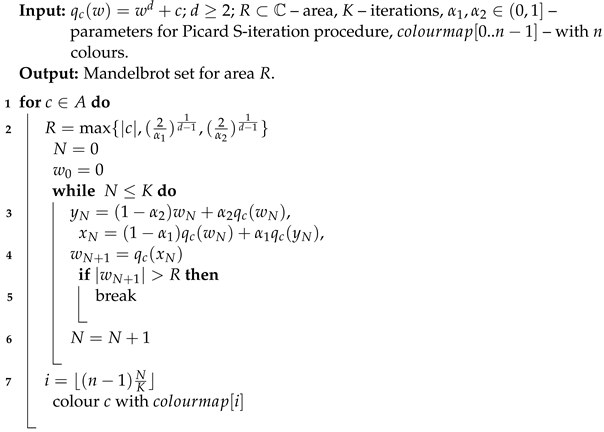
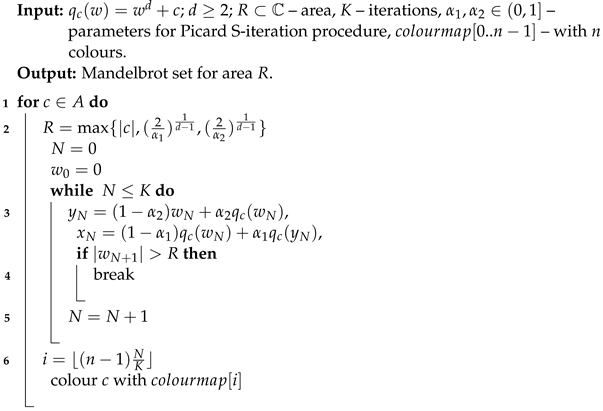
This section is concerned with the rich and exquisite patterns of the Mandelbrot set produced using the escape time algorithm. This depends on the greatest number of iterations required to determine whether the orbit sequence gets closer to infinity. When employing an iterative process, this method offers a useful framework that can be utilized to demonstrate specific features of dynamic systems. New Mandelbrot sets are presented here in this section for quadratic and cubic polynomials using the hybrid Picard S-iteration, as well as compared with Mandelbrot sets created by the S-iteration. The graphics were produced using the Mathematica 10 software and the escape specifications with the escape time algorithm. Observations were analyzed using a computer having specifications such as of Intel i5-2400 (@3.1 GHz) processor, 8 GB DDR3 RAM, and Microsoft Windows 10 (64-bit) operating system. The pseudocode of the Mandelbrot set creation algorithm in Picard S-orbit is exhibited in Algorithm 1 and for S-Orbit in Algorithm 2.
| Algorithm 1: Creation of the Mandelbrot sets using the hybrid Picard S-orbit |
 |
| Algorithm 2: Creation of the Mandelbrot sets using the S-orbit |
 |
4.1. Rich and Exquisite Patterns of the Mandelbrot Sets Using Hybrid Picard S-Iteration vs. S-Iteration and Quadratic Functions
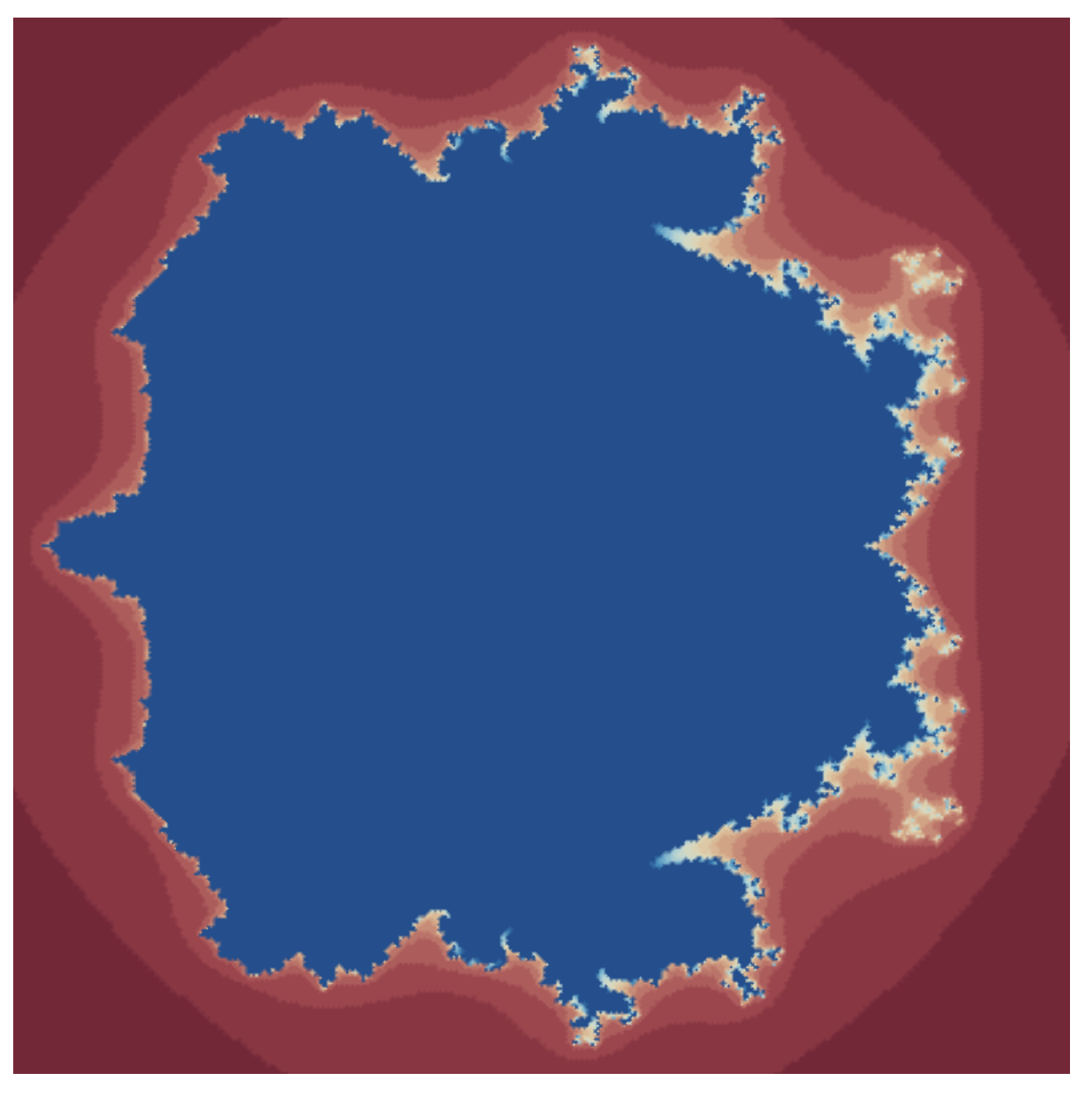
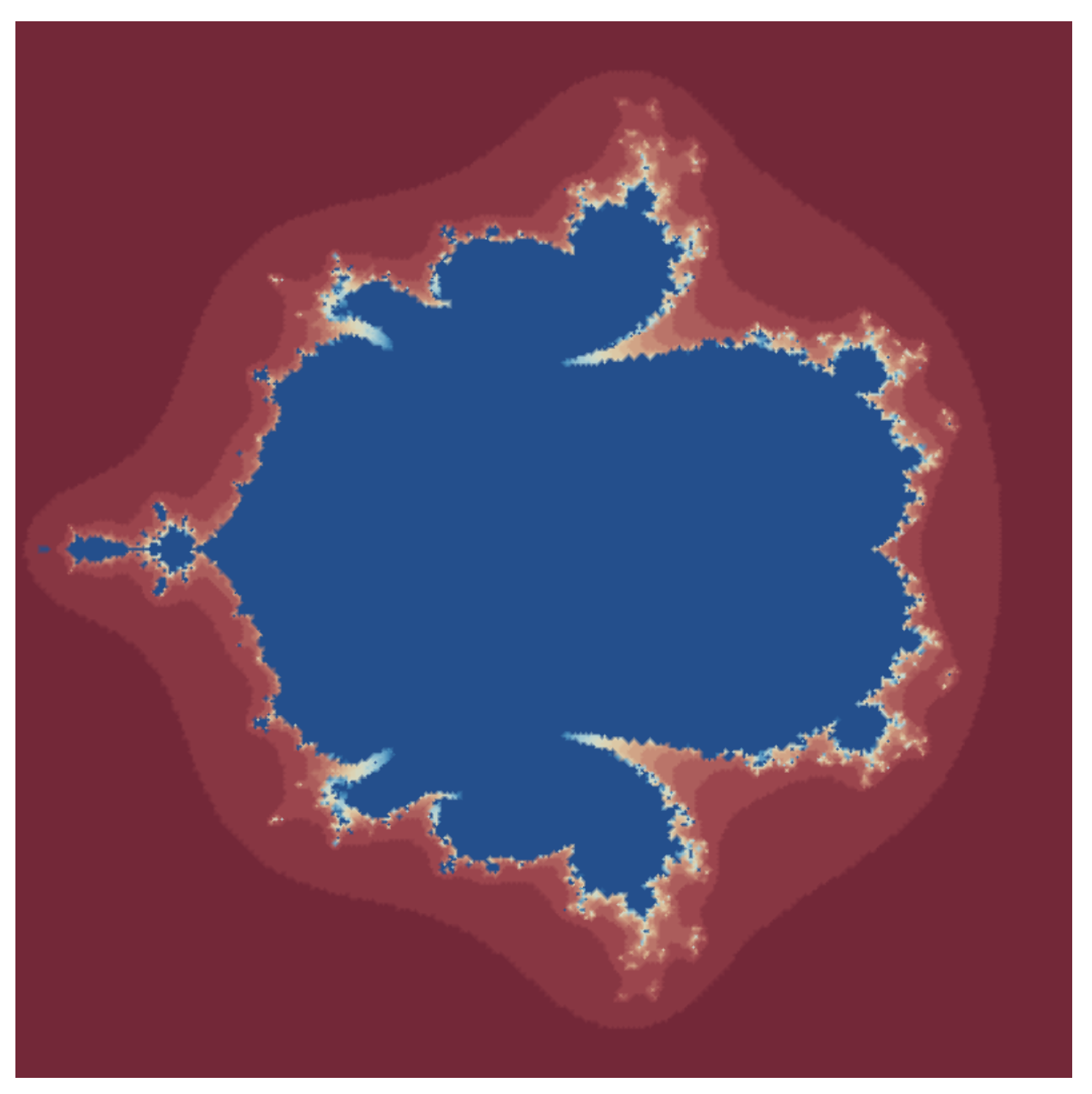
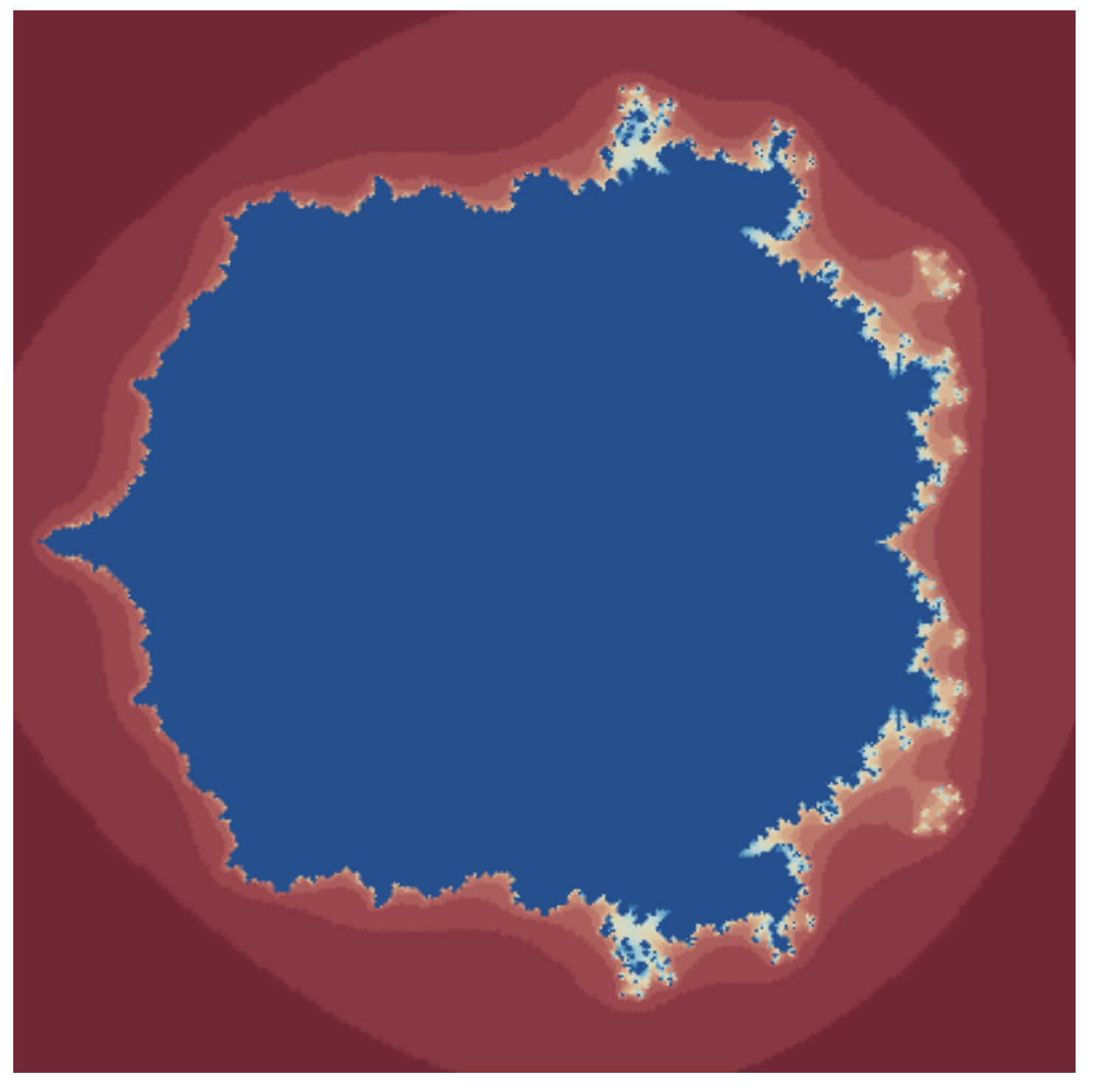
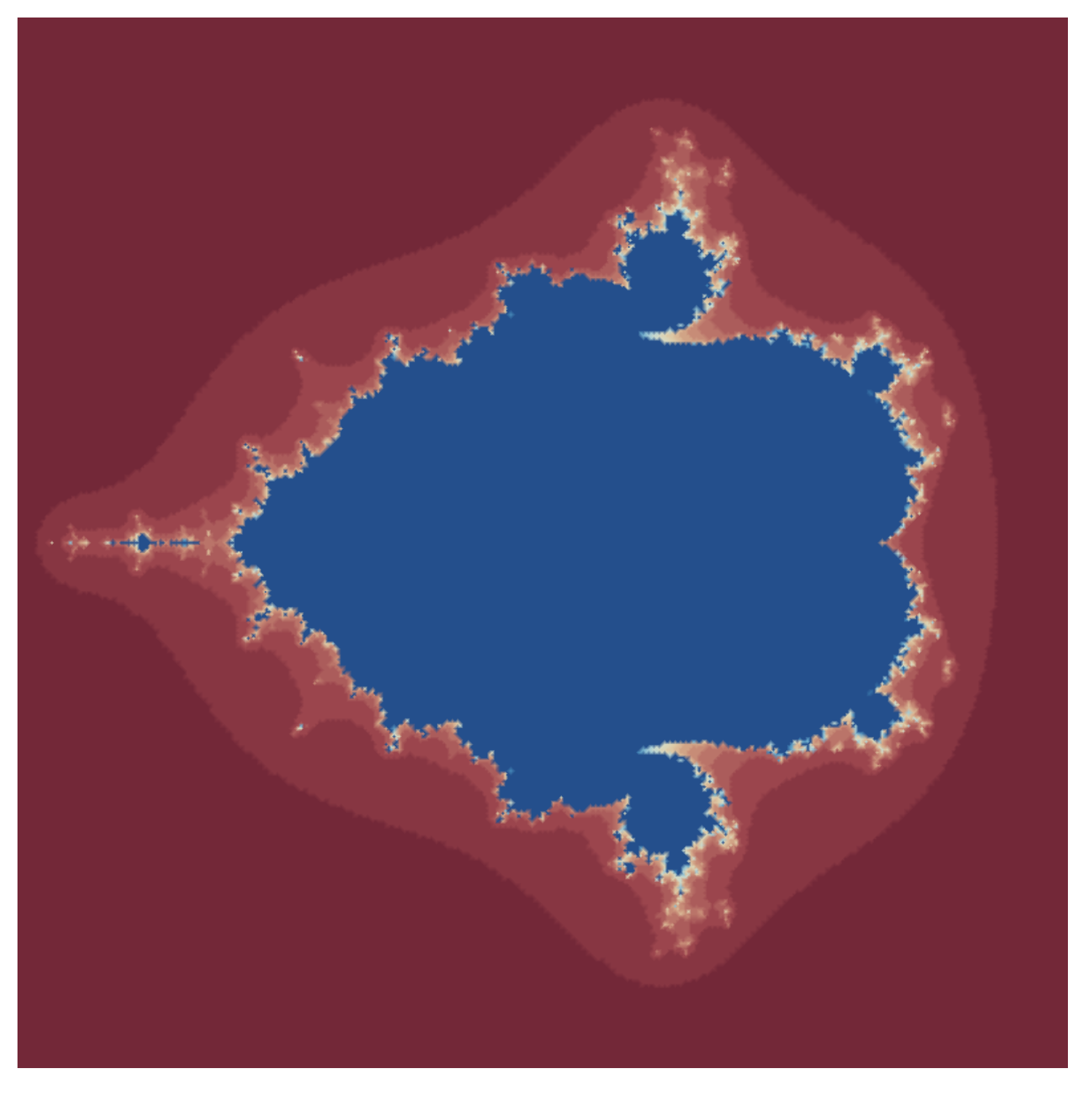
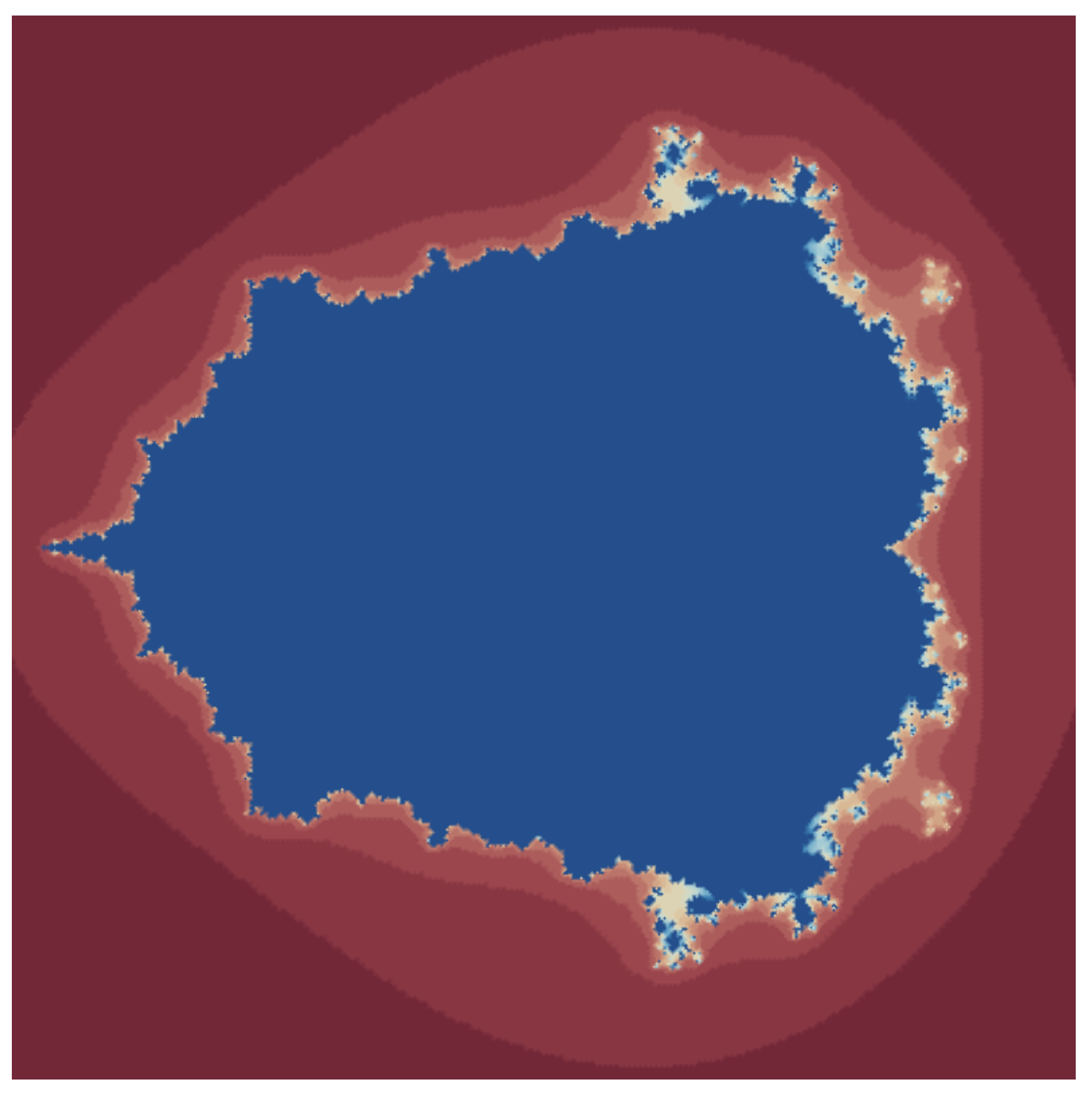
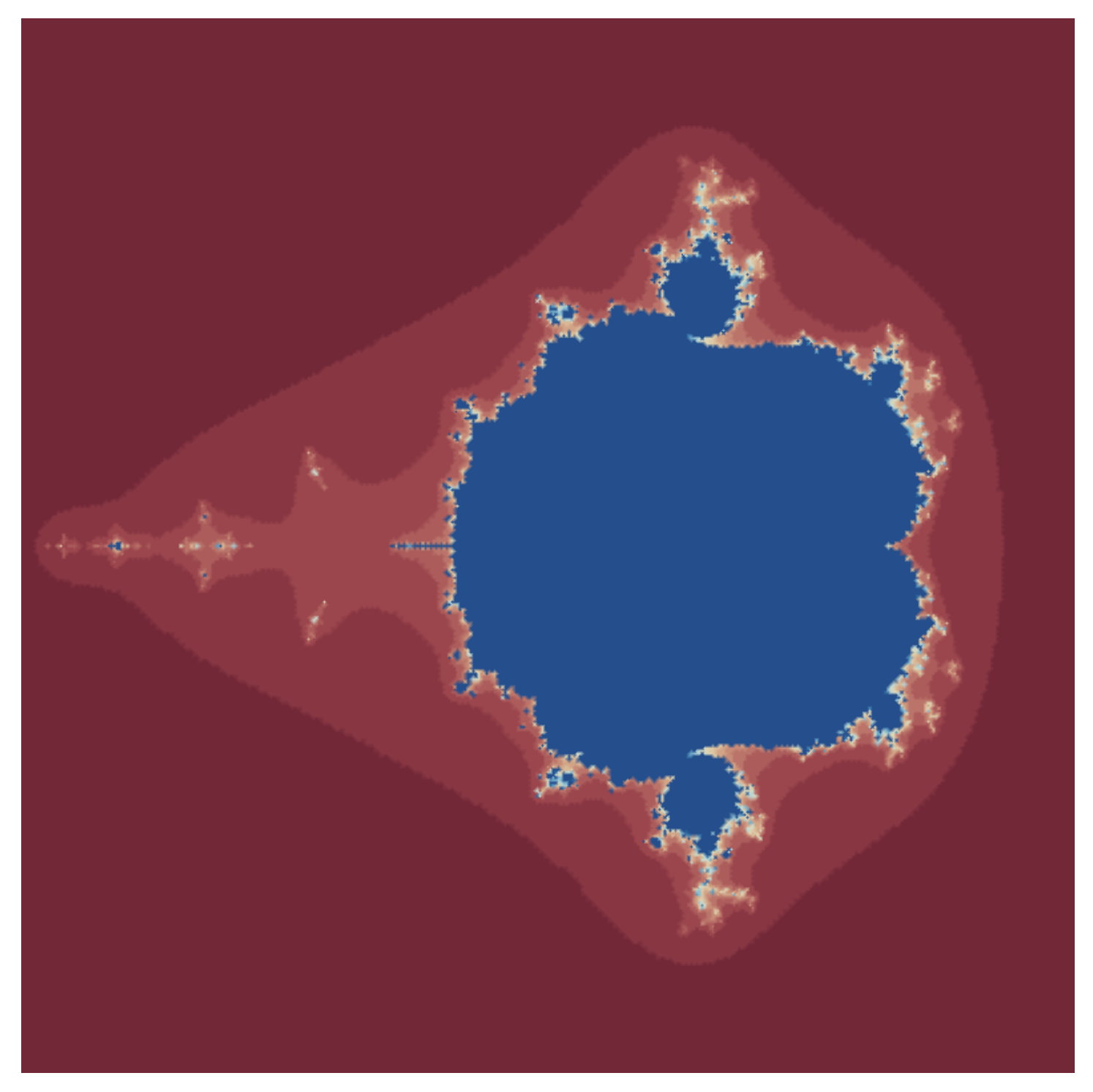
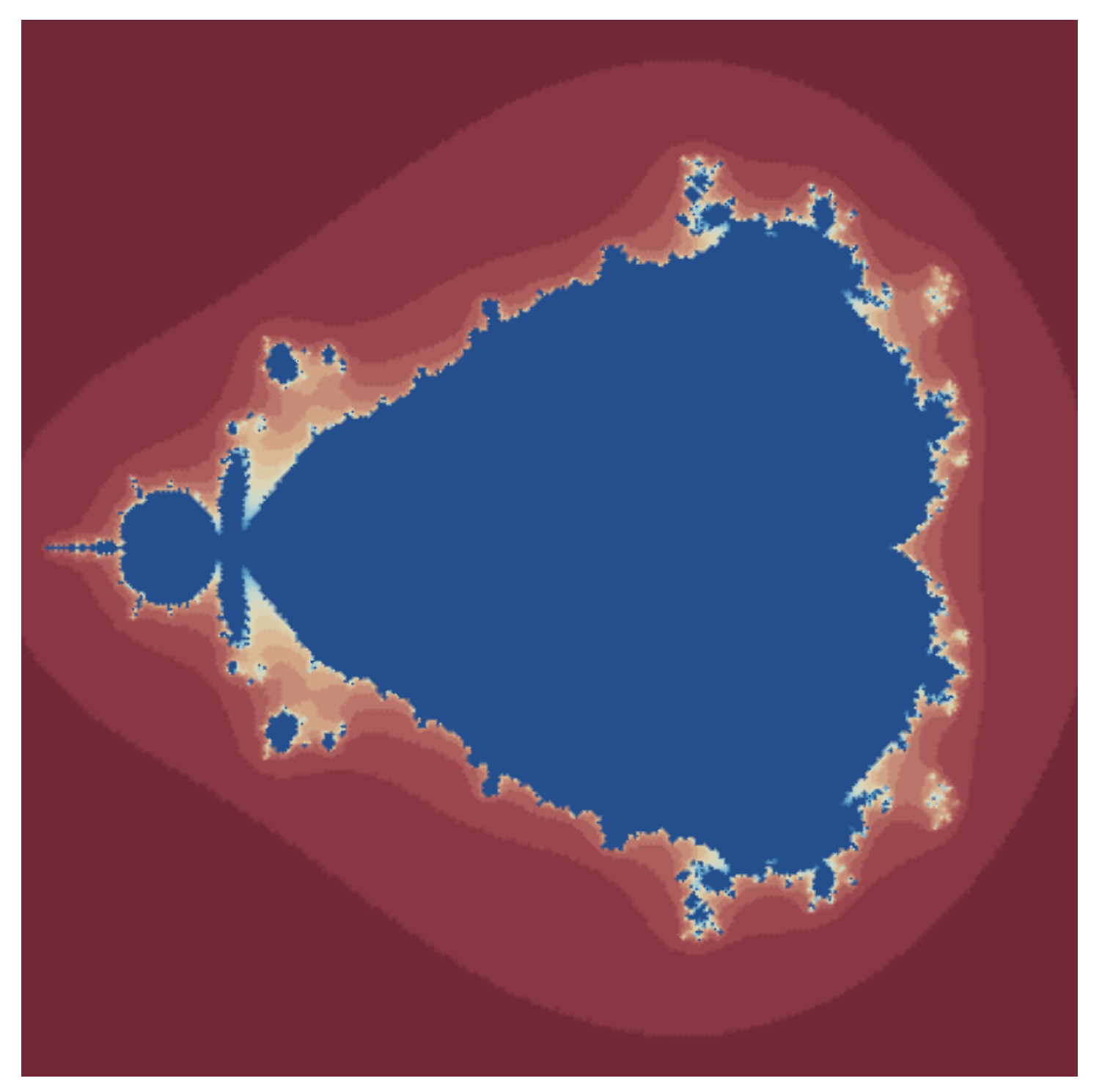
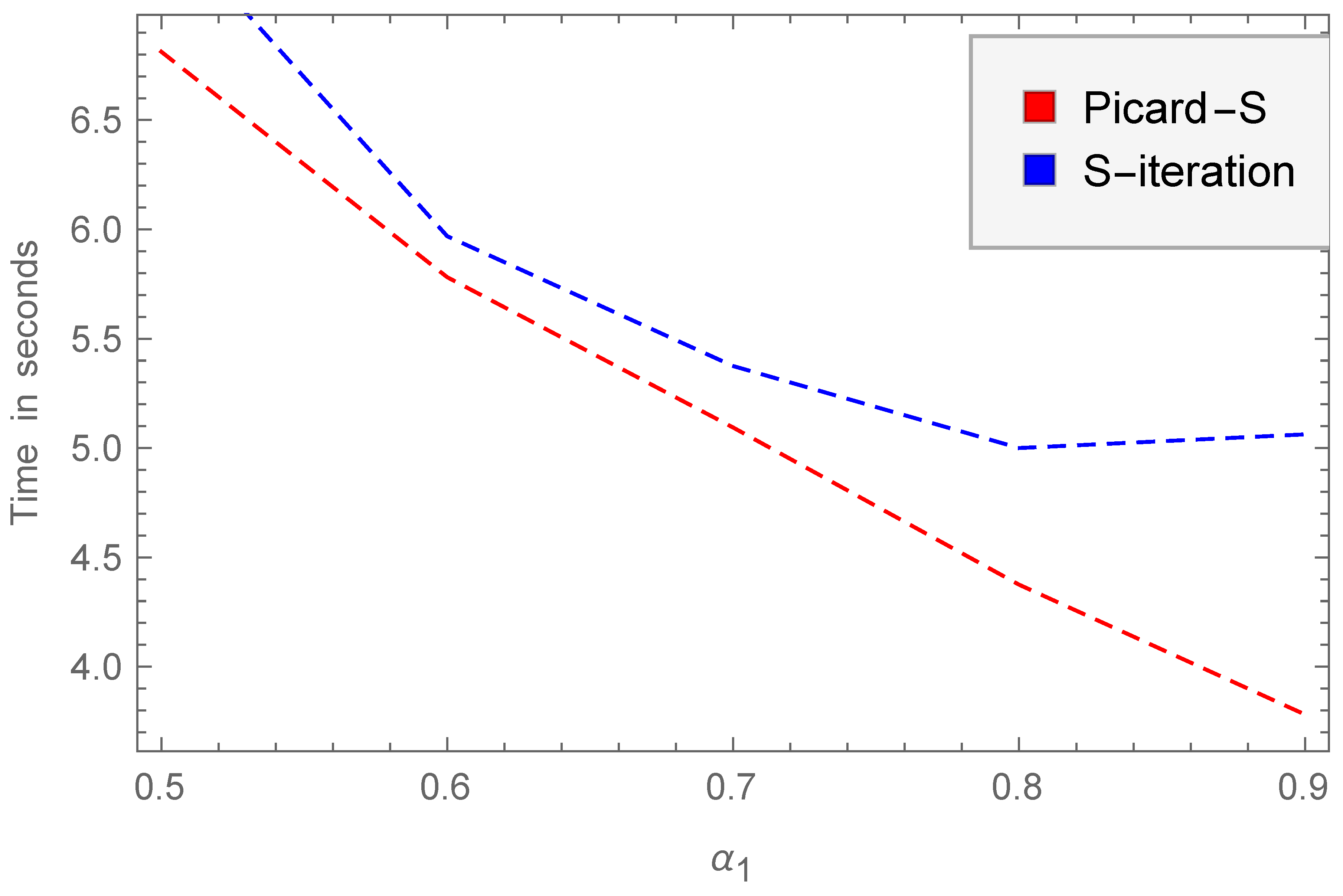
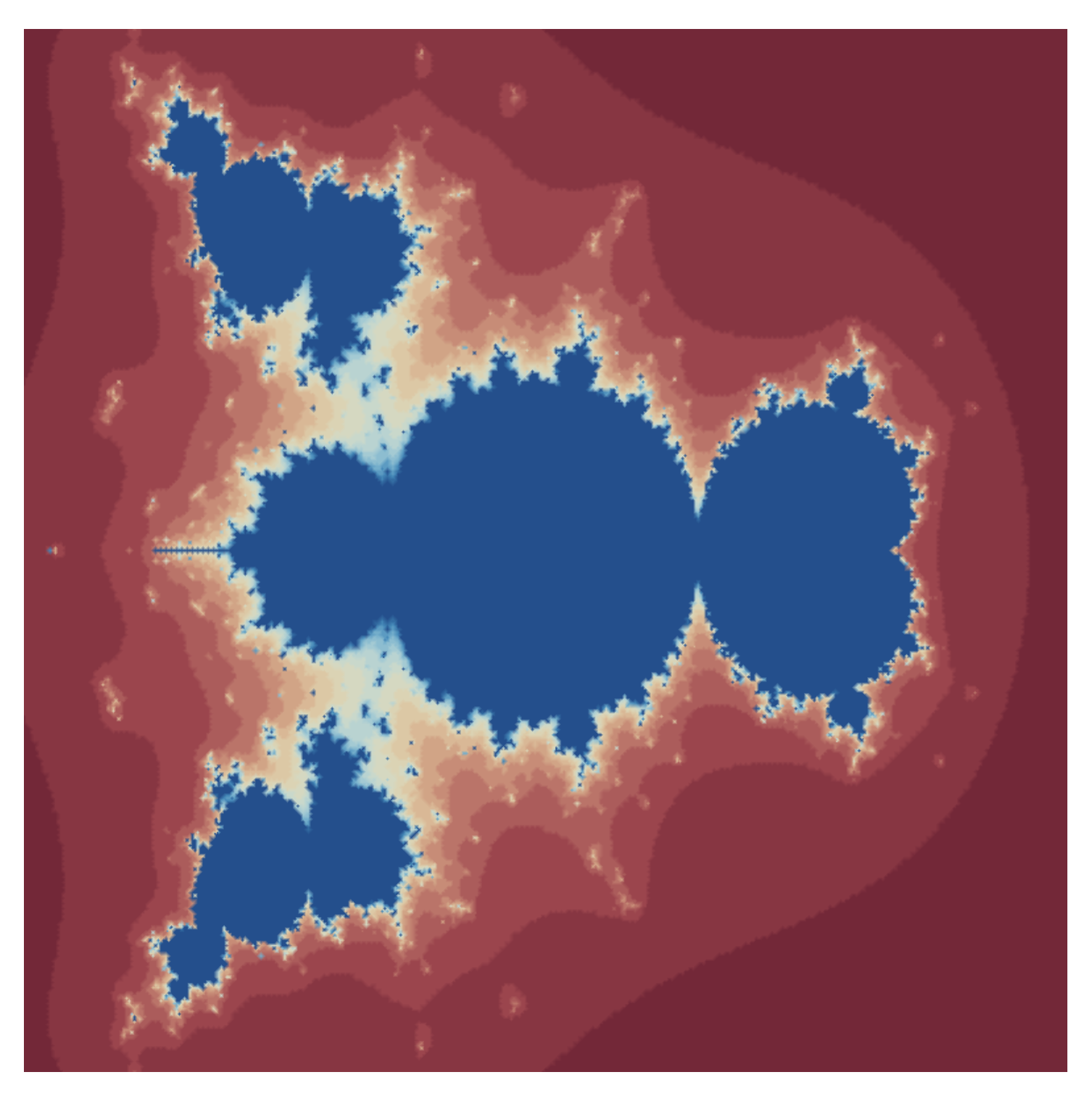
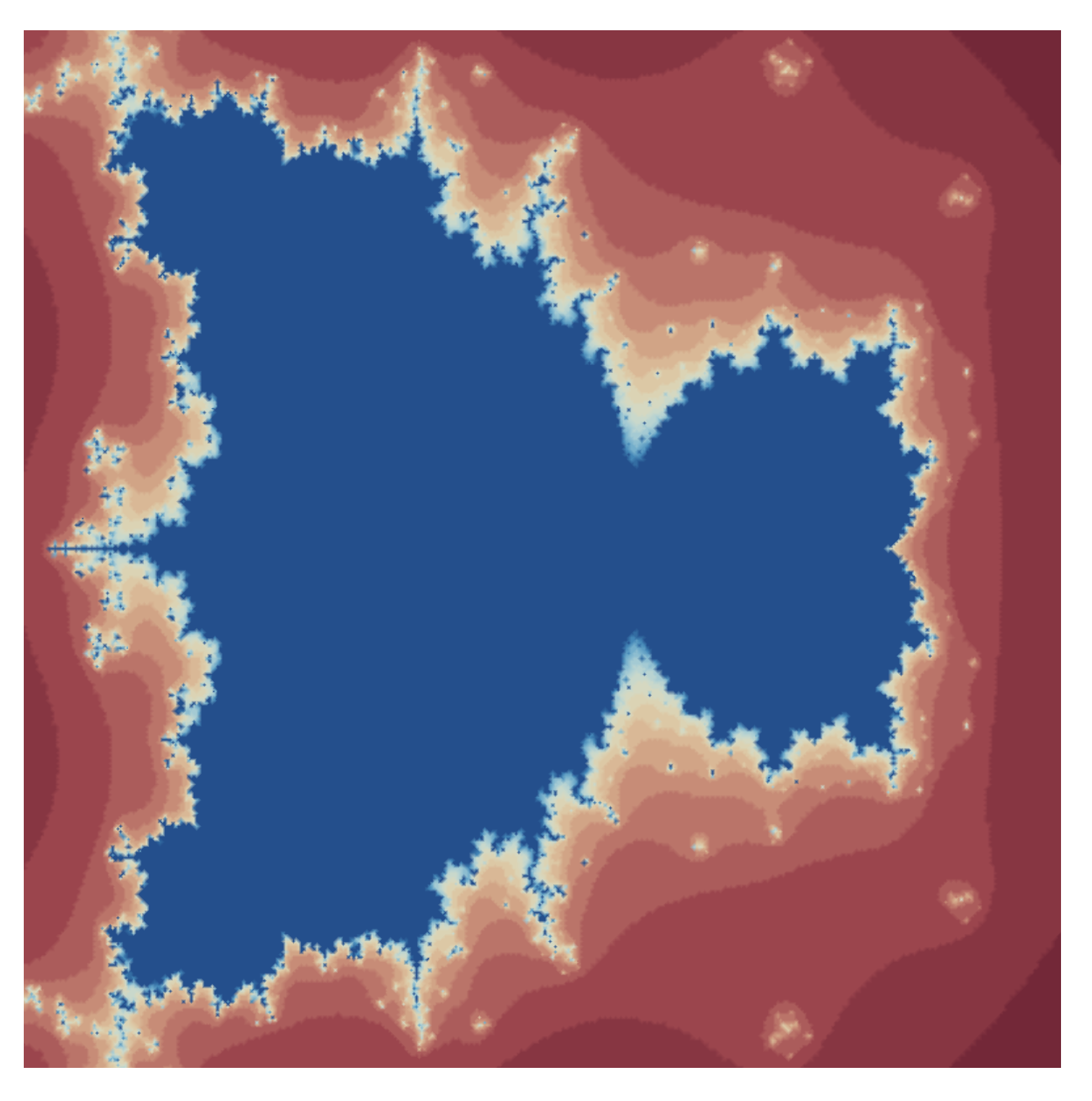
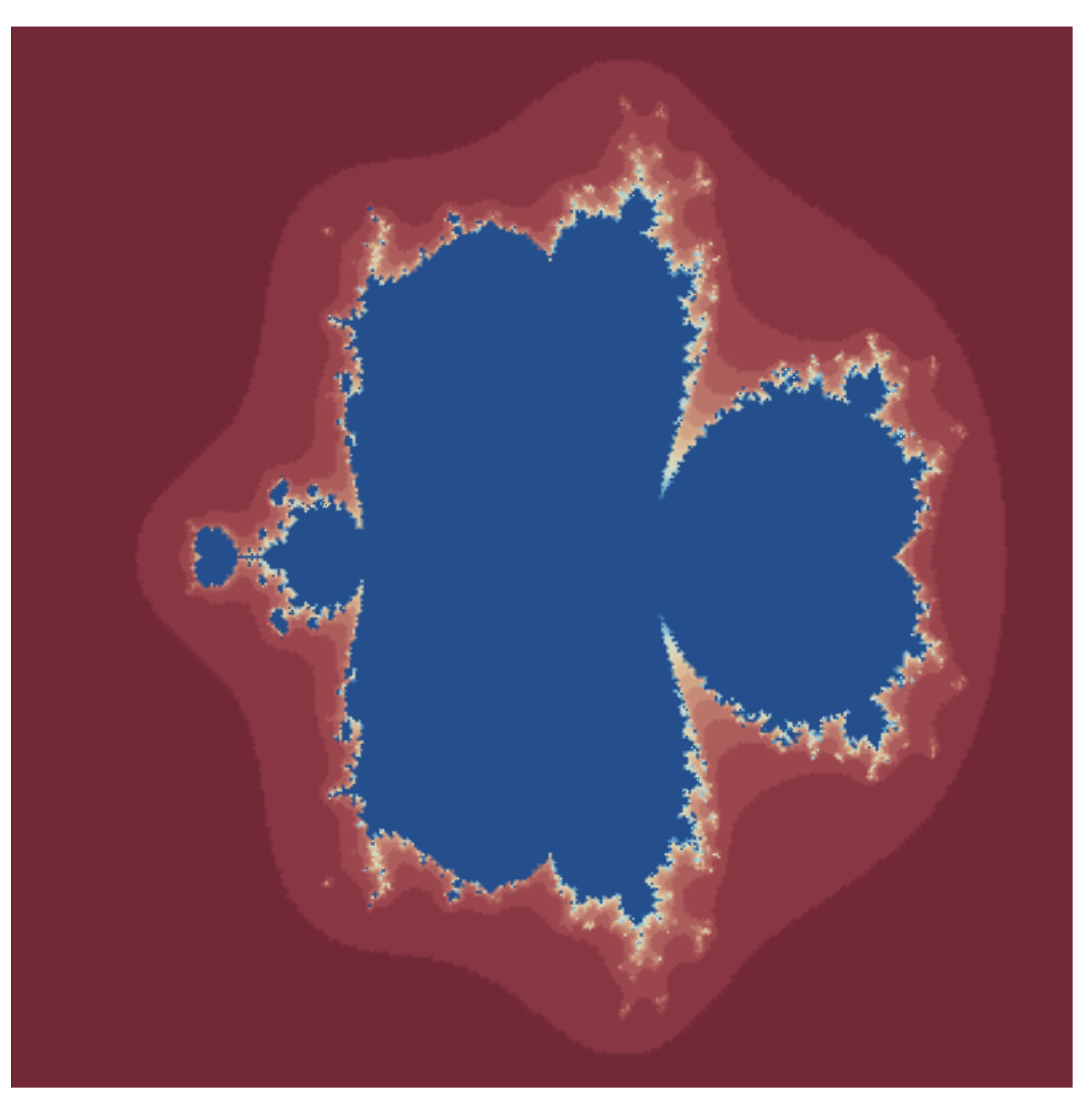
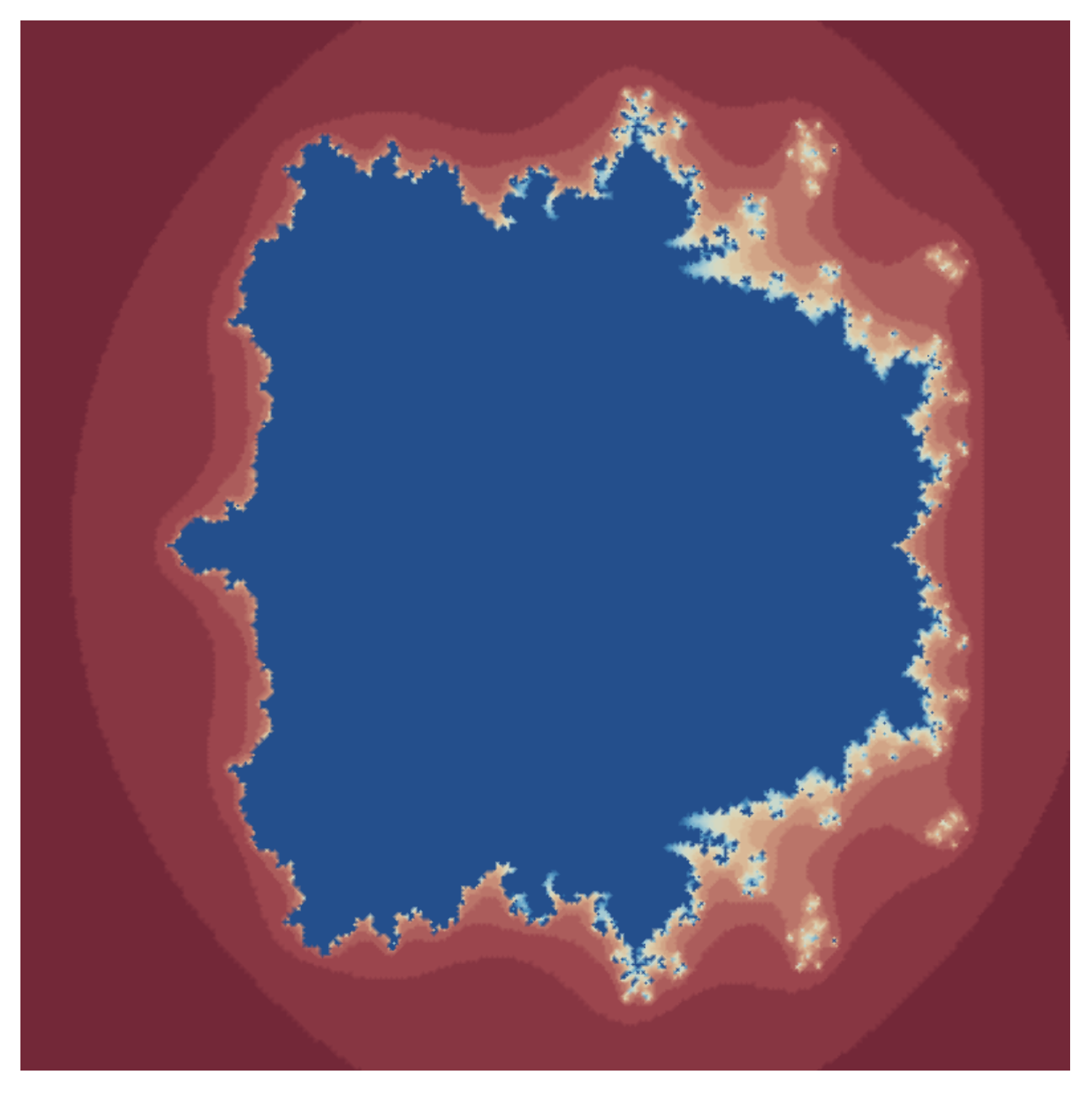
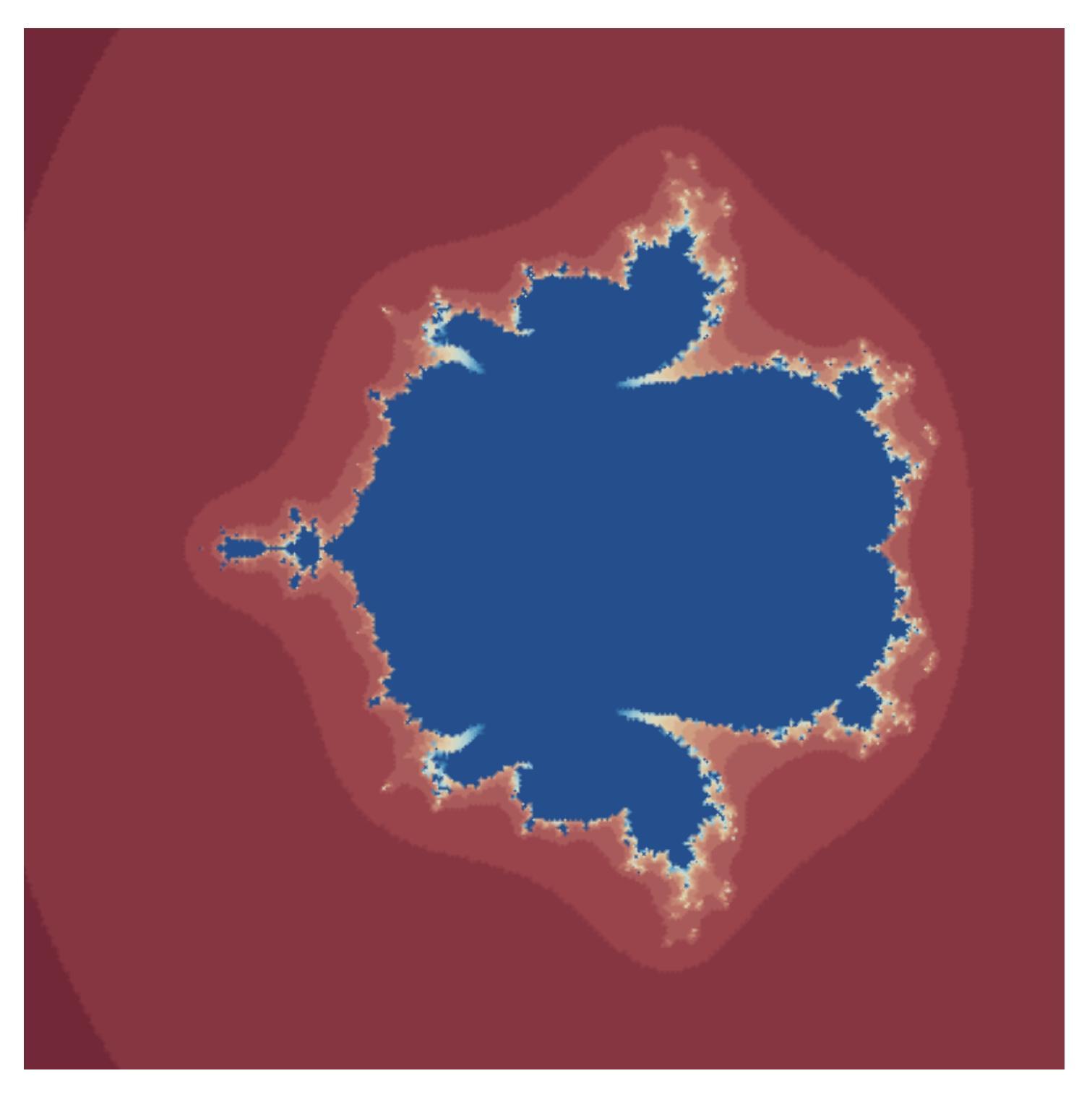
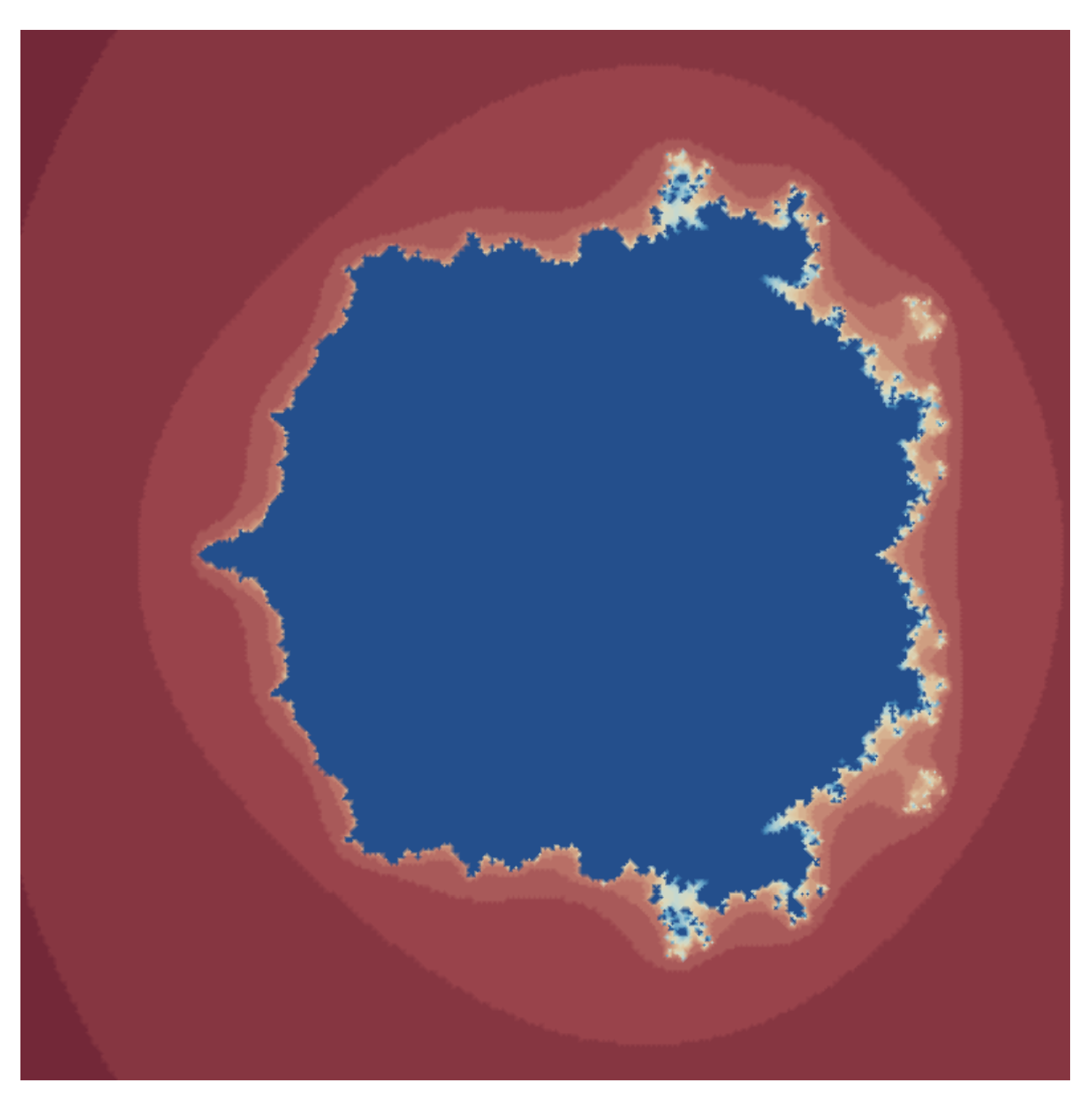
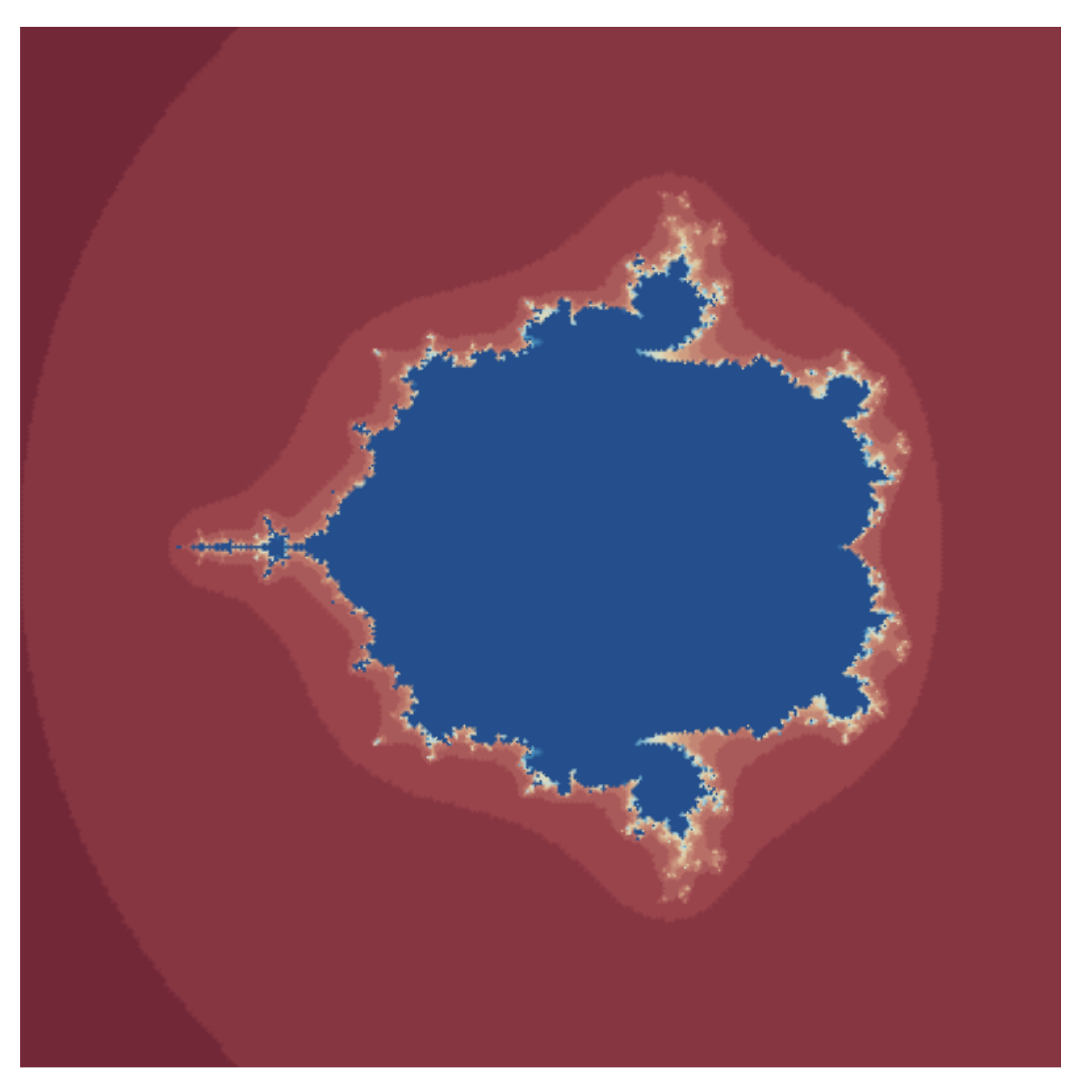
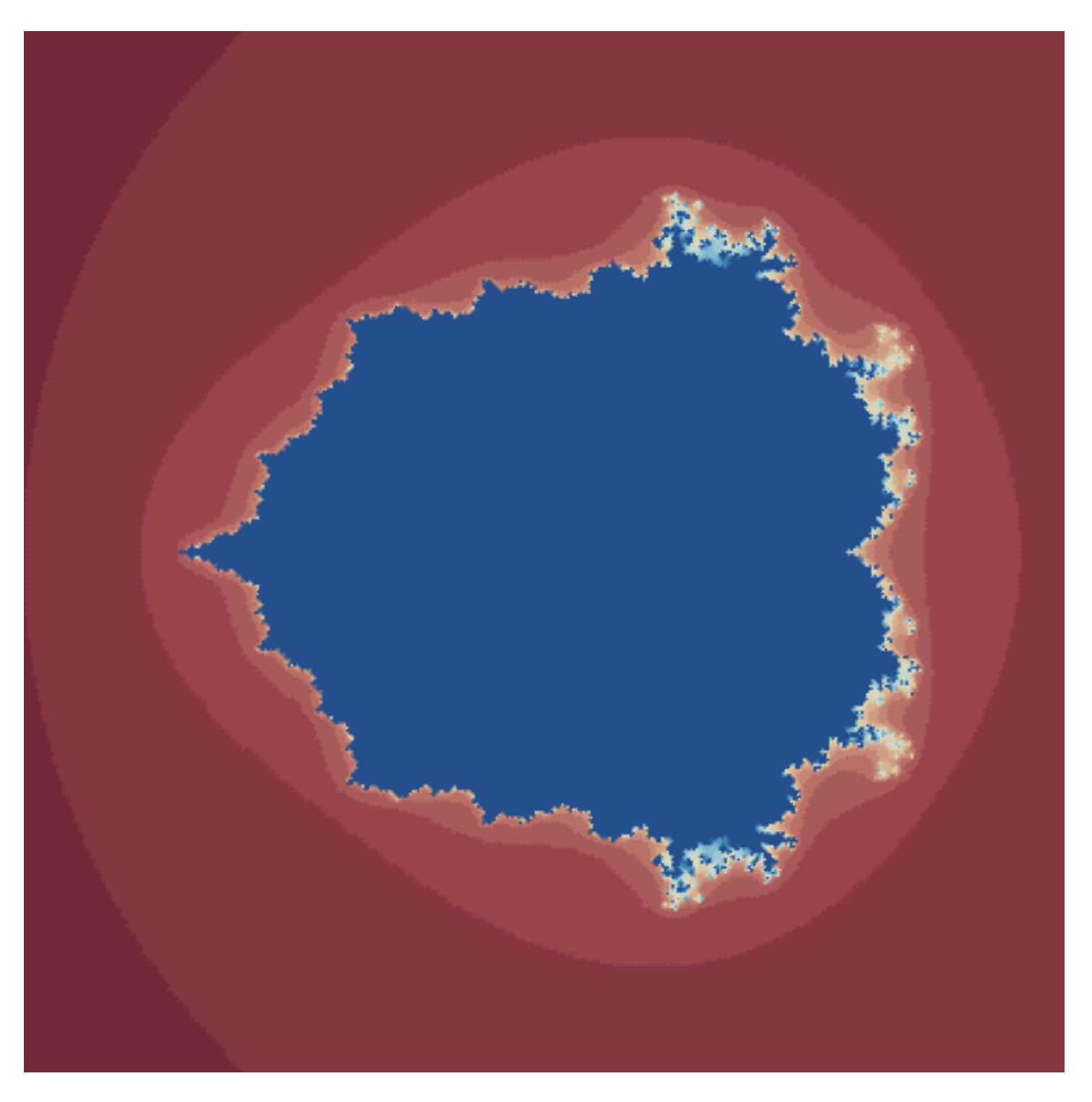
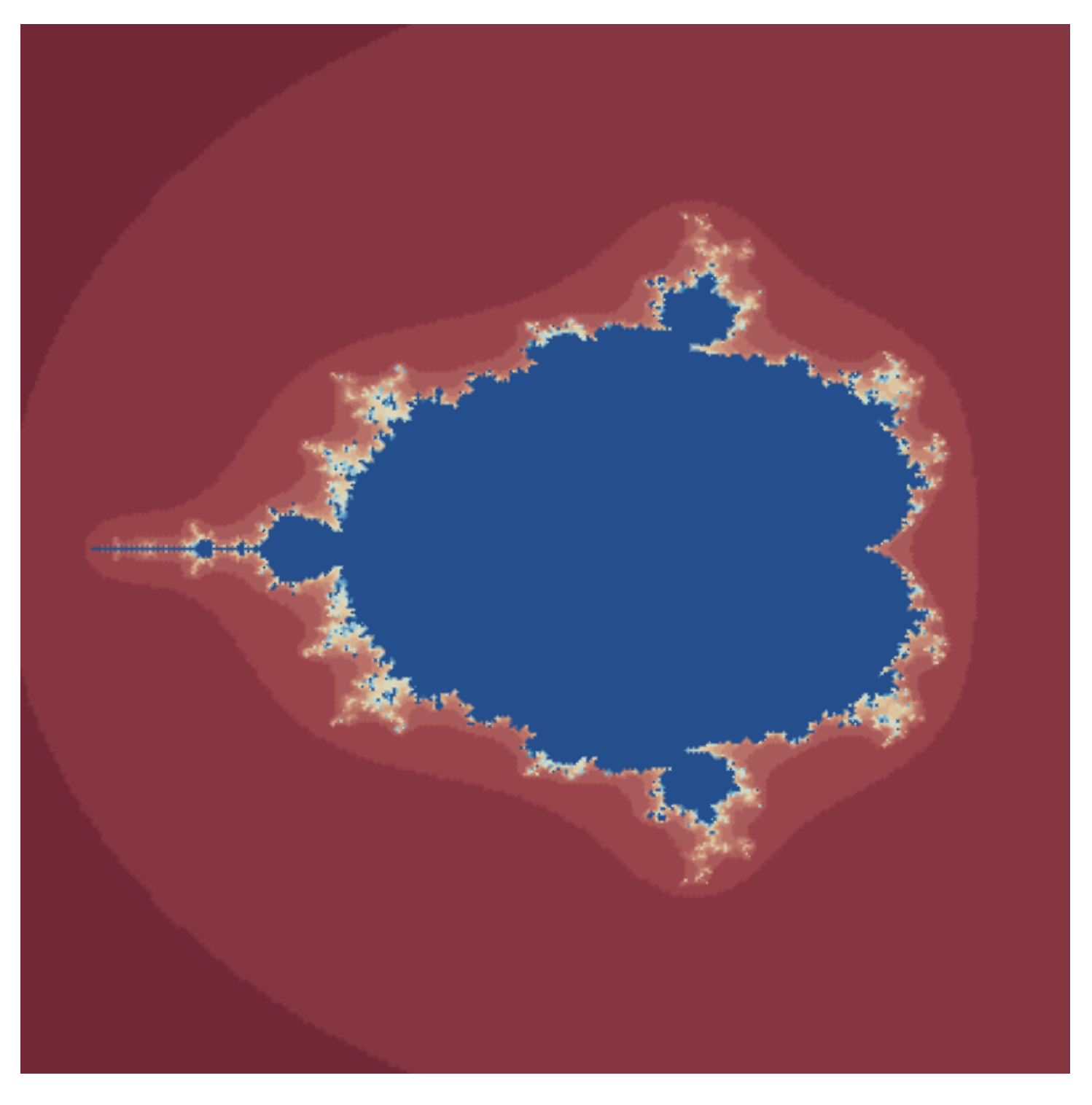
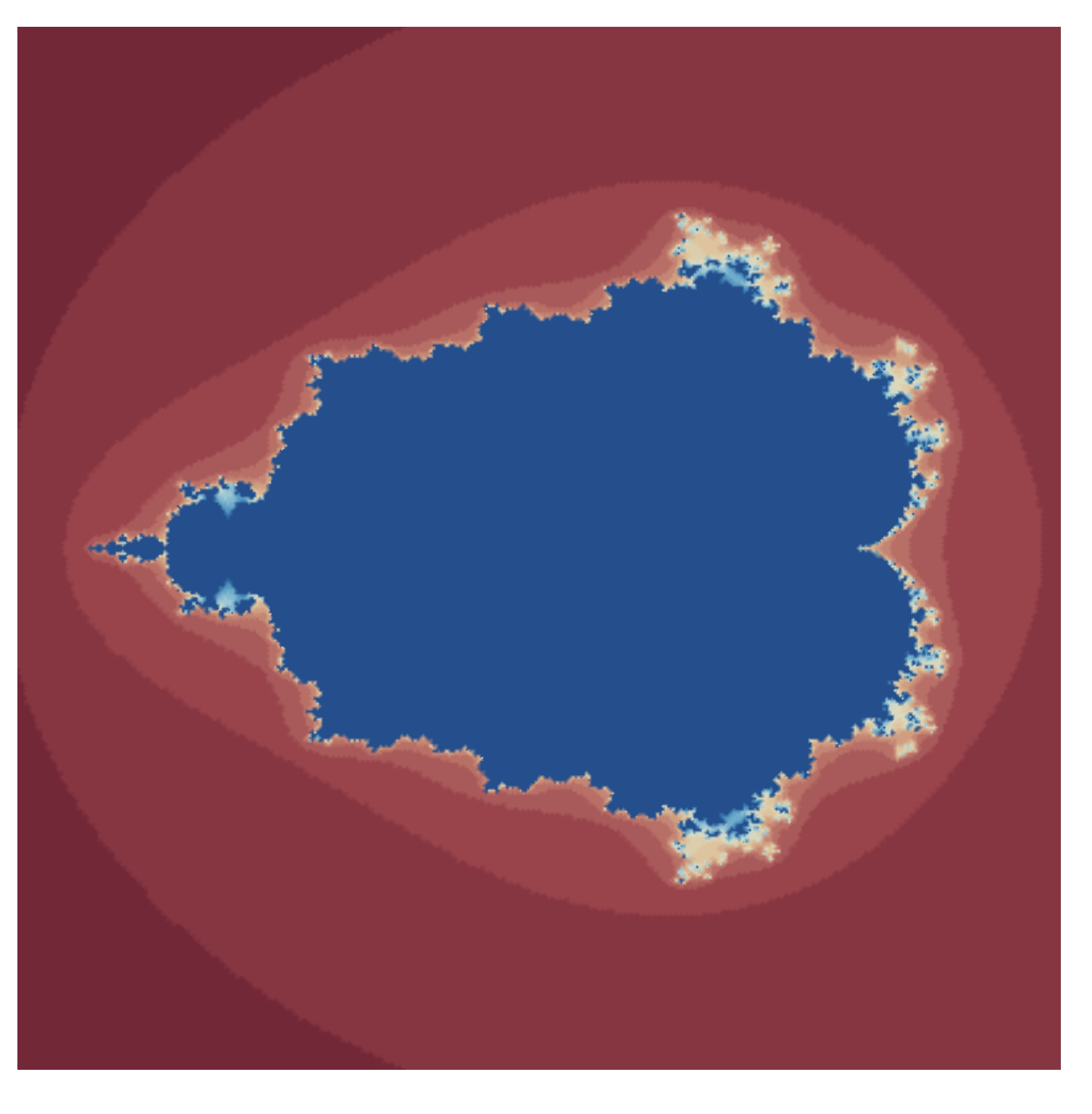
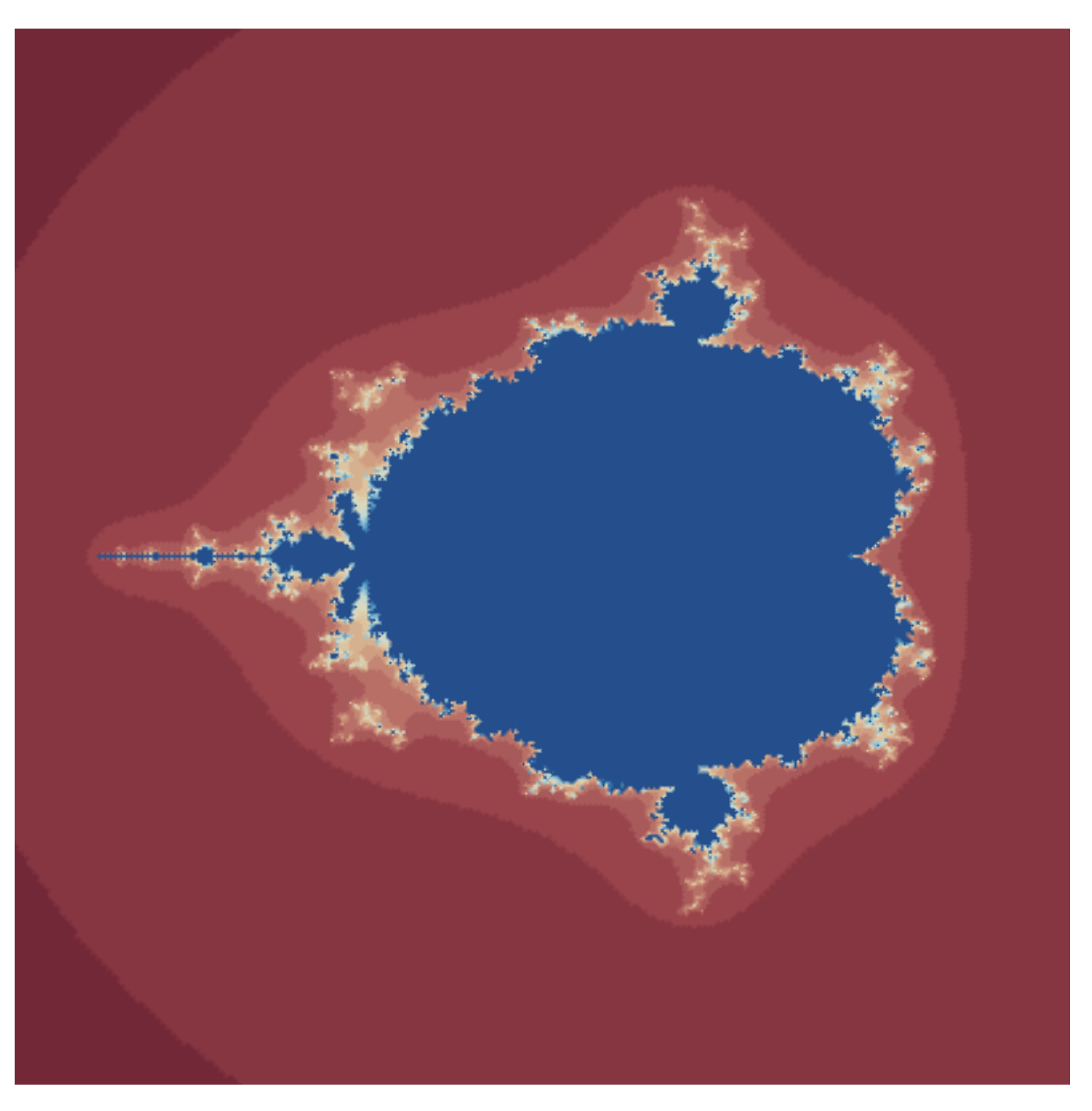
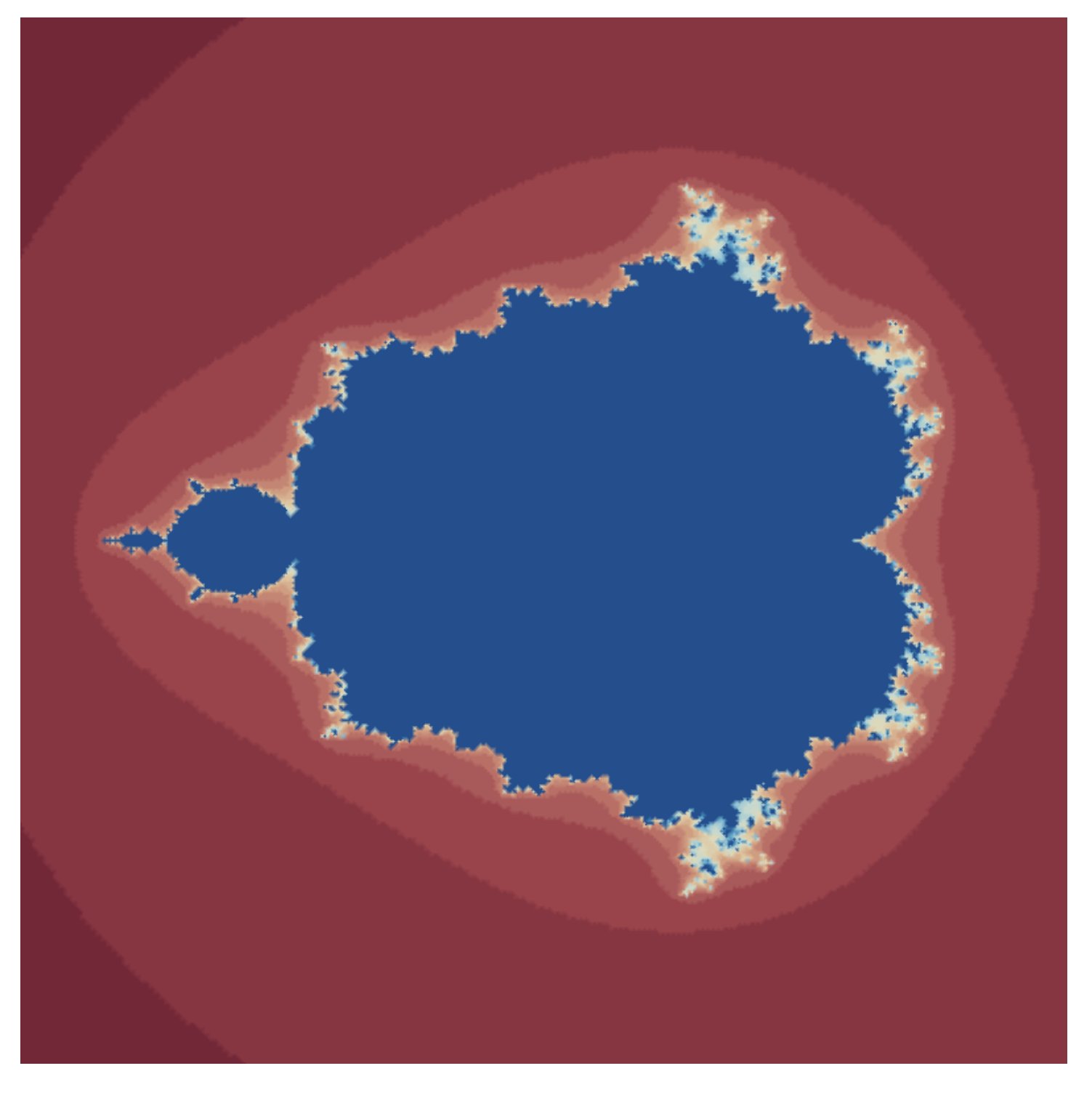
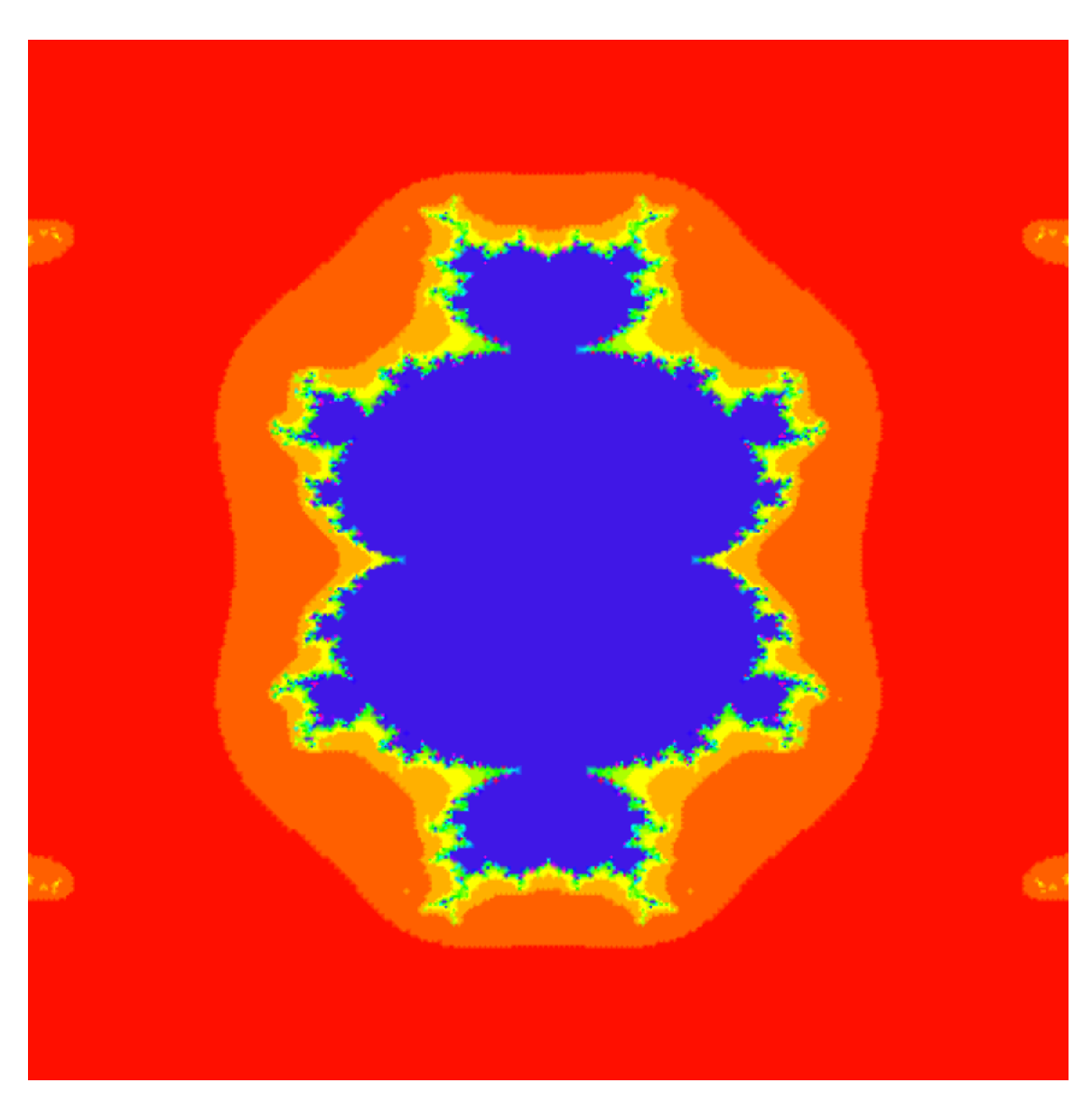
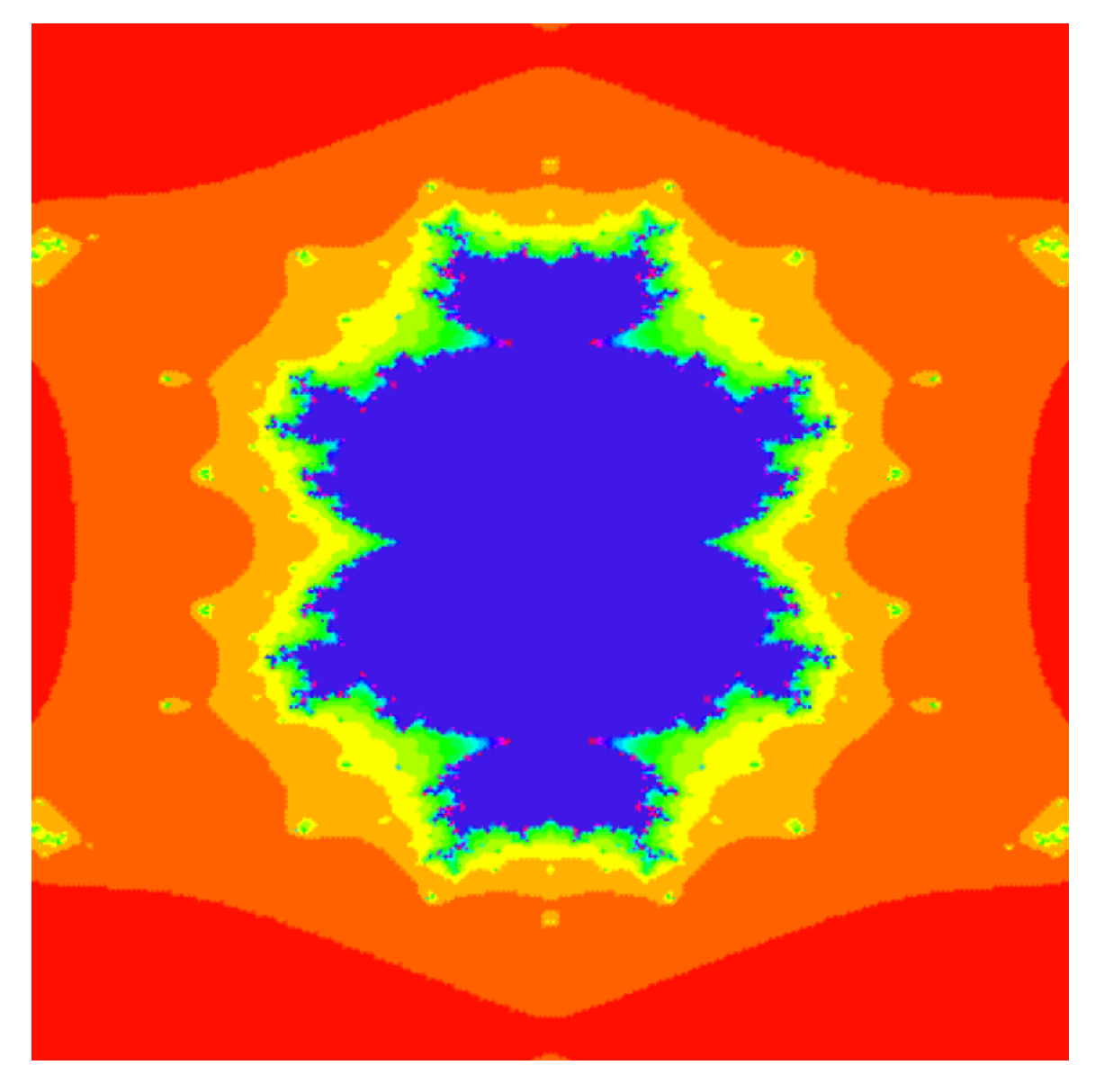
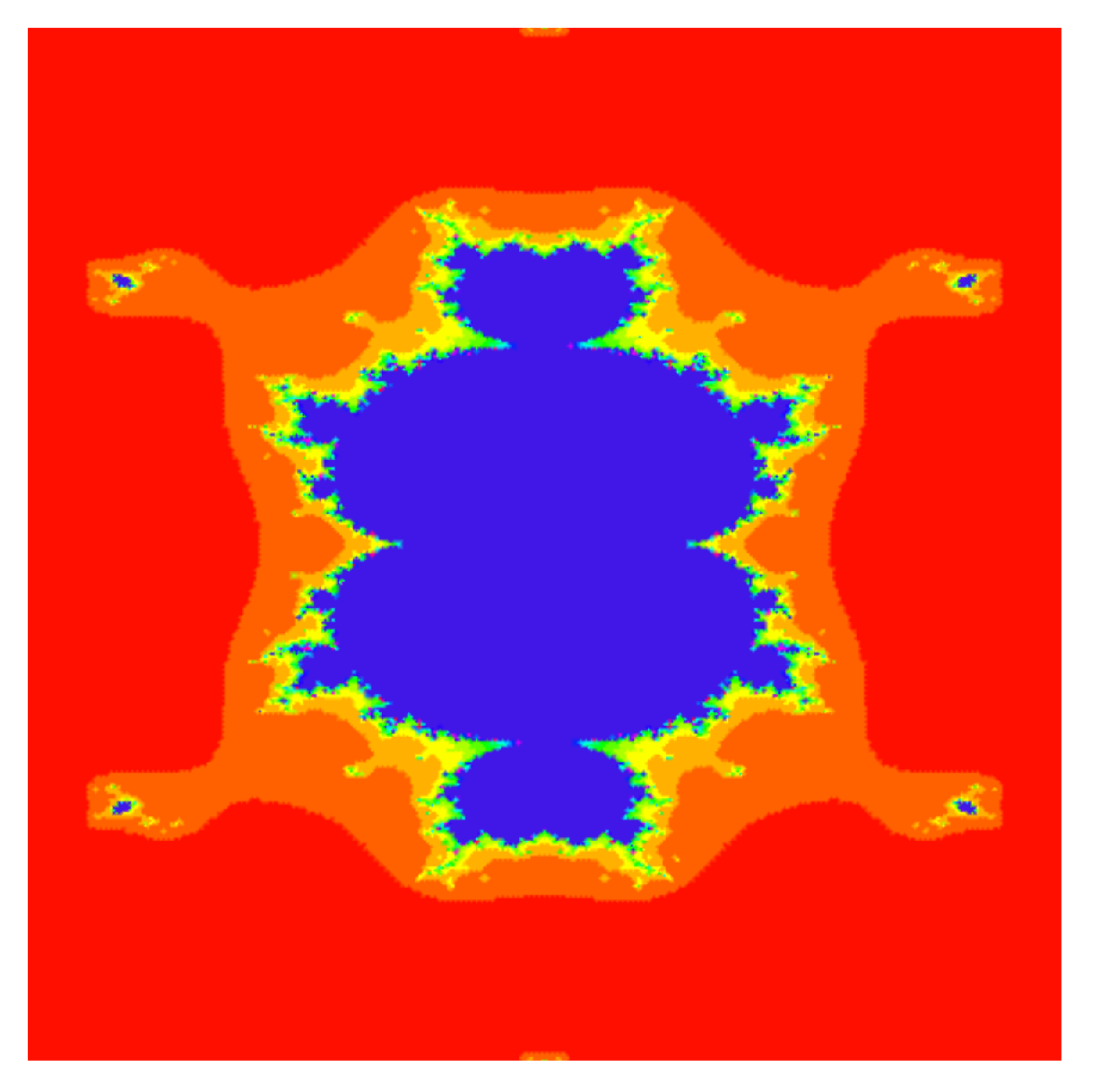
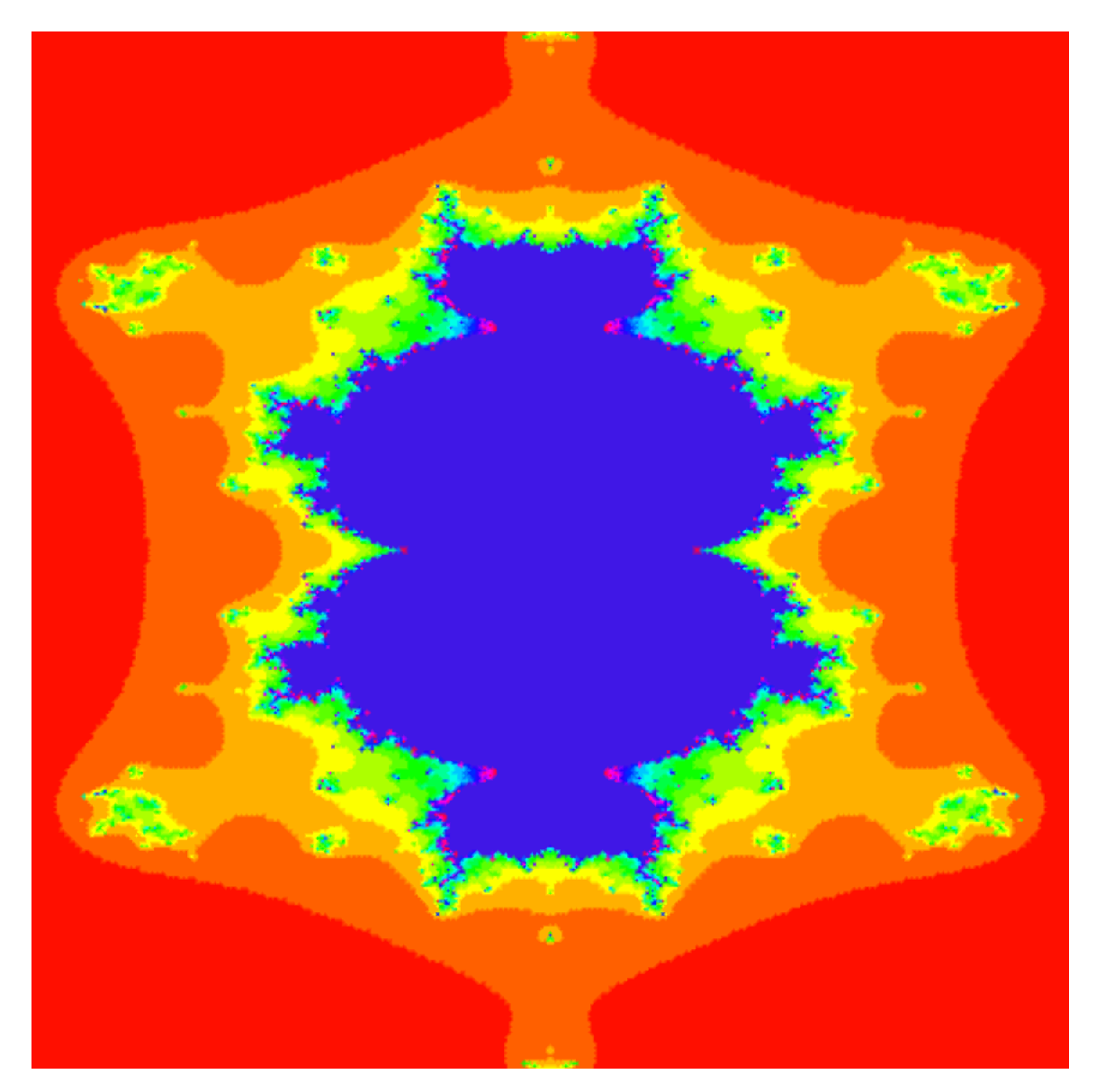
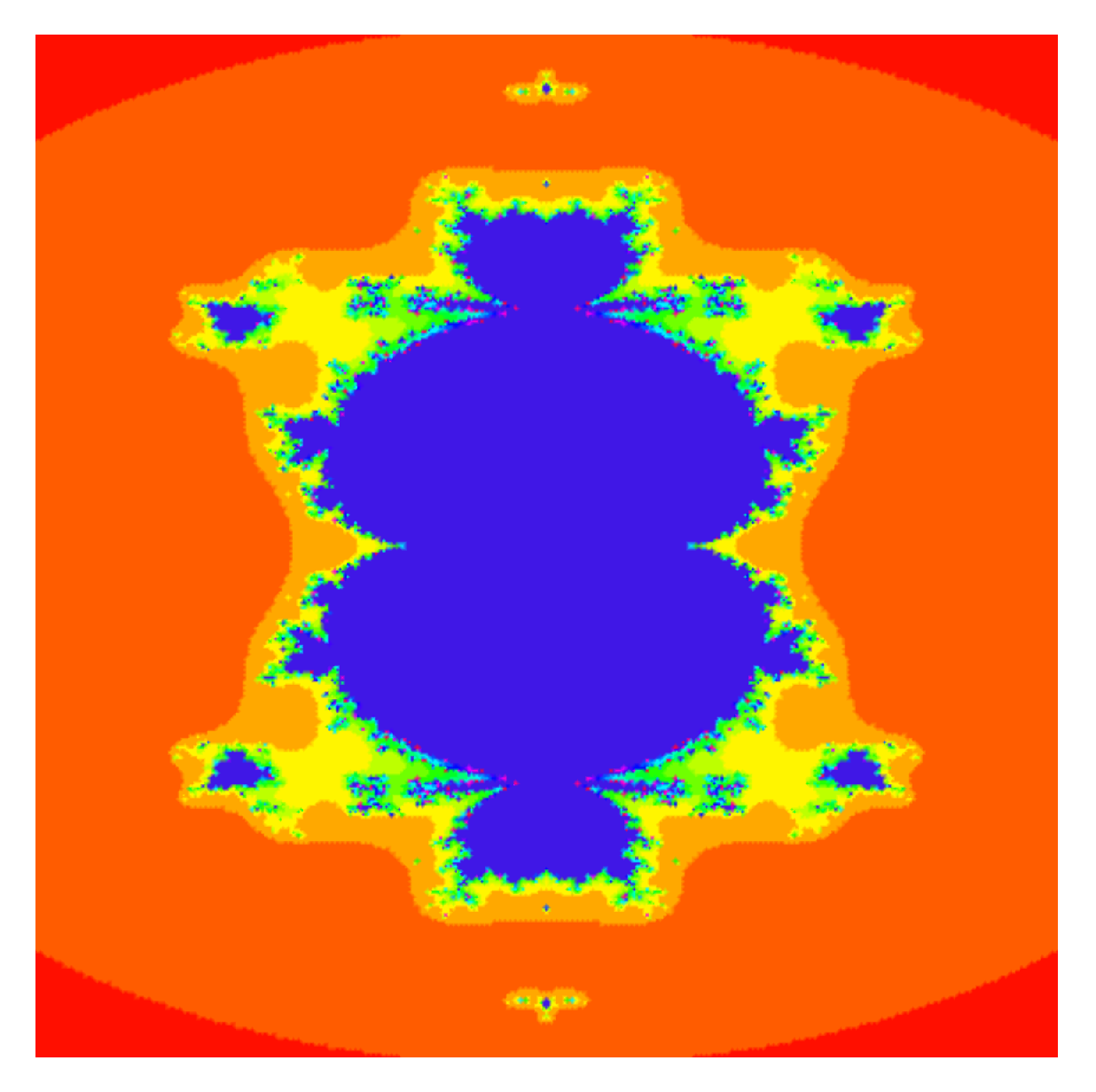
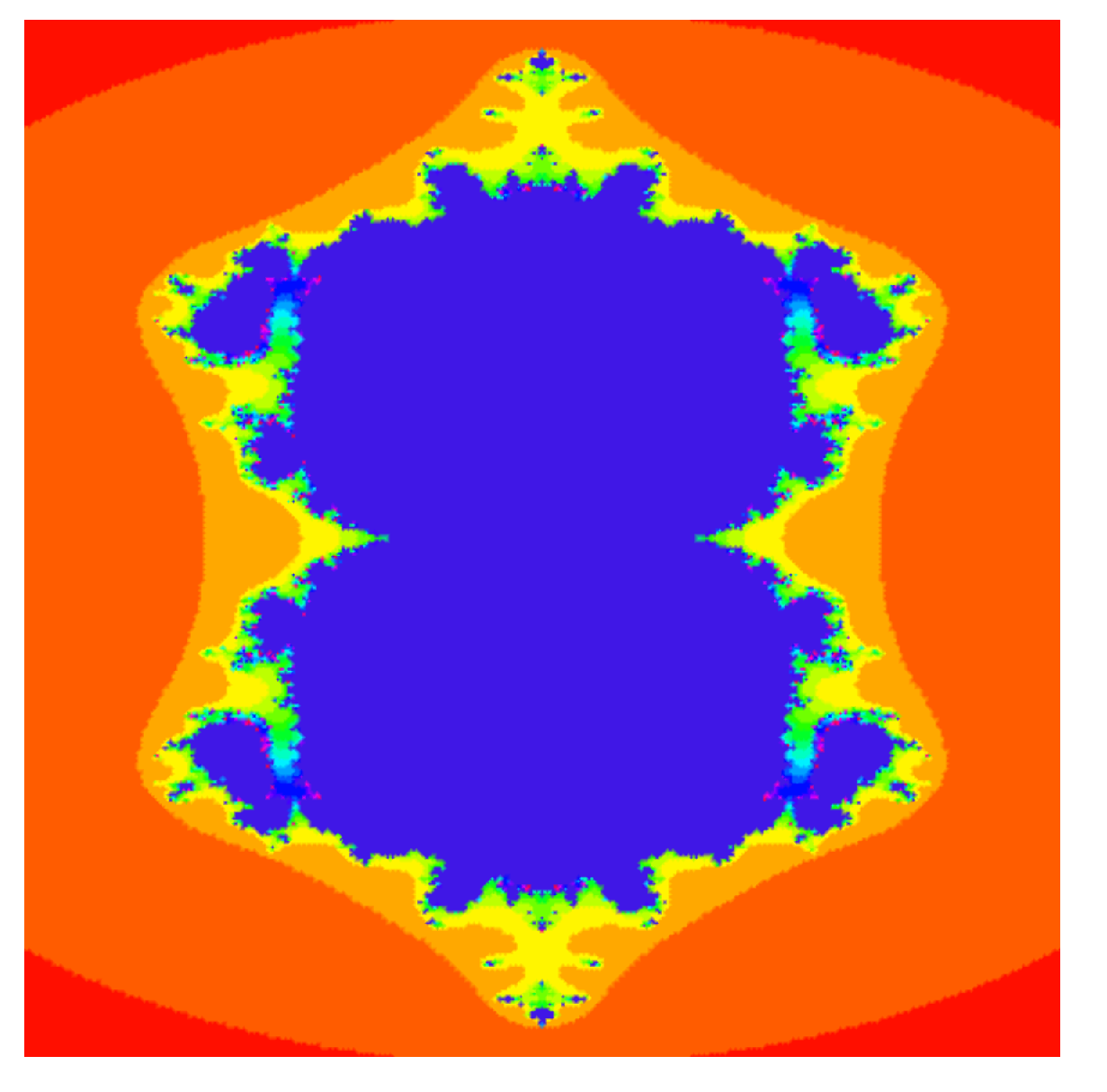
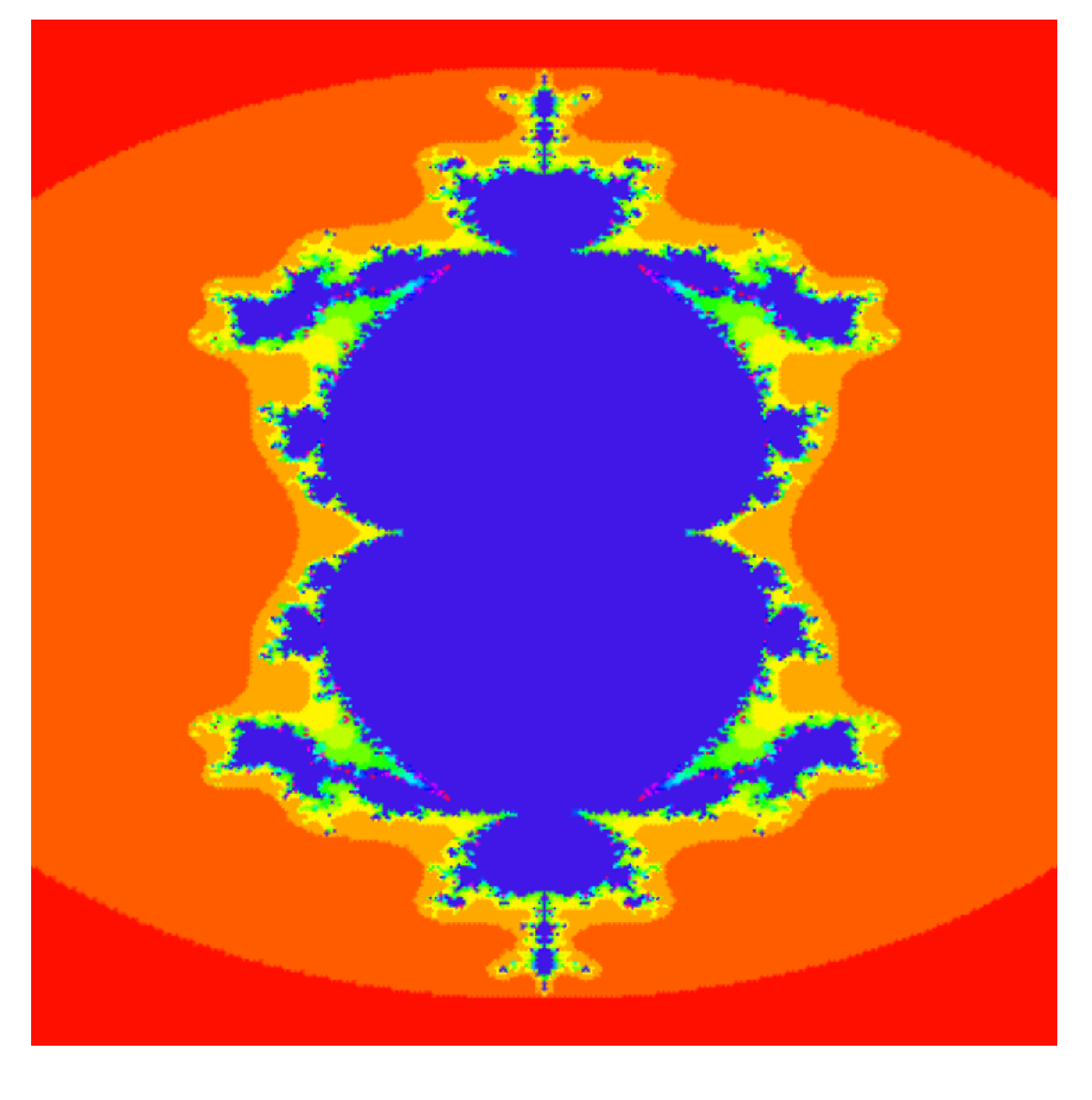
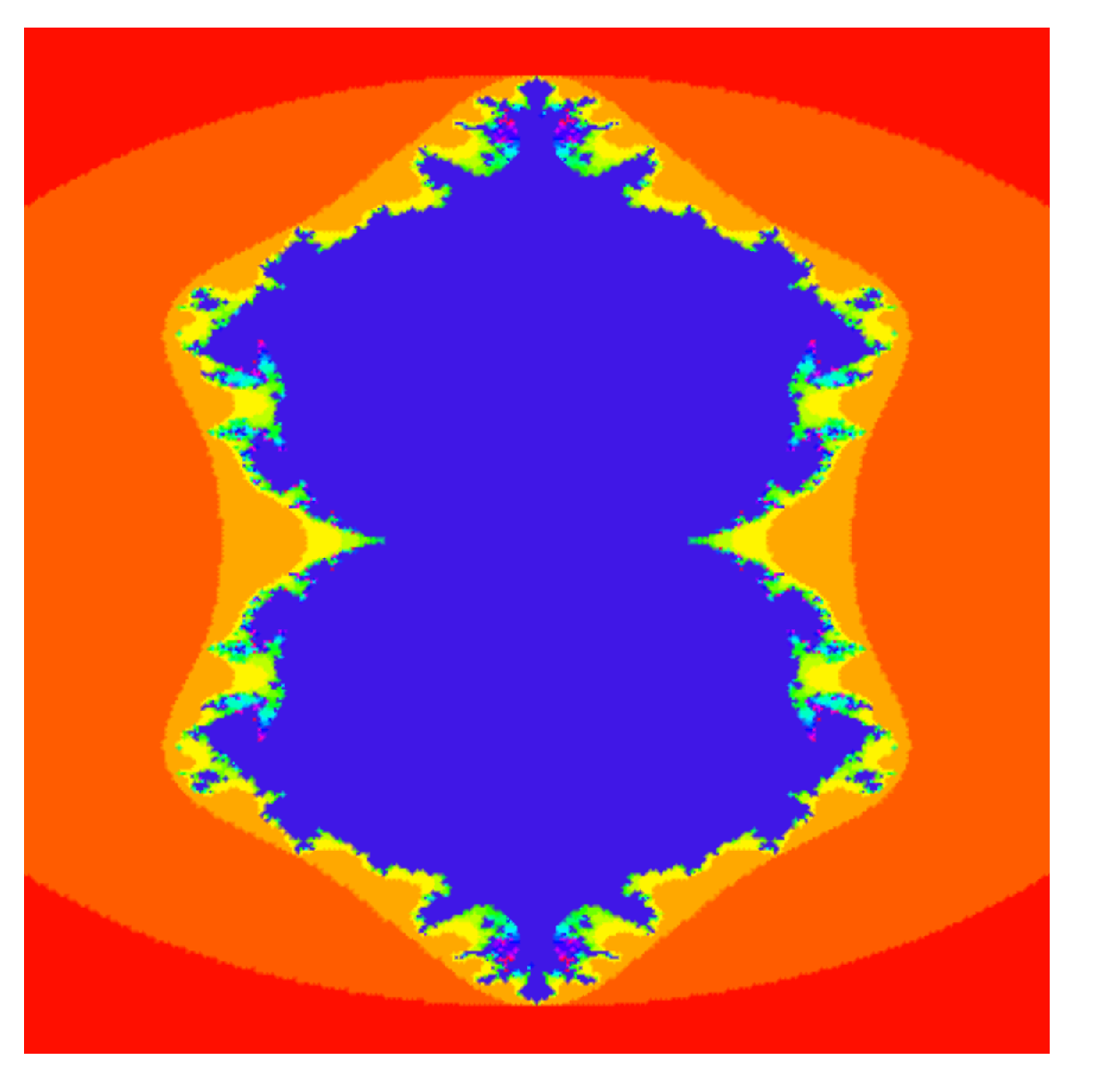
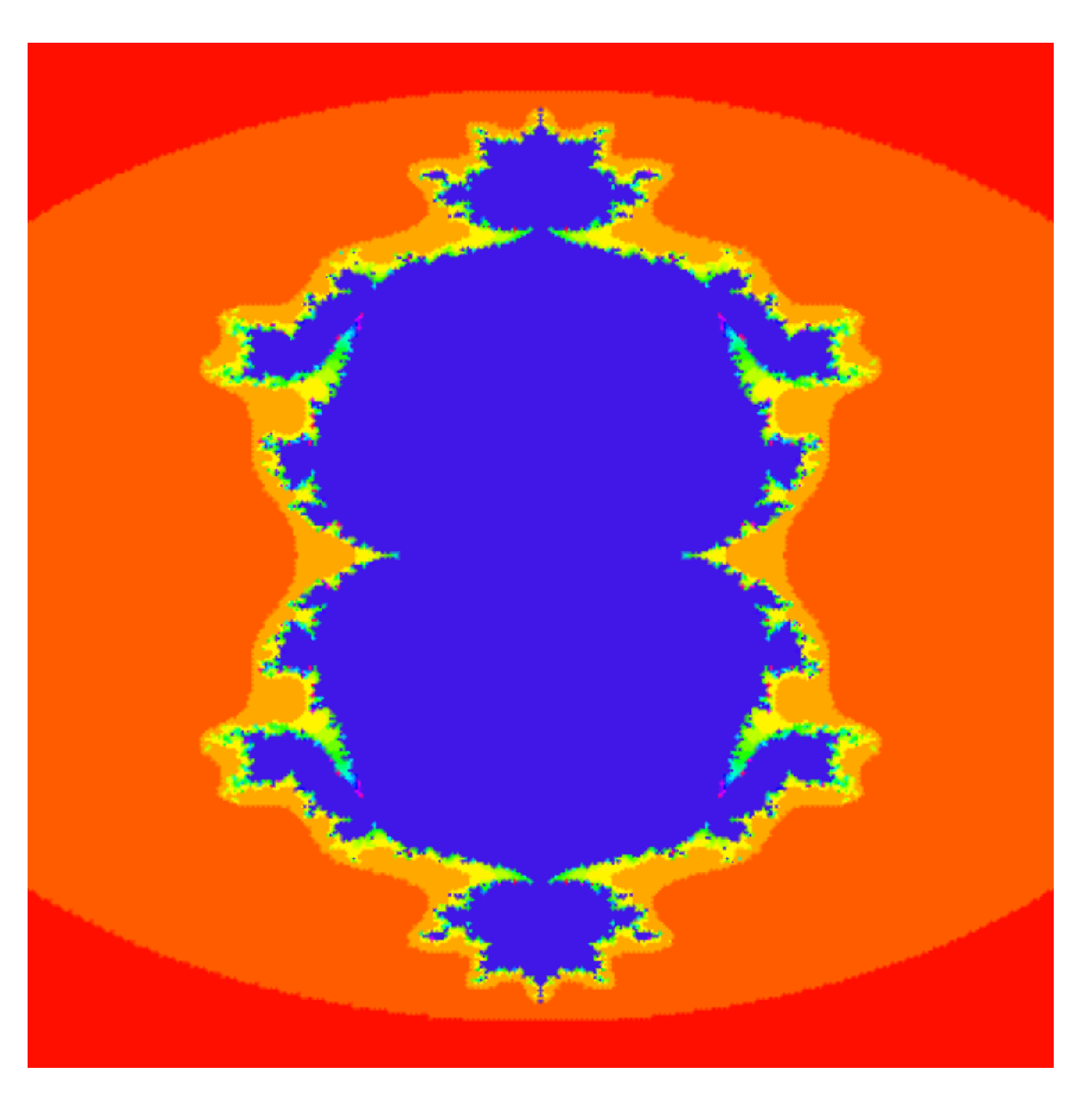
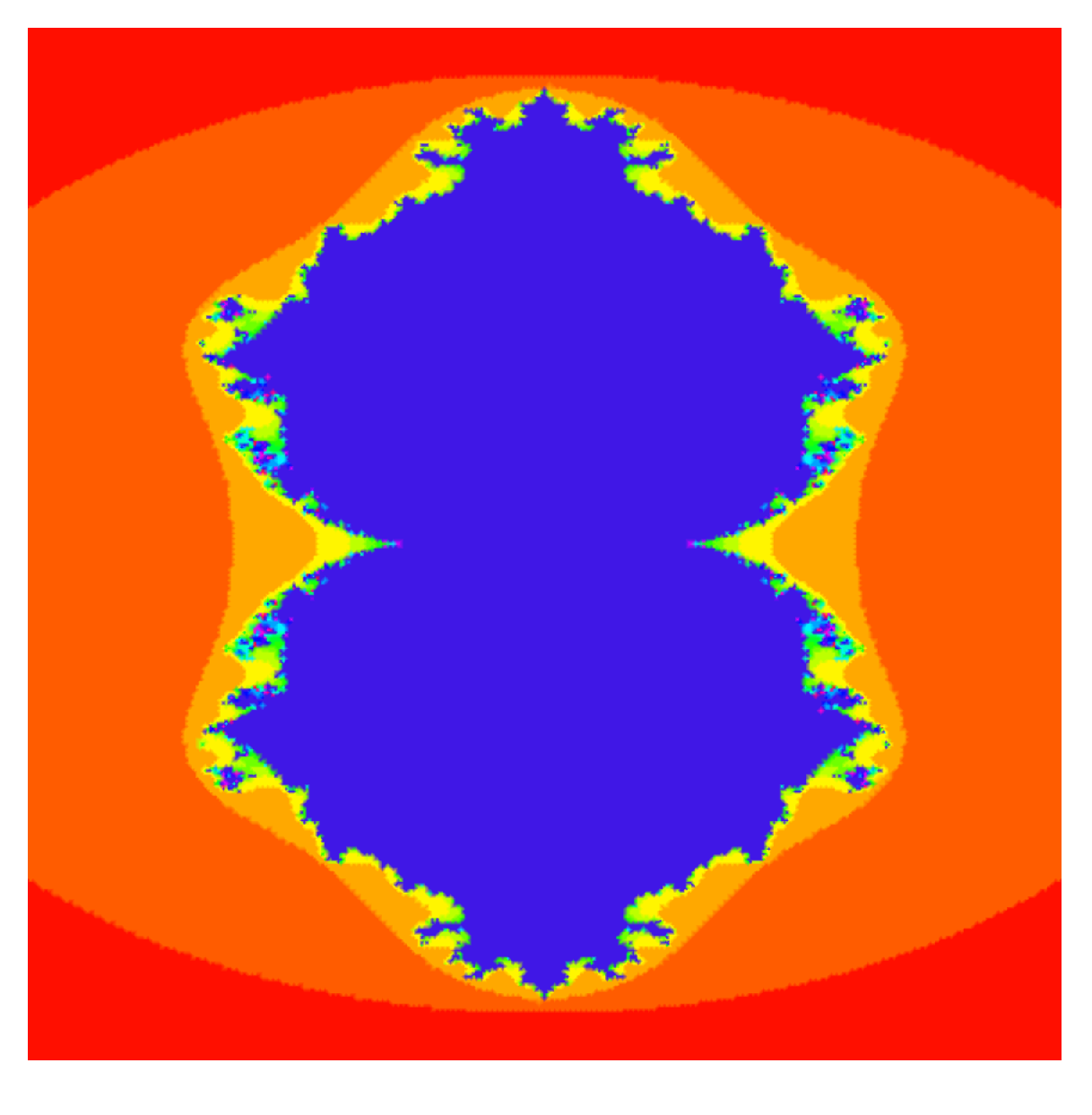
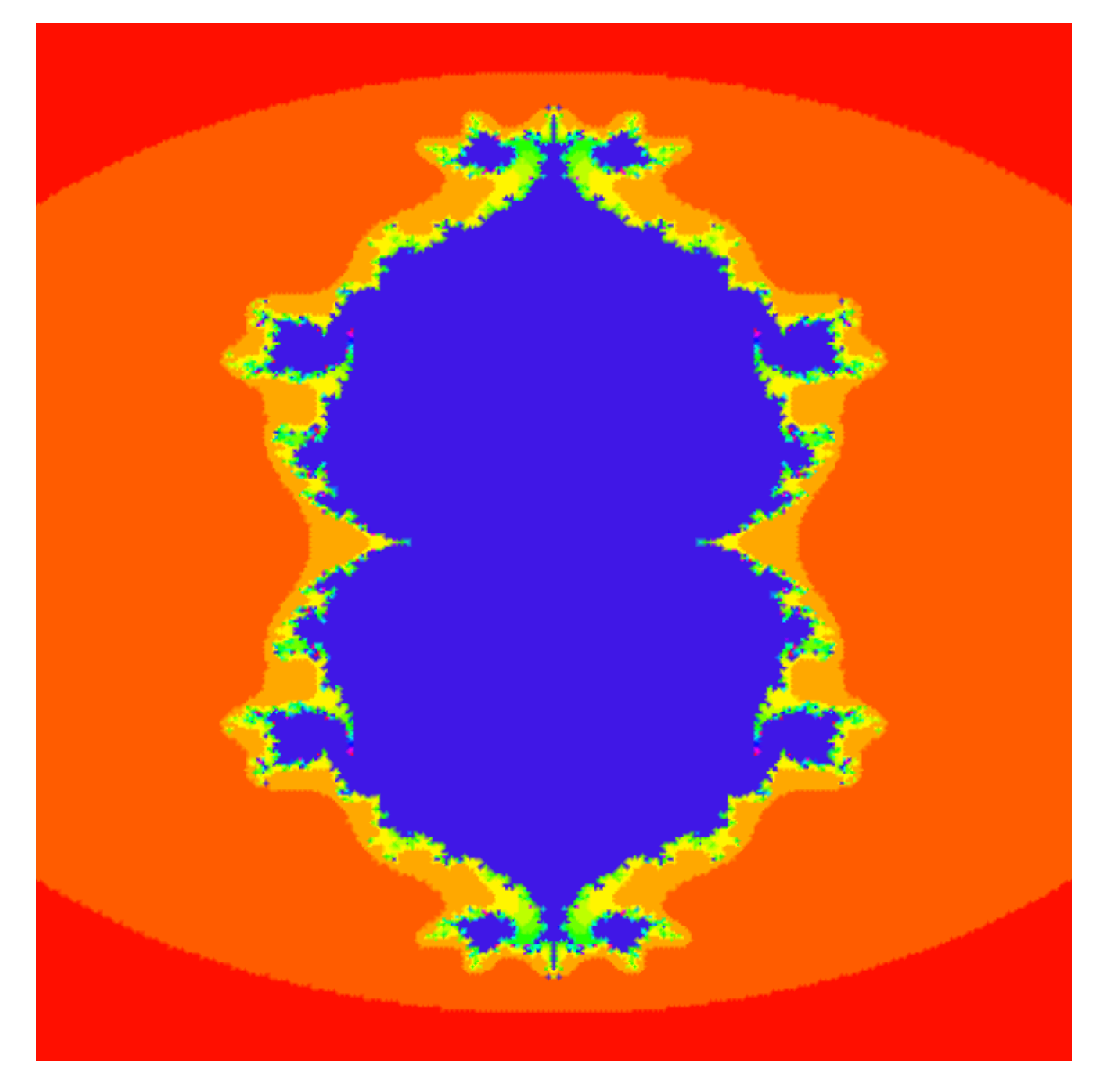
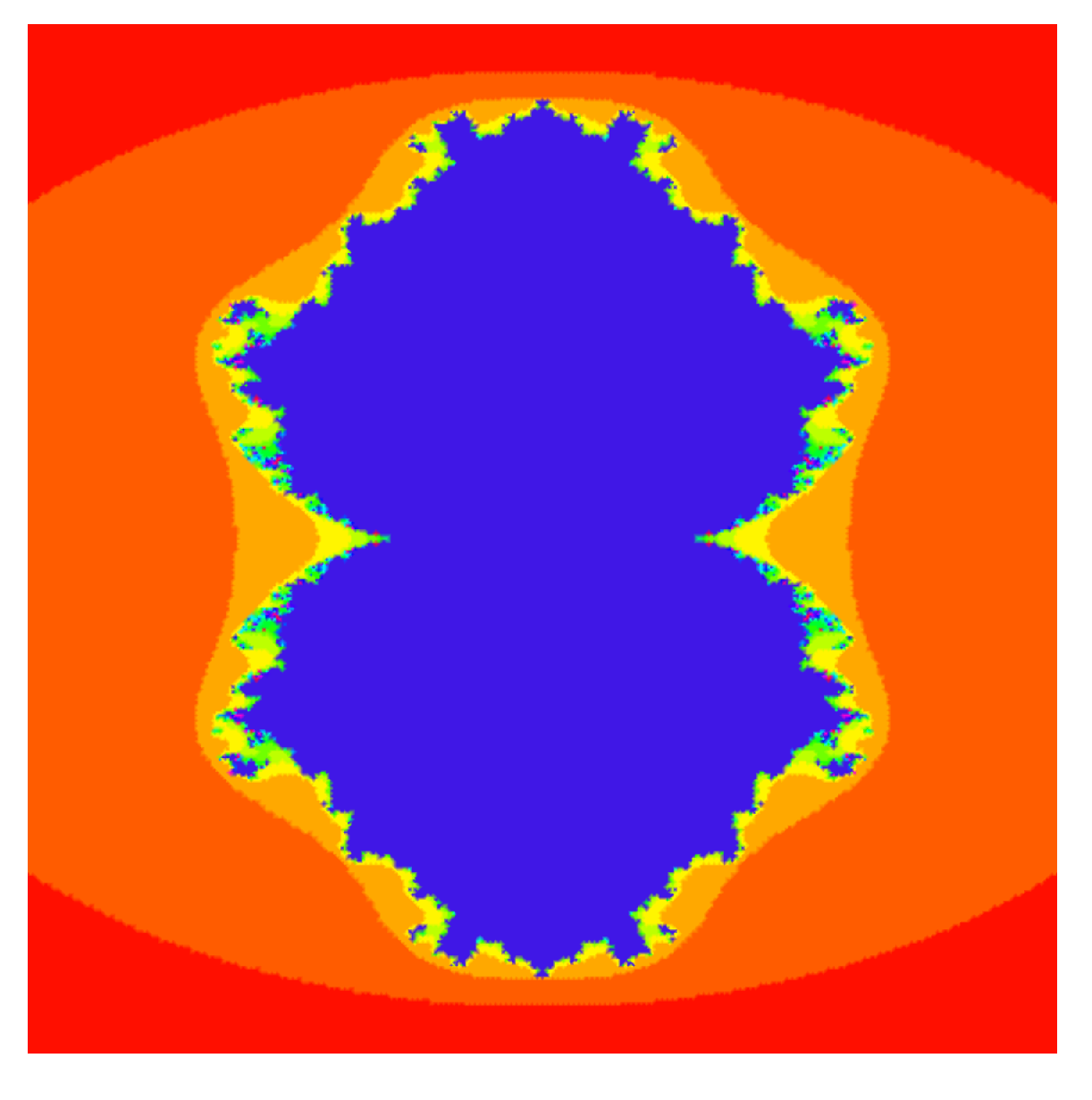
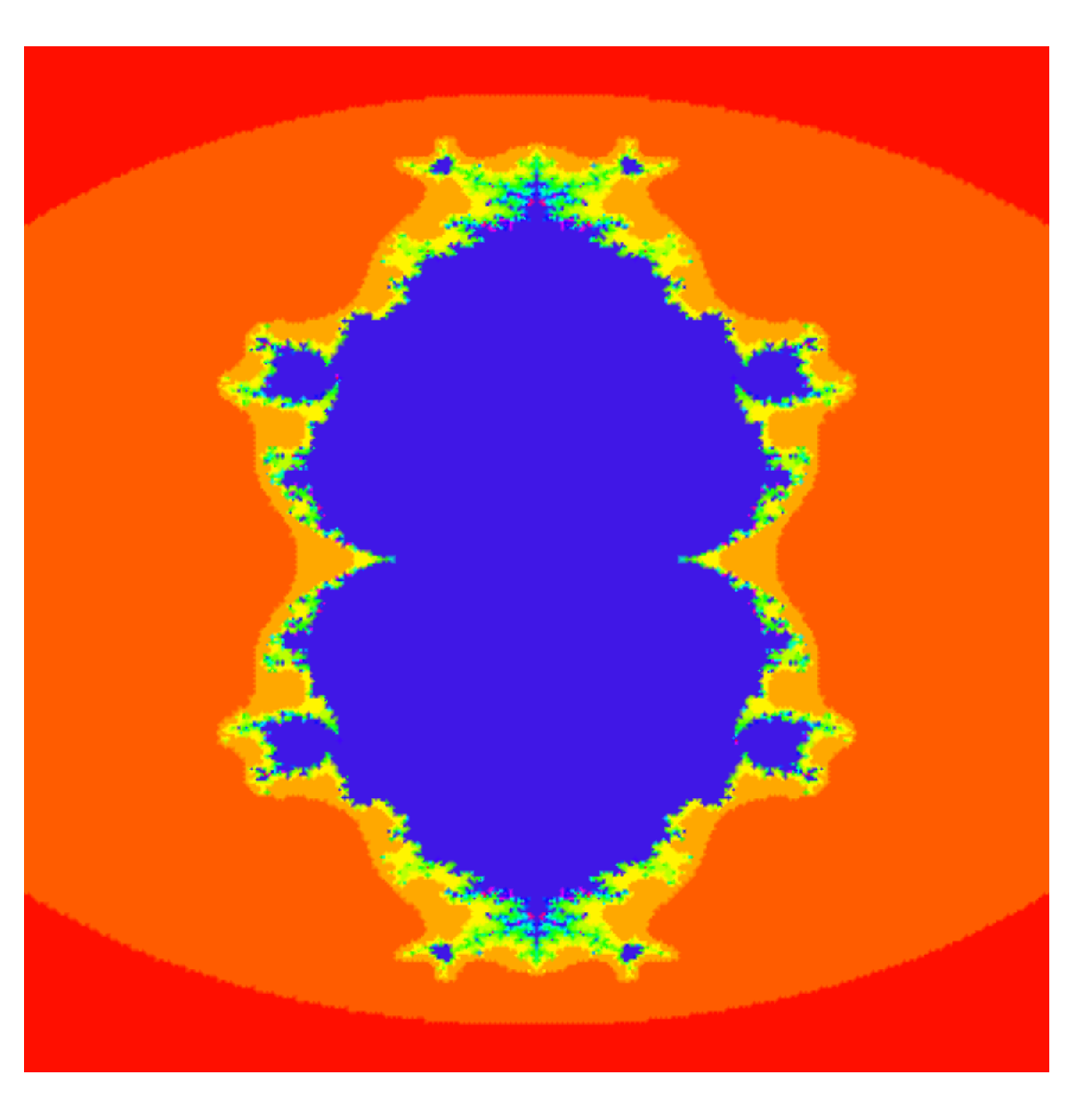
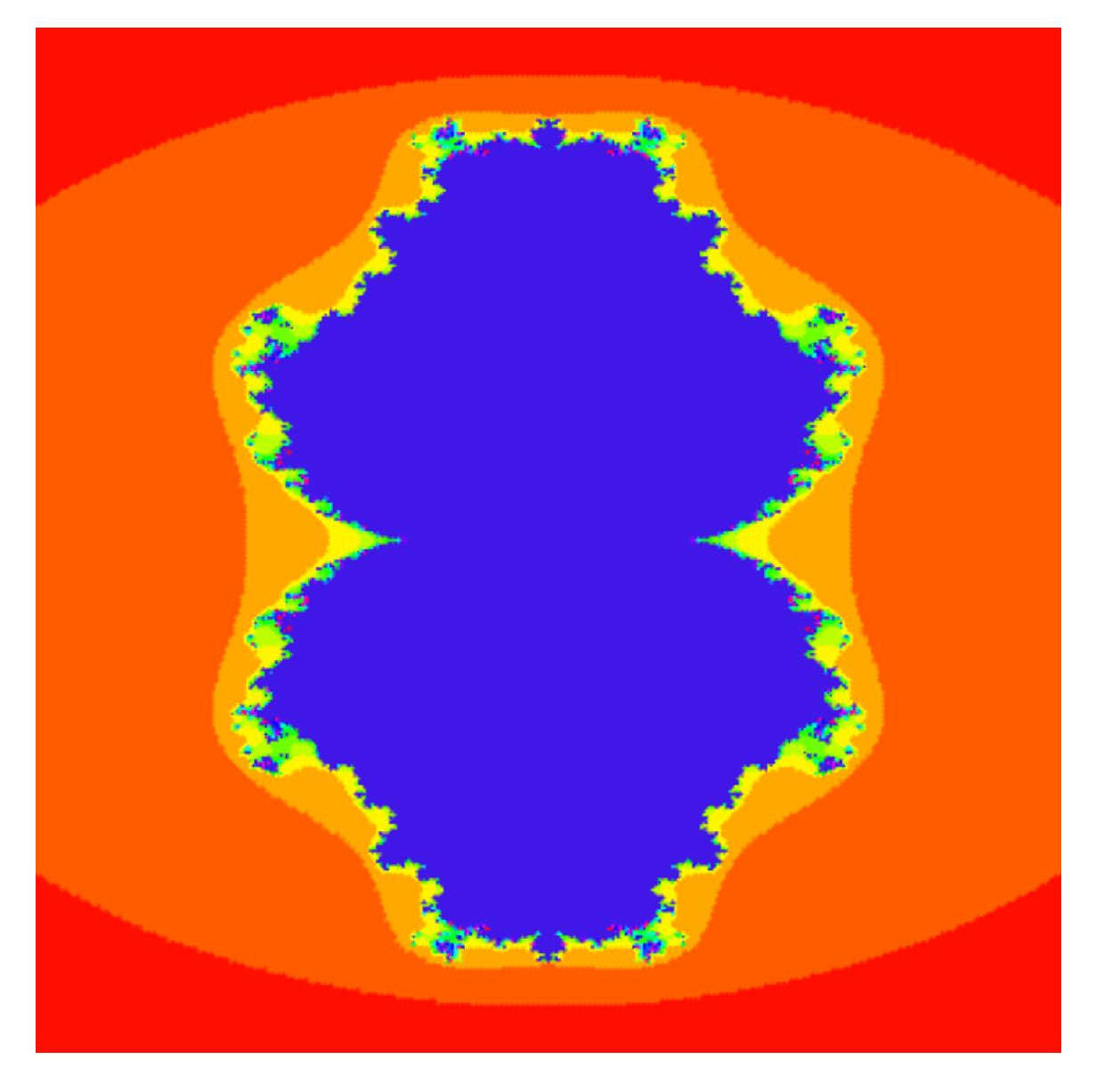
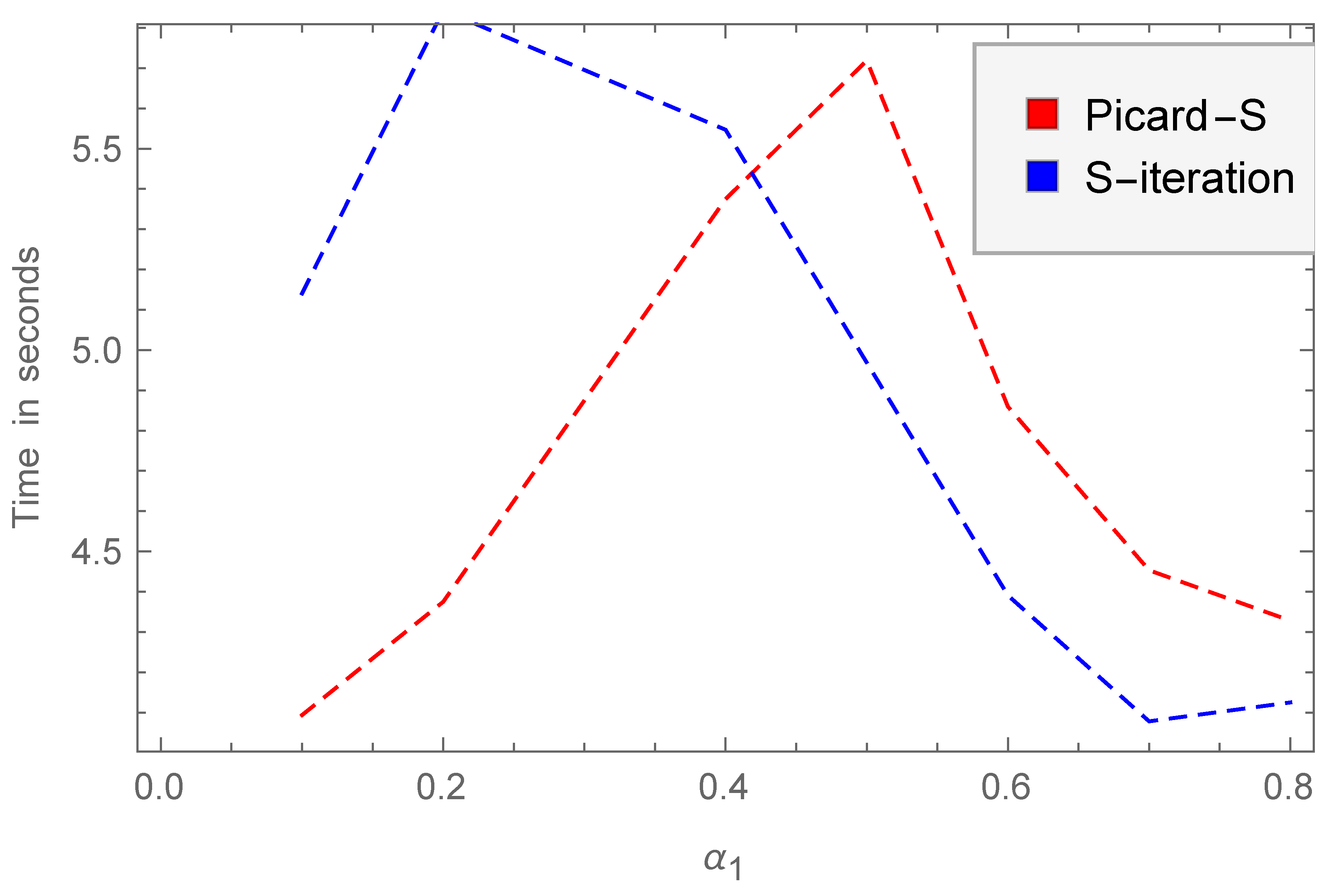
In Figure 1, Figure 2, Figure 3, Figure 4, Figure 5, Figure 6, Figure 7, Figure 8, Figure 9 and Figure 10, Mandelbrot sets using quadratic functions are visualized in the hybrid Picard S-orbit and S-orbit by choosing the greatest number of iterations, 20, as well as fixing parameter and varying the values of the parameter . The time comparison for quadratic functions using Picard S-orbit and S-orbit is also analyzed in Table 1 and Figure 11 by varying the value of .
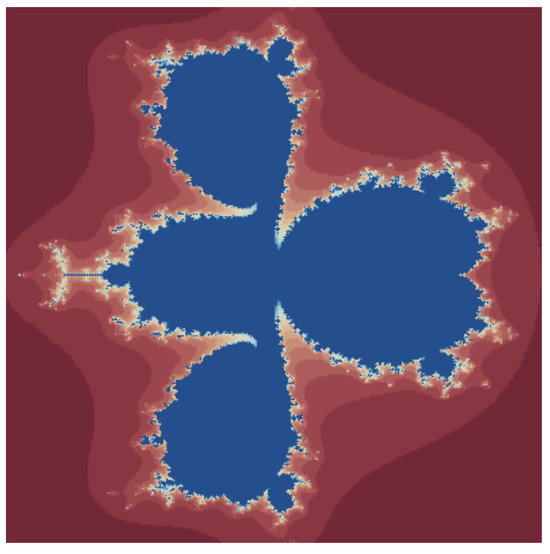
Figure 1.
Created in the hybrid Picard S-orbit for .
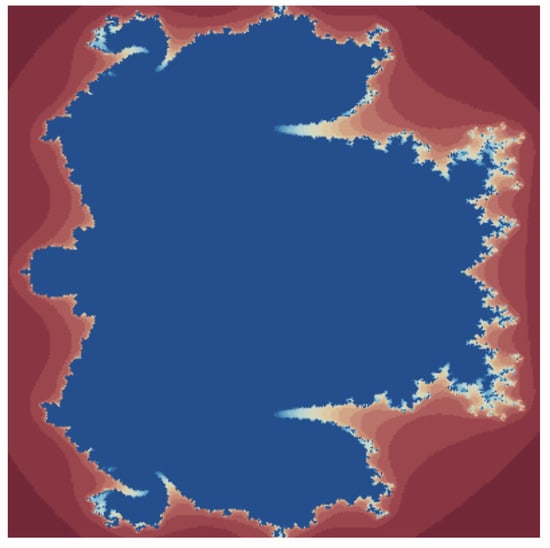
Figure 2.
Created in S-orbit for .
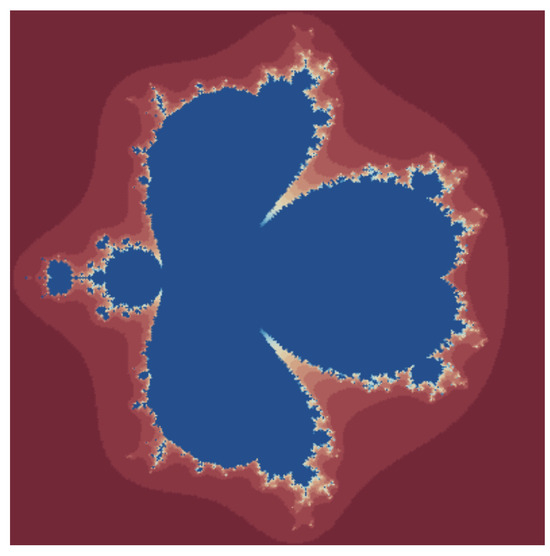
Figure 3.
Created in the hybrid Picard S-orbit for .
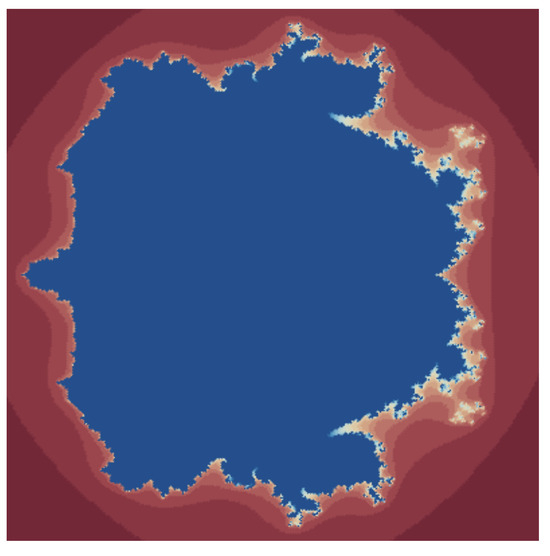
Figure 4.
Created in S-orbit for .
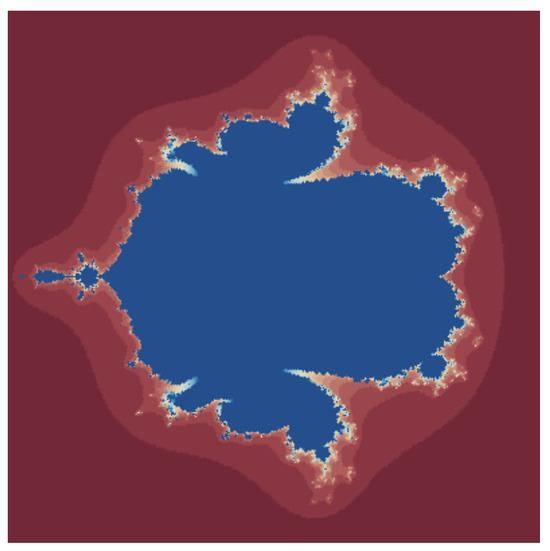
Figure 5.
Created in the hybrid Picard S-orbit for .
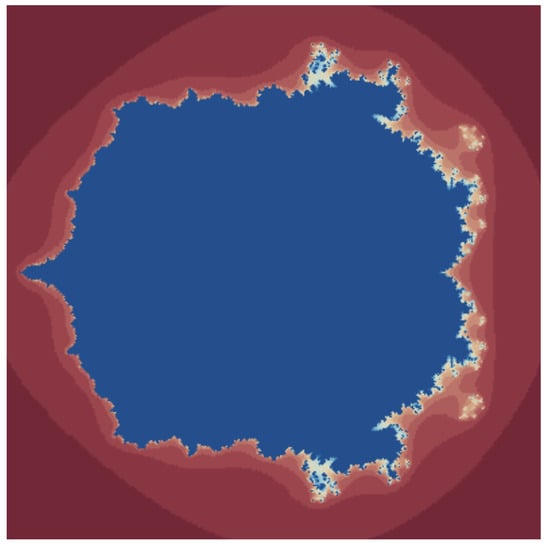
Figure 6.
Created in S-orbit for .
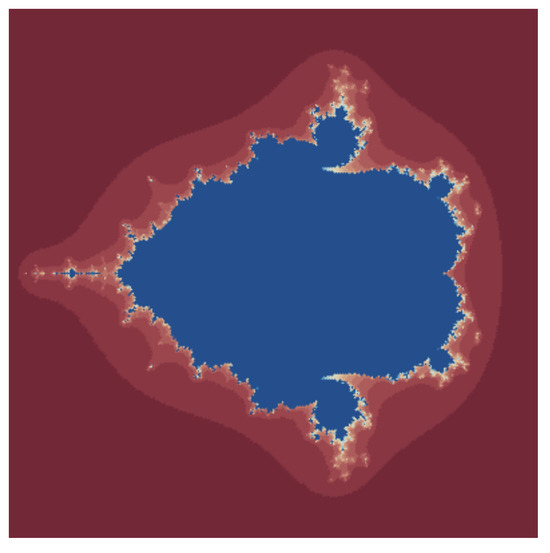
Figure 7.
Created in the hybrid Picard S-orbit for .
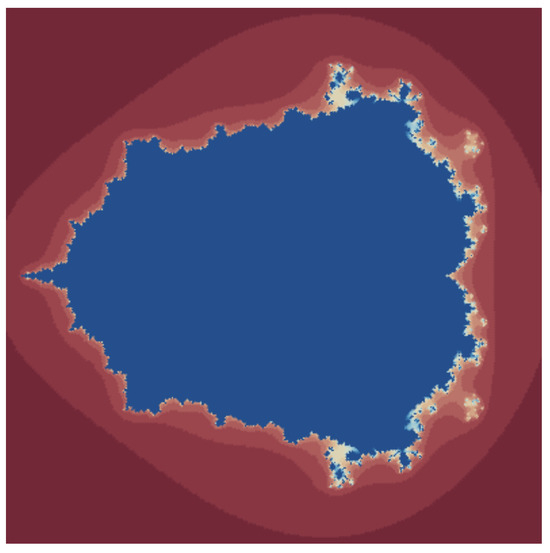
Figure 8.
Created in S-orbit for .
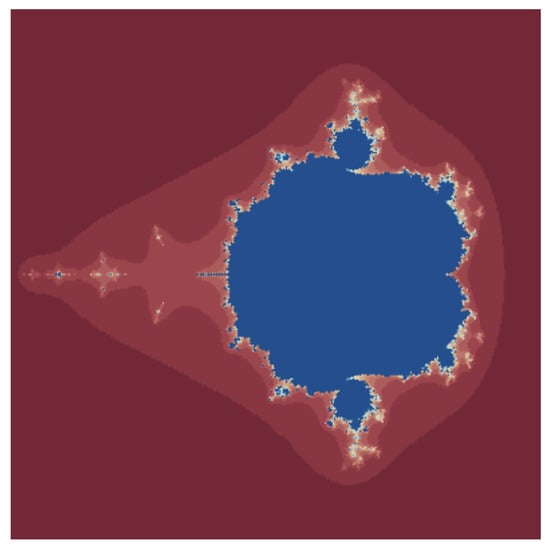
Figure 9.
Created in the hybrid Picard S-orbit for .
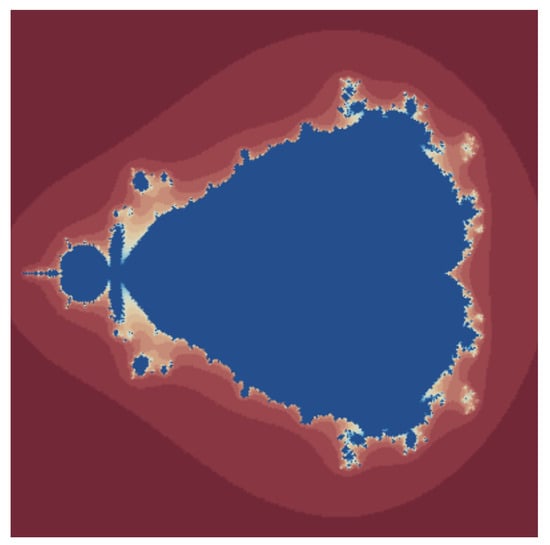
Figure 10.
Created in S-orbit for .

Table 1.
Time comparison of iterative schemes in seconds using quadratic functions.
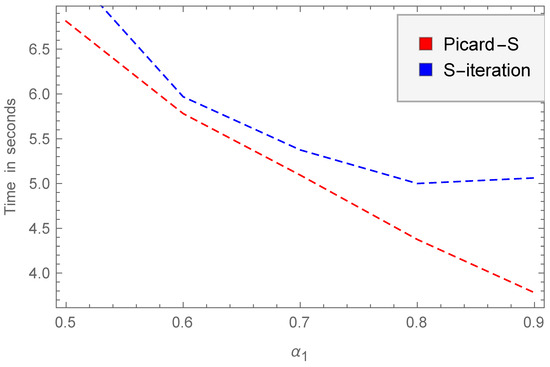
Figure 11.
Dependence of the Mandelbrot set creation time (in seconds) in the hybrid Picard S-orbit and S-orbit on .
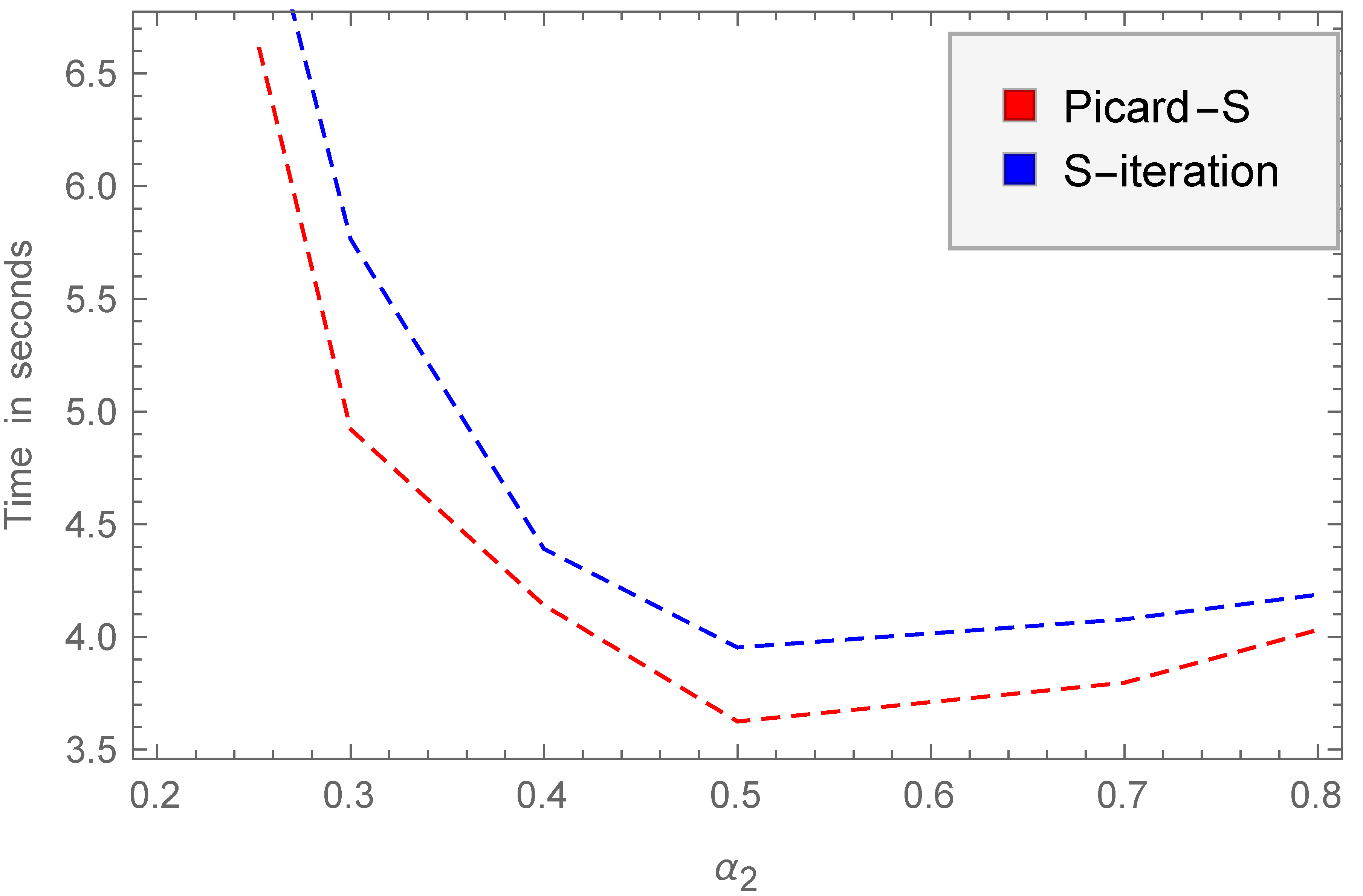
In Figure 12, Figure 13, Figure 14, Figure 15, Figure 16, Figure 17, Figure 18, Figure 19, Figure 20, Figure 21, Figure 22 and Figure 23, quadratic Mandelbrot sets are presented in Picard S-orbit and S-orbit by fixing parameter , choosing the greatest number of iterations (20), and varying parameter . The time comparison for quadratic functions using Picard S-orbit and S-orbit is also analyzed in Table 2 and Figure 24 by varying the value of .
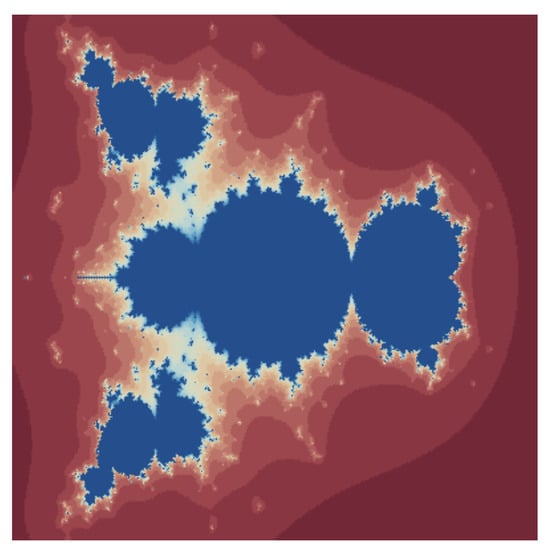
Figure 12.
Created in the hybrid Picard S-orbit for .
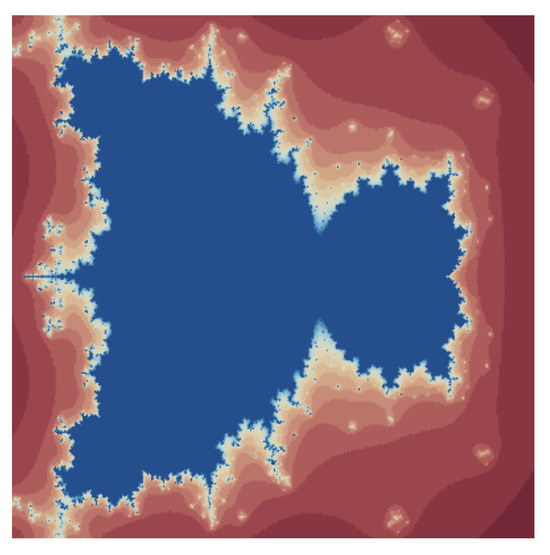
Figure 13.
Created in the hybrid S-orbit for .
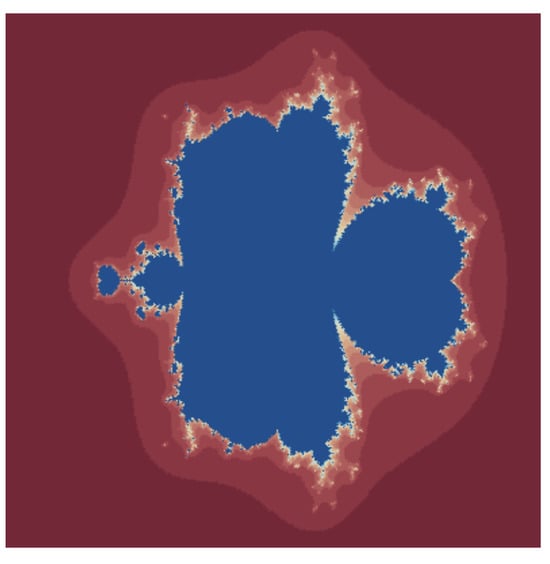
Figure 14.
Created in the hybrid Picard S-orbit for .
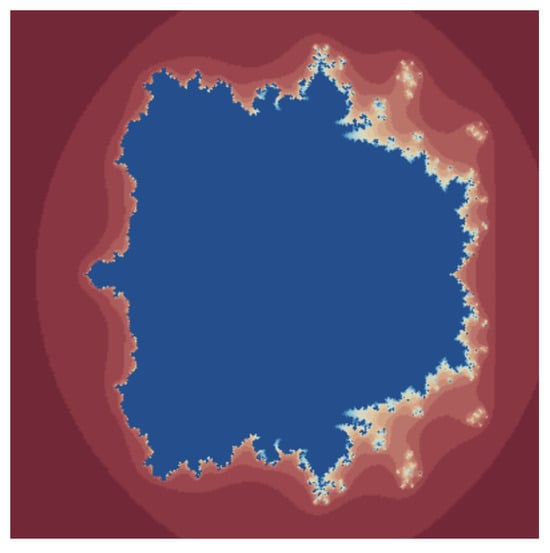
Figure 15.
Created in S-orbit for .
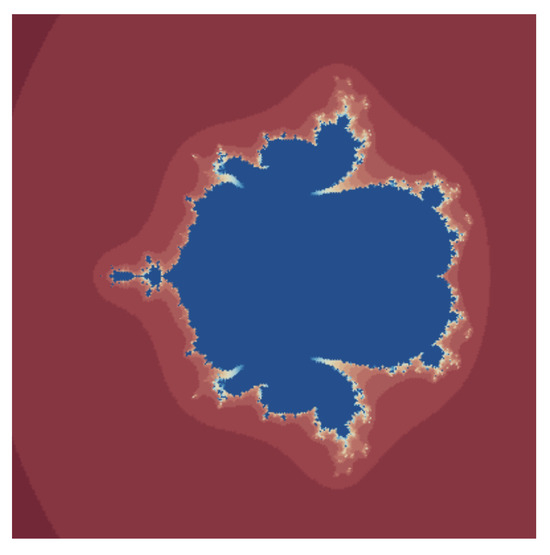
Figure 16.
Created in the hybrid Picard S-orbit for .
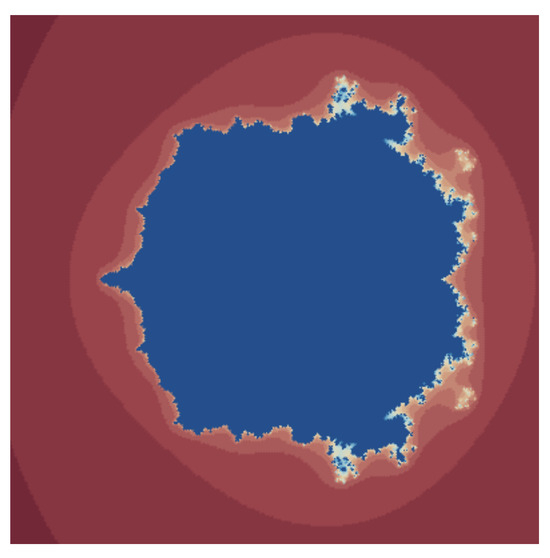
Figure 17.
Created in S-orbit for .
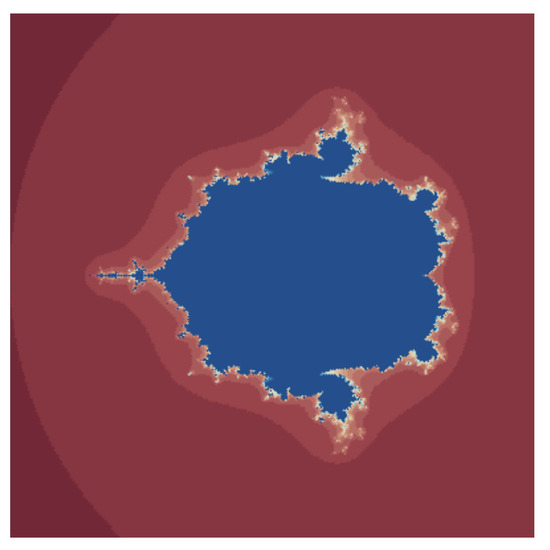
Figure 18.
Created in the hybrid Picard S-orbit for .
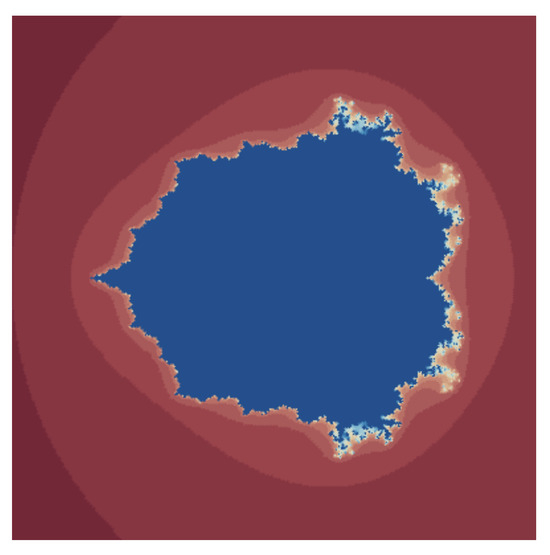
Figure 19.
Created in S-orbit for .
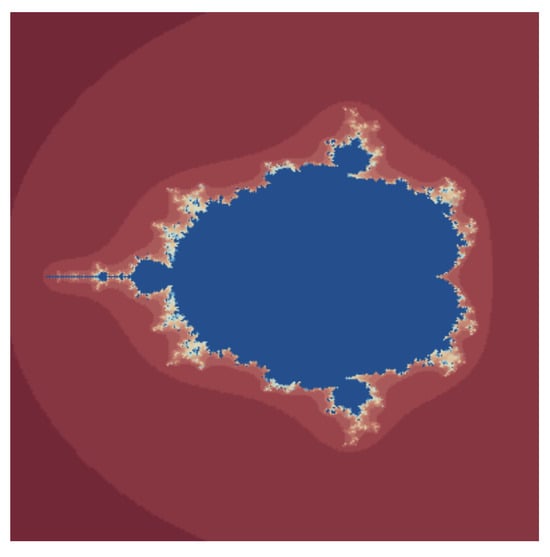
Figure 20.
Created in the hybrid Picard S-orbit for .
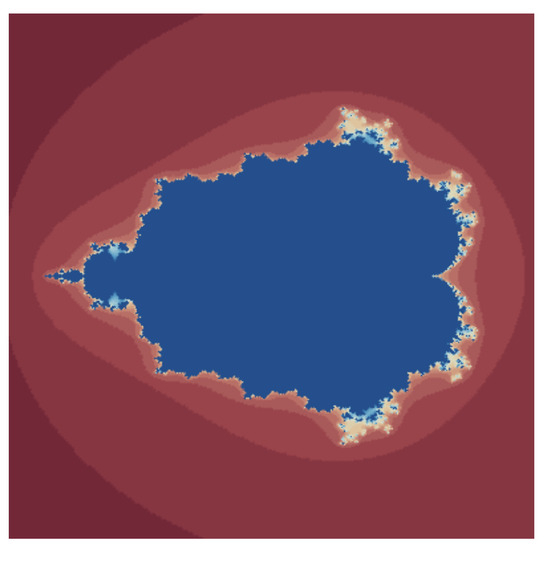
Figure 21.
Created in S-orbit for .
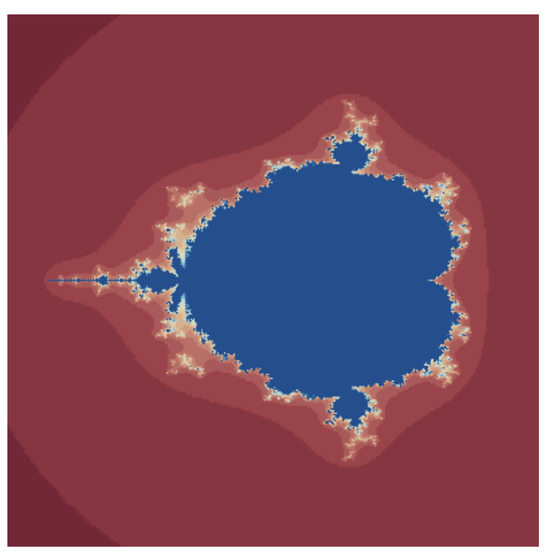
Figure 22.
Created in the hybrid Picard S-orbit for .
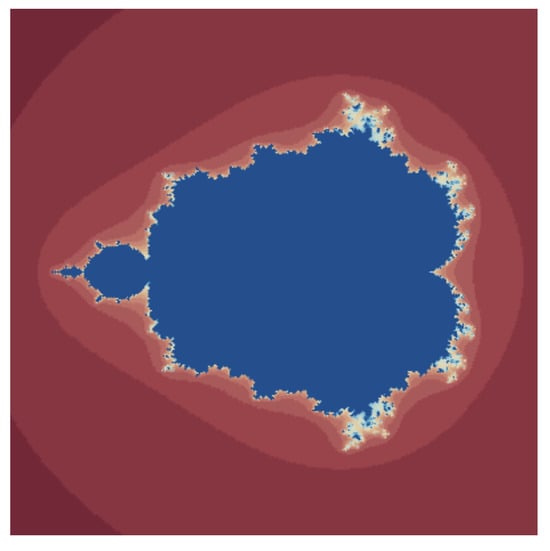
Figure 23.
Created in S-orbit for .
Table 2.
Time comparison of iterative schemes in seconds using quadratic functions.
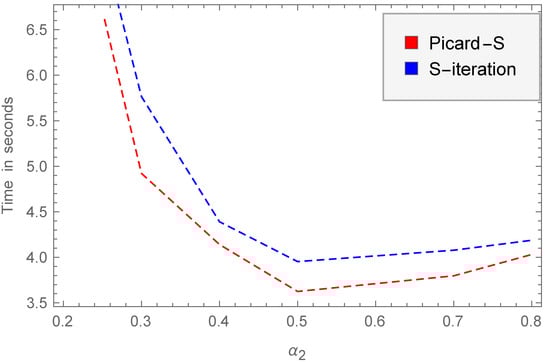
Figure 24.
Dependence on time (in seconds) in the hybrid Picard S-orbit and S-orbit for .
4.2. Rich and Exquisite Patterns of the Mandelbrot Sets Using Hybrid Picard S-Iteration vs. S-Iteration and Cubic Functions
In fractal theory, the Mandelbrot set is arguably the most well-known object. It is thought to be the most complex object that has been made visible, in addition to being the most beautiful. The cubic polynomial analogue of the Mandelbrot set has two critical orbits. Therefore, their analysis using cubic polynomials is significantly more complex as compared to quadratic polynomials.
In Figure 25, Figure 26, Figure 27, Figure 28, Figure 29, Figure 30, Figure 31, Figure 32, Figure 33, Figure 34, Figure 35, Figure 36, Figure 37 and Figure 38, Mandelbrot sets are presented using the cubic function along with the hybrid Picard S-iteration and S-iteration by choosing maximum number of iterations 20 and fixing parameter . The time comparison for cubic functions using hybrid Picard S-orbit and S-orbit is also analyzed in Table 3 and Figure 39 by varying the value of .
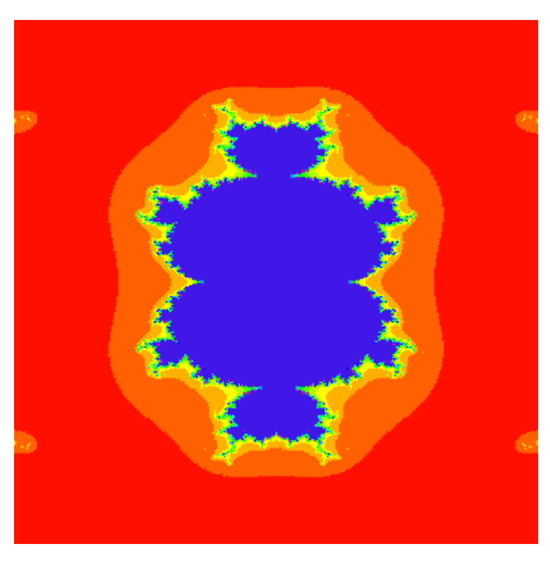
Figure 25.
Created in the hybrid Picard S-orbit for .
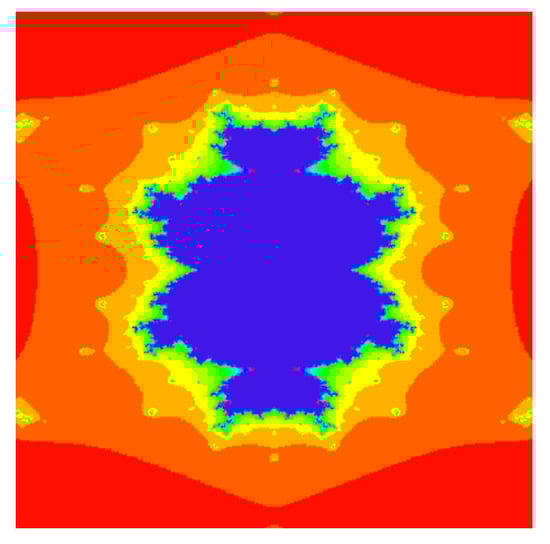
Figure 26.
Created in S-orbit for .
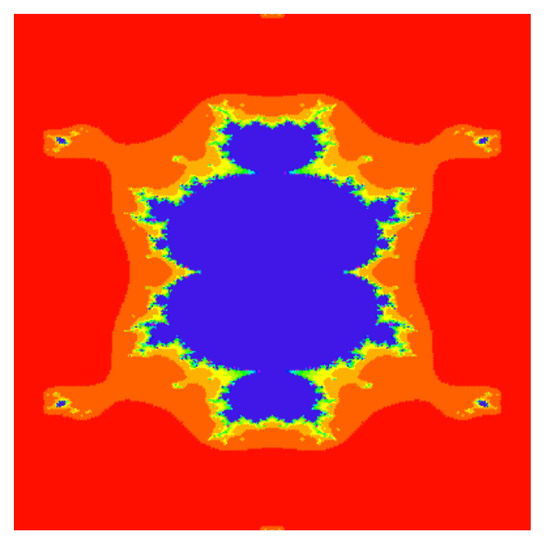
Figure 27.
Created in the hybrid Picard S-orbit for .
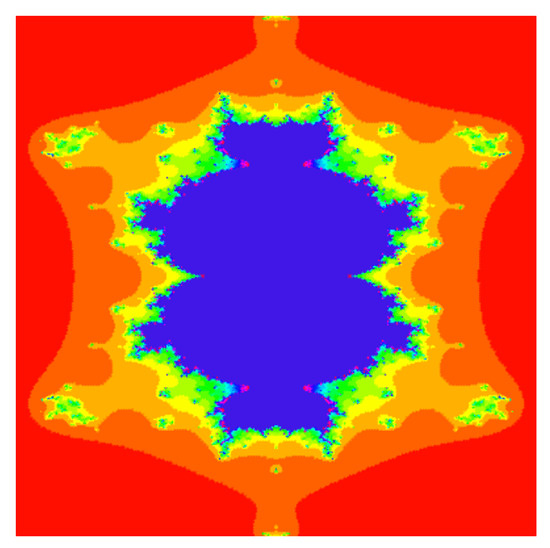
Figure 28.
Created in S-orbit for .
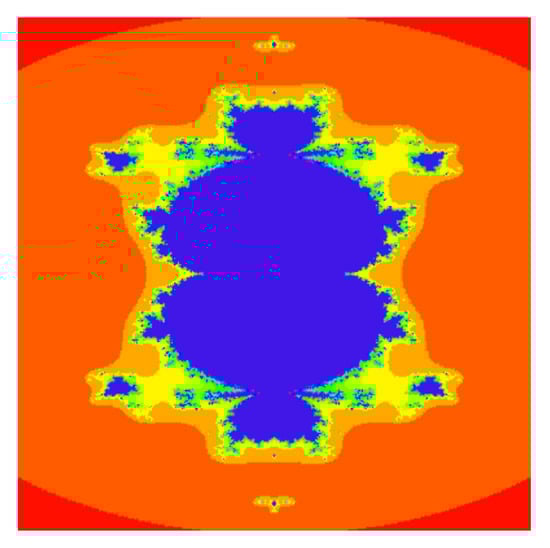
Figure 29.
Created in the hybrid Picard S-orbit for .
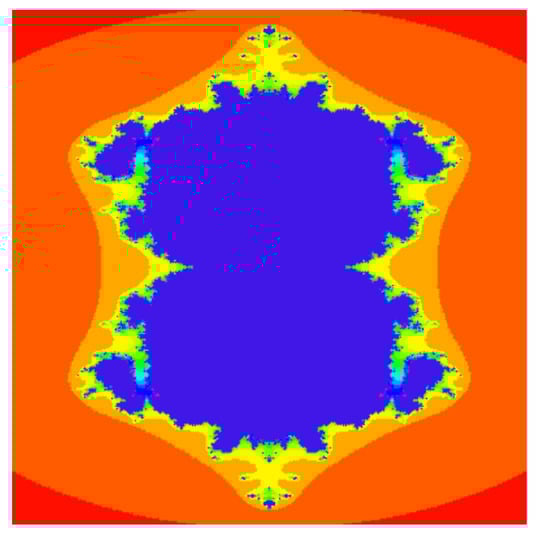
Figure 30.
Created in S-orbit for .
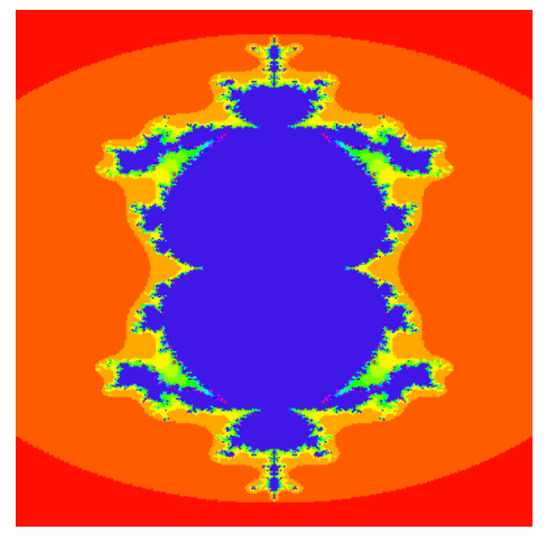
Figure 31.
Created in the hybrid Picard S-orbit for .
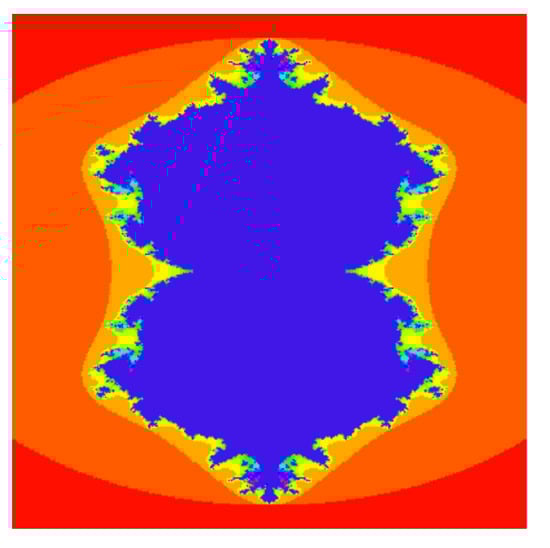
Figure 32.
Created in S-orbit for .
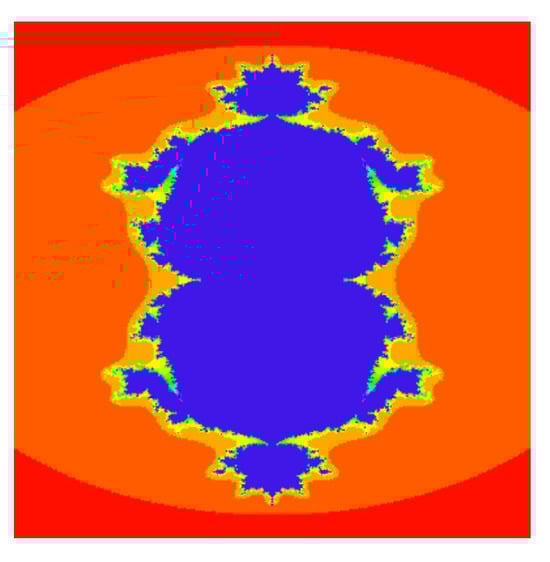
Figure 33.
Created in the hybrid Picard S-orbit for .
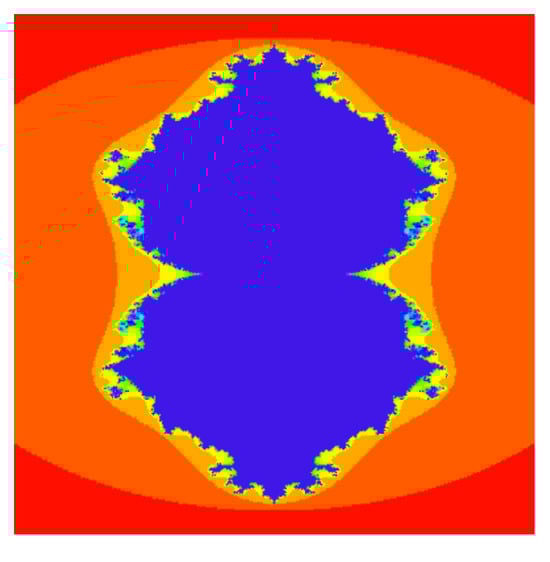
Figure 34.
Created in S-orbit for .
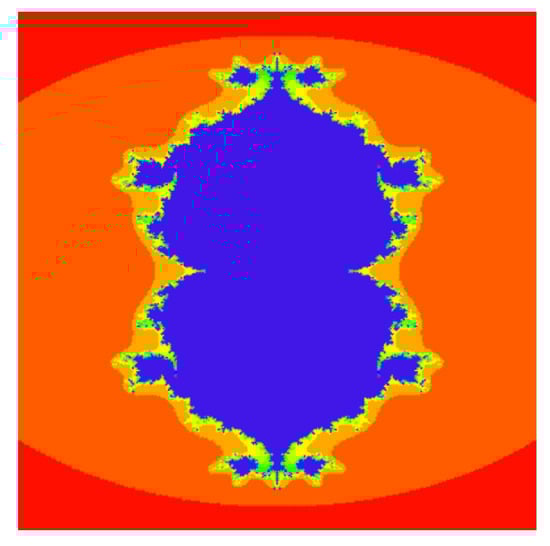
Figure 35.
Created in the hybrid Picard S-orbit for .
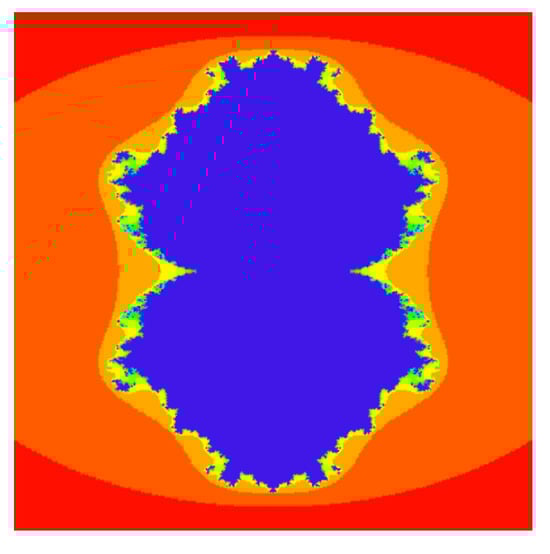
Figure 36.
Created in S-orbit for .
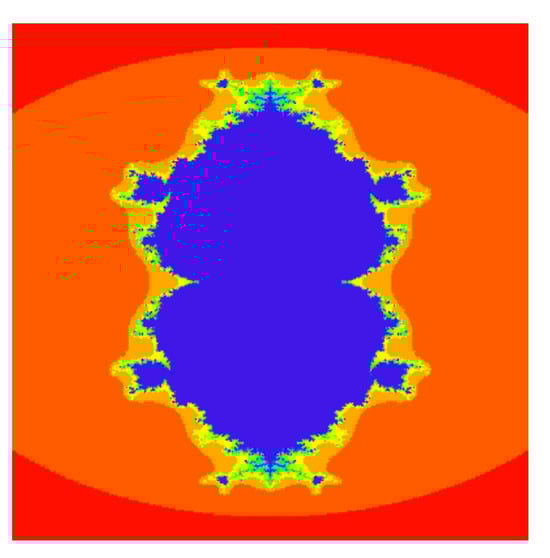
Figure 37.
Created in the hybrid Picard S-orbit for .
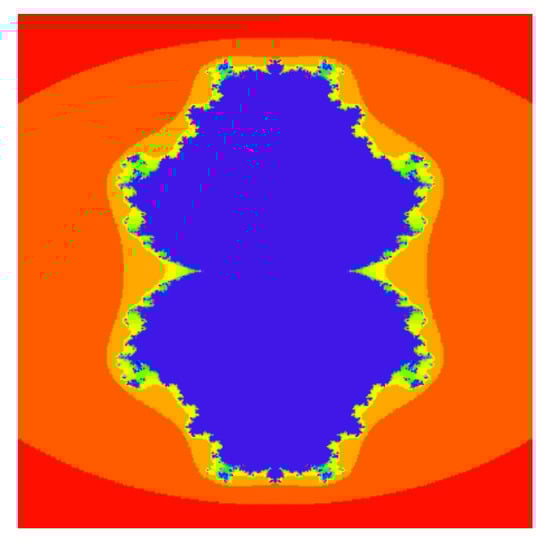
Figure 38.
Created in S-orbit for .
Table 3.
Time comparison of iterative schemes in seconds using cubic functions.
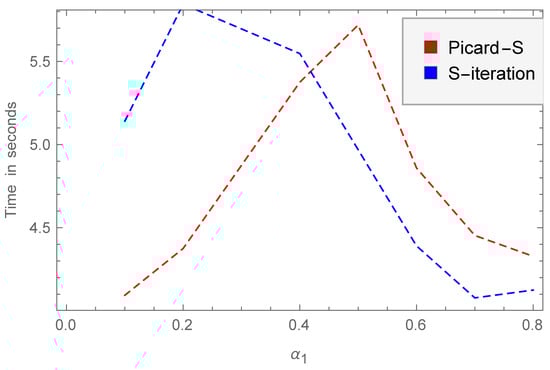
Figure 39.
Dependence on time (in seconds) in Picard S-orbit and S-orbit on .
5. Conclusions and Discussion
This paper presents the escape criteria for fractals (Mandelbrot sets) concerning hybrid Picard S-iteration and illustrates the novel fractal patterns. Fractals generated by the hybrid Picard S-iterative procedure exhibit drastic changes for varying values of and . Using Picard S-orbit, we were able to obtain more spontaneous or natural Mandelbrot sets than with fractals made using S-iteration. We have experienced the following observations:
- Similarly in Figure 12, Figure 13, Figure 14, Figure 15, Figure 16, Figure 17, Figure 18, Figure 19, Figure 20, Figure 21, Figure 22 and Figure 23, we fixed parameter and varied parameter to obtain quadratic Mandelbrot sets. Mandelbrot sets created using the hybrid Picard S-iteration procedure are quite spontaneous from those created via S-iteration.
- The cubic Mandelbrot sets created in the hybrid Picard S-orbit and S-orbit with fixed parameter also have an obvious variation in figures for varying parameter .
- Quadratic Mandelbrot sets are symmetrical along the x-axis whereas cubic Mandelbrot sets are symmetrical along both the x-axis and y-axis.
It is evident that changes in the iteration scheme’s orbit cause variations in the graphics. People interested in designing aesthetically pleasing patterns will find great satisfaction in the findings of this paper. For further future applications, this work can be combined with [52,53]. In future, comparisons can be made with other iterations and the process can be improved for higher-order polynomials and transcendental functions. Furthermore, a new Picard–Ishikawa hybrid iterative scheme [54] is analyzed for its fast convergence over the others. It proved useful in solving particular differential equations. It is remarkable that for , in (5), Picard–Ishikawa hybrid iterative scheme [54] can be obtained. Hence, our results can be used further to generalize the results of [54] and explore more general differential equations.
Author Contributions
Conceptualization, R.S.; methodology, A.T.; software, R.M.K.; validation, R.S., A.T. and R.M.K.; formal analysis, R.S., A.T. and R.M.K.; investigation, R.S., A.T. and R.M.K.; resources, R.S., A.T. and R.M.K.; data curation, R.S., A.T. and R.M.K.; writing—original draft preparation, R.S., A.T. and R.M.K.; writing—review and editing, R.S., A.T. and R.M.K.; visualization, R.S., A.T. and R.M.K.; supervision, R.S., A.T. and R.M.K.; project administration, R.S., A.T. and R.M.K.; All authors have read and agreed to the published version of the manuscript.
Funding
The author extends the appreciation to the Deanship of Postgraduate Studies and Scientific Research at Majmaah University for funding this research work through the project number (ICR-2024-949).
Data Availability Statement
The research is theoretical in nature. As a result, no data were used.
Conflicts of Interest
The authors declare no conflicts of interest.
Abbreviations
The following abbreviations are used in this manuscript:
| MS | Mandelbrot set |
| MSs | Mandelbrot sets |
| SO | S Orbit |
| PSO | Picard S-Orbit |
| PSIP | Picard S-Iteration Process |
References
- Diao, K.; Butler, D.; Ulanicki, B. Fractality in water distribution networks: Application to criticality analysis and optimal rehabilitation. Urban Water J. 2021, 18, 885–895. [Google Scholar] [CrossRef]
- Beata, K.E.H.; Dariusz, K. Fractal-heuristic method of water quality sensor locations in water supply network. Water 2020, 12, 832. [Google Scholar] [CrossRef]
- Wang, S.; Ji, H.; Zhan, Y.; Li, H.; Li, P. Research on the Model Improvement of a DLA Fractal River Network. IEEE Access 2020, 8, 100702–100711. [Google Scholar] [CrossRef]
- Liu, S.-A.; Bai, W.-L.; Liu, G.-C.; Li, W.-H.; Srivastava, H.M. Parallel fractal compression method for big video data. Complexity 2018, 2018, 2016976. [Google Scholar] [CrossRef]
- Martinez, F.; Manriquez, H.; Ojeda, A.; Olea, G. Organization Patterns of Complex River Networks in Chile: A Fractal Morphology. Mathematics 2022, 10, 1806. [Google Scholar] [CrossRef]
- Tehrani, D.H.T.; Solaimani, M. Persistent currents and electronic properties of Mandelbrot quantum rings. Sci. Rep. 2023, 13, 5710. [Google Scholar] [CrossRef]
- Taylor, R.; Spehar, B.; Hagerhall, C.; Van Donkelaar, P. Perceptual and Physiological Responses to Jackson Pollock’s Fractals. Front. Hum. Neurosci. 2011, 5, 10034. [Google Scholar] [CrossRef]
- Mandelbrot, B.B. The Fractal Geometry of Nature; WH freeman New York: New York, NY, USA, 1982; Volume 2. [Google Scholar]
- Burger, E.B.; Starbird, M. The Heart of Mathematics: An Invitation to Effective Thinking; Springer Science Business Media: Berlin/Heidelberg, Germany, 2004. [Google Scholar]
- Holtzman, S.R. Digital Mantras: The Languages of Abstract and Virtual Worlds; Mit Press: Cambridge, MA, USA, 1995. [Google Scholar]
- Mitchell, K. The Fractal Art Manifesto. Online. Disponível em. 1999. Available online: https://www.fractalus.com/info/manifesto.htm (accessed on 8 December 2023).
- Li, D.; Shahid, A.A.; Tassaddiq, A.; Khan, A.; Guo, X.; Ahmad, M. CR iteration in the generation of antifractals with s-convexity. IEEE Access 2020, 8, 77214. [Google Scholar] [CrossRef]
- Dhurandhar, S.V.; Bhavsar, V.C.; Gujar, U.G. Analysis of z-plane fractal images from z→zα + cforα < 0. Comput. Graph. 1993, 17, 89–94. [Google Scholar]
- Lakhtakia, A.; Varadan, V.; Messier, R.; Varadan, V. On the symmetries of the Julia sets for the process z→zα + c. J. Phys. A Math. Gen. 1987, 20, 3533–3535. [Google Scholar] [CrossRef]
- Crowe, W.D.; Hasson, R.; Rippon, P.J.; Strain-Clark, P.E.D. On the structure of the mandelbar set. Nonlinearity 1989, 2, 541–553. [Google Scholar] [CrossRef]
- Domínguez, P.; Fagella, N. Residual Julia sets of rational and transcendental functions. In Transcendental Dynamics and Complex Analysis; Cambridge University Press: Cambridge, UK, 2010; pp. 138–164. [Google Scholar]
- Peherstorfer, F.; Stroh, C. Connectedness of Julia sets of rational functions. Comput. Methods Funct. Theory 2001, 1, 61–79. [Google Scholar] [CrossRef]
- Koss, L. Elliptic functions with disconnected Julia sets. Int. Bifurc. Chaos 2016, 26, 1650095. [Google Scholar] [CrossRef]
- Liu, S.-A.; Xu, X.-Y.; Srivastava, G.; Srivastava, H.M. Fractal properties of the generalized Mandelbrot set with complex exponent. Fractals 2023. [Google Scholar] [CrossRef]
- Katunin, A. Analysis of 4D hypercomplex generalization of Julia sets. In Computer Vision and Graphics: International Conference, ICCVG 2016, Warsaw, Poland, 19–21 September 2016; Proceedings 8; Springer International Publishing: Berlin/Heidelberg, Germany, 2016; pp. 627–635. [Google Scholar]
- Dang, Y.; Kauffman, L.; Sandin, D. Hypercomplex Iterations: Distance Estimation and Higher Dimensional Fractals; World Scientific: Singapore, 2002. [Google Scholar]
- Griffin, C.; Joshi, G. Octonionic Julia sets. Chaos Solitons Fractals 1992, 2, 11–24. [Google Scholar] [CrossRef]
- Gdawiec, K. Inversion fractals and iteration processes in the generation of aesthetic patterns. In Computer Graphics Forum; Wiley Online Library: Hoboken, NJ, USA, 2017; Volume 36, pp. 35–45. [Google Scholar]
- Singh, S.L.; Mishra, S.; Sinkala, W. A new iterative approach to fractal models. Commun. Nonlinear Sci. Numer. Simulat. 2012, 17, 521–529. [Google Scholar] [CrossRef]
- Prasad, B.; Katiyar, K. Fractals via Ishikawa iteration. In Proceedings of the International Conference on Logic, Information, Control and Computation, Gandhigram, India, 25–27 February 2011; pp. 197–203. [Google Scholar]
- Gdawiec, K.; Kotarski, W.; Lisowska, A. Biomorphs via modified iterations. J. Nonlinear Sci. Appl. 2016, 9, 2305–2315. [Google Scholar] [CrossRef]
- Kittiratanawasin, L.; Yambangwai, D.; Chairatsiripong, C.; Thianwan, T. An Efficient Iterative Algorithm for Solving the Split Feasibility Problem in Hilbert Spaces Applicable in Image Deblurring. Signal Recover. Polynomiography J. Math. 2023, 2023, 15. [Google Scholar] [CrossRef]
- Rani, M.; Kumar, V. Superior Julia set. J. Korea Soc. Math. Educ. Ser. D Res. Math. Educ. 2004, 8, 261–277. [Google Scholar]
- Rani, M.; Kumar, V. Superior mandelbrot set. Res. Math. Educ. 2004, 8, 279–291. [Google Scholar]
- Rana, R.; Chauhan, Y.S.; Negi, A. Non linear dynamics of ishikawa iteration. Int. J. Comput. Appl. 2010, 7, 43–49. [Google Scholar] [CrossRef]
- Chauhan, Y.S.; Rana, R.; Negi, A. New julia sets of ishikawa iterates. Int. J. Comput. Appl. 2010, 7, 34–42. [Google Scholar] [CrossRef]
- Kang, S.M.; Rafiq, A.; Latif, A.; Shahid, A.A.; Kwun, Y.C. Tricorns and Multi-corns of S-iteration scheme. J. Funct. Spaces 2015, 2015, 1–7. [Google Scholar]
- Ashish, M.R.; Chugh, R. Julia sets and mandelbrot sets in Noor orbit. Appl. Math. Comput. 2014, 228, 615–631. [Google Scholar] [CrossRef]
- Li, D.; Tanveer, M.; Nazeer, W.; Guo, X. Boundaries of filled Julia sets in generalized Jungck-Mann orbit. IEEE Access 2019, 7, 76859–76867. [Google Scholar] [CrossRef]
- Kwun, Y.C.; Tanveer, M.; Nazeer, W.; Gdawiec, K.; Kang, S.M. Mandelbrot and Julia sets via Jungck-CR iteration with s-convexity. IEEE Access 2019, 7, 12167–12176. [Google Scholar] [CrossRef]
- Kwun, Y.C.; Tanveer, M.; Nazeer, W.; Abbas, M.; Kang, S.M. Fractal generation in modified Jungck–S orbit. IEEE Access 2019, 7, 35060–35071. [Google Scholar] [CrossRef]
- Gdawie, K.; Shahid, A.A. Fixed point results for the complex fractal generation in the s-iteration orbit with s-convexity. Open J. Math. Sci. 2018, 2, 56–72. [Google Scholar] [CrossRef]
- Nazeer, W.; Kang, S.M.; Tanveer, M.; Shahid, A.A. Fixed point results in the generation of julia and mandelbrot sets. J. Equal. Appl. 2015, 2015, 298. [Google Scholar] [CrossRef]
- Cho, S.Y.; Shahid, A.A.; Nazeer, W.; Kang, S.M. Fixed Point Results for Fractal Generation in Noor Orbit and S-Convexity; SpringerPlus: Berlin/Heidelberg, Germany, 2016; Volume 5, p. 1843. [Google Scholar]
- Zou, C.; Shahid, A.; Tassaddiq, A.; Khan, A.; Ahmad, M. Mandelbrot sets and Julia sets in Picard–Mann orbit. IEEE Access 2020, 8, 64411–64421. [Google Scholar] [CrossRef]
- Prajapati, D.J.; Rawat, S.; Tomar, A.; Sajid, M.; Dimri, R.C. A Brief Study on Julia Sets in the Dynamics of Entire Transcendental Function Using Mann Iterative Scheme. Fractal Fract. 2022, 6, 397. [Google Scholar] [CrossRef]
- Tomar, A.; Kumar, V.; Rana, U.S.; Sajid, M. Fractals as Julia and Mandelbrot Sets of Complex Cosine Functions via Fixed Point Iterations. Symmetry 2023, 15, 478. [Google Scholar] [CrossRef]
- Tanveer, M.; Nazeer, W.; Gdawiec, K. On the Mandelbrot set of zp + logct via the Mann and Picard–Mann iterations. Math. Comput. Simul. 2023, 209, 184–204. [Google Scholar] [CrossRef]
- Devaney, R. A First Course in Chaotic Dynamical Systems: Theory and Experiment; Addison-Wesley: New York, NY, USA, 1982; Volume 2. [Google Scholar]
- Mann, W.R. Mean value methods in iteration. Proc. Am. Math. Soc. 1953, 4, 506–510. [Google Scholar] [CrossRef]
- Ishikawa, S. Fixed points by a new iteration method. Proc. Am. Math. Soc. 1974, 44, 147–150. [Google Scholar] [CrossRef]
- Agarwal, R.; Regan, D.O.; Sahu, D. Iterative construction of fixed points of nearly asymptotically nonexpansive mappings. J. Nonlinear Convex Anal. 2007, 8, 61. [Google Scholar]
- Gursoy, F. A picard-s iterative method for approximating fixed point of weak-contraction mappings. Filomat 2016, 30, 2829–2845. [Google Scholar] [CrossRef]
- Tassaddiq, A.; Tanveer, M.; Azhar, M.; Arshad, M.; Lakhani, F. Escape Criteria for Generating Fractals of Complex Functions Using DK-Iterative Scheme. Fractal Fract. 2023, 7, 76. [Google Scholar] [CrossRef]
- Tassaddiq, A.; Tanveer, M.; Azhar, M.; Nazeer, W.; Qureshi, S. A Four Step Feedback Iteration and Its Applications in Fractals. Fractal Fract. 2022, 6, 662. [Google Scholar] [CrossRef]
- Tassaddiq, A. General escape criteria for the generation of fractals in extended Jungck—Noor orbit. Math. Comput. Simul. 2022, 196, 1–14. [Google Scholar] [CrossRef]
- Tassaddiq, A.; Tanveer, M.; Israr, K.; Arshad, M.; Shehzad, K.; Srivastava, R. Multicorn Sets of zk + cm via S-Iteration with h-Convexity. Fractal Fract. 2023, 7, 486. [Google Scholar] [CrossRef]
- Srivastava, H.M.; Saad, K.M.; Hamanah, W.M. Certain New Models of the Multi-Space Fractal-Fractional Kuramoto-Sivashinsky and Korteweg-de Vries Equations. Mathematics 2022, 10, 1089. [Google Scholar] [CrossRef]
- Okeke, G.A. Convergence analysis of the Picard–Ishikawa hybrid iterative process with applications. Afr. Mat. 2019, 30, 817–835. [Google Scholar] [CrossRef]
Disclaimer/Publisher’s Note: The statements, opinions and data contained in all publications are solely those of the individual author(s) and contributor(s) and not of MDPI and/or the editor(s). MDPI and/or the editor(s) disclaim responsibility for any injury to people or property resulting from any ideas, methods, instructions or products referred to in the content. |
© 2024 by the authors. Licensee MDPI, Basel, Switzerland. This article is an open access article distributed under the terms and conditions of the Creative Commons Attribution (CC BY) license (https://creativecommons.org/licenses/by/4.0/).