

Abstract
One of the fundamental parts of Geometric Function Theory is the study of analytic functions in different domains with critical geometrical interpretations. This article defines a new generalized domain obtained based on the quotient of two analytic functions. We derive various properties of the new class of normalized analytic functions defined in the new domain, including the sharp estimates for the coefficients , and , and for three second-order and third-order Hankel determinants, , and . The optimality of each obtained estimate is given as well.
1. Introduction
Let be the class of all analytic functions defined in the open unit disc with and Thus, each analytic function in has the following Taylor series representation
Let be the subclass of all analytic functions in that are univalent in .
An analytic function is said to be subordinate to an analytic function in , denoted as , if there exists a Schwarz function that is analytic in with and < 1, such that = . In particular (see [1]), if is univalent in , then if and only if
Using the concept of subordination, many subclasses have been defined and studied, such as and of starlike, convex, close to convex, and functions with bounded turnings, respectively. See [2,3,4,5,6] for the new results about more subclasses.
For two analytic functions and in with the series representation of given in (1) and the convolution (Hadamard product) is defined by
Shanmugam [7] generalized the idea of Padmanabhan et al. [8] and introduced the general form of function class as follows
where h is a fixed function in and is a convex univalent function on with and .
Ma and Minda [9] defined a more general form of function class by applying for some restrictions (and hence ) with and . The generic form of Ma and Minda-type class of starlike functions is defined as
In recent years, many authors have established important subfamilies of analytic functions by varying in , and they proved significant geometric properties of those subfamilies. For details, see [10,11,12,13,14].
We discuss the following two classes that have some interesting geometric properties.
- (i)
- For , the class becomes , which was introduced by Sokol and Stankiewicz [15], and it contains those functions such that lies in the region bounded by the right half of the lemniscate of Bernoulli defined by .
- (ii)
- For , the class becomes , which was defined and investigated by Geol et al. [16]. Geometrically, a function if and only if lies in the region defined by .
By taking inspiration from all of the previous works mentioned, we introduce the following new class of analytic functions by using the quotient of and .
Definition 1.
Let given in (1). We say if it satisfies the following condition
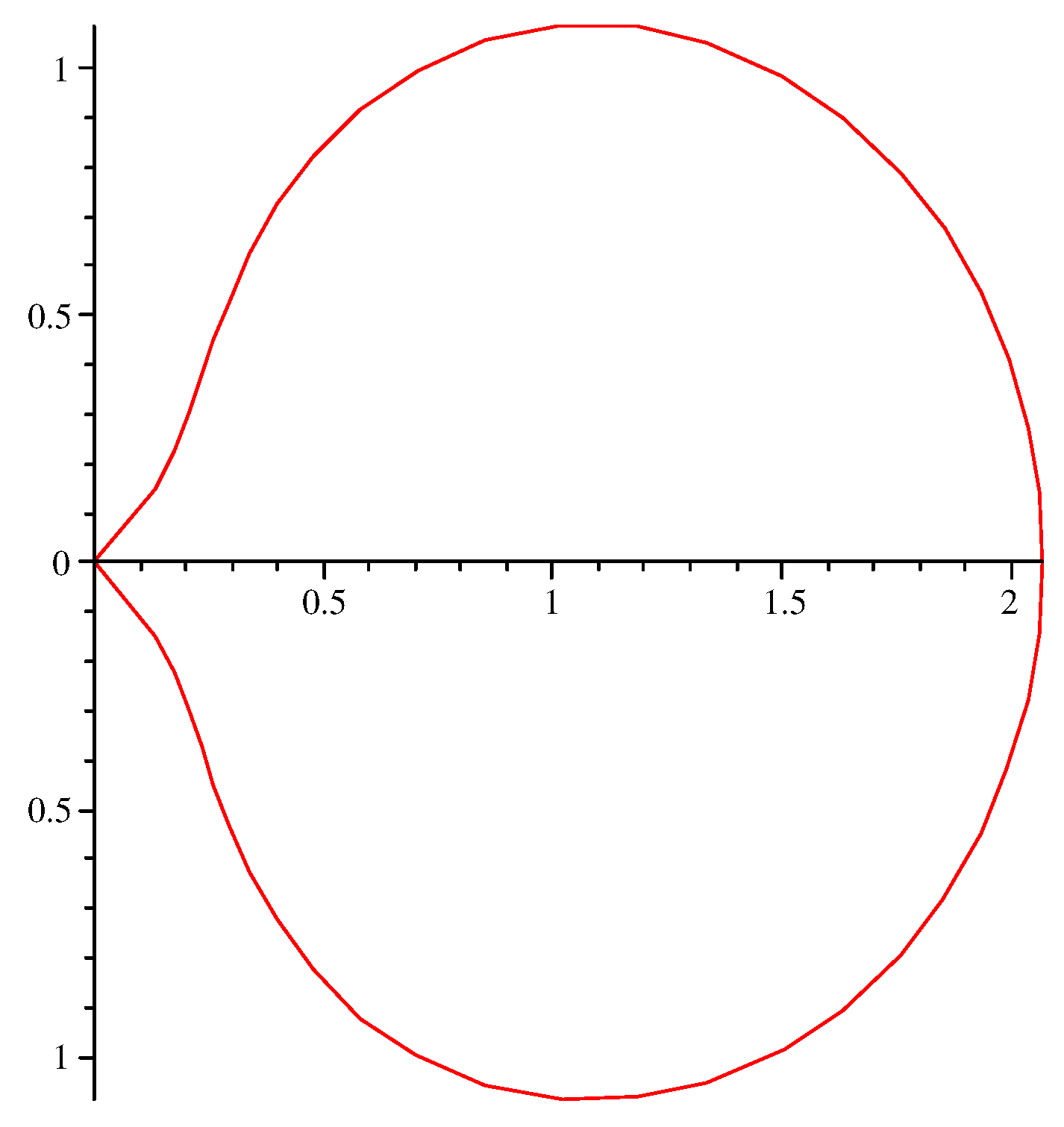
Geometrically, each maps the open unit disc into a balloon-shaped domain, which is symmetric about the real axis, as shown in the following Figure 1.
Figure 1.
The geometry of the function (z)=.
For and , Pommerenke [17] defined the order Hankel determinant by
Recently, finding the sharp upper bounds of the Hankel determinants for certain n and k for various subfamilies of analytic functions has been identified as an interesting and important problem. Many researchers have observed sharp upper bounds of Hankel determinants for many subfamilies of analytic functions. In particular, the upper bounds of second and third-order Hankel determinants have been estimated in [18,19,20,21,22,23] for several subclasses of normalized analytic function.
Hayman [24] was the first to give the sharp inequality for , and subsequently proved that , where . This inequality is further explained in [25] and showed that , where .
Janteng et al. [26] determined the sharp bounds of for the subfamilies of , , and . Babalola [27] studied a third-order Hankel determinant for the subclasses of and , while Zaprawa [28] amended Babalola’s results and gave the following estimates, which it is believed may not be the best possible results.
Kwon et al. [29] improved this determinant for starlike functions as Zaprawa et al. [30] extended his work by estimating for .
Arif et al. [31] calculated the sharpness of the bounds of the coefficients and for a subfamily of starlike functions related to sigmoid functions; see [32] for the modified sigmoid functions. Orhan et al. [33] estimated the sharp Hankel determinants for a subfamily of analytic functions associated with the lemniscate of Bernoulli. Moreover, Shi et al. [34,35] estimated the sharpness of Hankel determinants for the functions with bounded turning associated with a petal-shaped domain and inverse functions, respectively.
Moreover, the estimation of various bounds can be considered for many classes of functions; for example, see [36,37,38].
It is natural to ask what the upper bounds for the analytic functions in the newly defined class related to the coefficients of the Taylor series representation (1) and Hankel determinants are.
The aim and novelty of this article are the sharp upper bounds of the modulus of the coefficients , and and the second-order and third-order Hankel determinants, , and , for the analytic functions in the new class .
2. A Set of Lemmas
Let represent the class of analytic functions p, such that , for , which has the following Taylor series form,
The subsequent Lemmas 1–4 will help to demonstrate our main findings, where , and for are coefficients of the Taylor series (6).
Lemma 1.
([17]). Let . Then, the following inequalities hold true
and
Lemma 2.
Let . Then there exists , and with and such that
and
Lemma 3.
([39]). If , , and , then the following inequality holds true
Lemma 4.
([41]). Let , and λ satisfying the conditions
3. Main Results
Theorem 1.
Let . Then, the following inequalities for the coefficients in (1) are true.
The sharpness of these inequalities can be obtained using the function
In particular, if , and 4, then we have
Proof.
Let be written by
This implies that
Then,
It follows from (21) and (22) that
Using Lemma 1, (23) and (24) imply
By (25),
Using Lemma 3, we obtain
From (26), we have
By applying Lemma 4,
□
Theorem 2.
Let . Then, the sharp upper bound for the following second-order Hankel determinant is given by
Proof.
Theorem 3.
Let . Then, the sharp upper bound for the following second-order Hankel determinant is given by
Proof.
By the identities (23)–(25),
Now, using Lemma 2, we have
Using the triangular inequality by taking , , , and .
Let
Then
which shows that is an increasing function for all and Thus, the maximum value occurs at . Consequently,
Let
which implies
this shows that is a decreasing function for all , and the maximum value occurs at . By referring to (29), we can deduce the required inequality,
It is also easy to verify that the function (17) provides the sharpness of the inequality (28). □
Theorem 4.
Let Then, we have the sharp upper bound for the following third-order Hankel determinant.
The sharpness of this inequality can occur according to the function given in (18).
Proof.
From (5), we have
Also, taking in Lemma 2, we can simplify the terms in (32).
Let and , then
where
with
To find the maximum values of the function within the closed cuboid , we need to examine the function inside the cuboid, on its faces and along its edges. Let us divide the analysis into the following three cases.
- I.
- Interior points of cuboid
Now, we find the maximum value of within the cuboid’s interior.
Let . By differentiating with respect to y, we obtain
Putting , gives
If is a critical point inside ▵, then , which is possible only if
and
To identify the critical point, we need to find a solution that satisfies the inequalities (34) and (35). Let with , which shows that is a decreasing function, so
It follows from the simple calculations that (34) is not held for . As a result, it can be concluded that the function does not possess any critical points within the interior of the cuboid .
Suppose is a critical point of in the interior of the cuboid, satisfying the conditions and which leads us to . It can also be observed that
Since and , we have
Similarly, we obtain
It follows that
Differentiating with regard to “y”, we have
Consider
Then, for all and , we have
Thus, we obtain
where
It can be seen that , for any . Also, is a decreasing function and its maximum value occurs at , which is 37,437.
- II.
- On the six faces of the cuboid
Next, we proceed to examine the maximum value of the function on all six faces of the cuboid ▵.
On the face : becomes
then
which implies that does not have any optimal points within the interval .
On the face , we have
On the face , becomes
then gives
For the provided range of , if
Also, gives
Putting (37) in (38), we obtain
Solving for c within the range , we find that . This indicates that there is no optimal solution for .
On the face : becomes
then gives a critical point , where attains its maximum value; that is,
On the face : becomes
Thus,
Computation shows that the system of equations and has no solutions in .
On the face : , becomes
It follows that
Also, the computation indicates that the system of equations and has no solutions in .
- III.
- On the twelve edges of the cuboid
Finally, we need to find the maximum values of along the twelve edges.
On and : becomes
then gives the critical point , where the maximum value is obtained as follows.
On and : becomes
It is clear that for all . This indicates that is a decreasing function and attains its maximum value at .
On and : becomes
Therefore, for the interval which shows that is an increasing function. As a result, it attains its maximum value at ; that is,
As the terms and are free from q, that is
Putting , we find a critical point . At this critical point, achieves its maximum value, which is
On and : becomes
On :
On and : becomes
and calculation shows that for all , which means is a decreasing function and maximum value occurs at ; that is,
On and : becomes
Let , we then find a critical point where the function achieves its maximum value,
Therefore, we can conclude that
And hence, we reach the following inequality as described by (33),
□
4. Conclusions
In the present article, we defined a class of analytic functions by considering the ratio of two well-known functions. We investigated the sharp upper bounds of the modulus of coefficients , and ; and the sharp upper bounds for the modulus of three second-order and third-order Hankel determinants, , and , for the normalized analytic functions belonging to the newly defined class. These findings contribute to the existing body of knowledge and provide valuable insights for further research in the field. This work provides a direction to define more interesting generalized domains and to extend to new subclasses of starlike and convex functions by using quantum calculus.
Author Contributions
Conceptualization, A.A. (Adeel Ahmad), J.G., I.A.-S., A.R., A.A. (Asad Ali) and S.H.; Methodology, A.A. (Adeel Ahmad), J.G., I.A.-S., A.R., A.A. (Asad Ali) and S.H.; Formal analysis, A.A. (Adeel Ahmad), J.G., I.A.-S., A.R., A.A. (Asad Ali) and S.H.; Investigation, A.A. (Adeel Ahmad), J.G., I.A.-S., A.R., A.A. (Asad Ali) and S.H.; Writing—original draft, A.A. (Adeel Ahmad), J.G., I.A.-S., A.R., A.A. (Asad Ali) and S.H.; Writing—review & editing, A.A. (Adeel Ahmad), J.G., I.A.-S., A.R., A.A. (Asad Ali) and S.H.; All authors have read and agreed to the published version of the manuscript.
Funding
This research was funded by United Arab Emirates University with UAEU Program for Advanced Research (UPAR12S127).
Data Availability Statement
No new data were created or analyzed in this study. Data sharing is not applicable to this article.
Conflicts of Interest
The authors declare no conflict of interest.
References
- Al-Shbeil, I.; Gong, J.; Shaba, T.G. Coefficients Inequalities for the Bi-Univalent Functions Related to q-Babalola Convolution Operator. Fractal Fract. 2023, 7, 155. [Google Scholar] [CrossRef]
- Khan, M.F.; Al-Shbeil, I.; Khan, S.; Khan, N.; Haq, W.U.; Gong, J. Applications of a q-Differential Operator to a Class of Harmonic Mappings Defined by q-Mittag–Leffler Functions. Symmetry 2022, 14, 1905. [Google Scholar] [CrossRef]
- Saliu, A.; Al-Shbeil, I.; Gong, J.; Malik, S.N.; Aloraini, N. Properties of q-Symmetric Starlike Functions of Janowski Type. Symmetry 2022, 14, 1907. [Google Scholar] [CrossRef]
- Ur Rehman, M.S.; Ahmad, Q.Z.; Al-Shbeil, I.; Ahmad, S.; Khan, A.; Khan, B.; Gong, J. Coefficient Inequalities for Multivalent Janowski Type q-Starlike Functions Involving Certain Conic Domains. Axioms 2022, 11, 494. [Google Scholar] [CrossRef]
- Murugusundaramoorthy, G. Fekete–Szegő Inequalities for Certain Subclasses of Analytic Functions Related with Nephroid Domain. J. Contemp. Math. Anal. 2022, 57, 90–101. [Google Scholar] [CrossRef]
- Khan, M.G.; Khan, B.; Gong, J.; Tchier, F.; Tawfiq, F.M.O. Applications of First-Order Differential Subordination for Subfamilies of Analytic Functions Related to Symmetric Image Domains. Symmetry 2023, 15, 2004. [Google Scholar] [CrossRef]
- Shanmugam, T.N. Convolution and Differential subordination. Int. J. Math. Math. Sci. 1989, 12, 333–340. [Google Scholar] [CrossRef]
- Padmanabhan, K.S.; Parvatham, R. Some applications of differential subordination. Bull. Aust. Math. Soc. 1985, 32, 321–330. [Google Scholar] [CrossRef]
- Ma, W.C.; Minda, D. A unified treatment of some special classes of univalent functions. In Proceedings of the Conference on Complex Analysis; Li, Z., Ren, F., Yang, L., Zhang, S., Eds.; International Press: New York, NY, USA, 1992; pp. 157–169. [Google Scholar]
- Cho, N.E.; Kumar, V.; Kumar, S.S.; Ravichandran, V. Radius problems for starlike functions associated with the sine function. Bull. Iran. Math. Soc. 2019, 45, 213–232. [Google Scholar] [CrossRef]
- Kumar, S.S.; Arora, K. Starlike functions associated with a petal-shaped domain. arXiv 2020, arXiv:2010.10072. [Google Scholar]
- Mendiratta, S.; Nagpal, V.; Ravichandran, V. On a subclass of strongly starlike functions associated with exponential function. Bull. Malays. Math. Sci. Soc. 2015, 38, 365–386. [Google Scholar] [CrossRef]
- Mundula, M.; Kumar, S.S. On subfamily of starlike functions related to hyperbolic cosine function. J. Anal. 2023, 31, 2043–2062. [Google Scholar] [CrossRef]
- Sharma, K.; Jain, N.K.; Ravichandran, V. Starlike functions associated with cardioid. Afr. Mat. 2016, 27, 923–939. [Google Scholar] [CrossRef]
- Sokol, J.; Stankiewicz, J. Radius of convexity of some subclasses of strongly starlike functions. Zeszyty Naukowe Oficyna Wydawnicza Al. Powstańców Warszawy 1996, 19, 101–105. [Google Scholar]
- Geol, P.; Kumar, S.S. Certain class of starlike functions associated with modified sigmoid function. Bull. Malays. Math. Sci. Soc. 2020, 43, 957–991. [Google Scholar] [CrossRef]
- Pommerenke, C.; Jensen, G. Univalent Functions; Vandenhoeck and Ruprecht: Gottingen, Germany, 1975. [Google Scholar]
- Riaz, A.; Raza, M.; Binyamin, M.A.; Saliu, A. The second and third Hankel determinants for starlike and convex functions associated with Three-Leaf function. Heliyon 2023, 9, 12748. [Google Scholar] [CrossRef] [PubMed]
- Bansal, D.; Maharana, S.; Prajapat, J.K. Third order Hankel determinant for certain univalent functions. J. Korean Math. Soc. 2015, 52, 1139–1148. [Google Scholar] [CrossRef]
- Krishna, D.V.; Venkateswarlu, B.; RamReddy, T. Third Hankel determinant for bounded turning functions of order alpha. J. Niger. Math. Soc. 2015, 34, 121–127. [Google Scholar] [CrossRef]
- Singh, G. On the second Hankel determinant for a new subclass of analytic functions. J. Math. Sci. Appl. 2014, 2, 1–3. [Google Scholar]
- Al-Shbeil, I.; Gong, J.; Khan, S.; Khan, N.; Khan, A.; Khan, M.F.; Goswami, A. Hankel and Symmetric Toeplitz Determinants for a New Subclass of q-Starlike Functions. Fractals Fract. 2022, 6, 658. [Google Scholar] [CrossRef]
- Orhan, H.; Deniz, E.; Raducanu, D. The Fekete–Szegö problem for subclasses of analytic functions defined by a differential operator related to conic domains, Comput. Math. Appl. 2010, 59, 283–295. [Google Scholar]
- Hayman, W.K. On second Hankel determinant of mean univalent functions. Proc. Lond. Math. Soc. 1968, 3, 77–94. [Google Scholar] [CrossRef]
- Obradovi c, M.; Tuneski, N. Hankel determinants of second and third order for the class S of univalent functions. Math. Slovaca 2021, 71, 649–654. [Google Scholar] [CrossRef]
- Janteng, A.; Halim, S.A.; Darus, M. Coefficient inequality for a function whose derivative has a positive real part. J. Inequal. Pure Appl. Math. 2006, 7, 50. [Google Scholar]
- Babalola, K.O. On H3(1) Hankel determinant for some classes of univalent functions. Inequal. Theory Appl. 2010, 6, 1–7. [Google Scholar]
- Zaprawa, P. Third Hankel determinants for subclasses of univalent functions. Mediterr. J. Math. 2017, 14, 10. [Google Scholar] [CrossRef]
- Kwon, O.S.; Lecko, A.; Sim, Y.J. The bound of the Hankel determinant of the third kind for starlike functions. Bull. Malays. Math. Sci. Soc. 2019, 42, 767–780. [Google Scholar] [CrossRef]
- Zaprawa, P.; Obradović, M.; Tuneski, N. Third Hankel determinant for univalent starlike functions. Rev. R. Acad. Cienc. Exactas Fís. Nat. Ser. A Mat. 2021, 49, 115. [Google Scholar] [CrossRef]
- Arif, M.; Marwa, S.; Xin, Q.; Tchier, F.; Ayaz, M.; Malik, S.N. Sharp coefficient problems of functions with bounded turning subordinated by sigmoid function. Mathematics 2022, 10, 3862. [Google Scholar] [CrossRef]
- Khan, M.G.; Ahmad, B.; Murugusundaramoorthy, G.; Chinram, R.; Wali Khan Mashwani, W.K. Applications of Modified Sigmoid Functions to a Class of Starlike Functions. J. Funct. Spaces 2020, 2020, 8844814. [Google Scholar] [CrossRef]
- Orhan, H.; ÇaĞlar, M.; Cotirla, L.-I. Third Hankel determinant for a subfamily of holomorphic functions related with lemniscate of Bernoulli. Mathematics 2023, 11, 1147. [Google Scholar] [CrossRef]
- Shi, L.; Arif, M.; Rafiq, A.; Abbas, M.; Iqbal, J. Sharp bounds of Hankel determinant on logarithmic coefficients for functions of bounded turning associated with petal-shaped domain. Mathematics 2022, 10, 1939. [Google Scholar] [CrossRef]
- Shi, L.; Arif, M.; Abbas, M.; Ihsan, M. Sharp bounds of Hankel determinant for the inverse functions on a subclass of bounded turning functions. Mediterr. J. Math. 2023, 20, 156. [Google Scholar] [CrossRef]
- Kanas, S.; Răducanu, D. Some class of analytic functions related to conic domains. Math. Slovaca 2014, 64, 1183–1196. [Google Scholar] [CrossRef]
- Abd El-Hamid, H.A.H.; Rezk, M.; Ahmed, A.M.; AlNemer, G.; Zakarya, M.; El Saify, H.A. Dynamic Inequalities in Quotients with General Kernels and Measures, J. Funct. Spaces 2020, 2020, 5417084. [Google Scholar] [CrossRef]
- Ahmed, A.M.; Saker, S.H.; Kenawy, M.R.; Rezk, H.M. Lower Bounds on a Generalization of Cesaro Operator on Time Scales, Dyn. Contin. Discret. Impuls. Syst. Ser. A Math. Anal. 2021, 28, 345–355. [Google Scholar]
- Libera, R.J.; Zlotkiewicz, E.J. Coefficient bounds for the inverse of a function with derivative in P. Proc. Am. Math. Soc. 1983, 87, 251–257. [Google Scholar] [CrossRef]
- Kwon, O.S.; Lecko, A.; Sim, Y.J. On the fourth coefficient of functions in the Carathéodory class. Comput. Methods Funct. Theory 2018, 18, 307–314. [Google Scholar] [CrossRef]
- Ravichandran, V.; Verma, S. Bound for the fifth coefficient of certain starlike functions. Comptes Rendus Math. 2015, 353, 505–510. [Google Scholar] [CrossRef]
Disclaimer/Publisher’s Note: The statements, opinions and data contained in all publications are solely those of the individual author(s) and contributor(s) and not of MDPI and/or the editor(s). MDPI and/or the editor(s) disclaim responsibility for any injury to people or property resulting from any ideas, methods, instructions or products referred to in the content. |
© 2023 by the authors. Licensee MDPI, Basel, Switzerland. This article is an open access article distributed under the terms and conditions of the Creative Commons Attribution (CC BY) license (https://creativecommons.org/licenses/by/4.0/).


