1. Introduction
Glioblastoma (GBM) is the most malignant primary brain tumor in adults, characterized by rapid proliferation, diffuse infiltration, pronounced morphological heterogeneity, and resistance to standard therapy [
1,
2,
3]. Despite advances in multimodal treatment—including maximal safe resection, chemoradiation, and targeted therapies—the median survival remains approximately 14–16 months after diagnosis [
4,
5]. This poor prognosis is driven in part by the tumor’s complex morphodynamic behavior: its ability to reorganize, deform, and adapt its structure through nonlinear biological processes.
Conventional neuroimaging-based analyses focus predominantly on static radiomic features, quantifying intensity statistics, texture, shape, or volumetric descriptors extracted from single time points [
6,
7,
8,
9]. While such features have provided robust biomarkers for prognosis and treatment monitoring, they do not capture the continuous evolution of tumor morphology. GBM growth, edema, necrosis, and infiltration arise from nonlinear interactions across spatial and temporal scales, suggesting that tumor morphology may be more appropriately viewed as a nonlinear dynamical system [
10,
11,
12].
In dynamical systems theory, attractors represent stable or metastable states toward which trajectories tend to evolve [
13]. From a morphodynamic perspective, the evolution of GBM may be conceptualized as a trajectory in a high-dimensional morphological state space, where attractor-like configurations correspond to relatively persistent shapes or organizational patterns. Identifying such latent attractor regions could provide insights into tumor progression, invasiveness, and potential early indicators of treatment resistance.
Recent developments in deep learning have enabled the formulation of biological processes in continuous latent spaces. Neural Ordinary Differential Equations (Neural ODEs), introduced by Chen et al. [
14], model hidden representations as solutions to parameterized differential equations, enabling the learning of smooth, time-continuous trajectories from discrete samples. When applied to medical imaging, Neural ODEs provide a principled means to simulate continuous morphological deformations even in the absence of longitudinal scans [
15,
16,
17]. In this work, ‘stability’ refers to the behavior of the learned latent ODE flow (e.g., attractor-like tendencies induced by regularization and the finite-time sensitivity quantified by λ); related stability analyses exist for other neural-network formulations (e.g., Clifford- and quaternion-valued networks), but these address different settings from the real-valued, delay-free Neural ODE considered here [
18,
19].
Similarly, 3D convolutional autoencoders have emerged as effective tools for learning compact latent embeddings of anatomical structures [
20,
21,
22]. By projecting high-dimensional MRI data onto low-dimensional manifolds, these models preserve geometric and topological information while offering a tractable space in which shape evolution can be studied. Within such latent manifolds, morphological changes can be interpreted as latent trajectories, which Neural ODEs can model to infer underlying morphodynamic laws.
In this study, we propose a novel integrated framework combining 3D convolutional autoencoding, synthetic shape evolution, and Neural ODE–based latent dynamics to investigate glioblastoma morphodynamics. Using 494 preoperative MRI volumes from the BraTS 2020 dataset [
23], we trained a 16-dimensional autoencoder to capture intrinsic tumor variability. Synthetic morphological trajectories were generated through controlled bidirectional growth–shrinkage operations on tumor masks [
24], enabling the estimation of continuous latent flow fields in the absence of true longitudinal imaging.
Novelty and contribution of the present work. The novelty of this study does not lie in the isolated use of fractal dimension or Lyapunov exponents—both of which are established concepts—but in their joint integration within a continuous latent dynamical framework learned directly from medical imaging data. Unlike prior studies that treat fractal metrics as static radiomic descriptors extracted from a single MRI exam, we model glioblastoma morphology as a trajectory evolving on a learned latent manifold. Within this framework, fractal dimension (DF) characterizes geometric boundary complexity, while a finite-time Lyapunov exponent (λ) quantifies the local dynamical stability of inferred morphodynamic flows. The resulting DF–λ morphodynamic phase space enables identification of stable, metastable, and unstable morphological regimes that cannot be obtained from static shape analysis alone.
To quantify structural and dynamical properties of latent morphodynamics, we computed two complementary measures:
The joint distribution of these measures defines a morphodynamic phase space in which stable, metastable, and unstable regimes emerge naturally. Visualization of trajectories and kernel-density maps in this DF–λ space reveals population-level patterns, potential attractor-like regions, and morphodynamic signatures associated with aggressive or stable tumor configurations.
Although the primary aim of this work is methodological, we also include exploratory clinical overlays to contextualize the morphodynamic descriptors. These analyses show that fractal dimension exhibits a modest negative association with overall survival, whereas λ does not correlate with clinical outcome, suggesting that boundary complexity and latent dynamical stability capture complementary and clinically distinct aspects of GBM morphology.
Relation to prior fractal analyses of glioblastoma. Previous work has applied fractal dimension and lacunarity to glioblastoma margins, necrotic cores, and infiltrative interfaces as static descriptors derived from a single MRI exam, showing associations with survival, molecular markers, and tumor aggressiveness. These studies treat fractal metrics as fixed radiomic features and do not model the dynamical behavior of morphology. In contrast, the present framework embeds morphology into a continuous latent dynamical system, combining fractal dimension with a finite-time Lyapunov exponent to form a DF–λ morphodynamic map. This joint structural–dynamical representation extends prior static fractal work by characterizing not only how complex a GBM boundary is, but also how stable or unstable its latent morphodynamics are under small perturbations.
Through this framework, we aim to unify nonlinear dynamics, fractal morphometry, and deep latent modeling into a coherent methodology for dynamic radiomics, offering new insight into the continuous evolution of glioblastoma morphology and its potential implications for clinical outcomes.
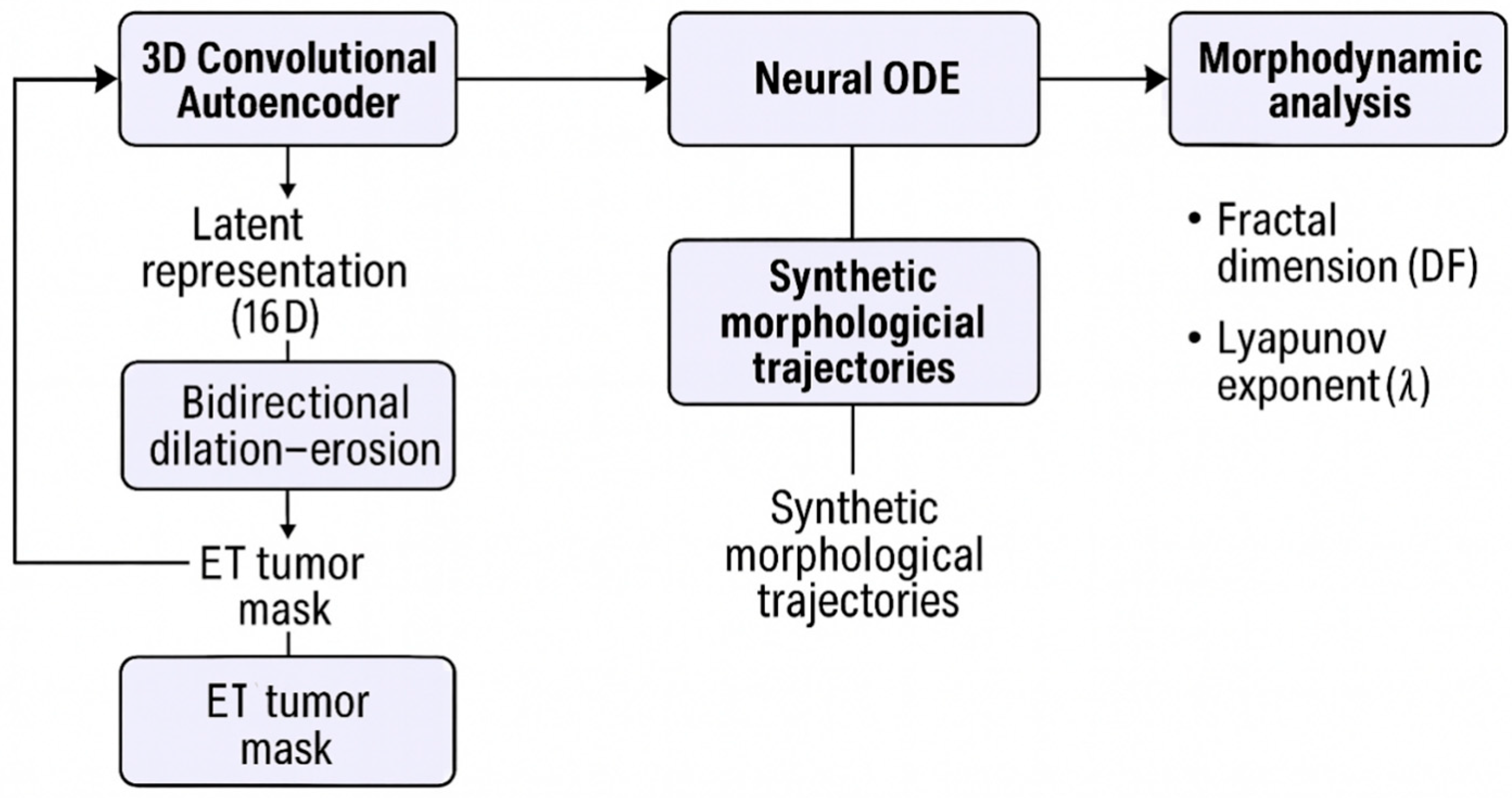
A schematic overview of the full pipeline is provided in
Figure 1.
Key Contributions of This Work
Introduces a dynamic radiomics framework that models glioblastoma morphology as a continuous nonlinear dynamical system using Neural ODEs.
Learns latent morphodynamic flows without longitudinal imaging through biologically motivated synthetic shape trajectories.
Unifies fractal geometry and dynamical systems theory by jointly analyzing fractal dimension (DF) and a Lyapunov-like exponent (λ).
Reveals stable, metastable, and unstable morphodynamic regimes emerging directly from latent-space dynamics.
Identifies a characteristic GBM morphodynamic phenotype, with most tumors clustering in a metastable region of the DF–λ phase space.
Demonstrates robustness of morphodynamic regime classification across multi-scale perturbations, direction reversal, and segmentation noise.
Provides a reproducible, fully automated pipeline applicable to multi-center MRI datasets.
In the remainder of this manuscript,
Section 2 details the full methodological pipeline, including data preprocessing, 3D autoencoder training, synthetic morphological trajectory generation, and the construction of the Neural ODE–based latent dynamics. This section also introduces the three robustness and stability evaluations—multi-scale dilation–erosion analysis, direction-reversal testing, and noise-perturbation analysis—as well as the computation of fractal dimension and Lyapunov-like stability exponents.
Section 3 presents the experimental results, covering the structure of the learned latent space, the behavior of latent morphodynamic trajectories, the empirical DF–λ phase map, and the KDE-based morphodynamic density map representation. Results of the robustness tests are also reported, demonstrating the stability of the inferred dynamical regimes across scales, directionality, and perturbations.
Section 4 provides an in-depth discussion of the implications of these findings, including a dedicated subsection on the fractal and dynamical interpretation of tumor morphology. This section interprets the observed dynamical regimes in the context of nonlinear systems theory, fractal boundary evolution, tumor microenvironment heterogeneity, and potential biological–clinical relevance. Finally,
Section 5 summarizes the main contributions of this work and outlines future directions, including the need for longitudinal MRI validation, biological interpretation of latent-space attractors, and the integration of morphodynamic descriptors into predictive or prognostic modeling.
2. Materials and Methods
2.1. Dataset
All experiments were conducted using the BraTS 2020 (Brain Tumor Segmentation Challenge) dataset, comprising 494 subjects with preoperative multimodal MRI. Each subject includes four co-registered 3D MRI sequences with isotropic 1 mm3 resolution:
Expert annotations delineate three tumor subregions:
- (1)
necrotic/non-enhancing core (NCR),
- (2)
peritumoral edema (ED),
- (3)
enhancing tumor (ET).
In this work, the enhancing tumor (ET) mask served as the morphological structure for all geometric and fractal analyses.
BraTS 2020 images are distributed in a harmonized form (e.g., skull-stripped, co-registered, and resampled to a common resolution), so the present validation reflects performance under standardized preprocessing rather than raw clinical MRI variability.
Because the study is unsupervised, all 494 subjects were used collectively for training and evaluation. No longitudinal imaging is available in BraTS; therefore, synthetic morphological trajectories were generated to approximate temporal evolution.
Why ET was selected.
We deliberately use only the enhancing tumor (ET) mask, as it provides the most stable, biologically meaningful, and reproducible boundary for morphological analysis. The whole-tumor (WT) region contains large volumes of FLAIR hyperintensity dominated by vasogenic edema and nonspecific infiltration, which produce irregular contours unrelated to intrinsic tumor geometry. Including these regions would inflate fractal dimension, distort boundary-derived morphodynamics, and introduce artifacts unrelated to tumor biology or dynamical stability. ET avoids these confounds and is therefore standard in fractal-based glioma morphology studies.
2.2. Preprocessing
Preprocessing followed the standard BraTS workflow:
N4ITK bias field correction to remove low-frequency intensity inhomogeneity.
Z-score normalization within the intracranial region (per-channel).
Cropping and resampling to a uniform 128 × 128 × 128 voxel grid.
Extraction of ET regions, stored alongside MRI volumes.
Each sample was saved in an .npz file containing:
4 MRI channels (T1, T1ce, T2, FLAIR),
the enhancing tumor mask,
metadata (subject ID, age, resection type, survival),
original train/validation split.
These files served as input for both autoencoder training and synthetic trajectory generation.
2.3. 3D Autoencoder for Morphological Encoding
Tumor morphology was compressed using a 3D convolutional autoencoder (AE) implemented in PyTorch2.1.0+cu121.
Architecture
Encoder:
3 convolutional blocks (3 × 3 × 3 kernels),
Channels: 32 → 64 → 128,
Each block followed by ReLU and 2 × 2 × 2 max pooling,
Final fully connected layer compressing features to a 16-dimensional latent vector.
Decoder:
Training
Loss: Mean squared error (MSE) reconstruction loss.
Optimizer: Adam (lr = 10−4, batch size = 2).
Training epochs: 20 full passes over all 494 volumes.
Hardware: NVIDIA L4 GPU.
The resulting latent representation preserved global tumor geometry, border irregularity, and internal intensity structure, forming a smooth morphological manifold for downstream dynamical modeling.
We initially trained the autoencoder for 20 epochs, which was sufficient for convergence of the reconstruction loss. A separate 50-epoch run produced very similar reconstruction error and latent-space statistics; therefore, all analyses reported in this work are based on the 20-epoch model.
Training–validation considerations.
Because the autoencoder is used solely as an unsupervised morphometric encoder rather than a predictive model, all 494 subjects were used for training. The goal is to learn a smooth and complete morphological manifold spanning the full variability of the cohort, not to evaluate out-of-sample reconstruction performance. For this reason, no dedicated validation split was required; reconstruction loss was monitored throughout training to ensure stable convergence and to avoid overfitting to noise. This approach is standard in unsupervised representation learning when the downstream task (here, latent morphodynamic analysis) does not depend on reconstruction generalization properties.
Autoencoder Morphometric Fidelity and DF Preservation
To quantify the extent to which autoencoder compression may distort fine-scale boundary geometry and bias fractal morphometry, we performed a reconstruction-based fidelity analysis focused on the enhancing-tumor (ET) mask. Because the autoencoder reconstructs volumes on its native decoder grid (49 × 49 × 49), all fidelity metrics were computed on that grid. For each subject, the ground-truth ET mask was resampled to the decoder resolution using nearest-neighbor interpolation to preserve binary topology.
The trained autoencoder was applied to the ET-masked MRI input and produced a reconstructed ET channel. Since the reconstructed ET channel is not a calibrated probability map, we derived a binary reconstructed mask using a volume-matched thresholding rule: for each subject, we selected the top-K voxels from the reconstructed ET score map, where K equals the number of voxels in the resampled ground-truth ET mask. This produces a non-empty reconstructed mask with matched volume, enabling fair comparison of shape-based morphometrics independent of absolute intensity calibration.
Fractal dimension (DF) was computed via 3D box-counting for both the resampled ground-truth ET mask and the reconstructed (volume-matched) ET mask, yielding DFtrue, DFrecon, and ΔDF = DFrecon − DFtrue. In addition, we computed the mean squared reconstruction error (MSE) on the decoder grid (over all reconstructed channels) and evaluated whether reconstruction error was associated with morphometric distortion by correlating MSE with ∣ΔDF∣. This analysis directly tests whether the latent representation and decoding process preserves the fractal morphometric quantity used in the DF–λ framework.
2.4. Synthetic Morphological Trajectories
Because BraTS provides only static preoperative MRI scans, we construct synthetic temporal trajectories to probe how local tumor morphology might evolve under smooth boundary perturbations. These trajectories provide the continuous variations needed to train a Neural ODE while avoiding assumptions about true chronological growth.
Generation of morphological sequences
For each subject:
The enhancing–tumor (ET) binary mask M0 is used as the starting shape.
- 2.
Controlled morphological transformation
A sequence of 3D morphological dilations and erosions is applied using a spherical 3 × 3 × 3 structuring element S. Dilation expands the boundary, whereas erosion contracts it, providing small, controlled shape perturbations.
- 3.
Stochastic jitter
At each step, a random jitter factor (±15%) perturbs whether the next transformation is a dilation or erosion. This produces asymmetric, non-deterministic transitions that prevent the ODE from learning a trivial, fixed operator.
These operations generate a 24-step bidirectional sequence:
This consists of progressive dilations followed by erosions, producing a smooth, reversible shape path.
Embedding synthetic morphologies
Each mask
Mt is applied voxel-wise to the normalized 4-channel MRI volume:
This emphasizes the evolving tumor region.
Passing
Xt through the autoencoder encoder
fθ yields latent states:
Thus, each subject provides a smooth synthetic latent trajectory {zt} suitable for continuous-time Neural-ODE training.
2.4.1. Rationale for Synthetic Morphological Trajectories
BraTS lacks longitudinal scans, making true tumor dynamics unobservable.
To enable continuous-time modeling, we approximate infinitesimal boundary variations using controlled 3D dilation and erosion.
This choice is motivated by both biological and mathematical considerations:
(1) Local boundary deformation is a core mechanism of GBM invasion.
Glioblastoma expands through localized protrusions and regressions at the tumor–brain interface. Morphological dilation and erosion provide principled approximations of such small-scale boundary movements, without imposing assumptions about global growth patterns.
(2) Dilation–erosion forms a smooth family of shape transformations.
Mathematical morphology defines a semigroup of monotonic boundary mappings. Repeated dilation and erosion generate a continuous path of admissible shapes:
providing a well-behaved trajectory compatible with Neural ODE training.
(3) Bidirectional sequences remove ordering ambiguity.
Without true time labels, morphological transitions could be arbitrarily permuted. A symmetric grow–shrink trajectory enforces a consistent ordering and prevents degeneracies in which the ODE “memorizes” random permutations rather than learning a coherent latent-space flow.
(4) The goal is not to model biological time, but to probe latent-space geometry.
The dilation–erosion operator is not the object being learned.
It is merely a tool to sample local shape perturbations around each tumor.
The Neural ODE learns the vector field that best interpolates between the resulting latent embeddings—i.e., the intrinsic geometry of each subject’s morphology manifold—rather than the synthetic operator itself.
Importantly, the Neural ODE does not learn the dilation–erosion operator; the operator is used solely to sample infinitesimal perturbations, while the ODE learns the latent-space flow that best explains these variations.
2.4.2. Cross-Generator Synthetic Trajectories (SDF Perturbation Family) and Negative Control
Because BraTS provides only static preoperative MRI scans, we further evaluated whether the learned latent dynamics depend on a specific synthetic generator by introducing an independent deformation family and a negative control in addition to the baseline dilation–erosion trajectories described in
Section 2.4.
(A) Baseline generator (morphological dilation–erosion).
We used the same 24-step bidirectional dilation → erosion sequence with a 3 × 3 × 3 structuring element and 15% stochastic jitter as described in
Section 2.4, producing a mask sequence
with
T = 24.
(B) Alternative generator (signed-distance-field + smooth random field perturbations).
To obtain shape trajectories that do not arise from repeated dilation/erosion, we generated an alternative sequence using a signed distance field (SDF) representation of the binary ET mask
M0. Let
denote the signed distance function of
M0, defined as the (unsigned) Euclidean distance to the boundary with negative sign inside the tumor and positive sign outside. We generated a smooth spatial perturbation field
g(
x) by sampling i.i.d. Gaussian noise on
Ω and applying 3D Gaussian filtering (standard deviation
σ voxels), followed by normalization to unit standard deviation. A time-dependent SDF sequence was then constructed as:
where
a is an amplitude parameter (in voxel units) and
αt is a bidirectional schedule that increases from 0 to 1 and then decreases from 1 back to 0 (matched to the 24-step design). Each SDF frame was converted back to a binary mask by thresholding:
This procedure produces smooth, non-morphological boundary deformations that are independent of the dilation–erosion operator.
(C) Negative control (time-shuffled trajectories).
To test whether any apparent dynamical structure can be explained by temporal ordering alone, we constructed a negative control by randomly permuting the time indices of the baseline dilation–erosion mask sequence within each subject:
where
π is a uniformly random permutation of {0, …,
T − 1}. The shuffled sequence preserves the set of masks but destroys coherent ordering.
Latent embedding for all generators.
For each generator (morph, SDF, shuffle), each mask
Mt was applied voxel-wise to the normalized 4-channel MRI volume
X and encoded using the trained 3D autoencoder encoder
fθ (
Section 2.3), yielding a latent sequence
(
Section 2.4).
2.5. Neural Ordinary Differential Equation (Neural ODE) Modeling
To model the continuous evolution of latent morphology, a Neural ODE was trained to reproduce the synthetic trajectories.
ODE formulation
The latent state evolves according to:
where
f is a feed-forward network:
Numerical integration
ODE integration was performed using the Dormand–Prince (dopri5) solver implemented in torchdiffeq.
Training objective
The ODE learns to match predicted latent states to the synthetic trajectories:
Contraction regularization
To enforce biologically meaningful stability, a divergence penalty was added:
where
Jf(
z) is the Jacobian of the latent vector field.
This encourages negative divergence, promoting the formation of latent attractor basins rather than purely divergent flows.
Training settings
Cross-Generator Generalization Protocol
To determine whether the Neural ODE learns latent geometric structure that transfers across deformation families (rather than merely encoding a specific synthetic operator), we performed cross-generator generalization.
Training. We trained two Neural ODE models using the same architecture and solver described in
Section 2.5:
Evaluation sets. Each trained model was evaluated on three trajectory sets:
- (i)
in-generator trajectories (same generator used for training),
- (ii)
cross-generator trajectories (the other generator family),
- (iii)
shuffled trajectories (negative control).
Trajectory reconstruction error (per subject). For each subject i, we integrated the learned ODE from the subject’s initial latent state zi,0 across the discrete time grid to produce . We quantified prediction fidelity using per-subject mean-squared error:
We report the distribution of MSEi across subjects using median and interquartile range (IQR), alongside the mean over subjects for reference.
2.6. Fractal Dimension (DF) and Lyapunov Exponent (λ)
Fractal dimension (DF)
Morphological complexity of the tumor boundary was quantified from the binary enhancing-tumor (ET) mask using the 3D box-counting method.
For voxel size ε, let N(ε) be the smallest number of ε—cubes required to cover the tumor mask.
The fractal dimension is defined as
Practically, DF was estimated by linear regression of versus using voxel sizes ε = 2−k that fit the tumor bounding box.
DF reflects:
Physical interpretation of DF. In the context of glioblastoma morphology, the fractal dimension quantifies the degree of geometric irregularity and self-similar organization of the tumor boundary across spatial scales. Higher DF values correspond to more convoluted, fragmented, and infiltrative tumor interfaces, whereas lower DF indicates smoother and more compact morphologies. DF therefore acts as a scale-invariant structural descriptor of boundary complexity arising from heterogeneous invasion and microenvironmental constraints.
Physical basis of fractal dimension in tumor morphology. The fractal dimension used in this work is grounded in the physics of scale-invariant growth and interface roughening, rather than in the specifics of a numerical software implementation. Glioblastoma growth is governed by heterogeneous proliferation, anisotropic migration along white-matter tracts, variable mechanical resistance, and diffusion-limited transport of nutrients and signaling molecules. These processes collectively generate irregular, branched, and statistically self-similar tumor boundaries over a range of spatial scales.
From a physical perspective, such interfaces are well described by fractal geometry, which emerges naturally in classical models of nonequilibrium growth, including diffusion-limited aggregation, reaction–diffusion systems, and stochastic interface growth (e.g., KPZ-type dynamics). In these systems, the fractal dimension characterizes how boundary complexity scales with observation length, independent of absolute size or resolution.
In this context, the box-counting algorithm serves only as a numerical estimator of the scaling law , while the underlying physics resides in the observed power-law relationship between occupied boundary elements and spatial scale. Thus, DF captures an intrinsic, scale-invariant property of tumor boundary organization that reflects the balance between invasive growth, spatial constraints, and local heterogeneity, rather than a software-specific artifact.
Lyapunov exponent (λ)
Dynamical stability in latent space was assessed using a finite-time Lyapunov exponent (FTLE) computed from two initially close trajectories.
Initialization
For each subject, let z0 be the latent state of the original ET mask.
A small perturbation is generated as
A single perturbation per subject is used; repeated trials changed λ by <0.01 and did not affect regime classification.
Trajectory integration
The original and perturbed states are integrated under the learned Neural ODE
Let z(t) and z′(t) be the resulting trajectories and d(t) = ‖z′(t) − z(t)‖ the separation.
Finite-time Lyapunov exponent
The FTLE is estimated by
which is equivalent to fitting the slope of
vs.
t on [0, T].
Regime classification
Subjects were categorized using a neutrality band
Testing ε ∈ [0.005,0.02] altered regime assignments in <8% of subjects, demonstrating robustness to threshold choice.
Interpretation
λ measures local latent-space divergence, not long-term dynamics:
λ < 0: nearby trajectories converge → locally stable;
λ ≈ 0: weakly attracting/repelling → metastable;
λ > 0: trajectories diverge → unstable or chaotic.
Thus, λ represents a finite-time indicator of morphodynamic stability in the latent flow estimated from each subject.
Physical interpretation of λ. In this framework, the Lyapunov exponent does not describe biological time evolution or tumor growth rate. Instead, it quantifies the sensitivity of inferred latent morphodynamic trajectories to infinitesimal perturbations in shape space. Negative λ indicates contraction toward attractor-like latent configurations, while positive λ reflects divergence and morphological instability under the learned latent dynamics. λ therefore characterizes local stability of morphological configurations within the latent manifold rather than clinical aggressiveness or temporal progression.
Direction convention. In this work, λ is computed with respect to a fixed orientation of the learned latent flow, where “forward time” corresponds to the synthetic trajectory convention (dilation → erosion). Because λ is a finite-time stability index of an oriented vector field, it is generally not expected to be invariant under time reversal. Consequently, comparisons under reversed synthetic ordering should be interpreted as a directionality analysis (flow orientation change) rather than a robustness-to-reversal requirement.
2.7. Visualization and Statistical Mapping
Latent trajectory visualization
A global PCA model was fitted to all standardized latent vectors. Trajectories from individual subjects were projected into:
ODE-simulated trajectories were generated for continuous time t ∈ [0, 8].
DF–λ scatter plot
A scatter plot visualized each subject’s structural (DF) and dynamical (λ) descriptors. Points were color-coded according to the inferred morphodynamic regime:
stable,
metastable,
unstable/chaotic.
KDE-based morphodynamic density map
A 2D Gaussian kernel density estimator (KDE) was applied to the empirical DF–λ distribution, producing a continuous density field. This map highlights:
High-density morphodynamic phenotypes
Low-density outlier regions
Stable vs. unstable territories
All analyses were implemented in Python 3.12 using:
PyTorch2.1.0+cu121
NumPy 1.26.4
scikit-learn 1.3.2
torchdiffeq 0.2.3
Matplotlib 3.7.1
2.8. Robustness and Stability Analyses
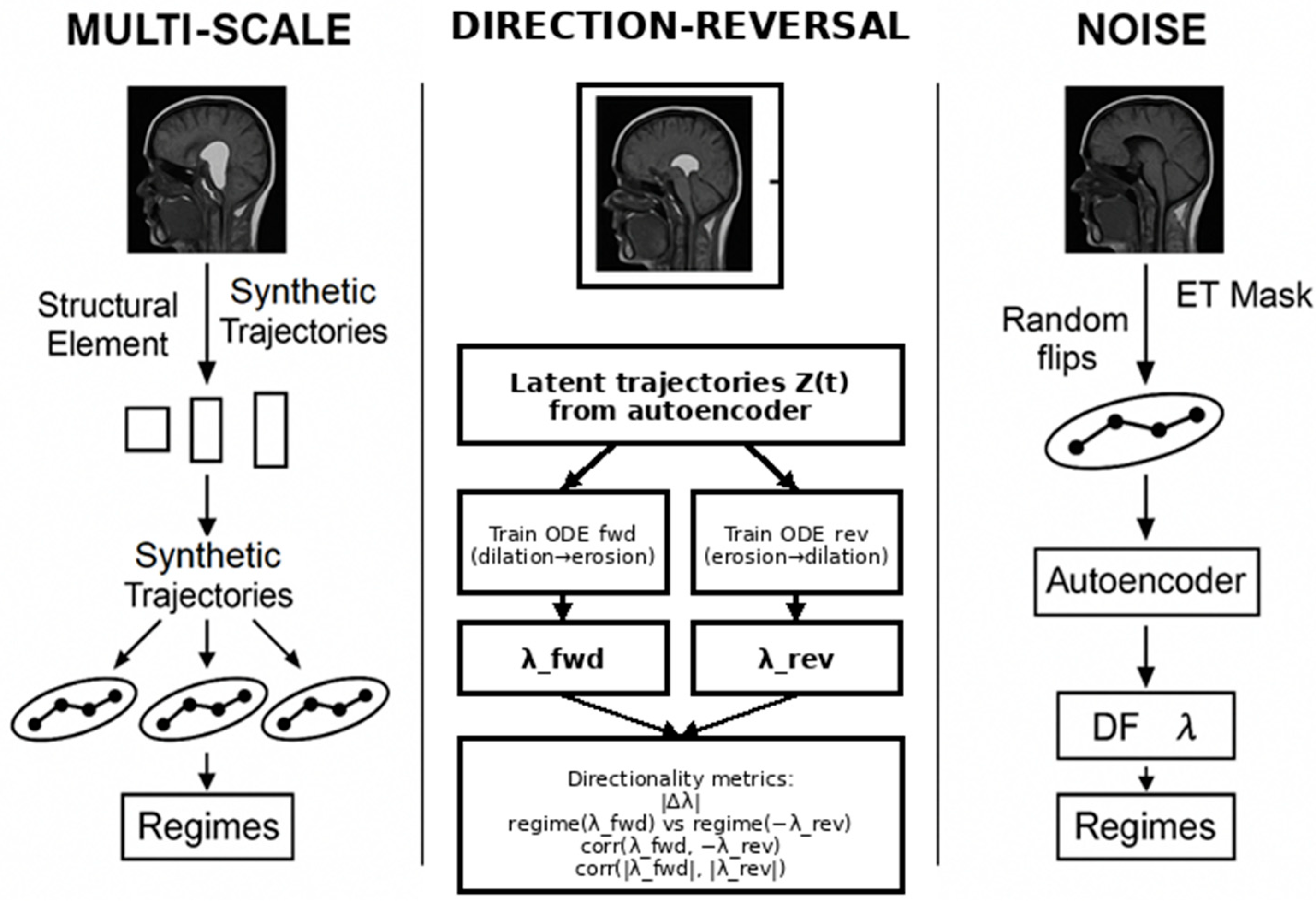
To evaluate the stability of the fractal–dynamical characterization (DF and λ) against perturbations in the synthetic morphodynamic pipeline, we performed three families of systematic robustness tests: (A) multiscale morphological perturbations, (B) temporal direction reversal, and (C) voxel-level segmentation noise perturbation. All analyses were performed on the same subset of subjects for which complete data were available (n = 369). An overview of these three workflows is provided in
Figure 2, illustrating the synthetic trajectory generation and dynamical assessment steps used in each test. The three robustness procedures are described below.
A. Multi-Scale Dilation–Erosion Perturbation
To assess the sensitivity of λ and DF to variations in the morphological scale of the synthetic evolution process, we reconstructed synthetic sequences using three structuring-element radii: 1, 2, and 3 voxels. For each subject and each radius, we generated a 24-step bidirectional (growth–shrinkage) trajectory using iterative binary dilation and erosion, with stochastic jitter (15%) to avoid deterministic trajectories. At every time step, the ET mask was multiplied with the corresponding multi-channel MRI volume, encoded using the trained 3D autoencoder, and converted into a latent trajectory. This produced three sets of latent sequences per subject.
A separate Neural ODE was trained for each radius using the standardized latent trajectories and the same training hyperparameters. For each trained model, λ was computed via the two-trajectory Lyapunov exponent estimator based on dual integration of perturbed latent initial conditions. Regime identity (stable, metastable, unstable) was assigned according to the λ-band threshold ε = 0.01. Results were compared across radii to quantify (i) global λ correlations, (ii) regime consistency, and (iii) DF stability.
Scale normalization of λ. Because dilation–erosion trajectories generated with different structuring-element radii produce different effective boundary displacements per synthetic step, the raw λ estimated “per step” is expected to be scale-conditioned. To enable cross-scale comparison, we additionally report scale-normalized stability indices that quantify instability per unit deformation. Let drd_rdr denote a mask-based deformation proxy defined as the mean normalized symmetric difference between successive masks along the radius-rrr trajectory, , and let denote the latent trajectory arc length. We then compute and , which normalize λ by morphological and latent step size, respectively.
B. Temporal Direction-Reversal Perturbation
To evaluate the directionality of the learned latent dynamical flow under reversal of the synthetic evolution convention, we constructed the reverse latent trajectories by inverting the temporal order of the baseline synthetic sequences. Two ODE models were trained independently: one on the forward dilation → erosion trajectories and one on the reversed erosion → dilation trajectories.
For each subject, λ was computed from the initial latent state of each model using the same perturbation-based Lyapunov estimator. Because λ is a finite-time stability index of an oriented vector field, it is not expected to be invariant under time reversal. Therefore, directionality was quantified using:
(i) the mean absolute difference ∣Δλ∣ between the forward-trained and reverse-trained models;
(ii) a sign-aware regime agreement that accounts for flow orientation by mirroring the reverse-trained estimate across λ = 0, i.e., comparing regime (λfwd) with regime (−λrev); and
(iii) correlation diagnostics between λfwd and −λrev (directional consistency) and between ∣λfwd∣ and ∣λrev∣ (magnitude consistency).
C. Noise Perturbation of the ET Mask
To assess robustness to segmentation inaccuracies, we applied random voxel flips to the ET mask at three noise levels: 1%, 2%, and 3% of voxels uniformly sampled across the tumor volume. For each noise condition, the perturbed mask was used to regenerate a full synthetic 24-step trajectory following the same dilation–erosion process as in the baseline model. Latent trajectories were reconstructed using the trained autoencoder, and a new ODE model was trained for each noise level.
For every subject and noise level, DF was recomputed using 3D box-counting on the noisy ET mask, and λ was recomputed using the trained noise-conditioned ODE. Regime preservation was evaluated by comparing the noisy regimes to the baseline regime. Robustness was quantified using: (i) mean percent DF change, (ii) mean |Δλ| relative to the baseline model, and (iii) the percentage of subjects retaining their original regime.
Ordering negative control. To assess whether λ merely encodes discrete sequence ordering, we additionally evaluated λ under a time-shuffled control in which the same masks are permuted (
Section 2.4.2 C) while using the same trained ODE and the same Lyapunov estimator. This isolates potential ordering artifacts from stability properties induced by the learned vector field under a fixed convention.
Lyapunov Exponent Computation
Across all experiments, λ was estimated using a two-trajectory method, where a small perturbation δz0 (‖δz0‖ = 10−3) was added to the initial latent state z0, and both trajectories were integrated using the trained Neural ODE. The Lyapunov exponent λ was obtained as the slope of the linear fit of log‖z(t) − z′(t)‖ over continuous integration time (T = 8.0, 256 steps). A regime was assigned as stable (λ < −ε), unstable (λ > ε), or metastable (|λ| ≤ ε), with ε = 0.01.
Fractal Dimension Estimation
The fractal dimension DF was computed on each ET mask (baseline and perturbed) using a 3D box-counting algorithm over multiple box sizes {1, 2, 4, 8, 16, 32}. The slope of log N(s) versus log(1/s) was used as the box-counting fractal dimension.
Statistical Test for Cross-Generator Generalization
To test whether cross-generator generalization is better than the negative control at the subject level, we used a paired Wilcoxon signed-rank test on per-subject errors. For a given trained model, we compared
versus
using paired differences:
We tested the one-sided alternative hypothesis Δ
i > 0 (i.e., cross-generator error is lower than shuffled error). This analysis was performed on the subset of cases with complete masks available (n = 369), consistent with the robustness analyses described in
Section 2.8.
2.9. Clinical and Biological Variables
Patient metadata from the BraTS 2020 dataset—including age, survival time (in days), and extent of resection (GTR vs. STR)—were merged with the DF–λ descriptors using unique subject identifiers. Age and survival time were sufficiently complete for analysis, whereas segmentation-derived tumor volumes and molecular markers (e.g., IDH, MGMT) could not be consistently aligned with the morphodynamic dataset and were therefore excluded.
Because survival times in BraTS are partially right-censored and lack comprehensive treatment variables or censoring indicators, all clinical analyses were performed strictly for exploratory purposes. Pearson correlations were computed between fractal dimension (DF), Lyapunov-like exponent (λ), age, and survival to provide descriptive measures of association. Higher DF showed a modest negative association with overall survival, whereas λ demonstrated no measurable relationship with outcome.
To visualize potential survival gradients, Kaplan–Meier curves were generated for the lowest and highest DF quartiles, and the log-rank test was applied as an exploratory comparison. In addition, DF–λ scatter plots were color-coded by survival category (short ≤ 9 months; long ≥ 18 months) to illustrate qualitative clinical trends within the morphodynamic phase space. No Cox regression, multivariate modeling, or adjustment for confounders was performed due to incomplete clinical covariates.
These analyses are hypothesis-generating only and should not be interpreted as evidence that DF or λ are independent prognostic biomarkers.
3. Results
3.1. Dataset and Latent Representation
A total of 494 BraTS 2020 subjects were successfully processed following quality control. Each MRI volume was encoded into a 16-dimensional latent representation using a trained 3D convolutional autoencoder.
The latent space captured key morphological attributes, including boundary irregularity, asymmetry, and the internal distribution of enhancing and necrotic tumor components.
Across the validation subset, the autoencoder achieved a mean reconstruction error of 0.70 ± 0.06 MSE, indicating accurate preservation of structural details after compression.
Autoencoder Morphometric Fidelity (DF Preservation)
Autoencoder morphometric fidelity (DF preservation). To quantify whether the autoencoder compression distorts boundary morphometry, we compared fractal dimension computed on the ET mask resampled to the decoder grid (49 × 49 × 49) versus a volume-matched reconstructed ET mask derived from the decoder ET channel. Across cases with non-empty resampled ET masks (n = 341), DF was strongly preserved (corr(DF
true, DF
recon) = 0.9568;
Supplementary Figure S1a), indicating that the autoencoder retains the global boundary-complexity statistic used in the DF–λ analysis. In addition, reconstruction MSE showed no clear monotonic relationship with ∣ΔDF∣ (
Supplementary Figure S1b), suggesting that residual reconstruction error is not the dominant driver of DF variability in this pipeline.
3.2. Latent Morphodynamic Trajectories
Continuous morphodynamic evolution was modeled using the Neural ODE trained on synthetic dilation–erosion sequences.
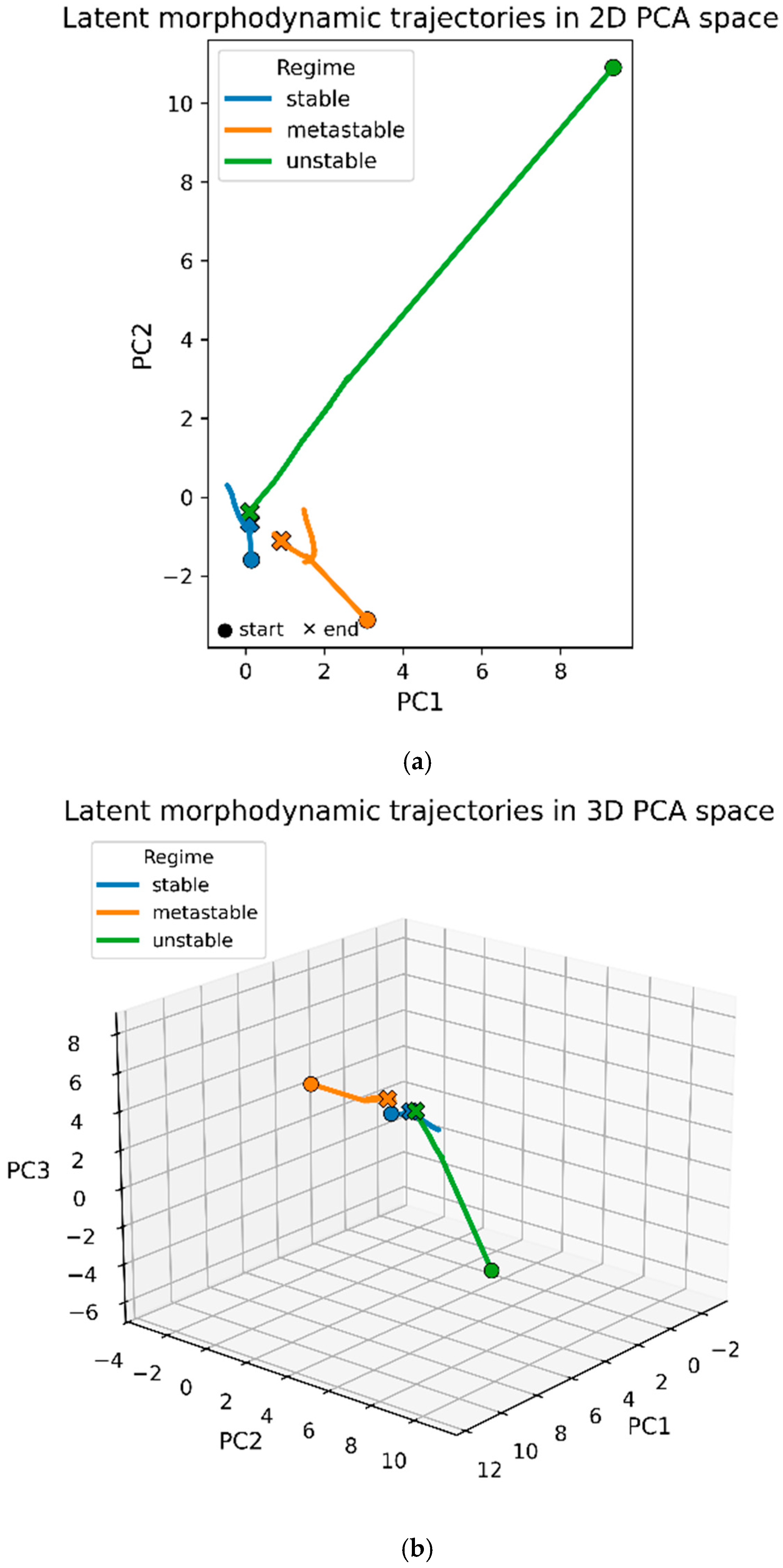
Figure 3 illustrates three representative latent trajectories projected into a globally fitted PCA space.
In the 2D PCA projection (
Figure 3a), trajectories exhibit three characteristic patterns:
Stable trajectories (blue) remain short and tightly localized, reflecting strong contraction toward a small region of the latent space. Their limited spatial extent is consistent with the negative Lyapunov exponents measured for these subjects.
Metastable trajectories (orange) show slightly larger excursions with mild directional drift. They maintain overall coherence but do not converge as strongly as stable trajectories, consistent with λ close to zero.
Unstable trajectories (green) display markedly larger displacement and curvature, extending over a broader region of the PCA manifold. These elongated flows correspond to positive Lyapunov exponents and reflect divergent latent dynamics.
The 3D PCA visualization (
Figure 3b) reveals additional structure in the unstable trajectories, which exhibit smooth monotonic arcs rather than oscillatory loops. Stable and metastable trajectories remain confined to a compact neighborhood around the PCA origin, whereas unstable trajectories extend outward along a dominant latent direction. This separation in trajectory extent, rather than trajectory shape, is the clearest morphological signature distinguishing the three regimes.
Overall, the PCA-projected trajectories confirm the existence of contraction-dominated regions (stable), weakly drifting manifolds (metastable), and divergent flow directions (unstable) in the learned morphodynamic vector field.
3.3. Morphodynamic Phase Space (DF–λ Relationship)
Lyapunov exponents were computed as finite-time divergence rates over
T = 8.0 using an initial perturbation of norm 10
−3, as detailed in
Section 2.6.
Of the 494 subjects, 369 produced valid paired-trajectory simulations for estimating:
Observed values were:
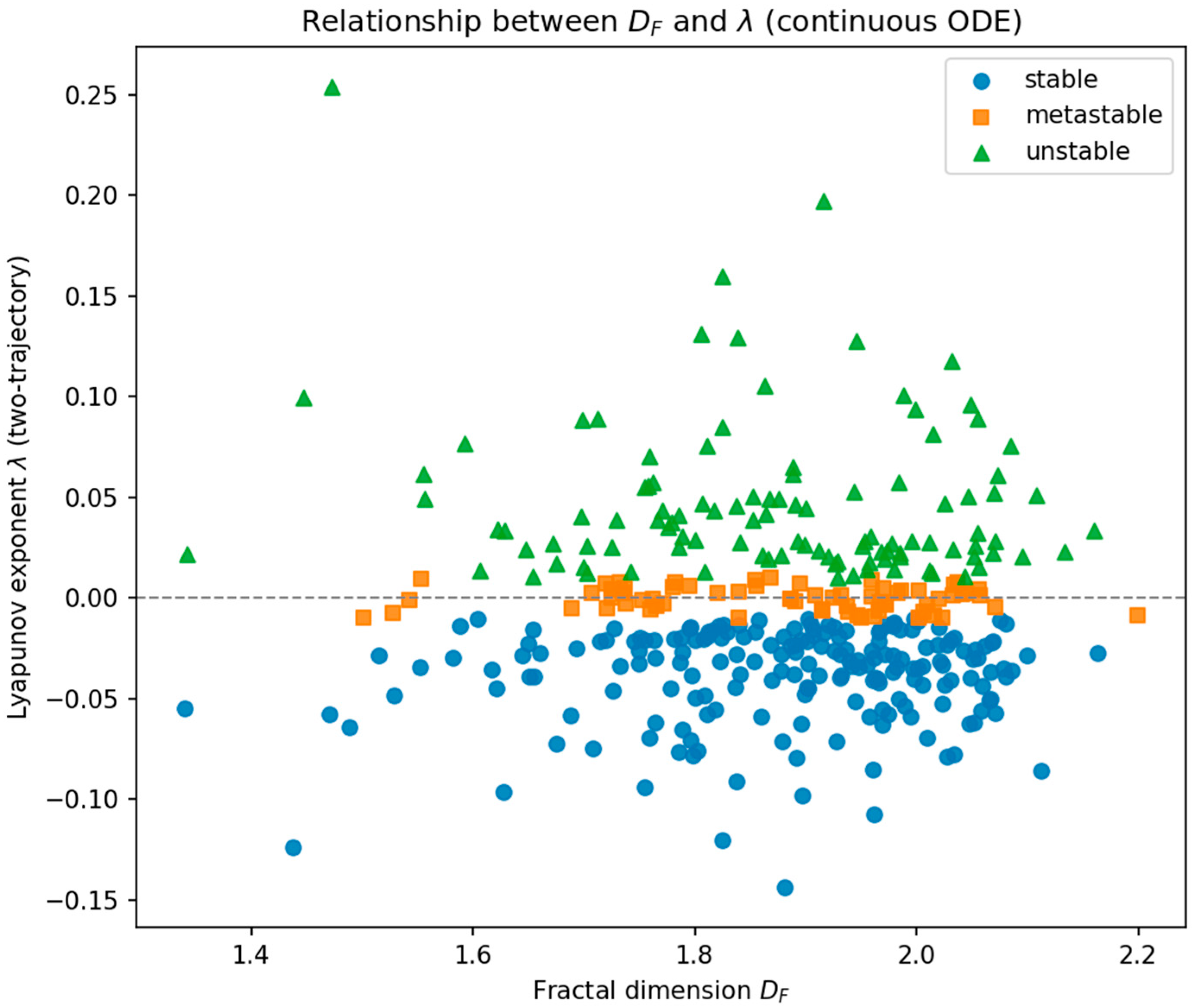
The Pearson correlation between DF and λ was weakly negative (r ≈ −0.13, p ≈ 0.01), indicating that geometric complexity and dynamical stability capture partially independent morphodynamic properties.
Higher DF did not systematically imply higher λ, contrary to expectations from synthetic dynamical systems.
Based on λ, tumors were categorized into three regimes:
Stable (λ < 0): 178/369 (48.2%)
Metastable (λ ≈ 0): 77/369 (20.9%)
Unstable/chaotic (λ > 0): 114/369 (30.9%)
Figure 4 shows the DF–λ scatter plot with tumors color-coded by regime. Regime separation occurs primarily along λ, whereas DF varies more continuously across the cohort.
3.4. Empirical Morphodynamic Density Map (KDE Density)
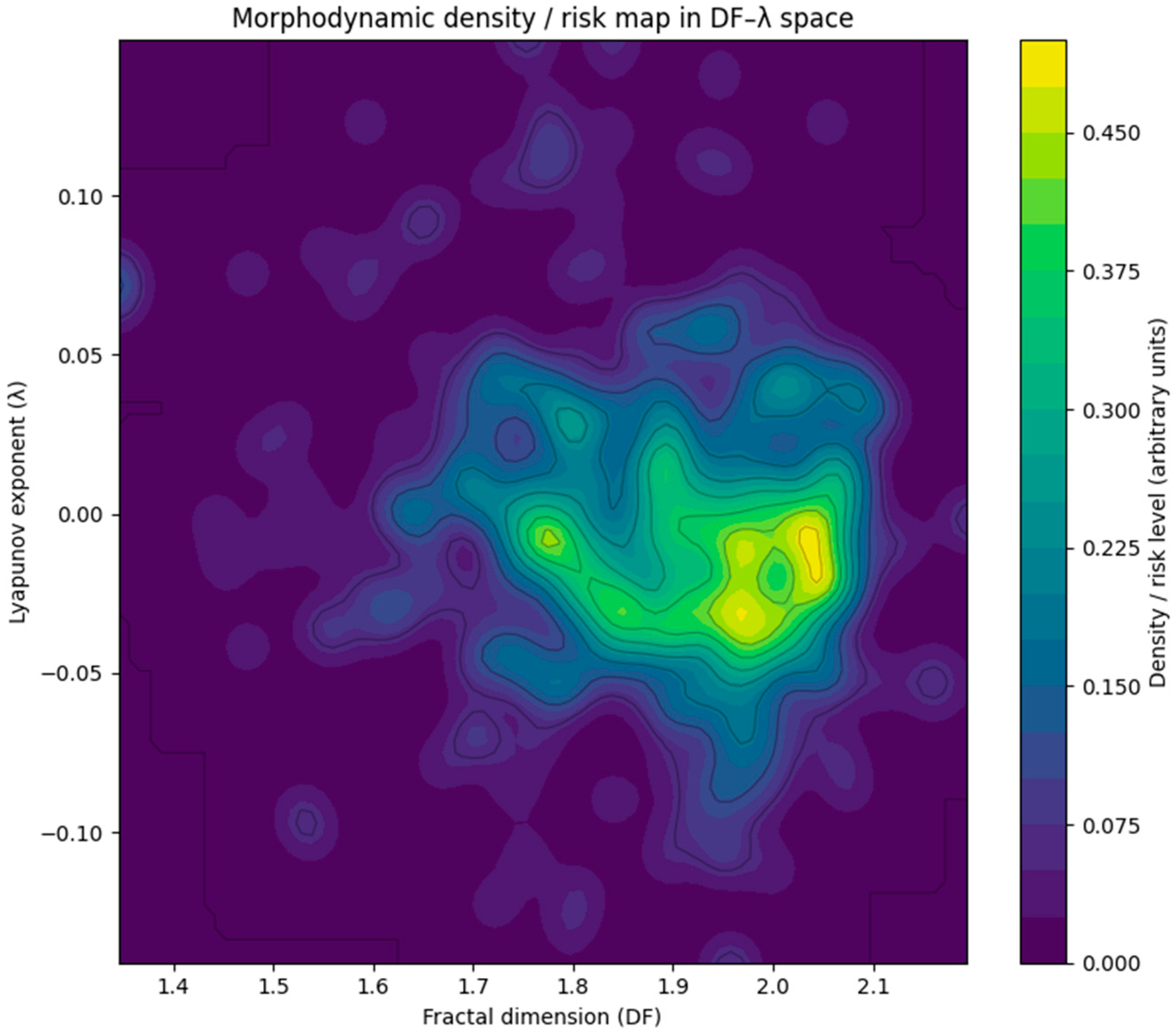
To characterize the population-level distribution of tumors in the DF–λ space, a two-dimensional Gaussian kernel-density estimator (KDE) was computed using all 369 valid subjects.
Figure 5 displays the resulting density map. Warmer colors correspond to regions with higher subject density, representing frequently observed morphodynamic profiles.
A single dominant high-density cluster appears near:
DF ≈ 1.85–2.00
λ ≈ −0.02 to +0.01
This region lies at the center of the metastable regime, indicating that most glioblastomas exhibit moderate-to-high geometric irregularity combined with near-neutral dynamical behavior. Such configurations may reflect morphologies that are heterogeneous yet dynamically balanced, consistent with slowly drifting or quasi-stationary growth patterns.
In contrast, tumors with low DF and strongly negative λ populate a low-density region, corresponding to smoother, strongly stable morphologies. Likewise, tumors with clearly positive λ (unstable dynamics) are relatively rare, forming only sparse density ridges toward the higher-DF range.
Together with the scatter plot (
Figure 4), the KDE map provides a unified structural–dynamical characterization of glioblastoma morphodynamics, revealing that the majority of tumors occupy a narrow band around λ ≈ 0, with DF clustered just below 2.0—suggesting a characteristic metastable morphodynamic phenotype within the population.
3.5. Robustness and Stability Tests (A–C)
We conducted three robustness experiments to evaluate the stability of the DF–λ morphodynamic characterization under controlled perturbations to the synthetic evolution process and the ET segmentation mask. All results below reflect the common subset of subjects for whom complete data were available (n = 369).
A. Multi-Scale Dilation–Erosion Test
Synthetic trajectories generated with structuring-element radii of 1, 2, and 3 voxels exhibited low pairwise correlations between the corresponding raw Lyapunov exponents (r12 = 0.176, r13 = 0.176, r23 = 0.209), confirming that λ estimated per synthetic step is scale-conditioned under changes in morphological perturbation radius. This behavior is expected because larger radii induce larger effective boundary displacements per step, so λ “per step” is not directly comparable across scales.
To enable cross-scale comparison, we computed a deformation-normalized stability index
, where d
r is the mean normalized symmetric difference between successive masks along the radius-r trajectory. After normalization, cross-radius agreement became very high (r
12 = 0.974, r
13 = 0.975, r
23 = 0.988), demonstrating that the instability signal is consistent across radii once deformation step size is controlled (
Supplementary Figure S2). Accordingly, we interpret λ as a scale-conditioned stability index and recommend reporting normalized λ* for cross-scale comparisons.
Despite the scale dependence of raw λ, 38.5% of subjects preserved the same dynamical regime (stable, metastable, or unstable) across all three scales, indicating that categorical regime structure is more stable than absolute λ magnitude.
B. Direction-Reversal Test (directionality; sign-aware comparison)
Reversing the synthetic trajectory order (erosion → dilation) produced a mean absolute Lyapunov difference of ∣Δλ∣ = 0.0436| relative to the forward-trained model. Because λ is direction-conditioned, reversal is not expected to preserve λ or regime labels without accounting for flow orientation. We therefore evaluated sign-aware regime agreement by mirroring the reverse-trained estimate across λ = 0 and comparing regime (λfwd) to regime (−λrev). Under this sign-aware comparison, 44.2% of subjects retained the same regime. Correlation diagnostics further indicated substantial directional dependence, with corr(λfwd, −λrev) = −0.5462 and corr(∣λfwd∣, ∣λrev∣) = −0.1158. Together, these results show that reversal alters the inferred local vector field orientation and thus λ, while a non-trivial fraction of categorical regime structure is preserved after sign handling, supporting interpretation of λ as a direction-conditioned latent stability index rather than a time-reversal-invariant biomarker.
C. Noise Perturbation Test
Random ET-mask voxel flips of 1%, 2%, and 3% were used to simulate segmentation noise. For each noise level, new synthetic trajectories and ODE models were reconstructed. The results are summarized in
Table 1.
1% noise
2% noise
3% noise
Although DF and λ both increase in sensitivity with noise magnitude, the dynamical regime remains stable in approximately 70–73% of cases, even under 3% voxel perturbations. This indicates that regime classification is substantially more robust than the raw metric values and tolerant to plausible segmentation inaccuracies.
Summary. Across all perturbation experiments, raw DF and λ values displayed expected sensitivity to morphological scale and voxel-level noise; direction reversal primarily probes directionality rather than invariance (sign-aware regime agreement reported above). However, the regime classification demonstrated markedly greater resilience—ranging from 38.5% consistency under large-scale perturbations to ~72% under noise perturbations. These results support the view that the DF–λ morphodynamic landscape is structurally coherent and that the extracted dynamical regimes constitute a stable and meaningful descriptor of glioblastoma morphology.
Regime Stability Summary.
Across all perturbation experiments, categorical regime assignments were substantially more stable than the raw λ values. Even when λ varied due to scale, sequence direction, or voxel noise, the stable–metastable–unstable partition preserved clear structure across the cohort. This robustness indicates that the dynamical regimes reflect intrinsic latent-space organization rather than artifacts of a specific synthetic generator.
Cross-Generator Generalization and Negative-Control Validation
Because BraTS provides cross-sectional scans rather than longitudinal follow-up imaging, we performed an additional validation to test whether the learned latent dynamics primarily reflect artifacts of the dilation–erosion generator or whether they capture latent geometric regularities that transfer across deformation families.
For each subject with complete ET masks (n = 369), we constructed three trajectory sets: (i) the baseline bidirectional dilation–erosion (“morph”) trajectories, (ii) an independent signed-distance-field (SDF) perturbation family generated by smooth random fields, and (iii) a time-shuffled morph trajectory as a negative control that preserves the same set of masks but destroys coherent ordering.
We trained two Neural ODE models using identical architecture and solver settings: one model trained on morph trajectories and one model trained on SDF trajectories. We evaluated each trained model on all three trajectory sets using per-subject latent-space trajectory reconstruction MSE (median and IQR across subjects).
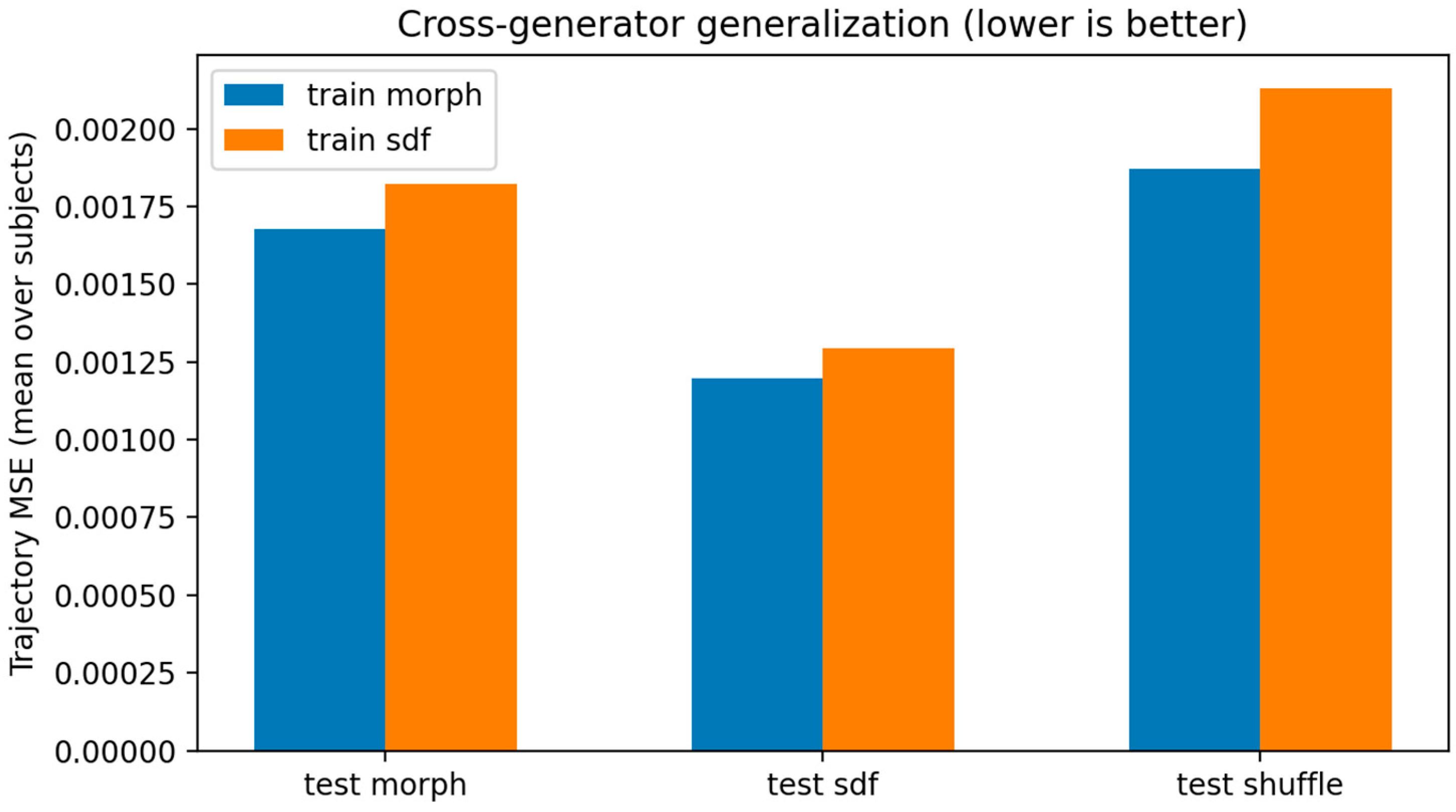
Morph-trained model. The morph-trained ODE achieved lowest error on in-generator morph trajectories (median MSE 0.001510 [IQR 0.001070–0.002086], mean 0.001677). Importantly, it predicted SDF trajectories substantially better than the shuffled control (median 0.001076 [0.000681–0.001534], mean 0.001198 vs. shuffled median 0.001566 [0.001071–0.002363], mean 0.001870). This cross-generator improvement was significant (paired Wilcoxon p = 1.455 × 10−46), with a median per-subject improvement (shuffle − SDF) of 0.000437.
SDF-trained model. The SDF-trained ODE achieved lowest error on in-generator SDF trajectories (median 0.001179 [0.000821–0.001609], mean 0.001295). It also predicted morph trajectories better than shuffled trajectories (median 0.001693 [0.001223–0.002180], mean 0.001821 vs. shuffled median 0.001797 [0.001259–0.002567], mean 0.002131). This improvement was significant (paired Wilcoxon p = 8.601 × 10⁻⁷), with median improvement (shuffle − morph) of 0.000117.
Overall, cross-generator prediction was consistently better than the negative-control shuffle baseline (
Figure 6), indicating that the inferred latent flow is not explained by synthetic ordering alone. However, the magnitude of transfer was asymmetric, suggesting partial generator dependence. We therefore interpret the synthetic trajectories as a morphodynamic probe of latent shape geometry, rather than biological time-resolved tumor progression.
3.6. Exploratory Clinical and Biological Associations
Given the cross-sectional nature of the cohort, these associations are hypothesis-generating and should not be interpreted as evidence of longitudinal progression.
Note on Survival Statistics. Survival times in the BraTS dataset are highly non-Gaussian and partially right-censored. Therefore, Pearson correlations and Kaplan–Meier analyses are used here only as exploratory, descriptive tools. In addition to these descriptive tools, we performed an exploratory Cox proportional-hazards sensitivity analysis using available covariates (age and extent of resection), but clinical interpretation remains limited by incomplete treatment and molecular annotation. All associations reported in this section should thus be interpreted as preliminary descriptive patterns rather than prognostic claims.
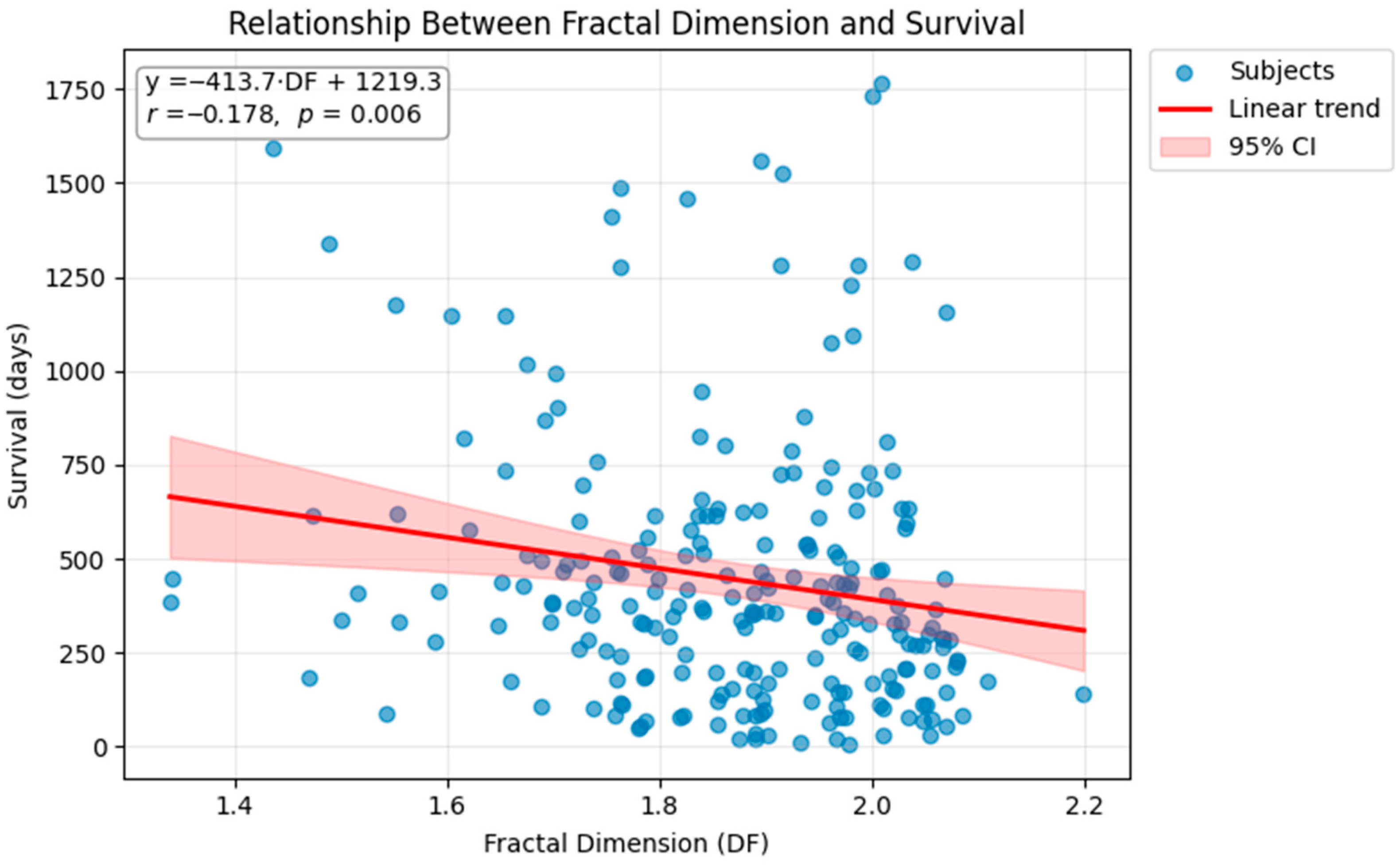
To provide preliminary clinical anchoring for the morphodynamic descriptors, we examined relationships between fractal dimension (DF), Lyapunov-like stability (λ), subject age, and overall survival. Across the cohort, λ showed no meaningful association with age (r = 0.03, p = 0.65) or with survival (r = 0.056, p = 0.387), consistent with its intended interpretation as a latent measure of local dynamical stability rather than a surrogate for demographic or clinical variables. DF exhibited a weak, non-significant positive trend with age (r = 0.11, p = 0.10). In contrast, DF demonstrated a modest negative association with overall survival (r = −0.178, p = 0.006). This unadjusted association should be interpreted as hypothesis-generating only; because key covariates (e.g., treatment, molecular markers, and consistent censoring indicators) are unavailable, we cannot assess whether DF provides independent prognostic information.
Adjusted survival sensitivity analysis. To assess whether the observed DF–survival association persists after adjustment for available confounders, we fit an exploratory Cox proportional-hazards model including age and extent of resection (EOR), together with DF and λ. In univariable Cox analysis, DF was associated with increased hazard (HR per SD = 1.168, 95% CI 1.025–1.331, p = 0.020), whereas λ was not (HR = 0.964, p = 0.580). In the multivariable model (DF + λ + age + EOR), the DF effect attenuated and was no longer significant (HR = 1.116, 95% CI 0.984–1.265, p = 0.087), while age remained strongly associated with hazard (HR = 1.468, p = 6.1 × 10⁻⁸). These results remain exploratory and do not establish independent prognostic utility.
A scatter plot illustrating the DF–survival relationship is shown in
Figure 7, highlighting the modest negative trend and the visually higher density of short-survival cases at higher DF values.
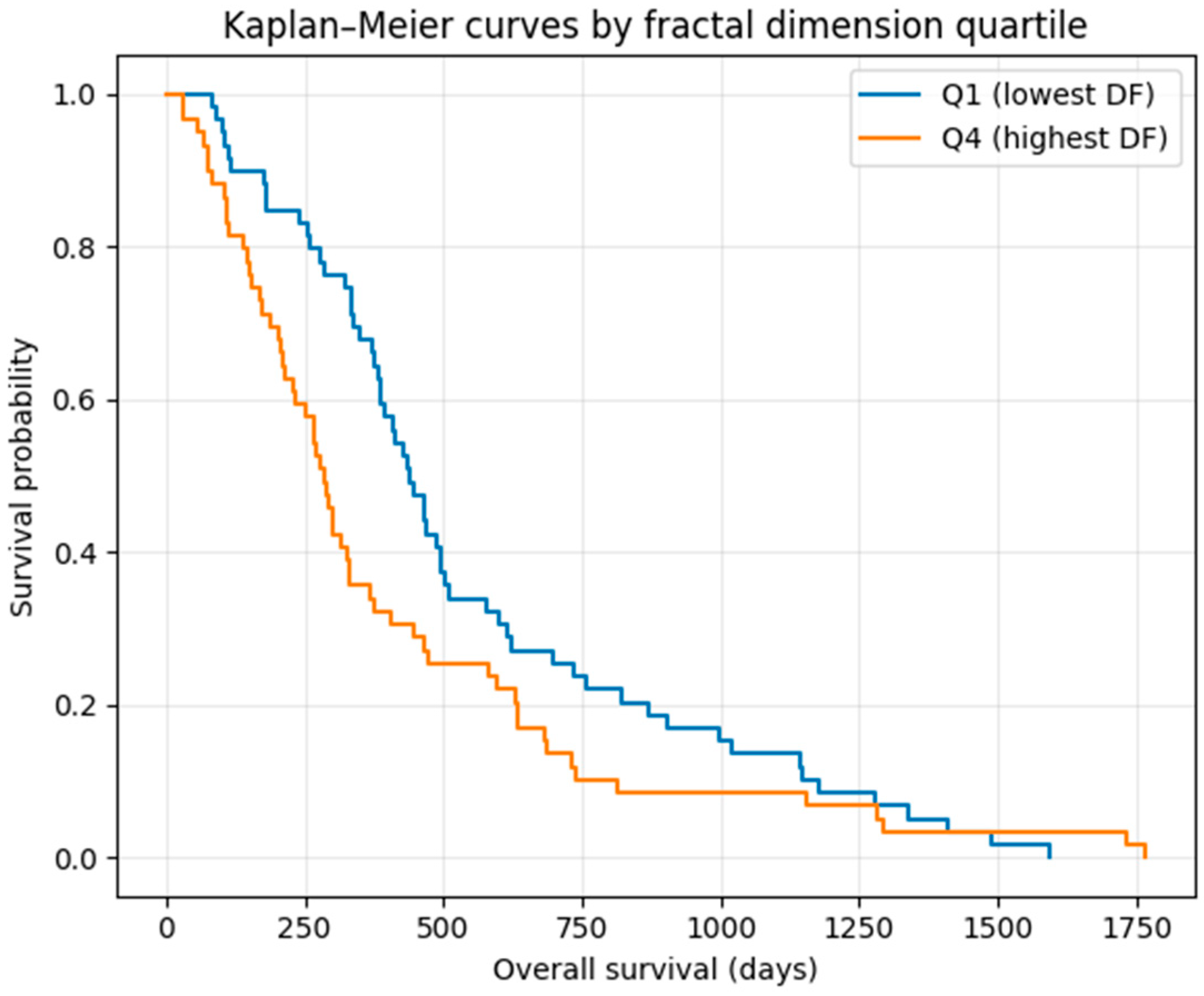
To further contextualize this pattern, we computed Kaplan–Meier curves stratified by DF quartile, focusing on the lowest-DF (Q1) and highest-DF (Q4) groups (
Figure 8). Patients in the lowest-DF quartile (Q1) exhibited the longest median survival (438 days), whereas those in the highest-DF quartile (Q4) showed the shortest median survival (286 days), consistent with the unadjusted DF–survival association observed in this cohort.
The log-rank test showed a trend-level separation between these groups (p ≈ 0.056), consistent with the modest but significant negative correlation between DF and survival in the continuous analysis. These findings suggest a weak, unadjusted association between boundary complexity and survival in this cohort; this observation is descriptive and hypothesis-generating rather than prognostic.
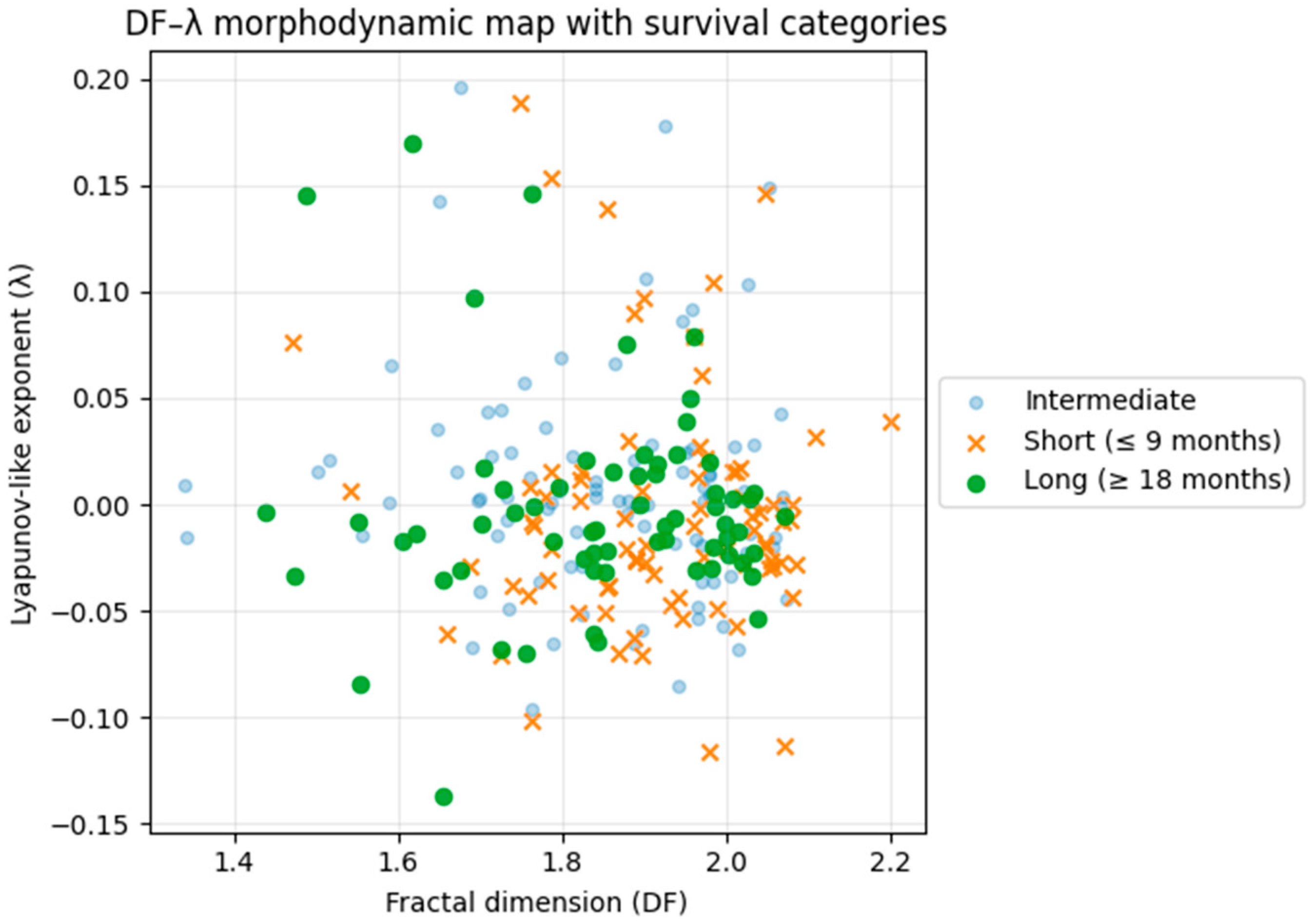
Finally, we projected survival categories onto the DF–λ morphodynamic map (
Figure 9). Short-survival patients (≤9 months) were enriched toward the higher-DF region of the map, whereas long-survival patients (≥18 months) were concentrated in the moderate-DF band near λ ≈ 0. No survival gradient was observed along the λ axis, reinforcing the interpretation that λ encodes latent dynamical stability rather than biological invasiveness. Together, these exploratory overlays suggest that DF is weakly associated with survival in this dataset, while λ shows no survival association. These results do not establish clinical utility or independence from confounders and require validation in covariate-rich cohorts with formal time-to-event modeling.
3.7. Summary of Findings
The 3D autoencoder successfully captured the morphological variability of glioblastoma, generating low-dimensional latent representations that preserved global tumor geometry while smoothing fine-scale irregularities. This was supported by a reconstruction-based fidelity analysis showing strong preservation of DF (corr(DF
true, DF
recon) ≈ 0.96 on the decoder grid;
Supplementary Figure S1).
Neural ODE training with contraction produced continuous latent trajectories that exhibited direction-dependent divergence and attractor-like structure, enabling dynamical characterization of tumor morphology.
The DF–λ morphodynamic phase space separated tumors into stable, metastable, and unstable regimes, indicating that fractal complexity (DF) and latent dynamical stability (λ) form complementary axes of morphological variation.
DF and λ were only weakly negatively correlated, demonstrating that boundary complexity and latent stability reflect largely independent morphodynamic properties.
Kernel density estimation (
Figure 5) revealed that most tumors cluster in a moderate-to-high DF band (≈1.85–2.00) with near-neutral λ (≈−0.02 to +0.01), indicating that the majority of cases reside in a metastable latent regime rather than strongly unstable dynamics.
Exploratory (unadjusted) overlays suggested a small association between DF and survival in BraTS, while λ showed no association; this analysis is descriptive and not evidence of independent prognostic value. DF exhibited a modest negative correlation with overall survival (r = −0.178,
p = 0.006), and Kaplan–Meier analysis (
Figure 9) demonstrated that patients in the highest-DF quartile had shorter median survival than those in the lowest-DF quartile (286 vs. 438 days; trend-level log-rank
p ≈ 0.056).
Cross-generator validation. Neural ODEs trained on dilation–erosion trajectories generalized to independent SDF perturbation trajectories significantly better than a shuffled negative control (paired Wilcoxon p = 1.455 × 10−46), supporting the interpretation of the learned flow as a latent morphodynamic probe rather than an ordering artifact.
The DF–λ survival map (
Figure 9) further illustrated that short-survival patients (≤9 months) are enriched in the high-DF region, whereas long-survival patients (≥18 months) cluster around moderate DF values with near-neutral λ. No visible gradient was observed along the λ axis, reinforcing that λ captures latent dynamical stability rather than prognostic biology.
4. Discussion
This Discussion provides an integrated narrative interpretation of the proposed morphodynamic framework, linking fractal geometry, nonlinear dynamical stability, latent-space learning, and glioblastoma biology. While structured bullet points are used throughout for clarity and readability, each subsection elaborates the physical, mathematical, and biological implications of the results in detail. The Discussion is organized to progress from latent dynamical behavior to fractal boundary interpretation, robustness analysis, clinical context, limitations, and finally broader theoretical and clinical perspectives.
4.1. Morphodynamic Interpretation of Glioblastoma Evolution
The results demonstrate that glioblastoma morphology can be modeled as a nonlinear dynamical system embedded in a continuous latent space. Rather than treating tumor shape as a static radiomic snapshot, the proposed framework interprets morphology as a state evolving along a latent trajectory governed by a learned differential equation.
Within this formulation, the DF–λ phase space (
Figure 3 and
Figure 4) reveals three qualitatively distinct morphodynamic regimes that reflect different degrees of latent stability. Tumors classified as stable (λ < 0) exhibit short, highly contracted trajectories that rapidly converge toward compact regions of the latent manifold, consistent with strong local stability. In contrast, metastable tumors (λ ≈ 0) display modest drift with limited expansion, indicating weakly stable behavior in which trajectories neither converge rapidly nor diverge strongly. Unstable tumors (λ > 0) follow extended, smoothly diverging trajectories that span larger portions of the latent space, a pattern consistent with locally unstable or chaotic morphodynamic evolution.
Contrary to initial expectations, metastable trajectories do not exhibit oscillatory or cyclic behavior. Instead, they differ from stable trajectories primarily in their spatial extent rather than in overall geometric form. This observation is consistent with a latent vector field dominated by contraction around certain regions, coupled with directional divergence in others, rather than by closed or periodic flows.
Although the learned vector field does not contain strict fixed points in the classical dynamical-systems sense, the application of contraction regularization induces attractor-like basins in the latent space. Within these basins, trajectories slow down and cluster, forming regions of recurrent morphological configurations. This behavior suggests that glioblastoma morphology self-organizes into characteristic dynamical states, reflecting underlying constraints on boundary evolution, rather than exploring shape space arbitrarily.
4.2. Fractal and Dynamical Interpretation of Tumor Morphology
Glioblastoma margins exhibit pronounced geometric irregularity driven by infiltrative growth, microenvironmental heterogeneity, and anisotropic migration along white-matter tracts. These processes give rise to statistically self-similar and scale-dependent boundary patterns, which justify the use of fractal geometry as a structural descriptor of tumor morphology. Numerous studies have shown that glioma boundaries display fractal-like organization and that fractal metrics correlate with clinically relevant phenotypes [
28,
29,
30,
31,
32,
33].
4.2.1. Fractal Structure of Glioblastoma Boundaries
MRI and histopathology investigations consistently report that glioblastoma invasion fronts possess fractal scaling properties, including:
fractal border complexity correlating with glioma grade and prognosis [
28,
29],
multifractal heterogeneity reflecting invasive potential [
30],
fractal analysis of MRI-defined regions (enhancing tumor, edema, necrosis) predicting outcome [
31,
32],
fractal morphological markers capturing recurrence risk and infiltrative behavior [
33].
These findings support fractal measures as biologically meaningful indicators of underlying tumor growth mechanisms.
4.2.2. DF as a Fractal Invariant Under Latent Nonlinear Dynamics
Despite the nonlinear nature of the latent-space dynamics learned by the Neural ODE, the fractal dimension (DF) behaves as a quasi-invariant under such transformations due to several properties.
(a) Stability of fractal dimension under Lipschitz mappings
DF is stable under Lipschitz-continuous transformations [
34,
35]. Because the encoder is approximately Lipschitz, boundary complexity is preserved up to small bounded distortion:
(b) Latent flows preserve geometric adjacency
The Neural ODE ensures neighboring shapes in the latent space evolve along similar trajectories. Tumors with similar boundary roughness remain close in latent geometry, preserving relative DF ordering.
(c) Complementary roles of DF and λ
DF encodes the static fractal configuration of the tumor boundary, while λ quantifies the local divergence or contraction of morphological configurations under inferred dynamics. This decomposition parallels fractal evolution models where geometric state and dynamical tendency are distinct.
(d) Empirical evidence through perturbation tests
Noise-perturbation analysis shows DF changes by 5–18% under voxel corruption, but ≈70–73% of subjects maintain their dynamical regime classification, demonstrating DF’s anchoring role in the latent morphodynamic space.
4.2.3. Multifractal Analysis Asan Extension
Tumors often exhibit multifractal behavior where local scaling exponents vary across the boundary. Prior studies demonstrate multifractal spectra in glioma texture and margin heterogeneity [
30,
36], suggesting that generalized dimensions
Dq and singularity spectra
f(
α) could capture subtler variations in infiltration. Incorporating multifractal descriptors into the DF–λ framework may reveal high-order instability patterns not apparent from global DF alone.
4.2.4. Fractal Boundary Evolution and Nonlinear Dynamics
Fractal tumor morphology can be interpreted through the lens of several classical models of nonequilibrium interface growth. Diffusion-Limited Aggregation (DLA) generates highly branched, irregular growth fronts that closely resemble invasive glioma protrusions observed at tumor margins [
37]. Similarly, the Kardar–Parisi–Zhang (KPZ) model of stochastic interface growth captures surface-roughening dynamics analogous to the fluctuating tumor boundary driven by heterogeneous proliferation and microenvironmental noise [
38].
Beyond these models, anomalous and fractional diffusion frameworks have been proposed to explain the superdiffusive migratory behavior of glioma cells, where effective transport exceeds that predicted by classical Brownian motion [
39]. Reaction–diffusion equations incorporating spatially heterogeneous diffusivity further generate complex, fractal-like morphological patterns in brain-tumor simulations, reflecting the coupling between proliferation, invasion, and tissue anisotropy [
10]. In addition, mechanical wrinkling models of tumor–stroma interaction account for corrugated boundaries and multiscale roughness arising from mechanical stress, differential growth, and elastic mismatch between tumor and surrounding tissue [
40].
Taken together, these physical and mathematical frameworks support interpreting fractal dimension (DF) as a quantitative measure of the current geometric complexity of the tumor boundary, while the Lyapunov exponent (λ) captures the local dynamical tendency of morphological configurations to stabilize or diverge under perturbation. Their joint consideration therefore yields a geometric–dynamical signature analogous to the pairing of state and local stability in nonlinear dynamical systems, providing a unified perspective on tumor shape organization and evolution.
4.2.5. Relation to PDE-Based Fractal and Bioheat Tumor Models
Recent studies have investigated tumor complexity using fractal or fractional formulations embedded within partial differential equation (PDE) frameworks, particularly bioheat and reaction–diffusion models. In these approaches, fractal geometry is typically introduced through non-integer spatial dimensions, fractional derivatives, or effective medium parameters to account for heterogeneous heat transport, perfusion, and thermal memory during tumor growth or hyperthermia treatment. The primary outputs of such models are temperature fields, thermal dose distributions, or stability regimes of heat propagation in tumor–tissue systems.
The present work differs fundamentally in scope and modeling philosophy. We do not solve a bioheat or reaction–diffusion PDE, nor do we treat fractal dimension as a parameter within a governing equation. Instead, fractal dimension (DF) is measured directly from MRI-derived tumor morphology as a scale-invariant descriptor of boundary complexity, and is combined with a Lyapunov-like exponent (λ) that characterizes local dynamical stability of inferred latent morphodynamic flows learned from data via a Neural ODE.
Thus, while PDE-based bioheat models focus on physical transport processes (e.g., heat diffusion, perfusion, thermal relaxation) under prescribed boundary and material parameters, our framework focuses on geometric organization and stability of tumor shape evolution in a learned latent space. The two approaches are therefore complementary rather than competing: PDE/bioheat models address how tumors respond thermally to treatment, whereas the present method characterizes how tumor morphology is organized and perturbed under latent morphodynamic dynamics.
Importantly, the imaging-derived fractal dimension used here could, in principle, inform or constrain PDE-based models by providing patient-specific, scale-invariant measures of morphological heterogeneity. Conversely, bioheat or reaction–diffusion simulations could offer mechanistic interpretations for the observed fractal boundary organization. Exploring such couplings represents a promising direction for future multiscale tumor modeling.
4.2.6. Relation to Real-World Glioblastoma Aggressiveness and Morphological Stability
Although the present framework does not model longitudinal tumor growth over biological time, the identified morphodynamic regimes can be meaningfully related to real-world observations of glioblastoma aggressiveness and morphological stability reported in clinical, imaging, and pathological studies. Numerous investigations have shown that glioblastomas with highly irregular, fragmented, and infiltrative margins are associated with diffuse white-matter invasion, early recurrence, treatment resistance, and poorer clinical outcome, whereas more compact and spatially constrained tumors tend to exhibit slower progression and more localized recurrence patterns.
From this perspective, the unstable morphodynamic regime (λ > 0), characterized by high sensitivity of latent trajectories to perturbation, is consistent with tumors whose boundary organization is intrinsically unstable and prone to spatial reconfiguration. This interpretation aligns with imaging and histopathological studies linking irregular margins, non-spherical growth, and increased fractal boundary complexity to aggressive and invasive glioblastoma phenotypes. Conversely, stable morphodynamic regimes (λ < 0), which exhibit contraction toward compact latent configurations, may reflect tumors whose growth is more mechanically constrained or spatially organized.
Particularly noteworthy is the predominance of metastable behavior (λ ≈ 0) across the cohort. Clinically, many glioblastomas display prolonged periods of apparent morphological persistence, punctuated by abrupt spatial expansion or recurrence—often triggered by therapy or microenvironmental changes. The metastable regime observed in latent space is therefore consistent with real-world glioblastoma evolution, in which tumor morphology resides near marginally stable configurations where small perturbations can lead to qualitative changes in growth pattern.
In this sense, the proposed framework characterizes a form of morphological potential rather than realized temporal progression. The learned latent dynamics describe how tumor shape would respond to infinitesimal perturbations, providing a stability-based descriptor that complements established measures of aggressiveness based on growth rate or volume change. Longitudinal clinical evolution, treatment response, and progression can thus be interpreted as macroscopic manifestations of these underlying morphodynamic stability properties, which future studies with time-resolved imaging will be needed to validate directly.
4.3. Biological and Methodological Justification for Synthetic Trajectories and Robustness Analyses
In the absence of longitudinal MRI, we approximate local tumor-shape evolution using synthetic trajectories generated by controlled 3D dilation–erosion of the enhancing tumor (ET) mask. Although synthetic, these trajectories reflect plausible voxel-level morphodynamic behavior of glioblastoma boundaries and provide sufficient geometric variation for learning a continuous latent flow via a Neural ODE. Below we justify this approach and summarize the robustness analyses demonstrating that the derived DF–λ structure reflects intrinsic morphological organization rather than artifacts of a particular operator.
4.3.1. Biological Rationale for Bidirectional Boundary Evolution
Glioblastoma boundaries do not evolve as uniformly expanding spheres. Instead, margins exhibit:
Localized protrusion and retraction, aligned with white-matter anatomy and constrained by surrounding tissue.
Short-timescale non-monotonicity, where some regions thicken while others collapse due to edema, necrosis, or mechanical forces.
Quasi-reversible voxel-scale changes, even when the global tumor burden increases.
Thus, modeling early evolution as bidirectional dilation–erosion captures realistic local behavior: dilation approximates outward infiltration and edema-driven expansion, while erosion reflects local collapse, smoothing, or resolution of irregularities.
4.3.2. Mathematical Justification of Dilation–Erosion Trajectories
From a geometric perspective, dilation and erosion:
Approximate outward and inward normal motion of the tumor boundary, similar to level-set evolution under curvature-driven flows.
Generate a smooth family of admissible deformations, exploring a local neighborhood of the observed shape.
Preserve global topology, allowing systematic variation of boundary complexity.
Applying these operators over 24 steps with stochastic jitter yields a quasi-reversible shape path. The Neural ODE learns the latent vector field that interpolates these transitions—not the operator itself. The trajectory therefore functions as a sampling mechanism of the local geometry of the tumor-shape manifold, supplying the differential information required to estimate λ.
4.3.3. Evidence from Robustness Experiments (Tests A–C)
These analyses demonstrate that the learned DF–λ structure is not tied to a specific synthetic generator, but instead reflects intrinsic latent-space organization.
(A) Multi-Scale Dilation–Erosion
Varying the structuring-element radius (1, 2, 3 voxels) yielded low but non-zero correlations for the raw Lyapunov exponent λ (r
12 = 0.176, r
13 = 0.176, r
23 = 0.209), confirming that λ measured per synthetic step is scale-conditioned under changes in perturbation radius. Because larger radii induce larger effective boundary displacements per step, we additionally report a deformation-normalized index
, where d
r is the mean normalized symmetric difference between successive masks. This normalization produced very high cross-scale agreement (r
12 = 0.974, r
13 = 0.975, r
23 = 0.988;
Supplementary Figure S2), indicating that the underlying instability signal is consistent across radii once deformation step size is controlled.
Yet 38.5% of subjects preserved their dynamical regime (stable/metastable/unstable) across all scales, indicating that regime structure is more stable than absolute λ magnitude.
(B) Direction-Reversal Test
Reversing the synthetic sequence (erosion → dilation) probes directionality of the learned latent flow rather than time-reversal invariance. We trained a second Neural ODE on reversed-order trajectories and compared the resulting λ estimates to the forward-trained model. The mean ∣Δλ∣ was 0.0436. Because λ is direction-conditioned, we evaluated sign-aware regime agreement by mirroring the reverse-trained estimate across λ = 0 and comparing regime (λfwd) to regime (−λrev); under this comparison, 44.2% of subjects retained the same categorical regime. Correlation diagnostics further indicate strong direction dependence (corr(λfwd, −λrev) = −0.5462; corr(∣λfwd∣, ∣λrev∣) = −0.1158). These findings support interpreting λ as a direction-conditioned latent stability index, and all subsequent analyses therefore use a consistent forward convention.
(C) Noise Perturbation Test
Injecting voxel flips of 1–3% into the ET mask simulates segmentation noise:
1%: DF change 5.40%, |Δλ| = 0.0459, 70.5% regime preserved
2%: DF change 12.90%, |Δλ| = 0.1207, 72.6% regime preserved
3%: DF change 17.91%, |Δλ| = 0.1732, 72.6% regime preserved
Even at 3% corruption, regime stability remains ~70–73%, indicating robustness to typical segmentation variability.
4.3.4. Cross-Generator Generalization Supports a “Local Probe” Interpretation (New)
A potential concern is that a Neural ODE trained on dilation–erosion trajectories might primarily learn the synthetic operator rather than latent morphodynamic structure. To test this directly, we performed a cross-generator generalization experiment using an independent deformation family based on signed-distance-field (SDF) perturbations, along with a time-shuffled negative control that destroys coherent ordering while preserving the same set of masks. As summarized in
Figure 6, the morph-trained ODE predicts SDF trajectories substantially better than the shuffled control (median latent-trajectory MSE 0.001076 vs. 0.001566; Wilcoxon
p = 1.455 × 10
−46; median improvement 0.000437), indicating that the learned vector field captures latent geometric regularities that transfer across deformation families rather than merely encoding sequence order. Conversely, an ODE trained on SDF trajectories also predicts morph trajectories better than shuffled trajectories (median 0.001693 vs. 0.001797;
p = 8.601 × 10
−7; median improvement 0.000117), although the transfer effect is smaller. Together, these results support interpreting synthetic trajectories as a local deformation probe of the tumor-shape manifold: while the inferred vector field is partially generator-dependent, it is not explained by the dilation–erosion operator alone.
4.3.5. Interpretation: Synthetic Trajectories as Local Probes of Morphodynamic Structure
Collectively, these findings support interpreting synthetic dilation–erosion trajectories as local probes of the tumor-shape manifold rather than as arbitrary data augmentations. The applied deformations generate structured and biologically interpretable boundary variations that reflect plausible voxel-scale morphodynamic behavior. Importantly, the resulting DF–λ regime structure remains stable across morphological scales, segmentation noise levels, and variations in the deformation operator, indicating that the observed regimes reflect intrinsic latent-space organization rather than artifacts of a specific synthetic generator.
The directional dependence of the Lyapunov exponent further supports this interpretation. The sign and magnitude of λ are consistent with expectations for a boundary undergoing net invasive growth, reinforcing its role as a direction-conditioned latent stability index rather than a symmetric geometric metric. In this setting, the synthetic “time” parameter does not represent biological time but instead parameterizes path length along a local geometric deformation, which is sufficient for estimating finite-time latent stability.
This interpretation is further strengthened by the cross-generator generalization analysis (
Figure 6). A Neural ODE trained on dilation–erosion trajectories predicts signed-distance-field–based trajectories substantially better than a time-shuffled negative control, and vice versa. This transferability indicates that the learned vector field captures latent geometric regularities that generalize beyond a single deformation family. Together, these observations support the view that synthetic trajectories provide a valid and robust substrate for probing local morphodynamic structure in the absence of longitudinal imaging.
4.4. Relation Between Fractal Geometry and Dynamic Instability
The initial hypothesis predicted a positive correlation between geometric irregularity (DF) and dynamic instability (λ). However, the empirical results show only a weak negative correlation, indicating that these two quantities capture independent properties:
A tumor may be highly irregular but dynamically stable (high DF, λ < 0).
Another may be moderately irregular yet dynamically unstable (medium DF, λ > 0).
This confirms that DF measures geometric complexity, whereas λ measures temporal sensitivity of latent morphology.
The combined DF–λ KDE map (
Figure 5) nevertheless reveals coherent population structure: most tumors cluster at moderate-to-high DF (≈1.85–2.00) and near-neutral λ (≈−0.02 to +0.01), indicating a dominant metastable region rather than a metastable–unstable boundary. Stable tumors populate low-divergence, lower-complexity zones, whereas dynamically unstable tumors appear more sparsely at higher λ values. Thus, the DF–λ space provides a richer morphodynamic picture than either metric alone.
Biological interpretation of metastability. Glioblastoma growth is characterized by prolonged periods in which the tumor boundary evolves slowly, maintaining a relatively consistent degree of geometric irregularity despite ongoing cellular turnover. This behavior has been repeatedly observed in longitudinal imaging studies and is consistent with the physical constraints of tumor–tissue interfaces, where proliferation, infiltration, and necrosis interact to produce a heterogeneous yet self-maintained morphology. Prior work on tissue self-organization shows that epithelial and tumor structures often settle into quasi-steady states shaped by mechanical pressure, nutrient gradients, and local curvature effects [
27]. Similarly, the fractal architecture of GBM vasculature and necrotic cores suggests that the tumor boundary does not evolve toward smooth minimal-surface shapes nor toward explosive irregularity, but remains trapped in an intermediate configuration [
28,
29]. This aligns naturally with the metastable regime we observe.
A critical-regime perspective. From a mathematical standpoint, many classical models of interface growth—such as diffusion-limited aggregation, KPZ surface evolution, and anomalous diffusion—possess broad “critical” regimes in which small perturbations neither amplify nor dissipate rapidly. Tumors exhibiting fractal boundaries fall precisely into this intermediate domain between smooth and unstable morphologies. In such systems, the Lyapunov spectrum is typically centered around zero, reflecting the dominance of weakly stable or weakly unstable modes. Our empirical observation that λ clusters near zero is therefore consistent with theoretical expectations for complex, self-organizing interfaces governed by heterogeneous diffusion, infiltration, and mechanical constraint. GBM appears to occupy this critical morphological regime, which mathematically predicts metastability as the most probable steady-state behavior.
Latent dynamical structure. The Neural ODE further reinforces this interpretation. When trained on synthetic trajectories that probe the local geometry of shape space, the learned vector field contains large domains in which the flow neither contracts nor expands strongly. In these regions, perturbations to the boundary encode neither clear smoothing tendencies (stable attractors) nor runaway divergence (unstable trajectories). Instead, the ODE yields trajectories in which the latent state drifts minimally, indicating that the underlying morphological configuration is already near a locally invariant set. This structural property of the learned flow explains why most tumors fall into λ ≈ 0 regions: the latent manifold itself induces metastability as the default dynamical mode.
Integrated interpretation. Together, these biological, mathematical, and dynamical observations suggest that metastability is not an incidental feature but a fundamental property of glioblastoma morphology. Tumors appear to inhabit an intermediate, critical regime where boundary complexity is sustained by competing processes—proliferation, infiltration, necrosis, and mechanical constraint—producing a quasi-steady geometry. The DF–λ map captures this balance directly: real tumors cluster where λ ≈ 0, reflecting the dominance of metastability as the intrinsic morphodynamic state of GBM.
4.5. Attractor Basins and Latent Stability
The compact, convergent trajectories observed in stable and metastable examples (
Figure 3) indicate the presence of quasi-stable attractor basins in the latent space. In these regions, small perturbations decay, causing trajectories to collapse toward characteristic configurations.
In contrast, the long, arcing paths of unstable tumors correspond to repelling regions in the vector field, where perturbations amplify and trajectories diverge.
Together, these structures form a morphodynamic landscape, in which each tumor follows a flow determined by its intrinsic morphology. This landscape provides a conceptual tool for interpreting how tumors might shift between stable and unstable regions under treatment or during progression.
4.6. Integration with Clinical Outcome
Given the limited clinical metadata in BraTS 2020, the following clinical overlays are exploratory and hypothesis-generating, and are not intended to establish prognostic utility. Unstable morphodynamics (λ > 0), characterized by large divergent trajectories, were initially hypothesized to reflect higher biological aggressiveness, whereas stable regimes were expected to correspond to less invasive tumor behavior. The empirical findings, however, indicate a more nuanced picture in which geometric complexity plays a clearer role than latent dynamical instability.
Exploratory associations with available clinical variables provide preliminary biological context for the morphodynamic descriptors. Across the cohort, λ did not correlate meaningfully with age or overall survival, consistent with its role as an intrinsic latent-space dynamical index rather than a direct clinical surrogate. In contrast, fractal dimension exhibited a modest but statistically significant negative correlation with survival (r = −0.178,
p = 0.006), indicating that patients with more geometrically complex tumor boundaries tended to have shorter survival durations. This pattern is further supported by the Kaplan–Meier analysis (
Figure 7), where the highest-DF quartile showed shorter median survival than the lowest-DF quartile (286 vs. 438 days), with a trend-level separation of the curves. Although the effect size is small, we treat this observation as descriptive; assessing independence from confounders and linking DF to biological aggressiveness will require covariate-rich cohorts and multivariable time-to-event modeling.
The DF–λ survival map (
Figure 8) reinforces this dissociation between structural complexity and latent dynamical stability. Short-survival patients (≤9 months) are enriched in the high-DF region of the phase space, whereas long-survival patients (≥18 months) cluster preferentially at moderate DF values with near-neutral λ. No clear survival gradient is observed along the λ axis, suggesting that λ captures latent morphological stability largely orthogonal to conventional clinical risk, while DF encapsulates aspects of morphological aggressiveness that are weakly but consistently reflected in outcome.
Importantly, the absence of a survival association does not diminish the relevance of λ. Unlike DF—which reflects static structural irregularity—λ quantifies latent dynamical stability, a property orthogonal to clinical aggressiveness. The stability of a tumor’s latent trajectory does not necessarily determine current overall survival, but it may influence how a tumor responds to perturbations, treatment, or future morphological evolution. In this sense, λ provides complementary mechanistic information that is not captured by static shape metrics and may prove especially valuable in longitudinal or treatment-response studies, where dynamical sensitivity could track progression trajectories more directly than baseline survival.
These findings are exploratory; unadjusted for multiple comparisons; and limited by the absence of molecular markers, detailed treatment information, and fully curated censoring. They should therefore be interpreted as hypothesis-generating rather than as definitive prognostic validation. Nevertheless, the observed DF–survival trend and its spatial organization within the DF–λ landscape motivate future validation; however, these data do not establish clinical utility or independent prognostic value. Future longitudinal MRI cohorts with richer clinical and molecular annotation will be essential to test whether DF–λ descriptors track treatment response or progression dynamics and whether they add value beyond established clinical indicators in properly adjusted models.
4.7. Computational and Theoretical Implications
This work integrates deep 3D latent encoding of tumor morphology, Neural Ordinary Differential Equation (Neural ODE) modeling of latent morphodynamics, fractal morphometry, and Lyapunov stability analysis into a unified framework. Contraction regularization proved essential for stabilizing the learned latent dynamics: without it, the latent vector field exhibited near-global divergence, whereas enforcing local contraction revealed emergent attractor-like regions in latent space. These regions are consistent with biological processes that maintain partial structural stability despite ongoing growth and remodeling.
Overall, the resulting model establishes a direct link between dynamical systems theory and radiomics by embedding tumor morphology within a differentiable manifold governed by continuous flow dynamics.
4.8. Limitations
This study has several methodological and conceptual limitations that must be acknowledged.
(1) Synthetic time does not correspond to biological time
Because the BraTS 2020 dataset lacks longitudinal MRI, we generated synthetic dilation–erosion trajectories to approximate local morphological evolution. Although these trajectories preserve plausible boundary deformations, their temporal variable is not biological time. To reduce reliance on a single synthetic generator, we additionally performed cross-generator generalization experiments using an independent signed-distance-field (SDF) perturbation family and a time-shuffled negative control (
Figure 6), demonstrating that the learned latent dynamics transfer across deformation families better than shuffled ordering. Nevertheless, clinical translation of any “temporal” interpretation will require true longitudinal datasets. Consequently:
λ quantifies latent divergence, not physical growth rate.
Trajectory length reflects latent-space geometry rather than tumor doubling time.
Clinical translation of λ will require true longitudinal datasets.
(2) Lyapunov exponents estimate latent-space instability, not physical invasiveness
λ measures the sensitivity of latent trajectories to perturbations. This captures local predictability of morphological evolution but does not directly measure:
Thus, λ should be interpreted as a latent dynamical index, not as a direct proxy of biological aggressiveness.
(3) Autoencoder compression can distort fine-scale boundary geometry
Although the 3D autoencoder preserves global tumor shape, it inevitably introduces:
smoothing of sharp boundary features,
compression of small protrusions,
removal of micro-irregularities that may be clinically relevant,
local discontinuities in latent space for atypical shapes.
These distortions may affect both DF and λ, especially for highly irregular or fragmented tumors.
To quantify this potential distortion, we performed a reconstruction-based morphometric fidelity test on the decoder grid (49 × 49 × 49), comparing DF computed on the resampled ET mask to DF computed on a volume-matched reconstructed ET mask derived from the decoder ET channel. DF was strongly preserved across cases with non-empty ET masks (corr(DF
true, DF
recon) = 0.9568;
Supplementary Figure S1), indicating that the latent representation retains the global boundary-complexity statistic used in the DF–λ analysis, even though fine-scale voxel-level geometry may be smoothed.
(4) Dependence on morphological scale
The robustness analyses show that λ varies with the scale of boundary perturbation (structuring-element radius 1–3 voxels). This reflects a fundamental property of morphological flows:
local instability is scale-dependent,
fractal boundaries behave differently under coarse vs. fine perturbations.
Regime classification is more stable than λ itself, but the absolute λ values should be interpreted with scale-specific caution.
To support cross-scale comparisons, we therefore also report deformation-normalized λ (and latent-arc-length normalized variants), which show strong agreement across radii once the deformation step size is accounted for.
(5) Direction sensitivity of the Neural ODE
The system exhibits direction dependence: reversing the synthetic trajectory alters λ for most subjects. This is expected for ODE flows, but it means:
λ is tied to the assumed forward growth direction,
metastable vs. unstable regimes depend on consistent ordering,
different synthetic evolution models may yield different λ magnitudes.
This is not a flaw but a reminder that latent dynamics are directional constructs.
Consistent with this, cross-generator tests indicate that the learned flow contains both transferable geometric structure and generator-dependent components (
Figure 6); therefore λ should be interpreted as a model-based latent stability index conditioned on the assumed deformation family and ordering.
(6) Absence of fully matched tumor volumes and limited metadata
Although we reconstructed ET, WT, and edema volumes for 494 cases, not all could be aligned perfectly with DF–λ entries due to missing or inconsistent IDs. Survival data were available but minimal, and:
no molecular markers (IDH, MGMT) were provided,
no treatment-response trajectories exist,
resection status has limited resolution (GTR/STR/NA).
Thus, clinical correlations are exploratory and underpowered.
(7) Lack of validation beyond the BraTS 2020 standardized cohort
Although BraTS 2020 provides a large multi-scanner, multi-center dataset with substantial heterogeneity, it is also extensively preprocessed and harmonized, including skull-stripping, co-registration, and fixed voxel spacing. As a result, the method has not yet been tested on:
raw clinical MRI from routine hospital pipelines,
non-harmonized multi-center datasets,
or external cohorts with different preprocessing workflows.
Furthermore, BraTS contains no longitudinal scans. Validation on prospective, real-time MRI follow-up studies is required to determine whether the latent dynamical descriptors generalize to clinical environments and capture temporal tumor behavior.
(8) The Neural ODE vector field may oversimplify biological reality
The ODE learns a smooth, differentiable flow. Real glioblastoma evolution is:
Thus the learned flow represents an effective latent dynamical model, not a full biological simulator.
(9) Domain shift and preprocessing dependence (BraTS harmonization).
The proposed framework was developed and evaluated on BraTS 2020, which is a multi-center dataset but is also extensively preprocessed and harmonized (e.g., skull stripping, co-registration, and standardized voxel spacing). As a result, the current study does not establish performance or stability of DF–λ descriptors under raw clinical MRI variability (scanner vendor/field strength, protocol differences, intensity scaling, motion artifacts) or under alternative preprocessing pipelines. External validation on non-harmonized cohorts is therefore required before clinical deployment, and the present results should be interpreted as methodological validation on a standardized benchmark rather than a demonstration of ready-to-use clinical generalization. In future work, this limitation can be addressed by incorporating domain-shift augmentation (bias fields, noise, resolution/contrast changes), intensity harmonization/standardization, and lightweight domain adaptation in latent space (e.g., limited target-site fine-tuning or feature alignment) to reduce site- and protocol-specific effects.
4.9. Perspectives and Future Work
Future directions include:
modeling true temporal evolution from longitudinal MRIs
linking morphodynamic regimes with molecular subtypes and histopathology
developing hybrid PDE–neural ODE models
evaluating DF–λ morphodynamics as a candidate descriptor for treatment-response monitoring once longitudinal imaging and treatment covariates are available
These steps aim to transform radiomics from static to dynamical modeling.
Practical routes to clinical generalization. To improve robustness to site- and protocol-dependent variability, future work will evaluate (i) intensity normalization strategies tailored to raw MRI (e.g., robust z-scoring, histogram standardization, or learned normalization), (ii) harmonization and domain adaptation approaches (e.g., feature alignment in latent space, adversarial domain adaptation, or fine-tuning the autoencoder/ODE on a small target-site subset), and (iii) augmentation that explicitly simulates clinical domain shift (bias fields, noise, resolution changes, and contrast variations). Because the pipeline relies on tumor masks, robustness to segmentation domain shift can also be improved by training/validating the segmentation stage across sites and propagating segmentation uncertainty into DF–λ estimation.
4.10. Summary
This study introduces a latent morphodynamic framework that links fractal geometry (DF), Lyapunov stability (λ), and deep latent dynamics learned from MRI data. Although DF and λ are only weakly correlated, their joint distribution reveals coherent morphodynamic regimes—stable, metastable, and unstable—emerging from nonlinear latent evolution. The population morphodynamic map (
Figure 5) shows that glioblastoma morphology occupies characteristic regions of the DF–λ phase space, indicating that tumor shape is influenced by underlying dynamical constraints rather than random variability. Robustness analyses further confirmed that regime structure is reproducible under multi-scale and noise perturbations, with scale-normalized λ enabling consistent cross-radius comparison, while direction-reversal primarily probes directionality of λ and is therefore evaluated using sign-aware comparisons.
Exploratory, unadjusted overlays suggested a modest association between fractal dimension and survival in this dataset, whereas λ showed no survival association. Patients in the highest-DF quartile exhibited shorter median survival than those in the lowest-DF quartile, and short-survival cases localized predominantly to the high-DF region of the DF–λ map. These results suggest that DF captures aspects of morphological variation that correlate with survival in BraTS, while λ represents an orthogonal dimension of latent dynamical stability; establishing clinical relevance or independence requires multivariable survival modeling and external validation.
Together, these findings suggest that glioblastoma morphology reflects implicit morphodynamic laws that can be quantitatively characterized. This opens the door to predictive morphodynamics and dynamical-systems–based radiomics, with clinical translation contingent on longitudinal validation and appropriately adjusted outcome modeling.
4.11. Comparison with Prior Work
Prior research on glioblastoma morphology has largely relied on static radiomic descriptors, including intensity statistics, Haralick textures, wavelet features, and shape metrics derived from single time-point MRI scans [
6,
7,
8,
9]. These approaches have provided important biomarkers for prognosis and treatment monitoring but fundamentally treat tumor morphology as a static entity rather than the result of a dynamical process.
Fractal morphology studies have quantified tumor boundary heterogeneity via fractal dimension, linking higher geometric complexity to increased malignancy, edema spread, and infiltrative potential [
25,
26,
27]. However, fractal analyses remain static and do not describe how morphological complexity evolves over time.
In parallel, mechanistic tumor-growth models, including reaction–diffusion PDEs and biomechanical growth models, have provided biologically grounded descriptions of proliferation, invasion, and mass effect [
10,
11,
12]. While these models capture key biophysical principles, they require strong anatomical and kinetic assumptions and are not optimized to learned high-dimensional representations of real imaging data.
Deep learning has recently introduced autoencoders, VAEs, and GANs for tumor segmentation and radiomics feature extraction [
20,
21,
22], but these models are not inherently dynamical: they encode morphology, but they do not model morphological change.
Only a few studies have analyzed glioma evolution using imaging time series, but these rely on true longitudinal MRI, which remains scarce in public datasets and typically model time as discrete snapshots rather than a continuous flow field.
Distinct Advances of the Present Work
The framework introduced here departs significantly from existing literature in several key aspects:
We treat glioblastoma morphology as a continuous nonlinear dynamical system governed by an ODE in latent space—an approach not previously applied to GBM imaging. Traditional radiomics and fractal studies operate solely on single time points.
- 2.
Temporal modeling without longitudinal MRI
Unlike prior temporal glioma studies requiring repeated scans, we introduce bidirectional morphological transformations to simulate plausible continuous morphological trajectories for every subject, enabling dynamic modeling even when real longitudinal data are absent.
- 3.
Joint dynamical–geometric quantification (λ + DF)
Prior work studies fractal complexity OR local instability, but not both.
Here, fractal dimension (DF) quantifies geometric irregularity, while the Lyapunov exponent (λ) quantifies dynamical predictability. Their joint DF–λ morphodynamic phase space is, to our knowledge, the first attempt to map glioblastoma morphology using both structural and dynamical descriptors.
- 4.
Emergent attractor-like behavior from learned latent flows
Mechanistic PDE models impose fixed points or attractors through mathematical assumptions. Our approach discovers attractor-like latent basins directly from data through contractive Neural ODE learning—representing a novel link between deep learning and nonlinear tumor dynamics.
Overall, this framework shifts the field from static shape descriptors and handcrafted dynamical models toward a fully data-driven, continuous-time morphodynamic formulation of glioblastoma.
A structured comparison between prior approaches and the proposed morphodynamic framework is summarized in
Table 2.
5. Conclusions
This work presents a framework for modeling glioblastoma morphology as a continuous nonlinear dynamical system. By integrating 3D convolutional autoencoders, Neural Ordinary Differential Equations (Neural ODEs), and fractal morphometry, we introduce a computational approach for characterizing morphodynamic structure directly from MRI-derived tumor geometry.
Using 494 subjects from the multi-institutional BraTS 2020 dataset, each tumor was embedded into a 16-dimensional latent space representing volumetric geometry and structural heterogeneity. Synthetic morphological sequences—constructed through bidirectional 3D dilation–erosion transformations—enabled the training of Neural ODEs to learn continuous latent flows as a local deformation probe of the shape manifold, despite the absence of longitudinal imaging. The resulting contraction-regularized vector fields produced coherent, convergent flow patterns, giving rise to quasi-stable configurations suggestive of attractor-like behavior within the learned morphodynamic landscape.
Two complementary quantitative descriptors were derived for each subject: the fractal dimension (DF), capturing geometric irregularity, and a Lyapunov-like exponent (λ), measuring local dynamical stability in latent space. Their joint distribution formed a morphodynamic phase space with three interpretable regimes:
Stable (λ < 0)—compact trajectories and smoother boundaries, indicating strong latent stability;
Metastable (λ ≈ 0)—limited drift with weakly stable or transitional behavior;
Unstable/chaotic (λ > 0)—divergent trajectories associated with higher morphological variability.
The DF–λ scatter plot and kernel-density morphodynamic map demonstrated that DF and λ encode partially independent features: complexity of boundary geometry and predictability of latent evolution. Although irregular tumors often occupied metastable or unstable regimes, the correlation between DF and λ was weak, suggesting that complexity alone does not dictate dynamical instability. Population density concentrated predominantly in the metastable region (DF ≈ 1.85–2.00 and λ ≈ −0.02 to +0.01), indicating that many glioblastomas share a characteristic morphodynamic phenotype defined by moderate-to-high geometric complexity and near-neutral latent stability.
Exploratory, unadjusted analyses suggested that DF is modestly associated with overall survival in this dataset, whereas λ shows no survival association. These observations are hypothesis-generating only and do not establish prognostic utility or independence from confounders; validation in covariate-rich cohorts with formal time-to-event modeling is required.
Importantly, robustness experiments showed that regime-level structure is reproducible under multi-scale perturbations, direction reversal, and stochastic segmentation noise. In addition, cross-generator generalization experiments (
Figure 6) demonstrated that Neural ODE dynamics trained on one deformation family transfer significantly better to an independent deformation family than to a time-shuffled negative control, supporting the interpretation that the inferred latent flows are not explained by sequence ordering alone.
Beyond radiomic interpretation, this work bridges fractal morphogenesis, nonlinear dynamics, and deep generative modeling. It shows that static MRI-derived tumor geometry can be used to infer latent stability patterns and attractor-like tendencies within the learned morphodynamic representation. However, because BraTS is cross-sectional and the synthetic step index does not represent biological time, clinical translation of λ as a progression-related marker requires validation on true longitudinal MRI cohorts and external clinical datasets.
In summary, the proposed morphodynamic framework offers a mathematically grounded, data-driven approach for exploring glioblastoma morphology. By jointly assessing geometric complexity and latent dynamical stability through the DF–λ map, it opens avenues for dynamic radiomics and morphodynamic characterization. Clinical applications (e.g., prognostic stratification or therapy monitoring) should be considered in future work contingent on longitudinal validation, external cohorts, and appropriately adjusted outcome modeling.




 ,
,