


Developing Comprehensive e-Game Design Guidelines to Support Children with Language Delay: A Step-by-Step Approach with Initial Validation


Abstract
1. Introduction
- Simple to follow and understand for designers, developers, and evaluators.
- Suitable for all users, especially children with linguistic delays.
- Specialized in designing and evaluating e-Games that support language development and incorporate diverse interactive game and therapy features to enhance learning and engagement.
2. Background Information and Related Work
2.1. Usability and Guidelines
- Visibility of system status.
- Similarity between the system and the real world.
- User control and freedom.
- Consistency and standards.
- Error prevention.
- Recognition rather than recall.
- Flexibility and efficiency of use.
- Aesthetic and minimalist design.
- Help users recognize and recover from errors.
- Help and documentation.
- Usability/playability.
- Narratives.
- Play engrossment.
- Enjoyment.
- Creative freedom.
- Audio aesthetics.
- Personal gratification.
- Social connectivity.
- Visual aesthetics.
2.2. Developing New Usability Guidelines
- Exploratory stage: gathering information from previous research about the application domain for which a new set of heuristics will be created, the application’s features and attributes.
- Descriptive Stage: highlighting the most important information collected from the previous stage to formulate the main concepts of the research.
- Correlational stage: identify specific features of the application that require evaluation using usability heuristics.
- Selection stage: determine the process used for each guideline. Using the existing heuristics collected, you have the option to retain, modify, or remove the heuristics, or develop new guidelines.
- Specification stage: formally define the new set of proposed guidelines using a standard template.
- Validation stage: validation of the guideline set through multiple experiments.
- Refinement stage: after obtaining feedback from the previous phase, the new set of guidelines is improved.
Validating Usability Guidelines
- Guideline evaluation: to check the proposed guidelines against traditional or specialized guidelines in terms of the number of usability issues detected (as recommended by Quinones).
- Expert judgment: use a questionnaire that assesses the perceptions and opinions of evaluators and experts of the proposed usability guidelines (to obtain additional feedback).
- User testing: to obtain user opinions about a set of usability guidelines (to receive additional feedback).
3. Materials and Methods
3.1. Developing eGLD
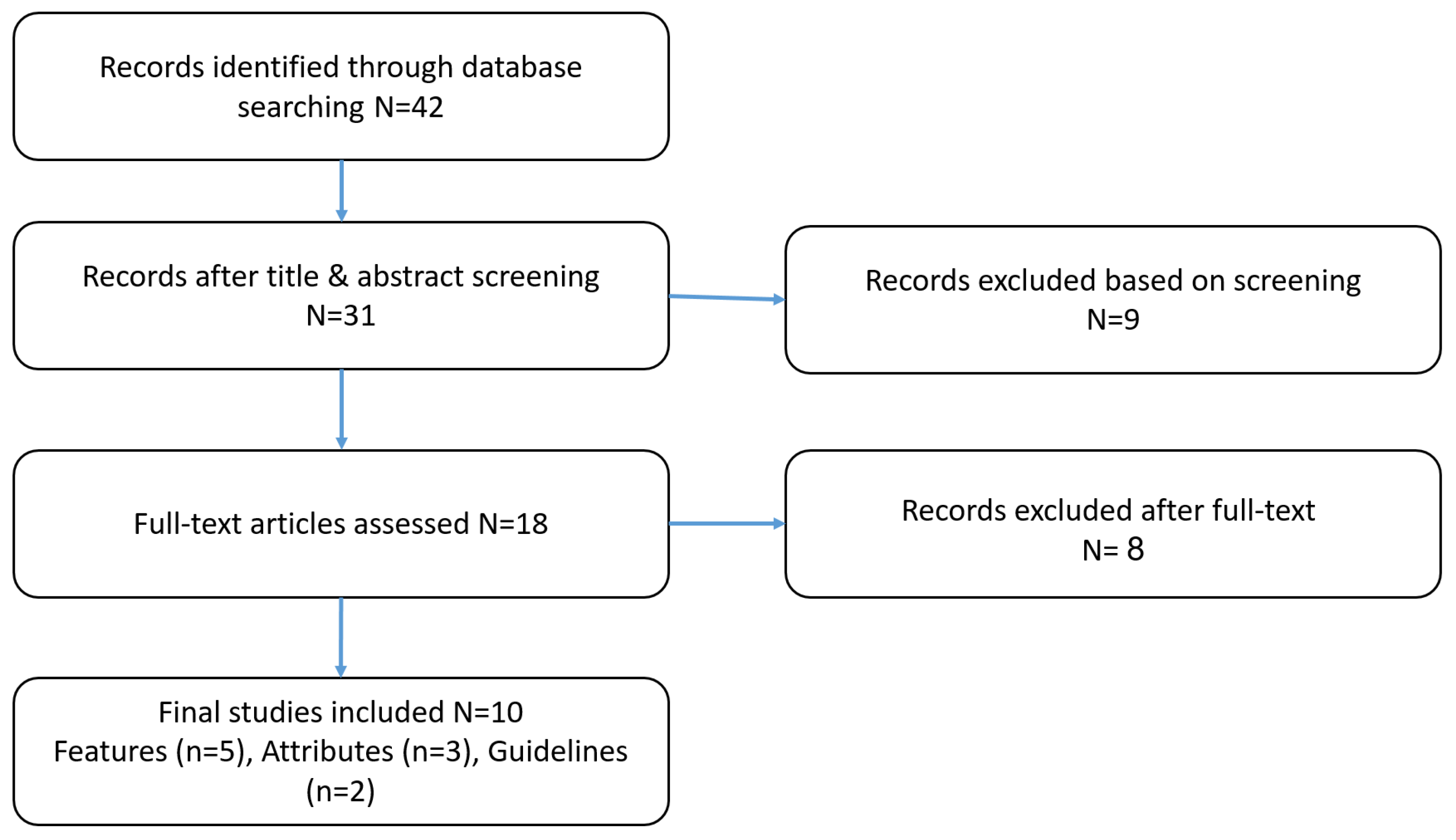
3.1.1. Stage 1: Exploratory Stage
- For features: (“e-Games” OR “mobile game”) AND “features”;
- For attributes: (“e-Games” OR “mobile game”) AND “usability attributes”;
- Guidelines and recommendations: (“e-Games” OR “mobile game”) AND (“usability guidelines” OR “usability principles”).
- Usability attributes: Attributes are the criteria used to evaluate the quality of mobile applications during usability testing, using specific usability metrics. Which include:
- –
- Nielsen’s attributes: learnability, efficiency, memorability, errors and satisfaction [28].
- –
- ISO attributes: effectiveness, efficiency, and satisfaction) [29].
- –
- PACMAD (People At the Centre of Mobile Application Development) attributes: combine elements from both ISO and Nielsen usability models, while also adding the cognitive load aspect. These attributes include effectiveness, efficiency, learnability, memorability, errors, satisfaction, and cognitive load [30].
- Usability guidelines: These serve as the basic principles, and include:
3.1.2. Stage 2: Descriptive Stage
- For features: We collected all the features from [10,24,25,26,27]. We added four language delay-specific features, combining them with the existing ones to create a comprehensive list of 28 integrated features, as shown below:
- Identification with the game [10].
- Interface design [10].
- Layout [10].
- Demonstrations [10].
- Personalization [10].
- Social interaction [10].
- Mobility [10].
- Time management/restriction [10].
- Repetition and rehearsal of skills [10].
- Motor skill [10].
- Cognitive development [10].
- Speech recognition [24].
- Emotional attachment [24].
- Animation and engaging graphics [25].
- Background music and sound effects [25].
- Story or theme [26].
- Show progress [26].
- Provides badges for achievements [26].
- Provides clear goals [26].
- Gradual language complexity.
- Review of previous words.
- Play-based therapy.
- Syntax and sentence formation.
- Usability attributes: We focused exclusively on attributes defined by PACMAD attributes [30]. Below are the definitions of each attribute [30].
- –
- Effectiveness: the capacity to accomplish the intended results.
- –
- Efficiency: minimizing wasted time, effort, money, and resources.
- –
- Satisfaction: meeting the user’s expectations and making them feel fulfilled.
- –
- Learnability: how quickly and easily users can figure out how to use the app.
- –
- Memorability: how well users can remember how to use the app after not using it for a while.
- –
- Errors: reducing the user’s error rate when using the program.
- –
- Cognitive load: the capacity to operate a mobile application while carrying out daily tasks.
- For usability guidelines: We divided the relevant research into two categories: main guidelines, which will serve as the basic principles for the next stages, and checklist items, which will customize the main guidelines more particularly to e-Games for children with language delay.
- –
- –
- Checklist items: we selected all the checklists for designing e-Games for children with language delays [10].
3.1.3. Stage 3: Correlational Stage
- Nielsen: N1—Visibility of system status; N2—Similarity between the system and the real world; N3—User control and freedom; N4—Consistency and standards; N5—Error prevention; N6—Recognition rather than recall; N7—Flexibility and efficiency of use; N8—Aesthetic and minimalist design; N9—Help users recognize and recover from errors; N10—Help and documentation.
- GUESS: G1—Usability/Reproduction; G2—Narratives; G3—Playing involvement; G4—Pleasure; G5—Creative freedom; G6—Audio aesthetics; G7—Personal gratification; G8—Social connectivity; G9—Visual aesthetics.
- Attributes:
- –
- Cognitive load: to determine if the game adapts its level of difficulty to the player’s skill level, making sure it is neither too easy nor too challenging.
- –
- Satisfaction: to gauge how gratifying and pleasurable the gaming is when the difficulties are suitably distributed.
- Guidelines:
- –
- Similarity between the system and the real world (N2) in Nielsen: guarantees that the game’s complexity and substance are in line with user comprehension and real-world expectations.
- –
- Help users recognize recover from errors (N9): when players are having trouble, the game may gently adapt or provide guidance, turning challenging situations into teaching opportunities rather than frustrating ones.
- –
- Play engrossment (G7), creative freedom (G5), and playing involvement (G3) in GUESS: adaptive gameplay keeps players deeply engaged throughout the game, boosts user motivation, and enables them to make meaningful decisions.
3.1.4. Stage 4: Selection Stage
- Keep: since the guideline was already in accordance with the desired qualities, it was kept exactly as is.
- Adapt: to properly represent the context of e-Game usability, the checklist elements in the guideline were expanded or improved.
- Eliminate: because the guideline was redundant or irrelevant to the target domain, it was eliminated.
- Create: to assess a feature not addressed by the previous rules, a new guideline was developed.
3.1.5. Stage 5: Specification Stage
- eGLD1: Visibility of system status.
- eGLD2: Similarity between the system and the real world.
- eGLD3: User control and freedom.
- eGLD4: Consistent and minimalist design.
- eGLD5: Minimize and manage errors.
- eGLD6: Recognition rather than recall.
- eGLD7: Flexibility and efficiency of use.
- eGLD8: Help and documentation.
- eGLD9: Playing involvement.
- eGLD10: Pleasure.
- eGLD11: Creative freedom
- eGLD12: Audio aesthetics.
- eGLD13: Personal gratification.
- eGLD14: Social connectivity.
- eGLD15: Gradual language complexity.
- eGLD16: Interactive feedback.
- eGLD17: Play-based engagement.
- eGLD18: Words review and sentence formation.
- eGLD19: Repetition and rehearsal of skills.
3.2. Validating eGLD
Stage 6: Validation Stage
- Experiment design
- –
- Participants: The evaluation was carried out by two of the researchers who worked on this study. The first one, Mrs. Noha Badkook, is a master’s student at the Faculty of Computing and Information Technology (FCIT) at King Abdulaziz University. She has a moderate level of experience with usability testing. The second evaluator is Dr. Duaa Sinnari, an assistant professor in FCIT at King Abdulaziz University, and she has high experience in usability testing and human–computer interaction (HCI).
- –
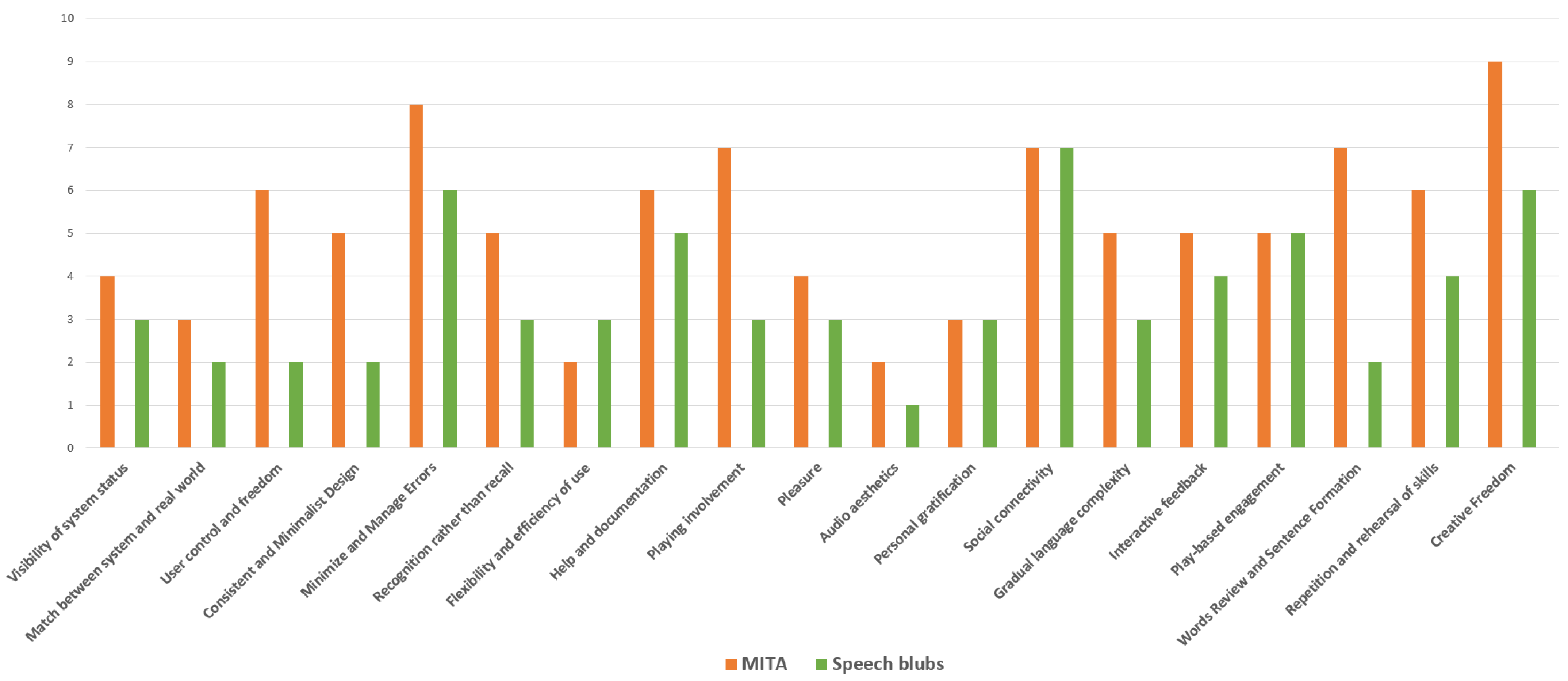
- Guidelines: Three different sets of guidelines were tested. The first one, eGLD, is a detailed set of 19 usability guidelines that includes 130 checklist items specifically created for apps designed to help with language delay. The second set, Nielsen’s guidelines, is a well-known group of 10 general usability guidelines aimed at improving how apps are designed and used. Lastly, GUESS includes 9 guidelines that focus on evaluating games, especially how engaging and visually appealing they are.
- –
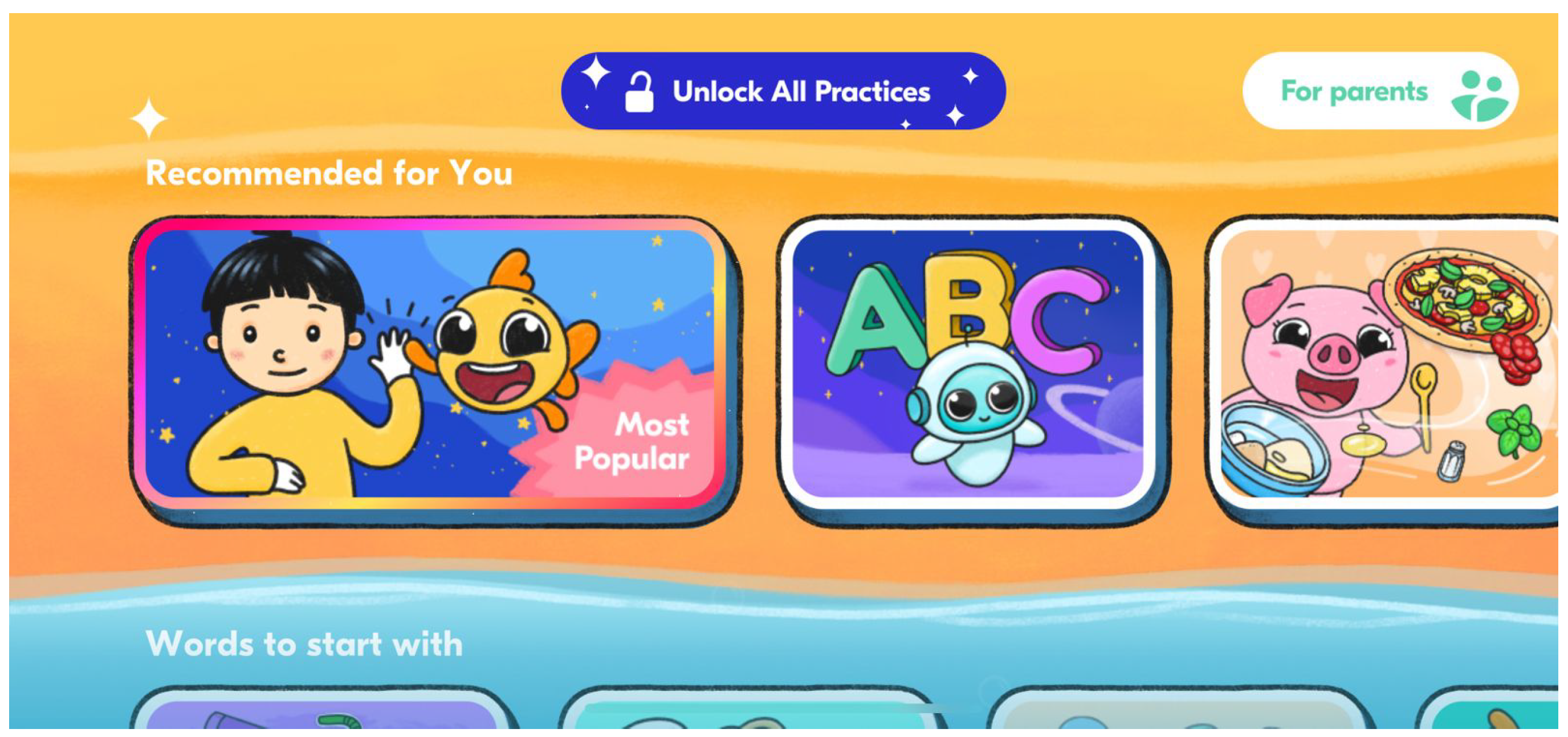
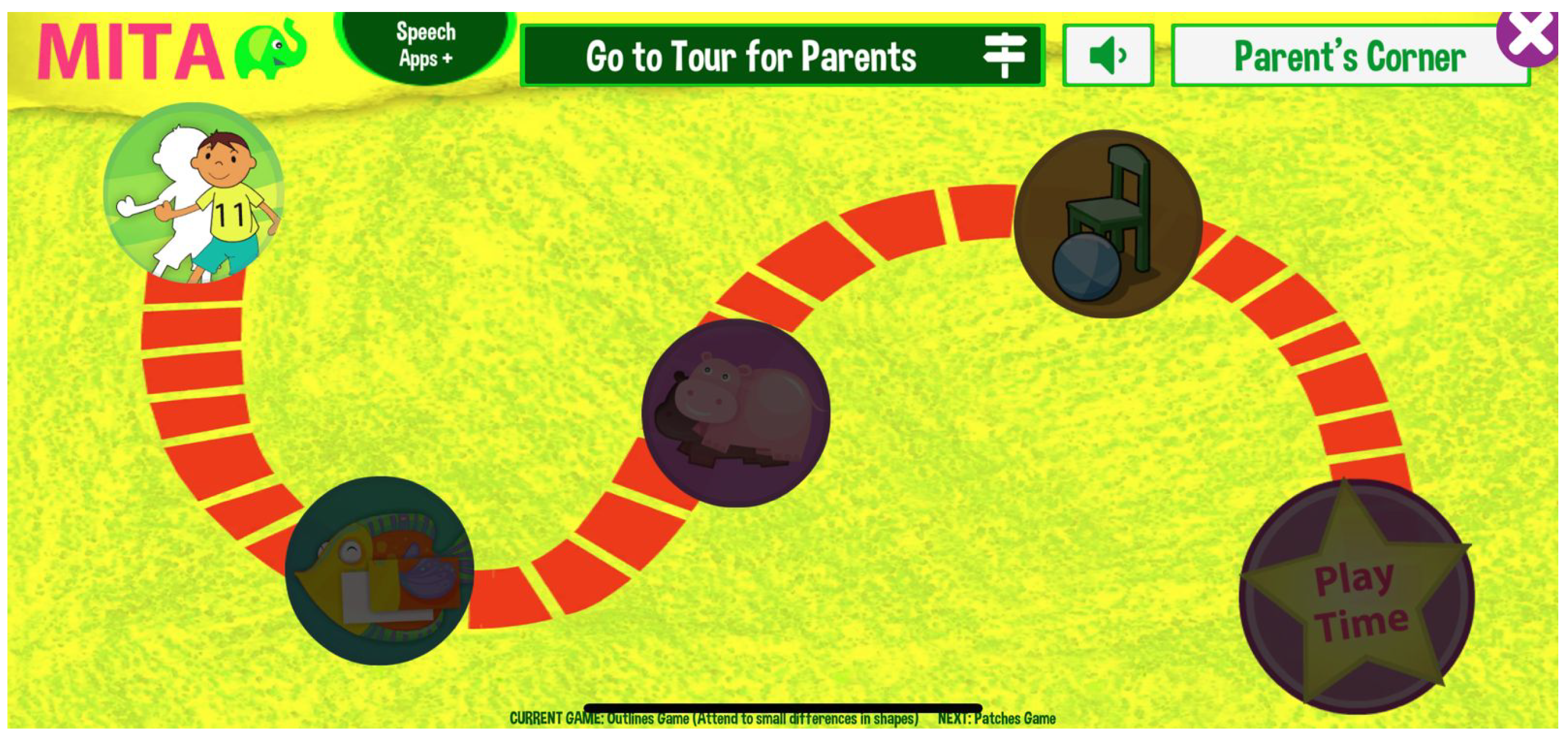
- Applications: We chose two of the most popular games for treating language delay in children, which are “Speech Blubs” and “MITA”, to conduct the experiment. The English language was the default interface and the mobile phone used was running on the iOS system. Reasons for choosing these two apps: Both apps are easy to use, popular, and specifically designed for children’s language development. Figure 2 shows the home screen of the “Speech Blubs” game, and Figure 3 shows the home screen of the “MITA” game.
- Experiment Procedure: Each evaluator started by testing the “Speech Blubs” app using the eGLD guidelines and recorded the usability issues they found. This was followed by evaluations using Nielsen’s and GUESS guidelines separately for the same app. Once the “Speech Blubs” app was evaluated, the process was repeated for the “MITA” app, following the same steps. This resulted in six evaluations in total: three for each app using the three sets of guidelines, as shown below:
- List of discovered usability issues on “Speech Blubs” using eGLD.
- List of discovered usability issues on “Speech Blubs” using Nielsen.
- List of discovered usability issues on “Speech Blubs” using GUESS.
- List of discovered usability issues on “MITA” using eGLD.
- List of discovered usability issues on “MITA” using Nielsen.
- List of discovered usability issues on “MITA” using GUESS.
4. Results
4.1. Results of eGLD Development
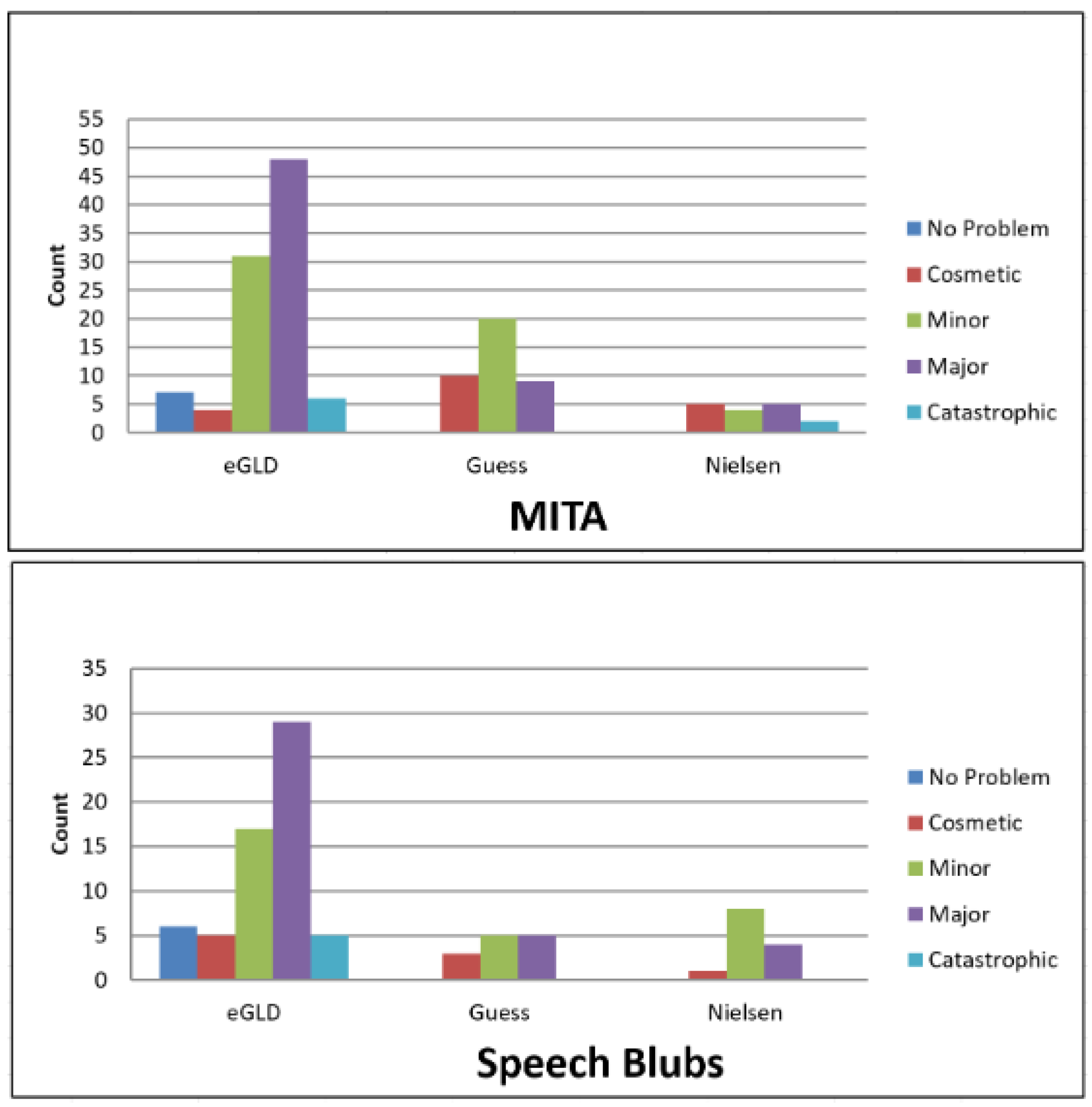
4.2. Results of the eGLD Validation
4.2.1. Usability Issues Among the Three Guidelines
4.2.2. Severe Usability Issues Among the Three Guidelines
4.2.3. Usability Issues in the eGLD Guidelines
5. Discussion
5.1. eGLD Development Discussion
5.2. eGLD Validation Discussion
6. Conclusions
- Offering design recommendations based on the usability issues found in “MITA” and “Speech Blubs” and gathering feedback from development teams.
- Involving UX experts, speech-language therapists, and HCI professionals to review the guidelines and contribute expert insights during the refining stage.
- Enhancing a selected game using the refined guidelines and conducting user testing to evaluate the impact of these improvements in real-world use.
Author Contributions
Funding
Institutional Review Board Statement
Informed Consent Statement
Data Availability Statement
Conflicts of Interest
Abbreviations
| e-Game | Electronic game |
| eGLD | e-Game for Language Delay |
| HCI | Human–computer interaction |
Appendix A
Appendix A.1

| ID | eGLD1 |
| Priority | (3) Critical |
| Name | Visibility of System Status |
| Definition | Ensure that players can always see their progress and the game status. Show feedback on what is happening in the game in real time. |
| Features | Progress indicators, feedback systems, motivational messages |
| Checklists |
|
| ID | eGLD2 |
| Priority | (2) Important |
| Name | Similarity Between the System and the Real World |
| Definition | Make the game relatable by incorporating real-world tasks, language, and visuals that players recognize. |
| Features | Real-life examples, relatable scenarios |
| Checklists |
|
| ID | eGLD3 |
| Name | User Control and Freedom |
| Priority | (2) Important |
| Definition | Allow players to explore the game freely, retry tasks, and fix mistakes without penalty. |
| Features | Back/Retry buttons, skip features |
| Checklists |
|
| ID | eGLD4 |
| Name | Consistency and Standards |
| Priority | (2) Important |
| Definition | Keep the design, instructions, and interface consistent across the game to make it easier for players to understand. |
| Features | Unified interface elements, consistent visuals |
| Checklists |
|
| ID | eGLD5 |
| Name | Minimize and Manage Errors |
| Priority | (3) Critical |
| Definition | Minimizing mistakes made by children while interacting with the game. This is achieved by providing clear instructions, validating their inputs, and guiding them through the correct steps to achieve success. |
| Features | Warnings and alerts for incorrect actions, immediate feedback to correct mistakes, guided steps for error recovery, interactive prompts to clarify actions. |
| Checklists |
|
| ID | eGLD6 |
| Name | Recognition Rather than Recall |
| Priority | (2) Important |
| Definition | Reduce the cognitive load on children by ensuring that they can recognize options or choices rather than relying on memory. |
| Features | Dropdown menus, visual prompts, consistent and familiar icons across the game |
| Checklists |
|
| ID | eGLD7 |
| Name | Flexibility and Efficiency of Use |
| Priority | (2) Important |
| Definition | Adapting the game to the player’s speed, preferences, and abilities. It ensures that the game remains accessible to diverse players while maintaining a smooth and efficient experience. |
| Features | Adjustable difficulty settings, progress-tracking tools |
| Checklists |
|
| ID | eGLD8 |
| Name | Help and Documentation |
| Priority | (2) Important |
| Definition | Provide helpful instructions and resources to assist players when they need guidance. |
| Features | Help menus, tutorials |
| Checklists |
|
| ID | eGLD9 |
| Name | Playing Involvement |
| Priority | (2) Important |
| Definition | Engage players by including interactive and challenging tasks to maintain their interest. |
| Features | Interactive elements, increasing difficulty levels |
| Checklists |
|
| ID | eGLD10 |
| Name | Pleasure |
| Priority | (3) Critical |
| Definition | Make the game enjoyable with rewards and activities that keep players happy and motivated. |
| Features | Rewards, animations, creative tasks |
| Checklists |
|
| ID | eGLD11 |
| Name | Creative Freedom |
| Priority | (2) Important |
| Definition | Provide players with opportunities to express creativity and make unique choices to shape their gameplay experience. |
| Features | Customizable gameplay elements, open-ended decision-making, and creative problem-solving tools. |
| Checklists |
|
| ID | eGLD12 |
| Name | Audio Aesthetics |
| Priority | (2) Important |
| Definition | Use sound and music to enhance the gaming experience without distracting players. |
| Features | Background music, sound effects |
| Checklists |
|
| ID | eGLD13 |
| Name | Personal Gratification |
| Priority | (2) Important |
| Definition | Reward players for their achievements to make them feel accomplished and motivated. |
| Features | Virtual trophies, leaderboards, progress tracking |
| Checklists |
|
| ID | eGLD14 |
| Name | Social Connectivity |
| Priority | (2) Important |
| Definition | The ability of the game to encourage meaningful social interactions among children, their peers, and family members. It promotes collaboration, communication, and relationship-building through engaging activities that require teamwork or shared experiences. |
| Features | Two-way interactive communication tools, multiplayer or cooperative modes, shared progress and achievements |
| Checklists |
|
| ID | eGLD15 |
| Name | Gradual Language Complexity |
| Priority | (2) Important |
| Definition | Start with simple words and phrases, gradually introducing more complex language as the player progresses. |
| Features | Increasing difficulty in language tasks |
| Checklists |
|
| ID | eGLD16 |
| Name | Interactive Feedback |
| Priority | (3) Critical |
| Definition | Provide real-time feedback to guide players, correct mistakes, and encourage learning. |
| Features | Hints, feedback messages, animations |
| Checklists |
|
| ID | eGLD17 |
| Name | Play-Based Therapy |
| Priority | (3) Critical |
| Definition | Incorporate fun elements like games and challenges to make learning enjoyable. |
| Features | Mini-games, animated characters |
| Checklists |
|
| ID | eGLD18 |
| Name | Words Review and Sentence Formation |
| Priority | (3) Critical |
| Definition | Provide players with opportunities to review and practice vocabulary they have learned previously, and help players move from learning individual words to forming complete sentences with correct syntax. |
| Features | Flashcards, practice games, reminders, sentence-building tasks, visual aids |
| Checklists |
|
| ID | eGLD19 |
| Name | Repetition and Rehearsal of Skills |
| Priority | (3) Critical |
| Definition | Allow repeated practice of key skills to help players reinforce their learning and improve memory. |
| Features | Repeated tasks, varied practice methods |
| Checklists |
|
References
- Manipuspika, Y.S.; Sudarwati, E. Phonological development of children with speech delay. RETORIKA J. Ilmu Bhs. 2019, 5, 12–22. [Google Scholar] [CrossRef]
- Feltner, C.; Wallace, I.F.; Nowell, S.W.; Orr, C.J.; Raffa, B.; Middleton, J.C.; Vaughan, J.; Baker, C.; Chou, R.; Kahwati, L. Screening for speech and language delay and disorders in children 5 years or younger: Evidence report and systematic review for the US Preventive Services Task Force. JAMA 2024, 331, 335–351. [Google Scholar] [CrossRef] [PubMed]
- Mirnawati, M.; Ilahiah, R. Development of Toupic (Touch Picture) Applications to Improve Expressive Language in Speech-Delayed Children. AL-ISHLAH J. Pendidik. 2023, 15, 5067–5077. [Google Scholar] [CrossRef]
- Warmbier, W.A.; Podgórska-Bednarz, J.; Gagat-Matuła, A.; Perenc, L. The Use of the “Talk To Me” Application in the Therapy of Speech Development Delays. Available online: https://repozytorium.ur.edu.pl/items/dec0831d-6893-40aa-af17-be743963a53f (accessed on 26 April 2024).
- Akbar, M.A.; Ismail, H. Language acquisition in child who speech delay. J. Xi’an Univ. Archit. Technol. 2021, 13, 392–402. [Google Scholar]
- Diamante, R.E.J. Interactive Learning Tool Using a Neural Network Algorithm for Speech-Delayed Child. Am. J. Agric. Sci. Eng. Technol. 2022, 6, 124–130. [Google Scholar] [CrossRef]
- Vermeij, B.A.; Wiefferink, C.H.; Knoors, H.; Scholte, R.H. Effects in language development of young children with language delay during early intervention. J. Commun. Disord. 2023, 103, 106326. [Google Scholar] [CrossRef]
- Zaki, N.A.A.; Wook, T.S.M.T.; Ahmad, K. A usability testing of ASAH-/for children with speech and language delay. In Proceedings of the 2017 6th International Conference on Electrical Engineering and Informatics (ICEEI), Langkawi, Malaysia, 25–27 November 2017; IEEE: Piscataway, NJ, USA, 2017; pp. 1–6. [Google Scholar]
- Gavriushenko, M.; Porokuokka, I.; Khriyenko, O.; Kärkkäinen, T. On developing adaptive vocabulary learning game for children with an early language delay. GSTF J. Comput. 2018, 6, 1. [Google Scholar]
- Zaki, N.A.A.; Wook, T.S.M.T.; Ahmad, K. Therapeutic serious game design guidelines for stimulating cognitive abilities of children with speech and language delay. J. Inf. Commun. Technol. 2017, 16, 284–312. [Google Scholar]
- Otey, D.Q. A methodology to develop usability/user experience heuristics. In Proceedings of the XVIII International Conference on Human Computer Interaction, Cancun, Mexico, 25–27 September 2017; pp. 1–2. [Google Scholar]
- Preston, J.L.; Frost, S.J.; Mencl, W.E.; Fulbright, R.K.; Landi, N.; Grigorenko, E.; Jacobsen, L.; Pugh, K.R. Early and late talkers: School-age language, literacy and neurolinguistic differences. Brain 2010, 133, 2185–2195. [Google Scholar] [CrossRef]
- Nasr, E.; Alsaggaf, W.; Sinnari, D. Developing Usability Guidelines for mHealth Applications (UGmHA). Multimodal Technol. Interact. 2023, 7, 26. [Google Scholar] [CrossRef]
- Dietlein, C.S.; Bock, O.L. Development of a usability scale based on the three ISO 9241-11 categories “effectiveness,”“efficacy” and “satisfaction”: A technical note. Accredit. Qual. Assur. 2019, 24, 181–189. [Google Scholar] [CrossRef]
- ISO 9241-11:2018; Ergonomics of Human-System Interaction—Part 11: Usability: Definitions and Concepts. International Organization for Standardization: Geneva, Switzerland, 2018; Reviewed and Confirmed in 2023. Available online: https://www.iso.org/standard/63500.html (accessed on 21 October 2014).
- Bevana, N.; Kirakowskib, J.; Maissela, J. What is usability. In Proceedings of the 4th International Conference on HCI, 1991; Citeseer: University Park, PA, USA, 1991; pp. 1–6. [Google Scholar]
- Quiñones, D.; Rusu, C. How to develop usability heuristics: A systematic literature review. Comput. Stand. Interfaces 2017, 53, 89–122. [Google Scholar] [CrossRef]
- Muhanna, M.; Masoud, A.; Qusef, A. Usability heuristics for evaluating Arabic mobile games. Int. J. Comput. Games Technol. 2022, 2022, 5641486. [Google Scholar] [CrossRef]
- Valente, L.; Feijó, B.; Leite, J.C. Features and checklists to assist in pervasive mobile game development. In Proceedings of the SBGames 2013, São Paulo, Brazil, 16–18 October 2013; pp. 90–99. [Google Scholar]
- Nielsen, J. Ten Usability Heuristics. 2005. Available online: http://www.nngroup.com/articles/ten-usability-heuristics (accessed on 14 September 2024).
- Phan, M.H.; Keebler, J.R.; Chaparro, B.S. The development and validation of the game user experience satisfaction scale (GUESS). Hum. Factors 2016, 58, 1217–1247. [Google Scholar] [CrossRef] [PubMed]
- Vieira, E.A.O.; SILVEIRA, A.C.d.; Martins, R.X. Heuristic evaluation on usability of educational games: A systematic review. Inform. Educ. 2019, 18, 427–442. [Google Scholar] [CrossRef]
- Quiñones, D.; Rusu, C.; Rusu, V. A methodology to develop usability/user experience heuristics. Comput. Stand. Interfaces 2018, 59, 109–129. [Google Scholar] [CrossRef]
- Saeedi, S.; Bouraghi, H.; Seifpanahi, M.S.; Ghazisaeedi, M. Application of digital games for speech therapy in children: A systematic review of features and challenges. J. Healthc. Eng. 2022, 2022, 4814945. [Google Scholar] [CrossRef]
- Tommy, C.A.; Minoi, J.L.; Sian, C.S. Pre-School Children with Speech Delay: Case Control Study Based on Guidelines for Game Designs. In Proceedings of the European Conference on Games Based Learning, Sophia Antipolis, France, 4–5 October 2018; Academic Conferences International Limited: Reading, UK, 2018; p. 713-XXI. [Google Scholar]
- Mahmoudi, E.; Yoo, P.Y.; Chandra, A.; Cardoso, R.; Dos Santos, C.D.; Majnemer, A.; Shikako, K. Gamification in Mobile Apps for Children with Disabilities: Scoping Review. JMIR Serious Games 2024, 12, e49029. [Google Scholar] [CrossRef]
- Hammady, R.; Arnab, S. Serious gaming for behaviour change: A systematic review. Information 2022, 13, 142. [Google Scholar] [CrossRef]
- Nielsen, J. Usability 101: Introduction to Usability (2012). 2012, Volume 9, p. 35. Available online: http://www.nngroup.com/articles/usability-101-introduction-to-usability/ (accessed on 14 September 2024).
- Iso, W. 9241-11. Ergonomic requirements for office work with visual display terminals (VDTs). Int. Organ. Stand. 1998, 45, 22. [Google Scholar]
- Harrison, R.; Flood, D.; Duce, D. Usability of mobile applications: Literature review and rationale for a new usability model. J. Interact. Sci. 2013, 1, 1–16. [Google Scholar] [CrossRef]
- Group, N.N. How to Rate the Severity of Usability Problems. Available online: https://www.nngroup.com/articles/how-to-rate-the-severity-of-usability-problems/ (accessed on 15 April 2025).
- Quiñones, D.; Rusu, C. Applying a methodology to develop user eXperience heuristics. Comput. Stand. Interfaces 2019, 66, 103345. [Google Scholar] [CrossRef]


| No. | Feature | PACMAD Attributes | Nielsen | GUESS |
|---|---|---|---|---|
| F1 | Identification with the game | Satisfaction | N2 | G2, G7 |
| F2 | Interface design | Effectiveness, Efficiency, Learnability | N4 | G1, G9 |
| F3 | Layout | Efficiency, Satisfaction, Memorability | N3, N8 | G9 |
| F4 | Demonstrations | Learnability, Cognitive Load | N1, N10 | G1 |
| F5 | Reward/encouragement | Satisfaction | – | G7, G4 |
| F6 | Performance feedback and guidance | Effectiveness, Errors | – | – |
| F7 | Personalization | Effectiveness, Satisfaction | N7 | G3, G7 |
| F8 | Adaptive games and challenges | Cognitive Load, Satisfaction | N2, N9 | G3, G5, G7 |
| F9 | Social interaction | Satisfaction | – | G8 |
| F10 | Mobility | Efficiency | N7 | – |
| F11 | Time management/restriction | Efficiency, Cognitive Load | N3 | – |
| F12 | Repetition and rehearsal of skills | Memorability, Learnability | – | – |
| F13 | Motivation and engagement | Satisfaction | N6 | G3, G4 |
| F14 | Motor skill | Effectiveness | N3 | G1 |
| F15 | Cognitive development | Effectiveness, Cognitive Load | – | G3, G7 |
| F16 | Speech recognition | Effectiveness, Efficiency | N1, N2 | G1 |
| F17 | Emotional attachment | Satisfaction | – | G7 |
| F18 | Animation and engaging graphics | Satisfaction, Memorability | N8 | G9 |
| F19 | Background music and sound effects | Satisfaction, Cognitive Load | – | G6 |
| F20 | Points | Satisfaction | – | G4, G7 |
| F21 | Story or theme | Satisfaction, Learnability | – | G2, G5 |
| F22 | Show progress | Effectiveness, Satisfaction | N1 | G1 |
| F23 | Provides badges for achievements | Satisfaction | – | G4, G7 |
| F24 | Provides clear goals | Effectiveness | N2, N5 | – |
| F25 | Gradual language complexity | Effectiveness, Cognitive Load | – | – |
| F26 | Review of previous words | Memorability | – | – |
| F27 | Play-based therapy | Satisfaction | – | – |
| F28 | Syntax and sentence formation | Effectiveness | – | – |
| ID | Guideline Name | Action | Covered Features | Applicability |
|---|---|---|---|---|
| N1 | Visibility of system status | Adapt * | F4, F16, F22 | (3) Critical |
| N2 | Similarity between the system and the real world | Adapt * | F1, F8, F16, F24 | (2) Important |
| N3 | User control and freedom | Adapt * | F3, F11, F14 | (2) Important |
| N4 | Consistency and standards | Adapt * | F2 | (1) Useful |
| N5 | Error prevention | Adapt * | F24 | (3) Critical |
| N6 | Recognition rather than recall | Adapt * | F13 | (2) Important |
| N7 | Flexibility and efficiency of use | Adapt * | F7, F10 | (2) Important |
| N8 | Aesthetic and minimalist design | Adapt * | F3, F18 | (1) Useful |
| N9 | Help users recognize and recover from errors | Adapt * | F8 | (1) Useful |
| N10 | Help and documentation | Adapt * | F8 | (2) Important |
| ID | Guideline Name | Action | Covered Features | Priority |
|---|---|---|---|---|
| G1 | Usability/ergonomics | Eliminate (moved to N1) | F1, F2, F4, F16, F22 | – |
| G2 | Narrative | Eliminate (moved to N2) | F11, F21 | – |
| G3 | Playing involvement | Adapt * | F8, F9, F13, F15 | (3) Critical |
| G4 | Pleasure | Adapt * | F5, F8, F13, F20 | (2) Important |
| G5 | Creative freedom | Adapt * | F8, F21 | (2) Important |
| G6 | Audio aesthetics | Adapt * | F19 | (2) Important |
| G7 | Internal gratification | Adapt * | F1, F9, F13, F15, F20 | (2) Important |
| G8 | Social connectivity | Adapt * | F9 | (2) Important |
| G9 | Visual aesthetics | Eliminate (moved to N8) | F2, F3, F18 | – |
| ID | Guideline Name | Action | Covered Features | Priority |
|---|---|---|---|---|
| NW1 | Gradual language complexity | Create | F25 | (3) Critical |
| NW2 | Interactive feedback | Create | F6, F26 | (3) Critical |
| NW3 | Play-based engagement | Create | F27 | (2) Important |
| NW4 | Words review and sentence formation | Create | F26 | (2) Important |
| NW5 | Repetition and rehearsal of skills | Create | F12 | (3) Critical |
| Rating | Description |
|---|---|
| 0 | No problem at all. |
| 1 | Cosmetic issue; only fix if there is extra time. |
| 2 | Minor usability problem; low priority for fixing. |
| 3 | Major usability issue; should be fixed as a high priority. |
| 4 | Critical usability problem; must be fixed immediately before release. |
| Element | Description |
|---|---|
| ID | Starts with eGLD (e-Game for Language Delay). |
| Priority | (3) Critical, (2) important, or (1) useful. |
| Name | The name of the guideline, derived from Nielsen [20] and GUESS [22]. |
| Definition | Describes the guideline and clarifies its intended goal. |
| Features | Lists the features covered by the guideline. |
| Checklists | Checklist items are taken from [10] to add more details, making the guidelines relevant for e-Game applications for children with language delay. |
| Guideline | MITA | Speech Blubs | Total |
|---|---|---|---|
| Nielsen | 16 | 13 | 29 |
| GUESS | 39 | 13 | 52 |
| eGLD | 96 | 62 | 158 |
| Rating | MITA (eGLD) | MITA (GUESS) | MITA (Nielsen) | Speech Blubs (eGLD) | Speech Blubs (GUESS) | Speech Blubs (Nielsen) |
|---|---|---|---|---|---|---|
| No Problem | 7 | 0 | 0 | 6 | 0 | 0 |
| Cosmetic | 4 | 10 | 5 | 5 | 3 | 1 |
| Minor | 31 | 20 | 4 | 17 | 5 | 8 |
| Major | 48 | 9 | 5 | 29 | 5 | 4 |
| Catastrophic | 6 | 0 | 2 | 5 | 0 | 0 |
| Total | 96 | 39 | 16 | 62 | 13 | 13 |
| ID | eGLD Guideline | Nielsen’s Guideline | GUESS Guideline |
|---|---|---|---|
| eGLD1 | Visibility of system status | Visibility of system status | Usability/Reproduction |
| eGLD2 | Similarity between the system and the real world | Similarity between the system and the real world | Narratives |
| eGLD3 | User control and freedom | User control and freedom | – |
| eGLD4 | Consistent and minimalist design | Consistency and standards; aesthetic and minimalist design | Visual Aesthetics |
| eGLD5 | Minimize and manage errors | Error prevention; help users recognize and recover from errors | – |
| eGLD6 | Recognition rather than recall | Recognition rather than recall | – |
| eGLD7 | Flexibility and efficiency of use | Flexibility and efficiency of use | – |
| eGLD8 | Help and documentation | Help and documentation | – |
| eGLD9 | Playing involvement | – | Playing involvement |
| eGLD10 | Pleasure | – | Pleasure |
| eGLD11 | Creative freedom | – | Creative freedom |
| eGLD12 | Audio aesthetics | – | Audio aesthetics |
| eGLD13 | Personal gratification | – | Personal gratification |
| eGLD14 | Social connectivity | – | Social connectivity |
| eGLD15 | Gradual language complexity | – | – |
| eGLD16 | Interactive feedback | – | – |
| eGLD17 | Play-based engagement | – | – |
| eGLD18 | Words review and sentence formation | – | – |
| eGLD19 | Repetition and rehearsal of skills | – | – |
| eGLD | GUESS | Nielsen | |
|---|---|---|---|
| Number of guidelines | 19 | 9 | 10 |
| Number of checklist items | 131 | 55 | 0 |
Disclaimer/Publisher’s Note: The statements, opinions and data contained in all publications are solely those of the individual author(s) and contributor(s) and not of MDPI and/or the editor(s). MDPI and/or the editor(s) disclaim responsibility for any injury to people or property resulting from any ideas, methods, instructions or products referred to in the content. |
© 2025 by the authors. Licensee MDPI, Basel, Switzerland. This article is an open access article distributed under the terms and conditions of the Creative Commons Attribution (CC BY) license (https://creativecommons.org/licenses/by/4.0/).
Share and Cite
Badkook, N.; Sinnari, D.; Almakky, A. Developing Comprehensive e-Game Design Guidelines to Support Children with Language Delay: A Step-by-Step Approach with Initial Validation. Multimodal Technol. Interact. 2025, 9, 68. https://doi.org/10.3390/mti9070068
Badkook N, Sinnari D, Almakky A. Developing Comprehensive e-Game Design Guidelines to Support Children with Language Delay: A Step-by-Step Approach with Initial Validation. Multimodal Technologies and Interaction. 2025; 9(7):68. https://doi.org/10.3390/mti9070068
Chicago/Turabian StyleBadkook, Noha, Doaa Sinnari, and Abeer Almakky. 2025. "Developing Comprehensive e-Game Design Guidelines to Support Children with Language Delay: A Step-by-Step Approach with Initial Validation" Multimodal Technologies and Interaction 9, no. 7: 68. https://doi.org/10.3390/mti9070068
APA StyleBadkook, N., Sinnari, D., & Almakky, A. (2025). Developing Comprehensive e-Game Design Guidelines to Support Children with Language Delay: A Step-by-Step Approach with Initial Validation. Multimodal Technologies and Interaction, 9(7), 68. https://doi.org/10.3390/mti9070068