Abstract
With rapid urbanization, issues such as blind planning, disorder, and inefficiency in urban construction and land use have become increasingly prominent. To address these challenges, this study proposes a comprehensive suitability evaluation framework for urban construction land, using Zhengzhou City as a case study. The evaluation system incorporates five dimensions: topography, transportation, location, current land use status, and soil clay content. A hybrid weighting method, combining the Analytic Hierarchy Process (AHP) and Entropy Weight Method (EWM), was employed to determine indicator weights. The research indicates that the suitability of the construction land can be classified into four categories: highly suitable, moderately suitable, critically suitable, and unsuitable. Among them, the highly suitable area accounted for 6.907% (502.71 km2), the moderately suitable area accounted for 81.668% (5943.54 km2), the critically suitable area accounted for 11.422% (830.98 km2), and the unsuitable area only accounted for 0.003% (0.18 km2). The results show that most areas in Zhengzhou City are highly suitable or moderately suitable for construction land, while Gongyi and Dengfeng, due to their complex terrain and long distances from the city center, are mostly in the critically suitable or unsuitable construction land. This evaluation result is in good agreement with the actual situation and can offer valuable insights for sustainable urban development.
1. Introduction
The rapid pace of global urbanization has led to a steady increase in the demand for construction land, often leading to challenges such as encroachment on cultivated land and inefficient development. Given the significance of land in urban economic and social development, achieving intensive and scientifically informed land use is paramount for sustainable urban planning. The Suitability Evaluation of Construction Land (SECL) not only has a certain guiding effect on urban expansion but also has important significance for the layout of national land spatial planning. In the recent past, China has prioritized the evaluation of the suitability of construction land for urban development. In 2009, the Ministry of Housing and Urban-Rural Development promulgated the Standard for Evaluation of Urban and Rural Land Use (CJJ132-2009), which points out that, “The Suitability Evaluation of Urban Construction Land is a process that evaluates the natural environmental conditions and engineering-technical feasibility of land designated for urban-rural development, aiming to satisfy the requirements of such development. In order to meet the requirements of urban and rural development, it is necessary to conduct a comprehensive quality assessment of the natural environmental conditions and their engineering and technical possibilities and economy, so as to determine the suitability of the land for construction, and to provide a basis for the rational selection of land for urban and rural development” [1].
Current studies mainly use the following aspects to evaluate the suitability of construction sites, such as economic, cultural, ecological, etc. Additionally, specific influences like geological hazards are acknowledged in complex terrain cities [2]. Assessing construction area fit largely leans on the Delphi methodology—expert scoring and AHP [3] While the integration of Geographic Information Systems (GIS) has further revolutionized the field by providing powerful spatial analysis capabilities, enabling comprehensive assessments that combine AHP with spatial data [4,5,6]. For instance, Zeng Hongchun’s land fit assessment project in Pingguo County employed AHP to select indicators spanning soil, climate, topography, geology, etc., and establish an indicator system [7]. Cao Jing et al. assessed urban development potential through their unique construction suitability index, assigning indicator weights via index modeling, a distinct approach compared to earlier approaches [8]. Considerable value and significance stem from this suitability analysis tool.
Despite these advancements, a clear research gap persists. The prevailing reliance on subjective weighting methods, primarily AHP, introduces inherent uncertainty, as the weights are susceptible to the biases of the experts consulted. While objective methods like the EWM exist and are widely used in other disciplines for their data-driven approach to weighting, their application in construction land suitability evaluation, particularly in complex urban contexts, remains relatively underexplored.
Most of the existing studies either adopt purely subjective methods (such as AHP) or purely objective methods (such as EWM) [3,7]. However, there is a lack of hybrid methods that can effectively combine both advantages to overcome their respective limitations. The mixed model of Analytic Hierarchy Process and Entropy Weight Method proposed in this study aims to fill this specific gap. It intends to leverage the advantages of the Analytic Hierarchy Process in integrating experts’ judgments on strategic priorities (such as the primary importance of the current land use status) and the ability of the Entropy Weight Method to reflect the intrinsic information and dispersion of objective spatial data. This integration is not only a technical combination but also a conceptual advancement to generate more robust and reliable suitability evaluation results.
As Zhengzhou City, the hectic heart of the Central Plains Urban Agglomerate, rapidly unveils its economic prowess, the need for construction land escalates alongside urban growth. Consequently, effective and logical planning of urban construction land is paramount. Market analysis indicates that existing research focuses mainly on spatial and temporal land use trends, identifying drivers for future growth and predicting the expansion trend to guide the law of controlling land use [9]. However, there is a scarcity of research that employs a hybrid methodological approach to specifically address the city’s pressing need for scientifically sound construction land planning. Enter the Entropy Weight Method—a reliable, multidisciplinary approach frequently implemented across macroeconomics, corporate economy [10], industrial economy [11], agricultural economy [12], healthcare [13], environmental sciences, resource utilization [14], construction science and engineering [15]—making it an appealing choice for high precision research [16].
This study proposes a novel hybrid weighting method that integrates the AHP with the Entropy Weight Method for evaluating construction land suitability in Zhengzhou City. The primary objective is to leverage the strengths of both methods: the expert-based judgment of AHP for structuring the problem and establishing initial indicator importance, and the data-driven objectivity of EWM to refine the weights based on the intrinsic information of the dataset. By synthesizing these approaches within a GIS environment, this research aims to provide a more accurate and reliable suitability assessment. The findings are expected to offer valuable insights for guiding the rational planning of urban construction land in Zhengzhou, supporting smart city initiatives, and fostering sustainable economic growth.
2. Materials and Methods
2.1. Study Area
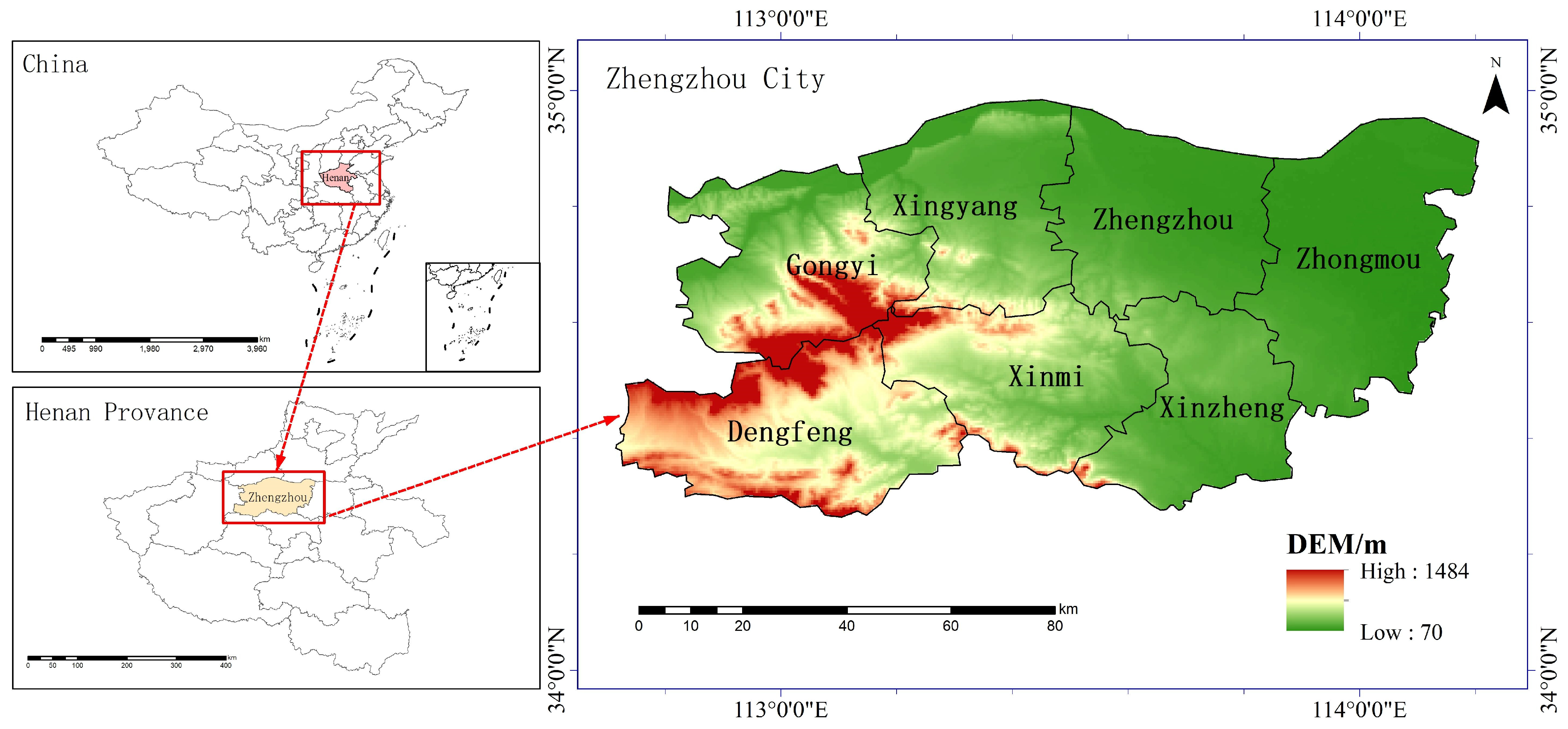
Zhengzhou City is situated between longitudes 112°42′–114°14′ east and latitudes 34°16′–34°58′ north (Figure 1). Situated in the central plains, the Yellow River borders it on the north, Songshan Mountain borders it on the west, and the expansive Yellow-Huaihe Plain borders it on the southeast. This city serves as the capital of Henan Province. The overall topography of Zhengzhou City is characterized by higher elevations in the southwest and lower ones in the northeast. The western part is mostly composed of low mountainous areas, while the central and eastern regions are mostly hills and plains. The land area decreases in a stepped pattern.
Figure 1.
Schematic diagram of urban built-up area of Zhengzhou City in 2020.
Zhengzhou City encompasses 7567 square kilometers as of 2020, and it is home to six districts, five county-level cities, and one county. The population is relatively densely distributed. In 2021, the resident population will be 12.6 million, an increase of 3.97 million, or 46%, over 2010, accounting for 12.38% of the province’s resident population. In 2020, Zhengzhou City’s urbanization rate will reach 78.40%, an increase of 14.91% relative to 2010, and the level of urbanization will be much higher than that of other provincial municipalities, with an obvious increase in the ability to gather population.
The built-up land area of Zhengzhou City gradually expands with the development of the city. In August 2021, the Zhengzhou Municipal People’s Government put forward in the “Circular of the Zhengzhou Municipal People’s Government on the Scale of Zhengzhou City’s Built-Up Area in 2020”, in terms of urban construction, the area of Zhengzhou’s central built-up area in 2020 will be 709.69 square kilometers (including the Comprehensive Pilot Zone of the Airport Economy), and the area of city area built-up area will be 1284.89 square kilometers, compared with 1181.51 square kilometers in 2019, an increase of 103.38 square kilometers.
2.2. Data
The primary data used in the study are vector data for the Zhengzhou City area, DEM data, road network data, central city distribution data, Landset-8 remote sensing image data, and soil texture data. Of these, the road network data are obtained from the National Geographic Information Resource Catalog Service System (https://www.webmap.cn), the Landset-8 remote sensing image data of Zhengzhou City is sourced from publicly available data on the Geospatial Data Cloud website, the DEM data comes from NASA with a spatial resolution of thirty meters, and the soil texture data comes from the Chinese soil data set in the World Soil Library HWSD dataset.
The preprocessing of data mainly includes the cropping of vector data and the preprocessing of remote sensing image data. Urban road network data are merged and cropped. The remote sensing image data of Zhengzhou City is radiometrically calibrated and atmospherically corrected, and then the surface band data are used to decipher the land type. Soil texture data are merged with attributes to extract the clay content attributes.
2.3. Methods
In the methodology of evaluation, research is typically classified into two major categories: parametric methods and non-parametric methods [17]. The core feature of parametric methods is the need to pre-determine a clear model form and parameters, such as weights, functional relationships, etc. These parameters are usually explicitly estimated through data fitting, expert judgment, or optimization algorithms. The AHP and entropy weight method used in this study are both typical parametric methods. AHP explicitly defines the relative importance parameters between indicators by constructing a judgment matrix [18]; the entropy weight method objectively calculates a set of explicit weight parameters based on the dispersion of the data using the information entropy formula [19]. The advantage of these methods lies in their transparent models and strong interpretability, with weight parameters having clear physical or decision-making meanings.
In contrast, non-parametric methods (such as certain machine learning models: random forests, support vector machines, etc.) do not rely on pre-defined parametric model forms but instead implicitly capture the complex relationships between variables through a data-driven learning process, and their decision rules are often a “black box” [20]. In fields such as evacuation planning, research often systematically compares the advantages and disadvantages of parametric methods and non-parametric methods.
This study selects the parametric method framework because the suitability evaluation of construction land requires clear and interpretable weight parameters to directly support land use and spatial planning decisions. The mixed use of AHP and the entropy weight method is a strategy within the parametric framework that integrates subjective and objective information to optimize parameter estimation.
2.3.1. Selection of Indicators for Suitability Evaluation Model
Following the principles of dominance, difference, stability, operability, quantification and independence in the selection of indicators in land suitability evaluation, combining with the actual situation of Zhengzhou City, we select and construct land suitability evaluation factors in terms of topography, location, transportation, current land development status and soil cohesion (Table 1), with the focus on the city’s construction intensity and potential.
Table 1.
Selection of evaluation indicators for land construction suitability in Zhengzhou City.
(1) The terrain condition is a necessary factor for evaluating the land suitability of an area; it will have an important impact on the construction cost, and the flatter the terrain is, the more suitable for construction. In the specific evaluation of the advantages of Zhengzhou City’s topography, the use of elevation and slope to measure, the elevation of the place is more suitable for the development of construction land.
(2) Transportation is a fast channel for urban communication and a booster for urban economic development. The more developed the transportation, the easier it is to carry out urbanization in the area. For the role of Zhengzhou City as the transportation hub of the Central Plains, the distribution of its transportation advantages should be comprehensively evaluated.
(3) Location advantage means the proximity to the city center area, which largely reflects the attraction and pulling power of the city and county center area to the surrounding areas, and the closer the center of the urban area is, the more obvious the location advantage is.
(4) A certain amount of land’s ease of development and building is reflected in its use. The degree of complexity varies for the current construction land, grassland, forest land, and bare land in terms of development and construction.
(5) The soil’s clay content plays a significant role in the building process; the higher the clay content, the more stable the building may be constructed to be, and the more appropriate the site is for the development of construction land [21].
2.3.2. AHP
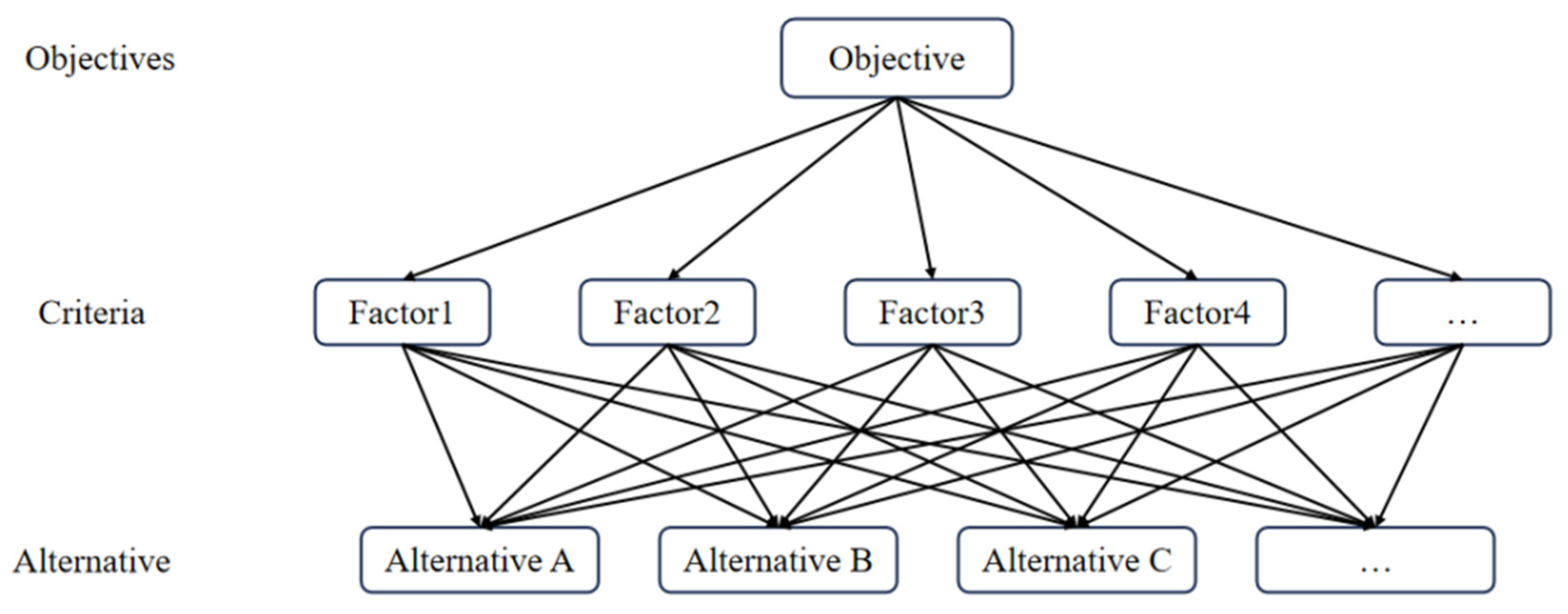
AHP is a straightforward, adaptable, and pragmatic multiple-criteria decision-making methodology for the quantitative dissection of qualitative issues, and it is a combination of subjective and objective methods of assigning weights, which are mainly used for solving evaluation-type problems [18].The main feature of AHP is to transform human judgments into comparisons of the importance of a number of factors two-by-two, known as the decision-making level, by establishing a recursive hierarchical structure (Figure 2). The qualitative judgment, which is difficult to quantify, is transformed into an actionable comparison of importance, called the criterion layer.
Figure 2.
AHP structure diagram.
The AHP is applied to create the evaluation index system, and the judgment matrix is constructed through expert consultation scoring and reference to similar land suitability-related studies [7]. In this study, the requisite expert input for constructing the judgment matrix was derived from a synthesis of methodologies and consensus values reported in relevant literature, combined with the current situation of Zhengzhou City (Table 2), and the values in the matrix are constructed by two-by-two comparisons of each index factor based on the degree of importance:
Table 2.
Weighting of evaluation indicators for land construction suitability in Zhengzhou City.
The weight of the indicator is obtained based on the mathematical formula:
A consistency test was conducted to test the validity of subjective weights, and the result was considered to satisfy the consistency when < 0.1; when > 0.1, the values of each evaluation index in the judgment matrix were adjusted and calculated until the consistency test was satisfied [22]:
where in (3), (4) is the maximum eigenvalue of the judgment matrix , denotes the ith element of the vector , and is the consistency ratio value.
The weights of the indicators that pass the consistency test are calculated to obtain the weights of the land construction suitability evaluation indicators. Where the combined weight value is the multiplication of the primary weight value corresponding to the indicator by the secondary weight value.
2.3.3. Entropy Weight Method
The Entropy Weight Method is an objective assignment technique that takes into account each indicator’s degree of dispersion. It calculates each indicator’s entropy weight using information entropy, and it then makes adjustments based on the indicator’s entropy weight to give the indicator a more objective weight. The information scientist Shannon published the formula for computing the entropy weight in the entropy right technique. The more dispersed the data, the higher the entropy value, which can be interpreted as indicating that the data contains more information, and thus the larger the weight [19,23]. Before carrying out the formula calculation of the Entropy Weight Method, it is necessary to quantify the existing index data to ensure the importance of the results in the calculation, and the specific quantification method is shown in Table 3. The classification thresholds and scores in Table 3 were determined based on the following principles: (1) For slope, the criteria strictly adhere to the Chinese national standard “Code for vertical planning on urban and rural construction land” (CJJ 83-2016). (2) For elevation, land use, and soil properties, the classifications integrate engineering guidelines, land management policies, and local conditions of Zhengzhou City. (3) For distance-based indicators, a distance-decay function was conceptually applied, reflecting reduced suitability with increased distance from infrastructure and urban centers.
Table 3.
Quantitative method for evaluation factors of land construction suitability in Zhengzhou City.
Before applying the entropy weight method to calculate the objective weights of the indicators, a basic data matrix for analysis is first constructed. In this study, the Zhengzhou urban area is divided into m regular geographic grids as the basic evaluation units. For the selected n evaluation indicators (see Table 3), we use software and, based on the original data source, through spatial analysis, the values of each indicator for each grid unit are extracted or calculated. For example, the terrain indicators (elevation, slope) extract the average value from the DEM data; distance-based indicators (distance to roads, subway stations) calculate the distance from the center of the unit to the nearest element using the Euclidean distance tool; land use types are quantified by area proportion. Finally, an initial data matrix X = [Xij]m×n is formed, where Xij represents the original value of the i-th unit in the j-th indicator. This matrix is the input data for the entropy weight method calculation.
The specific process of the entropy method consists of the following three steps.
First of all, due to the existence of evaluation factors of different natures, the forward and reverse indicators are normalized separately, and Equation (5) is used for the forward indicator factor and Equation (6) is used for the reverse indicator factor.
where denotes the normalized value of the ith evaluation object under the th factor; denotes the calculated value of the corresponding evaluation index; denotes the minimum value of the th factor; and denotes the maximum value of the th factor.
In the second step, the entropy value of each factor is calculated.
where, , represents the total number of evaluation factors; represents the entropy value corresponding to the th factor; in the actual calculation, due to the existence of 0 value of the indicator, in order to avoid the meaninglessness of , let .
Finally, the evaluation factor weights are calculated.
where represents the total number of evaluation indicators; is the objective weight of the th indicator.
2.3.4. Calculation of Combined Weights
The selection of the AHP–Entropy weight hybrid method is grounded in the need to balance strategic prioritization with data-driven objectivity. The AHP, while effective for structuring complex decisions and incorporating domain expertise, is susceptible to the subjective biases of the experts involved [18]. Conversely, the Entropy Weight Method objectively determines weights based on the data dispersion but may overlook strategically important factors that are not fully captured by the dataset itself [19]. By integrating these two methods using the principle of minimum information entropy (9), this study seeks to generate a set of synthesized weights (Wj) that are both strategically informed and empirically grounded, thereby enhancing the robustness of the suitability evaluation.
In the evaluation model, the weights are defined as parameters that measure the relative importance of each evaluation indicator. Their values directly determine the contribution degree of that indicator to the final suitability evaluation result. The AHP and the entropy weight method (Entropy Weight Method) adopted in this study both fall within the category of parametric evaluation methods. Their core feature lies in explicitly defining and calculating a set of weight parameters to construct a decision model. AHP converts experts’ subjective judgments into explicit weight parameters by constructing a judgment matrix; while the entropy weight method objectively calculates its own explicit weight parameters based on the degree of dispersion of the indicator data. The hybrid weight method in this study integrates these two different sources of explicit parameters to achieve more robust evaluation results.
The weights derived from the Entropy Weight Method and the hierarchical analysis of evaluation factors are synthesized in accordance with the principle of minimum information entropy, with the aim of achieving the closest feasible match between the synthesized weights and the weights of both. The calculation formula is as follows:
where is the combined weight; is the weight corresponding to the th indicator of the AHP, and is the weight value corresponding to the th indicator of the Entropy Weight Method. The calculated combined weights are shown in Table 4.
Table 4.
Combined weights of evaluation indicators for land construction suitability in Zhengzhou City.
3. Results
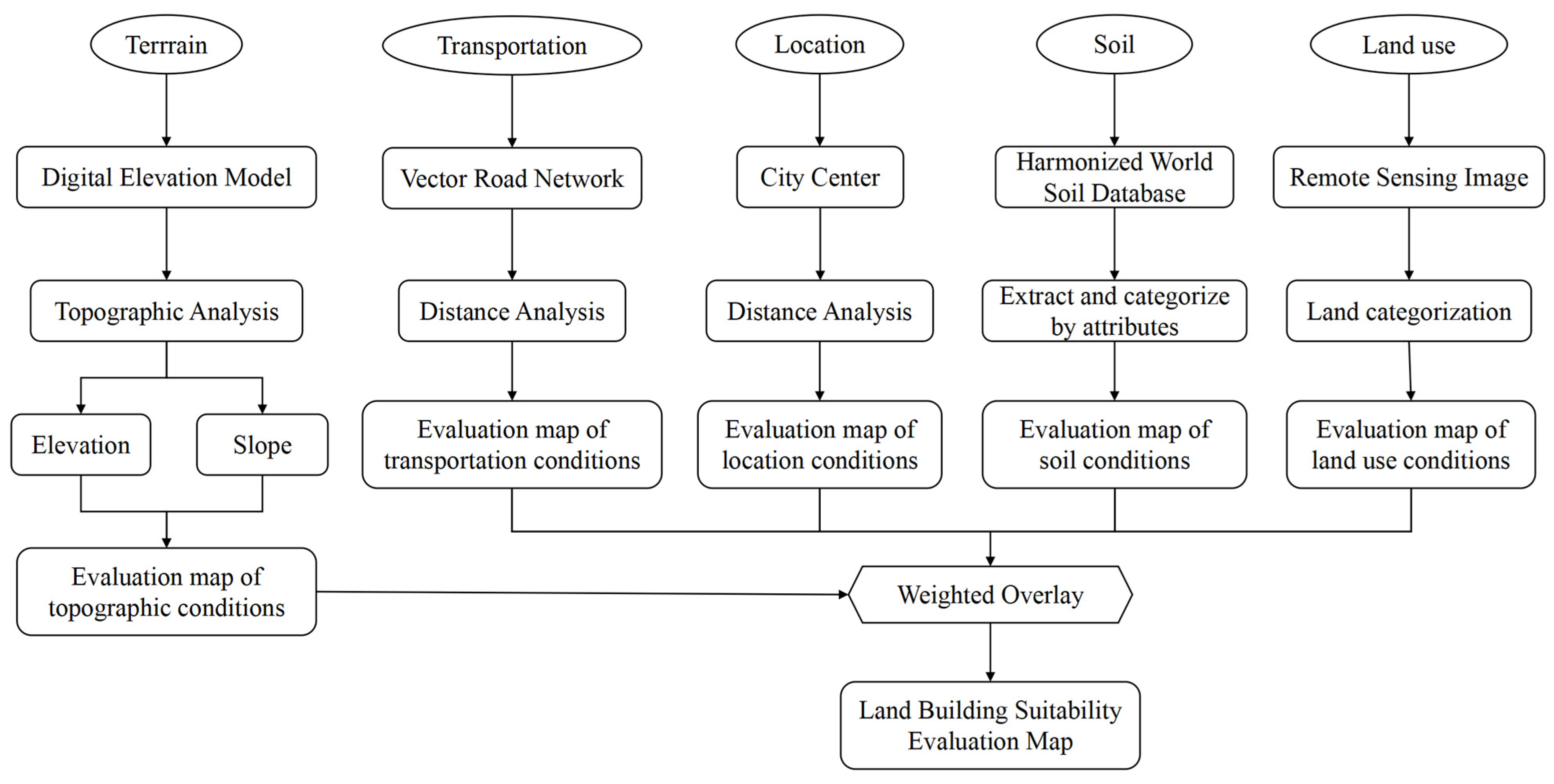
First of all, the spatial assignment of terrain, transportation, location, land use and soil type factors involved in construction land suitability evaluation is carried out, and some of the above factors will have an attenuation effect with the expansion of distance, such as transportation, location, etc., and some of them do not change according to the change of distance, such as the evaluation factor of land use type and the factor of soil condition [24]. Among them, the land classification in the land use status evaluation map is based on the fact that the areas with NDVI < 0 are classified as water bodies, those with NDBI < −0.2 are categorized as bare land, and those with FVC > 0.4 are shrubs for the assignment process [25]. Then, the evaluation factors after the assignment were weighted and superimposed using Equation (10), and the processing flow is shown in Figure 3.
where is the spatial unit index score, is the number of factors, is the i-factor weight, and is the i-factor score. The construction land suitability evaluation map of Zhengzhou City is obtained after processing, as shown in Figure 4.
Figure 3.
Flowchart of land construction suitability evaluation in Zhengzhou City.
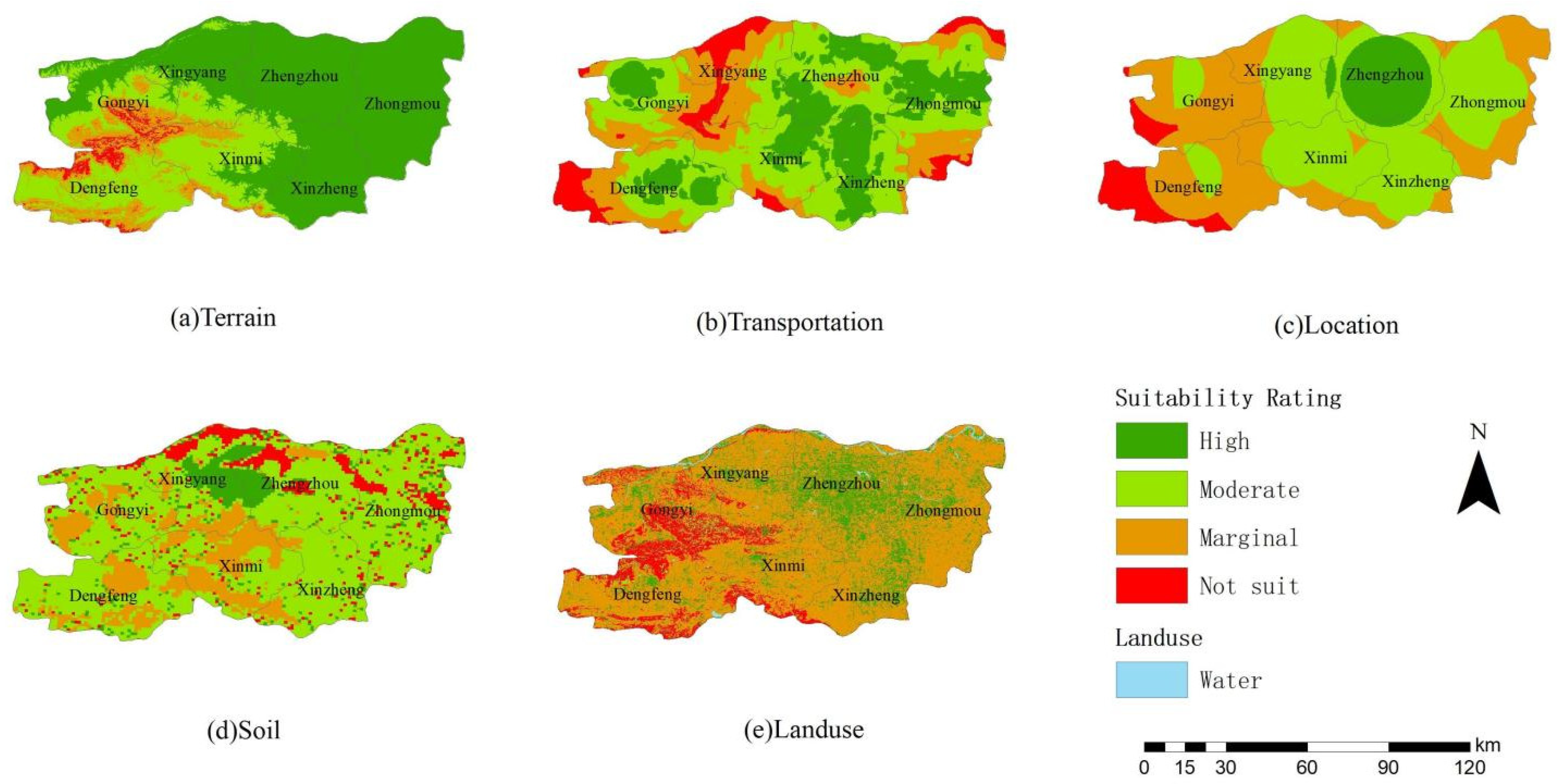
Figure 4.
Evaluation chart for each factor of land construction suitability in Zhengzhou City.
The spatial distribution of suitability levels for each individual evaluation factor is visually presented in Figure 4.
For the terrain factor (a), the western and southwestern regions of Zhengzhou are predominantly classified as marginally suitable or unsuitable, which correlates strongly with the location of the mountainous areas (e.g., Songshan). In contrast, the vast eastern plains exhibit high suitability. Regarding transportation (b), areas of high suitability are primarily distributed along major road networks, showing a distinct linear pattern radiating from the city center. Regions farther from primary roads, especially at the city’s periphery, transition to lower suitability grades. The location factor (c) demonstrates a clear concentric pattern, with the highest suitability concentrated in the central urban core. Suitability decreases with increasing distance from the center, resulting in a gradual transition from green (highly suitable) to orange (marginally suitable) in the outer zones and counties. The soil clay content factor (d) shows a patchy distribution of highly suitable land, with significant clusters located to the west of the central city and east of Xingyang. Notably, areas adjacent to river systems are consistently identified as unsuitable, likely due to lower clay content. Finally, the land use factor (e) directly reflects existing land cover. Current construction land is assigned high suitability, while large tracts of agricultural land are categorized as marginally suitable. Forested and shrubland areas are primarily classified as unsuitable for construction.
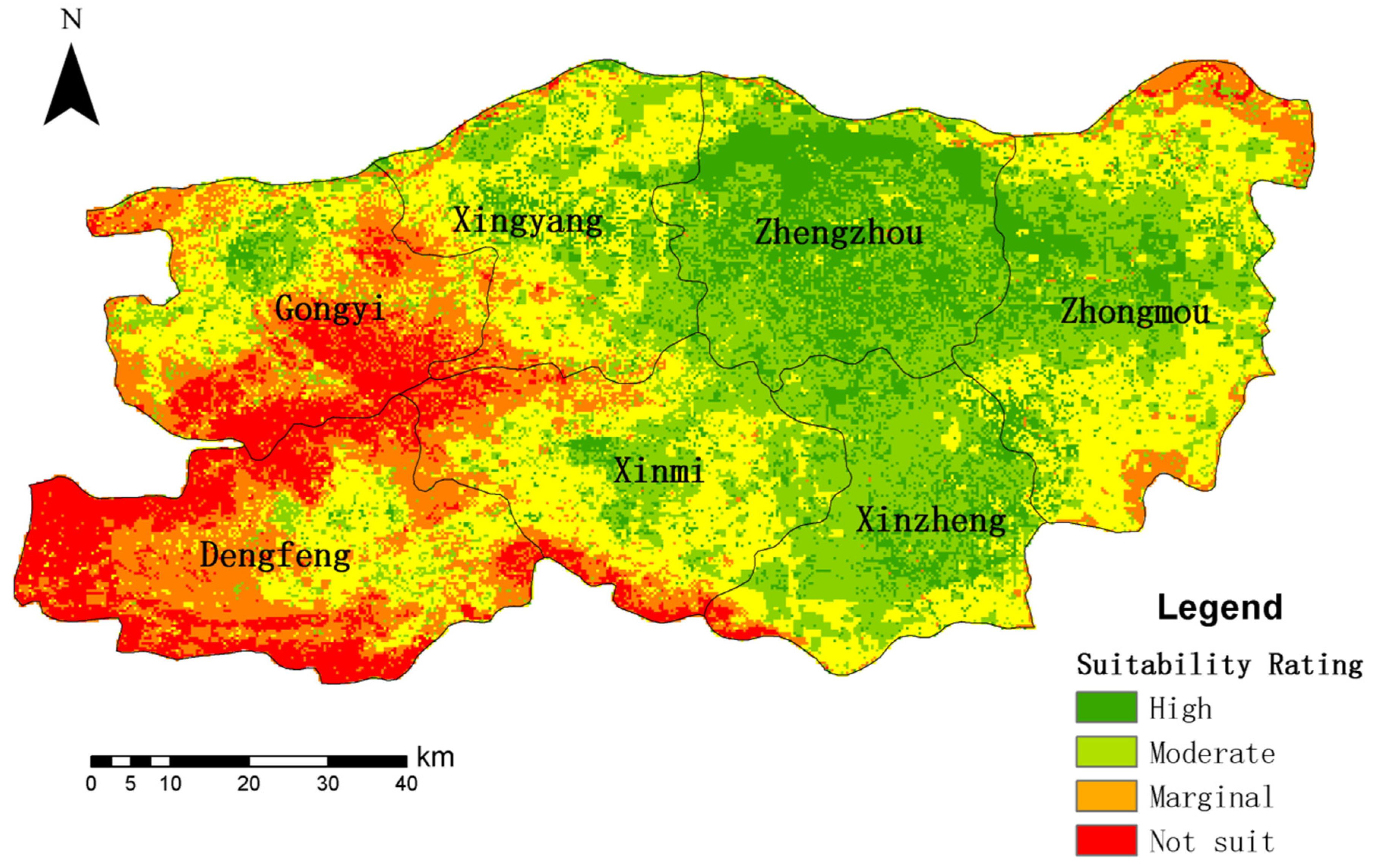
The above results were weighted and superimposed to obtain a comprehensive evaluation map of land construction suitability (Figure 5). By counting the number of rasters, it is obtained that the construction land has highly suitable area accounting for 6.907%, moderately suitable area accounting for 81.668%, marginally suitable area accounting for 11.422%, and unsuitable area accounting for 0.003%. Therefore, most of the land in Zhengzhou City is the construction land development zone in the moderately suitable area, and the proportion of unsuitable area is the least, which is related to the flat terrain and its role as the central hub of the Central Plains. Due to the unique geographic location and natural environment, most of the land is highly or moderately suitable for construction and the highly suitable areas are concentrated near the city center and dispersed to the county-level cities, in which the suitable construction areas of the county-level cities are different, as shown in Table 5. By counting the area of each degree of suitability in the municipalities under the jurisdiction, it can be found that the area of highly suitable area is the largest in Zhengzhou Municipal Jurisdiction, the area of moderately suitable area is the largest in Zhongmou County, and the area of marginally suitable area accounts for the largest proportion in Gongyi and Dengfeng.
Figure 5.
Evaluation map of land construction suitability in Zhengzhou City.
Table 5.
The distribution of suitability levels for municipalities in Zhengzhou City.
4. Discussion
4.1. Interpretation of Spatial Suitability Patterns
The comprehensive evaluation results of this study (Figure 5) show that the land construction suitability in Zhengzhou presents significant spatial differentiation. The highly suitable areas (6.91%) are mainly concentrated in the urban area and the eastern plain, while the marginal and unsuitable areas (totaling 11.43%) are mainly located in the western regions such as Gongyi and Dengfeng. This spatial pattern is a direct manifestation of the combined effects of multiple factors including terrain, location, and transportation.
4.2. The Added Value of the Hybrid Weighting Method
This study’s primary contribution lies in the application of the AHP–Entropy weight hybrid method. Compared to evaluations relying solely on AHP, our approach demonstrated a heightened sensitivity to subtle data variations. For instance, the hybrid model successfully captured local variations in suitability within the eastern plains that were influenced by differences in soil clay content (Figure 4d), a factor that might be underweighted in a purely expert-driven approach. This demonstrates the method’s capability to identify potential limiting factors that subjective methods might overlook, thereby enhancing the refinement and objectivity of the evaluation.
4.3. Transferability and Replicability of the Methodology
A key strength of the proposed framework is its transferability. The methodology itself is generic. While the specific evaluation indicators (e.g., soil clay content) and their thresholds (Table 3) were tailored to Zhengzhou’s context, the core procedural steps—constructing an indicator system; calculating subjective (AHP) and objective (Entropy) weights; synthesizing weights, and GIS-based overlay analysis—are universally applicable. Researchers and planners applying this method to other regions would need to adapt the indicator system and thresholds based on local data availability, policies, and environmental constraints, but the methodological framework remains robust and replicable.
4.4. Limitations and Future Research
This study has limitations. The data timeliness (e.g., based on 2020 conditions) and the selection of indicators, while comprehensive, could be expanded. Future research could incorporate socio-economic factors (e.g., land price, population density) and dynamic ecological constraints to construct a more forward-looking evaluation system. Furthermore, comparing the results of the hybrid method with those derived from pure AHP or pure EWM could provide a more quantitative assessment of its superiority.
5. Conclusions
This study developed an integrated AHP–Entropy weight method for urban construction land suitability evaluation in Zhengzhou, China. The main conclusions and contributions are as follows:
- (1)
- We proposed and verified a hybrid weighted model. By combining subjective factors with objective factors to determine the weights of the indicators, using data such as terrain, road network, and land use, we constructed an assessment model for the suitability of urban construction land in Zhengzhou from multiple dimensions. Then, by combining GIS spatial analysis tools with classification, we obtained the suitability grades of land construction in Zhengzhou. This model effectively balances the objectivity of expert judgment and data-driven methods, and is a universal approach that is not limited to a specific region. When applied to other regions, as long as the local basic geographic data is obtained and corresponding adjustments are made according to local specific policies, specific assessment factors, and their thresholds, it can be directly used to assess the suitability of construction land in other cities or regions.
- (2)
- Through the analysis of the land construction suitability assessment map, it was found that there is still potential for the expansion of construction land to the east and south, which provides valuable reference for planning construction land and optimizing land utilization efficiency.
- (3)
- In selecting the indexes, the index of soil clay content in soil conditions is added to the evaluation of the suitability of construction land, which takes into full consideration of the natural geographic environment required for the implementation of the construction and produces more reasonable results than the indexes referred to in other studies on the subject.
- (4)
- AHP (subjective weighting) and Entropy Weight Method (objective weighting) are combined, with incorporated clay content as an indicator to enhance the accuracy and objectivity of the evaluation in the study, but certain limitations still exist, such as data timeliness and constraints in indicator selection. Future research should overcome these limitations to refine the evaluation system.
- (5)
- Based on the findings, the following specific recommendations are proposed for territorial spatial planning in Zhengzhou: Prioritize development in the highly and moderately suitable areas in the eastern and southern plains, where infrastructure investment should be concentrated for efficient urban expansion. Strictly limit large-scale construction in the marginally suitable zones (e.g., parts of Gongyi and Dengfeng), enforcing ecological conservation and allowing only low-impact developments. Establish a dynamic land-use monitoring system that incorporates updated data (e.g., real-time soil and traffic data) to regularly revise the suitability maps, ensuring planning decisions remain scientifically grounded.
Author Contributions
Conceptualization, D.X., Y.K. and X.G.; Methodology, D.X. and Y.K.; Software, Y.K.; Validation, D.X., S.L. and X.G.; Formal analysis, D.X., S.L., Y.K. and X.G.; Investigation, S.L., Y.K. and X.G.; Resources, Y.K. and X.G.; Data curation, S.L. and Y.K.; Writing—original draft, S.L. and Y.K.; Writing—review & editing, D.X., S.L. and X.G.; Visualization, S.L.; Supervision, D.X. and X.G.; Project administration, D.X. and X.G.; Funding acquisition, X.G. All authors have read and agreed to the published version of the manuscript.
Funding
This research was funded by Henan Provincial Department of Natural Resources 2024 provincial natural resources: No. 2024-18.
Institutional Review Board Statement
Not applicable.
Informed Consent Statement
Not applicable.
Data Availability Statement
The data presented in this study are available on request from the corresponding author.
Acknowledgments
The authors of this article thank the support of the projects: “Henan Provincial Department of Natural Resources 2024 provincial natural resources “challenge list” scientific and technological innovation project “Research on intelligent detection of farmland violations based on surveillance video (No. 2024-18)” “. Furthermore, we are also grateful to the editors and reviewers for reading this research and providing valuable comments and suggestions.
Conflicts of Interest
The authors declare no conflict of interest.
References
- Industry Standard—Urban Construction. Standard for Urban and Rural Land Evaluation. 2009. Available online: https://kns.cnki.net/kcms2/article/abstract?v=VYuoLtjwl8NrPVqLCW38aLMCtzzFSRhgQrEhZZy1f_s29CHzzgx5TTgRKHlIPOxzd774h5VsKEf0aZX0swT4p0txpX6pKcTMLrTJhL1ZlM4kTwINkf2oeNtAZTCFWzU1SnQISKgQqdfy6dxryUpZ9vuq-K50eKQ_vXAvzHdmCbr_zbeYr9R6UQ==&uniplatform=NZKPT&language=CHS (accessed on 1 December 2025).
- Liu, X.; Wang, Y.; Li, M. How to Identify Future Priority Areas for Urban Development: An Approach of Urban Construction Land Suitability in Ecological Sensitive Areas. Int. J. Environ. Res. Public Health 2021, 18, 4252. [Google Scholar] [CrossRef]
- Tang, C.; Wei, S. Comprehensive Evaluation of Land Spatial Development Suitability of the Yangtze River Basin. Acta Geogr. Sin. 2012, 67, 1587–1598. [Google Scholar] [CrossRef]
- Akinci, H.; Ozalp, A.Y.; Turgut, B. Agricultural land use suitability analysis using GIS and AHP technique. Comput. Electron. Agric. 2013, 97, 71–82. [Google Scholar] [CrossRef]
- Memarbashi, E.; Azadi, H.; Barati, A.A.; Mohajeri, F.; Van Passel, S.; Witlox, F. Land-Use Suitability in Northeast Iran: Application of AHP-GIS Hybrid Model. ISPRS Int. J. Geo-Inf. 2017, 6, 396. [Google Scholar] [CrossRef]
- Ustaoglu, E.; Aydinoglu, A.C. Suitability evaluation of urban construction land in Pendik district of Istanbul, Turkey. Land Use Policy 2020, 99, 18. [Google Scholar] [CrossRef]
- Zeng, H. Assessment of Land Use Suitabilityin Pingguo County Based on GIS; China University of Geosciences: Beijing, China, 2018. [Google Scholar]
- Cao, J.; Zhang, W.; Liu, J. Delimiting urban development boundaries in metropolitan fringe with economic and ecological perspectives: A case study of Panyu District, Guangzhou City. Resour. Sci. 2020, 42, 262–273. [Google Scholar] [CrossRef]
- Liu, G. Spatial and Temporal Change Simulation Ofurban and Rural Construction Land in Zhengzhou Urban Based on CA-MAS; Henan University: Kaifeng, China, 2020. [Google Scholar]
- Zhang, H.; Lu, C. Research on Financial Performance Evaluation of High-tech Enterprises Based on Entropy Weight Method—Taking Wanrun Technology as an Example. Friends Account. 2025, 2023, 80–88. [Google Scholar]
- Zhao, Y.; Lin, W. Research on Typical Scenarios Based on Fusion Density Peak Value and Entropy Weight Method of Pearson’s Correlation Coefficient. Electr. Power 2023, 56, 193–202. [Google Scholar]
- Bo, W. Evaluation of High Quality Development of Agriculture in Jiangxi Province Based on Analytic Hierarchy Process and Entropy Weight Method. Liaoning Agric. Sci. 2022, 6, 54–58. [Google Scholar]
- Chen, X.; Li, Y.; Li, Y.; Gio, W.; Lin, T. Construction of formative evaluation index system of nursing undergraduate clinical practice based on Analytic Hierarchy Process and entropy weight method. Chin. Gen. Pract. Nurs. 2023, 21, 1873–1877. [Google Scholar]
- Chen, Y.; Xie, L. Study on Assessment Method of Nantong Town Level River Channel Based on AHP and Entropy Method. Sci. Technol. Innov. 2023, 2, 171–175. [Google Scholar]
- Li, S. The Application of Entropy Weight Method in Decision-making for Protection Goals of Breakwater during Seasonal Transition Periods. China Water Transp. 2023, 3, 48–50. [Google Scholar]
- Wu, R.M.X. Which Objective Weight Method Is Better: PCA or Entropy? Sci. J. Res. Rev. 2022, 3, 000558. [Google Scholar] [CrossRef]
- Hien, N.T.T.; Quynh, P.H.; Minh, V.Q. A Comparative Analysis of Multi-Criteria Decision-Making Methods. Eng. Technol. Appl. Sci. Res. 2025, 15, 26369–26375. [Google Scholar] [CrossRef]
- Golden, B.L.; Edward, A.; Harker, P.T. The Analytic Hierarchy Process: Applications and Studies; Springer: Berlin/Heidelberg, Germany, 1989; pp. 1–273. [Google Scholar]
- Ma, Z.; Qin, S.; Cao, C.; Lv, J.; Li, G.; Qiao, S.; Hu, X. The Influence of Different Knowledge-Driven Methods on Landslide Susceptibility Mapping: A Case Study in the Changbai Mountain Area, Northeast China. Entropy 2019, 21, 372. [Google Scholar] [CrossRef] [PubMed]
- Rindone, F.R.C. Evaluation methods for evacuation planning. In WIT Transactions on the Built Environment; WIT Press: Billerica, MA, USA, 2010; Volume 111. [Google Scholar]
- Xu, K.; Kong, C.; Li, J.; Zhang, L.; Wu, C. Suitability evaluation of urban construction land based on geo-environmental factors of Hangzhou, China. Comput. Geosci. 2011, 37, 992–1002. [Google Scholar] [CrossRef]
- Liu, B.; Xu, S.; Zhao, H.; He, J. Hierarchical analysis-a tool for planning decisions. Syst. Eng. 1984, 2, 25–32. [Google Scholar]
- Liu, J.P.; Shao, J.W.; Dong, F.L. Integrated Fuzzy Evaluation of Raw Water Eutrophication based on GIS. Appl. Mech. Mater. 2014, 580, 2350–2353. [Google Scholar]
- Dun, Q. On the subdivision of main function region of territory in county scale—A case study of Haian County in Jiangsu Province. Territ. Nat. Resour. Study 2010, 2, 18–19. [Google Scholar] [CrossRef]
- Min, W.; Gao, X.H.; Chen, S.Y.; Feng, Q.S.; Liang, T.G. The land use classification based on Landsat 8 remote sensing image—A case study of Anqu demonstration community in Hongyuan County of Sichuan Province. Pratacultural Sci. 2015, 32, 694–701. [Google Scholar]
Disclaimer/Publisher’s Note: The statements, opinions and data contained in all publications are solely those of the individual author(s) and contributor(s) and not of MDPI and/or the editor(s). MDPI and/or the editor(s) disclaim responsibility for any injury to people or property resulting from any ideas, methods, instructions or products referred to in the content. |
© 2026 by the authors. Licensee MDPI, Basel, Switzerland. This article is an open access article distributed under the terms and conditions of the Creative Commons Attribution (CC BY) license.