Abstract
This study investigates why Generation Z in Surabaya remains reluctant to live in vertical housing despite strong urbanization pressures and policy promotion. Using an explanatory sequential mixed-methods approach with 340 respondents aged 18–27, the research identifies five key factors influencing preferences: physical environment, psychological-social concerns, social status and stress, economic considerations, and cultural accommodation. Factor analysis explains 45.1% of total variance, while structural equation modeling reveals that physical environment preferences play a central mediating role. Economic factors affect psychological-social concerns both directly and indirectly, and cultural accommodation strongly shapes social status perceptions but does not directly influence physical preferences. Qualitative analysis of 411 statements shows consistently negative psychological themes, predominantly negative economic sentiments, and more balanced views of physical attributes. Subgroup analysis reveals stronger economic effects among early-career professionals than students. The findings challenge purely rational housing choice models, demonstrating that cultural and economic factors shape psychological acceptance through indirect pathways. Recommendations include culturally sensitive designs (flexible guest rooms, communal gathering spaces), innovative ownership schemes (rent-to-own, cooperative models), and reframed marketing emphasizing lifestyle enablement rather than amenity features.
1. Introduction and Background
Urbanization in Indonesia, particularly in Java-Bali, is significantly influenced by natural population growth and the reclassification of rural areas to urban [1]. Mark Roberts et al. note that this trend, observed between 2000 and 2010, contributes more to urbanization than rural-urban migration [1]. This rapid urban expansion highlights the necessity for efficient urban planning strategies to accommodate the growing population. Vertical living is often proposed as a key strategy to address urban sprawl and provide affordable housing options in densely populated cities [2]. Kheir AlKodmany points out that as cities grapple with rapid population growth, the vertical city paradigm has garnered increasing interest from politicians, planners, and architects [3]. Vertical housing is viewed as a potential solution to house the increasing urban population within limited land areas.
Low apartment occupancy rates in Surabaya suggest a potential imbalance between the available housing supply and the actual demand, possibly indicating a reluctance among the younger generation to embrace vertical living [4]. Recent studies indicate that the average occupancy rate for apartments in Surabaya is below 50%, which is significantly low compared to other urban areas. While vertical living is intended to address urban sprawl and provide affordable housing, the low apartment occupancy rates in Surabaya suggest that current offerings may not align with the needs and desires of this demographic. Annissa Ul Jannah and J. Adianto also highlighted the need to understand housing transitions across different generations to address the unique challenges each generation faces in securing housing [5].
As the largest demographic group in Indonesia, comprising approximately 27.94% of the total population, Gen Z’s preferences and behaviors significantly influence housing market dynamics. Generation Z (born between 1997 and 2012) represents a significant demographic with unique lifestyle preferences shaped by technology and socio-economic changes, and increasingly influences the housing market [6], particularly in urban areas where they seek modern, affordable, and sustainable living options. Understanding why Generation Z may resist vertical living is crucial, as their perspectives will influence future urban development and housing markets [7].
Despite the growing literature on urban housing preferences among millennials and the general urban populations in Indonesia [8]. Studies specifically targeting Generation Z’s perspectives on vertical living remain limited. Existing research often emphasizes the financial or environmental aspects of vertical housing [9], or focuses on single dimensions such as physical amenities [10], overlooking intragenerational or cultural issues [11,12]. This study advances the literature by: (1) developing an integrated model that captures the simultaneous influence of cultural, economic, physical, psychological, and social factors; (2) identifying indirect pathways through which these factors interact; and (3) providing qualitative depth to understand the meanings Generation Z attaches to housing choices [13].
This study seeks to investigate the underlying factors contributing to Generation Z’s reluctance toward vertical living in Surabaya. The research aims to identify and analyze specific concerns held by this demographic, offering valuable insights into their housing preferences. By quantifying the relative significance of these factors, the study will enhance understanding of their impact, thereby informing the prioritization of targeted interventions. Furthermore, the research is expected to develop a structural model that illustrates the interrelationships among these factors and Generation Z’s attitudes toward vertical housing. This model will offer a comprehensive framework for understanding the complex dynamics shaping housing decisions within the urban context of Surabaya. The results can help urban planners and developers understand the structural relationships among key factors, enabling them to provide more targeted, Generation Z-friendly vertical housing solutions.
1.1. Definition and Typology of Vertical Housing
This study operationalizes “vertical housing” as multi-family residential buildings of four or more stories where dwelling units are stacked vertically rather than arranged horizontally on individual land parcels. This encompasses apartments (apartemen), flats (rusunami/rusunawa), and condominiums, but excludes low-rise walk-up buildings (3 stories or fewer) and single-family townhouses. In the Surabaya context, vertical housing typically includes:
- High-rise apartments (>15 floors): Premium developments targeting middle-upper income segments [14].
- Mid-rise apartments (4–15 floors): Mixed-income developments are common in suburban areas [15].
- Subsidized flats (rusunawa/rusunami): Government-supported housing for lower-income residents [16].
This typology acknowledges that respondents’ experiences may vary significantly by building type, height, and amenity level.
1.2. Contemporary Indonesian Family Structure
Indonesian family structures are undergoing significant transformation while retaining core cultural values. The traditional extended family model (keluarga besar), where multiple generations cohabit, remains prevalent, particularly in Javanese culture, with approximately 35% of Indonesian households including three or more generations [17]. However, urbanization has accelerated nuclear family formation among younger cohorts, with average household size in Surabaya declining from 4.2 (2010) to 3.8 (2020) [18]. Critically, even nuclear families maintain strong obligations to extended kin through practices such as arisan (rotating savings groups) [19], regular family gatherings (silaturahmi) [20], and expectations of hosting relatives for cultural celebrations (Lebaran, weddings) [21]. Generation Z navigates these dual pressures: embracing modern independence while upholding filial obligations that shape spatial requirements in housing.
1.3. Gen-Z Housing Preferences
1.3.1. Theoretical Foundation
The investigation of Generation Z’s housing preferences requires a multidimensional framework that captures the complexity of residential decision-making in contemporary urban contexts. Drawing from environmental psychology, consumer behavior theory, and generational studies, this research conceptualizes housing preferences through five interconnected dimensions: cultural, social, economic, psychological, and physical. This framework extends traditional housing choice models, which primarily emphasized tangible attributes and economic constraints [22], to incorporate the sociocultural and psychological factors, particularly salient for Generation Z [23].
This study integrates three theoretical perspectives. First, environmental psychology’s person-environment fit theory suggests that misalignment between physical environments and psychological needs creates stress and dissatisfaction [24]. Second, consumer behavior theory (particularly the Theory of Planned Behavior) posits that attitudes are shaped by beliefs, subjective norms, and perceived behavioral control [25]. Third, cultural-historical activity theory emphasizes that housing choices are embedded in cultural systems of meaning that shape both preferences and interpretations of residential experiences [26]. We hypothesize that cultural and economic factors serve as distal antecedents that shape both physical environment requirements and psychological orientations, with physical preferences mediating effects on psychological-social outcomes
1.3.2. Cultural Dimensions of Housing Preferences
Cultural factors fundamentally shape housing preferences through deeply embedded values, traditions, and lifestyle expectations [27]. For Generation Z in Asian contexts, the tension between traditional cultural values and modern lifestyles creates unique housing challenges. The influence of cultural beliefs about ideal home characteristics reflects what Rapoport (2005) termed “culture-specific meanings” in residential environments [28]. In Indonesian contexts, housing must accommodate extended family structures and cultural celebrations, creating spatial requirements that often conflict with vertical housing designs [29].
Generation Z’s relationship with cultural identity manifests paradoxically in housing preferences. While embracing global digital culture, they simultaneously maintain strong connections to local traditions [30]. The perception of vertical housing alignment with Indonesian cultural identity becomes critical, as housing serves not merely as shelter but as cultural expression. Research by Nguyen et al. [31] on Southeast Asian youth housing preferences found that cultural practice accommodation—including spaces for religious activities, family gatherings, and traditional celebrations—significantly influenced residential satisfaction. The value placed on maintaining traditional family living arrangements reflects broader Asian values of filial piety and intergenerational support, which Generation Z continues to uphold despite modernization pressures [32].
1.3.3. Social Dimensions of Community Dynamics
Social considerations encompass both interpersonal relationships and status signaling functions of housing. Generation Z demonstrates heightened awareness of housing’s role in identity construction and social positioning [33]. The desire for strong community connections within residential settings reflects this generation’s quest for authentic relationships despite digital nativity. However, this creates tension with their simultaneous need for privacy and personal space, which Boyd (2014) termed “context collapse” in physical environments [34].
The perception of social status associated with different housing types operates through complex mechanisms for Generation Z. Unlike previous generations, who viewed homeownership as a universal status symbol, Generation Z evaluates housing through lifestyle compatibility and Instagram-worthy aesthetics [35]. The importance of proximity to peer networks reflects their collaborative consumption patterns and preference for walkable, socially vibrant neighborhoods [36]. Family opinion influence remains strong, particularly in Asian contexts, where housing decisions involve extended family consultation [37].
Safety and security perceptions in different housing types have evolved beyond physical concerns to encompass psychological safety—the ability to express identity without judgment. Generation Z values shared communal spaces that facilitate organic social interactions while maintaining boundaries, seeking what is termed “third places” within residential contexts. This generation’s unique socialization patterns, shaped by both digital and physical interactions, require housing designs that support hybrid social experiences [38].
1.3.4. Economics Considerations and Financial Reality
Economic dimensions encompass both objective affordability and subjective value perceptions. Generation Z faces unprecedented economic challenges, including rising housing costs, stagnant wages, and economic uncertainty [39]. Affordability concerns extend beyond purchase prices to include long-term financial commitments, with this generation demonstrating heightened risk aversion following exposure to economic crises during formative years [40].
The perception of long-term investment value reflects Generation Z’s pragmatic approach to housing as both a consumption and investment good. Research by Chen and Yang (2021) found that young adults increasingly evaluate housing through portfolio diversification lenses, considering liquidity and flexibility over traditional wealth accumulation through property [41]. Maintenance and operational costs gain prominence as Generation Z prioritizes experiences over possessions, viewing high maintenance obligations as lifestyle constraints [42].
Financial accessibility barriers, including down payment requirements and mortgage qualification criteria, disproportionately affect Generation Z entering weakened job markets with educational debt [43]. The perception of value-for-money transcends spatial calculations to include amenity access, lifestyle enhancement, and opportunity costs. Economic flexibility to accommodate changing life circumstances reflects this generation’s expectations of career mobility and lifestyle fluidity, challenging traditional models of residential stability [44].
1.3.5. Psychological Dimensions and Well-Being
Psychological factors increasingly influence housing preferences as mental health awareness rises among Generation Z [45]. The sense of belonging and place attachment associated with housing types connect to identity formation processes crucial during young adulthood. Generation Z seeks housing that provides psychological restoration while supporting personal growth—what Hartig et al. (2003) identified as restorative environments [46].
The perception of autonomy and control over living environments reflects Generation Z’s desire for customization and personalization, shaped by digital experiences offering infinite customization options [47]. Psychological comfort with density and proximity challenges traditional privacy concepts, with Generation Z demonstrating complex privacy preferences combining selective disclosure with community engagement [48].
Alignment with self-identity through housing becomes particularly salient as Generation Z views living spaces as identity expression platforms. The anxiety levels associated with different housing arrangements reflect broader mental health concerns, with spatial factors significantly impacting psychological well-being [49]. This generation’s heightened environmental consciousness adds psychological dimensions to housing choices, with eco-anxiety influencing preferences for sustainable living options [50].
1.3.6. Physical Environment and Design Preferences
Physical dimensions encompass tangible housing attributes and spatial configurations. Generation Z’s design preferences reflect both functional requirements and aesthetic sensibilities shaped by digital exposure to global design trends [51]. The importance of layout and room configuration extends beyond traditional functionality to include adaptability for remote work, content creation, and social media documentation [52].
Access to outdoor and green spaces gained prominence following pandemic experiences, with Generation Z demonstrating increased biophilic preferences [53]. Technological integration expectations reflect digital nativity, with smart home features viewed as basic rather than luxury amenities. Building quality and materials significance connect to both sustainability concerns and health consciousness, with Generation Z demonstrating a sophisticated understanding of indoor environmental quality impacts [54].
Spatial flexibility for multiple uses responds to Generation Z’s fluid lifestyle boundaries, requiring spaces that transform between work, leisure, and social functions. Environmental sustainability features represent non-negotiable requirements for environmentally conscious Generation Z, who evaluate housing through carbon footprint and resource efficiency lenses [55]. Location importance transcends traditional accessibility metrics to include cultural vibrancy, social infrastructure, and lifestyle amenity proximity, reflecting what Florida (2019) termed the “urbanism of everything” [56].
2. Materials and Methods
2.1. Research Approach
This study employed an explanatory sequential mixed-methods design to investigate Generation Z’s reluctance toward vertical housing in the Surabaya metropolitan area. The research integrated quantitative and qualitative approaches to achieve methodological triangulation and provide a comprehensive understanding of the phenomenon [57]. The quantitative phase utilized exploratory factor analysis to identify factor structure from dimensions identified through literature review and structural equation modeling to test hypothesized relationships among these factors influencing housing preferences. Subsequently, qualitative content analysis was conducted to validate and contextualize the quantitative findings, providing deeper insights into the underlying reasons for Generation Z’s housing attitudes. This mixed-methods approach was selected based on the premise that housing preferences represent complex socio-cultural phenomena requiring both statistical validation of theoretical models and interpretative understanding of lived experiences [58,59].
2.2. Population and Sampling Method
The target population comprised Generation Z individuals born between 1997 and 2012 [60], currently residing in the Surabaya metropolitan area, including Surabaya City, Gresik Regency, and Sidoarjo Regency. The sampling frame included individuals aged 18–27 years who were either currently seeking housing, planning to seek housing within five years, or had recently made housing decisions. A stratified random sampling technique was employed to ensure representation across geographical areas and socioeconomic backgrounds [61] (Table 1). The minimum sample size was calculated using Cochran’s formula: n = (Z2pq)/e2, where Z = 1.96 for 95% confidence level, p = 0.5 (maximum variability), q = 0.5, and e = 0.05 (margin of error), yielding a minimum requirement of 384 respondents. To account for potential non-response and incomplete data, 400 individuals were initially contacted, resulting in 340 valid responses (85% response rate), exceeding the minimum requirement for structural equation modeling, which suggests 10–20 observations per variable or a minimum of 200 for complex models [62].
Table 1.
Sample stratification by life stage.
2.3. Data Collection Instruments
Data collection utilized an online structured questionnaire distributed from April 2025 to August 2025. The questionnaire consists of three sections. The first section captured demographic characteristics, including age, gender, education level, employment, financial status, and current housing situation. The second section contained 30 research variables measuring five dimensions identified through the literature review (Table 2). All items employed a 5-point Likert scale ranging from 1 (strongly disagree) to 5 (strongly agree), adapted from validated housing preference scales while incorporating context-specific items developed through preliminary interviews with 30 Generation Z participants. The third section included an open-ended question: “Please share additional thoughts you have about why Generation Z in Surabaya might prefer or avoid vertical housing,” allowing respondents to express views not captured by structured items. The instrument underwent pilot testing with 50 respondents, achieving Cronbach’s alpha values ranging from 0.72 to 0.89 across constructs, indicating acceptable to good internal consistency.
Table 2.
Research variables and dimensions.
2.4. Data Analysis Methods
The quantitative analysis proceeded through three sequential phases. First, exploratory factor analysis (EFA) was conducted using principal axis factoring with Promax rotation to identify the underlying dimensional structure. The Kaiser-Meyer-Olkin (KMO) measure of sampling adequacy and Bartlett’s test of sphericity were computed to assess factorability of the correlation matrix. Factor extraction was based on eigenvalues greater than 1.0 and examination of the scree plot, with factor loadings above 0.40 considered significant. The measurement model was validated using maximum likelihood estimation. Model fit was assessed through multiple indices: χ2/df ratio < 3, Comparative Fit Index (CFI) > 0.90, Tucker–Lewis Index (TLI) > 0.90, Root Mean Square Error of Approximation (RMSEA) < 0.08, and Standardized Root Mean Square Residual (SRMR) < 0.08.
Initial EFA with all 30 items revealed several cross-loading items (loading >0.40 on multiple factors). Following Hair et al.’s recommendations [63], we iteratively removed items with cross-loadings differing by <0.20 between factors, retaining items where primary loadings clearly dominated. This process eliminated Social 5 (community desire), Social 6 (family influence), and Culture 1 (cultural beliefs), which loaded ambiguously across multiple factors. The final 27-item solution showed a cleaner factor structure while preserving content validity across all theoretical dimensions. Notably, retained items showed no substantial cross-loadings (all secondary loadings <0.35), supporting the discriminant validity of the five-factor solution.
Second, structural equation modeling was used to analyze complex relationships among observed variables and latent variables influencing Gen-Z preference towards vertical housing. Based on the identified factors from the EFA and grounded in existing literature, a hierarchical theoretical model was tested where cultural and economic factors serve as antecedents, physical environment preferences act as a mediator, and psychological-social outcomes influence the ultimate housing choice behavior (Table 3). Indirect effects were calculated using the product coefficient method with bootstrapping (5000 samples) to establish confidence intervals.
Table 3.
Hypothesized relationships among observed and latent variables influencing Gen-Z preferences towards vertical housing.
Finally, the qualitative data from the open-ended responses underwent thematic content analysis following Braun and Clarke’s six-phase framework: familiarization, initial coding, theme searching, theme reviewing, theme defining, and reporting [82]. Two independent coders achieved an inter-rater reliability of 0.87 using Cohen’s kappa. Coded segments were categorized into the five theoretical dimensions, with sentiment analysis distinguishing positive (encouraging vertical housing) from negative (avoiding vertical housing) expressions. This sequential explanatory design allowed qualitative findings to elaborate, explain, and validate quantitative results, strengthening the overall validity of conclusions through methodological triangulation [83,84].
3. Analysis and Results
3.1. Results of Exploratory Factor Analysis
The exploratory factor analysis (EFA) was conducted to identify the underlying factor structure of Generation Z’s reluctance toward vertical housing in the Surabaya metropolitan area. The Kaiser-Meyer-Olkin (KMO) measure of sampling adequacy yielded a value of 0.865, exceeding the recommended threshold of 0.60, indicating that the data were suitable for factor analysis. Bartlett’s Test of Sphericity was statistically significant (χ2 = 10874.513, df = 406, p < 0.001), confirming that the correlation matrix was not an identity matrix and that factor analysis was appropriate.
The initial extraction using principal axis factoring revealed five factors with eigenvalues greater than 1.0, collectively explaining 45.1% of the total variance after varimax rotation (Table 4).
Table 4.
Factor Loadings.
The psychological and social dimensions, while conceptually distinct in the literature, exhibited empirical overlap among our respondents, a finding consistent with Nguyen et al.’s [31] observation that privacy concerns (traditionally social) and place attachment (traditionally psychological) co-occur in young adults’ housing evaluations. Specifically, Factor 2 (Psychological-Social Concerns) amalgamates privacy preferences, belonging, and safety perceptions, suggesting these represent a unified construct of “residential security” for Generation Z. Factor 3 (Social Status and Psychological Stress) captures status anxiety and housing-related stress, reflecting the intertwined nature of social comparison and psychological well-being in this digitally native cohort. This reconfiguration has theoretical implications: It suggests that traditional categorical distinctions between psychological and social housing factors may require revision for younger generations whose identity formation occurs simultaneously in physical and digital spaces.
Factor 1: Physical Environment Preferences (15.8% variance). This factor emerged as the strongest, with all physical dimension variables loading substantially (loadings ranging from 0.514 to 0.775). The highest loadings were observed for building quality and materials (Physical Environment 4: 0.775), need for flexible family space (Physical Environment 5: 0.753), and location/accessibility to urban facilities (Physical Environment 7: 0.727). This factor captures Generation Z’s emphasis on tangible housing attributes and urban connectivity.
Factor 2: Psychological-Social Concerns (9.0% variance). This factor revealed an interesting amalgamation of psychological ownership and social privacy concerns. Notable loadings included preference for landed houses due to privacy (Social 4: 0.674), sense of belonging in landed houses (Psychology 1: 0.616), and safety perceptions (Social 7: 0.569). This suggests that psychological well-being and social considerations are intertwined in housing preferences.
Factor 3: Social Status and Psychological Stress (7.4%f variance) The third factor primarily captured social image concerns and psychological discomfort, with vertical housing’s impact on social status perception (Social 2: 0.692) and anxiety about vertical living (Psychology 5: 0.570) loading strongly. This factor indicates the role of social perception and mental health considerations in housing choices.
Factor 4: Economic Considerations (6.1% variance) Economic variables clustered cohesively on this factor, including high maintenance costs (Economic 3: 0.632), financial accessibility challenges (Economic 4: 0.606), and limited economic flexibility (Economic 6: 0.596). This demonstrates that economic barriers form a distinct dimension in vertical housing reluctance.
Factor 5: Cultural Accommodation (4.8% variance) Cultural variables related to family practices loaded on this factor, particularly the inability to accommodate cultural practices and family celebrations (Culture 4: 0.710) and multi-generational living arrangements (Culture 3: 0.617). This highlights the cultural incompatibility perceived between vertical housing and Indonesian family traditions.
The model demonstrated acceptable fit indices with RMSEA = 0.070 (90% CI: 0.066–0.074), falling within the acceptable range of < 0.08. The SRMR value of 0.034 indicated good absolute fit (<0.08) (Table 5). However, the incremental fit indices showed room for improvement (CFI = 0.887, TLI = 0.814), slightly below the conventional threshold of 0.90. The chi-square test was significant (χ2 = 1428.259, df = 247, p < 0.001), though this is common with large sample sizes.
Table 5.
Additional Fit Indices.
The marginal incremental fit indices (CFI = 0.887, TLI = 0.814), while below conventional thresholds of 0.90, are not uncommon in exploratory housing preference research involving complex, multidimensional constructs. Alternative model specifications were tested, including a five-factor solution collapsing Psychological-Social Concerns and Social Status; however, this yielded poorer fit (CFI = 0.842) and theoretically ambiguous factor interpretations. The five-factor model, despite marginal incremental fit, demonstrated superior absolute fit (RMSEA = 0.070, SRMR = 0.034) and interpretability. Future research with larger samples may enable more stringent confirmatory testing of this factor structure.
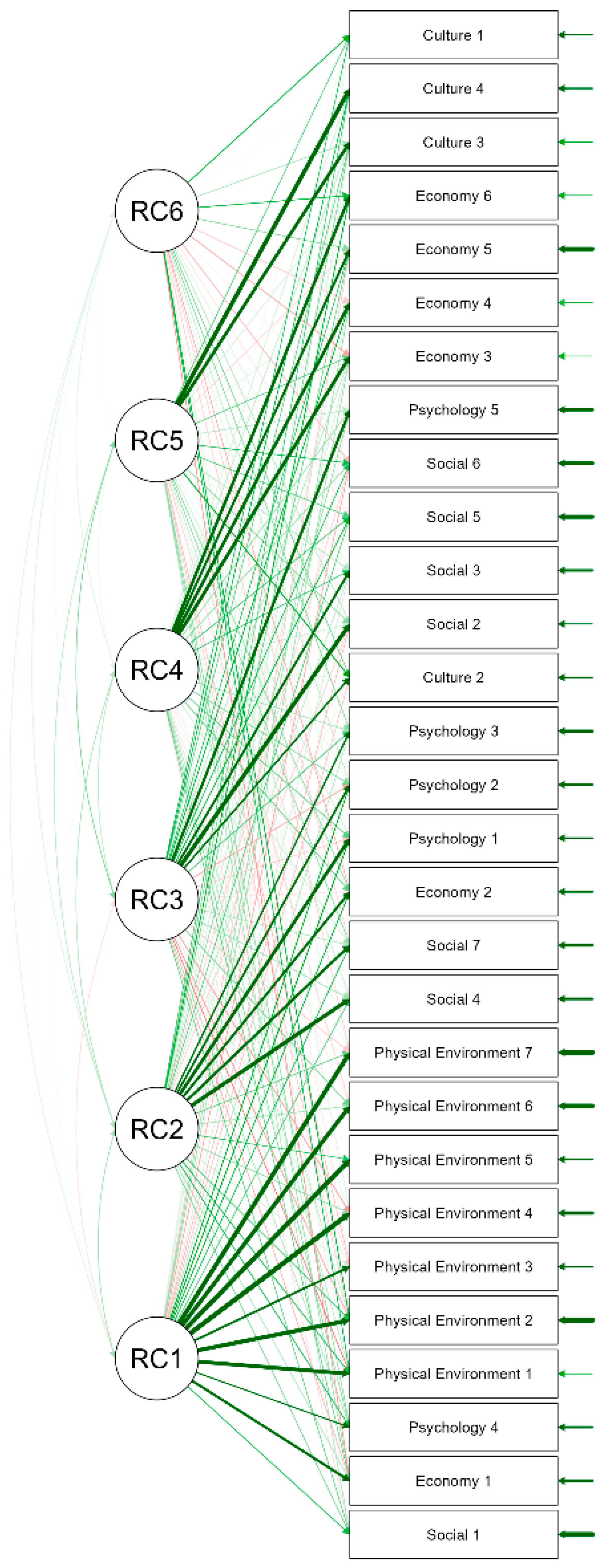
The analysis reveals that Generation Z’s reluctance toward vertical housing in Surabaya is multidimensional, with physical environment preferences emerging as the primary factor, followed by an interrelated complex of psychological-social concerns. Notably, the expected five theoretical dimensions (cultural, social, economic, psychological, and physical environment) reorganized into a more nuanced five-factor structure, with considerable overlap between psychological and social dimensions (Figure 1). The relatively modest variance explained (45.1%) suggests that additional unmeasured factors may influence housing preferences, warranting further investigation through mixed-methods approaches.
Figure 1.
Factor structure of Generation Z’s reluctance toward vertical housing in the Surabaya metropolitan area. Note. Green lines indicate primary factor assignment. Solid arrows indicate factor loadings exceeding 0.50. The applied rotation method is Varimax.
3.2. Results of Structural Equation Modeling
All factor loadings were statistically significant (p < 0.001), confirming the validity of the measurement model. The standardized factor loadings demonstrated moderate to strong relationships across all constructs, indicating robust construct reliability. Specifically, the loadings for Cultural Accommodation ranged from 0.734 (Culture 3) to 0.841 (Culture 4), while those for Economic Considerations varied between 0.524 (Economic 4) and 0.598 (Economic 6). The Physical Environment construct exhibited loadings from 0.438 (Physical Environment 3) to 0.610 (Physical Environment 5), whereas Psychological-Social Concerns ranged from 0.464 (Psychology 3) to 0.648 (Social 4). Lastly, the Social Status construct showed factor loadings between 0.548 (Psychology 5) and 0.714 (Social 2).
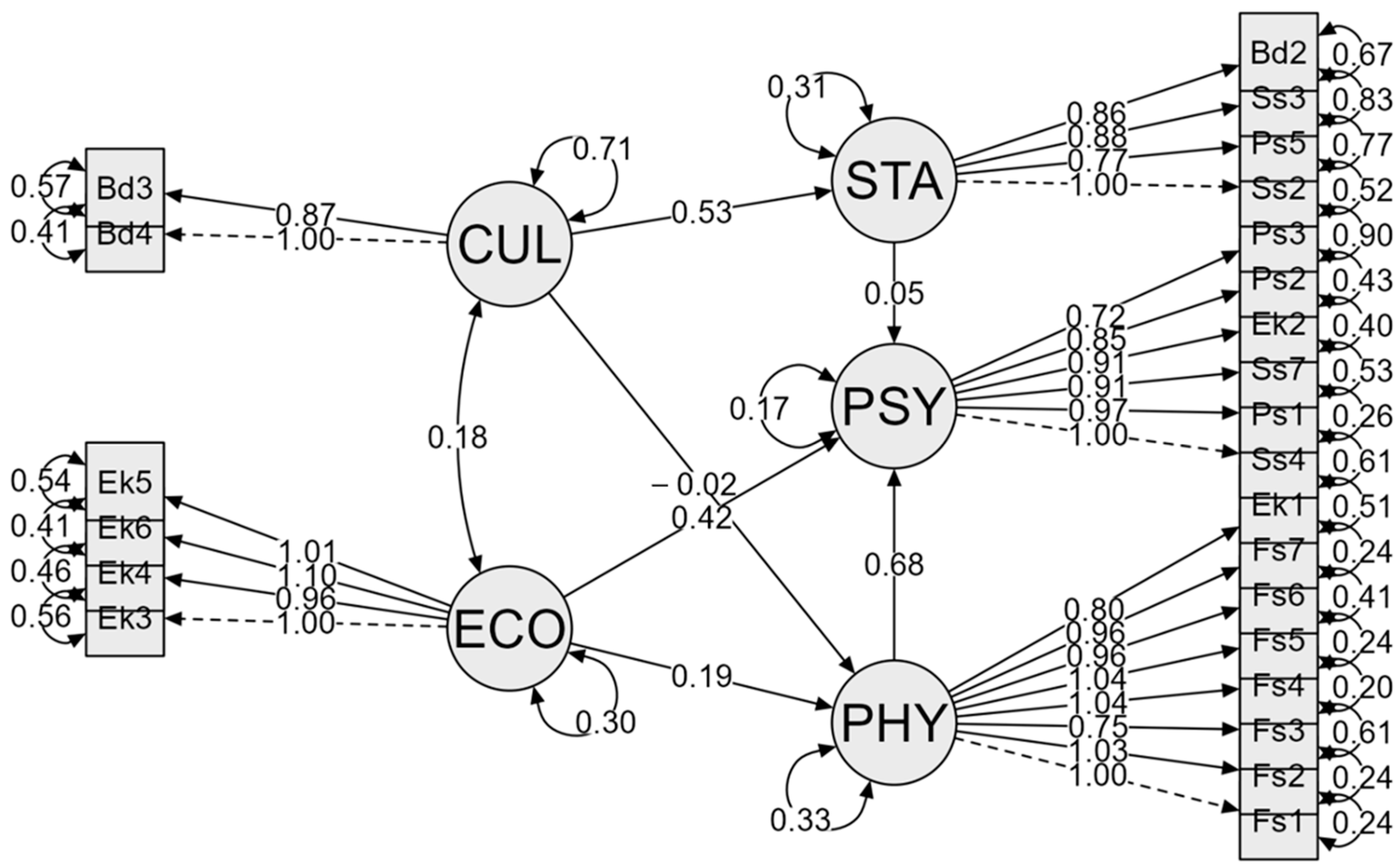
The structural model analysis revealed several supported hypotheses indicating significant relationships among the latent constructs (Table 6). Economic Considerations showed a significant positive effect on Physical Environment Preferences (β = 0.177, p = 0.024), supporting H2 and suggesting that financial factors meaningfully shape individuals’ preferences for physical housing attributes. A strong positive relationship was also found between Physical Environment Preferences and Psychological-Social Concerns (β = 0.611, p < 0.001), providing robust support for H3 and highlighting the influence of housing characteristics on psychological and social well-being. Similarly, Cultural Accommodation demonstrated a strong positive effect on Social Status (β = 0.620, p < 0.001), supporting H5 and indicating that cultural housing requirements play a significant role in shaping perceptions of social standing. Furthermore, Economic Considerations had a significant direct positive effect on Psychological-Social Concerns (β = 0.351, p < 0.001), supporting H6 and suggesting that financial constraints directly affect psychological well-being related to housing decisions.
Table 6.
Regression Coefficients significant relationships among the latent constructs.
In contrast, two hypotheses were not supported. The path from Cultural Accommodation to Physical Environment Preferences was not significant (β = −0.023, p = 0.762), indicating that cultural requirements do not directly influence individuals’ preferences for physical housing attributes, thereby rejecting H1. Likewise, the relationship between Social Status and Psychological-Social Concerns was not significant (β = 0.056, p = 0.328), leading to the rejection of H4 and suggesting that social status considerations do not directly impact psychological and social well-being in the context of housing preferences.
The SEM analysis reveals that Generation Z’s reluctance toward vertical housing operates through complex pathways (Figure 2). Economic considerations influence both physical environment preferences and psychological-social concerns directly. Cultural accommodation strongly shapes social status perceptions but does not directly affect physical preferences. Physical environment preferences emerge as a critical mediator, strongly influencing psychological-social concerns. The model’s ability to explain 58.4% of the variance in psychological-social concerns underscores the importance of addressing physical, economic, and cultural factors in promoting vertical housing acceptance among Generation Z in the Surabaya metropolitan area.
Figure 2.
SEM Path Diagram. Note: Single-headed arrows represent directional relationships. Double-headed curved arrows represent covariance/correlation. Solid lines show statistically significant paths (p < 0.05). Dashed lines show non-significant paths (p > 0.05).
3.3. Results of Content Analysis
The content analysis identified 411 coded statements across five dimensions, with a notable hierarchy of concerns emerging (Table 7). Physical dimensions dominated the discourse with 147 mentions (35.8%), followed by social considerations (92 mentions, 22.4%), economic factors (87 mentions, 21.2%), psychological concerns (56 mentions, 13.6%), and cultural aspects (29 mentions, 7.1%). This distribution aligns with the SEM findings, where physical environment preferences demonstrated the strongest mediating role in psychological-social concerns.
Table 7.
Thematic Keyword.
The physical dimension revealed the most balanced sentiment distribution. While 44 respondents expressed positive views, emphasizing that vertical housing offers “practical, modern facilities with complete amenities,” 21 respondents voiced concerns about “space limitations.” Psychological Inauthenticity: “Rasanya seperti tinggal di hotel, bukan rumah sendiri” (It feels like living in a hotel, not your own home) [R203, female, 22]. This ambivalence supports the SEM finding of relatively low variance explained in physical environment preferences (R2 = 0.029), suggesting heterogeneous attitudes within Generation Z.
Economic themes were overwhelmingly negative, with 36 respondents citing “high purchase prices” as a deterrent, compared to only 9 who viewed vertical housing as “affordable compared to landed houses.” Economic Anxiety: “Harga apartemen mahal tapi tidak bisa diwariskan ke anak-cucu seperti rumah” (Apartment prices are high but cannot be inherited by children and grandchildren like a house) [R089, male, 26]. This 4:1 negative-to-positive ratio corroborates the significant positive path coefficient from economic considerations to psychological-social concerns (β = 0.351, p < 0.001) in the SEM model, indicating that financial barriers substantially contribute to reluctance.
Social considerations revealed competing narratives. Thirty respondents expressed that vertical housing “requires privacy, making it unsuitable,” while 16 appreciated the “modern, practical, fast-paced, digital lifestyle” it offers. Positive Lifestyle Alignment: “Apartemen cocok untuk saya yang single dan mobile, tidak perlu repot maintenance” (Apartments suit me as a single, mobile person—no maintenance hassle) [R312, male, 25]. This tension validates the non-significant path from social status to psychological-social concerns in the SEM model, suggesting that social factors operate through complex, potentially opposing mechanisms.
Psychological themes exhibited complete negative valence, with all 30 coded statements expressing that vertical housing “lacks the comfort of a real home.” No positive psychological associations emerged from the data. This uniform negativity aligns with the high variance explained in psychological-social concerns (R2 = 0.584) in the SEM model, confirming these concerns as central to Generation Z’s housing reluctance.
Cultural dimensions, though least frequently mentioned, showed exclusively negative sentiment. All 23 cultural references stated that vertical housing is “not suitable for living with extended families,” with no positive cultural associations identified. Cultural-Family Tensions: “Kalau tinggal di apartemen, gimana kalau ibu mau menginap? Tidak ada kamar untuk beliau” (If I live in an apartment, what if my mother wants to stay? There is no room for her) [R127, female, 24]. This finding supports the SEM result showing cultural accommodation’s strong influence on social status (β = 0.620, p < 0.001) but not on physical preferences, suggesting cultural concerns operate through social mechanisms rather than physical housing attributes.
4. Findings and Discussion
This study investigated Generation Z’s reluctance toward vertical housing in the Surabaya metropolitan area through a mixed-methods approach combining exploratory factor analysis, structural equation modeling, and content analysis. The findings reveal a complex, multidimensional phenomenon where housing preferences are shaped by interconnected cultural, economic, physical, psychological, and social factors. The structural model successfully explained 58.4% of the variance in psychological-social concerns, identifying critical pathways through which reluctance develops.
4.1. Multidimensional Housing Preference Framework
Our five-factor structure extends previous housing preference models by revealing the unique configuration of concerns among Generation Z. While traditional housing choice theories emphasized location, price, and amenities [85,86], our findings demonstrate that Generation Z evaluates housing through additional lenses of cultural compatibility and psychological authenticity. This aligns with recent work by [2] who found that younger generations prioritize lifestyle alignment and identity expression in housing decisions beyond functional considerations.
The emergence of cultural accommodation as a distinct factor (explaining 38.4% variance in social status) corroborates emerging literature on Generation Z’s paradoxical relationship with tradition. Despite being digital natives, often characterized as individualistic [47] Our Indonesian sample demonstrates strong attachment to extended family structures. This finding resonates with Tan (2021), who identified similar patterns among Asian Generation Z, suggesting that modernization does not necessarily erode familial values but rather creates tension when housing forms conflict with cultural practices [87].
4.2. The Physical Environment as Critical Mediator
The strong mediating role of physical environment preferences (β = 0.611 to psychological-social concerns) provides empirical support for environment-behavior theories in the context of vertical housing. This finding extends the works on residential crowding and psychological distress [88,89], demonstrating that perceived spatial constraints translate into broader psychological resistance even before actual occupancy. The content analysis revealing balanced sentiments toward physical attributes (44 positive vs. 21 negative mentions) suggests that Generation Z recognizes practical benefits, but these are insufficient to overcome deeper concerns, a nuance missed in purely quantitative housing preference studies.
The low variance explained in physical environment preferences (R2 = 0.029) suggests that cultural and economic factors alone inadequately predict physical housing attribute preferences. Several unmeasured variables likely contribute: (1) childhood housing experiences, which shape baseline spatial expectations [90]; (2) media representations of ideal homes, particularly influential given Generation Z’s digital media consumption [76]; (3) peer housing situations creating reference points for comparison [71]; and (4) workplace location and commute considerations [36]. Additionally, the heterogeneous nature of physical preferences within Generation Z, some valuing modern amenities while others prioritize space, may suppress overall predictive power. Future research should incorporate these variables to develop more comprehensive models of physical preference formation.
4.3. Economic Considerations: Direct and Indirect Effects
The dual pathways from economic considerations—both direct (β = 0.351) and indirect through physical preferences (β = 0.177)—align with recent findings on Generation Z’s financial anxieties. Studies identified this generation as particularly cost-conscious due to witnessing economic instability during formative years [88,91]. Our content analysis ratio of 4:1 negative to positive economic sentiments extends this understanding, suggesting that perceived affordability issues with vertical housing may reflect broader economic insecurity rather than absolute price differences. This finding challenges assumptions in urban planning literature that position vertical housing as an affordable solution for younger generations [92].
4.4. Economic and Cultural Considerations: Analysis by Life Stage
Multi-group SEM analysis revealed significant differences between students (18–22, n = 156) and early-career professionals (23–27, n = 184). Economic considerations exerted stronger effects on psychological-social concerns among professionals (β = 0.428, p < 0.001) compared to students (β = 0.267, p = 0.003), reflecting heightened financial awareness accompanying economic independence. Conversely, cultural accommodation more strongly influenced social status concerns among students (β = 0.712, p < 0.001) than professionals (β = 0.534, p < 0.001), suggesting that parental and family influences diminish as individuals gain autonomy. These differential patterns imply that housing interventions should be life-stage sensitive.
4.5. Psychological Authenticity and Home Concept
The uniformly negative psychological themes in our content analysis and high variance explained in psychological-social concerns provide empirical evidence for the distinction theory between “house” and “home” [90]. Generation Z’s expression that vertical housing “lacks the comfort of a real home” suggests deeply embedded mental models of domestic space that vertical housing violates. This connects to recent works on “Generation Rent,” which found that young adults increasingly view homeownership, specifically of traditional housing forms, as essential to adult identity formation [93,94].
4.6. Implication for Urban Development and Policy
The non-significant path from cultural accommodation to physical preferences, coupled with its strong effect on social status, suggests that current vertical housing designs fail to accommodate cultural practices not through physical limitations but through social signaling. Developers should consider incorporating culturally sensitive design elements such as larger common areas for family gatherings [95], flexible unit configurations allowing multi-generational living [96], and semi-private spaces that balance privacy with communal interaction [97].
The strong direct effect of economic considerations on psychological-social concerns indicates that financial interventions alone may be insufficient. Rather than simply reducing prices, policymakers should consider innovative ownership models that address Generation Z’s specific economic anxieties. Examples include graduated ownership schemes, where residents transition from renting to owning [98,99], or cooperative housing models that provide both affordability and control—approaches showing promise in European contexts [100,101]. Several financing and policy mechanisms can be adopted as follows:
- Graduated Ownership Schemes: Implement rent-to-own programs where monthly payments transition from rental to equity accumulation over 5–10 years, addressing Generation Z’s preference for flexibility while building long-term investment value.
- Cooperative Housing Models: Adapt European cooperative models [101] to Indonesian contexts, allowing collective ownership that provides affordability, control, and community, addressing economic, psychological, and social concerns simultaneously.
- Intergenerational Housing Incentives: Provide tax incentives or subsidized loans for vertical housing projects incorporating multi-generational design features (e.g., adjoining units for parents, ground-floor commercial for family businesses).
- Transparent Total Cost of Ownership Disclosure: Mandate developers to provide lifetime cost projections, including maintenance fees, sinking funds, and utility estimates, reducing information asymmetry that fuels economic anxiety.
The balanced sentiment toward physical attributes suggests an opportunity for reframing vertical housing narratives. Rather than emphasizing modern amenities that Generation Z already acknowledges, communication should address psychological and cultural concerns directly. Marketing should reframe vertical housing narratives around:
- Lifestyle enablement: “Vertical living frees your time for what matters” rather than “convenient location”.
- Family accommodation: Showcase how vertical developments facilitate family gatherings and intergenerational visits.
- Investment security: Provide transparent data on resale values, rental yields, and long-term appreciation.
- Community building: Highlight social programming and resident associations that create authentic neighborhood connections.
Successful examples from Tokyo’s compact living movement demonstrate how vertical housing can be repositioned as enabling rather than constraining lifestyle choices [102].
This study contributes to housing preference theory by demonstrating that Generation Z’s housing decisions operate through complex, indirect pathways rather than simple attribute evaluations. The model reveals that cultural and economic factors influence psychological acceptance through multiple mechanisms, suggesting that traditional discrete choice models may oversimplify young adults’ housing decisions. Furthermore, the identification of psychological-social concerns as a critical outcome variable extends Technology Acceptance Model principles to residential contexts, where perceived compatibility with lifestyle and identity may override objective utility calculations. Table 8 shows valuable guidance for factor-specific design and policy strategies, indicating directions for Gen-Z-specific vertical housing development.
Table 8.
Factor-specific design and policy strategies.
4.7. Limitations and Future Research Directions
Several limitations warrant consideration. First, the cross-sectional design prevents causal inference about how preferences might evolve with life stage transitions. Longitudinal studies tracking Generation Z as they form households could reveal whether reluctance persists or adapts. Second, the study focused on metropolitan Surabaya; comparative research across Indonesian cities with different vertical housing traditions could identify context-specific versus generalizable patterns. Third, the relatively low variance explained in physical preferences (R2 = 0.029) suggests unmeasured variables, potentially including peer influence, media representations, childhood residential experiences, or commute consideration.
Future research should explore interventions designed to address identified concern pathways. Experimental studies could test whether exposure to culturally adapted vertical housing designs shifts preference patterns. Additionally, comparing Generation Z preferences across Asian countries could distinguish culture-specific from generation-specific factors. Finally, investigating successful vertical housing communities that attract young residents could identify best practices for overcoming the identified barriers.
5. Conclusions
This study reveals that Generation Z’s reluctance toward vertical housing reflects sophisticated evaluation across multiple life dimensions rather than a simple preference for traditional housing forms. The high explanatory power for psychological-social concerns, coupled with uniformly negative psychological themes, suggests that current vertical housing models fundamentally misalign with this generation’s conception of home. The qualitative findings particularly illuminate the nature of the “reluctance” phenomenon. Rather than simple rejection, Generation Z demonstrates sophisticated evaluation across multiple dimensions, with physical amenities recognized but ultimately outweighed by concerns about family accommodation, genuine comfort, privacy, and affordability. As urbanization pressures intensify and Generation Z enters prime household formation years, addressing this misalignment becomes critical for sustainable urban development. Success will require moving beyond technical solutions to create vertical housing that resonates with Generation Z’s unique blend of modern aspirations and enduring values.
Author Contributions
I.H.: Data collection, processing, investigation, analysis, and writing—original draft; P.N.: Supervision, conceptualisation, writing—review and editing. All authors have read and agreed to the published version of the manuscript.
Funding
This research was funded by Institut Teknologi Sepuluh Nopember, grant number 2433/PKS/ITS/2025.
Institutional Review Board Statement
This study is exempt from full ethical review by the Urban and Regional Planning Department-ITS (Reference No. 4184/IT2.IX.3.1.4/T/TU.00.08/XII/2025).
Informed Consent Statement
Informed consent was obtained from all subjects involved in the study.
Data Availability Statement
The data are contained within the article. Further inquiries can be directed to the corresponding author.
Acknowledgments
During the preparation of this manuscript/study, the author(s) used GenAI, Answerthis for the purposes of data collection. The authors have reviewed and edited the output and take full responsibility for the content of this publication.
Conflicts of Interest
The authors declare no conflicts of interest.
References
- Roberts, M.; Gil Sander, F.; Tiwari, S. Time to ACT: Realizing Indonesia’s Urban Potential; World Bank: Washington, DC, USA, 2019; ISBN 978-1-4648-1389-4. [Google Scholar]
- Fadillah, P.; Adianto, J. Reasons for Freehold Homeownership of the Younger Generations to Live in Vertical Housing in the Greater Jakarta Metropolitan Area, Indonesia. Int. J. Built Environ. Sci. Res. 2024, 8, 45. [Google Scholar] [CrossRef]
- Al-Kodmany, K. Sustainability and the 21st Century Vertical City: A Review of Design Approaches of Tall Buildings. Buildings 2018, 8, 102. [Google Scholar] [CrossRef]
- Vala Pardede, G.D.; Qastharin, A.R. Designing Social Media Marketing Strategies Targeting Generation Z for Subsidized Housing in Indonesia (A Case Study of Pt. Graha Putra Asido). Int. J. Curr. Sci. Res. Rev. 2024, 7, 5659–5666. [Google Scholar] [CrossRef]
- Ul Jannah, A.; Adianto, J. Getting a Home for Urban Young Adult: A Preliminary Study of Intergenerational Housing Transitions in Indonesia. Int. J. Built Environ. Sci. Res. 2024, 8, 123. [Google Scholar] [CrossRef]
- Ismail, H.; Nawawi, A.H.; Saat, Z.M. Property Development: The Influence of Demographic Changes on the Actors and the Malaysian Housing Demand (Preferences)—Preliminary Findings (Housing Consumers). In Proceedings of the 2012 IEEE Business, Engineering & Industrial Applications Colloquium (BEIAC), Kuala Lumpur, Malaysia, 7–8 April 2012; IEEE: New York, NY, USA, 2012; pp. 334–341. [Google Scholar]
- Mulyano, Y.; Rahadi, R.A.; Amaliah, U. Millennials Housing Preferences Model in Jakarta. Eur. J. Bus. Manag. Res. 2020, 5. [Google Scholar] [CrossRef]
- Prativi, F.P.; Yuniarti, N.A.; Kamara, I.S. Millennial Generation (Gen-Y) Preferences Towards Landed House Ownership in Yogyakarta Urban Agglomeration Using Logistic Regression. JAMPE (J. Asset Manag. Public Econ.) 2024, 3, 31–43. [Google Scholar] [CrossRef]
- Subagyo, A.; Syari’udin, A.; Yunani, A. Determinant Residential Real Estate of Millennial Generation in Adapting Housing Microfinance Case Indonesia Chapter. Int. J. Hous. Mark. Anal. 2023, 16, 1007–1020. [Google Scholar] [CrossRef]
- Ratu Sonya Mentari Haerdy. PEMENUHAN HUNIAN LAYAK DAN TERJANGKAU MILENIAL DI KOTA BANDUNG MELALUI PENERAPAN TEKNOLOGI PREFABRIKASI RISHA. Tesa Arsit. 2023, 20, 148–157. [Google Scholar] [CrossRef]
- Sagala, Y.K.; Damayanti, R.; Sunaryo, R.G. CORRIDOR AS A SUSTAINABLE SOCIAL SPACE IN HIGH-RISE RESIDENTIAL BUILDING. Adv. Civ. Eng. Sustain. Archit. 2022, 4, 12–25. [Google Scholar] [CrossRef]
- Abdi, F. Understanding the Impact of High-Rise Buildings on Environmental Quality and Sustainable Urban Development. J. Art Archit. Stud. 2019, 8, 13–18. [Google Scholar] [CrossRef]
- Forys, I. Municipal Housing Resource Management System: Element of Polish City Management Strategy or Housing Policy? IOP Conf. Ser. Mater. Sci. Eng. 2019, 471, 112078. [Google Scholar] [CrossRef]
- Apriani, K.; Sukoharsono, E.G.S.; Adib, N. Quintuple Helix in Public Private Partnership (Ppp) Projects (Case Study—PPP’s Housing Project in Surabaya). Marg. J. Manag. Account. Gen. Financ. Int. Econ. Issues 2024, 3, 874–885. [Google Scholar] [CrossRef]
- Adianto, J.; Rahman, M.F.; Gabe, R.T.; Christina, A. The Complexity of Contextuality: A Case Study on Vertical Housing Facilities in Surabaya, Indonesia. Environ. Urban. ASIA 2022, 13, 99–112. [Google Scholar] [CrossRef]
- Vialita, E.; Rahmawati, D. How Liveable Is Living in Public Housing? A Liveability Measurement at Low-Income Apartment of Kompleks Rumah Susun Sombo, Surabaya. IOP Conf Ser Earth Environ. Sci. 2020, 452, 012129. [Google Scholar] [CrossRef]
- Sulistyarini, D.; Kumorotomo, W.; Rajiyem, R. Javanese Cultural Content and Identity Construction: Study on Javanese Transmigrant Descendants in Lampung, Indonesia. J. Komun. Malays. J. Commun. 2024, 40, 448–464. [Google Scholar] [CrossRef]
- BPS. Statistical Yearbook of Indonesia 2023; BPS-Statistics Indonesia: Jakarta, Indonesia, 2023; pp. 83–141. [Google Scholar]
- Ajija, S.R.; Siddiqui, A.I. Impact of Joining Rotating Savings and Credit Association (Rosca) on Household Assets in Indonesia. J. Dev. Areas 2021, 55, 205–216. [Google Scholar] [CrossRef]
- Hermaleni, T.; Setiyawati, D.; Defrain, J. A Strong Family System From The Perspective Of Minangkabau Women; Qualitative Interviews With Ethnic Minang Wives And Bundo Kanduang. Proc. 1st Int. Conf. Soc. Sci. (ICSS) 2025, 4, 509–523. [Google Scholar] [CrossRef]
- Schröder-Butterfill, E. The Impact of Kinship Networks on Old-Age Vulnerability In Indonesia. Ann. Demogr. Hist. 2005, 110, 139. [Google Scholar] [CrossRef]
- Jansen, S.J.T.; Coolen, H.C.C.H.; Goetgeluk, R.W. (Eds.) The Measurement and Analysis of Housing Preference and Choice; Springer: Dordrecht, The Netherlands, 2011; ISBN 978-90-481-8893-2. [Google Scholar]
- Szymkowiak, A.; Melović, B.; Dabić, M.; Jeganathan, K.; Kundi, G.S. Information Technology and Gen Z: The Role of Teachers, the Internet, and Technology in the Education of Young People. Technol. Soc. 2021, 65, 101565. [Google Scholar] [CrossRef]
- Hartig, T.; Staats, H. The Need for Psychological Restoration as a Determinant of Environmental Preferences. J. Environ. Psychol. 2006, 26, 215–226. [Google Scholar] [CrossRef]
- Thwe, S.M.; Lim, W.M.; Koay, K.Y.; Ong, D. Consumers’ Motivation to Purchase Electric Vehicles: A Mixed-Methods Belief Elicitation Study Using Theory of Planned Behavior. Acta Psychol. 2025, 258, 105185. [Google Scholar] [CrossRef]
- Pisman, A.; Allaert, G.; Lombaerde, P. Urban and Suburban Lifestyles and Residential Preferences in a Highly Urbanized Society. Belgeo 2011, 1, 89–104. [Google Scholar] [CrossRef]
- Collen, H.; Hoekstra, J. Values as Determinants of Preferences for Housing Attributes. J. Hous. Built Environ. 2001, 16, 285–306. [Google Scholar] [CrossRef]
- Kamalipour, H.; Zaroudi, M. Sociocultural Context and Vernacular Housing Morphology: A Case Study. Curr. Urban Stud. 2014, 2, 220–232. [Google Scholar] [CrossRef]
- Kusno, A. Middling Urbanism: The Megacity and the Kampung. Urban Geogr. 2020, 41, 954–970. [Google Scholar] [CrossRef]
- Gentina, E.; Parry, E. (Eds.) The New Generation Z in Asia: Dynamics, Differences, Digitalisation; Emerald Publishing Limited: Leeds, UK, 2020; ISBN 978-1-80043-221-5. [Google Scholar]
- Nguyen, N.T.; Bui, H.T.H.; Cao, D.T.K. Residential Zones of Students around a University in Ho Chi Minh City: Characteristics and Preferences. Int. J. Built Environ. Sustain. 2023, 11, 49–58. [Google Scholar] [CrossRef]
- Zhou, M.; Kan, M.-Y.; He, G. Intergenerational Co-Residence and Young Couple’s Time Use in China. Chin. Sociol. Rev. 2022, 54, 401–431. [Google Scholar] [CrossRef]
- Hoolachan, J.; McKee, K. Inter-Generational Housing Inequalities: ‘Baby Boomers’ versus the ‘Millennials’. Urban Stud. 2019, 56, 210–225. [Google Scholar] [CrossRef]
- Boyd, D. It’s Complicated; Yale University Press: London, UK, 2020; ISBN 9780300166439. [Google Scholar]
- Wang, S.; Song, Y. A Study on the Aesthetic Tendency of the YZ Generation in China Toward the Façade Design of Coffee Shop Buildings. Buildings 2025, 15, 608. [Google Scholar] [CrossRef]
- Moos, M.; Revington, N.; Wilkin, T.; Andrey, J. The Knowledge Economy City: Gentrification, Studentification and Youthification, and Their Connections to Universities. Urban Stud. 2019, 56, 1075–1092. [Google Scholar] [CrossRef]
- Irviana, L.; Feranita, F.; Ge, B. Family Values, Emotions and Succession Intentions among Asian Gen Z: A Qualitative Multi-Country Exploration. J. Entrep. Emerg. Econ. 2025, 17, 1533–1561. [Google Scholar] [CrossRef]
- Youssef, E.; Medhat, M.; Abdellatif, S.; Babiker Yousif, N. Analyzing the Impact of Metaverse Technology on Social Development: A Field Study on Generation Z in the United Arab Emirates. Soc. Sci. 2024, 13, 446. [Google Scholar] [CrossRef]
- Twenge, J.M. Generations: The Real Differences between Gen Z, Millennials, Gen X, Boomers, and Silents—And What They Mean for America’s Future. Perspect. Sci. Christ. Faith 2023, 75, 212–214. [Google Scholar] [CrossRef]
- Turner, P.; Zepeda, E.M. Navigating White Waters: Generation Z Untraditional College Transition Amid Unprecedented Social, Health, and Academic Crisis. High. Educ. Stud. 2023, 13, 87. [Google Scholar] [CrossRef]
- Arundel, R.; Doling, J. The End of Mass Homeownership? Changes in Labour Markets and Housing Tenure Opportunities across Europe. J. Hous. Built Environ. 2017, 32, 649–672. [Google Scholar] [CrossRef]
- Jayatissa, K.A.D.U. Generation Z—A New Lifeline: A Systematic Literature Review. Sri Lanka J. Soc. Sci. Humanit. 2023, 3, 179–186. [Google Scholar] [CrossRef]
- Nwoke, J.U.C. Bridging Generational Wealth Gaps: Financial Planning Innovations for Millennials and Gen Z Clients. Int. J. Res. Publ. Rev. 2025, 6, 5904–5917. [Google Scholar] [CrossRef]
- Clapham, D.; Mackie, P.; Orford, S.; Thomas, I.; Buckley, K. The Housing Pathways of Young People in the UK. Environ. Plan. A Econ. Space 2014, 46, 2016–2031. [Google Scholar] [CrossRef]
- Twenge, J.M.; Cooper, A.B.; Joiner, T.E.; Duffy, M.E.; Binau, S.G. Age, Period, and Cohort Trends in Mood Disorder Indicators and Suicide-Related Outcomes in a Nationally Representative Dataset, 2005–2017. J. Abnorm. Psychol. 2019, 128, 185–199. [Google Scholar] [CrossRef]
- Hartig, T.; Evans, G.W.; Jamner, L.D.; Davis, D.S.; Gärling, T. Tracking Restoration in Natural and Urban Field Settings. J. Environ. Psychol. 2003, 23, 109–123. [Google Scholar] [CrossRef]
- Seemiller, C.; Grace, M. Generation Z; Routledge: Oxfordshire, UK, 2018; ISBN 9780429442476. [Google Scholar]
- Mutiara Cipta, D.; Alvin, S. Safeguarding Personal Information: Communication Privacy Management By Gen-Z Influencers. Int. J. Educ. Res. Soc. Sci. 2023, 4, 465–471. [Google Scholar] [CrossRef]
- Evans, G.W. The Built Environment and Mental Health. J. Urban Health 2003, 80, 536–555. [Google Scholar] [CrossRef]
- Pihkala, P. Anxiety and the Ecological Crisis: An Analysis of Eco-Anxiety and Climate Anxiety. Sustainability 2020, 12, 7836. [Google Scholar] [CrossRef]
- Malik, A.; Gulzar, A.; Khan, M.A.; Siddique, N. Mapping Global Research on Generation Z: A Bibliometric Analysis. Glob. Knowl. Mem. Commun. 2024, 72, 138–159. [Google Scholar] [CrossRef]
- Tarigan, S.G.; Mannan, K.A.; Uddin, N. The Future of Workplace in Greater Jakarta: Hybrid Office in the Post Covid-19 Pandemic. IOP Conf. Ser. Earth Environ. Sci. 2023, 1218, 012026. [Google Scholar] [CrossRef]
- Dzhambov, A.M.; Lercher, P.; Browning, M.H.E.M.; Stoyanov, D.; Petrova, N.; Novakov, S.; Dimitrova, D.D. Does Greenery Experienced Indoors and Outdoors Provide an Escape and Support Mental Health during the COVID-19 Quarantine? Environ. Res. 2021, 196, 110420. [Google Scholar] [CrossRef]
- Lulewicz-Sas, A.; Kinowska, H.; Zubek, M.; Danilewicz, D. Examining the Impacts of Environmental, Social and Governance (ESG) on Employee Engagement: A Study of Generation Z. Cent. Eur. Manag. J. 2025. [Google Scholar] [CrossRef]
- Kamenidou, I.C.; Mamalis, S.A.; Pavlidis, S.; Bara, E.-Z.G. Segmenting the Generation Z Cohort University Students Based on Sustainable Food Consumption Behavior: A Preliminary Study. Sustainability 2019, 11, 837. [Google Scholar] [CrossRef]
- Noaime, E.; Alalouch, C.; Mesloub, A.; Hamdoun, H.; Gnaba, H.; Alnaim, M.M. Urban Centrality as a Catalyst for City Resilience and Sustainable Development. Land 2025, 14, 1333. [Google Scholar] [CrossRef]
- Vivek, R.; Nanthagopan, Y.; Piriyatharshan, S. Beyond Methods: Theoretical Underpinnings of Triangulation in Qualitative and Multi-Method Studies”. SEEU Rev. 2023, 18, 105–122. [Google Scholar] [CrossRef]
- Adianto, J.; Gabe, R.T.; Farraz, M.A. The Influence of Family Relations on the Housing Preferences of Millennials in Depok, Indonesia. J. Urban. Int. Res. Placemaking Urban Sustain. 2023, 16, 84–100. [Google Scholar] [CrossRef]
- Varjakoski, H.; Koponen, S.; Kouvo, A.; Tiilikainen, E. Age Diversity in Neighborhoods—A Mixed-Methods Approach Examining Older Residents and Community Wellbeing. Int. J. Env. Res. Public Health 2023, 20, 6574. [Google Scholar] [CrossRef]
- Cerna, J.T.; Dela, C.; Sonido, J.M.; Mae Rubio, D.K.; V. Sisles, L.F. Analyzing Gen Z’s Travel Influence in the Digital Age: The Correlational Effect of Social Media. Int. J. Multidiscip. Res. Anal. 2024, 7, 4580–4586. [Google Scholar] [CrossRef]
- Brown, E.D.; Williams, B.K. The Potential for Citizen Science to Produce Reliable and Useful Information in Ecology. Conserv. Biol. 2019, 33, 561–569. [Google Scholar] [CrossRef]
- Salim, E.; Ali, H. Yulasmi Modeling Interest in Visiting Through Expected Values in Tourism at Solok Regency, Indonesia. Int. J. Prof. Bus. Rev. 2023, 8, e0986. [Google Scholar] [CrossRef]
- Sarstedt, M. Revisiting Hair Et al.’s Multivariate Data Analysis: 40 Years Later. In The Great Facilitator; Springer International Publishing: Cham, Switzerland, 2019; pp. 113–119. [Google Scholar]
- Suminar, L.; Astuti, W.; Sunjaya, N.I.; Kusumaputri, A.N.; Margareta, L.A.; Pamungkas, P.B. Local Wisdom in Housing and Settlement Planning: A Case Study of Sudiroprajan Chinatown, Surakarta. ETHOS J. Penelit. Dan Pengabdi. Kpd. Masy. 2024, 12, 71–80. [Google Scholar] [CrossRef]
- Tan, T.H.; Lee, J.H. Assessing the Determinants of Retirement Home Ownership among Malaysian Young-Old Seniors. Int. J. Hous. Mark. Anal. 2018, 11, 687–700. [Google Scholar] [CrossRef]
- Latif, A.; Apriani, E.; Afandi, D.R.; Sabilla, A.R. Financial Management Behavior: Case Study of Gen Z and Millennial Gen Bekasi Regency. Riwayat Educ. J. Hist. Humanit. 2025, 8, 448–456. [Google Scholar] [CrossRef]
- Safuwan, A.M. Personal Construct Experience of Tionghoa Community in Aceh Reality; Emerald Publishing: Leeds, UK, 2018; pp. 193–198. [Google Scholar]
- Yohanes, K.N.; Hamumpuni, H.S.; Utami, M.P.P. The Middle-Income Trap Problem Faced by Millennials and Gen z in Jakarta: Challenges and Mitigating Strategies. Crit. Issue Sustain. Future 2025, 2, 45–65. [Google Scholar] [CrossRef]
- Sumathy, M.; Kesawaraj, P.K. Thrift Economy: Why Gen Z Prefers Second Hand Over Fast Fashion. Int. J. Adv. Res. Sci. Commun. Technol. 2025, 5, 258–259. [Google Scholar] [CrossRef]
- Farasa, N.; Kusuma, H.E. Housing Preferences of Young Adults in Indonesia: Housing Attributes and Consequences. IOP Conf. Ser. Earth Environ. Sci. 2018, 126, 012184. [Google Scholar] [CrossRef]
- McCartney, S.; Rosenvasser, X. Affordability Is King–with Private Bedroom: Exploring the Mismatch of Students’ Housing Preferences in Constrained Housing Markets. Hous. Stud. 2024, 39, 2806–2826. [Google Scholar] [CrossRef]
- Khogali, M.M.E.; Mohamed Ali, E.A.; Ramdani, A. Integrating Behavioral Science into Urban Planning: A Framework for Human-Centered Spatial Design. Front. Psychol. 2025, 16, 1632523. [Google Scholar] [CrossRef]
- Gladysheva, A. Psychological Aspects of Human Perception of the Urban Environment in the Context of Sustainable Development. Appl. Psychol. Pedagog. 2025, 10, 12–25. [Google Scholar] [CrossRef]
- Eßwein, S. Generation Z. WzS Wege Zur Sozialversicherung; Erich Schmidt Verlag GmbH & Co. KG.: Berlin, Germany, 2025; Volume 10, p. 9. [Google Scholar] [CrossRef]
- Napiórkowska-Baryła, A.; Świdyńska, N.; Witkowska-Dąbrowska, M. Owning versus Renting a Home—Prospects for Generation Z. Sustainability 2024, 16, 4715. [Google Scholar] [CrossRef]
- Kennedy, Ü. Exploring YouTube as a Transformative Tool in the “The Power of MAKEUP!” Movement. M/C J. 2016, 19. [Google Scholar] [CrossRef]
- Kaniah; Budihastuti, E.; Suharja, A.A.; Maemunah, E.; Parwati, S.A.P.E.; Mulyanah, A.; Sariah; Widiastuti, R.; Kusnanto, E.A. The Utilization of Social Media and the Reinforcement of National Identity in Generation Z. Southeast Asian Lang. Lit. Stud. 2025, 1, 116–122. [Google Scholar] [CrossRef]
- Esteve, A.; Reher, D.S. Rising Global Levels of Intergenerational Coresidence Among Young Adults. Popul. Dev. Rev. 2021, 47, 691–717. [Google Scholar] [CrossRef]
- Syufa’at, S.; Zaidi, S.M.S.; Mutholaah, M. Sandwich Generation in Contemporary Indonesia: Determining Responsibility in Caring for Elderly under Islamic Law and Positive Law. Al-Manahij J. Kaji. Huk. Islam 2023, 17, 167–182. [Google Scholar] [CrossRef]
- Nasr, R.; Nasr, N.; Haddad, C.; Saab, S.A.; Ibrahim, S.A.; Karam, J.; Rahman, A.A. Financial Insecurity and Mental Well-Being: Experiences of Parents amid the Lebanese Economic Crisis. BMC Public Health 2024, 24, 3017. [Google Scholar] [CrossRef]
- Naim, M.F. Managing Generation Z in Gig Economy: Towards an Integrative Framework of Talent Management. In Sustainability in the Gig Economy; Springer Nature: Singapore, 2022; pp. 293–303. [Google Scholar]
- Lomas, C.D. A Thematic Analysis of British Rehabilitation Centers Clients Reviews 2020–2024. Alcohol Treat Q 2025, 43, 167–187. [Google Scholar] [CrossRef]
- Addison, H.A.; Richmond, T.S.; Lewis, L.M.; Jacoby, S. Mental Health Outcomes in Formerly Incarcerated Black Men: A Systematic Mixed Studies Review. J. Adv. Nurs. 2022, 78, 1851–1869. [Google Scholar] [CrossRef]
- Li, Q.; Zeng, J.; Zhao, B.; Perrin, N.; Wenzel, J.; Liu, F.; Pang, D.; Liu, H.; Hu, X.; Li, X.; et al. Nurses’ Preparedness, Opinions, Barriers, and Facilitators in Responding to Intimate Partner Violence: A Mixed-methods Study. J. Nurs. Scholarsh. 2024, 56, 174–190. [Google Scholar] [CrossRef]
- Wang, D.; Li, S.-M. Housing Preferences in a Transitional Housing System: The Case of Beijing, China. Environ. Plan. A Econ. Space 2004, 36, 69–87. [Google Scholar] [CrossRef]
- Opoku, R.A.; Abdul-Muhmin, A.G. Housing Preferences and Attribute Importance among Low-Income Consumers in Saudi Arabia. Habitat Int. 2010, 34, 219–227. [Google Scholar] [CrossRef]
- Tan, C. A Study of Boundedly Rational Behaviour in Housing Choice: Evidence from Malaysia. Int. J. Hous. Mark. Anal. 2022, 15, 1259–1274. [Google Scholar] [CrossRef]
- Ekstam, H. Residential Crowding in a “Distressed” and a “Gentrified” Neighbourhood—Towards an Understanding of Crowding in “Gentrified” Neighbourhoods. Hous. Theory Soc. 2015, 32, 429–449. [Google Scholar] [CrossRef]
- Wang, X.; Liu, T. Home-Made Blues: Residential Crowding and Mental Health in Beijing, China. Urban Stud. 2023, 60, 461–482. [Google Scholar] [CrossRef]
- Liu, Y. House vs. Home: Two Case Studies of Rural Migrant Workers’ Residences. Cult. Pedagog. Inq. 2025, 16, 128–154. [Google Scholar] [CrossRef]
- Kumar Chaudhary, M.; Dhungana, M.; Subedi, M.; Singh, H.; Mani Ghimire, D. Resilience of Gen Z to Socioeconomic Challenges: The Interconnection of Family Financial Socialization, Attitudes Towards Money and Financial Well-Being. Socioecon. Chall. 2025, 9, 1–20. [Google Scholar] [CrossRef]
- Yung, E.H.K.; Wang, S.; Chau, C. Thermal Perceptions of the Elderly, Use Patterns and Satisfaction with Open Space. Landsc Urban Plan 2019, 185, 44–60. [Google Scholar] [CrossRef]
- Tocchioni, V.; Berrington, A.; Vignoli, D.; Vitali, A. The Changing Association Between Homeownership and the Transition to Parenthood. Demography 2021, 58, 1843–1865. [Google Scholar] [CrossRef]
- Howard, A.; Hochstenbach, C.; Ronald, R. Understanding Generational Housing Inequalities beyond Tenure, Class and Context. Econ. Soc. 2024, 53, 135–162. [Google Scholar] [CrossRef]
- Lafi, M.W.; Alkhalifa, H.E.; Jiwane, A.V. Identifying the Issues Leading to Residents’ Modifications in Bahraini Subsidized Housing Units. Front. Built. Environ. 2023, 9, 1154546. [Google Scholar] [CrossRef]
- Verderber, S.; Koyabashi, U.; Cruz, C.D.; Sadat, A.; Anderson, D.C. Residential Environments for Older Persons: A Comprehensive Literature Review (2005–2022). HERD Health Environ. Res. Des. J. 2023, 16, 291–337. [Google Scholar] [CrossRef] [PubMed]
- Kulangara, S.; Prakash, A.V.P. Boundaries of Privacy: A Reevaluation of Spatial Dynamics in Traditional Kerala Homes. Int. J. Sci. Res. Eng. Manag. 2024, 8, 1–13. [Google Scholar] [CrossRef]
- Jin, C.; Li, B.; Jansen, S.J.T.; Boumeester, H.J.F.M.; Boelhouwer, P.J. Understanding the Housing Pathways and Migration Plans of Young Talents in Metropolises–A Case Study of Shenzhen. Hous. Theory Soc. 2023, 40, 435–462. [Google Scholar] [CrossRef]
- Oyesomo, O.C.; Seun, O.J.; Bolayemi, A.K. Housing Affordability in Nigeria; an Analysis of Lagos State Government Rent to Own Scheme. Int. J. Res. Innov. Soc. Sci. 2023, VII, 272–289. [Google Scholar] [CrossRef]
- Hagbert, P.; Larsen, H.G.; Thörn, H.; Wasshede, C. Contemporary Co-Housing in Europe; Routledge: London, UK, 2019; ISBN 9780429450174. [Google Scholar]
- Larsen, H.G. Property Relations between State and Market: A History of Housing Cooperatives in Denmark. Hous. Stud. 2025, 40, 2142–2164. [Google Scholar] [CrossRef]
- Murooka, T.; Shimizu, H.; Taniguchi, M. Networked Compact City Policy Status and Issues—Hierarchy and Human Mobility in Tokyo, Japan. Sustainability 2021, 13, 13107. [Google Scholar] [CrossRef]
Disclaimer/Publisher’s Note: The statements, opinions and data contained in all publications are solely those of the individual author(s) and contributor(s) and not of MDPI and/or the editor(s). MDPI and/or the editor(s) disclaim responsibility for any injury to people or property resulting from any ideas, methods, instructions or products referred to in the content. |
© 2026 by the authors. Licensee MDPI, Basel, Switzerland. This article is an open access article distributed under the terms and conditions of the Creative Commons Attribution (CC BY) license.