Article

Evaluating the Drivers of Willingness to Pay for Stormwater Fees Using Machine Learning Analysis of Citizen Perceptions and Attitudes

1
Department of Work, Technology and Participation, Technische Universität Berlin, 10587 Berlin, Germany
2
School of Technology and Architecture, SRH Berlin University of Applied Science, 12059 Berlin, Germany
*
Author to whom correspondence should be addressed.
Urban Sci. 2026, 10(1), 27; https://doi.org/10.3390/urbansci10010027
Submission received: 26 November 2025 / Revised: 26 December 2025 / Accepted: 28 December 2025 / Published: 2 January 2026

Abstract

Urban stormwater management presents significant challenges for municipalities seeking to balance environmental resilience with financial considerations and social equity. This study investigates the factors shaping residents’ willingness to pay (WTP) for a proposed stormwater management fee in Norwalk, Connecticut, within the context of local sustainability plans. A survey of 457 residents assessed demographics, personal beliefs, perceptions of benefits, risks, and WTP. Since participation was voluntary and open, an exact response rate could not be calculated, and the resulting respondent profile differed from city benchmarks. The results were analyzed using descriptive and inferential statistics alongside a Random Forest machine learning model assessing two payment scenarios, achieving classification accuracies above the majority-class baseline (approximately 60–68%). Across both scenarios, expectations of tangible and locally visible outcomes, including infrastructure upgrades and climate resilience improvements, were the strongest determinants of WTP. When respondents evaluated a specific fee amount rather than a general modest fee, concerns about affordability and program effectiveness became more influential and revealed the conditional nature of financial support. The findings illustrate the value of machine learning for analyzing public attitudes toward environmental finance and highlight how policy framing, transparency, and communication shape acceptance of sustainability measures. These insights provide a data-driven foundation for future research on public engagement and equity in local environmental policy and stormwater plan development.

1. Introduction

Cities across the United States are under increasing pressure to adapt to climate-driven challenges as a result of intensifying precipitation, aging infrastructure, and more frequent and severe flooding [1,2]. These pressures are occurring at a time when municipal funding remains constrained by political resistance to new taxes and growing competition for limited public resources. Stormwater management, which is often underfunded and invisible to residents, has therefore become a critical focus of climate adaptation policy as both inland and coastal flood risks continue to intensify and management costs increase.
The City of Norwalk, Connecticut, illustrates these dynamics while actively pursuing the goal of becoming the state’s “greenest” and most sustainable municipality. In pursuit of this objective, Norwalk has adopted a comprehensive Sustainability and Resilience Plan (SRP) to guide climate adaptation and infrastructure modernization. A central recommendation of the SRP is the establishment of a dedicated stormwater authority and the introduction of a stormwater management fee to provide stable, long-term funding for capital investments and routine maintenance. Beyond the SRP’s stated objectives, Norwalk provides a relevant case for examining public willingness to pay (WTP) for stormwater management due to its combined coastal and inland flood risk, socio-economic diversity, and local community interest in sustainability initiatives.

1.1. Stormwater Finance and Public Acceptance

Stormwater management fees are increasingly being used as policy tools for financing urban resilience initiatives as flood events escalate in frequency and severity. Unlike general property taxation, these fees are typically structured as user-based charges linked to measurable impacts on the stormwater system, often derived from the amount of impervious surface area on a property [3,4]. Revenue generated by stormwater fees is often directed toward targeted investments in green infrastructure, maintenance, and flood mitigation projects [5,6]. In some jurisdictions, credit or rebate programs are also developed to encourage property owners to adopt on-site mitigation practices such as rain gardens or green roofs, attempting to shift responsibility for stormwater management beyond municipal systems and distributing adaptation efforts more equitably across the community [7]. These efforts represent a hybrid strategy for addressing increased demands on stormwater systems and offer a community-driven alternative for stormwater management.
Despite their technical and fiscal rationale, stormwater fees are frequently contested by policymakers and the general public. Their adoption often intersects with broader debates as stormwater systems have historically been funded through general revenues, and the introduction of a dedicated fee can heighten public scrutiny of municipal decision-making and the perceived fairness of cost allocation. As a result, the effectiveness of stormwater fees depends not only on engineering performance or regulatory compliance, but also on public acceptance and behavioral response.

1.2. Research Context and Theoretical Framework

Research on public acceptance of environmental financing mechanisms emphasizes that policy support is shaped by behavioral, institutional, and perceptual factors rather than technical design alone, with public participation and trust in governance processes playing central roles in shaping acceptance of new policy instruments [8]. Early work on environmental concern further demonstrates that individual values and normative orientations condition how people evaluate environmental policies and collective responsibilities [9]. Building on this foundation, WTP has become a widely used approach for assessing public support for environmental initiatives. Value–belief–norm (VBN) theory provides an additional framework for understanding how moral norms and belief systems translate into policy acceptance [10], while extensions of the theory of planned behavior (TPB) highlight the roles of attitudes, subjective norms, and perceived behavioral control in shaping stated WTP [11]. Research on scientific expertise and environmental policy further underscores that trust in institutional competence and transparency mediates how individuals interpret policy information and proposed interventions [12].
A related body of literature examines how demographic characteristics influence environmental concern and policy preferences. While early studies identified income, education, and gender as predictors of environmental attitudes, subsequent research shows that these relationships are sensitive to contextual framing [13]. Classic theories of local public finance suggest that preferences for public goods are shaped by perceptions of benefit distribution and economic fairness rather than demographic characteristics alone [14]. Other experimental studies demonstrate that framing effects can substantially alter policy support by shaping perceptions of costs, benefits, and responsibility even when underlying policy attributes remain constant [15]. These dynamics are further amplified in polarized political contexts [16], which can reduce support for environmental adaptation measures when risks are perceived as remote or abstract [17]. These findings suggest that demographic variables do not operate as direct predictors of WTP but instead interact with perceptions of relevance, fairness, and anticipated outcomes.
Broader theories of environmentally significant behavior reinforce this interpretation by emphasizing that behavioral intentions emerge from the interaction of values, norms, and situational factors rather than from isolated economic considerations [18]. Within this framework, the TPB provides a useful lens for linking attitudinal constructs to expressed support for specific policies [19]. At the same time, methodological research highlights persistent limitations in stated preference approaches, including hypothetical bias and status quo bias, particularly when respondents evaluate unfamiliar or abstract policy instruments [20,21]. These limitations suggest that WTP estimates should be interpreted as conditional expressions of support shaped by perception, trust, and framing rather than as fixed indicators of financial capacity.
In response to these challenges, recent research has increasingly applied machine learning methods to analyze complex behavioral and perceptual systems. Studies across urban and transportation domains demonstrate that machine learning techniques can capture nonlinear relationships and interaction effects that are difficult to identify using conventional statistical models [22]. At the same time, growing emphasis has been placed on explainable machine learning approaches that balance predictive flexibility with interpretability, allowing researchers and policymakers to assess the relative importance of underlying drivers rather than relying on opaque predictive outputs [23]. Together, this literature indicates that WTP for environmental infrastructure is best understood as a multidimensional and context-dependent outcome shaped by values, perceptions, institutional trust, and methodological framing. Building on these insights, the present study integrates behavioral theory, demographic critique, and explainable machine learning within a unified analytical framework to examine the drivers of public support for a proposed stormwater management fee.

1.3. Research Gap, Aim, and Objectives

Although prior research is moving toward a deeper understanding of the context shaping WTP for environmental initiatives, significant gaps remain. In particular, there is limited empirical understanding of how demographic characteristics, perceptual factors, and latent attitudes jointly influence WTP in small and mid-sized cities, where infrastructure challenges, governance capacity, and socio-economic conditions may significantly shape public responses. Furthermore, minimal use of machine learning approaches in the public sector limits the generalizability of model outcomes, as the methods have yet to be applied in a diverse array of municipal settings.
The primary aim of this study is to examine how public perception and latent attitudinal factors jointly shape residents’ WTP for a proposed stormwater management fee in Norwalk, Connecticut. The study also assesses the representativeness of the survey sample relative to the city’s broader population to contextualize findings, identify potential biases, and evaluate whether machine learning approaches can complement traditional statistical methods in identifying key drivers of public acceptance.
Accordingly, this study addresses the following research questions:
  • How do demographic, perceptual, and attitudinal factors shape WTP for a stormwater management fee?
  • Can machine learning approaches complement traditional statistical methods in identifying the behavioral drivers of policy acceptance?
By addressing these questions, this research contributes to stormwater finance literature by demonstrating the application of interpretable machine learning approaches for analyzing WTP and highlighting how feature importance metrics can reveal behavioral drivers of policy acceptance beyond what is typically captured using traditional statistical methods.

2. Materials and Methods

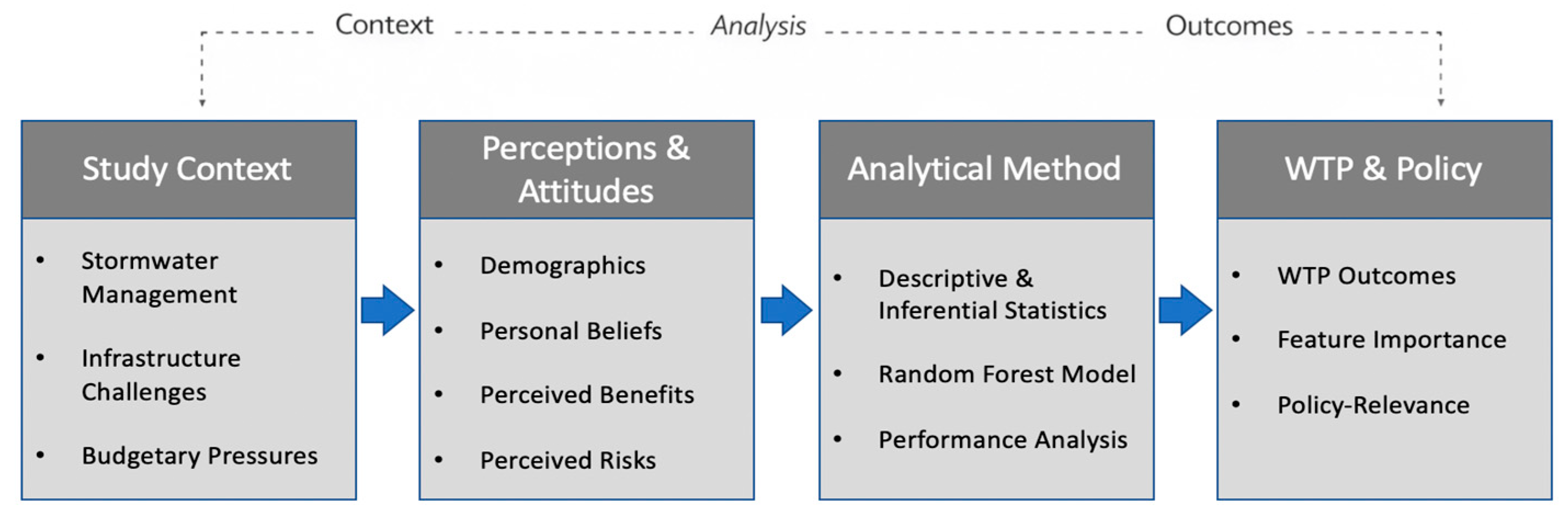
This study employs a mixed-methods quantitative design to examine public perceptions, attitudes, and WTP for a proposed stormwater management fee in Norwalk, Connecticut. The research design integrates survey-based data collection with descriptive statistical analysis and machine learning techniques to identify the demographic, attitudinal, and perceptual factors that shape policy acceptance. The following sections detail the methodological approach, including details about the survey instrument, the analytical framework guiding data processing and modeling, and statistical techniques used to assess sample characteristics and explore key predictors of support. Figure 1 presents the study framework, illustrating how stormwater management context, resident perceptions, and analytical methods are linked to WTP outcomes. Together, these methods provide the empirical foundation for understanding how socio-economic context, perceived benefits and risks, and individual beliefs influence public support for a local stormwater management fee.

2.1. Study Area: City of Norwalk

Norwalk is a mid-sized coastal city in southwestern Connecticut with a population of approximately 93,000 residents. Situated along the Long Island Sound, it maintains a combination of inland watersheds and coastal drainage systems. The city experiences a generally humid climate with increasing precipitation intensity, resulting in recurring stormwater challenges associated with heavy rainfall, localized inland flooding, and coastal storm surge. These meteorological conditions place sustained pressure on municipal drainage infrastructure and contribute to water quality impacts in local waterways and coastal receiving waters.
Land use in Norwalk is predominantly urban and residential, with a mix of dense neighborhoods, commercial corridors, transportation infrastructure, and coastal development zones. A substantial portion of the city’s built environment predates contemporary stormwater design standards, contributing to high levels of impervious surface coverage and limited on-site stormwater retention. Runoff from residential, commercial, and transportation areas represents a significant component of stormwater volume and pollutant loading, reinforcing the need for system-wide management strategies rather than site-specific controls alone.
Within this context, stormwater management is a locally important issue for residents as it directly affects neighborhoods and quality of life through coastal and inland flooding, which presents a regular threat to property and socially vulnerable populations, as a significant portion of the flood zone encumbers economically distressed areas of the City. These physical conditions provide an important backdrop for evaluating public perceptions of stormwater infrastructure investment and fee-based financing mechanisms, as residents’ WTP is shaped not only by socio-economic characteristics but also by lived experience with flooding risks and infrastructure performance.

2.2. Survey Design and Data Collection

The survey instrument was designed in collaboration with municipal officials to align with the City of Norwalk’s policy and communication objectives. Before distribution, the instrument underwent pilot testing in May 2024 with a group of residents (n = 87). This sample size was chosen in consideration of established survey methodology for instrument pretesting and was sufficient to evaluate question clarity, logical sequencing, internal consistency, and coherence between research objectives and data requirements. Minor adjustments were made following pilot feedback, including revisions to item wording, response options, and survey flow to enhance measurement validity and reduce nonresponse bias [24,25]. The final questionnaire was structured into five thematic sections designed to capture the range of factors influencing public perceptions of a potential stormwater management fee:
  • Demographic Characteristics: Age, gender, household income, educational attainment, race/ethnicity, housing tenure, neighborhood, and length of residency were collected to characterize the respondent population and support analysis of socio-demographic influences on policy preferences.
  • Personal Beliefs and Attitudes: Respondents rated their agreement with statements on municipal spending priorities, environmental protection, and social equity, as well as their perceptions of government effectiveness. A ranking task asked participants to prioritize economic development, environmental improvement, and equity initiatives for potential government spending.
  • Perceived Benefits: Participants evaluated the potential positive impacts of a stormwater fee, including improved infrastructure, enhanced climate resilience, reduced flood risk, and improved water quality. These items were preceded by a short, neutrally worded informational video to ensure a consistent baseline understanding of stormwater management concepts.
  • WTP: This section assessed respondents’ financial support thresholds for a modest fee, and a contextualized scenario referencing other locally relevant existing stormwater fees in Connecticut.
  • Perceived Risks: Respondents rated concerns about potential negative impacts, including increased living costs, disproportionate effects on low-income households and small businesses, limited environmental effectiveness, and insufficient adaptation outcomes.
Qualitative insights were drawn from open-ended survey responses and a follow-up discussion with municipal staff involved in stormwater management. Responses were reviewed using a thematic approach to identify recurring concerns related to affordability, transparency, fairness, and perceived benefits. These qualitative findings were used to contextualize quantitative results rather than formal inference.

Sampling, Distribution, and Data Processing

The survey targeted adult residents (aged 18 and older) in Norwalk, Connecticut, with the aim of capturing a broad sample of the city’s population. It was conducted over a three-month period from late May through July 2024, representing a cross-sectional snapshot of public perceptions during the early policy design phase. Recruitment employed a multimodal strategy to maximize accessibility and representation. The survey was distributed electronically via the City’s email distribution list and promoted through official social media channels. To increase participation among traditionally underrepresented neighborhoods, physical mailers and informational flyers were distributed on public buses, and the U.S. Postal Service’s targeted-mailing tool was used to reach geographic areas with historically low survey response rates.
A total of 457 residents participated voluntarily after providing informed consent. Survey participation was open to the general public, and sample characteristics were compared with American Community Survey (ACS) benchmarks to contextualize representativeness and guide interpretation. As the survey relied on open distribution channels, an exact response rate could not be calculated, but the total number of responses was comparable to prior municipal survey efforts. All participants were required to confirm their residency within the City of Norwalk to ensure sample validity. Responses were collected using Google Forms and exported into a master dataset for cleaning and preprocessing. Incomplete, duplicate, or invalid entries were removed prior to analysis. Categorical and Likert-scale responses were converted into numerical codes to facilitate statistical analysis. The resulting dataset formed the basis for descriptive statistics, inferential testing, and predictive modeling. Statistical analyses were conducted using SPSS version 29, and machine-learning applications, including Random Forest classification, were implemented in Python 3.10 using the scikit-learn library [26,27]. Participation in the study was anonymous, and all procedures complied with institutional ethical standards for research involving human subjects. Generative AI tools were not used in the development of this study or manuscript.

2.3. Analytical Framework

The analytical framework for this study was developed to investigate the socio-demographic, perceptual, and attitudinal determinants of public support for a proposed stormwater management fee and to evaluate how advanced machine learning techniques can complement traditional statistical approaches. The primary objective was to capture both the structural characteristics of the survey sample and the behavioral dynamics underlying WTP with particular attention to the latent psychological and perceptual variables that shape policy acceptance.
The analysis proceeded in two distinct but complementary stages. In the first stage, descriptive and inferential statistics were calculated to summarize the survey respondents’ key demographic and socio-economic characteristics. These measures provided an initial profile of the sample’s composition and allowed for comparison with the broader population of the City of Norwalk. Variables, including age, gender, income, education, housing tenure, and race/ethnicity, were compared against population benchmarks. Measures of central tendency (mean, median) and distribution (frequency, percentage) were calculated to profile the sample. Inferential statistical tests, specifically chi-square goodness-of-fit analyses, were conducted to evaluate whether observed differences between the survey sample and population benchmarks were statistically significant within the contexts of demographic groups and their relative WTP.
In addition to demographic analysis, a correlation matrix was constructed to map the attitudinal landscape and examine interrelationships among key perceptual variables, including environmental concern, equity considerations, perceived government effectiveness, and WTP. This exploratory analysis provided insight into how attitudes cluster and co-vary within the sample, offering contextual understanding of public perceptions prior to subsequent modeling. An ordered logistic regression using representative perceptual variables and demographic controls was estimated as a baseline benchmark for comparison with the Random Forest results. This combined approach, integrating descriptive profiling, inferential testing, and attitudinal landscape mapping, reflects a widely accepted methodological standard in environmental economics and policy research for identifying participation biases, establishing baseline sample characteristics, and contextualizing subsequent analytical findings [28,29].
In the second stage, a supervised machine learning model, specifically a Random Forest classifier, was implemented to assess the relative influence of individual predictors on WTP and to detect complex interactions among variables that are often missed by conventional statistical models. WTP was measured using a five-point Likert scale ranging from “strongly disagree” to “strongly agree” and was modeled directly as a multi-class classification outcome. Separate Random Forest classifiers were estimated for the modest conceptual fee and the specific example fee amount, allowing the model to capture variation in the intensity of support across response categories and compare how predictors influenced WTP under different payment contexts.
This two-stage analytical design integrates the strengths of classical statistical methods, particularly their ability to describe sample characteristics, and leverages the enhanced explanatory power of machine learning. The framework aligns with established theoretical models in environmental behavior, public goods provision, and policy acceptance, which emphasize that support for environmental initiatives is shaped by a multidimensional interplay of beliefs, perceived outcomes, perceived risks, and behavioral intentions. Such integration of descriptive, inferential, and computational approaches provides a comprehensive basis for examining the drivers of public WTP and for developing more targeted, socially responsive stormwater management policies.

2.3.1. Latent Variables and Model Structure

A core objective of this study was to identify and measure latent constructs underlying psychological and attitudinal dimensions that, while not directly observable, exert significant influence over WTP for environmental policies. These constructs were derived from four thematic sections of the survey instrument, which were purposefully designed to capture key determinants of public support for stormwater management.
  • Personal Beliefs: The first section of the survey measured respondents’ orientations toward municipal spending priorities, environmental protection, and social equity, as well as their trust in government institutions and sense of civic duty. In this context, institutional trust was defined as confidence that local authorities will manage resources transparently, deliver promised outcomes, and act in the public interest. Similarly, civic responsibility captures internalized social norms around collective action and environmental stewardship, which are shown to enhance support for public goods and sustainability initiatives [30].
  • Perceived Benefits: The second section assessed respondents’ expectations of positive outcomes associated with a stormwater fee, including improved infrastructure, reduced flood risk, enhanced water quality, and increased climate resilience. These items operationalize the construct of environmental efficacy, defined as the belief that a policy will achieve its stated objectives. Perceived efficacy is a critical mediator between ecological concern and behavioral intention, with higher efficacy perceptions consistently linked to stronger public support [31].
  • Perceived Risks: The third section focused on potential drawbacks, such as financial burden, equity implications, and doubts about the policy’s effectiveness or credibility. These measures capture latent perceptions of fairness, encompassing both distributive fairness (whether costs are shared equitably across demographic groups) and procedural fairness (whether decision-making processes are transparent and inclusive) [32].
  • WTP: The final section collected data on WTP directly as a behavioral intention variable by asking respondents to indicate their financial support thresholds for a proposed stormwater fee, both as a general concept of a monthly fee, and separately as a proposed example amount. These variables sought to provide actionable insight in line with behavioral intention models such as TPB, which link attitudes and perceptions to concrete policy support and WTP.
For each latent construct, individual Likert-scale items were first coded in a consistent direction and standardized to ensure comparability across measures. Composite indices were then constructed by averaging the standardized item scores within each construct, with equal weighting applied to all items to preserve interpretability and avoid imposing assumptions about relative item importance. Reliability was assessed using Cronbach’s alpha, with all indices exceeding the conventional 0.70 threshold (Table 1), indicating strong internal consistency and construct validity [33]. These composite indices were subsequently used as independent variables alongside demographic and socio-economic data in the Random Forest classification model to evaluate their relative influence on WTP and identify the most relevant factors in citizen decision-making. Although exploratory factor analysis is often used to identify latent dimensions in survey data, it was not applied here because the analysis focused on demonstrating how Random Forest models can be used to examine nonlinear relationships and conditional patterns in WTP, rather than on reducing dimensionality or validating latent constructs. Given this objective, the ordinal nature of the Likert-scale items is well-suited to tree-based methods, which can accommodate nonlinear effects and interactions without requiring the assumptions or transformations associated with factor analysis.
A Random Forest classifier was selected as the primary analytical tool to explore the determinants of WTP for a stormwater management fee. This ensemble-based approach was chosen because of its capacity to model complex, nonlinear relationships among characteristics typical of public perception and behavioral intention data in an environmental policy context [34,35,36,37]. Traditional econometric techniques such as logistic regression or ordinary least squares are often constrained by assumptions of linearity, independence, and additivity among predictors. These limitations can obscure important behavioral dynamics and interactions between socio-demographic variables, perceptions, and latent constructs [38,39,40,41].
Random Forests, by contrast, build an ensemble of decision trees on bootstrapped dataset samples and combine their results through majority voting or averaging. This ensemble approach reduces overfitting, improves predictive accuracy, and allows the model to capture subtle interactions among latent variables that would otherwise remain undetected [42,43]. In addition, tree-based machine learning methods such as Random Forest do not rely on assumptions of linearity, normality, or interval scaling. As a result, ordinal Likert-scale variables can be incorporated directly, with model splits based on relative ordering rather than distributional properties. This makes Random Forest models well-suited for social survey data that integrate demographic, attitudinal, and perceptual measures [44,45,46].
The Random Forest model was trained using a set of predictors that included both observable characteristics (e.g., age, income, education, housing tenure, race/ethnicity) and latent indices derived from the four thematic survey dimensions. Random Forest hyperparameters were selected through an iterative tuning process guided by model performance and interpretability. Key parameters, including the number of trees, maximum tree depth, and minimum samples per leaf, were adjusted incrementally, with model performance evaluated using out-of-bag (OOB) error estimates and cross-validation. Parameter values were refined until further adjustments produced minimal improvements in classification accuracy, with final settings selected to balance predictive performance and minimize overfitting rather than to maximize model complexity.

2.3.2. Feature Importance and Interpretation

Model interpretation focused on assessing the relative importance of individual predictors in shaping WTP. Feature importance scores calculated as the average reduction in impurity across all decision trees were used to rank variables according to their contribution to predictive performance [47]. This approach enabled the identification of the most influential demographic, perceptual, and attitudinal factors without imposing restrictive parametric assumptions.
Overall model performance was validated using cross-validation and OOB error estimation to ensure generalizability and reduce overfitting. Accuracy, precision, recall, and the F1 score were calculated to assess predictive performance. Feature importance measures were used as an explainable machine learning tool to support transparent interpretation of model predictions. These steps align with best practices in applied machine learning for policy analysis, where transparent reporting of model validation metrics is essential for interpretability and reproducibility [48]. Generative AI was not used in the production of this study.
It is important to emphasize that feature importance should not be interpreted as evidence of causality. Rather, it identifies the variables most strongly associated with WTP and provides direction to weight decision factors within their context rather than assessing them as independent variables. By triangulating these findings with descriptive statistics and inferential tests, the analysis provides a more comprehensive and nuanced understanding of the behavioral dynamics underlying support for the stormwater management fee.


3. Results

This section presents descriptive statistics that profile the socio-demographic characteristics of the survey sample and assess its representativeness relative to Norwalk’s population. These results provide essential context for understanding how variations in demographic composition, perceptions, and attitudinal factors shape WTP and broader public acceptance of stormwater management policies.

3.1. Demographic Composition

Descriptive statistical analysis was conducted to compare the demographic composition of the survey sample with that of the general population of the City of Norwalk. Table 2 presents the principal demographic indicators and population benchmarks derived from the U.S. Census Bureau’s 2024 ACS data as compared to the sample population.
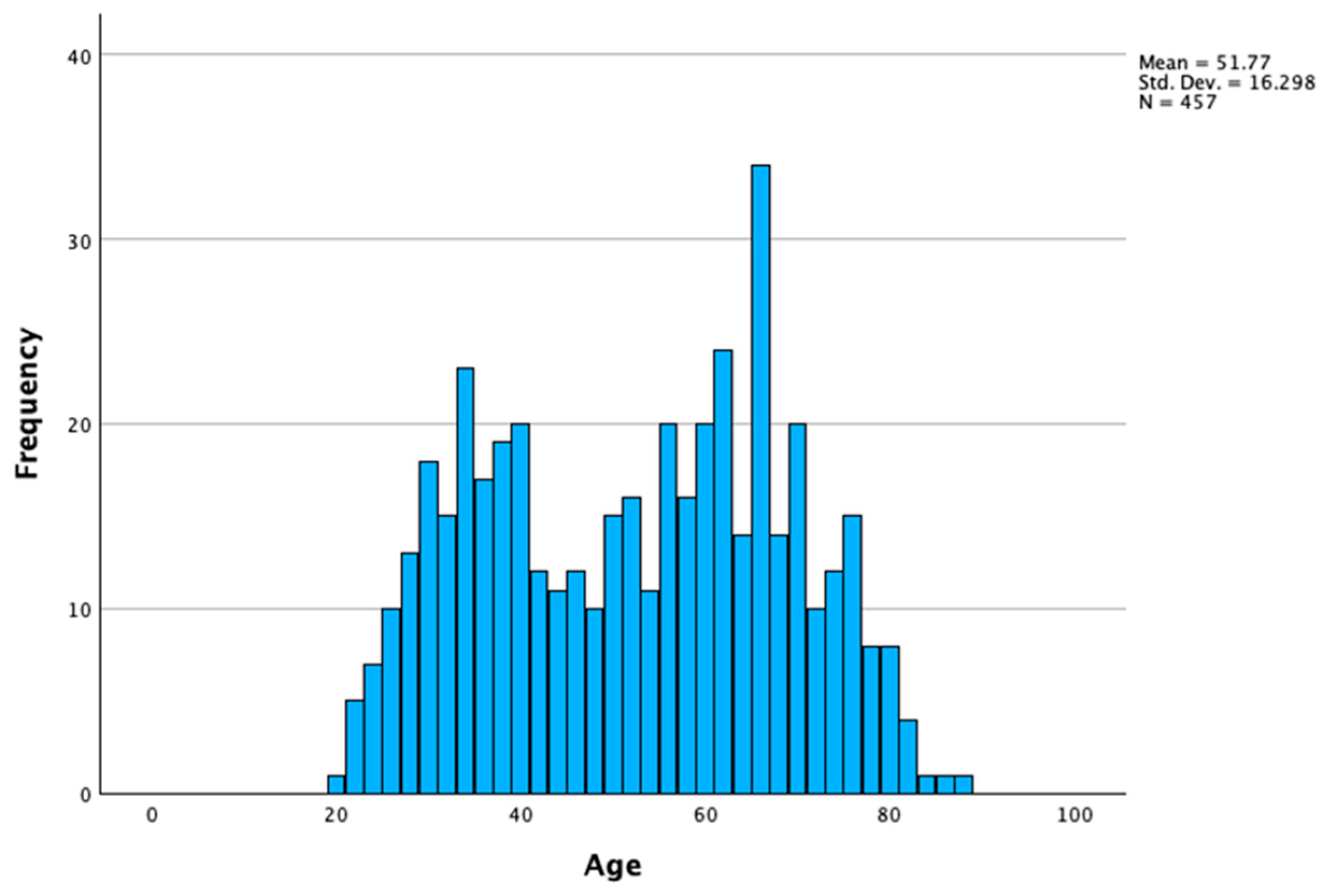
As shown in Figure 2, the age distribution is slightly weighted toward a comparatively older segment of the population. In terms of gender composition, women accounted for 57 percent of survey participants, whereas they comprise just over 51 percent of Norwalk’s total population.
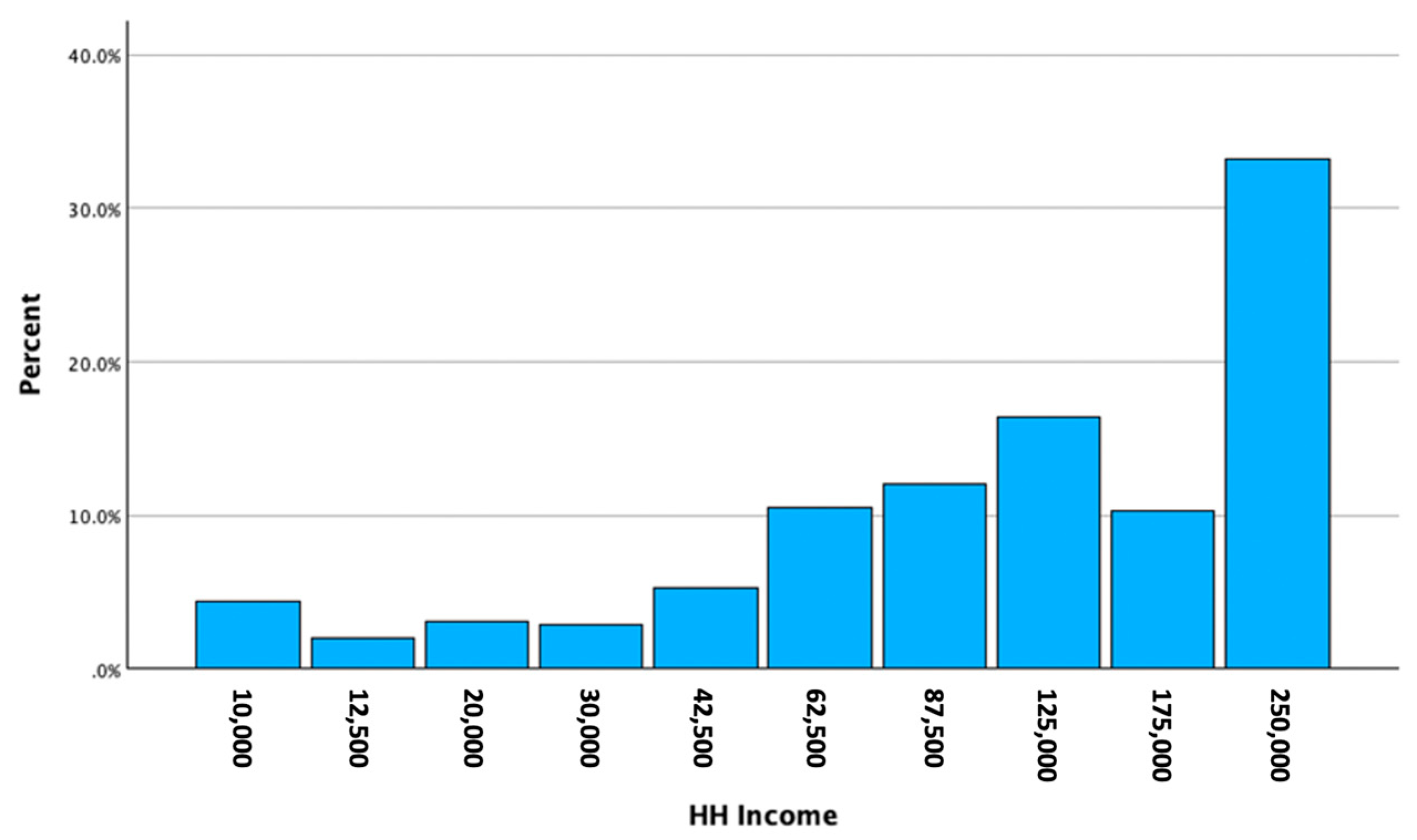
Income distribution (Figure 3) also differed substantially from the city’s overall profile. Approximately one-third of respondents reported annual household incomes exceeding $200,000, while only 17.7 percent reported incomes below $50,000. This upward skew was evident across the entire income distribution, with higher-income categories consistently overrepresented compared to population benchmarks.
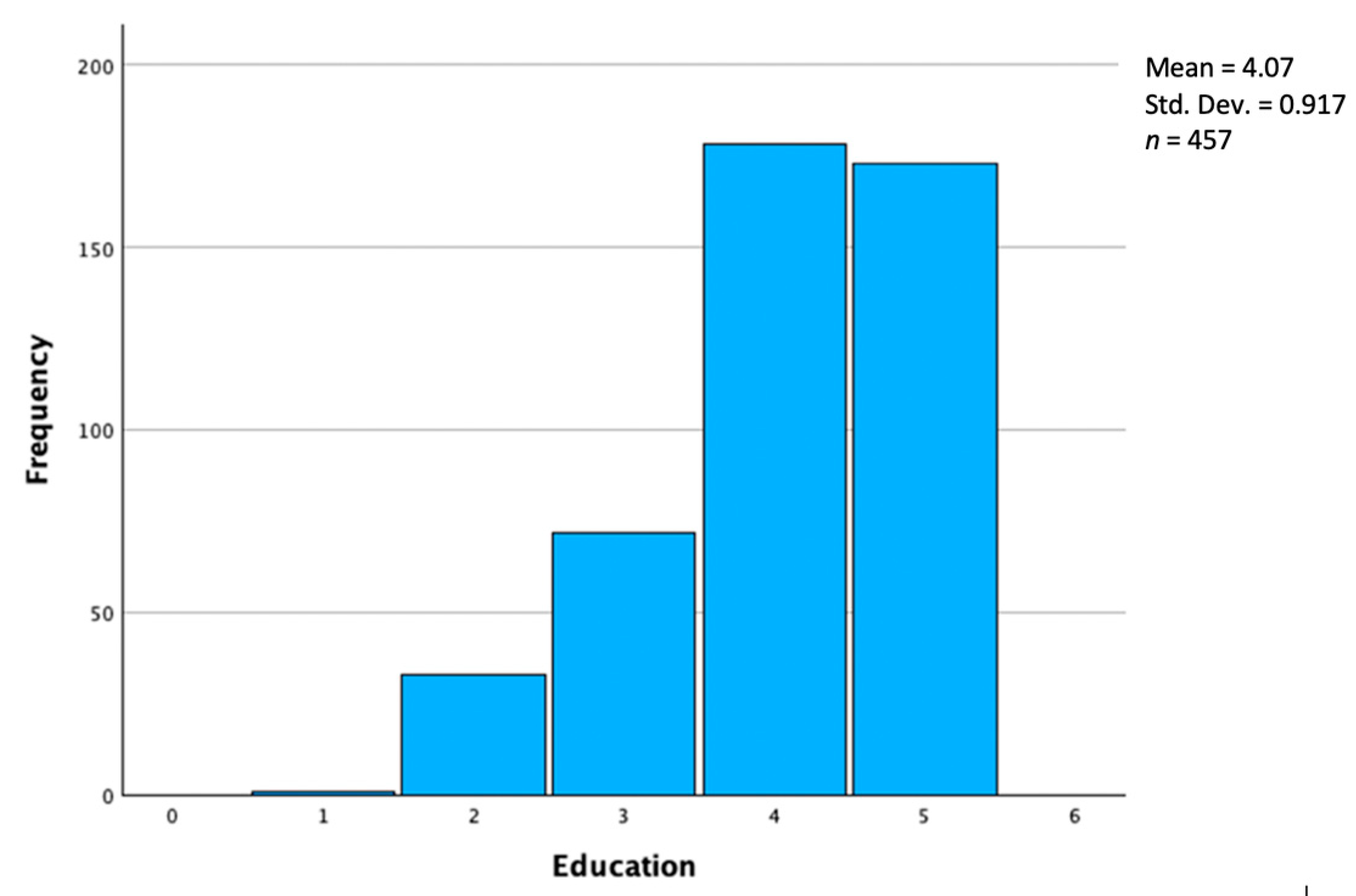
Educational attainment (Figure 4) levels were likewise elevated, with more than three-quarters of respondents holding at least a bachelor’s degree and 37.9 percent holding a graduate or professional degree, more than double the municipal share of 17.7 percent.
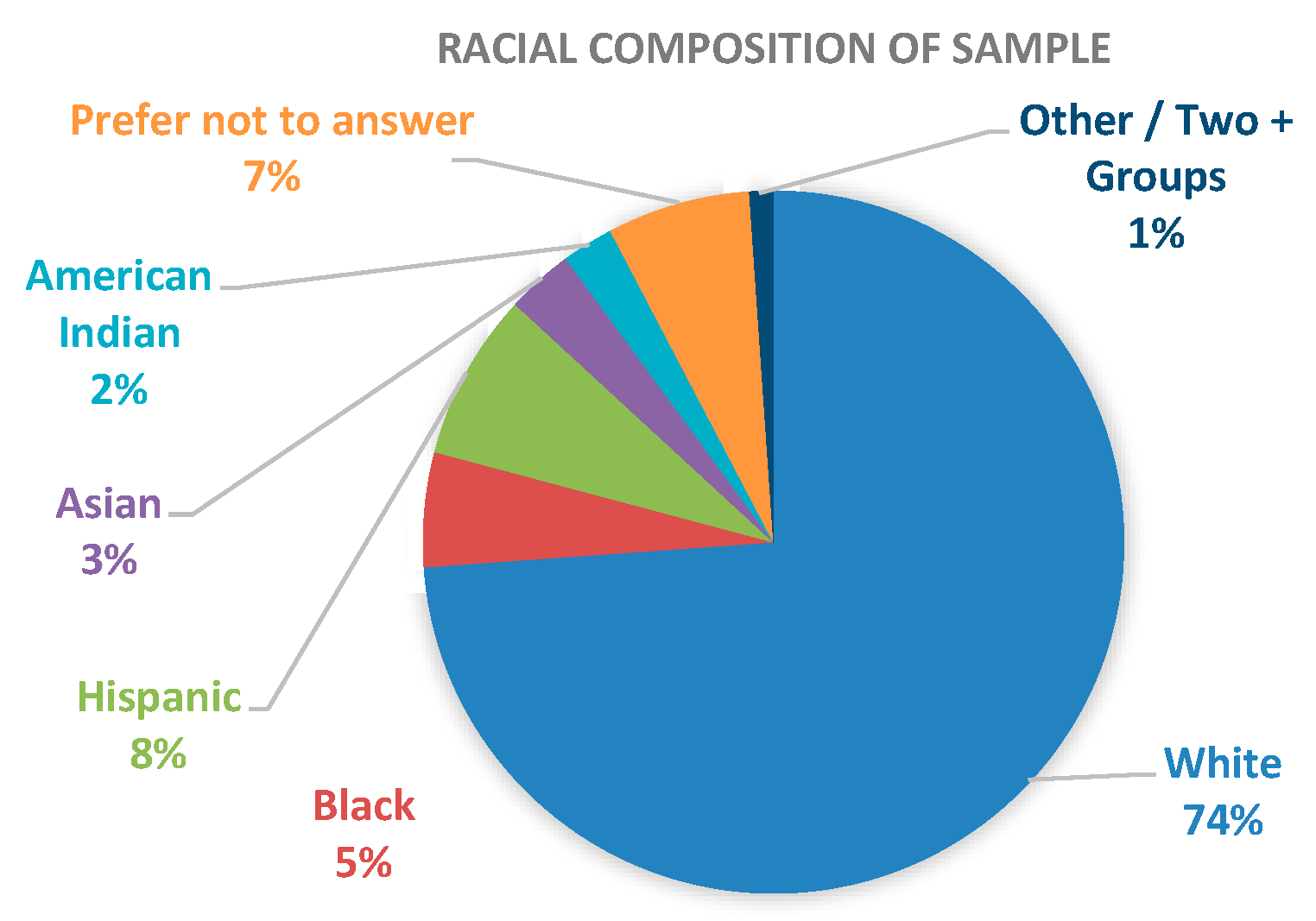
Housing tenure patterns also reflected higher socioeconomic status. Homeownership among respondents was 79 percent, compared with 57 percent across Norwalk’s population. The racial composition of the survey sample (Figure 5) also differed from Norwalk’s overall population. White respondents accounted for 74 percent of the sample, compared with approximately 53 percent of the city population, while Black and Hispanic residents were underrepresented relative to municipal benchmarks. Asian and American Indian respondents were represented at roughly comparable levels, though the “prefer not to answer” category was higher than expected. These patterns suggest the sample reflects a somewhat narrower racial and ethnic profile than the city as a whole, which becomes an important consideration when interpreting attitudes that may vary across demographic groups.
Although the survey sample differs from Norwalk’s broader population in several demographic respects, these differences primarily provide contextual background rather than limiting the usefulness of the method and analysis. The sample characteristics help frame how certain perceptions and WTP patterns may be interpreted, particularly where socioeconomic factors shape attitudes toward environmental policy. At the same time, while demographic deviations should be considered when generalizing results to the full community, the dataset still captures substantial variation across age, income, education, and housing tenure. This diversity offers a robust basis for examining the underlying drivers of stormwater perceptions and support within the sample.

3.1.1. Inferential Analyses of WTP Across Demographics

Nonparametric analyses were conducted to examine demographic differences in WTP for both the modest conceptual stormwater fee and the specified fee amount. Across most demographic variables, no statistically significant differences were observed (Table 3). Age emerged as the only socioeconomic variable with a significant association regarding WTP for a modest fee (H(2) = 6.42, p = 0.040). However, no age differences were found for the specific fee scenario (p = 0.349). Gender showed no significant differences for either WTP measure (p = 0.236 and p = 0.274). Likewise, the multi-category income measure did not predict WTP for the modest fee (p = 0.626) or for the specific amount (p = 0.101), indicating that income level did not meaningfully influence respondents’ fee preferences.
Race was the only demographic variable consistently associated with both WTP outcomes. Significant differences were observed in WTP the modest fee (H(5) = 15.60, p = 0.008) and the specific fee amount (H(5) = 12.48, p = 0.008). Pairwise results from earlier analyses indicated that respondents selecting “prefer not to answer” displayed higher WTP than White or Hispanic respondents. However, given the substantial racial imbalance in the sample and very small counts in several race categories, these findings should be interpreted with caution and treated as exploratory.
Overall, demographic factors played a limited role in shaping WTP among respondents, with only age and race demonstrating statistically meaningful differences. These results align with the representativeness analysis, reinforcing that socio-demographic biases in the sample must be acknowledged when interpreting WTP outcomes.

3.1.2. Socio-Economic Characteristics

A more detailed examination of the survey’s socio-economic composition reveals several patterns that help contextualize the sample characteristics beyond the aggregate demographic comparisons presented above. Participation was most concentrated among households with greater financial resources and higher levels of educational attainment, which also influenced the geographic distribution of responses across the city.
Spatially, survey participation was higher in neighborhoods with single-family homes, larger lot sizes, and higher assessed property values. By contrast, apartment-dense districts with lower median household incomes yielded fewer responses despite targeted efforts to advertise the survey in these areas. This uneven distribution suggests that housing type, property value, and other demographic parameters may influence engagement in voluntary municipal surveys. Housing tenure patterns further illustrate this point as the overrepresentation of homeowners corresponded with longer average residency and a greater likelihood of direct financial interest in property-related infrastructure decisions. These characteristics also mirror a population segment commonly associated with higher levels of participation in local governance processes in Norwalk.

3.2. Attitudinal Landscape

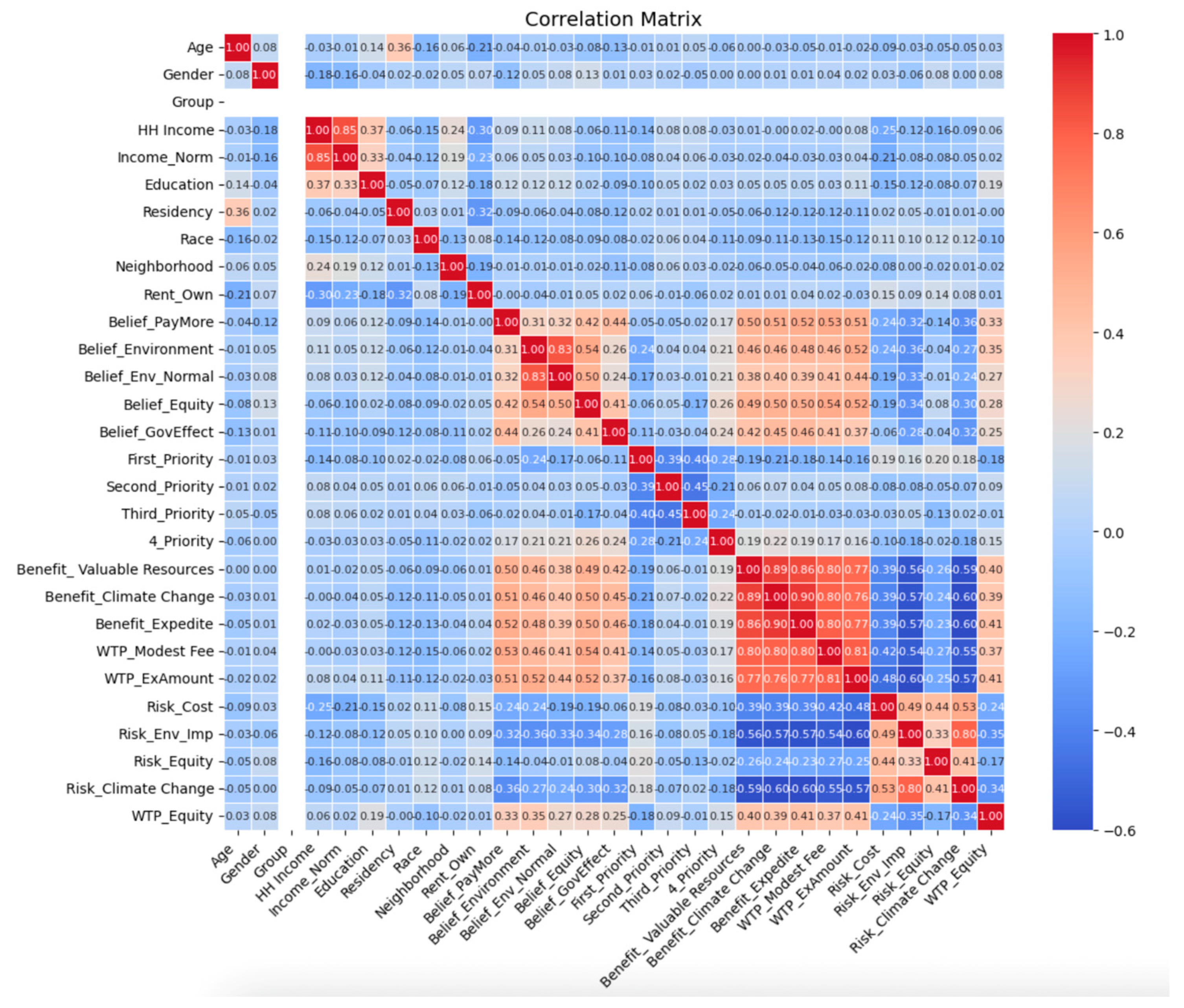
To complement the demographic analysis and provide deeper insight into the cognitive and perceptual dimensions shaping WTP for stormwater management, a correlation matrix was constructed to examine interrelationships among key attitudinal variables. This analysis aimed to map the underlying attitudinal landscape of the sample, identify clusters of related beliefs and perceptions, and reveal how these orientations may interact to influence policy-relevant behaviors. Variables included in the analysis encompassed perceptions of environmental risk and importance, beliefs about government effectiveness and equity, perceived benefits of stormwater interventions, and measures of WTP under various fee scenarios.
As shown in Figure 6 and summarized in Table 4, the correlation analysis revealed a series of strong and statistically meaningful associations, suggesting that respondents’ attitudes are not formed in isolation but instead aggregate into identifiable clusters reflecting broader cognitive orientations. One prominent dimension emerged around environmental concern and normative belief systems. Belief-related variables exhibited moderate positive correlations, indicating that respondents who viewed stormwater infrastructure as environmentally necessary were also more likely to support collective funding and express trust in governmental effectiveness. These relationships suggest that environmental concern, perceptions of fairness, and institutional trust form a coherent belief framework that provides important context for WTP decisions rather than acting as a direct determinant.
A second major cluster centered on perceived benefits and behavioral intentions. Perceptions of stormwater management as providing valuable ecosystem services, mitigating climate risks, and improving community resilience were highly interrelated (r ≈ 0.86–0.90) and strongly associated with WTP (r ≈ 0.76–0.81), indicating that expectations of visible, local improvements are tightly linked to fee support.
A third attitudinal dimension linked risk perceptions to both belief systems and behavioral outcomes. Perceived risks operationalized as concerns about costs, program effectiveness, and equity, were negatively associated with WTP (r ≈ −0.42 to −0.57), consistent with a trade-off between anticipated benefits and perceived burdens. Respondents who perceive higher risks from inaction are more likely to endorse government-led responses and more willing to contribute financially to such efforts. Notably, demographic variables showed relatively weak correlations with attitudinal measures (|r| < 0.20 in most cases), indicating that socio-economic characteristics alone do not fully explain the distribution of perceptions and preferences in the sample.
The correlation matrix provides a conceptual map of the attitudinal landscape within the surveyed population. The clustering of variables into coherent dimensions of environmental responsibility and institutional trust, perceived benefits and behavioral intentions, risk awareness, and policy support reveals a structured belief system underlying WTP decisions. These findings offer important context for interpreting the results of the subsequent predictive modeling as they highlight the pathways through which perceptions, values, and beliefs shape public support for stormwater infrastructure funding.

3.3. Analysis of WTP Using Random Forest

To further the analysis of the determinants shaping public support for stormwater infrastructure funding, a Random Forest classification model was employed to predict respondents’ WTP for the proposed stormwater management fee. The model integrated a diverse set of predictor variables encompassing demographic characteristics, attitudinal factors, and perceptions of policy-relevant outcomes. These included respondents’ views on environmental risks and benefits, beliefs regarding governmental effectiveness and social equity, and socio-economic indicators such as income and tenure status. Together, these variables comprehensively represented the cognitive, perceptual, and structural factors that may influence financial support for stormwater initiatives.

3.3.1. Model Performance

Two classification models were developed to examine WTP at different payment thresholds, one for a modest fee (WTP_Modest Fee) and another for a more specific example amount (WTP_ExAmount) derived from comparable stormwater initiatives in Connecticut. Both models exceeded the majority-class baseline (~37%). For WTP_Modest Fee (RF: n_estimators = 40, min_samples_leaf = 5, max_samples = 0.5, oob_score = True) OOB accuracy was ~62% and test accuracy ~66%. For WTP_ExAmount (RF: n_estimators = 150, max_depth = 5, min_samples_split = 10, min_samples_leaf = 5, max_samples = 0.5, oob_score = True) OOB accuracy was ~60% and test accuracy ~66%. The close alignment between OOB and test accuracies indicates that the models generalized well to unseen data and successfully captured meaningful relationships in the dataset. These performance levels, which exceed baseline classification accuracy, are particularly noteworthy given the complexity and subjective nature of individual financial decision-making in environmental contexts. As shown in the confusion matrices (Supplementary Figures S1 and S2), the model performs best in the middle and higher WTP categories, with most errors occurring between neighboring levels. This pattern suggests that misclassification largely reflects uncertainty around adjacent thresholds rather than broad disagreement in predicted support.

3.3.2. Feature Importance Results

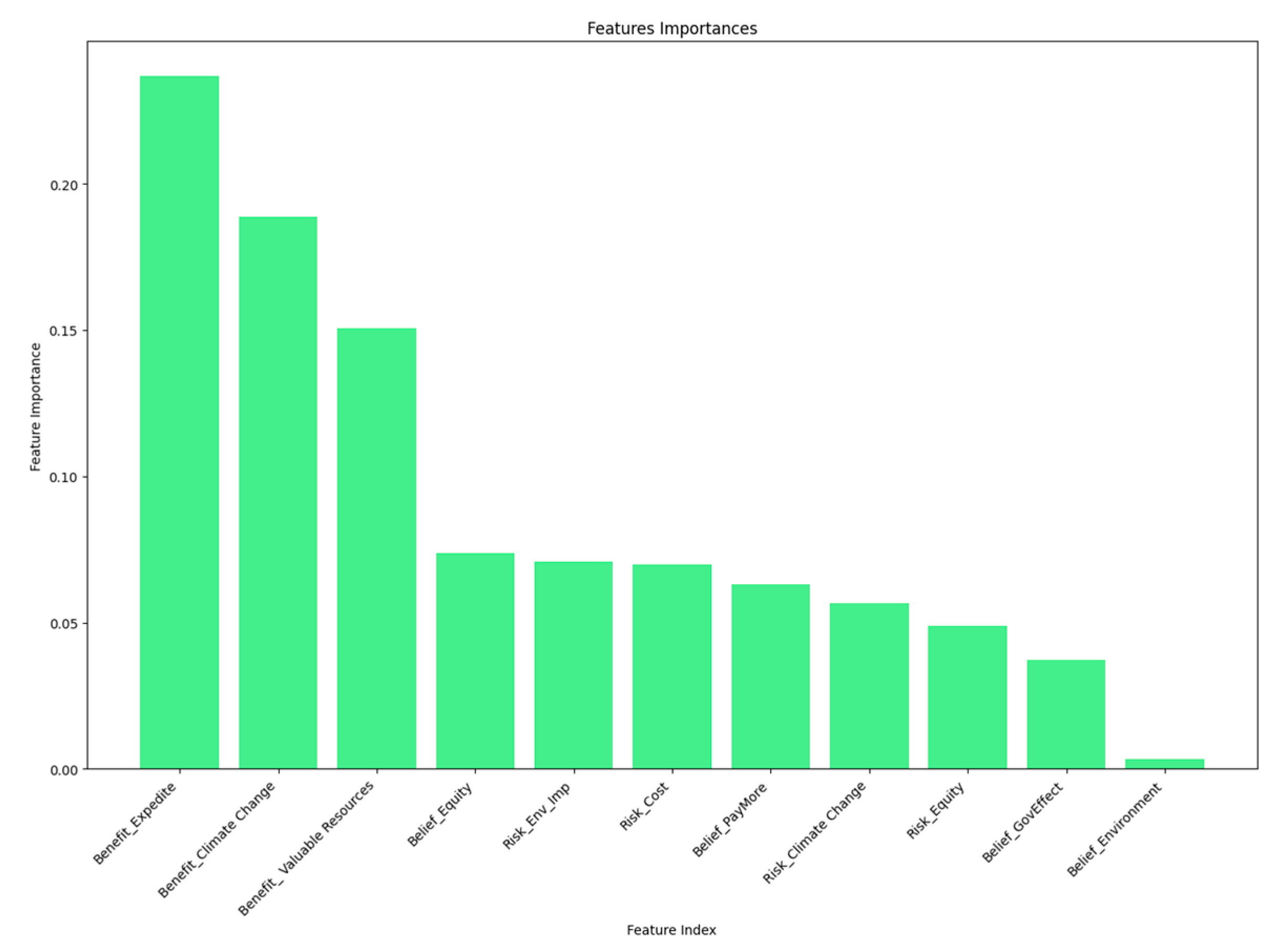
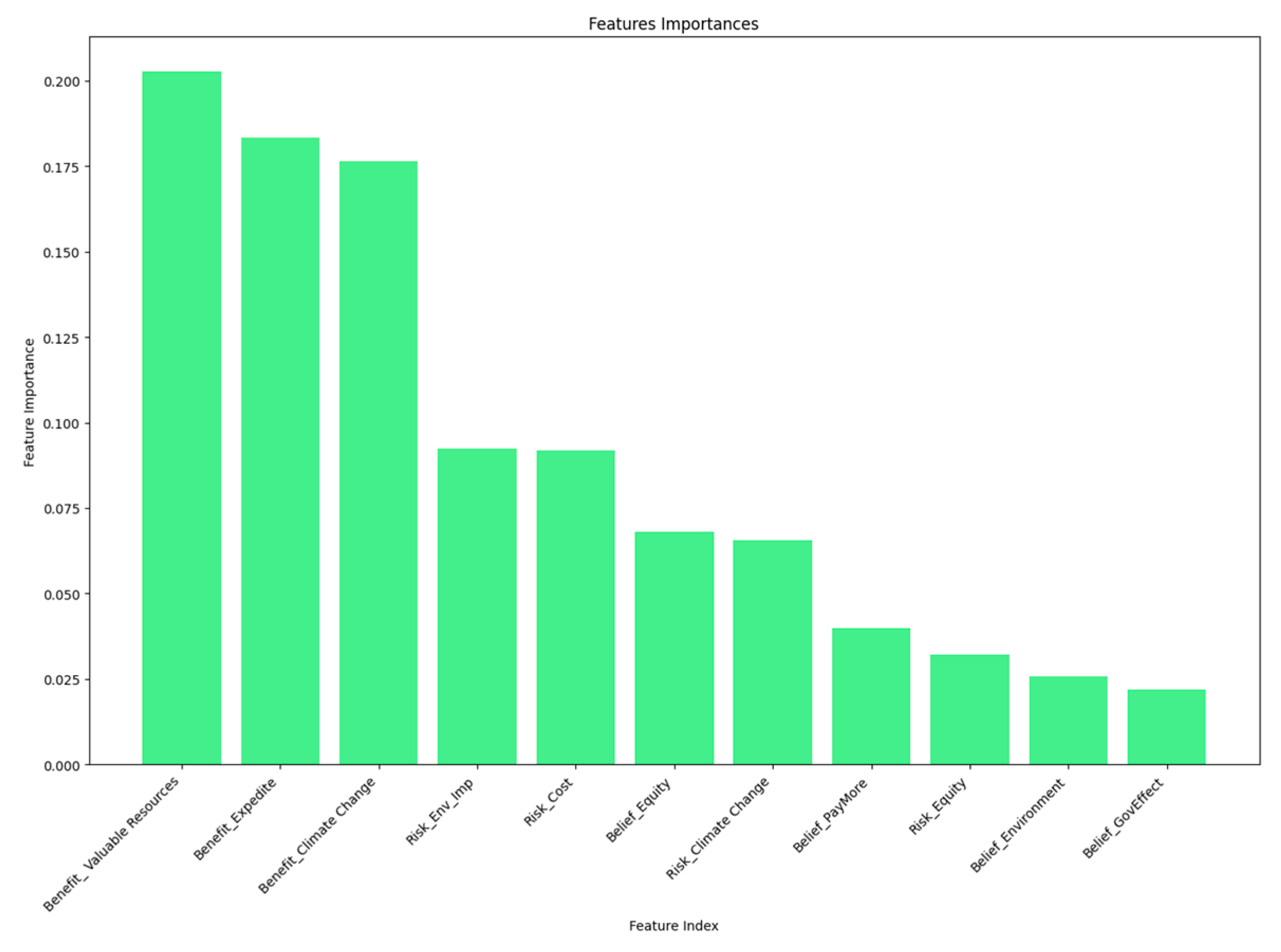
The feature importance analysis provides deeper insight into the relative influence of different factors on WTP outcomes across both models. As shown in Figure 7 and Figure 8 and Table 5 and Table 6, perceived benefits related to expediting infrastructure investment (Benefit_Expedite), providing valuable resources (Benefit_Valuable Resources), and improving climate-related conditions (Benefit_Climate Change) were consistently ranked as the most influential factors.
As the payment level increases (WTP_ExAmount), risk-related features (e.g., concerns about cost of living and environmental effectiveness) gain relative importance. In the WTP_ModestFee model, the expectation that the fee would expedite infrastructure improvements held the highest importance score (0.217), followed closely by beliefs that the fee would mitigate climate change impacts (0.197) and generate valuable resources for local infrastructure (0.189). These findings suggest that respondents’ support for a modest fee is primarily motivated by anticipated, visible community-level improvements rather than more abstract environmental or institutional considerations, and their support may be tempered as the fee becomes more tangible and concrete rather than conceptual in nature.
A similar pattern emerged in the WTP_ExAmount model, with subtle shifts in emphasis. The belief that the fee would provide valuable resources remained the strongest predictor (0.203), followed by expectations of accelerated infrastructure upgrades (0.183) and climate change mitigation benefits (0.177). Notably, as the payment level became more specific, risk-related variables gained prominence. Concerns that the fee might fail to deliver substantive environmental outcomes (0.092) and fears that it could contribute to a higher cost of living (0.092) rose to the fourth and fifth positions, respectively. This shift indicates that when faced with larger financial commitments, respondents evaluate not only the anticipated benefits but also potential inefficiencies and economic trade-offs.
In both models, general environmental attitudes and institutional trust consistently ranked among the least influential predictors, with feature importance scores below 0.040. This result suggests that while respondents may broadly support environmental stewardship or express confidence in local government, such overarching values play a limited role in shaping specific financial decisions. Instead, WTP decisions are more closely tied to assessments of concrete program outcomes and, at higher payment levels, to perceived risks and trade-offs.

3.3.3. Comparative Insights

As shown in Table 7, a comparative examination of the two Random Forest models reveals a clear behavioral dynamic in public support structure for stormwater funding. At lower fee levels, respondents’ decisions are predominantly benefit-driven, anchored in expectations of tangible infrastructure enhancements, climate resilience gains, and visible improvements to local environmental conditions. However, the decision-making calculus becomes more nuanced as financial stakes increase. Risk-related considerations, particularly about cost burden, program effectiveness, and the sufficiency of environmental returns, become more influential in shaping WTP. This predictive dynamic illustrates that public support is not monolithic but rather contingent on the scale of financial commitment, with attitudes shifting from relatively straightforward benefit appraisal toward more cautious, deliberative assessments as potential costs become concrete.
To address RQ2 and provide a statistical benchmark for comparison with the Random Forest analysis, a baseline ordered logistic regression model was developed using representative perceptual variables and demographic controls. The regression results (Table 8) confirm that perceived benefits are positively and significantly associated with WTP across both payment scenarios, while affordability concerns are negatively related to WTP, with larger effects observed when respondents evaluated a specific fee amount. Beliefs about government effectiveness are also positively associated with WTP, although with smaller and less consistent effect sizes, whereas most demographic variables exhibit weak or inconsistent associations once perceptual factors are considered. Compared to these regression results, the Random Forest analysis emphasizes differences in the relative importance of perceptual and demographic factors across payment scenarios.

3.4. Qualitative Perspectives on WTP

Alongside quantitative results, open-ended survey responses and stakeholder discussions provide valuable context for understanding what drives public attitudes toward a stormwater management fee. Five main themes emerged from the qualitative data, including skepticism about additional charges, concerns over government transparency and accountability, debates over fairness and equity, a strong preference for clear local benefits, and significant worries about affordability. Many survey respondents questioned why new fees were necessary for services they believed should already be paid for through existing taxes, and some expressed doubt about whether municipal funds are being used effectively.
Perceptions of fairness were closely linked to support levels. Respondents frequently argued that those who benefit most, such as developers and commercial property owners, should bear a larger financial burden. At the same time, households with limited incomes should be protected from disproportionate costs. Support for the initiative was highest when respondents perceived a clear link between the fee and tangible improvements such as flood mitigation, green infrastructure, or enhanced water quality. These attitudes closely mirror the feature importance results from the Random Forest model, which identified environmental and infrastructural benefits as the strongest predictors of WTP.
Feedback from a subsequent meeting with city officials echoed many of these themes. Stakeholders emphasized that public acceptance would hinge on how the fee is framed and communicated, recommending a focus on tangible local benefits and consideration of differential fee structures. They cautioned that public support could erode if the initiative was perceived as merely another tax, whereas branding it as a “Climate Action Fund” aligned with local climate resilience goals could substantially improve acceptance.

4. Discussion

The descriptive and inferential analyses provide an essential foundation for interpreting the results of this study by establishing baseline patterns in WTP and identifying where traditional socio-demographic predictors exhibit limited explanatory power. While age and race showed statistically significant differences in WTP, household income did not, despite the sample’s skew toward higher-income respondents. This pattern suggests that conventional linear associations alone may not fully capture how residents evaluate stormwater fees. The machine learning analysis complements these findings by revealing how perceptual and attitudinal factors condition support across payment contexts, offering a more complete picture of the drivers underlying public acceptance.

4.1. Interpreting Machine Learning Insights into WTP

The machine learning results provide additional insight into how respondents evaluated the proposed stormwater management fee beyond what is captured through traditional statistical analysis. Rather than identifying income, education, or housing tenure as dominant predictors, the Random Forest models consistently ranked perceived benefits related to infrastructure improvement, climate resilience, and local environmental outcomes as the most influential factors shaping WTP. This pattern suggests that within the surveyed population, support for the fee was structured primarily around expectations of tangible benefits rather than socio-economic position alone.
In addition, the feature importance results indicate that this support was conditional and sensitive to how financial commitments were framed. When respondents considered a modest, conceptual fee, expectations of benefits dominated decision-making. When a specific fee amount was introduced, concerns related to cost and effectiveness increased in relative importance, indicating respondents became more evaluative once the financial implications were made explicit. While the baseline regression analysis confirms the directional influence of perceived benefits, costs, and institutional confidence on WTP, the Random Forest results provide additional insight into how these factors are prioritized across payment scenarios.
Although the analysis focuses on feature importance rather than explicit interaction terms, the model structure reflects how demographic characteristics, perceived benefits, and perceived risks jointly shape WTP. Variables such as income and education may influence how respondents interpret expected benefits or assess affordability in relation to other considerations, even if they do not emerge as strong standalone predictors in the feature rankings. In this sense, socio-demographic characteristics may shape WTP indirectly by conditioning how perceived benefits, costs, and fairness concerns are evaluated across different decision contexts, rather than exerting a direct, uniform influence on WTP outcomes.
This interpretive pattern is further shaped by the demographic composition of the survey sample, which may affect generalizability. Respondents were disproportionately higher income, well educated, and more likely to be homeowners than the broader Norwalk population, resulting in the underrepresentation of lower-income and minority residents. Within this context, the Random Forest model reflects decision patterns more characteristic of relatively advantaged respondents, for whom expectations of tangible benefits may play a stronger role and affordability concerns may be less pronounced. The absence of a statistically significant income effect should therefore be understood as reflecting how respondents within this sample evaluated the proposed fee, rather than as evidence that affordability is unimportant. For residents facing greater economic constraints or housing insecurity, affordability and equity considerations may play a more direct role in shaping WTP than is observed in the survey data.

4.2. Behavioral Interpretation of WTP

The economic profile of WTP that emerges from this study is best understood as conditional and benefit-driven rather than as a direct function of income or demographic position. Across both payment scenarios, support for a stormwater management fee was strongest when respondents expected tangible improvements such as accelerated infrastructure upgrades, increased climate resilience, and locally visible environmental benefits. Similar patterns have been observed in studies of low-impact development and urban stormwater investment in other contexts, where WTP is closely tied to perceived returns and the visibility of outcomes rather than to abstract environmental concern or financial capacity alone [49].
The results also show that WTP becomes more evaluative as proposed costs become concrete. When respondents were asked to consider a specific fee amount, concerns related to affordability, program effectiveness, and fairness increased in importance relative to perceived benefits. This shift is consistent with findings from environmental valuation studies showing that stated support often declines or becomes more conditional when hypothetical policies are translated into explicit financial commitments [50,51]. Rather than reflecting simple cost aversion, this pattern suggests that respondents weigh expected benefits against perceived risks and tradeoffs once the financial implications are clearly defined.
From a behavioral perspective, these findings indicate that respondents rely on outcome-oriented reasoning when evaluating stormwater fees. Expected benefits appear to function as a primary reference point, shaping whether a policy is viewed as worthwhile, while cost considerations serve as a secondary filter that moderates support when personal financial exposure becomes explicit. This layered decision process aligns with recent research applying machine learning approaches to contingent valuation, which similarly finds that benefit perceptions and anticipated effectiveness dominate early evaluations, with economic concerns exerting greater influence as decisions become more concrete [52,53].

4.3. Policy Implications from a Machine Learning Perspective

The patterns observed in WTP are closely connected to the environmental and physical context in which respondents experience stormwater impacts. Norwalk faces both coastal and inland flooding, and many of the risks associated with stormwater are visible at the neighborhood level through street flooding, overwhelmed drainage systems, and localized water quality concerns. These place-based experiences help explain why perceived benefits related to infrastructure improvement and climate resilience ranked consistently higher than more general attitudes or institutional considerations in the model results.
The emphasis on tangible outcomes suggests that respondents evaluated the proposed fee through a lens shaped by everyday exposure to environmental conditions rather than abstract assessments of environmental protection. When stormwater challenges are experienced directly and locally, expectations of practical improvements appear to play a central role in shaping WTP. This interpretation is consistent with research showing that environmental decision-making is strongly influenced by how closely risks and benefits are connected to lived experience and observable conditions within urban systems [54].
Socio-economic characteristics interact with this environmental context in important ways. The overrepresentation of homeowners and longer-term residents in the sample likely reinforces attention to neighborhood-level outcomes, as these groups are more directly exposed to property-related flood risks and infrastructure performance over time. At the same time, the limited role of demographic variables in the model suggests that environmental context can cut across socio-economic categories, shaping preferences through shared exposure rather than through income or education alone.
Recent work on the application of artificial intelligence and machine learning in urban water systems highlights the importance of situating analytical results within the physical and environmental systems they represent [55,56]. In this study, the prominence of benefit-related variables reflects not only individual attitudes but also the environmental setting in which stormwater management is understood and evaluated. Interpreting WTP through this combined behavioral and environmental lens helps explain why expectations of local impact outweighed more generalized expressions of environmental concern, reinforcing the role of place-based context in shaping public responses to infrastructure funding proposals.

4.4. Study Limitations and Future Research

Placing the results of this study in a broader international and governance context helps clarify how the observed WTP patterns relate to existing research on environmental finance and urban infrastructure policy. The WTP patterns identified here are consistent with findings from research on stormwater and environmental fee acceptance, where support is strongest when proposed charges are clearly linked to visible, local improvements and weakens as uncertainty about costs, effectiveness, or fairness increases [57]. Comparative work across different governance settings similarly shows that public acceptance of environmental fees depends not only on the scale of the charge, but on whether residents believe that revenues will be used transparently and deliver meaningful outcomes [58,59].
Recent international literature examining WTP in environmental and geospatial contexts further supports this interpretation. Studies that link socio-economic characteristics, environmental exposure, and spatially differentiated risk have found that benefit expectations and perceived returns often outweigh income effects when residents evaluate environmental fees, particularly in municipalities facing recurring and visible environmental pressures [60]. This alignment suggests that the patterns observed in Norwalk are comparable to behavioral dynamics identified in other contexts, while still remaining shaped by the city’s specific environmental and socio-economic context.
The use of feature importance measures helps clarify how different considerations were weighted relative to one another within the model, allowing benefit expectations, cost concerns, and governance-related factors to be interpreted in terms of their comparative influence rather than as causal determinants of WTP. Within this framework, legitimacy, fairness, and trust function as conditions that shape how benefit information is interpreted rather than as primary drivers of WTP. Although these factors ranked below perceived benefits in the model results, they become more influential as proposed fees move from abstract concepts to concrete financial commitments. This finding is consistent with governance research showing that transparency, participation, and equitable cost allocation play a central role in sustaining public support for environmental infrastructure funding, particularly when affordability concerns are present [61,62]. Clear communication about how funds will be allocated, who will bear costs, and how outcomes will be monitored can therefore influence whether benefit expectations translate into durable support. Research on policy framing demonstrates that emphasizing local outcomes, avoiding damages, and collective benefits can strengthen acceptance, while vague or generalized messaging can amplify skepticism, especially in politically or economically diverse communities [63,64]. Within this study, these patterns should be understood as interpretive insights into preference formation rather than as evidence of causal mechanisms.
In addition to these limitations, the study is subject to constraints related to its survey and analytical strategies. WTP was assessed using stated preferences under hypothetical fee scenarios, which may differ from actual behavior once fees are implemented. The analysis employed Random Forest models to explore nonlinear relationships and relative feature importance, and while this approach is well-suited for identifying conditional patterns in complex data, it does not provide causal estimates or explicit interaction effects. Feature importance rankings reflect how variables contribute to model performance within the observed data rather than independent or policy-ready effect sizes. These strategies were intentionally applied in a complementary manner alongside traditional regression analysis to enhance interpretability and exploratory insight, and the findings should be understood in light of these methodological tradeoffs.
Building from these conditions, the immediate next steps for both research and policy include testing whether the observed shift from benefit-driven to more risk-sensitive WTP holds across other municipal contexts and alternative fee structures. From a policy perspective, pilot implementations that pair clearly framed stormwater fees with transparent reporting and targeted communication strategies could help evaluate how framing, trust, and perceived fairness influence public acceptance in practice. From a research perspective, replicating this analysis in communities with different socio-economic profiles and governance arrangements would help assess the generalizability of these findings and further refine the use of machine learning tools in environmental finance research.

5. Conclusions

This study examined how demographic, perceptual, and attitudinal factors shape residents’ WTP for a proposed stormwater management fee and assessed whether machine learning can complement traditional statistical approaches in identifying the drivers of policy acceptance. The findings show that WTP is conditional and largely shaped by expectations of tangible benefits, while concerns related to cost and effectiveness become more important as financial commitments are defined more clearly. Within the surveyed population, traditional socio-demographic variables played a limited role as standalone predictors, suggesting that how residents evaluate expected outcomes and tradeoffs provides a more useful lens for understanding support for stormwater financing in this context. While the respondent sample limits population-level inference and generalizability due to the overrepresentation of higher-income, highly educated, and homeowner residents, the Random Forest analysis offers meaningful insight into how stormwater fees were evaluated under different framing conditions by revealing consistent patterns in how perceived benefits, risks, and fairness considerations were prioritized.
From a policy perspective, these findings suggest that public acceptance of stormwater fees is likely to be strongest when revenues are clearly tied to tangible outcomes such as infrastructure upgrades, flood mitigation, and climate resilience improvements. Attention to affordability, transparency, and equity considerations in policy design is also important for maintaining support as proposed fees become more concrete. Fee structures that include credits, exemptions, or tiered approaches, along with clear communication about how funds will be used and tracked, may help align expected benefits with fairness concerns. Future research can build on this work by applying similar survey designs and interpretable machine learning approaches in other municipalities to better understand how these preference patterns vary across different social, economic, and environmental contexts.

Supplementary Materials

The following supporting information can be downloaded at: https://www.mdpi.com/article/10.3390/urbansci10010027/s1. Figure S1: Confusion matrix for the Random Forest model predicting WTP for a modest stormwater fee. Figure S2: Confusion matrix for the Random Forest model predicting WTP for a specific example fee amount.

Author Contributions

Conceptualization, B.B. and H.M.; methodology, B.B.; formal analysis, B.B.; data curation, B.B.; writing—original draft preparation, B.B.; writing—review and editing, B.B. and H.M.; visualization, B.B.; supervision, H.M. All authors have read and agreed to the published version of the manuscript.

Funding

This research received no external funding.

Institutional Review Board Statement

Ethical review and approval were waived for this study by Institution Committee due to U.S. federal research regulations (45 CFR 46.104) (The research was conducted in the US, and according to U.S. federal research regulations (45 CFR 46.104), research involving anonymous surveys on non-sensitive topics is exempt from IRB review.)

Informed Consent Statement

Informed consent for participation was obtained from all subjects involved in the study.

Data Availability Statement

The data presented in this study are available on request from the corresponding author and will be provided in accordance with local Freedom of Information Act (FOIA) requirements.

Acknowledgments

We acknowledge support by the Open Access Publication Fund of TU Berlin.

Conflicts of Interest

The authors declare no conflicts of interest.

References

  1. US Global Change Research Program. Fourth National Climate Assessment, Volume II: Impacts, Risks, and Adaptation in the United States; USGCRP: Washington, DC, USA, 2018. [CrossRef]
  2. Intergovernmental Panel on Climate Change (IPCC). Climate Change 2022: Impacts, Adaptation, and Vulnerability; Cambridge University Press: Cambridge, UK, 2022. [Google Scholar] [CrossRef]
  3. Black, R.; Baldwin, R. Regulatory Reform and Environmental Taxation: Recent Trends and Prospects. Environ. Plan. C Gov. Policy 2010, 28, 311–329. [Google Scholar]
  4. Porse, E.; Kerner, M.; Shinneman, J.; Kaplan, J.; Stone, S.; Cadenasso, M.L. Stormwater utility fees and household affordability of urban water services. Water Policy 2022, 24, 998–1013. [Google Scholar] [CrossRef]
  5. Roy, A.H.; Wenger, S.J.; Fletcher, T.D.; Walsh, C.J.; Ladson, A.R.; Shuster, W.D.; Thurston, H.W.; Brown, R.R. Impediments and Solutions to Sustainable, Watershed-Scale Urban Stormwater Management. Environ. Manag. 2008, 42, 344–359. [Google Scholar] [CrossRef]
  6. Brown, R.R.; Farrelly, M.A.; Loorbach, D.A. Actors Working the Institutions in Sustainability Transitions: The Case of Melbourne’s Stormwater Management. Glob. Environ. Change 2013, 23, 701–718. [Google Scholar] [CrossRef]
  7. Keeley, M.; Koburger, A.; Dolowitz, D.; Medearis, D.; Nickel, D.; Shuster, W. Perspectives on the Use of Green Infrastructure for Stormwater Management in Cleveland and Milwaukee. Environ. Manag. 2013, 51, 1093–1108. [Google Scholar] [CrossRef] [PubMed]
  8. Konisky, D.M.; Beierle, T.C. Innovations in Public Participation and Environmental Decision Making. Soc. Nat. Resour. 2001, 14, 815–826. [Google Scholar] [CrossRef]
  9. Stern, P.C.; Dietz, T.; Kalof, L. Value Orientations, Gender, and Environmental Concern. Environ. Behav. 1993, 25, 322–348. [Google Scholar] [CrossRef]
  10. Steg, L.; Dreijerink, L.; Abrahamse, W. Factors Influencing the Acceptability of Energy Policies: A Test of Value–Belief–Norm Theory. J. Environ. Psychol. 2005, 25, 415–425. [Google Scholar] [CrossRef]
  11. López-Mosquera, N.; García, T.; Barrena, R. An Extension of the Theory of Planned Behavior to Predict Willingness to Pay for the Conservation of an Urban Park. J. Environ. Manag. 2014, 135, 91–99. [Google Scholar] [CrossRef] [PubMed]
  12. Oppenheimer, M.; Oreskes, N.; Jamieson, D.; Brysse, K.; O’Reilly, J.; Shindell, M.; Wazeck, M. Discerning Experts: The Practices of Scientific Assessment for Environmental Policy; University of Chicago Press: Chicago, IL, USA, 2019. [Google Scholar] [CrossRef]
  13. Klineberg, S.L.; McKeever, M.; Rothenbach, B. Demographic Predictors of Environmental Concern: It Does Make a Difference How It’s Measured. Soc. Sci. Q. 1998, 79, 734–753. [Google Scholar]
  14. Tiebout, C.M. A Pure Theory of Local Expenditures. J. Polit. Econ. 1956, 64, 416–424. [Google Scholar] [CrossRef]
  15. Levin, I.P.; Schneider, S.L.; Gaeth, G.J. All Frames Are Not Created Equal: A Typology and Critical Analysis of Framing Effects. Organ. Behav. Hum. Decis. Process. 1998, 76, 149–188. [Google Scholar] [CrossRef]
  16. McCright, A.M.; Dunlap, R.E. Politicization of Climate Change and Polarization of Public Opinion. Sociol. Q. 2011, 52, 155–194. [Google Scholar] [CrossRef]
  17. Spence, A.; Poortinga, W.; Pidgeon, N. The Psychological Distance of Climate Change. Risk Anal. 2012, 32, 957–972. [Google Scholar] [CrossRef]
  18. Stern, P.C. New Environmental Theories: Toward a Coherent Theory of Environmentally Significant Behavior. J. Soc. Issues 2000, 56, 407–424. [Google Scholar] [CrossRef]
  19. Ajzen, I. The Theory of Planned Behavior. Organ. Behav. Hum. Decis. Process. 1991, 50, 179–211. [Google Scholar] [CrossRef]
  20. Shrestha, R.K.; Alavalapati, J.R. Estimating Ranchers’ Cost of Agroforestry Adoption: A Contingent Valuation Approach. In Valuing Agroforestry Systems: Methods and Applications; Springer: Dordrecht, The Netherlands, 2004; pp. 183–199. [Google Scholar]
  21. Meyerhoff, J.; Liebe, U. Status Quo Effect in Choice Experiments. Land Econ. 2009, 85, 515–528. [Google Scholar] [CrossRef]
  22. Zhu, L.; Chen, C.; Wang, H.; Yu, F.R.; Tang, T. Machine Learning in Urban Rail Transit Systems: A Survey. IEEE Trans. Intell. Transp. Syst. 2024, 25, 2182–2207. [Google Scholar] [CrossRef]
  23. Zhang, J.; Wang, J.; Zang, H.; Ma, N.; Skitmore, M.; Qu, Z.; Skulmoski, G.; Chen, J. The Application of Machine Learning and Deep Learning in Intelligent Transportation: A Scientometric Analysis and Qualitative Review of Research Trends. Sustainability 2024, 16, 5879. [Google Scholar] [CrossRef]
  24. Dillman, D.A.; Smyth, J.D.; Christian, L.M. Internet, Phone, Mail, and Mixed-Mode Surveys: The Tailored Design Method, 4th ed.; Wiley: Hoboken, NJ, USA, 2014. [Google Scholar]
  25. Fowler, F.J. Survey Research Methods, 6th ed.; SAGE: Thousand Oaks, CA, USA, 2020. [Google Scholar]
  26. Groves, R.M.; Presser, S. The Role of Topic Interest in Survey Participation Decisions. Public Opin. Q. 2004, 68, 2–31. [Google Scholar] [CrossRef]
  27. Pedregosa, F.; Varoquaux, G.; Gramfort, A.; Michel, V.; Thirion, B.; Grisel, O.; Blondel, M.; Prettenhofer, P.; Weiss, R.; Dubourg, V.; et al. Scikit-Learn: Machine Learning in Python. J. Mach. Learn. Res. 2011, 12, 2825–2830. [Google Scholar]
  28. Meyerhoff, J.; Oehlmann, M.; Weller, P. The Influence of Design Dimensions on Stated Choices in an Environmental Context. Environ. Resour. Econ. 2015, 61, 385–407. [Google Scholar] [CrossRef]
  29. Stern, P.C.; Dietz, T.; Abel, T.; Guagnano, G.A.; Kalof, L. A Value-Belief-Norm Theory of Support for Social Movements: The Case of Environmentalism. Hum. Ecol. Rev. 1999, 6, 81–97. [Google Scholar]
  30. Ostrom, E. Collective Action and the Evolution of Social Norms. J. Econ. Perspect. 2000, 14, 137–158. [Google Scholar] [CrossRef]
  31. Wu, Z.; Wang, W.; Sun, W.; Zhang, C. Public Preference and WTP for Green Infrastructure Benefits. Water 2023, 15, 2767. [Google Scholar] [CrossRef]
  32. Numata, M.; Sugiyama, M.; Swe, W.; del Barrio Alvarez, D. Willingness to Pay for Renewable Energy in Myanmar: Energy Source Preference. Energies 2021, 14, 1505. [Google Scholar] [CrossRef]
  33. Tavakol, M.; Dennick, R. Making Sense of Cronbach’s Alpha. Int. J. Med. Educ. 2011, 2, 53–55. [Google Scholar] [CrossRef]
  34. Breiman, L. Random Forests. Mach. Learn. 2001, 45, 5–32. [Google Scholar] [CrossRef]
  35. Cutler, D.R.; Edwards, T.C.; Beard, K.H.; Cutler, A.; Hess, K.T.; Gibson, J.; Lawler, J.J. Random Forests for Classification in Ecology. Ecology 2007, 88, 2783–2792. [Google Scholar] [CrossRef]
  36. Strobl, C.; Malley, J.; Tutz, G. Introduction to Recursive Partitioning. Psychol. Methods 2009, 14, 323–348. [Google Scholar] [CrossRef] [PubMed]
  37. Yektansani, K.; He, C.; Azizi, S.; Aftabi, A.; AzizKhani, M. Can machine learning predict environmental attitudes and beliefs? Int. J. Environ. Stud. 2024, 81, 2012–2026. [Google Scholar] [CrossRef]
  38. Nicodemus, K.K. Letter to the Editor: On the Stability and Ranking of Predictors from RF Importance. Brief. Bioinform. 2011, 12, 369–373. [Google Scholar] [CrossRef] [PubMed]
  39. Kuhn, M.; Johnson, K. Applied Predictive Modeling; Springer: New York, NY, USA, 2013. [Google Scholar] [CrossRef]
  40. Shmueli, G.; Koppius, O.R. Predictive Analytics in Information Systems Research. MIS Q. 2011, 35, 553–572. [Google Scholar] [CrossRef]
  41. Hastie, T.; Tibshirani, R.; Friedman, J. The Elements of Statistical Learning, 2nd ed.; Springer: New York, NY, USA, 2009. [Google Scholar] [CrossRef]
  42. James, G.; Witten, D.; Hastie, T.; Tibshirani, R. An Introduction to Statistical Learning, 2nd ed.; Springer: New York, NY, USA, 2021. [Google Scholar] [CrossRef]
  43. Wooldridge, J.M. Introductory Econometrics: A Modern Approach, 7th ed.; Cengage: Boston, MA, USA, 2020. [Google Scholar]
  44. Polikar, R. Ensemble Learning. In Ensemble Machine Learning; Zhang, C., Ma, Y., Eds.; Springer: New York, NY, USA, 2012. [Google Scholar] [CrossRef]
  45. Bishop, C.M. Pattern Recognition and Machine Learning; Springer: New York, NY, USA, 2006. [Google Scholar]
  46. Liaw, A.; Wiener, M. Classification and Regression by randomForest. R News 2002, 2, 18–22. [Google Scholar]
  47. Dietterich, T.G. Ensemble Methods in Machine Learning. In Multiple Classifier Systems; Springer: Berlin, Germany, 2000; pp. 1–15. [Google Scholar] [CrossRef]
  48. Chen, T.; Guestrin, C. XGBoost: A Scalable Tree Boosting System. In Proceedings of the 22nd ACM SIGKDD Conference, San Francisco, CA, USA, 13–17 August 2016; pp. 785–794. [Google Scholar] [CrossRef]
  49. Zhang, Y.; Xu, Z.; Liang, X.; Zeng, L. Public preferences and willingness to pay for low impact development: A comparative case study of pilot sponge cities in China. Blue–Green Syst. 2023, 5, 220–234. [Google Scholar] [CrossRef]
  50. Sun, F.; Kong, Z. How Media and Climate Perception Affect Residents’ Willingness to Pay for Environmental Protection: Evidence from China. Sustainability 2025, 17, 8138. [Google Scholar] [CrossRef]
  51. Deng, X.; Liu, S.; Xu, L.; Ouyang, Z. Public willingness to pay watershed eco-compensation in China’s Taihu basin: A case study. Front. Environ. Sci. 2022, 10, 1066194. [Google Scholar] [CrossRef]
  52. Khuc, V.Q.; Tran, D.T. Contingent Valuation Machine Learning (CVML): A Novel Method for Estimating Citizens’ Willingness to Pay for a Safer and Cleaner Environment. Urban Sci. 2023, 7, 84. [Google Scholar] [CrossRef]
  53. Prodhan, F.A.; Hoque, M.Z.; Nafee, K.M.; Fahad, M.S.A.; Rahman Sakib, M.N. Machine Learning-Based Analysis of Community Perceptions on Coastal Forest Ecosystem Services, Restoration Willingness and Their Determinants in Bangladesh. Wild 2025, 2, 26. [Google Scholar] [CrossRef]
  54. Hou, J.; Zhang, J.; Zhang, C.; Liu, J. The Role of Deep Learning in Urban Water Management. Water Res. 2022, 219, 118973. [Google Scholar] [CrossRef] [PubMed]
  55. Fu, G.; Sun, S.; Hoang, L.; Yuan, Z.; Butler, D. Artificial intelligence underpins urban water infrastructure of the future: A holistic perspective. Camb. Prism. Water 2023, 1, e14. [Google Scholar] [CrossRef]
  56. Ezzat, D.; Soliman, M.; Ahmed, E.; Hassanien, A.E. An optimized explainable artificial intelligence approach for sustainable clean water. Environ. Dev. Sustain. 2024, 26, 13807–13836. [Google Scholar] [CrossRef]
  57. Rezk, N.G.; Alshathri, S.; Sayed, A.; El-Din Hemdan, E. EWAIS: An Ensemble Learning and Explainable AI Approach for Water Quality Classification Toward IoT-Enabled Systems. Processes 2024, 12, 2771. [Google Scholar] [CrossRef]
  58. Kirsop-Taylor, N.; Russel, D.; Jensen, A. Urban governance and policy mixes for nature-based solutions and integrated water policy. J. Environ. Policy Plan. 2021, 24, 498–512. [Google Scholar] [CrossRef]
  59. Romano, O.; Akhmouch, A. Water Governance in Cities: Current Trends and Future Challenges. Water 2019, 11, 500. [Google Scholar] [CrossRef]
  60. Thapa, K.; Ntanos, S.; Kyriakopoulos, G.; Skordoulis, M.; Getzner, M. Visitors’ Environmental Attitudes and Willingness to Pay for Nature Conservation: The Case of Langtang National Park in the Himalayas. Glob. NEST J. 2024, 26, 05717. [Google Scholar] [CrossRef]
  61. Meyer, B. Significance of the participatory budget in supporting green infrastructure. Eur. Res. Stud. J. 2023, 26, 842–852. Available online: https://www.um.edu.mt/library/oar/handle/123456789/115558 (accessed on 1 December 2024). [CrossRef]
  62. Epting, S.R. Participatory Budgeting for Environmental Justice. Ethics Policy Environ. 2020, 23, 22–36. [Google Scholar] [CrossRef]
  63. Poortinga, W.; Whitmarsh, L.; Steentjes, K.; Gray, E.; Thompson, S.; Brisley, R. Factors and framing effects in support for net zero policies in the United Kingdom. Front. Psychol. 2023, 14, 1287188. [Google Scholar] [CrossRef] [PubMed]
  64. Dasandi, N.; Graham, H.; Hudson, D.; Jankin, S.; van Heerde-Hudson, J.; Watts, N. Positive, global, and health or environment framing bolsters public support for climate policies. Commun. Earth Environ. 2022, 3, 239. [Google Scholar] [CrossRef]
Figure 1. Study Framework.
Urbansci 10 00027 g001
Figure 2. Age Distribution of Sample.
Urbansci 10 00027 g002
Figure 3. Income Distribution of the Sample.
Urbansci 10 00027 g003
Figure 4. Education Distribution of Sample.
Urbansci 10 00027 g004
Figure 5. Racial Composition of Sample.
Urbansci 10 00027 g005
Figure 6. Correlation Matrix of Study Variables.
Urbansci 10 00027 g006
Figure 7. Rank Importance WTP_Modest Fee.
Urbansci 10 00027 g007
Figure 8. Rank Importance WTP_ExAmount.
Urbansci 10 00027 g008
Table 1. Reliability Analysis Using Cronbach’s Alpha.
Latent VariableQuestionVariable NameCronbach Alpha
Personal BeliefsI believe residents should pay more to expand and improve municipal services.Belief_PayMore0.710
I consider the environment, including air, water, green areas, and soil, to be very important, and the City should allocate public funds to protect it.Belief_Environment
I believe we should allocate public funding to improve social equity and support lower income residents in the community.Belief_Equity
I believe city government spends money effectively in support of resident quality of life.Belief_GovEffect
Perceived BenefitsA stormwater management fee would provide valuable resources to improve local infrastructure and environmental conditions.Benefit_Valuable Resources0.958
A stormwater management fee would help Norwalk address the impacts of climate change by cleaning streams, rivers, and lakes; reducing flood risk; etc.Benefit_Climate Change
A stormwater management fee would provide additional resources to expedite the development of infrastructure and improve Norwalk’s adaptability.Benefit_Expedite
Perceived RisksA stormwater management fee would significantly increase the cost of living in Norwalk.Risk_Cost0.801
A stormwater management fee would do little to improve the environment.Risk_Env_Imp
A stormwater management fee would disproportionately impact lower income households and small businesses.Risk_Equity
A stormwater management fee would increase costs without improving Norwalk’s ability to adapt to climate change.Risk_Climate Change
Willingness to PayIf I were buying a home in Norwalk, I would be comfortable paying a modest fee if I knew it would improve the environment and protect vulnerable areas from flood damage. WTP_Modest Fee0.777
Other communities in Connecticut have stormwater management programs. The Clean Water Fund in New Britain estimates an average fee of $52 per year for the typical single-family home. I would pay a similar amount for improved stormwater management and infrastructure in the community.WTP_ExAmount
Properties that generate more stormwater runoff and additional impact on local infrastructure should pay more than properties generating less stormwater.WTP_Equity
Table 2. Demographic Comparison of Sample.
VariableCategorySurvey Sample (%)City of Norwalk (%)
AgeMedian5339.5
GenderMale4349.7
Female5750.3
Income<$25,0009.614.7
$25,000–$49,9998.111
$50,000–$74,99910.513.2
$75,000–$99,9991210.2
$100,000–$149,99916.218.2
$150,000–$200,00010.312.8
>$200,00033.320
EducationLess than High School0.29.5
High School Graduate7.422.2
Some College/Associate Degree15.822.6
Bachelor’s Degree38.728
Graduate/Professional Degree37.917.7
HousingRent21.443
Own78.657
RaceWhite7452.6
Black5.315.1
Hispanic7.74.6
Asian3.118.8
American Indian2.42.3
Prefer not to answer6.65.3
Other / Two + Groups1.11.2
Table 3. Nonparametric Analysis of WTP Variables.
DemographicWTP VariableH Statisticdfp-Value
AgeModest Fee6.42120.04
Example Amount2.1070.349
GenderModest Fee2.89220.236
Example Amount2.5920.274
IncomeModest Fee0.23810.626
Example Amount2.6840.101
RaceModest Fee15.60150.008
Example Amount12.4790.008
EducationModest Fee3.0740.546
Example Amount8.8530.065
Table 4. Selected correlation coefficients for key attitudinal relationships.
Attitudinal ClusterConstruct AConstruct BCorrelation (r)
Personal BeliefsBelief_EnvironmentBelief_PayMore0.31
Belief_EnvironmentBelief_GovEffect0.26
Perceived BenefitsBenefit_Climate_ChangeWTP_Modest_Fee0.80
Benefit_Climate_ChangeWTP_ExAmount0.76
Perceived RisksRisk_CostWTP_Modest_Fee−0.42
Risk_Climate_ChangeWTP_Modest_Fee−0.55
Table 5. Factor Importance Score–WTP_Modest Fee.
RankFeatureFeature IndexSurvey Question (Paraphrased)Importance Score
1Benefit_Expedite7Belief that the fee expedites infrastructure improvements.0.217
2Benefit_Climate Change6Belief that the fee helps address climate change impacts.0.197
3Benefit_Valuable Resources5Belief that the fee provides valuable resources for infrastructure.0.189
4Belief_Equity3Belief in funding programs to improve social equity.0.066
5Risk_Env_Imp9Concern that the fee has little environmental benefit.0.065
6Risk_Cost8Concern that the fee would raise the cost of living.0.062
7Risk_Climate Change11Concern that the fee won’t improve climate adaptation.0.062
8Belief_PayMore1Belief that residents should contribute more to improve city services.0.057
9Belief_Environment2Belief in prioritizing environmental protection in city funding.0.039
10Belief_GovEffect4Trust in city government’s effective spending for quality of life.0.028
11Risk_Equity10Concern that the fee would unfairly burden lower-income households.0.018
Table 6. Factor Importance Score–WTP_ExAmount.
RankFeatureFeature IndexSurvey Question (Paraphrased)Importance Score
1Benefit_Valuable Resources5Belief that the fee provides valuable resources for infrastructure.0.203
2Benefit_Expedite7Belief that the fee expedites infrastructure improvements.0.183
3Benefit_Climate Change6Belief that the fee helps address climate change impacts.0.177
4Risk_Env_Imp9Concern that the fee has little environmental benefit.0.092
5Risk_Cost8Concern that the fee would raise the cost of living.0.092
6Belief_Equity3Belief in funding programs to improve social equity.0.068
7Risk_Climate Change11Concern that the fee won’t improve climate adaptation.0.066
8Belief_PayMore1Belief that residents should contribute more to improve city services.0.040
9Risk_Equity10Concern that the fee would unfairly burden lower-income households.0.032
10Belief_Environment2Belief in prioritizing environmental protection in city funding.0.026
11Belief_GovEffect4Trust in city government’s effective spending for quality of life.0.022
Table 7. Comparative Analysis of WTP Feature Importance.
FeatureQuestionWTP_Modest FeeWTP_ExAmount
Benefit_ExpediteBelief that the fee expedites infrastructure improvements.0.2170.203
Benefit_Climate ChangeBelief that the fee helps address climate change impacts.0.1970.183
Benefit_Valuable ResourcesBelief that the fee provides valuable resources for infrastructure.0.1890.177
Belief_EquityBelief in funding programs to improve social equity.0.0660.092
Risk_Env_ImpConcern that the fee won’t improve climate adaptation.0.0650.092
Risk_CostConcern that the fee would raise the cost of living.0.0620.068
Risk_Climate ChangeConcern that the fee won’t improve climate adaptation.0.0620.066
Belief_PayMoreBelief that residents should contribute more to improve city services.0.0570.040
Belief_EnvironmentBelief in prioritizing environmental protection in city funding.0.0390.032
Belief_GovEffectTrust in city government’s effective spending for quality of life.0.0280.026
Risk_EquityConcern that the fee would unfairly burden lower-income households.0.0180.022
Table 8. Baseline Ordered Logistic Regression for WTP.
VariableWTP_Modest Fee (Coef.)p-ValueWTP_ExAmount (Coef.)p-Value
Benefit_Valuable Resources1.726<0.0011.699<0.001
Risk_Cost−0.407<0.001−0.672<0.001
Risk_Equity−0.0930.3130.0700.451
Belief_GovEffect0.3410.0010.2070.038
Income_Norm−0.0000.3710.0000.425
Age−0.0020.693−0.0070.231
Rent_Own0.2100.399−0.0670.785
Race−0.1520.015−0.0860.168
Disclaimer/Publisher’s Note: The statements, opinions and data contained in all publications are solely those of the individual author(s) and contributor(s) and not of MDPI and/or the editor(s). MDPI and/or the editor(s) disclaim responsibility for any injury to people or property resulting from any ideas, methods, instructions or products referred to in the content.