You are currently viewing a new version of our website. To view the old version click .

Urban Science, Volume 1, Issue 4

December 2017 - 10 articles

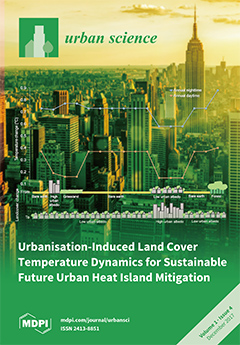
Cover Story: The cover image illustrates a cross-section of land cover change-temperature association between 2003 and 2013 in the city of Perth, Australia. The Urban Heat Island (UHI) effect describes higher temperatures over manmade surfaces, often associated with increased mortality, energy consumption and economic expenditure. Globally, urban areas are expected to triple by 2030 and the UHI effect is considered a major problem of the 21st century for sustainable cities. Current UHI monitoring methodologies fail to detect temperature intra-city differences between urban and non-urban surfaces negating targeted policy. This paper applies an earth observation approach to disentangle spatial variations between land cover change and land surface temperature, enabling refined mitigation of the UHI effect. View this paper
  • Issues are regarded as officially published after their release is announced to the table of contents alert mailing list .
  • You may sign up for email alerts to receive table of contents of newly released issues.
  • PDF is the official format for papers published in both, html and pdf forms. To view the papers in pdf format, click on the "PDF Full-text" link, and use the free Adobe Reader to open them.

Articles (10)

  • Article
  • Open Access
2 Citations
5,665 Views
12 Pages

19 December 2017

Coming to terms with the complexity of dense urban areas represents one of the major challenges people, organizations and governments will face in the next few decades. Defining, explaining and modeling socio-cultural factors associated with the deve...

  • Article
  • Open Access
8 Citations
5,242 Views
9 Pages

7 December 2017

Event legacy has become a major topic of discussion in recent years. Especially, European Capital of Culture is emerging as a means of facilitating community development in Europe. Based on a case study of the 2008 European Capital of Culture Liverpo...

  • Article
  • Open Access
18 Citations
9,461 Views
21 Pages

2 December 2017

Urban land cover is one of the fastest global growing land cover types which permanently alters land surface properties and atmospheric interactions, often initiating an urban heat island effect. Urbanisation comprises a number of land cover changes...

  • Article
  • Open Access
24 Citations
7,881 Views
21 Pages

1 December 2017

The United Nations Paris agreement of 2015 highlighted the need for urban planning to prevent and contain urban sprawl so as to reduce trip lengths through an efficient distribution of agglomerations and a well-balanced urban pattern distribution, al...

  • Review
  • Open Access
124 Citations
30,215 Views
21 Pages

30 November 2017

A smarter transport system that caters for social, economic and environmental sustainability is arguably one of the most critical prerequisites for creating pathways to more livable urban futures. This paper aims to provide a state-of-the-art analysi...

  • Article
  • Open Access
8 Citations
7,889 Views
14 Pages

25 November 2017

There are many calls for urban planning in Australia to be reformed, although often in contradictory ways. For example, some argue it should be capable of delivering greater certainty to developers while others call for more flexibility in processes...

  • Article
  • Open Access
17 Citations
12,878 Views
15 Pages

Quantifying the Overlap between Cadastral and Visual Boundaries: A Case Study from Vanuatu

  • Xianghuan Luo,
  • Rohan Bennett,
  • Mila Koeva,
  • Christiaan Lemmen and
  • Nathan Quadros

16 November 2017

Cadastres are argued as an essential tool to support land tenure security. Low cadastral coverage in developing countries creates a driver for innovative methods to expedite the mapping processes. As a human construct, the morphology of parcel bounda...

  • Article
  • Open Access
66 Citations
26,098 Views
20 Pages

Dhaka, the capital of Bangladesh, is the eleventh largest megacity city in the world, with a population of 18.2 million people living in an area of 1528 km2. This city profile traces the trajectories of its urban development to becoming a megacity an...

Get Alerted

Add your email address to receive forthcoming issues of this journal.

XFacebookLinkedIn
Urban Sci. - ISSN 2413-8851