
- Article

41 Pages
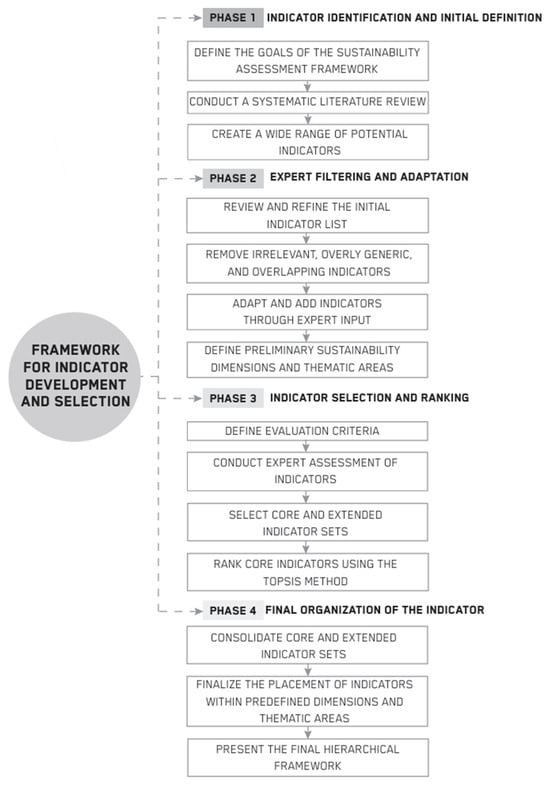
Although vital to urban operations, urban freight transport (UFT) generates substantial negative externalities. Despite the rising interest in urban transport sustainability, methodological frameworks targeting UFT remain scarce, particularly those tailored to the needs of local authorities. To address this gap, we design a transparent, multi-phase framework for creating a UFT sustainability assessment indicator set intended for local traffic authorities. The framework encompasses indicator identification, expert validation, evaluation, selection, and ranking. An initial pool was refined to 45 indicators across five dimensions: Economic, Environmental, Social, Energy and Resource Usage, and Policy and Governance. The indicators were evaluated by a panel of five transport experts according to their relevance, interpretability, measurability, achievability, and simplicity, to construct two nested sets. The Core Set represents a baseline compliant with stricter quality requirements, while the Extended Set is intended to facilitate comprehensive assessment and monitoring in more mature data systems and institutional capacities. Based on the evaluation, the Extended Set comprises 36 indicators, including all 22 Core indicators. Finally, the TOPSIS method was applied to rank Core indicators, guiding their phased introduction into monitoring. The framework is intended to support local authorities in monitoring UFT sustainability and evaluating policy interventions, including gradual monitoring system establishment.
Urban Sci.
23 October 2026


![BART system map [35].](https://mdpi-res.com/urbansci/urbansci-10-00459/article_deploy/html/images/urbansci-10-00459-g001-550.jpg)