Skip Content
You are currently on the new version of our website. Access the old version .

All Articles (827)

This work presents the development of a measuring instrument capable of assessing the possible presence of critical permanent deformations on the connecting rod in hybrid cars equipped with gasoline-powered internal combustion engines. The permanent deformation can be due to incorrect fueling and cause a progressive engine failure through the breaking of one or more connecting rods. The measuring tool developed is a non-invasive, low-cost system and permits the detection of the incipient damage without dismantling the engine, thus assuring a time-saving approach. The instrument is composed of a mechanical system and an electronic interface that permits easy use during measuring operations and the possibility to store the data collected. An experimental campaign was implemented to validate the measurement system’s capability to detect this type of damage and to determine a threshold beyond which it is necessary to proceed with the replacement of connecting rods. The results show the optimal ability to differentiate between usual technological variability of the piston stroke and the range that can be connected to the anomaly studied. The system is also able to permit the measurement of a whole engine in less than 20 min.

5 February 2026
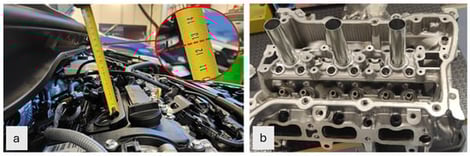
(a) Maximum permitted size of the instrument (red dashed line); (b) cylinder head with the three spark plug tubes.

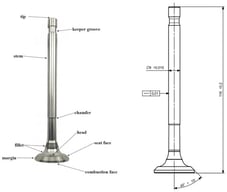
Reverse engineering (RE) is essential in the automotive and aerospace industries for reconstructing high-precision components, such as exhaust valves, when design documentation is unavailable. However, different measurement methods introduce varied errors that can affect engine performance and safety. This study presents a comparative analysis of contact and optical measurement systems—specifically the CMM Accura II (ZEISS Group, Oberkochen, Germany), Mahr MarSurf XC 20 (Esslingen am Neckar, Germany), GOM Scan 1 (ZEISS/GOM, Braunschweig/Oberkochen, Germany) and MCA-II with an MMD×100 laser head (Nikon Metrology, Leuven, Belgium)—to assess their accuracy in reconstructing exhaust valve geometry. The research procedure involved measuring global surface deviations and critical functional parameters, including stem diameter, straightness, and seat angle. The results indicate that tactile methods (CMM and Mahr) provide significantly higher accuracy and lower dispersion than optical methods. The Mahr system was the most effective for stem precision, while the CMM was the only system to pass the seat angle tolerance requirement unambiguously. In contrast, the MCA-II laser system failed to meet the required precision–mechanical tolerances. The findings suggest that an optimal industrial strategy should adopt a hybrid methodology: utilizing rapid optical scanning (GOM) for general geometry and high-precision tactile systems (CMM, Mahr) for critical functional features. This approach can reduce total inspection time by 30–40% while ensuring technical safety and preventing catastrophic engine failures.

4 February 2026

Physical model showing characteristics examined in article.

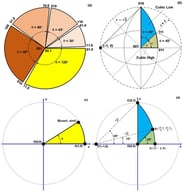
Inverse pole figure mapping is a common orientation visualization method used in electron backscatter diffraction (EBSD) software to display crystal orientations. Although this technique has been routinely used in commercial EBSD software, the coloring algorithm employed to map the orientation and construct the color key (standard stereographic triangle) has not been reported in the literature. This paper presents a simple algorithm to color the standard stereographic triangles of the 11 Laue groups by mapping the Maxwell color triangle to the curved standard stereographic triangles using nonlinear shape functions commonly employed in finite element methods. Detailed procedures are given to illustrate how the mapping is performed and how it is used to construct inverse pole figure maps from Euler angles. Color coding of the seven different standard stereographic triangles is demonstrated using a computer program written in C++. It is shown that the simple color-coding algorithm presented in this paper can be conveniently utilized to display orientation data in inverse pole figure maps, which is a critical part of designing customized EBSD software. It also provides a method to adjust the color center within the curved triangles to more uniformly distribute the color, which is not available in commercial EBSD software. The algorithm can also be used to design orientation representation software for other applications, e.g., crystal plasticity simulations, where representation of orientation data is also a routine task.

2 February 2026

The seven different shapes of the SSTs for the 11 Laue groups: (a) five sectors of a unit circle for symmetries other than cubic, (b) portions of a 45° sector for cubic low and cubic high symmetries, (c) the coordinates of the vertices for the five sectors as defined on a unit circle centered at (0, 0), (d) the coordinates of the vertices for the cubic low and cubic high symmetries. Note that each SST can be drawn with the first straight side starting at 0° and the other straight side ending at the sector angle (θ = 30°, 45°, 60°, 90°, and 120°).

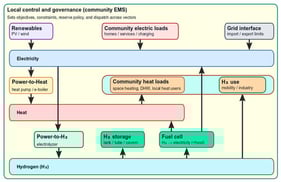
Hydrogen-integrated decentralized energy systems (DIESs) promise communities higher renewable penetration, greater resilience, and sector coupling across electricity, heat, and mobility. AI supports forecasting, dispatch optimization, multi-asset coordination, and planning, yet designing AI-driven hydrogen communities is challenging because it spans physical infrastructure, cyber-control, and governance. This review (2020–2025) synthesizes design strategies for AI-enabled hydrogen DIESs, distilling architectural patterns, electricity–hydrogen co-optimization, uncertainty-aware operation, and digital-twin planning. It summarizes AI benefits (flexibility, efficiency, reduced curtailment) and recurring risks (forecast-optimization cascades, objective mismatch, data drift, safety and constraint breaches, digital-twin credibility gaps, cybersecurity and privacy issues, and weak reproducibility) and proposes a pragmatic roadmap prioritizing safety-aware control, standardized metrics, transparent assumptions, and community-appropriate governance.

29 January 2026

Simplified DIES structure at the community scale.

News & Conferences

Issues

Open for Submission

Editor's Choice

Reprints of Collections

Design and Applications of Positive Energy Districts
Reprint

Design and Applications of Positive Energy Districts

Editors: Tony Castillo-Calzadilla, Carlos Quesada-Granja
Design Process for Additive Manufacturing
Reprint

Design Process for Additive Manufacturing

Editors: Paweł Turek

Get Alerted

Add your email address to receive forthcoming issues of this journal.

XFacebookLinkedIn
Designs - ISSN 2411-9660