

Skip to Content
You are currently on the new version of our website. Access the old version .

International Journal of Neonatal Screening, Volume 7, Issue 3

2021 September - 29 articles

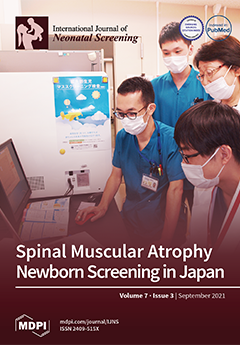
Cover Story: Spinal muscular atrophy newborn screening (SMA-NBS) is now gradually expanding in Japan. Osaka Women's and Children's Hospital (OWCH) has played the role of a mandatory NBS center, where 40,000 newborns/year are examined, since 1981 in the Osaka prefecture. The pilot study of SMA-NBS started in February 2021 as an optional NBS program. The cover photo shows a close collaboration between technologists and pediatricians, wearing masks to prevent COVID-19, in OWCH. (Photo courtesy of Shinobu Ida) View this paper.
  • Issues are regarded as officially published after their release is announced to the table of contents alert mailing list .
  • You may sign up for email alerts to receive table of contents of newly released issues.
  • PDF is the official format for papers published in both, html and pdf forms. To view the papers in pdf format, click on the "PDF Full-text" link, and use the free Adobe Reader to open them.

Articles (29)

  • Article
  • Open Access
11 Citations
3,251 Views
13 Pages

Economic Evaluation of Different Screening Strategies for Severe Combined Immunodeficiency Based on Real-Life Data

  • M. Elske van den Akker-van Marle,
  • Maartje Blom,
  • Mirjam van der Burg,
  • Robbert G. M. Bredius and
  • Catharina P. B. Van der Ploeg

Although several countries have adopted severe combined immunodeficiency (SCID) into their newborn screening (NBS) program, other countries are still in the decision process of adding this disorder in their program and finding the appropriate screeni...

  • Article
  • Open Access
30 Citations
5,966 Views
15 Pages

First Year of TREC-Based National SCID Screening in Sweden

  • Christina Göngrich,
  • Olov Ekwall,
  • Mikael Sundin,
  • Nicholas Brodszki,
  • Anders Fasth,
  • Per Marits,
  • Sam Dysting,
  • Susanne Jonsson,
  • Michela Barbaro and
  • Rolf H. Zetterström
  • + 2 authors

Screening for severe combined immunodeficiency (SCID) was introduced into the Swedish newborn screening program in August 2019 and here we report the results of the first year. T cell receptor excision circles (TRECs), kappa-deleting element excision...

  • Review
  • Open Access
24 Citations
4,387 Views
9 Pages

Advanced Diagnostic System and Introduction of Newborn Screening of Adrenoleukodystrophy and Peroxisomal Disorders in Japan

  • Nobuyuki Shimozawa,
  • Shigeo Takashima,
  • Hiroki Kawai,
  • Kazuo Kubota,
  • Hideo Sasai,
  • Kenji Orii,
  • Megumi Ogawa and
  • Hidenori Ohnishi

We established a diagnostic system for adrenoleukodystrophy (ALD) and peroxisomal disorders (PD) over 35 years ago in Japan, and have diagnosed 237 families with ALD and more than 100 cases of PD other than ALD using biochemical and molecular analyse...

  • Review
  • Open Access
20 Citations
6,693 Views
10 Pages

Advances in the Diagnosis and Treatment of Krabbe Disease

  • David A Wenger,
  • Paola Luzi and
  • Mohammad A. Rafi

Krabbe disease is an autosomal recessive leukodystrophy caused by pathogenic variants in the galactocerebrosidase (GALC) gene. GALC activity is needed for the lysosomal hydrolysis of galactosylceramide, an important component of myelin. While most pa...

  • Article
  • Open Access
11 Citations
5,558 Views
11 Pages

Early Diagnosis of Classic Homocystinuria in Kuwait through Newborn Screening: A 6-Year Experience

  • Hind Alsharhan,
  • Amir A. Ahmed,
  • Naser M. Ali,
  • Ahmad Alahmad,
  • Buthaina Albash,
  • Reem M. Elshafie,
  • Sumaya Alkanderi,
  • Usama M. Elkazzaz,
  • Parakkal Xavier Cyril and
  • Laila Bastaki
  • + 12 authors

Kuwait is a small Arabian Gulf country with a high rate of consanguinity and where a national newborn screening program was expanded in October 2014 to include a wide range of endocrine and metabolic disorders. A retrospective study conducted between...

  • Case Report
  • Open Access
6 Citations
4,474 Views
8 Pages

Early-onset carnitine palmitoyltransferase II deficiency (CPT II deficiency) (OMIM 600650) can result in severe outcomes, which are often fatal in the neonatal to infantile period. CPT II deficiency is a primary target in the Maritime Newborn Screeni...

  • Article
  • Open Access
12 Citations
3,434 Views
5 Pages

Implementation of SCID Screening in Denmark

  • Marie Bækvad-Hansen,
  • Dea Adamsen,
  • Jonas Bybjerg-Grauholm and
  • David Michael Hougaard

Screening for SCID was added to the Danish Neonatal Screening Program in February 2020. The screening uses a RealtimePCR kit and we here present the results and experiences with the validation of the kit and the first 10 months of screening.

  • Article
  • Open Access
10 Citations
5,612 Views
12 Pages

Newborn Screening for 5q Spinal Muscular Atrophy: Comparisons between Real-Time PCR Methodologies and Cost Estimations for Future Implementation Programs

  • Vanessa Luiza Romanelli Tavares,
  • Frederico Monfardini,
  • Naila Cristina Vilaça Lourenço,
  • Katia Maria da Rocha,
  • Karina Weinmann,
  • Rita Pavanello and
  • Mayana Zatz

Since the approval of modifying therapies for Spinal Muscular Atrophy (SMA), several protocols aiming to screen SMN1 homozygous deletion in a neonatal context have been published. However, no work has compared different methodologies along with detai...

  • Commentary
  • Open Access
10 Citations
2,655 Views
3 Pages

During the ISNS meeting “Newborn Screening for SCID ‘State of the Art’” on 26 and 27 January 2021, the topic of case definitions and related issues were discussed. There is currently a lack of uniform definitions and therefore a lack of uniform regis...

  • Article
  • Open Access
2 Citations
4,099 Views
11 Pages

Newborn screening (NBS) for congenital hypothyroidism (CH) started in the 1970s, with the introduction of radioimmuno assays (RIA) for the measurement of thyroxine (T4), and thyroid stimulating hormone (TSH). With the development of sensitive enzyme...

  • Article
  • Open Access
7 Citations
3,489 Views
10 Pages

Establishing a National Community of Practice for Newborn Screening Follow-Up

  • Erin Darby,
  • John Thompson,
  • Carol Johnson,
  • Sikha Singh and
  • Jelili Ojodu

Newborn screening (NBS) follow-up programs in the United States are managed at the state level, leaving limited opportunities for collaboration across programs and coordinated resource sharing. The Newborn Screening Technical assistance and Evaluatio...

  • Article
  • Open Access
21 Citations
5,154 Views
17 Pages

Use of Molecular Genetic Analyses in Danish Routine Newborn Screening

  • Allan Meldgaard Lund,
  • Flemming Wibrand,
  • Kristin Skogstrand,
  • Marie Bækvad-Hansen,
  • Niels Gregersen,
  • Brage Storstein Andresen,
  • David M. Hougaard,
  • Morten Dunø and
  • Rikke Katrine Jentoft Olsen

Historically, the analyses used for newborn screening (NBS) were biochemical, but increasingly, molecular genetic analyses are being introduced in the workflow. We describe the application of molecular genetic analyses in the Danish NBS programme and...

  • Case Report
  • Open Access
7 Citations
4,741 Views
8 Pages

Homocystinuria, caused by cystathionine β-synthase deficiency, is a rare inherited disorder involving metabolism of methionine. Impaired synthesis of cystathionine leads to accumulation of homocysteine that affects several organ systems leading to ab...

  • Article
  • Open Access
8 Citations
3,367 Views
10 Pages

Novel Modification of a Confirmatory SMA Sequencing Assay that Can Be Used to Determine SMN2 Copy Number

  • Binod Kumar,
  • Samantha Barton,
  • Jolanta Kordowska,
  • Roger B. Eaton,
  • Anne M. Counihan,
  • Jaime E. Hale and
  • Anne Marie Comeau

Promising treatments for spinal muscular atrophy (SMA), the leading genetic cause of infant mortality, prompted calls for inclusion in newborn screening (NBS). In January 2018, the New England Newborn Screening Program (NENSP) began statewide screeni...

  • Article
  • Open Access
28 Citations
7,476 Views
12 Pages

Spinal Muscular Atrophy: Diagnosis, Incidence, and Newborn Screening in Japan

  • Tomokazu Kimizu,
  • Shinobu Ida,
  • Kentaro Okamoto,
  • Hiroyuki Awano,
  • Emma Tabe Eko Niba,
  • Yogik Onky Silvana Wijaya,
  • Shin Okazaki,
  • Hideki Shimomura,
  • Tomoko Lee and
  • Masakazu Shinohara
  • + 11 authors

Spinal muscular atrophy (SMA) is a genetic neuromuscular disorder that causes degeneration of anterior horn cells in the human spinal cord and subsequent loss of motor neurons. The severe form of SMA is among the genetic diseases with the highest inf...

  • Article
  • Open Access
15 Citations
5,445 Views
9 Pages

Newborn Screening for SCID: Experience in Spain (Catalonia)

  • Ana Argudo-Ramírez,
  • Andrea Martín-Nalda,
  • Jose Manuel González de Aledo-Castillo,
  • Rosa López-Galera,
  • Jose Luis Marín-Soria,
  • Sonia Pajares-García,
  • Mónica Martínez-Gallo,
  • Marina García-Prat,
  • Roger Colobran and
  • Pere Soler-Palacín
  • + 5 authors

Newborn screening (NBS) for severe combined immunodeficiency (SCID) started in Catalonia in January-2017, being the first Spanish and European region to universally include this testing. In Spain, a pilot study with 5000 samples was carried out in Se...

  • Article
  • Open Access
19 Citations
5,288 Views
13 Pages

To minimize false-positive cases in newborn screening by tandem mass spectrometry in Japan, practical second-tier liquid chromatography-tandem mass spectrometry analyses have been developed using a multimode ODS column with a single set of mobile pha...

  • Review
  • Open Access
13 Citations
4,472 Views
9 Pages

After it was demonstrated in 2005 that T cell receptor excision circle (TREC) quantification for dried blood spot (DBS) samples on Guthrie cards is an effective means of SCID screening and following several pilot studies, the practice was formally re...

  • Article
  • Open Access
5 Citations
4,462 Views
7 Pages

Newborn Screening for Severe Combined Immunodeficiency Using the Multiple of the Median Values of T-Cell Receptor Excision Circles

  • Michael F. Cogley,
  • Amy E. Wiberley-Bradford,
  • Sean T. Mochal,
  • Sandra J. Dawe,
  • Zachary D. Piro and
  • Mei W. Baker

All newborn screening programs screen for severe combined immunodeficiency by measurement of T-cell receptor excision circles (TRECs). Herein, we report our experience of reporting TREC assay results as multiple of the median (MoM) rather than using...

  • Article
  • Open Access
11 Citations
3,767 Views
7 Pages

The Wisconsin Newborn Screening (NBS) Program began screening for severe combined immunodeficiency (SCID) in 2008, using real-time PCR to quantitate T-cell receptor excision circles (TRECs) in DNA isolated from dried blood NBS specimens. Prompted by...

  • Article
  • Open Access
6 Citations
3,179 Views
12 Pages

Surveys are used to gather a range of data on newborn screening (NBS) processes. We describe the development of a survey about parents’ NBS experiences, in the United States, informed by cognitive pretest interviews among parents with varying NBS tes...

  • Article
  • Open Access
4 Citations
3,431 Views
8 Pages

The onset of the COVID-19 pandemic caused significant changes in healthcare delivery. Telemedicine rapidly and unexpectedly became the primary vehicle for ambulatory management. As newborn screen (NBS) referrals require varying levels of acuity, whet...

  • Article
  • Open Access
3 Citations
3,842 Views
9 Pages

Pilot Study on Neonatal Screening for Methylmalonic Acidemia Caused by Defects in the Adenosylcobalamin Synthesis Pathway and Homocystinuria Caused by Defects in Homocysteine Remethylation

  • Reiko Kagawa,
  • Go Tajima,
  • Takako Maeda,
  • Fumiaki Sakura,
  • Akari Nakamura-Utsunomiya,
  • Keiichi Hara,
  • Yutaka Nishimura,
  • Miori Yuasa,
  • Yosuke Shigematsu and
  • Satoshi Okada
  • + 3 authors

Neonatal screening (NS) for methylmalonic acidemia uses propionylcarnitine (C3) as a primary index, which is insufficiently sensitive at detecting methylmalonic acidemia caused by defects in the adenosylcobalamin synthesis pathway. Moreover, homocyst...

  • Article
  • Open Access
18 Citations
5,033 Views
10 Pages

The goal of newborn screening is to improve health outcomes by identifying and treating affected newborns. This manuscript provides an overview of a data tool to facilitate the longitudinal collection of health information on newborns diagnosed with...

  • Review
  • Open Access
18 Citations
5,931 Views
15 Pages

Congenital adrenal hyperplasia (CAH) is an inherited disorder caused by the absence or severely impaired activity of steroidogenic enzymes involved in cortisol biosynthesis. More than 90% of cases result from 21-hydroxylase deficiency (21OHD). To pre...

  • Review
  • Open Access
24 Citations
5,505 Views
7 Pages

Congenital hypothyroidism (CH) is the most common preventable cause of intellectual impairment or failure to thrive by early identification and treatment. In Japan, newborn screening programs for CH were introduced in 1979, and the clinical guideline...

  • Review
  • Open Access
9 Citations
4,857 Views
8 Pages

Current Perspectives on Neonatal Screening for Propionic Acidemia in Japan: An Unexpectedly High Incidence of Patients with Mild Disease Caused by a Common PCCB Variant

  • Go Tajima,
  • Reiko Kagawa,
  • Fumiaki Sakura,
  • Akari Nakamura-Utsunomiya,
  • Keiichi Hara,
  • Miori Yuasa,
  • Yuki Hasegawa,
  • Hideo Sasai and
  • Satoshi Okada

Propionic acidemia (PA) is a disorder of organic acid metabolism which typically presents with acute encephalopathy-like symptoms associated with metabolic acidosis and hyperammonemia during the neonatal period. The estimated incidence of symptomatic...

  • Article
  • Open Access
38 Citations
4,937 Views
10 Pages

Newborn screening (NBS) programs identify newborns at increased risk for genetic disorders, linking these newborns to timely intervention and potentially life-saving treatment. In the United States, the Health and Human Services (HHS) Advisory Commit...

Get Alerted

Add your email address to receive forthcoming issues of this journal.

XFacebookLinkedIn
Int. J. Neonatal Screen. - ISSN 2409-515X