

You are currently viewing a new version of our website. To view the old version click .

International Journal of Neonatal Screening, Volume 7, Issue 4

December 2021 - 23 articles

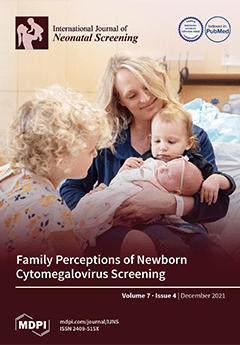
Cover Story: Congenital cytomegalovirus (cCMV) is a common congenital condition that affects not only 6–7 per 1000 infants worldwide, but also their families. Newborn screening for cCMV would allow for early identification and intervention for infants who may have otherwise not been diagnosed. In this issue, a study examines families’ perspectives on newborn cCMV screening and shows families felt positively empowered by knowledge provided by newborn screening for cCMV. The family on the cover is celebrating the birth of their third child, a seemingly healthy baby girl who was not identified at birth as having severe symptomatic cCMV due to the absence of a screening program. (Photo: Courtesy of Megan Pesch, University of Michigan Medical School, and Board of Directors National CMV Foundation) View this paper.
  • Issues are regarded as officially published after their release is announced to the table of contents alert mailing list .
  • You may sign up for email alerts to receive table of contents of newly released issues.
  • PDF is the official format for papers published in both, html and pdf forms. To view the papers in pdf format, click on the "PDF Full-text" link, and use the free Adobe Reader to open them.

Articles (23)

  • Article
  • Open Access
14 Citations
4,646 Views
5 Pages

Newborn Screening Practices for Beta-Thalassemia in the United States

  • Michael A. Bender,
  • Mary Hulihan,
  • Mary Christine Dorley,
  • Maria del Pilar Aguinaga,
  • Jelili Ojodu and
  • Careema Yusuf

Beta-thalassemia, a heritable condition of abnormal hemoglobin production, is not a core condition on the United States Recommended Uniform Screening Panel (RUSP) for state and territorial newborn screening (NBS) programs. However, screening for sick...

  • Technical Note
  • Open Access
7 Citations
3,502 Views
5 Pages

Sensitive and Robust LC-MS/MS Assay to Quantify 25-Hydroxyvitamin D in Leftover Protein Extract from Dried Blood Spots

  • Sanne Grundvad Boelt,
  • Lars Melgaard,
  • Marta Jadwiga Thorbek,
  • Nadia Sara Jensen MacSween,
  • John J. McGrath and
  • Arieh S. Cohen

Neonatal dried blood spots (DBS) provide a remarkable resource for biobanks. These microsamples can provide information related to the genetic correlates of disease and can be used to quantify a range of analytes, such as proteins and small molecules...

  • Article
  • Open Access
3 Citations
5,037 Views
13 Pages

Secondary screening for missed congenital hypothyroidism (CH) has been introduced sporadically, but its necessity and optimal strategy have not been recognized. We hypothesized that a simple clinical protocol (performed by a medical group without a g...

  • Article
  • Open Access
12 Citations
3,578 Views
13 Pages

Family Perceptions of Newborn Cytomegalovirus Screening: A Qualitative Study

  • Michael J. Cannon,
  • Denise M. Levis,
  • Holly McBride,
  • Danie Watson,
  • Carol Rheaume,
  • Mary Ann Kirkconnell Hall,
  • Tatiana M. Lanzieri and
  • Gail Demmler-Harrison

We sought to understand long-term retrospective parental perceptions of the utility of newborn screening in a context where many affected children never develop sequelae but where intensive support services and ongoing healthcare were provided. We co...

  • Article
  • Open Access
4 Citations
4,552 Views
13 Pages

DBS Screening for Glycogen Storage Disease Type 1a: Detection of c.648G>T Mutation in G6PC by Combination of Modified Competitive Oligonucleotide Priming-PCR and Melting Curve Analysis

  • Emma Tabe Eko Niba,
  • Yogik Onky Silvana Wijaya,
  • Hiroyuki Awano,
  • Naoko Taniguchi,
  • Yasuhiro Takeshima,
  • Hisahide Nishio and
  • Masakazu Shinohara

Glycogen storage disease type Ia (GSDIa) is an autosomal recessive disorder caused by glucose-6-phosphatase (G6PC) deficiency. GSDIa causes not only life-threatening hypoglycemia in infancy, but also hepatocellular adenoma as a long-term complication...

  • Article
  • Open Access
7 Citations
5,080 Views
12 Pages

The Alberta Newborn Screening Approach for Sickle Cell Disease: The Advantages of Molecular Testing

  • Janet R. Zhou,
  • Ross Ridsdale,
  • Lauren MacNeil,
  • Margaret Lilley,
  • Stephanie Hoang,
  • Susan Christian,
  • Pamela Blumenschein,
  • Vanessa Wolan,
  • Aisha Bruce and
  • Gurpreet Singh
  • + 4 authors

Sickle cell disease (SCD), a group of inherited red blood cell (RBC) disorders caused by pathogenic variants in the beta-globin gene (HBB), can cause lifelong disabilities and/or early mortality. If diagnosed early, preventative measures significantl...

  • Article
  • Open Access
21 Citations
5,733 Views
15 Pages

Duchenne muscular dystrophy (DMD) is not currently part of mandatory newborn screening, despite the availability of a test since 1975. In the absence of screening, a DMD diagnosis is often not established in patients until 3–6 years of age. Dur...

  • Review
  • Open Access
7 Citations
4,200 Views
8 Pages

In this review, we analyze medical and select ethical aspects of the increasing use of next-generation sequencing (NGS) based tests in newborn medicine. In the last five years, there have been several studies exploring the role of rapid exome sequenc...

  • Article
  • Open Access
6 Citations
7,698 Views
8 Pages

Province-Wide Stool Color Card Screening for Biliary Atresia in Lower-Saxony: Experiences with Passive Distribution Strategies and Results

  • Omid Madadi-Sanjani,
  • Joachim F. Kuebler,
  • Marie Uecker,
  • Eva-Doreen Pfister,
  • Ulrich Baumann,
  • Berit Kunze-Hullmann,
  • Jochen Blaser,
  • Thomas Buck and
  • Claus Petersen

Background: Stool color card (SCC) screenings for biliary atresia (BA) have shown to improve Kasai timing and outcome significantly. Both obligatory and non-obligatory screenings with passive distribution strategies have proven to be effective. There...

of 3

Get Alerted

Add your email address to receive forthcoming issues of this journal.

XFacebookLinkedIn
Int. J. Neonatal Screen. - ISSN 2409-515X